@Article{icces.2022.08673,
AUTHOR = {Daniel Varadaradjou, Hocine Kebir, Jérôme Mespoulet, David Tingaud, Salima
Bouvier, Paul Deconick, Kei Ameyama, Guy Dirras},
TITLE = {High Strain Rate Behavior of Harmonic Structure Designed Pure Nickel: Mechanical Characterization, Microstructure Analysis and Modelisation},
JOURNAL = {The International Conference on Computational \& Experimental Engineering and Sciences},
VOLUME = {24},
YEAR = {2022},
NUMBER = {1},
PAGES = {1--3},
URL = {http://www.techscience.com/icces/v24n1/48971},
ISSN = {1933-2815},
ABSTRACT = {The development of new architecture metallic alloys with controlled microstructures is one of the
strategic ways for designing materials with high innovation potential and, particularly with
improved mechanical properties as required for structural materials [1]. Indeed, unlike
conventional counterparts, metallic materials having so-called harmonic structure displays
strength and ductility synergy. The latter occurs due to a unique microstructure design: a coarse
grain structure surrounded by a 3D continuous network of ultra-fine grain known as “core” and
“shell”, respectively. In the present study, pure harmonic-structured (HS) Nickel samples were
processed via controlled mechanical milling and followed by spark plasma sintering (SPS), detailed
in previous work [2].
In previous studies, the mechanical behavior under quasi-static loading at room temperature has
been evaluated and showed the superior mechanical properties of HS pure Ni over the
homogeneous conventional counterpart [3]. The present work aims at characterizing the
mechanical properties of HS pure Ni under room temperature dynamic loading, through a Split
Hopkinson Pressure Bar (SHPB) test, and the underlying microstructure evolution. A stopper ring
was used to maintain the strain at a fixed value of about 20% (Fig. 1). Five samples (named B1 to
B5) were impacted using different striker bar velocity (V0) from 14 m/s to 28 m/s, yielding strain
rate in the range 4000-7000 s-1. Results were considered until a 10% deformation value, which is
the deformation threshold for the constant strain rate assumption [4].
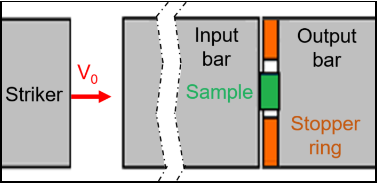
Figure 1: SHPB test mounting with a stopper ring
The evolution flow stress with the strain rate for harmonic and conventional structure (CS) (using
data from quasi-static and high rate experiments) makes it possible to identify two domains with
a transition around 3000 s-1. First domain operating at low deformation rates is conventionally
associated with the thermal activated movement of dislocation, whereas the second domain at high
strain rates is associated with viscous drag.
The non-deformed (INIT), and post-SHPB microstructure (B1 to B5), were investigated by EBSD
(Fig. 2) and show that while strain rate increase, grains size within the core decrease. An in-depth
analysis of grains and grain boundaries were made to highlight the thermal (such as dynamic
recrystallization) or mechanical (such as grains fragmentation by dislocation) contribution within
the “core” and “shell”.

Figure 2: Cross section EBSD map of the initial sample from post-SPS process (INIT)
One of the most widely used methods for determining dynamic behavior of materials is the SHPB
technique developed by Kolsky [6]. A 3D simulation of SHPB test was created through ABAQUS in
dynamic explicit. This 3D simulation allow taking into account all modes of vibration. An inverse
approach was used to identify the material parameters from the equation of Johnson-Cook (JC) by
minimizing the difference between the numerical and experimental data. The JC’s parameters were
identified using B1 and B5 samples configuration. Predictively, identified parameters of JC’s
equation shows good result for the others sample configuration (Fig. 3)
(a)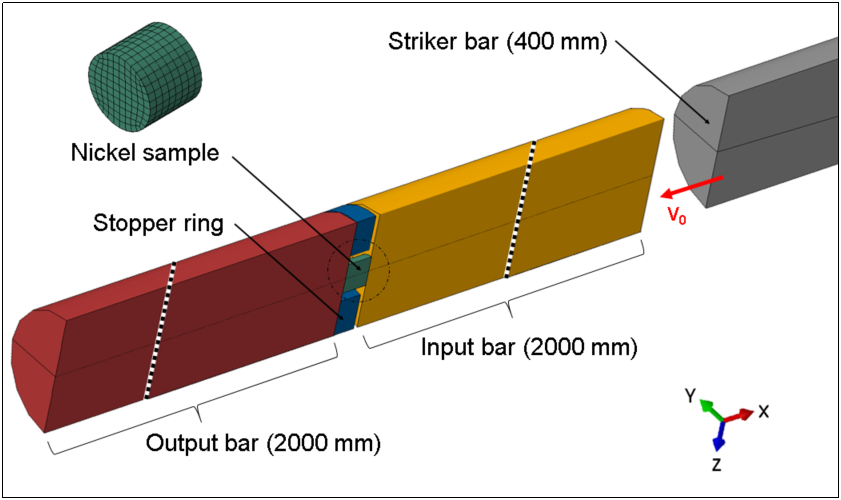
(b)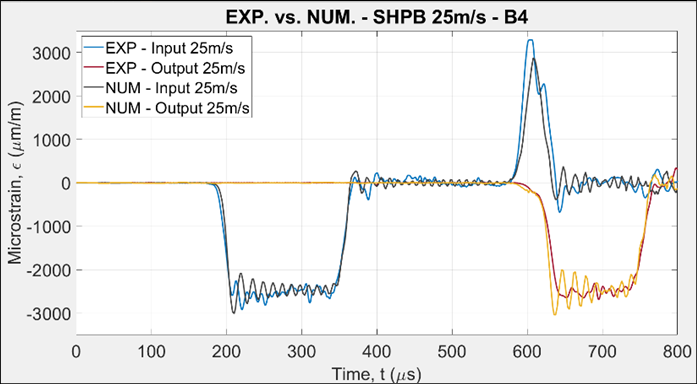
Figure 3: 3D simulation assembly of SHPB test from ABAQUS (a) and output data of SHPB test from experiment and numerical test for the sample B4 (b)
Furthermore, mean rise of temperature within the harmonic Nickel sample can be obtained
through ABAQUS and show an elevation of about 35°C for all fives sample. At this temperature,
thermal mechanism cannot be activated. Therefore, grains fragmentation within the core is mainly
due to mechanical phenomena for a fixed final strain of 20%
},
DOI = {10.32604/icces.2022.08673}
}