@Article{icces.2023.09982,
AUTHOR = {Yan liu, Chuanlong Xu, Xiaobao Tian, Wentao Jiang, Qingyuan Wang, Haidong Fan},
TITLE = {Formation of Stacking Fault Pyramid in Zirconium},
JOURNAL = {The International Conference on Computational \& Experimental Engineering and Sciences},
VOLUME = {25},
YEAR = {2023},
NUMBER = {2},
PAGES = {1--1},
URL = {http://www.techscience.com/icces/v25n2/53835},
ISSN = {1933-2815},
ABSTRACT = {Zirconium alloys were widely used as fuel cladding in nuclear reactors. Stacking fault pyramid (SFP) is an
irradiation-induced defect in zirconium. In this work, the formation process of SFP from a hexagonal vacancy
plate on basal plane is studied by molecular dynamics (MD) simulations. The results show that, during the
SFP formation from a basal vacancy plate, the 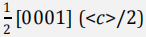 dislocation is firstly dissociated into two
partial dislocations
dislocation is firstly dissociated into two
partial dislocations  and
and  . The former one resides on the basal plane, while the latter one
glides on the first-order pyramidal plane. The partials on adjacent pyramidal planes react further and form
a partial dislocation on the pyramidal edge, i.e.
. The former one resides on the basal plane, while the latter one
glides on the first-order pyramidal plane. The partials on adjacent pyramidal planes react further and form
a partial dislocation on the pyramidal edge, i.e.  . A critical edge length of the
initial vacancy plate is observed, below which perfect SFP is formed while above which truncated SFP is
formed. The critical edge length increases with the increasing temperature. Under a compressive stress, the
SFP collapses into an <c>/2 dislocation loop and then becomes a faulted loop. Under shear stress, the
formation of SFP is facilitated, i.e. the critical edge length increases with the increasing shear stress. The
current work is useful for understanding the irradiation effects in zirconium alloys.},
DOI = {10.32604/icces.2023.09982}
}
. A critical edge length of the
initial vacancy plate is observed, below which perfect SFP is formed while above which truncated SFP is
formed. The critical edge length increases with the increasing temperature. Under a compressive stress, the
SFP collapses into an <c>/2 dislocation loop and then becomes a faulted loop. Under shear stress, the
formation of SFP is facilitated, i.e. the critical edge length increases with the increasing shear stress. The
current work is useful for understanding the irradiation effects in zirconium alloys.},
DOI = {10.32604/icces.2023.09982}
}