@Article{icces.2023.010481,
AUTHOR = {Y. F. Yin, X. J. Zhang, Y. X. Lin},
TITLE = {Effects of Alignment and Dislocation on the Impact Mechanical Response of Tandem Nomex Honeycomb},
JOURNAL = {The International Conference on Computational \& Experimental Engineering and Sciences},
VOLUME = {28},
YEAR = {2023},
NUMBER = {1},
PAGES = {1--4},
URL = {http://www.techscience.com/icces/v28n1/55226},
ISSN = {1933-2815},
ABSTRACT = {1 Introduction
Nomex honeycomb is widely used in aerospace field due to its formability and impact resistance.
Tandem honeycomb structure is favored for its excellent energy absorption and controllable deformation
sequence [1]. Because impact damage is inevitable in the use of sandwich structures, it is necessary to
analyze the impact mechanical response of such structures. The research objects include single honeycomb
and two layers align honeycomb. First, the drop weight impact test was carried out to compare the
mechanical response of double-layer aligned and staggered honeycomb with that of single honeycomb. Then
finite element method was used to simulate the experiment and results were compared.
2 Experimental methods
2.1 Test article
Two panels of the test article were composed of epoxy resin and glass fiber, with glass fiber ±45°
layered. The size was 110×110mm, the thickness of one panel was 0.25mm. The core adopted regular
hexagonal Nomex honeycomb with nominal density of 48 kg/m3, relative density of 0.042, and the side
length of the honeycomb lattice was 1.85mm. The wall thickness of the monolayer was 0.05 mm. For the
single honeycomb shown in Fig.1, the height of the core was 19.6mm. For two layers align honeycomb shown
in Fig.2, high strength adhesive was used to bond two layers of 9.3mm honeycomb core and Membrane
interlayer.
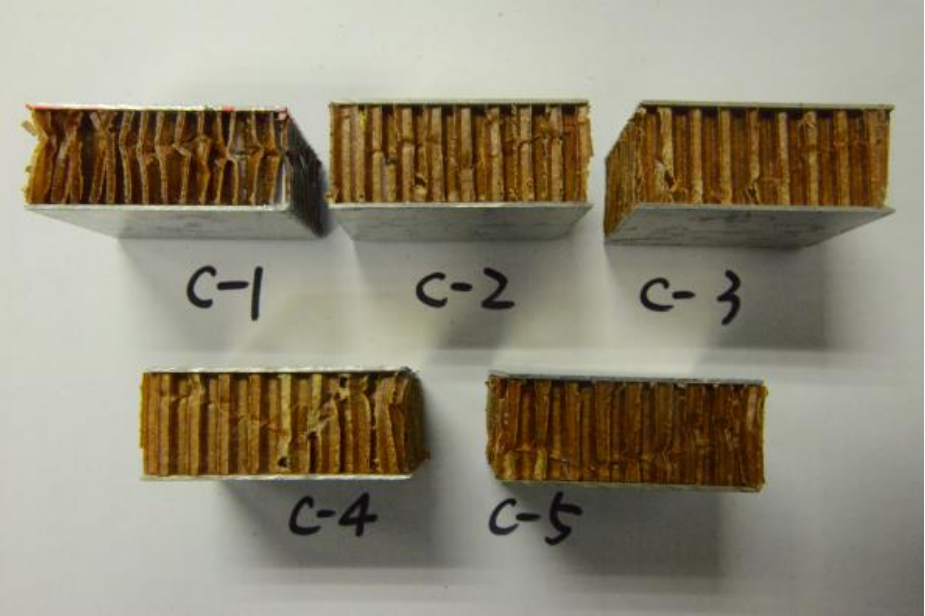
Figure 1: Single honeycomb samples
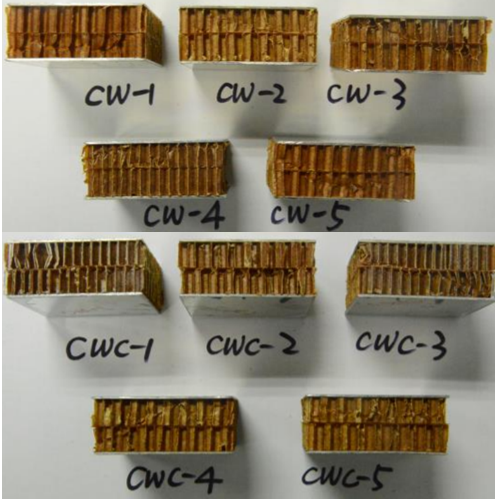
Figure 2: Two layers align honeycomb samples
2.2 Experimental methods
The experiment was carried out on the instrument INSTRON CEAST 9350 drop weight impact
according to experimental standard ASTM-D3763. The mass of the impactor was 2.131kg. The test article
was clamped by an annular standard fixture, then different energy levels were used to impact the test
article, and the corresponding results were obtained.
3 Finite element model
Using Abaqus software to establish the finite models for two types of honeycomb structures, shown in
Fig.3. Panels and honeycomb core were defined as C3D8R element. Equivalent modeling method was
dopted for the core: the compressibility curve of honeycomb core obtained from the test was imported into
the model as an elastoplastic constitutive relation. The impact was defined as a rigid body, The element type
was R3D4. And Surface-to-Surface contact was used between the impact and panel as well as panel and
honeycomb core. The remaining contact, including the self-contact of all components were defined as the
general contact. The rest of the modules, such as material properties, fixed model and impact energy, were
endowed according to the physical truth. Meanwhile, meshes of the contact part between the center of the
panel and the impactor were refined and the hourglass values of the elements were added to make the
calculation more stable.
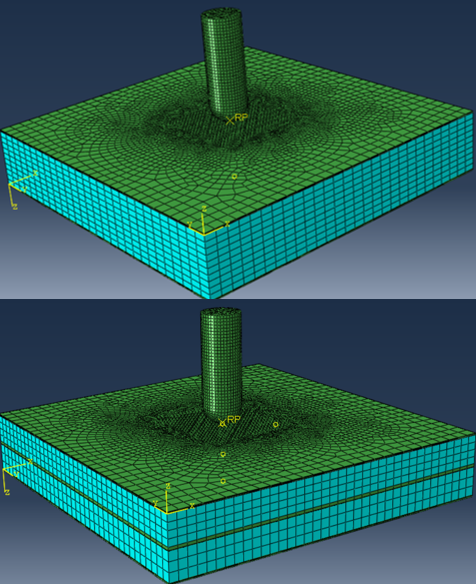
Figure 3: Finite element model
4 Analysis
4.1 Experimental results
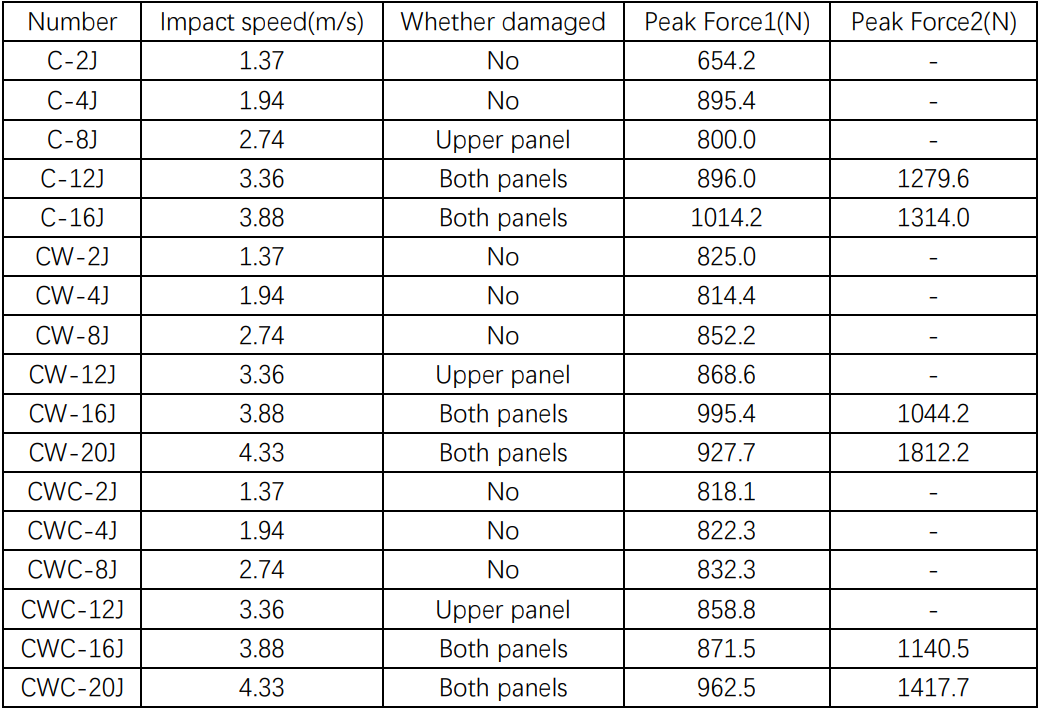
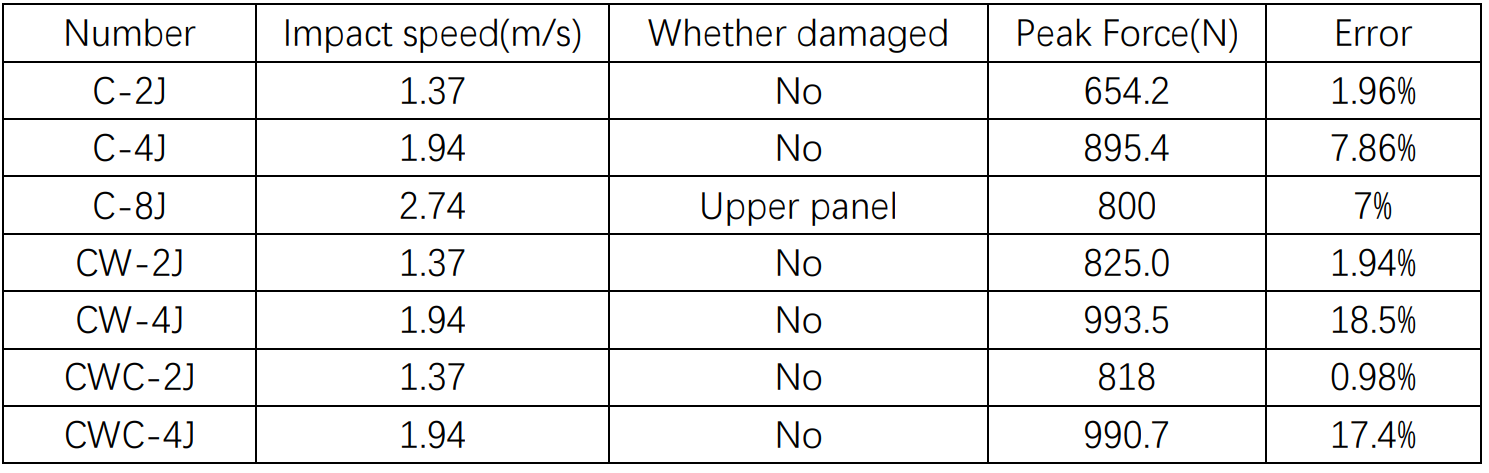
As shown in table.1, The group C was the single honeycomb samples, group CW and group CWC were
the two layers align honeycomb samples. With the increment of the impact speed, the peak force on the
panel was also increasing. When the impactor breaked through the upper panel, it continued impacting
the honeycomb core until it reached the down panel,then the impact force reached the second peak and
was greater than the first one. Moreover, two layers align honeycomb samples had better impact
impedance performance.
Table 1: Experiment results
4.2 Finite element simulation results
It takes quite a lot of time to accomplish the Explicit Dynamic Analysis in ABAQUS, so limited results
were used to compare with the experiments. As shown in Table.2, the finite element results are in good
agreement with the experimental results.
Table 2: Finite element simulation results and error
5 Conclusion and follow-up work
Two layers align honeycomb samples have better impact impedance performance compared with the
single honeycomb samples. Meanwhile, the finite element model simulation work still needs to be carried
out to get more data to verify the experiment.
},
DOI = {10.32604/icces.2023.010481}
}