TY - EJOU
AU - Sun, Justin E. Ka Ip
AU - Fu, Lin
TI - Universality of the Inner-Outer Interaction Model and Its Connections to the Attached-Eddy Hypothesis
T2 - The International Conference on Computational \& Experimental Engineering and Sciences
PY - 2025
VL - 34
IS - 1
SN - 1933-2815
AB - The inner-outer interaction model (IOIM), first proposed by Marusic et al. [1], based on the amplitude modulation mechanism, has proven to be a successful turbulence model for canonical and non-canonical flows, where a reference velocity signal from the logarithmic region acts as the input for predicting near-wall velocity fluctuations below the reference location. Its most recent iteration by Baars et al. [2] further proposes a user-independent scale separation point, refining model parameters. The IOIM model has been used extensively in various applications, where its framework and amplitude modulation mechanism have been validated in other types of turbulent flows other than canonical wall-bounded flows, such as free-stream turbulence, turbulent flows with different wall conditions, and different driving pressures. Yet, a holistic study on the universality of the framework across incompressible and compressible flow, which is vital for understanding the differences between the flow regimes and for future modelling, has not been conducted.
In this study, we compared the IOIM’s parameters, including the linear transfer kernel, amplitude modulation coefficients, and the universal signal for a range of Reynolds and Mach numbers (140≤Reτ≤2003 , 0.8≤Mab≤3), where mathematical relationships between the parameters are quantified. We observed that while the universal signal is indeed universal, the amplitude modulation coefficients (Γ) and linear transfer kernels ( ) display Reynolds and Mach number effects, where varying the reference location also causes Γ and to exhibit significant changes. These quantitative variations of the parameters correspond well to the physical structures from the attached eddy hypothesis (AEH), consistent with previous studies for incompressible flow [3], where we find that the IOIM represents the balance between the effects of the attached and detached eddies at different locations. As the prediction signal nears the wall, the decreasing large-scale coherence between the reference and the prediction signal, due to the differing physical structures experienced at their respective locations, is compensated for by the amplitude modulation coefficients, representing the increased population of the smaller-scale attached eddies, while the near-wall viscous detached eddies are captured by the universal signal.
With this physical perspective in mind, we have found transformations to collapse Γ profiles for incompressible flows and differing reference locations, further asserting the profound robustness of the IOIM framework and its connections to the AEH, despite the differences in model parameters and flow settings.
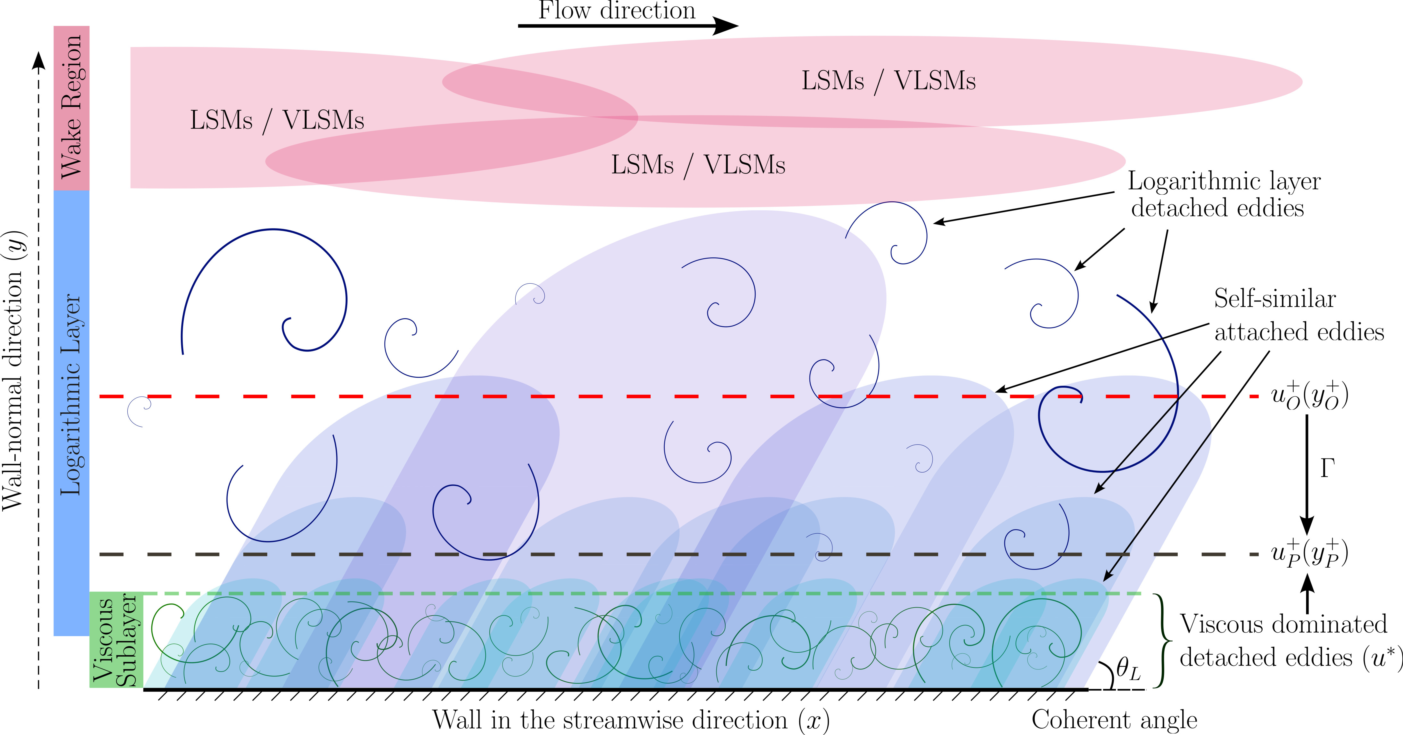
Figure 1: An illustration of the turbulent structures within wall-bounded turbulence based on the AEH, not to physical scale. The red dashed line indicates the reference layer within the IOIM framework, where the know velocity  lies. Large-Scale Motions / Very Large-Motions (LSMs / VLSMs) are shown to be detached from the wall for illustration purposes, but they may extend well into the logarithmic layer and influence the near-wall region. The known velocity signal is then used to predict
  for
for  based on Γ and the universal signal, u∗.
KW - Turbulence modelling; turbulent boundary layers; boundary layer structure; compressible boundary layers
DO - 10.32604/icces.2025.011859
based on Γ and the universal signal, u∗.
KW - Turbulence modelling; turbulent boundary layers; boundary layer structure; compressible boundary layers
DO - 10.32604/icces.2025.011859