
 Login
Login Register
 Submit a Paper
 Propose a Special lssue
 Open Access
ARTICLE

CFD Modeling to Evaluate User Safety by Using Flame Retardants in Asphalt Road Pavements during Large Tunnel Fires
Department of Civil Engineering, University of Salerno, via Giovanni Paolo II, 132, Fisciano, 84084, Salerno, Italy
* Corresponding Author: Isidoro Russo. Email:
Computer Modeling in Engineering & Sciences 2025, 144(1), 693-715. https://doi.org/10.32604/cmes.2025.068123
Received 21 May 2025; Accepted 03 July 2025; Issue published 31 July 2025
 View Full Text
 Download PDF
Abstract
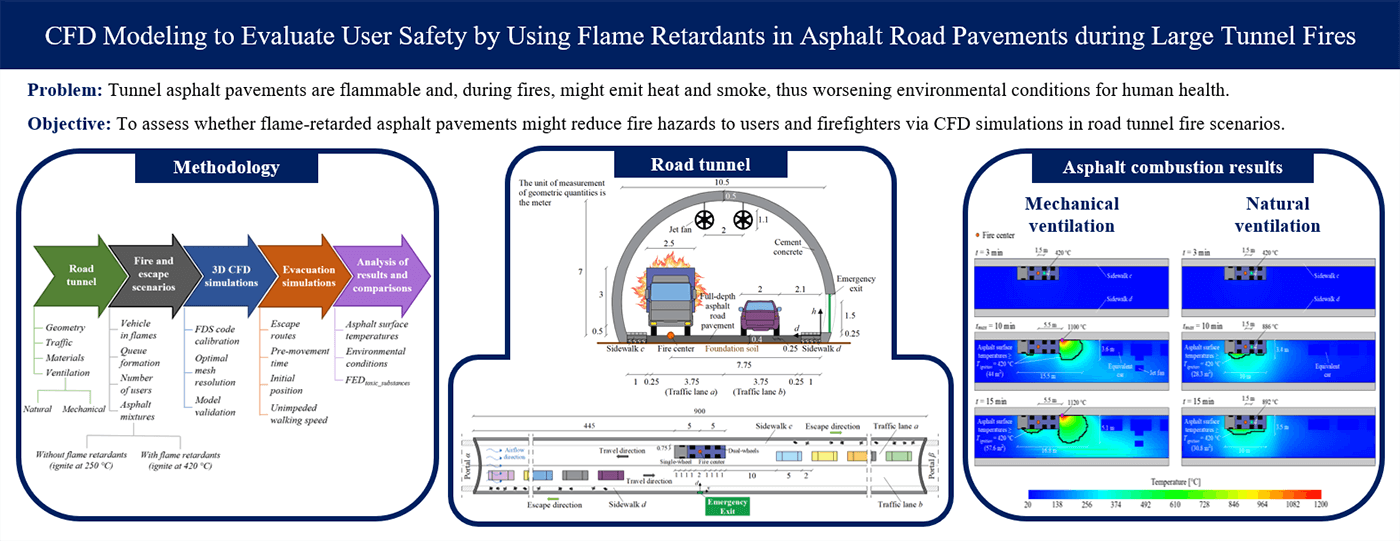
Road pavements in tunnels are usually made of asphalt mixtures, which, unfortunately, are flammable materials. Hence, this type of pavement could release heat, and more specifically smoke, in the event of a tunnel fire, thereby worsening the environmental conditions for human health. Extensive research has been conducted in recent years to enhance the fire reaction of traditional asphalt mixtures for the road pavements used in tunnels. The addition of the Flame Retardants (FRs) in conventional asphalt mixtures appears to be promising. Nevertheless, the potential effects of the FRs in terms of the reduction in consequences on tunnel users in the event of a large fire do not seem to have been sufficiently investigated by using fluid dynamics analysis as a computational tool. Given this gap of knowledge, this article aims to quantitatively evaluate whether the use of flame-retarded asphalt mixtures, as opposed to traditional ones without FRs, might mitigate the adverse effects on the safety of evacuees and fire brigade by performing numerical analyses in the case of a tunnel fire. To achieve this goal, 3D Computational Fluid Dynamics (CFD) models, which were executed using the Fire Dynamics Simulator (FDS) tool, were established in the case of a major fire of a Heavy Goods Vehicle (HGV) characterized by a maximum Heat Release Rate (HRRmax) of 100 MW. The people evacuation process was also simulated, and the Evac tool was used. Compared to the traditional asphalt pavements without FRs, the simulation findings indicated that the addition of the FRs causes a reduction in CO and CO2 levels in the tunnel during the aforementioned fire, with a minor number of evacuees being exposed to the risk of incapacity to self-evacuate, as well as certain safety benefits for the operability of the firefighters entering the tunnel downstream of the fire when the tunnel is naturally ventilated.Graphic Abstract
Keywords
Asphalt pavement combustion; flame retardants; road tunnel fire; CFD modeling; user safety; operability of fire brigade
Cite This Article
APA Style
Caliendo, C., Russo, I., Genovese, G. (2025). CFD Modeling to Evaluate User Safety by Using Flame Retardants in Asphalt Road Pavements during Large Tunnel Fires. Computer Modeling in Engineering & Sciences, 144(1), 693–715. https://doi.org/10.32604/cmes.2025.068123
Vancouver Style
Caliendo C, Russo I, Genovese G. CFD Modeling to Evaluate User Safety by Using Flame Retardants in Asphalt Road Pavements during Large Tunnel Fires. Comput Model Eng Sci. 2025;144(1):693–715. https://doi.org/10.32604/cmes.2025.068123
IEEE Style
C. Caliendo, I. Russo, and G. Genovese, “CFD Modeling to Evaluate User Safety by Using Flame Retardants in Asphalt Road Pavements during Large Tunnel Fires,” Comput. Model. Eng. Sci., vol. 144, no. 1, pp. 693–715, 2025. https://doi.org/10.32604/cmes.2025.068123
 Copyright © 2025 The Author(s). Published by Tech Science Press.
This work is licensed under a Creative Commons Attribution 4.0 International License , which permits unrestricted use, distribution, and reproduction in any medium, provided the original work is properly cited.
 Downloads
 Citation Tools
