
 Login
Login Register
 Submit a Paper
 Propose a Special lssue
 Open Access
ARTICLE

Analytical Modeling of Transcoding Artifacts for Detecting SIMBox-Routed Calls
1 Graduate School of Information, Yonsei University, Seoul, Republic of Korea
2 Graduate School of Information Security, Korea University, Seoul, Republic of Korea
3 School of AI Software, Soongsil University, Seoul, Republic of Korea
* Corresponding Authors: Kyungho Joo. Email: ; Hyojin Jo. Email:
(This article belongs to the Special Issue: Advanced Security and Privacy for Future Mobile Internet and Convergence Applications: A Computer Modeling Approach)
Computer Modeling in Engineering & Sciences 2026, 148(1), 53 https://doi.org/10.32604/cmes.2026.083948
Received 14 April 2026; Accepted 15 June 2026; Issue published 27 July 2026
 View Full Text
 Download PDF
Abstract
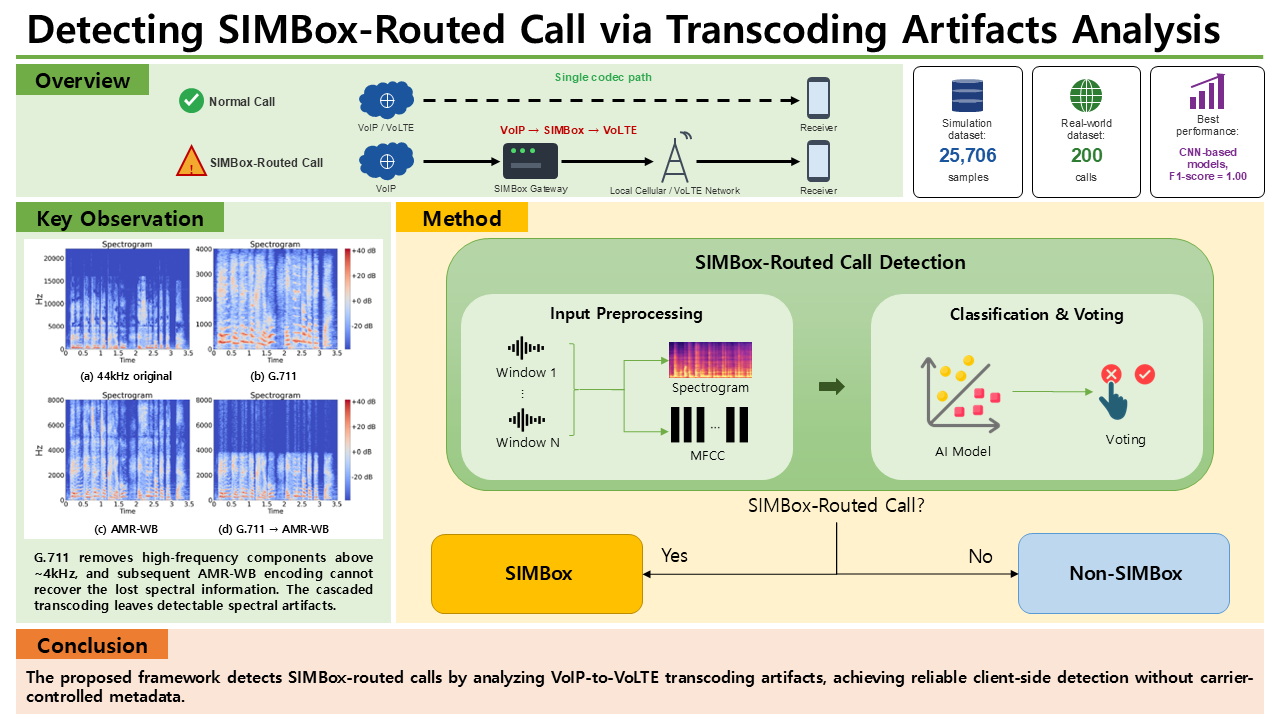
As mobile networks evolve toward next-generation architectures in which cellular and IP-based voice services are increasingly converged, SIMBox-based call routing has emerged as an important issue in modern telecommunication networks. By converting Voice over IP (VoIP) traffic into local cellular calls, SIMBox appliances allow IP-originated calls to appear as domestic cellular calls. Although SIMBox usage is not inherently fraudulent, detecting SIMBox-routed calls is important for identifying abnormal call-routing behavior and supporting network-side and client-side security applications. In this paper, we propose a client-side framework for SIMBox-routed call detection. Calls routed through SIMBox infrastructure are identified by exploiting acoustic artifacts introduced by VoIP-to-VoLTE codec transcoding. Variable-length call recordings are segmented into fixed-duration windows and analyzed using supervised classifiers to capture spectral patterns associated with transcoding operations. Unlike network-side SIMBox detection methods that rely on carrier-controlled metadata such as call detail records, subscriber identifiers, or cell-location patterns, our approach focuses on acoustic evidence observable from the call audio itself. We evaluate the proposed framework using two datasets: 25,706 codec-processed voice samples generated from 12,853 source recordings with the ITU-T G.191 Software Tool, and 200 real-world call samples collected through a commercial SIMBox platform (DINSTAR UC2000-VE) under realistic call-routing conditions. Among five evaluated models, the CNN-based classifiers achieve the best performance, reaching an F1-score of 1.00. These results show that audio-level codec artifacts can serve as reliable indicators for detecting SIMBox-routed voice calls at the client side, and offer a promising direction for securing converged voice services in 5G and beyond.Graphic Abstract
Keywords
Cite This Article
 Copyright © 2026 The Author(s). Published by Tech Science Press.
This work is licensed under a Creative Commons Attribution 4.0 International License , which permits unrestricted use, distribution, and reproduction in any medium, provided the original work is properly cited.
 Downloads
 Citation Tools
