
 Login
Login Register
 Submit a Paper
 Propose a Special lssue
 Open Access
REVIEW
Contemporary Management of Failing Modified Fontan after the Total Cavopulmonary Connection
Department of Cardiovascular Surgery, Chinese Academy of Medical Sciences and Peking Union Medical College, National Center for Cardiovascular Diseases, Fuwai Hospital, Beijing, 100037, China
* Corresponding Author: Shoujun Li. Email:
# These authors contributed equally to this work
(This article belongs to the Special Issue: Novel Methods and Techniques for the Management of Congenital Heart Disease)
Congenital Heart Disease 2025, 20(3), 287-303. https://doi.org/10.32604/chd.2025.067619
Received 08 May 2025; Accepted 27 June 2025; Issue published 11 July 2025
 View Full Text
 Download PDF
Abstract
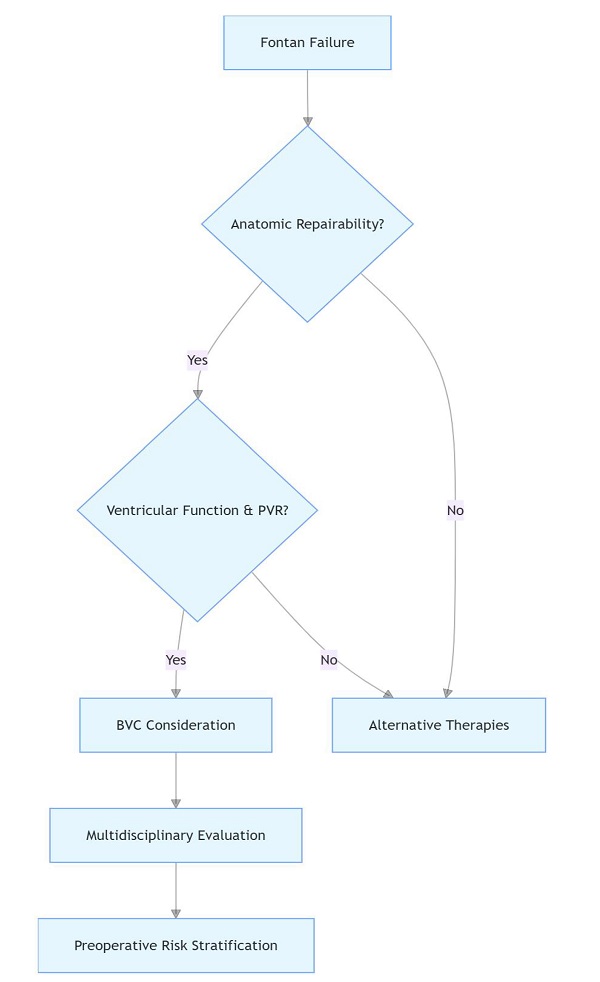
Congenital heart disease (CHD) stands as the most common cardiovascular disorder among children, exerting a profound impact on the growth, development, and quality of life of the affected pediatric population. The modified Fontan procedure, the total cavopulmonary connection (TCPC), has become a pivotal palliative or definitive surgical method for treating complex CHD cases, including single ventricle and tricuspid valve atresia. Through staged surgical processes, this technique directly diverts vena cava blood into the pulmonary artery, thus improving the patient’s oxygenation status. Despite the initial success of the Fontan circulation in providing a means for survival in patients with complex CHD, a significant proportion of patients will eventually experience Fontan failure. Fontan failure is a complex syndrome characterized by a constellation of symptoms and signs, including heart failure, arrhythmia, protein-losing enteropathy, and plastic bronchitis. Understanding the contemporary management of failing modified Fontan after TCPC is crucial for optimizing patient outcomes, as the number of adult patients with Fontan circulation continues to grow due to improved surgical techniques and postoperative care.Graphic Abstract
Keywords
Cite This Article
 Copyright © 2025 The Author(s). Published by Tech Science Press.
This work is licensed under a Creative Commons Attribution 4.0 International License , which permits unrestricted use, distribution, and reproduction in any medium, provided the original work is properly cited.
 Downloads
 Citation Tools
