
 Login
Login Register
 Submit a Paper
 Open Access
PROCEEDINGS

Boundary Penalty Method based Acoustic–Structural Coupled Topology Optimization
1 School of Aerospace Engineering, Tsinghua University, Beijing, 100084, China
2 School of Engineering and Materials Science, Queen Mary University of London, London, E1 4NS, UK
* Corresponding Author: Jianbin Du. Email:
The International Conference on Computational & Experimental Engineering and Sciences 2025, 33(4), 1-2. https://doi.org/10.32604/icces.2025.011595
 Download PDF
Abstract
Currently, the application of the Boundary Penalty (BP) method in acoustic-structural coupled multiphysics optimization problems remains unexplored. Within the theoretical framework of BP developed previously, we address acoustic-structural coupled topology optimization problems by proposing a BP-based acoustic-structural coupled topology optimization model. A systematic solution strategy is developed to tackle the challenges encountered during model solving.The proposed model employs a mixed u/p formulation for finite element analysis and the adjoint method for sensitivity analysis to minimize the acoustic pressure within a specified region (Fig.1 A). During optimization iterations, issues such as topological discretization and iteration oscillations arise. Through an in-depth mechanism analysis, it is found that the acoustic-structural coupled topology optimization problem exhibits strong non-convexity. Additionally, the significant difference in bulk modulus between weak materials (e.g., air) and solid materials during material interpolation exacerbates the ill-conditioned nature of the problem, leading to highly unstable computations and a high likelihood of converging to local optima.
Based on the above analysis, improvements are made to the boundary penalty method for acoustic-structural coupled multiphysics optimization problems. A comprehensive optimization strategy is proposed, combining sensitivity filtering, weak material handling, and adaptive iteration control. Through weak material handling, the absolute magnitude of sensitivity extremes is reduced, while sensitivity filtering alleviates the relative differences in sensitivity between neighboring elements at structural boundaries. This approach achieves stable iterations (Fig.1 B), well-defined topological morphologies, and smooth boundaries in the optimized results (Fig.1 C), and extends the applicability of the BP method to complex multiphysics problems. The corresponding sound pressure level distribution is shown in Fig. 1 D.
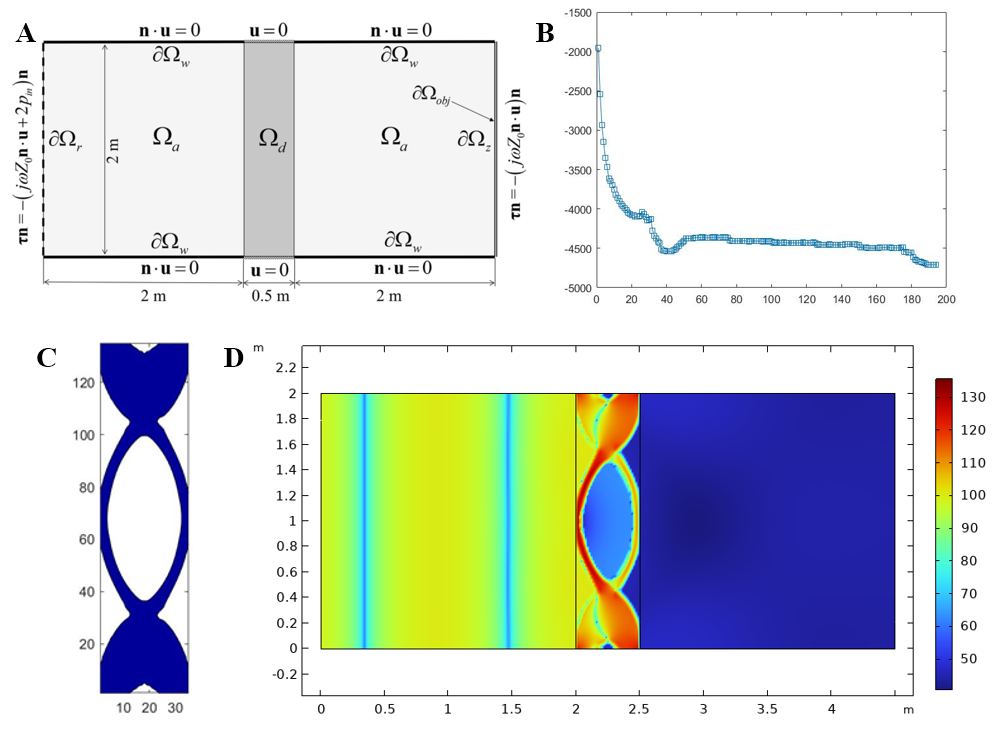
Figure 1: A. Case of acoustic-structural coupled optimization problem: Ωa represents the acoustic domain, Ωd represents the design domain, the left end face is subjected to plane wave radiation, the upper and lower boundaries are acoustic rigid wall conditions, with the optimization objective of minimizing the sound pressure at the right end face. B. Iteration curve of the objective function. C. Optimization result obtained in this work. D. Sound pressure level distribution of the obtained topology result.
Keywords
Topology optimization; acoustic–structure interaction; boundary penalty method; mixed u/p formulation
Cite This Article
APA Style
Liu, T., Liu, Y., Du, J. (2025). Boundary Penalty Method based Acoustic–Structural Coupled Topology Optimization. The International Conference on Computational & Experimental Engineering and Sciences, 33(4), 1–2. https://doi.org/10.32604/icces.2025.011595
Vancouver Style
Liu T, Liu Y, Du J. Boundary Penalty Method based Acoustic–Structural Coupled Topology Optimization. Int Conf Comput Exp Eng Sciences. 2025;33(4):1–2. https://doi.org/10.32604/icces.2025.011595
IEEE Style
T. Liu, Y. Liu, and J. Du, “Boundary Penalty Method based Acoustic–Structural Coupled Topology Optimization,” Int. Conf. Comput. Exp. Eng. Sciences, vol. 33, no. 4, pp. 1–2, 2025. https://doi.org/10.32604/icces.2025.011595
 Copyright © 2025 The Author(s). Published by Tech Science Press.
This work is licensed under a Creative Commons Attribution 4.0 International License , which permits unrestricted use, distribution, and reproduction in any medium, provided the original work is properly cited.
 Downloads
 Citation Tools
