
 Login
Login Register
 Submit a Paper
 Propose a Special lssue
 Open Access
ARTICLE

A Robust Hybrid Solution for Pull-in Instability of FG Nano Electro-Mechanical Switches Based on Surface Elasticity Theory
Department of Mechanical Engineering, Amirkabir University of Technology (Tehran Polytechnic), Hafez Ave, Tehran, 158754413, Iran
* Corresponding Author: Mohammad Mohammadi Aghdam. Email:
Computer Modeling in Engineering & Sciences 2025, 143(3), 2811-2832. https://doi.org/10.32604/cmes.2025.065318
Received 10 March 2025; Accepted 16 May 2025; Issue published 30 June 2025
 View Full Text
 Download PDF
Abstract
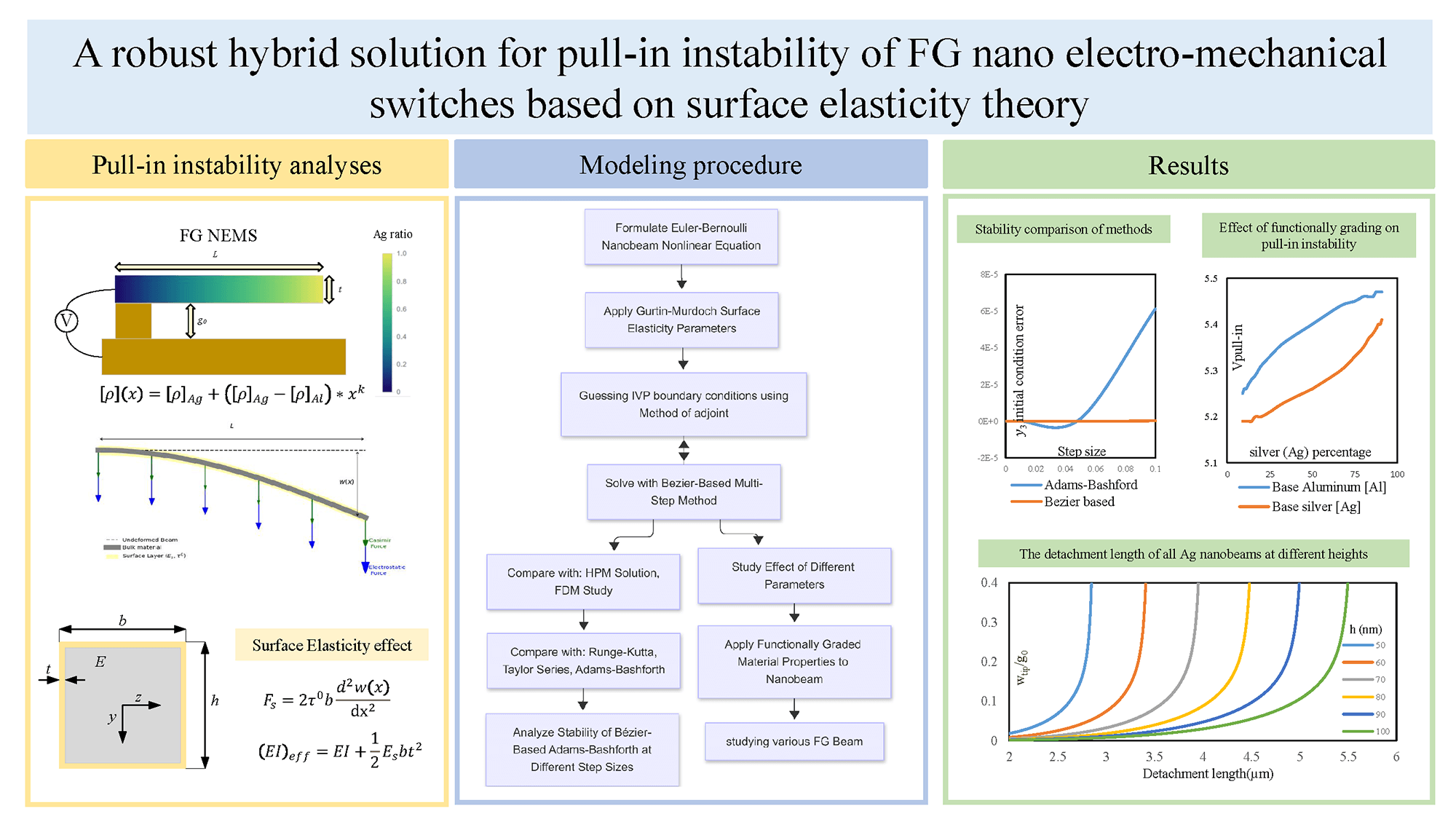
The precise computation of nanoelectromechanical switches’ (NEMS) multi-physical interactions requires advanced numerical models and is a crucial part of the development of micro- and nano-systems. This paper presents a novel compound numerical method to study the instability of a functionally graded (FG) beam-type NEMS, considering surface elasticity effects as stated by Gurtin-Murdoch theory in an Euler-Bernoulli beam. The presented method is based on a combination of the Method of Adjoints (MoA) together with the Bézier-based multi-step technique. By utilizing the MoA, a boundary value problem (BVP) is turned into an initial value problem (IVP). The resulting IVP is then solved by employing a cost-efficient multi-step process. It is demonstrated that the mentioned method can arrive at a high level of accuracy. Furthermore, it is revealed that the stability of the presented methodology is far better than that of other common multi-step methods, such as Adams-Bashforth, particularly at higher step sizes. Finally, the effects of axially functionally graded (FG) properties on the pull-in phenomenon and the main design parameters of NEMS, including the detachment length, are inspected. It was shown that the main parameter of design is the modulus of elasticity of the material, as Silver (Ag), which had better mechanical properties, showed almost a 6% improvement compared to aluminum (Al). However, by applying the correct amount of material with sturdier surface parameters, such as Aluminum (Al), at certain points, the nanobeams’ functionality can be improved even further by around 1.5%.Graphic Abstract
Keywords
Nano electro-mechanical switches; pull-in instability; surface elasticity theory; method of Adjoints; Bezier multi-step method
Cite This Article
APA Style
Mirzaei, V., Bameri, M., Moradweysi, P., Aghdam, M.M. (2025). A Robust Hybrid Solution for Pull-in Instability of FG Nano Electro-Mechanical Switches Based on Surface Elasticity Theory. Computer Modeling in Engineering & Sciences, 143(3), 2811–2832. https://doi.org/10.32604/cmes.2025.065318
Vancouver Style
Mirzaei V, Bameri M, Moradweysi P, Aghdam MM. A Robust Hybrid Solution for Pull-in Instability of FG Nano Electro-Mechanical Switches Based on Surface Elasticity Theory. Comput Model Eng Sci. 2025;143(3):2811–2832. https://doi.org/10.32604/cmes.2025.065318
IEEE Style
V. Mirzaei, M. Bameri, P. Moradweysi, and M. M. Aghdam, “A Robust Hybrid Solution for Pull-in Instability of FG Nano Electro-Mechanical Switches Based on Surface Elasticity Theory,” Comput. Model. Eng. Sci., vol. 143, no. 3, pp. 2811–2832, 2025. https://doi.org/10.32604/cmes.2025.065318
 Copyright © 2025 The Author(s). Published by Tech Science Press.
This work is licensed under a Creative Commons Attribution 4.0 International License , which permits unrestricted use, distribution, and reproduction in any medium, provided the original work is properly cited.
 Downloads
 Citation Tools
