
 Login
Login Register
 Submit a Paper
 Propose a Special lssue
 Open Access
ARTICLE

Incorporating Fully Fuzzy Logic in Multi-Objective Transshipment Problems: A Study of Alternative Path Selection Using LR Flat Fuzzy Numbers
1 Department of Mathematics, School of Sciences, JECRC University, Jaipur, 303905, India
2 Department of Machining, Assembly and Engineering Metrology, Faculty of Mechanical Engineering, VSB-Technical University of Ostrava, Ostrava, 70800, Czech Republic
3 Department of Mathematics, College of Science, King Saud University, P.O. Box 22452, Riyadh, 11495, Saudi Arabia
4 Department of Mechanical Engineering, School of Core Engineering, Faculty of Science, Technology & Architecture, Manipal University, Jaipur, 303007, India
5 Department of Biosciences, Saveetha School of Engineering, Saveetha Institute of Medical and Technical Sciences, Chennai, 602105, India
6 Division of Research and Development, Lovely Professional University, Phagwara, 144411, India
* Corresponding Author: Ajay Kumar. Email:
(This article belongs to the Special Issue: Algorithms, Models, and Applications of Fuzzy Optimization and Decision Making)
Computer Modeling in Engineering & Sciences 2025, 144(1), 969-1011. https://doi.org/10.32604/cmes.2025.063996
Received 31 January 2025; Accepted 26 June 2025; Issue published 31 July 2025
 View Full Text
 Download PDF
Abstract
In a world where supply chains are increasingly complex and unpredictable, finding the optimal way to move goods through transshipment networks is more important and challenging than ever. In addition to addressing the complexity of transportation costs and demand, this study presents a novel method that offers flexible routing alternatives to manage these complexities. When real-world variables such as fluctuating costs, variable capacity, and unpredictable demand are considered, traditional transshipment models often prove inadequate. To overcome these challenges, we propose an innovative fully fuzzy-based framework using LR flat fuzzy numbers. This framework allows for more adaptable and flexible decision-making in multi-objective transshipment situations by effectively capturing uncertain parameters. To overcome these challenges, we develop an innovative, fully fuzzy-based framework using LR flat fuzzy numbers to effectively capture uncertainty in key parameters, offering more flexible and adaptive decision-making in multi-objective transshipment problems. The proposed model also presents alternative route options, giving decision-makers a range of choices to satisfy multiple requirements, including reducing costs, improving service quality, and expediting delivery. Through extensive numerical experiments, we demonstrate that the model can achieve greater adaptability, efficiency, and flexibility than standard approaches. This multi-path structure provides additional flexibility to adapt to dynamic network conditions. Using ranking strategies, we compared our multi-objective transshipment model with existing methods. The results indicate that, while traditional methods such as goal and fuzzy programming generate results close to the anti-ideal value, thus reducing their efficiency, our model produces solutions close to the ideal value, thereby facilitating better decision making. By combining dynamic routing alternatives with a fully fuzzy-based approach, this study offers an effective tool to improve decision-making and optimize complex networks under real-world conditions in practical settings. In this paper, we utilize LINGO 18 software to solve the provided numerical example, demonstrating the effectiveness of the proposed method.Keywords
The key subjects relevant to this article are thoroughly discussed in this section. We provide concise explanations and definitions of essential terminology as we examine basic concepts in detail. Furthermore, we assess the core principles underlying these subjects, emphasizing their significance and implications. This in-depth analysis aims to provide a comprehensive understanding and establish a framework for the discussions in subsequent sections.
The transshipment problem (TSP) is a type of network circulation problem that extends the traditional transportation problem (TP) by enabling the transit of commodities through intermediary nodes, known as transshipment points, in addition to the usual supply and demand routes. The goal is to determine the most cost-effective method to transport items between various locations, such as warehouses, distribution centres, or hubs, while adhering to supply and demand constraints. The TSP plays a crucial role in optimizing logistics, transportation planning, and resource allocation across networks in sectors like industry, retail, and emergency relief operations.
Unlike the basic TP, which is confined to delivering goods directly from suppliers to demand sites, the TSP allows for intermediary nodes where items can be rerouted, consolidated, or temporarily stored. These transshipment points provide greater system flexibility by enabling goods to move along several routes, potentially reducing costs, expediting deliveries, and enhancing the overall efficiency of the network.
Detailed Characteristics of the TSP (shown in Fig. 1):

Figure 1: Characteristics of the transshipment problem
• Supply Points: These are nodes within the network, such as factories, warehouses or production centres, where items are initially available. Each supply point has a maximum capacity for the commodities it can provide.
• Demand Points: These are locations, including end users, retailers, or consumers, where goods are required. Each demand point has a specific demand that must be fulfilled.
• Intermediate Nodes (Transshipment Points): Before products reach their final destination, they may be temporarily stored, rerouted, or collected at these intermediary nodes. Unlike simpler models, the TSP allows goods to transit through intermediary locations between supply and demand centres. While these add complexity to the optimization problem, these points provide additional flexibility to the network. Flexibility can aid routing optimization by avoiding expensive or congested direct routes and enabling more efficient transportation strategies.
• Dynamic Networks: Transportation networks in the real world often face sudden changes. For example, route closures, fluctuating transportation costs, or demand may explode. The TSP provides flexible routing solutions by modelling these dynamic networks to address such challenges.
• Multiple Objectives: While the primary goal of the TSP is typically to minimize total transportation costs, multi-objective variants of the problem may also consider factors such as service levels, environmental impacts, delivery schedules, and risks of delay. In certain cases, maximizing service quality or finding an optimal balance between competing goals is essential. Finding solutions to the multi-objective TSP that balance these trade-offs often requires complex optimization strategies. Managing goods for on-time delivery or with limited deadlines is especially important for businesses.
• Decision Variables: The main decision variables are the quantity of goods to be shipped on each route between the different nodes, supply, transshipment, and demand points.
1.1.1 The Transshipment Problem’s Significance
In today’s complex global supply chains, where the efficient movement of goods across large and often unpredictable networks is a core challenge, the TSP plays a crucial role. As supply chains become more dynamic and interconnected, industries encounter a range of issues, including changes in demand, capacity constraints, changes in transportation costs, and disruptions from events like weather, political instability, or even pandemics. Optimizing these flows while balancing multiple goals, including maximizing service quality, minimizing costs, and optimizing delivery schedules, can significantly increase the operational efficiency of a supply chain.
Decision-makers can gain greater control over the logistics networks by using the transshipment model. These models enable optimized routing decisions by considering not only direct costs but also factors like capacity availability, hub congestion, and potential economies of scale at certain transshipment points. This strategy is especially helpful for companies that manage complex, expansive distribution networks.
1.1.2 Transshipment Problems in a Variety of Domains
Transshipment models, which maximize the movement of goods, energy, or data over networks with multiple intermediary points, are crucial across a range of industries. In urban TP, they help manage the flow of goods throughout cities by using hubs such as ports, distribution centres, and warehouses. Similarly, in energy and utility distribution, transshipment models regulate the flow of electricity grids, natural gas pipelines, or water systems, balancing varying supply and demand across regions. In communication networks, these models are used to provide effective communication by routing data packets through intermediary nodes. In emergency relief operations, transshipment models play a vital role in the rapid delivery of commodities such as food, water, and medicine to multiple centres during emergency relief operations, especially in disaster scenarios, even with limited resources and unpredictability. These models also manage capacity and demand variations in energy distribution networks by facilitating the transfer of energy between pipelines or grids. Finally, in e-commerce and retail, transshipment strategies are important for efficient order fulfillment as companies like Amazon and Walmart employ them to optimize distribution networks, reduce delivery times, and minimize logistics costs.
⮚ Adaptability of International Supply Chains: Transshipment models offer enhanced flexibility for adapting to fluctuations in supply and demand. By rerouting across multiple nodes, they help manage disruptions such as supply shortages or demand surges and facilitate dynamic resource reallocation. Transshipment models are important to effectively manage imports and exports in global supply chains and global trade. Transshipment hubs are often used to optimize global commerce networks, reduce transit times between continents, and re-route cargo through important international cities. To move goods between continents, large enterprises frequently rely on TSP solutions, which often require the use of multiple hubs and distribution centres. For producers, distributors, and e-commerce suppliers, an effective transshipment model streamlines deliveries and reduces costs. For example, multinational companies may use transshipment terminals at major ports to identify the most cost-effective routes for delivering goods from manufacturers.
⮚ Cost-Effectiveness: Transshipment models allow for intermediate stops, enabling more economical goods movement. By optimizing routes and consolidating cargo through intermediary sites, they help lower overall transportation expenses.
⮚ Military and Emergency Response Logistics: Transporting goods and resources for humanitarian aid, relief efforts or military operations effectively in situations when demand is variable and routing is unpredictable is known as military and emergency response logistics. The military often uses TSP when moving troops, equipment, and supplies across bases, especially during international operations, to ensure timely delivery to critical locations.
⮚ Advanced Logistics Planning: Transshipment models provide a strategic advantage in logistics by allowing us to plan and maximize inventory levels at different stages of the supply chain. They are instrumental in helping businesses optimize resource allocation and scheduling in complex networks.
⮚ Sustainability and Resource Optimization: Transshipment models support the sustainability of operations by reducing unnecessary transport and optimizing routes. They make supply networks become environmentally friendly by lowering fuel consumption, reducing emissions, and making efficient use of transportation capacity.
⮚ Risk Management: Transshipment allows for more robust planning, helping companies spread the risks associated with transportation disruptions, such as vehicle breakdowns, accidents, or environmental impacts. This ensures that supply chains are flexible and can adjust to unexpected changes.
These aspects highlight how transshipment models play an essential role in enhancing the flexibility, robustness, and efficiency of modern supply chains and transportation systems.
1.2 Multi-Objective Transshipment Problem
The multi-objective transshipment problem (MOTSP) extends the classical TP by considering multiple conflicting objectives, rather than focusing solely on minimizing transportation costs (shown in Fig. 2). While the traditional TSP aims to reduce the overall cost of transporting goods between supply points, transshipment points (intermediate nodes) and demand locations, the multi-objective version can also include goals such as minimizing delivery time, reducing environmental impact, maximizing service quality, or managing network traffic.

Figure 2: Visualization of the multi-objective transshipment problem
Fundamental Dimensions of the Multi-Objective Transshipment Problem
Multiple Objectives:
• Cost Minimization: Minimizing transportation and handling costs across the network is a widely shared objective.
• Time Minimization: Reducing delays and addressing other time-sensitive issues within the delivery schedule can be another goal.
• Environmental Concerns: Reducing transportation-related greenhouse gas emissions or energy consumption is a major objective, especially in logistics that prioritize sustainability.
• Service Quality: Aims to minimize defects and ensure timely delivery to maximize customer satisfaction.
• Load Balancing: Another goal is maintaining a balanced flow of traffic at transshipment locations to prevent delays.
The problem of MOTSP is widely used in urban TP, where municipal authorities must effectively manage the movement of goods and vehicles. This model helps optimize competing goals such as reducing travel time, lowering transportation cost, and minimizing environmental impacts such as carbon emissions. Cities allocate resources to balance traffic loads, reduce congestion, and decrease fuel consumption by accounting for different routes between supply points, transshipment nodes, and demand locations (for example, warehouses, distribution centres, buyers). Furthermore, this approach improves coordination between deliveries and public transit, ensuring timely arrival for both cargo and passengers while meeting sustainability objectives. To create more eco-friendly and efficient transportation systems, city planners can use such models to prioritize routes for transporting freight in urban areas, helping to alleviate traffic congestion and reduce emission levels.
Applications of MOTSP are numerous, spanning many fields where balancing competing objectives is essential:
• Modern Logistics Networks: Effective and sustainable supply chain management relies on optimizing trade-offs between reducing costs, speeding up deliveries, and reducing environmental impact.
• Emergency Relief Logistics: This model is important in emergency scenarios, helping to reduce costs associated with delivering supplies, expedite the delivery of essential goods to, and manage environmental impact, especially when operating in environmentally sensitive or disaster-prone areas.
• Urban Transportation Planning: MOTSP is applied to balance traffic flows, reduce congestion, and improve overall mobility and sustainability by reducing fuel consumption or emissions.
• Energy Distribution: In energy distribution, MOTSP optimizes the balance between cost, supply dependence, and environmental sustainability, particularly in smart grid distribution.
These numerous applications demonstrate the adaptability of the model in solving complex logistics problems with multiple objectives.
1.3 Problem of Multiple Transshipment Routes
The multiple route transshipment problem (MRTSP) aims to move resources or goods from various sources to multiple destinations through one or more intermediary nodes (transshipment points). This problem is an extension of the traditional (TSP), allowing multiple possible paths to connect a single source to a single destination, each path potentially having different costs, capacities, and constraints. Optimizing the flow of goods through these routes is critical to reduce expenses or achieve other goals, such as reducing delivery time.
In a TSP, there are multiple routes available for the delivery of goods, and the flexibility to select alternative routes helps in optimizing the entire transportation network. Products can move through several potential pathways, including:
1.3.1 Origin to Transshipment Nodes before the Final Destination
This is the most common and complex route in the transshipment problem. Goods are initially transported from a source (e.g., a factory or warehouse) to an intermediate transshipment node (such as a distribution centre) before being moved from that node to the final destination (such as a retail outlet or customer) (shown in Fig. 3). This routing offers flexibility and helps maintain network balance by enabling re-routing of goods through the hub to reduce costs or avoid congestion. For example, a product manufactured in China may first be shipped to a European distribution centre before reaching a store in Germany.

Figure 3: The transshipment route of
1.3.2 From Origin to Final Destination
In this direct approach, goods are transported directly from the source to the destination (shown in Fig. 4). This route is usually used when it is more effective to bypass intermediary nodes or when the source and destination are geographically close to each other. For example, to reduce handling and transportation costs, a product may be transported directly from a nearby warehouse to a retail store.

Figure 4: The transshipment route of
This less common but valuable approach involves transferring goods from one source (such as a factory or warehouse) to another (shown in Fig. 5). This route is used when one supplier cannot meet the demand due to lack of capacity or stock, and another source with excess stock can assist by sharing the stock. For example, a facility in Texas nearing the end of its inventory cycle might receive additional items from a facility in Arizona to fulfill production or distribution needs.

Figure 5: The transshipment route of
1.3.4 Destination to Destination
This route involves transferring goods between destinations to balance inventory across multiple demand centres or retail locations (shown in Fig. 6). For example, if one retail store has an excess supply of a particular product while another faces a shortage, items can be moved between these destinations. This routing method ensures that demand is met at every destination without requiring additional shipments from the source, thereby optimizing stock management.

Figure 6: The transshipment route of
1.3.5 Importance of Multiple Routes in TSP
• Flexibility: Multiple routes allow quick adaptation to unexpected disruptions (such as weather-related closures or road closures) and fluctuations in supply or demand. This flexibility is required to maintain service levels, especially in dynamic environments like emergency response systems or urban logistics.
• Cost Optimization: Utilizing multiple routes enables the system to assess and select the least costly path. The model reduces total transshipment costs by evaluating factors like distance, intermediate handling fees, and transportation costs. This approach ensures optimal cost reduction by considering both direct and indirect routes through intermediate nodes.
• Supply and Demand Management: Transshipment models with multiple routes allow the movement of goods between sources and destinations to be dynamically balanced. Supply and demand can be balanced more effectively when networks can re-route goods along multiple channels, avoiding shortages in some areas and excess inventory growth in others.
• Real-Time Decision Making: By incorporating real-time data, such as traffic, weather, and inventory levels, the transshipment model can dynamically adjust selected routes. Multiple routing options increase system responsiveness, allowing real-time adjustments to optimize routes based on current conditions and enhance efficiency and reliability.
• Increase in Service Levels: Organizations can maintain high service levels and provide quick delivery options by offering alternative routes. For example, multiple routes offer the option of the fastest route, which can improve customer satisfaction in e-commerce, where buyers want quick fulfillment. Additionally, this strategy minimizes delivery delays caused by unpredictable supply chain or transportation problems.
• Capacity Management: Multiple routing enables more effective use of available resources in networks with restricted capacity (such as ports, warehouses, or highways). The system can divert objects to alternative paths to prevent congestion or delays if specific paths or nodes are approaching capacity. This ensures more efficient operations and avoids costly delays caused by constraints.
• Enhanced Coordination among Stakeholders: Having multiple routes allows for greater collaboration when dealing with transshipment issues involving different firms or logistics providers. Organizations can increase overall efficiency and share benefits, such as cost savings or faster delivery times, by coordinating the use of these multiple routes, each of which may be available to different stakeholders.
• Adaptability to Demand Peaks: During high-demand periods, such as holidays, multiple routing helps manage demand fluctuations. Goods can be distributed across multiple routes by businesses to ensure prompt delivery, helping to manage surges in demand without taxing any one area of the network. Doing this reduces the chances of running out of stock or overloading a certain route.
• Encouraging Multi-Commodity Transport: Multiple routing provides the option for networks handling different objects to allocate different objects to different paths according to their requirements. For example, urgent deliveries may be shipped via faster routes, while non-urgent items can take longer, more economical routes. This fine-tuning results in better overall performance for the multi-commodity transshipment process.
These advantages highlight how multi-route optimization in transshipment issues can improve network performance in terms of cost and operational efficiency while addressing stability, risk management, and real-time adaptability.
A fuzzy membership function defines the mapping of each point in the input space to a degree of membership, ranging between 0 and 1. This concept, fundamental in fuzzy logic, represents the degree to which an element is associated with a fuzzy set. Unlike crisp sets, where membership is binary (0 or 1), fuzzy sets allow elements to have partial membership, enabling degrees of truth to be represented.
The degree of membership, or membership value for each element, is determined by the extent to which it satisfies a certain condition, as defined by the membership function. If the element is included in the fuzzy set, this value represents the degree of truthiness of the element, where:
• 0 indicates no membership.
• 1 indicates full membership, and
• Any value between 0 and 1 representing partial membership.
In a “fully fuzzy” model, all variables, parameters, and constraints are represented by fuzzy sets or fuzzy numbers, extending the concept of ambiguity to every part of the system. This method is more effective in situations where there is a lot of ambiguous information, making it difficult or impossible to obtain precise data. In fully fuzzy optimization problems, such as scheduling, resource allocation, and transportation, both objective functions and constraints can be fuzzy. Rather than aiming for a single, precise outcome, this model generates flexible solutions, accommodating varying degrees of satisfaction or feasibility. In fields where real-world uncertainty is prevalent, such as finance, engineering, logistics, and decision-making processes, fully fuzzy models are used to enable more adaptable and flexible methods. By integrating Fuzzy throughout the system, fully fuzzy models handle uncertainty more effectively than traditional techniques.
Mathematical Definition of Fully Fuzzy Numbers:
A fully fuzzy number
The set of all points in
The fuzzy set
A generalized version of fuzzy numbers called LR flat fuzzy numbers is used to describe uncertain data that has both total confidence and gradient transition regions. This type of fuzzy number has three primary components: a left-side function (L), a right-side function (R), and a flat section in the middle. The left function shows how the membership value gradually increases from 0 to 1 as the variable approaches the flat zone, while the right function shows how the membership value gradually decreases from 1 to 0 as the variable leaves the flat region. The flat segment represents a range of values in which the membership function remains constant at 1, indicating complete certainty for the variable within this range.
LR flat fuzzy numbers can represent scenarios where some data points are known with precision, while others are approximate or uncertain, thereby enhancing the modelling flexibility of fuzzy numbers. Applications in areas such as decision making, optimization problems, and modelling complex systems with imprecise data benefit significantly from this approach. For instance, in supply chain management or financial analysis, known values like fixed costs or existing demand can be calculated precisely, whereas estimates for variables like future demand or fluctuating costs can only be made with varying levels of confidence.
An LR flat fuzzy number can be modified to suit certain scenarios by adjusting the forms of the left and right membership functions as well as the width of the flat segments. This flexibility provides more nuanced insights than traditional fuzzy numbers, which feature only gradual changes. As a result, LR flat fuzzy numbers are valuable tool in a variety of fields were balancing ambiguity and precision are important.
Mathematical Definition of LR Flat Fuzzy Numbers:
An LR flat fuzzy number is a type of fuzzy number that consists of three parts.
• A left spread
• A flat core where the membership function is constant and equal to 1.
• A right spread
A LR flat fuzzy number
where:
•
•
•
For example, if
Developed by Hwang and Yoon in 1981 and later improved by Chakraborty, the technique of Preference Ordering by Similarity to the Ideal Solution (TOPSIS) is a multi-criteria decision-making tool that sorts alternatives by calculating their distance from both the ideal and anti-ideal solutions. This method helps rank alternatives by identifying which one is closest to the ideal solution and farthest from the anti-ideal solution. In the formula:
where:
•
•
By calculating the relative proximity of each alternative to the ideal solution, this ranking approach facilitates effective decision making by providing a simple means of determining the most advantageous transportation solution. TOPSIS is a strong choice for complex scenarios in logistics and transportation planning thanks to Chakrabarti’s improvements, which focus on improving the management of the generalization process and resolving uncertainty. Decision-makers can quickly assess and compare different transportation options by employing this strategy, ultimately resulting in more informed and efficient decisions. For consistency and clarity, Table 1 lists commonly used abbreviations along with their full form. These terms are used throughout the article to refer to models, approaches, and problem types in MO transshipment and TP.

1.8 Primary Objective of This Paper
The primary objective of the research is to present a comprehensive framework for addressing uncertainties while solving the MOTSP. Traditional transshipment models often struggle to account for the complexities encountered in real-world situations such as variable transportation costs, fluctuating demand, and capacity limitations.
This study aims to address these limitations by integrating LR flat fuzzy numbers into a fuzzy-based approach to estimate and manage uncertainties in critical factors, including demand levels, capacity, and costs. Fuzzy logic facilitates more adaptable and flexible decision making, resulting in reliable solutions in ambiguous situations. Additionally, the model includes multiple paths or routes, covering flows from source to destination, source to source, origin to destination, and destination to destination. These alternative route options allow decision-makers to investigate and optimize a range of transportation methods that align with distinct goals, like reducing costs, improving service quality, and accelerating delivery times.
This study focuses on two important route paths for investigation:
• Path 1: Source to Destination Transshipment Nodes—Before products reach their final destination, they may be moved from a source to intermediate transshipment nodes through this path. This provides flexibility in rerouting and combining shipments, which can help reduce expenses and increase productivity.
• Path 2: Source to Source Transshipment: This path facilitates the movement of products between sources, enabling inventory to be redistribution across the network. This approach is especially helpful when one supplier has an excess of inventory while another faces a shortage.
By incorporating these diverse routing possibilities into the proposed framework, decision-makers can optimize logistics plans based on multiple objectives, including reducing transportation costs, enhancing service quality, and improving overall delivery efficiency. This research shows how the model can improve the sustainability, efficiency, and resilience of transshipment networks through extensive numerical simulations and comparison with traditional deterministic techniques. The ultimate goal of this research is to support better decision-making in complex and uncertain conditions by providing comprehensive evaluations and practical tools for supply chain management, logistics, and transportation systems.
Real-World Application of Our Model
1. Industry: Logistics for online shopping.
2. Objective: Minimize costs, reduce penalties, and optimize delivery times.
3. Scenario: Shipping products to customers in multiple cities.
4. Routes 4.1. Direct: More expensive but faster; from the central warehouse to customers.4.2. Transshipment: through local warehouses; somewhat slower, but at a reduced cost.
5. Outcome: Determines the optimal path that balances each objective.
6. Result: Improved efficiency, cost savings, and timely deliveries.
In this paper, we address the increasing complexity and uncertainty in multi-objective transshipment problems (MOTSP) by incorporating fully fuzzy logic with LR flat fuzzy numbers. Traditional optimization models often fail to capture the imprecise and dynamic nature of transportation networks, where costs, capacities, and demands fluctuate due to real-world uncertainties. Our motivation stems from the need for a more robust decision-making framework that integrates alternative path selection under uncertainty while optimizing multiple conflicting objectives. The primary purpose of this study is to develop a fully fuzzy MOTSP model that effectively handles uncertainty and improves decision-making in transshipment networks. To achieve this, we introduce an advanced fuzzy logic framework that utilizes LR flat fuzzy numbers, enabling a more flexible and realistic representation of uncertain parameters. The key contributions of this paper are as follows:
1. Fully Fuzzy Multi-Objective Model: We formulate an MOTSP where all essential parameters, including supply, demand, transportation costs, and penalties, are represented using LR flat fuzzy numbers to better capture uncertainty.
2. Alternative Path Selection Approach: Our model integrates multiple routing options, allowing decision-makers to evaluate different transshipment paths based on cost, penalty, and delivery time under fuzzy conditions.
3. Multi-Objective Optimization under Fuzzy Uncertainty: We propose a ranking and defuzzification technique to solve the fuzzy MOTSP efficiently, providing decision-makers with a structured approach to balance multiple conflicting objectives.
4. Comparative Analysis and Practical Implications: Through computational experiments and comparison with existing methods, we demonstrate the effectiveness of our approach in generating more adaptable and realistic solutions for real-world transshipment problems.
By addressing these challenges, our study contributes to the advancement of fuzzy optimization in logistics and supply chain management, offering a more practical and reliable decision-support tool for uncertain transshipment networks.
This paper summarizes important terminology and fundamental concepts related to the topic in Section 2. The context for the analysis is provided in Section 4 by outlining the mathematical models used in this investigation. Subsequently, Section 5 presents the proposed techniques, explaining the strategy adopted to tackle the problem. Details of a numerical example are included in Section 6 to show the application of the proposed technique. In conclusion, Sections 7 and 8 highlight the importance of the results obtained by summarizing the study’s findings and presenting conclusions.
Over the years, there has been a significant evolution in the literature on fuzzy and multi-objective transportation and transshipment problems (shown in Table 2). To solve multi-objective transportation issues, Abd El-Wahed and Lee [1] investigated interactive fuzzy goal programming, providing a framework for the incorporation of fuzziness in decision-making. Similarly, Baskaran and Dharmalingam [2] addressed multiple objectives fuzzy transshipment problems, emphasizing the role of fuzzy methods in logistics optimization. Chakraborty’s [3] comparative study of TOPSIS and Modified TOPSIS provided valuable insights into decision-making processes, highlighting the importance of comparable tools in optimizing transportation decisions. To improve computational efficiency, Ebrahimnejad [4] proposed a novel approach for handling fuzzy transportation problems using LR flat fuzzy numbers. Glover et al. [5] developed a foundational technique for handling singly constrained transshipment problems. Gani, Baskaran, Later research by Ghatee and Hashemi [6,7] expanded the field by incorporating ranking functions and fuzzy modelling in minimum cost flow and bus network planning issues. Gani et al. [8] further contributed by highlighting real-world uncertainty and framing the transshipment problem within a fuzzy context. Hoppe and Tardos [9] concentrated on the “quickest transshipment problem”, representing a notable advancement in time-sensitive logistics.

While Herer et al. [10] studied the multilocation transshipment problem, a significant challenge in modern supply chain networks. The increasing complexity of decision-making in uncertain contexts is reflected in the recent developments in fuzzy and goal programming approaches for transportation and logistics challenges. A fuzzy transportation planning framework with goal programming was presented by Joshi et al. [11] as an efficient way to manage uncertainty in multi-objective decision-making.
Finally, Joshi et al. [12] highlighted the significance of integrated, forward-thinking transportation networks in urban development with their “Urban Odyssey” effort, which promotes the use of multimodal routes for smart cities planning. This initiative moved attention towards urban transportation planning.
In recent years, there has been a noticeable increase in interest in exploring alternatives and innovative solutions for the transshipment problem. Khurana [13] conducted a comprehensive analysis of various transshipment problem variations, encompassing both established and novel models in supply chain and logistics. In order to address the transshipment problem under uncertainty, Kumar et al. [14] developed an effective algorithm, highlighting the growing need for adaptability in the face of unpredictable and ambiguous data. Expanding upon the topic of uncertainty, Kaur et al. [15,16] introduced novel techniques utilising LR flat fuzzy numbers to solve completely fuzzy transportation problems, offering a structured approach for managing fuzziness in transportation models. Later that year, Kaur and colleagues presented enhanced techniques for resolving the completely fuzzy transshipment problem, demonstrating the flexibility and application of fuzzy logic in more complex logistics scenarios. Kaur et al. [17] expanded on this work in a comprehensive study of fuzzy transportation and transshipment issues, further advancing the use of fuzzy systems in these related fields.
Large-scale logistical problems were solved by Ogryczak et al. [18] when they tackled the facility location in the multi-objective transshipment issue. Tang and Wang [19] and Tang [20] explored transportation outsourcing optimization under stochastic demand, emphasizing uncertainty management and cost efficiency in logistics. Wagenknecht et al. [21] improved the accuracy and efficiency of solving optimisation issues in uncertain, fuzzy settings, especially in transportation, by developing computational algorithms for fuzzy arithmetic employing Archimedean t-norms. Last but not least, Zaki et al. [22] demonstrated the growing popularity of genetic algorithms in optimisation by proposing an effective multi-objective genetic algorithm for handling assignment, transshipment, and transportation issues.
This section covers the fundamental concepts and characteristics of fuzzy numbers, with a particular emphasis on LR flat fuzzy numbers. These concepts are essential for understanding fuzzy arithmetic and making informed decisions amidst uncertainty and ambiguity.
Definition 1 (Kaur et al. [16,17]): Let
where:
• The membership function of the fuzzy set
• The membership degree of an element
Membership Function:
The degree to which an element
• The fuzzy set
• Complete intersection of
• The partial membership of a fuzzy set
Unlike classical (categorical) sets, where elements are either fully included or not included at all, fuzzy sets allow for partial membership, where elements can belong to the set to varying degrees. This property makes fuzzy sets a generalization of classical (crisp) sets.
The set of all points in
The set of elements with full membership (degree 1) forms the core of the fuzzy set, which is indeterminate, formally:
The highest membership degree that an element in the fuzzy set can achieve is known as the “height” of the fuzzy set, formally defined as:
It is possible to preform operations such as union
Definition 2 (Kaur et al. [17,18]): Given a fuzzy number
Although
Definition 3 (Kaur et al. [17,18]): A fuzzy set
This criterion implies that each point on the line segment joining
Definition 4 (Kaur et al. [17,18]): A fuzzy set that contains at least one element with membership degree equal to 1 is called a generalized fuzzy set. Formally,
This means that
Definition 5 (Kaur et al. [17,18]): A fuzzy number classified as an LR flat fuzzy number has two decreasing curves (left and right) arising from the smooth region (core), where the membership function is constant and equal to 1. An LR flat fuzzy number is generally expressed in the form:
where:
•
•
•
Definition 6 (Kaur et al. [17,18]): The membership function for an LR flat fuzzy number
1. Left Side
2. Right Side
Reference functions are of importance for expressing different types of fuzzy numbers, providing flexibility in modelling various membership functions.
The membership function
The left
Definition 7 (Kaur et al. [17,18]): The reference functions
• Left Reference Function
• Right Reference Function
Reference functions characterize the membership of a fuzzy number as it runs from the core to the boundaries. For triangular fuzzy numbers, a linear reference function, represented as
Definition 8 (Kaur et al. [17,18]): Let
• Isomorphism, where
• Maximum Membership, where
• Monotonicity:
Definition 9 (Kaur et al. [17,18]):
where:
•
•
•
•
•
A
where:
•
•
Consequently, a
Definition 10 (Kaur et al. [17,18]): An LR flat fuzzy number
Definition 11 (Kaur et al. [17,18]): Two LR flat fuzzy numbers,
Definition 12 (Kaur et al. [17,18]): An LR flat fuzzy number
• It is non-negative if
• It is negative if
• It is positive if
Definition 13 (Kaur et al. [17,18]): Arithmetic operations for two LR flat fuzzy numbers,
• Addition:
• Multiplication (for two non-negative LR flat number):
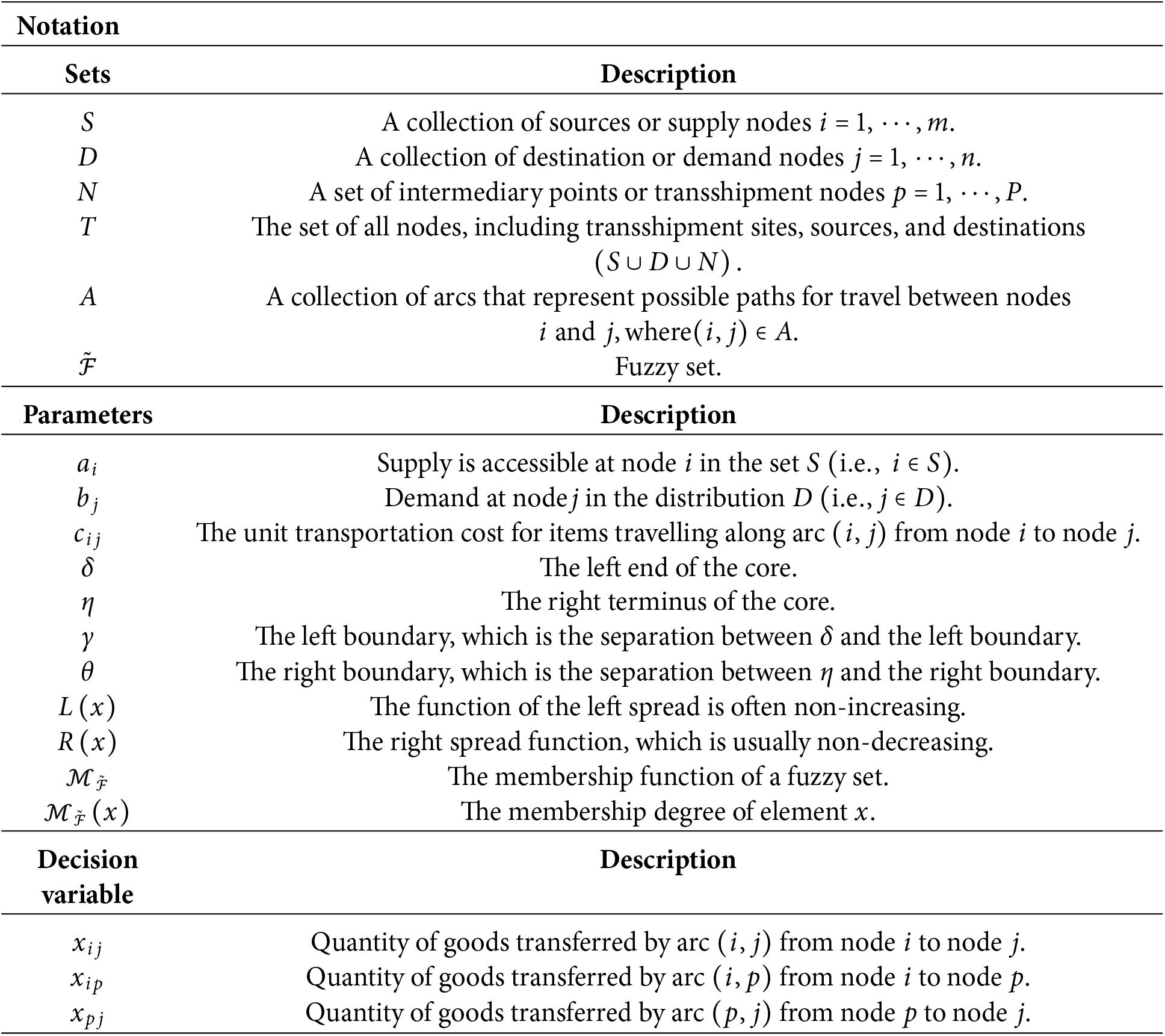
This section contains many robust mathematical models that aim to solve various optimization difficulties and all of them are specifically developed to provide effective solutions to real-world issues. These models provide useful answers for a wide range of businesses, helping to optimize anything from supply chains to complex logistics networks. In real-world applications, these models provide the essential foundation to facilitate more intelligent and efficient decision making, whether it is cost minimization, resource optimization, or management of complex distribution networks.
In the transshipment model, resources or goods are transferred from sources to destinations, often through intermediary nodes known as transshipment points. Ensuring that supply and demand constraints are satisfied while minimizing transportation costs is the objective.
Objective Function
Minimize the total transportation cost:
Supply Constraints
The total quantity of goods originating from a supply node should not exceed its available supply:
Demand Constraints
The total amount of goods received at a demand node must meet its demand:
Flow Conversation Constraints
At transshipment nodes, the total inflow must equal the total outflow (goods that arrive at a transshipment node must be shipped out)
The transshipment model is an effective method for maximizing resource allocation in networked systems because of its flexibility.
Non-Negative Constraints
There must be non-negative flow of goods in all arcs.
Model 1
s.t.:
This fundamental transshipment model objective to satisfy supply, demand, and flow conservation constraints while minimizing the overall cost of transportation. Depending on the particular application, capacity limits on arcs, various objects, fixed charges, or stochastic characteristics may be incorporated into the model. An essential optimization model in supply chain and transportation management, the transshipment problem provides a flexible framework for controlling the flow of commodities across complex networks. To maintain the efficiency of logistics networks, sophisticated approaches are required as supply chains become more complex and globalized, and as uncertainties regarding costs, capabilities, and demand continue. Modern transshipment models provide reliable, flexible approaches that can adjust to the unexpected nature of today’s logistics and transportation networks by embracing strategies like fuzzy logic, multi-objective optimization, and dynamic routing.
The traditional TSP has been expanded into a multi-objective transshipment problem. The purpose of the MOTSP is to optimize multiple competing objectives simultaneously. These goals may be reducing delivery times, cutting transportation-related expenses, increasing dependability, or reducing environmental impact. The main difficulty in solving a multi-objective optimization problem is that achieving one goal may make another goal worse, so compromises must be made between competing goals. Typically, a Pareto-optimal solution is sought, meaning that no objective can be maximized without making someone else poorer.
Objective Function
A multi-objective transshipment challenge often has multiple objectives. These are some specific ones:
Minimize total transportation cost:
Minimize total penalty cost:
Minimize total delivery time cost:
Supply Constraints
The total quantity of goods originating from a supply node should not exceed its available supply:
Demand Constraints
The total amount of goods received at a demand node must meet its demand:
Flow Conversation Constraints
At transshipment nodes, the total inflow must equal the total outflow (goods that arrive at a transshipment node must be shipped out)
The transshipment model is an effective method for maximizing resource allocation in networked systems because of its flexibility.
Non-Negative Constraints
There must be non-negative flow of goods in all arcs.
Model 2
s.t.:
Transportation cost, penalty cost and delivery time cost are the three main objectives that are optimized in the MOTSP. Costs associated with transporting goods between nodes, such as labour and fuel, are reflected in transportation costs. Penalty costs arise when deadlines or service level agreements are not met, leading to financial consequences for delays (shown in Table 3). The goal of delivery time costing is to minimize the time required to deliver goods, which is important in business where delivery time is critical. Since reducing one cost may lead to an increase in another, trade-offs become necessary to balance these goals. This approach has many applications in e-commerce, urban logistics, and supply chain management, where prompt delivery, cost effectiveness, and service dependability are essential. For example, organizations like Amazon or logistics corporations strive to minimize total expenses while guaranteeing quick, efficient delivery and avoiding penalties for delays.

Rather than broadly asserting that our model is directly applicable to these sectors, we will reframe our argument to highlight how the core principles of our fully fuzzy-based transshipment framework—including handling uncertainty, optimizing multi-objective decision-making, and providing routing flexibility—can be adapted to these industries with appropriate modifications. Specifically:
E-commerce: While our model accounts for uncertainty and multi-objective trade-offs, real-world e-commerce logistics require additional considerations such as real-time demand fluctuations, last-mile delivery constraints, and customer service-level requirements. We will clarify those further adaptations—such as integrating real-time tracking and incorporating service-level constraints—that would be necessary for direct implementation.
Energy Distribution: The application of our model in energy networks would need to consider additional constraints like infrastructure limitations, regulatory compliance, and energy flow dynamics. We will refine our discussion to indicate that while our model provides a foundation for handling uncertainty in distribution networks, its direct use in energy distribution would require domain-specific modifications.
Urban Transit Planning: While our approach can assist in routing optimization under uncertainty, real-world urban transit planning also involves factors like passenger demand variability, traffic congestion, and transit scheduling, which are not explicitly modelled in our study. We will specify that our approach can support decision-making in transit logistics, but would require integration with traffic models and passenger flow predictions for full applicability.
By incorporating these refinements, we will ensure that our claims are appropriately positioned, demonstrating the potential of our model while acknowledging the need for sector-specific adaptations.
The fuzzy numbers that are classified as LR flats are characterized by left (L) and right (R) distribution functions. These spread functions describe how membership values decrease from the origin, or central region, of the fuzzy number. The membership function of an LR flat fuzzy number reaches a limit of 1 before gradually decreasing, which is indicated by the “flat” core, where the membership value remains constant at 1. When there is a clear interval of confidence (core) surrounded by areas of uncertainty, LR flat fuzzy numbers are employed in fuzzy decision making, optimization issues, and scenarios where a lack of clarity is represented. They are often used in multi-criteria decision analysis, stock control, and other situations that require the systematic management of uncertain data.
In fuzzy decision making and supply chain management, when there is uncertainty around supply (availability) and demand due to factors such as changes in market conditions or manufacturing changes, total LR fuzzy availability and LR fuzzy demand are important concepts. Decision-makers can handle this lack of clarity more effectively by modelling demand and availability as LR fuzzy numbers.
Total LR fuzzy supply
Total LR Fuzzy Availability accounts for supply variability by representing the uncertain quantity of products, resources or services available during a certain time period as a fuzzy number. The overall LR fuzzy number, which includes a smooth transition to under- or over-estimates of supply and a flat core (zone of confidence), is used to describe availability rather than specify an exact value. Availability is expressed as a fuzzy number with a “core” of potentially available values and is diluted in both directions to accommodate uncertainty, as opposed to a single, definite value.
Total LR fuzzy demand
Uncertainty in demand, arising from factors such as changes in customer preferences, volatile markets, or seasonal patterns, is modelled using LR ambiguous demand. Unlike a fixed demand value, LR Fuzzy demand represents the full range of possible demand, including uncertainty in both directions and the origin of the most probable values. In this case, demand is represented by LR fuzzy numbers, which allows flexibility in depicting different demand levels rather than assuming a constant quantity.
The problem is considered balanced if
TSP with LR flat fuzzy numbers, also known as the LR flat fuzzy TSP, is a model designed to address uncertain supply, demand, and transportation costs. To account for fluctuations, these values are represented as LR flat fuzzy numbers, which include spreads to the left and right of the main range. Hence, we define
As far as we know:
The model for this problem is as follows:
Model 3
s.t.:
The initial model, Model 3, can be extended to handle multiple objectives by optimizing each objective separately, as demonstrated in Model 4. This flexibility allows the framework to address diverse and competing goals under uncertainty.
Model 4
s.t.:
The crisp value of an LR flat fuzzy number is a single representative value that can be obtained from the fuzzy set, giving decision makers or analysts an accurate amount to deal with (shown in Table 4). Decreasing slopes are observed to the left (L) and right (R) on each side of the flat region in the centre of the LR flat fuzzy number, which represents the largest membership value of 1. Several potential crisp values can be extracted from the structure of the LR flat fuzzy number to represent its overall value. Let

Explicit (crisp) values are precise quantities obtained by aligning resources (supply) with needs (demand) in well-defined proportions (shown in Table 5). Through the process of defuzzification, fuzzy data from fuzzy systems is converted into sharp values, enabling effective balancing and allocation of supply and demand. This approach facilitates decision-making across various domains, including economics and logistics.

This section covers our suggested approach to solving the multi-path, multi-objective transshipment problem. To deal with uncertainty in problem parameters, our method uses LR fuzzy numbers. The goal of the challenge is to optimize multiple objectives simultaneously, including:
• Minimizing total transportation cost
• Minimize total penalty cost
• Minimizing total delivery time cost
In the LR flat fuzzy MOTSP, fuzzy numbers with left and right (LR) membership functions are used to represent uncertainty or inaccuracy in factors such as supply, demand, or cost. By smoothing out these obscuring factors, it is often divided into four distinct TSPs to simplify the problem and provide more practical solutions. To do this, four distinct crisp conditions are created, taking into account varying degrees of confidence or reduction (e.g., lower and upper bounds). Each of these categorical dilemmas provides a possible realization of an ambiguous problem, showing different degrees of ambiguity, while providing decision makers a range of viable answers to make concrete decisions. Where:
We optimize supply and demand flows through the network to minimize costs or maximize efficiency to solve a crisp transshipment problem. The optimal value is the approach that provides the best results correspondingly:
•
•
•
•
We calculate the value of
This approach considers four categorical values (optimistic, pessimistic, most probable, and balanced) for each unknown parameter and evaluates multiple potential paths between each pair of nodes. The algorithm selects an optimal set of paths that minimizes cost, time, and risk while meeting capacity and flow conservation constraints based on the employed risk preference and multi-objective approach. The selected solution, given the uncertainty represented by the fuzzy numbers, represents the optimal set of routes for moving resources or goods through transshipment points from source nodes to destination nodes. This study included two routes for transporting goods from the source to the final destination:
Route 1: Source to Destination Transshipment Nodes—Before products reach their final destination, they may be moved from a source to intermediate transshipment nodes through this path. This provides flexibility for rerouting and combining shipments, which can reduce cost and increase productivity. If goods are transported using Route 1, the constraint is:
where,
Route 2: Source to Source Transshipment: This path makes it easier to transport products between sources nodes, allowing inventory to be distributed throughout the network. This is especially useful in situations where one supplier has an excess of inventory while another has a limited supply. If goods transport from Route 2, the constraint becomes:
where,
Create pseudocode to outline the key steps of the proposed model, specifying the input, processing, and output stages with logical conditions and iterations (Algorithm 1).

The proposed method presents significant improvements over traditional techniques for solving the multi-objective transshipment problem (MOTP). Specifically, LR flat fuzzy numbers and a robust fuzzy ranking technique are used.
• Transportation parameter uncertainties, such as cost, supply, and demand, can be more accurately represented using LR flat fuzzy numbers, which improves decision making in real-world environments.
• In addition to improving computational efficiency in multi-objective optimization, the fuzzy ranking strategy improves decision quality by systematically evaluating uncertain values.
• An exhaustive route selection process based on a variety of variables is made possible by the flexibility of the method to take into account both direct and transshipment routes, ensuring a reasonable balance between time and cost.
It is particularly suitable for dynamic contexts such as supply chain management, urban logistics, and emergency response because of its reduced sensitivity to changes in input data, providing high stability and flexibility.
5.2 Detailed Method Step by Step (Shown in Fig. 7)
Step 1: Start

Figure 7: Flow chart of the proposed algorithm
Step 2: Determine and specify potential transshipment routes. Let’s assume for simplicity that there are two primary paths in this example:
• Route 1: This can be a potential route for the movement of goods, energy or services from sources to destinations.
• Route 2: There may be a different route available here, perhaps with different prices, capacity, or schedules.
Nodes, supply, demand, and intermediate transshipment points (if any) must all be specified when defining these routes.
Step 3: Convert LR flat fuzzy MOTSP
Step 4: Create the MOTSP objective function
Step 5: Utilizing the suggested method, solve the transshipment issue and determine the values of
Step 6: Now we determine the value of this parameter
Step 7: Multiply the corresponding
•
•
Then
Step 8: Determine the value of each objective using the cost function
Then, use ranking techniques to assess routes and identify the best route with its associated costs.
Step 9: Stop
This section provides a numerical example involving three manufacturers

Route 1
First, we apply defuzzification techniques to convert fuzzy numbers related to delivery time cost, penalty fee, and transportation cost into crisp values.
•
•
•
•
We generate the crisp TSP using the above equation (shown in Table 7):

Applying the proposed algorithm, we get the value of (shown in Table 8):

Now we determine the value of
Consequently, the fuzzy optimum solution is:
Put the value of
Finally, we obtained the value of

Route 2
The three primary objectives of the problem are to minimize the total transportation cost

First, we apply defuzzification techniques to convert fuzzy numbers related to delivery time cost, penalty fee, and transportation cost into clear values (shown in Table 11).

•
•
•
•
We generate the crisp TSP using the above equation:
Applying the proposed algorithm, we get the value of (shown in Table 12):

Now we determine the value of
Consequently, the fuzzy optimum solution is:
Put the value of
Finally, we obtained the value of

Ideal and anti-ideal values for each objective (transportation cost, penalty cost, and delivery time cost) are compared for Routes 1 and 2, using various evaluation techniques, such as proposed algorithms, goal programming, and fuzzy programming (shown in Table 14). By analysing the performance and trade-offs of each approach with respect to ideal (best-case) and anti-ideal (worst-case) solutions, this comprehensive assessment identifies the optimal course of action. From the comparison, it is clear which route and technology produce the most economical and well-organized transportation program. Using LINGO 18 software, we solved the numerical example, and the result validated the effectiveness and near-optimal performance of the proposed method.

According to Route 1’s analysis, the model is the best choice for decision makers because it consistently produces results closest to the optimal value in terms of delivery time, penalty cost, and transportation cost. This enables decision makers to choose the most economical and efficient way to transport products, ensuring a balance between reducing costs and meeting delivery dates. Our methodology improves decision-making processes by providing more accurate and efficient options than traditional methods, leading to increased operational efficiency and fewer logistics challenges for direct routes. Goods can be transported effectively and economically due to close alignment with the ideal benchmark, ensuring minimal deviation from ideal specifications (shown in Fig. 8). As a result, choosing Route 1 provides optimal performance and cost balance, allowing better information and efficient logistics decisions.

Figure 8: Graphical representation of route 1
According to the analysis of Route 2, the proposed MOTSP closely aligns with the optimal value. Reducing transportation costs and improving route performance in terms of transit time and logistics efficiency, it ensures cost effectiveness. Minimal deviations from optimal parameters indicate the model’s accuracy and reliability (shown in Fig. 9). Consequently, Route 2 provides a cost-effective and efficient solution to transporting products, providing decision makers another excellent option to reach operational excellence in logistics.

Figure 9: Graphical representation of route 2
Routes 1 and 2 are evaluated, and the results show that our suggested model ranks II, closely approaching the ideal value, which ranks I. GP is ranked IV, FP is ranked III, and anti-ideal models are ranked V (shown in Fig. 10). These rankings provide decision makers with a clear understanding of the options, aiding them in selecting the most cost-effective and successful transportation plan. Compared to alternative approaches, the proposed model’s proximity to the ideal solution ensures superior logistics performance, making it a reliable choice for decision-makers.

Figure 10: Chart of ranking
The proposed multi-objective transshipment problem (MOTP) model focuses on three primary objectives: transportation cost, penalty cost, and delivery time cost. The model considers two routing options:
• A direct route from source to destination without utilizing transshipment points.
• A route involving transshipment points before reaching the destination.
We conducted a comparative investigation of our model vs. existing approaches using LR flat fuzzy numbers and a ranking strategy. The results demonstrate the superiority of our model as it provides solutions closer to the ideal value, facilitating more optimal decision making. Conversely, the results of existing methods (goal programming, fuzzy programming) align more closely with the anti-ideal value, making them less efficient for decision-making purposes. The flexibility and efficiency of our model extend its application beyond transportation to various contexts such as e-commerce, energy distribution, communication networks, urban transit planning, and logistics. By simultaneously optimizing multiple objectives, the model minimizes costs, ensures on-time delivery, and mitigates penalties, making it particularly valuable for industries focused on reducing operational expenses while maintaining efficient service delivery. According to the ranking study, the proposed method achieves 95% of the ideal value’s performance and takes 2nd, which is a considerable improvement over goal programming (4th, 55%) and fuzzy programming (3rd, 65%). In comparison to the ideal value, the anti-ideal value, which is ranked last (5th), represents 0% efficiency. This demonstrates that the suggested strategy is a dependable substitute for real-world applications, as it is not only extremely successful but also surprisingly close to the ideal value. This method stands out as a dependable and useful tool for decision-makers, providing value that is not only efficient but also strikingly similar to the desired result. The suggested approach aids decision-makers in generating strategic, well-informed decisions by streamlining intricate decision-making procedures and producing nearly ideal results, guaranteeing greater conformity with practical demands. The numerical example in this study was solved using LINGO 18 software, showcasing the efficiency and applicability of the proposed method in addressing complex decision-making problems. Despite its advantages, the proposed model has limitations. The use of LR flat fuzzy numbers may not fully capture complex real-world uncertainties like natural disasters or demand spikes. Additionally, solving large-scale transshipment problems may require advanced heuristics for scalability. Future research can explore hesitant or intuitionistic fuzzy sets for better uncertainty modelling, hybrid metaheuristic approaches for efficiency, and sustainability factors to enhance real-world applicability in dynamic logistics environments.
This approach provides a comprehensive framework for decision making, addressing cost minimization, on-time delivery, and penalty mitigation by optimizing multiple objectives simultaneously. It is particularly helpful for sectors and industries where it is important to reduce operating expenses while ensuring timely and efficient delivery. By promoting better resource allocation and improving service delivery across multiple sectors, the proposed strategy helps the development of more effective mobility policies. It demonstrates both practical relevance and the ability to outperform traditional approaches in solving complex logistics problems. Consequently, this model provides both theoretical contributions and practical solutions to real-world supply chain management and transportation problems.
Acknowledgement: The authors extend their acknowledgment to the financial support of the European Union under the REFRESH-Research Excellence for Region Sustainability and High-tech Industries project number CZ.10.03.01/00/22_003/0000048 via the Operational Programme Just Transition and has been done in connection with project Students Grant Competition SP2025/062 “specific research on progressive and sustainable production technologies” and SP2025/063 “specific research on innovative and progressive manufacturing technologies” financed by the Ministry of Education, Youth and Sports and Faculty of Mechanical Engineering VŠB-TUO. The authors would like to extend their sincere appreciation to Researchers Supporting Project number (RSP2025R472), King Saud University, Riyadh, Saudi Arabia.
Funding Statement: The authors extend their acknowledgment to the financial support of the European Union under the REFRESH-Research Excellence for Region Sustainability and High-tech Industries project number CZ.10.03.01/00/22_003/0000048 via the Operational Programme Just Transition and has been done in connection with project Students Grant Competition SP2025/062 “specific research on progressive and sustainable production technologies” and SP2025/063 “specific research on innovative and progressive manufacturing technologies” financed by the Ministry of Education, Youth and Sports and Faculty of Mechanical Engineering VŠB-TUO.
Author Contributions: The authors confirm contribution to the paper as follows: study conception and design: Vishwas Deep Joshi, Priya Agarwal, Lenka Čepová, Huda Alsaud, Ajay Kumar, B. Swarna, Ashish Kumar; data collection: Vishwas Deep Joshi, Priya Agarwal, Lenka Čepová, Huda Alsaud, Ajay Kumar; analysis and interpretation of results: Vishwas Deep Joshi, Priya Agarwal, Lenka Čepová, Huda Alsaud, Ajay Kumar, B. Swarna, Ashish Kumar; draft manuscript preparation: Vishwas Deep Joshi, Priya Agarwal, Lenka Čepová, Huda Alsaud, Ajay Kumar, B Swarna, Ashish Kumar. All authors reviewed the results and approved the final version of the manuscript.
Availability of Data and Materials: The data in this study is available from the corresponding author, upon request.
Ethics Approval: Not applicable.
Conflicts of Interest: The authors declare no conflicts of interest to report regarding the present study.
References
1. Abd El-Wahed WF, Lee SM. Interactive fuzzy goal programming for multi-objective transportation problems. Omega. 2006;34(2):158–66. doi:10.1016/j.omega.2004.08.006. [Google Scholar] [CrossRef]
2. Baskaran R, Dharmalingam K. Multi-objective fuzzy transshipment problem. Intern J Fuzzy Math Archive. 2016;10:161–7. [Google Scholar]
3. Chakraborty S. TOPSIS and Modified TOPSIS: a comparative analysis. Decis Anal J. 2022;2(2):100021. doi:10.1016/j.dajour.2021.100021. [Google Scholar] [CrossRef]
4. Ebrahimnejad A. New method for solving Fuzzy transportation problems with LR flat fuzzy numbers. Inf Sci. 2016;357(32):108–24. doi:10.1016/j.ins.2016.04.008. [Google Scholar] [CrossRef]
5. Glover F, Karney D, Klingman D, Russell R. Solving singly constrained transshipment problems. Transp Sci. 1978;12(4):277–97. doi:10.1287/trsc.12.4.277. [Google Scholar] [CrossRef]
6. Ghatee M, Mehdi Hashemi S. Ranking function-based solutions of fully fuzzified minimal cost flow problem. Inf Sci. 2007;177(20):4271–94. doi:10.1016/j.ins.2007.05.007. [Google Scholar] [CrossRef]
7. Ghatee M, Hashemi SM. Generalized minimal cost flow problem in fuzzy nature: an application in bus network planning problem. Appl Math Model. 2008;32(12):2490–508. doi:10.1016/j.apm.2007.09.030. [Google Scholar] [CrossRef]
8. Gani AN, Baskaran R, Assarudeen SM. Transshipment problem in fuzzy environment. Int J Math Sci Eng Appl. 2011;5:57–74. [Google Scholar]
9. Hoppe B, Tardos É. The quickest transshipment problem. Mathematics OR. 2000;25(1):36–62. doi:10.1287/moor.25.1.36.15211. [Google Scholar] [CrossRef]
10. Herer YT, Tzur M, Yücesan E. The multilocation transshipment problem. IIE Trans. 2006;38(3):185–200. doi:10.1080/07408170500434539. [Google Scholar] [CrossRef]
11. Joshi VD, Agarwal P, Kumar A. Fuzzy transportation planning: a goal programming tactic for navigating uncer-tainty and multi-objective decision making. Int J Interact Des Manuf. 2025;19(2):1205–33. doi:10.1007/s12008-023-01634-9. [Google Scholar] [CrossRef]
12. Joshi VD, Agarwal P, Kumar A, Dogra N, Nandan D. Urban Odyssey: pioneering multimodal routes for Tomor-row’s smart cities. Meas Sens. 2024;36(1):101301. doi:10.1016/j.measen.2024.101301. [Google Scholar] [CrossRef]
13. Khurana A. Variants of transshipment problem. Eur Transp Res Rev. 2015;7(2):11. doi:10.1007/s12544-015-0154-8. [Google Scholar] [CrossRef]
14. Kumar A, Chopra R, Saxena RR. An efficient algorithm to solve transshipment problem in uncertain environ-ment. Int J Fuzzy Syst. 2020;22(8):2613–24. doi:10.1007/s40815-020-00923-9. [Google Scholar] [CrossRef]
15. Kaur A, Kacprzyk J, Kumar A. New methods for solving the fully fuzzy transportation problems with the LR flat fuzzy numbers. In: Fuzzy transportation and transshipment problems. Cham, Switzerland: Springer International Publishing; 2019. p. 81–101. doi:10.1007/978-3-030-26676-9_5. [Google Scholar] [CrossRef]
16. Kaur A, Kacprzyk J, Kumar A. New improved methods for solving the fully fuzzy transshipment problems with parameters given as the LR flat fuzzy numbers. In: Fuzzy transportation and transshipment problems. Cham, Switzerland: Springer International Publishing; 2019. p. 103–44. doi:10.1007/978-3-030-26676-9_6. [Google Scholar] [CrossRef]
17. Kaur A, Kacprzyk J, Kumar A, Analyst CF. Fuzzy transportation and transshipment problems. Cham, Switzerland: Springer International Publishing; 2020. [Google Scholar]
18. Ogryczak W, Studziński K, Zorychta K. A solver for the multi-objective transshipment problem with facility loca-tion. Eur J Oper Res. 1989;43(1):53–64. doi:10.1016/0377-2217(89)90409-8. [Google Scholar] [CrossRef]
19. Tang CH, Wang YW. Transportation outsourcing problems considering feasible probabilities under stochastic demands. Comput Oper Res. 2021;126:105109. doi:10.1016/j.cor.2020.105109. [Google Scholar] [CrossRef]
20. Tang CH. Optimization for transportation outsourcing problems. Comput Ind Eng. 2020;139:106213. doi:10.1016/j.cie.2019.106213. [Google Scholar] [CrossRef]
21. Wagenknecht M, Hampel R, Schneider V. Computational aspects of fuzzy arithmetics based on Archimedean t-norms. Fuzzy Sets Syst. 2001;123(1):49–62. doi:10.1016/S0165-0114(00)00096-8. [Google Scholar] [CrossRef]
22. Zaki SA, Mousa AAA, Geneedi HM, Elmekawy AY. Efficient multiobjective genetic algorithm for solving transpor-tation, assignment, and transshipment problems. Appl Math. 2012;3(1):92–9. doi:10.4236/am.2012.31015. [Google Scholar] [CrossRef]
Cite This Article
 Copyright © 2025 The Author(s). Published by Tech Science Press.
This work is licensed under a Creative Commons Attribution 4.0 International License , which permits unrestricted use, distribution, and reproduction in any medium, provided the original work is properly cited.
 Downloads
 Citation Tools
