
 Login
Login Register
 Submit a Paper
 Propose a Special lssue
 Open Access
ARTICLE

Adaptive Relay-Assisted WBAN Protocol: Enhancing Energy Efficiency and QoS through Advanced Multi-Criteria Decision-Making
1 Department of Computer Science and Engineering, DAV University, Jalandhar, 144012, India
2 Department of Computer Science and Engineering, BGIET, Sangrur, 148001, India
* Corresponding Authors: Surender Singh. Email: ; Naveen Bilandi. Email:
Computer Modeling in Engineering & Sciences 2025, 144(1), 489-509. https://doi.org/10.32604/cmes.2025.065101
Received 03 March 2025; Accepted 28 May 2025; Issue published 31 July 2025
 View Full Text
 Download PDF
Abstract
Wireless Body Area Network (WBAN) is essential for continuous health monitoring. However, they face energy efficiency challenges due to the low power consumption of sensor nodes. Current WBAN routing protocols face limitations in strategically minimizing energy consumption during the retrieval of vital health parameters. Efficient network traffic management remains a challenge, with existing approaches often resulting in increased delay and reduced throughput. Additionally, insufficient attention has been paid to enhancing channel capacity to maintain signal strength and mitigate fading effects under dynamic and robust operating scenarios. Several routing strategies and procedures have been developed to effectively reduce communication-related energy consumption based on the selection of relay nodes. The relay node selection is essential for data transmission in WBAN. This paper introduces an Adaptive Relay-Assisted Protocol (ARAP) for WBAN, a hybrid routing protocol designed to optimize energy use and Quality of Service (QoS) metrics such as network longevity, latency, throughput, and residual energy. ARAP employs neutrosophic relay node selection techniques, including the Analytic Hierarchy Process (AHP) and Technique for Order Preference by Similarity to Ideal Solution (TOPSIS) to optimally resolve data and decision-making uncertainties. The protocol was compared with existing protocols such as Low-Energy Adaptive Clustering Hierarchy (LEACH), Modified-Adaptive Threshold Testing and Evaluation Methodology for Performance Testing (M-ATTEMPT), Wireless Adaptive Sampling Protocol (WASP), and Tree-Based Multicast Quality of Service (TMQoS). The comparative results show that the ARAP significantly outperformed these protocols in terms of network longevity and energy efficiency. ARAP has lower communication cost, better throughput, reduced delay, increased network lifetime, and enhanced residual energy. The simulation results indicate that the proposed approach performed better than the conventional methods, with 68%, 62%, 25%, and 50% improvements in network longevity, residual energy, throughput, and latency, respectively. This significantly improves the functional lifespan of WBAN and makes them promising candidates for sophisticated health monitoring systems.Keywords
Wireless Body Area Network (WBAN) is a limited subclass of Wireless Sensor Network (WSN) dedicated to monitoring human physiological parameters for medical and non-medical applications [1,2]. These networks utilize an array of invasive and non-invasive sensors. Invasive sensors are inserted within the body, whereas non-invasive sensors are attached to or placed outside the body, such as in wearable devices [3]. WBAN is used in physiological monitoring, sports performance analysis, and other physiological tracking applications [4]. Data obtained from sensors such as electroencephalogram (EEG), electrocardiogram (ECG), blood oxygen levels, and body temperature are transmitted to a central sink node, which then forward data to intermediary devices such as Personal Digital Assistants (PDA) for processing and further communication with healthcare providers or emergency personnel [5,6].
The structure of a WBAN must be lightweight and minimally intrusive to facilitate continuous monitoring without affecting the user’s regular lifestyle. It is far more sophisticated than traditional systems such as the Holter monitor, which is bulky and not ideal for long-term monitoring. The small size and wireless nature of WBAN sensors make them particularly suitable for discreet, continuous monitoring and the delivery of key data to facilitate timely medical intervention [7,8]. A major challenge in WBAN is balancing the energy usage of sensors, which are typically powered by small batteries with very limited energy reserves [9]. Effective energy management is crucial for extending the operational life of these sensors, as they are responsible not only for data acquisition and processing but also for wirelessly transmitting the data to the sink node [10,11]. Battery constraints make it important to conserve energy, which is a fundamental issue in long-term monitoring [12].
This hierarchical structure ensures strong and uninterrupted monitoring, along with optimal energy usage and data transmission efficiency, which are of prime importance for efficient WBAN operation in health monitoring. The architecture provides end-to-end support for a large and scalable solution for WBAN integration into numerous health monitoring systems, enabling timely and reliable medical data access and response. However, current routing protocols, such as LEACH, M-ATTEMPT, WASP and TMQoS, have addressed concerns regarding energy efficiency and data reliability in WBAN [13–15]. These protocols primarily rely on static routing mechanisms [16], making them less adaptive in responding to dynamic and uncertain environments. This limited adaptability can result in inefficient energy consumption and data transmission. To address these challenges, an ARAP for WBAN was proposed for intra-WBAN. ARAP introduces a hybrid routing scheme employing the neutrosophic-Analytic Hierarchy Process (AHP) and Technique for Order Preference by Similarity to Ideal Solution (TOPSIS) techniques for relay node selection. These techniques provide a comprehensive evaluation of relay nodes based on various criteria, including residual energy, traffic load, and node criticality. The use of such decision-making aids is intended to optimize relay node selection, thereby enhancing critical QoS measures, such as throughput, delay, network lifetime, energy consumption, and residual energy [17–19].
The principal aims of this research are to undertake a critical analysis of existing energy-efficient routing protocols, implement and deploy ARAP for WBAN, and benchmark its performance against existing protocols [20]. It is hoped that ARAP will significantly improve the lifetime and efficiency of WBAN, making them more reliable for long-term health monitoring. This study also addresses the gaps identified in previous research, particularly the need for more robust and energy-efficient routing mechanisms for WBAN.
This study is motivated by the need for an adaptive and robust solution to overcome various types of limitations, such as robustness, cost, and energy effectiveness. By integrating neutrosophic-AHP and TOPSIS, this study proposes a hybrid routing protocol that optimizes relay node selection according to traffic load, leftover energy, and node criticality in uncertain environments. The developed protocol is intended to enhance network efficiency by minimizing energy consumption, reducing latency, and prolonging the operational life of WBAN. These developments are expected to substantially enhance WBAN applications for health monitoring, making them scalable and reliable for deployment in real-world settings.
The primary contributions of this study are as follows:
1. Proposed ARAP for WBAN to maximize energy efficiency and QoS using state-of-the-art multi-criteria decision-making methods (neutrosophic-AHP and TOPSIS).
2. Incorporated neutrosophic-AHP and TOPSIS to improve relay node selection, ensuring dynamic adaptability to real-time network conditions.
3. Enhanced key QoS metrics such as throughput, delay, and network lifetime, while significantly reducing energy consumption and extending network longevity.
4. Conducted a comparative evaluation that demonstrates the superior performance of ARAP compared to existing protocols such as LEACH, M-ATTEMPT, WASP, and TMQoS through rigorous benchmarking and analysis.
The remainder of this paper is organized as follows. In Section 2, we provide a thorough analysis of various related studies to identify research gaps. Section 3 presents the research methodology, while Section 4 discusses the simulation and experimental results, along with a comparison of ARAP with other protocols across several key metrics. Finally, Section 5 concludes the paper by summarizing the findings and suggesting directions for future research.
WBAN has become an essential tool for real-time patient data collection and ongoing health monitoring. Much research has been done recently to increase the security, energy efficiency, and dependability of data transmission in WBAN contexts. The special difficulties presented by WBAN, including their dynamic topology, limited energy resources, and the requirement for high-quality service in life-critical applications, have been addressed in several ways. To improve network lifetime and communication reliability, several routing protocols, relay node selection strategies, and optimization techniques are examined in the literature currently under publication. Significant contributions to the discipline are critically reviewed in this part, with an emphasis on their approaches, advantages, and disadvantages.
In [21], a hierarchical decision-making framework using digital twin technology was proposed to enhance resource-efficient utilization and facilitate real-time mission planning. The framework divides a swarm of UAVs into subgroups and uses a deep Q-learning method with several agents to optimize training. Simulations proved the efficiency of this method in generating high-quality plans despite the drawbacks of learning-based methods in addressing sim-to-real challenges. In [22], data-driven methods such as device placement, routing, sampling rate calibration, and machine learning techniques were investigated to resolve these challenges. These results provide insights into how to maximize energy efficiency and security in WBAN and offer future research directions for healthcare applications. A dual optimization mechanism was proposed in [23] to improve the energy efficiency of WBAN. First, the naïve Bayesian classifier was used to reduce interference, whereas the second approach employed the Hungarian algorithm for time slot allocation. The simulation results indicate that the scheme considerably enhances WBAN energy efficiency with a QoS guarantee. A new routing protocol, Simple Energy-Aware and Reliable (SEAR), which is energy-aware and reliable, was introduced by [24] to deliver reliable data packets in WBAN. The protocol considers the remaining energy, priority data, and hop count to select an optimal forwarder node. The route reliability factor (RRF) determines the optimal route. SEAR outperforms existing protocols in terms of overall energy consumption, packet loss, end-to-end latency, and network lifetime.
Routing techniques have been suggested by the authors of [25–27] to enhance wireless networks. They focused on hybrid routing protocols to develop optimal routing solutions that meet design objectives. Energy efficiency and routing in various nodes are the core concepts. For WBAN, the authors of [28,29] suggested an energy-efficient routing system. The healthcare industry, where patients can operate using IoT-enabled WBAN, remains the main focus. To improve network performance in WBAN, they demonstrated an energy-efficient protocol framework with energy consumption models. To conserve energy and provide an energy-efficient routing protocol in WBAN environments, the authors of [30] clarified the routing method in WBAN. Models for energy harvesting and blockchain were also presented. The main objective was to maintain a high network stability period, minimize transmission loss, and achieve high throughput.
Ultra Energy Efficient Lossless Compression (UEELC) is a compression technique that was introduced in [31], which consumes less energy since it sends less data to the sink node. Each input string is transformed into a shorter code in a series of stages to accomplish this. First, each input string is converted to its ASCII counterpart, and the resulting ASCII code is subsequently converted to its binary equivalent. A more optimal traversal is chosen in the following step by counting the number of zeros and ones in the generated binary code. Additionally, the binary code is traversed more effectively in the final phase.
A wireless relay system fueled by an energy buffer was proposed to help install a WBAN that can sustain itself. An implantable device, consisting of multiple users and an off-body Access Point (AP), was placed inside the body of the proposed system. Each user also had a wearable gadget with two modes and an energy buffer attached to their body. During data transmission, the dual-mode wearable gadget consumed wireless energy while also transferring energy to supply the implant device and harvesting energy from an AP’s broadcast radio frequency signal. This harvested energy was stored in the energy buffer as presented in [32].
The published literature in [33] reviews work related to Multi-fractional Triphase Duplex Data Encryption (MTDDE) with Ant Colony Optimization (ACO), which is the recommended technique for encrypting data. This approach considers data security and various constraints on sensor nodes, including dynamic topology, battery life, throughput, and computational power limitations.
Three methods utilizing distance were proposed by the author of [34], using a distance matrix to create a chain of sensor nodes. The first strategy uses the shortest paths to construct a single chain. The second and third methods involve moving the sink by employing the fuzzy C-means (FCM) method to create a single cluster, with the sink’s new location determined by the cluster center. The third suggested chain-based technique significantly reduced energy consumption compared with RE-ATTEMPT and Particle Swarm Optimization Body Area Network (PSOBAN), positively impacting the network’s overall lifespan.
A suggested technique called Hierarchical Energy Efficient Secure Routing (HEESR) [35] classifies deployed body nodes into direct and relay nodes based on a threshold value. In contrast to traditional protocols, energy levels and traffic priority information, including critical and non-critical data, are used to select the cluster head. Subsequently, the best path for forwarding the obtained information is determined, and the data is encrypted using an asymmetric cryptographic algorithm and compressed using the Huffman encoding method for secure data transmission.
According to [36], the increasing number of WBANs in hospitals negatively affects service delays and network throughput [37]. To address this issue and ensure QoS, dynamic connectivity establishment and cooperative scheduling schemes have been proposed [38,39]. A wearable prototype using 9DoF sensor boards was developed in [40], along with a new classification algorithm that detects various arm movements using two wrist-mounted sensors. The key advancement is that the algorithm can run directly on the wearable unit’s microcontroller. To improve and manage health care services in an autonomous manner, an energy-aware and stable routing protocol has been proposed [41]. The objective of this protocol is to improve network performance for point-to-point communication. In [42], a signal processing system based on the clustering algorithm is proposed to monitor the real-time health condition of the patient under observation with respect to variation in mobility. The problem of temperature balancing has been addressed in [43], with the Thermal-Aware Routing Algorithm (TARA) by diversifying the route in case of wise in temperature of the sensor node. The importance of WBAN in real-time healthcare monitoring has drawn increasing attention [44,45]. To address the issues challenges of data reliability and delay, an efficient QoS-based Multi-Path Routing (MPR) scheme for WBAN was proposed in [46]. Incoming traffic in MPR is divided into two categories: routine and emergency. To increase network dependability and throughput, emergency traffic has been given top priority and is being sent via the optimal path. By the use of Optimal K-Means Clustering (OKMC), a novel metaheuristic method Energy Enrichment Multi-Hop Routing (EEMR) protocol is proposed in [47], to strengthening network lifetime and route selection strategy. The primary goal of the first phase, the Enhanced Flower Bee Optimization Algorithm (EFBOA), is to increase the network lifetime of the WBAN by establishing a network of clusters. Dynamic Local Hunting and Location Discarding (DLH-LD) is used in the following step to determine the quickest path out of all the options. By using sophisticated multi-criteria decision-making to maximize energy usage and network stability [48], our proposed protocol expands upon earlier research [49,50].
The Secure Optimal Path-Routing (SOPR) protocol is a novel cluster-based secure routing system that has been suggested in [51] to address the dependability, energy efficiency, and security concerns in WBAN. In order to improve communication security in WBAN, this suggested algorithm detects and prevents black-hole attacks on the one hand and transmits data packets in encrypted form on the other. A cluster-based routing protocol for WBAN is proposed in [52], that uses machine learning to predict energy waste and a Modified Grey Wolf Optimization with Q-Learning (MGWOQL) for cluster head selection and updating. With the help of various objective functions, the suggested protocol minimized cluster energy consumption by choosing the best cluster head (CH).
For WBAN, a novel Mobile Agent-Based data aggregation scheme that is dependable and energy-efficient is suggested in [53]. The network is split up into clusters in the suggested scheme, and cluster heads are chosen. Second, the base station creates a mobile agent to gather the necessary information from cluster heads. In line with our strategy of integrating relay-assisted techniques to balance energy consumption across nodes, their study highlights the necessity of effective cluster formation to prolong network lifetime [54–56]. The drawbacks of conventional approaches in dynamic contexts were also highlighted by [57], who reviewed several energy-aware routing strategies for WBAN [58]. In [59], Shortened Repeating Code Modulation (SRCM), an effective technique based on data similarity, was proposed. SRCM employs data similarity to minimize energy usage through four distinct steps: sampling, quantization, encoding, and compression. This is achieved by sending less data during the sampling phase. To avoid sending similar data, the cross-correlation technique detects data similarity.
The study presented in [60], two performance parameters, namely end-to-end delay and packet transmission ratio have been evaluated using the Ant Colony Optimization (ACO) algorithm, which has been strategically implemented to predict the position and to search the direction. Relay-accessed routing algorithm has been implemented in [61], to select the appropriate relay node in order to maintain the quality of the link, which further decides the step to maintain overall data packet quality for delivery. The study presented in [62] demonstrated the potential of bio-inspired algorithms in network optimization using a clustering approach for WBAN based on dragonfly optimization. Meta-heuristic optimization algorithm has been implemented, which is based on the behavior of the emperor penguins in [63]. The overall scenario of the algorithm is controlled by the nature-inspired spiral-like movement of the penguin and thermal radiation. Our study complements optimization-based methods by incorporating a decision-making framework that selects the most energy-efficient and QoS-compliant relay nodes, even though it does not explicitly use bio-inspired methodologies. An energy-efficient routing system designed for WBAN was proposed by [64], who placed a strong emphasis on dependable data transfer and low energy consumption [65–67]. To improve the flexibility of the protocol in adapting to current network conditions, our study expands this by presenting a multi-criteria decision-making framework [68,69].
Hierarchical and cluster-based routing algorithms [70] were also investigated in [67,71], respectively, highlighting the need for an organized node organization for WBAN effectiveness. To improve energy efficiency among sensor nodes and prevent premature node failure, the protocol adds relay-assisted transmission [72]. In a thorough analysis of energy efficiency and reliability issues in WBAN [69], several significant obstacles were identified, including frequent disconnections and node failures. Through adaptive relay selection and link-quality evaluation, our proposed approach addresses these problems and guarantees a reliable communication network. To illustrate the significance of intelligent network partitioning [73,74], we focused on inter-WBAN interference control and dynamic clustering. By dynamically modifying relay nodes according to network reliability, residual energy, and QoS requirements [75,76], the method enhances these findings by reducing interference and guaranteeing reliable data transmission [77].
An energy-efficient routing approach [76,77] was developed in [78] to enhance the reliability of WBAN. Their work also maximized the trade-off between energy usage and data transmission reliability [79,80], which aligns with our emphasis on energy-efficient relay-assisted data forwarding.
Based on the previous contemplation following are the identified research gaps which has been addressed in the rest of the section:
• Requirement to reduce the energy consumption while retrieving the vital health parameters strategically during WBAN is under consideration.
• Efficient management of network traffic should be prioritized in order to reduce the network delay and to increase the overall throughput when WBAN is under consideration by adapting the robust scenario.
• Furthermore, another challenge that needs to be addressed such as increasing channel capacity to maintain the strength of the signal thereby reducing the fading effects.
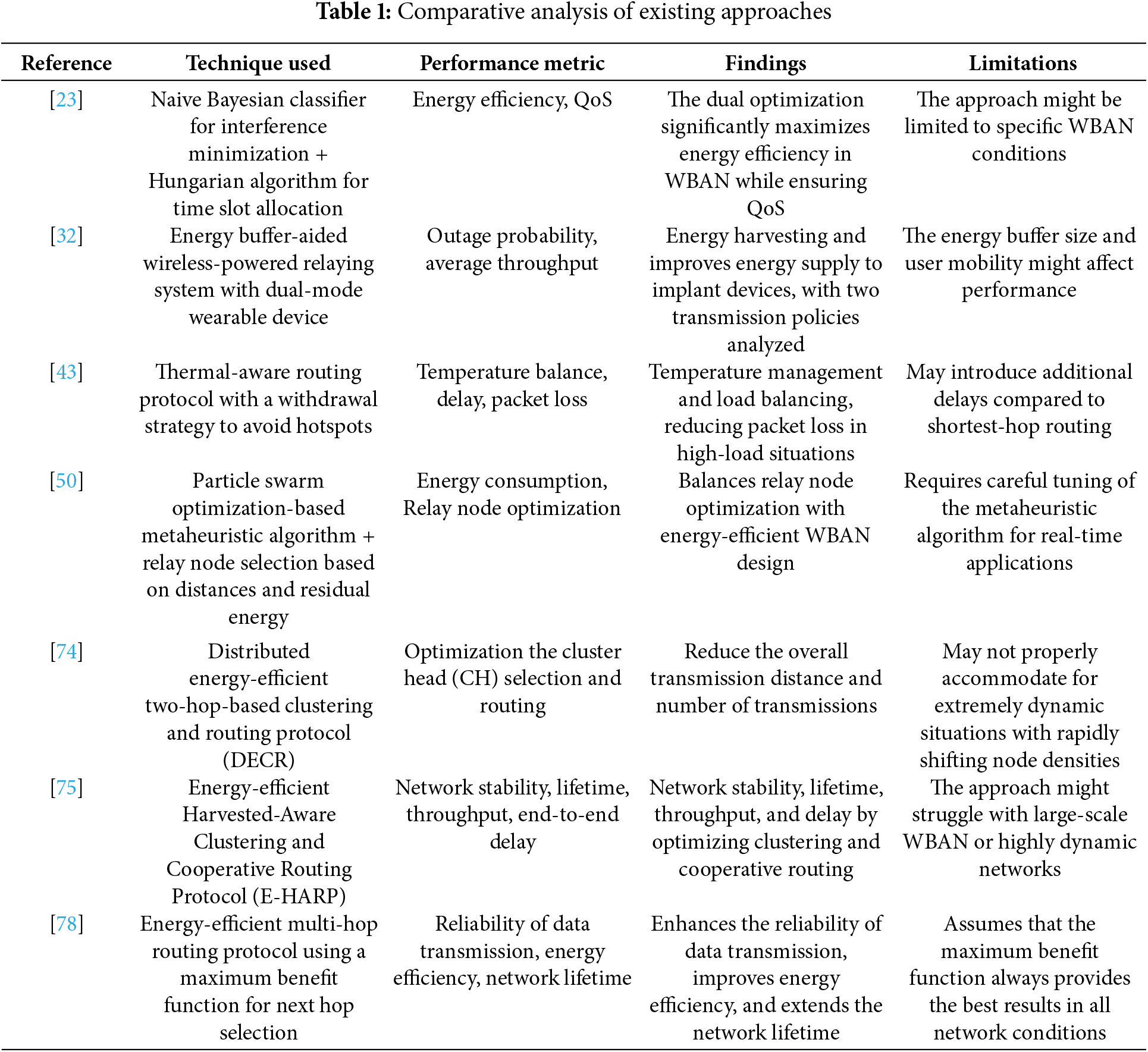
Therefore, the research challenges that have been raised after reviewing the literature survey have been addressed in Section 2. These critical issues, which limit the performance of the WBAN as discussed in the research gaps have been addressed with the help of the ARAP protocol. The comparative analysis of the existing approaches is also shown in Table 1, which includes the limitations of these approaches.
In this research work, the ARAP for WBAN is proposed as a hybrid routing protocol designed to reduce energy consumption while maintaining network QoS. The ARAP protocol employs neutrosophic relay node selection techniques, incorporating the AHP to enhance decision-making in selecting optimal relay nodes.
ARAP introduces a novel relay node selection method by integrating neutrosophic-AHP and TOPSIS techniques to optimize network performance. The model consists of several key components: sensor nodes are strategically positioned on the body, with their initial energy levels and placements recorded. This setup serves as the foundation for subsequent data transmission and relay node selection. During the relay candidate discovery process, nodes transmit control messages containing key metrics such as residual energy, traffic load, and node criticality to identify potential relay nodes. At this stage, neutrosophic-AHP and TOPSIS are applied, where AHP assigns weights to various criteria, and TOPSIS ranks nodes based on these attributes. This ensures a robust decision-making process that accounts for both objective data and subjective uncertainties. Once relay nodes are selected, they facilitate data transmission from sensor nodes to the sink, enhancing energy efficiency and data reliability. The novelty of ARAP lies in its advanced relay node selection approach, leveraging neutrosophic-AHP and TOPSIS. Neutrosophic-AHP, an extension of classical AHP, employs neutrosophic sets to handle ambiguity, vagueness, and uncertainty in decision-making. These sets are defined by truth (T), falsity (F), and indeterminacy (I), providing a more nuanced representation of uncertainty, an essential factor in complex systems like WBAN, where information may be incomplete or subjective.
This architecture allows for real-time data acquisition and processing, enabling efficient healthcare monitoring, early diagnosis, and timely treatment. ARAP increases data credibility, minimizes communication latency, and maximizes energy efficiency in WBAN applications. Conventional AHP structures and process decisions are made by partitioning them into a hierarchy and employing a judgment scale to measure the relative significance of the criteria. However, neutrosophic-AHP enhances this by employing neutrosophic numbers to capture the degrees of truth, falsity, and indeterminacy, thus strengthening the process and making it more precise. Thus, TOPSIS was employed to determine the optimal solutions by computing the distances between the negative ideal solution and the ideal solution. In the context of WBAN, TOPSIS evaluates relay node candidates based on criteria such as node density, node criticality, traffic load, signal-to-noise ratio, and residual energy. This process involves criteria weighting using neutrosophic-AHP, calculating the distances between the ideal and negative ideal solutions, and ranking the candidates based on their proximity to a perfect solution. Integrating neutrosophic-AHP and TOPSIS in this research uniquely enhances the decision-making process, effectively handles uncertainty, and provides a more reliable and accurate selection of relay nodes, optimizing network performance and energy efficiency in a dynamic and unpredictable WBAN environment.
Fig. 1 is a general diagram of the proposed health monitoring system using a WBAN. The system gathers essential physiological data through various sensors, including EEG, ECG, blood pressure, body temperature, blood oxygen, and EMG, applied to the body. This data is transmitted through a relay node to a PDA device, which then forwards it to a medical server for monitoring and analysis.

Figure 1: Proposed model of ARAP
The ARAP methodology is grounded in advanced mathematical frameworks and decision-making processes for Body Area Networks. The flowchart (Fig. 2) depicts ARAP, an energy-efficient hybrid routing strategy for WBAN. The process begins with the initialization of the sensor nodes on the body, followed by broadcasting control messages to gather essential data. The weights for various criteria are subsequently computed via neutrosophic-AHP, after which node ranking is performed using TOPSIS. Based on these rankings, the most suitable relay nodes are selected, and data transfer is enabled to ensure efficient and reliable monitoring of health parameters.

Figure 2: Flow chart of adaptive relay-assisted protocol for WBAN
The neutrosophic-AHP method calculates the weights of each criterion by establishing a comparison matrix and performing consistency checks. The criteria used are Residual Energy (Eresi), Traffic Load (TL), Node Density (ND), Signal-To-Noise Ratio (SNR), Euclidean Distance and Node Criticality (NC). TOPSIS is then used to rank the nodes based on these weighted criteria so that the most suitable relay node can be chosen. The details of these criteria are as follows:
(i) Residual Energy: This metric measures the residual battery amount of batteries in the sensor nodes.
where Einitial denotes the initial energy and Eused represents the energy consumed by the sensor node.
(ii) Traffic Load: This condition assesses the load on a sensor node to determine data accessibility.
where tr represents the occupied timeslot within the frame, and q represents the available timeslots.
(iii) Node Density: This measures the number of neighboring nodes to a sensor node, which influences potential relay choices.
where NDi represents the number of neighbors of the sensor node and ND0 denotes the optimal number of neighbors.
(iv) Signal-to-Noise Ratio: This measure is used to test the quality of the communication link by measuring the power ratio of the signal to noise.
where Psignal denotes the signal power, and Pnoise represents the noise power.
(v) Euclidean Distance: This metric is used to determine the distance between nodes, which affects energy consumption and transmission quality.
where x1 and y1 denote the coordinates of the first node, and x2 and y2 represent the coordinates of the second node, respectively.
(vi) Node Criticality (NC): This value quantifies the importance of a node within a network in terms of a variety of factors, such as the information it handles, its remaining energy, and connectivity. NC can be calculated through a weighted sum of relevant factors, such as the priority of critical data, the number of connections a node has, and its remaining energy. The precise formula may change depending on the specific applications and requirements of a network. The ARAP operation involves the integration of advanced mathematical models and decision-making frameworks, which are keys to identifying optimal relay nodes in a network.
Determining the optimal nodes is instrumental in minimizing power consumption without compromising the quality of the transmitted data. The use of neutrosophic-AHP is one of the pillars of ARAP. This method calculates the weights of various criteria that influence the selection of relay nodes. The criteria include residual energy, traffic load, node density, signal-to-noise ratio, Euclidean distance, and node criticality. The energy remaining in the sensor nodes is known as residual energy, which is essential for the network’s lifespan. The quantity of data that must be sent is referred to as traffic load, and handling it effectively prevents network congestion. Node density and SNR are keys to determining the quality and reliability of communication links. Euclidean distance is used to calculate the spatial relationships between nodes, influencing the efficiency of data transmission. Node criticality assesses the importance of nodes in maintaining network functionality.
3.2.1 Proposed Algorithm: Relay Node Selection for ARAP
The following are the various steps of proposed Algorithm 1:

A systematic multi-criteria decision-making process is used in the suggested relay node selection algorithm. Important parameters like traffic load, node density, SNR, residual energy, Euclidean distance, and node criticality are established in Step 1. For these criteria, a pairwise comparison matrix is created in Step 2, and in Step 3, the matrix is normalized to determine priority weights. To guarantee the stability of the matrix, a consistency check is carried out in Step 4 and any necessary revisions are made in Step 5. Only sensor nodes that meet the consistency ratio are chosen for additional examination in Step 6. For these qualified nodes, Step 7 creates a decision matrix containing criterion values, which Step 8 normalizes. Step 9 then uses neutrosophic-AHP to weight the normalized matrix. The ideal and negative-ideal solutions are defined in Step 10, and the distance between each relay node and these reference points is determined in Step 11. In Step 12, the most optimal relay node is determined by ranking the nodes according to how close they are to the ideal solution.
Step 1: Construct a pairwise comparison matrix A for the criteria:
A pairwise comparison matrix (A) is constructed to evaluate the relative importance of each criterion against the others. The value Aij represents how much more important criterion i is compared to criterion j. The matrix is reciprocal, meaning Aij = 1/Aij, and diagonal elements are always 1.
Step 2: Normalize the matrix:
Each element of the matrix is divided by the sum of its column to normalize the comparison matrix. This step ensures all values are scaled appropriately for further calculations.
Step 3: Calculate the priority vector (weights):
The normalized matrix is used to calculate the average of each row, resulting in the weight (priority) of each criterion. This vector reflects the relative importance of each criterion in decision making.
Step 4: Perform consistency check:
If
To ensure the judgments made in the pairwise comparison matrix are consistent, the maximum eigenvalue (λmax) is calculated. Using this, the consistency index (CI) and consistency ratio (CR) are derived. If CR < 0.1, the matrix is considered consistent; otherwise, the comparisons should be revised.
Step 5: Normalize decision matrix D:
The decision matrix, which contains performance values of alternatives (sensor nodes) with respect to each criterion, is normalized using vector normalization. This step removes the scale differences among criteria.
Step 6: Calculate weighted normalized matrix V:
Each element of the normalized decision matrix is multiplied by its corresponding criterion weight to obtain the weighted normalized matrix. This gives more influence to more important criteria.
Step 7: Determine ideal (
For each criterion, the best (ideal) and worst (negative-ideal) values are identified. For benefit-type criteria, the ideal is the maximum value, and for cost-type criteria, it is the minimum.
Step 8: Calculate distances
The Euclidean distance of each alternative from the ideal and negative-ideal solutions is calculated. These distances (
Step 9: Calculate relative closeness to the ideal solution
The relative closeness (
Step 10: Rank nodes by
Sensor nodes (alternatives) are ranked in descending order based on their Ci values. The node with the highest score is considered the most suitable or qualified.
4 Simulation & Experimental Results
The results demonstrated significant improvements across all QoS parameters. The ARAP protocol was implemented using the advanced computational tool MATLAB 2023 to ensure accurate modeling and simulation. Simulations were conducted on a configuration featuring a latest-generation Intel Core i7 processor, which offers high computational power and speed.
This choice of processor played a crucial role in handling the extensive calculations required in the multi-criteria decision-making processes inherent in the operation of the protocol. Furthermore, the system utilizes a 64-bit version of the Windows 10/11 operating system to provide a stable and compatible platform for running MATLAB and accommodating the required drivers and software.
In this study, the network consists of eight sensor nodes and one sink node, with relay nodes selected randomly. Each sensor node is initialized with an energy level of 0.5 J. The initial energy is significant as it determines the operational lifespan of network. The packet size is set to 50 bits, and the transmission and reception energy costs are 16.7 and 36.1 nJ/bit, respectively. The amplification energy is 1.97 nJ/bit/mn. These parameters ensure effective communication and data reliability within the WBAN, as detailed in Table 2.
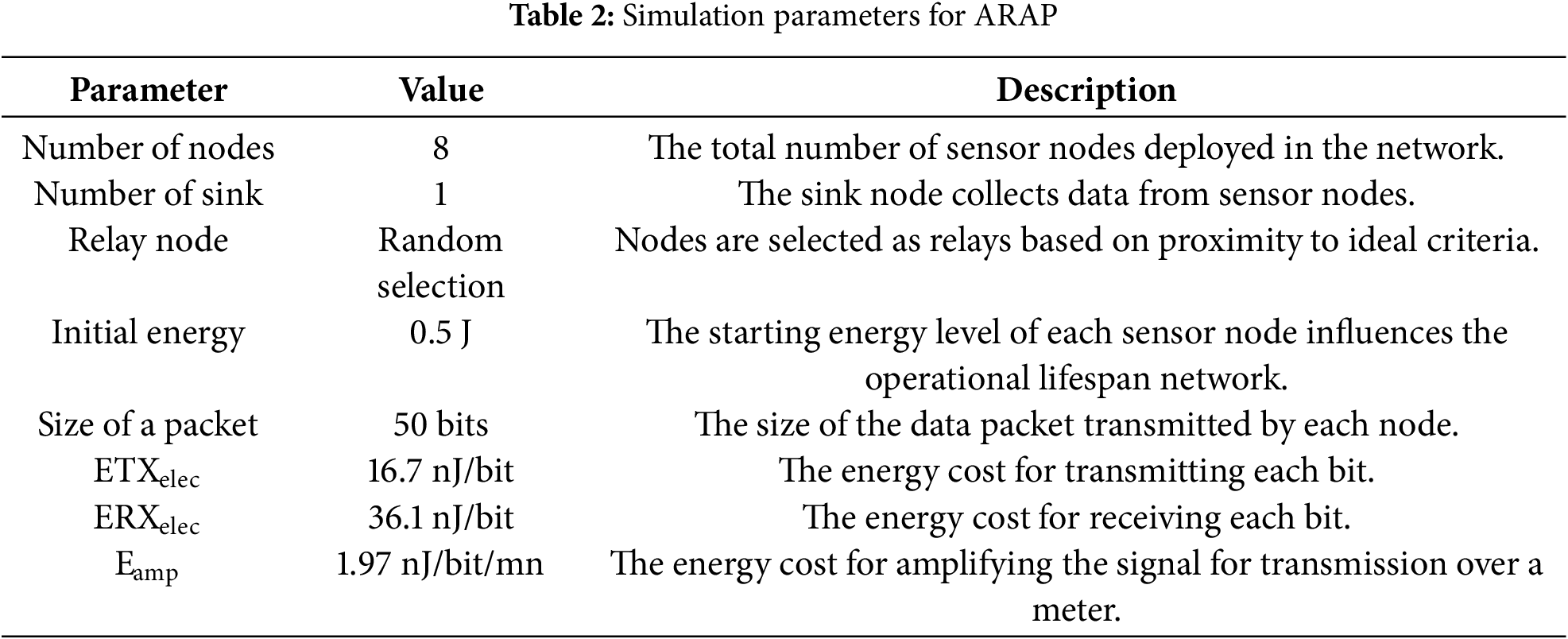
The above parametric values used in the network setup are typically informed by previous research [81], real-world sensor hardware specifications and simulation frameworks commonly used in similar studies. Simulation tools like NS-2/3, MATLAB WSN model, or OMNeT++ often use these or similar values.
A WBAN network for ARAP is formed, consisting of eight sensor nodes and one sink node. All nodes sense data and transmit it to the sink. The deployment of the sensor nodes on the human body is shown in Table 3.

The proposed protocol exhibited superior performance across all measured metrics compared to existing protocols such as LEACH, M-ATTEMPT, WASP, and TMQoS. It achieved a significantly higher throughput which is ensuring more reliable data delivery and efficient network bandwidth utilization. Additionally, the average delay was reduced to 350 ms, attributed to the efficient selection of relay nodes.
Furthermore, the ARAP protocol attained a throughput 3.35 × 10⁴ bps, outperforming LEACH and TMQoS 3.30 × 10⁴ bps, M-ATTEMPT 3.25 × 10⁴ bps and WASP 3.10 × 10⁴ bps due to its effective relay node selection and data transmission process, as illustrated in Fig. 3a. The average delay was significantly reduced to 350 ms, compared to 450 ms for LEACH, 710 ms for M-ATTEMPT, 770 ms for WASP, and 715 ms for TMQoS, indicating that ARAP efficiently manages data traffic and minimizes congestion, as shown in Fig. 3b.

Figure 3: Performance metrics (a) throughput; (b) delay; (c) network lifetime; (d) residual energy; (e) energy consumption; (f) network communication cost
Fig. 3c illustrates that the network lifetime was notably extended to about 5000 rounds, significantly surpassing 4000 rounds for LEACH, 2550 rounds for M-ATTEMPT, 2600 rounds for WASP, and 2500 rounds for TMQoS, reflecting optimized energy consumption within the network. Additionally, the residual energy per node was, on average, 0.3 J, as depicted in Fig. 3d, compared to 0.2 J for LEACH, 0.25 J for M-ATTEMPT, 0.18 J for WASP, and 0.19 J for TMQoS, demonstrating improved energy conservation and management. Furthermore, as shown in Fig. 3e, total energy consumption was reduced by 30%, with ARAP consuming only 0.3 J per round compared to 0.4 J for LEACH, 0.35 J for M-ATTEMPT, 0.42 J for WASP, and 0.41 J for TMQoS, highlighting the efficiency of the relay node selection mechanism. Network communication cost is a key parameter for evaluating the effectiveness of routing protocols in WBAN. It determines the number of bits transmitted within the network and provides an estimate of transmission energy consumption efficiency. Lower communication costs imply more efficient data management, reduced energy expenditure, and an extended network lifespan. In ARAP, communication cost efficiency plays a significant role compared to the LEACH protocol. ARAP achieves a remarkable 25% reduction in communication costs. Similarly, compared to M-ATTEMPT, ARAP reduces communication costs by approximately 17%, illustrating its superior ability to minimize excessive data transmissions. Even when compared with WASP and TMQoS, ARAP demonstrated notable improvements, with communication cost savings of 29% and 32%, respectively.
These savings result from ARAP advanced relay node selection and optimal data transmission operations, which transmit only the required data. Not only is energy saved, but the network’s operating life is also extended by a significant margin. By including network communication costs in the analysis, this study highlights the crucial role of efficient data management in enhancing the overall efficiency and lifetime of WBAN protocols. Fig. 3f illustrates the network communication cost (in bits) relative to the number of rounds for the five routing protocols: ARAP, LEACH, M-ATTEMPT, WASP, and TMQoS. Communication cost is a significant measure of data transmission efficiency in WBAN because it directly affects the amount of data that each protocol can transmit per unit of energy consumed. A lower communication cost translates to efficient data transmission, leading to a longer network lifetime and improved performance.
This study introduced ARAP as an innovative routing protocol for WBAN, addressing critical challenges in energy efficiency and QoS optimization. By integrating neutrosophic-AHP and TOPSIS for relay node selection, ARAP effectively adapts to the uncertainties and dynamic nature of WBAN environments. Comparative analysis with traditional protocols, including LEACH, M-ATTEMPT, WASP, and TMQoS, demonstrated ARAP’s superior performance in prolonging network lifespan, reducing energy consumption, and improving data transmission reliability. These findings confirm ARAP as a viable and energy-efficient solution for continuous health monitoring applications.
The practical implications of this study are significant. ARAP enhances WBAN performance, making it particularly beneficial for healthcare applications such as patient monitoring, where reliable and energy-efficient data transmission is crucial. Additionally, its potential use in fields like sports analytics and military operations highlights its versatility. However, the protocol has certain limitations. The computational complexity of neutrosophic-AHP and TOPSIS may pose challenges for real-time implementation in resource-constrained environments. Furthermore, performance evaluations rely on simulations, which may not fully represent real-world WBAN conditions.
Future research should focus on optimizing the computational efficiency of ARAP and potentially incorporating machine learning for adaptive relay node selection. Additionally, integrating energy harvesting technologies could further enhance network longevity. Comprehensive real-world testing is essential to validate the scalability and effectiveness of ARAP, across diverse environments.
Acknowledgement: Not applicable.
Funding Statement: The authors received no specific funding for this study.
Author Contributions: The authors declare their contributions to the paper as follows: Study conception and design, analysis and interpretation of results, draft manuscript preparation with editing: Surender Singh; data collection and validation, manuscript review: Naveen Bilandi. All authors reviewed the results and approved the final version of the manuscript.
Availability of Data and Materials: The data that support the findings of this study are available from the corresponding author upon reasonable request.
Ethics Approval: Not applicable.
Conflicts of Interest: The authors declare no conflicts of interest to report regarding the present study.
List of Abbreviations
| Abbreviation | Meaning |
| AP | Access Point |
| ARAP | Adaptive Relay-Assisted Protocol |
| CI | Consistency Index |
| CR | Consistency Ratio |
| ECG | Electrocardiogram |
| EEG | Electroencephalogram |
| EMG | Electromyography |
| GTS | Guaranteed Time Slot |
| LEACH | Low-Energy Adaptive Clustering Hierarchy |
| M-ATTEMPT | Mobility-Aware Thermal and Energy-Efficient Multihop Protocol |
| NC | Node Criticality |
| Neutrosophic-AHP | Neutrosophic Analytical Hierarchy Process |
| PDA | Personal Digital Assistant |
| PS | Personal Server |
| QoS | Quality of Service |
| SNR | Signal-to-Noise Ratio |
| SPI | Serial Peripheral Interface |
| TMQoS | Thermal-Aware Multi-QoS Routing Protocol |
| TOPSIS | Technique for Order of Preference by Similarity to Ideal Solution |
| WASP | Wireless Autonomous Spanning Tree Protocol |
| WBAN | Wireless Body Area Network |
References
1. Chen M, Gonzalez S, Vasilakos A, Cao H, Leung VC. Body area networks: a survey. Mob Netw Appl. 2011;16(2):171–93. doi:10.1007/s11036-010-0260-8. [Google Scholar] [CrossRef]
2. Movassaghi S, Abolhasan M, Lipman J, Smith D, Jamalipour A. Wireless body area networks: a survey. IEEE Commun Surv Tutor. 2014;16(3):1658–86. doi:10.1109/SURV.2013.121313.00064. [Google Scholar] [CrossRef]
3. Natarajan A, Motani M, Srinivasan V. Investigating network architectures for body sensor networks. Int J Wirel Inf Netw. 2009;16(3):65–74. doi:10.1145/1248054.1248061. [Google Scholar] [CrossRef]
4. Khan RA, Pathan ASK. The state-of-the-art wireless body area sensor networks: a survey. Int J Distrib Sens Netw. 2018;14(4):1550147718768994. doi:10.1177/15501477187689. [Google Scholar] [CrossRef]
5. Hasan K, Biswas K, Ahmed K, Nafi NS, Islam MS. A comprehensive review of wireless body area network. J Netw Comput Appl. 2019;143(2):178–98. doi:10.1016/j.jnca.2019.06.016. [Google Scholar] [CrossRef]
6. Tao W, Liu T, Zheng R, Feng H. Gait analysis using wearable sensors. Sensors. 2012;12(2):2255–83. doi:10.3390/s120202255. [Google Scholar] [PubMed] [CrossRef]
7. Pantelopoulos A, Bourbakis NG. A survey on wearable sensor-based systems for health monitoring and prognosis. IEEE Trans Syst Man Cybern C Appl Rev. 2009;40(1):1–12. doi:10.1109/TSMCC.2009.2032660. [Google Scholar] [CrossRef]
8. Ullah S, Khan P, Ullah N, Saleem S, Higgins H, Kwak KS. A review of wireless body area networks for medical applications. arXiv:1001.0831. 2010. doi:10.48550/arXiv.1001.0831. [Google Scholar] [CrossRef]
9. Zhong L, Ling Z, Hu F, Shao M. Technological requirements and challenges in wireless body area networks for health monitoring: a comprehensive survey. Sensors. 2022;22(9):3539. doi:10.3390/s22093539. [Google Scholar] [PubMed] [CrossRef]
10. Ling Z, Hu F, Shao M. The optimal control policy for point-to-point wireless body area network based on simultaneous time-ratio and transmission power allocation. IEEE Access. 2019;7:46454–60. doi:10.1109/ACCESS.2019.2901969. [Google Scholar] [CrossRef]
11. Faheem M, Abbas MZ, Tuna G, Gungor VC. EDHRP: energy efficient event-driven hybrid routing protocol for densely deployed wireless sensor networks. J Netw Comput Appl. 2015;58:309–26. doi:10.1016/j.jnca.2015.08.002. [Google Scholar] [CrossRef]
12. He P, Han X, Liu H. Chain modelling of molecular communications for body area network. Sensors. 2019;19(2):395. doi:10.3390/s19020395. [Google Scholar] [PubMed] [CrossRef]
13. Ehyaie A, Hashemi M, Khadivi P. Using a relay network to increase the lifetime in wireless body area sensor networks. In: Proceedings of the 2009 IEEE International Symposium on a World of Wireless, Mobile and Multimedia Networks & Workshops; 2009 Jun 15–19; Kos, Greece. p. 1–6. doi:10.1109/WOWMOM.2009.5282405. [Google Scholar] [CrossRef]
14. Punj R, Kumar R. Technological aspects of WBANs for health monitoring: a comprehensive review. Wirel Netw. 2019;25(3):1125–57. doi:10.1007/s11276-018-1694-3. [Google Scholar] [CrossRef]
15. Javaid N, Ahmad A, Nadeem Q, Imran M, Haider N. LEACH: improved stable increased-throughput multi-hop link efficient routing protocol for Wireless Body Area Networks. Comput Hum Behav. 2015;51(4):1003–11. doi:10.1016/j.chb.2014.10.005. [Google Scholar] [CrossRef]
16. Khan NA, Javaid N, Khan ZA, Jaffar M, Rafiq U, Bibi A. Ubiquitous healthcare in wireless body area networks. In: Proceedings of the 2012 IEEE 11th International Conference on Trust, Security and Privacy in Computing and Communications; 2012 Jun 25–27; Liverpool, UK. p. 1960–7. doi:10.1109/TrustCom.2012.289. [Google Scholar] [CrossRef]
17. Bhardwaj T, Reyes C, Upadhyay H, Sharma SC, Lagos L. Cloudlet-enabled wireless body area networks (WBANsa systematic review, architecture, and research directions for QoS improvement. Int J Syst Assur Eng Manag. 2022;2022(4):1–25. doi:10.1007/s13198-021-01508-x. [Google Scholar] [CrossRef]
18. Bilandi N, Verma HK, Dhir R. Performance and evaluation of energy optimization techniques for wireless body area networks. Beni-Suef Univ J Basic Appl Sci. 2020;9(1):1–11. doi:10.1186/s43088-020-00064-w. [Google Scholar] [CrossRef]
19. Gao T, Jin RC, Song JY, Xu TB, Wang LD. Energy-efficient cluster head selection scheme based on multiple criteria decision making for wireless sensor networks. Wirel Pers Commun. 2012;63(4):871–94. doi:10.1007/s11277-010-0172-8. [Google Scholar] [CrossRef]
20. Afsana F, Asif-Ur-Rahman M, Ahmed MR, Mahmud M, Kaiser MS. An energy conserving routing scheme for wireless body sensor nanonetwork communication. IEEE Access. 2018;6:9186–200. doi:10.1109/ACCESS.2018.2789437. [Google Scholar] [CrossRef]
21. Tan L, Hai X, Ma K, Fan D, Qiu H, Feng Q. Digital twin-enabled decision-making framework for multi-UAV mission planning: a multiagent deep reinforcement learning perspective. In: Proceedings of the /IECON 2023-49th Annual Conference of the IEEE Industrial Electronics Society; 2023 Oct 16–19; Singapore. p. 1–6. [Google Scholar]
22. Majumdar P, Roy S, Sikdar S, Ghosh P, Ghosh N. A survey on data-driven approaches for reliability, robustness, and energy efficiency in wireless body area networks. Sensors. 2024 Oct 10;24(20):6531. doi:10.3390/s24206531. [Google Scholar] [PubMed] [CrossRef]
23. Guo K, Qian Y. A dual optimization mechanism for energy efficiency in wireless body area networks based on Naive Bayesian classifier and Hungarian algorithm. IEEE Internet Things J. 2023;11(6):11021–30. doi:10.1109/jiot.2023.3329188. [Google Scholar] [CrossRef]
24. Abdullah AM. An efficient energy-aware and reliable routing protocol to enhance the performance of wireless body area networks. J Supercomput. 2024;80(10):14773–98. doi:10.1007/s11227-024-06039-3. [Google Scholar] [CrossRef]
25. Hussain A, Hussain T, Faisal F, Ali I, Khalil I, Nazir S, et al. DLSA: delay and link stability aware routing protocol for flying ad-hoc networks (FANETs). Wirel Pers Commun. 2021;121(4):2609–34. doi:10.1007/s11277-021-08839-9. [Google Scholar] [CrossRef]
26. Hussain A, Shah B, Hussain T, Ali F, Kwak D. Co-DLSA: cooperative delay and link stability aware with relay strategy routing protocol for flying ad-hoc network. Hum Cent Comput Inf Sci. 2022;12(34):428–47. doi:10.21203/rs.3.rs-905038/v1. [Google Scholar] [CrossRef]
27. Cicioğlu M, Çalhan A. Energy efficiency solutions for IEEE 802.15.6 based wireless body sensor networks. Wirel Pers Commun. 2021;119(2):1499–513. doi:10.1007/s11277-021-08292-8. [Google Scholar] [CrossRef]
28. Rismanian Yazdi F, Hosseinzadeh M, Jabbehdari S. A hybrid protocol for energy management in wireless body area networks. Wirel Pers Commun. 2021;121(4):2973–87. doi:10.1007/s11277-021-08859-5. [Google Scholar] [CrossRef]
29. Ahmad N, Shahzad B, Arif M, Izdrui D, Ungurean I, Geman O. An energy-efficient framework for WBAN in health care domain. J Sens. 2022;2022(1):5823461. doi:10.1155/2022/5823461. [Google Scholar] [CrossRef]
30. Anbarasan HS, Natarajan J. Blockchain-based delay and energy harvest aware healthcare monitoring system in WBAN environment. Sensors. 2022;22(15):5763. doi:10.3390/s22155763. [Google Scholar] [PubMed] [CrossRef]
31. Khani MJ, Shirmohammadi Z. UEELC: an ultra energy-efficient lossless compression method for wireless body area networks. In: Proceedings of the 2020 6th Iranian Conference on Signal Processing and Intelligent Systems (ICSPIS); 2020 Dec 23–24;Mashhad, Iran. p. 1–7. [Google Scholar]
32. Ning T, Lin C, Cai G, Xie K, He J, Huang C, et al. Energy buffer-aided wireless-powered relaying system for self-sustainable implant WBAN. IEEE Open J Commun Soc. 2024;5:2302–18. doi:10.1109/OJCOMS.2024.3385369. [Google Scholar] [CrossRef]
33. Ismael OA, Kamil AT, Jasim LA, JosephNg PS. Enhancing the performance of network in wireless body area network based on novel encryption algorithm. TELKOMNIKA. 2024;22(2):340–50. doi:10.12928/telkomnika.v22i2.24759. [Google Scholar] [CrossRef]
34. Sidhoum L, Hadjila M, Merzougui R. Chain-based routing approach to improve lifespan in wireless body area networks. TELKOMNIKA. 2024;22(2):427–34. doi:10.12928/telkomnika.v22i2.25745. [Google Scholar] [CrossRef]
35. Roshini A, Kiran KVD. Hierarchical energy-efficient secure routing protocol for optimal route selection in wireless body area networks. Int J Intell Netw. 2023;4(3):19–28. doi:10.1016/j.ijin.2022.11.006. [Google Scholar] [CrossRef]
36. Samanta A, Misra S. Dynamic connectivity establishment and cooperative scheduling for QoS-aware wireless body area networks. IEEE Trans Mob Comput. 2018;17(12):2775–88. doi:10.1109/tmc.2018.2813370. [Google Scholar] [CrossRef]
37. Bilandi N, Verma HK, Dhir R. AHP-neutrosophic decision model for selection of relay node in wireless body area network. CAAI Trans Intell Technol. 2020;5(3):222–9. doi:10.1049/trit.2020.0059. [Google Scholar] [CrossRef]
38. Bilandi N, Verma HK, Dhir R. Energy-efficient relay node selection scheme for sustainable wireless body area networks. Sustain Comput Inf Syst. 2021;30(3):100516. doi:10.1016/j.suscom.2021.100516. [Google Scholar] [CrossRef]
39. Sangwan A, Bhattacharya PP. Delay tolerant energy efficient protocol for inter-BAN communication in mobile body area networks. Int J Adv Sci Eng Inf Technol. 2018;8(3):938–48. [Google Scholar]
40. Sarcevic P, Kincses Z, Pletl S. Online human movement classification using wrist-worn wireless sensors. J Ambient Intell Hum Comput. 2019;10(1):89–106. doi:10.1007/s12652-017-0606-1. [Google Scholar] [CrossRef]
41. Smail O, Kerrar A, Zetili Y, Cousin B. ESR: energy aware and stable routing protocol for WBAN networks. In: Proceedings of the 2016 International Wireless Communications and Mobile Computing Conference (IWCMC); 2016 Sep 5–9; Paphos, Cyprus. p. 452–7. doi:10.1109/IWCMC.2016.7577100. [Google Scholar] [CrossRef]
42. Tambe SB, Gajre SS. Cluster-based real-time analysis of mobile healthcare application for prediction of physiological data. J Ambient Intell Hum Comput. 2018;9(2):429–45. doi:10.1007/s12652-017-0562-9. [Google Scholar] [CrossRef]
43. Tang Q, Tummala N, Gupta SK, Schwiebert L. TARA: thermal-aware routing algorithm for implanted sensor networks. In: International Conference on Distributed Computing in Sensor Systems. Berlin/Heidelberg, Germany: Springer; 2005. p. 206–17. doi:10.1007/11502593_17. [Google Scholar] [CrossRef]
44. Dumka A, Sah A. Smart ambulance system using concept of big data and internet of things. In: Healthcare data analytics and management. Cambridge, MA, USA: Academic Press; 2019. p. 155–76. doi:10.1016/B978-0-12-815368-0.00006-3. [Google Scholar] [CrossRef]
45. Wu T, Wu F, Redoute JM, Yuce MR. An autonomous wireless body area network implementation towards IoT connected healthcare applications. IEEE Access. 2017;5:11413–22. doi:10.1109/ACCESS.2017.2716344. [Google Scholar] [CrossRef]
46. Choudhary A, Nizamuddin M, Sachan VK. A hybrid fuzzy-genetic algorithm for performance optimization of cyber-physical wireless body area networks. Int J Fuzzy Syst. 2020;22(2):548–69. doi:10.1007/s40815-019-00751-6. [Google Scholar] [CrossRef]
47. Pardeep R, Kavithaa G. Network lifetime optimization and route selection strategy towards energy enrichment in wireless body area networks. Peer-to-Peer Netw Appl. 2024;17(3):1158–68. doi:10.1007/s12083-023-01612-8. [Google Scholar] [CrossRef]
48. Cavallari R, Martelli F, Rosini R, Buratti C, Verdone R. A survey on wireless body area networks: technologies and design challenges. IEEE Commun Surv Tutor. 2014;16(3):1635–57. doi:10.1109/SURV.2014.012214.00007. [Google Scholar] [CrossRef]
49. Nakas C, Kandris D, Visvardis G. Energy efficient routing in wireless sensor networks: a comprehensive survey. Algorithms. 2020;13(3):72. doi:10.3390/a13030072. [Google Scholar] [CrossRef]
50. Bilandi N, Verma HK, Dhir R. PSOBAN: a novel particle swarm optimization based protocol for wireless body area networks. SN Appl Sci. 2019;1(11):1–14. doi:10.1007/s42452-019-1514-0. [Google Scholar] [CrossRef]
51. Dass R, Narayanan M, Ananthakrishnan G, Kathirvel Murugan T, Nallakaruppan MK, Somayaji SRK, et al. A cluster-based energy-efficient secure optimal path-routing protocol for wireless body-area sensor networks. Sensors. 2023;23(14):6274. doi:10.3390/s23146274. [Google Scholar] [PubMed] [CrossRef]
52. Bedi P, Das S, Goyal SB, Shukla PK, Mirjalili S, Kumar M. A novel routing protocol based on grey wolf optimization and Q learning for wireless body area network. Expert Syst Appl. 2022;210(3):118477. doi:10.1016/j.eswa.2022.118477. [Google Scholar] [CrossRef]
53. Mehmood G, Khan MZ, Fayaz M, Faisal M, Rahman HU, Gwak J. An energy-efficient mobile agent-based data aggregation scheme for wireless body area networks. Comput Mater Contin. 2022;70(3):5929–48. doi:10.32604/cmc.2022.020546. [Google Scholar] [CrossRef]
54. Chatterjee K. An improved authentication protocol for wireless body sensor networks applied in healthcare applications. Wirel Pers Commun. 2020;111(4):2605–23. doi:10.1007/s11277-019-07005-6. [Google Scholar] [CrossRef]
55. Bilandi N, Verma HK, Dhir R. hybrid particle swarm optimization-simulated annealing algorithm for relay node selection in wireless body area networks. Appl Intell. 2021;51(3):1410–38. doi:10.1007/s10489-020-01834-w. [Google Scholar] [CrossRef]
56. Oleiwi SS, Mohammed GN, Al_Barazanchi I. Mitigation of packet loss with end-to-end delay in wireless body area network applications. Int J ElectrComput Eng. 2022;12(1):460–7. doi:10.11591/ijece.v12i1. [Google Scholar] [CrossRef]
57. Khani NAKK, Rana AA, Rahim S, Liaqat HB, Ahmed S. Revisiting routing protocols to design energy-aware wireless body area network. EMITTER Int J Eng Technol. 2021;9(1):1–12. doi:10.24003/emitter.v9i1.556. [Google Scholar] [CrossRef]
58. Yan S, Soh PJ, Vandenbosch GA. Wearable ultrawideband technology—a review of ultrawideband antennas, propagation channels, and applications in wireless body area networks. IEEE Access. 2018;6:42177–85. doi:10.1109/ACCESS.2018.2861704. [Google Scholar] [CrossRef]
59. Khani MJ, Shirmohammadi Z. SRCM: an efficient method for energy consumption reduction in wireless body area networks based on data similarity. Ad Hoc Sens WirelNetw. 2022;51(1–3):173–87. [Google Scholar]
60. Sun G, Zhang Y, Yu H, Du X, Guizani M. Intersection fog-based distributed routing for V2V communication in urban vehicular ad hoc networks. IEEE Trans Intell Transp Syst. 2020;21(6):2409–26. doi:10.1109/TITS.2019.2918255. [Google Scholar] [CrossRef]
61. Sun G, Song L, Yu H, Chang V, Du X, Guizani M. V2V routing in a VANET based on the autoregressive integrated moving average model. IEEE Trans Veh Technol. 2019;68(1):908–22. doi:10.1109/TVT.2018.288452. [Google Scholar] [CrossRef]
62. Mehmood B, Aadil F. An efficient clustering technique for wireless body area networks based on dragonfly optimization. Internet Things Bus Transform Dev Eng Bus Strategy Ind. 2021;5(9):27–42. doi:10.1002/9781119711148.ch3. [Google Scholar] [CrossRef]
63. Harifi S, Khalilian M, Mohammadzadeh J, Ebrahimnejad S. Emperor Penguins Colony: a new metaheuristic algorithm for optimization. Evol Intell. 2019;12(2):211–26. doi:10.1007/s12065-019-00212-x. [Google Scholar] [CrossRef]
64. Abidi B, Jilbab A, Mohamed EH. An energy efficiency routing protocol for wireless body area networks. J Med Eng Technol. 2018;42(4):290–7. doi:10.1080/03091902.2018.1483440. [Google Scholar] [PubMed] [CrossRef]
65. Sethi D, Bhattacharya PP. A study on energy efficient and reliable data transfer (EERDT) protocol for WBAN. In: Proceedings of the 2016 Second International Conference on Computational Intelligence & Communication Technology (CICT); 2016 Feb 12–13; Ghaziabad, India. Piscataway, NJ, USA: IEEE; 2016. p. 254–8. [Google Scholar]
66. Adhikary S, Choudhury S, Chattopadhyay S. A new routing protocol for WBAN to enhance energy consumption and network lifetime. In: Proceedings of the 17th International Conference on Distributed Computing and Networking; 2016 Jan 4–7; Singapore. p. 1–6. [Google Scholar]
67. Alghamdi T. Cluster-based energy-efficient routing protocol for wireless body area network. Trends Appl Sci Res. 2016;11(1):12–8. doi:10.3923/tasr.2016.12.18. [Google Scholar] [CrossRef]
68. Latha R, Vetrivelan P. Topsis based delay sensitive network selection for wireless body area networks. In: Proceedings of the 2017 International Conference on Advances in Computing, Communications and Informatics (ICACCI); 2017 Sep 13–16; Udupi, India. Piscataway, NJ, USA: IEEE; 2017. p. 736–9. [Google Scholar]
69. Aissaoui Ferhi L, Sethom K, Choubani F. Energy efficiency optimization for wireless body area networks under 802.15. 6 standard. Wirel Pers Commun. 2019;109(3):1769–79. doi:10.1007/s11277-019-06651-0. [Google Scholar] [CrossRef]
70. Zaman K, Sun Z, Hussain A, Hussain T, Ali F, Shah SM, et al. EEDLABA: energy-efficient distance- and link-aware body area routing protocol based on clustering mechanism for wireless body sensor network. Appl Sci. 2023;13(4):2190. doi:10.3390/app13042190. [Google Scholar] [CrossRef]
71. Mu J, Stewart R, Han L, Crawford D. A self-organized dynamic clustering method and its multiple access mechanism for multiple WBANs. IEEE Internet Things J. 2019;6(4):6042–51. doi:10.1109/jiot.2018.2869829. [Google Scholar] [CrossRef]
72. Mu J, Wei Y, Ma H, Li Y. Spectrum allocation scheme for intelligent partition based on machine learning for inter-WBAN interference. IEEE Wirel Commun. 2020;27(5):32–7. doi:10.1109/mwc.001.1900551. [Google Scholar] [CrossRef]
73. Sharma S, Mishra VM, Tripathi MM. Intelligent-Routing Algorithm for wireless body area networks (I-RAW). Int J Commun Syst. 2021;34(17):e4984. doi:10.1002/dac.4984. [Google Scholar] [CrossRef]
74. Arafat MY, Pan S, Bak E. Distributed energy-efficient clustering and routing for wearable IoT enabled wireless body area networks. IEEE Access. 2023;11:5047–61. doi:10.1109/access.2023.3236403. [Google Scholar] [CrossRef]
75. Ullah Z, Ahmed I, Khan FA, Asif M, Nawaz M, Ali T, et al. Energy-efficient harvested-aware clustering and cooperative routing protocol for WBAN (E-HARP). IEEE Access. 2019;7:100036–50. doi:10.1109/access.2019.2930652. [Google Scholar] [CrossRef]
76. Cai Y, Dong S, Mu J. Intelligent clustering coloring algorithm based on K-means++ algorithm in WBANs. In: Proceedings of the International Conference on Artificial Intelligence in China; 2023 Jul 22–23; Singapore. Singapore: Springer Nature; 2023. p. 297–303. [Google Scholar]
77. Shunmugapriya B, Paramasivan B. Fuzzy based relay node selection for achieving efficient energy and reliability in wireless body area network. Wirel Pers Commun. 2022;122(3):2723–43. doi:10.1007/s11277-021-09027-5. [Google Scholar] [CrossRef]
78. Qu Y, Zheng G, Wu H, Ji B, Ma H. An energy-efficient routing protocol for reliable data transmission in wireless body area networks. Sensors. 2019;19:4238. doi:10.3390/s19194238. [Google Scholar] [PubMed] [CrossRef]
79. Chang Y, Tang H, Cheng Y, Zhao Q, Yuan BLA. Dynamic hierarchical energy-efficient method based on combinatorial optimization for wireless sensor networks. Sensors. 2017;17(7):1665. doi:10.3390/s17071665. [Google Scholar] [PubMed] [CrossRef]
80. Chen X, Xu Y, Liu A. Cross layer design for optimizing transmission reliability, energy efficiency, and lifetime in body sensor networks. Sensors. 2017;17(4):900. doi:10.3390/s17040900. [Google Scholar] [PubMed] [CrossRef]
81. Anwar M, Abdullah AH, Altameem A, Qureshi KN, Masud F, Faheem M, et al. Green communication for wireless body area networks: energy aware link efficient routing approach. Sensors. 2018;18(10):3237. doi:10.3390/s18103237. [Google Scholar] [PubMed] [CrossRef]
Cite This Article
 Copyright © 2025 The Author(s). Published by Tech Science Press.
This work is licensed under a Creative Commons Attribution 4.0 International License , which permits unrestricted use, distribution, and reproduction in any medium, provided the original work is properly cited.
 Downloads
 Citation Tools
