
 Login
Login Register
 Submit a Paper
 Propose a Special lssue
 Open Access
ARTICLE

A Hybrid LSTM-Single Candidate Optimizer Model for Short-Term Wind Power Prediction
1 Department of Information Technologies, Bilecik Seyh Edebali University, Bilecik, 11100, Turkey
2 Department of Electrical Electronics Engineering, Bilecik Seyh Edebali University, Bilecik, 11100, Turkey
3 Department of Computer Engineering, Bilecik Seyh Edebali University, Bilecik, 11100, Turkey
* Corresponding Author: Mehmet Balci. Email:
(This article belongs to the Special Issue: Advanced Artificial Intelligence and Machine Learning Methods Applied to Energy Systems)
Computer Modeling in Engineering & Sciences 2025, 144(1), 945-968. https://doi.org/10.32604/cmes.2025.067851
Received 14 May 2025; Accepted 03 July 2025; Issue published 31 July 2025
 View Full Text
 Download PDF
Abstract
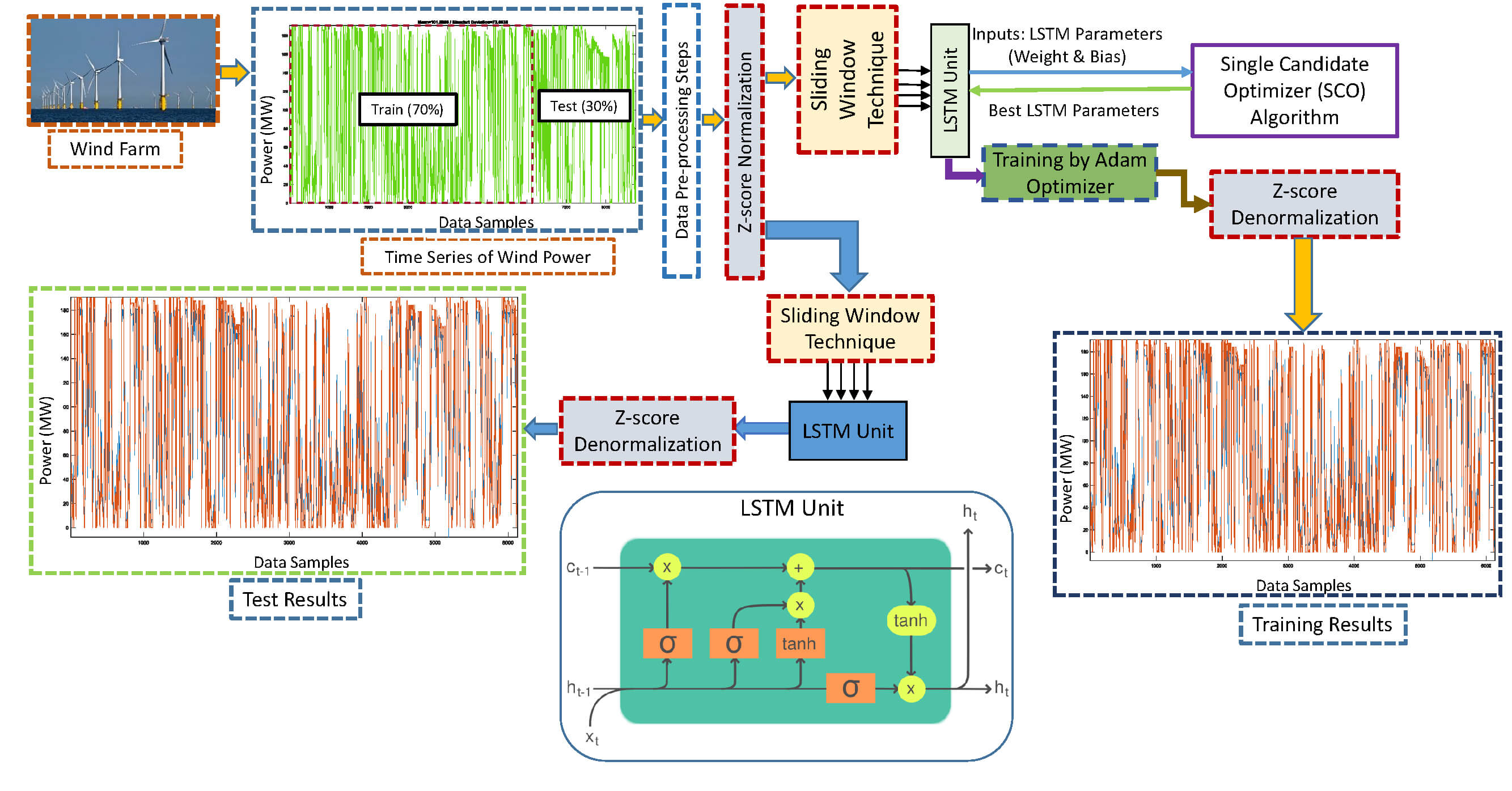
Accurate prediction of wind energy plays a vital role in maintaining grid stability and supporting the broader shift toward renewable energy systems. Nevertheless, the inherently variable nature of wind and the intricacy of high-dimensional datasets pose major obstacles to reliable forecasting. To address these difficulties, this study presents an innovative hybrid method for short-term wind power prediction by combining a Long Short-Term Memory (LSTM) network with a Single Candidate Optimizer (SCO) algorithm. In contrast to conventional techniques that rely on random parameter initialization, the proposed LSTM-SCO framework leverages the distinctive capability of SCO to work with a single candidate solution, thereby substantially reducing the computational overhead compared to traditional population-based metaheuristics. The performance of the model was benchmarked against various classical and deep learning models across datasets from three geographically diverse sites, using multiple evaluation metrics. Experimental findings demonstrate that the SCO-optimized model enhances prediction accuracy by up to over standard LSTM implementations.Graphic Abstract
Keywords
Cite This Article
 Copyright © 2025 The Author(s). Published by Tech Science Press.
This work is licensed under a Creative Commons Attribution 4.0 International License , which permits unrestricted use, distribution, and reproduction in any medium, provided the original work is properly cited.
 Downloads
 Citation Tools
