
 Login
Login Register
 Submit a Paper
 Propose a Special lssue
 Open Access
REVIEW
Human Behaviour Classification in Emergency Situations Using Machine Learning with Multimodal Data: A Systematic Review (2020–2025)
1 Department of Computer Science, Faculty of Computing, The Islamia University of Bahawalpur, Bahawalpur, 63100, Pakistan
2 Fakulti Kecerdasan Buatan dan Keselamatan Siber, Universiti Teknikal Malaysia, Melaka, 76100, Malaysia
3 Department of AI and SW, Gachon University, Seongnam, 13557, Republic of Korea
4 Fakulti Pengurusan Teknologi Dan Teknousahawanan, Universiti Teknikal Malaysia Melaka, Kampus Teknologi, Melaka, 76100, Malaysia
* Corresponding Authors: Muhammad Rehan Faheem. Email: ; Lal Khan. Email:
Computer Modeling in Engineering & Sciences 2025, 145(3), 2895-2935. https://doi.org/10.32604/cmes.2025.073172
Received 12 September 2025; Accepted 13 November 2025; Issue published 23 December 2025
 View Full Text
 Download PDF
Abstract
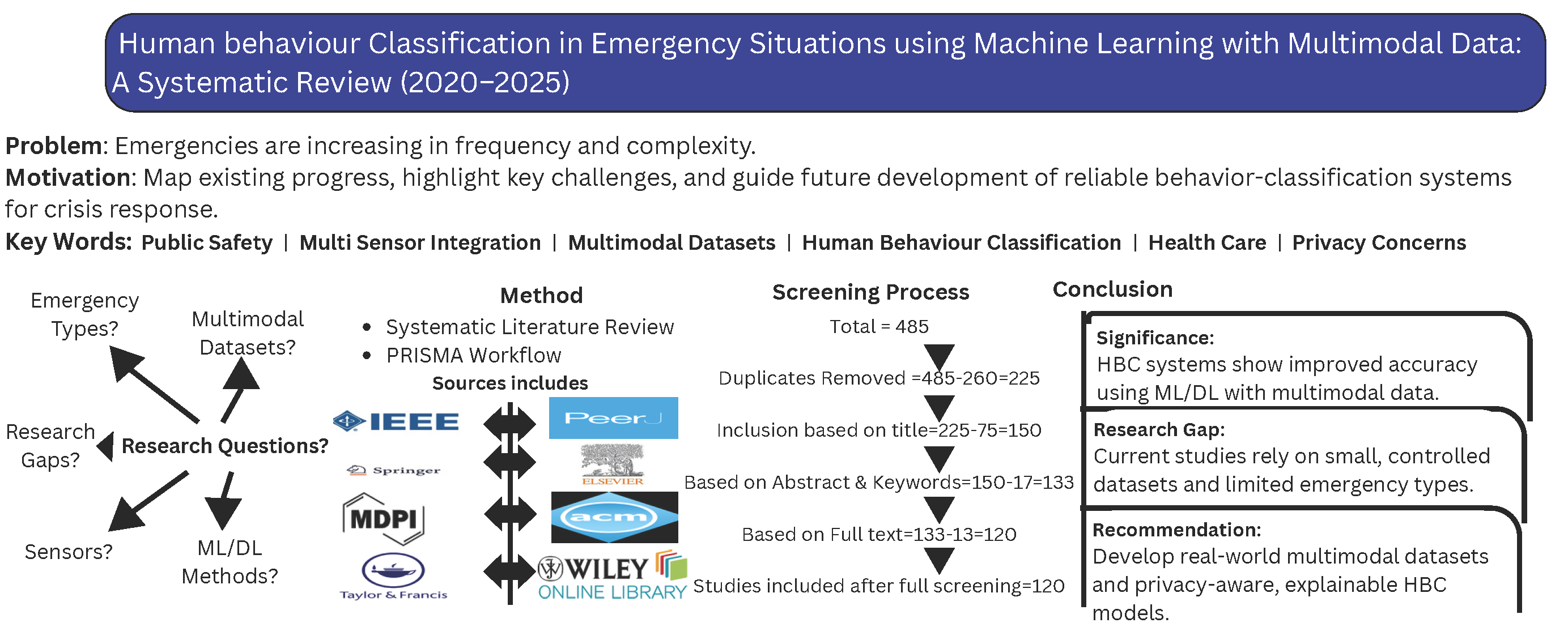
With growing urban areas, the climate continues to change as a result of growing populations, and hence, the demand for better emergency response systems has become more important than ever. Human Behaviour Classification (HBC) systems have started to play a vital role by analysing data from different sources to detect signs of emergencies. These systems are being used in many critical areas like healthcare, public safety, and disaster management to improve response time and to prepare ahead of time. But detecting human behaviour in such stressful conditions is not simple; it often comes with noisy data, missing information, and the need to react in real time. This review takes a deeper look at HBC research published between 2020 and 2025 and aims to answer five specific research questions. These questions cover the types of emergencies discussed in the literature, the datasets and sensors used, the effectiveness of machine learning (ML) and deep learning (DL) models, and the limitations that still exist in this field. We explored 120 papers that used different types of datasets, some were based on sensor data, others on social media, and a few used hybrid approaches. Commonly used models included CNNs, LSTMs, and reinforcement learning methods to identify behaviours. Though a lot of progress has been made, the review found ongoing issues in combining sensors properly, reacting fast enough, and using more diverse datasets. Overall, from the findings we observed, the focus should be on building systems that use multiple sensors together, gather real-time data on a large scale, and produce results that are easier to interpret. Proper attention to privacy and ethical concerns needs to be addressed as well.Graphic Abstract
Keywords
Supplementary Material
Supplementary Material FileCite This Article
 Copyright © 2025 The Author(s). Published by Tech Science Press.
This work is licensed under a Creative Commons Attribution 4.0 International License , which permits unrestricted use, distribution, and reproduction in any medium, provided the original work is properly cited.
 Downloads
 Citation Tools
