
 Login
Login Register
 Submit a Paper
 Propose a Special lssue
 Open Access
ARTICLE

Multipoint Deformation Prediction Model Based on Clustering Partition of Extra High-Arch Dams
1 College of Water Conservancy, Yunnan Agricultural University, Kunming, China
2 State Key Laboratory of Water Disaster Prevention, Hohai University, Nanjing, China
3 Yunnan Small and Medium-Sized Water Conservancy Project, Intelligent Management and Maintenance Engineering Research Center, Kunming, China
4 Yunnan Key Laboratory of Water Security, Kunming, China
* Corresponding Author: Dingzhu Zhao. Email:
Computer Modeling in Engineering & Sciences 2026, 146(1), 17 https://doi.org/10.32604/cmes.2026.074757
Received 17 October 2025; Accepted 07 January 2026; Issue published 29 January 2026
 View Full Text
 Download PDF
Abstract
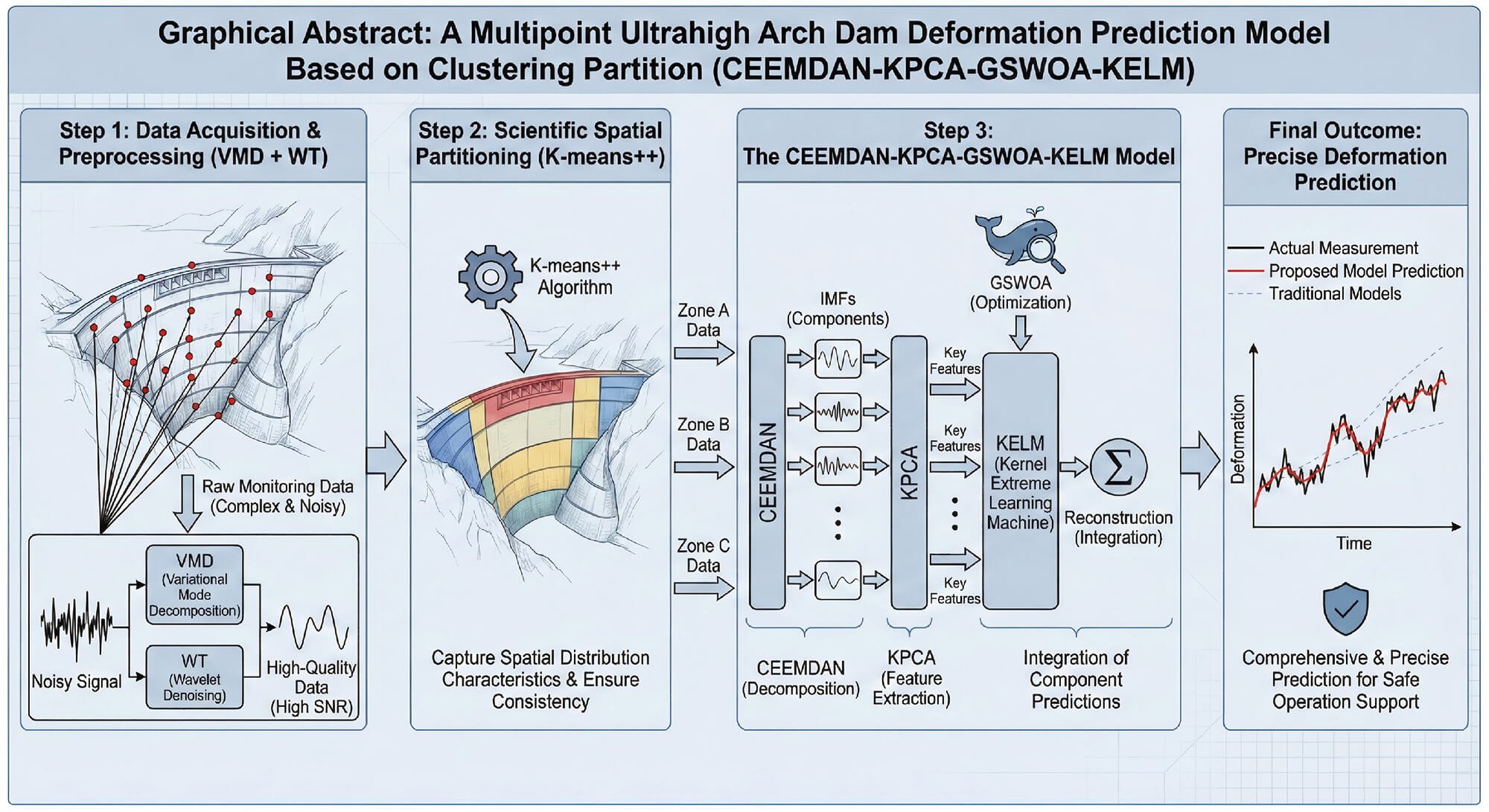
Deformation prediction for extra-high arch dams is highly important for ensuring their safe operation. To address the challenges of complex monitoring data, the uneven spatial distribution of deformation, and the construction and optimization of a prediction model for deformation prediction, a multipoint ultrahigh arch dam deformation prediction model, namely, the CEEMDAN-KPCA-GSWOA-KELM, which is based on a clustering partition, is proposed. First, the monitoring data are preprocessed via variational mode decomposition (VMD) and wavelet denoising (WT), which effectively filters out noise and improves the signal-to-noise ratio of the data, providing high-quality input data for subsequent prediction models. Second, scientific cluster partitioning is performed via the K-means++ algorithm to precisely capture the spatial distribution characteristics of extra-high arch dams and ensure the consistency of deformation trends at measurement points within each partition. Finally, CEEMDAN is used to separate monitoring data, predict and analyze each component, combine the KPCA (Kernel Principal Component Analysis) and the KELM (Kernel Extreme Learning Machine) optimized by the GSWOA (Global Search Whale Optimization Algorithm), integrate the predictions of each component via reconstruction methods, and precisely predict the overall trend of ultrahigh arch dam deformation. An extra high arch dam project is taken as an example and validated via a comparative analysis of multiple models. The results show that the multipoint deformation prediction model in this paper can combine data from different measurement points, achieve a comprehensive, precise prediction of the deformation situation of extra high arch dams, and provide strong technical support for safe operation.Graphic Abstract
Keywords
Cite This Article
 Copyright © 2026 The Author(s). Published by Tech Science Press.
This work is licensed under a Creative Commons Attribution 4.0 International License , which permits unrestricted use, distribution, and reproduction in any medium, provided the original work is properly cited.
 Downloads
 Citation Tools
