
 Login
Login Register
 Submit a Paper
 Propose a Special lssue
 Open Access
ARTICLE

A Hybrid SSA-CNN-LSTM-Transformer Model for Predicting Settlement of Buildings Adjacent to Shield Tunnels
College of Transportation Engineering, Dalian Maritime University, Dalian, China
* Corresponding Author: Annan Jiang. Email:
(This article belongs to the Special Issue: Artificial Intelligence and Advanced Numerical Modeling Integration Techniques in Tunnel and Underground Engineering)
Computer Modeling in Engineering & Sciences 2026, 148(1), 19 https://doi.org/10.32604/cmes.2026.082647
Received 19 March 2026; Accepted 05 June 2026; Issue published 27 July 2026
 View Full Text
 Download PDF
Abstract
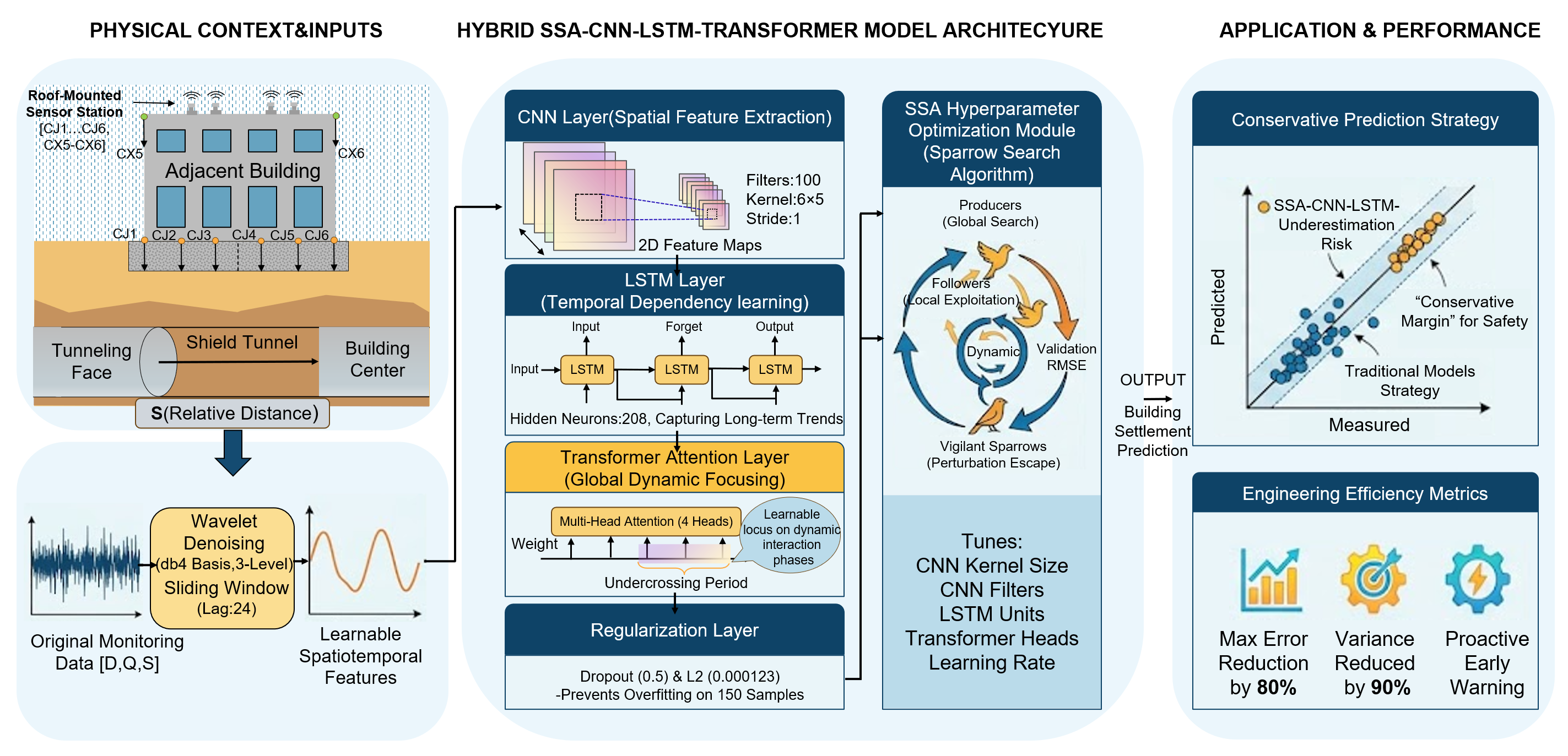
Accurate forecasting of settlement in buildings adjacent to shield tunnels remains a critical challenge in underground engineering due to complex spatiotemporal interactions and nonlinear relationships among multi-source monitoring data and construction parameters. To address this issue, a Sparrow Search Algorithm (SSA)-optimized Convolutional Neural Network–Long Short-Term Memory–Transformer (CNN-LSTM-Transformer) hybrid framework is proposed, explicitly incorporating the relative spatial relationship between the shield excavation face and adjacent structures. In this framework, the Convolutional Neural Network (CNN) module extracts spatial features from monitoring data and tunneling parameters, capturing interdependencies among different construction indicators and reflecting local spatial heterogeneity of building deformation, while the Long Short-Term Memory (LSTM) network is employed to model temporal dependencies in multi-factor time-series data, enabling the network to learn long-term settlement evolution patterns. Notably, a Transformer-based self-attention mechanism is incorporated to improve the model’s ability to capture global dependencies, highlight critical construction stages—such as the shield undercrossing period—and identify key influencing features in the multivariate data. Key hyperparameters are optimized using the Sparrow Search Algorithm (SSA), improving prediction performance, model robustness, and stability while identifying an optimal configuration. The framework is validated through a case study using real monitoring data from the east extension of Section 02 of the Nanchang Metro. Results demonstrate that the SSA-CNN-LSTM-Transformer model achieves significantly higher precision, reducing the maximum prediction error by over 80% compared to traditional LSTM and empirical Peck methods. This approach provides a reliable computational tool for proactive risk assessment, safety management, and informed decision-making in complex urban underground engineering applications.Graphic Abstract
Keywords
Cite This Article
 Copyright © 2026 The Author(s). Published by Tech Science Press.
This work is licensed under a Creative Commons Attribution 4.0 International License , which permits unrestricted use, distribution, and reproduction in any medium, provided the original work is properly cited.
 Downloads
 Citation Tools
