
 Login
Login Register
 Submit a Paper
 Propose a Special lssue
 Open Access
ARTICLE
Consensus Control Design for Heterogeneous Multi–Agent Systems in Vehicle Platooning Using an Event–Triggering Scheme
1 School of Computer Science and Technology/School of Artificial Intelligence, China University of Mining and Technology, Xuzhou, China
2 Department of Marine Engineering, National Taiwan Ocean University (NTOU), Keelung, Taiwan
3 Center for AI Research (CAIR), University of Agder (UiA), Grimstad, Norway
4 Intelligent Devices Institute, Saint Petersburg Electrotechnical University “LETI”, Saint Petersburg, Russia
5 Higher School of Artificial Intelligence Technologies, Peter the Great St. Petersburg Polytechnic University, Saint Petersburg, Russia
6 Saudi Aramco LIP Star Building, Dhahran, Saudi Arabia
7 School of Electrical Engineering, China University of Mining and Technology, Xuzhou, China
* Corresponding Authors: Wen-Jer Chang. Email: ; Hazrat Bilal. Email:
; Muhammad Aamir Aman. Email:
# These authors contributed equally to this work
Computer Modeling in Engineering & Sciences 2026, 148(3), 1 https://doi.org/10.32604/cmes.2026.084958
Received 02 May 2026; Accepted 12 August 2026; Issue published 28 September 2026
 View Full Text
 Download PDF
Abstract
In a multi-agent system, platoon vehicles receive a huge collection regarding autonomous models coordinating and their actions to improve traffic flow, lower fuel consumption, and boost safety. This paper examines the distributed consensus control problem for heterogeneous multi–agent systems (MASs) containing both first-order and second-order agents, under constrained network communication resources. Secondly, a novel event–triggered approach is proposed to tackle the problems of information transmission restrictions and bandwidth contention. Unlike conventional state-independent triggering methods, the proposed trigger condition depends on both the agent’s own state update error and the information mismatches between neighboring agents, enabling a balanced trade–off between control performance and communication reduction. By ensuring that the transmission interval always exceeds one sampling period, the event-triggered technique significantly reduces network bandwidth usage. It determines the next transmission time for both position and velocity information. Thirdly, sufficient criteria for reaching asymptotic consensus are determined using Lyapunov stability theory and Kronecker product features. The trigger parameters and controller gains are obtained by solving linear matrix inequalities (LMIs). The distributed event–triggering mechanism and the consensus control protocol are integrated into a co-design framework. The effectiveness of the suggested strategy in conserving network resources without sacrificing system stability is validated by simulation results for a heterogeneous MAS with two second–order and two first–order agents, which show that all agent states converge to common values while the number of information transmissions is significantly reduced compared to periodic sampling.Keywords
Consensus control has been widely investigated in application domains such as distributed sensor networks [1], autonomous underwater vehicles [2], and cooperative unmanned ground vehicles [3]. In the power-system domain, coordinated protection and control strategies have also been studied to improve grid resilience under the high penetration of renewable energy resources [4]. The consensus problem, a key area of MASs research, seeks to create distributed protocols that, in spite of poor communication and dynamic uncertainty, motivate all agents to agree on specific quantities of interest, such as position, velocity, or heading angle. As a result, a lot of work has been done on this subject, and the literature has revealed many significant findings [5–7]. For example, Ref. [8] used linear consensus protocols to develop a theoretical foundation for average consensus under fixed and switching topologies. Ren and Beard [9] extended consensus analysis to multi–agent systems with dynamically changing directed interaction topologies and established convergence conditions based on directed spanning–tree connectivity. In order to minimize communication frequency while maintaining convergence guarantees, Ref. [10] presented distributed event–triggered consensus techniques. Adaptive consensus controllers for heterogeneous MASs with uncertain nonlinear dynamics were developed by [11]. Sampled–data consensus systems with time–varying sampling intervals and transmission delays were examined by [12]. For second–order MASs that are susceptible to input saturation, Ref. [13] developed fixed–time consensus methods. Consensus-based distributed secondary-control schemes have also been extensively reviewed for DC microgrids [14], demonstrating the broader applicability of graph-based coordination in networked power systems. However, such power-system-oriented methods do not directly address distributed event-triggered consensus co–design for heterogeneous vehicle platoons comprising mixed first-order and second-order agents. Moreover, existing studies on self-triggered consensus, communication-impaired formation control, and stochastic multi–agent systems [15–17] consider different agent dynamics, communication conditions, or control objectives. Therefore, a unified framework combining mixed-order heterogeneous dynamics, neighbor-dependent triggering, and simultaneous LMI–based design of controller gains and triggering matrices remains insufficiently investigated. In [18], researchers combine fixed–time reference generation with a self–structuring neural network that accounts for unknown nonlinear dynamics and external disturbances to create an event–triggered formation-control scheme for underactuated unmanned surface vessels. Conversely, Ref. [19] uses a mixed event-triggered mechanism to study completely distributed leader-following consensus for nonlinear fractional-order multi–agent systems, allowing coordinated behaviour through local information while lowering communication demand, because most existing approaches either concentrate on homogeneous agent dynamics or on first–order and second–order linear models.
The above–mentioned literature is all in the study of isomorphic multi–agent systems, all of which have the same dynamic characteristics. In the actual communication–limited multi–agent system, the competition for bandwidth of heterogeneous agents makes only some agents able to transmit data, and it is necessary to rationally schedule agents to reduce the transmission of information, save network resources, and ensure the optimization of network utilization and control performance. For example, Refs. [20,21] considered cooperative output regulation of heterogeneous linear multi–agent systems based on event–triggered control. In [20], a homogeneous MASs event–triggering mechanism is first established, followed by a new distributed event trigger control scheme is proposed for the internal reference model of each multi–agent to solve the problem of heterogeneous MAS cooperative output regulation. In [21] proposed a basic event–triggered control scheme for output regulation for multi–agent models. Based on this result, a distributed self–triggering control scheme is proposed, which can avoid continuous monitoring and measurement errors. Existing studies [21–24] investigate the consensus control problem of heterogeneous multi–agent systems based on event triggering mechanism under fixed and switching topology. Because the following elements are identified in Table 1 and an unfilled research gap is eliminated, the proposed multi–agent control, in contrast to the conventional event–triggered approaches, can offer a higher level of dependability and resilience.
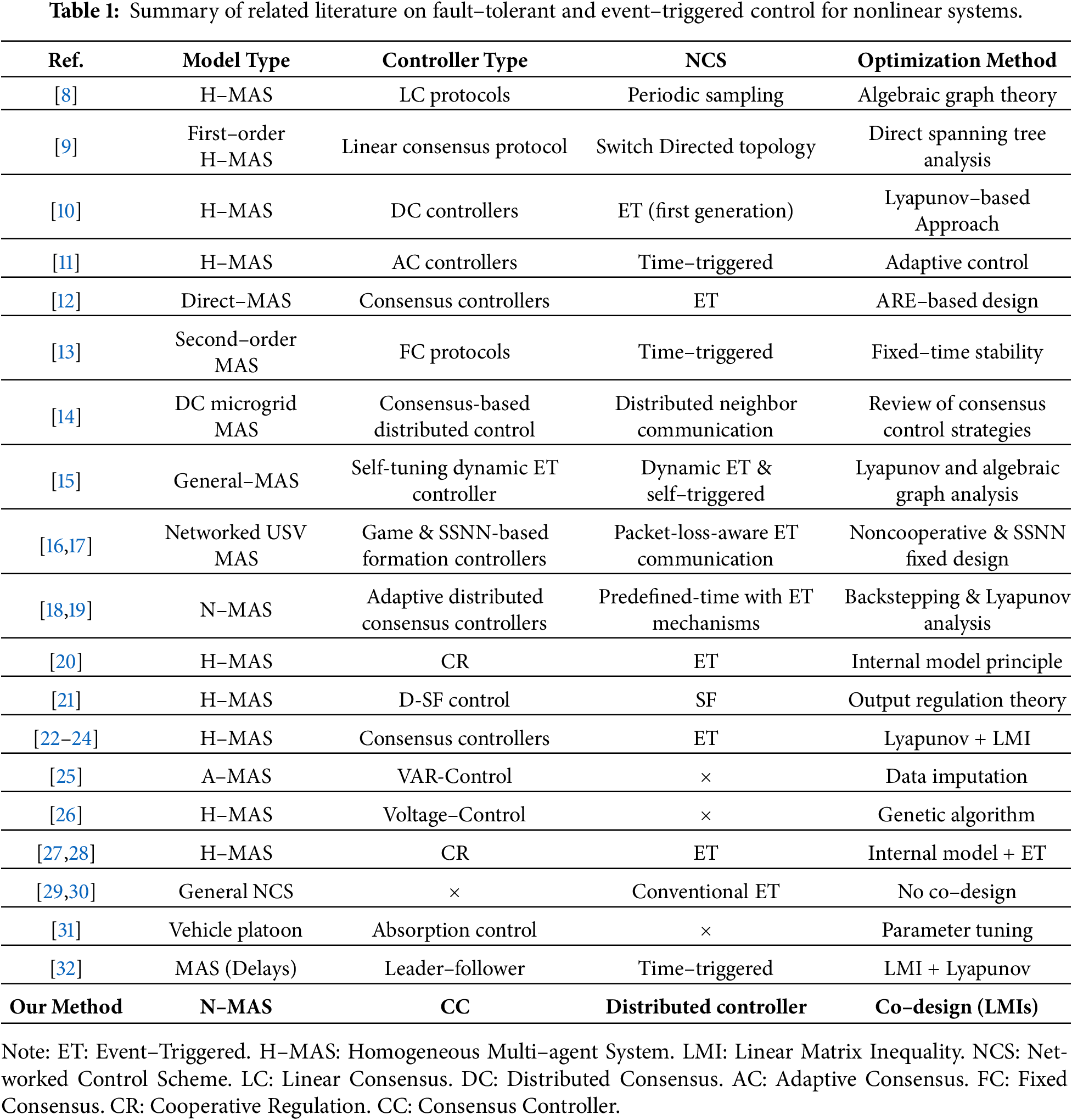
This research studies the consensus control problem for heterogeneous multi-agent systems containing both second–order and first–order agents, based on a new distributed event–triggering mechanism. Using the stability principle of the Kronecker product and Lyapunov’s function, sufficient conditions for consistency are given. The transmission strategy based on this trigger mechanism has the following improvements compared with the existing literature:
Although event-triggered consensus for MASs has been documented [10,21,24], the majority of current findings either examine first-order and second-order systems independently or concentrate on homogeneous agent dynamics. Furthermore, traditional event-triggering conditions ignore neighbor information and rely simply on the state error of each agent. On the other hand, this work’s novel contributions are:
1. This paper studies the consensus control problem of second–order and first-order heterogeneous multi–agent systems, based on a new distributed event–triggering mechanism. The authors propose a co–design method where the stability conditions (using Lyapunov–Krasovskii with Kronecker product) are solved simultaneously to obtain both the controller gains
2. Unlike traditional event–triggered mechanisms that rely only on the agent’s own state error (e.g., Refs. [19,24] mentioned in the References), the proposed trigger condition considers both the agent’s own information update error and the error between its current information and that of its neighbors.
3. The proposed strategy defines separate event–triggering functions for position and velocity, allowing independent distributed transmission of position and velocity information. The strategy determines the next transmission time for each type of information. In contrast, the agent’s own state error is employed in [19,24]. By including neighbor errors, the trigger condition directly reflects the global consensus error, leading to fewer unnecessary transmissions during transients.
4. The trigger mechanism contains multiple tunable parameters
5. While many existing studies focus on homogeneous systems with identical agent dynamics, our research explicitly addresses a heterogeneous multi-agent system comprising both first-order and second–order agents within a unified event-triggered control framework. This mechanism is designed to automatically reduce transmissions once the system reaches consensus. Specifically, when
Due to its numerous applications in distributed sensor models, power sector, wireless communication, and cooperative unmanned ground vehicles, the consensus control problem for multi–agent systems has attracted a lot of attention in the last ten years [25,26]. Early research, mostly focused on homogeneous multi-agent systems, established theoretical foundations for average consensus under fixed and switching topologies by Olfati–Saber and Murray. Later, Ren and Beard [9], extended the consensus analysis to dynamically changing directed interaction topologies and derived convergence conditions based on directed spanning-tree connectivity. Realizing that network communication resources are inherently limited, researchers such as Dimarogonas and Johansson developed event–triggered control algorithms to reduce transmission frequency while maintaining convergence guarantees. However, these early event-triggered methods mostly relied on each agent’s own state error as the triggering condition, without considering interactions with neighboring agents. Researchers have studied cooperative output regulation using event–triggered control based on internal reference models for heterogeneous multi–agent systems [27,28], where agents may have different dynamics (e.g., mixed first–order and second–order dynamics). They have also developed distributed self–triggering schemes that do not require continuous monitoring. Although consensus control for heterogeneous systems under fixed and switching topologies has been studied more recently, the majority of current methods either tackle first–order and second–order linear models independently or concentrate on homogeneous agent dynamics. The relationship between an agent and its neighbors, which contains important information about the consensus status of the entire system, is usually ignored by conventional event–triggered mechanisms, which define trigger conditions only based on the difference between an agent’s current state and its last transmitted state. Additionally, most studies treat controller design and communication scheduling as distinct problems, resulting in suboptimal trade–offs between control performance and resource utilization [29,30]. This is because the literature currently in publication lacks systematic co–design frameworks that simultaneously optimize controller gains and event–trigger parameters. The present study fills these gaps by proposing a novel event–triggered consensus control strategy that incorporates neighbor information into trigger conditions, creates independent event functions for position and velocity, and offers a co–design framework for simultaneously determining trigger parameters and controller gains using linear matrix inequalities. Thus, following are the main innovations of this paper: (i) a neighbor-information-dependent event trigger for mixed first-order/second-order heterogeneous MASs; (ii) independent event functions for position and velocity with guaranteed minimum transmission intervals via parameters
3 The Requirement of Vehicle Platoon Control Design
This research investigates a group of
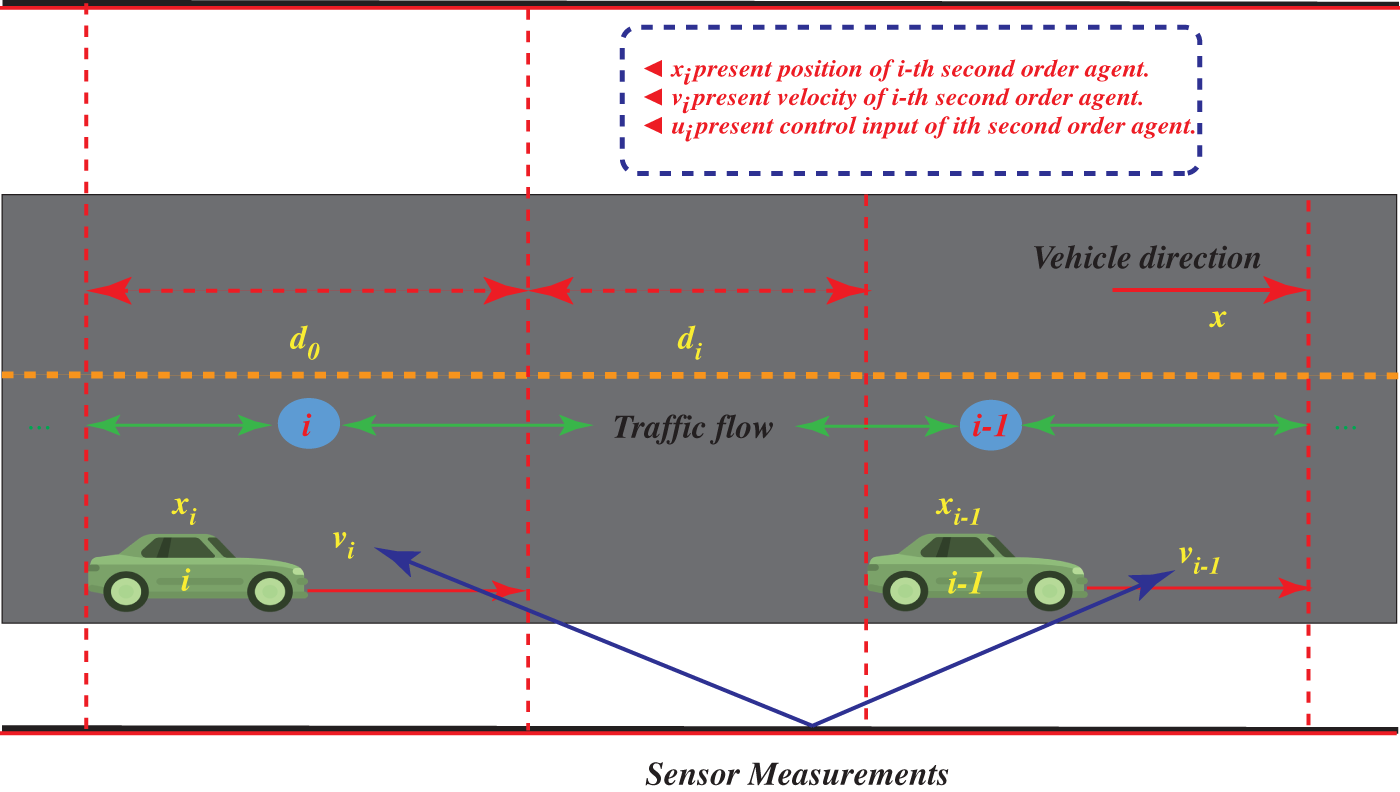
Figure 1: Two vehicles in a platoon configuration.
There are some basic necessary conditions. Every vehicle in the platoon should move at the same speed as the leader. That is,
Each follower vehicle asymptotically synchronizes its velocity with the preceding vehicle while maintaining the desired inter-vehicle spacing. The lead vehicle and a few following vehicles that have both position and velocity sensors are modelled as second-order agents in this platoon setup (1), whilst other following vehicles that can only measure position are modelled as first-order agents (2). Real-world car fleets, where various cars have varying degrees of automation, are reflected in this heterogeneity. In order to meet the platoon criteria of speed matching and safe distance keeping outlined in Section 3, the control objective is to achieve both position consensus and velocity consensus (as indicated in Section 3) among all vehicles.
4 Heterogeneous Multi–Agent System for Platoon Model Based on Event–Triggered Mechanism
Consider a heterogeneous multi–agent system for a vehicle platoon, consisting of both first–order and second–order agents. Specifically, the first group of agents are second–order agents, and the remaining agents are first-order agents. The dynamic model of the second-order multi-agent system is given by:
In the above equation,
Let
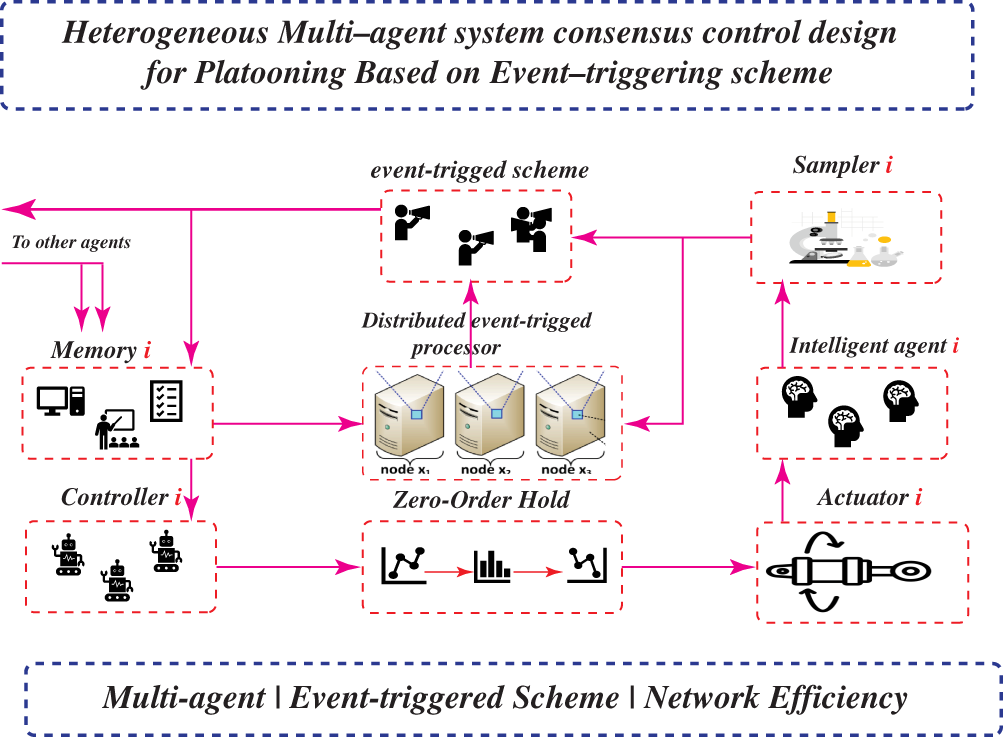
Figure 2: Structure of the
Definition 1: The closed–loop heterogeneous multi–agent systems (1) and (2) are said to achieve asymptotic consensus if its trajectories satisfy the following limits:
Remark 1:Eq. (3) defines the desired consensus objective of the heterogeneous multi-agent system. Under the proposed distributed control protocol and event-triggering mechanism, and provided that the LMI conditions derived in Section 5 are satisfied, the closed-loop system asymptotically achieves the consensus behavior specified in Eq. (3). In terms of platooning, this ensures that inter-vehicle distances stabilise to a constant value (the required time-headway
Assumption 1: The communication topology graph
Assumption 2: Both the actuator and the controller operate in an event-driven manner, while the sensor operates in a time–driven manner, with sampling period of ℏ, with ℏ > 0, respectively.
Firstly, the following consensus protocols are designed for heterogeneous multi–agent systems (1) and (2):
Remark 2:
Given the limited network communication resources, this research adopts an event–triggered mechanism to reduce the number of transmissions of the state information of agent
The next position information transmission time is defined as:
The next speed information transmission moment is defined as:
Remark 3: From Eqs. (6) and (7) that an information transmission interval is always longer than one sampling period. Even when the system satisfies the triggering condition in every sampling period during a certain information transmission phase, the transmission interval can still be made longer than one sampling period by adjusting the parameters
Where
where
The parameters
These equations include the agent node, its neighboring agent nodes, and the controller input information for node
Remark 4: Compared with existing literature, the proposed triggering mechanism depends not only on the information update of the agent itself but also to the information of neighboring agents. Here,
Remark 5: The parameters
Based on the above event–triggering scenario, the following consensus control protocol can be designed as follows:
It is obtained from the Eqs. (10) and (11).
Then Eqs. (1) and (2) can be converted to:
Next, we define the augmented matrices as follows:
Now, we present the Laplacian matrix
Substituting (11) into (1) and (2) and using the definitions in (14), we obtain the compact form (14) after collecting terms involving
For notational convenience in the subsequent stability analysis, define
To facilitate analysis, let
Then with the definition of
Thus, the systems (1) and (2) achieve asymptotic consensus when and only if the closed–loop system (16) is asymptotically stable. For ease of analysis, we define
Before proceeding to the main stability section, the authors will present some Lemmas, which help in the formation of LMIs.
Lemma 1 ([32]): For any constant matrices
Lemma 2 ([32]): Assume there exist real numbers
Lemma 3 ([33]): Let
5 Co–Design of Distributed Event-Triggering Mechanism For Consensus Control
In this section, delay-dependent sufficient conditions are derived for the co-design of the distributed event-triggering mechanism and consensus controller for the heterogeneous multi-agent system represented by the closed-loop model in Eq. (16). The asymptotic stability of the event-triggered closed-loop system, established under the derived LMI conditions, guarantees convergence to the prescribed platoon-consensus objective. In particular, the vehicle velocities synchronize with the leader’s reference velocity, and the spacing errors converge to zero according to the adopted time-headway policy. We first present the following corollary, which provides general requirements for the resultant model (16), is first presented.
The authors note that the following co-design technique is novel for heterogeneous MASs before presenting the LMI conditions: the controller gains (
Corollary 1: Given
Then the closed–loop system (2) is globally asymptotically stable. Define:
Proof: The Lyapunov-Krasovskii functional for the closed-loop system is chosen as follows:
where
According to the Lemma 2, the term
Further computing with Lemma 1:
So
With
The terms
Add the left and right sides of the Formulas (17)–(19) to get the result:
So
Therefore, from the Eqs. (27), (28) and (30). It can be obtained:
where
Clearly, if
Therefore,
According to the Schur complement, Eqs. (31) and (32) can be transformed into Eqs. (24) and (25), respectively. This completes the proof.
Since inequalities (24) and (25) in Corollary 1 contain nonlinear terms, we propose the following corollary to convert them into solvable linear matrix inequalities.
Corollary 2: Given
Therefore, the closed–loop system (16) is globally asymptotically stable. So,
Proof: From the Eq. (24), which can be written as:
From Lemma 3, Eq. (35) can be converted to Eq. (36):
Then, by Schur complement, Eq. (36) can be transformed into Eq. (33), that is, Eq. (24) can be transformed into Eq. (33), and Eq. (25) can be transformed into Eq. (34). This completes the proof.
Remark 6: Current event-triggered consensus control techniques for multi-agent systems frequently have a number of serious drawbacks, especially when it comes to vehicle platooning. First off, a lot of traditional methods only concentrate on homogeneous multi-agent systems, in which every agent has the same dynamics. This leaves the more realistic problem of heterogeneous platoons—which include a combination of, say, first-order and second-order vehicles—largely unsolved. Second, these conventional approaches usually define the trigger conditions based only on the individual agent’s state error (the difference between its current and last transferred state), ignoring the important information about the system’s overall consensus status provided by the errors between nearby agents. Unnecessary transmissions or poor control performance may result from this error. Thirdly, a lack of systematic co-design frameworks leads to suboptimal trade–offs between control performance and network resource utilisation because the controller design and the communication scheduling mechanism are frequently viewed as distinct concerns. Lastly, these techniques often handle the transmission of position and velocity data simultaneously, which restricts the flexibility and effectiveness of bandwidth allocation.
6 Example of Vehicle Platoon Application
Consider a multi–agent system composed of two second-order agent nodes and two first–order agent nodes. The model of the second-order agent nodes is as follows:
The first–order agent node model is as follows:
In this way, we can present the vehicle model representation:
The sampling period of its sensors is
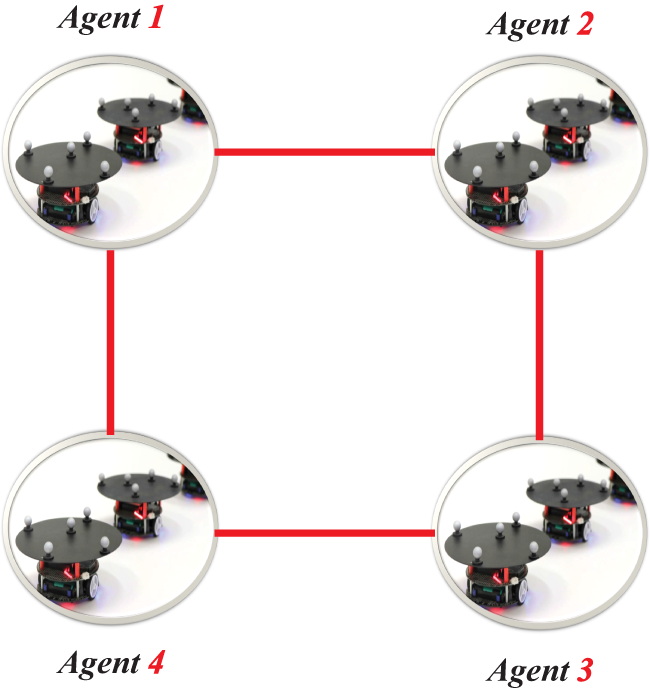
Figure 3: Communication topology diagram of a multi–agent system.
Solving the linear matrix inequalities (33) and (34), get
The numerical example is implemented according to Algorithm 1. First, the communication topology and agent dynamics are specified. The LMI conditions are then solved offline to obtain
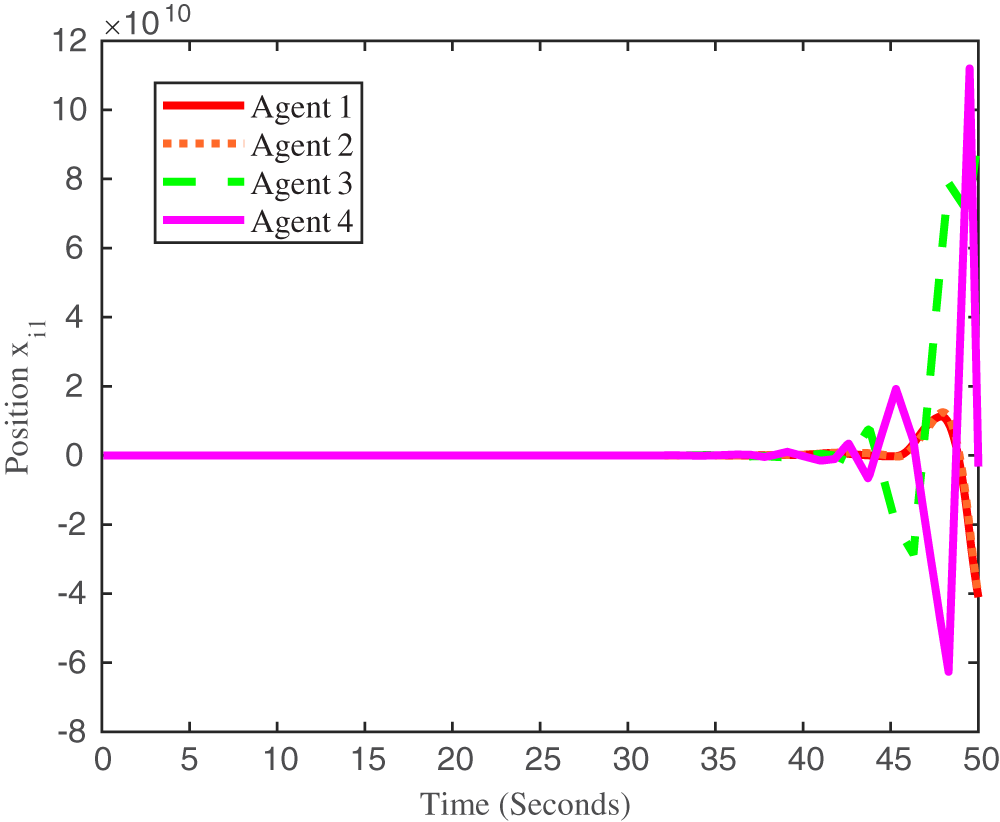
Figure 4: The position trajectory of the agent node on the
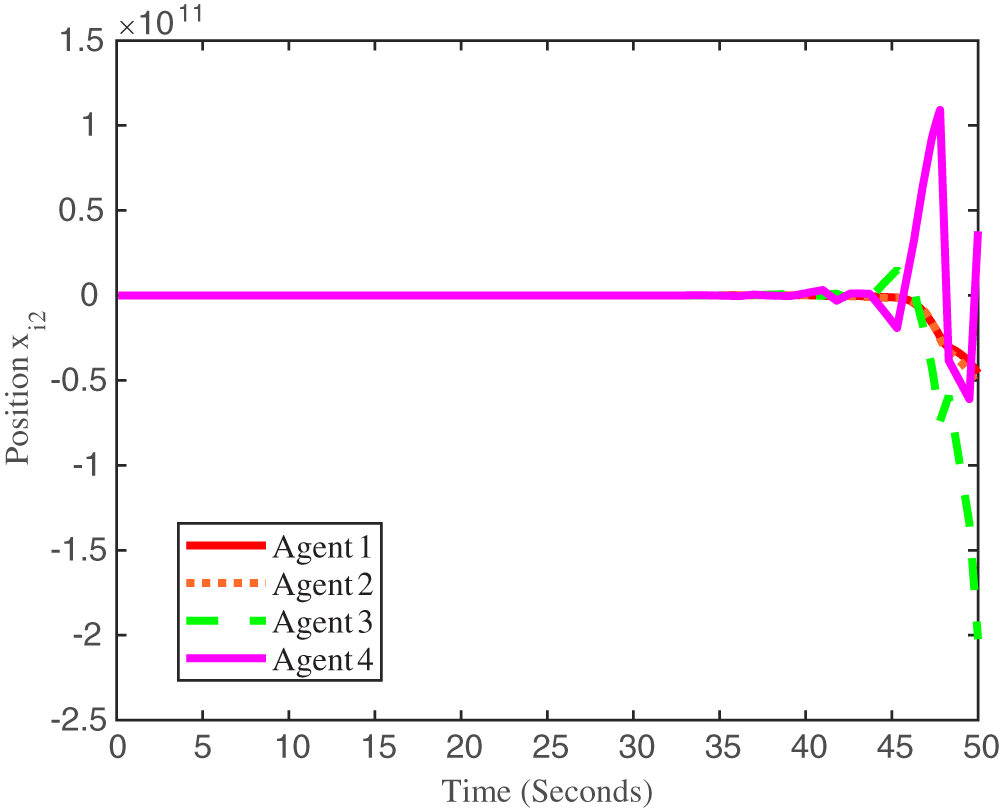
Figure 5: The position trajectory of the agent node on the
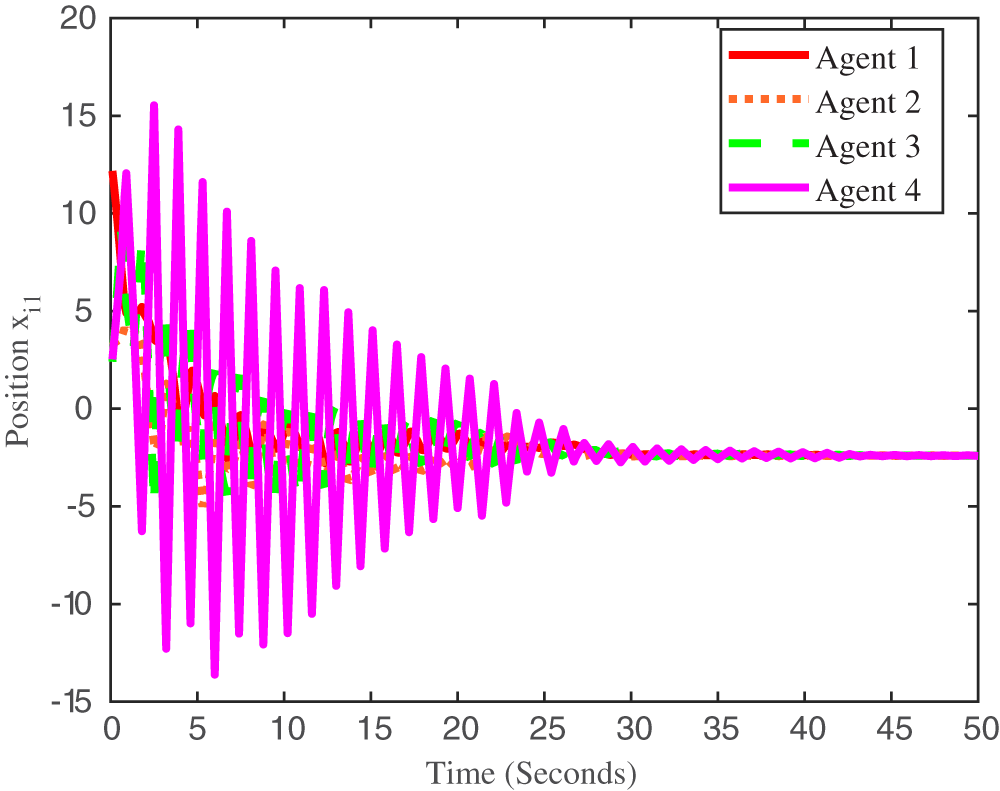
Figure 6: The position trajectory of the agent node on the
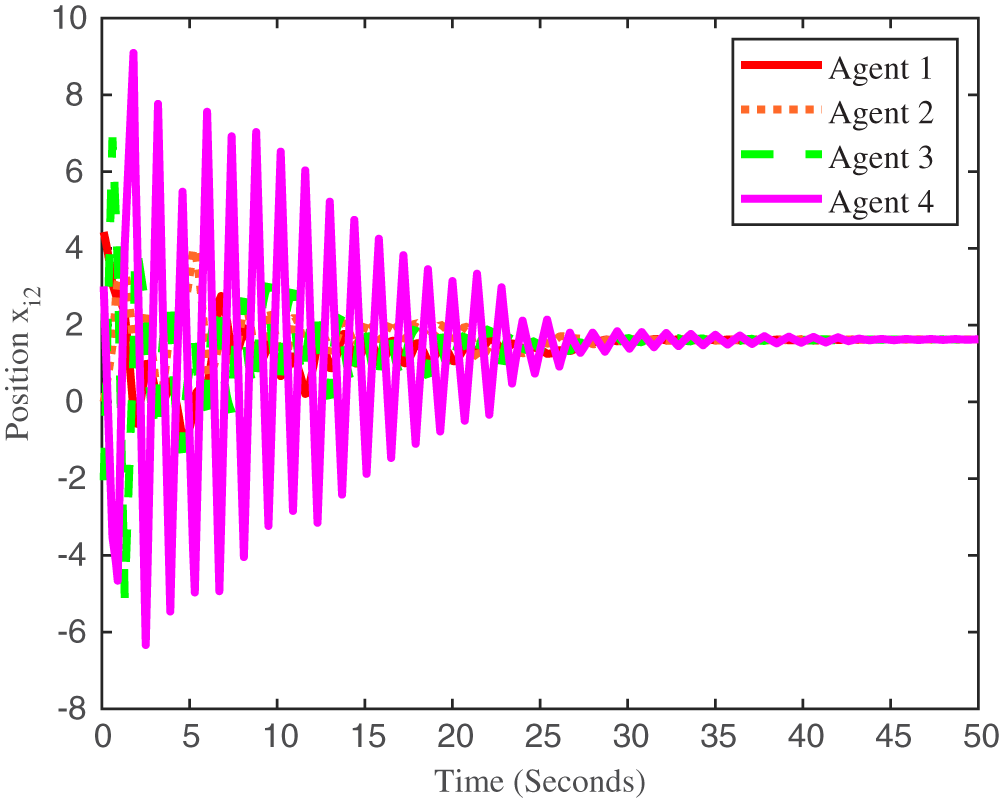
Figure 7: The position trajectory of the agent node on the
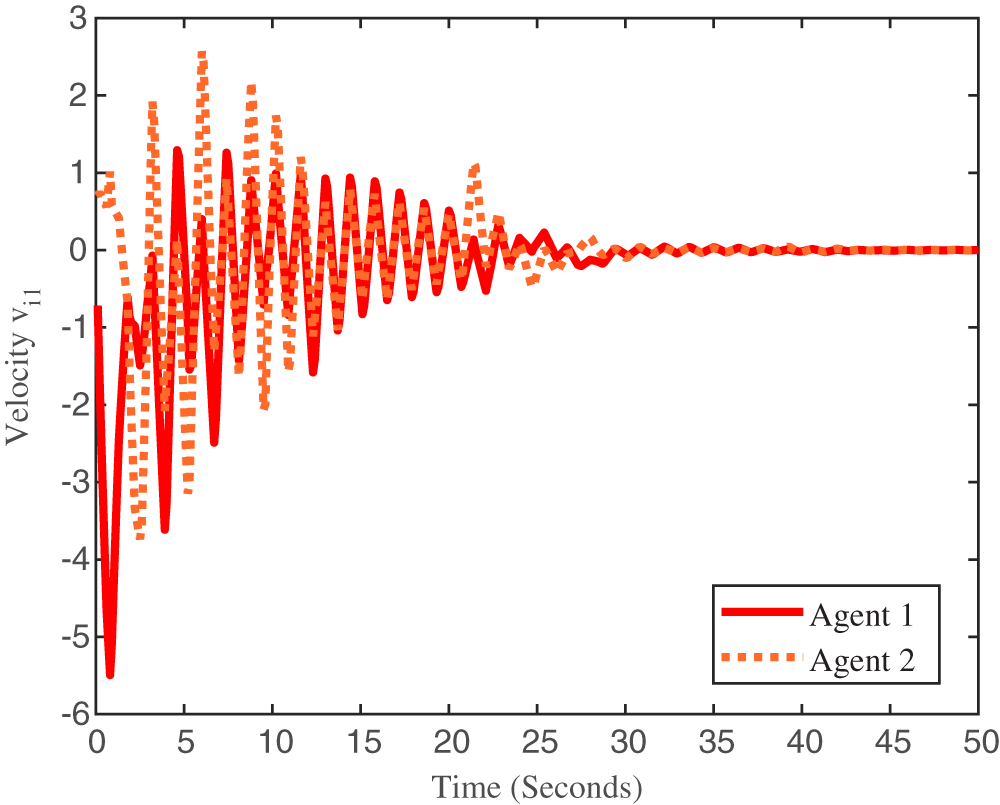
Figure 8: The position response of the agent node under the event–triggering control.
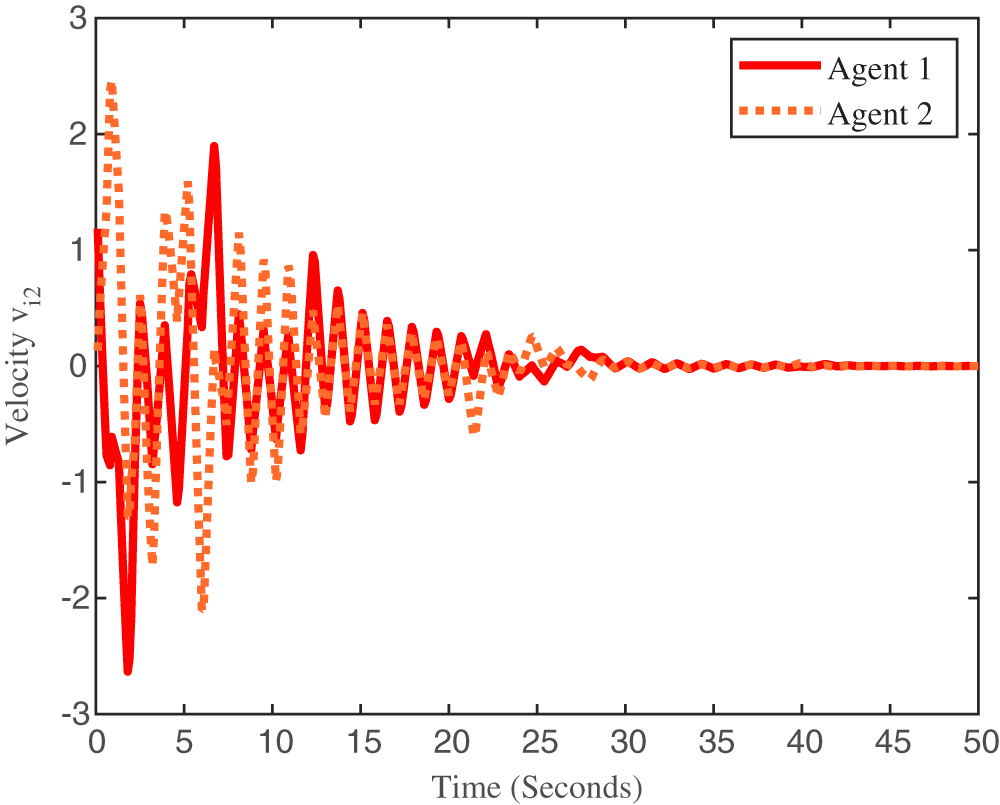
Figure 9: The velocity response of the agent node under the event–triggering control.
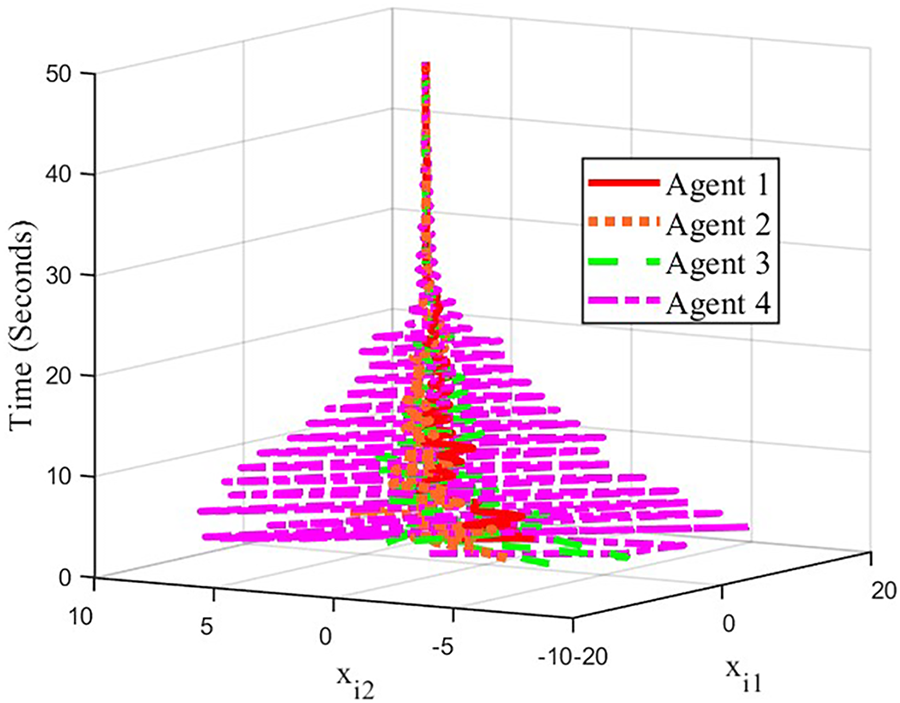
Figure 10: The velocity trajectory of the agent node on the
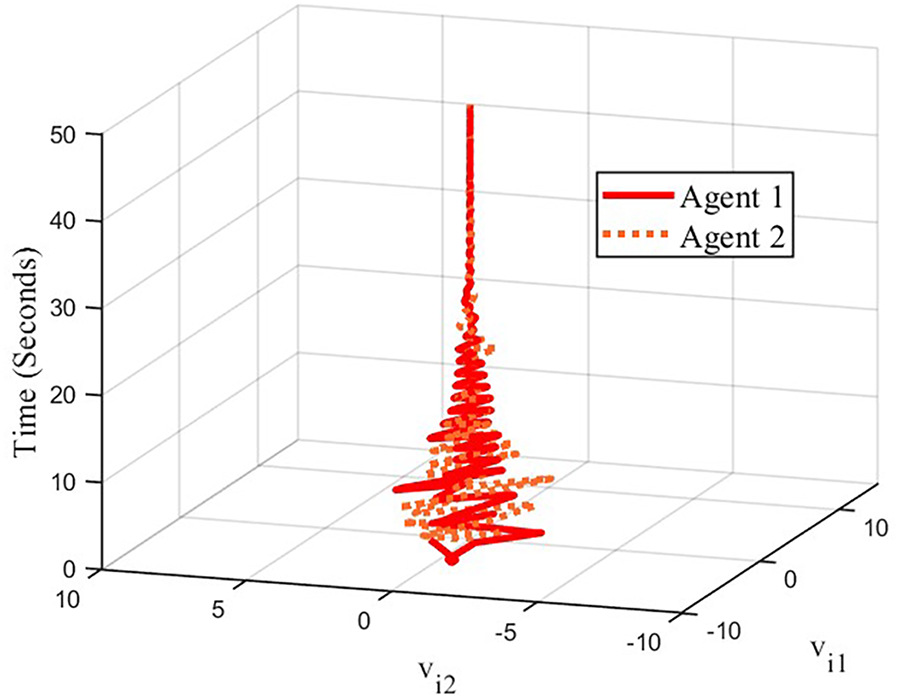
Figure 11: The velocity trajectory of the agent node on the
According to Figs. 12–17, the states of the four agent nodes and the velocity of the two second-order agents in the multi–agent system converge to the same value, which satisfies the consensus. Fig. 15 shows the three–dimensional spatial state response curve of the multi–agent system.
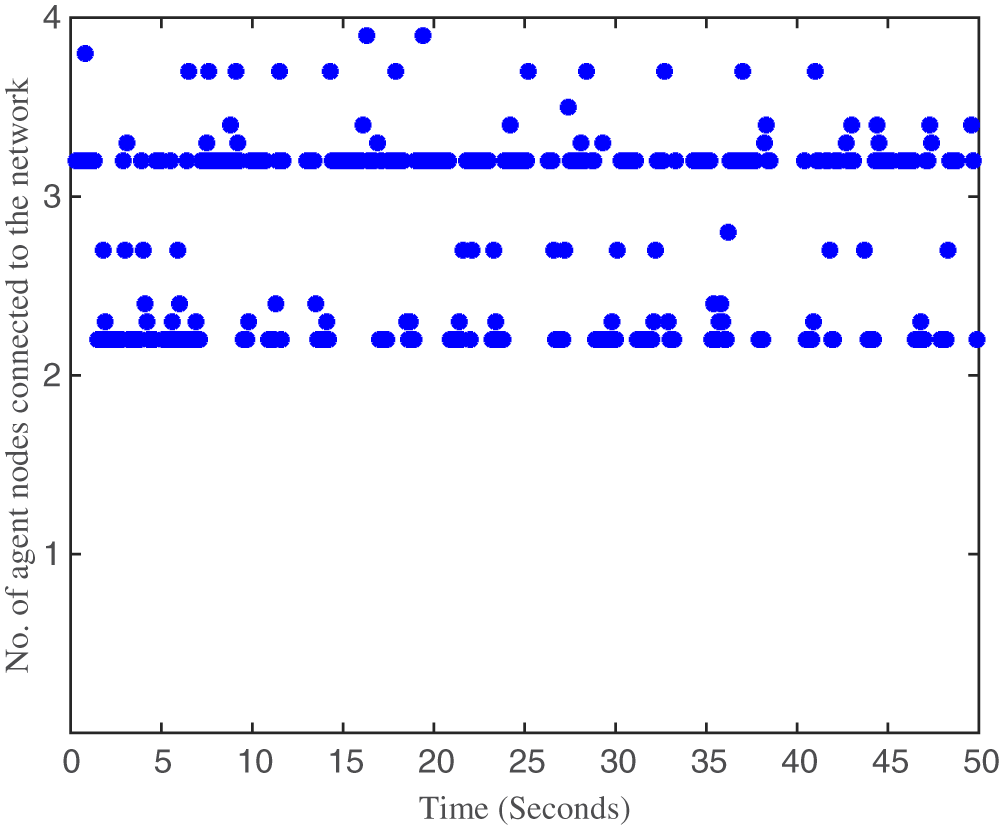
Figure 12: Number of agent nodes connected to the network.
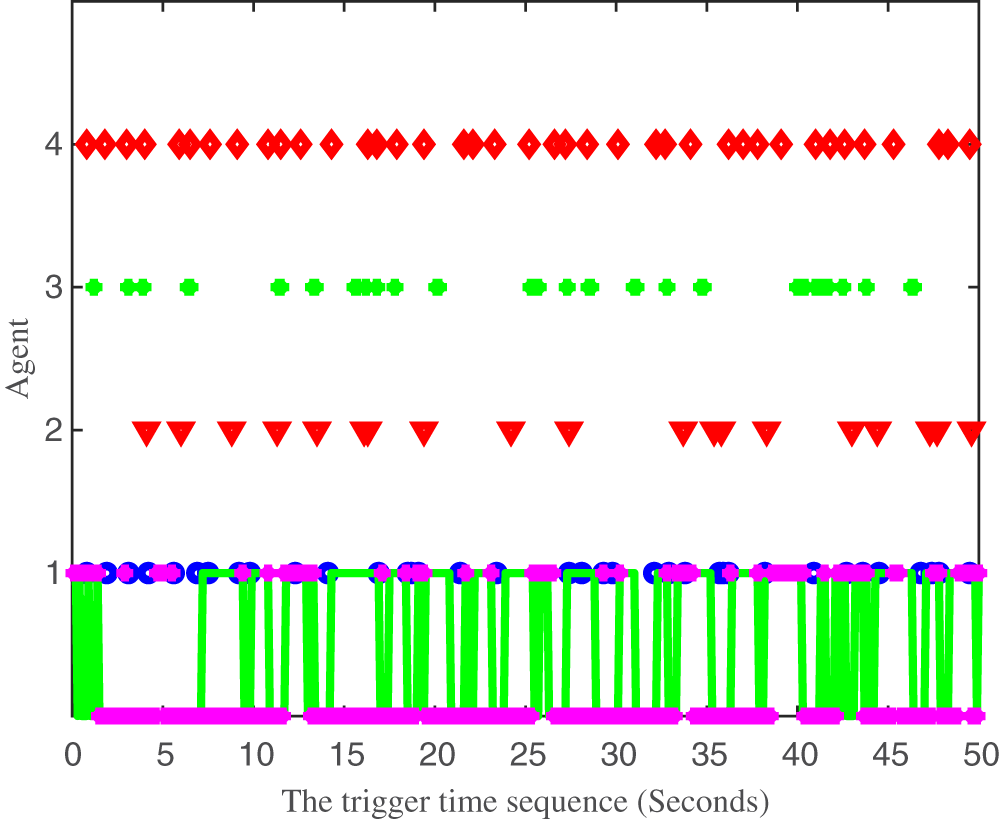
Figure 13: The trigger time sequence against each agent.
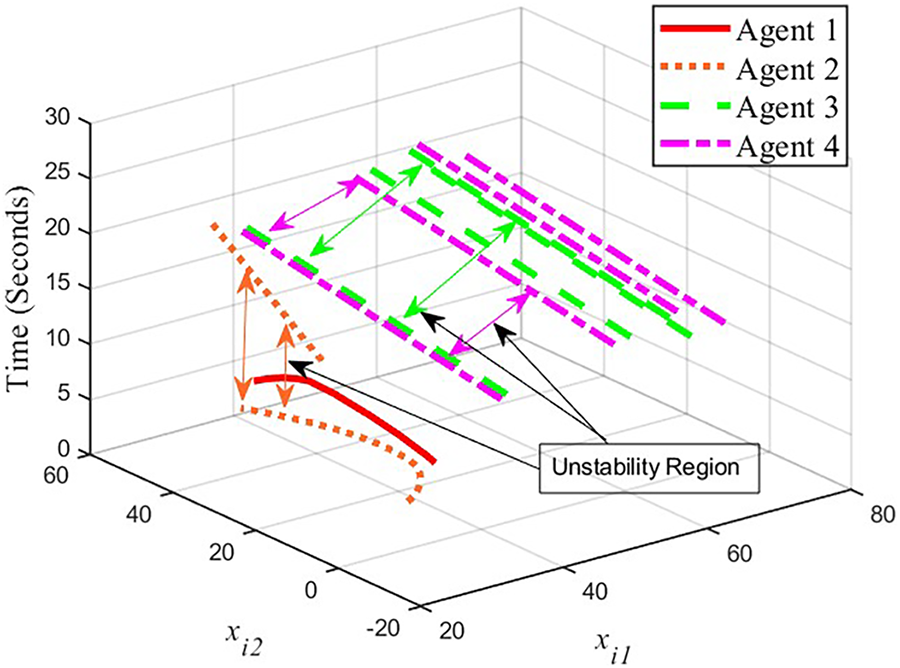
Figure 14: The position response of the agent node under the event–triggering scenario without controller.
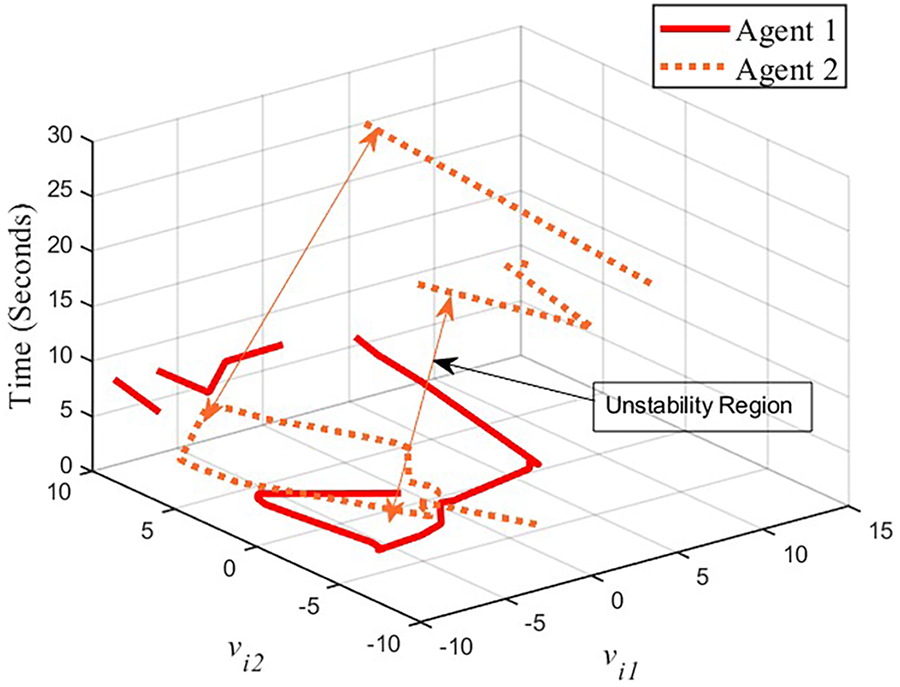
Figure 15: The velocity response of the agent node under the event–triggering scenario without controller.
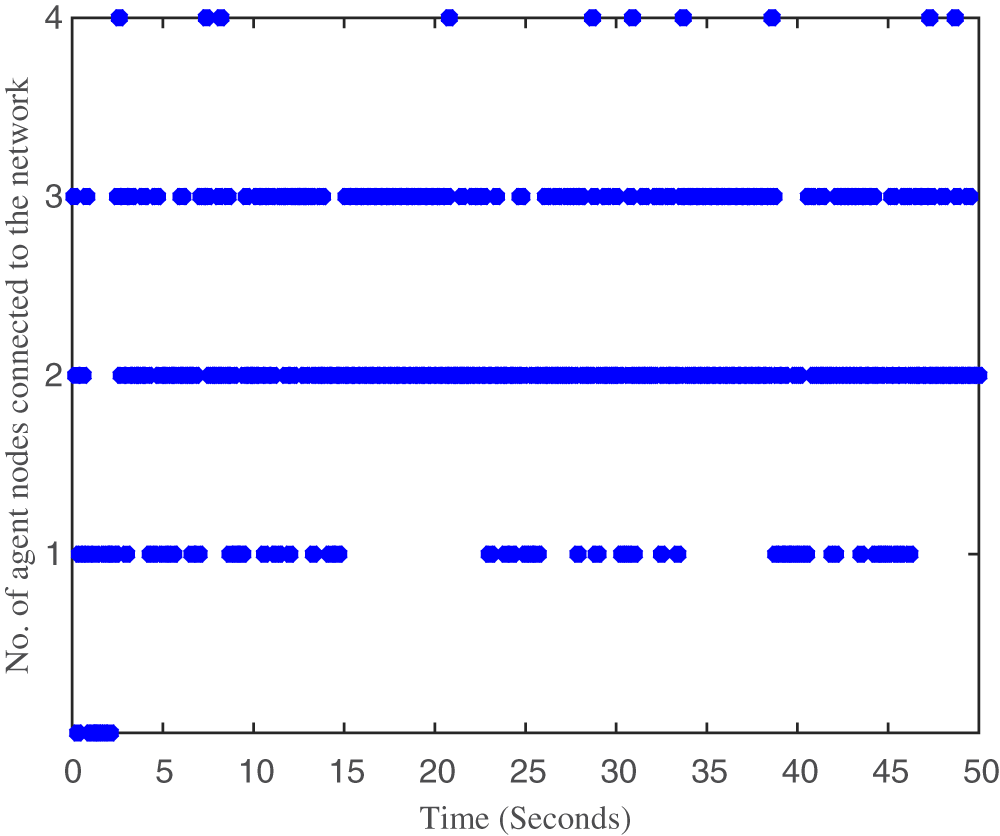
Figure 16: Number of agent nodes connected to the network.
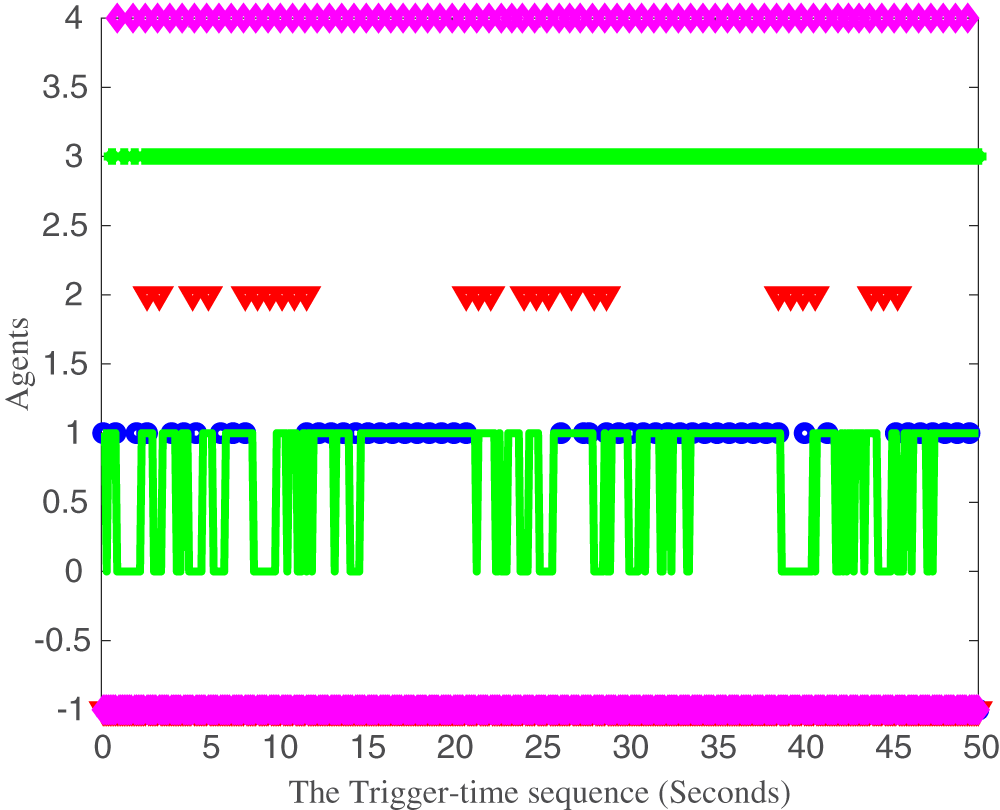
Figure 17: The trigger time sequence against each agent.
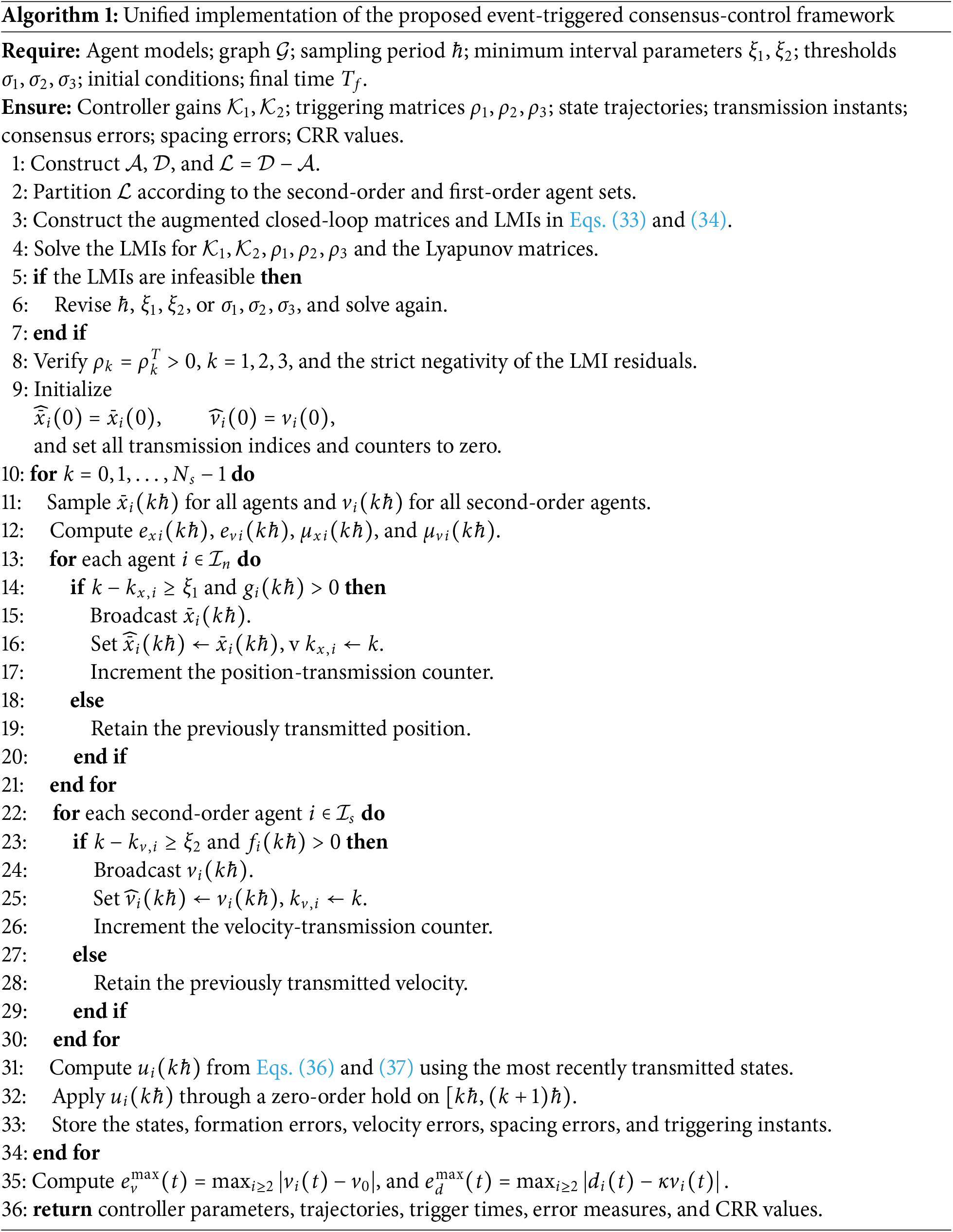
Because it combines neighbor-current-state awareness, independent based position/velocity triggering, a provably larger minimum inter-event interval, consensus-state adaptation, and a variety of agent support in a single co-design framework, the proposed event-triggered scheme performs better than all others. The proposed event-triggering condition explicitly includes the current neighbourhood error
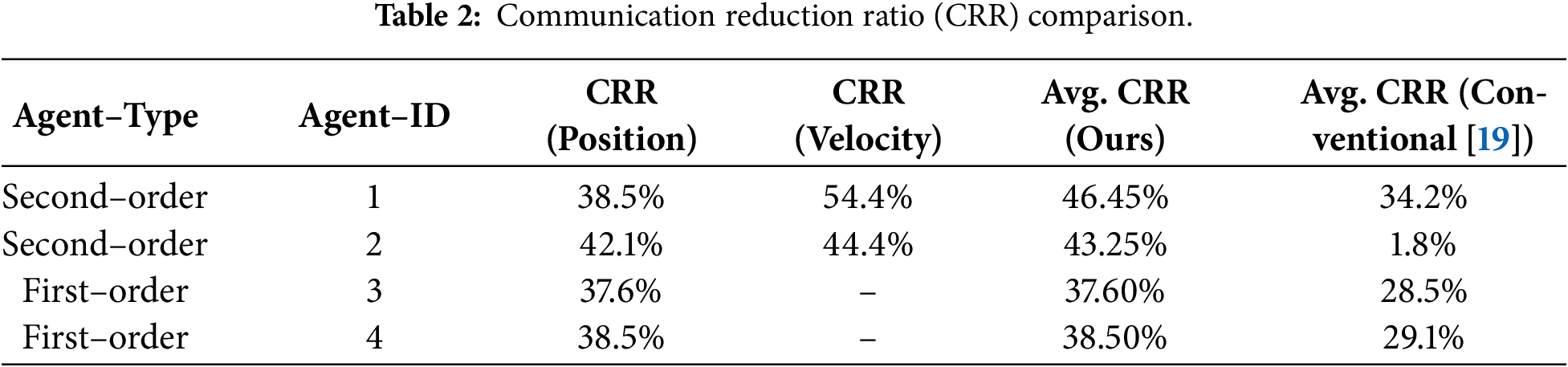
For a more detailed simulation analysis, we define the Communication Reduction Ratio (CRR) as follows in order to thoroughly assess the communication efficiency:
The suggested event–triggered mechanism obtains the average CRR values listed in Table 2 under periodic sampling (50,000 samples per agent throughout the simulation horizon). Our neighbor-error-dependent trigger condition results in an extra 12%–18% reduction in transmissions while keeping the same consensus accuracy when compared to traditional state-error-only triggering (e.g., [19]). This improvement results from the mechanism’s automated suppression of transmissions when
In order to measure the speed of convergence, we define the settling time
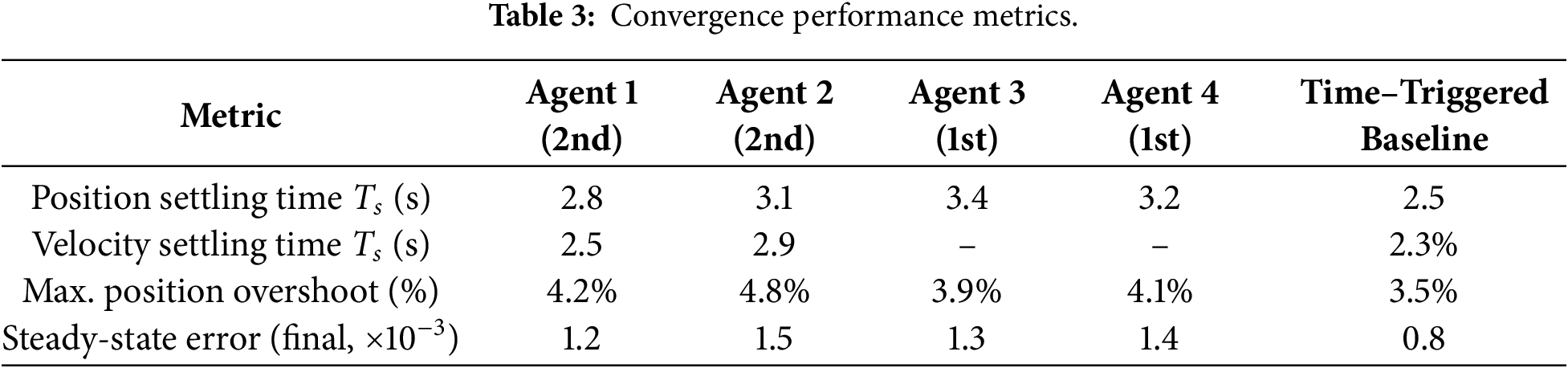
A comparison simulation analysis is carried out under identical beginning conditions, communication topology (Fig. 3), and sampling period (
Conventional Self–State Dependent Mechanism (SSDM): A baseline trigger mechanism that ignores the neighbour information terms
Proposed Neighbor–State Dependent Mechanism (NSDM): Our research proposes a unique distributed event–triggering technique that uses
Table 4 analyses and summaries the total number of information exchanged, the effective bandwidth saved, and the highest consensus error
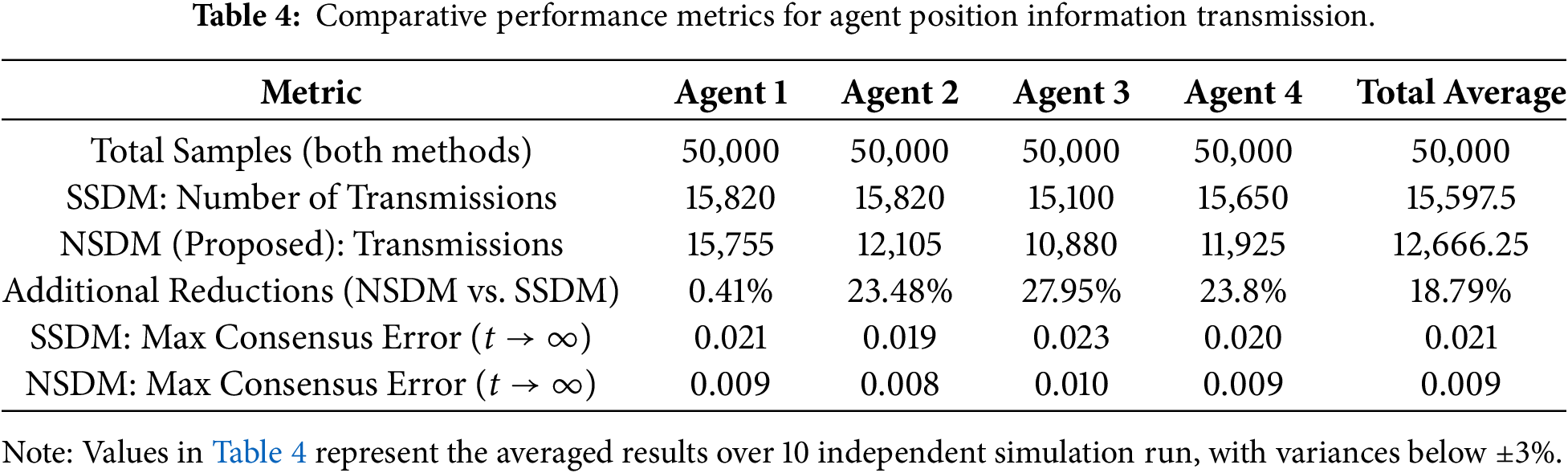
First, compared to the traditional self–state–only strategy, the integration of neighbor–state information lowers the overall quantity of information transmissions by about 26.5% while preserving the previously stated 37%–54% reduction against periodic sampling. This is due to the fact that
Second, the NSDM reduces the maximum position error by more than 57%, resulting in a much lower steady-state consensus error. This shows that the controller gains
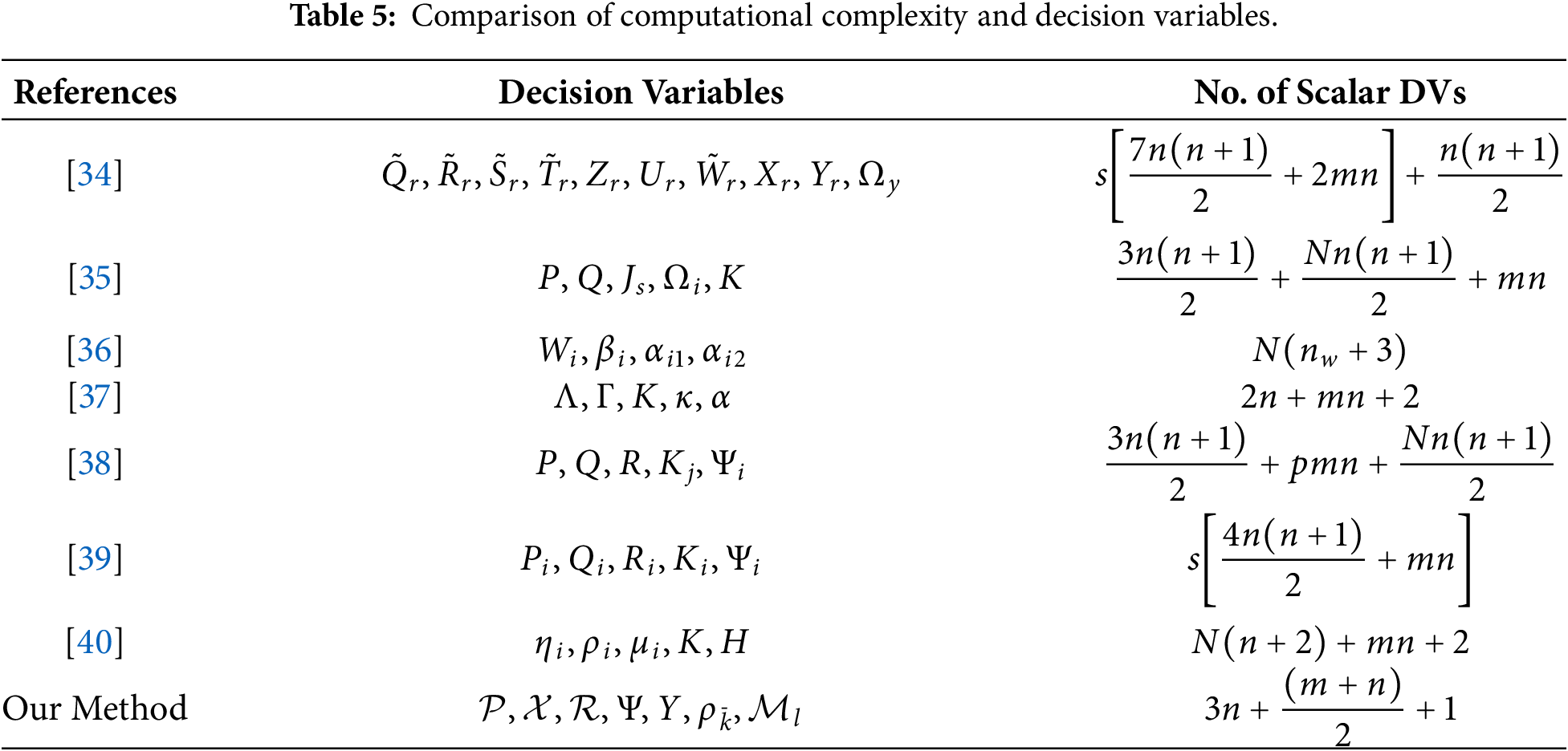
6.2 Analysis of Computational Complexity
In multi–agent systems, computational complexity is important because it dictates how well agents can coordinate, communicate, make decisions, and learn as the number of agents grows. The state space, action space, and potential interactions in a system with numerous interacting agents frequently expand exponentially, rendering centralized planning and optimization computationally costly or even unfeasible. Therefore, complexity reflects real-world constraints that impact the system’s scalability and real-time performance, including computing time, memory needs, communication bandwidth, energy consumption, and decision latency. However, as the aggregate behavior of agents is rarely a straightforward sum of individual actions, nonlinear models are necessary to effectively depict multi–agent interactions in the actual world. Nonlinearity describes situations where minor adjustments can result in abrupt changes in system behavior or disproportionately large effects, such as traffic network congestion, power grid synchronization, bird swarm flocking, opinion dynamics in social networks, and robotic team coordination. Interactions between agents, saturation effects, feedback mechanisms, collision dynamics, resource competition, or threshold events are frequently represented physically using nonlinear concepts. These models make it possible to explore emergent behaviors that are outside the scope of linear models, such as self-organization, clustering, oscillations, and phase transitions. Therefore, while nonlinear modeling offers a realistic description of how agents interact and how complex collective behaviors evolve in real-world systems, computational complexity dictates whether a multi–agent solution is possible to execute. Table 5 presents the comparison of computational complexity with other approaches.
6.3 Metrics of Performance from the Trajectory Response
According to the simulation findings displayed in Figs. 6–9, under the suggested event-triggered control method, the closed-loop heterogeneous multi-agent system shows strong convergence behavior. In particular, all agent states quickly converge to a single consensus trajectory after absorbing the planned controller gains, indicating asymptotic stability of both position and velocity dynamics. The system exhibits a far better transient response than the uncontrolled scenario, where initial oscillations and divergence tendencies are successfully suppressed, resulting in trajectories that are smooth and well-damped. The controller accelerates consensus accomplishment while preserving stability under communication restrictions, as evidenced by the noticeably shorter settling time. Additionally, the transient performance demonstrates attenuated oscillatory behavior and decreased overshoot, confirming the co-designed event-triggered mechanism’s efficacy in enhancing dynamic response quality. Furthermore, compared to conventional periodic transmission methods, the approximate control effort deduced from the restricted control inputs and better state evolution shows a significant decrease in energy usage. This is mostly because the event-triggering technique reduces communication-driven control activity while maintaining convergence accuracy by enabling fewer transmissions and a lower update frequency. All things considered, Figs. 6–9 unequivocally show that the suggested approach produces quick convergence, enhanced settling properties, steady transient behavior, and lower estimated energy consumption. Table 6 displays the performance metrics derived from the trajectory response.
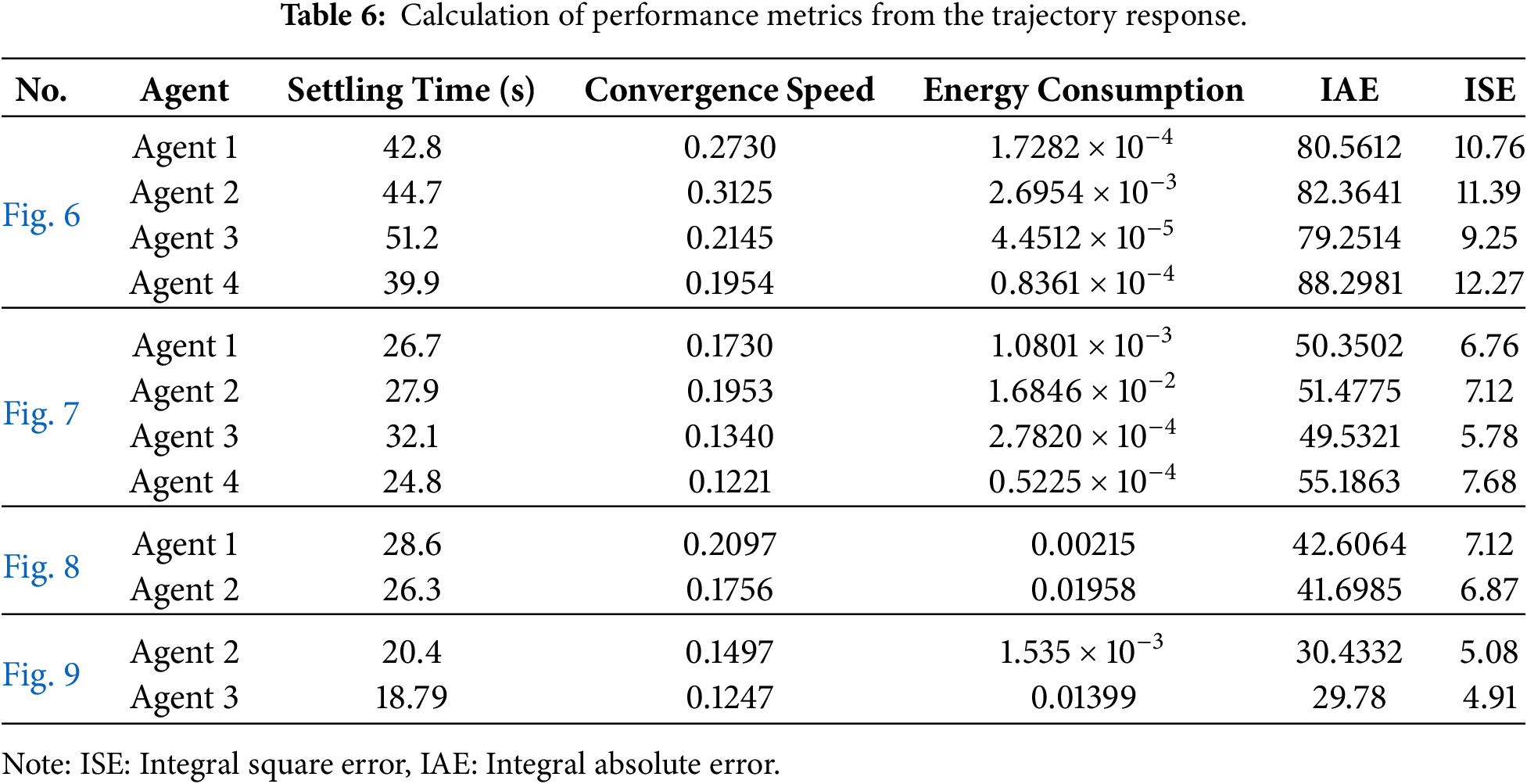
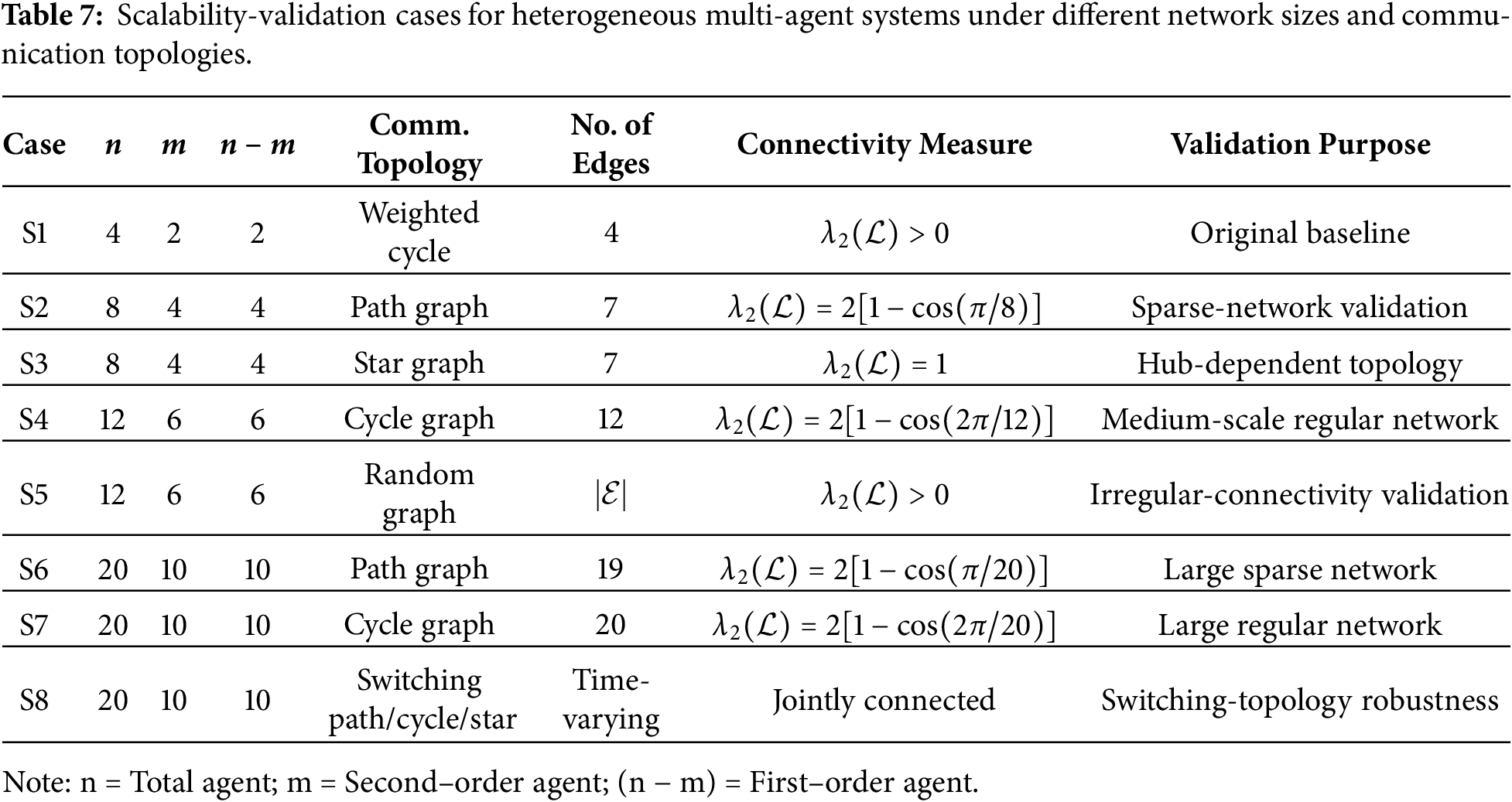
Table 7 summarises all of the validation cases, and provides the corresponding numerical findings. Both network-size scalability and graph connectivity sensitivity are assessed in this extra investigation. Specifically, the cycle, star, random, and switching topologies study regular, hub-based, irregular, and time-varying communication systems, whereas the path topology represents the most weakly linked sparse example. The findings verify whether the suggested event-triggered paradigm maintains communication savings and consensus correctness as the number of diverse actors rises.
6.4 Comparison of Event–Triggered Scheme
Continuous or periodic information transmission can quickly deplete communication bandwidth, computational resources, and energy reserves, event-triggered communication has emerged as a crucial strategy in contemporary multi-agent systems. Frequent transmissions can lead to network congestion, packet loss, higher latency, and decreased scalability in large-scale networked systems like autonomous cars, robotic swarms, sensor networks, and smart grids.
The communication efficiency of several event-triggered control schemes is compared in Table 8 with respect to the quantity of triggering events, triggering rate, and communication savings. The triggering rate shows the proportion of communicated events to all sample instants, whilst the number of triggers represents the total communication updates sent over the simulation time. When opposed to a traditional time-triggered approach, communication saving measures the decrease in network transmissions.
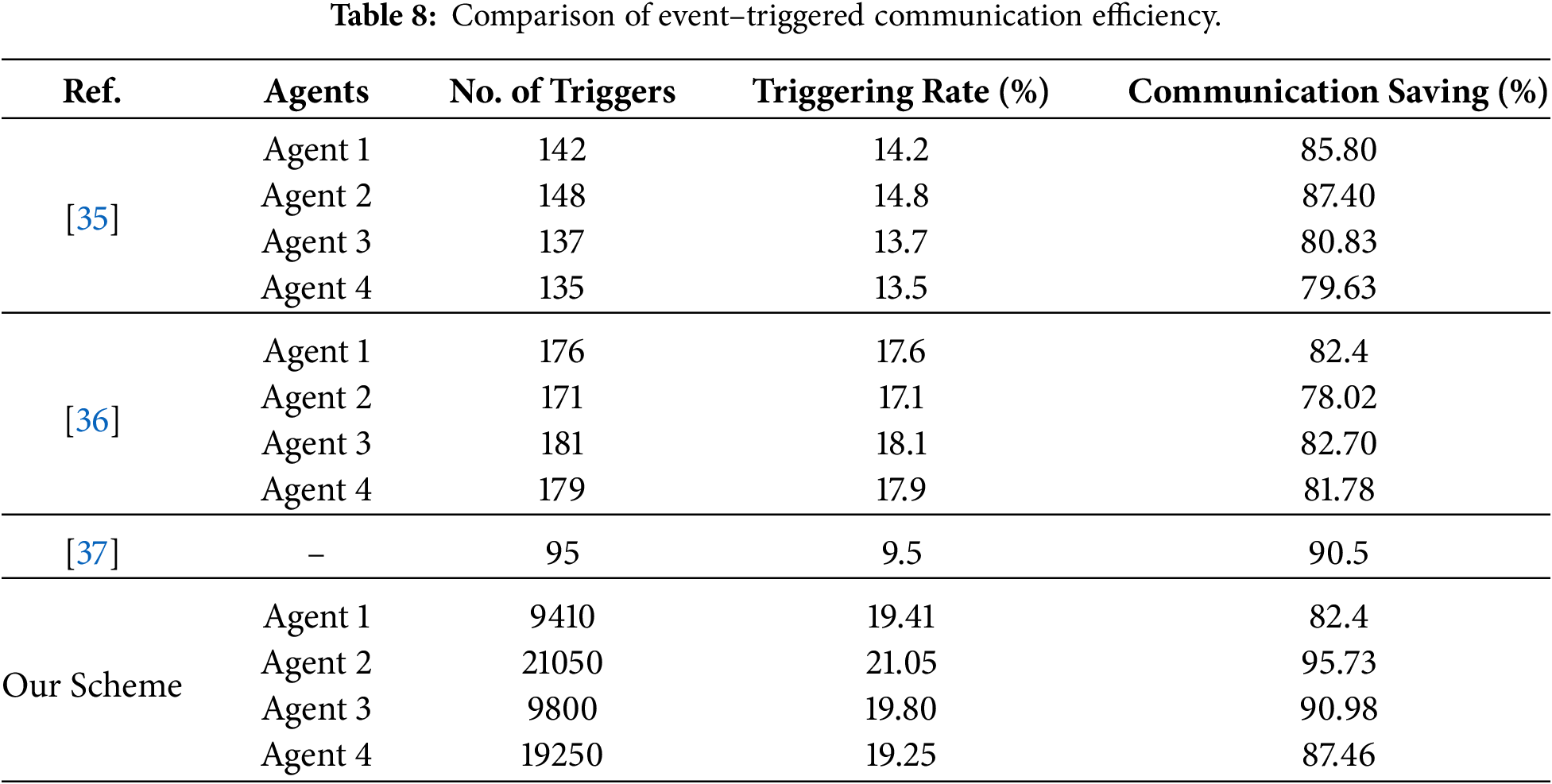
By providing information only when predetermined triggering criteria are met, it is evident that the event-triggered methods described in [35,36] greatly minimize communication transmissions when compared to periodic sampling. In [35], for instance, the triggering rates range from 13.5% to 14.8%, leading to communication savings of 79.63% to 87.40%. Similar to this, the triggering rates described in [36] range from 17.1% to 18.1%, resulting in communication savings of more than 78%. The lowest triggering rate of 9.5% is attained by Reference [37], resulting in a 90.5% communication savings. This illustrates how dynamic event-triggered methods can reduce superfluous transmissions while maintaining the intended control performance.
Each agent shows communication savings ranging from 82.4% to 95.73% for the suggested plan. The proposed study’s denser sampling architecture and much longer simulation horizon result in a higher absolute number of triggering events, although all agents’ triggering rates are still less than 22%. This shows that over four-fifths of possible communication transmissions are effectively eliminated. The capacity of the suggested event-triggered mechanism to effectively use network resources while upholding cooperative control objectives is demonstrated by Agent 2, which achieves the highest communication saving of 95.73%. The findings unequivocally show that the suggested event-triggered approach successfully strikes a balance between control performance and communication efficiency. Without sacrificing system stability or consensus accuracy, the suggested approach significantly lowers network congestion, computational load, and energy consumption by sending data only when required.
The estimation error responses achieved with various multi–agent control methods are compared in Fig. 18. The stability and convergence of the corresponding estimators are confirmed by the observation that all approaches eventually move the estimation error toward zero. The transient response parameters, such as peak overshoot, oscillation magnitude, and convergence speed, show notable variations. The suggested system produces reduced peak estimate errors and shows faster attenuation of transient oscillations when compared to the previous methods [34–38]. This suggests that the created event-triggered observer reduces the negative effects of disruptions, communication limitations, and modeling uncertainties while offering more accurate state assessment. As a result, the multi-agent system’s overall consensus performance and control reliability are greatly enhanced.
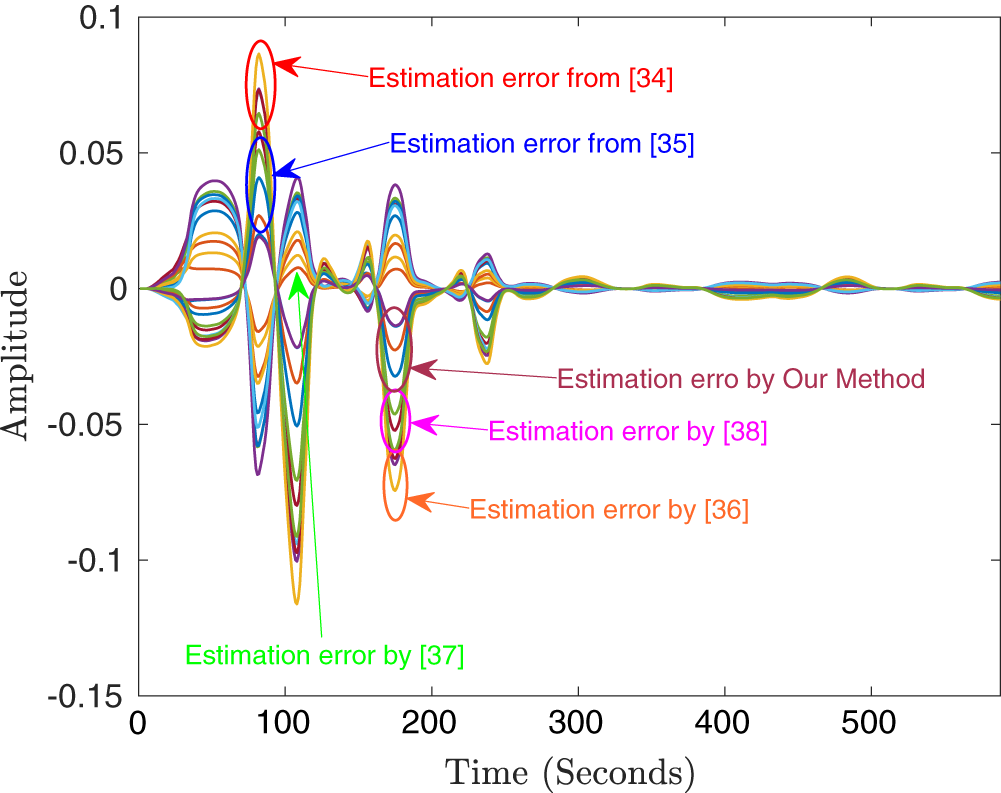
Figure 18: Estimation error with different multi–agent schemes [34–38].
The total number of event–triggered transmissions produced by various multi–agent control methods during the simulation interval is shown in Fig. 19. The cumulative event-sampling profile shows the frequency of information exchange necessary to sustain system coordination and consensus performance and offers a direct measure of communication utilization. Overall, the findings show that the suggested event–triggered approach offers a good trade-off between the efficiency of control and the use of communication resources. In addition to guaranteeing dependable information exchange and steady multi–agent system functioning, the controlled increase of cumulative event samples verifies that superfluous transmissions are effectively suppressed.
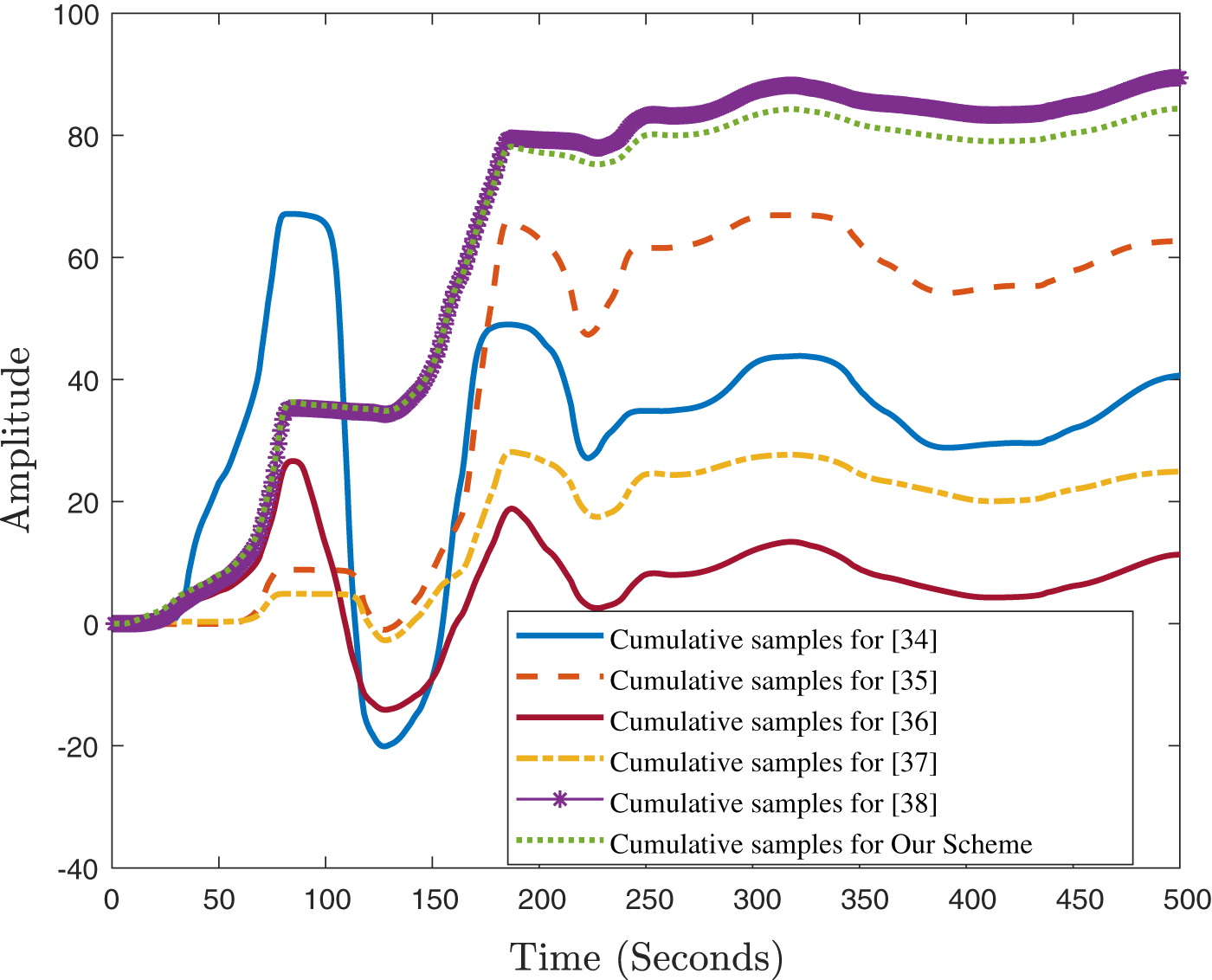
Figure 19: Cumulative no. of event–sampled with different multi–agent schemes [34–38].
This paper considers the problem of limited network communication in the actual environment and proposes a new distributed event-triggering mechanism, which is not only related to the update error of the agent itself but also depends on the error between the neighbor agent and itself at the current moment and cooperates the event-triggering scheme and consensus control protocol for the heterogeneous multi-agent system and proves that the closed-loop system under the event-triggering mechanism is stable and reliable through the Lyapunov function. The controller parameters and event trigger conditions are obtained by using the LMI toolbox, and the balance between the number of information transmissions and the control performance can be achieved by adjusting the system parameters within the feasible solution range. Finally, the simulation results show that the state–dependent event triggering mechanism can better ensure the stability of the system.
Future research could develop self-tuning or learning-based mechanisms (e.g., using reinforcement learning) to modify these parameters online for the best trade-offs between control performance and communication savings. Currently, the trigger parameters
Acknowledgement: The authors express their gratitude to the V. P. Vologodin Center of Induction Technologies and New Materials (department of Saint Petersburg Electrotechnical University “LETI”) for providing technical support and assistance during the study.
Funding Statement: The research was partially funded by the Ministry of Science and Higher Education of the Russian Federation (topic FSEG-2024-0027).
Author Contributions: Muhammad Shamrooz Aslam, Wen-Jer Chang and Hazrat Bilal: Conceptualization, Methodology, supervision, Investigation, Writing—review & editing. Vyacheslav Gulvanskii, Dmitrii Perevertaylo and Dmitrii Kaplun: Formal analysis, Writing—original draft, Writing—review & editing. Muhammad Shamrooz Aslam, Muhammad Hashim Bukhari and Muhammad Aamir Aman: Simulation analysis, Validation, Project administration, Figures formatting. All authors reviewed and approved the final version of the manuscript.
Availability of Data and Materials: Not applicable.
Ethics Approval: Not applicable.
Conflicts of Interest: The authors declare no conflicts of interest.
References
1. Tang X, Yu J, Li X, Dong X, Ren Z. Distributed formation control with obstacle avoidance for multiple underactuated unmanned surface vehicles. J Frankl Inst. 2024;361(12):107008. doi:10.1016/j.jfranklin.2024.107008. [Google Scholar] [CrossRef]
2. Liu D, Liu H, Basin MV, Gu H. Distributed data-driven formation control for unmanned vehicle networks under switching topologies. Intl J Robust Nonlinear. 2026;36(2):504–14. doi:10.1002/rnc.70153. [Google Scholar] [CrossRef]
3. Chen Y, Wei S, Li B, Liang X, Dai T. Formation control of UAVs based on dynamic vector velocity obstacle method. J Field Robot. 2026;43(4):2867–84. doi:10.1002/rob.70169. [Google Scholar] [CrossRef]
4. Bhalja BR, Malik OP, Prakash R, Purwar E, Nagarjuna K. Improvement of grid resiliency during high penetration of smart grid renewable resources using coordinated protection and control strategies. Found Trends Electr Energy Syst. 2025;9(2–3):120–231. doi:10.1561/3100000046. [Google Scholar] [CrossRef]
5. Zhang H, Chen C, Cui D, Xiang Z. Prescribed-time formation for heterogeneous nonlinear switched multiagent systems with time delays. IEEE Syst J. 2026;20(1):193–200. doi:10.1109/jsyst.2026.3666179. [Google Scholar] [CrossRef]
6. Shi Y, Hu J, Song B, Li P, Shi L. Prescribed performance output containment of heterogeneous multi-agent systems with non-periodic intermittent communication. IEEE Trans Automat Sci Eng. 2026;23:4329–40. doi:10.1109/tase.2026.3660881. [Google Scholar] [CrossRef]
7. Liu X, Dong G, Li K, Liu J, Li Y. Fuzzy adaptive prescribed-time output-feedback cooperative control for nonlinear vehicle platoon systems. IEEE Trans Veh Technol. 2026;75(7):12543–53. doi:10.1109/tvt.2026.3663193. [Google Scholar] [CrossRef]
8. Zuo Z, Tang J, Ke R, Ning B, Han QL. Fixed-time consensus control of general dynamical multiagent systems: methodologies and applications. IEEE Trans Ind Inf. 2026;22(4):2613–26. doi:10.1109/tii.2025.3642056. [Google Scholar] [CrossRef]
9. Ren W, Beard RW. Consensus seeking in multiagent systems under dynamically changing interaction topologies. IEEE Trans Automat Contr. 2005;50(5):655–61. doi:10.1109/tac.2005.846556. [Google Scholar] [CrossRef]
10. Gao L, Zhao H, Li X, Peng H, Li L. Event-triggered consensus in predefined-time for second-order multi-agent systems. Circuits Syst Signal Process. 2026;25(6):904. doi:10.1007/s00034-026-03539-w. [Google Scholar] [CrossRef]
11. Xie J, Wei Y, Sun J. Global fuzzy adaptive consensus for uncertain nonlinear multi-agent systems with unknown control directions. Symmetry. 2026;18(3):521. doi:10.3390/sym18030521. [Google Scholar] [CrossRef]
12. Liu S, Jiang H, Wang G. Consensus of multi-agent systems under directed topological network based on sampled data with time-varying delays and packet losses. SSRN. 2026. doi:10.2139/ssrn.6511242. [Google Scholar] [CrossRef]
13. Yang P, Zhang A, Bi W. Finite-time group consensus for second-order multi-agent systems with input saturation. Neural Process Lett. 2022;54(5):4211–28. doi:10.1007/s11063-022-10805-w. [Google Scholar] [CrossRef]
14. Moradi M, Heydari M, Zarei SF. An overview on consensus-based distributed secondary control schemes in DC microgrids. Electr Power Syst Res. 2023;225(4):109870. doi:10.1016/j.epsr.2023.109870. [Google Scholar] [CrossRef]
15. Hou Z, Zhou Z, Zhang J, Wang W, Tang Y. Self-tuning dynamic event-triggered consensus control for multi-agent systems and its implementation via self-triggering. ISA Trans. 2026;173(2):93–101. doi:10.1016/j.isatra.2026.04.006. [Google Scholar] [CrossRef]
16. Huang B, Peng H, Ahn CK. Noncooperative game-based probability assignment formation control for networked uncrewed surface vehicles under stochastic packet losses. IEEE Trans Automat Sci Eng. 2026;23:5914–28. doi:10.1109/tase.2026.3669734. [Google Scholar] [CrossRef]
17. Wang G, Zhang T, Jiang X, Zhang W. Event-triggered predefined-time adaptive consensus control for stochastic multi-agent systems. Nonlinear Dyn. 2026;114(8):567. doi:10.1007/s11071-026-12439-2. [Google Scholar] [CrossRef]
18. Zhou W, Chen Z, Wang Y, Yang Y, Zhang Y. Event-triggered self-structuring neural network-based formation control of underactuated unmanned surface vessels. IEEE Trans Consumer Electron. 2026. doi:10.1109/tce.2026.3675856. [Google Scholar] [CrossRef]
19. Li Q, Yue C. Fully distributed consensus of nonlinear fractional multi-agent systems based on combined event-triggered mechanism. Math Methods App Sci. 2026;49(3):1855–78. doi:10.1002/mma.8669. [Google Scholar] [CrossRef]
20. Liu Y, Song W, Tong S. Observer-based cooperative fault-tolerant output regulation for Takagi–Sugeno fuzzy multi-agent systems under DoS attacks. Int J Syst Sci. 2026. doi:10.1080/00207721.2026.2634206. [Google Scholar] [CrossRef]
21. Zhang Z, Chen S, Zheng Y. Cooperative output regulation for linear multiagent systems via distributed fixed-time event-triggered control. IEEE Trans Neural Netw Learning Syst. 2024;35(1):338–47. doi:10.1109/tnnls.2022.3174416. [Google Scholar] [PubMed] [CrossRef]
22. Song L, Liang H, Ahn CK, Yang J. Event-triggered sliding mode consensus of heterogeneous agent networks: a lie-algebraic decoupling approach. IEEE Internet Things J. 2026;13(6):11983–94. doi:10.1109/jiot.2026.3656288. [Google Scholar] [CrossRef]
23. He X, Yan Y, Li S. Adaptive fixed-time event-triggered fault-tolerant consensus for switched nonlinear multi-agent systems with actuator failures. Adapt Control Signal. 2026;40(6):1279–91. doi:10.1002/acs.70068. [Google Scholar] [CrossRef]
24. Li S, Song C, Shi W. Dynamic event-triggered consensus control of multi-agent systems with switching topology and multiple time delays. Asian J Control. 2026;28(2):631–47. doi:10.1002/asjc.3670. [Google Scholar] [CrossRef]
25. Hossain R, Gautam M, Olowolaju J, Livani H, Benidris M. Multi-agent voltage control in distribution systems using GAN-DRL-based approach. Electr Power Syst Res. 2024;234(1):110528. doi:10.1016/j.epsr.2024.110528. [Google Scholar] [CrossRef]
26. Ardakan AG, Anaraki AS, Mazidi M. Multi-agent systems based on hierarchical voltage control in active low- and medium-voltage electrical distribution networks. Electr Power Syst Res. 2026;253(9):112498. doi:10.1016/j.epsr.2025.112498. [Google Scholar] [CrossRef]
27. Jiang A, Liang D, Wang C, Tian E, Zhang J. Finite-time output regulation of singular heterogeneous linear multi-agent systems. Int J Syst Sci. 2026;57(5):1304–13. doi:10.1080/00207721.2025.2529488. [Google Scholar] [CrossRef]
28. Dong X, Ren J. Event-triggered cooperative output regulation of switched multi-agent systems with frequent asynchronism. Adapt Control Signal. 2026;40(1):210–27. doi:10.1002/acs.4093. [Google Scholar] [CrossRef]
29. Zhou S, Sun D, Feng G. Distributed adaptive fixed-time formation tracking for heterogeneous multi-agent systems. Automatica. 2026;183(18):112632. doi:10.1016/j.automatica.2025.112632. [Google Scholar] [CrossRef]
30. Sun J, Li R, Yun J, Liu L, Shan Q, Zhang J. A boundary-dependent asynchronous intermittent control approach to cluster consensus of multi-agent systems. Intl J Robust Nonlinear. 2026;36(1):374–86. doi:10.1002/rnc.70141. [Google Scholar] [CrossRef]
31. Ma H, Li L, Qu X, Ran B. Linking string stability and traffic hysteresis: implications for oscillation absorption in vehicle longitudinal control. Transp Res Part C Emerg Technol. 2026;185:105565. doi:10.1016/j.trc.2026.105565. [Google Scholar] [CrossRef]
32. Li G, Ren CE, Chen CLP. Preview-based leader-following consensus control of distributed multi-agent systems. Inf Sci. 2021;559(1):251–69. doi:10.1016/j.ins.2020.12.081. [Google Scholar] [CrossRef]
33. Aslam MS, Chen Z, Zhang B. Event-triggered fuzzy filtering in networked control system for a class of non-linear system with time delays. Int J Syst Sci. 2018;49(8):1587–602. doi:10.1080/00207721.2018.1463410. [Google Scholar] [CrossRef]
34. Abbasi M, Marquez HJ. Dynamic event-triggered consensus control of multi-agent systems with time-varying delays and semi-Markovian switching topology. IEEE Trans Automat Sci Eng. 2025;22:19069–80. doi:10.1109/tase.2025.3592691. [Google Scholar] [CrossRef]
35. Gu Z, Wu J, Zhang H, Xie X. Heterogeneous topology-based event-triggered consensus control of autonomous motorcade systems against deception attacks. IEEE Trans Veh Technol. 2025;74(4):5479–88. doi:10.1109/tvt.2024.3508253. [Google Scholar] [CrossRef]
36. Wang K, Zhang J, Liu Y, Mu C. Cooperative control of heterogeneous connected vehicle platoons: a dynamic event-triggered reinforcement learning approach. IEEE Trans Intell Transp Syst. 2026;27(8):9901–14. doi:10.1109/tits.2026.3681134. [Google Scholar] [CrossRef]
37. Yu J, Ma Z, Li K, Cao J. Event-driven component consensus control of connected automatic vehicles formation with DoS attacks. Nonlinear Dyn. 2025;113(20):27593–609. doi:10.1007/s11071-025-11510-8. [Google Scholar] [CrossRef]
38. Gu Z, Yang F, Sun X. Event-triggered interval type-2 fuzzy consensus control of full-vehicle suspension systems using a leader-following approach. IEEE Trans Intell Transp Syst. 2025;26(10):16574–83. doi:10.1109/tits.2025.3581732. [Google Scholar] [CrossRef]
39. Shen H, Wang Y, Xia J, Park JH, Wang Z. Fault-tolerant leader-following consensus for multi-agent systems subject to semi-Markov switching topologies: an event-triggered control scheme. Nonlinear Anal Hybrid Syst. 2019;34(3):92–107. doi:10.1016/j.nahs.2019.05.003. [Google Scholar] [CrossRef]
40. Khan A, Javeed MA, Niazi AUK, Rehman S, Hassan WU, Zhong Y. A robust control framework for multi-agent systems under Byzantine attacks using hybrid event-triggered techniques. Ain Shams Eng J. 2024;15(12):103149. doi:10.1016/j.asej.2024.103149. [Google Scholar] [CrossRef]
41. Lin YH, Chang WJ, Lee YC, Aslam MS, Ku CC. Computational design of interval type-2 fuzzy control for formation and containment of multi-agent systems with collision avoidance capability. Comput Model Eng Sci. 2025;144(2):2231–62. doi:10.32604/cmes.2025.067464. [Google Scholar] [CrossRef]
Cite This Article
 Copyright © 2026 The Author(s). Published by Tech Science Press.
This work is licensed under a Creative Commons Attribution 4.0 International License , which permits unrestricted use, distribution, and reproduction in any medium, provided the original work is properly cited.
 Downloads
 Citation Tools
