
 Login
Login Register
 Submit a Paper
 Propose a Special lssue
 Open Access
ARTICLE
Adaptive Multi-Scale Grid Search with Ensemble Integration for ANN Surrogate Optimization: Application to Multi-Objective Design of Slider–Crank Mechanisms with Springs
1 Faculty of Mechanical Engineering, Industrial University of Ho Chi Minh City, Ho Chi Minh City, Vietnam
2 Faculty of Aerospace Engineering, Le Quy Don Technical University, Hanoi, Vietnam
* Corresponding Author: Van Binh Phung. Email:
(This article belongs to the Special Issue: AI-Enhanced Computational Mechanics and Structural Optimization Methods)
Computer Modeling in Engineering & Sciences 2026, 148(3), 13 https://doi.org/10.32604/cmes.2026.086495
Received 31 May 2026; Accepted 01 September 2026; Issue published 28 September 2026
 View Full Text
 Download PDF
Abstract
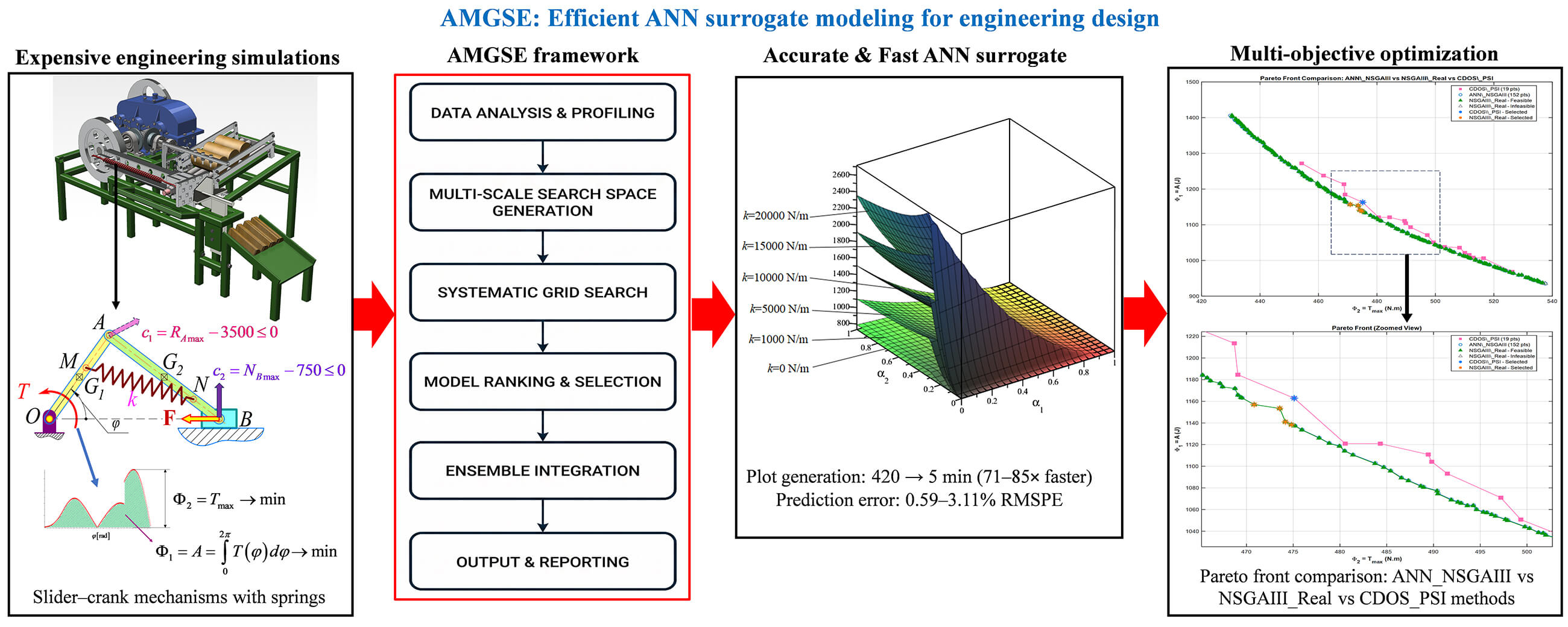
Evaluating objectives and constraints in complex dynamical or multi-physics systems can take minutes to hours per design point, which motivates the use of artificial neural network (ANN) surrogates; in practice, however, their architectures and hyperparameters are still largely chosen by trial and error. This study proposes the Adaptive Multi-scale Grid Search with Ensemble Integration (AMGSE), an automated framework that constructs ANN surrogates from a fixed, previously generated dataset under an explicit training-time budget and without any additional calls to the expensive model. AMGSE couples four explicit decision rules: budget-tiered search scales, dataset-size-triggered complexity scaling, multi-restart training with algorithm-specific restart selection, and a gap-thresholded conditional ensemble rule that withholds ensembling when candidate models are too heterogeneous. Every accepted surrogate must pass an external acceptance test, and every optimization candidate is re-evaluated on the exact model. Under matched search spaces and data partitions over ten independent runs, AMGSE attains mean prediction errors of 0.11%–0.67%, 3.3–10.6 times lower than those of Bayesian optimization, the Tree-structured Parzen Estimator and random search on three of four response functions; Gaussian process regression remains more accurate on three of these smooth, low-dimensional responses, while the AMGSE-selected ANN provides orders-of-magnitude faster batch inference inside the optimization loop. Applied to the multi-objective design of spring-assisted slider-crank mechanisms, the framework enables NSGA-III to return 151 exact-model-verified feasible solutions, of which 150 are mutually non-dominated; these collectively dominate all 19 previously published solutions and improve the hypervolume indicator by 16.1%. Beyond the case study, the same decision protocol was applied without modification to analytic benchmarks with two, six, and eight input dimensions, either certifying a surrogate or declining certification and returning a structured diagnostic. These contrasting outcomes indicate that response multimodality relative to sample density, rather than input dimensionality as such, determined whether the prescribed accuracy could be certified.Graphic Abstract
Keywords
Supplementary Material
Supplementary Material FileCite This Article
 Copyright © 2026 The Author(s). Published by Tech Science Press.
This work is licensed under a Creative Commons Attribution 4.0 International License , which permits unrestricted use, distribution, and reproduction in any medium, provided the original work is properly cited.
 Downloads
 Citation Tools
