
 Login
Login Register
 Submit a Paper
 Propose a Special lssue
 Open Access
ARTICLE

Multi-Head Encoder Shared Model Integrating Intent and Emotion for Dialogue Summarization
School of Artificial Intelligence, Chongqing University of Technology, Chongqing, 401135, China
* Corresponding Author: Junliang Chen. Email:
(This article belongs to the Special Issue: The Next-generation Deep Learning Approaches to Emerging Real-world Applications)
Computers, Materials & Continua 2025, 82(2), 2275-2292. https://doi.org/10.32604/cmc.2024.056877
Received 01 August 2024; Accepted 13 November 2024; Issue published 17 February 2025
 View Full Text
 Download PDF
Abstract
In task-oriented dialogue systems, intent, emotion, and actions are crucial elements of user activity. Analyzing the relationships among these elements to control and manage task-oriented dialogue systems is a challenging task. However, previous work has primarily focused on the independent recognition of user intent and emotion, making it difficult to simultaneously track both aspects in the dialogue tracking module and to effectively utilize user emotions in subsequent dialogue strategies. We propose a Multi-Head Encoder Shared Model (MESM) that dynamically integrates features from emotion and intent encoders through a feature fusioner. Addressing the scarcity of datasets containing both emotion and intent labels, we designed a multi-dataset learning approach enabling the model to generate dialogue summaries encompassing both user intent and emotion. Experiments conducted on the MultiWoZ and MELD datasets demonstrate that our model effectively captures user intent and emotion, achieving extremely competitive results in dialogue state tracking tasks.Keywords
Task-oriented dialogue systems (TOD) are a significant type of dialogue system designed to fulfill specific user goals, such as hotel reservations and route planning [1–3]. In recent years, the application of deep learning in TOD research has achieved remarkable progress, attracting considerable interest from both academia and industry. Dialogue state tracking (DST) is a fundamental component of such task-oriented dialogue systems [4,5]. The primary goal of DST is to understand the needs expressed by the user during the dialogue based on a given schema or ontology.
However, most dialogue state tracking (DST) tasks focus primarily on tracking user intent, often neglecting the emotional states of users. The user’s emotional state can provide valuable feedback to enhance the component’s ability to accurately recognize user intent. As is well-known, emotions are psychological behaviors generated by the joint stimulation of internal and external worlds. In other words, emotions are determined by one’s intentions and external actions. Positive emotions are often displayed when actions satisfy intentions. This emotional awareness can help dialogue AI generate responses that are more emotionally and semantically appropriate [6].
In task-oriented dialogue systems, accurately extracting the user’s departure location, destination, and departure time, while simultaneously perceiving changes in the user’s emotional state and adjusting the dialogue strategy in real-time, is crucial for creating a positive user experience, as illustrated in Fig. 1.
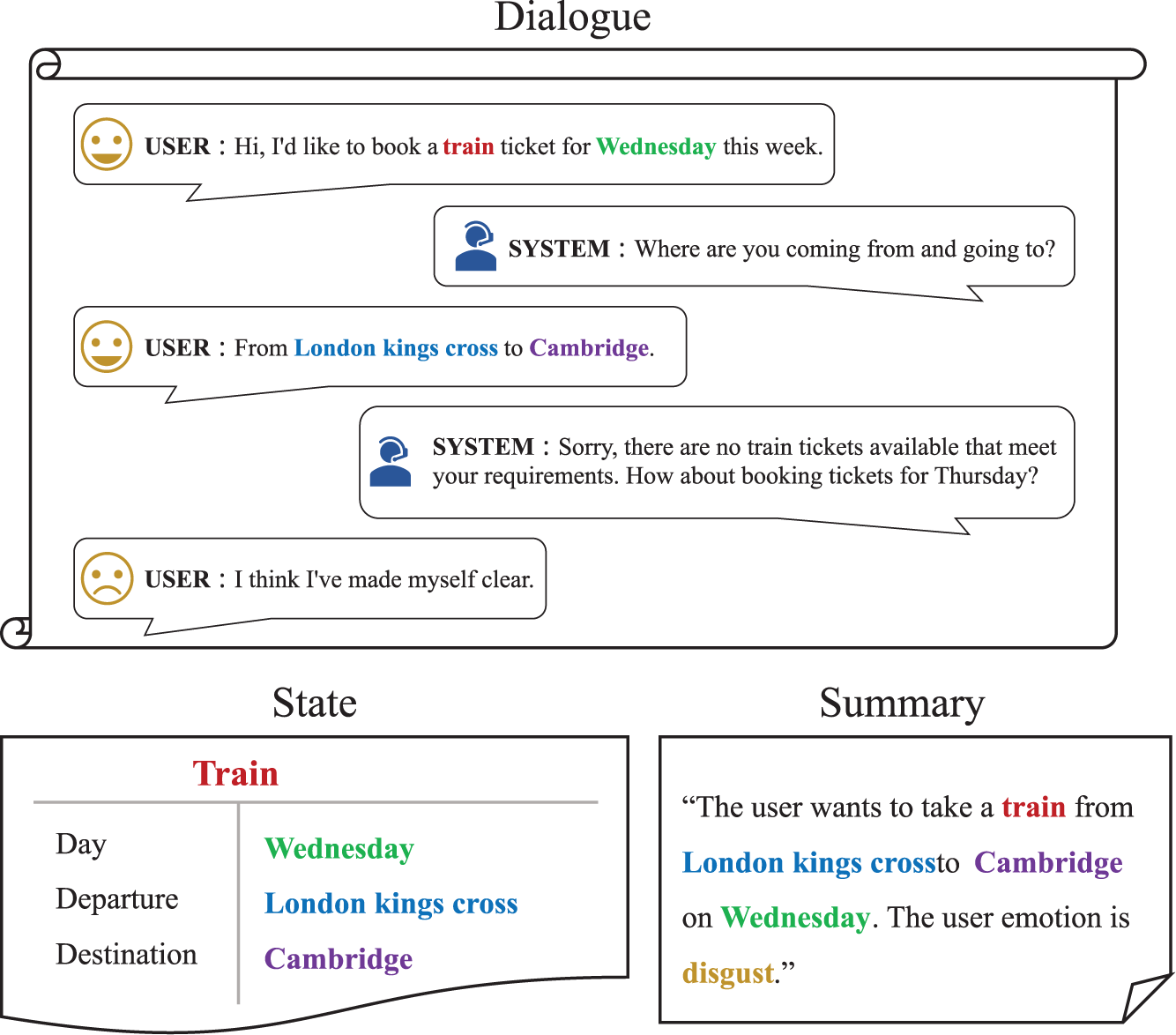
Figure 1: An example of a dialogue in the train domain and the summary created based on the state and user emotion
Nevertheless, the acquisition of turn-level dialogue state annotations is highly resource-intensive, necessitating considerable effort from domain experts in terms of design and mediation. Typically, this annotation process employs the Wizard-of-Oz (WoZ) technique [7], wherein two individuals engage in dialogue and annotate each turn’s state. In a notable study [8], researchers utilized crowdsourcing to compile MultiWoZ 2.0, creating one of the most extensive publicly available multi-domain task-oriented dialogue datasets. Many works on task-oriented dialogue systems (TOD) are based on MultiWoZ 2.0 [8] and MultiWoZ 2.1 [9].
So far, MultiWoZ is undoubtedly the most suitable dataset for guiding models in intent recognition, but it does not contain emotion labels. However, recognizing emotions is equally important in task-oriented dialogues. To address this issue, Reference [10] conducted extensive manual emotion annotations based on MultiWoZ, creating the EmoWOZ dataset. Unfortunately, the proportion of neutral emotion labels in EmoWOZ remains high, which is insufficient to fully guide models in dialogue emotion recognition.
To tackle the aforementioned issues, we propose integrating dialogue intent and emotion recognition, and using multiple datasets to guide model training. We replace dialogue state with dialogue summary that incorporate user intent and emotional information, as shown in Fig. 1. In the original Dialogue State Tracking (DST), the dialogue in Fig. 1 consists of the following three states: train-day: Wednesday, train-departure: London Kings Cross, and train-destination: Cambridge. We utilize the dialogue summary: “The user wants to take a train from London Kings Cross to Cambridge on Wednesday. The user’s emotion is disgust.” to replace the original dialogue states. These summaries are generated using heuristic rules that consider dialogue state and the user’s current emotion. This approach offers two main benefits: firstly, by replacing the dialogue state tracking task with the natural language generation task of dialogue summarization, and by using natural language sentence templates instead of formatted dialogue states, dialogue state tracking can more easily handle unexpected slot value information and be extended to other unknown domains. Second, we also replace user emotion classification recognition with user emotion summary generation, making the overall model’s dialogue summary generation more unified and facilitating feature integration. We continue to explore the limits of dialogue summary representation and expansion on the DS2 [11] basis. Since it has been validated in DS2 that guiding a dialogue summary model to generate dialogue states is feasible. Our research questions are as follow: 1. Is it feasible to use natural language sentence templates to guide the summarization model in generating emotional summaries. 2. Can the integration of features from emotional summaries and intent summaries enhance the quality of dialogue summary generation.
Therefore, we propose a Multi-Head Encoder Shared Model (MESM) and design a multi-dataset learning method. This model can learn features from different datasets through shared encoders and generate dialogue summaries that include both user intent and emotion. Additionally, this process is highly extensible, allowing for the easy expansion of other types of summarization capabilities. Finally, experiments on the MultiWoZ and MELD datasets demonstrate that our model can generate summaries that include both user intent and emotion, achieving improvements over the DS2 baseline, thereby proving the effectiveness of our approach. The main contributions of this paper are as follows:
• We propose the use of a dialogue summary model to generate emotion summaries, providing a new approach for dialogue emotion recognition tasks.
• We designed a Multi-Head Encoder Shared Model with a feature fusion mechanism that extracts and fits features from emotion encoders and intent encoders, enabling the model to generate dialogue summaries that encompass both user intent and emotion.
• We demonstrate the effectiveness of emotion summary generation. Furthermore, when implemented within generative models with reasoning capabilities, our approach achieved extremely competitive results on the MultiWoZ dataset.
Dialogue State Tracking (DST) is a recognized component within task-oriented dialogue systems [12,13]. In recent years, many works [14] have addressed the DST problem by leveraging large pre-trained language models, such as BERT [15] and T5 [16]. Large pre-trained language models enhance context understanding and provide stronger generalization capabilities, enabling them to handle diverse input data. However, they also come with increased parameter counts and longer training times. Modern advanced methods generally involve fine-tuning pre-trained language models with extensive annotated datasets [17–20]. To reduce reliance on large amounts of costly labeled training data, many researchers have made significant explorations in Few-Shot Dialogue State Tracking [21–24]. SM2 [25], by combining meta-learning with candidate pool retrieval, has demonstrated excellent performance in Few-Shot Dialogue State Tracking. At the same time, the QA-style prompts in TransferQA [26] introduce a high time complexity for slot value decoding. To address this issue, DS2 proposes replacing traditional dialogue state tracking tasks with dia-logue summarization, achieving promising results. DualLoRA [27] achieves strong results by using two distinct Low-Rank Adaptation (LoRA) components to handle dialogue context and optimize prompts. However, the aforementioned work still overlooks the importance of tracking user emotions in multi-turn dialogues, which is just as crucial as tracking user intent. We conducted Few-Shot training in a multi-domain setup with 1%, 5%, 10%, and 100% of the data. In Section 5.1, we briefly introduce our MESM and compare it with existing models.
Emotion Recognition in Conversation, a task that has been gaining increasing attention in the NLP field [28–31], has recently seen numerous encoder-based approaches [32,33]. However, the ERC task remains underexplored, which motivates us to reframe it as a unified gen-erative paradigm, specifically by using summarization for dialogue emotion recognition. In Section 5.2, we briefly describe and compare MESM with classical models.
Dialogue Summarization has been the focus of a growing number of researchers, encompassing both datasets [34–36] and models [37–39]. In DS2, the authors proposed representing dialogue states as dialogue summaries, which offers significant flexibility and scalability. Building on this, Reference [40] integrated summarization and response generation through a shared encoder, achieving strong results in task-oriented dialogue systems. We further explored the scalability of dialogue summarization and applied it to dialogue state tracking and dialogue emotion recognition, enabling subsequent feature integration.
In the Dialogue State Tracking (DST) task, each data point comprises a task-oriented dialogue
where the set of all possible slots

Using this setup, DST is a task that predicts
3.2 Multi-Head Encoder Shared Model (MESM)
Incorporating user emotion recognition alongside intent detection can facilitate smoother multi-turn interactions in task-oriented dialogue systems, thereby enhancing the user experience. In this section, we describe the overall framework of our proposed Multi-Head Encoder Shared Model (MESM) for jointly generating intent and emotion summaries, as shown in Fig. 2. Our approach consists of three main steps: the first step is emotion summarization training, which primarily involves training the emotion encoder and emotion decoder; the second step is intent summarization training, which primarily involves training the intent encoder, feature fusion mechanism, and intent decoder; the third step outlines the inference process when the model is used. In our method, we treat emotion as a type of slot-value pair in dialogue state tracking, following the approach proposed in DS2, which uses dialogue summaries instead of traditional dialogue state tracking. Therefore, to convert slot-value pair labels into summaries suitable for training and to evaluate the effectiveness of the generated summaries in capturing user emotion and intent, our components also include a dialogue summarizer
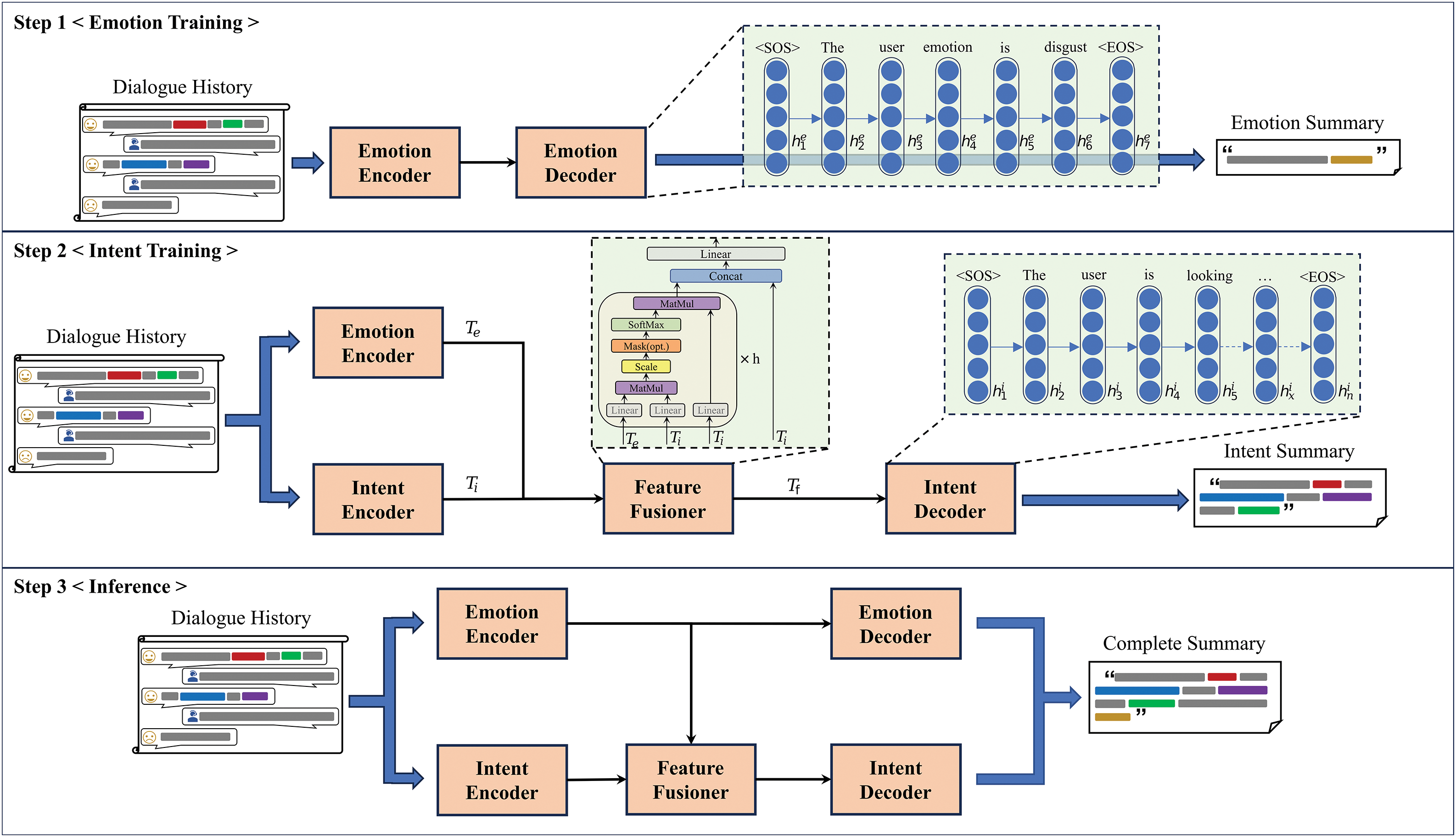
Figure 2: Overview of our Multi-Head Encoder Shared Model (MESM). In Section 3.2, we provide a detailed explanation of our model’s training and inference process, dividing it into three steps
First, we propose converting the dialogue emotion recognition task into a emotion summarization task. In Step 1, we train the emotion encoder and emotion decoder to generate emotion summaries. For a given dialogue history
Next, in the intent training step, we introduce a feature fusion mechanism
which is then input into the intent decoder. In this step, we train the intent encoder, feature fusion mechanism, and intent decoder to predict
Finally, we produce a unified summary containing both emotion and intent through a unified inference process, as illustrated in Step 3 of Fig. 2. To evaluate the performance of the predicted summaries, during testing, we need to use the dialogue state extractor
Here,
3.3 Converter between State and Summary
Building on the foundation established by DS2, we have enhanced the dialogue summarizer
For a given set of dialogue states
“The user emotion is disgust.”
For domains with multiple slots, each slot value
“The user wants to take a train from London kings cross to Cambridge on Wednesday.”
Combining the emotion summary
“The user wants to take a train from London kings cross to Cambridge on Wednesday. And the user emotion is disgust.”
As mentioned earlier, the dialogue summarizer
The design of the Feature Fusioner
Specifically, in our model, let the output of the emotion encoder be
where Q, K and V represent the query, key, and value matrices,
Through this method, Multi-head Attention can automatically learn and extract the correlations between the outputs of the emotion encoder and the intent encoder, enhancing the feature representation between them. After extracting features
where
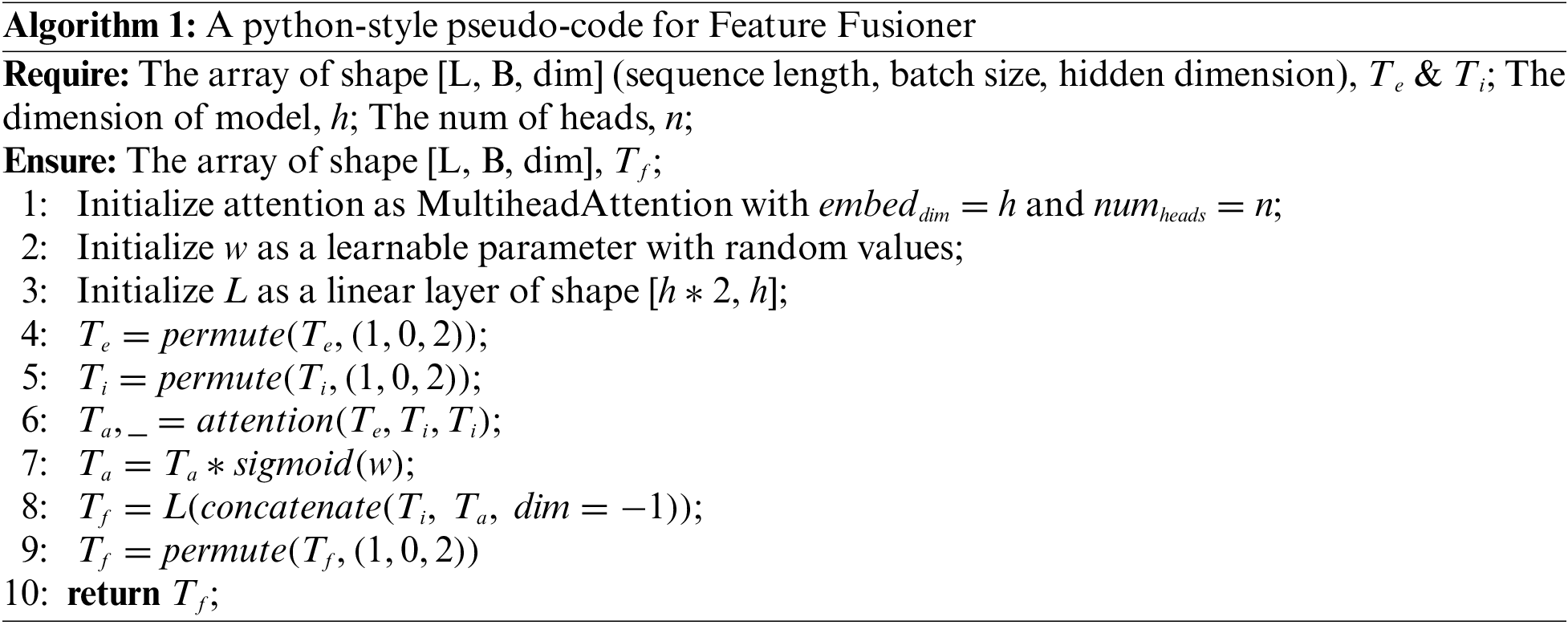
The design of feature fusion and residual connection is intended to enhance the expressiveness of the features and the accuracy of intent recognition by effectively combining feature information from different sources. We illustrate the computation process of the Feature Fusioner in Algorithm 1 using Python-style pseudo-code.
MultiWoZ is an extensive English dataset for multi-domain task-oriented dialogues, covering seven distinct domains. However, akin to the approach in [4], we focus on five domains: attraction, taxi, train, hotel and restaurant. Table 2 lists the number of dialogues in each of the five domains within the MultiWoZ 2.1 training set. Our model is evaluated on both MultiWoZ 2.0 and MultiWoZ 2.1.

MELD [31] dataset is a multimodal dataset derived from the popular TV show “Friends,” comprising over 1400 dialogues and more than 13,000 utterances, each annotated with emotion and emotion labels. In our scenario, we only use the textual data. Table 3 presents the distribution of emotions in the MELD dataset and the number of instances in each category. For our purposes, we primarily focus on the emotion labels.

Intent Summary Generation
In our experiments, we use intent summary generation as a replacement for Dialogue State Tracking (DST), where the generated intent summaries can be easily converted into dialogue states within DST. Therefore, the primary performance metric for our intent summary generation experiments is the Joint Goal Accuracy (JGA) in DST, as shown in Eq. (7). In each turn of dialogue, we use a dialogue state extractor (
Emotion Summary Generation
Similar to intent summary generation, emotion labels can also be easily extracted from the generated emotion summaries. As shown in Eq. (8), we use weighted-average (w-avg) to evaluate the model’s accuracy across each emotion category.
Recently, many large parameter models have demonstrated outstanding performance and ex-ceptional scalability in various natural language processing (NLP) tasks. However, in multi-turn dialogue systems, the advantages of these large language models primarily lie in their ability to handle open-domain dialogue and their strong natural language generation (NLG) capabilities. Due to their extensive parameter sizes, many studies tend to utilize large language models as a whole, employing prompt-based fine-tuning methods for implementation, as seen in [41].
Therefore, for subsequent deployment in practical environments, we evaluated two pre-trained language models, BART-large and T5-large, as the encoder and decoder within the Multi-Head En-coder Shared Model (MESM) framework after careful selection. Unfortunately, the BART-large model did not perform well in emotion summary generation. Consequently, we primarily utilized the T5-large model. The pretrained weights for T5-large were sourced from [11], from which we extracted the encoder and decoder to incorporate into the MESM model.
Intent Summary Generation Settings
In our experiments, we primarily explored the Multi-Domain (MD) setting as described in [42]. For the MD experiments, the model was trained using all domains, with each slot value contributing to the overall summary and evaluation. Performance was assessed by measuring both the per-domain JGA and the overall JGA.
We conducted Few-Shot DST experiments within the MD scenario, sampling 1%, 5%, 10%, and 100% of the training data to fine-tune the model. The full dev and test datasets were used for evaluation across all settings. As outlined in Section 4.1, each setting was run on MultiWoZ 2.0 and 2.1.
Emotion Summary Generation Settings
In our experiments, we focused on recognizing various emotion labels within the MELD dataset. We preprocessed the data from MELD into multi-turn dialogues based on Dialogue_ID. For each dialogue, we input the historical dialogue context to generate emotion summaries.
Other Settings
For both intent summary generation and emotion summary generation, we used the Adam optimizer with a learning rate of 5e-5, a batch size of 2, and trained for 50 epochs. We implemented and ran our experiments using Python 3.8.18 and PyTorch 1.9.1, leveraging CUDA 11.1 for accelerated computation. The model was trained on the training dataset, with early stopping criteria based on validation set performance. After training, final evaluations were performed on the test dataset.
Intent Summary Generation
We conducted experiments on MultiWoZ 2.0 and MultiWoZ 2.1, as most of the baseline evaluations were performed on these datasets.
DS2 [11] is an innovative dialogue system model that proposes using dialogue summaries instead of dialogue states, aiming to simultaneously handle intent recognition, slot filling, and dialogue generation tasks.
TRADE [4] is a model based on multi-turn dialogues aimed at intent recognition and slot filling in task-oriented dialogues. It utilizes a copy mechanism and slot-domain embeddings to achieve transferability and enhance dialogue system performance.
MinTL [20] is a lightweight Transformer model specifically designed for intent recognition and slot filling tasks in dialogue systems. It employs multitask learning by minimizing the distance between the target task and the language model task.
SOLOIST [43] is a self-supervised learning-based dialogue system model that leverages local information from the dialogue history for intent recognition and slot filling. It uses a method called SOLO (Self-supervised Open-dialogue Learning) for model training.
PPTOD [24] is an end-to-end Transformer-based model for intent recognition and slot prediction tasks in multi-turn dialogues. It utilizes a pre-trained Transformer model for dialogue state tracking and generation.
SM2 [25] achieves extremely competitive results by combining a meta-learning scheme with an improved training retrieval mechanism.
DualLoRA [27] enhances model performance by processing and optimizing dialogue context and prompts through two distinct Low-Rank Adaptation (LoRA) components, all without introducing additional inference latency.
Emotion Summary Generation
In this experiment, we proposed using emotion summary generation to identify emotions in dialogues. Most recent works utilize multimodal data from the MELD dataset, while we used only text from MELD for emotion summary generation. Therefore, our primary objective here is to validate the effectiveness of using emotion summary generation and compare it with classical models.
text-CNN [28] is a convolutional neural network-based model for emotion summary generation tasks, aiming to capture local features of emotional information through convolution operations on dialogue text.
bcLSTM [29] is a bidirectional contextual long short-term memory network that considers both contextual and current input information simultaneously and captures long-term dependencies in dialogues through LSTM units.
DialogueRNN [30] is a recurrent neural network model that captures the evolution of emotions and contextual information in dialogues by recursively modeling the dialogue history.
We present the performance of our method, MESM, in different Few-Shot settings compared to the baselines mentioned in Section 4.4 in Table 4. We evaluated our model on the MultiWOZ 2.0 and 2.1 version. We observed that under low-parameter training settings, MESM does not exhibit significant advantages over previous methods.
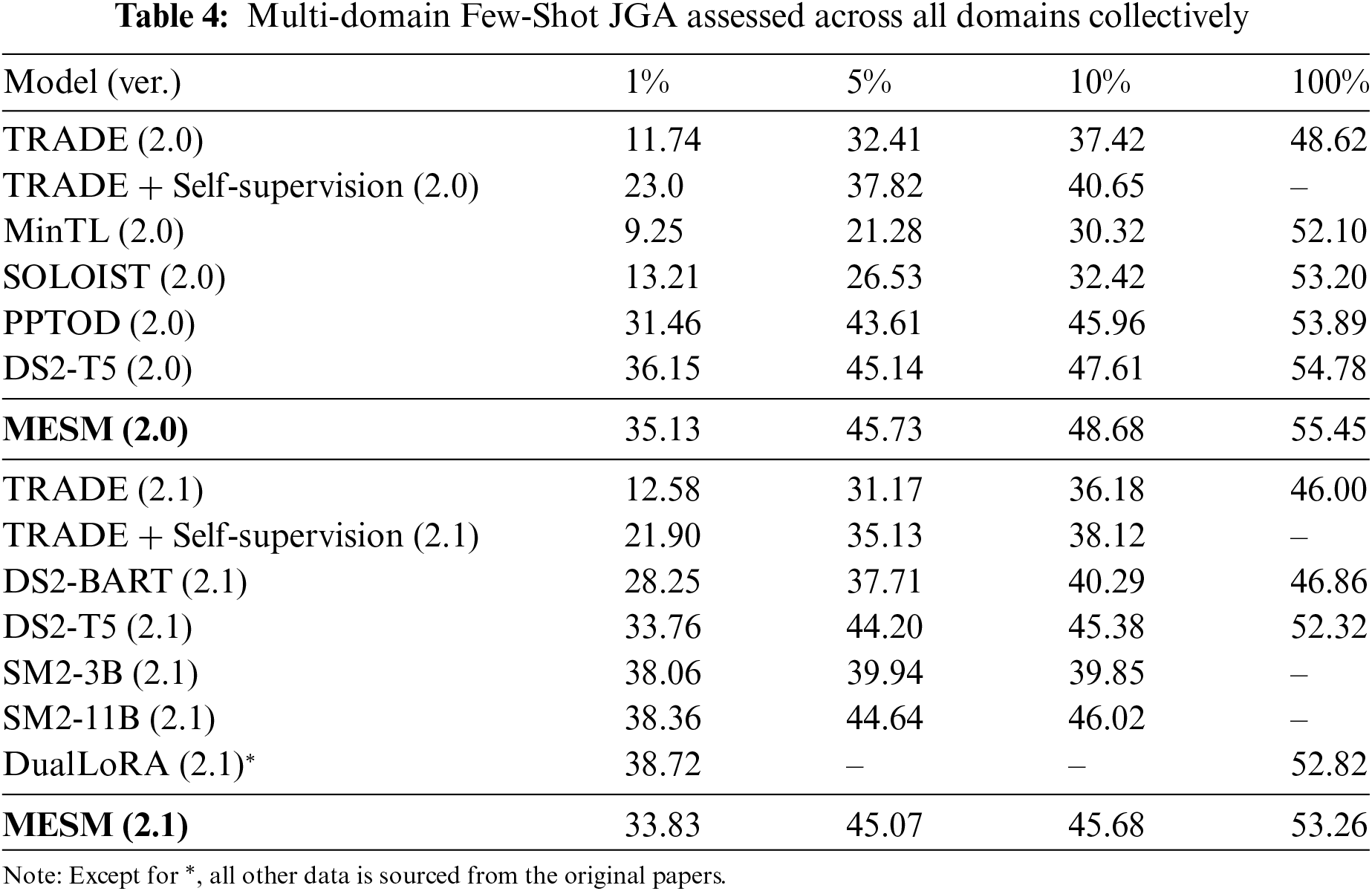
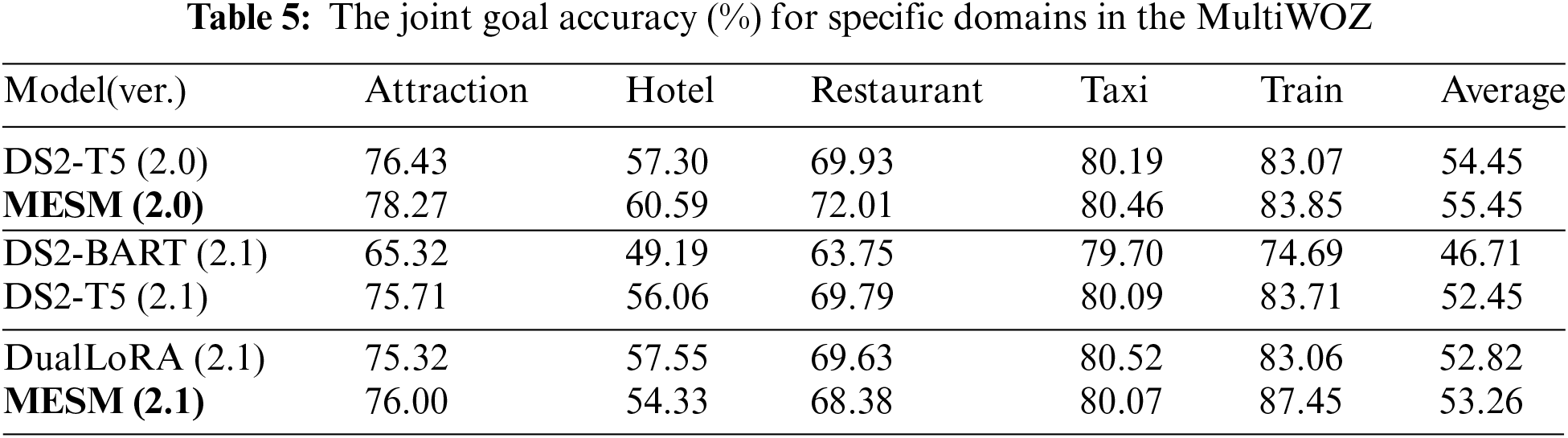
Consequently, we retrained DS2 and DualLoRA in our environment with multi-domain full-parameter training and evaluated its specific domain JGA. As shown in Table 5, the overall performance of MESM was 55.45 (2.0) and 53.26 (2.1), achieving a notable improvement compared to DS2’s 54.45 (2.0) and 52.45 (2.1). Furthermore, compared to DualLoRA, our Multi-Head Encoder Shared Model (MESM) shows significant advantages on the MultiWOZ 2.1 dataset.
Furthermore, we analyzed the slot accuracy for specific domains and compared MESM with DS2 on MultiWOZ 2.0 and MultiWOZ 2.1. As illustrated in Fig. 3, our model generally achieved better results compared to the baselines in most scenarios.
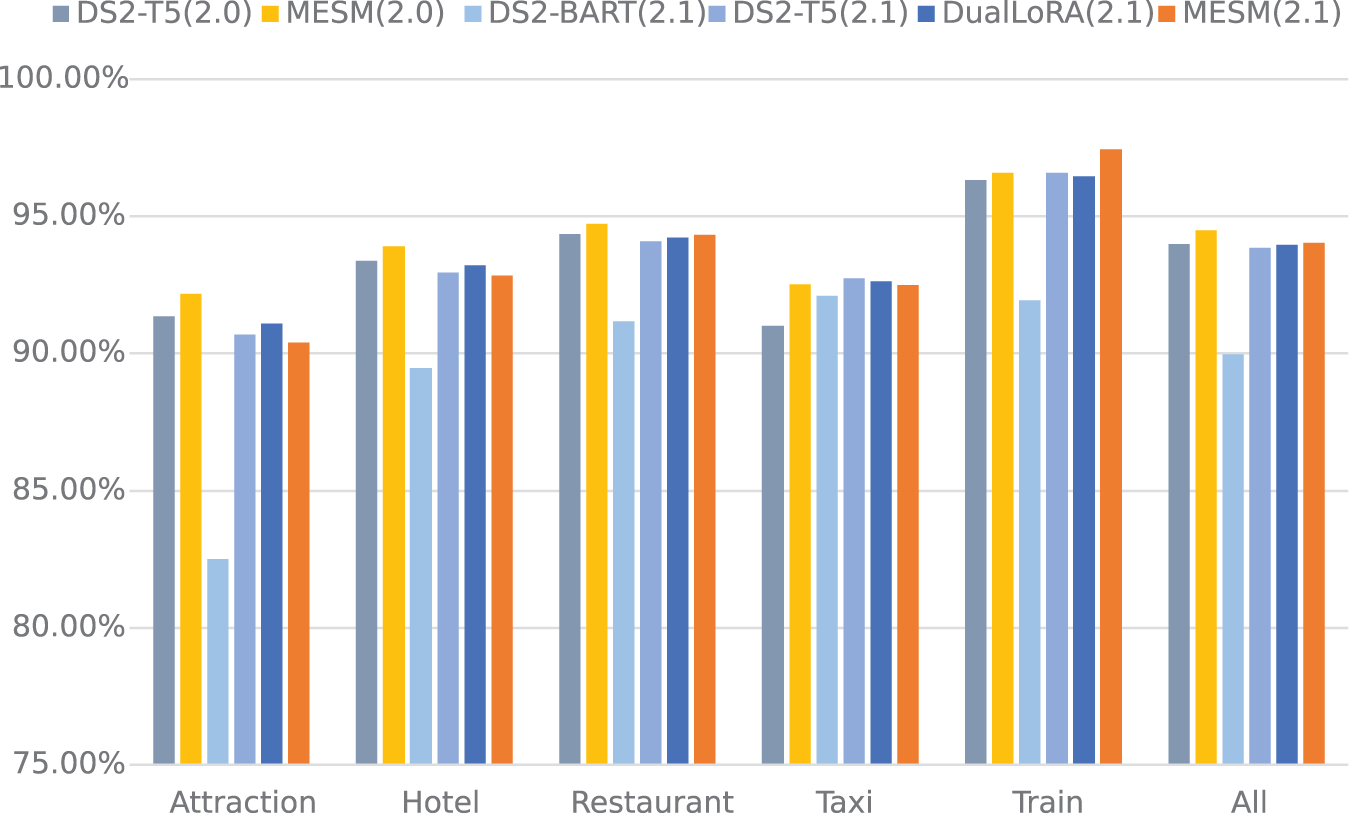
Figure 3: The slots accuracy for specific domains in the MultiWOZ
5.2 Emotion Summary Generation
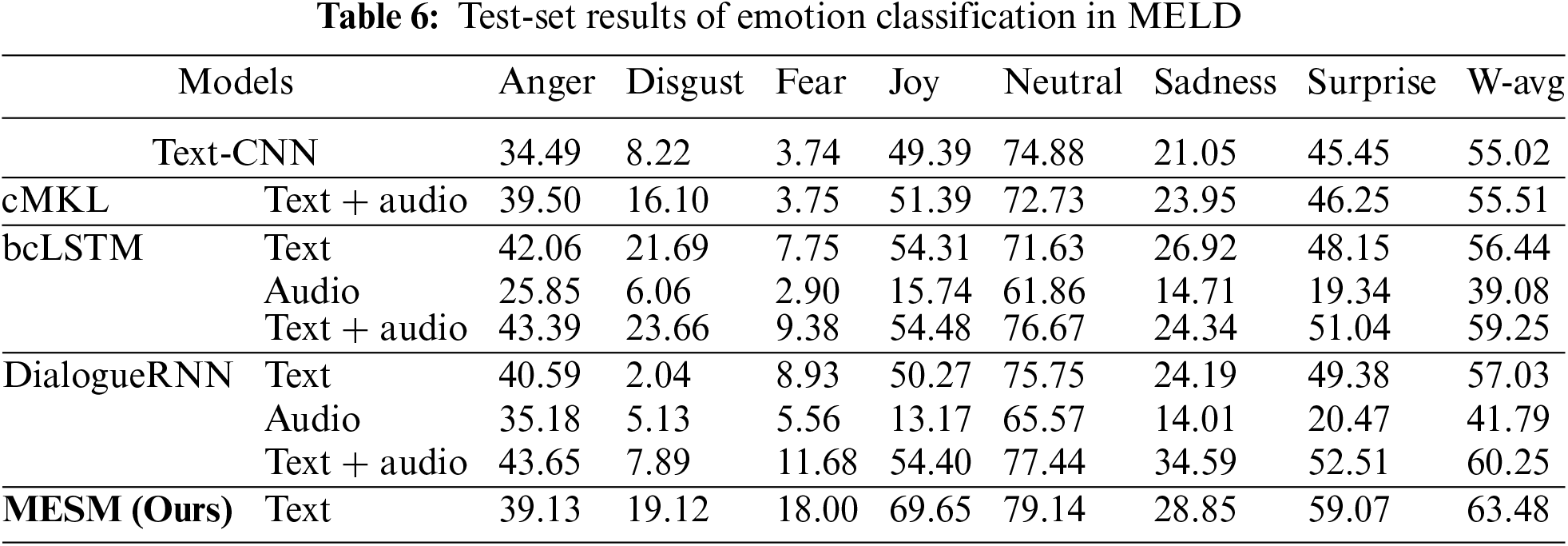
In Table 6, we compare the accuracy of each emotion classification and the weighted average (w-avg) results of our model. It is important to note that our method only utilizes text for prediction. This experiment demonstrates that our proposed approach of generating emotion summaries through a summary generation model is feasible and exhibits certain advantages.
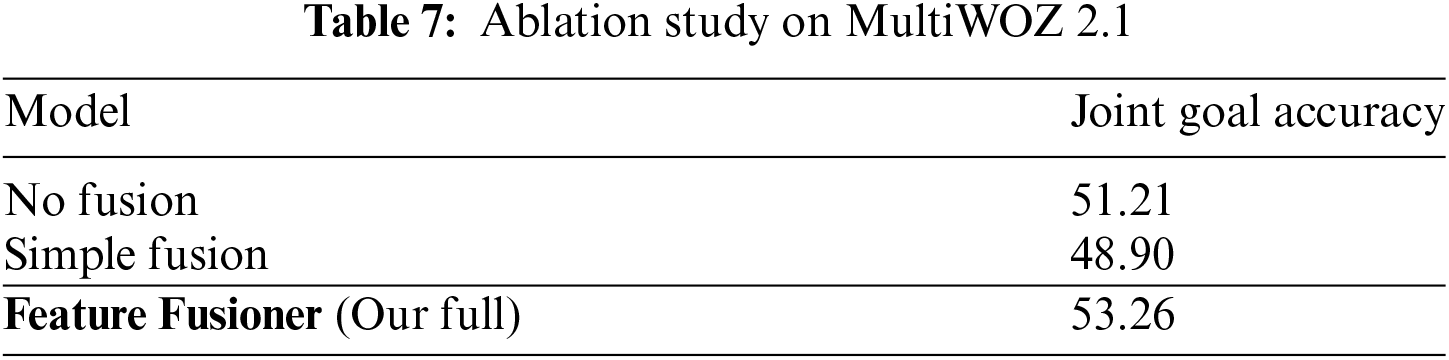
To assess the impact of the Feature Fusioner on model’s performance, we conducted an ablation study. We designed three methods to assess the model’s performance: (1) No Fusion between emotion features and intent features, where emotion summary generation and intent summary generation are conducted independently; (2) Simple fusion of emotion features
As shown in Table 7, we observed that the Feature Fusioner significantly improved performance compared to the No Fusion method, where intent summary generation was conducted independently. Due to the additional noise introduced by Simple Fusion, its performance is actually inferior to that of No Fusion. This demonstrates the effectiveness of using the Feature Fusioner to integrate emotion features
6.2 Cost of Experimental Engineering
In our experiments, we extended the dialogue summarizer
Our model comprises 1.6 billion trainable parameters, and we utilized the NVIDIA RTX A6000 48G for our experiments. For each turn in the dialogue, we input the current dialogue history and perform inference. In terms of time complexity, the worst-case inference time complexity of our model is
Our experiments have several limitations. Due to the requirement of generating dialogue summaries that encompass both emotion and intent tasks, our model has a larger scale. The number of trainable parameters in our model is more than double that of other Dialogue State Tracking (DST) models, necessitating more substantial hardware resources. Additionally, the increased parameter size and the complexity of training the Feature Fusioner for feature integration result in longer training times. For instance, training on the full data for the multi-domain scenario takes approximately 75 h. These issues of large parameter size and extended training time need to be addressed in future work to improve the efficiency and practicality of our model.
To address the limitation of traditional Dialogue State Tracking (DST) modules in Task-Oriented Dialogue Systems (TOD) which fail to concurrently track user intents and emotions, we propose the Multi-Head Encoder Sharing Model (MESM). In our approach, we reframe the emotion recognition task as a summary generation task, guiding the model to produce user emotion summaries through an extended state-to-summary converter. Additionally, during intent recognition training, the Feature Fusioner in MESM integrates intent and emotion features, ultimately generating a complete summary that encompasses both user intent and emotion.
We evaluated the performance of our method on the MultiWoZ and MELD datasets. The experimental results demonstrate that MESM effectively captures user emotions and enhances the accuracy of generated user intent summaries. Our model maintains Few-Shot capabilities while achieving extremely competitive performance in multi-domain full-parameter training compared to current baselines. However, our model has a larger parameter size and longer training time compared to other DST models. These issues will be addressed in future work to improve the efficiency and practicality of our approach.
Acknowledgement: We extend our gratitude to the anonymous reviewers for their insightful feedback.
Funding Statement: This research was funded by the Science and Technology Foundation of Chongqing Education Commission (Grant No. KJQN202301153), the Scientific Research Foundation of Chongqing University of Technology (Grant No. 2021ZDZ025) and the Postgraduate Innovation Foundation of Chongqing University of Technology (Grant No. gzlcx20243524).
Author Contributions: Conceptualization, Xinlai Xing; methodology, Junliang Chen; software, Junliang Chen and Shuran Zhou; validation, Junliang Chen, Shuran Zhou and Runqing Zhang; formal analysis, Xiaochuan Zhang; investigation, Shuran Zhou; resources, Xinlai Xing; data curation, Shuran Zhou; writing original draft preparation, Junliang Chen; writing review and editing, Xinlai Xing; visualization, Shuran Zhou; supervision, Xinlai Xing; project administration, Xiaochuan Zhang; funding acquisition Xinlai Xing and Xiaochuan Zhang. All authors reviewed the results and approved the final version of the manuscript.
Availability of Data and Materials: The data that support the findings of this study are available from the corresponding author, Junliang Chen, upon reasonable request.
Ethics Approval: Not applicable.
Conflicts of Interest: The authors declare no conflicts of interest to report regarding the present study.
References
1. H. Chen, X. Liu, D. Yin, and J. Tang, “A survey on dialogue systems: Recent advances and new frontiers,” ACM SIGKDD Explor. Newsl., vol. 19, no. 2, pp. 25–35, 2017. doi: 10.1145/3166054.3166058. [Google Scholar] [CrossRef]
2. J. Ni, T. Young, V. Pandelea, F. Xue, and E. Cambria, “Recent advances in deep learning based dialogue systems: A systematic survey,” Artif. Intell. Rev., vol. 56, no. 4, pp. 3055–3155, 2023. doi: 10.1007/s10462-022-10248-8. [Google Scholar] [CrossRef]
3. Z. Zhang, R. Takanobu, Q. Zhu, M. Huang, and X. Zhu, “Recent advances and challenges in task-oriented dialog systems,” Sci. China Technol. Sci., vol. 63, no. 10, pp. 2011–2027, 2020. doi: 10.1007/s11431-020-1692-3. [Google Scholar] [CrossRef]
4. C. -S. Wu, A. Madotto, E. Hosseini-Asl, C. Xiong, R. Socher and P. Fung, “Transferable multi-domain state generator for task-oriented dialogue systems,” in Proc. 57th Annual Meet.e Assoc. Comput. Linguist., Florence, Italy: Association for Computational Linguistics, Jul. 2019, pp. 808–819. doi: 10.18653/v1/P19-1078. [Google Scholar] [CrossRef]
5. V. Balaraman, S. Sheikhalishahi, and B. Magnini, “Recent neural methods on dialogue state tracking for task-oriented dialogue systems: A survey,” in Proc. 22nd Annual Meet. Special Interest Group Disc. Dial., 2021, pp. 239–251. [Google Scholar]
6. H. Zhou, M. Huang, T. Zhang, X. Zhu, and B. Liu, “Emotional chatting machine: Emotional conversation generation with internal and external memory,” Proc. AAAI Conf. Artif. Intell., vol. 32, no. 1, 2018. doi: 10.1609/aaai.v32i1.11325. [Google Scholar] [CrossRef]
7. J. F. Kelley, “An iterative design methodology for user-friendly natural language office information applications,” ACM Trans. Inf. Syst., vol. 2, no. 1, pp. 26–41, 1984. doi: 10.1145/357417.357420. [Google Scholar] [CrossRef]
8. P. Budzianowski et al., “MultiWOZ-A large-scale multi-domain Wizard-of-Oz dataset for task-oriented dialogue modelling,” in Proc. 2018 Conf. Empi. Meth. Nat. Lang. Process., Brussels, Belgium: Association for Computational Linguistics, Oct.–Nov. 2018, pp. 5016–5026. doi: 10.18653/v1/D18-1547. [Google Scholar] [CrossRef]
9. M. Eric et al., “MultiWOZ 2.1: A consolidated multi-domain dialogue dataset with state corrections and state tracking baselines,” in Proc. Twelfth Lang. Res. Eval. Conf., Marseille, France: European Language Resources Association, May 2020, pp. 422–428. [Google Scholar]
10. S. Feng et al., “EmoWOZ: A large-scale corpus and labelling scheme for emotion recognition in task-oriented dialogue systems,” in Proc. Thirteenth Lang. Res. Eval. Conf., Marseille, France: European Language Resources Association, Jun. 2022, pp. 4096–4113. [Google Scholar]
11. J. Shin, H. Yu, H. Moon, A. Madotto, and J. Park, “Dialogue summaries as dialogue states (DS2template-guided summarization for few-shot dialogue state tracking,” in Find. Assoc. Comput. Linguist.: ACL 2022, Dublin, Ireland: Association for Computational Linguistics, May 2022, pp. 3824–3846. doi: 10.18653/v1/2022.findings-acl.302. [Google Scholar] [CrossRef]
12. J. D. Williams and S. Young, “Partially observable markov decision processes for spoken dialog systems,” Comput. Speech Lang., vol. 21, no. 2, pp. 393–422, 2007. doi: 10.1016/j.csl.2006.06.008. [Google Scholar] [CrossRef]
13. J. D. Williams, M. Henderson, A. Raux, B. Thomson, A. Black and D. Ramachandran, “The dialog state tracking challenge series,” AI Magazine, vol. 35, no. 4, pp. 121–124, 2014. doi: 10.1609/aimag.v35i4.2558. [Google Scholar] [CrossRef]
14. S. Gao, S. Agarwal, D. Jin, T. Chung, and D. Hakkani-Tur, “From machine reading comprehension to dialogue state tracking: Bridging the gap,” in Proc. 2nd Workshop Nat. Lang. Process. Conversat. AI, Association for Computational Linguistics, Jul. 2020, pp. 79–89. doi: 10.18653/v1/2020.nlp4convai-1.10. [Google Scholar] [CrossRef]
15. J. Devlin, M. -W. Chang, K. Lee, and K. Toutanova, “BERT: Pre-training of deep bidirectional transformers for language understanding,” in Proc. 2019 Conf. North American Chapt. Assoc. Comput. Linguist.: Human Lang. Technol, Minneapolis, Minnesota: Association for Computational Linguistics, Jun. 2019, pp. 4171–4186. doi: 10.18653/v1/N19-1423. [Google Scholar] [CrossRef]
16. C. Raffel et al., “Exploring the limits of transfer learning with a unified text-to-text transformer,” J. Mach. Learn. Res., vol. 21, no. 140, pp. 1–67, 2020. [Google Scholar]
17. Y. Zhang, Z. Ou, and Z. Yu, “Task-oriented dialog systems that consider multiple appropriate responses under the same context,” Proc. AAAI Conf. Artif. Intell., vol. 34, no. 5, pp. 9604–9611, 2020. doi: 10.1609/aaai.v34i05.6507. [Google Scholar] [CrossRef]
18. C. -S. Wu, S. C. Hoi, R. Socher, and C. Xiong, “TOD-BERT: Pre-trained natural language understanding for task-oriented dialogue,” in Proc. 2020 Conf. Empirical Meth. Nat. Lang. Process. (EMNLP), Association for Computational Linguistics, Nov. 2020, pp. 917–929. doi: 10.18653/v1/2020.emnlp-main.66. [Google Scholar] [CrossRef]
19. J. Zhang et al., “Find or classify? dual strategy for slot-value predictions on multi-domain dialog state tracking,” in Proc. Ninth Joint Conf. Lexic. Computat. Semant., Barcelona, Spain: Association for Computational Linguistics, Dec. 2020, pp. 154–167. [Google Scholar]
20. Z. Lin, A. Madotto, G. I. Winata, and P. Fung, “MinTL: Minimalist transfer learning for task-oriented dialogue systems,” in Proc. 2020 Conf. Empiric. Meth. Nat. Lang. Process. (EMNLP), Association for Computational Linguistics, Nov. 2020, pp. 3391–3405. doi: 10.18653/v1/2020.emnlp-main.273. [Google Scholar] [CrossRef]
21. F. Mi, Y. Wang, and Y. Li, “CINS: Comprehensive instruction for few-shot learning in task-oriented dialog systems,” Proc. AAAI Conf. Artif. Intell., vol. 36, no. 10, pp. 11 076–11 084, 2022. doi: 10.1609/aaai.v36i10.21356. [Google Scholar] [CrossRef]
22. S. Li et al., “Zero-shot generalization in dialog state tracking through generative question answering,” in Proc. 16th Conf. Eur. Chap. Assoc. Computational Linguist., 2021, pp. 1063–1074. [Google Scholar]
23. G. Campagna, A. Foryciarz, M. Moradshahi, and M. Lam, “Zero-shot transfer learning with synthesized data for multi-domain dialogue state tracking,” in Proc. 58th Annual Meet. Assoc. Computat. Linguist., 2020, pp. 122–132. [Google Scholar]
24. Y. Su et al., “Multi-task pre-training for plug-and-play task-oriented dialogue system,” in Proc. 60th Annual Meet. Assoc. Computat. Linguist., 2022, pp. 4661–4676. [Google Scholar]
25. D. Chen, K. Qian, and Z. Yu, “Stabilized in-context learning with pre-trained language models for few shot dialogue state tracking,” in Find. Assoc. Computat. Linguist.: EACL 2023, Dubrovnik, Croatia: Association for Computational Linguistics, May 2023, pp. 1551–1564. doi: 10.18653/v1/2023.findings-eacl.115. [Google Scholar] [CrossRef]
26. Z. Lin et al., “Zero-shot dialogue state tracking via cross-task transfer,” in Proc. 2021 Conf. Empiric. Meth. Nat. Lang. Process., Punta Cana, Dominican Republic: Association for Computational Linguistics, Nov. 2021, pp. 7890–7900. doi: 10.18653/v1/2021.emnlp-main.622. [Google Scholar] [CrossRef]
27. X. Luo, Z. Tang, J. Wang, and X. Zhang, “Zero-shot cross-domain dialogue state tracking via dual low-rank adaptation,” in Proc. 62nd Annual Meet. Assoc. Computat. Linguist., Bangkok, Thailand: Association for Computational Linguistics, Aug. 2024, pp. 5746–5765. doi: 10.18653/v1/2024.acl-long.312. [Google Scholar] [CrossRef]
28. Y. Kim, “Convolutional neural networks for sentence classification,” in Proc. 2014 Conf. Empiric. Meth. Nat. Lang. Process. (EMNLP), Doha, Qatar: Association for Computational Linguistics, Oct. 2014, pp. 1746–1751. doi: 10.3115/v1/D14-1181. [Google Scholar] [CrossRef]
29. S. Poria, E. Cambria, D. Hazarika, N. Majumder, A. Zadeh and L. -P. Morency, “Context-dependent sentiment analysis in user-generated videos,” in Proc. 55th Annual Meet. Assoc. Computat. Linguist. (Volume 1: Long Papers), Vancouver, BC, Canada: Association for Computational Linguistics, Jul. 2017, pp. 873–883. doi: 10.18653/v1/P17-1081. [Google Scholar] [CrossRef]
30. N. Majumder, S. Poria, D. Hazarika, R. Mihalcea, A. Gelbukh and E. Cambria, “DialogueRNN: An attentive rnn for emotion detection in conversations,” Proc. AAAI Conf. Artif. Intell., vol. 33, no. 1, pp. 6818–6825, 2019. doi: 10.1609/aaai.v33i01.33016818. [Google Scholar] [CrossRef]
31. S. Poria, D. Hazarika, N. Majumder, G. Naik, E. Cambria and R. Mihalcea, “MELD: A multimodal multi-party dataset for emotion recognition in conversations,” in Proc. 57th Annu. Meet. Assoc. Computat. Linguist., Association for Computational Linguistics, 2019. [Google Scholar]
32. G. Dong et al., “PSSAT: A perturbed semantic structure awareness transferring method for perturbation-robust slot filling,” in Proc. 29th Int. Conf. Computati. Linguist., 2022, pp. 5327–5334. [Google Scholar]
33. G. Zhao, G. Dong, Y. Shi, H. Yan, W. Xu and S. Li, “Entity-level interaction via heterogeneous graph for multimodal named entity recognition,” in Find. Assoc. Computat. Linguist.: EMNLP, Abu Dhabi, United Arab Emirates: Association for Computational Linguistics, 2022, pp. 6345–6350. doi: 10.18653/v1/2022.findings-emnlp.473. [Google Scholar] [CrossRef]
34. C. Zhu, Y. Liu, J. Mei, and M. Zeng, “Mediasum: A large-scale media interview dataset for dialogue summarization,” in Proc. 2021 Conf. North American Chapt. Assoc. Computat. Linguist.: Human Lang. Technol/, Association for Computational Linguistics, 2021. [Google Scholar]
35. M. Zhong et al., “QMSum: A new benchmark for query-based multi-domain meeting summarization,” in Proc. 2021 Conf. North American Chapt. Assoc. Computati. Linguist.: Human Lang. Technol., 2021, pp. 5905–5921. [Google Scholar]
36. Y. Chen, Y. Liu, and Y. Zhang, “Dialogsum challenge: Summarizing real-life scenario dialogues,” in Proc. 14th Int. Conf. Nat. Lang. Gen., 2021, pp. 308–313. [Google Scholar]
37. C. Wu, L. Liu, W. Liu, P. Stenetorp, and C. Xiong, “Controllable abstractive dialogue summarization with sketch supervision,” in Find. Assoc. Computat. Linguist.: ACL-IJCNLP 2021, Association for Computational Linguistics, 2021, pp. 5108–5122. doi: 10.18653/v1/2021.findings-acl.454. [Google Scholar] [CrossRef]
38. X. Feng, X. Feng, L. Qin, B. Qin, and T. Liu, “Language model as an annotator: Exploring dialogpt for dialogue summarization,” in Proc. 59th Annual Meet. Assoc. Computat. Linguist. 11th Int. Joint Conf. Nat. Lang. Process., 2021, pp. 1479–1491. doi: 10.18653/v1/2021.acl-long.11. [Google Scholar] [CrossRef]
39. M. Khalifa, M. Ballesteros, and K. Mckeown, “A bag of tricks for dialogue summarization,” in Proc. 2021 Conf. Empiric. Meth. Nat. Lang. Process., 2021, pp. 8014–8022. [Google Scholar]
40. M. Zhao et al., “Mutually improved response generation and dialogue summarization for multi-domain task-oriented dialogue systems,” Knowl.-Based Syst., vol. 279, no. 2, 2023, Art. no. 110927. doi: 10.1016/j.knosys.2023.110927. [Google Scholar] [CrossRef]
41. I. T. Aksu, M. -Y. Kan, and N. Chen, “Prompter: Zero-shot adaptive prefixes for dialogue state tracking domain adaptation,” in Proc. 61st Annu. Meet. Assoc. Computat. Linguist. (Volume 1: Long Papers), Toronto, ON, Canada: Association for Computational Linguistics, Jul. 2023, pp. 4588–4603. doi: 10.18653/v1/2023.acl-long.252. [Google Scholar] [CrossRef]
42. C. -S. Wu, S. C. Hoi, and C. Xiong, “Improving limited labeled dialogue state tracking with self-supervision,” in Find. Assoc. Computat. Linguist.: EMNLP 2020, 2020, pp. 4462–4472. doi: 10.18653/v1/2020.findings-emnlp.400. [Google Scholar] [CrossRef]
43. B. Peng, C. Li, J. Li, S. Shayandeh, L. Liden and J. Gao, “SOLOIST: Few-shot task-oriented dialog with a single pretrained auto-regressive model,” 2020, arXiv:2005.05298. [Google Scholar]
Cite This Article
 Copyright © 2025 The Author(s). Published by Tech Science Press.
This work is licensed under a Creative Commons Attribution 4.0 International License , which permits unrestricted use, distribution, and reproduction in any medium, provided the original work is properly cited.
 Downloads
 Citation Tools
