
 Login
Login Register
 Submit a Paper
 Propose a Special lssue
 Open Access
ARTICLE
HyTiFRec: Hybrid Time-Frequency Dual-Branch Transformer for Sequential Recommendation
1 School of Information Science and Engineering, Zhejiang Sci-Tech University, Hangzhou, 310018, China
2 Department of Vehicle Engineering, Army Academy of Armored Forces, Beijing, 100072, China
3 Performance and Training Center, Army Academy of Armored Forces, Beijing, 100072, China
* Corresponding Authors: Peng Wu. Email: ; Xiaoming Zhang. Email:
(This article belongs to the Special Issue: Advances in Deep Learning and Neural Networks: Architectures, Applications, and Challenges)
Computers, Materials & Continua 2025, 83(2), 1753-1769. https://doi.org/10.32604/cmc.2025.062599
Received 22 December 2024; Accepted 08 February 2025; Issue published 16 April 2025
 View Full Text
 Download PDF
Abstract
Recently, many Sequential Recommendation methods adopt self-attention mechanisms to model user preferences. However, these methods tend to focus more on low-frequency information while neglecting high-frequency information, which makes them ineffective in balancing users’ long- and short-term preferences. At the same time, many methods overlook the potential of frequency domain methods, ignoring their efficiency in processing frequency information. To overcome this limitation, we shift the focus to the combination of time and frequency domains and propose a novel Hybrid Time-Frequency Dual-Branch Transformer for Sequential Recommendation, namely HyTiFRec. Specifically, we design two hybrid filter modules: the learnable hybrid filter (LHF) and the window hybrid filter (WHF). We combine these with the Efficient Attention (EA) module to form the dual-branch structure to replace the self-attention components in Transformers. The EA module is used to extract sequential and global information. The LHF and WHF modules balance the proportion of different frequency bands, with LHF globally modulating the spectrum in the frequency domain and WHF retaining frequency components within specific local frequency bands. Furthermore, we use a time domain residual information addition operation in the hybrid filter module, which reduces information loss and further facilitates the hybrid of time-frequency methods. Extensive experiments on five widely-used real-world datasets show that our proposed method surpasses state-of-the-art methods.Keywords
In today’s era of information overload, using recommendation algorithms to provide users with personalized recommendations from massive data sets has become a research priority. Traditional recommender systems [1,2] usually model user preferences in a static manner and capture only general interests. In contrast, sequential recommendation accounts for the temporal characteristics of user behavior and captures user’s evolved and dynamic preferences.
Early Sequential recommendation methods mainly relied on Markov chains [3] to predict user behavior based on the transition probabilities between behaviors. With the development of deep learning, deep neural network-based sequential recommendation systems (SRSs) have gradually become the focus of research. Recurrent Neural Networks (RNNs) [4,5] effectively process sequential data through their recurrent structure, capturing long-term dependencies in user behavior sequences. Convolutional Neural Networks (CNNs) model [6,7] user preferences by extracting local features through convolutional operations. Additionally, memory networks [8] and self-attention [9] mechanisms have also been introduced and have achieved notable success. In recent years, the Transformer architecture has demonstrated superior performance in Sequential recommendation tasks. Transformer-based approaches [10,11] leverage multi-head self-attention layers to model complex interactions in long sequences to improve recommendation accuracy and leverage its parallelization capabilities to significantly improve training efficiency.
However, recent studies [12,13] have shown that self-attention tends to preserve low-frequency signals while diminishing high-frequency signals. As shown in Fig. 1, in recommendation systems, high-frequency information typically involves items frequently purchased within short time intervals (e.g., milk or notebooks), reflecting users’ immediate needs or short-term preference changes. In contrast, low-frequency information usually includes items purchased over long time intervals (e.g., cameras or smartphones), representing users’ long-term preferences. This implies that sasrec [10] and its variants tend to ignore users’ short-term preference changes. Jannach et al. [14] highlight the necessity of considering both short- and long-term preferences, and thus how to balance the two to overcome this limitation is insightful.

Figure 1: Illustration of high and low-frequency signals in SR
To achieve a better balance between users’ short-term and long-term preferences, LOCKER [15] combines local encoder with global self-attention networks, enhancing its capability to capture recent user dynamics while preserving the extraction of long-term user preferences. MPAN [16] employs an innovative temporal attention mechanism to capture short-term preferences and utilizes a multi-head self-attention module to derive long-term preferences from diverse semantic perspectives. DIARec [17] combines the Intention Learning Module and the Preference Module to capture users’ multifaceted preferences. FEARec [18] employs an adaptive frequency modulation mechanism to enhance self-attention, combining temporal attention with spectral attention based on an autocorrelation mechanism to extract both high and low frequency information as well as periodic features in user behavior.
We observe the convenience and efficiency of processing frequency band information in the frequency domain and the potential of hybrid methods to address this limitation. Thus, from the perspective of the synergy between time domain and frequency domain methods, we propose a Hybrid Time-Frequency Dual-Branch Transformer for Sequential Recommendation, named HyTiFRec. In HyTiFRec, we replaced the self-attention layer in the Transformer block with a dual-branch structure, where each branch consists of a time domain layer and a frequency domain layer. We define the time domain layer as a layer that directly processes time domain signals containing sequential information, and the frequency domain layer as a layer that converts the time domain signals from the time domain to the frequency domain and processes it. The user’s long-term interest reflects their overall preferences, providing a stable basis for recommendations. Therefore we employ the efficient attention mechanism [19] in the time domain layer to capture the temporal dependencies in the user’s historical behavioral sequences. Efficient attention is mathematically equivalent to dot-product attention with scaling normalization, but it can better capture global information. In order to preserve high-frequency information, we use residual connection in the time domain layer to retain the original information. In the frequency layer, we design a learnable hybrid filter module and a window hybrid filter module. Specifically, the two modules are used to adjust and balance the frequency information by using the filtering method that modulates all frequency components of the spectrum using learnable filters and retains specific local frequency components, respectively. The combination of the time domain and frequency domain layers, along with the synergy between the two branches, enables HyTiFRec to effectively capture and balance users’ global and recent preferences. This, to some extent, addresses the limitation of many attention-based methods in overlooking users’ short-term interests. It is worth noting that, although many models [20,21] employ learnable filters, our proposed learnable hybrid filter module is unique in that it adaptively incorporates certain time domain information into the filtered output, reducing information loss and achieving a time-frequency fusion effect. We also apply this same design principle to the window hybrid filtering module.
We conduct comprehensive experiments on five real-world datasets from diverse scenarios to assess the effectiveness of our model. The results indicate that our approach surpasses seven baseline methods in recommendation performance.
This section outlines the problem statement and provides relevant background on the Fourier transform and efficient attention mechanism, which will facilitate a detailed explanation of the proposed HyTiFRec.
The task of sequential recommendation is to estimate the probability distribution of the potential next interaction based on the user’s chronological interaction history. Let
The Discrete Fourier Transform (DFT) [22,23] is a critical algorithm in the field of signal analysis and processing. This study utilize 1D DFT to project sequential feature signals from the time domain to the frequency domain. Given a digital sequence
where
The Fast Fourier Transform (FFT) [24,25] is an algorithm that efficiently computes the DFT and its inverse. Calculating the DFT for a sequence of length n has a computational complexity of
Efficient Attention (EA) is an optimized implementation of the attention mechanism. In EA, the feature matrix
where
This section elaborates on the proposed method in three components, as illustrated in Fig. 2: Embedding Layer, Encoder, and Prediction Layer.

Figure 2: Illustration of HyTiFRec. HyTiFRec constructs item representations by combining item and position embeddings in the embedding layer, and then employs a proposed dual-branch structure based on time-frequency hybrid to replace the self-attention layer for extracting user preferences
For a user interaction sequence
3.2 Hybrid Time-Frequency Encoder
We construct the item encoder by stacking multiple Hybrid Time-Frequency (HyTiF) blocks. The HyTiF block generally consists of the dual-branch structure and the point-wise Feed-Forward Network (FFN). We employ the efficient attention layer as the time domain layer for the branches, and the proposed Learnable Hybrid Filter (LHF) and Window Hybrid Filter (WHF) layers as the frequency domain layers for the branches. Accordingly, we refer to these two branches as the LHF branch and the WHF branch.
In the time domain layer, we use an attention mechanism to extract features. Considering that the feature map
where
The outputs of the time domain layers in the LHF branch and the WHF branch are denoted as
For the frequency domain layer of the LHF branch, we propose a Learnable Hybrid Filter. LHF performs filtering operations on each dimension of the spectrum of
where
where
where
where
For the frequency domain layer of the WHF branch, we propose a Window Hybrid Filter. FFT is first applied along the item dimension to transform
After obtaining the spectrum
where
We refer to this filtering method as the Window-Pass Filter (WPF). Depending on the selected strategy, WPF can represent a low-pass, high-pass, or band-pass filter in the frequency domain. WPF captures signals within a specified frequency band; however, since valuable information exists across all frequency bands, we aim to balance both low- and high-frequency signals and reduce information loss. To achieve this, we adopt residual information addition from a time-frequency hybrid perspective, the same as the approach used in the Learnable Hybrid Filter:
where
LHF leverages adaptive frequency-domain weighting to flexibly adjust to different preference patterns. It can effectively capture long-term preferences while also making adjustments to account for short-term fluctuations in user preferences to a certain extent. WHF, on the other hand, emphasizes specific frequency bands by adjusting the window position, thereby highlighting either long-term or short-term preferences. This proactive intervention, combined with its complementary role to LHF, enhances the model’s flexibility and effectiveness in balancing short-term and long-term dependencies.
3.2.4 Point-Wise Feed-Forward Network
We use the GeLU activation function and linear transformations to form the point-wise feed-forward network, which introduces non-linearity to the model. This computation is defined as:
where
After extracting information from the user interaction sequence, we compute the relevance score of item
where
where
This section outlines our experimental setup and presents the empirical results. We design the experiments to investigate the following research questions:
RQ1: How does HyTiFRec perform compared to current state-of-the-art sequential recommendation methods?
RQ2: What is the influence of various component designs in HyTiFRec?
RQ3: How do different hyperparameters affect HyTiFRec’s performance?
RQ4: Can the proposed method improve the model’s ability to capture and balance users’ long-term interests with short-term interest changes?
We evaluate HyTiFRec on five real-world and widely used benchmark datasets. These datasets differ in scenario, size, and sparsity, and are commonly used for evaluating sequential recommendation methods. For all datasets, we exclude users and items with fewer than five interactions [28,29]. Table 1 presents the dataset statistics.
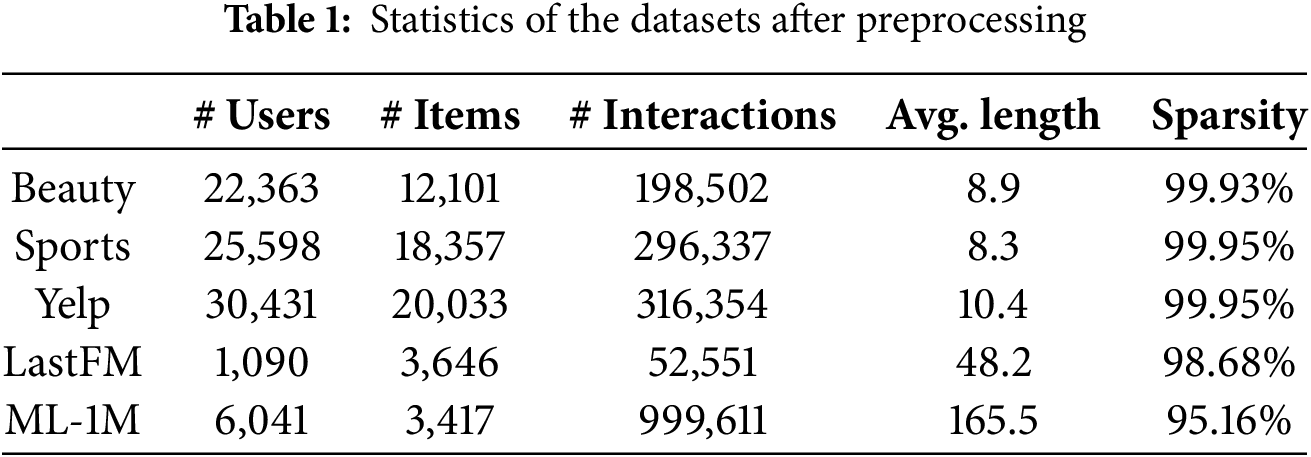
(a) Beauty and Sports are domain-specific datasets extracted from the Amazon Review dataset.
(b) Yelp is a business recommendation dataset from the Yelp open dataset.
(c) ML-1M is a movie rating dataset provided by MovieLens.
(d) LastFM is a dataset from the Last.fm music platform that contains user activity records.
We compare HyTiFRec with the following baseline methods:
(a) GRU4Rec [4]: An RNN-based approach that leverages gated recurrent units (GRUs) for modeling user interaction sequences.
(b) SASRec [10]: A Transformer-based approach that employs self-attention to capture long-range dependencies within user behavior sequences.
(c) BERT4Rec [30]: A bidirectional Transformer-based method that leverages BERT [31] to capture bidirectional dependencies in user interaction sequences.
(d) FMLP-Rec [20]: A MLP-based method that uses filter-enhanced MLP to filter noise and learn user preferences.
(e) DuoRec [32]: A contrastive learning-based method that improves item embedding distribution through the uniformity property of contrastive learning.
(f) FEARec [18]: A Transformer-based method that combines attention mechanisms in the time and frequency domains to capture users’ evolving preferences over time.
(g) BSARec [33]: A Transformer-based method that leverages the Fourier transform to capture inductive biases from frequency information and employs a frequency rescaler to address the issue of over-smoothing.
4.1.3 Implementation and Hyperparameter Settings
We implement all models using PyTorch. The other hyperparameters for each model are tuned based on recommendations from their respective papers. The experiments are conducted with the following hyperparameters: embedding size
We use standard top-K ranking evaluation metrics, Hit Ratio@K (HR@K) and NDCG@K, to score the ranked lists of each method. HR@K is a recall-based metric that focuses on whether the items the user is interested in appear in the top K recommended items. NDCG@K is a ranking-based metric that focuses on the ranking of items in the recommendation list, providing a better evaluation of the ranking quality of the recommendation system. By default, K is set to 5, 10, and 20. As suggested by [34,35], we evaluate model performance using a full ranking approach, where rankings are computed across the entire item set without negative sampling.
4.2 Recommendation Performance (RQ1)
To demonstrate the sequential recommendation performance of HyTiFRec, we conduct a comparison with several state-of-the-art methods. Table 2 shows the results of different methods across five datasets. On all five datasets, Transformer-based methods outperformed CNN-based Caser and RNN-based GRU4Rec, demonstrating the efficiency of the Transformer architecture and self-attention mechanism in modeling user interaction sequences for sequential recommendation tasks. FMLP-Rec removes the self-attention component from Transformer and enhances MLP with a learnable filter, achieving better performance than SASRec across most datasets, indicating the research potential of frequency domain methods in sequential recommendation. The performance of FEARec, which also utilizes frequency domain methods, further supports this conclusion. Furthermore, DuoRec and FEARec, which incorporate contrastive learning, significantly outperform methods that do not use contrastive learning, validating that contrastive learning is useful for improving performance. BSARec, which utilizes self-attention mechanisms and a frequency rescaler, outperforms other baselines in overall performance.
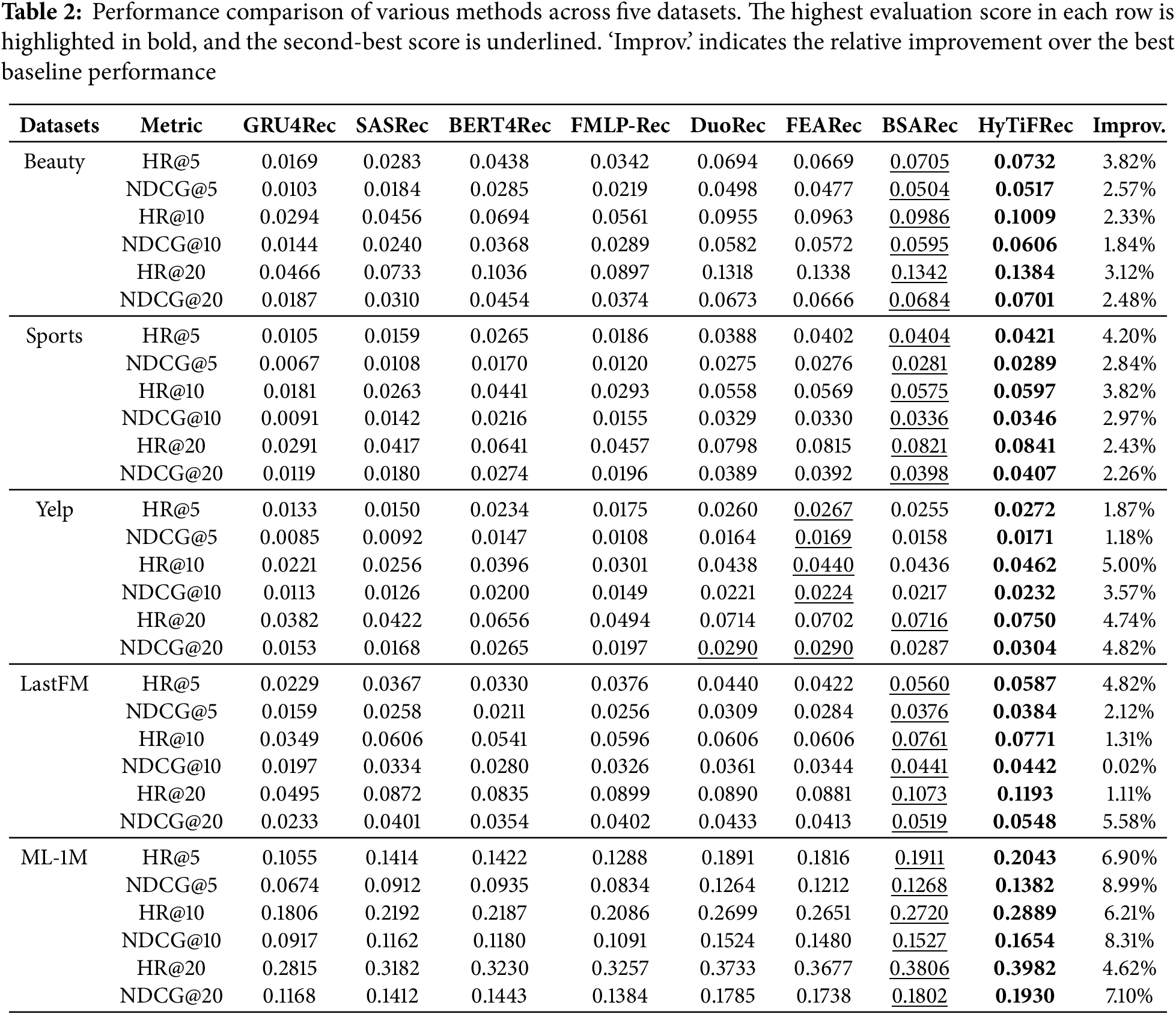
Our proposed HyTiFRec is a novel transformer architecture that leverages the synergy of time domain and frequency domain methods. It outperforms SASRec, which uses only time domain attention; FMLP-Rec, which employs only frequency domain filters; and FEARec, which incorporates both time domain and frequency domain attention along with contrastive learning. Our method demonstrates relatively larger improvements compared to most baselines on datasets with lower sparsity and longer interaction sequence lengths (i.e., LastFM and ML-1M), indicating that HyTiFRec is more effective in capturing complex temporal patterns. On datasets with higher sparsity and shorter sequence lengths (i.e., Beauty, Sports, and Yelp), it shows certain improvements. Through the learnable frequency filtering, HyTiFRec can weigh information from different frequencies, effectively suppressing noise and enhancing the accuracy of user preference modeling.
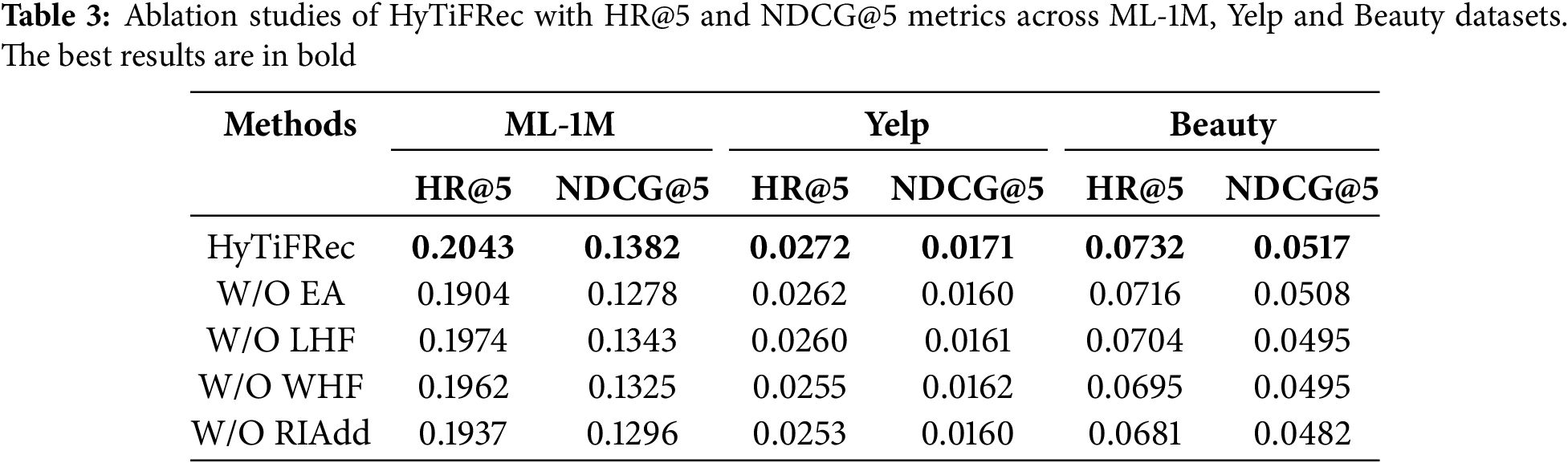
To investigate the effectiveness of HyTiFRec’s components, we conduct several ablation studies. The ablation studies examine HyTiFRec and its four variants across three datasets. The four variants are derived from HyTiFRec by removing the frequency domain layer LHF (w/o LHF), removing the frequency domain layer WHF (w/o WHF), removing the time domain layer EA (w/o EA), and removing the operation of adding time domain residual information in the frequency domain layers (w/o RIAdd).
Table 3 presents the evaluation results. When the time domain layer is removed, that is, when the EA component is removed, the model’s performance decreases. This suggests that the EA is used to extract preliminary features and provide global information, which provides a solid foundation for subsequent filtering and integration of information using frequency domain methods. Removing either the LHF or WHF module also leads to performance degradation. The LHF globally modulates the spectrum, and the WHF retains local frequency components from the spectrum for integration. These two different frequency domain methods can effectively extract and integrate frequency domain information. Both the time domain and frequency domain layers are important, reflecting the potential of combining time domain and frequency domain methods. When the addition of time domain residual information is removed, the model’s performance drops significantly. This suggests that adding time domain residual information to the output after frequency domain filtering helps reduce the loss of important information.
4.4 Hyperparameter Studies (RQ3)
In this section, we investigate the effect of two key hyperparameters on HyTiFRec: the balance coefficient
As shown in Fig. 3, HyTiFRec achieves the best performance on the ML-1M and Beauty datasets when

Figure 3: Performance of HyTiFRec on three datasets with different balance coefficients
4.4.2 Upper Truncation Limit V
As shown in Fig. 4, the models with

Figure 4: Performance of HyTiFRec w.r.t different upper truncation limit on three datasets
4.5 Performance Comparison Based on Transition Frequency (RQ4)
We evaluate HyTiFRec and SASRec on test samples with varying item transition frequencies using the NDCG@20 metric. The item transition frequency of each sample sequence is calculated based on the transition from the validation item (the second-to-last item) to the test item (the last item) in the sequence. Fig. 5 presents the evaluation results on two datasets. Whether on test samples with zero item transition frequency or those with high item transition frequency, HyTiFRec consistently outperforms SASRec. This suggests that HyTiFRec, compared to SASRec, has a deeper grasp of short-term changes in user interests without reducing its ability to model long-term user preferences. By better balancing users’ short-term and long-term preferences, HyTiFRec achieves higher prediction accuracy.
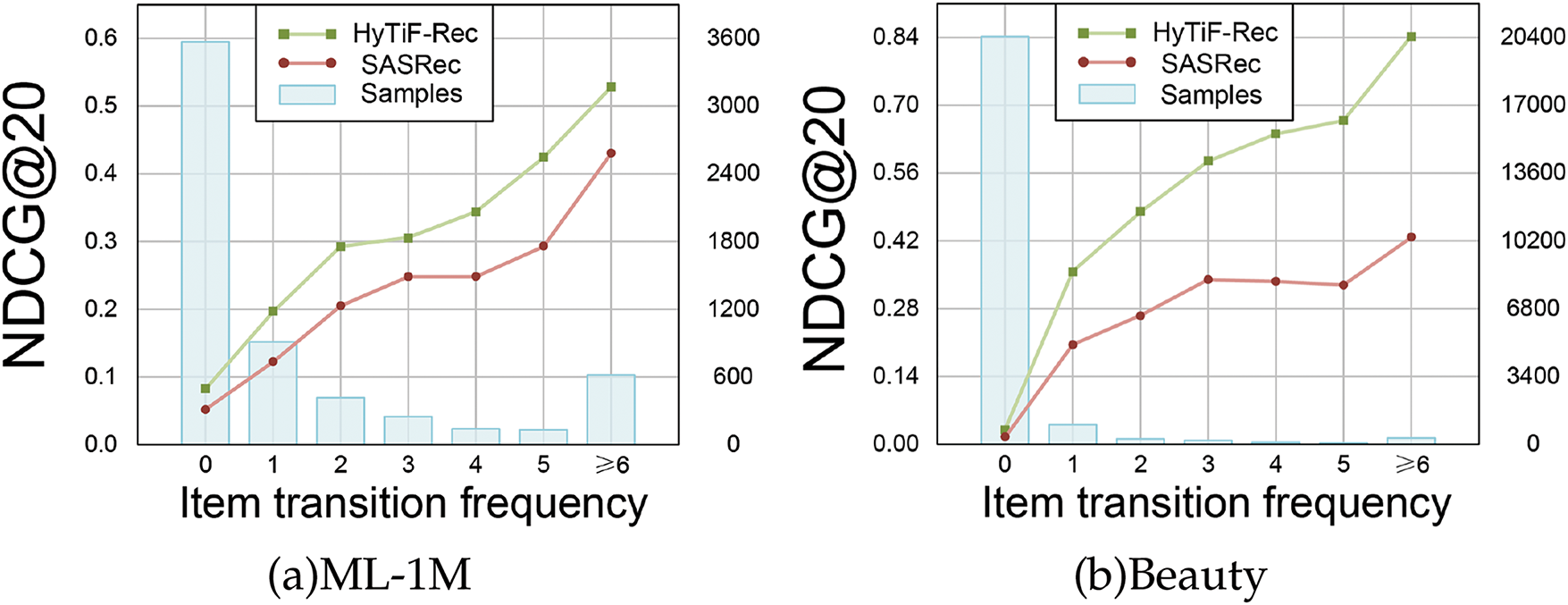
Figure 5: Performance of two methods w.r.t item transition frequency on two datasets
sequential recommendation methods aim to predict users’ future preferences based on their historical interaction sequences [36]. Early sequential recommendation approaches were primarily based on Markov Chains. With the development of deep learning, research in SRSs has increasingly focused on deep learning methods. GRU4Rec [4] employs Gated Recurrent Units (GRU). Caser [6] utilizes horizontal and vertical convolutional filters. Models like SASRec [10] and BERT4Rec [30] adopt unidirectional and bidirectional encoders, respectively, to capture contextual information from user interaction sequences. TiSASRec [28] uses a novel self-attention to explicitly capture the timestamps of items in a sequence. These self-attention models focus more on long-term preference modeling. HAFLS [37] combines a hierarchical attention structure with a multi-head self-attention mechanism and adopts a joint learning mechanism to integrate users’ current interests and general preferences. DIARec [17] introduces a time-aware attention mechanism to model interest shifts and employs GRU to extract sequential selection patterns in short-term interaction items. However, these studies predominantly focus on the time domain, overlooking the exploration of frequency domain methods.
There are many works related to frequency domain methods in the fields of natural language processing [38,39] and computer vision [40,41]. Recently, sequential recommendation has also started to recognize the effectiveness of frequency domain methods. FMLP-Rec [20] is the first to introduce frequency filter into sequential recommendation to address the noise issue in the data, proposing a fully MLP architecture with a learnable filter. To tackle the problem of self-attention underrate high frequency signals [18,42], leverage frequency domain methods and contrastive learning to improve the model’s ability to capture high-frequency information and enhance overall performance. BSARec [33] injects inductive bias by considering fine-grained sequential patterns and addresses the oversmoothing issue by utilizing a frequency rescaler. Our proposed HyTiFRec replaces the self-attention layer in the Transformer module by serially combining LHF and WHF with EA. It improves the model’s flexibility and the ability to balance high-frequency and low-frequency signals through adaptive filtering and emphasizing specific frequency components.
In this paper, to address the limitations of many sequential recommendation methods based on self-attention mechanisms in balancing users’ long-term and short-term interests, we design a novel Transformer-based model, HyTiFRec. Instead of the self-attention component in the Transformer, we employ a hybrid time-frequency dual-branch structure. HyTiFRec utilizes efficient attention to extract initial features and global information. We propose a learnable hybrid filter module and a window hybrid filter module to perform frequency tuning for full-band frequency domain signals and to extract local frequency components from frequency domain signals, respectively, ensuring a balance between components across different frequency bands. After filtering in the filter module, time domain residual information is incorporated to mitigate information loss during the filtering process. Our model demonstrates superior sequential recommendation performance compared to seven baseline methods across five datasets, effectively improving the modeling of users’ long-term preferences while enhancing sensitivity to short-term preference changes. Our method has certain limitations. The adjustable filter window size and position in WHF make the model more flexible but also introduce a significant tuning workload. Additionally, its filtering method is relatively simple and coarse, lacking a more refined and effective utilization of frequency components. In response to these limitations, in future work, we will conduct a more in-depth study on frequency-domain methods, particularly in aspects such as the partitioning and sampling of frequency components.
Acknowledgement: The authors appreciate the support of the Natural Science Foundation of Zhejiang Province.
Funding Statement: This work was supported by a grant from the Natural Science Foundation of Zhejiang Province under Grant LY21F010016.
Author Contributions: The authors confirm contribution to the paper as follows: Conceptualization, methodology and validation, Dawei Qiu; investigation and data curation, Xiaoming Zhang; writing—original draft preparation, Dawei Qiu; writing—review and editing, Peng Wu; supervision, Renjie Xu; project administration and funding acquisition, Peng Wu. All authors reviewed the results and approved the final version of the manuscript.
Availability of Data and Materials: The data used in this work come mainly from public datasets. Specifically: Beauty and Sports datasets are accessible at https://cseweb.ucsd.edu/∼jmcauley/datasets.html (accessed on 11 May 2024); The Yelp dataset can be downloaded from https://www.yelp.com/dataset (accessed on 11 May 2024); The ML-1M dataset is available through https://grouplens.org/datasets/movielens/1m/ (accessed on 11 May 2024); The LastFM dataset can be obtained from https://grouplens.org/datasets/hetrec-2011/ (accessed on 11 May 2024).
Ethics Approval: The user data used in this study were sourced from publicly available datasets and comply with relevant privacy protection regulations.
Conflicts of Interest: The authors declare no conflicts of interest to report regarding the present study.
References
1. Resnick P, Iacovou N, Suchak M, Bergstrom P, Riedl J. Grouplens: an open architecture for collaborative filtering of netnews. In: Proceedings of the 1994 ACM Conference on Computer Supported Cooperative Work; Chapel Hill, NC, USA. New York, NY, USA: Association for Computing Machinery; 1994. p. 175–86. [Google Scholar]
2. Koren Y, Bell R, Volinsky C. Matrix factorization techniques for recommender systems. Computer. 2009;42(8):30–7. doi:10.1109/MC.2009.263. [Google Scholar] [CrossRef]
3. Rendle S, Freudenthaler C, Schmidt-Thieme L. Factorizing personalized markov chains for next-basket recommendation. In: Proceedings of the 19th International Conference on World Wide Web; Raleigh, NC, USA. New York, NY, USA: Association for Computing Machinery; 2010. p. 811–20. [Google Scholar]
4. Hidasi B. Session-based recommendations with recurrent neural networks. arXiv:151106939. 2015. [Google Scholar]
5. Hidasi B, Karatzoglou A. Recurrent neural networks with top-k gains for session-based recommendations. In: Proceedings of the 27th ACM International Conference on Information and Knowledge Management; Torino, Italy. New York, NY, USA: Association for Computing Machinery; 2018. p. 843–52. [Google Scholar]
6. Tang J, Wang K. Personalized top-n sequential recommendation via convolutional sequence embedding. In: Proceedings of the Eleventh ACM International Conference on Web Search and Data Mining; Marina Del Rey, CA, USA. New York, NY, USA: Association for Computing Machinery; 2018. p. 565–73. [Google Scholar]
7. Yuan F, Karatzoglou A, Arapakis I, Jose JM, He X. A simple convolutional generative network for next item recommendation. In: Proceedings of the Twelfth ACM International Conference on Web Search and Data Mining; Melbourne VIC, Australia. New York, NY, USA: Association for ComputingMachinery; 2019. p. 582–90. [Google Scholar]
8. Chen X, Xu H, Zhang Y, Tang J, Cao Y, Qin Z, et al. Sequential recommendation with user memory networks. In: Proceedings of the Eleventh ACM International Conference on Web Search and Data Mining; Marina Del Rey, CA, USA. New York, NY, USA: Association for Computing Machinery; 2018. p. 108–16. [Google Scholar]
9. Li J, Ren P, Chen Z, Ren Z, Lian T, Ma J. Neural attentive session-based recommendation. In: Proceedings of the 2017 ACM on Conference on Information and Knowledge Management; Singapore.New York, NY, USA: Association for Computing Machinery; 2017. p. 1419–28. [Google Scholar]
10. Kang WC, McAuley J. Self-attentive sequential recommendation. In: 2018 IEEE International Conference on Data Mining (ICDM); 2018; Singapore: IEEE. p. 197–206. [Google Scholar]
11. Zhou K, Wang H, Zhao WX, Zhu Y, Wang S, Zhang F, et al. S3-Rec: self-supervised learning for sequential recommendation with mutual information maximization. In: Proceedings of the 29th ACM International Conference on Information & Knowledge Management; Ireland. New York, NY, USA: Association for Computing Machinery; 2020. p. 1893–902. [Google Scholar]
12. Raghu M, Unterthiner T, Kornblith S, Zhang C, Dosovitskiy A. Do vision transformers see like convolutional neural networks? Adv Neural Inf Process Syst. 2021;34:12116–28. [Google Scholar]
13. Park N, Kim S. How do vision transformers work? arXiv:220206709. 2022. [Google Scholar]
14. Jannach D, Lerche L, Jugovac M. Adaptation and evaluation of recommendations for short-term shopping goals. In: Proceedings of the 9th ACM Conference on Recommender Systems; Vienna, Austria. New York, NY, USA: Association for Computing Machinery; 2015. p. 211–8. [Google Scholar]
15. He Z, Zhao H, Lin Z, Wang Z, Kale A, McAuley J. Locker: locally constrained self-attentive sequential recommendation. In: Proceedings of the 30th ACM International Conference on Information & Knowledge Management; Virtual Event, Queensland, Australia. New York, NY, USA: Association for Computing Machinery; 2021. p. 3088–92. [Google Scholar]
16. Zang T, Zhu Y, Zhu J, Xu Y, Liu H. MPAN: multi-parallel attention network for session-based recommendation. Neurocomputing. 2022;471(1):230–41. doi:10.1016/j.neucom.2021.11.030. [Google Scholar] [CrossRef]
17. Vaghari H, Aghdam MH, Emami H. Diarec: dynamic intention-aware recommendation with attention-based context-aware item attributes modeling. J Artif Intell Soft Comput Res. 2024;14(2):171–89. doi:10.2478/jaiscr-2024-0010. [Google Scholar] [CrossRef]
18. Du X, Yuan H, Zhao P, Qu J, Zhuang F, Liu G, et al. Frequency enhanced hybrid attention network for sequential recommendation. In: Proceedings of the 46th International ACM SIGIR Conference on Research and Development in Information Retrieval; Taipei, Taiwan. New York, NY, USA: Association for Computing Machinery; 2023. p. 78–88. [Google Scholar]
19. Shen Z, Zhang M, Zhao H, Yi S, Li H. Efficient attention: attention with linear complexities. In: Proceedings of the IEEE/CVF Winter Conference on Applications of Computer Vision; Waikoloa, HI, USA; 2021. p. 3531–9. [Google Scholar]
20. Zhou K, Yu H, Zhao WX, Wen JR. Filter-enhanced MLP is all you need for sequential recommendation. In: Proceedings of the ACM Web Conference 2022; 2022. p. 2388–99. [Google Scholar]
21. Rao Y, Zhao W, Zhu Z, Lu J, Zhou J. Global filter networks for image classification. Adv Neural Inf Proc Syst. 2021;34:980–93. [Google Scholar]
22. Trick T. Theory and application of digital signal processing. IEEE Trans Acoust, Speech, Signal Process. 1975;23(4):394–5. doi:10.1109/TASSP.1975.1162708. [Google Scholar] [CrossRef]
23. Soliman SS, Srinath MD. Continuous and discrete signals and systems. 2nd ed. Englewood Cliffs, NJ, USA: Pearson; 1990. [Google Scholar]
24. Cooley JW, Tukey JW. An algorithm for the machine calculation of complex Fourier series. Math Comput. 1965;19(90):297–301. doi:10.1090/S0025-5718-1965-0178586-1. [Google Scholar] [CrossRef]
25. Frigo M, Johnson SG. The design and implementation of FFTW3. Proc IEEE. 2005;93(2):216–31. doi:10.1109/JPROC.2004.840301. [Google Scholar] [CrossRef]
26. Ba JL. Layer normalization. arXiv:160706450. 2016. [Google Scholar]
27. Srivastava N, Hinton G, Krizhevsky A, Sutskever I, Salakhutdinov R. Dropout: a simple way to prevent neural networks from overfitting. J Mach Learn Res. 2014;15(1):1929–58. [Google Scholar]
28. Li J, Wang Y, McAuley J. Time interval aware self-attention for sequential recommendation. In: Proceedings of the 13th International Conference on Web Search and Data Mining; Houston, TX, USA. New York, NY, USA: Association for Computing Machinery; 2020. p. 322–30. [Google Scholar]
29. Hidasi B, Quadrana M, Karatzoglou A, Tikk D. Parallel recurrent neural network architectures for feature-rich session-based recommendations. In: Proceedings of the 10th ACM Conference on Recommender Systems; Boston, MA, USA. New York, NY, USA: Association for Computing Machinery; 2016. p. 241–8. [Google Scholar]
30. Sun F, Liu J, Wu J, Pei C, Lin X, Ou W, et al. BERT4Rec: sequential recommendation with bidirectional encoder representations from transformer. In: Proceedings of the 28th ACM International Conference on Information and Knowledge Management; Beijing, China. New York, NY, USA: Association for Computing Machinery; 2019. p. 1441–50. [Google Scholar]
31. Devlin J. Bert: pre-training of deep bidirectional transformers for language understanding. arXiv:181004805. 2018. [Google Scholar]
32. Qiu R, Huang Z, Yin H, Wang Z. Contrastive learning for representation degeneration problem in sequential recommendation. In: Proceedings of the Fifteenth ACM International Conference on Web Search and Data Mining; Virtual Event, AZ, USA. New York, NY, USA: Association for Computing Machinery; 2022. p. 813–23. [Google Scholar]
33. Shin Y, Choi J, Wi H, Park N. An attentive inductive bias for sequential recommendation beyond the self-attention. Proc AAAI Conf Artif Intell. 2024;38(8):8984–92. doi:10.1609/aaai.v38i8.28747. [Google Scholar] [CrossRef]
34. Krichene W, Rendle S. On sampled metrics for item recommendation. In: Proceedings of the 26th ACM SIGKDD International Conference on Knowledge Discovery & Data Mining; AZ, USA. New York, NY, USA: Association for Computing Machinery; 2020. p. 1748–57. [Google Scholar]
35. Dallmann A, Zoller D, Hotho A. A case study on sampling strategies for evaluating neural sequential item recommendation models. In: Proceedings of the 15th ACM Conference on Recommender Systems; Amsterdam, Netherlands. New York, NY, USA: Association for Computing Machinery; 2021. p. 505–14. [Google Scholar]
36. Wang S, Hu L, Wang Y, Cao L, Sheng QZ, Orgun M. Sequential recommender systems: challenges, progress and prospects. arXiv:200104830. 2019. [Google Scholar]
37. Du Y, Peng Z, Niu J, Yan J. A unified hierarchical attention framework for sequential recommendation by fusing long and short-term preferences. Expert Syst Appl. 2022;201(8):117102. doi:10.1016/j.eswa.2022.117102. [Google Scholar] [CrossRef]
38. Tamkin A, Jurafsky D, Goodman N. Language through a prism: a spectral approach for multiscale language representations. In: Proceedings of the 34th International Conference on Neural Information Processing Systems; Vancouver, BC, Canada. Red Hook, NY, USA: Curran Associates Inc.; 2020. p. 5492–504. [Google Scholar]
39. Lee-Thorp J, Ainslie J, Eckstein I, Ontanon S. FNet: mixing tokens with fourier transforms. arXiv:210503824. 2021. [Google Scholar]
40. Xu K, Qin M, Sun F, Wang Y, Chen YK, Ren F. Learning in the frequency domain. arXiv:2002.12416. 2020. [Google Scholar]
41. Suvorov R, Logacheva E, Mashikhin A, Remizova A, Ashukha A, Silvestrov A, et al. Resolution-robust large mask inpainting with fourier convolutions. In: 2022 IEEE/CVF Winter Conference on Applications of Computer Vision (WACV); 2021. p. 3172–82. Available from: https://api.semanticscholar.org/CorpusID:237513361. [Google Scholar]
42. Du X, Yuan H, Zhao P, Fang J, Liu G, Liu Y, et al. Contrastive enhanced slide filter mixer for sequential recommendation. In: 2023 IEEE 39th International Conference on Data Engineering (ICDE); 2023, Anaheim, CA, USA: IEEE. p. 2673–85. [Google Scholar]
Cite This Article
 Copyright © 2025 The Author(s). Published by Tech Science Press.
This work is licensed under a Creative Commons Attribution 4.0 International License , which permits unrestricted use, distribution, and reproduction in any medium, provided the original work is properly cited.
 Downloads
 Citation Tools
