
 Login
Login Register
 Submit a Paper
 Propose a Special lssue
 Open Access
ARTICLE
PolyDiffusion: A Multi-Objective Optimized Contour-to-Image Diffusion Framework
1 School of Computer Science and Engineering, Hunan University of Science and Technology, Xiangtan, 411201, China
2 Sanya Research Institute, Hunan University of Science and Technology, Sanya, 572024, China
* Corresponding Author: Xiaoliang Wang. Email:
Computers, Materials & Continua 2025, 85(2), 3965-3980. https://doi.org/10.32604/cmc.2025.068500
Received 30 May 2025; Accepted 07 August 2025; Issue published 23 September 2025
 View Full Text
 Download PDF
Abstract
Multi-instance image generation remains a challenging task in the field of computer vision. While existing diffusion models demonstrate impressive fidelity in image generation, they often struggle with precisely controlling each object’s shape, pose, and size. Methods like layout-to-image and mask-to-image provide spatial guidance but frequently suffer from object shape distortion, overlaps, and poor consistency, particularly in complex scenes with multiple objects. To address these issues, we introduce PolyDiffusion, a contour-based diffusion framework that encodes each object’s contour as a boundary-coordinate sequence, decoupling object shapes and positions. This approach allows for better control over object geometry and spatial positioning, which is critical for achieving high-quality multi-instance generation. We formulate the training process as a multi-objective optimization problem, balancing three key objectives: a denoising diffusion loss to maintain overall image fidelity, a cross-attention contour alignment loss to ensure precise shape adherence, and a reward-guided denoising objective that minimizes the Fréchet distance to real images. In addition, the Object Space-Aware Attention module fuses contour tokens with visual features, while a prior-guided fusion mechanism utilizes inter-object spatial relationships and class semantics to enhance consistency across multiple objects. Experimental results on benchmark datasets such as COCO-Stuff and VOC-2012 demonstrate that PolyDiffusion significantly outperforms existing layout-to-image and mask-to-image methods, achieving notable improvements in both image quality and instance-level segmentation accuracy. The implementation of PolyDiffusion is available at (accessed on 06 August 2025).Keywords
In recent years, diffusion-based generative models [1] have advanced rapidly, achieving state-of-the-art fidelity in image, video, and 3D modeling, gradually superseding traditional GANs [2]. However, text-to-image diffusion approaches [3,4] still struggle with multi-instance scenes: a single textual prompt provides only global guidance, leaving per-object details—shape, pose, and spatial arrangement—underconstrained. As a result, multi-object generation must be formulated as a multi-objective optimization problem, balancing overall image fidelity with individual instance constraints.
Layout-to-image methods [5] address part of this challenge by using bounding-box layouts and class labels to enforce coarse spatial positioning. LayoutDiffusion further improves multimodal fusion between layout and image features, yielding more coherent object placement. However, reliance on high-level layout diagrams still falls short of fine-grained shape control and inter-object consistency in complex scenes. For instance, text-to-image or layout-to-image methods often suffer from issues like object shape distortion, spatial overlap, and semantic inconsistency when generating multiple objects simultaneously. These problems arise because layout diagrams provide only high-level semantic guidance without fine-grained constraints, which limits the generation of realistic multi-object scenes. Specifically, in many cases, objects may overlap in the generated scene, or the shapes of the objects may become distorted due to the lack of precise control over their spatial relationships. Moreover, semantic inconsistencies arise when objects with similar categories or spatial proximity are generated, leading to unrealistic or poorly placed objects.
To illustrate, Contour Wavelet Diffusion [6] introduces a fast image generation method using wavelet transforms, which improves efficiency while maintaining image quality. However, this method still faces challenges when generating multi-object scenes due to the limited control over object layout and interactions. Similarly, Unicontrol [7] is a representative work that supports multiple control signals for controllable visual generation. While it enables flexible multi-task learning, its focus is on broader control, lacking the precise instance-level control required for multi-object generation.
In contrast, we propose PolyDiffusion, a multi-objective optimized contour-to-image diffusion framework that addresses these challenges. By encoding detailed object contours as closed-loop boundary sequences, PolyDiffusion offers precise control over the shape, size, and placement of multiple objects in a scene. This allows for better spatial consistency and object interaction, overcoming the limitations of previous methods that struggle with complex object layouts. Through the introduction of multi-objective optimization, PolyDiffusion refines contour-to-image generation by incorporating both global and local constraints, providing higher fidelity and flexibility in multi-object image generation.
Our approach builds on the foundation of layout-to-image and mask-to-image generation methods, unifying them into a flexible framework. Specifically, the input for layout-to-image generation consists of a set of bounding boxes and class labels for the objects within the scene, while the input for mask-to-image generation is usually text and shape descriptions. We noticed that InstanceDiffusion [8] works very similar to ours. In our task, the mask of each object is described as a polygon sequence, and the layout diagram, as a simpler 2D box, can be easily extended to represent polygon sequences. In contrast, much of the current non-text-to-image generation research is limited to single-object image generation, rather than focusing on generating images with multiple objects. Our goal is to use more flexible control conditions to guide the generation of multi-object images.
The core contributions of PolyDiffusion are as follows:
• Polygon Diffusion Model for Multi-Object Generation: We introduce a polygon diffusion model that builds on the layout-to-image framework, transforming contour maps into image-generating objects. This model decouples multiple objects, enabling the generation of high-quality, diverse images with precise control over the position, size, and shape of each object.
• Spatial Relationship Modeling via Contour Representation: We propose a contour point coordinate representation based on circular relative position encoding, which combines shape and spatial information to better capture an object’s geometric features. By placing the contours of different objects within a unified coordinate system, the model enhances the understanding of spatial relationships between objects, improving the overall image quality.
• Unified Control of Global Conditions and Object Details: To facilitate interaction between objects, we introduce CFM modules that enable contextual perception based on object distance and class similarity. Additionally, we achieve seamless contour-image fusion using object-aware and position-sensitive design. A novel alignment loss is introduced to ensure consistency between conditions and generated objects, and further fine-tuning of the final denoising step enhances the quality of the generated images.
Through these innovations, PolyDiffusion sets a new standard for contour-to-image generation, providing precise, flexible control over multi-object scenes and addressing challenges that have limited the effectiveness of previous methods.
The related work is mainly introduced from the aspects of diffusion models and image generation. Image generation is a critical task in computer vision. A range of works has been proposed, from early GAN series [2,9,10] to VAE series [11] and stream model series.
Recently, advances in image generation based on diffusion models have led to significant progress, with text-to-image generation standing out as one of the most advanced applications. This success is largely due to the availability of large-scale text-image pair datasets, which are much easier to collect compared to other types of data. The development of models like CLIP [12] has enabled diffusion models to achieve remarkable results in this field. While text-image data remains the most abundant, there is also ongoing work exploring other conditions beyond text-to-image, such as layout-to-image [13], pose-to-image, depth map-to-image, and mask-to-image [14–16].
LayoutDiffusion is a controllable diffusion framework designed specifically for layout-to-image generation. By transforming the complex fusion of layout and image data into a unified structural representation, LayoutDiffusion improves both generation quality and controllability. Unlike traditional methods, it offers precise control over object placement and size while maintaining high image quality [17]. Similarly, SmartMask is a context-aware diffusion model developed to enhance object insertion and layout generation. This model eliminates the need for masks, enabling precise object placement, and supports iterative refinement for fine-grained layout generation. By preserving background content and offering better control over object placement, SmartMask further advances semantic-to-image generation [18].
In addition to these methods, Contour Wavelet Diffusion [6] introduces a fast image generation method using wavelet transforms, improving efficiency while maintaining image quality. It accelerates training and inference with batch-normalized stochastic attention and a balanced loss function. In contrast, PolyDiffusion focuses on precise control over object placement and layout in multi-object scenes. While Contour Wavelet Diffusion emphasizes efficiency, PolyDiffusion excels in handling complex object interactions, offering better control and higher fidelity in multi-object image generation.
Unicontrol is one of the most representative works in recent years, proposing a unified diffusion model for controllable image generation. It supports multiple control signals and enables multi-task learning in a zero-shot setting [7]. In contrast, PolyDiffusion focuses on contour-to-image generation, providing precise control over object layout and spatial structure, particularly in multi-object generation, where it offers higher accuracy and flexibility.
While Transformer-based methods, such as Vision Transformers (ViT) [19] and Swin Transformers [20], have demonstrated success in handling long-range dependencies in image generation tasks, PolyDiffusion focuses on leveraging contour-based representations to offer more precise control over object shapes and spatial relationships. This makes our approach particularly well-suited for multi-object generation, where managing object interactions and maintaining spatial consistency are crucial.
Our work lies somewhere between layout-to-image and mask-to-image generation, or our approach somewhat unifies the two. Specifically, the input for layout-to-image generation consists of a set of bounding boxes and class labels for the objects within the scene, while the input for mask-to-image generation is usually text and shape descriptions. We noticed that InstanceDiffusion [8] works very similar to ours. In our task, the mask of each object is described as a polygon sequence, and the layout diagram, as a simpler 2D box, can be easily extended to represent polygon sequences. In contrast, much of the current non-text-to-image generation research is limited to single-object image generation, rather than focusing on generating images with multiple objects. Our goal is to use more flexible control conditions to guide the generation of multi-object images.
In this section, we present our Poly Diffusion, as shown in Fig. 1. The whole framework is mainly composed of 6 parts. (a) Contour Representation: Preprocessing and encoding of contour and category inputs. (b) Contour Fusion Module: Encourages more interaction between contour objects. (c) Global Information Injection: Adds global information representing contour diagrams to image features at different resolutions. (d) Contour Position Encoding: Treats image patches as square object contours, incorporating their position and shape information into a unified space, replacing traditional position encoding. (e) Object Space Awareness: Fusion of image and contour features without losing any token information, while utilizing self-attention layers to encourage interaction between different patches. (f) Objective function: The final objective function is constructed based on alignment loss.
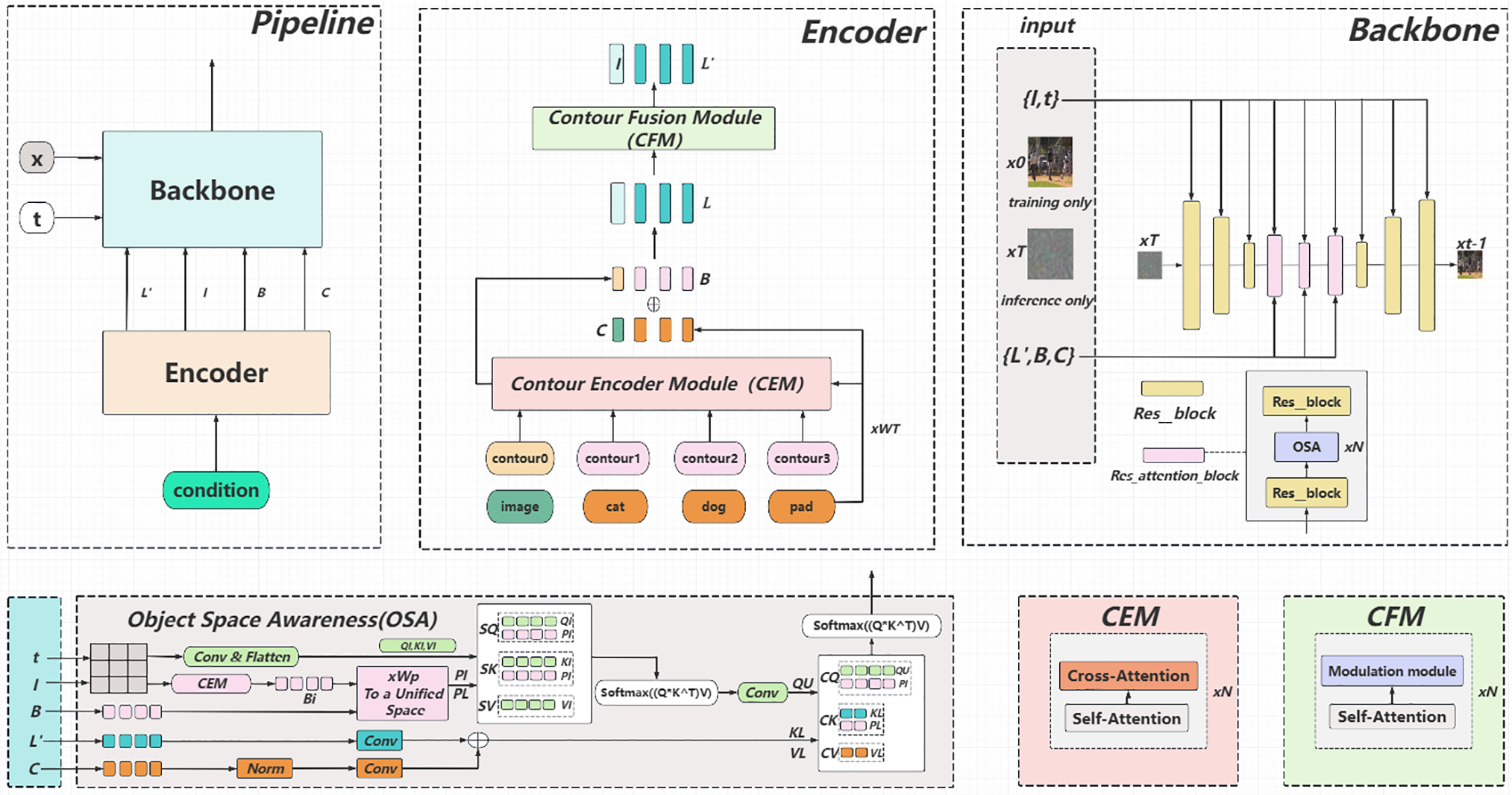
Figure 1: Illustration of the PolyDiffusion framework. The model jointly optimizes three objectives—denoising fidelity, contour alignment, and reward-driven refinement—to achieve precise control over multi-instance image generation
Each component plays a crucial role in achieving the goals of Poly Diffusion, from enhancing interaction between contours to incorporating global information and ensuring consistency in the diffusion process. The following subsections delve into the details of each component, elucidating their contributions and functionalities.
We built this module inspired by Polyformer [21]. A contour, denoted as
Contours encode both object shape and position, offering richer structural detail than simple layout boxes. Unlike traditional bounding boxes or masks, which only provide coarse spatial information, contour representations capture the full geometric structure of each object. This allows PolyDiffusion to achieve precise control over the shape, size, and placement of multiple objects within a scene. To construct contour sequences
To mitigate starting-point ambiguity, each sequence is preprocessed to begin at the point nearest to the upper-left corner. Given the ring-like structure of contours, we introduce two encoding strategies: (1) a relative-position-based encoder incorporating self-attention for intra-contour relations and cross-attention for class-contour interaction, and (2) Rmamba, a cyclic scan module inspired by SimBA, designed to reduce the quadratic complexity of attention. We implement Rmamba by processing cyclically shifted sequences through shared-weight Mamba modules and aggregating the outputs, as shown in Fig. 2.
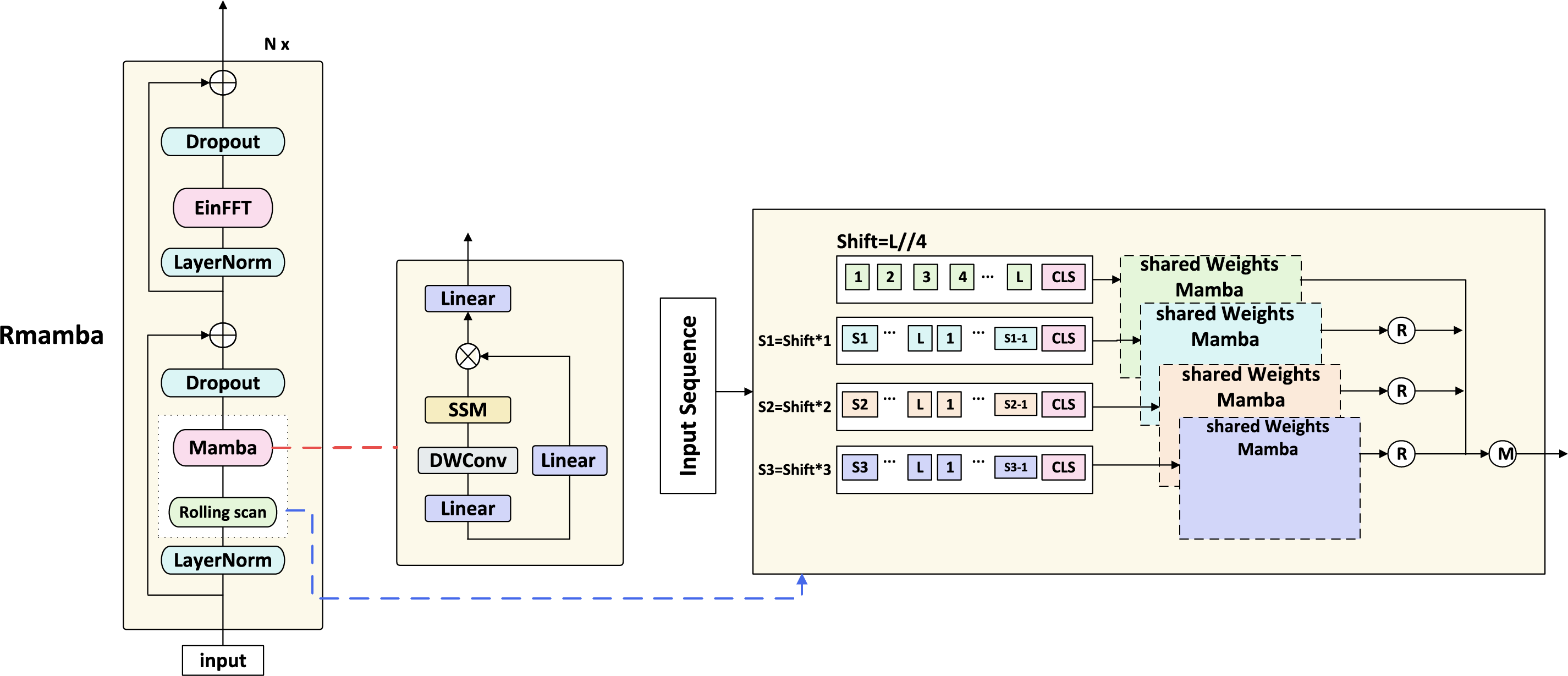
Figure 2: Rmamba consists of standard mamba blocks and a cyclic scan and EinFFT module
The contour encoding process treats each point
For the class encoder, a simple linear layer
To ensure effective structural encoding, we pre-train the Contour Encoder Module (CEM) on three contour-related tasks: (1) contour sequence reconstruction, (2) target frame prediction from contour input, and (3) object classification. We adopt a random masking mechanism that ignores specific coordinate tokens during attention calculation, enabling self-supervised learning without external labels.
Through these tasks, CEM learns not only the geometric structure of the contour but also contextual associations between the contour and the expected object appearance. This facilitates high-level semantic reasoning, which is critical for size-aware and location-aware image generation. Furthermore, the masking mechanism introduces controlled contour deformations, encouraging the model to develop robustness to incomplete or noisy contour inputs.
At this stage, each contour object is considered in isolation, lacking direct connections to other contour objects. To encourage interaction between different objects, we leverage the proximity of their centers within the image as an indicator of their relational closeness. Specifically, the closer the center points of two objects, the stronger the implied relationship between them. We aim to explicitly enhance this relationship.
Firstly, we calculate the original Attention Weight. Let the input token sequence be
We then adjust these weights based on a prior relationship graph. The distance between the center points of two objects is used to create an
This method models the strength and weakness of relationships between objects using a heuristic approach. We believe that the approach is versatile and not limited to the distance between the center points of two objects. As an example, in scenarios with prominent occlusion, the approach relying on the IOU (Intersection over Union) value of object frames can be readily applied to gauge the intensity of occlusion between two objects.
The comprehensive embedding is then fed into the Contour Fusion Module, constructed from a multi-layer self-attention module. During the calculation of self-attention, the attention is adjusted according to prior knowledge. This module facilitates the fusion of contour features, incorporating relational information based on the proximity of object centers.
3.3 Global Information Injection
The Contour Fusion Module (CFM) is designed to aggregate contour-guided global and local representations into the image generation pathway. Specifically, we designate its first token
To inject global structural priors into the image generation process, we propose a conditioning strategy that directly adds the projected global token to multi-resolution image features. Furthermore, to incorporate temporal awareness within the denoising process, we linearly combine the time step t with the global token, forming the final conditioning vector. This operation is formally defined as:
where W is a learnable projection matrix, and I′ denotes the image feature modulated by global contour context.
The resulting feature I′ is embedded into the image generator using adaptive layer normalization [22], enabling hierarchical control at different levels of resolution. By injecting globally structured contour information, CFM enhances semantic consistency across instances and improves spatial alignment between contour guidance and visual synthesis. This module is crucial for enabling fine-grained instance control while maintaining coherence in layout-driven image generation.
The contour map inherently encapsulates spatial information, making it a pivotal component for integrating the spatial position, shape, and size of objects with image features. Rather than relying on generic positional embeddings, we propose a contour-aware strategy that encodes object-level structure directly from annotated boundaries.
Specifically, we treat each image patch as a square region associated with its corresponding contour coordinates. This allows contour tokens and patch tokens to share a unified spatial frame, enabling structural features to interact directly with visual features under the same coordinate system. This approach effectively replaces traditional position encoding with contour-based geometric guidance.
Let I represent the feature map of the image with height h, width w, and channel dimension d. For a patch located at the u-th row and v-th column, denoted as
This contour-based spatial encoding offers object-aware priors that reflect real-world structure, beyond the scope of simple coordinate indexing. By grounding positional semantics in actual boundary geometry, the model gains a more faithful understanding of spatial layout, which promotes better structure retention and spatial coherence in the generation process.
Cross-attention and adaptive layer normalization have become standard in conditional generation. Following DIT [4], we adopt cross-attention due to its effectiveness in computing alignment loss. In text-to-image tasks, the first token often encodes global semantics but neglects individual token detail. This limitation is critical in contour-to-image generation, where each token carries distinct object-level information (shape, position, attributes); losing it risks pixel-level generation errors.
Object Space Awareness (OSA) is designed to aggregate two modes of information without losing any token information. By combining self-attention and cross-attention mechanisms, OSA enhances both vertical and horizontal learning, ensuring that each object’s spatial relationships and contextual information are preserved. To encourage interaction among different image patches, we first perform self-attention calculations within each patch, capturing the local structure and spatial coherence. This is followed by cross-attention calculations to allow the model to learn interactions between different image patches and objects, ensuring that spatial relationships between objects are maintained. By incorporating both self- and cross-attention, OSA ensures that each object’s shape, position, and context are correctly aligned, thus improving spatial consistency and object interaction in complex multi-object scenes. This dual attention mechanism plays a crucial role in maintaining object-level semantics and structure fidelity during generation.
Specifically, we calculate
Here,
where
Finally,
Here, CA is the cross-attention map, and all the CA of different sizes from various cross-attention layers, namely
The form of its loss function is as follows:
where
where
OSA enhances the alignment between contour tokens and image patches by combining self-attention and cross-attention. This improves spatial precision during generation. The additional alignment loss further enforces contour-image consistency, making OSA essential for preserving object-level semantics and structure fidelity.
We employ a multi-objective optimization strategy, jointly optimizing three key losses via weighted summation: denoising diffusion loss for global fidelity, contour alignment loss for shape preservation, and reward-guided consistency loss (minimizing Fréchet distance) for semantic refinement. This balance ensures high-quality image generation with precise object-level control. PolyDiffusion thus effectively handles complex multi-object scenes without complex Pareto or game-theoretic modeling, offering a robust solution for multi-instance generation.
Diffusion Model: The diffusion model operates by progressively introducing noise to the image until the original signal is reduced to full Gaussian noise. Reversing this process allows converting random noise
Here,
In our approach, conditions are incorporated to generate corresponding objective functions:
We introduce a single-step reward refinement inspired by ControlNet++. After freezing the base model post-initial training, we generate a clean sample
In the fine-tuning phase, provided that the added noise
Eventually, the loss consists of the diffusion training loss, the reward loss and the alignment loss:
In order to improve the quality of image generation, we use the classifier-free guidance technology. This method utilizes label condition guidance without a classifier, reducing training costs by combining conditional and unconditional networks in a single model. During training, the guide signal c is randomly discarded. After training, by adjusting the guidance intensity
To achieve this, we construct an empty set contour
We adopt the layout diffusion as the model backbone, a standard Unet network built using Resnet and transformer.
We conduct our experiments based on the layout-to-image framework, LayoutDiffusion, using the following setup: the experiments are performed on a machine with 4 NVIDIA 3090 GPUs, running on Python 3.8 with PyTorch version 1.10.1, Torchvision 0.11.2, and Torchaudio 0.10.1. The CUDA Toolkit used is version 11.3, and the random seed for all experiments is set to 2024 to ensure reproducibility.
We constructed our training and validation sets from the COCO-Stuff [24] and PASCAL VOC 2012 [25] benchmarks. From COCO-Stuff, we selected images exhibiting one to nine clearly delineated, non-facial object instances, yielding 28,292 training images and 1682 validation images; of these, 18,794 contained no human subjects. To maximize diversity while excluding portrait-centric scenes—given the specialized requirements and abundant data typically needed for high-fidelity face generation—we supplemented our non-human subset with images containing a single person alongside three to nine other objects. Our training protocol consisted of two phases: (1) an initial pass over the full COCO-Stuff dataset, and (2) a fine-tuning stage using only the “no-people” subset. We further applied standard data augmentation—random horizontal and vertical flips—to all images and their corresponding contour representations.
Notably, in order to strengthen the model’s understanding of contours and boost its robustness in handling contour-related conditions, we specifically applied data augmentation to contour representation. After fixing the sequence of points to a predetermined length of l, we introduced random offsets to some points, allowing the contours to deform slightly.
We evaluate the performance of our model using several standard metrics. Fréchet Inception Distance (FID) measures the similarity between generated and real images by comparing their feature distributions using Inception V3. The Inception Score (IS) assesses the quality and diversity of generated images by evaluating the entropy of class and conditional distributions, also using Inception V3. Additionally, we use the Classification Accuracy Score (CAS) to evaluate the classifier’s performance on the generated images by cropping and resizing ground truth bounding boxes and comparing them with real images through a trained ResNet-101 classifier.
To evaluate object detection performance, we calculate Average Precision (AP) and Average Recall (AR). These metrics compare instance masks from generated images with ground truth masks using YOLOv8m-Seg and COCO metrics. These evaluation techniques provide a comprehensive assessment of both image quality and instance-level generation precision.
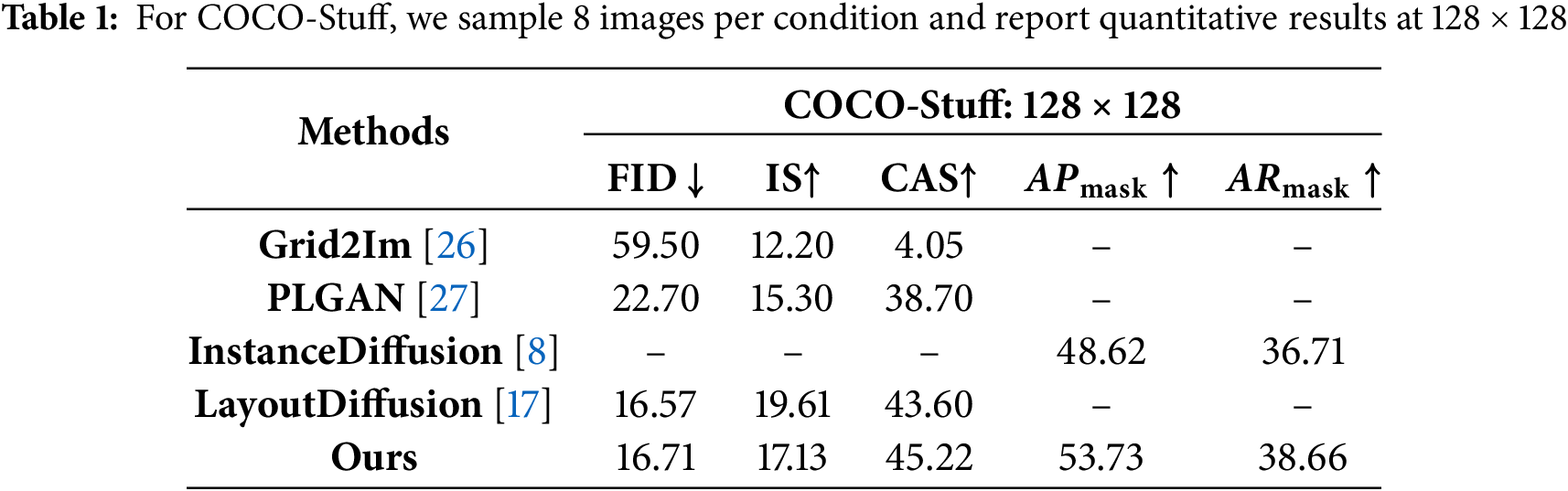
As shown in Table 1, on COCO-Stuff at
On VOC-2012 (
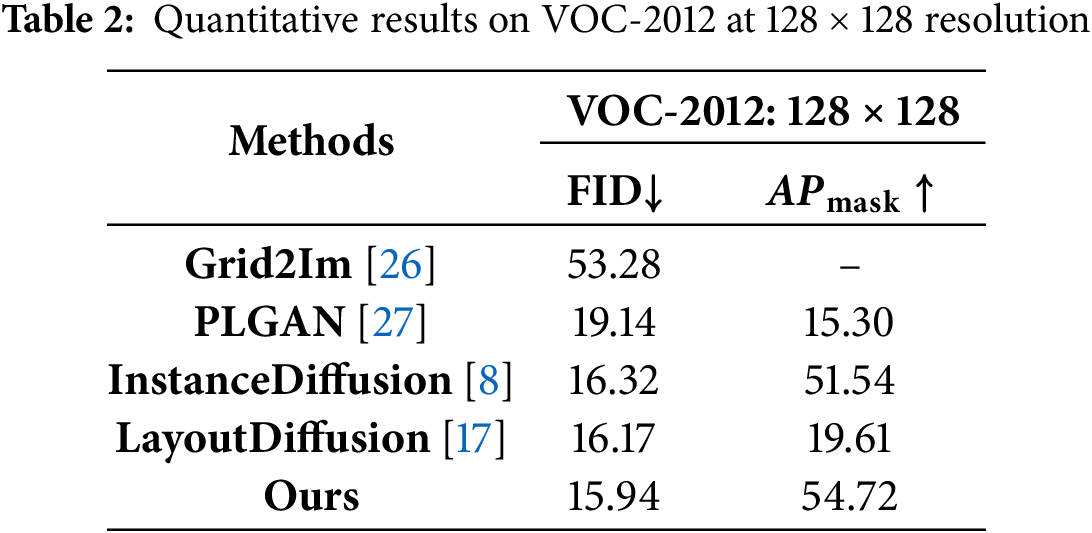
At
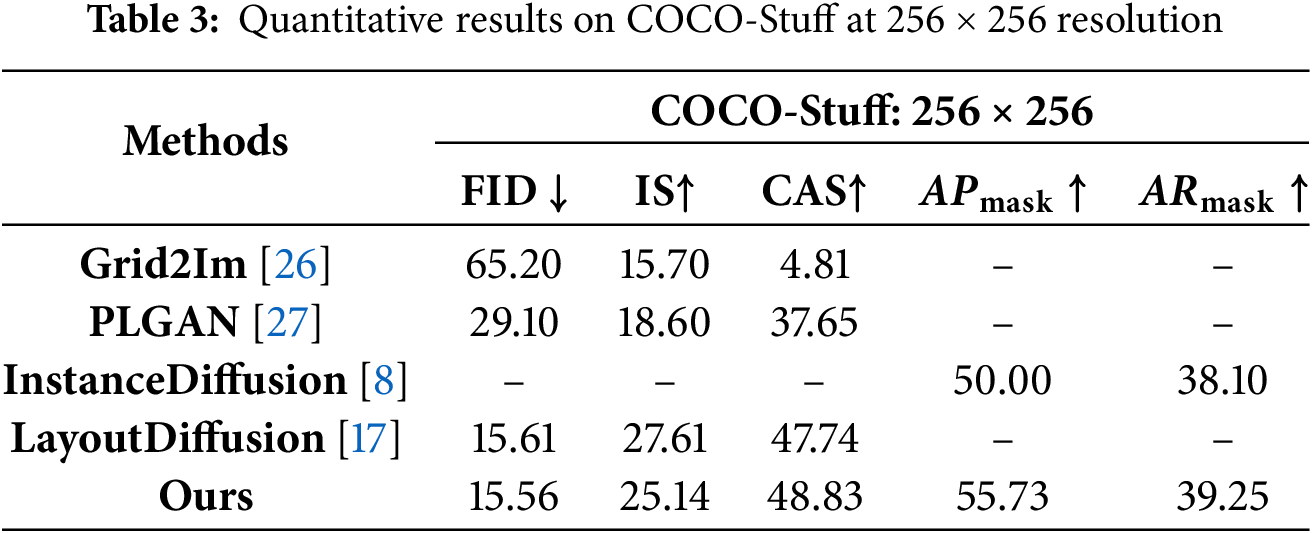
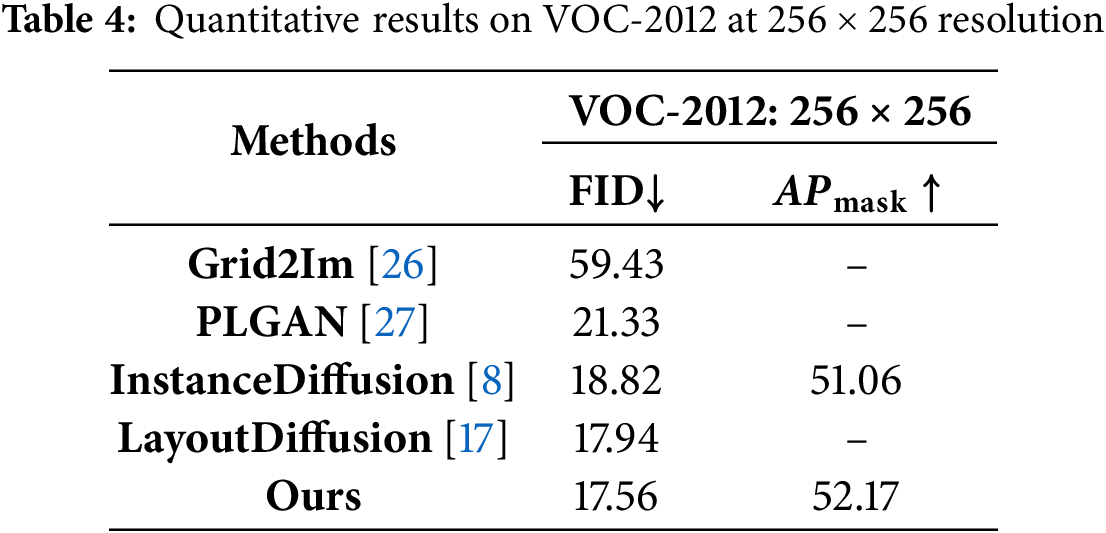
These results clearly demonstrate that, by jointly optimizing denoising fidelity, contour alignment, and reward-driven refinement, PolyDiffusion achieves balanced and significant gains in image quality, diversity, classification accuracy, and mask consistency—validating its superiority for complex multi-instance image generation.
These consistent gains across resolutions demonstrate that by jointly optimizing denoising fidelity, contour alignment, and reward-driven refinement, PolyDiffusion achieves balanced improvements in image quality, diversity, classification accuracy, and mask consistency.
Fig. 3 shows the qualitative results of PolyDiffusion, alongside a comparison with LayoutDiffusion. Our experiments demonstrate that PolyDiffusion outperforms LayoutDiffusion in both image variety and quality. While LayoutDiffusion generates diverse images, PolyDiffusion excels in maintaining high fidelity and consistency across instances.
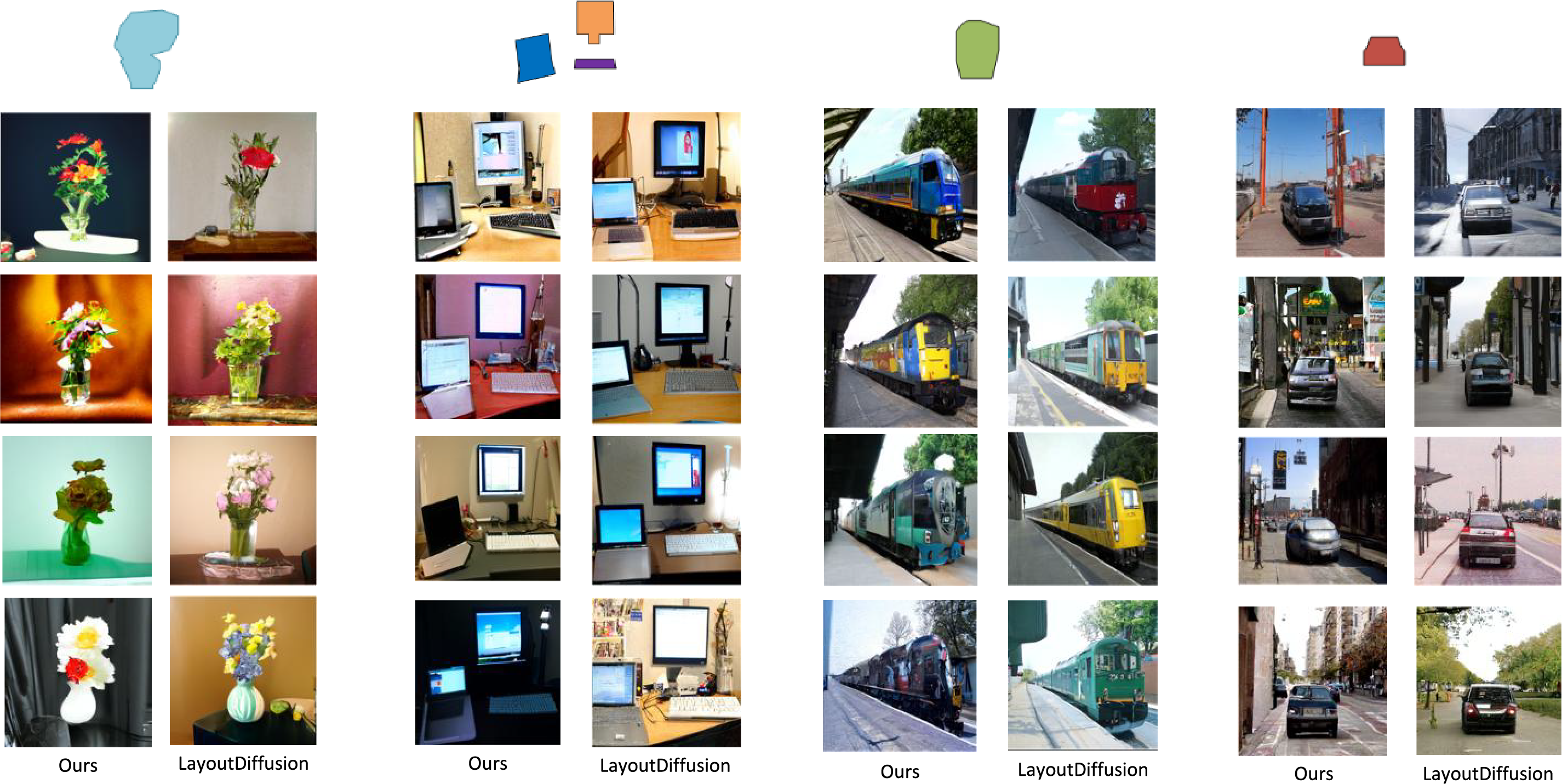
Figure 3: Visualization of contour diffusion results. Each column shows the generated images under the same contour conditions, with comparisons between PolyDiffusion and LayoutDiffusion
On the COCO-Stuff dataset, PolyDiffusion reduces FID from 22.70 to 16.71 and increases IS to 17.13, achieving a 40% improvement over Grid2Im. On the VOC-2012 dataset, FID drops to 15.94 and APmask rises to 54.72, surpassing both LayoutDiffusion and InstanceDiffusion. At 256
The generated images in Fig. 3 further validate PolyDiffusion’s ability to maintain high quality and consistency in multi-object generation, avoiding object overlap and distortion. In contrast, LayoutDiffusion struggles with shape distortion and spatial overlap in complex scenes.
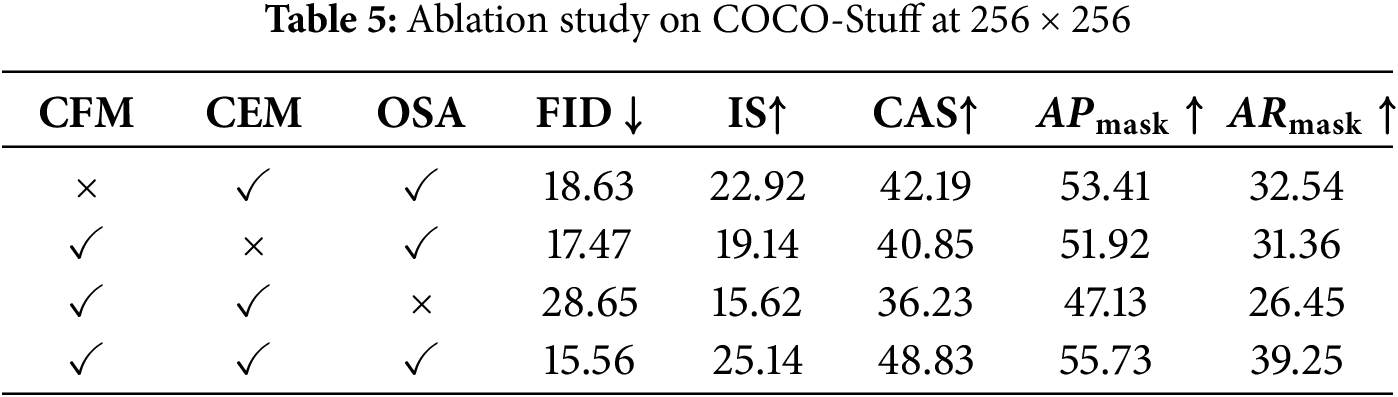
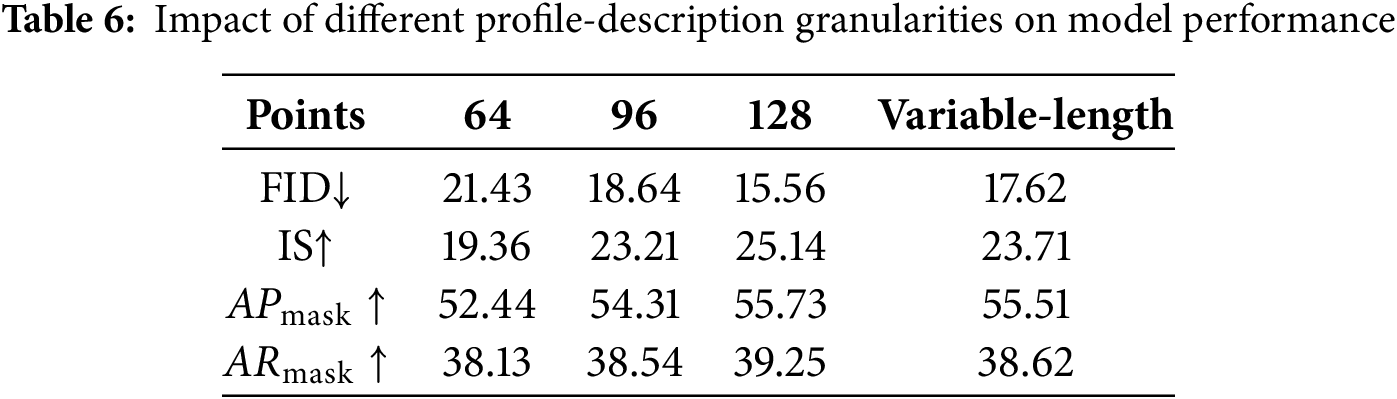
Tables 5 and 6 present ablation studies analyzing the contributions of individual components and their combinations. Table 5 compares different contour encoders and reveals that while attention-based encoders yield superior visual quality, Mamba-based methods—with linear complexity—offer a promising alternative for fine-grained contour representations due to their significantly lower resource demands [28]. Table 6 examines the effect of contour point granularity and shows that a finer-grained contour representation, achieved by increasing the number of contour points, improves the fidelity and accuracy of image generation, though at the cost of greater computational and memory requirements. These findings confirm that robust multi-instance image generation depends on the coordinated optimization of interaction priors, alignment constraints, and reward-guided refinement objectives.
We introduced PolyDiffusion, a contour-based diffusion framework that achieves precise instance-level control by jointly optimizing denoising fidelity, contour adherence, and reward-guided refinement. Extensive evaluations on COCO-Stuff and VOC-2012 confirm that PolyDiffusion outperforms current layout-to-image and mask-to-image methods in both image quality and instance precision.
Future work will focus on addressing PolyDiffusion’s limitations in generating very small or highly fragmented objects, where low contour resolution and conflicts among objectives may impair fine structural reconstruction. To enhance fine-grained generation, we will explore adaptive contour sampling, multi-scale feature fusion, and instance-aware dynamic loss weighting. We also aim to support deployment in Convergence ICT scenarios through lightweight refinement modules and federated learning strategies that preserve user privacy and enable efficient edge–cloud collaboration.
Acknowledgement: I sincerely thank everyone who contributed to this paper; your dedication and insights were invaluable.
Funding Statement: This work is supported in part by the Scientific Research Fund of National Natural Science Foundation of China (Grant No. 62372168), the Hunan Provincial Natural Science Foundation of China (Grant No. 2023JJ30266), the Research Project on teaching reform in Hunan province (No. HNJG-2022-0791), the Hunan University of Science and Technology (No. 2022-44-8), and the National Social Science Funds of China (19BZX044).
Author Contributions: The authors confirm contribution to the paper as follows: Study conception and system design: Yuzhen Liu, Jiasheng Yin; Supervision: Xiaoliang Wang; Data curation and preprocessing: Yixuan Chen, Jin Wang; Analysis and interpretation of results: Yuzhen Liu, Yixuan Chen, Jiasheng Yin; Draft manuscript preparation: Yuzhen Liu, Jiasheng Yin, Yixuan Chen, Jin Wang; Writing—review & editing: Xiaoliang Wang, Xiaolan Zhou. All authors reviewed the results and approved the final version of the manuscript.
Availability of Data and Materials: We used publicly available data and have referenced it in our paper; see references [24] and [25].
Ethics Approval: Not applicable.
Conflicts of Interest: The authors declare no conflicts of interest to report regarding the present study.
References
1. Fan WC, Chen YC, Chen D, Cheng Y, Yuan L, Wang YCF. Frido: feature pyramid diffusion for complex scene image synthesis. In: Proceedings of the AAAI Conference on Artificial Intelligence. Washington, DC, USA: AAAI Press; 2023. Vol. 37, p. 579–87. doi:10.1609/aaai.v37i1.25133. [Google Scholar] [CrossRef]
2. Creswell A, White T, Dumoulin V, Arulkumaran K, Sengupta B, Bharath AA. Generative adversarial networks: an overview. IEEE Sig Process Magaz. 2018;35(1):53–65. doi:10.1109/MSP.2017.2765202. [Google Scholar] [CrossRef]
3. Esser P, Kulal S, Blattmann A, Entezari R, Müller J, Saini H, et al. Scaling rectified flow transformers for high-resolution image synthesis. In: Forty-first International Conference on Machine Learning; 2024 Jul 21–27; Vienna, Austria. p. 12606–33. [Google Scholar]
4. Peebles W, Xie S. Scalable diffusion models with transformers. In: Proceedings of the 2023 IEEE/CVF International Conference on Computer Vision; 2023 Oct 1–6; Paris, France. p. 4195–205. doi:10.48550/arXiv.2212.09748. [Google Scholar] [CrossRef]
5. Zhang J, Guo J, Sun S, Lou JG, Zhang D. Layoutdiffusion: improving graphic layout generation by discrete diffusion probabilistic models. In: Proceedings of the 2023 IEEE/CVF International Conference on Computer Vision; 2023 Oct 1–6; Paris, France. p. 7226–36. doi:10.1109/ICCV51070.2023.00664. [Google Scholar] [CrossRef]
6. Ding Y, Zhu X, Zou Y. Contour wavelet diffusion: a fast and high-quality image generation model. Comput Intell. 2024;40(2):e12644. doi:10.1111/coin.12644. [Google Scholar] [CrossRef]
7. Qin C, Zhang S, Yu N, Feng Y, Yang X, Zhou Y, et al. Unicontrol: a unified diffusion model for controllable visual generation in the wild. arXiv:2305.11147. 2023. doi:10.48550/arXiv.2305.11147. [Google Scholar] [CrossRef]
8. Wang X, Darrell T, Rambhatla SS, Girdhar R, Misra I. InstanceDiffusion: instance-level control for image generation. arXiv:2402.03290. 2024. doi:10.48550/arXiv.2402.03290. [Google Scholar] [CrossRef]
9. Cao P, Yang L, Liu D, Yang X, Huang T, Song Q. What decreases editing capability? Domain-specific hybrid refinement for improved GAN inversion. In: Proceedings of the 2024 IEEE/CVF Winter Conference on Applications of Computer Vision; 2024 Jan 3–8; Waikoloa, HI, USA, p. 4240–9. doi:10.1109/WACV57701.2024.00417. [Google Scholar] [CrossRef]
10. Cao P, Yang L, Liu D, Liu Z, Li S, Song Q. Lsap: rethinking inversion fidelity, perception and editability in gan latent space. arXiv:2209.12746. 2022. doi:10.48550/arXiv.2209.12746. [Google Scholar] [CrossRef]
11. Kingma DP, Welling M. Auto-encoding variational bayes. arXiv:1312.6114. 2013. doi:10.48550/arXiv.1312.6114. [Google Scholar] [CrossRef]
12. Ramesh A, Dhariwal P, Nichol A, Chu C, Chen M. Hierarchical text-conditional image generation with clip latents. arXiv:2204.06125. 2022. doi:10.48550/arXiv.2204.06125. [Google Scholar] [CrossRef]
13. Ashual O, Wolf L. Specifying object attributes and relations in interactive scene generation. In: Proceedings of the 2019 IEEE/CVF International Conference on Computer Vision; 2019 Oct 27–Nov 2; Seoul, Republic of Korea; 2019. p. 4561–9. doi:10.1109/ICCV.2019.00466. [Google Scholar] [CrossRef]
14. Xie S, Zhang Z, Lin Z, Hinz T, Zhang K. Smartbrush: text and shape guided object inpainting with diffusion model. In: Proceedings of the 2023 IEEE/CVF Conference on Computer Vision and Pattern Recognition; 2023 Jun 17–24; Vancouver, BC, Canada, p. 22428–37. doi:10.1109/CVPR52729.2023.02148. [Google Scholar] [CrossRef]
15. Couairon G, Careil M, Cord M, Lathuilière S, Verbeek J. Zero-shot spatial layout conditioning for text-to-image diffusion models. In: Proceedings of the 2023 IEEE/CVF International Conference on Computer Vision; 2023 Oct 1–6; Paris, France, p. 2174–83. doi:10.1109/ICCV51070.2023.00207. [Google Scholar] [CrossRef]
16. Nguyen Q, Vu T, Tran A, Nguyen K. Dataset diffusion: diffusion-based synthetic data generation for pixel-level semantic segmentation. In: Advances in neural information processing systems. La Jolla, CA, USA: NIPS; 2024. doi:10.48550/arXiv.2309.14303. [Google Scholar] [CrossRef]
17. Zheng G, Zhou X, Li X, Qi Z, Shan Y, Li X. Layoutdiffusion controllable diffusion model for layout-to-image generation. In: Proceedings of the 2023 IEEE/CVF Conference on Computer Vision and Pattern Recognition; 2023 Jun 17–24; Vancouver, BC, Canada, p. 22490–9. doi:10.48550/arXiv.2303.17189. [Google Scholar] [CrossRef]
18. Singh J, Zhang J, Liu Q, Smith C, Lin Z, Zheng L. Smartmask: context aware high-fidelity mask generation for fine-grained object insertion and layout control. arXiv:2312.05039. 2023. doi:10.48550/arXiv.2312.05039. [Google Scholar] [CrossRef]
19. Dosovitskiy A, Beyer L, Kolesnikov A, et al. An image is worth 16x16 words: transformers for image recognition at scale. arXiv:2010.11929. 2020. doi:10.48550/arXiv.2010.11929. [Google Scholar] [CrossRef]
20. Liu Z, Lin Y, Cao Y, Hu H, Wei Y, Zhang Z, et al. Swin transformer: hierarchical vision transformer using shifted windows. In: Proceedings of the 2021 IEEE/CVF International Conference on Computer Vision; 2021 Oct 10–17; Montreal, QC, Canada. p. 9992–10002. doi:10.1109/ICCV48922.2021.00986. [Google Scholar] [CrossRef]
21. Liu J, Ding H, Cai Z, Zhang Y, Satzoda RK, Mahadevan V, et al. Polyformer: referring image segmentation as sequential polygon generation. In: Proceedings of the 2023 IEEE/CVF Conference on Computer Vision and Pattern Recognition; 2023 Jun 17–24; Vancouver, BC, Canada. p. 18653–63. doi:10.1109/CVPR52729.2023.01789. [Google Scholar] [CrossRef]
22. Huang X, Belongie S. Arbitrary style transfer in real-time with adaptive instance normalization. In: Proceedings of the 2017 IEEE International Conference on Computer Vision; 2017 Oct 22–29; Venice, Italy. p. 1501–10. doi:10.48550/arXiv.1703.06868. [Google Scholar] [CrossRef]
23. Ho J, Jain A, Abbeel P. Denoising diffusion probabilistic models. Adv Neural Inform Process Syst. 2020;33:6840–51. doi:10.48550/arXiv.2006.11239. [Google Scholar] [CrossRef]
24. Caesar H, Uijlings J, Ferrari V. Coco-stuff: thing and stuff classes in context. In: Proceedings of the 2018 IEEE Conference on Computer Vision and Pattern Recognition; 2018 Jun 18–23; Salt Lake City, UT, USA. p. 1209–18. doi:10.48550/arXiv.1612.03716. [Google Scholar] [CrossRef]
25. Everingham M, Van Gool L, Williams C, Winn J, Zisserman A. The PASCAL visual object classes challenge 2012 (VOC2012) Results [Internet]. 2012 [cited 2025 Aug 6]. Available from: http://host.robots.ox.ac.uk/pascal/VOC/voc2012/. [Google Scholar]
26. Wang B, Wu T, Zhu M, Du P. Interactive image synthesis with panoptic layout generation. In: Proceedings of the 2022 IEEE/CVF Conference on Computer Vision and Pattern Recognition; 2022 Jun 18–24; New Orleans, LA, USA. p. 7783–92. doi:10.1109/CVPR52688.2022.00764. [Google Scholar] [CrossRef]
27. Abdelfattah R, Wang X, Wang S. PLGAN: generative adversarial networks for power-line segmentation in aerial images. IEEE Trans Image Process. 2023;32:6248–59. doi:10.1109/TIP.2023.3321465. [Google Scholar] [PubMed] [CrossRef]
28. Gu A, Dao T. Mamba: linear-time sequence modeling with selective state spaces. arXiv:2312.00752. 2023. doi:10.48550/arXiv.2312.00752. [Google Scholar] [CrossRef]
Cite This Article
 Copyright © 2025 The Author(s). Published by Tech Science Press.
This work is licensed under a Creative Commons Attribution 4.0 International License , which permits unrestricted use, distribution, and reproduction in any medium, provided the original work is properly cited.
 Downloads
 Citation Tools
