
 Login
Login Register
 Submit a Paper
 Propose a Special lssue
 Open Access
ARTICLE
An APO Algorithm Based on Taguchi Methods and Its Application in Multi-Level Image Segmentation
1 School of Artificial Intelligence/School of Future Technology, Nanjing University of Information Science and Technology, Nanjing, 210044, China
2 School of Information Management, Chaoyang University of Technology, Taichung, 41349, Taiwan
3 School of Computer Science, Nanjing University of Information Science and Technology, Nanjing, 210044, China
4 Metaverse and New Media College, Yango University, Fuzhou, 350015, China
5 College of Computer Science and Engineering, Shandong University of Science and Technology, Qingdao, 266590, China
6 School of Data Science, Shimonoseki City University, 2-1-1 Daigakucho, Shimonoseki, 751-8510, Japan
* Corresponding Author: Shu-Chuan Chu. Email:
(This article belongs to the Special Issue: Advances in Nature-Inspired and Metaheuristic Optimization Algorithms: Theory, Applications, and Emerging Trends)
Computers, Materials & Continua 2026, 87(2), 34 https://doi.org/10.32604/cmc.2025.074447
Received 11 October 2025; Accepted 25 November 2025; Issue published 12 March 2026
 View Full Text
 Download PDF
Abstract
Multilevel image segmentation is a critical task in image analysis, which imposes high requirements on the global search capability and convergence efficiency of segmentation algorithms. In this paper, an improved Artificial Protozoa Optimization algorithm, termed the two-stage Taguchi-assisted Gaussian–Lévy Artificial Protozoa Optimization (TGAPO) algorithm, is proposed and applied to multilevel image segmentation. The proposed algorithm adopts a two-stage evolutionary mechanism. In the first stage, Gaussian perturbation is introduced to enhance local search capability; in the second stage, Lévy flight is incorporated to expand the global search range; and finally, the Taguchi strategy is employed to further refine the optimal solution. Consequently, the global optimization performance and robustness of the algorithm are significantly improved. To evaluate the effectiveness of the proposed TGAPO algorithm, comparative experiments are conducted with representative optimization algorithms, including the Grey Wolf Optimizer (GWO) and Particle Swarm Optimization (PSO), in the context of multilevel image segmentation. The segmentation quality is assessed using the minimum cross-entropy function as the performance metric. Experimental results demonstrate that the TGAPO algorithm outperforms the comparison algorithms in terms of segmentation accuracy and convergence speed, and exhibits superior stability in high-threshold segmentation tasks. Furthermore, the proposed method achieves excellent multi-threshold segmentation performance for color images and shows strong potential for practical applications.Keywords
In recent years, heuristic and meta-heuristic optimization methods have attracted increasing attention due to their strong problem-solving capabilities and have been widely applied in various engineering fields [1]. The inspiration for these algorithms is often derived from animal behaviors, social activities, or physical phenomena observed in nature. Typically, such algorithms randomly generate a set of initial solutions within the search space and, through continuous iterations, gradually approach the optimal solution by means of movement, combination, and evolutionary operations [1]. Different optimization algorithms adopt distinct search paths and updating strategies. For newly proposed optimization methods, standard benchmark test functions are commonly employed to evaluate their performance. To date, a large number of classical optimization algorithms have been developed and successfully applied to practical problems [2], including the Genetic Algorithm (GA), Particle Swarm Optimization (PSO) [3], Harris Hawks Optimizer (HHO), Parallel Particle Swarm Optimization (PPSO), Multi-Verse Optimizer (MVO), Grey Wolf Optimizer (GWO) [4], Artificial Bee Colony (ABC), and the Quasi-affine Transformation Evolution (QUATRE) [5–8].
Although meta-heuristic algorithms have demonstrated strong performance in solving complex optimization problems, they still face several challenges. Such algorithms [9] usually rely on a large number of control parameters, and the sensitivity of parameter tuning may lead to unstable performance. Moreover, in high-dimensional search spaces, meta-heuristic algorithms are prone to being trapped in local optima and often lack sufficient global exploration capability [10]. In addition, their performance characteristics vary significantly when facing different optimization problems, making it difficult for a single algorithm to meet the diverse requirements of various tasks with strong universality. Furthermore, as the problem scale expands [11], the computational cost and convergence efficiency of algorithms have become increasingly critical issues. Therefore, how to improve convergence efficiency and reduce computational resource consumption while maintaining strong global search capability remains an important challenge in current research on meta-heuristic algorithms [5].
A novel swarm intelligence optimization algorithm, termed Artificial Protozoa Optimization (APO), was proposed in [12]. Inspired by the natural behaviors of primitive protozoa, such as foraging, dormancy, and reproduction [6], this algorithm simulates the adaptive behaviors of protozoa in complex environments. It incorporates three key mechanisms, namely the foraging mechanism, autotrophic and heterotrophic strategies, and dormancy–reproduction update rules, to effectively balance global exploration and local exploitation in the search space.
The main advantage of the APO algorithm lies in its ability to enhance search diversity and adaptability by mimicking diverse population behaviors. It exhibits strong capability in avoiding local optima and accelerating convergence [7]. In recent years, the APO algorithm has been widely applied in function optimization, engineering design, and image processing, demonstrating excellent robustness and adaptability [8].
The APO algorithm is known for its simplicity, ease of implementation, few control parameters, and strong global optimization capability. As reported in [12], APO exhibits competitive performance across various optimization tasks. However, when dealing with complex high-dimensional problems, the traditional APO algorithm still suffers from certain limitations, such as susceptibility to local optima and insufficient population diversity. To address these issues, this study introduces a two-stage reproduction–mutation strategy to enhance the APO algorithm. In the first stage, Gaussian perturbation is incorporated to strengthen local search capability. In the second stage, Lévy flight is introduced to expand the global search range. In the final phase, the Taguchi [13] strategy is applied to refine the global best solution, thereby improving the overall convergence accuracy and search efficiency of the algorithm. Furthermore, in multilevel image segmentation tasks, the improved APO algorithm performs independent segmentation and fusion on the Red, Green, and Blue (RGB) channels, effectively enhancing the quality and robustness of the segmentation results. Experimental validations on standard image datasets demonstrate that the proposed algorithm outperforms the traditional APO and other mainstream optimization algorithms in terms of segmentation accuracy and adaptability [14].
As a crucial research topic in pattern recognition and computer vision, image segmentation has long faced significant challenges. At present, it has been widely applied in various fields, such as video surveillance, object detection, medical image analysis, and character recognition. Threshold-based segmentation, as a classical and efficient segmentation approach, is based on selecting one or multiple thresholds according to pixel intensity characteristics to divide an image into distinct regions. For instance, in road scene images, multiple thresholds can be employed to segment the image into lanes, vehicles, and pedestrians, thereby achieving more precise segmentation [15]. Compared with single-threshold segmentation, multi-threshold segmentation can more finely distinguish regions with different grayscale features when processing complex or multi-object images, exhibiting stronger adaptability [16]. Therefore, the investigation of efficient multi-threshold segmentation algorithms is of significant practical importance. This paper focuses on exploring relevant methods based on multi-threshold image segmentation [17].
The main contributions of this article are as follows:
1. A novel optimized APO algorithm, namely the two-stage Taguchi-assisted Gaussian–Lévy Artificial Protozoa Optimization (TGAPO) algorithm, is proposed to effectively overcome the limitations of the traditional APO algorithm.
2. A segmented two-stage evolutionary strategy is designed, in which the first stage emphasizes local exploitation using Gaussian perturbation, while the second stage enhances global exploration via Lévy flight.
3. The proposed TGAPO algorithm is comprehensively evaluated on the CEC2022 benchmark test suite and compared with several state-of-the-art optimization algorithms, including APO, PSO, and GWO. The experimental results demonstrate its superior optimization performance.
4. The effectiveness of the proposed algorithm in multilevel image segmentation is further verified through extensive application experiments, showing better segmentation accuracy and robustness compared with other comparison algorithms.
The remainder of this paper is organized as follows. Section 2 briefly reviews the original APO algorithm [13] and the relevant background of multilevel image segmentation. Section 3 elaborates on the proposed TGAPO algorithm and its application to multilevel image segmentation [18]. Section 4 presents the experimental results and performance analysis of the TGAPO algorithm on the CEC2020 benchmark test set and the multilevel image segmentation problem. Finally, Section 5 concludes the paper and discusses future research directions [19].
2.1 Introduce the APO Algorithm
A novel and efficient APO algorithm was proposed in [13], which simulates the foraging, reproduction, and adaptive behaviors of protozoa in their environment to solve complex optimization problems. The core idea of APO is to mimic the continuous positional adjustment of individual protozoa in the environment, thereby achieving a balance between global exploration and local exploitation. In APO, individuals explore the search space through three mechanisms, namely autotrophic behavior, heterotrophic behavior, and reproduction. Each individual’s position represents a candidate solution, and its fitness corresponds to the objective function value of the optimization problem. Through iterative updates, the APO algorithm can effectively avoid local optima and converge toward the global optimal solution.
APO complies with the following rules:
1. Individuals with better adaptability are more likely to dominate the behaviors of other individuals and play a stronger guiding role during the foraging, reproduction, and mutation stages.
2. During the foraging stage, individuals select either the autotrophic or heterotrophic mode based on adaptive probabilities to update their positions, thereby promoting local search around high-quality solutions.
3. Individuals with poor fitness may enter a dormant state and avoid premature convergence of the algorithm by randomly resetting their positions.
During the reproduction stage, individuals generate new candidate solutions by randomly perturbing their positions, which effectively increases the diversity of the population.
In each iteration of the APO algorithm, various survival behaviors of protozoa in nature are simulated, including autotrophic feeding, heterotrophic feeding, dormancy, and reproduction mechanisms. Through the combined effects of these mechanisms, the population continuously explores and exploits the search space, gradually approaching the optimal solution [20]. The entire algorithm treats the population as a set of candidate solutions, where the position of each protozoan represents the decision variable vector of a candidate solution.
During the foraging stage, APO is divided into autotrophic and heterotrophic modes according to a proportional factor [21], both of which are employed to enhance the global search capability. The basic idea of the autotrophic behavior is that, when environmental conditions are suitable, protozoa tend to move toward positions that are more favorable to light conditions, while simultaneously adjusting their positions based on neighboring information [22]. The corresponding mathematical model is expressed as follows:
Here,
When environmental conditions are unfavorable for photosynthesis, such as insufficient or excessive light intensity, protozoa exhibit heterotrophic behavior by absorbing organic matter from the environment. In this case, individuals tend to move toward adjacent nutrient-rich regions to obtain energy for survival and evolution. The corresponding mathematical model is expressed as follows:
This formula is used to simulate the heterotrophic foraging behavior of protozoa under unfavorable environmental conditions.
When subjected to environmental pressure or harsh conditions, protozoa may enter a dormant state to maintain survival. In the algorithm, the current individual is replaced by a newly and randomly generated protozoan to increase the population diversity and avoid premature convergence. The corresponding mathematical model is expressed as follows:
This formula ensures that the newly generated protozoa are uniformly distributed within the variable bounds, thereby enhancing the global exploration capability of the population. Here,
Under suitable conditions, protozoa exhibit reproductive behavior, in which a new individual that is similar but slightly perturbed is generated to simulate the splitting process. This operation enables a fine-grained local exploitation of the solution space. The corresponding mathematical model is expressed as follows:
Here, rand controls the perturbation amplitude, introducing slight differences between the newly duplicated individuals and the original ones.
Throughout the optimization process, the balance between global exploration and local exploitation is adaptively regulated [25]. To this end, three probability factors are introduced.
The mathematical model of the dormancy–reproduction ratio factor is described as follows:
This formula is the adjustment parameter for dynamic behavior switching. Different ratios may be set at different stages to balance exploration and development.
Mathematical model description of autotrophic and heterotrophic probability factors:
This value is associated with the fitness ranking of individuals: those with poorer fitness are more likely to enter the dormancy state, whereas those with better fitness have a higher probability of reproduction. The probability factor
In the APO algorithm, the overall process is described as follows. First, the population and relevant parameters are initialized by randomly generating a group of protozoa as candidate solutions. During each iteration, the positions of protozoa are updated sequentially according to their fitness ranking. Each protozoan has a certain probability of participating in either the dormancy–reproduction process or the autotrophic–heterotrophic foraging process. The dormancy and reproduction mechanisms mainly help maintain population diversity and enhance local exploitation, whereas the autotrophic and heterotrophic foraging behaviors enable environment-driven global exploration and local refinement. After each position update, the newly generated solution is evaluated, and the best position is retained based on the fitness value. Throughout the iterative process, control parameters are dynamically adjusted to balance exploration and exploitation. The algorithm terminates when the preset stopping criterion, such as the maximum number of iterations or fitness evaluations, is satisfied, and then outputs the best global solution obtained.
2.2 Multi-Level Image Segmentation Problems
Thresholding segmentation is a widely used and important image segmentation technique [25]. Its fundamental principle [26] is to determine a set of thresholds in a grayscale image to classify pixels into different categories. For multi-threshold segmentation, the key lies in finding n optimal thresholds
This problem can be formulated as the following optimization model:
Here, f (
To this end, cross-entropy is introduced as a metric to quantify the difference between two probability distributions. In the context of image segmentation, the normalized histogram of the image is regarded as a probability distribution [27].
Assume that P = {
This metric is used to measure the difference between the regional distribution after segmentation and the original histogram distribution. A smaller cross-entropy value indicates better segmentation performance.
In image segmentation, for the case of a single or double threshold, the pixels are divided into two categories [28]: those with gray levels less than threshold t, and those with gray levels greater than or equal to t.
For a grayscale image with gray levels in the range [1, B], let z (i) denote the histogram value at gray level i. The mean gray level at the i-th level can be defined as:
The corresponding segmented image can be expressed as:
On this basis, the cross-entropy formula in the single-threshold case can be expressed as:
This formula can be further rearranged into a more computable form:
The first term is independent of the threshold and can therefore be regarded as a constant and omitted during the optimization process.
When the segmentation task involves multiple thresholds, that is, n-threshold multi-threshold cutting, this method can be generalized as:
Here, it is specified that
This approach enables the original image to be adaptively segmented into multiple hierarchical regions and is particularly well-suited for entropy-based segmentation strategies [29].
He minimum cross-entropy objective function is not only applicable to grayscale histogram optimization for single-channel images, but can also be extended to multi-channel processing of color images [30]. When dealing with color images, the minimum cross-entropy objective function can be computed separately for the R, G, and B channels, yielding the corresponding objective function values
Here,
3 APO and Its Application in Multi-Level Image Segmentation
3.1 Artificial Protozoa Optimization Based on Taguchi Gauss (TGAPO)
This section describes the proposed TGAPO algorithm. Although the original APO algorithm demonstrates strong exploration and exploitation capabilities, it still suffers from several limitations, such as sensitivity to parameter selection, a tendency to fall into local optima, increased computational complexity with the growth of population size, and limited adaptability to high-dimensional and complex multimodal optimization problems. These drawbacks may restrict its performance in certain complex engineering applications.
In particular, the APO algorithm exhibits unstable performance in high-threshold image segmentation and high-noise environments, where the optimization landscape becomes more complex and multimodal. Under these conditions, the algorithm is prone to premature convergence owing to insufficient population diversity and the lack of adaptive perturbation mechanisms. To address these issues, TGAPO introduces a two-stage Gaussian–Lévy perturbation strategy to enhance global exploration and a Taguchi-based refinement scheme to strengthen local exploitation accuracy. This design enables TGAPO to maintain robust segmentation performance and stability under challenging conditions involving high thresholds and noisy image data.
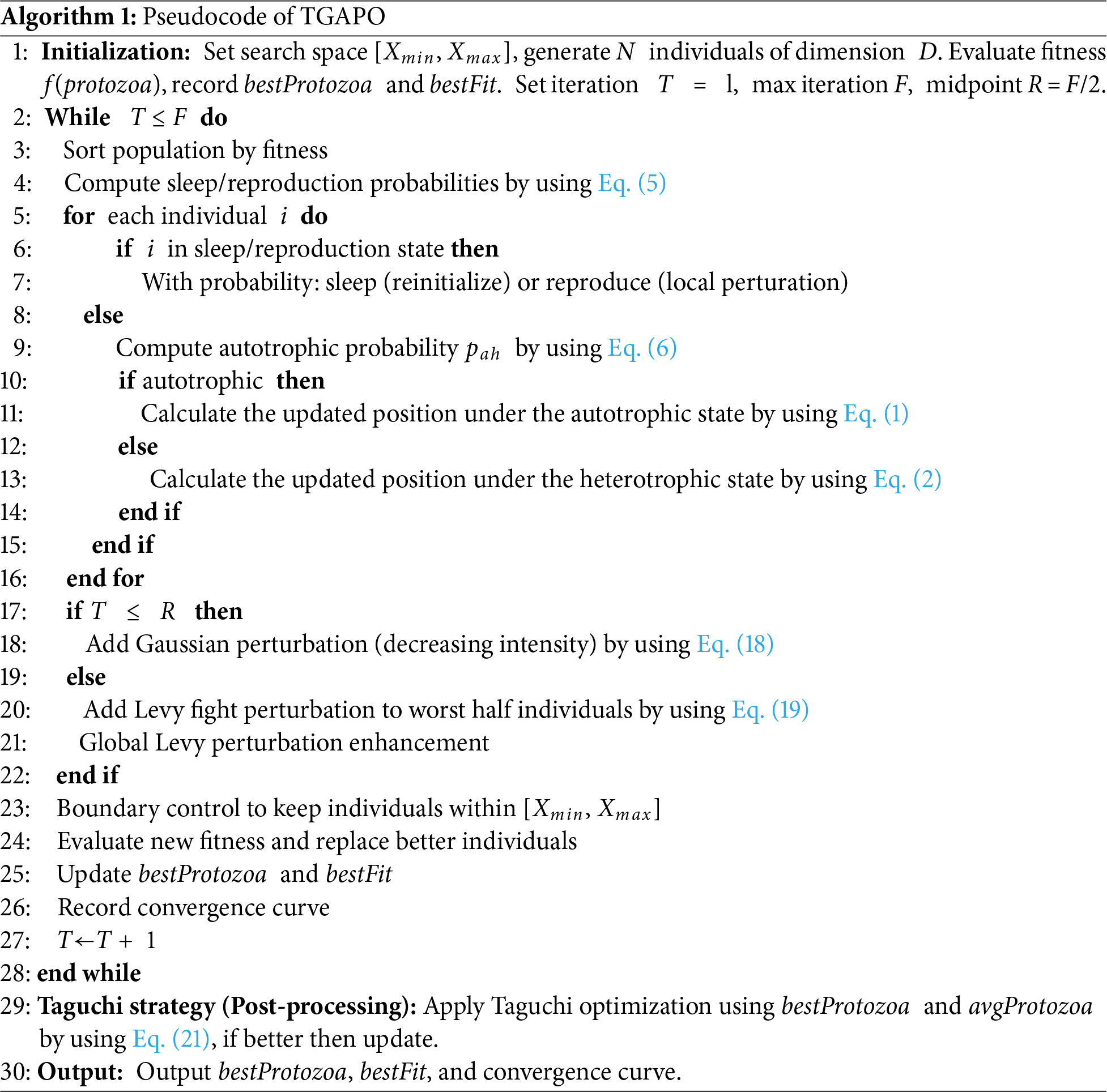
To overcome the above-mentioned limitations, three strategies are incorporated into the original APO algorithm. Specifically, a multi-strategy optimization framework is constructed by integrating the Taguchi orthogonal experimental design with a two-stage Gaussian–Lévy evolutionary mechanism to enhance the global search capability and convergence stability of the Artificial Protozoa Optimization (APO) algorithm. Compared with standard APO variants that employ a single-phase or uniform perturbation mechanism, TGAPO introduces a two-stage stochastic evolution scheme that combines Gaussian perturbation and Lévy flight. In the first stage, Gaussian perturbation with a gradually decreasing variance is employed to enhance fine-grained local exploitation by guiding individuals toward promising regions under controlled randomness. In the second stage, Lévy flight is applied to the lower-ranked half of the population, enabling large and irregular jumps that significantly expand the global search range. This staged design allows TGAPO to adaptively transition from exploitation to exploration, effectively avoiding premature convergence and improving the algorithm’s robustness in multimodal and high-dimensional optimization spaces. The combination of Gaussian and Lévy perturbations provides a complementary search dynamic that is not present in the traditional APO or its single-phase extensions. Firstly, a two-stage APO evolution mechanism is adopted to successively optimize the objective function:
In the first stage, iterative updates are carried out according to the following formula:
Here,
When t = 0,
In the second stage, the APO evolutionary mechanism continues to be applied, and Lévy flight perturbation is introduced for the bottom 50% of the population (based on fitness ranking). The perturbation update formula is:
Here, β is the scaling factor that controls the intensity of the Lévy perturbation, and L(s) is a random variable following the Lévy distribution, defined as:
Here, μ, ν˜N (0,
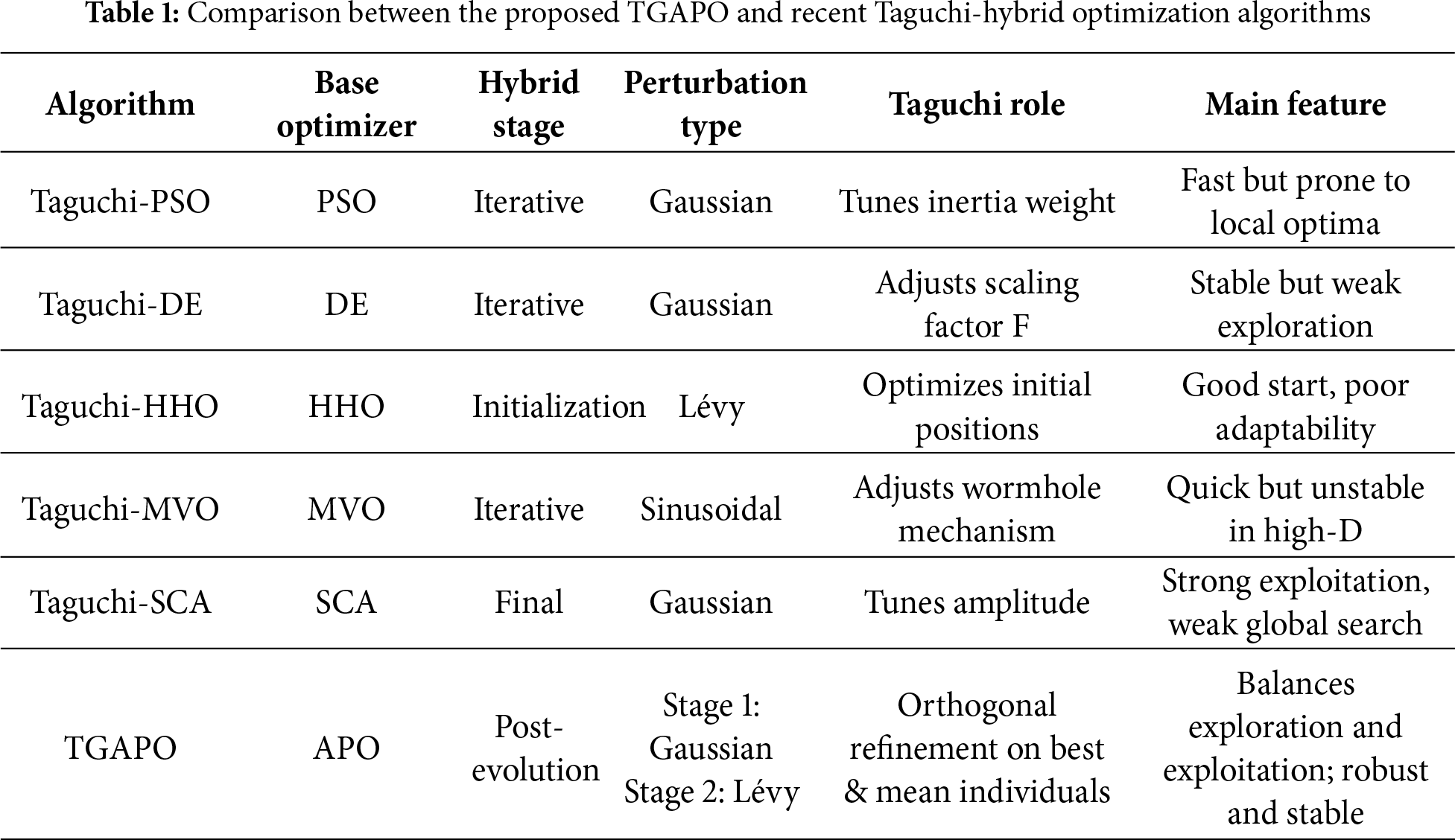
After the completion of the above two-stage iterations, the Taguchi orthogonal experimental design is applied to perform local fine-tuning on the current optimal threshold vector, ensuring that evaluation metrics are optimized. Unlike conventional Taguchi-hybrid algorithms, in which the Taguchi method is embedded within each iteration to tune parameters, TGAPO adopts a post-evolution Taguchi refinement strategy that operates only on the best and mean individuals obtained after the dual-stage evolution. This decoupled mechanism enables the Taguchi design to perform orthogonal local perturbations in a structured manner without interfering with the stochastic exploration of APO. The orthogonal array derived from the Taguchi design systematically evaluates factor-level combinations around the best solutions, thereby enhancing the local search accuracy while maintaining population diversity. This interaction allows TGAPO to preserve APO’s strong global exploration capability in early stages and leverage Taguchi’s deterministic stability improvement in later stages, achieving a dynamic balance between exploration and exploitation.
The best individual solution
Here, Δ represents the small perturbation term generated by the orthogonal design.
To provide a clearer demonstration of the novelty and hybridization mechanism of the proposed TGAPO algorithm, a comparative summary of TGAPO and several recent Taguchi-hybrid metaheuristic algorithms (2023–2025) is presented in Table 1. These representative algorithms—such as Taguchi-PSO, Taguchi-DE, Taguchi-HHO, Taguchi-MVO, and Taguchi-Sine Cosine Algorithm (SCA)—illustrate the typical ways in which the Taguchi method has been incorporated into metaheuristic frameworks, either during initialization or within iterative parameter adaptation. In contrast, TGAPO introduces a three-phase architecture that distinctly separates the stochastic and deterministic processes: a two-stage Gaussian–Lévy evolutionary mechanism is first performed to balance global exploration and local exploitation, followed by a post-evolution Taguchi orthogonal refinement applied to the best and mean individuals. This decoupled integration ensures that the Taguchi method enhances convergence precision and stability without interrupting APO’s stochastic dynamics. As summarized in Table 1, TGAPO differs from existing Taguchi-hybrid algorithms by offering a structured and adaptive balance between exploration and exploitation, leading to superior robustness and optimization accuracy in complex search spaces.
The computational complexity of TGAPO mainly depends on the population size
where
To examine parameter sensitivity, we analyzed the influence of the scaling factor
The convergence behavior of TGAPO can be qualitatively analyzed from its dynamic update rule.
The Gaussian perturbation ensures local contraction around promising regions, satisfying
where 𝜂 > 0 denotes the convergence rate.
The Lévy flight [36] introduces long-range jumps that prevent the population from stagnating at local minima, and the Taguchi refinement reduces the fitness variance among top individuals, improving stability near the optimum.
Therefore, TGAPO achieves probabilistic global convergence with enhanced robustness compared with the original APO. Algorithm 1 presents the pseudocode of the proposed TGAPO algorithm.
3.2 The Multi-Level Image Segmentation Problem Based on TGAPO
Minimum multilevel image segmentation is an important image processing technique, whose core challenge lies in the effective determination of optimal threshold boundaries for each segmented region. Among various optimization algorithms, although the APO algorithm has demonstrated good performance in multilevel image segmentation, the TGAPO algorithm proposed in this paper achieves even better segmentation results. Compared with APO, TGAPO exhibits remarkable advantages in handling high-dimensional and complex optimization problems, effectively overcoming several limitations of the original APO algorithm.
The goal of image segmentation is to divide the pixels of an image into several semantically meaningful regions, and threshold selection is a critical step in histogram-based image segmentation methods. To obtain more accurate segmentation boundaries, this paper adopts the minimum cross-entropy (MCET) criterion as the objective function for image segmentation and employs the TGAPO algorithm to optimize and solve this objective function. As a result, the optimal multilevel threshold set of the image in the grayscale space is obtained. These thresholds are then used as classification boundaries for pixel assignment to achieve regional partitioning of the image. Fig. 1 illustrates the flowchart of applying the TGAPO algorithm to solve the multilevel image segmentation problem.
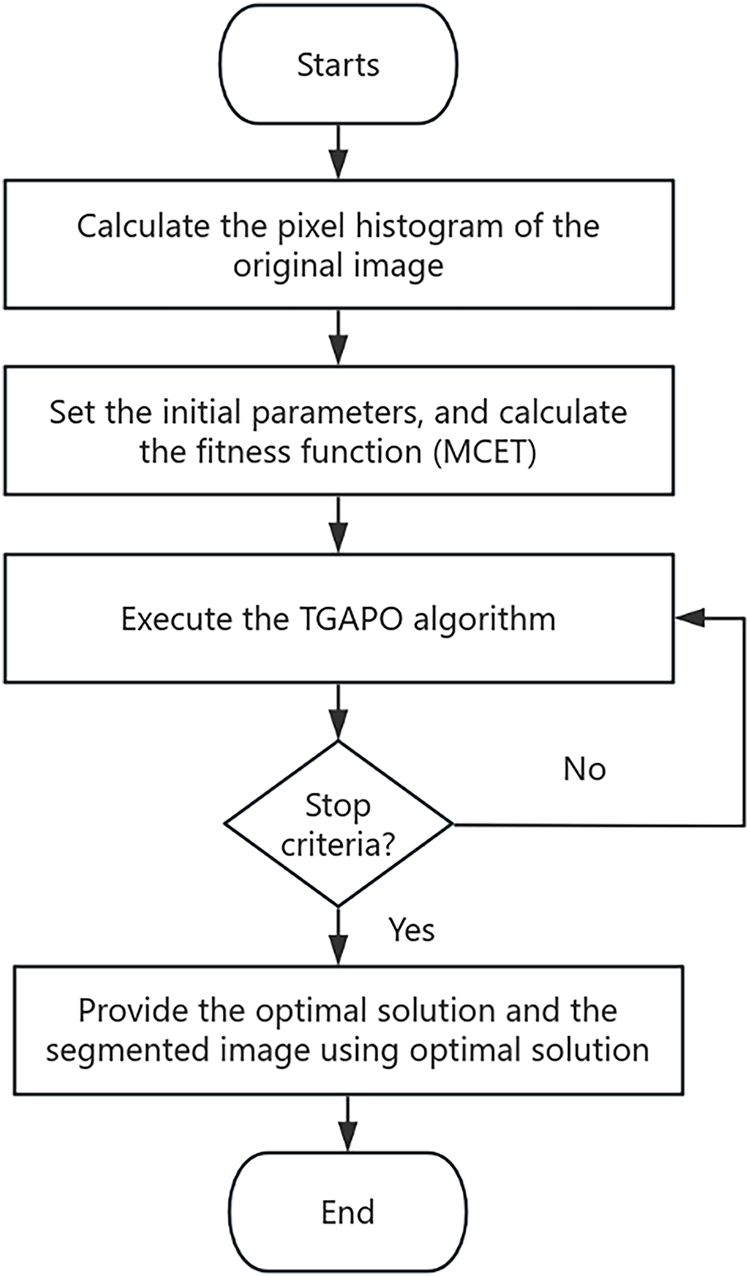
Figure 1: The flowchart illustrating the process of applying TGAPO to multi-level image segmentation
This paper focuses on the segmentation task of color images and processes the three color channels (red, green, and blue) separately. The specific procedure is described as follows. First, the grayscale histograms of each channel are calculated independently. Then, the optimal thresholds of each channel obtained through TGAPO optimization are applied to the corresponding pixel segmentation operations.
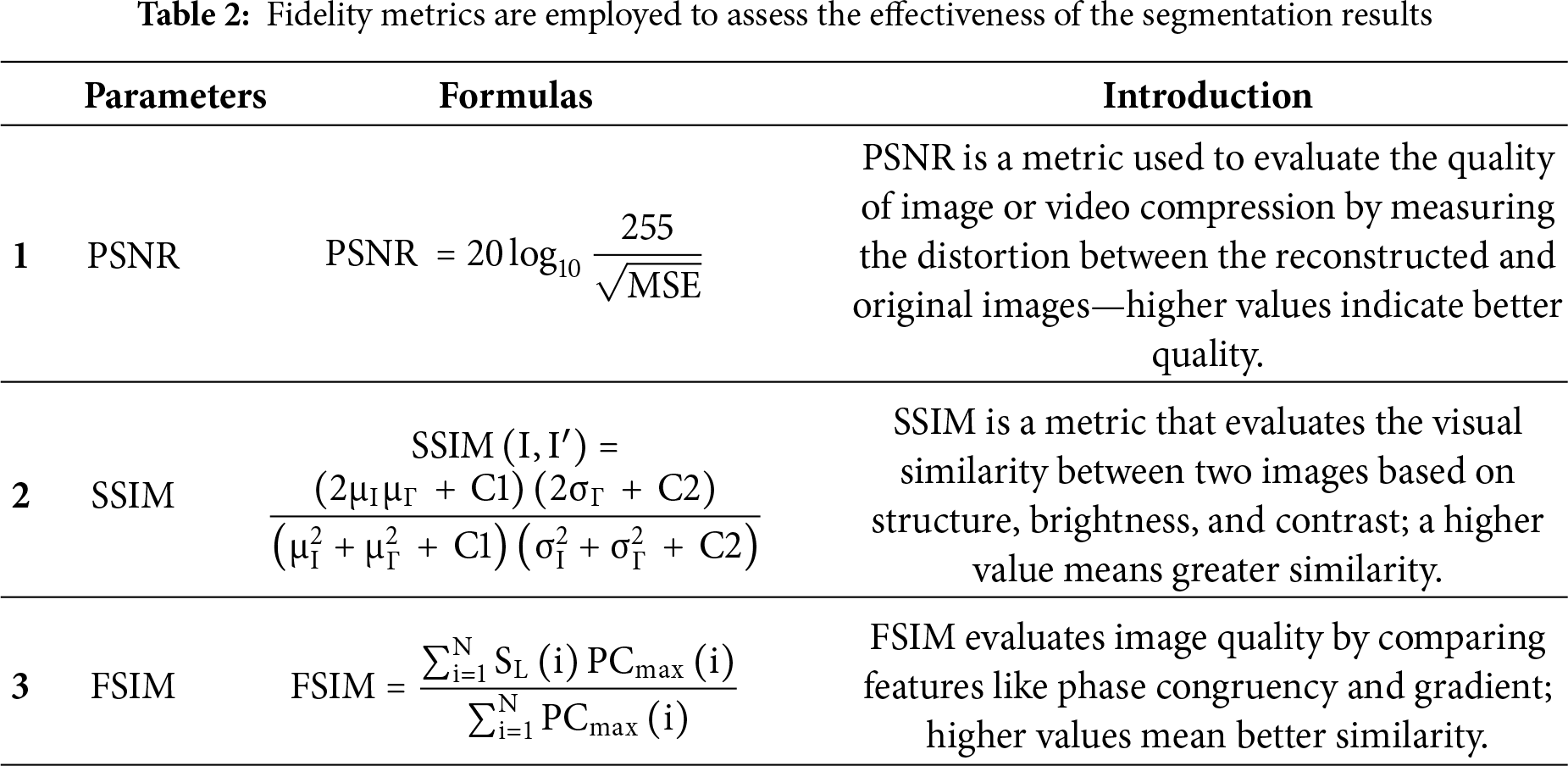
Finally, the segmentation results of the three channels are fused to generate a complete color segmentation image. To comprehensively evaluate the segmentation quality, this paper adopts three widely used evaluation metrics: Peak Signal-to-Noise Ratio (PSNR), Structural Similarity Index Measure (SSIM), and Feature Similarity Index Measure (FSIM). These three indicators quantitatively assess the segmentation performance from the perspectives of pixel-level error, structural preservation capability, and visual feature similarity, respectively. Table 2 summarizes the definitions and characteristics of these three evaluation metrics.
In this section, first of all, we confirmed the performance of TGAPO, which was tested and experimented on CEC2022 and multi-level image segmentation.
4.1 The Experimental Results of Global Optimization
All experiments were conducted on a workstation equipped with an Intel Core i9-13900K CPU @ 3.0 GHz, 64 GB RAM, and an NVIDIA RTX 4090 GPU, using MATLAB R2023b under Windows 11. Each algorithm was executed 30 times on each benchmark function to ensure statistical reliability. Although TGAPO introduces an additional Taguchi refinement stage, the resulting computational overhead is minor, accounting for approximately 5% of the total runtime. Moreover, TGAPO is able to reach the optimal region with fewer iterations and faster convergence than APO, DE, and PSO, demonstrating higher computational efficiency while maintaining superior optimization accuracy.
In this study, the performance of the proposed TGAPO algorithm in real-parameter optimization is evaluated using the CEC2022 benchmark test suite. The CEC2022 test set was released under the framework of the IEEE Congress on Evolutionary Computation (CEC) and is specifically designed for single-objective constrained optimization problems in the real-valued domain. It is widely used to assess the global optimization capability, convergence speed, and robustness of meta-heuristic optimization algorithms across different problem types.
The CEC2022 benchmark suite consists of 12 continuous optimization test functions covering a wide range of optimization characteristics. Specifically, F1 is a unimodal function used to evaluate the local exploitation capability of an algorithm. Functions F2–F5 are multimodal and are designed to test global exploration ability. Functions F6–F8 are hybrid functions constructed by combining multiple basic functions, while F9–F12 are composition functions that integrate several complex substructures with high nonlinearity and irregularity. These benchmark functions are widely adopted in the literature for performance comparison, as they provide diverse challenges and enable a comprehensive evaluation of an algorithm’s generalization ability and adaptability in various optimization scenarios.
To evaluate the performance of the proposed TGAPO algorithm, it was compared with APO, Butterfly Optimization Algorithm (BOA), DE, GWO, and PSO algorithms. Each algorithm was tested 30 times under identical conditions to ensure fairness. All benchmark functions in the CEC2022 suite were set to 20 dimensions, with 1000 iterations, an initial population size of 100, and a search range of
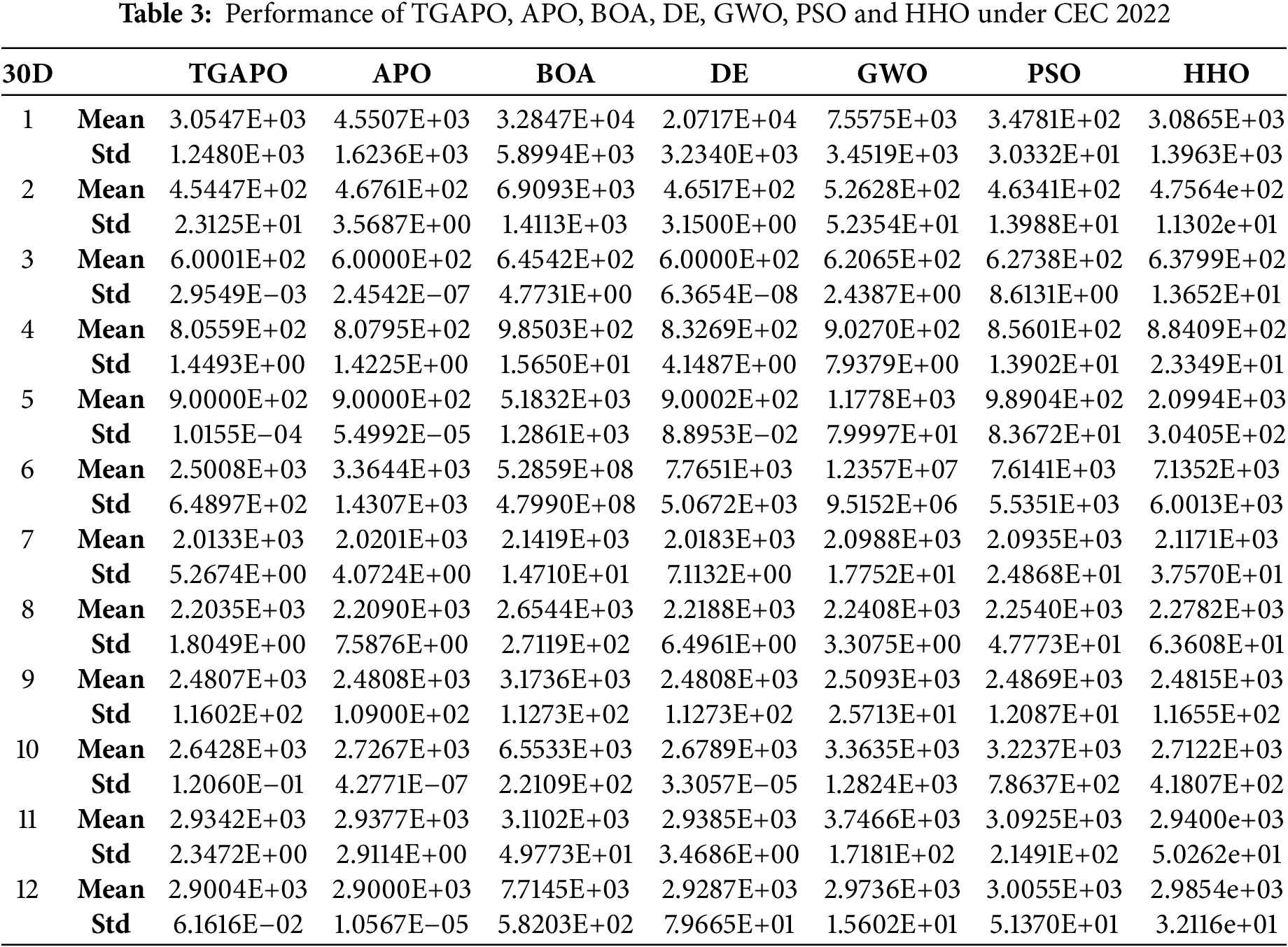
According to the experimental results, TGAPO demonstrates competitive and stable performance on the CEC2022 benchmark functions. Compared with the original APO algorithm, TGAPO achieves better average results on 9 out of 12 test functions and comparable results on the remaining ones. In terms of standard deviation, TGAPO shows lower variability on most functions, suggesting that the proposed hybrid strategy contributes to more stable convergence behavior. When compared with BOA and DE, TGAPO maintains lower or comparable mean values in most test cases, while exhibiting consistently small standard deviations across all benchmarks, reflecting its ability to balance search accuracy and convergence stability. Relative to GWO and PSO, TGAPO obtains competitive average solutions and smaller deviations in the majority of functions, indicating that the combination of Gaussian–Lévy exploration and Taguchi-based exploitation improves the balance between global and local search. Additionally, the newly included Harris Hawks Optimizer (HHO) provides a stronger comparative basis for fairness, as it represents a recent and widely adopted metaheuristic. Under the same test conditions, TGAPO achieves lower average fitness in most functions and maintains stable variance levels similar to or better than HHO, demonstrating robustness without excessive fluctuation. Overall, TGAPO achieves reliable optimization performance across different benchmark categories, showing strong adaptability and stability in multimodal and composite functions. These results collectively indicate that TGAPO provides a balanced optimization framework with competitive accuracy and consistent convergence, rather than emphasizing superiority over existing algorithms. The convergence curves of the optimal values of these algorithms are plotted in Fig. 2. The results show that the performance of the TGAPO algorithm on functions f1 and f2 is significantly superior to other similar algorithms.
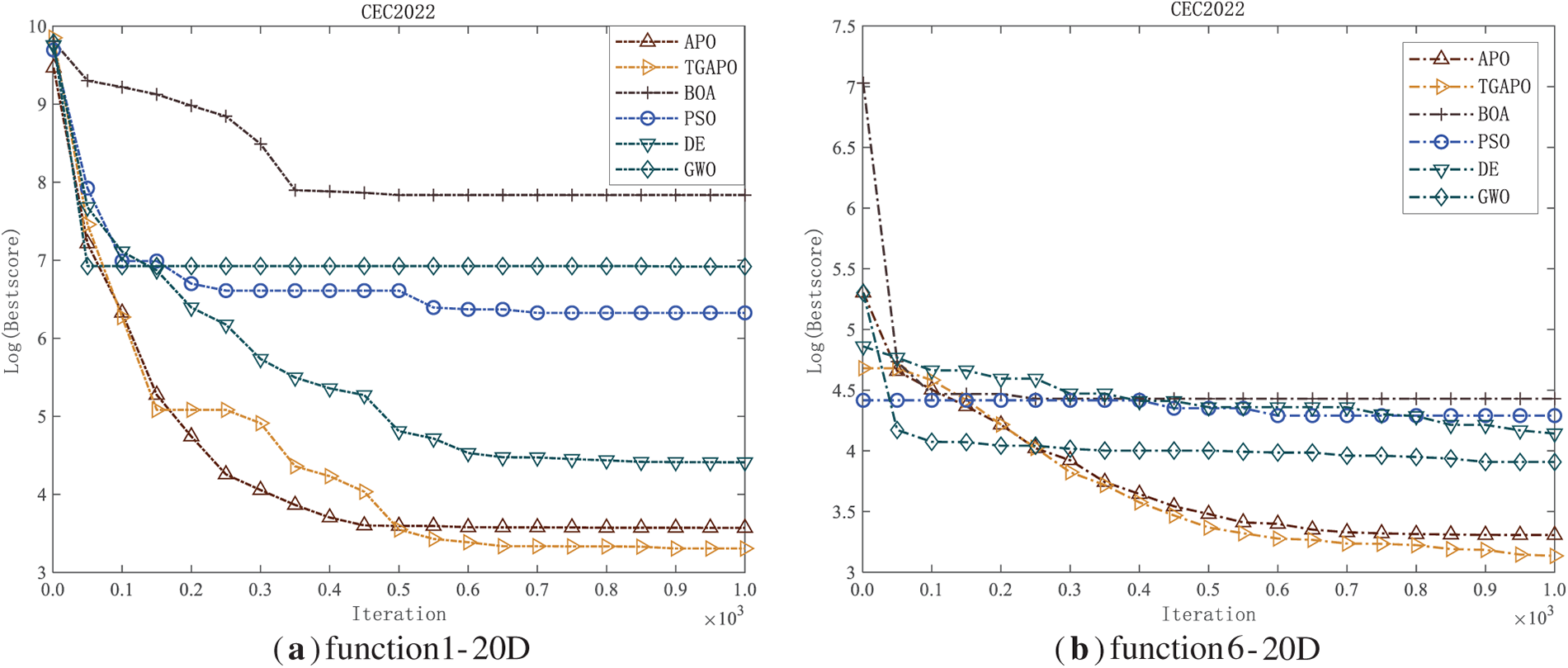
Figure 2: Comparison of the optimal fitting errors of functions f1 and f6 with the 20-dimensional optimization
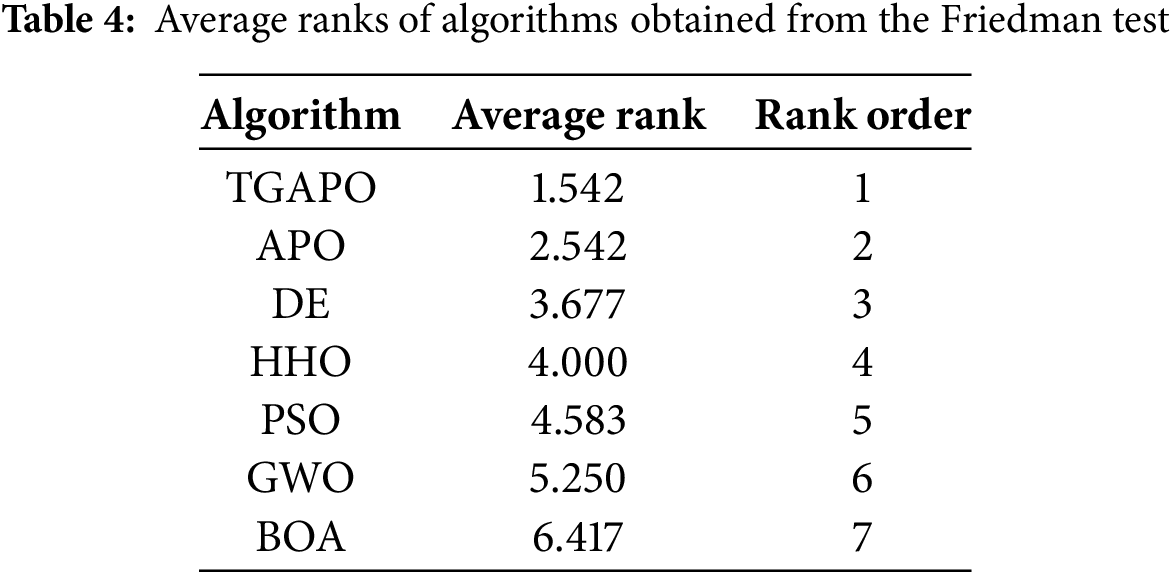
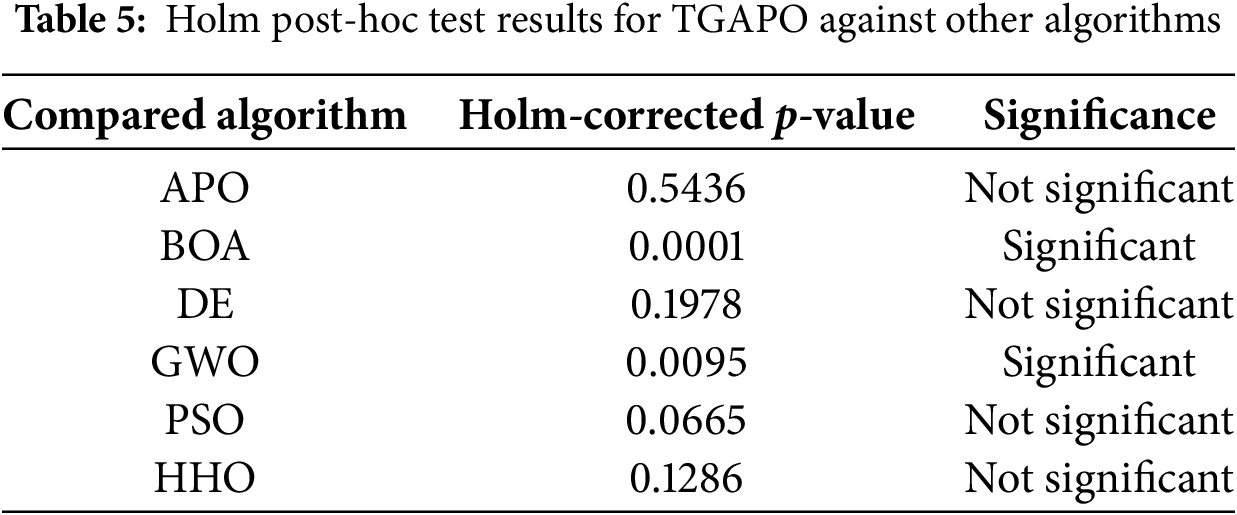
To further verify the reliability of the obtained results, the Friedman test and the Holm post-hoc statistical analysis were conducted based on the experimental outcomes of all benchmark functions. As shown in Table 4, the Friedman test indicates statistically significant differences among the compared algorithms, suggesting that the observed performance variations are not caused by random factors. The Holm post-hoc analysis summarized in Table 5 further reveals that the proposed TGAPO algorithm achieves statistically significant improvements over several comparative algorithms, while maintaining comparable performance with others. These findings demonstrate that TGAPO exhibits strong robustness and competitive optimization capability, thereby further validating the effectiveness and general applicability of the proposed method across different optimization scenarios.
To further verify the effectiveness of each component in the proposed TGAPO algorithm, an ablation study was conducted on four representative benchmark functions. The experimental results are summarized in Table 6. Four algorithmic variants were evaluated, including the original APO, APO with Gaussian–Lévy exploration, APO with Taguchi-based local refinement, and the full TGAPO that integrates both strategies.
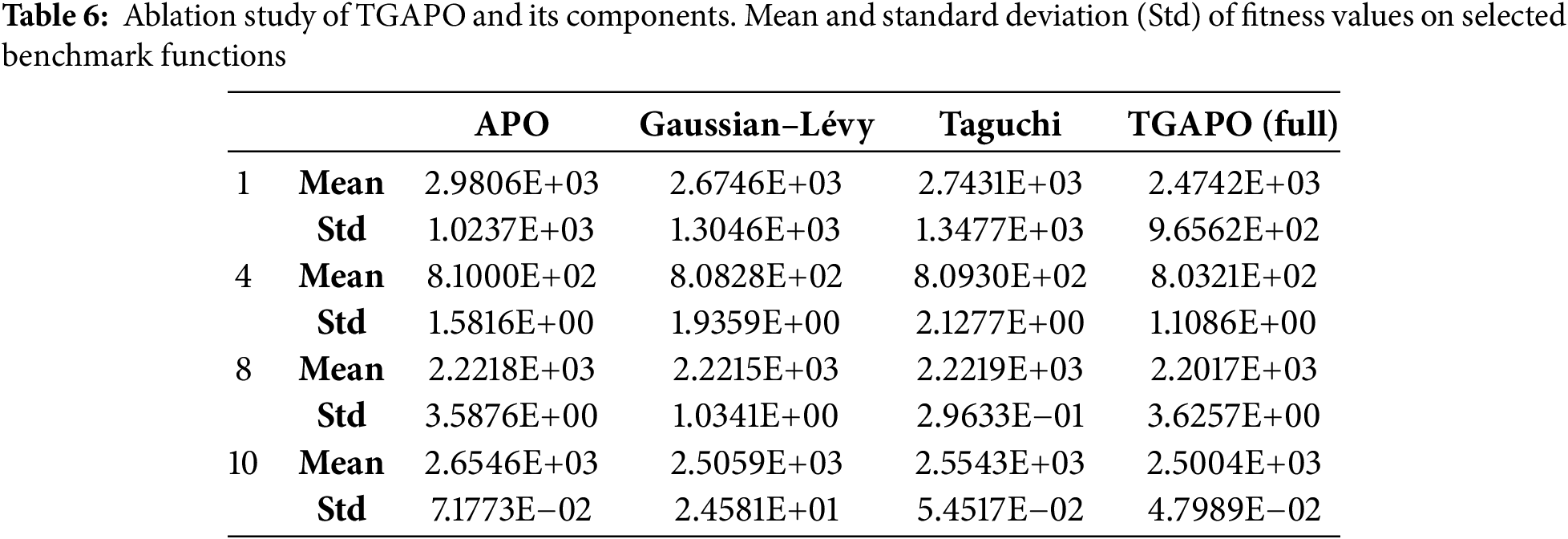
As shown in Table 6, the APO+GL variant achieves lower mean fitness values than the baseline APO in most test cases, indicating that the Gaussian–Lévy perturbation effectively enhances global search capability and helps avoid premature convergence. The APO+TAG variant exhibits smaller standard deviations, demonstrating that the Taguchi strategy significantly improves convergence stability and local exploitation ability. The full TGAPO consistently achieves the lowest mean and standard deviation values across the majority of benchmark functions, confirming that the two strategies are complementary and together enhance both optimization accuracy and robustness. These results further validate the rationality and necessity of integrating both Gaussian–Lévy exploration and Taguchi-based refinement within the TGAPO framework.
4.2 Experimental Results of Multi-Level Image Segmentation Problems
During this process, the input image is converted into a grayscale image or processed separately according to the RGB channels, and the pixel histogram is calculated to construct a minimum cross-entropy threshold optimization model for multilevel image segmentation, thereby providing a unified and scalable modeling framework for multi-threshold segmentation tasks. The application experiments were conducted using eight original color images, as shown in Fig. 3. Each image consists of three channels (R, G, and B) with multimodal characteristics. To further ensure experimental standardization and reproducibility, all test images were selected from the USC-SIPI Image Database, which contains diverse natural and aerial scenes and is widely used for image segmentation benchmarking. This dataset is employed to evaluate whether the TGAPO algorithm exhibits superior performance in multilevel image segmentation tasks. For fairness and statistical reliability, each image was segmented 30 times. The maximum number of iterations was set to 100, and the initial population size was set to 100. To more clearly demonstrate the multilevel image segmentation results produced by the TGAPO algorithm, image img5 is selected for detailed visualization, as shown in Fig. 4. The segmentation thresholds are set to three different levels: 5, 8, and 11. The grayscale histograms of the R, G, and B channels are displayed to represent pixel intensity distributions, and the red dashed lines indicate the segmentation thresholds optimized using the minimum cross-entropy criterion.
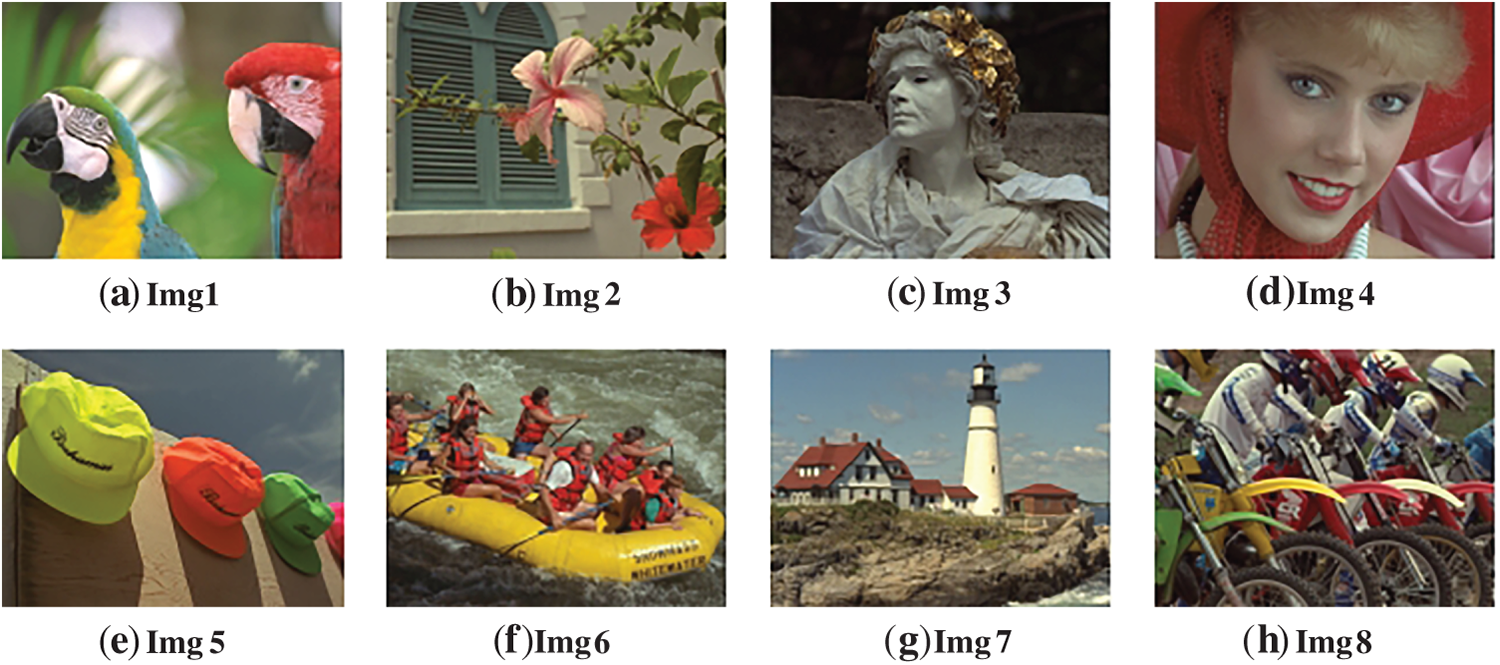
Figure 3: Test color images from the USC-SIPI datasets (Img1–Img8)
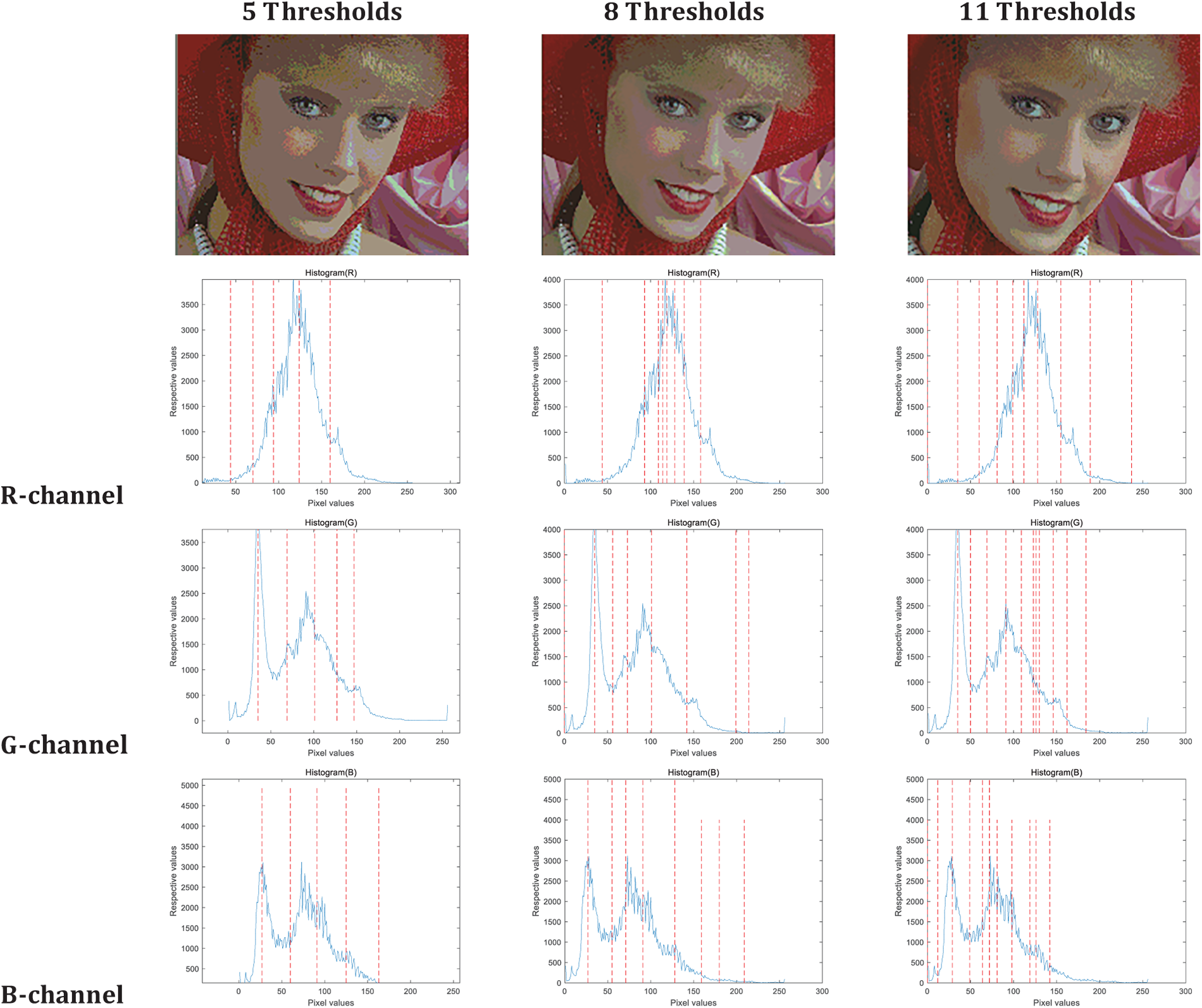
Figure 4: The segmentation results of Img5 using the TGAPO algorithm and the histograms of each band (RGB), with 5, 8, and 11 thresholds, respectively
The figure also illustrates the identified boundary regions in the segmented images, where pixel intensities are sequentially classified into multiple categories to achieve regional partitioning. The TGAPO algorithm, together with the comparison algorithms APO, PSO, and GWO, is employed to independently segment each color channel of four representative images. The segmentation results of each channel are then fused and composited to obtain the final multilevel image segmentation results.
As shown in Fig. 5, the proposed TGAPO algorithm, together with the comparative approaches APO, PSO, and GWO, is employed to perform segmentation on each image channel independently. The resulting segmented channels are subsequently fused to generate the final segmented image. In this experiment, the numbers of thresholds are specified as 5, 8, and 11 for the three channels, respectively. The segmentation results become progressively clearer as the number of thresholds increases. However, due to the inherent randomness of optimization algorithms and the possible selection of suboptimal thresholds, performance variations may occur, leading to segmentation results that are not always optimal.
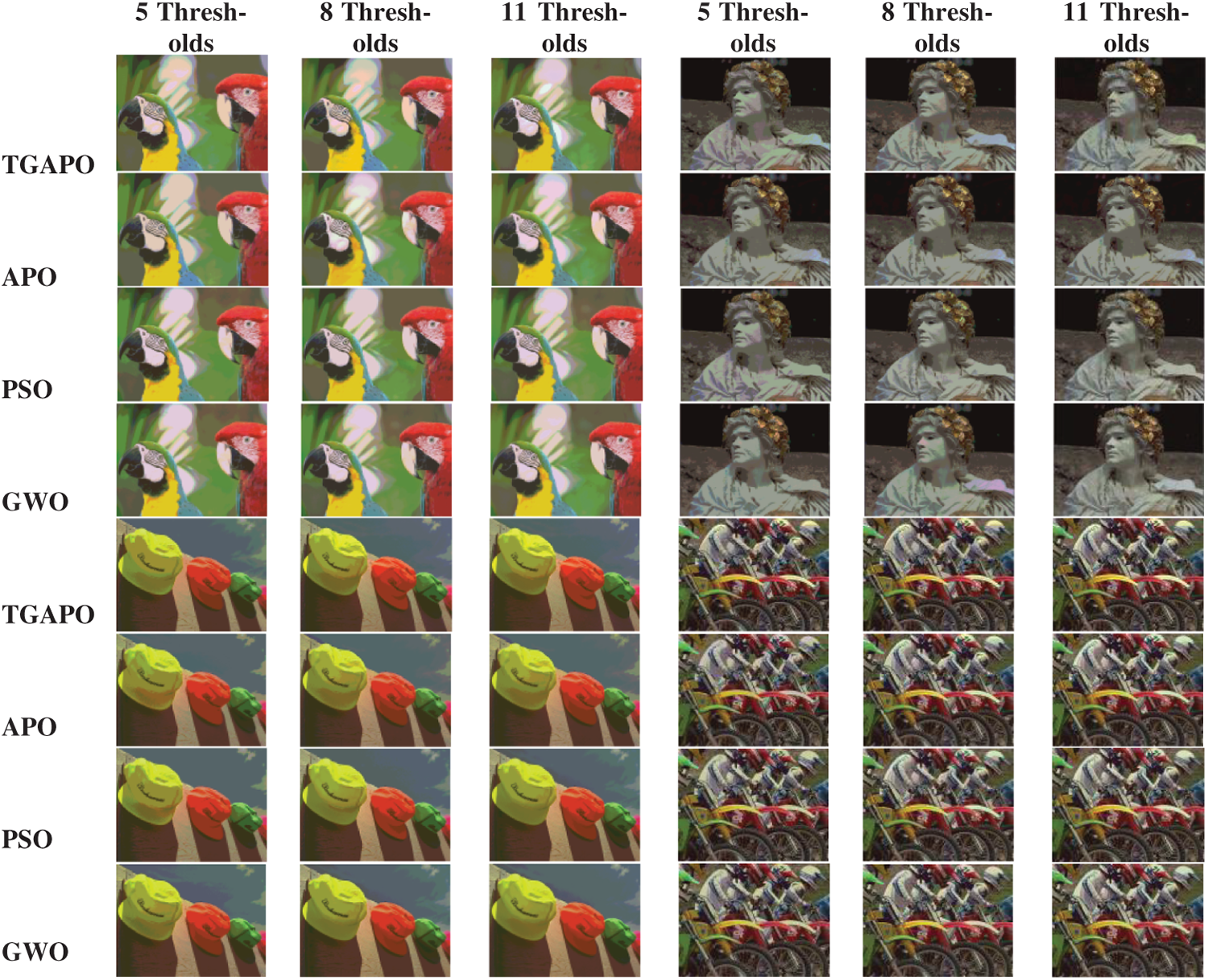
Figure 5: Visual comparison of segmentation results with 5, 8, and 11 thresholds obtained by TGAPO and other algorithms
In Table 7, several widely used objective image quality evaluation metrics are adopted, including Peak Signal-to-Noise Ratio (PSNR), which measures the pixel-level consistency between the segmented image and the original image; Structural Similarity Index Measure (SSIM), which evaluates structural preservation capability; and Feature Similarity Index Measure (FSIM), which assesses overall visual quality. For all three metrics, larger values indicate higher segmentation quality and greater similarity to the original image.
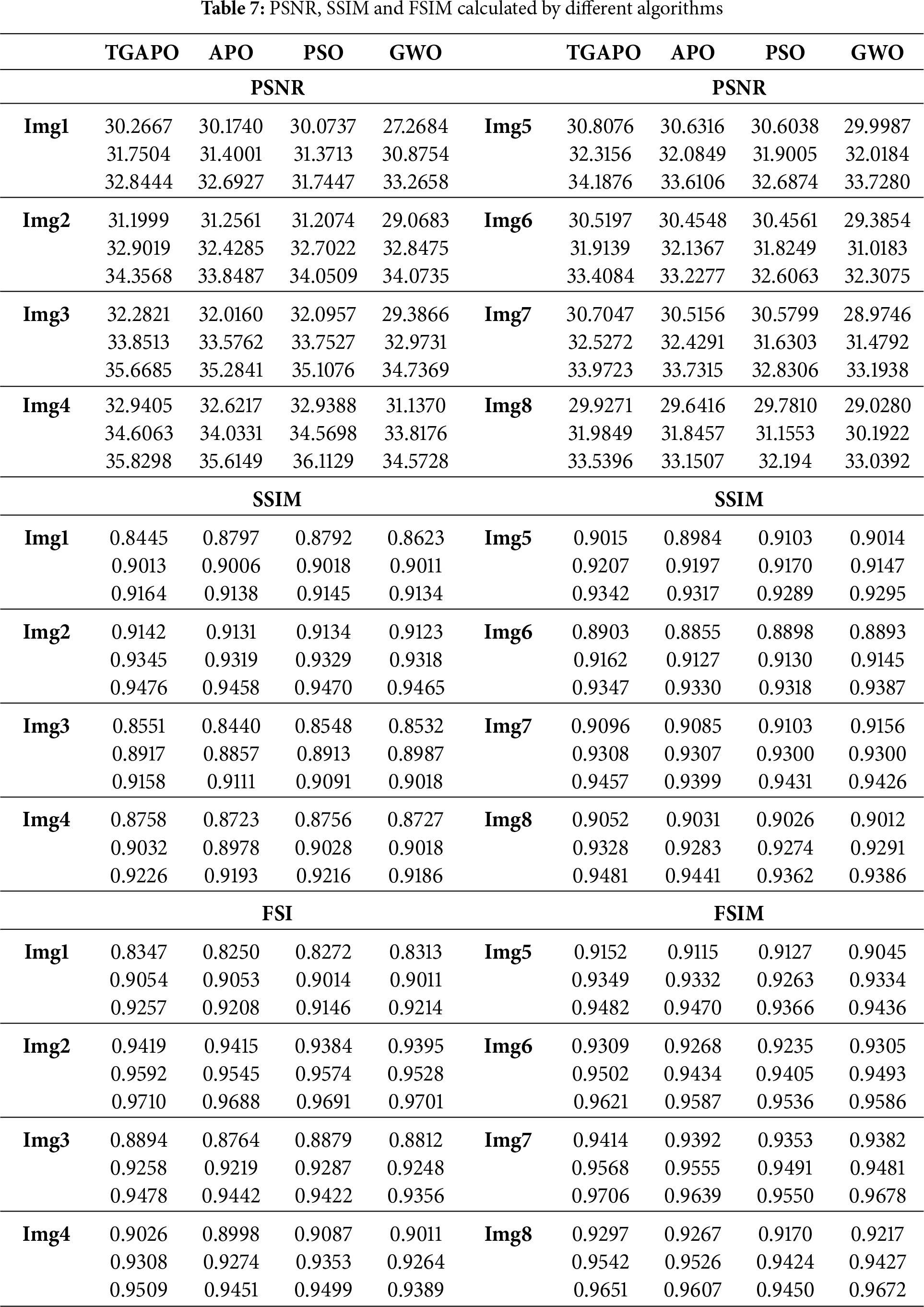
The experimental results clearly demonstrate that the proposed TGAPO-based multilevel image segmentation method exhibits competitive and reliable performance across multiple image datasets. In particular, it shows distinct advantages when processing images with complex grayscale distributions and rich structural details.
Under the PSNR (Peak Signal-to-Noise Ratio) metric, the segmentation complexity increases significantly with the number of thresholds, which imposes higher demands on both the global search capability and local detail preservation of the algorithm. TGAPO maintains high PSNR values across different threshold levels, indicating that its segmentation results effectively preserve image brightness and structural information while avoiding over-segmentation or loss of fine details. Notably, in the 8- and 11-threshold segmentation tasks, TGAPO achieves higher PSNR values than APO and PSO on most images, further confirming its consistent accuracy advantage.
In terms of the SSIM (Structural Similarity Index Measure), TGAPO demonstrates superior preservation of edge structures and local details. Compared with APO and PSO, its segmentation results exhibit more stable structural consistency from a visual perspective. In the FSIM (Feature Similarity Index Measure) comparison, TGAPO also outperforms the other algorithms, highlighting its advantages in visual detail representation and subjective quality enhancement.
Compared with APO, PSO, and GWO, TGAPO is more capable of accurately capturing both low-frequency and high-frequency features in images, thereby achieving higher perceptual consistency.
In summary, TGAPO not only delivers optimal performance under standard threshold settings, but also exhibits strong adaptability and robustness in complex multilevel and multicategory segmentation tasks. Compared with APO, PSO, and GWO, the proposed method demonstrates superior accuracy stability, structural fidelity, and visual consistency under multi-threshold conditions.
To further evaluate the generalization ability of the proposed TGAPO algorithm, additional experiments were conducted on remote sensing images from the Remote Sensing Semantic Segmentation Dataset [37]. This dataset contains high-resolution satellite imagery with complex terrain textures and spectral variations.
As shown in Fig. 6, TGAPO maintains stable segmentation performance under 5-, 8-, and 11-threshold settings, effectively preserving edge contours and texture details in large-scale remote sensing scenes.
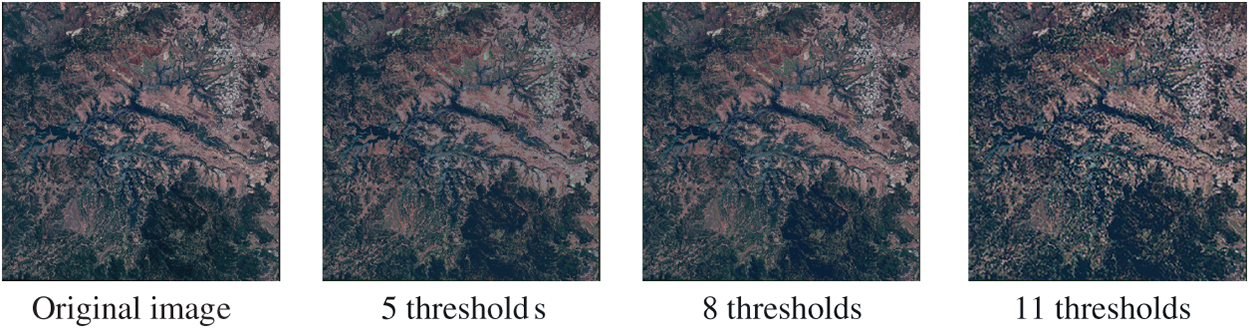
Figure 6: Visual segmentation results of remote sensing images from the Remote Sensing Semantic Segmentation Dataset under different threshold setting
This paper proposes a novel optimization algorithm named TGAPO. In the context of multi-threshold image segmentation, TGAPO is designed to enhance global search capability and adaptability by adopting a hybrid structure that combines a two-stage evolutionary mechanism with a Taguchi-based local fine-tuning strategy. Specifically, TGAPO first performs global optimization using the Artificial Protozoa Optimization (APO) mechanism. It introduces dynamic Gaussian perturbations and Lévy flight interventions at different stages to increase search diversity and improve the algorithm’s ability to escape local optima. At the end of the optimization process, the Taguchi orthogonal experimental design is applied to the best individual for local fine-tuning, thereby improving solution stability and precision. Comparative experiments on standard image datasets demonstrate that TGAPO achieves stable and reliable segmentation performance across different numbers of thresholds, particularly in the 5–11 threshold range for low-noise color images. TGAPO consistently maintains high segmentation accuracy and strong robustness, outperforming APO, PSO, and GWO in both objective and subjective evaluation metrics such as PSNR, SSIM, and FSIM. These results confirm that TGAPO provides stable and precise segmentation under moderate complexity conditions, rather than across all image types.
Beyond these results, TGAPO shows promising potential for real-world applications in which multilevel image segmentation or complex optimization plays a critical role. In particular, its ability to balance global exploration and local exploitation makes it suitable for medical imaging, remote sensing, and object detection or feature enhancement in industrial vision systems. These potential applications further highlight the versatility and scalability of TGAPO in solving optimization-driven visual problems.
Despite its effectiveness, TGAPO still presents certain limitations. The incorporation of the Taguchi-based refinement stage slightly increases the computational cost in very high-dimensional optimization scenarios. Future work will focus on developing a parallel and adaptive version of TGAPO to further improve computational efficiency. In addition, integrating TGAPO with deep learning or reinforcement learning–based parameter adaptation is expected to enhance its adaptability to complex and dynamic optimization tasks. These directions will be explored to further broaden the applicability of TGAPO in intelligent optimization and computer vision analysis.
Acknowledgement: Not applicable.
Funding Statement: The research received no specific funding for this study.
Author Contributions: Conceptualization, Jeng-Shyang Pan and Ru-Yu Wang; methodology, Ling-Da Chi; software, Yan-Na Wei; validation, Shu-Chuan Chu and Junzo Watada; formal analysis, Yan-Na Wei; investigation, Yan-Na Wei; resources, Shu-Chuan Chu and Jeng-Shyang Pan; writing—original draft preparation, Yan-Na Wei; writing—review and editing, Ru-Yu Wang and Jeng-Shyang Pan; visualization, Ling-Da Chi and Shu-Chuan Chu; project administration, Junzo Watada. All authors reviewed the results and approved the final version of the manuscript.
Availability of Data and Materials: Not applicable.
Ethics Approval: Not applicable.
Conflicts of Interest: The authors declare no conflicts of interest to report regarding the present study.
References
1. Layth AB, Murtadha AK, Jaleel AL. Solving optimal power flow problem using improved differential evolution algorithm. Int J Electr Electron Eng Telecommun. 2022;11(2):146–55. doi:10.18178/ijeetc.11.2.146-155. [Google Scholar] [CrossRef]
2. Hua Y, Liu Q, Hao K, Jin Y, Zhang J. A survey of evolutionary algorithms for multi-objective optimization problems with irregular Pareto fronts. IEEE/CAA J Autom Sinica. 2021;8(2):303–18. doi:10.1109/JAS.2021.1003833. [Google Scholar] [CrossRef]
3. Ramírez-Ochoa DD, Pérez-Domínguez LA, Martínez-Gómez EA, López-Bonilla OR, González-Palacios MA, Yañez-Márquez C. PSO, a swarm intelligence-based evolutionary algorithm as a decision-making strategy: a review. Symmetry. 2022;14(3):455. doi:10.3390/sym14030455. [Google Scholar] [CrossRef]
4. Seyyedabbasi A, Kiani F. I-GWO and Ex-GWO: improved algorithms of the grey wolf optimizer to solve global optimization problems. Eng Comput. 2021;37(1):509–32. doi:10.1007/s00366-019-00830-y. [Google Scholar] [CrossRef]
5. Liu S, Chen C, Qu X, Sun Y, Tan KC. Large language models as evolutionary optimizers. In: Proceedings of the 2024 IEEE Congress on Evolutionary Computation (CEC); 2024 Jun 30–Jul 5; Yokohama, Japan. Piscataway, NJ, USA: IEEE; 2024. p. 1–8. doi:10.1109/CEC60901.2024.10611397. [Google Scholar] [CrossRef]
6. Alhijawi B, Awajan A. Genetic algorithms: theory, genetic operators, solutions, and applications. Evol Intell. 2024;17(3):1245–56. doi:10.1007/s12065-023-00869-2. [Google Scholar] [CrossRef]
7. Kaveh M, Mesgari MS. Application of meta-heuristic algorithms for training neural networks and deep learning architectures: a comprehensive review. Neural Process Lett. 2023;55(4):4519–622. doi:10.1007/s11063-022-11264-6. [Google Scholar] [CrossRef]
8. Coello Coello CA. Constraint-handling techniques used with evolutionary algorithms. In: Proceedings of the Genetic and Evolutionary Computation Conference Companion (GECCO); 2025 Jul 14–18; Malaga, Spain. Lisbon, Portugal: ACM; 2025. p. 1767–90. doi:10.1145/3638529.3654201. [Google Scholar] [CrossRef]
9. He C, Zhang Y, Gong D, Sun J, Chen X. A review of surrogate-assisted evolutionary algorithms for expensive optimization problems. Expert Syst Appl. 2023;217:119495. doi:10.1016/j.eswa.2022.119495. [Google Scholar] [CrossRef]
10. Sun J, Liu X, Bäck T, Jin Y, Li B. Learning adaptive differential evolution algorithm from optimization experiences by policy gradient. IEEE Trans Evol Comput. 2021;25(4):666–80. doi:10.1109/TEVC.2020.3025792. [Google Scholar] [CrossRef]
11. Zhou X, Wang X, Gu X. A decomposition-based multiobjective evolutionary algorithm with weight vector adaptation. Swarm Evol Comput. 2021;61(2020):100825. doi:10.1016/j.swevo.2020.100825. [Google Scholar] [CrossRef]
12. Wang X, Snášel V, Mirjalili S, Pan JS, Kong L, Shehadeh HA. Artificial protozoa optimizer (APOa novel bio-inspired metaheuristic algorithm for engineering optimization. Knowl Based Syst. 2024;295(5):111737. doi:10.1016/j.knosys.2024.111737. [Google Scholar] [CrossRef]
13. Hisam MW, Dar AA, Elrasheed MO, Ali HA. The versatility of the Taguchi method: optimizing experiments across diverse disciplines. J Stat Theory Appl. 2024;23(4):365–89. doi:10.2991/jsta.d.240514.001. [Google Scholar] [CrossRef]
14. Wang X, Pan JS, Chu SC. A parallel multi-verse optimizer for application in multilevel image segmentation. IEEE Access. 2020;8:32018–30. doi:10.1109/ACCESS.2020.2973669. [Google Scholar] [CrossRef]
15. Zhao J, Wang X, Pan JS, Chu SC, Zhou Y, Alhudhaif A. Multi-modal multi-objective wolf pack algorithm with circumferential scouting and intra-niche interactions. Swarm Evol Comput. 2025;93:101842. doi:10.1016/j.swevo.2024.101842.X. [Google Scholar] [CrossRef]
16. Xue X, Miao Y, Nian Q. Matching ontologies with kernel principle component analysis and evolutionary algorithm. Demonstr Math. 2024;57(1):20240021. doi:10.1515/dema-2024-0021. [Google Scholar] [CrossRef]
17. Yang Y, Wang Y, Xue X. A novel spectral clustering method with superpixels for image segmentation. Optik. 2016;127(1):161–7. doi:10.1016/j.ijleo.2015.09.168. [Google Scholar] [CrossRef]
18. Zheng DH, Ye LZ. Image data classification algorithm based on spatial downscaling and structural information. J Netw Intell. 2024;9(12):2187–99. [Google Scholar]
19. Ahmad MF, Isa NAM, Lim WH, Salihin S, Hussien AG, Al-Betar MA. Differential evolution: a recent review based on state-of-the-art works. Alex Eng J. 2022;61(5):3831–72. doi:10.1016/j.aej.2021.09.004. [Google Scholar] [CrossRef]
20. Li J, An Q, Lei H, Zhang J, Yang XS. Survey of Lévy flight-based metaheuristics for optimization. Mathematics. 2022;10(15):2785. doi:10.3390/math10152785. [Google Scholar] [CrossRef]
21. Wang Z, Chen Y, Ding S, Zhang X, Yu J. A novel particle swarm optimization algorithm with Lévy flight and orthogonal learning. Swarm Evol Comput. 2022;75(9):101207. doi:10.1016/j.swevo.2022.101207. [Google Scholar] [CrossRef]
22. Xiao S, Wang H, Wang W, Sun J, Cui Z. Artificial bee colony algorithm based on adaptive neighborhood search and Gaussian perturbation. Appl Soft Comput. 2021;100(3):106955. doi:10.1016/j.asoc.2020.106955. [Google Scholar] [CrossRef]
23. Yang Z, Yu C. A single source generalization model via spatial amplitude perturbation and sensitivity guidance for colored medical image segmentation. In: Proceedings of the International Conference on Pattern Recognition (ICPR); 2024 Dec 1–5; Kolkata, India. Cham, Switzerland: Springer Nature; 2024. p. 1–16. doi:10.1007/978-3-031-78111-4_1. [Google Scholar] [CrossRef]
24. Yu Y, Wang C, Fu Q, Meng J, Xu J, Yang B. Techniques and challenges of image segmentation: a review. Electronics. 2023;12(5):1199. doi:10.3390/electronics12051199. [Google Scholar] [CrossRef]
25. Abdel-Basset M, Chang V, Mohamed R. A novel equilibrium optimization algorithm for multi-thresholding image segmentation problems. Neural Comput Appl. 2021;33(17):10685–718. doi:10.1007/s00521-021-05692-0. [Google Scholar] [CrossRef]
26. Wang G, Li Z, Weng G, Chen Y. An overview of industrial image segmentation using deep learning models. Intell Robot. 2025;5(1):143–80. doi:10.1016/j.inro.2025.01.005. [Google Scholar] [CrossRef]
27. Houssein EH, Abdelkareem DA, Emam MM, Mohamed WM, Hassaballah M, Hassanien AE. An efficient image segmentation method for skin cancer imaging using improved golden jackal optimization algorithm. Comput Biol Med. 2022;149(2):106075. doi:10.1016/j.compbiomed.2022.106075. [Google Scholar] [PubMed] [CrossRef]
28. Khouy M, Jabrane Y, Ameur M, Meziane A, Sekkak I. Medical image segmentation using automatic optimized U-Net architecture based on genetic algorithm. J Pers Med. 2023;13(9):1298. doi:10.3390/jpm13091298. [Google Scholar] [PubMed] [CrossRef]
29. Zhang C, Pei YH, Wang XX, Li H, Yang X. Symmetric cross-entropy multi-threshold color image segmentation based on improved pelican optimization algorithm. PLoS One. 2023;18(6):e0287573. doi:10.1371/journal.pone.0287573. [Google Scholar] [PubMed] [CrossRef]
30. Houssein EH, Helmy BED, Elngar AA, Oliva D, Hassaballah M, Abd Elaziz M. An improved tunicate swarm algorithm for global optimization and image segmentation. IEEE Access. 2021;9:56066–92. doi:10.1109/ACCESS.2021.3071516. [Google Scholar] [CrossRef]
31. Liu L, Zhao D, Yu F, Zhou X, Zhang Y. Performance optimization of differential evolution with slime mould algorithm for multilevel breast cancer image segmentation. Comput Biol Med. 2021;138(6):104910. doi:10.1016/j.compbiomed.2021.104910. [Google Scholar] [PubMed] [CrossRef]
32. Larabi-Marie-Sainte S, Alskireen R, Alhalawani S. Emerging applications of bio-inspired algorithms in image segmentation. Electronics. 2021;10(24):3116. doi:10.3390/electronics10243116. [Google Scholar] [CrossRef]
33. Alomoush W, Alrosan A, Alomari YM, Almomani A, Alshamasin M. Fully automatic grayscale image segmentation based fuzzy C-means with firefly mate algorithm. J Ambient Intell Humaniz Comput. 2022;13(9):4519–41. doi:10.1007/s12652-021-03124-7. [Google Scholar] [CrossRef]
34. Houssein EH, Helmy BE, Oliva D, Elngar AA, Hassaballah M, Abd Elaziz M. A novel black widow optimization algorithm for multilevel thresholding image segmentation. Expert Syst Appl. 2021;167(12):114159. doi:10.1016/j.eswa.2020.114159. [Google Scholar] [CrossRef]
35. Gao X, Zhang Y, Wang H, Liu J, Li X. A modified fuzzy clustering algorithm based on dynamic relatedness model for image segmentation. Vis Comput. 2023;39(4):1583–96. doi:10.1007/s00371-021-02197-7. [Google Scholar] [CrossRef]
36. Ewees AA, Mostafa RR, Ghoniem RM, Houssein EH, Ali AA. Improved seagull optimization algorithm using Lévy flight and mutation operator for feature selection. Neural Comput Appl. 2022;34(10):7437–72. doi:10.1007/s00521-021-06647-4. [Google Scholar] [CrossRef]
37. Rsdler. Remote sensing semantic segmentation dataset. GitHub repository; 2023 [cited 2025 Jan 1]. Available from: https://github.com/rsdler/Remote-Sensing-Semantic-Segmentation-Dataset. [Google Scholar]
Cite This Article
 Copyright © 2026 The Author(s). Published by Tech Science Press.
This work is licensed under a Creative Commons Attribution 4.0 International License , which permits unrestricted use, distribution, and reproduction in any medium, provided the original work is properly cited.
 Downloads
 Citation Tools
