
 Login
Login Register
 Submit a Paper
 Propose a Special lssue
 Open Access
ARTICLE
Local-Stress-Induced Detwinning in Nanotwinned Al without Shear Stress on Twin Boundaries
1 School of Materials Science and Engineering, Hefei University of Technology, Hefei, China
2 Marine Design and Research Institute of China, Shanghai, China
3 Institute of Machinery Manufacturing Technology, China Academy of Engineering Physics, Mianyang, China
4 School of Mechanical Engineering, Jiangsu University of Science and Technology, Zhenjiang, China
5 The National Key Laboratory for Precision Hot Forming of Metals, Harbin Institute of Technology, Harbin, China
* Corresponding Authors: Bin Shao. Email: ; Peng Jing. Email:
Computers, Materials & Continua 2026, 87(2), 13 https://doi.org/10.32604/cmc.2026.075293
Received 29 October 2025; Accepted 16 January 2026; Issue published 12 March 2026
 View Full Text
 Download PDF
Abstract
Enhancing the strength of nanotwinned aluminum (Al) is essential for the development of next-generation high-end chip technology. To better understand the detwinning behavior of nanotwinned Al under conditions with no resolved shear stress acting on the twin boundaries, we conducted molecular dynamics simulations of uniaxial tensile deformation in nanotwinned single-crystal Al at room temperature. Detwinning is observed only when the twin boundary spacing is 7.01 Å. At larger spacings, twin boundaries remain parallel to the loading direction, with no rotation or bending, indicating negligible migration. Detwinning is triggered by localized stress from dislocation interactions, with detwinning fraction evolving synchronously with dislocation density. In the absence of detwinning, dislocations inclined toward twin boundaries interact frequently with them, leading to a loss of coherency that intensifies with increasing twin boundary spacing. These findings enhance understanding of the plastic deformation mechanisms in nanotwinned metals at very small twin boundary spacings, supplement the conventional understanding of twin boundary stability, and therefore suggest potential pathways for designing Al-based nanostructures with enhanced stability or controllable plastic deformation.Keywords
Supplementary Material
Supplementary Material FileAdvances in nanotechnology have enabled the precise processing and manipulation of materials at the nanoscale, where their mechanical properties become critical for ensuring processability and service performance. One effective strategy for enhancing these properties in nanocrystalline metals is the introduction of high-density coherent twin boundaries (TBs) [1–7]. The introduction of high-density TBs not only strengthens the material but also increases its interfacial energy and strain energy of the system [8]. However, the strain energy and interface energy stored within the system can be reduced by detwinning, which drives the system toward a lower energy and more stable state. The subsequent reduction in the number of TBs due to detwinning diminishes their effectiveness in hindering dislocation motion, which ultimately leads to a reduction in strength.
Numerous experiments [2,9–11] and simulations [4,12–15] have shown that as the TB spacing (λ) decreases, the strength of nanotwinned metals may transition from strengthening to softening. This strength softening is attributed to detwinning becoming the dominant plastic deformation mechanism. The abundant TB-grain boundary (GB) junctions in these materials act as nucleation sites for detwinning dislocations. Understanding the physical essence of detwinning is crucial for predicting the mechanical properties, service performance, and lifespan of nanotwinned metals. The driving force for this process mainly comes from non-uniform internal stress fields, which means that the relative orientation between the TB and the local stress determines the stress state of detwinning dislocations on the TBs. The TBs are typically inclined at an angle to the loading direction within each grain of nanotwinned polycrystalline metals. This misorientation allows the externally applied stress to resolve a shear stress on TBs, thereby driving the movement of detwinning dislocations. The anisotropy in the angle between the TB and the loading direction within each grain ultimately leads to the anisotropic detwinning behavior [4,12,15–17].
When the loading direction is parallel or perpendicular to the TBs, the resolved shear stress (RSS) on the TBs vanishes. Under these conditions, slip systems oriented towards the TBs possess a higher Schmid factor and are preferentially activated, which is expected to prevent detwinning [9,18–20]. However, several studies have reported instances of detwinning even under these loading orientations. For example, Zhou et al. [21] proposed that a gradient Eshelby force can drive the motion of detwinning dislocations in columnar-grained nanotwinned Cu without any RSS on TBs. In a study on a bi-crystal nanotwinned Ag nanowire, Cheng et al. [22] found that when the nanowire is loaded parallel to the TB, it initially undergoes a localized transitions from a twinned structure to a single-crystal embryo. Detwinning is ultimately accomplished through the migration of a newly formed TB-GB junction. Additionally, Yang et al. [23] observed that the detwinning behavior in nanotwinned Cu with a TB spacing of 1.88 nm varies with temperature. Lin et al. [24] found that high temperatures weaken interatomic interactions and reduce the material strength.
Detwinning is influenced not only by the loading direction but also by the TB spacing. Using kinetic analysis and molecular dynamic (MD) simulations, Li et al. [15] established a correlation between the strength of nanotwinned metals and both their grain size and TB spacing. Moreover, they also showed that the critical TB spacing for strength softening is not a fixed value but varies with grain size. Our previous study on nanotwinned single-crystal Al, loaded perpendicular to its TBs, revealed that detwinning becomes the dominant plastic deformation mechanism when the TB spacing decreases below a critical value [25]. This finding is consistent with the work of Chen et al. [10], who observed the activation of detwinning in nanotwinned Cu when the TB spacing falls below 5 nm, particularly under loading parallel to the TBs. Further corroborating this, Li et al. [15] confirmed that in equiaxed nanotwinned polycrystalline Cu, the predominant plastic deformation mechanism shifts from dislocation accumulation and transmission across TBs to detwinning dislocation activity once the TB spacing is reduced below a critical size. Moreover, under parallel loading, the dominant type of dislocation changes with TB spacing. Specifically, jog dislocations prevail at TB spacings below 2 nm, while threading dislocations dominate above 5 nm; at intermediate TB spacings, both types coexist [20,26].
Detwinning is typically accomplished through the slip of detwinning dislocations [27]. Li et al. [15] observed that the numerous junctions between TBs and GBs (of equiaxed grains) provide abundant nucleation sites for dislocations. Furthermore, the non-fixed orientation between these TBs and the loading direction favored the nucleation and motion of partial dislocations parallel to the TBs. In the absence of RSS on TBs, understanding the motion of these dislocations becomes crucial for predicting the mechanical properties of nanotwinned metals. Although the macroscopic loading direction was set parallel to the TBs in the study by Zhou et al. [21], the crystallographic orientation of individual columnar grains results in varying angles between the local stress axis and the TBs.
Owing to its excellent electrical conductivity, high resistance to electromigration, and superior mechanical strength [28], nanotwinned Al has emerged as an ideal alternative to nanotwinned Cu for interconnects in high-end chips. The theoretical minimum TB spacing in Al is 7.01 Å; however, previous studies have not explored this ultra-fine scale, making it easy to overlook important deformation mechanism transitions and leaving the detwinning mechanism at such small spacings insufficiently understood. Therefore, this study will systematically investigate the detwinning behavior and its underlying mechanisms in nanotwinned single-crystal Al under such zero-RSS conditions. Our objective is to clarify the specific conditions and parameter ranges under which detwinning occurs.
Compared with previous studies [15,21], this work systematically investigates the detwinning behavior in nanotwinned single crystals with uniformly distributed TBs under varying TB spacings, while eliminating the influence of GBs. More importantly, we reveal a previously overlooked detwinning mechanism that operates even under zero RSS on TBs and without a gradient Eshelby force driving the detwinning dislocations. This finding provides a crucial explanation for the effect of loading direction on the microscale deformation mechanisms in nanotwinned metals, which was insufficiently addressed in prior research. This work not only deepens the fundamental understanding of plastic deformation in nanotwinned metals but also provides critical insights for accurately predicting and designing the mechanical properties and structural stability of these materials under complex loading conditions.
MD simulations were performed on the simulation cell depicted in Fig. 1. Equally spaced TBs were created with their plane normals aligned parallel to the x-direction. The initial models were free of defects other than the TBs, with their top views provided in Fig. S1. Key model parameters are summarized in Table 1, while the crystallographic orientations of the twins and parents are illustrated in Fig. 1. All simulations were conducted using LAMMPS [29]. Since the detwinning behavior in nanotwinned Al—the core of this work—is highly sensitive to stacking fault energy (SFE), employing a well-validated interatomic potential is crucial for obtaining reliable results. Therefore, we adopt the embedded-atom method (EAM) potential developed by Mishin et al. [30] for Al. This potential was selected specifically because it has demonstrated excellent accuracy in reproducing the SFE of Al. To validate our selection of the Mishin et al. potential for Al, we assessed its accuracy in predicting the SFE of Al. The SFE predicted by the Mishin et al. potential is 156.8 mJ/m2, which is in good agreement with 155 mJ/m2 calculated using another EAM potential [31], 162.44 mJ/m2 [32] obtained from density functional theory, and 166 mJ/m2 [33] determined experimentally. The twin formation energy calculated by the Mishin et al. potential is 76.3 mJ/m2. Furthermore, it has been extensively used in the literature [20,34–36] to study deformation twinning and dislocation dynamics in Al, which supports its suitability for our investigation of detwinning. Given its accurate prediction of the SFE and extensive validation in the literature for deformation twinning and dislocation dynamics, we consider the Mishin et al. (1999) potential to be a robust and well-suited choice for our investigation of detwinning behaviors.
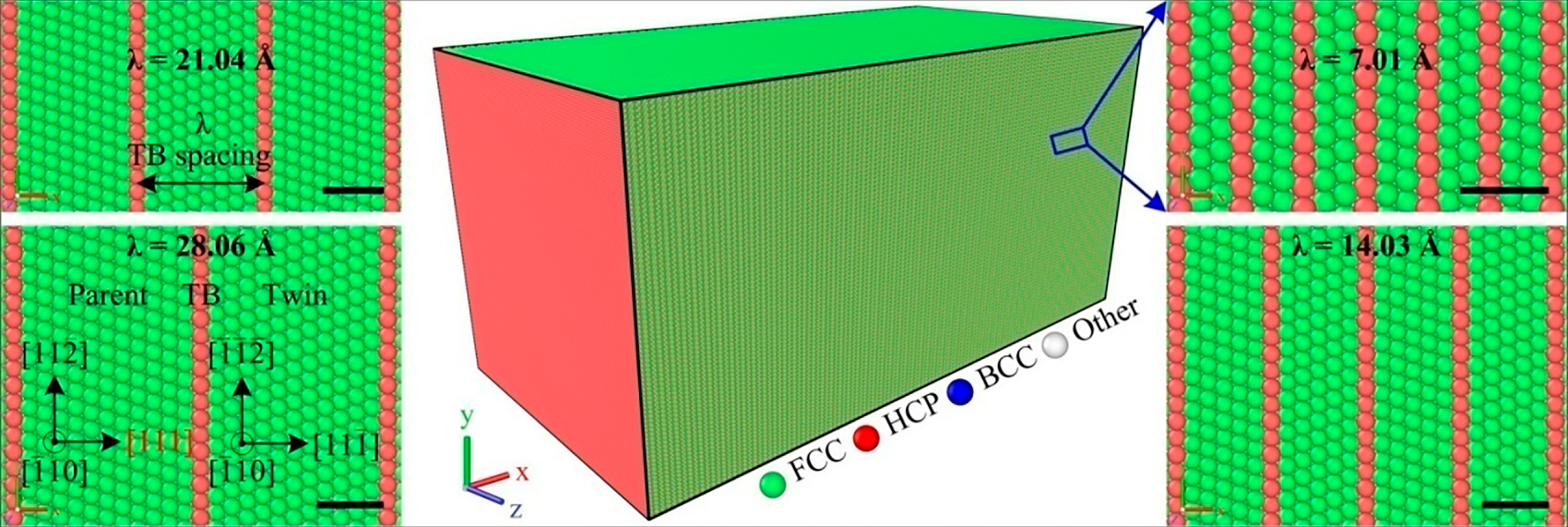
Figure 1: Geometry of a simulation model. Shown are perspective and regional top views of four representative models with different TB spacings. Scale bars are 10 nm.
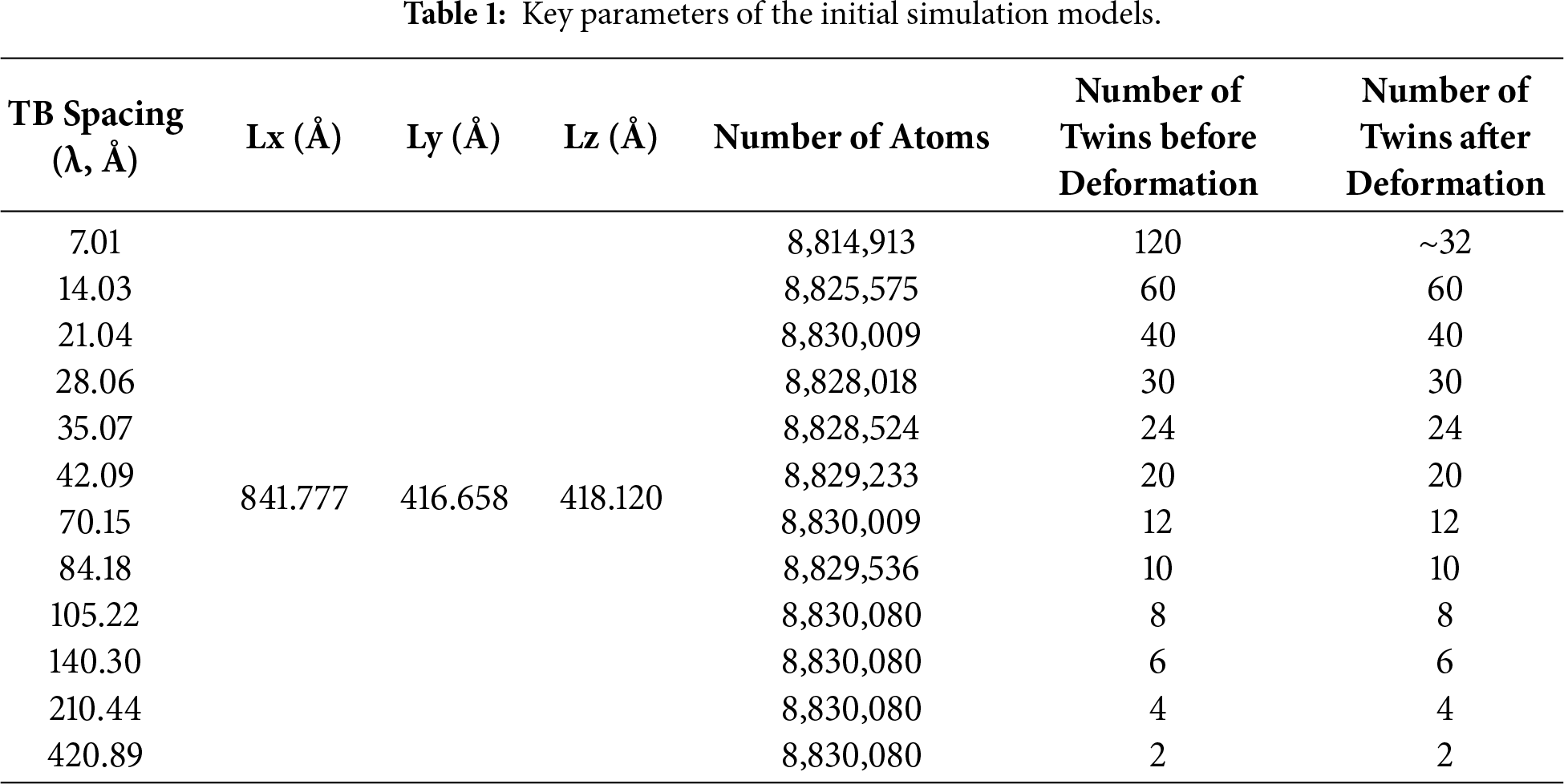
Periodic boundary conditions were maintained in all directions throughout the simulation. The timestep was set to 1 fs, and the initial simulation cells were created using the built-in commands of LAMMPS. The initial models were first energy-minimized with the same method in Refs. [37,38] and then equilibrated for 100 ps at 300 K under zero pressure in all directions. After equilibration, uniaxial tensile deformation was imposed along the z-direction ([1–10]) at a constant strain rate of 1 × 10⁸ s−1, continuing until a total strain of 0.2 was achieved. Throughout the deformation process, the temperature was maintained at 300 K, and the pressure along the x- and y-directions was held at 0 bar. A simulation temperature of 300 K was chosen to replicate standard room-temperature conditions, which correspond to the typical service environment for most engineering materials. This choice not only facilitates direct comparison with numerous room-temperature experimental studies but also ensures that the mechanical response is primarily governed by the applied stress, minimizing complexities arising from significant thermal fluctuations. Due to the intrinsic nanosecond timescale of MD simulations, high strain rates are necessary to induce observable plastic deformation within the feasible computational timeframe. For this study, an ultra-high strain rate of 1 × 10⁸ s−1 was selected corresponding to a dynamic loading regime (e.g., high-speed impact) in which dislocation nucleation and inertial effects govern the material’s response. This strain rate is commonly used in MD simulations of nanocrystalline metals [1,4,7,9,12–15,17,19–23,25–27,39]. Moreover, while challenging, experimental studies at comparable strain rates have been achieved [40], providing a valuable, albeit indirect, reference. Importantly, research suggests that deformation mechanisms revealed at such high strain rates can offer qualitative insights into material behavior across a wider range of strain rates [17].
The simulation results were visualized and analyzed using OVITO [41]. The common neighbor analysis (CNA) method [42] was employed to identify the regional crystal structure of atoms, and the dislocation extraction algorithm (DXA) [43] was used to identify and quantify dislocations within the models.
The comparison of internal microstructures before and after deformation reveals that detwinning occurs only in the model with λ = 7.01 Å, as shown in Fig. 2a. In this model, the number of twins decreases from 60 to approximately 32, which significantly increases the average TB spacing. Furthermore, up to 75.57% of the initial TB atoms are eliminated, forming substantially larger twin lamellae that favor dislocation activity. In contrast, the number of twins in all other models remains unchanged after deformation, and only limited TB migration is observed in them (Figs. 2b and S2, and Table 1).
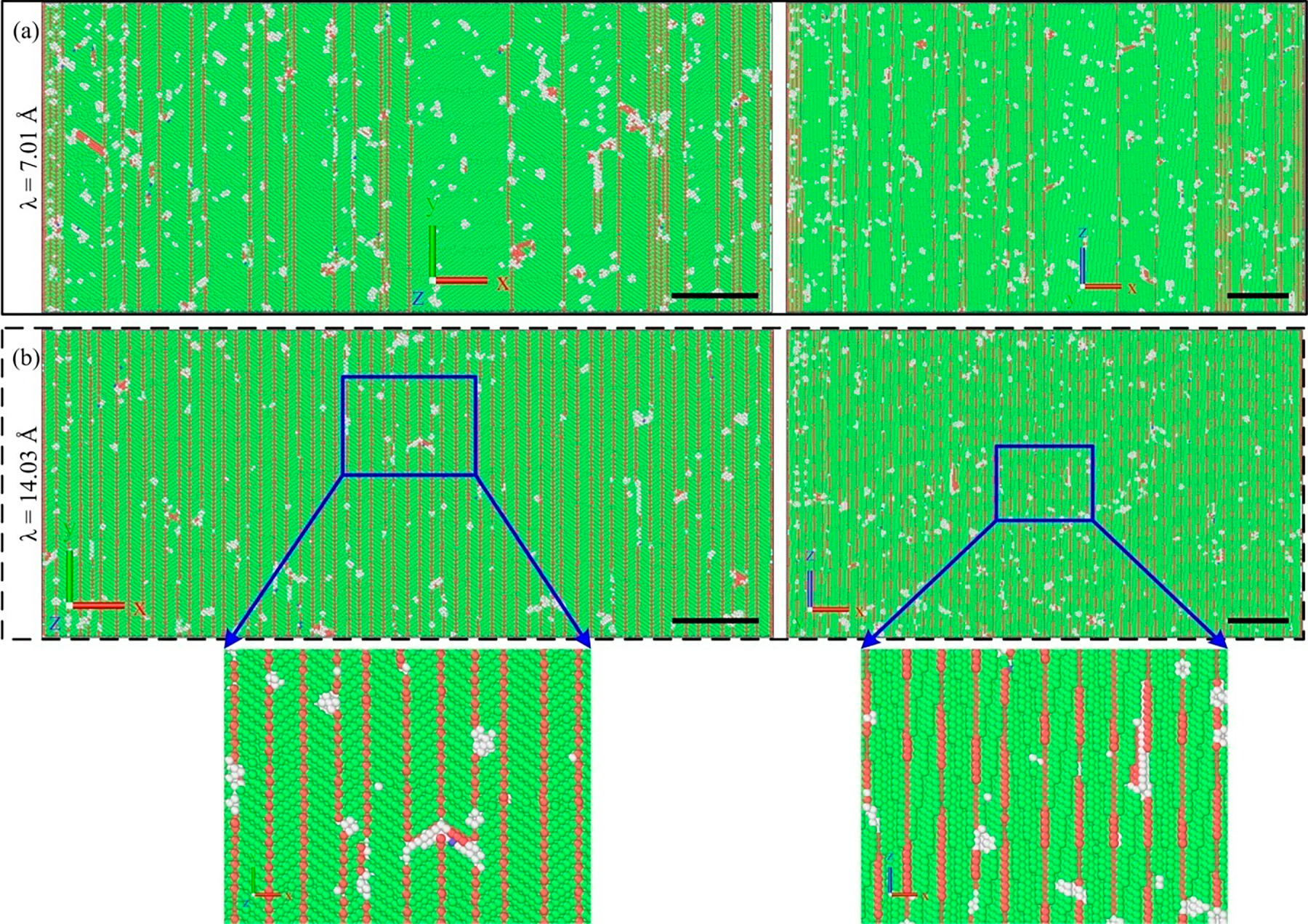
Figure 2: Deformation-induced microstructural evolution. CNA of atomic structures in models with (a) λ = 7.01 Å and (b) λ = 14.03 Å. Atom coloring is consistent with Fig. 1. Scale bars are 10 nm.
As shown in Fig. 2, the TBs remain perpendicular to the x-direction after deformation, consistent with their initial orientation. This indicates that the TBs do not undergo rotation or bending during deformation. According to the Schmid’s law, a loading direction parallel to the TBs results in a Schmid factor of zero for slip systems on TBs, thereby producing zero RSS on the TBs. This confirms that the externally applied stress could not have provided the driving force for detwinning dislocations. Furthermore, the TBs in the initial models are evenly distributed, exhibiting no gradient in TB spacing. Therefore, the detwinning observed in Fig. 2a cannot be attributed to the gradient Eshelby force reported by Zhou et al. [21]. Based on this evidence, we conclude that the detwinning is caused by local stress.
During deformation, initial Shockley partial dislocation loops nucleate in twin lamellae, as shown in Fig. 3a. During their slip and interaction with the TBs, these dislocations transform into detwinning dislocations, as highlighted by the blue arrows in Fig. 3b. The angle between the Burgers vector and the dislocation line of partial dislocations determines their interaction modes with a TB. According to Zhu et al. [44], 90° dislocations (Dα) can cross-slip directly into TBs, as shown by the reaction given in Eq. (1), in which Aα represents a 90° dislocation on a different slip system. This process occurs spontaneously without any external force. In contrast, 30° dislocations (Bα) need to overcome an energy barrier to complete the cross-slip process, as shown by the reaction in Eq. (2). Here, Bδ represents a 30° dislocation on a different slip system, and δα denotes a Stair-rod dislocation. Both Eqs. (1) and (2) are common pathways for the formation of detwinning dislocations in nanotwinned face-centered cubic (fcc) metals.
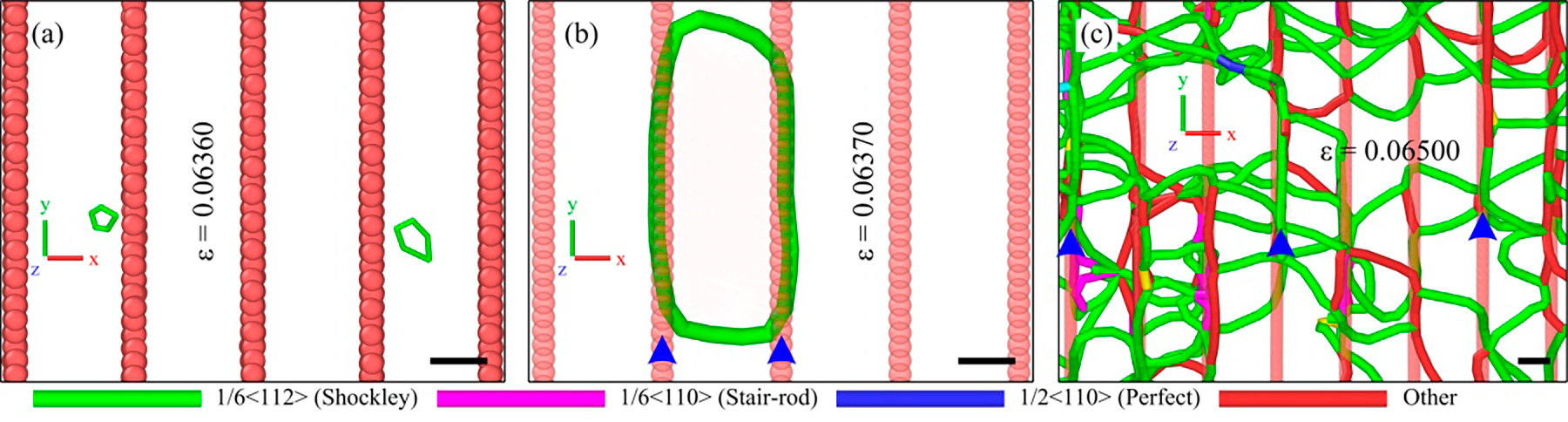
Figure 3: Dislocation evolution in the model with λ = 21.04 Å, identified by DXA. (a) Nucleation of a dislocation loop; (b) Formation of detwinning dislocations; (c) Development of a complex dislocation network. For clarity, only atoms belonging to TBs are shown. Scale bars are 1 nm.
The formation of these detwinning dislocations is a prerequisite for detwinning. With further strain, more dislocations nucleate within the twins, transmit across the TBs, and assemble into complex dislocation networks (Fig. 3c). These networks consist of detwinning dislocations on TBs, Shockley partials within the twin lamellae, and Stair-rod dislocations. Stair-rod dislocations can form on a TB by the dislocation reaction described in Eq. (2) or within the twin lamellae through the interaction of two Shockley dislocations, as shown in Eq. (3). Here, δB and Bα are the incoming 30° dislocations and δα is the resulting Stair-rod dislocation.
The development of these networks results in a high density of dislocations surrounding the detwinning dislocations. Each dislocation creates a local stress field, and the detwinning dislocations (blue arrows in Fig. 3c) experience forces due to their interaction with the stress fields of adjacent dislocations. This interaction provides the necessary driving force for detwinning.
The model with λ = 7.01 Å exhibits varying detwinning rates at different strains, as indicated by the slope of the solid blue line in Fig. 4. After yield, dislocations transmit across TBs, gradually spreading deformation throughout the entire grain, leading to a steady increase in the detwinning fraction. The detwinning fraction increases steadily with strain after yield. Within the strain range of approximately 0.09 to 0.12, both dislocation density and the detwinning fraction increase rapidly, as indicated by the solid lines in Fig. 4. Beyond a strain of 0.12, the dislocation density nearly saturates, and this correspondingly leads to a much slower rate of increase in the detwinning fraction. The near-synchronous evolution of the detwinning fraction with the dislocation density, shown in Fig. 4, strongly suggests that the nucleation of detwinning dislocations and their subsequent interactions with surrounding dislocations are two key factors governing the detwinning process.
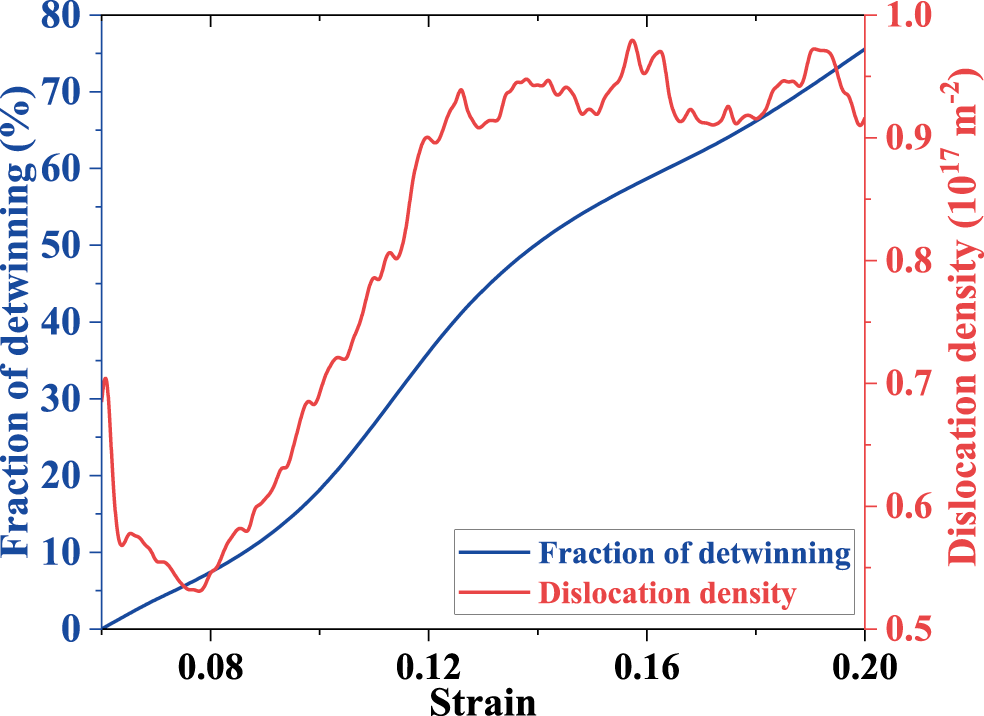
Figure 4: Variation of the fraction of detwinning and dislocation density with strain in the model with λ = 7.01 Å.
For models with λ > 7.01 Å, the significantly lower TB density compared to that of the λ = 7.01 Å model greatly reduces the necessity of detwinning. Furthermore, according to the Schmid’s law, slip systems inclined to the TBs are preferentially activated when the TBs are parallel to the loading direction. Consequently, the deformation in these models is dominated by the activity of these inclined dislocations. Although detwinning dislocations also form when dislocations transmit across the TBs, their slip is hindered by regions where TB coherency is lost, as indicated by the blue arrows in Fig. 5. These sites of coherency loss originate from the strong and frequent interactions between inclined dislocations within the twin lamellae and the TBs [45].
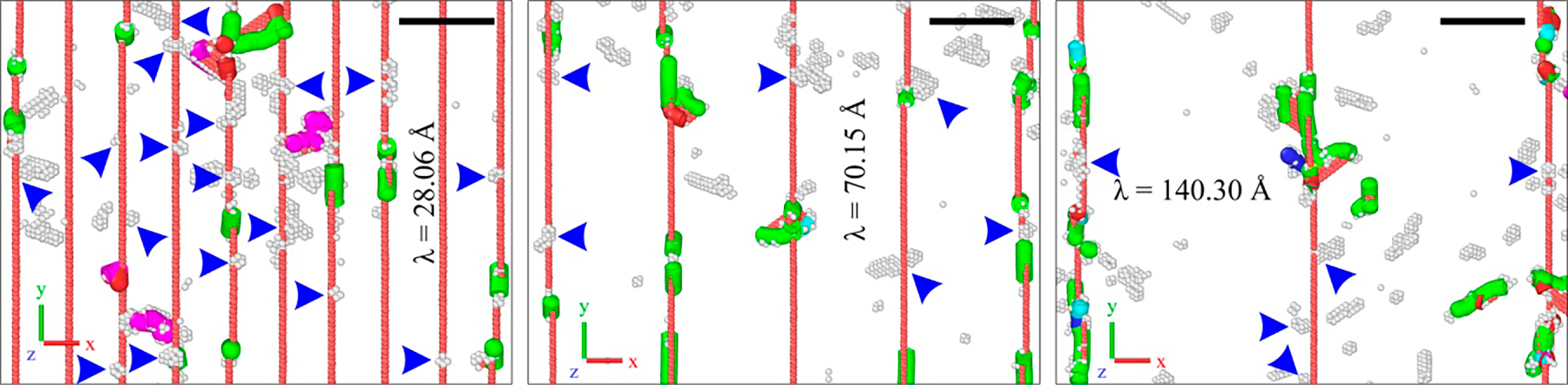
Figure 5: Detwinning dislocation motion hindered by sites of TB coherency loss. Dislocations were identified using the DXA method. For clarity, fcc atoms are deleted. Atom coloring is consistent with Fig. 1. Dislocation coloring is consistent with Fig. 3. Scale bars are 5 nm.
Since the number of twins remains unchanged in the models with λ > 7.01 Å, the reduction in TB atoms is attributed solely to the loss of TB coherency. Fig. 6 presents the percentage of TB atom reduction caused by coherency loss in each model. This trend of an increasing proportion with larger TB spacings indicates that the interaction between inclined dislocations and TBs intensifies at larger TB spacings. In the model with λ = 420.89 Å, over 70% of TB atoms lose coherency after deformation and act as obstacles to the slip of detwinning dislocations. As the loss of TB coherency intensifies, the motion of detwinning dislocations becomes increasingly difficult and may even cease entirely. This reduction in dislocation mobility diminishes the likelihood of detwinning, thereby promoting strengthening. Furthermore, incoherent TBs possess high interfacial energy, leading to instability and a tendency for rupture and decomposition.
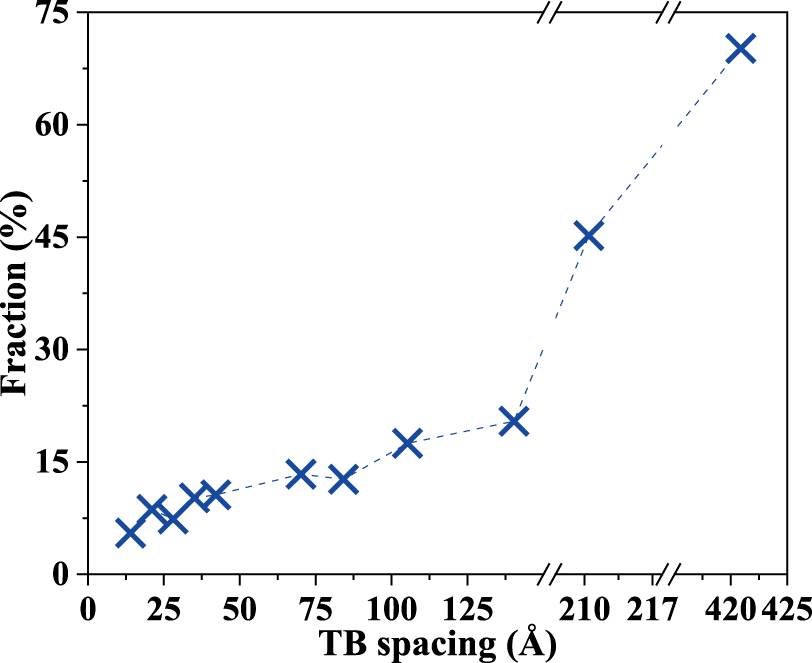
Figure 6: Fraction of TB atoms lost due to coherency loss in models with λ > 7.01 Å.
4.1 Interactions between Detwinning Dislocations and Their Neighboring Dislocations
Detwinning plays a critical role in determining the strength of nanotwinned metals at extremely small TB spacings. A thorough understanding of the detwinning process is, therefore, essential for designing high-strength nanotwinned metallic materials. The detwinning process is governed by two key factors: the presence of detwinning dislocations and the availability of a driving force. Detwinning dislocations can form through the interaction of lattice dislocations with TBs, nucleate from TB-GB junctions, or even nucleate spontaneously on the TBs themselves. Potential driving forces include the RSS on TBs, stress gradients, gradients in TB spacing, and forces arising from dislocation interactions. The relative orientation between the TB and the external load can be categorized into three basic types: perpendicular, inclined, and parallel (Fig. 7). For the parallel and perpendicular orientations, Schmid’s law dictates that the RSS on the twin plane (Fext_TB) is zero. Consequently, the driving force (Ftotal) acting on detwinning dislocations is entirely due to the interaction force between dislocations resolved on the TBs (Fint_TB). In the inclined orientations, the external applied stress (σ) generates a RSS on the twin plane given by Fext_TB = σm, where m is the Schmid factor. In this case, the total driving force for detwinning is the sum of the dislocation interaction force and the external stress contribution: Ftotal = Fint_TB + σm. In the present study, the TBs are homogeneously distributed, thereby eliminating gradient in TB spacing as possible drivers. Furthermore, with the loading direction parallel to the TBs, the RSS on the TBs is zero. Under this specific condition, this study demonstrates that the forces generated by interactions between dislocations provide the primary driving force for the observed detwinning.
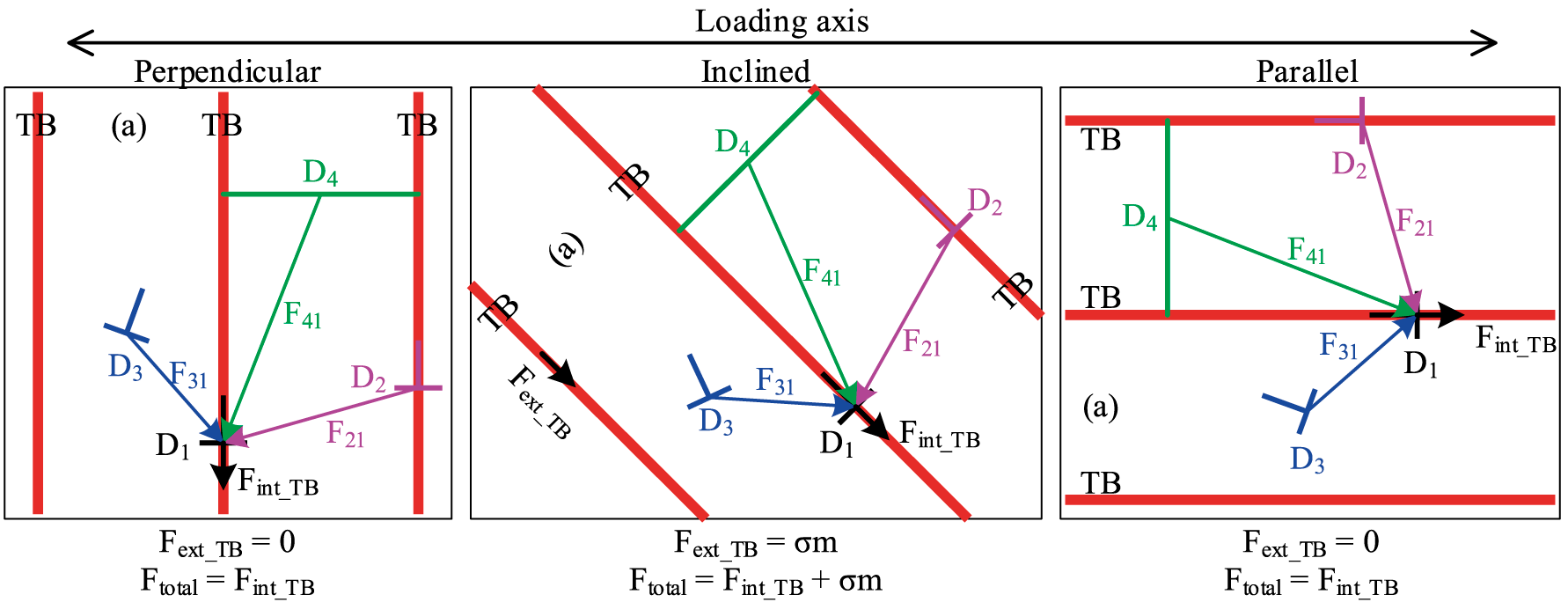
Figure 7: Schematic illustration of the contribution of external load and dislocation interaction to the driving force on a detwinning dislocation.
The stress fields generated by dislocations induce forces on other dislocations [46]. The interaction force is determined by the types of dislocations, their Burgers vectors, and other factors, such as the spacing between them. This force can be calculated from the stress fields of individual dislocations. As shown in Fig. 3c, the detwinning dislocation is surrounded by dislocations of different types and orientations. The environment of the detwinning dislocation is simplified in Fig. 8a to facilitate calculation of the interaction forces with surrounding dislocations. This study focuses on the driving force for detwinning dislocation motion provided by dislocation interactions. Consequently, the discussion below focuses solely on the RSS on the twin plane generated by this interaction force.
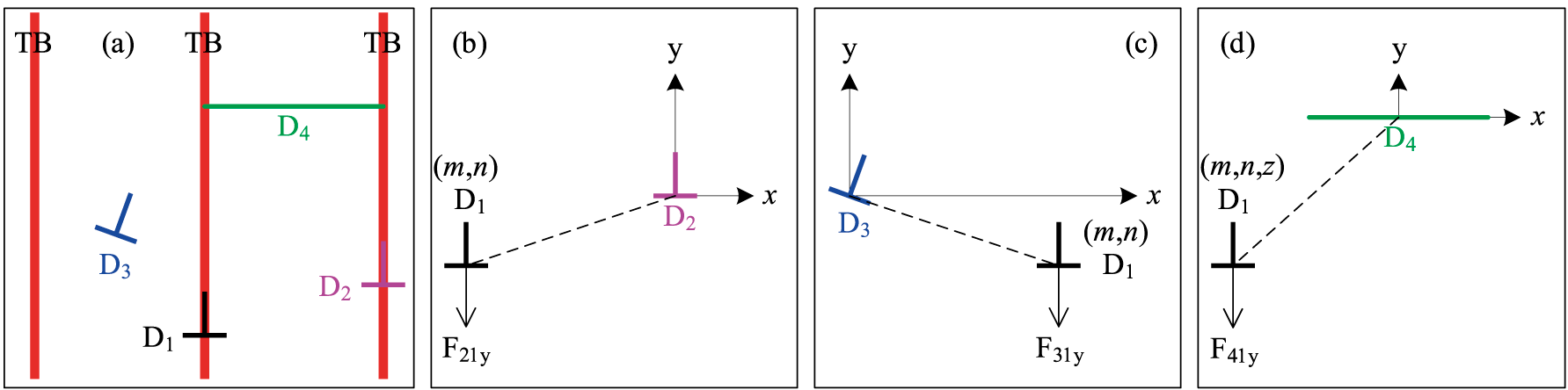
Figure 8: Forces acting on a detwinning dislocation generated by dislocation interactions. (a) Schematic of a detwinning dislocation within a dislocation network; (b) Interaction with a parallel screw dislocation; (c) Interaction with a parallel edge dislocation; (d) Interactions with a perpendicular dislocation: a screw dislocation or an edge dislocation.
(1) Parallel screw dislocations
As shown in Fig. 8b, two parallel screw dislocations, D1 and D2, have Burgers vectors b1 and b2, respectively. Their dislocation lines are perpendicular to the plane of the page. The detwinning dislocation D1 is located at coordinates (m, n). With dislocation D2 located at the origin, the stress components of its field along the y-direction are described by Eq. (4) according to elasticity theory [46].
where σzy represents the shear tress in the y-direction on a plane whose normal is oriented along the z-direction; G is the shear modulus (GPa); and x and y are the coordinates of an arbitrary point in the coordinate system.
The RSS on D1 along the y-direction, which is derived from Eq. (4), is given by Eq. (5).
(2) Parallel edge dislocations
Fig. 8c shows two parallel edge dislocations, D1 and D3, possessing Burgers vectors b1 and b3, respectively, with dislocation lines oriented perpendicular to the plane of the page. The detwinning dislocation D1 is located at coordinates (m, n), while D3 is fixed at the origin. The stress component along the y-direction in the field of dislocation D3 is expressed by Eq. (6).
where σxy denotes the shear tress in the y-direction on a plane whose normal is oriented along the x-direction; G is the shear modulus (GPa); ν represents the poisson's ratio; and x and y correspond to the coordinates of an arbitrary point in the coordinate system.
The expression for the RSS on D1 along the y-direction is given by Eq. (7), which is derived from Eq. (6).
(3) Perpendicular screw dislocations
As shown in Fig. 8d, two screw dislocations, D1 and D4, whose dislocation lines are oriented perpendicular to each other, have Burgers vectors b1 and b4, respectively. The detwinning dislocation D1 lies at coordinates (m, n) with its dislocation line normal to the page, while D4 is located at the origin with its dislocation line parallel to the x-axis. The RSS acting on D1 along the y-direction is given by Eq. (8), which is derived from Eq. (4).
(4) Stress from a screw dislocation on a perpendicular edge dislocation
Fig. 8d shows that the dislocation lines of the edge dislocation D1 and the screw dislocation D4 are oriented perpendicular to each other, possessing Burgers vectors b1 and b4, respectively. The detwinning dislocation D1 is located at coordinates (m, n) with its line normal to the page, while D4 is fixed at the origin with its line parallel to the x-axis. The RSS exerted on D1 by this configuration is given by Eq. (9), which is derived from Eq. (4).
This force, parallel to the z-axis, also drives detwinning dislocation motion.
(5) Stress from an edge dislocation on a perpendicular screw dislocation
As shown in Fig. 8d, the screw dislocation D1 and the edge dislocation D4 are oriented perpendicular to each other, with Burgers vectors b1 and b4, respectively. D1, the detwinning dislocation, is located at coordinates (m, n, z) with its dislocation line normal to the page. D4 is fixed at the origin with its dislocation line parallel to the x-axis. The RSS exerted on D1 is given by Eq. (10), which is derived from Eq. (6).
This force is parallel to the x-axis and therefore has no effect on the motion of the detwinning dislocation along the TBs. The core objective of this study is to elucidate the role of dislocation interactions in driving detwinning dislocations. Analytical expressions for this driving force were derived using the isotropic elasticity theory, considering the absence of RSS on the twin plane under external loading. These expressions facilitate a deeper understanding of dislocation interactions. While relying on the assumption of isotropy, the theory, when employed with suitably averaged elastic constants, yields a robust qualitative approximation for anisotropic situations, thereby providing a practical approach to ascertain the existence and orientation of interaction forces. This study adopts a qualitative approach, aiming to determine the existence and direction of dislocation interaction forces rather than to calculate their magnitudes quantitatively. This approach, provides a clear and reasonable theoretical framework that is key to interpreting our simulation results. The shear stresses resolved on the twin plane from Eqs. (5) and (7)–(10) serve as the driving forces for the motion of detwinning dislocations. They not only govern the mobility of these dislocations, but also drive their interactions with other dislocations and defects.
The preceding analysis demonstrates that the interaction forces between dislocations are governed by their types and relative orientations. Furthermore, the sign of the Burgers vector is also critical, as dislocations of the same sign typically repel each other, whereas those with opposite signs attract. Therefore, to accurately assess the effect of surrounding dislocations on a detwinning dislocation, one must comprehensively consider their types, Burgers vectors, and mutual orientations. In practice, this requires decomposing any mixed dislocations into their screw and edge components so that the respective interaction forces can be determined. A deep understanding of the driving forces for dislocation-mediated detwinning is essential. It not only enables the accurate development of constitutive models for predicting mechanical properties but also provides theoretical guidance for optimizing material properties. This optimization is achieved by suppressing or utilizing detwinning through microstructural design, such as controlling TB spacing and orientation.
4.2 Planarity of Twin Boundaries
The planarity of TBs is essential for achieving both high strength and high plasticity in nanotwinned metals. Loss of TB planarity promotes the shift from plastic deformation to material damage, leading to a marked deterioration in mechanical properties. Ideally, coherent TBs in nanotwinned metals are nearly perfect planar interfaces. These planar and coherent boundaries effectively impede dislocation propagation, resulting in the high yield strength and work hardening capacity of nanotwinned metals. During plastic deformation, dislocations interact with TBs to form sessile stair-rod dislocations on them, as described by Eq. (2). These sessile dislocations pin the TBs, making it difficult for them to maintain their planarity during deformation. Due to the varying local stress fields acting on detwinning dislocations, their motion causes the TBs to migrate at non-uniform rates. This means some TB segments advance faster than others, making it difficult for the boundary to maintain its planarity. Once a TB becomes curved during deformation, it can no longer effectively impede dislocation motion, leading to material softening [47]. Concurrently, the material’s work hardening capacity diminishes, resulting in a loss of plasticity. Therefore, understanding and controlling the evolution of TB planarity during plastic deformation is key to developing high-strength nanotwinned metals. In this study, the TBs maintained their planarity throughout deformation, exhibiting no bending, fragmentation, or rotation, and remained parallel to the loading direction. Our results demonstrate that loading along the [−110] direction is an effective strategy for strengthening nanotwinned metals. By contrast, our previous study on the same models, when loaded perpendicular to the TBs (i.e., normal to the loading direction in this study), confirmed that detwinning leads to softening [25].
In MD simulations, when the simulation box is too small under periodic boundary conditions, periodic images can artificially interfere long-range interactions like Coulomb forces, leading to inaccurate results. Generally speaking, to ensure simulation accuracy when modeling dislocation behavior under periodic boundary conditions, the model dimension along the slip direction must be several tens of nanometers. This size is necessary to accommodate sufficiently long dislocation lines and to prevent their nucleation and bowing-out processes from being artificially constrained by periodic boundaries. Empirically, such models typically require over one million atoms [4,12–15,20,21,26]. In this study, our models contain approximately 8.82 million atoms, which far exceeds this empirical threshold. Therefore, any potential influence of finite model size on our results is expected to be minimal. Given the substantially larger model size used here, potential finite-size effects are unlikely to affect our conclusions. To verify that our results represent bulk behavior and are free from artificial constraints, using the identical interatomic potential and all other simulation parameters, we performed the same deformation simulation on the λ = 7.01 Å model with two different model sizes: 8.82 and 4.50 million atoms. The model with 4.50 million atoms has dimensions of Lx = 420.888 Å, Ly = 421.618 Å, and Lz = 420.976 Å. Fig. 9 shows the simulated stress-strain curves. The curves exhibit identical elastic and yield stages, with the same maximum stress and an average flow stress difference of 1.37%. Although model size introduces a discernible variation in flow stress, these differences are minimal and well within the acceptable range of statistical error. Moreover, key microstructural events—from the initial nucleation of dislocations to their subsequent evolution—were unaffected by the model size. The critical stress for detwinning, calculated using the small and large models, was 1.04 and 1.03 GPa, respectively. Given the small difference, these values are in excellent agreement, confirming the minimal influence of model size. Given the observed agreement between differently sized models, the selected model size is sufficiently large for the detwinning behavior investigated in this study. This effectively eliminates concerns regarding artifacts from image forces or model size, establishing the robustness and reliability of our simulation results.
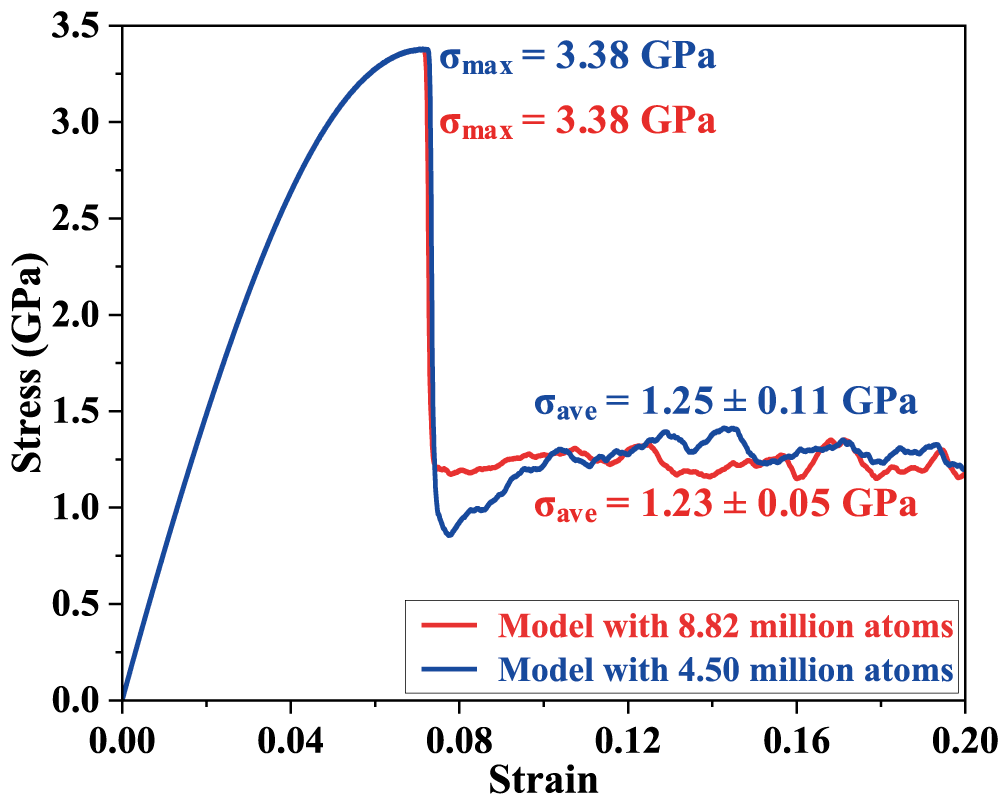
Figure 9: Stress-strain curves for models of varying sizes under identical deformation conditions. σmax is the maximum stress, and σave stands for the average flow stress calculated over the plastic flow stage.
4.4 Comparison with Previous Studies
Surface and interface energies are critical in the plastic deformation of nanocrystalline metals. The abnormally high GB content in these materials results in a high overall energy of the system, making it unstable and prone to energy reduction through grain growth. In contrast, TBs possess lower energy; their formation energy (76.3 mJ/m2) is, in fact, less than half of the SFE (156.8 mJ/m2). Nevertheless, at extremely high densities, TBs significantly elevate the overall system energy. Consequently, the system tends to release stored elastic energy through mechanisms like detwinning to regain stability. This thermodynamic instability provides a plausible explanation for the detwinning observed at λ = 7.01 Å in this study. Fig. 2 illustrates this instability at the atomic scale. Specifically, in this study, the external load was applied parallel to the TBs. This loading configuration ensures the absence of RSS on the twin plane prior to initial dislocation nucleation. Moreover, there is no gradient in TB spacing [21], nor are there any regional transitions from a twinned structure to a single-crystal embryo [22]. Consequently, the detwinning observed in Fig. 2 is likely driven by dislocation interaction forces, a result that exceeds our initial expectations. A similar loading configuration (loading parallel to TBs) was used by Zhou et al. [21] in their study of columnar-grained nanotwinned Cu with a TB spacing gradient. They attributed the observed detwinning to the Eshelby force arising from elastic energy release in the gradient system. In contrast, Zhou et al. [26] investigated columnar-grained nanotwinned Cu with uniformly distributed TBs (minimum TB spacing = 0.63 nm) under the same parallel loading condition. In their study, however, detwinning was not reported. Under loading perpendicular to TBs, our previous study [25] revealed that detwinning occurs below a critical TB spacing (λ = 21.04 Å), a process primarily driven by TB rotation resulting from dislocation propagation and dislocation interaction [17]. This mechanism stands in sharp contrast to the one identified in the present study under parallel loading, where detwinning is caused solely by dislocation interactions. In equiaxed nanotwinned polycrystalline metals, the orientation between TBs and the loading direction is random rather than fixed. Detwinning below a critical TB spacing has been observed in various nanotwinned materials, including Cu [15], Al [13], and stainless steel [10]. This prevalence can be attributed to the abundant TB-GB junctions, which offer ample nucleation sites for detwinning dislocations. Furthermore, external loads can resolve shear stress on the twin planes, providing the necessary driving force. The combination of these factors ultimately leads to anisotropic detwinning behavior within individual grains [17].
This study employed MD simulations to model the uniaxial tensile deformation of nanotwinned single-crystal Al at room temperature. The simulation box was designed with TBs parallel to the loading direction and zero pressure maintained in the non-loading directions, such that zero RSS acts on the TBs. Results show that detwinning occurs only in the model with a TB spacing of 7.01 Å. Models with other TB spacings exhibit only limited TB migration after deformation. In all cases, the TBs remain parallel to the loading direction throughout deformation, indicating that no rotation or bending has occurred during straining. The detwinning is attributed to the local stress generated by dislocation interactions. In the model with a TB spacing of 7.01 Å, the detwinning fraction increases steadily after yield. As the strain reaches the range of approximately 0.1 to 0.12, the dislocation density rises sharply. This surge is accompanied by a rapid increase in the detwinning fraction. Beyond a strain of 0.12, the dislocation density stabilizes, which corresponds to a significant deceleration in the rate of detwinning. The close correlation between the evolution of dislocation density and the detwinning fraction indicates that their evolution is nearly synchronous. In models where detwinning does not occur, dislocations within the twin lamellae that are inclined to TBs interact with them intensely and frequently, resulting in a loss of TB coherency. As the TB spacing increases, these interactions strengthen, leading to a greater loss of TB coherency. To comprehensively assess the forces acting on a detwinning dislocation, one must consider its type, Burgers vector, orientation, and all surrounding dislocations. This typically requires decomposing any mixed dislocations into their screw and edge components. The findings of this study elucidate the anisotropic plastic deformation mechanisms in nanotwinned metals and reveal the critical TB spacing range for detwinning under specific loading conditions. This article proposes a detwinning mechanism driven solely by dislocation interactions. It shifts the focus from merely observing “dislocation blockage” to explaining how dislocations actively modify microstructures. The findings constitute a significant contribution to the fundamental understanding of structural mechanics of nanotwinned metals. This work provides a theoretical basis for designing high-strength nanotwinned metals.
Acknowledgement: Not applicable.
Funding Statement: This study was founded by the National Natural Science Foundation of China under grant numbers 52375325, 52105410 and Anhui Provincial Natural Science Foundation under grant number 2308085ME164.
Author Contributions: The authors confirm contribution to the paper as follows: Conceptualization, Wenchao Shi; methodology, Wenchao Shi and Hongxi Liu; software, Hongxi Liu; validation, Peng Jing; formal analysis, Bin Shao; investigation, Bin Shao and Qichao Fan; resources, Peng Jing; data curation, Hongxi Liu; writing—original draft preparation, Wenchao Shi; writing—review and editing, Bin Shao, Qichao Fan, Chuan Yang, Tao Wei and Peng Jing; visualization, Bin Shao; supervision, Wenchao Shi; project administration, Wenchao Shi; funding acquisition, Wenchao Shi, Bin Shao, Tao Wei and Chuan Yang. All authors reviewed and approved the final version of the manuscript.
Availability of Data and Materials: The data that support the findings of this study are available from the Corresponding Authors, Shao and Jing, upon reasonable request.
Ethics Approval: Not applicable.
Conflicts of Interest: The authors declare no conflicts of interest.
Supplementary Materials: The supplementary material is available online at https://www.techscience.com/doi/10.32604/cmc.2026.075293/s1.
References
1. Wang L, Yan S, Meng M, Xue K, Li P. Twin boundary-assisted improvement of radiation resistance of iron: defect evolution, mechanical properties, and deformation mechanism. J Nucl Mater. 2022;567:153818. doi:10.1016/j.jnucmat.2022.153818. [Google Scholar] [CrossRef]
2. Lu L, Chen X, Huang X, Lu K. Revealing the maximum strength in nanotwinned copper. Science. 2009;323(5914):607–10. [Google Scholar] [PubMed]
3. Rafailović LD, Gammer C, Ebner C, Rentenberger C, Jovanović AZ, Pašti IA, et al. High density of genuine growth twins in electrodeposited aluminum. Sci Adv. 2019;5(10):eaax3894. doi:10.1126/sciadv.aax3894. [Google Scholar] [PubMed] [CrossRef]
4. Ke X, Ye J, Pan Z, Geng J, Besser MF, Qu D, et al. Ideal maximum strengths and defect-induced softening in nanocrystalline-nanotwinned metals. Nat Mater. 2019;18(11):1207–14. doi:10.1038/s41563-019-0484-3. [Google Scholar] [PubMed] [CrossRef]
5. Duan F, Lin Y, Pan J, Zhao L, Guo Q, Zhang D, et al. Ultrastrong nanotwinned pure nickel with extremely fine twin thickness. Sci Adv. 2021;7(27):eabg5113. doi:10.1126/sciadv.abg5113. [Google Scholar] [PubMed] [CrossRef]
6. Pydi HP, Prasad ASV, Sri MNS, Prasad C, Peyyala A, Jarso BB, et al. Experimental study and optimization of electrochemical machining of Al-7Si-0.4Mg alloy using NaNO3 and NaOH electrolytes. Adv Mater Sci Eng. 2025;2025(1):3884745. doi:10.1155/amse/3884745. [Google Scholar] [CrossRef]
7. Jing P, Wang Y, Zhou Y, Shi W. Atomistic insight into grain boundary deformation induced strengthening in layer-grained nanocrystalline Al. Langmuir. 2023;39(28):9963–71. doi:10.1021/acs.langmuir.3c01342. [Google Scholar] [PubMed] [CrossRef]
8. Bahena JA, Juarez T, Velasco L, Hodge AM. Grain boundary evolution of highly nanotwinned alloys: effect of initial twinned microstructure. Scr Mater. 2021;190:27–31. doi:10.1016/j.scriptamat.2020.08.024. [Google Scholar] [CrossRef]
9. Duan F, Li Q, Shen Z, Jiang Z, Liu W, Yan Y, et al. Anisotropic mechanical properties and deformation mechanisms of nanotwinned Ni and Ni alloys with extremely fine twin boundary spacings. Acta Mater. 2023;260:119311. doi:10.1016/j.actamat.2023.119311. [Google Scholar] [CrossRef]
10. Chen AY, Zhu LL, Sun LG, Liu JB, Wang HT, Wang XY, et al. Scale law of complex deformation transitions of nanotwins in stainless steel. Nat Commun. 2019;10(1):1403. doi:10.1038/s41467-019-09360-1. [Google Scholar] [PubMed] [CrossRef]
11. Wang L, Du K, Yang C, Teng J, Fu L, Guo Y, et al. In situ atomic-scale observation of grain size and twin thickness effect limit in twin-structural nanocrystalline platinum. Nat Commun. 2020;11(1):1167. doi:10.1038/s41467-020-14876-y. [Google Scholar] [PubMed] [CrossRef]
12. Wang H, Rimoli JJ, Cao P. Dislocation mechanisms in strengthening and softening of nanotwinned materials. J Appl Phys. 2023;133(5):055106. doi:10.1063/5.0138379. [Google Scholar] [CrossRef]
13. Hou Z, Zhou S, Niu Y, Wang F, Zou P, Shi G, et al. Effect of twin spacing on the mechanical behavior and deformation mechanism of nanotwinned Al. Mater Sci Eng A. 2023;862:144465. doi:10.1016/j.msea.2022.144465. [Google Scholar] [CrossRef]
14. Xiao J, Yang H, Liu H, Younus F, Xu B, Zhang X, et al. Strengthening-softening transition in yield strength of nanotwinned Cu. Scr Mater. 2019;162:372–6. doi:10.1016/j.scriptamat.2018.11.049. [Google Scholar] [CrossRef]
15. Li X, Wei Y, Lu L, Lu K, Gao H. Dislocation nucleation governed softening and maximum strength in nano-twinned metals. Nature. 2010;464(7290):877–80. doi:10.1038/nature08929. [Google Scholar] [PubMed] [CrossRef]
16. Yang X, Zhang R, Wu D, Zhu Y, Li J, Zhang J, et al. Molecular dynamics simulation study on orientation effects on the shock-induced spallation of single-crystal aluminum. Mater Today Commun. 2025;44:111931. doi:10.1016/j.mtcomm.2025.111931. [Google Scholar] [CrossRef]
17. Jing P, Shao B, Zong Y, Liu H. Anisotropic detwinning behaviors in nanotwinned aluminum: an atomistic simulation study. Int J Plast. 2026;197:104568. doi:10.1016/j.ijplas.2025.104568. [Google Scholar] [CrossRef]
18. Lu Q, You Z, Huang X, Hansen N, Lu L. Dependence of dislocation structure on orientation and slip systems in highly oriented nanotwinned Cu. Acta Mater. 2017;127:85–97. doi:10.1016/j.actamat.2017.01.016. [Google Scholar] [CrossRef]
19. Ding J, Zhao HN, Wang LS, Huang X, Wang J, Song K, et al. Influence of loading directions on dislocation slip mechanism of nanotwinned Ni with void defect at the twin boundary. Comput Mater Sci. 2018;152:1–11. doi:10.1016/j.commatsci.2018.05.026. [Google Scholar] [CrossRef]
20. Fang Q, Sansoz F. Columnar grain-driven plasticity and cracking in nanotwinned FCC metals. Acta Mater. 2021;212:116925. doi:10.1016/j.actamat.2021.116925. [Google Scholar] [CrossRef]
21. Zhou H, Zhu P, Yang W, Gao H. A gradient Eshelby force on twinning partial dislocations and associated detwinning mechanism in gradient nanotwinned metals. J Mech Phys Solids. 2022;159:104746. doi:10.1016/j.jmps.2021.104746. [Google Scholar] [CrossRef]
22. Cheng G, Yin S, Chang TH, Richter G, Gao H, Zhu Y. Anomalous tensile detwinning in twinned nanowires. Phys Rev Lett. 2017;119(25):256101. doi:10.1103/PhysRevLett.119.256101. [Google Scholar] [PubMed] [CrossRef]
23. Yang Z, Ding X, Yang Y, Cao S. Temperature-induced different deformation mechanisms for compressive behavior of nanotwinned Cu: molecular dynamics simulation. J Nanopart Res. 2022;24(7):127. doi:10.1007/s11051-022-05514-3. [Google Scholar] [CrossRef]
24. Lin P, Basem A, Alizadeh A, Nasser EN, Al-Bahrani M, Chan CK, et al. Effect of temperature on the mechanical properties of aluminum polycrystal using molecular dynamics simulation. Case Stud Therm Eng. 2024;59:104480. doi:10.1016/j.csite.2024.104480. [Google Scholar] [CrossRef]
25. Shi W, Shao B, Fan Q, Yang C, Liu H, Jing P. Optimal twin boundary spacing in nanotwinned monocrystalline Al under loading perpendicular to twin boundaries: an atomistic study. Mater Today Chem. 2025;46:102728. doi:10.1016/j.mtchem.2025.102728. [Google Scholar] [CrossRef]
26. Zhou H, Li X, Qu S, Yang W, Gao H. A jogged dislocation governed strengthening mechanism in nanotwinned metals. Nano Lett. 2014;14(9):5075–80. doi:10.1021/nl501755q. [Google Scholar] [PubMed] [CrossRef]
27. Shen J, Shen X, Zhou J, Yue W, Zhang T. Molecular dynamics simulation of fatigue damage formation in single-crystal/polycrystalline aluminum. Mater Today Commun. 2024;39:109138. doi:10.1016/j.mtcomm.2024.109138. [Google Scholar] [CrossRef]
28. Ma B, Yu X, Huang G. Coupled effects of single-vacancy defect positions on the mechanical properties and electronic structure of aluminum crystals. Comput Mater Contin. 2026;86(1):1–21. doi:10.32604/cmc.2025.071320. [Google Scholar] [CrossRef]
29. Plimpton S. Fast parallel algorithms for short-range molecular dynamics. J Comput Phys. 1995;117(1):1–19. doi:10.1006/jcph.1995.1039. [Google Scholar] [CrossRef]
30. Mishin Y, Farkas D, Mehl MJ, Papaconstantopoulos DA. Interatomic potentials for monoatomic metals from experimental data and ab initio calculations. Phys Rev B. 1999;59(5):3393–407. doi:10.1103/physrevb.59.3393. [Google Scholar] [CrossRef]
31. Hirel P, Godet J, Brochard S, Pizzagalli L, Beauchamp P. Determination of activation parameters for dislocation formation from a surface in FCC metals by atomistic simulations. Phys Rev B. 2008;78(6):064109. doi:10.1103/physrevb.78.064109. [Google Scholar] [CrossRef]
32. Muzyk M, Pakiela Z, Kurzydlowski KJ. Ab initio calculations of the generalized stacking fault energy in aluminium alloys. Scr Mater. 2011;64(9):916–8. doi:10.1016/j.scriptamat.2011.01.034. [Google Scholar] [CrossRef]
33. Hirth JP, Lothe J. Theory of dislocations. 2nd ed. Hoboken, NJ, USA: John Wiley & Sons, Inc.; 1982. [Google Scholar]
34. Burbery NJ, Das R, Ferguson WG. Transitional grain boundary structures and the influence on thermal, mechanical and energy properties from molecular dynamics simulations. Acta Mater. 2016;108:355–66. doi:10.1016/j.actamat.2016.01.054. [Google Scholar] [CrossRef]
35. Daphalapurkar NP, Ramesh KT. Orientation dependence of the nucleation and growth of partial dislocations and possible twinning mechanisms in aluminum. J Mech Phys Solids. 2012;60(2):277–94. doi:10.1016/j.jmps.2011.10.009. [Google Scholar] [CrossRef]
36. Zhang Y, Ding K, Stangebye S, Chen D, Kacher J, Pierron O, et al. Atomistic modeling of surface and grain boundary dislocation nucleation in FCC metals. Acta Mater. 2022;237:118155. doi:10.1016/j.actamat.2022.118155. [Google Scholar] [CrossRef]
37. Wang L, Luo L, Shen L, Liu H, Ding J, Tian Y, et al. Atomic scale insights into super-nano dual-phase amorphous-nanocrystalline iron with synergistic high strength-plasticity. Intermetallics. 2025;185:108902. doi:10.1016/j.intermet.2025.108902. [Google Scholar] [CrossRef]
38. Yin Y, Lu S, Wang L, Song K, Huang X, Ding J, et al. Atomic-scale insights into the strength and plasticity enhancement of Ni-based superalloys with refinement dispersion of precipitates. Chem Phys Lett. 2025;861:141837. doi:10.1016/j.cplett.2024.141837. [Google Scholar] [CrossRef]
39. Jing P, Shao B, Fan Q, Yang C, Shi W, Liu H. Cryogenic incipient plasticity in bicrystalline copper with a spherical void and sigma 5 STGB by molecular dynamics simulation. Mater Chem Phys. 2024;324:129681. doi:10.1016/j.matchemphys.2024.129681. [Google Scholar] [CrossRef]
40. Xue S, Fan Z, Lawal OB, Thevamaran R, Li Q, Liu Y, et al. High-velocity projectile impact induced 9R phase in ultrafine-grained aluminium. Nat Commun. 2017;8:1653. doi:10.1038/s41467-017-01729-4. [Google Scholar] [PubMed] [CrossRef]
41. Stukowski A. Visualization and analysis of atomistic simulation data with OVITO–the open visualization tool. Model Simul Mater Sci Eng. 2010;18(1):015012. doi:10.1088/0965-0393/18/1/015012. [Google Scholar] [CrossRef]
42. Stukowski A. Structure identification methods for atomistic simulations of crystalline materials. Model Simul Mater Sci Eng. 2012;20(4):045021. doi:10.1088/0965-0393/20/4/045021. [Google Scholar] [CrossRef]
43. Stukowski A, Bulatov VV, Arsenlis A. Automated identification and indexing of dislocations in crystal interfaces. Model Simul Mater Sci Eng. 2012;20(8):085007. doi:10.1088/0965-0393/20/8/085007. [Google Scholar] [CrossRef]
44. Zhu YT, Wu XL, Liao XZ, Narayan J, Kecskés LJ, Mathaudhu SN. Dislocation–twin interactions in nanocrystalline FCC metals. Acta Mater. 2011;59(2):812–21. doi:10.1016/j.actamat.2010.10.028. [Google Scholar] [CrossRef]
45. Hou XW, Guo YF, Zhou L, Zu Q, Tang XZ. Plastic deformation mechanisms of nanotwinned Mg with different twin boundary orientations: molecular dynamics simulations. Mol Simul. 2020;46(10):757–65. doi:10.1080/08927022.2020.1770751. [Google Scholar] [CrossRef]
46. Zhang T, Xu S, Liu L, Jiang M. Long-range internal stress from non-uniform geometrically necessary dislocations: a prediction method refined by dislocation dynamics simulations. Int J Plast. 2025;188:104316. doi:10.1016/j.ijplas.2025.104316. [Google Scholar] [CrossRef]
47. Li YJ, Hsu CW, Ting YH, Tsou NT, Lo YC, Wu WW, et al. Deformation induced columnar grain rotation in nanotwinned metals. Mater Sci Eng A. 2020;797:140045. doi:10.1016/j.msea.2020.140045. [Google Scholar] [CrossRef]
Cite This Article
 Copyright © 2026 The Author(s). Published by Tech Science Press.
This work is licensed under a Creative Commons Attribution 4.0 International License , which permits unrestricted use, distribution, and reproduction in any medium, provided the original work is properly cited.
 Downloads
 Citation Tools
