
 Login
Login Register
 Submit a Paper
 Propose a Special lssue
 Open Access
ARTICLE

Optimizing Small Object Detection in Low-Resolution Imagery: A Unified Super-Resolution and Detection Framework Using YOLO-Flex
Software College, Northeastern University, Shenyang, China
* Corresponding Author: Ruiyun Yu. Email:
Computers, Materials & Continua 2026, 89(1), 39 https://doi.org/10.32604/cmc.2026.083186
Received 30 March 2026; Accepted 28 May 2026; Issue published 13 August 2026
 View Full Text
 Download PDF
Abstract
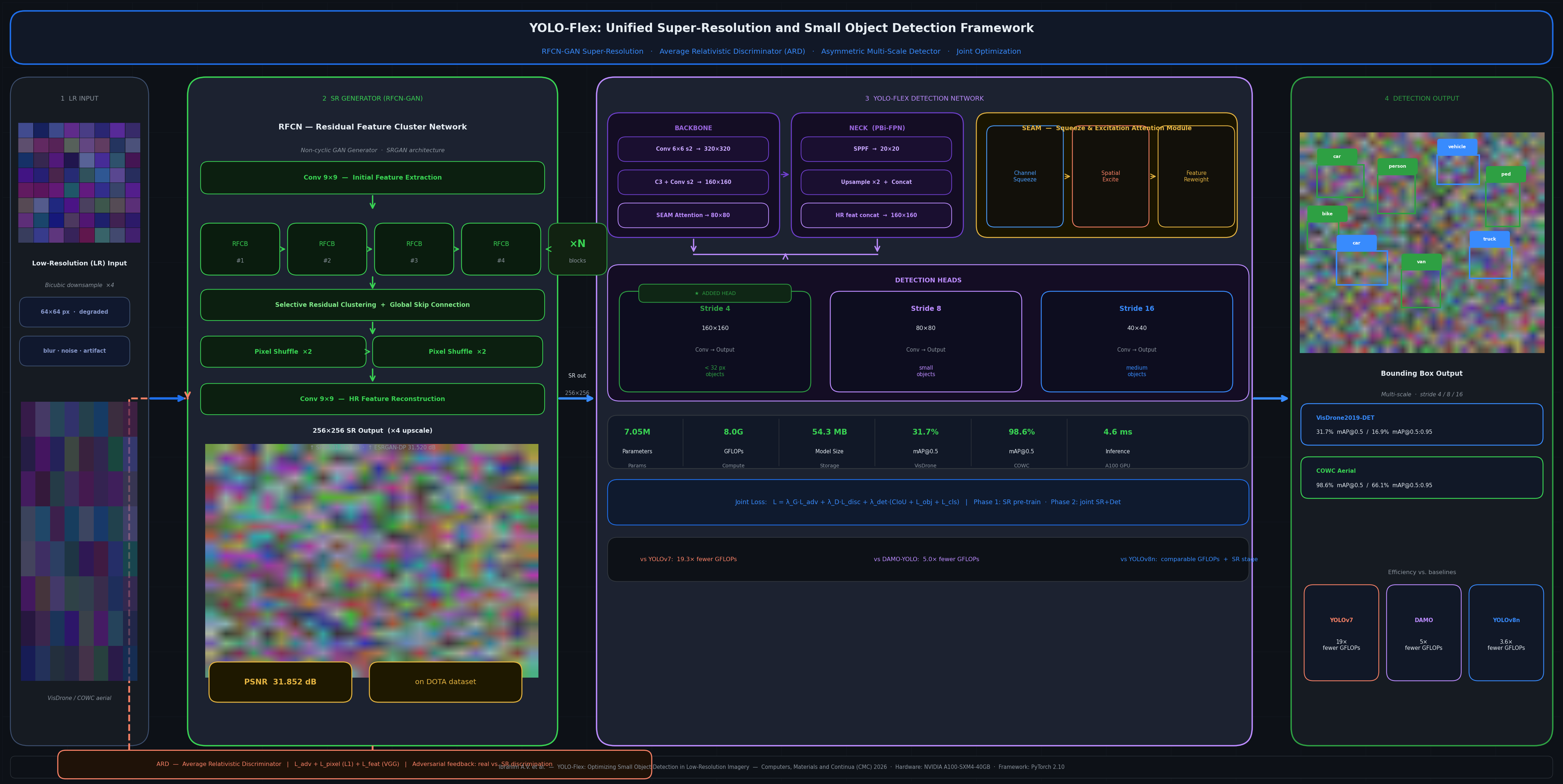
The detection of small objects in low-resolution aerial imagery presents a persistent challenge in computer vision, where hardware constraints, imaging altitude, and scene complexity collectively degrade spatial detail to the point where standard detection frameworks fail. Existing super-resolution methods offer partial remedies but are limited by substantial computational costs and by feature discrepancies between Generative Adversarial Network-enhanced and real high-resolution images that degrade downstream detection accuracy. This paper presents YOLO-Flex, a unified framework that addresses these challenges through the co-design of a super-resolution module and a task-adapted object detection network, jointly optimized through a shared loss function. The YOLO-Flex approach employs a Generative Adversarial Network (GAN)-based super-resolution module in which the Residual Feature Cluster Network (RFCN) serves as the generator, trained adversarially against the Average Relativistic Discriminator to produce high-quality super-resolved images from low-resolution inputs, preserving block-level residual features that standard super-resolution-based methods progressively integrate in deep networks. The detection network is restructured from the YOLOv5 baseline through principled backbone reduction, addition of a stride-4 detection head, task-aware SE attention placement, and a trimmed bidirectional feature pyramid prioritizing high-resolution fusion pathways. The complete YOLO-Flex framework achieves competitive super-resolution quality with Peak Signal-to-Noise Ratio (PSNR) of 31.852 dB on DOTA, surpassing notable super-resolution techniques, while the detector subnetwork contains 7.05 million parameters and requires 8.0 GFLOPs, representing a 6.0 times reduction in computational cost compared to the YOLOv5m baseline. Experimental validation is conducted on three benchmark datasets: VisDrone2019-DET, DOTA, and COWC.Graphic Abstract
Keywords
Image super-resolution; small object detection; residual feature cluster; feature representation; YOLO
Cite This Article
APA Style
Ibrahim, A.V., Li, H., Guo, B., Yu, R. (2026). Optimizing Small Object Detection in Low-Resolution Imagery: A Unified Super-Resolution and Detection Framework Using YOLO-Flex. Computers, Materials & Continua, 89(1), 39. https://doi.org/10.32604/cmc.2026.083186
Vancouver Style
Ibrahim AV, Li H, Guo B, Yu R. Optimizing Small Object Detection in Low-Resolution Imagery: A Unified Super-Resolution and Detection Framework Using YOLO-Flex. Comput Mater Contin. 2026;89(1):39. https://doi.org/10.32604/cmc.2026.083186
IEEE Style
A. V. Ibrahim, H. Li, B. Guo, and R. Yu, “Optimizing Small Object Detection in Low-Resolution Imagery: A Unified Super-Resolution and Detection Framework Using YOLO-Flex,” Comput. Mater. Contin., vol. 89, no. 1, pp. 39, 2026. https://doi.org/10.32604/cmc.2026.083186
 Copyright © 2026 The Author(s). Published by Tech Science Press.
This work is licensed under a Creative Commons Attribution 4.0 International License , which permits unrestricted use, distribution, and reproduction in any medium, provided the original work is properly cited.
 Downloads
 Citation Tools
