
 Login
Login Register
 Submit a Paper
 Propose a Special lssue
 Open Access
REVIEW
Emerging Computing Technologies for Smart Roads: A Systematic Review of Enabling Systems, Challenges, and Future Directions
1 Department of Software Engineering, University of Sargodha, Sargodha, Punjab, Pakistan
2 Faculty of Resilience, Rabdan Academy, Abu Dhabi, United Arab Emirates
3 Department of Information Systems, Faculty of Computing and Information Technology, King Abdulaziz University, Jeddah, Saudi Arabia
4 Department of Information Systems and Technology, College of Computer Science and Engineering, University of Jeddah, Jeddah, Saudi Arabia
5 School of Computing, Skyline University College, Sharjah, United Arab Emirates
* Corresponding Authors: Afzal Badshah. Email: ; Ali Daud. Email:
Computers, Materials & Continua 2026, 89(2), 4 https://doi.org/10.32604/cmc.2026.077836
Received 17 December 2025; Accepted 07 April 2026; Issue published 15 September 2026
 View Full Text
 Download PDF
Abstract
The rapid increase in vehicle numbers and resulting traffic congestion have amplified critical challenges related to safety, environmental impact, and transportation efficiency. Road accidents account for approximately 1.19 million deaths annually, with an additional 20 to 50 million people injured. Moreover, congestion leads to the loss of nearly 50 billion hours and around 3 billion gallons of fuel each year. These pressing issues necessitate innovative and integrated solutions that can enhance the overall performance of the road. This study investigates the integration of Emerging Computing Technologies (ECT) into smart road infrastructures as a potential response to these challenges. It explores key enabling technologies (e.g., advanced communication systems, the Internet of Things (IoT), sensors, Artificial Intelligence (AI), big data, blockchain, and energy harvesting) for their capacity to support intelligent transportation systems. The paper further reviews real-world applications of smart roads, such as smart traffic lights, automated road maintenance, intelligent lighting, and energy-efficient infrastructure, illustrating their contribution to sustainable urban mobility. In parallel, it examines challenges impeding widespread adoption, including technical limitations, financial and regulatory constraints, cybersecurity risks, and societal acceptance. Finally, the study highlights future opportunities by discussing ongoing advancements in ECT and renewable energy integration, outlining their potential to revolutionize road network efficiency, safety, and sustainability.Keywords
The global transportation sector is witnessing substantial growth in vehicle ownership, with over one billion vehicles operating on roads worldwide [1]. This surge has exacerbated traffic congestion and introduced complex challenges spanning road safety, environmental sustainability, and economic performance [2]. Persistent congestion results in significant productivity losses, with drivers collectively spending approximately 50 billion extra hours on the road each year [3]. This congestion also leads to the annual waste of 3 billion gallons of fuel and contributes substantially to carbon emissions. In 2022, passenger cars and vans accounted for nearly 10% of global
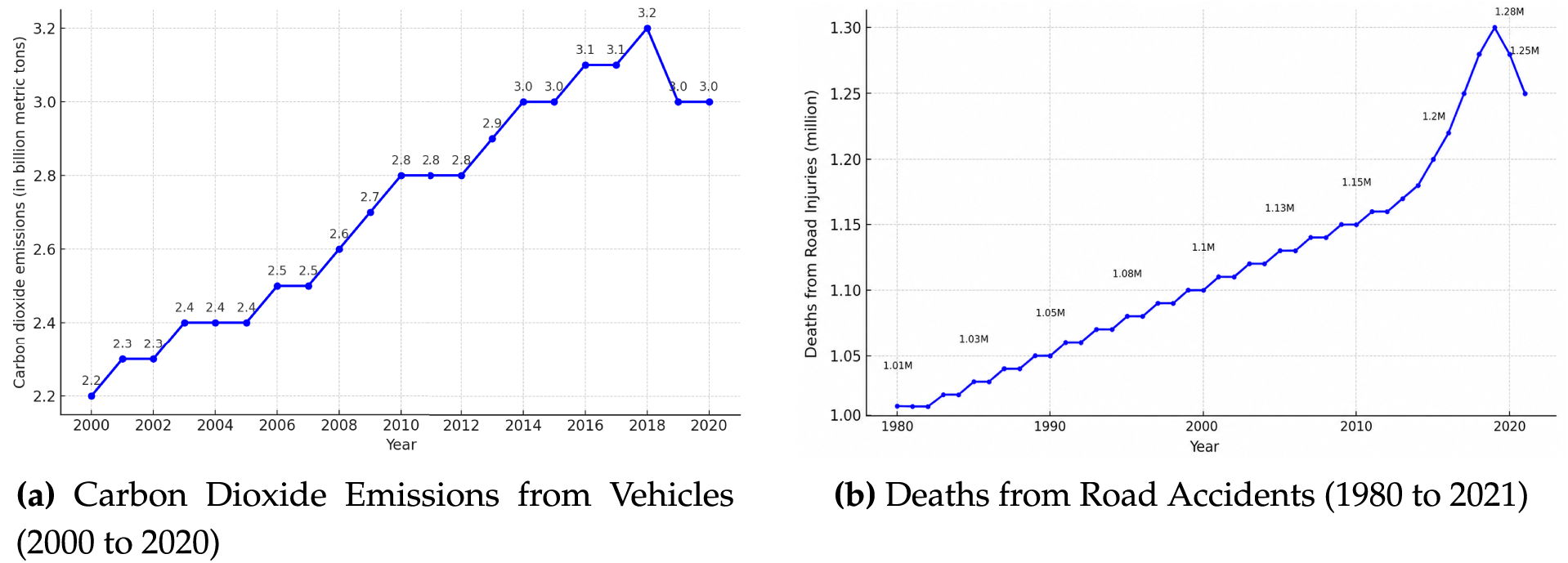
Figure 1: Comparison of carbon emissions and deaths from road injury.
The rise in traffic volumes has intensified safety challenges across modern transportation systems. Road traffic crashes cause approximately 1.19 million deaths each year, while an estimated 20 to 50 million people suffer non-fatal injuries, as illustrated in Fig. 1b [3,5]. Beyond the human cost, the economic consequences are substantial, with accident-related losses reaching nearly 3% of the gross domestic product (GDP) in several countries [3]. These observations emphasize the necessity for advanced road safety frameworks, efficient traffic management mechanisms, and sustainable strategies capable of addressing both safety risks and environmental pressures associated with increasing transportation demand.
Traditional road infrastructure, primarily designed for lower traffic volumes and simple vehicles, now struggles under modern transportation demands. Outdated infrastructure often fails to facilitate efficient vehicle movement, contributing to congestion, productivity losses, and increased fuel consumption [1]. Static traffic management systems, which rely on manual intervention and fixed signaling schemes, are inadequate for handling dynamic traffic patterns, thereby increasing the likelihood of accidents [3]. Moreover, the environmental inefficiency of older road designs exacerbates greenhouse gas emissions [4]. Maintenance of traditional roads is also costly and resource-intensive, often leading to disruptions that further amplify emissions [6].
To overcome these issues, ECT provide cutting-edge solutions by combining the latest communication technologies, IoT, AI, big data analytics, blockchain, and energy harvesting [7]. These technologies provide intelligent traffic control, improve road safety, and minimize environmental effects [6]. The latest communication technologies, such as Vehicle-to-Everything (V2X), Vehicle-to-Infrastructure (V2I), and Vehicle-to-Vehicle (V2V), enable seamless communication between vehicles and infrastructure, which in turn helps to minimize congestion through intelligent traffic signals [8]. IoT sensors are always on to monitor road conditions, and AI analytics help to predict traffic flow and potential dangers, which helps enable proactive maintenance and improve safety. Blockchain technology provides data security and transparency, particularly in autonomous vehicle networks [9], and energy harvesting technologies such as piezoelectric sensors and solar roads help to provide sustainable infrastructure. These technologies help to convert conventional roads into intelligent roads that can efficiently control traffic, improve safety, and provide sustainability in transportation.
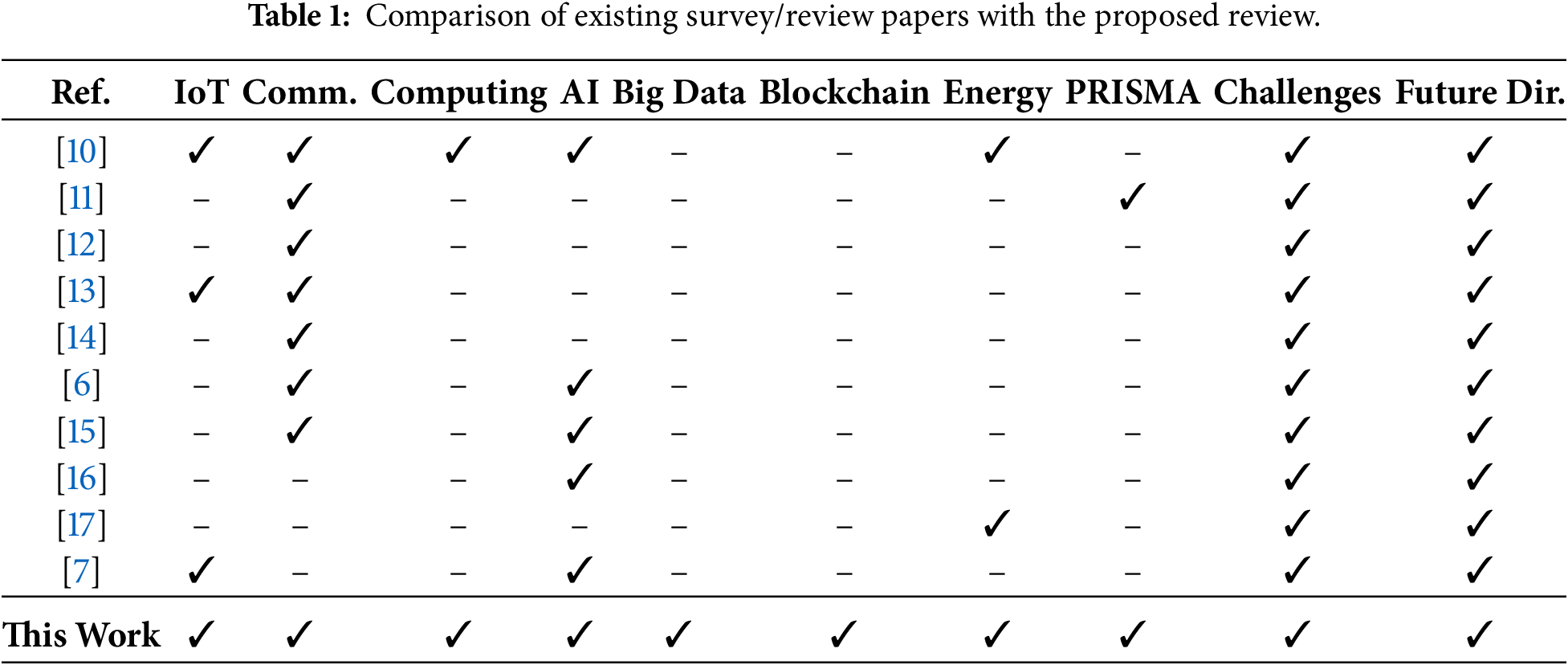
Although several survey articles have reviewed specific aspects of smart roads and ITS, existing studies mainly focus on limited technological domains or isolated applications. To explicitly highlight the distinction between prior surveys and the proposed work, Table 1 presents a concise comparison based on key enabling technologies, methodological coverage, challenges, and future research directions.
Keeping in mind the above, the main contributions of this article are:
• A systematic and comprehensive review of recent advancements in Smart Roads, focusing on technology integration and development since 2020.
• An in-depth analysis of key enabling technologies, including advanced communication systems, IoT, AI, Big Data, Edge and Cloud Computing, Blockchain, and energy harvesting solutions, demonstrating their roles in enhancing road infrastructure.
• Critical evaluation of the challenges associated with Smart Roads, covering technical, financial, regulatory, data security, privacy, and social dimensions, providing insights into potential barriers to large-scale implementation.
• Exploration of emerging trends and future directions in Smart Roads, emphasizing the transformative impact of technologies like 5G/6G networks, AI-driven analytics, energy-efficient infrastructure, and resilient urban mobility solutions.
The rest of the article is organized as follows: Section 3 explores enabling technologies for smart roads; Section 4 covers applications of ECT in smart roads; Section 5 examines the challenges of integrating these technologies into smart roads; Section 6 discusses future directions; and finally, Section 7 concludes the study.
This study adopts a systematic literature review methodology to collect, analyze, and present research literature on smart road technologies, challenges, and future potential. The methodology is structured into four primary stages: i) Planning, ii) Search Strategy, iii) Quality Assessment, and iv) Reporting. This review follows the PRISMA guidelines to ensure transparency and reproducibility in the selection and analysis of studies. During dataset consolidation, all retrieved records were manually verified for duplication. No duplicate studies were identified; therefore, a separate duplicate-removal stage is not shown in the PRISMA flow diagram.
The detailed protocols followed in this study are outlined below.
The planning phase focused on recognizing the necessity of a comprehensive review of emerging technologies for smart roads. The study aims to address four primary research questions:
RQ1: What are the key enabling technologies for smart roads?
RQ2: How are smart road technologies applied to enhance the functionality of smart roads?
RQ3: What are the primary challenges associated with implementing smart road infrastructure?
RQ4: What are the future trends and potential advancements in smart road technologies?
Each research question is later addressed in specific sections of the paper, allowing a structured and traceable response.
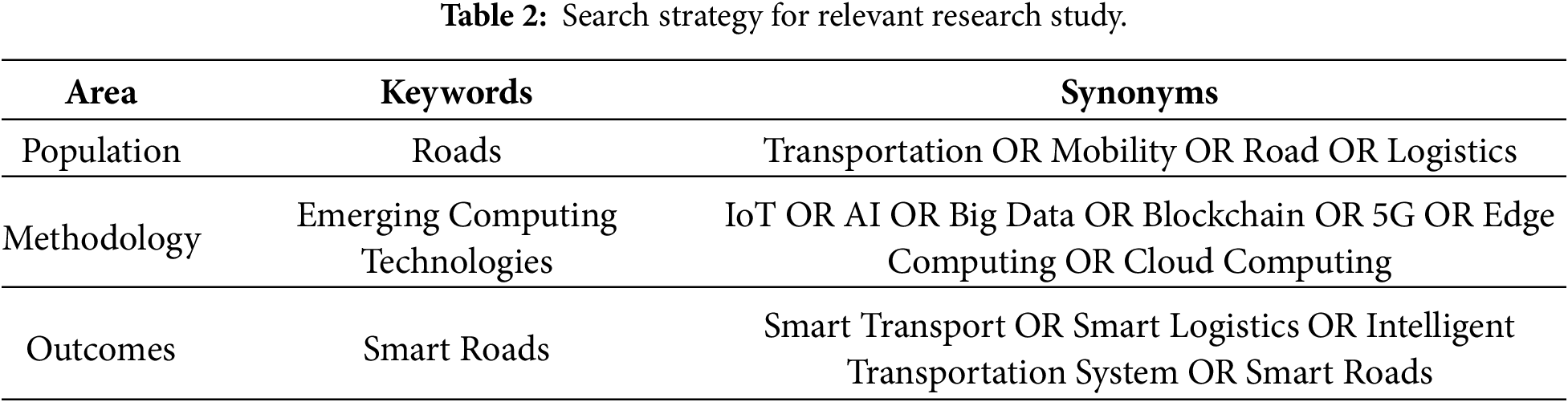
The search strategy aimed to gather relevant research studies based on well-defined inclusion criteria and research objectives. Table 2 summarizes the primary keyword categories used to construct the database queries, while the actual searches were performed using refined Boolean combinations and domain-specific constraints.
(“Smart Road” OR “Intelligent Transportation System” OR “Smart Transport”) AND (“IoT” OR “Artificial Intelligence” OR “Big Data” OR “Blockchain” OR “5G” OR “Edge Computing”) AND (“Traffic Management” OR “Road Safety” OR “Smart Mobility” OR “Road Infrastructure”).
The search method is broken down into three major parts: i) Population, ii) Techniques, and iii) Outcomes, as shown in Table 2. The articles were collected from leading scientific databases such as IEEE Xplore, ScienceDirect, SpringerLink, and ACM Digital Library. With regard to the scope of population, this research is mainly concerned with smart roads, which include more general terms such as “Transportation,” “Mobility,” and “Logistics.” With respect to the technological dimension, the research explores ECT, including IoT, AI, Big Data, Blockchain, 5G, and Edge Computing. These technologies serve as the foundation for innovations in smart road infrastructure and management systems. Regarding the expected outcomes, the study evaluates the impact of technologies on smart roads, focusing on outcomes such as Smart Transport, Smart Logistics, Intelligent Transportation Systems, and Smart Road implementations.
2.3 Quality Assessment Criteria
The quality assessment phase applied specific inclusion and exclusion criteria to filter relevant studies. The inclusion criteria focused on studies from 2020 to 2025, emphasizing research on emerging technologies in smart roads with documented methodologies and results. The initial populated studies were narrowed down based on relevance, clarity of methodology, and applicability to smart road technologies. Finally, 132 studies were chosen for the review. The quality assessment focused on verifying the relevance, methodological clarity, and reported outcomes of the retrieved studies. Studies lacking a clear research methodology or without reported experimental or analytical results were excluded. This screening process ensured that the retained literature provided sufficient methodological description and evaluable findings relevant to smart road technologies.
The inclusion standards applied during the quality assessment are summarized as follows:
• Studies published between 2020 and 2025.
• Research focusing on emerging technologies in smart roads.
• Clear documentation of methodology and research findings.
• Studies related to smart transportation, logistics, and road management.
• English language publications.
On the other hand, the following exclusion standards were applied to remove studies that did not meet the review scope or quality requirements:
• Patents, technical reports, newsletters, and non-peer-reviewed articles.
• Studies do not focus on smart road technologies or do not provide empirical data.
• Literature related to non-transportation applications of emerging technologies.
• Publications in languages other than English.
The selected studies were thoroughly reviewed to analyze the impact of emerging technologies on smart roads. The findings were categorized based on the technologies used, their applications, and their effectiveness in addressing the challenges of smart road implementations. The PRISMA flow chart for this article is shown in Fig. 2. The detailed checklist for PRISMA is also available at Zenodo [18].
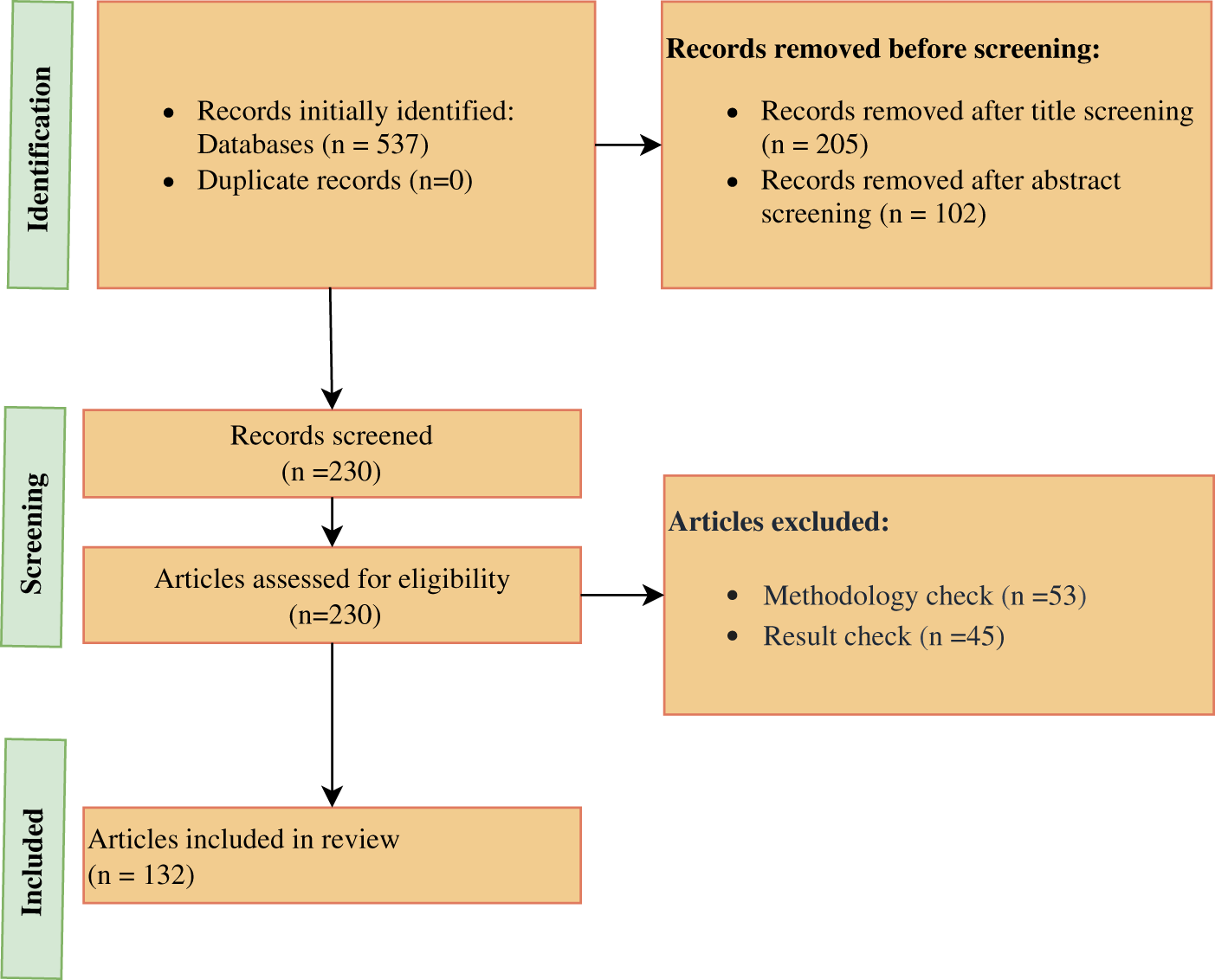
Figure 2: PRISMA flow chart for studies collection.
3 Smart Road Enabling Technologies
This section presents a technology-centric analysis of the key enabling technologies for smart roads, focusing on their fundamental principles, capabilities, and technical roles independent of specific application scenarios. It introduces the foundational technologies that support smart road ecosystems, while their application-oriented utilization is discussed later in Section 4.
Smart road functionality relies on a multi-layered technology stack. This section presents enabling technologies across communication, sensing, data analytics, and energy domains. It integrates advanced communication systems, IoT, AI, Big Data, Blockchain, and energy harvesting solutions to transform traditional infrastructure into intelligent, adaptive networks. These technologies, as shown in Fig. 3, enable real-time data exchange, predictive analytics, and dynamic control, enhancing road safety, traffic efficiency, and sustainability. The following section explores the key technologies driving the evolution of smart roads.
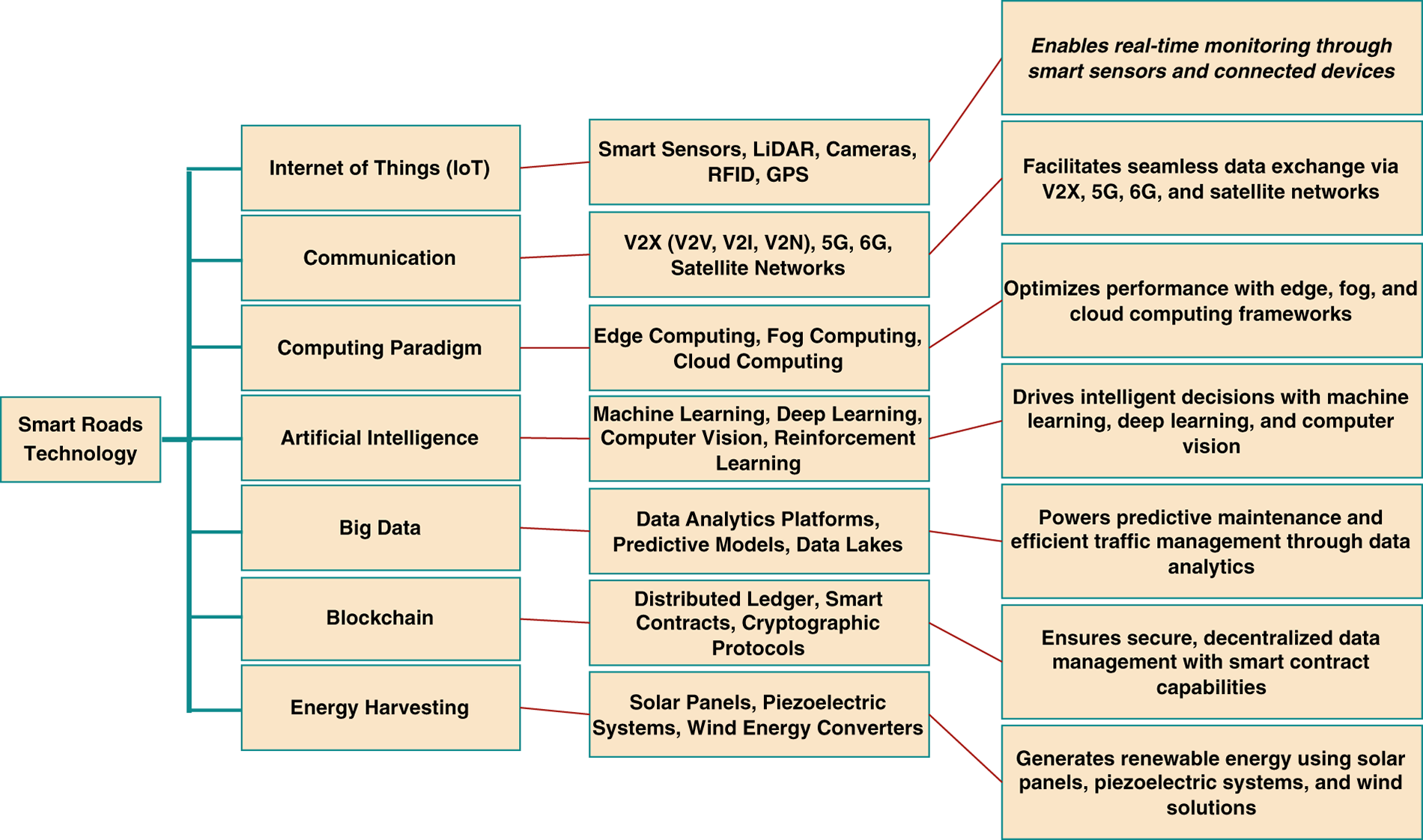
Figure 3: Smart road enabling technologies and their functional contributions.
3.1 Communication Technologies
The evolution of smart road communication is a cornerstone of ITS. Smart road communication depends on advanced communication technologies to facilitate seamless interaction between vehicles, infrastructure, and networks [6]. The integration of V2X communication has revolutionized road safety, traffic efficiency, and autonomous mobility [15]. This section looks at the key components of smart road communication (e.g., Vehicle-to-Network (V2N), V2I, and V2V) along with the technologies driving these advancements. Table 3 summarizes the communication technologies’ role in smart roads.
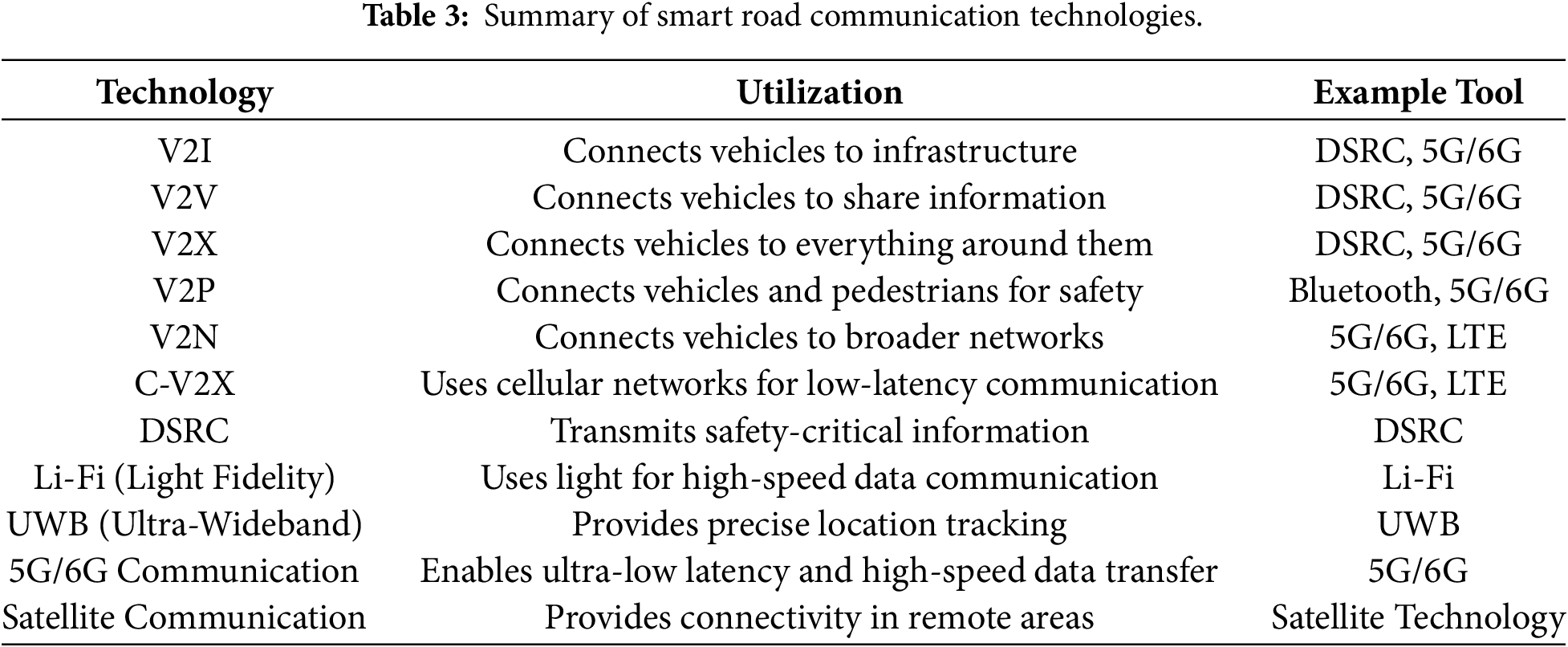
Advancements in V2N communication are crucial for smart transportation systems, enabling seamless connectivity for services. 5G and emerging 6G technologies have enhanced these capabilities, offering ultra-reliable low-latency communication and massive machine-type communication (mMTC), ensuring uninterrupted data flow between vehicles and infrastructure [19]. Integrating blockchain in 5G communication improves data security and integrity, creating a decentralized communication framework [19]. 6G is expected to utilize AI for predictive maintenance, vehicle automation, and sensor data fusion [20]. The deployment of these technologies in regional ITS enhances coordination of Connected Vehicles (CVs) and utilizes edge computing for improved traffic management and congestion detection [21].
V2V communication enables direct data exchange between vehicles, allowing cooperative driving manoeuvres, collision avoidance, and improved situational awareness. Dedicated Short Range Communication (DSRC) and Cellular V2X (C-V2X) are key technologies supporting V2V communication [22,23].
Predictive analytics in V2X networks use Machine Learning (ML) to anticipate collision risks, while Vehicular Ad Hoc Networks (VANET) integrate mobility prediction algorithms to minimize delays in traffic [22,24]. For autonomous driving, a prioritized road management system allocates resources using V2X data for reduced congestion and improved safety [25]. Smart road design considers Autonomous Vehicles (AVs) and CVs technologies in lane configurations and capacity planning, with real-world deployments at equipped smart intersections [12].
V2I communication connects vehicles with roadside infrastructure, including traffic signals, surveillance cameras, and road sensors. V2I systems integrate edge computing and cloud to enhance ITS, reducing congestion and improving emergency response efficiency [21,26].
ITS support hierarchical V2I communication, enhancing data exchange between road infrastructure and vehicles [27]. Communication protocols (e.g., LoRa WAN) optimize traffic management systems [28]. AI-driven automation in smart roads also plays a role in environmental sustainability by supporting predictive analytics for traffic optimization [29].
Vehicle-to-Pedestrian (V2P) communication enables direct interaction between vehicles and pedestrians, significantly improving road safety for vulnerable road users. V2P facilitates real-time alerts between vehicles and pedestrians, reducing collision risks, by utilizing IoT sensors, smart crosswalks, and mobile applications [30]. Pedestrian detection systems utilize computer-vision-based object recognition and LiDAR (LiDAR) technology to identify pedestrians [31]. Smart road infrastructure (e.g., connected traffic lights and road studs) communicates with pedestrian devices, ensuring safe crossing through automated alerts and adaptive signal adjustments [32]. The implementation of wearable V2P technology (e.g., connected wristbands and mobile applications) enhances pedestrian safety by notifying both drivers and pedestrians of potential risks in real-time [33].
3.2 IoT and Sensor Technologies
The integration of the IoT in smart road infrastructure has significantly improved modern ITS. The IoT environment, with its network of interlinked sensors, devices, and communication systems, supports real-time data acquisition, transmission, and analysis. The data is essential for efficient traffic control, road safety, and infrastructure management [12,19–26,34–37]. This section highlights the major elements of IoT-based smart road infrastructure and the technologies that are fueling these developments. Table 4 summarizes the IoT technologies’ role in smart roads.
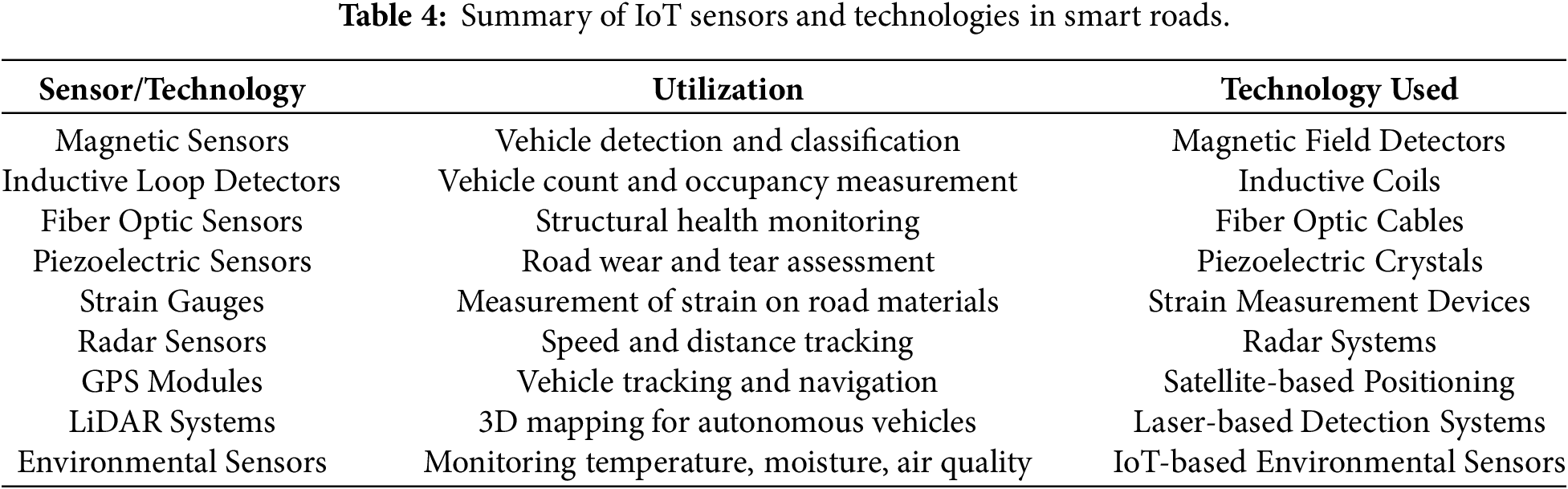
Magnetic sensors and inductive loop detectors are widely adopted for traffic flow monitoring and vehicle detection. Magnetic sensors detect changes in magnetic fields caused by metal objects, making them suitable for monitoring vehicle flow and speed [19]. They are often embedded in road surfaces to support traffic management and congestion detection [20]. Similarly, inductive loop detectors provide accurate measurements of vehicle count and speed by measuring changes in inductance when vehicles pass over them [37]. Their integration with IoT platforms enhances traffic monitoring and adaptive traffic signal control [24].
Infrastructure monitoring relies on sensing technologies capable of evaluating structural integrity and pavement conditions. Fiber optic sensors are employed to monitor critical infrastructure such as bridges and tunnels by detecting strain, temperature variations, and vibrations [21,26]. Piezoelectric sensors generate electrical signals under mechanical stress, providing valuable data for assessing road wear and traffic loads [35]. These sensors support predictive maintenance strategies that improve safety and reduce repair costs [36]. In addition, strain gauges measure material deformation under stress, enabling early identification of structural weaknesses and supporting maintenance planning before failures occur [22,23].
Perception and mobility-oriented sensing technologies further enhance intelligent transportation capabilities. Radar sensors provide real-time measurements of vehicle speed, distance, and movement patterns, supporting adaptive traffic control and automated vehicle systems [24,38]. Radar-based sensing improves situational awareness in complex traffic environments [25]. Global Positioning System (GPS) modules enable precise vehicle tracking for navigation, fleet management, and emergency response applications [12]. When integrated with IoT networks, GPS data enhances route optimization and traffic analysis [34,39]. LiDAR systems utilize laser pulses to generate high-resolution 3D maps of road environments, supporting obstacle detection and autonomous navigation in dynamic driving conditions [19,20].
Environmental sensing technologies complement traffic and infrastructure monitoring by capturing external conditions affecting road safety. Environmental sensors monitor parameters such as temperature, humidity, air quality, and precipitation, enabling early identification of hazardous conditions [21]. IoT-based environmental monitoring systems support proactive management of weather related traffic risks and contribute to safer road operations [26].
The inclusion of big data technologies in smart road infrastructure has revolutionized the way transportation networks are managed and optimized. Big data, which is defined by its volume, velocity, variety, and veracity, enables decision-making, predictive analysis, and optimized efficiency within ITS [40–42]. This section highlights the technologies that are propelling big data in smart roads. Table 5 illustrates the importance of big data technologies in smart roads.
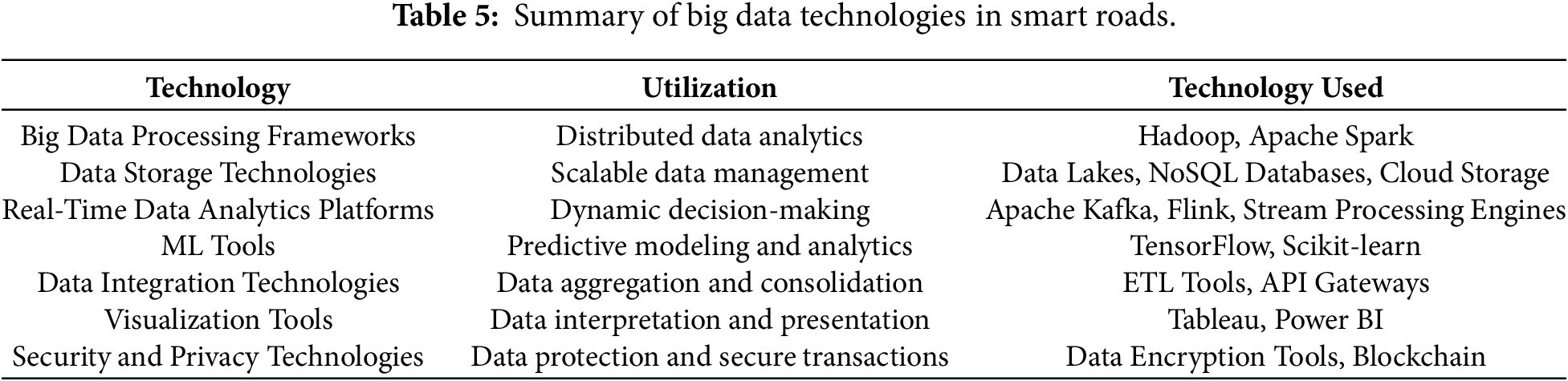
Big data processing and storage are the backbone of smart road systems based on data. Big data processing frameworks are critical for efficient management of large amounts of transport data. Technologies such as Hadoop and Apache Spark make it possible to process transport data in a distributed manner, allowing for real-time analysis and large-scale processing [43]. Big data processing frameworks improve the ability to process data from various sources [44]. At the same time, appropriate data storage solutions are vital for the efficient management of the large amounts of data generated by smart road infrastructure systems. Data lakes, NoSQL databases, and cloud storage solutions create flexible and scalable environments for storing both structured and unstructured data [40]. These solutions make it possible to archive and easily retrieve transport data [41].
Data analytics and integration tools help in intelligent decision-making and synchronized use of data. Data analytics tools help in dynamic monitoring and quick reaction to changing road conditions. Tools such as Apache Kafka, Flink, and stream processing engines help in data ingestion, processing, and analysis [44]. These tools are required for smart road applications such as dynamic traffic signal control, incident detection, and emergency response [45,46]. Data integration and aggregation tools further help in integrating data from different sources, and ETL (Extract, Transform, Load) tools and API gateways are often used to integrate data for overall analysis [47]. These tools help in improving data consistency, accuracy, and availability in smart road environments.
Visualization and security technologies complete the big data ecosystem by supporting interpretation and protection of transportation data. Visualization and business intelligence tools (e.g., Tableau and Power BI) are used to interpret and present complex big data insights. These tools enable stakeholders to visualize traffic trends, analyze performance metrics, and make informed decisions [48]. Effective data visualization improves transparency and supports strategic planning in smart transportation systems [27]. In addition, security and privacy technologies are essential for protecting sensitive transportation data from cyber threats. Data encryption tools, secure access protocols, and blockchain technology ensure the integrity, confidentiality, and authenticity of data within smart roads [49,50].
The development of smart road systems is greatly dependent on the use of advanced computing paradigms that can support the processing of data in real-time, effective resource utilization, and enhanced decision-making processes. The major computing paradigms (cloud computing, edge computing, and fog computing) are essential in supporting the infrastructure and applications of ITS [40,41,43,47,51]. This section discusses the computing paradigms, focusing on their functionalities, benefits, and applications in smart road systems. Table 6 explains the role of computing paradigms in smart roads.
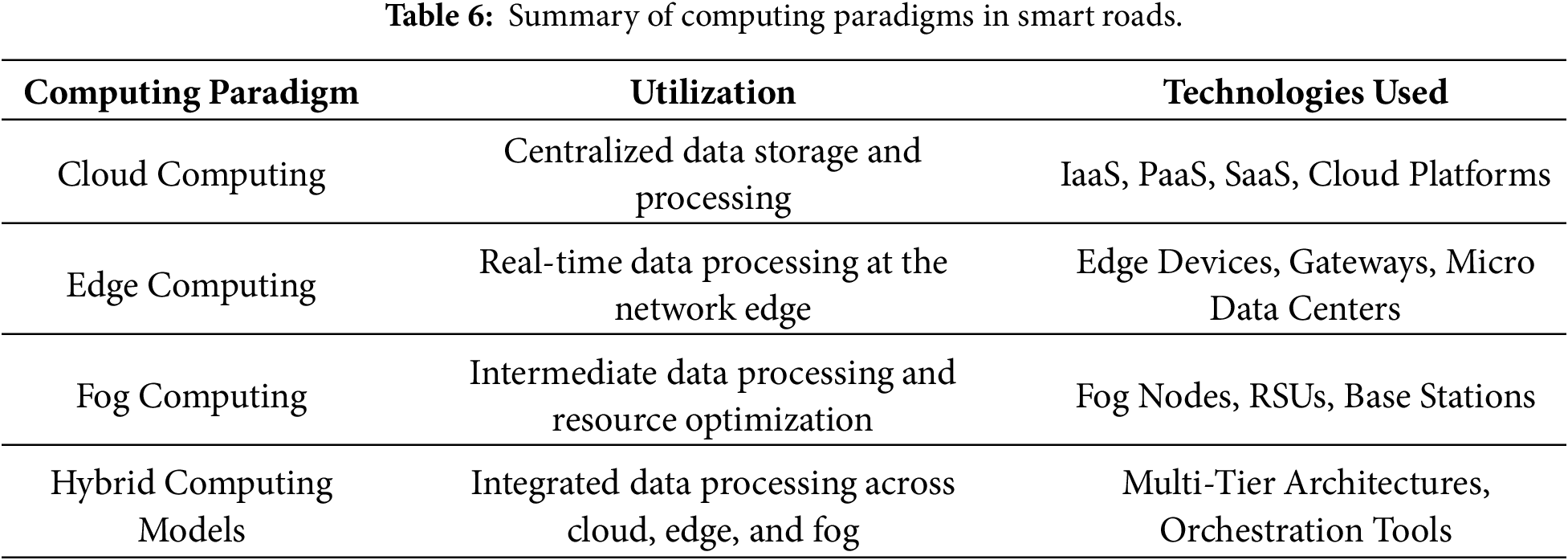
Cloud computing is a flexible and scalable computing paradigm that uses the internet to offer computing services for the processing and analysis of large amounts of transportation data [43]. Cloud computing supports the centralized management of data, which allows smart road systems to collect data from multiple sources [40,51]. Cloud computing is a centralized computing paradigm that is ideal for large-scale data analysis and management in smart road systems.
Edge computing is a supporting technology for cloud computing, which processes data closer to the data source, thus reducing latency and bandwidth consumption [41]. This technology is critical for time-sensitive applications in smart roads, such as autonomous vehicle routing, traffic management, and emergency response systems [47,52]. Edge computing accelerates decision-making processes and enhances system robustness by reducing the latency of centralized processing [45].
Fog computing is an extension of cloud computing, which adds an intermediate layer that brings computation and storage resources closer to distributed data sources [40]. Fog computing optimizes data processing and resource management in smart road environments by supporting localized analytics and edge-cloud coordination [49]. Fog nodes are strategically located at points such as Roadside Units (RSUs) and base stations, which help with data filtering, aggregation, and analysis, thus alleviating the processing load on centralized infrastructure while enhancing the performance of time-sensitive applications [3,50].
Hybrid computing models combine cloud, edge, and fog computing paradigms to leverage their complementary benefits [27]. In smart road systems, hybrid models provide seamless data communication and processing across multiple layers of computing, ensuring scalability, reliability, and efficient resource management [28,53].
The AI technologies in smart roads have revolutionized the efficiency, safety, and management of transportation networks. AI enables real-time decision-making that is essential for modern ITS [19,20,43]. This section discusses key AI technologies that support smart road environments. Table 7 summarizes the AI technologies’ role in smart roads.
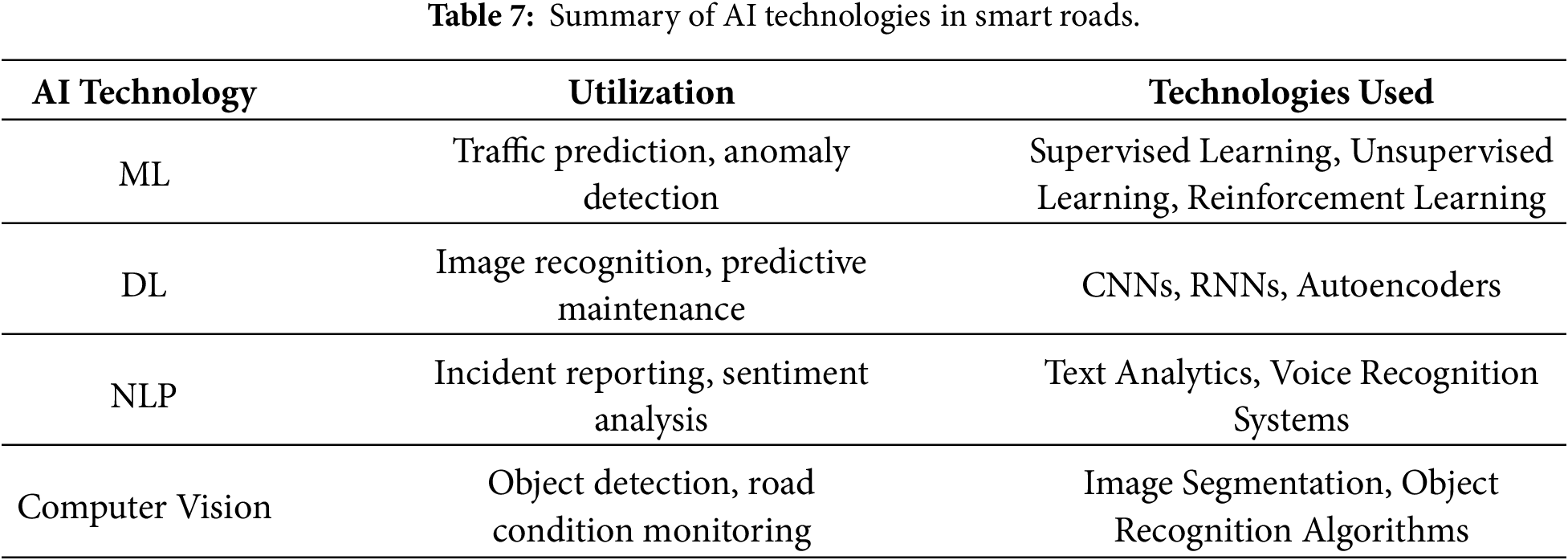
ML techniques form the foundation of many AI applications in smart roads. Supervised learning algorithms are used for traffic prediction, accident detection, and vehicle classification [40,54]. Unsupervised learning helps in identifying traffic patterns, anomaly detection, and clustering of road usage data [45]. Reinforcement learning further supports traffic signal optimization, adaptive routing, and autonomous vehicle navigation [55].
Deep Learning (DL) models extend learning capabilities by enabling efficient processing of complex data generated from traffic cameras, sensors, and LiDAR systems [41]. Models such as Convolutional Neural Networks (CNNs) are effective for image recognition tasks including vehicle detection, pedestrian tracking, and road condition monitoring [44]. Recurrent neural networks (RNNs) support time series analysis for traffic flow forecasting and predictive maintenance [51,56].
Beyond learning-based models, Natural Language Processing (NLP) and computer vision technologies support semantic interpretation and environmental perception in smart road systems. NLP facilitates the interpretation of unstructured data from social media, emergency call reports, and driver feedback [57]. These technologies enable real-time incident reporting, sentiment analysis for public transport systems, and voice-controlled navigation services [58]. Computer vision technologies enhance situational awareness and automation by applying object detection and recognition algorithms to identify vehicles, pedestrians, and obstacles in real-time [42]. Image segmentation techniques further support road mapping, lane detection, and traffic density analysis [47].
AI predictive analytics tools utilize historical and real-time data to forecast traffic conditions, predict accidents, and optimize road maintenance schedules [59]. These tools combine statistical models, ML algorithms, and AI-driven simulations to improve road safety and operational efficiency [48].
3.6 Energy Harvesting Technologies
The integration of energy harvesting technologies into smart roads has the potential to create self-sustaining infrastructures capable of generating renewable energy. These technologies generate energy from various environmental and mechanical sources, converting it into usable electrical power to support ITS operations [60,61]. This section explores the key energy harvesting technologies used in smart roads. Table 8 summarizes the energy-harvesting technologies’ role in smart roads.
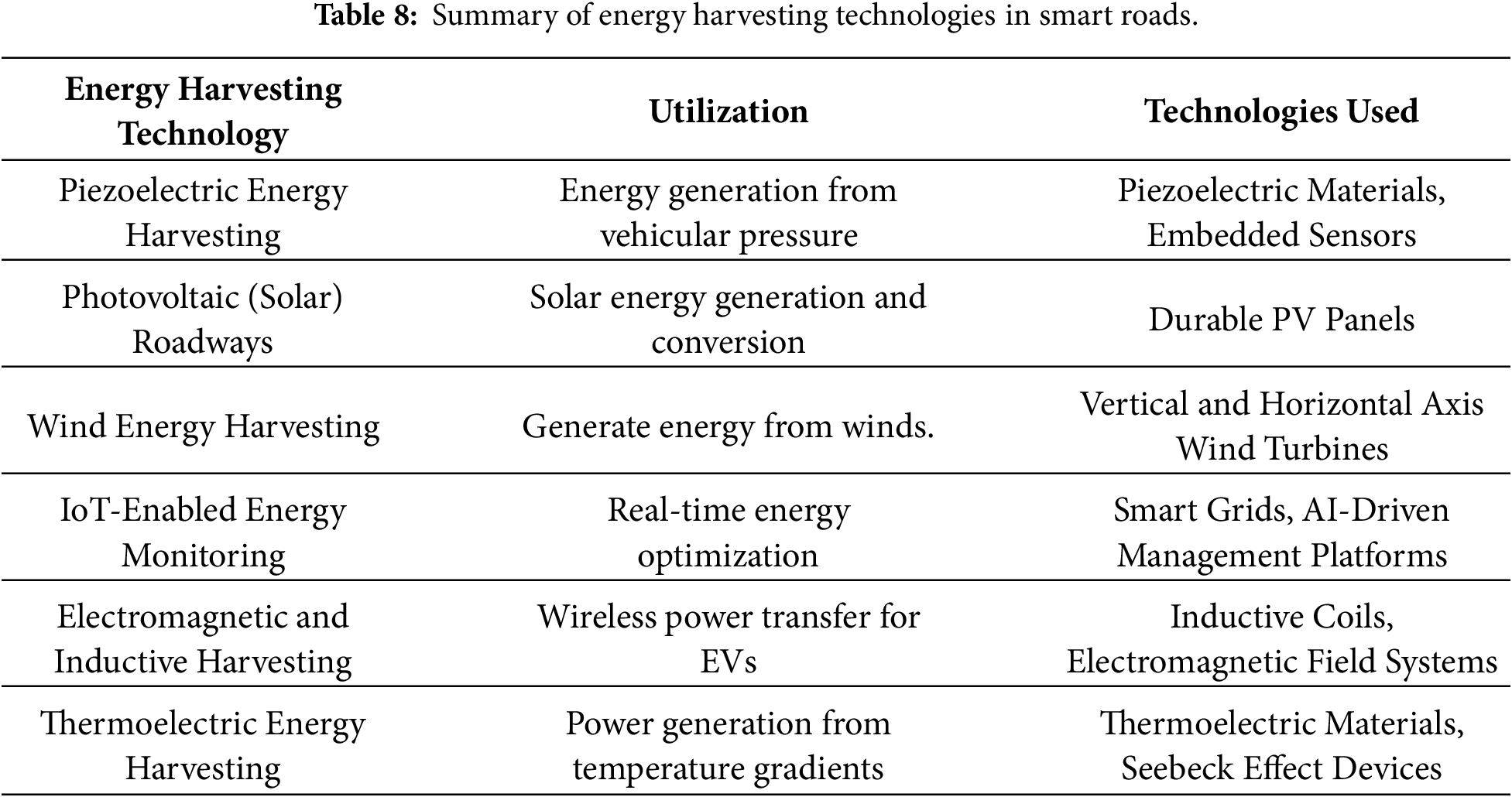
Piezoelectric energy harvesting utilizes materials that generate electrical energy under mechanical stress [62]. Piezoelectric sensors embedded in pavements convert kinetic energy from traffic into electricity, which can power lights, traffic signals, and other roadside devices [63,64]. This technology is particularly effective in high-traffic areas, providing a sustainable energy source without additional environmental impact. Advances in piezoelectric materials have improved durability and energy conversion efficiency, making them suitable for long-term deployment in smart road systems [65].
Photovoltaic (PV) roadways harvest solar energy by incorporating solar panels into road surfaces [66]. These panels are designed using durable materials capable of withstanding vehicular loads while efficiently converting sunlight into electrical power [67]. Solar road technologies support applications such as powering streetlights, traffic management systems, and Electrical Vehicle (EV) charging stations. In addition, smart monitoring systems enhance the efficiency of PV roadways by optimizing energy capture and distribution based on real-time environmental conditions [68].
Electromagnetic and inductive energy harvesting technologies generate energy through electromagnetic fields and inductive coupling, commonly applied in wireless power transfer systems [69]. Inductive coils embedded in roadways enable dynamic wireless charging of EVs while vehicles are in motion, reducing dependency on stationary charging stations. This approach supports sustainable transportation while improving the practicality of electric mobility solutions. The efficiency of inductive energy harvesting depends on coil alignment and electromagnetic field frequency [70].
Thermoelectric energy harvesting converts temperature differences between road surfaces and the surrounding environment into electrical energy [71]. This technology utilizes thermoelectric materials based on the Seebeck effect, making it suitable for regions with significant temperature variations [72]. Thermoelectric generators can be integrated into road pavements to utilize waste heat from vehicles and solar radiation, thereby improving the overall energy efficiency of smart road infrastructures [73].
Wind energy harvesting in smart roads produces electricity through roadside wind turbines or embedded micro wind energy conversion systems [74]. Vertical-axis wind turbines (VAWTs) installed along highways and tunnels capture aerodynamic forces and convert them into electrical energy capable of powering streetlights, traffic management systems, and sensing devices [75]. Additionally, small scale wind energy harvesters integrated into noise barriers and bridge structures further enhance energy efficiency within urban mobility networks [21].
Blockchain technology has emerged as a transformative solution for enhancing the security, transparency, and efficiency of smart roads. Its decentralized architecture ensures data integrity, secure communication, and transaction processing, making it an integral part of ITS [19,20,43]. This section explores the key blockchain technologies and their applications in smart road environments. Table 9 summarizes the blockchain technologies’ role in smart roads.
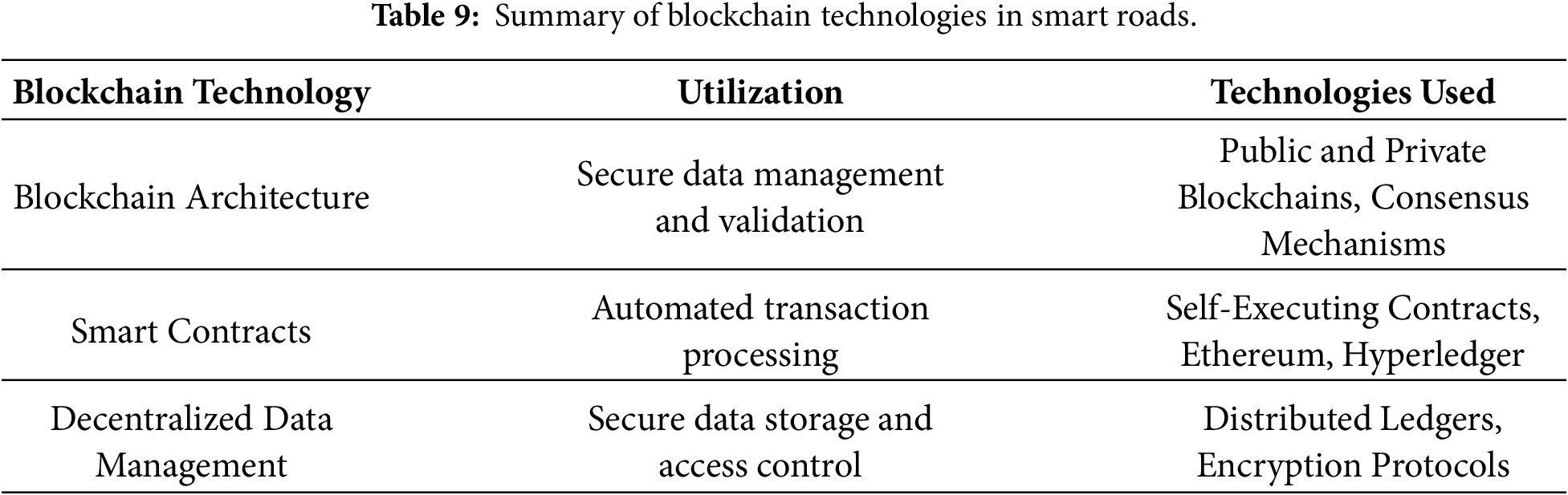
Blockchain technology has come forward as a revolutionary approach to improve the security, transparency, and efficiency of smart roads. The decentralized nature of blockchain technology provides data integrity, secure communication, and transaction processing, making it a crucial component of ITS [19,20,43]. This section discusses the major blockchain technologies and their use cases in smart road scenarios. Table 9 highlights the role of blockchain technologies in smart roads.
Blockchain technologies in smart road infrastructure are designed to handle secure data transactions and ensure the reliability of operations [40]. Public blockchain networks, such as Ethereum, are designed to provide transparency and decentralization, while private blockchains are designed to provide controlled access for transportation stakeholders [45,76]. Consensus algorithms, such as Proof of Work (PoW) and Proof of Stake (PoS), are used to secure transactions and ensure the integrity of the network. These algorithms ensure that the data exchanged between vehicles, roads, and control centers is valid and tamper-proof [55].
Beyond architectural design, smart contracts enable automated and rule-based transaction execution within transportation environments [41]. In smart road systems, smart contracts support applications such as toll collection, vehicle registration, and traffic violation management [44]. For instance, automated toll payment systems implemented through smart contracts reduce manual intervention and congestion at toll booths. Furthermore, smart contracts facilitate secure data exchange between vehicles and IoT devices, strengthening trust and operational efficiency in decentralized transportation networks [51].
3.8 Geographical Information System (GIS) and Mapping Technologies
GIS and mapping systems are very important for the development and management of smart road infrastructure. These systems help in the analysis and mapping of spatial data, which is necessary for traffic management, route optimization, and infrastructure development [60,61]. This section discusses the major GIS and mapping systems used in smart road systems. Table 10 explains the importance of GIS technologies in smart roads.
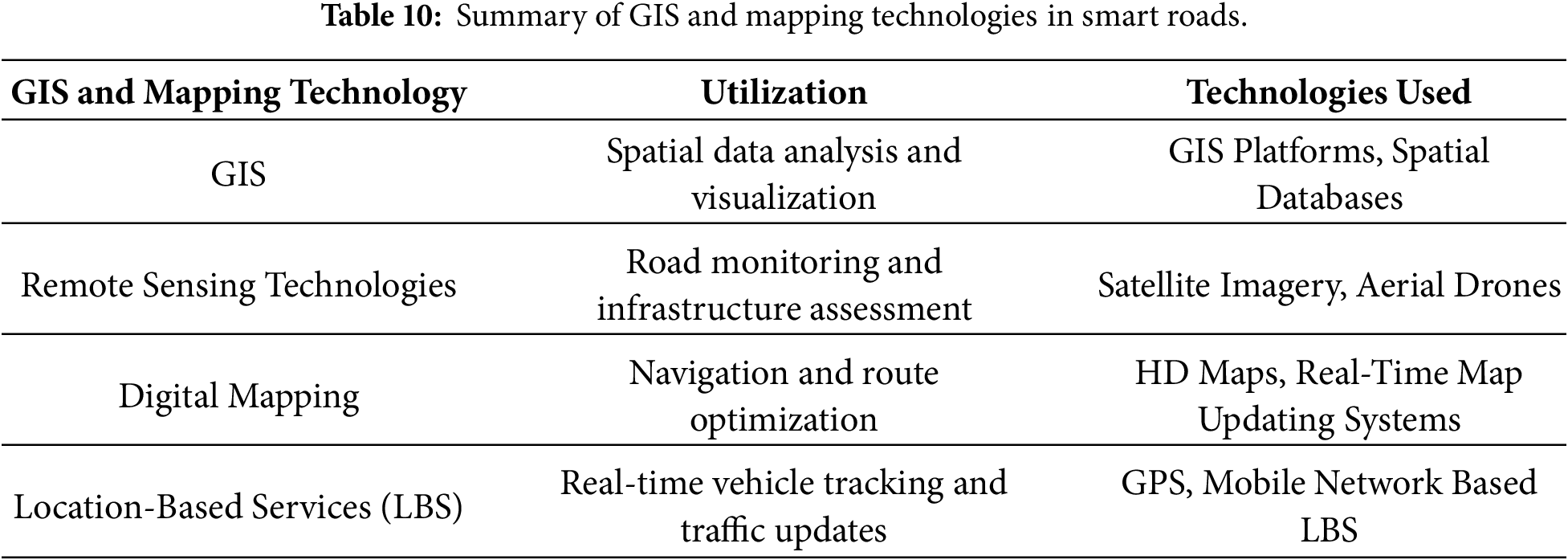
GIS is a system that helps in the analysis and mapping of spatial data associated with road infrastructure [62]. The system helps in smart road development by integrating spatial data from IoT sensors, traffic sensors, and satellite images [63]. GIS traffic management systems enhance decision-making by analyzing traffic patterns, predicting congestion, and optimizing routes. Furthermore, the system helps in the monitoring of road conditions, accident points, and maintenance needs [65].
Remote sensing technologies, such as satellite imaging and aerial drones, further expand spatial knowledge by allowing large-scale and real-time observation of road environments [66]. Satellite images enable the creation of high-resolution maps for transportation network mapping, while drones enable flexible observation capabilities for local-scale monitoring [67]. The combination of remote sensing information with GIS enhances the accuracy and efficiency of smart road systems [68].
Digital mapping technology enables the creation of high-definition (HD) maps with detailed information on road geometry, traffic signs, and lane markings [69]. HD maps play a critical role in autonomous vehicle navigation, route optimization, and dynamic traffic management. Digital maps are constantly updated using information gathered from GPS sensors, traffic sensors, and mobile apps, thus ensuring accurate routing, minimized travel time, and enhanced road safety [70].
Location-based services (LBS) employ GIS information to deliver real-time information on vehicle location, traffic, and points of interest [71]. LBS enable applications such as fleet management, emergency response coordination, and personalized navigation systems, thus enabling more efficient and responsive smart transportation environments [72,73].
4 Use Cases for Smart Road Technologies
This section takes an application-centric view, examining how the various technologies mentioned above, taken together, work to solve some of the most important challenges facing smart roads.
Smart road technologies have a wide range of applications, from intelligent traffic control and accident avoidance to smart lighting and energy-efficient infrastructure. These applications illustrate, as can be seen in Fig. 4, how the combination of various technologies can improve road safety, traffic flow, and sustainable mobility. The next section will examine real-world implementations of smart road technologies.
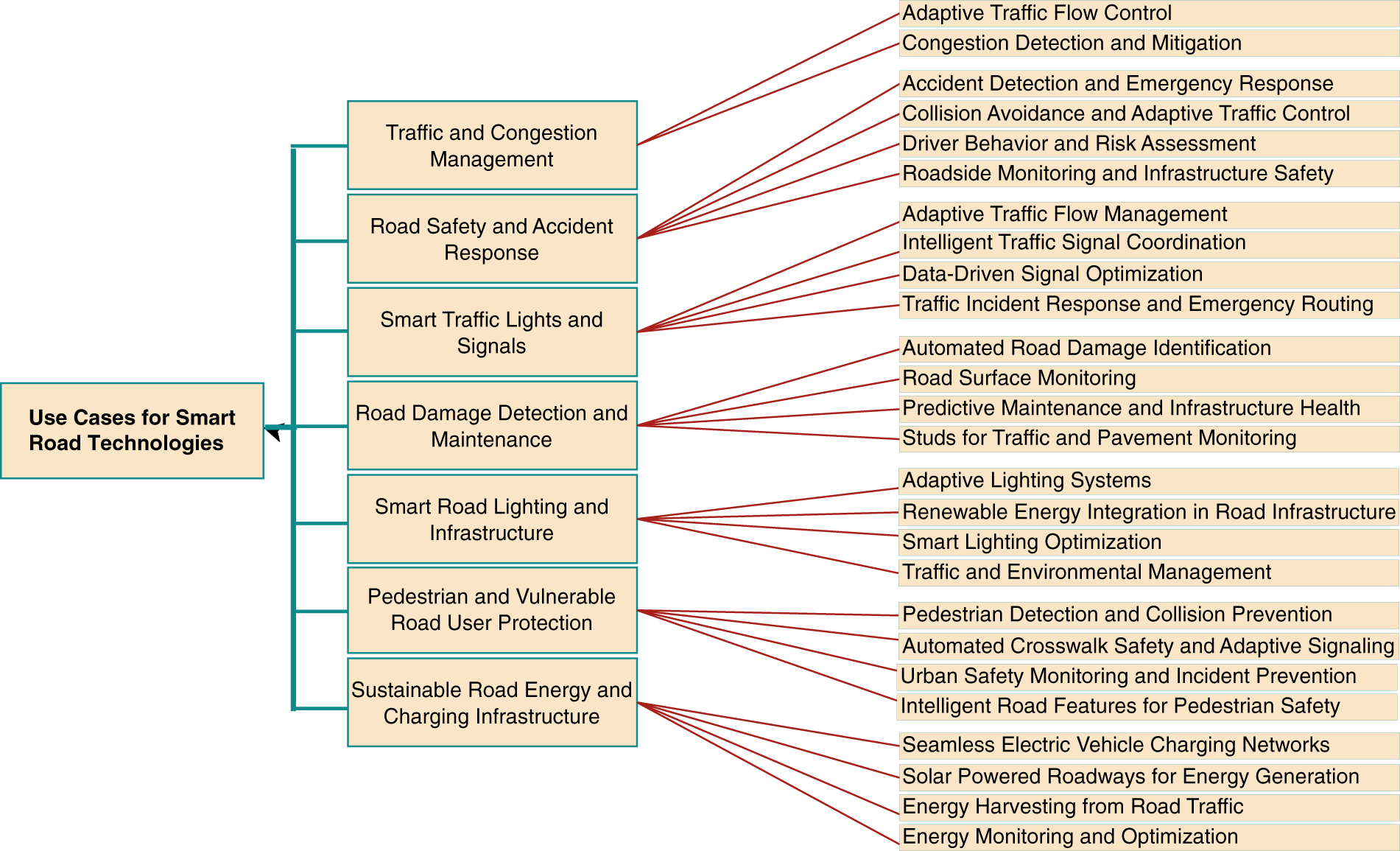
Figure 4: Smart road technologies use cases.
4.1 Traffic and Congestion Management
Smart road infrastructure is an important component of modern traffic management and congestion control. By combining real-time data acquisition and analysis, IoT technology optimizes traffic flow and minimizes congestion. This section discusses the role of smart road infrastructure in traffic and congestion management.
Traffic monitoring systems employ sensor networks, smart cameras, and IoT devices to collect traffic information. These systems help the authorities estimate congestion levels, identify traffic violations, and optimize traffic signal timing [43,77–79]. More advanced V2I communication also helps optimize dynamic traffic signal changes according to real-time traffic conditions [80,81]. Moreover, IoT technology-based adaptive traffic light control optimizes congestion points by adjusting green light time based on vehicle density [82,83].
The integration of IoT and AI enhances traffic flow management through predictive analytics and intelligent optimization. AI-based models analyze historical and real-time traffic data to forecast congestion patterns, enabling proactive traffic management strategies [84,85]. These models support dynamic lane configuration, traffic rerouting, and improved road capacity utilization [86–88]. The incorporation of ML algorithms into traffic monitoring frameworks further improves predictive capabilities and supports early congestion mitigation [42,69].
Connected vehicle networks equipped with IoT sensors facilitate cooperative traffic management through V2V and V2I communication. These networks enable coordinated driving behaviors such as platooning, which enhances road capacity and improves traffic stability while reducing congestion [65,70,89,90].
Congestion detection systems provide continuous insights into traffic density, allowing authorities to implement targeted mitigation strategies [3,91]. Adaptive traffic management solutions utilize real-time vehicle data to dynamically adjust lane assignments, reroute vehicles, and manage high traffic zones [89,92]. Additionally, AI-based congestion forecasting models predict congestion hotspots and recommend optimal traffic distribution strategies [84]. Smart road infrastructure also incorporates dynamic toll pricing mechanisms that adjust usage costs according to congestion levels, encouraging alternative routing and reducing peak-hour traffic. The deployment of intelligent traffic signaling systems further improves congestion control by optimizing signal timings based on live traffic conditions [93].
4.2 Road Safety and Accident Response
Enhancing road safety and reducing accident rates are key objectives of ITS. The integration of AI-based analytics, monitoring, and real-time communication has transformed accident detection and emergency response mechanisms [94,95]. These technologies enable real-time monitoring, predictive analytics, and automated interventions to improve overall road safety outcomes.
Smart accident detection systems rely on sensors and data analytics to identify traffic incidents rapidly. Advanced algorithms analyze data patterns collected from sensor networks, in-vehicle systems, and RSUs to detect anomalies indicative of accidents [96,97]. AI-based accident detection further utilizes ML and computer vision techniques to analyze road conditions and vehicle behavior, enabling early identification of traffic incidents. Smart emergency notification systems integrate IoT sensors with cloud computing platforms to provide real-time alerts for road accidents, fires, and injury cases [98]. Autonomous accident detection frameworks employing sensor fusion and data analytics can instantly notify nearby vehicles and first responders, thereby reducing emergency response time [99].
Collision avoidance mechanisms play a fundamental role in proactive accident prevention. Advanced cooperative communication enables coordinated vehicle interaction, reducing collision risks in dense traffic environments [74]. Smart road management systems enhance safety by prioritizing autonomous vehicle pathways and supporting adaptive traffic control [24]. These systems dynamically adjust speed limits, reroute traffic flows, and utilize predictive analytics to maintain safer driving conditions.
Driver behavior monitoring represents an additional layer of safety enhancement by identifying high risk driving patterns. IoT devices and telematics systems track metrics such as speed, braking behavior, and lane discipline to detect unsafe driving practices [100,101]. AI algorithms analyze this information to provide real-time feedback that encourages safer driving habits and reduces accident likelihood [102,103]. Driver fatigue detection systems further employ biometric sensors to monitor eye movement, heart rate, and other physiological indicators, issuing alerts when signs of drowsiness are detected [104]. Moreover, ML techniques assist in identifying accident-prone conditions by analyzing driving patterns and risk factors. For example, clustering-based risk diagnosis frameworks classify driving behaviors and detect high risk situations, enabling proactive interventions [71]. AI-based safety models using DL techniques analyze historical crash data and telemetry to provide alerts for both drivers and traffic authorities [105].
Roadside monitoring and intelligent infrastructure further strengthen accident prevention capabilities. IoT-based roadside monitoring systems integrate sensing technologies to detect abnormal vehicle movements and hazardous road conditions [32]. Smart infrastructure solutions utilize vibration detection to assess road quality and identify high risk areas [106]. In addition, advanced infrastructure incorporates real-time environmental monitoring, dynamic hazard warning systems, and adaptive lighting technologies to enhance safety during nighttime and adverse weather conditions. Collectively, these systems support automated traffic regulation and improve emergency response efficiency while promoting safer road environments for all users.
4.3 Smart Traffic Lights and Signals
Smart traffic signal control systems are an essential component of ITS as they use sophisticated computing and data-driven approaches to optimize traffic flow and reduce congestion. Conventional traffic signals, which follow fixed cycles, are not as effective as smart traffic signals that adapt signal timing based on real-time traffic data and forecasts [1,107].
Adaptive traffic signal control systems use ML and reinforcement learning algorithms to optimize intersection performance and reduce congestion. A deep reinforcement learning algorithm-based adaptive traffic signal control system has been proposed that uses continuous analysis of traffic conditions and signal timing optimization to minimize waiting times for vehicles [66]. Similarly, ML-based traffic flow prediction models have been used for adaptive signal control through congestion forecasting [67].
Apart from personal intersections, the intelligent coordination of traffic signals makes it possible to have a comprehensive traffic management system in urban areas. Intelligent traffic control systems allow real-time observation and synchronized adjustments of traffic signals for connected intersections. Intelligent traffic control systems have proved effective in the prioritization of emergency vehicles and congestion relief in dense areas [73]. Adaptive signal infrastructure developed for smart cities optimizes signal phases, thus eliminating unnecessary stops and fuel consumption [47]. Smart intersections also incorporate connected vehicle systems and real-time analysis for improved vehicular traffic and pedestrian safety.
Data-driven signal optimization algorithms improve the responsiveness and adaptability of traffic signals. Fuzzy logic controller algorithms dynamically control green light time based on vehicle density, thus increasing road capacity [62]. Moreover, intelligent traffic signal control systems that integrate fuzzy logic and image processing algorithms have been proposed to optimize vehicle traffic at intersections [108].
Smart traffic signals also contribute to incident management and emergency routing. Emergency vehicle prioritization mechanisms automatically modify signal timings to establish green corridors for ambulances and law enforcement vehicles [73]. Furthermore, IoT-based traffic light systems integrate with urban monitoring platforms to reroute traffic during road closures, construction activities, or severe congestion [47]. Such adaptive control measures reduce response time and enhance overall road safety.
4.4 Road Damage Detection and Maintenance
Effective road damage detection and maintenance is crucial for ensuring the longevity of the infrastructure, road safety, and cost-effective management. The convergence of IoT, AI, and data analytics has revolutionized the conventional road maintenance process to a predictive and automated system, enabling road authorities to make informed decisions and enhance road conditions.
Automated road damage detection has been greatly improved by the implementation of the latest ML and DL models. A DL solution has been proposed for road damage detection and classification in various regions by using CNNs models for real-time analysis and automated reporting [109,110]. Furthermore, smart road monitoring systems use roadside sensors to identify cracks and surface damage, which supports optimized maintenance activities and minimizes future infrastructure costs [111,112].
Road surface monitoring approaches further enhance maintenance planning through continuous condition assessment. Vibration sensing technologies are used to measure vehicle-induced vibrations, providing reliable indicators of deteriorating road conditions and supporting repair prioritization [86,113]. Similarly, pothole mapping systems based on vibration analysis enable authorities to generate damage maps for proactive infrastructure maintenance [114]. These sensing approaches improve infrastructure durability by identifying minor defects before they evolve into major hazards.
Predictive maintenance strategies integrate intelligent surveillance and computational frameworks to improve maintenance efficiency. Road surveillance systems automate damage detection and support early intervention through predictive analytics. For example, edge-cloud computing frameworks have been employed for detecting and predicting road cracks, reducing latency and improving response times for maintenance operations [115]. Furthermore, AI-based systems analyze pavement conditions using high-resolution imagery and predictive models to support long-term infrastructure health monitoring [48,116,117].
Continuous monitoring capabilities are further enhanced through intelligent road infrastructure such as smart road studs. These systems integrate magnetic field detection to assess road surface integrity and enable continuous vehicle detection and pavement monitoring [118]. Two lane traffic surveillance using smart road studs has also been explored for simultaneous traffic flow analysis and pavement condition monitoring [119]. Such intelligent monitoring solutions support timely maintenance interventions and contribute to improved road safety and infrastructure resilience.
4.5 Smart Road Lighting and Infrastructure
Smart road lighting and infrastructure have become integral components of modern transportation systems, incorporating advanced technologies to enhance energy efficiency, road safety, and adaptive lighting control.
Adaptive lighting systems dynamically regulate illumination levels based on traffic density and pedestrian presence. This approach improves energy efficiency while maintaining adequate visibility for safer road conditions [68]. LED-based intelligent lighting solutions further reduce power consumption and extend operational lifetimes of lighting components [59]. Such adaptive systems contribute to sustainable urban development by minimizing unnecessary energy usage and reducing carbon emissions.
The integration of renewable energy sources into road infrastructure represents an important step toward sustainable smart city development. Solar roadways embed photovoltaic panels into road surfaces to generate electricity for powering lighting systems and other roadside equipment [120]. This approach reduces dependence on conventional energy sources and enhances environmental sustainability. In addition, piezoelectric energy harvesting from vehicle motion contributes to powering roadway lighting and associated infrastructure, improving overall energy autonomy [57].
Intelligent optimization mechanisms further enhance lighting efficiency and operational reliability. Advanced sensing technologies embedded within road lighting systems adjust light intensity according to environmental conditions and traffic patterns [121]. Fuzzy logic control frameworks have also been proposed to regulate illumination based on vehicle flow and pedestrian activity, enabling dynamic light adaptation while conserving energy [122]. These AI-based optimization strategies additionally support predictive maintenance, reducing operational costs and improving system reliability.
Road lighting systems are increasingly integrated with traffic monitoring and environmental sensing platforms to support comprehensive infrastructure management. Automated lighting adjustments improve visibility during adverse weather conditions and reduce nighttime accident risks [123]. Intelligent lighting networks facilitate coordination between traffic control centers and infrastructure systems, ensuring optimal illumination in critical zones. Furthermore, integration with environmental monitoring systems enables real-time lighting adaptation based on air quality, fog density, and noise levels [124].
4.6 Pedestrian and Vulnerable Road User Protection
Ensuring the safety of pedestrians and other vulnerable road users is a critical component of modern intelligent transportation systems. Advances in sensing, AI-based detection, and IoT enabled traffic management have enhanced pedestrian protection, reduced accidents, and improved urban mobility.
Smart road infrastructure integrates advanced pedestrian detection mechanisms to prevent collisions and ensure safer crossings. Multi-sensor fusion approaches combining cameras and LiDAR have been implemented to accurately detect pedestrians and analyze movement patterns [30]. In high risk urban environments, AI-based detection frameworks further analyze pedestrian behavior, predict potential collision scenarios, and trigger automated alerts for drivers and traffic control systems [31]. These perception-driven monitoring solutions significantly improve safety outcomes, particularly in densely populated areas.
Adaptive signaling technologies enhance pedestrian safety at intersections by dynamically adjusting crossing durations according to pedestrian density and vehicular flow [32]. Smart crosswalk systems equipped with IoT sensors detect pedestrian presence in real-time and synchronize traffic signals to provide safer crossing opportunities [50]. In addition, ML-based predictive models analyze pedestrian movement trends to optimize signal timing and improve coordination between pedestrians and vehicles.
Urban safety monitoring frameworks support proactive incident prevention through connected infrastructure and continuous surveillance. Roadside systems incorporating embedded cameras and tracking technologies enable early identification of jaywalking, unauthorized crossings, and other hazardous behaviors [50]. Intelligent road management platforms integrate pedestrian tracking with urban surveillance networks to facilitate rapid response to safety events [33]. Automated pedestrian notification mechanisms further enhance awareness and reduce accident risks in high traffic zones.
Intelligent infrastructure features provide an additional layer of physical safety for vulnerable road users. Smart road stud networks with embedded sensors detect pedestrian crossings and issue dynamic alerts to approaching vehicles [125]. These systems help regulate vehicle speed, enhance driver awareness, and reduce pedestrian related accidents [126]. Furthermore, AI assisted safety monitoring integrates environmental factors to optimize crossing safety conditions and ensure safer mobility for vulnerable road users.
4.7 Sustainable Road Energy and Charging Infrastructure
Developing sustainable and efficient transportation infrastructure is a key priority for modern cities, and smart road energy and charging systems play an important role in achieving this goal. By integrating renewable energy sources, wireless electric vehicle charging, and energy-efficient road technologies, these systems aim to minimize environmental impact and enhance overall road network efficiency.
Seamless electric vehicle charging networks have emerged as a transformative component of smart road systems. Wireless charging technologies embedded within roadways enable continuous power transfer to EVs while driving, reducing dependency on stationary charging stations [17,127]. This approach improves travel efficiency and supports broader EV adoption. Dynamic charging mechanisms further optimize energy utilization by adjusting power delivery according to vehicle demand, thereby extending driving range and improving energy efficiency.
Renewable energy generation through solar powered roadways represents another important direction in sustainable smart road development. The integration of photovoltaic panels into road surfaces enables electricity generation while supporting regular traffic operations [120]. Such systems contribute to energy self-sufficiency by reducing reliance on non-renewable energy sources. In addition, solar road networks can store surplus energy for use in street lighting, traffic signals, and charging infrastructure, improving overall urban energy management.
Energy harvesting from road traffic provides an additional method for supporting smart road power requirements. Piezoelectric energy harvesting systems convert mechanical stress generated by vehicular movement into electrical energy. Research has demonstrated lever-based piezoelectric harvesters capable of generating usable electricity from traffic loads [57,128]. This approach allows road infrastructure to partially self-power sensing and operational components while reducing external energy dependency.
Energy monitoring and optimization platforms enhance efficiency by enabling intelligent management of distributed energy resources. IoT-based energy monitoring systems utilize embedded sensors to track energy consumption patterns and support predictive maintenance planning [129]. By integrating AI-driven analytics, these platforms can dynamically allocate power resources, optimize energy distribution, and improve operational efficiency across transportation networks.
Despite their potential, smart roads face significant challenges, including technical, financial, regulatory, data security, privacy, and social barriers, as shown in Fig. 5. These obstacles resist large-scale implementation and integration, requiring strategic solutions to ensure successful deployment. The following section examines the key challenges impacting the development and adoption of smart road technologies.
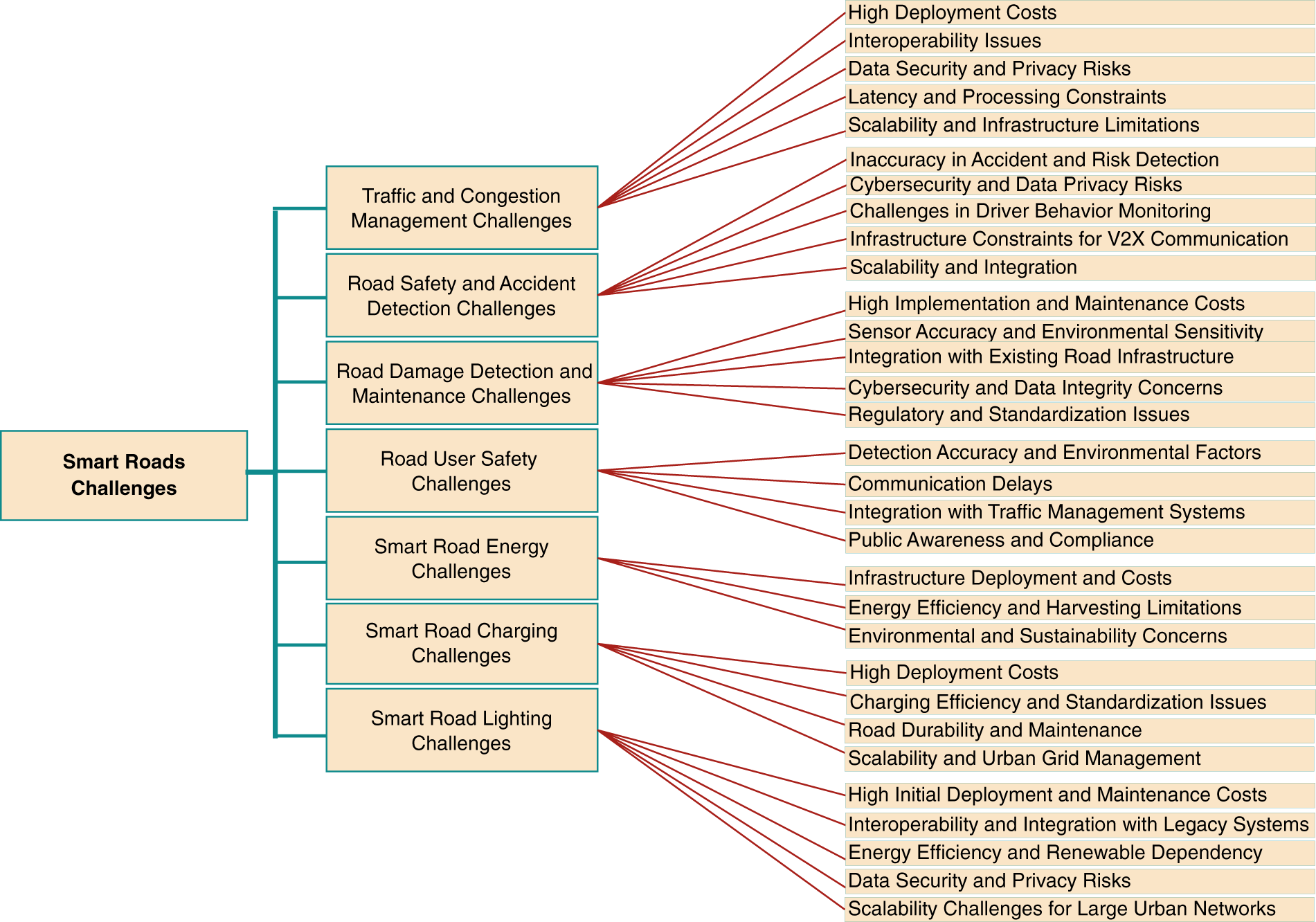
Figure 5: Smart road implementation challenges.
5.1 Traffic and Congestion Management Challenges
The integration of emerging technologies in traffic management has significantly improved congestion control and road efficiency. However, several challenges hinder the large-scale deployment of these technologies in ITS. This subsection discusses the major technical, economic, and operational challenges associated with implementing intelligent traffic and congestion management systems.
A primary challenge is the high deployment cost associated with smart traffic infrastructure. The implementation of emerging technology-based traffic monitoring and congestion management systems requires substantial financial investment. Smart traffic lights, vehicle detection sensors, and V2I communication infrastructures involve high installation and operational costs, limiting large-scale adoption, particularly in developing regions [43,45]. The expense of deploying and maintaining AI enabled smart intersections further constrains scalability [73].
Interoperability remains another critical limitation in modern ITS. Traffic management frameworks rely on diverse technologies such as V2V, V2I, and cloud-based analytics, often operating under different communication protocols. The absence of unified standards across vendors and infrastructure platforms introduces compatibility issues and hinders seamless system integration. In particular, the coexistence of C-V2X and DSRC systems presents communication challenges that affect coordination between vehicles and traffic control networks [21,89].
Data security and privacy concerns also present significant barriers to deployment. The continuous collection and transmission of traffic data through IoT devices increase vulnerability to cyberattacks. Unauthorized access to V2X communication networks may lead to traffic signal manipulation and other hazardous scenarios [130]. Moreover, privacy risks arise as connected vehicles and monitoring systems collect sensitive information related to driver location and movement patterns [24].
Latency and processing constraints further limit the effectiveness of intelligent traffic control systems. Congestion management depends on ultra-low latency communication to support real-time decision-making in dynamic urban environments. Delays in data transmission and computational processing can reduce the accuracy and responsiveness of AI-based predictive models and adaptive signal control strategies, particularly under high traffic density conditions [131,132].
Finally, scalability and infrastructure limitations pose long-term deployment challenges. Expanding intelligent traffic solutions across large metropolitan areas requires complex coordination among interconnected ITS components. In many cases, existing road infrastructure is not designed to support AI-driven adaptive traffic systems, making large-scale implementation dependent on costly retrofitting and infrastructure upgrades [26].
5.2 Road Safety and Accident Detection Challenges
Enhancing road safety and accident detection remains a primary objective of ITS, supported by advanced AI, IoT, and V2X communication technologies. However, the deployment of these solutions faces several challenges, including detection accuracy limitations, cybersecurity risks, infrastructure constraints, and scalability issues [131,133]. Addressing these challenges is essential for ensuring reliable and efficient accident detection and response mechanisms.
A major challenge lies in the accuracy of accident detection and risk assessment systems. Reliable incident identification requires precise sensor data and robust AI models capable of distinguishing actual accidents from false alarms. In practice, sensor limitations, adverse weather conditions, and urban occlusions reduce the effectiveness of CVs-based accident detection systems [99,134]. Furthermore, ML models used for risk assessment often struggle to generalize across diverse traffic environments, leading to inconsistent predictions and reduced reliability [105].
Cybersecurity and data privacy risks represent another critical concern in intelligent accident detection frameworks. Unauthorized access to detection systems may enable data manipulation or false emergency alerts, potentially disrupting emergency response services. In addition, V2X communication networks require strong encryption and secure communication mechanisms to mitigate cyber threats that could compromise road safety operations [130].
Human factor challenges also affect the effectiveness of accident prevention technologies. Monitoring driver behavior through AI-based telematics and biometric sensing faces reliability and user acceptance issues. Fatigue detection systems, for example, may produce false positives or fail to adapt to diverse driver profiles, limiting real-world effectiveness [71]. Continuous monitoring additionally raises privacy concerns, which remain a significant barrier to widespread adoption [32].
Infrastructure limitations further hinder the deployment of V2X-based accident prevention mechanisms. Many regions lack sufficient communication infrastructure to support low latency V2V and V2I communication required for collision avoidance systems [12,26]. Moreover, upgrading legacy vehicles and roadway infrastructure to support V2X capabilities requires substantial investment, slowing adoption of intelligent safety technologies [24].
Finally, scalability and integration challenges arise when combining diverse accident detection and prevention technologies within a unified ITS framework. Traffic cameras, IoT sensors, and ML models must operate cohesively to enable effective accident prevention and response. However, data silos across platforms and jurisdictions restrict real-time information sharing and limit coordinated decision-making.
5.3 Road Damage Detection and Maintenance Challenges
The integration of IoT, AI, and ML technologies in road damage detection and maintenance has significantly improved infrastructure monitoring and predictive maintenance capabilities. Smart road technologies enable continuous assessment of road conditions, pothole detection, and automated maintenance planning. However, several challenges hinder the widespread adoption and operational efficiency of these systems.
A major barrier is the high implementation and maintenance cost associated with smart road monitoring solutions. Deploying intelligent infrastructure requires substantial investment in IoT sensors, high-resolution cameras, and ML-based analytics platforms. The installation of vibration sensors, LiDAR systems, and pressure sensors across large road networks demands significant funding, which limits large-scale deployment [109,111]. In addition, maintaining sensor networks and ensuring proper calibration for reliable data collection further increases operational expenses [48,114].
Sensor accuracy and environmental sensitivity also present important technical challenges. Road surface monitoring relies heavily on IoT sensors and image processing technologies, which can be affected by environmental conditions such as extreme weather, dust accumulation, and road debris. Vibrational sensing systems may produce false readings under heavy vehicle loads, while vision-based damage detection approaches are sensitive to lighting variations and occlusions [86,115,135].
Integration with existing road infrastructure remains another significant limitation. Many cities continue to depend on conventional inspection and maintenance procedures, making the transition toward smart monitoring systems complex. Incorporating IoT-based damage detection often requires infrastructure modifications, including embedded sensing installations and upgrades to municipal data management systems [75]. Furthermore, interoperability between modern smart maintenance platforms and legacy infrastructure introduces additional implementation challenges [86].
Cybersecurity and data integrity risks represent further obstacles to large-scale deployment. The massive volume of road condition data collected through IoT monitoring systems is vulnerable to cyber threats. Unauthorized access to predictive maintenance platforms could lead to data manipulation, resulting in incorrect maintenance decisions and compromised road safety [136]. Although blockchain technologies and end-to-end encryption can enhance data integrity, integrating these security mechanisms increases both system complexity and deployment costs [51].
Finally, regulatory and standardization issues limit uniform adoption of smart maintenance technologies. The absence of unified standards for IoT sensor integration, data sharing protocols, and road assessment models results in inconsistent implementations across regions and platforms [83]. Establishing standardized frameworks is therefore essential for achieving scalable and interoperable smart road maintenance systems.
5.4 Road User Safety Challenges
Ensuring the safety of pedestrians and other vulnerable road users presents several challenges in modern ITS. Despite advancements in IoT monitoring, AI-based detection, and V2X communication, multiple technical and operational limitations hinder the effective implementation of pedestrian safety mechanisms.
Detection accuracy remains a primary challenge in pedestrian protection systems. AI-based pedestrian detection approaches are sensitive to environmental conditions such as poor lighting, fog, and visual occlusions, which can reduce system reliability [30,31]. Improving sensor fusion strategies and enabling robust real-time processing are critical requirements for achieving dependable pedestrian safety performance [125,126].
Communication latency also limits the effectiveness of intelligent safety interventions. Pedestrian protection mechanisms rely on low latency communication among vehicles, roadside infrastructure, and road users. However, existing communication networks, particularly in underdeveloped regions, often experience delays that reduce the responsiveness and effectiveness of safety systems [33,50].
Integration with broader traffic management frameworks presents an additional challenge. Although AI-based pedestrian safety models improve risk prediction, integrating these models with traffic monitoring, congestion control, and signal optimization systems requires seamless interoperability. Coordinating pedestrian protection with dynamic traffic management remains complex and technically demanding [32].
Human factors and public compliance further influence the success of pedestrian safety technologies. Even with advanced intelligent systems, safety outcomes depend on user awareness and adherence to traffic rules. Ensuring that pedestrians and drivers understand and appropriately respond to smart infrastructure functionalities is essential for maximizing the benefits of intelligent safety solutions [50,137].
5.5 Smart Road Energy Challenges
The deployment of energy harvesting solutions, including photovoltaic roadways and piezoelectric systems, introduces several challenges related to cost, efficiency, scalability, and environmental sustainability [129]. Addressing these limitations is essential for ensuring the long-term reliability and viability of renewable energy-based smart road infrastructure.
Infrastructure deployment and associated costs represent a primary barrier to large-scale adoption. The installation of solar roadways and piezoelectric harvesting systems requires substantial financial investment and modifications to existing urban infrastructure. Embedding these technologies within road networks involves specialized materials, structural reinforcement, and advanced installation procedures, increasing overall implementation costs [57,120].
Energy efficiency and harvesting limitations further constrain practical deployment. Renewable energy generation in road environments is strongly influenced by environmental variability. Fluctuations in sunlight exposure, vehicle induced pressure levels, and temperature changes directly affect the efficiency and consistency of photovoltaic and piezoelectric systems [120,127,128]. These variations reduce predictability in power output and complicate energy management strategies.
Energy efficiency and harvesting limitations further constrain practical deployment. Renewable energy generation in road environments is strongly influenced by environmental variability. Fluctuations in sunlight exposure, vehicle induced pressure levels, and temperature changes directly affect the efficiency and consistency of photovoltaic and piezoelectric systems [120,127,128]. These variations reduce predictability in power output and complicate energy management strategies. Moreover, existing studies report that solar roadways and piezoelectric harvesting systems still face durability, maintenance, and cost-effectiveness challenges, which limit their large-scale real-world adoption.
Environmental and lifecycle sustainability concerns also require careful consideration. Although smart road energy technologies promote renewable energy utilization, the production, maintenance, and disposal of photovoltaic cells, piezoelectric materials, and electronic components generate environmental burdens. Proper recycling frameworks and lifecycle management strategies are necessary to mitigate electronic waste and reduce long-term ecological impact [120].
5.6 Smart Road Charging Challenges
Wireless and inductive EV charging solutions are considered key enablers of future transportation infrastructure; however, their deployment faces several technological, economic, and operational challenges.
High deployment cost represents a major limitation in adopting smart road charging systems. The installation of inductive charging lanes and wireless charging stations requires substantial financial investment and significant modifications to existing road infrastructure. Replacing or retrofitting conventional roads to support embedded charging technologies is expensive and technically complex [17,127].
Charging efficiency and standardization issues further constrain large-scale adoption. Inductive charging performance is affected by coil misalignment, energy transfer losses, and variations in EV battery specifications. In addition, the lack of unified wireless charging standards limits interoperability among vehicle manufacturers and charging networks, complicating system integration [17,127].
Road durability and maintenance requirements introduce additional operational challenges. Embedding charging infrastructure into road surfaces raises concerns regarding long-term structural reliability under heavy vehicular loads and environmental exposure. These factors increase maintenance frequency and associated operational costs [57,120].
Scalability and urban grid management also present significant challenges when expanding charging infrastructure. Supporting large-scale EV charging demands advanced power distribution and grid coordination strategies. Managing peak energy loads and preventing grid overload in dense urban environments requires adaptive energy balancing and intelligent load management techniques [129].
5.7 Smart Road Lighting Challenges
The integration of intelligent lighting solutions into smart road systems aims to enhance visibility, safety, and energy efficiency. However, several technical, economic, and operational challenges limit large-scale deployment and effective implementation.
High initial deployment and maintenance costs represent a major barrier to adoption. Transitioning from conventional lighting infrastructure to smart lighting requires substantial investment in LED technologies, adaptive control mechanisms, and sensor-based automation systems [68]. Replacing or upgrading existing road lighting networks further increases deployment costs, making large-scale implementation financially challenging [120].
Interoperability and integration with legacy infrastructure also present significant difficulties. Many urban areas continue to rely on traditional street lighting systems, complicating the integration of adaptive intelligent lighting solutions. Standardized communication protocols are required to ensure seamless interoperability among diverse lighting platforms and urban management systems [121,122].
Energy efficiency and renewable energy dependency introduce additional operational constraints. Although smart lighting systems aim to optimize power utilization, reliance on solar energy and other renewable sources can result in inconsistent power availability during adverse weather conditions [120]. Advanced energy storage and intelligent power management strategies are therefore necessary to ensure continuous and reliable lighting performance [127].
Data security and privacy risks must also be addressed in connected lighting infrastructures. Smart lighting networks continuously collect and transmit information related to road conditions, vehicle movement, and environmental factors [83]. Unauthorized access to these networks introduces cybersecurity threats, requiring robust encryption mechanisms and secure data management frameworks, including blockchain-based security approaches [51,136].
Scalability challenges arise when expanding smart lighting solutions across large urban environments. Large scale deployment requires extensive infrastructure upgrades, efficient data processing, and adaptive energy management mechanisms. The integration of Mobile Edge Computing (MEC)-based lighting control units has been proposed to reduce latency and improve operational efficiency in large-scale smart lighting networks [123,131].
6 Future Directions and Potential
The future of smart roads lies in emerging technologies (e.g., 5G/6G networks, AI-based analytics, autonomous vehicle integration, and sustainable infrastructure solutions) as shown in Fig. 6. These advancements promise to enhance road safety, traffic efficiency, and environmental sustainability. The following section explores the potential developments and transformative impact of smart road technologies.
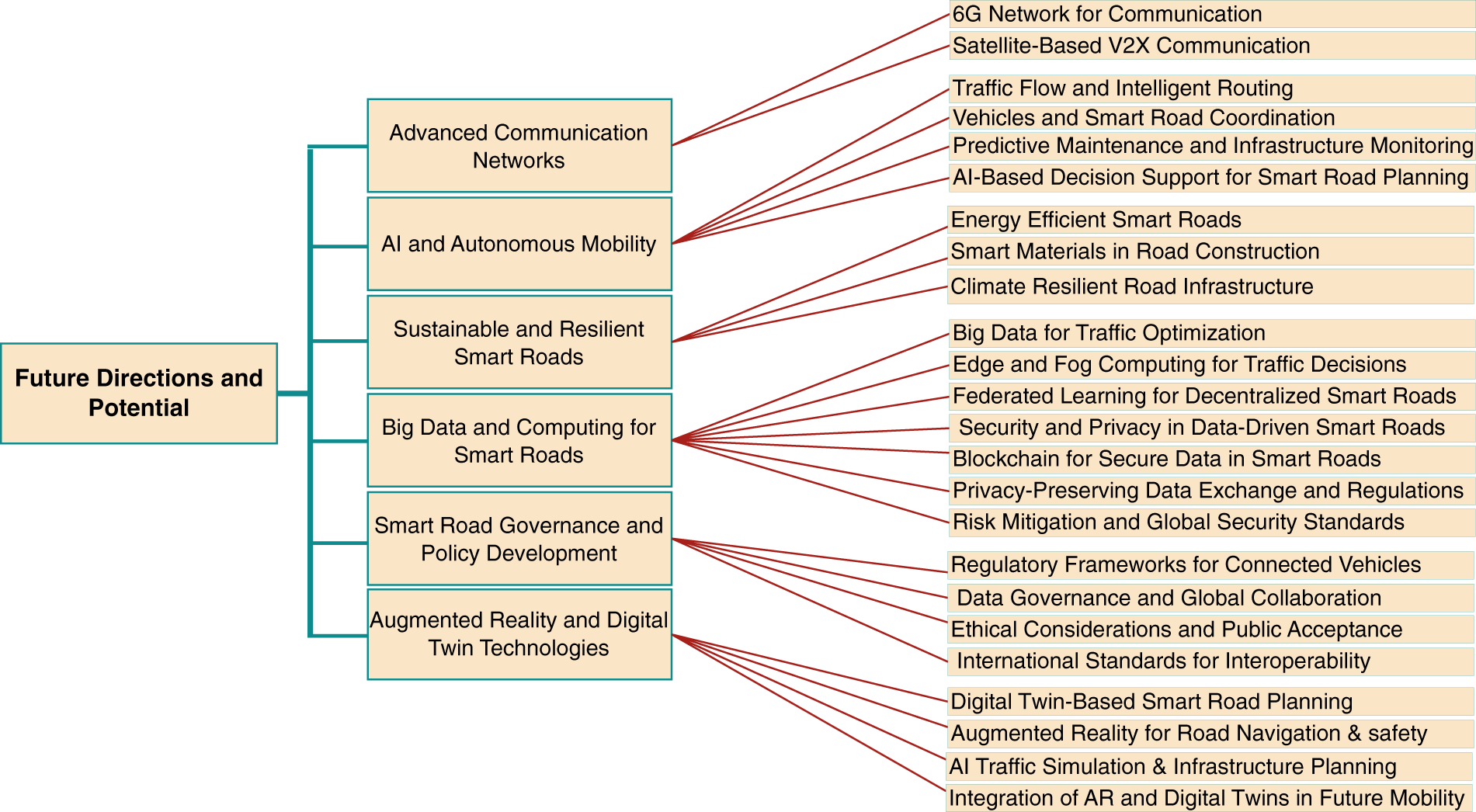
Figure 6: The future directions and potential of smart roads.
6.1 Advanced Communication Networks
Future smart road systems are expected to rely on advanced communication networks capable of supporting large-scale data exchange, seamless vehicle coordination, and highly efficient traffic management. The evolution from 5G toward 6G communication technologies is anticipated to provide ultra-low latency, enhanced reliability, and significantly higher data throughput, addressing the growing requirements of connected and AVs ecosystems [14,20].
The integration of AI within 6G enabled vehicular networks represents a major research direction for intelligent transportation systems. Combining AI-driven analytics with next-generation communication infrastructures will support real-time sensor fusion, distributed decision-making, and predictive traffic coordination [14]. In parallel, blockchain-based secure communication frameworks are expected to play an important role in strengthening network security and ensuring trusted V2X data exchange against cyber threats [19].
Satellite assisted V2X communication is emerging as an important approach for extending connectivity beyond urban environments. Integrating satellite networks with terrestrial communication infrastructure can reduce coverage gaps in remote and underdeveloped regions, enabling reliable vehicular communication and traffic monitoring. Furthermore, high definition satellite imaging combined with intelligent road systems may support improved congestion detection and adaptive traffic management at regional and national scales [14].
6.2 AI and Autonomous Mobility
AI is expected to play a central role in intelligent mobility by enhancing traffic management, improving vehicle coordination, and enabling predictive infrastructure monitoring. Future smart road ecosystems will increasingly rely on AI-driven automation and ML analytics to improve operational efficiency, reduce congestion, and strengthen road safety.
A key research direction is AI enabled traffic flow optimization and intelligent routing. ML models can analyze historical and real-time traffic data to predict congestion patterns and support dynamic adjustments in traffic signal timing, lane allocation, and vehicle rerouting strategies [26]. The coupling of V2X communication with AI enabled edge computing is also expected to improve responsiveness by enabling low latency V2I interactions and adaptive traffic control mechanisms [24].
Autonomous mobility further depends on reliable coordination between vehicles and roadside infrastructure. Advanced DL techniques, including CNNs models and reinforcement learning, enhance perception and decision-making by supporting obstacle detection, road understanding, and robust driving policies under dynamic conditions [31]. In addition, smart intersections and connected infrastructure combined with V2V communication can enable cooperative driving strategies that reduce collision risks and improve overall road utilization [21].
Predictive maintenance and infrastructure monitoring represent another important direction for AI enabled smart roads. IoT sensors can continuously monitor pavement condition, traffic loads, and environmental variables, while AI models analyze these data streams to forecast degradation and schedule interventions before major failures occur [109]. This proactive approach reduces downtime, lowers long-term repair costs, and extends infrastructure lifespan [114].
At the planning level, AI-driven decision support can strengthen strategic development of road networks and mobility policies. Decision support systems can analyze large-scale datasets, including traffic demand, land use, and environmental indicators, to generate optimized infrastructure designs and policy recommendations [136]. Moreover, AI-based simulation frameworks can evaluate alternative road layouts, traffic scenarios, and autonomous deployment strategies to support adaptive and data-driven planning [138].
6.3 Sustainable and Resilient Smart Roads
The development of sustainable and climate resilient smart road infrastructure represents a key future direction for intelligent transportation systems. Integrating renewable energy technologies, advanced construction materials, and environmental monitoring mechanisms can improve long-term efficiency, reduce environmental impact, and enhance infrastructure durability under varying climatic conditions.
A major research focus involves energy-efficient smart roads that incorporate renewable energy generation and utilization mechanisms. Technologies such as solar powered roadways, piezoelectric energy harvesting, and wireless charging systems can contribute to energy self sustainability within transportation networks. Photovoltaic road surfaces can generate electricity for street lighting, traffic control systems, and EV charging infrastructure, reducing dependence on conventional power grids [120]. Similarly, piezoelectric materials embedded within road surfaces convert vehicular pressure into electrical energy to support roadside systems [57], while inductive charging lanes enable continuous energy transfer to moving EVs and improve mobility efficiency [127].
The adoption of smart materials in road construction is another promising direction for improving infrastructure longevity and sustainability. Self healing asphalt and concrete containing embedded rejuvenating agents can autonomously repair minor cracks, limiting structural degradation and reducing maintenance requirements [114]. In addition, permeable pavements improve water drainage and reduce surface runoff, helping mitigate urban flooding risks [48]. Emerging nanotechnology-based materials further enhance strength, flexibility, and environmental resistance, supporting long lasting and resilient road structures.
Climate resilient road infrastructure supported by intelligent monitoring is also expected to play an increasingly important role. Roads equipped with embedded temperature sensors and environmental monitoring systems can provide real-time awareness of changing weather conditions and enable predictive maintenance strategies. Advanced thermal coatings and reflective materials may reduce heat accumulation and improve durability in high temperature environments. Furthermore, AI-driven climate adaptation models can assist in optimizing material selection and infrastructure design based on predictive environmental analytics, improving resilience against extreme climate events.
6.4 Big Data and Computing for Smart Roads
Big data analytics and advanced computing paradigms are expected to play a fundamental role in enabling intelligent, adaptive, and scalable smart road infrastructures. By combining large-scale data analytics, ML models, and distributed computing architectures, future transportation systems can support improved traffic management, predictive maintenance, and data-driven decision-making [45,131]. The convergence of edge, fog, and cloud computing with intelligent analytics is anticipated to further enhance system responsiveness and operational scalability [139].
A major research direction involves the use of big data analytics for traffic optimization and mobility management. Large scale datasets collected from GPS trajectories, connected vehicles, roadside sensors, and telematics platforms enable the identification of congestion patterns and traffic dynamics. ML driven predictive models can support adaptive traffic signal control, real-time rerouting, and infrastructure planning decisions that improve mobility efficiency and reduce congestion [45,87].
Edge and fog computing paradigms are increasingly important for enabling low latency decision-making in smart roads. Processing data closer to its source allows traffic analytics and control decisions to be executed in real-time, reducing reliance on centralized cloud infrastructures [60]. Distributed computation at RSUs and vehicle nodes improves responsiveness for congestion management, emergency routing, and safety applications, while supporting reliable V2I and V2V communication for connected and autonomous mobility [24,131].
Decentralized learning approaches, particularly federated learning, represent an emerging direction for intelligent transportation systems. Federated learning enables vehicles and infrastructure nodes to collaboratively train AI models without sharing raw data, improving privacy while supporting distributed intelligence [140,141]. These frameworks can enhance traffic prediction, routing optimization, and cooperative mobility management while reducing risks associated with centralized data collection [26,136].
As smart roads become increasingly data-driven, ensuring security and privacy remains a critical research priority. The large-scale exchange of vehicular and infrastructure data introduces cybersecurity risks that require advanced encryption, secure authentication, and privacy-preserving analytics [51]. Blockchain-based data management and decentralized authentication mechanisms can provide tamper-resistant communication and trusted identity verification within V2X networks [24,142]. In addition, privacy-preserving techniques such as federated learning, homomorphic encryption, and zero-knowledge proofs support secure data exchange while maintaining compliance with regulatory frameworks [49,136].
Future smart road ecosystems will also require standardized cybersecurity policies and global risk mitigation strategies. Multi-layered security architectures combining AI-based anomaly detection, secure over-the-air updates, and robust encryption protocols are expected to strengthen system resilience against emerging threats [136]. Establishing international security standards and governance frameworks will be essential for ensuring interoperability, trust, and long-term sustainability in data-driven transportation environments [51,143].
6.5 Smart Road Governance and Policy Development
The large-scale deployment of smart road infrastructure requires robust governance frameworks, regulatory oversight, and clear policy guidelines to ensure safe and equitable adoption. As transportation systems increasingly integrate AI, IoT, and V2X technologies, governance strategies must address operational safety, cybersecurity, data management, and public trust to support sustainable smart mobility ecosystems [83].
A primary research and policy direction involves the development of regulatory frameworks for connected and autonomous mobility. The rapid adoption of intelligent transportation technologies requires standardized policies to govern system reliability, AI-driven decision processes, and autonomous vehicle operations. Regulatory initiatives are increasingly focused on ensuring transparency, accountability, and compliance with international safety requirements while enabling the safe coexistence of autonomous and human driven vehicles [21,24].
Effective data governance is also essential as smart roads rely on continuous data exchange among vehicles, infrastructure, and traffic authorities. Establishing standardized data sharing policies and interoperability frameworks can enable secure cross-platform communication across regions [136]. Collaboration among governments, industry stakeholders, and regulatory bodies is required to develop unified cybersecurity regulations, privacy protection policies, and cross-border data governance strategies. Technologies such as blockchain-based authentication further support data integrity and trusted information exchange within transportation ecosystems [51,143].
Ethical considerations represent another important dimension of future smart road governance. The use of AI-driven automation in traffic control, safety monitoring, and infrastructure management raises concerns related to algorithmic bias, liability, and decision accountability [136]. Policy frameworks must therefore establish guidelines for fairness, transparency, and bias mitigation while ensuring responsible use of intelligent systems. Public acceptance will depend on clear regulatory oversight, transparent system behavior, and effective communication of the benefits and limitations of smart road technologies [140].
International standardization efforts are expected to play a critical role in enabling interoperability across global smart transportation networks. Organizations such as ISO, IEEE, and the United Nations Economic Commission for Europe (UNECE) are actively developing standards for connected vehicle communication, cybersecurity, and intelligent infrastructure management [21,24]. Harmonized global policies can facilitate cross-border mobility, ensure technology compatibility, and support consistent deployment of secure and interoperable smart road systems.
6.6 Augmented Reality (AR) and Digital Twin Technologies
The integration of AR and digital twin technologies is emerging as a significant direction for intelligent and adaptive smart road ecosystems. Digital twin frameworks enable virtual representations of physical road infrastructures, supporting real-time monitoring, predictive analytics, and data-driven operational optimization. In parallel, AR technologies enhance situational awareness by overlaying contextual traffic information onto real environments, contributing to safer and more efficient mobility systems [12,138].
Digital twin-based infrastructure management represents a key research direction for future smart roads. High-fidelity virtual replicas of road networks can continuously integrate data from IoT sensors, traffic monitoring platforms, and environmental systems to evaluate infrastructure conditions and support predictive maintenance [138]. These models enable scenario-based analysis for lifecycle management, allowing authorities to anticipate structural degradation, optimize maintenance scheduling, and reduce long-term operational costs through intelligent analytics [48,114].
AR technologies are expected to play an important role in enhancing navigation and traffic safety. By superimposing real-time navigation guidance, hazard alerts, and traffic information onto the physical environment, AR assisted systems can improve driver awareness and response time [12]. Heads-up display (HUD) systems provide contextual road information directly within the driver’s field of view, supporting safer decision-making under dynamic traffic conditions [21]. Moreover, AR-enabled pedestrian assistance and V2P interaction mechanisms can improve safety for vulnerable road users through real-time alerts and adaptive crossing guidance [31].
The combination of AI-driven traffic simulation with digital twin environments further strengthens infrastructure planning and mobility optimization. Predictive models can analyze traffic patterns, congestion behavior, and vehicle interactions to simulate future transportation scenarios and evaluate alternative infrastructure designs [87,144]. Such simulation environments support adaptive lane management, intelligent intersection planning, and optimized road layouts to improve overall system efficiency [24].
The convergence of AR and digital twin technologies is expected to enable more responsive and intelligent mobility ecosystems. Integrated platforms can support autonomous navigation assistance, real-time infrastructure adaptation, and dynamic traffic coordination by linking virtual models with real-world sensing systems [21]. This convergence may further enhance autonomous vehicle operation by improving obstacle awareness, route planning, and cooperative mobility management in future smart road environments [31].
This study provides a comprehensive review of smart road technologies, including advanced communication systems, IoT, AI, Big Data, Edge and Cloud Computing, Blockchain, and energy harvesting solutions. These technologies hold significant potential to enhance road safety, optimize traffic management, and support the development of sustainable infrastructure. The paper outlines practical applications of smart roads, such as adaptive traffic management, accident prevention, smart lighting, and energy-efficient infrastructure. The research critically examines the challenges associated with implementing smart roads, addressing technical, financial, regulatory, data security, privacy, and social considerations. Overcoming these challenges is essential for the successful large-scale deployment and integration of smart road systems. The study also explores emerging trends and future directions, highlighting advancements in 5G/6G networks, AI-based analytics, and autonomous vehicle integration within urban mobility solutions. By integrating technological innovations with effective policy frameworks and strategic governance, smart roads can transform modern transportation networks. These advancements promise safer, more efficient, and environmentally sustainable urban mobility, aligning with global initiatives to mitigate traffic-related challenges and enhance smart city development.
Acknowledgement: The authors used AI-based language assistance tools for grammar correction and linguistic refinement during manuscript preparation.
Funding Statement: The authors received no specific funding for this study.
Author Contributions: Afzal Badshah conceived the research idea, coordinated the study, and led the manuscript preparation. Ali Daud contributed to framing the research objectives, methodology design, and critical revisions of the draft. Sachi Arafat worked on the literature review and analysis of enabling technologies. Wafa Almukadi contributed to the synthesis of applications and use cases of smart roads. Riad Alharbey assisted in identifying and analyzing challenges, as well as reviewing technical details. Hussain Dawood contributed to future research directions, editing, and overall refinement of the manuscript. All authors reviewed and approved the final version of the manuscript.
Availability of Data and Materials: Data sharing not applicable to this article as no datasets were generated or analysed during the current study.
Ethics Approval: This article does not contain any studies involving human participants or animals performed by any of the authors.
Conflicts of Interest: The authors declare no conflicts of interest.
References
1. Insights FB. Smart transportation market. 2025 [cited 2025 Feb 4]. Available from: https://www.fortunebusinessinsights.com/smart-transportation-market-105736. [Google Scholar]
2. Anwar AHMM, Oakil AT. Smart transportation systems in smart cities: practices, challenges, and opportunities for Saudi Cities. In: Smart cities. Cham, Switzerland: Springer International Publishing; 2023. p. 315–37. doi:10.1007/978-3-031-35664-3_17. [Google Scholar] [CrossRef]
3. WHO. Road traffic injuries. 2025 [cited 2025 Feb 4]. Available from: https://www.who.int/news-room/fact-sheets/detail/road-traffic-injuries. [Google Scholar]
4. Statista. Carbon dioxide emissions from passenger transport worldwide from 2010 to 2025. 2025 [cited 2025 Feb 4]. Available from: https://www.statista.com/statistics/1107970/carbon-dioxideemissions-passenger-transport/. [Google Scholar]
5. Our Word in Data. Number of deaths from road injuries. 2025 [cited 2025 Feb 4]. Available from: https://ourworldindata.org/grapher/number-of-deaths-from-road-injuries?tab=chart. [Google Scholar]
6. Ahangar MN, Ahmed QZ, Khan FA, Hafeez M. A survey of autonomous vehicles: enabling communication technologies and challenges. Sensors. 2021;21(3):706. doi:10.3390/s21030706. [Google Scholar] [CrossRef]
7. Shohel Parvez M, Moridpour S. Application of smart technologies in safety of vulnerable road users: a review. Int J Transp Sci Technol. 2025;18(5):285–304. doi:10.1016/j.ijtst.2024.07.006. [Google Scholar] [CrossRef]
8. Ahmad U, Han M, Jolfaei A, Jabbar S, Ibrar M, Erbad A, et al. A comprehensive survey and tutorial on smart vehicles: emerging technologies, security issues, and solutions using machine learning. IEEE Trans Intell Transp Syst. 2024;25(11):15314–41. doi:10.1109/TITS.2024.3419988. [Google Scholar] [CrossRef]
9. Alanazi F. The future of transportation: blockchain-powered solutions. Transp J. 2025;64(1):e12032. doi:10.1002/tjo3.12032. [Google Scholar] [CrossRef]
10. Trubia S, Severino A, Curto S, Arena F, Pau G. Smart roads: an overview of what future mobility will look like. Infrastructures. 2020;5(12):107. doi:10.3390/infrastructures5120107. [Google Scholar] [CrossRef]
11. Tsigdinos S, Tzouras PG, Bakogiannis E, Kepaptsoglou K, Nikitas A. The future urban road: a systematic literature review-enhanced Q-method study with experts. Transp Res Part D Transp Environ. 2022;102(1):103158. doi:10.1016/j.trd.2021.103158. [Google Scholar] [CrossRef]
12. Hejazi H, Bokor L. V2X-equipped smart intersections-survey of surveys, use cases, and deployments. J Commun. 2023:722–38. doi:10.12720/jcm.18.11.722-738. [Google Scholar] [CrossRef]
13. Guerrero-Ibáñez J, Zeadally S, Contreras-Castillo J. Sensor technologies for intelligent transportation systems. Sensors. 2018;18(4):1212. doi:10.3390/s18041212. [Google Scholar] [CrossRef]
14. Noor-A-Rahim M, Liu Z, Lee H, Khyam MO, He J, Pesch D, et al. 6G for vehicle-to-everything (V2X) communications: enabling technologies, challenges, and opportunities. Proc IEEE. 2022;110(6):712–34. doi:10.1109/JPROC.2022.3173031. [Google Scholar] [CrossRef]
15. Adnan Yusuf S, Khan A, Souissi R. Vehicle-to-everything (V2X) in the autonomous vehicles domain-a technical review of communication, sensor, and AI technologies for road user safety. Transp Res Interdiscip Perspect. 2024;23(11):100980. doi:10.1016/j.trip.2023.100980. [Google Scholar] [CrossRef]
16. Khanmohamadi M, Guerrieri M. Advanced sensor technologies in CAVs for traditional and smart road condition monitoring: a review. Sustainability. 2024;16(19):8336. doi:10.3390/su16198336. [Google Scholar] [CrossRef]
17. Warsi MH, Nandha Kumar T. Advances in energy harnessing techniques for smart highways: a review. Electr Eng. 2024;106(5):6389–408. doi:10.1007/s00202-024-02379-8. [Google Scholar] [CrossRef]
18. Badshah DA. PRISMA checklist for smart roads. Geneve, Switzerland: Zenodo; 2025. doi:10.5281/zenodo.17778003. [Google Scholar] [CrossRef]
19. Rajawat AS, Goyal SB, Bedi P, Verma C, Ionete EI, Raboaca MS. 5G-enabled cyber-physical systems for smart transportation using blockchain technology. Mathematics. 2023;11(3):679. doi:10.3390/math11030679. [Google Scholar] [CrossRef]
20. Hijji M, Iqbal R, Kumar Pandey A, Doctor F, Karyotis C, Rajeh W, et al. 6G connected vehicle framework to support intelligent road maintenance using deep learning data fusion. IEEE Trans Intell Transp Syst. 2023;24(7):7726–35. doi:10.1109/TITS.2023.3235151. [Google Scholar] [CrossRef]
21. Wu W, Wang X, Chu P. An overview of wireless communication technology applications for smart roads. Urban Trans Syst. 2023;3(1):11–7. [Google Scholar]
22. Al-Yarimi FAM. Enhancing road safety through advanced predictive analytics in V2X communication networks. Comput Electr Eng. 2024;115(4):109134. doi:10.1016/j.compeleceng.2024.109134. [Google Scholar] [CrossRef]
23. Mchergui A, Moulahi T, Ben Othman MT, Nasri S. Enhancing VANETs broadcasting performance with mobility prediction for smart road. Wirel Pers Commun. 2020;112(3):1629–41. doi:10.1007/s11277-020-07119-2. [Google Scholar] [CrossRef]
24. Bin Naeem A, Soomro AM, Saim HM, Malik H. Smart road management system for prioritized autonomous vehicles under vehicle-to-everything (V2X) communication. Multimed Tools Appl. 2024;83(14):41637–54. doi:10.1007/s11042-023-16950-1. [Google Scholar] [CrossRef]
25. Guerrieri M. Smart roads geometric design criteria and capacity estimation based on AV and CAV emerging technologies. A case study in the trans-European transport network. Int J Intell Transp Syst Res. 2021;19(2):429–40. doi:10.1007/s13177-021-00255-4. [Google Scholar] [CrossRef]
26. Yu M. Construction of regional intelligent transportation system in smart city road network via 5G network. IEEE Trans Intell Transp Syst. 2023;24(2):2208–16. doi:10.1109/TITS.2022.3141731. [Google Scholar] [CrossRef]
27. Vidyarthi A, Coxon S, Napper R, Gusheh M. A proposed hierarchy of smart roads: assisting future technological developments. In: Design in the era of industry 4.0, volume 2. Singapore: Springer; 2023. p. 455–66. doi:10.1007/978-981-99-0264-4_38. [Google Scholar] [CrossRef]
28. Jangam NR, Ramesh GP, Rachana P. A review on smart road traffic management system using LoRa WAN. In: Distributed computing and optimization techniques. Singapore: Springer; 2022. p. 45–54. doi:10.1007/978-981-19-2281-7_5. [Google Scholar] [CrossRef]
29. Shahid N, Ali Shah M, Khan A, Maple C, Jeon G. Towards greener smart cities and road traffic forecasting using air pollution data. Sustain Cities Soc. 2021;72(4):103062. doi:10.1016/j.scs.2021.103062. [Google Scholar] [CrossRef]
30. Wang H, Li C, Zhang Y, Liu Z, Hui Y, Mao G. A scheme on pedestrian detection using multi-sensor data fusion for smart roads. In: Proceedings of the 2020 IEEE 91st Vehicular Technology Conference (VTC2020-Spring); 2020 May 25–28; Antwerp, Belgium. p. 1–5. doi:10.1109/vtc2020-spring48590.2020.9128855. [Google Scholar] [CrossRef]
31. Djenouri Y, Belhadi A, Srivastava G, Djenouri D, Chun-Wei Lin J. Vehicle detection using improved region convolution neural network for accident prevention in smart roads. Pattern Recognit Lett. 2022;158(7):42–7. doi:10.1016/j.patrec.2022.04.012. [Google Scholar] [CrossRef]
32. El Hamdani S, Benamar N, Younis M. Pedestrian support in intelligent transportation systems: challenges, solutions and open issues. Transp Res Part C Emerg Technol. 2020;121:102856. doi:10.1016/j.trc.2020.102856. [Google Scholar] [CrossRef]
33. Praticò FG, Bosurgi G, Bruneo D, Cafiso S, De Vita F, Di Graziano A, et al. Innovative smart road management systems in the urban context: integrating smart sensors and miniaturized sensing systems. Struct Control Health Monit. 2022;29(10):e3044. doi:10.1002/stc.3044. [Google Scholar] [CrossRef]
34. Colley M, Rukzio E. A design space for external communication of autonomous vehicles. In: Proceedings of the 12th International Conference on Automotive User Interfaces and Interactive Vehicular Applications; 2020 Sep 21–22; Virtual Event. p. 212–22. doi:10.1145/3409120.3410646. [Google Scholar] [CrossRef]
35. Sabella D, Brevi D, Bonetto E, Ranjan A, Manzalini A, Salerno D. MEC-based infotainment services for smart roads in 5G environments. In: Proceedings of the 2020 IEEE 91st Vehicular Technology Conference (VTC2020-Spring); 2020 May 25–28; Antwerp, Belgium. p. 1–6. doi:10.1109/vtc2020-spring48590.2020.9128807. [Google Scholar] [CrossRef]
36. Sun G, Zhang Y, Liao D, Yu H, Du X, Guizani M. Bus-trajectory-based street-centric routing for message delivery in urban vehicular ad hoc networks. IEEE Trans Veh Technol. 2018;67(8):7550–63. doi:10.1109/TVT.2018.2828651. [Google Scholar] [CrossRef]
37. Colley M, Fabian T, Rukzio E. Investigating the effects of external communication and automation behavior on manual drivers at intersections. Proc ACM Hum-Comput Interact. 2022;6(MHCI):1–16. doi:10.1145/3546711. [Google Scholar] [CrossRef]
38. Yao Y, Shu F, Cheng X, Liu H, Miao P, Wu L. Automotive radar optimization design in a spectrally crowded V2I communication environment. IEEE Trans Intell Transp Syst. 2023;24(8):8253–63. doi:10.1109/TITS.2023.3264507. [Google Scholar] [CrossRef]
39. Alsahfi T, Almotairi M, Elmasri R, Alshemaimri B. Road map generation and feature extraction from GPS trajectories data. In: Proceedings of the 12th ACM SIGSPATIAL International Workshop on Computational Transportation Science; 2019 Nov 5; Chicago, IL, USA. p. 1–10. doi:10.1145/3357000.3366140. [Google Scholar] [CrossRef]
40. Badshah A, Daud A, Alhajlah M, Alsahfi T, Alshemaimri B, Ur-Rehman G. Smart cities’ big data: performance and cost optimization with regional computing. IEEE Access. 2024;12(70):128896–908. doi:10.1109/ACCESS.2024.3457269. [Google Scholar] [CrossRef]
41. Dong J, Meng W, Liu Y, Ti J. A framework of pavement management system based on IoT and big data. Adv Eng Inform. 2021;47(2):101226. doi:10.1016/j.aei.2020.101226. [Google Scholar] [CrossRef]
42. Alazeb A, Chughtai BR, Al Mudawi N, AlQahtani Y, Alonazi M, Aljuaid H, et al. Remote intelligent perception system for multi-object detection. Front Neurorobot. 2024;18:1398703. doi:10.3389/fnbot.2024.1398703. [Google Scholar] [CrossRef]
43. De Vita F, Sollazzo G, Bruneo D, Pellegrino O, Bosurgi G. A cloud platform for collecting and processing road pavement multi sensor data. In: Proceedings of the 2021 IEEE International Conference on Smart Computing (SMARTCOMP); 2021 Aug 23–27; Irvine, CA, USA. p. 353–8. doi:10.1109/SMARTCOMP52413.2021.00072. [Google Scholar] [CrossRef]
44. Nawaratne R, Kahawala S, Nguyen S, De Silva D. A generative latent space approach for real-time road surveillance in smart cities. IEEE Trans Ind Inform. 2021;17(7):4872–81. doi:10.1109/TII.2020.3037286. [Google Scholar] [CrossRef]
45. Ahmed MJ, Iqbal S, Awan KM, Sattar K, Khan ZA, Sherazi HHR. A congestion aware route suggestion protocol for traffic management in Internet of Vehicles. Arab J Sci Eng. 2020;45(4):2501–11. doi:10.1007/s13369-019-04099-9. [Google Scholar] [CrossRef]
46. Almotairi M, Alsahfi T, Elmasri R. Challenges of comparing and matching roads from different spatial datasets. In: Proceedings of the 12th ACM International Conference on PErvasive Technologies Related to Assistive Environments; 2019 Jun 5–7; Rhodes, Greece. p. 164–71. doi:10.1145/3316782.3316787. [Google Scholar] [CrossRef]
47. Mishra KN. A novel integration of smart vehicles and secure clouds for supervising vehicle accidents on roads/highways. Sādhanā. 2020;45(1):88. doi:10.1007/s12046-020-1320-9. [Google Scholar] [CrossRef]
48. Alshmmari AS. A novelty design of a smart road for crowd prediction and prevention SRCPP. Int J Adv Appl Sci. 2021;8(9):39–42. doi:10.21833/ijaas.2021.09.005. [Google Scholar] [CrossRef]
49. C KS, Divakarala U, Chandrasekaran K, Reddy KHK. A hierarchical blockchain architecture for secure data sharing for vehicular networks. Int J Inf Technol. 2023;15(3):1689–97. doi:10.1007/s41870-023-01175-0. [Google Scholar] [CrossRef]
50. Teixeira P, Sargento S, Rito P, Luís M, Castro F. A sensing, communication and computing approach for vulnerable road users safety. IEEE Access. 2023;11(2):4914–30. doi:10.1109/ACCESS.2023.3235863. [Google Scholar] [CrossRef]
51. Badshah A, Daud A, Khan HU, Alghushairy O, Bukhari A. Optimizing the over and underutilization of network resources during peak and off-peak hours. IEEE Access. 2024;12(2):82549–59. doi:10.1109/ACCESS.2024.3402396. [Google Scholar] [CrossRef]
52. Feng S, Li N, Liu K, Li B, Dong C, Wu Q. A cross Q-learning assisted resource allocation for user-centric optical wireless communication networks. IEEE Trans Green Commun Netw. 2025;9(4):2264–78. doi:10.1109/TGCN.2025.3553202. [Google Scholar] [CrossRef]
53. Dai X, Xiao Z, Jiang H, Chen H, Min G, Dustdar S, et al. A learning-based approach for vehicle-to-vehicle computation offloading. IEEE Internet Things J. 2023;10(8):7244–58. doi:10.1109/JIOT.2022.3228811. [Google Scholar] [CrossRef]
54. Wang T, Chen J, Lü J, Liu K, Zhu A, Snoussi H, et al. Synchronous spatiotemporal graph transformer: a new framework for traffic data prediction. IEEE Trans Neural Netw Learn Syst. 2023;34(12):10589–99. doi:10.1109/TNNLS.2022.3169488. [Google Scholar] [CrossRef]
55. Mubarak AS, Ameen ZS, Tonga P, Altrjman C, Al-Turjman F. A framework for pothole detection via the AI-blockchain integration. In: Forthcoming networks and sustainability in the IoT Era. Cham, Switzerland: Springer International Publishing; 2022. p. 398–406. doi:10.1007/978-3-030-99616-1_53. [Google Scholar] [CrossRef]
56. Almotairi M, Alsahfi T, Elmasri R. Using local and global divergence measures to identify road similarity in different road network datasets. In: Proceedings of the 11th ACM SIGSPATIAL International Workshop on Computational Transportation Science; 2018 Nov 6; Seattle, WA, USA. p. 21–8. doi:10.1145/3283207.3283214. [Google Scholar] [CrossRef]
57. Jeon DH, Cho JY, Jhun JP, Ahn JH, Jeong S, Jeong SY, et al. A lever-type piezoelectric energy harvester with deformation-guiding mechanism for electric vehicle charging station on smart road. Energy. 2021;218:119540. doi:10.1016/j.energy.2020.119540. [Google Scholar] [CrossRef]
58. Chiesa S, Pollino M, Taraglio S. A mobile small sized device for air pollutants monitoring connected to the smart road: preliminary results. In: Computational Science and its Applications–ICCSA 2020. Cham, Switzerland: Springer International Publishing; 2020. p. 517–25. doi:10.1007/978-3-030-58814-4_37. [Google Scholar] [CrossRef]
59. Gursoy ME, Dindar B, Gul O. A novel strategy for transformation of conventional road lighting to smart road lighting. Light Eng. 2020;5(8):97–105. doi:10.33383/2019-107. [Google Scholar] [CrossRef]
60. Busacca F, Grasso C, Palazzo S, Schembra G. A smart road side unit in a microeolic box to provide edge computing for vehicular applications. IEEE Trans Green Commun Netw. 2023;7(1):194–210. doi:10.1109/TGCN.2022.3187674. [Google Scholar] [CrossRef]
61. Bhatlawande S, Shilaskar S, Patil N, Raj P, Pujari R. A smart system for detection of road lane and divider. Int J Recent Innov Trends Comput Commun. 2023;11(8):186–91. doi:10.17762/ijritcc.v11i8.7944. [Google Scholar] [CrossRef]
62. Desmira D, Hamid MA, Abu Bakar N, Nurtanto M, Sunardi S. A smart traffic light using a microcontroller based on the fuzzy logic. IAES Int J Artif Intell IJ AI. 2022;11(3):809. doi:10.11591/ijai.v11.i3.pp809-818. [Google Scholar] [CrossRef]
63. Ata A, Khan MA, Abbas S, Khan MS, Ahmad G. Adaptive IoT empowered smart road traffic congestion control system using supervised machine learning algorithm. Comput J. 2019;64(11):1672–9. doi:10.1093/comjnl/bxz129. [Google Scholar] [CrossRef]
64. Bukhari A, Aboulola OI, ur Rehman A, Alharbi A, Alosaimi W, Daud A. Renewable energy driven on-road wireless charging infrastructure for electric vehicles in smart cities: a prototype design and analysis. Energy Rep. 2024;12(2):5145–54. doi:10.1016/j.egyr.2024.11.019. [Google Scholar] [CrossRef]
65. Felici-Castell S, García-Pineda M, Segura-Garcia J, Fayos-Jordan R, Lopez-Ballester J. Adaptive live video streaming on low-cost wireless multihop networks for road traffic surveillance in smart cities. Future Gener Comput Syst. 2021;115(1):741–55. doi:10.1016/j.future.2020.10.010. [Google Scholar] [CrossRef]
66. Kumar R, Sharma NVK, Chaurasiya VK. Adaptive traffic light control using deep reinforcement learning technique. Multimed Tools Appl. 2024;83(5):13851–72. doi:10.1007/s11042-023-16112-3. [Google Scholar] [CrossRef]
67. Moumen I, Abouchabaka J, Rafalia N. Adaptive traffic lights based on traffic flow prediction using machine learning models. Int J Electr Comput Eng. 2023;13(5):5813. doi:10.11591/ijece.v13i5.pp5813-5823. [Google Scholar] [CrossRef]
68. Gagliardi G, Lupia M, Cario G, Tedesco F, Cicchello Gaccio F, Lo Scudo F, et al. Advanced adaptive street lighting systems for smart cities. Smart Cities. 2020;3(4):1495–512. doi:10.3390/smartcities3040071. [Google Scholar] [CrossRef]
69. Hamdani M, Sahli N, Jabeur N, Khezami N. Agent-based approach for connected vehicles and smart road signs collaboration. Cai. 2022;41(1):376–96. doi:10.31577/cai_2022_1_376. [Google Scholar] [CrossRef]
70. Reddy APJD. AI based smart traffic management. Int J Sci Res Eng Manag. 2023;7(7):1–5. doi:10.55041/ijsrem24517. [Google Scholar] [CrossRef]
71. Pathik N, Gupta RK, Sahu Y, Sharma A, Masud M, Baz M. AI enabled accident detection and alert system using IoT and deep learning for smart cities. Sustainability. 2022;14(13):7701. doi:10.3390/su14137701. [Google Scholar] [CrossRef]
72. Englund C, Aksoy EE, Alonso-Fernandez F, Cooney MD, Pashami S, Åstrand B. AI perspectives in smart cities and communities to enable road vehicle automation and smart traffic control. Smart Cities. 2021;4(2):783–802. doi:10.3390/smartcities4020040. [Google Scholar] [CrossRef]
73. Aleko DR, Djahel S. An efficient adaptive traffic light control system for urban road traffic congestion reduction in smart cities. Information. 2020;11(2):119. doi:10.3390/info11020119. [Google Scholar] [CrossRef]
74. Kaur K, Verma HK. An intelligent communication system for collision avoidance on roads: a smart city application. Comput Electr Eng. 2022;103(6):108398. doi:10.1016/j.compeleceng.2022.108398. [Google Scholar] [CrossRef]
75. Al-Ali AR, Beheiry S, Alnabulsi A, Obaid S, Mansoor N, Odeh N, et al. An IoT-based road bridge health monitoring and warning system. Sensors. 2024;24(2):469. doi:10.3390/s24020469. [Google Scholar] [CrossRef]
76. Xu W, Deng J, Yu J, Mao S, Li Y, Peng Z, et al. Blockchain-based verifiable decentralized identity for intelligent flexible manufacturing. IEEE Internet Things J. 2025;12(16):32366–78. doi:10.1109/JIOT.2025.3576735. [Google Scholar] [CrossRef]
77. Lilhore UK, Imoize AL, Li CT, Simaiya S, Pani SK, Goyal N, et al. Design and implementation of an ML and IoT based adaptive traffic-management system for smart cities. Sensors. 2022;22(8):2908. doi:10.3390/s22082908. [Google Scholar] [CrossRef]
78. Sayed SA, Abdel-Hamid Y, Hefny HA. Artificial intelligence-based traffic flow prediction: a comprehensive review. J Electr Syst Inf Technol. 2023;10(1):13. doi:10.1186/s43067-023-00081-6. [Google Scholar] [CrossRef]
79. Indira P, Kamatar PM, Sangeetha HK, Sahana HK, Soumya HK, Raj A. Controlling of smart movable road divider and clearance ambulance path using Internet of Things (IoT). Int J Adv Res Sci Commun Technol. 2023:472–6. doi:10.48175/ijarsct-9603. [Google Scholar] [CrossRef]
80. Gaikwad A, Kannao A, Gawande D, Gite P, Pandey S, Mahato T. Road condition improvement in smart cities using IoT. Int Res J Eng Technol. 2020;7(3):1906–8. doi:10.23883/ijrter.2018.4185.zcupb. [Google Scholar] [CrossRef]
81. Sayin MO, Lin CW, Kang E, Shiraishi S, Bacsar T. Reliable smart road signs. IEEE Trans Intell Trans Syst. 2020;21(12):4995–5009. [Google Scholar]
82. Yamin Siddiqui S, Adnan Khan M, Abbas S, Khan F. Smart occupancy detection for road traffic parking using deep extreme learning machine. J King Saud Univ Comput Inf Sci. 2022;34(3):727–33. doi:10.1016/j.jksuci.2020.01.016. [Google Scholar] [CrossRef]
83. Hou J, Arpan L, Wu Y, Feiock R, Ozguven E, Arghandeh R. The road toward smart cities: a study of citizens’ acceptance of mobile applications for city services. Energies. 2020;13(10):2496. doi:10.3390/en13102496. [Google Scholar] [CrossRef]
84. Bachu S, Sudheer Kumar Reddy K, Nagabhushanam K. Design and monitoring of smart roads based on weather data by using IoT. IOP Conf Ser Mater Sci Eng. 2021;1084(1):012123. doi:10.1088/1757-899x/1084/1/012123. [Google Scholar] [CrossRef]
85. Asiain D, Antolín D. LoRa-based traffic flow detection for smart-road. Sensors. 2021;21(2):338. doi:10.3390/s21020338. [Google Scholar] [CrossRef]
86. Thakare L, Thorat P, Borwake K. Smart road damage detection and warning using machine learning. Int J Adv Res Sci Commun Technol. 2022:297–300. doi:10.48175/ijarsct-3526. [Google Scholar] [CrossRef]
87. Majumdar S, Subhani MM, Roullier B, Anjum A, Zhu R. Congestion prediction for smart sustainable cities using IoT and machine learning approaches. Sustain Cities Soc. 2021;64(6):102500. doi:10.1016/j.scs.2020.102500. [Google Scholar] [CrossRef]
88. Saini K, Sharma S. Smart city: road traffic monitoring system based on the integration of IoT and ML. In: Communication and intelligent systems. Singapore: Springer Nature; 2023. p. 137–48. doi:10.1007/978-981-99-2100-3_12. [Google Scholar] [CrossRef]
89. Zhuravleva N, Volkova E, Solovyev D. Smart technology implementation for road traffic management. E3S Web Conf. 2020;220:01063. doi:10.1051/e3sconf/202022001063. [Google Scholar] [CrossRef]
90. Ye Z, Wei Y, Yang S, Li P, Yang F, Yang B, et al. IoT-enhanced smart road infrastructure systems for comprehensive real-time monitoring. Internet Things Cyber Phys Syst. 2024;4(5):235–49. doi:10.1016/j.iotcps.2024.01.002. [Google Scholar] [CrossRef]
91. Gaspar G, Dudak J, Behulova M, Stremy M, Budjac R, Sedivy S, et al. IoT-ready temperature probe for smart monitoring of forest roads. Appl Sci. 2022;12(2):743. doi:10.3390/app12020743. [Google Scholar] [CrossRef]
92. Elsagheer Mohamed SA, AlShalfan KA. Intelligent traffic management system based on the Internet of Vehicles (IoV). J Adv Transp. 2021;2021(1):4037533. doi:10.1155/2021/4037533. [Google Scholar] [CrossRef]
93. Evtiukov SA, Evtiukov SS, Kurakina EV. Smart transport in road transport infrastructure. IOP Conf Ser Mater Sci Eng. 2020;832(1):012094. doi:10.1088/1757-899x/832/1/012094. [Google Scholar] [CrossRef]
94. Siddiqi MH, Alruwaili M, Tarimer İ, Karadağ BC, Alhwaiti Y, Khan F. Development of a smart signalization for emergency vehicles. Sensors. 2023;23(10):4703. doi:10.3390/s23104703. [Google Scholar] [CrossRef]
95. Ahmad Khan M, Khan M, Dawood H, Dawood H, Daud A. Secure explainable-AI approach for brake faults prediction in heavy transport. IEEE Access. 2024;12(3):114940–50. doi:10.1109/ACCESS.2024.3444907. [Google Scholar] [CrossRef]
96. Zikratova TV, Zikratov IA. Neural network application for detection of road accidents. Naučno-teh Vestn Inf Tehnol Meh Opt. 2020;20(2):301–5. doi:10.17586/2226-1494-2020-20-2-301-305. [Google Scholar] [CrossRef]
97. Alomari AH, Abu Lebdeh E. Smart real-time vehicle detection and tracking system using road surveillance cameras. J Transp Eng Part A Syst. 2022;148(10):04022076. doi:10.1061/jtepbs.0000728. [Google Scholar] [CrossRef]
98. Derawi M, Dalveren Y, Cheikh FA. Internet-of-things-based smart transportation systems for safer roads. In: Proceedings of the 2020 IEEE 6th World Forum on Internet of Things (WF-IoT); 2020 Jun 2–16; New Orleans, LA, USA. p. 1–4. doi:10.1109/wf-iot48130.2020.9221208. [Google Scholar] [CrossRef]
99. Mateen A, Hanif MZ, Khatri N, Lee S, Nam SY. Smart roads for autonomous accident detection and warnings. Sensors. 2022;22(6):2077. doi:10.3390/s22062077. [Google Scholar] [CrossRef]
100. Shinde K, Shinde P, Valhvankar S, Narkhede S. IoT based smart road safety and vehicle accident prevention system for mountain roads. SSRN J. 2021;8(4):1. doi:10.2139/ssrn.3918689. [Google Scholar] [CrossRef]
101. Yuan H, Guo D, Liao H, Wu R, Li J. Enabling road detection tasks via collaborative smart vehicles. IEEE Internet Things J. 2022;9(6):4269–79. doi:10.1109/JIOT.2021.3103755. [Google Scholar] [CrossRef]
102. Bhattacharya S, Jha H, Nanda RP. Application of IoT and artificial intelligence in road safety. In: Proceedings of the 2022 Interdisciplinary Research in Technology and Management (IRTM); 2022 Feb 24–26; Kolkata, India. p. 1–6. doi:10.1109/IRTM54583.2022.9791529. [Google Scholar] [CrossRef]
103. Prasanth B, Aravindh S, Dalash PA, Imran A, Gowtham SS. Design and implementation of accident prevention with alert messages and motion sensors for mountain road safety. In: Proceedings of the 2024 First International Conference on Electronics, Communication and Signal Processing (ICECSP); 2024 Aug 8–10; New Delhi, India. p. 1–5. doi:10.1109/ICECSP61809.2024.10698746. [Google Scholar] [CrossRef]
104. Ali MAH, Mailah M, Jabbar WA, Moiduddin K, Ameen W, Alkhalefah H. Autonomous road round about detection and navigation system for smart vehicles and cities using laser simulator-fuzzy logic algorithms and sensor fusion. Sensors. 2020;20(13):3694. doi:10.3390/s20133694. [Google Scholar] [CrossRef]
105. Shi X, Wong YD, Chai C, Li MZ, Chen T, Zeng Z. Automatic clustering for unsupervised risk diagnosis of vehicle driving for smart road. IEEE Trans Intell Transp Syst. 2022;23(10):17451–65. doi:10.1109/TITS.2022.3166838. [Google Scholar] [CrossRef]
106. Bhawarthi A, Kapase A, Kapase S, Sangmeshwar K, Kapre V, Kapse B, et al. Smart turns: revolutionizing road safety. Int J Res Appl Sci Eng Technol. 2023;11(10):620–2. doi:10.22214/ijraset.2023.55986. [Google Scholar] [CrossRef]
107. Sousa H, Figueiredo P, Francisco D, Monteiro M, Dias R, Almeida A, et al. Safe roads: an integration between twitter and city sensing. In: Proceedings of the 12th International Conference on the Internet of Things; 2022 Nov 7–10; Delft, The Netherlands. p. 211–8. doi:10.1145/3567445.3571110. [Google Scholar] [CrossRef]
108. Chabchoub A, Hamouda A, Al-Ahmadi S, Cherif A. Intelligent traffic light controller using fuzzy logic and image processing. Int J Adv Comput Sci Appl. 2021;12(4). doi:10.14569/ijacsa.2021.0120450. [Google Scholar] [CrossRef]
109. Chu HH, Rizwan Saeed M, Rashid J, Tahir Mehmood M, Ahmad I, Sohail Iqbal R, et al. Deep learning method to detect the road cracks and potholes for smart cities. Comput Mater Continua. 2023;75(1):1863–81. doi:10.32604/cmc.2023.035287. [Google Scholar] [CrossRef]
110. Khahro SH, Javed Y, Memon ZA. Low cost road health monitoring system: a case of flexible pavements. Sustainability. 2021;13(18):10272. doi:10.3390/su131810272. [Google Scholar] [CrossRef]
111. Ma F, Wang G, Hui Y, Sun R, Li C, Mao G. Roadside IoT sensor-based crack detection for smart roads. In: Proceedings of the 2023 IEEE 98th Vehicular Technology Conference (VTC2023-Fall); 2023 Oct 10–13; Hong Kong, China. p. 1–6. doi:10.1109/VTC2023-Fall60731.2023.10333752. [Google Scholar] [CrossRef]
112. Liu AY, Cao LJ, Han Y, Gao SN, Li X, Zhao W. Design of a low-power road monitoring system for smart cities based on wireless sensor network. Adv Trans Stud. 2021;53:183–96. [Google Scholar]
113. Chen B, Ding C, Ren W, Xu G. Automatically tracking road centerlines from low-frequency GPS trajectory data. ISPRS Int J Geo Inf. 2021;10(3):122. doi:10.3390/ijgi10030122. [Google Scholar] [CrossRef]
114. Chen D, Chen N, Zhang X, Guan Y. Real-time road pothole mapping based on vibration analysis in smart city. IEEE J Sel Top Appl Earth Obs Remote Sens. 2022;15(12):6972–84. doi:10.1109/JSTARS.2022.3200147. [Google Scholar] [CrossRef]
115. Yuan Y, Islam MS, Yuan Y, Wang S, Baker T, Kolbe LM. EcRD: edge-cloud computing framework for smart road damage detection and warning. IEEE Internet Things J. 2021;8(16):12734–47. doi:10.1109/JIOT.2020.3024885. [Google Scholar] [CrossRef]
116. Alfarraj O. Internet of Things with bio-inspired co-evolutionary deep-convolution neural-network approach for detecting road cracks in smart transportation. Neural Comput Appl. 2025;37(35):29061–76. doi:10.1007/s00521-020-05401-9. [Google Scholar] [CrossRef]
117. Luo J, Wang G, Li G, Pesce G. Transport infrastructure connectivity and conflict resolution: a machine learning analysis. Neural Comput Appl. 2022;34(9):6585–601. doi:10.1007/s00521-021-06015-5. [Google Scholar] [CrossRef]
118. Sun Y, Wang H, Quan W, Ma X, Tao Z, Elhajj M, et al. Smart road stud-empowered vehicle magnetic field distribution and vehicle detection. IEEE Trans Intell Transp Syst. 2023;24(7):7357–62. doi:10.1109/TITS.2023.3257837. [Google Scholar] [CrossRef]
119. Wang H, Quan W, Ochieng WY. Smart road stud based two-lane traffic surveillance. J Intell Transp Syst. 2020;24(5):480–93. doi:10.1080/15472450.2019.1610405. [Google Scholar] [CrossRef]
120. Kesari JP, Kumar A. Solar roadways: the roadways to next generation. Int Res J Eng Technol. 2021;8(3):861–4. [Google Scholar]
121. Piot A, Travnik A, Bainschab M, Fleury C, Sasaki T, Guerreiro S, et al. Unfolding the future with smart road lighting and sensing. In: Proceedings of the 2023 IEEE Sensors; 2023 Oct 29–Nov 1; Vienna, Austria. p. 1–2. doi:10.1109/SENSORS56945.2023.10325214. [Google Scholar] [CrossRef]
122. Satam I. Fuzzy-based smart system for controlling road lights. Vojnotehnički Glasnik. 2022;70(2):297–313. doi:10.5937/vojtehg70-36670. [Google Scholar] [CrossRef]
123. Singh R, Sharma R, Vaseem Akram S, Gehlot A, Buddhi D, Malik PK, et al. Highway 4.0: digitalization of highways for vulnerable road safety development with intelligent IoT sensors and machine learning. Saf Sci. 2021;143:105407. doi:10.1016/j.ssci.2021.105407. [Google Scholar] [CrossRef]
124. Ajay P, Nagaraj B, Pillai BM, Suthakorn J, Bradha M. Intelligent ecofriendly transport management system based on IoT in urban areas. Environ Dev Sustain. 2025;27(10):24127–34. doi:10.1007/s10668-021-02010-x. [Google Scholar] [CrossRef]
125. Tao Z, Quan W, Wang H. Innovative smart road stud sensor network development for real-time traffic monitoring. J Adv Transp. 2022;2022(1):8830276. doi:10.1155/2022/8830276. [Google Scholar] [CrossRef]
126. Li M, Luo Q, Fan J, Ning Q. Impact analysis of smart road stud on driving behavior and traffic flow in two-lane two-way highway. Sustainability. 2023;15(15):11559. doi:10.3390/su151511559. [Google Scholar] [CrossRef]
127. Istomin AV, Dobricyna AP, Ermolaeva VV. Smart roads with wireless charging for electric vehicles. Trends Dev Sci Educ. 2020:22–4. doi:10.18411/lj-12-2020-07. [Google Scholar] [CrossRef]
128. Pei Y, Chen F, Ma T, Gu G. A comparative review study on the electrified road structures: performances, sustainability, and prospects. Structures. 2024;62(1):106185. doi:10.1016/j.istruc.2024.106185. [Google Scholar] [CrossRef]
129. Skar A, Vestergaard A, Pour SM, Pettinari M. Internet-of-things (IoT) platform for road energy efficiency monitoring. Sensors. 2023;23(5):2756. doi:10.3390/s23052756. [Google Scholar] [CrossRef]
130. Manickam D, Bhaskar KB. Smart highway accident alert using raspberry pi camera. J Digit Integr Circ Electr Dev. 2020;5(1):11–9. [Google Scholar]
131. Hazarika A, Choudhury N, Nasralla MM, Bin Altaf Khattak S, Rehman IU. Edge ML technique for smart traffic management in intelligent transportation systems. IEEE Access. 2024;12:25443–58. doi:10.1109/ACCESS.2024.3365930. [Google Scholar] [CrossRef]
132. Wang Y, Luo Q, Hui Y, Liu Z, Li C. Three-side dynamic task offloading for smart roads enabled vehicular edge computing. In: Proceedings of the 2020 IEEE 92nd Vehicular Technology Conference (VTC2020-Fall); 2020 Nov 18–Dec 16; Victoria, BC, Canada. p. 1–5. doi:10.1109/vtc2020-fall49728.2020.9348440. [Google Scholar] [CrossRef]
133. Irawan W, Fadillah A, Uddin N, Hermawan H, Nurhaida I, Philip Sitorus FJ. Smart road quality monitoring system based on measurement of vehicle vibrations. In: Proceedings of the 2023 International Conference on Information Technology and Computing (ICITCOM); 2023 Dec 1–2; Yogyakarta, Indonesia. p. 215–20. doi:10.1109/ICITCOM60176.2023.10442506. [Google Scholar] [CrossRef]
134. Djenouri Y, Srivastava G, Djenouri D, Belhadi A, Lin JC. Hybrid RESNET and regional convolution neural network framework for accident estimation in smart roads. IEEE Trans Intell Transp Syst. 2022;23(12):25335–44. doi:10.1109/TITS.2022.3165156. [Google Scholar] [CrossRef]
135. Tran VT, Tsai WH. Audio-vision emergency vehicle detection. IEEE Sens J. 2021;21(24):27905–17. doi:10.1109/JSEN.2021.3127893. [Google Scholar] [CrossRef]
136. Sharma A, Awasthi Y, Kumar S. The role of blockchain, AI and IoT for smart road traffic management system. In: Proceedings of the 2020 IEEE India Council International Subsections Conference (INDISCON); 2020 Oct 3–4; Visakhapatnam, India. p. 289–96. doi:10.1109/indiscon50162.2020.00065. [Google Scholar] [CrossRef]
137. Ji T, Wang S, Wang J, Zhang J. Beyond technology: role of technology-organization-environment-human factors in autonomous driving adoption for new energy vehicles. J Retail Consum Serv. 2026;88(24):104552. doi:10.1016/j.jretconser.2025.104552. [Google Scholar] [CrossRef]
138. El Marai O, Taleb T, Song J. Roads infrastructure digital twin: a step toward smarter cities realization. IEEE Netw. 2021;35(2):136–43. doi:10.1109/mnet.011.2000398. [Google Scholar] [CrossRef]
139. Zhang F, Zhang C, Guan J, Zhou Q, Chen K, Zhang X, et al. Breaking the edge: enabling efficient neural network inference on integrated edge devices. IEEE Trans Cloud Comput. 2025;13(2):694–710. doi:10.1109/tcc.2025.3559346. [Google Scholar] [CrossRef]
140. Yuan Q, Li J, Zhou H, Luo G, Lin T, Yang F, et al. Cross-domain resource orchestration for the edge-computing-enabled smart road. IEEE Netw. 2020;34(5):60–7. doi:10.1109/MNET.011.2000007. [Google Scholar] [CrossRef]
141. Liu S, Shen Y, Yuan J, Wu C, Yin R. Storage-aware joint user scheduling and bandwidth allocation for federated edge learning. IEEE Trans Cogn Commun Netw. 2025;11(1):581–93. doi:10.1109/TCCN.2024.3451711. [Google Scholar] [CrossRef]
142. Khan MJ, Khan MA, Ullah O, Malik S, Iqbal F, El-Sayed H, et al. Augmenting CCAM infrastructure for creating smart roads and enabling autonomous driving. Remote Sens. 2023;15(4):922. doi:10.3390/rs15040922. [Google Scholar] [CrossRef]
143. Ksibi A, Mhamdi H, Ayadi M, Almuqren L, Alqahtani MS, Ansari MD, et al. Secure and fast emergency road healthcare service based on blockchain technology for smart cities. Sustainability. 2023;15(7):5748. doi:10.3390/su15075748. [Google Scholar] [CrossRef]
144. Pascale A, Guarnaccia C, Macedo E, Fernandes P, Miranda AI, Sargento S, et al. Road traffic noise monitoring in a smart city: sensor and model-based approach. Transp Res Part D Transp Environ. 2023;125:103979. doi:10.1016/j.trd.2023.103979. [Google Scholar] [CrossRef]
Cite This Article
 Copyright © 2026 The Author(s). Published by Tech Science Press.
This work is licensed under a Creative Commons Attribution 4.0 International License , which permits unrestricted use, distribution, and reproduction in any medium, provided the original work is properly cited.
 Downloads
 Citation Tools
