
 Login
Login Register
 Submit a Paper
 Propose a Special lssue
 Open Access
ARTICLE
Quantum-Inspired Optimization with Hamming-Distance Reinforcement for Hypercube-Encoded Reversible Circuit Synthesis
1 Department of Computer Science and Information Engineering, National University of Tainan, Tainan, 700301, Taiwan
2 Department of Communication Engineering, National Central University, Taoyuan, 320317, Taiwan
* Corresponding Author: Yu-Chi Jiang. Email:
(This article belongs to the Special Issue: Next-Generation Optimization: Quantum and Hybrid Classical Computing for Real-World Applications)
Computers, Materials & Continua 2026, 89(2), 48 https://doi.org/10.32604/cmc.2026.083187
Received 30 March 2026; Accepted 23 July 2026; Issue published 15 September 2026
 View Full Text
 Download PDF
Abstract
Quantum logic reversible synthesis is a fundamental operation in quantum computing. One of the most challenging issues in this field resides in navigating the immense search space to synthesize the most compact circuit configurations, which are critical for realizing reliable, noise-free, and error-free quantum computing systems. To address this challenge, this study proposes a novel hypercube-encoded quantum-inspired optimization framework to formulate the synthesis task as a trajectory-finding process. This structure-informed domain knowledge transformation delivers exceptional search direction guidance, moving away from blind, black-box exploration. Specifically, by mapping the reversible functions onto the hypercube architecture, the framework embeds explicit dual Hamming-distance (HMD) guidance metrics into a global-best guided quantum-inspired tabu search (GQTS) engine. To minimize computational cost and enhance search efficiency, the framework incorporates a domain-informed initialization and couples a streamlined two-particle configuration with a global-best mechanism, thereby amplifying the efficiency of the underlying quantum-inspired updating mechanism to escape local optima and rapidly converge once a successfully synthesized superior path is locked. Under an online step relaxation mechanism, the framework preserves exceptional structural optimization flexibility without altering the underlying hypercube representation. The framework’s significance is rigorously evaluated against both rigid hypercube rule-based methods and generic randomized search-based heuristics, using gate count and exact-optimality as primary evaluation metrics. Extensive ablation studies first validate the individual and synergistic contributions of each core algorithmic component. Experimental results demonstrate that for the complete set of 3-bit reversible functions, the proposed HMD-guided GQTS (HMD-GQTS) framework achieves over 98% exact-optimal circuits in a single fine-tuned sweep, with selective retries attaining 100% exhaustive optimal coverage. Furthermore, for typical 4-bit benchmark instances, the method consistently delivers competitive gate counts, matching or improving upon previous hypercube-based outcomes. Through the seamless integration of structure-informed guidance and coordinated optimization mechanisms, the framework preserves exceptional structural flexibility and algorithmic robustness, offering an effective, low-cost, and highly scalable avenue for reversible circuit synthesis.Keywords
Reversible circuits are a cornerstone of quantum computation because quantum circuits are governed by unitary transformations and are therefore reversible in nature [1,2]. Reversible circuits are also widely regarded as an enabling basis for low-power and energy-aware next-generation computing technologies [3,4]. However, the same reversibility constraint that enables exact information preservation also makes synthesis substantially more difficult. Given a reversible function, one must construct a functionally exact circuit while minimizing the gate count. Since there is not yet a comprehensive algorithm that can synthesize the most compact circuit for all reversible functions, the synthesis framework remains diversified to cope with different problem characteristics. From this perspective, search optimization is attractive because it provides a flexible way to organize the synthesis process, especially when exact solutions are difficult to obtain efficiently and the design setting may call for adjustments in guidance, evaluation, or gate-library choices.
Quantum-inspired optimization [5,6] is therefore a natural candidate for this formulation. By introducing the simulation of quantum properties, such as the uncertainty of superposition, while remaining practically executable on classical machines, quantum-style search becomes appealing for improving search efficiency [7]. This optimization line has also been applied to reversible circuit synthesis [8] and, more recently, to automatic quantum circuit optimization [9]. In the present study, the importance of this framework lies in offering a tunable optimization mechanism that can be integrated with a reversible circuit structure.
To make such an optimization process effective, it still requires guidance that reflects the internal structure of reversible functions rather than relying only on generic black-box fitness evaluation. A prior hypercube-based viewpoint for quantum Boolean circuit synthesis [10] provides an important foundation in this direction. That study showed that the hypercube can serve as a structurally meaningful representation of a reversible function, enabling one to observe circuit evolution, evaluate current synthesis states, and interpret swap actions in a visually and mathematically coherent way.
Inspired by that perspective, the present paper adopts the hypercube as the encoding foundation of reversible synthesis and extracts two guidance indicators with complementary structural roles based on Hamming distance (HMD) aggregation: the total Hamming distance (THD), which captures global mismatch, and the adjacent Hamming distance (AHD), which summarizes local discrepancy over the adjacent neighborhood. These indicators are then embedded into a quantum-inspired optimization process to guide the search toward shorter exact circuits.
Based on this idea, this study introduces the first framework to reformulate hypercube-centered reversible synthesis from a deterministic, rule-based constructive approach into a global, trajectory-based heuristic optimization framework. To navigate this vast permutation space efficiently, this study proposes a set of novel strategies that provide both adaptive guidance and boundary flexibility to ensure search convergence. Specifically, our approach introduces domain-informed topological steering via Hamming-distance measures to provide effective evaluation guidance, implements a multi-stage search adjustment to accelerate convergence, and incorporates a dynamic boundary mechanism to overcome non-synthesizable structural bottlenecks. Through these coordinated advancements, the proposed method successfully extends the hypercube-based synthesis line toward a next-generation optimization paradigm.
The three main contributions of this paper are summarized as follows.
1. This study introduces the first framework to reformulate hypercube-centered synthesis from a rule-based constructive approach [10] into a trajectory-based heuristic optimization framework. By embedding domain-informed, non-uniform initializations and a competitive winner-loser updating mechanism, the proposed method successfully achieves an adaptive, structure-guided global search.
2. The structure-informed domain knowledge incorporates dual Hamming-distance indicators (THD and AHD) as explicit guidance signals rather than relying on black-box search, directly coupling the internal geometric properties of the discrete permutation space with the Q-matrix evolution. This integration provides structurally meaningful quality information at both global and local levels to precisely steer the candidate synthesis trajectories.
3. A flexible search optimization architecture equipped with a novel two-phase step-relaxation mechanism is proposed. This mechanism dynamically scales the circuit cost budget during runtime to prevent trajectories from becoming trapped in non-synthesizable local dead ends, ensuring robust convergence under tight gate constraints.
The remainder of this paper is organized as follows. Section 2 reviews the most relevant literature on reversible circuit synthesis and optimization based approaches. Section 3 introduces the reversible circuit and gate-library concepts required by the proposed method. Section 4 presents the proposed method, including the hypercube-reversible correspondence, the THD/AHD-guided formulation, and the hypercube encoded GQTS procedure. Section 5 reports the experimental setting and benchmark results. Finally, Section 6 concludes the paper.
Quantum computing has faced several challenges in the phase of practical circuit realization, including fidelity assessment [11] and hierarchical scheduling [12]. Before tackling these challenging topics, understanding the reversibility of quantum computing is a fundamental prerequisite for realizing quantum logic circuits. Reversible logic is important from both quantum computing and low-energy computing perspectives. Since quantum circuits are implemented by unitary transformations [13], they are reversible by nature; hence, reversible circuit synthesis is a basic issue in quantum circuit realization and optimization [1,2]. From the thermodynamic viewpoint, the low-energy motivation of reversible computing is rooted in Landauer’s principle, which relates irreversible information loss to heat dissipation [14], and Bennett’s result that logically reversible computation can in principle avoid this information-loss-induced dissipation [15]. This motivation remains visible in recent circuit-level studies, including reversible metal-oxide-semiconductor (MOS) current-mode implementations [3] and ultra-energy-efficient reversible quantum-dot cellular automata (QCA) sequential circuits with explicit energy-dissipation analysis [4].
The literature on reversible circuit synthesis is broad and methodologically diverse. Early design automation studies developed exact search and gate-cost-aware synthesis formulations [16], transformation-based synthesis [17], and template-based optimization for reversible Toffoli networks [18]. These method families are summarized in the survey of Saeedi and Markov [19]. More recent work further extends this line through multi-commodity network formulations for optimal synthesis [20], optimization of reversible logic networks through gate sharing [21], and asymptotically optimal constructive algorithms for large reversible circuits [22]. These methods typically rely on fixed synthesis principles or construction rules, which makes adaptation less direct when the search objective or gate library changes.
When the search space becomes too large for direct constructive control or exhaustive optimization, metaheuristic search becomes a practical alternative. Given the diversity of reversible functions and synthesis objectives, no single constructive strategy is known to perform best across all practical settings. In that sense, search-driven methods offer a flexible and adaptive alternative for navigating the discrete synthesis space. Genetic search has been applied to reversible circuit synthesis over the NCT library [23], metaheuristic reordering has been integrated into binary decision diagram (BDD)-based reversible logic optimization [24], and ant colony optimization (ACO) based search has also been explored for reversible circuit synthesis improvement [25,26]. Within the quantum-inspired line, the quantum-inspired tabu search (QTS) algorithm has been applied directly to reversible logic circuit synthesis [8], has been established as an effective optimizer for classical combinatorial problems [7], and has been further extended to reversible circuit optimization [9] and quantum design automation [27]. These studies suggest that QTS provides a viable optimization framework for circuit synthesis in which the search space is large.
To effectively navigate such a large discrete space, relying solely on robust optimization techniques is often insufficient; exploiting the underlying problem structure is equally critical to making the search process meaningful. This philosophy aligns with the emerging paradigm of informed machine learning [28], where data patterns, physical laws, and domain-specific heuristics are embedded to reduce the search space and avoid invalid trajectories. Particularly, structure-informed multi-scale hierarchical machine learning models [29] are increasingly adopted to achieve rapid performance in complex science and engineering problems. Analogous to these complex scientific applications, quantum Boolean circuit synthesis also faces the challenge of navigating a massive search space. While a prior study [10] successfully introduced the hypercube as a valuable structural representation for reversible functions, it primarily relied on fixed constructive rules. To bridge the gap between search heuristics and structural constraints, the present work is the first to elevate this hypercube viewpoint into a truly structure-informed optimization framework. By retaining the hypercube encoding and integrating its Hamming distance-style guidance into a tunable QTS-based engine, our method explicitly uses topological domain rules to restrict the massive permutation space. This structure-guided search allows the optimizer to avoid invalid trajectories and effectively converge on highly compact and consistent circuit configurations.
This section introduces the background knowledge and notation usage in reversible circuit synthesis, including the reversible function model, the gate library for synthesis, and the hypercube interpretation used throughout the paper.
3.1 Characteristics of Reversible Circuits
A reversible circuit on
A reversible circuit
3.2 Generalized Toffoli Gate for Reversible Circuit
The generalized Toffoli (GT) interpretation is defined as follows. A
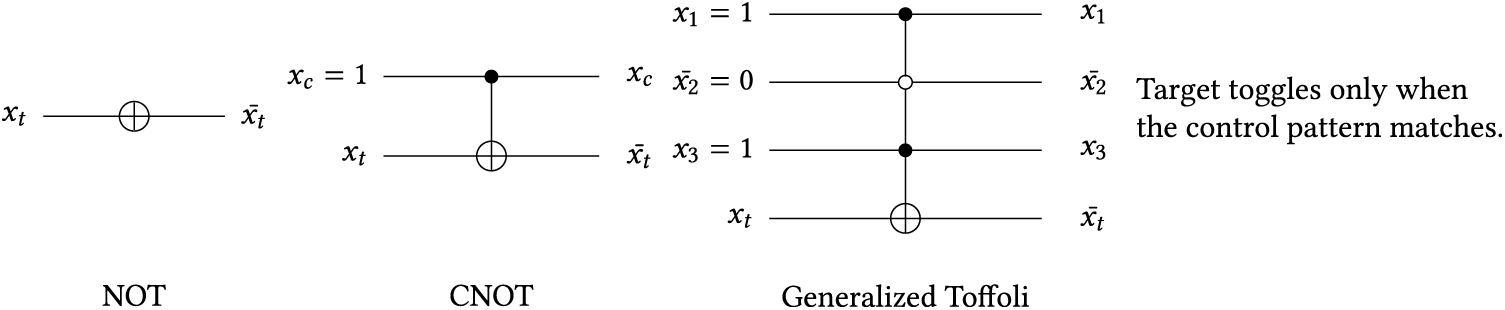
Figure 1: In an
3.3 Hypercube Structure Reversible Function Correspondence
The
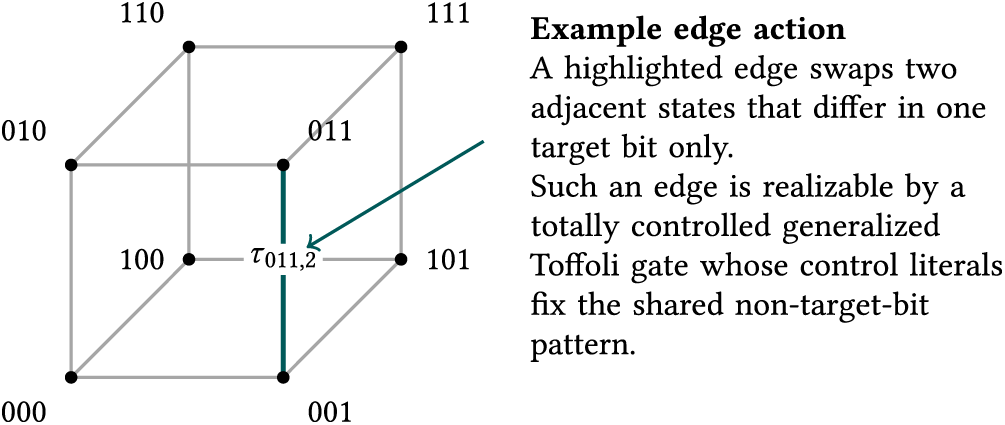
Figure 2: Three-dimensional hypercube model for 3-bit reversible synthesis. Each vertex is a basis state, and each edge represents an admissible adjacent transposition. The highlighted edge illustrates how a single hypercube edge corresponds to one reversible gate action.
For a vertex
For the 3-bit case, this correspondence can be listed exhaustively. Fig. 3 labels all twelve edges of the three-dimensional hypercube and shows the totally controlled GT circuit associated with each edge. This explicit mapping is useful because it makes the hypercube representation and the circuit implementation view completely consistent at the level of individual synthesis moves.
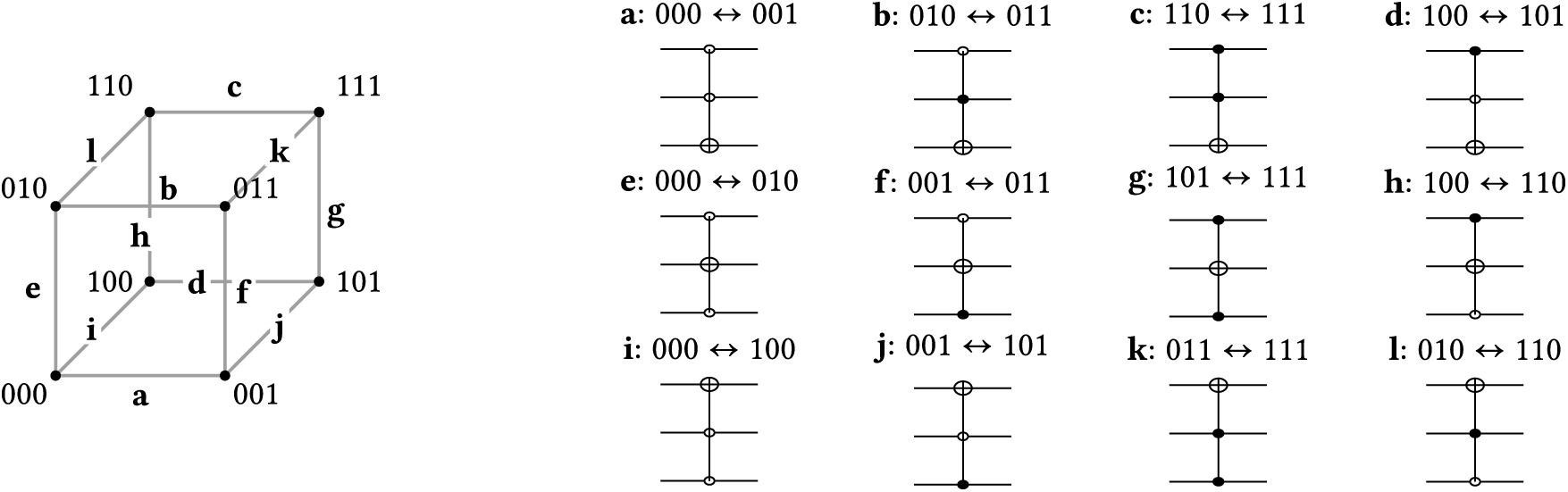
Figure 3: Complete edge-to-circuit correspondence for the 3-bit hypercube. The left panel labels the twelve hypercube edges by
This study introduces the first framework that reformulates hypercube-centered reversible synthesis from a rule-based constructive approach into a trajectory-based search-driven optimization framework. To effectively explore this space, a quantum-inspired tabu search (QTS) algorithm is adopted as the core optimization engine, leveraging its proven capability in quantum and reversible circuit synthesis [8,9] and other complex combinatorial tasks [5]. The main innovation is that the hypercube structure is not used only as a representation, but is further transformed into trajectory-level search guidance through Hamming-distance observations that capture both global and local synthesis variations. Based on these observations, the proposed method adaptively updates trajectory preference, adjusts convergence behavior, and flexibly relaxes the circuit budget when necessary, making the synthesis process as the trajectory finding. By incorporating this structure-informed domain knowledge, the framework effectively guides the search direction. Concurrently, using the Q-matrix for trajectory path encoding combined with direct winner-loser updates provides exceptional flexibility, significantly boosting overall search efficiency. The remainder of this section first introduces the hypercube-based structural indicators and then presents the corresponding quantum-inspired optimization procedure.
4.1 Hypercube-Based Structural Indicators
The Hamming distance (HMD)
To evaluate local structural properties, this study utilizes the adjacent Hamming distance (AHD) [10]. For a specific vertex
Within the hypercube structure, adjacent vertices naturally possess a Hamming distance of one. In the GT gate library, a single adjacent transposition (corresponding to one gate) changes
In the proposed framework, THD serves as a global progress indicator to estimate the initial search budget, while AHD (and its aggregation TAHD) provides fine-grained structural evaluation to guide the search toward promising regions of the solution space.
4.2 Hypercube Structure HMD-GQTS Procedure
This study integrates Hamming distance (HMD) reinforcement guidance into a global-best guided quantum-inspired tabu search (GQTS) framework, referred to as HMD-GQTS, to realize a search-driven reversible circuit synthesis process over the hypercube structure. Accordingly, the synthesis process can be interpreted as a sequence of guided transitions over hypercube vertices, where each step involves selecting a candidate move, evaluating its impact using both global and local criteria, and updating the current solution.
In this framework, THD and AHD (along with its aggregation TAHD) provide complementary guidance at different levels of the search. While THD drives the search toward global convergence, AHD captures local structural characteristics to refine neighborhood exploration and avoid misleading transitions. This combination enables each move to be evaluated not only by its global improvement but also by its local structural consistency. The pseudocode of the proposed HMD-GQTS is presented in Algorithm 1. This section also provides the detailed procedures of the proposed synthesis method.
4.2.1 Problem Formulation and Encoding Method
Fig. 4 summarizes the overall search procedure. A target reversible function is formulated as a labeling problem on a hypercube. The synthesis process is modeled as a sequential decision procedure, in which a series of discrete actions progressively transforms the target permutation into the identity.
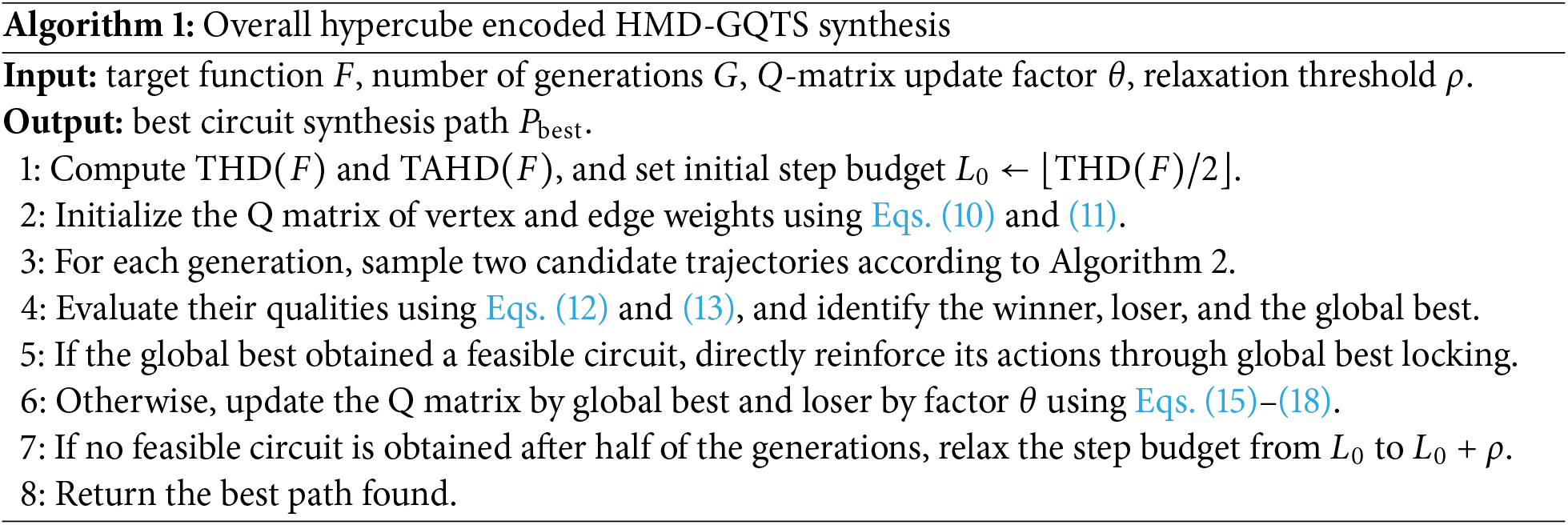
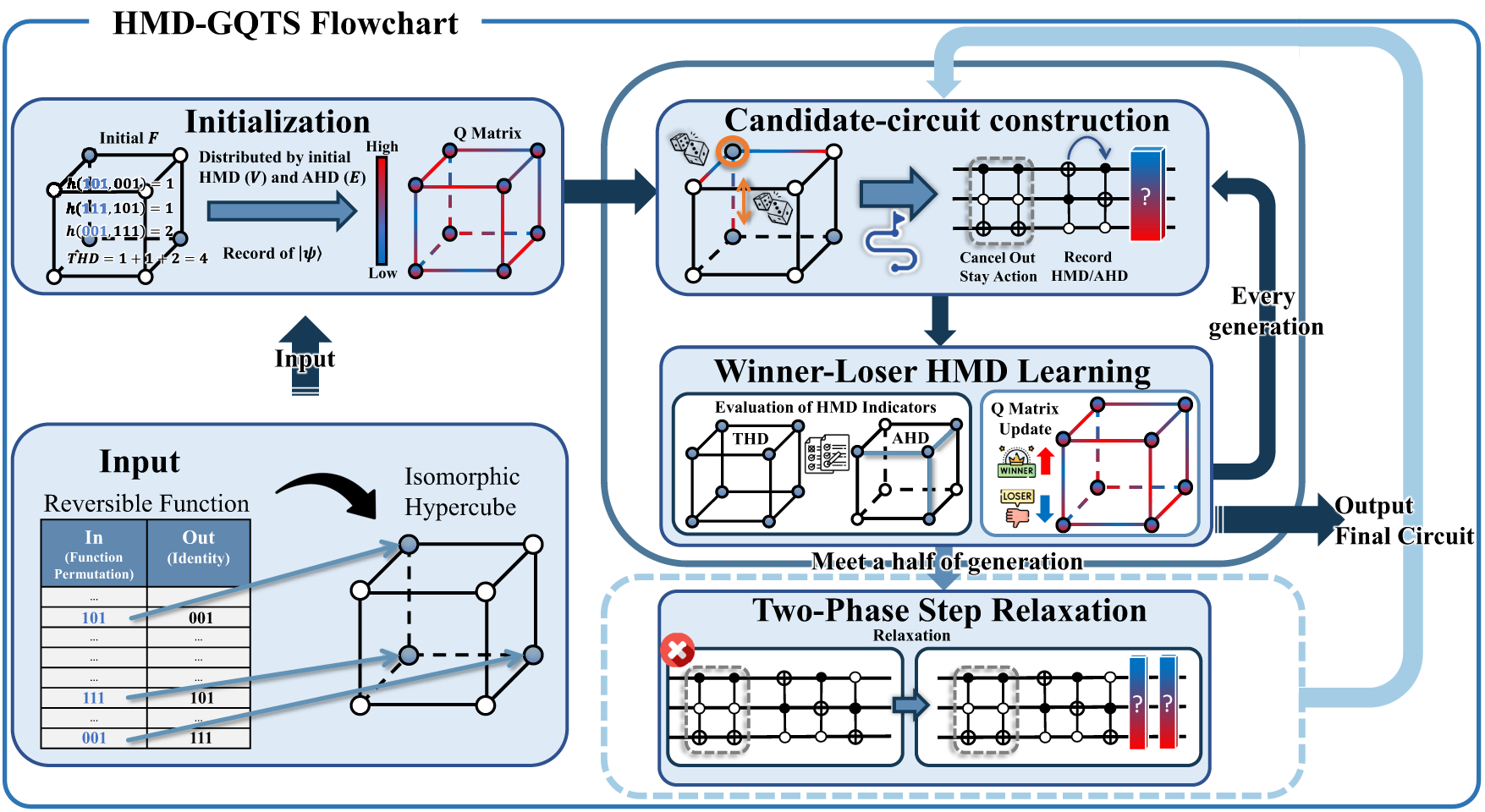
Figure 4: Conceptual architecture of the proposed HMD-GQTS synthesis framework.
At each iteration, the algorithm selects an action by first choosing a vertex and then determining one of its adjacent edges (or a stay action), which together define a reversible swap operation. The resulting candidate solution is evaluated using both global and local criteria. The selection weights of candidate actions are iteratively updated through winner-loser learning and global-best reinforcement, enabling adaptive exploration and exploitation throughout the search.
Formally, the path
To model the action selection process, GQTS maintains a superposition-inspired probability distribution over candidate actions. The superposition state is defined in Eq. (9), where the squared magnitude of the amplitude
For a circuit with
4.2.2 Initialization of the Q Matrix
The probability of Q matrices should be normalized from 0 to 1. For easy understanding, the weight is utilized before being reinterpreted into the sampling space. The heuristic from the previous hypercube-based literature [10] is to improve the large HMD and AHD area first. Therefore, the initial vertex and edge weights in Q matrices are defined by Eqs. (10) and (11). The node initialization includes a Stay action. During trajectory construction, the corresponding probabilities are obtained by proportional normalization. Therefore, the first sampling distribution is already informed by local structural discrepancy.
4.2.3 Candidate Circuit Construction and Quality Evaluation
The construction of a candidate circuit starts with a sampled step budget
The circuit quality is formulated as a maximization problem. Let
If a candidate trajectory successfully reaches the identity state, its quality
If the trajectory fails to reach the identity state within the budget, the quality
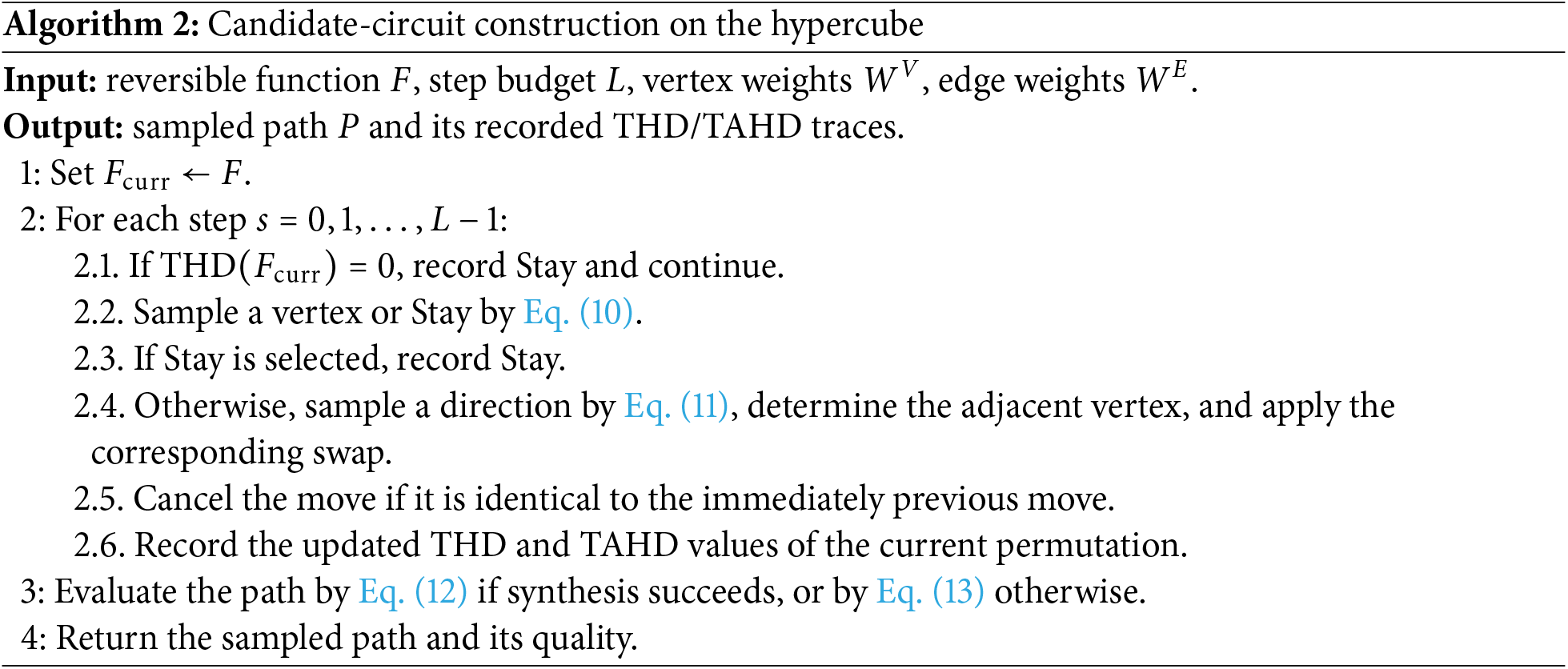
This design ensures that exact synthesis (reaching THD = 0) has the highest priority. Among unsuccessful paths, the optimizer favors trajectories with smaller residual global mismatch and lower local discrepancy. This approach provides informative ranking signals even for failed attempts, allowing the search engine to distinguish and evolve toward more promising partial synthesis paths.
4.2.4 Winner-Loser HMD Learning and Global-Best Reinforcement
The core philosophy of the proposed quantum-inspired tabu search (QTS) is to navigate the search space by simultaneously approaching optimal solutions and avoiding inferior ones. To implement this, two candidate trajectories are sampled and compared in each generation. Let
A step comparison score
In our implementation, we set
Let
This mechanism rewards actions that yield significant structural improvements while suppressing weaker competing moves. Furthermore, once a feasible circuit (THD = 0) is discovered, the focus shifts from structural guidance to gate-count optimization. We then employ a Lock-to-Global-Best strategy, where the Q-matrix is aggressively updated to favor the global-best circuit structure. During this phase, the learning factor is amplified to
4.2.5 Two-Phase Step Relaxation Mechanism
The theoretical lower bound
In the initial phase, the search is strictly constrained by the practical baseline (
This study evaluates the proposed HMD-GQTS framework by navigating quantum-inspired optimization with structural guidance to construct effective trajectories for reversible circuit synthesis. The experimental results demonstrate that Hamming distance-based evaluation provides clear guidance, enabling the HMD-GQTS strategy to successfully synthesize all 40,320 exhaustive 3-bit functions and extend effectively to 4-bit benchmark-level experiments. This section details the implementation, parameter configurations, and performance metrics to illustrate the effectiveness and stability of the proposed approach. The comparison with the hypercube rule-based algorithm [10] is conducted to demonstrate the effectiveness.
5.1 Experimental Setup and Parameter Configurations
The performance of HMD-GQTS is validated across 3-bit and 4-bit functions to demonstrate that HMD-related reinforcement enhances both search optimization and stability.
Hyperparameter Tuning: The exhaustive testing of all
Optimization Parameters: The delicate optimization parameter
Hardware Environment: The experiments were conducted on a desktop computer equipped with an Intel Core i9-14900K processor, 32 GB RAM, and Windows 11 Pro.
Reward and Punishment Constant Settings The constant settings for reward and penalty are defined as follows:
5.2 Exhaustive 3-Bit Experimental Result
5.2.1 Parameter-Tuning Protocol
In this study, the optimization process is guided by HMD-related indicators to navigate the vast search space efficiently. While existing heuristic and metaheuristic studies on reversible circuit synthesis typically evaluate performance on selected benchmark functions, the present work extends the validation protocol to the entire 3-bit permutation space, covering all 40,320 possible functions. This exhaustive testing ensures that the algorithm’s effectiveness is not limited to specific cases but is robust across the complete functional landscape. To identify the optimal configuration for this extensive search, we conducted a comprehensive sweep of the hyperparameters (generations
Each parameter combination was tested via an exhaustive pass over all 40,320 functions. The primary selection criterion was the number of exact-optimal circuits recovered in a single pass. As shown in Fig. 5a, the combination of
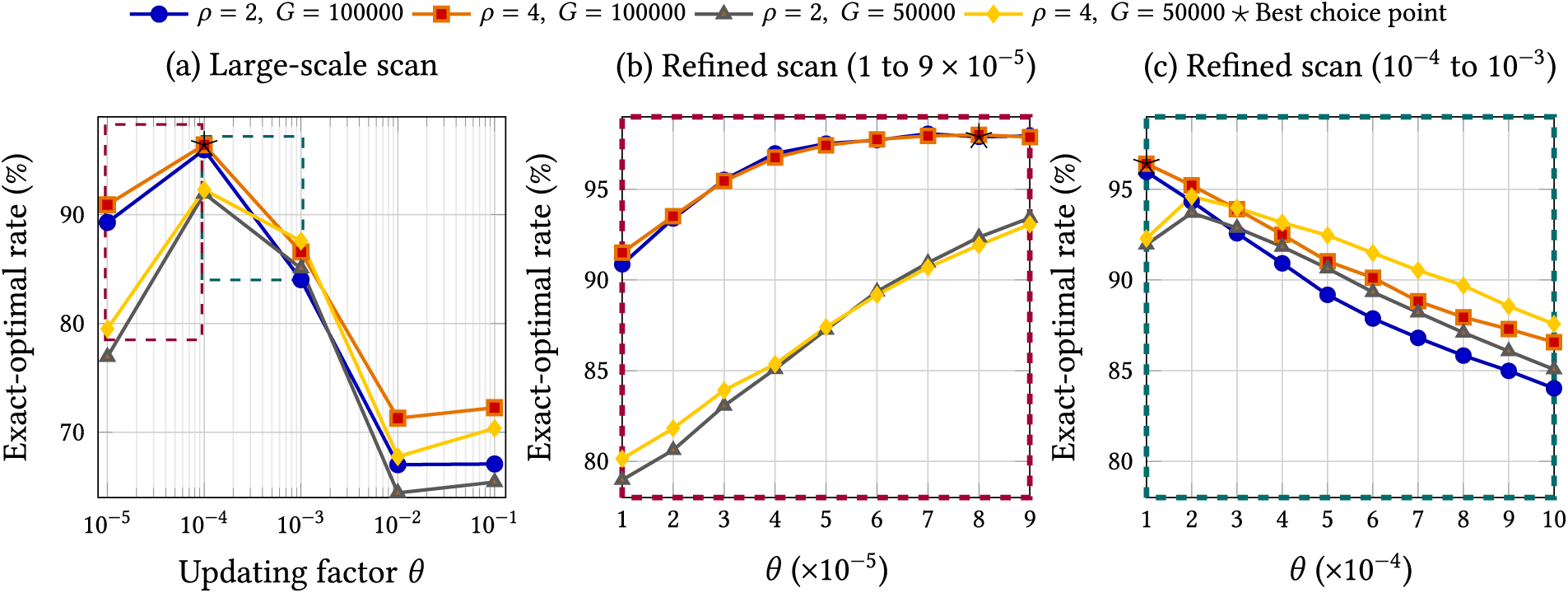
Figure 5: Combined 3-bit parameter-tuning visualization into three panels. (a) The left panel shows the large-scale scan to find the
A finer-scale scan of
5.2.2 Single-Sweep Ablation Study
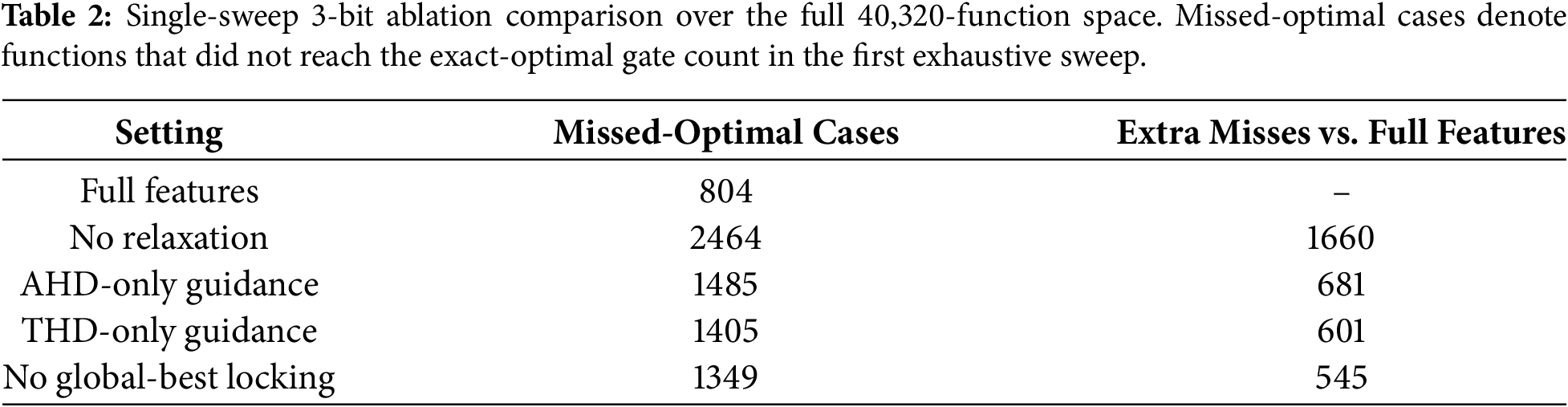
To isolate the contribution of the main design components, we conducted a single-sweep ablation study over the full 40,320-function 3-bit space under the same exhaustive protocol. The full-feature configuration (
5.2.3 Comparison of Gate-Count Distribution over the Full Permutation Space
A distribution-level comparison over the full 3-bit permutation space provides a more robust measure of algorithm efficacy. Fig. 6 and Table 3 compare the gate-count distributions under the same Generalized Toffoli (GT) gate library between the prior hypercube rule-based algorithm [10], a hybrid method [32], and the theoretical optimal distribution. Notably, the gate-count distribution produced by the proposed HMD-GQTS perfectly matches the optimal distribution, resulting in completely overlapping curves for “This work” and “Optimal.”
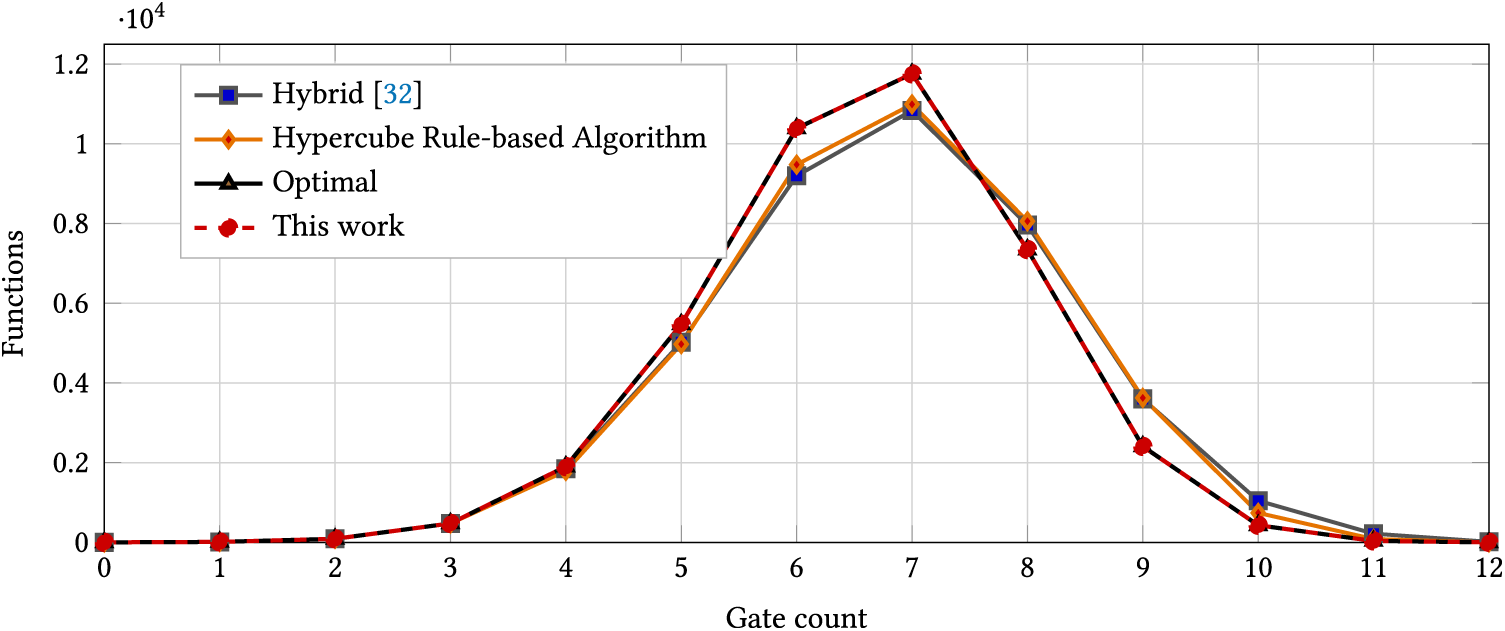
Figure 6: Gate-count distribution over all 40,320 3-bit reversible functions. The present method coincides with the optimal distribution, so the red dashed “This work” curve overlaps the black “Optimal” curve throughout the plot.
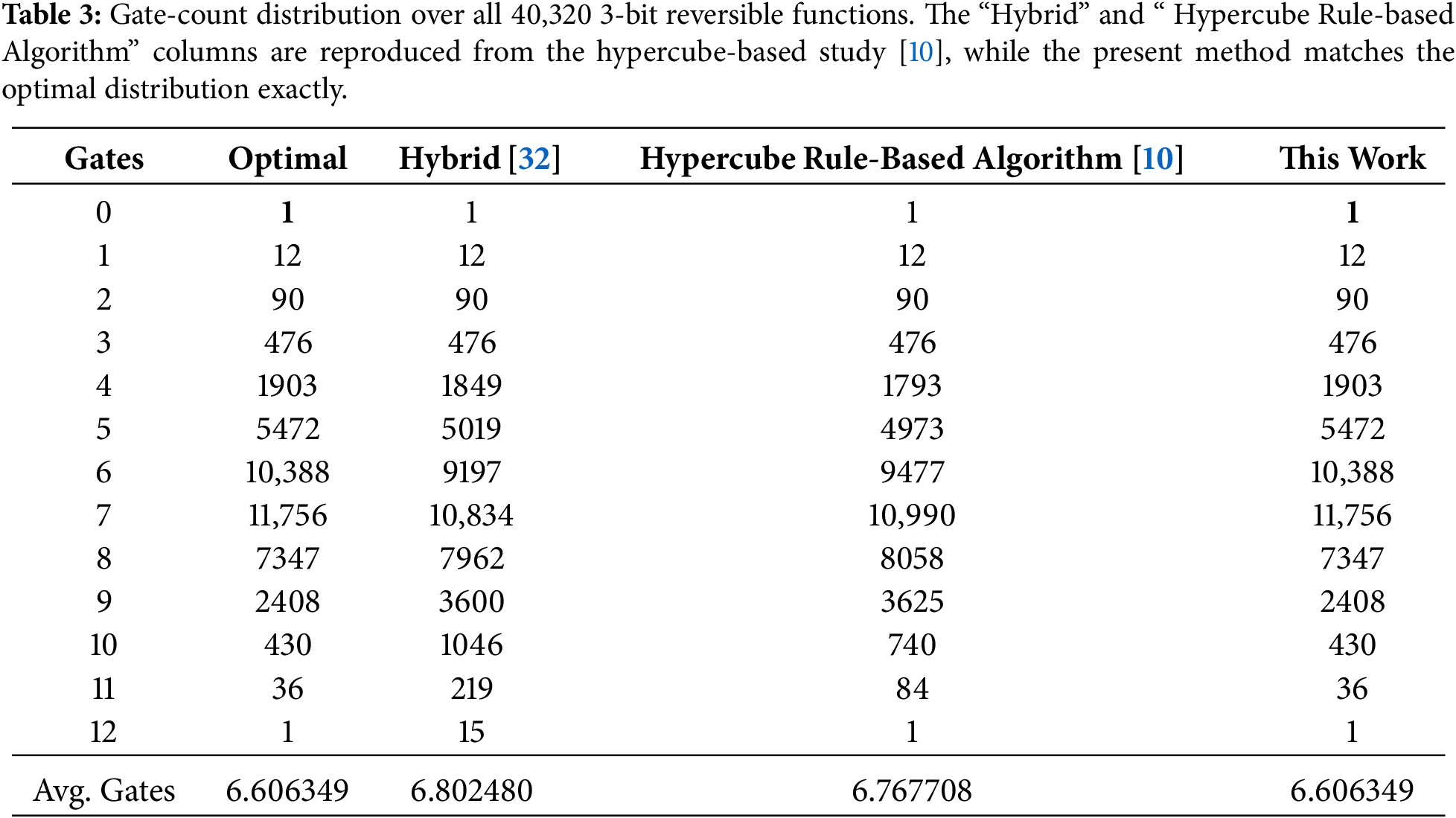
Compared to the baselines, our method successfully shifts the distribution toward the lower gate-count regions and eliminates the heavy tail previously observed above 9 gates. These results highlight the potential of metaheuristic optimization to match or even exceed the performance of rule-based algorithms through a more flexible and computationally efficient search mechanism.
5.3 Benchmark-Level 4-Bit Experimental Result
The 4-bit experiments complement the exhaustive 3-bit study by evaluating the scalability of HMD-GQTS. Given that the full 4-bit space encompasses
5.3.1 Parameter-Tuning Protocol
The tuning evaluation was conducted with a fixed generation budget
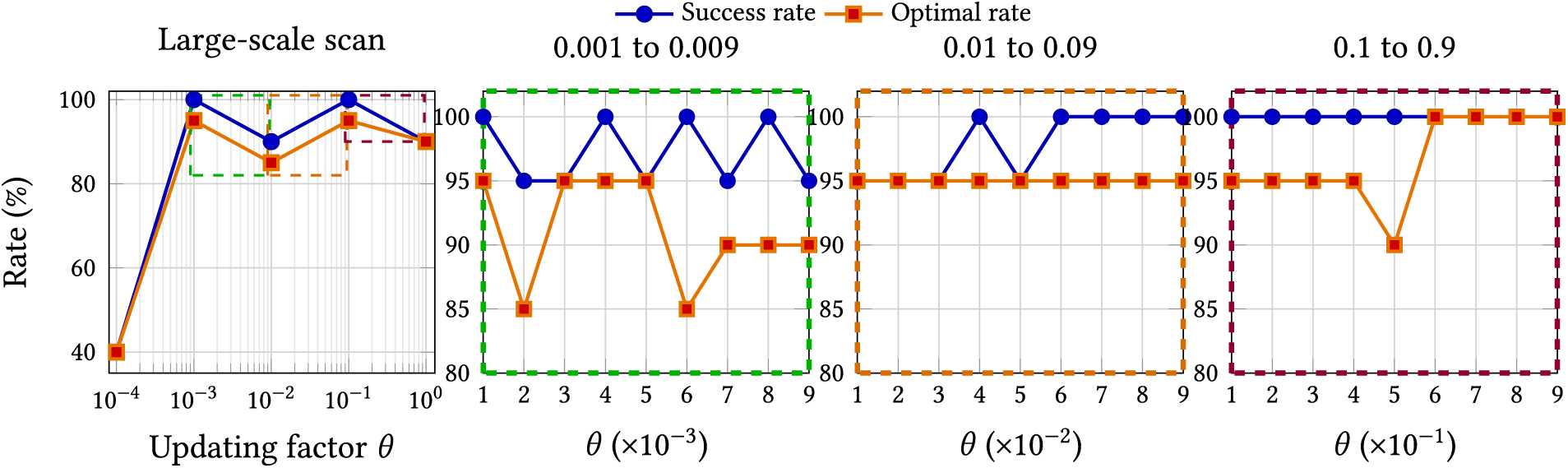
Figure 7: Parameter visualization for the 4-bit tuning. The large-scale panel shows the global trend over
The empirical trajectories demonstrate that both the success rate and optimal rate consistently maintain a remarkably high performance baseline (>85%) across distinct parameters, except at the extreme boundary condition of
5.3.2 Comparison of Gate-Count Performance
This subsection evaluates the performance of the proposed HMD-GQTS against two representative baselines: an ant-colony optimization (ACO)-based metaheuristic [26] and the hypercube rule-based algorithm [10]. Table 4 presents the final gate counts, absolute reductions in circuit cost, and corresponding improvement ratios. While ACO-based methods are traditionally recognized as suitable for combinatorial problems with sequence-dependent constraints, our results indicate that hypercube-based frameworks—both the rule-based algorithm and the present study—significantly outperform ACO in reducing gate counts in these 20 benchmark-level functions.
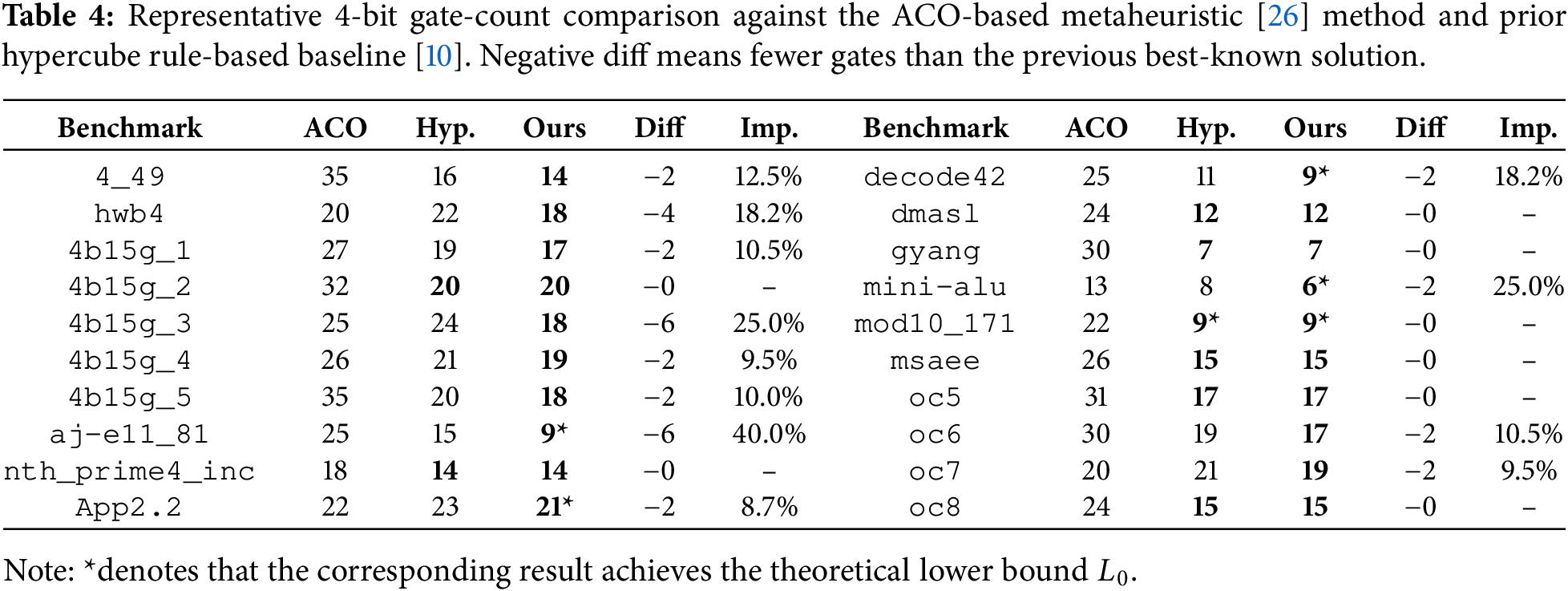
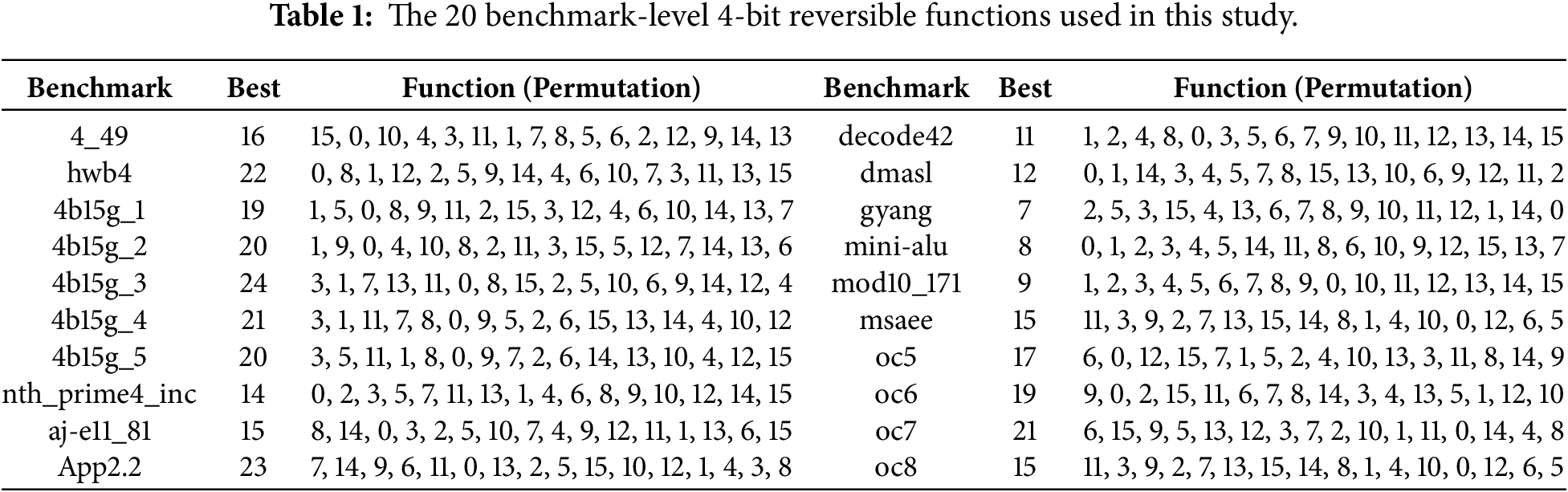
By integrating the hypercube-based HMD evaluation into a quantum-inspired optimization framework, this study further pushes the boundaries of synthesis efficiency. In summary, the proposed method successfully matched or improved the best-known results for all 20 benchmark functions, achieving an average reduction of 1.70 gates across the entire set. Notably, our approach reduced the gate count for 12 functions, with a maximum reduction of 6 gates, representing a maximum improvement of 40.00% over previous studies. Among these results, five starred values in Table 4 represent cases that reach the theoretical optima, while bold values indicate the best performance among the compared methods. These 4-bit results underscore the scalability and high potential of the HMD-guided strategy for extension to higher-bit reversible functions. The circuits generated by our method are listed in the Appendix A.
This study presents the first hypercube-centered reversible synthesis framework that reformulates the rule-based constructive paradigm into a search-based heuristic optimization approach. By embedding explicit Hamming-distance guidance (THD and AHD) into a quantum-inspired engine, the proposed HMD-GQTS framework ensures that the optimization is driven by domain knowledge rather than blind, black-box exploration. To enhance the search efficiency within the overall structure, the framework incorporates a domain-informed initialization and couples a streamlined two-particle configuration with a global-best mechanism, enabling the algorithm to escape local optima and rapidly converge once a successfully synthesized superior path is locked.
Experimental results rigorously validate this formulation at both exhaustive and benchmark levels. For the complete 3-bit function space, HMD-GQTS achieves over 98% exact-optimal circuits in a single fine-tuned sweep and attains 100% coverage following selective retries. For typical 4-bit benchmark instances, the framework consistently produces competitive gate counts, matching or improving upon prior hypercube rule-based and search-based outcomes.
This superior benchmark performance directly stems from the structural advantages of HMD-GQTS over existing approaches. Compared to rule-based methods that rely on rigid constructive lines, this search-based reformulation operates within a well-defined budget limit while providing flexibility to dynamically adapt paths through the proposed online step relaxation mechanism. Furthermore, compared to search-based methods, the framework delivers explicit hypercube structure-informed HMD guidance that avoids blind wandering. Supported by the efficient Q-matrix updating mechanism and the powerful ability to lock and accelerate toward global optima, the proposed framework successfully integrates domain knowledge with robust search optimization, offering an effective and highly scalable avenue for reversible circuit synthesis.
Acknowledgement: The author expresses sincere gratitude to the previous collaborators whose foundational development and insightful support inspired the conceptual framework and experimental methodology of this research.
Funding Statement: The author received no specific funding for this study.
Availability of Data and Materials: The datasets supporting this article are not currently available due to ongoing analyses. Access requests may be directed to the corresponding author.
Ethics Approval: Not applicable.
Conflicts of Interest: The author declares no conflicts of interest.
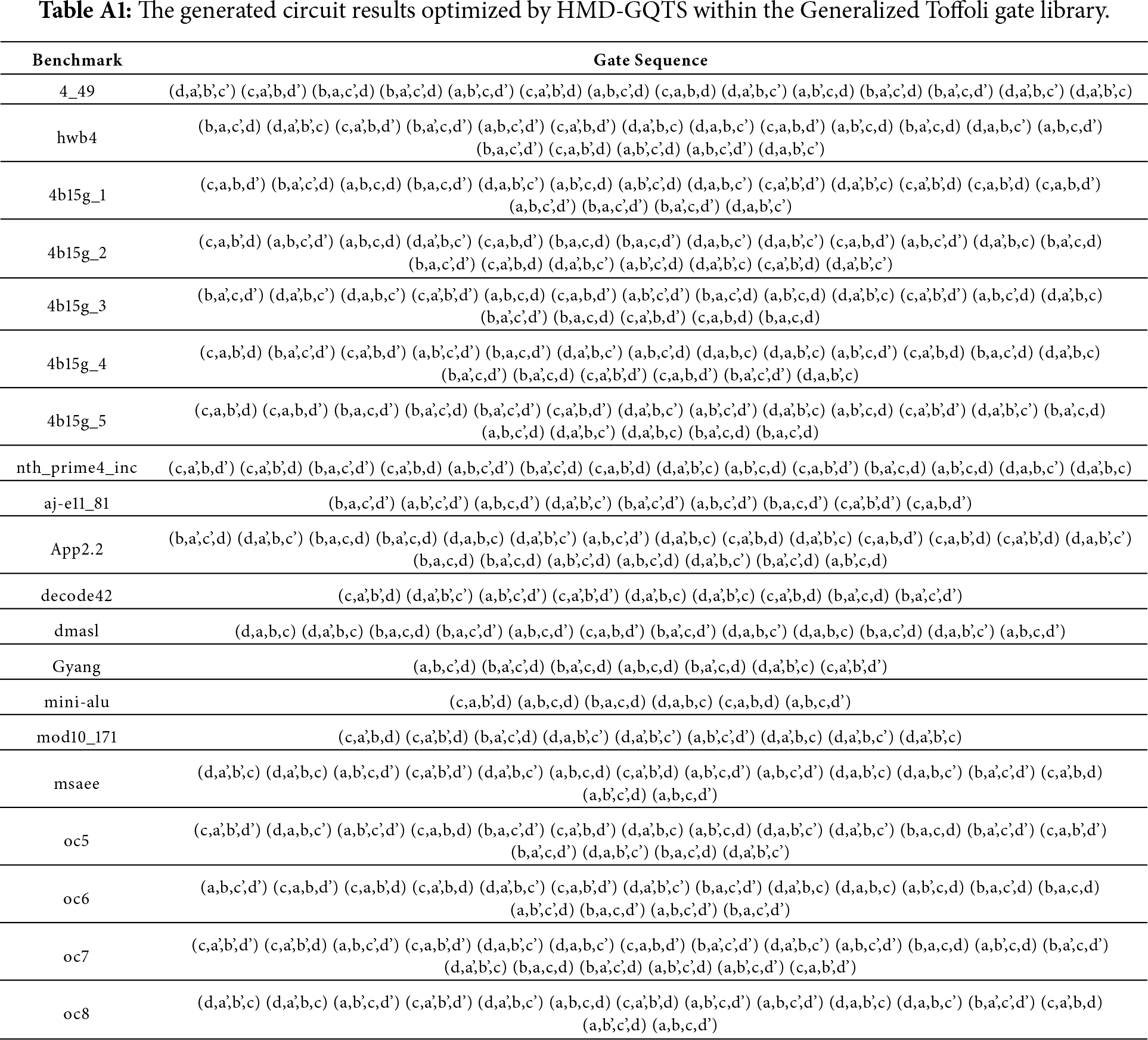
Appendix A The Generated Circuit in 4-Bit Benchmark
In this appendix, we present the verified, top-performing gate sequences generated by the proposed framework for the 20 4-bit benchmark instances in Table A1. The bits are ordered from top to bottom as
References
1. Nielsen MA, Chuang IL. Quantum computation and quantum information. Cambridge, UK: Cambridge University Press; 2000. [Google Scholar]
2. Shende VV, Bullock SS, Markov IL. Synthesis of quantum logic circuits. IEEE Trans Comput Aided Des Integr Circ Syst. 2006;25(6):1000–10. doi:10.1109/TCAD.2005.855930. [Google Scholar] [CrossRef]
3. Devi SS, Bhanumathi V. Reversible logic based MOS current mode logic implementation in digital circuits. Comput Mater Contin. 2022;70(2):3609–24. doi:10.32604/cmc.2022.020426. [Google Scholar] [CrossRef]
4. Alharbi M, Edwards G, Stocker R. Novel ultra-energy-efficient reversible designs of sequential logic quantum-dot cellular automata flip-flop circuits. J Supercomput. 2023;79:11530–57. doi:10.1007/s11227-023-05134-1. [Google Scholar] [CrossRef]
5. Chou YH, Hua CY, Tseng RW, Kuo SY. Quantum-inspired optimization algorithm for 3D multi-objective base-station deployment in next-generation 5G/6G wireless network. Comput Mater Contin. 2026;87(2):1. doi:10.32604/cmc.2025.075705. [Google Scholar] [CrossRef]
6. Xu G, Wang L, Huang Y, Lu Y, Liu X, Tan W, et al. A quantum-inspired algorithm for clustering and intrusion detection. Comput Mater Contin. 2026;87(1):48. doi:10.32604/cmc.2025.074256. [Google Scholar] [CrossRef]
7. Chiang HP, Chou YH, Chiu CH, Kuo SY, Huang YM. A quantum-inspired Tabu search algorithm for solving combinatorial optimization problems. Soft Comput. 2014;18(9):1771–81. doi:10.1007/s00500-013-1203-7. [Google Scholar] [CrossRef]
8. Wang WH, Chiu CH, Kuo SY, Huang SF, Chou YH. Quantum-inspired tabu search algorithm for reversible logic circuit synthesis. In: Proc IEEE Int Conf Syst Man Cybern (SMC); 2012 Oct 14–17; Seoul, Republic of Korea. p. 709–14. doi:10.1109/ICSMC.2012.6377742. [Google Scholar] [CrossRef]
9. Kuo SY, Hua CY, Hsu ET, Chen HP, Shen JY, Liu CL, et al. Controlled-swap-based and knowledge navigated quantum-inspired computational intelligence for quantum circuit optimization. In: Proc IEEE Int Conf Fuzzy Syst (FUZZ-IEEE); 2024 Jun 6–Jul 5; Yokohama, Japan. p. 1–9. doi:10.1109/FUZZ-IEEE60900.2024.10612170. [Google Scholar] [CrossRef]
10. Jiang YC, Tseng KC, Hua CY, Kuo SY, Chou YH, Kuo SY. A novel hypercube-based heuristic for quantum boolean circuit synthesis. IEEE J Emerg Sel Top Circ Syst. 2022;12(3):648–61. doi:10.1109/JETCAS.2022.3202840. [Google Scholar] [CrossRef]
11. Yang M, Yue F, Wang W, Meng X, Wang L, Han P, et al. LIRB-based quantum circuit fidelity assessment and gate fault diagnosis. Comput Mater Contin. 2025;82(2):2215–33. doi:10.32604/cmc.2024.058163. [Google Scholar] [CrossRef]
12. Han Z, Li H, Lu K, Liu S, Ju M. Research on optimization of hierarchical quantum circuit scheduling strategy. Comput Mater Contin. 2025;82(3):5097–113. doi:10.32604/cmc.2025.059577. [Google Scholar] [CrossRef]
13. Li Z, Zhang W, Zhang G, Dai J, Hu J, Perkowski M, et al. An extended approach for generating unitary matrices for quantum circuits. Comput Mater Contin. 2020;62(3):1413–21. doi:10.32604/cmc.2020.07483. [Google Scholar] [CrossRef]
14. Landauer R. Irreversibility and heat generation in the computing process. IBM J Res Dev. 1961;5(3):183–91. doi:10.1147/rd.53.0183. [Google Scholar] [CrossRef]
15. Bennett CH. Logical reversibility of computation. IBM J Res Dev. 1973;17(6):525–32. doi:10.1147/rd.176.0525. [Google Scholar] [CrossRef]
16. Shende VV, Prasad AK, Hayes JP. Synthesis of reversible logic circuits. IEEE Trans Comput Aided Des Integr Circ Syst. 2003;22(6):710–22. doi:10.1109/TCAD.2003.811448. [Google Scholar] [CrossRef]
17. Miller DM, Maslov D, Dueck GW. A transformation based algorithm for reversible logic synthesis. In: Proc 40th Des Autom Conf (DAC); 2003 Jun 2–6; Anaheim, CA, USA. p. 318–23. doi:10.1145/775832.775915. [Google Scholar] [CrossRef]
18. Maslov D, Dueck GW, Miller DM. Techniques for the synthesis of reversible Toffoli networks. ACM Trans Des Autom Electron Syst. 2007;12(4):42. doi:10.1145/1278349.1278355. [Google Scholar] [CrossRef]
19. Saeedi M, Markov IL. Synthesis and optimization of reversible circuits—a survey. ACM Comput Surv. 2013;45(2):21. doi:10.1145/2431211.2431220. [Google Scholar] [CrossRef]
20. Jung J, Choi IC. A multi-commodity network model for optimal quantum reversible circuit synthesis. PLoS One. 2021;16(6):e0253140. doi:10.1371/journal.pone.0253140. [Google Scholar] [CrossRef]
21. Chen YC, Chao FJ. Optimization of reversible logic networks with gate sharing. In: Proceedings of the Asia and South Pacific Design Automation Conference (ASP-DAC); 2023 Jul 16–19; Tokyo, Japan. p. 166–71. [Google Scholar]
22. Wu X, Li L. Asymptotically optimal synthesis of reversible circuits. Inf Comput. 2024;305:105235. doi:10.1016/j.ic.2024.105235. [Google Scholar] [CrossRef]
23. Sasamal TN, Singh AK, Mohan A. Reversible logic circuit synthesis and optimization using adaptive genetic algorithm. Procedia Comput Sci. 2015;70:407–13. doi:10.1016/j.procs.2015.10.054. [Google Scholar] [CrossRef]
24. Abdalhaq B, Awad A, Hawash A. A fast Binary Decision Diagram (BDD)-based reversible logic optimization engine driven by recent meta-heuristic reordering algorithms. Microelectron Reliab. 2021;122:114168. doi:10.1016/j.microrel.2021.114168. [Google Scholar] [CrossRef]
25. Palahuta M, Deibuk V. Improved synthesis of reversible circuits based on the ant colony optimization algorithm. Inf Technol Comput Model. 2023:202–4. doi:10.31861/ITCM.2023.57. [Google Scholar] [CrossRef]
26. Podlaski K. Ant colony optimization implementation for reversible synthesis in Walsh-Hadamard domain. In: Comput Sci (ICCS). Lect Notes Comput Sci. 2020;12141:230–43. doi:10.1007/978-3-030-50426-7_18. [Google Scholar] [CrossRef]
27. Kuo SY, Jiang YC, Chou YH, Kuo SY, Kung SY. Quantum computer-aided design automation: optimization algorithms and visualization interfaces. IEEE Nanotechnol Mag. 2023;17(2):15–25. doi:10.1109/MNANO.2023.3249500. [Google Scholar] [CrossRef]
28. Oneto L, Navarin N, Micheli A, Pasa L, Gallicchio C, Bacciu D, et al. Informed machine learning for complex data. Neurocomputing. 2026;669:132505. doi:10.1016/j.neucom.2025.132505. [Google Scholar] [CrossRef]
29. Li Y, Zhan RH, Rao J, Liu M, Sang P, Zeng X, et al. Structure-informed machine learning for drug discovery: a task-centric perspective. Brief Bioinform. 2026;27(1):bbag081. doi:10.1093/bib/bbag081. [Google Scholar] [CrossRef]
30. Toffoli T. Reversible computing. In: Automata Lang Program (ICALP). Lect Notes Comput Sci. 1980;85:632–44. doi:10.1007/3-540-10003-2_104. [Google Scholar] [CrossRef]
31. Zeng GJ, Chiang HH, Kuo SY, Chou YH. A novel classifying algorithm for reversible circuit synthesis. In: Proc IEEE Int Conf Syst Man Cybern (SMC); 2015 Oct 9–12; Hong Kong, China. p. 62–7. doi:10.1109/SMC.2015.24. [Google Scholar] [CrossRef]
32. Zhu W, Li Z, Zhang G, Pan S, Zhang W. A reversible logical circuit synthesis algorithm based on decomposition of cycle representations of permutations. Int J Theor Phys. 2018;57(8):2466–74. doi:10.1007/s10773-018-3768-5. [Google Scholar] [CrossRef]
Cite This Article
 Copyright © 2026 The Author(s). Published by Tech Science Press.
This work is licensed under a Creative Commons Attribution 4.0 International License , which permits unrestricted use, distribution, and reproduction in any medium, provided the original work is properly cited.
 Downloads
 Citation Tools
