
 Login
Login Register
 Submit a Paper
 Propose a Special lssue
 Open Access
ARTICLE
Hybrid Fuzzy Spark Lion Whale Algorithm for Energy-Efficient Resource Allocation and Task Migration in Cloud Data Centers
1 Department of Computer Science and Engineering, Chandigarh University, Gharuan, Mohali, Punjab, India
2 School of Computing, Gachon University, Seongnam, Republic of Korea
3 Smart Systems Engineering Laboratory, College of Engineering, Prince Sultan University, Riyadh, Saudi Arabia
4 Department of Robotics and Intelligent Machines, Faculty of Artificial Intelligence, Kafrelsheikh University, Kafrelsheikh, Egypt
* Corresponding Author: Nidhika Chauhan. Email:
Computers, Materials & Continua 2026, 89(2), 92 https://doi.org/10.32604/cmc.2026.084063
Received 17 April 2026; Accepted 24 July 2026; Issue published 15 September 2026
 View Full Text
 Download PDF
Abstract
The exponential growth of cloud data centers necessitates highly efficient resource allocation and task migration strategies. However, multi-dimensional memory fragmentation severely limits the efficacy of standard scheduling algorithms under heavy-tailed, real-world workloads. This paper proposes Fuzzy-SLW, a hybrid swarm-intelligence architecture that integrates a Mamdani fuzzy-inference pre-filter with a distributed Spark Lion-Whale Optimization (SLWO) core via Apache Spark. The fuzzy pre-filter mathematically prunes the search space using non-compressible hardware constraints, while the Spark execution model resolves the traditional serial bottleneck of swarm intelligence. Evaluated within a discrete-event environment utilizing the Google Cluster Trace (2019), Fuzzy-SLW demonstrates a greater than 240% relative improvement (+42.2 percentage points) in virtual machine utilization over load-scattering metaheuristics and avoids the premature policy convergence observed in Deep-DQN baselines. For large-population offline optimization configurations ( individuals), the distributed architecture achieves a 5.85 times sub-linear Amdahl speedup; below this population threshold, including the configuration used for online, per-task scheduling, thread-pool context-switching overhead dominates and distributed partitioning does not improve wall-clock latency. The results empirically quantify the necessary tradeoff between aggressive hardware consolidation and Service Level Agreement preservation, establishing Fuzzy-SLW as a scalable solution for power-constrained hyper-scale environments.Keywords
Cloud computing has revolutionized the way computational services are delivered, enabling on-demand, elastically scalable access to infrastructure, platform, and software resources across shared physical substrates. The concept originated in the telecommunications industry during the 1990s, where Virtual Private Network services demonstrated the feasibility of dynamically redirecting capacity across shared circuits, and has since grown to underpin virtually every category of enterprise and scientific workload. This growth carries a significant consequence: cloud data centers collectively account for a substantial and rising fraction of global electricity consumption, elevating energy efficiency to a primary engineering objective alongside performance and reliability [1].
Resource allocation is a critical issue in the efficient functioning of cloud data centres, defined as the process of assigning the workload of different users to physical and virtual resources in a systematic manner to maximise overall resource utilisation, minimise energy consumption, and maintain service-level agreements [2]. In the Infrastructure-as-a-Service (IaaS) model, this corresponds to allocating CPU time, memory, storage, and network bandwidth to virtual machines (VMs), the main abstraction on which users depend to consume computational resources. This is further complicated by the ever-moving, non-stationary nature of cloud workloads, in which the demand changes over time and spans from milliseconds to days, as well as heavy-tailed, heterogeneous task distributions, which make any set allocation policy structurally inadequate [1].
Virtual machine migration plays a crucial role in enabling data center operators to respond to workload dynamics. This process involves the live transfer of memory state, CPU context, and disk contents of a VM from a source physical machine (PM) to a destination PM, allowing operators to rebalance load, consolidate underutilized servers into low-power states, and maintain service continuity in the face of hardware faults [3]. Task migration extends this concept to the scheduling layer, enabling the transparent relocation of pending or executing jobs to alternative VM instances in the interest of fault tolerance, load balance, and performance optimization [4]. Despite their practical importance, accurately modeling the combined costs of these mechanisms in simulation remains challenging because live migration incurs measurable network transfer latency and energy overhead that conventional simulators often approximate or neglect.
In a heterogeneous cloud setting, the vast search space size results in premature convergence with the conventional metaheuristic optimization methods such as the Differential Evolution (DE) and Particle Swarm Optimization (PSO). The previous fuzzy controllers could not adapt to the changes in workloads for different machine configurations, and used a fixed rule base [5]. High-fidelity multi-objective optimization is often not tractable when dealing with VM placement in production environments due to real-time latency requirements [6].
While Deep Reinforcement Learning (DRL) agents offer adaptive scheduling, they frequently experience premature policy convergence when navigating the heavy-tailed heterogeneity of real-world cloud traces. Addressing these challenges simultaneously requires a framework that combines principled search-space reduction, distributed parallel execution, and physically grounded simulation.
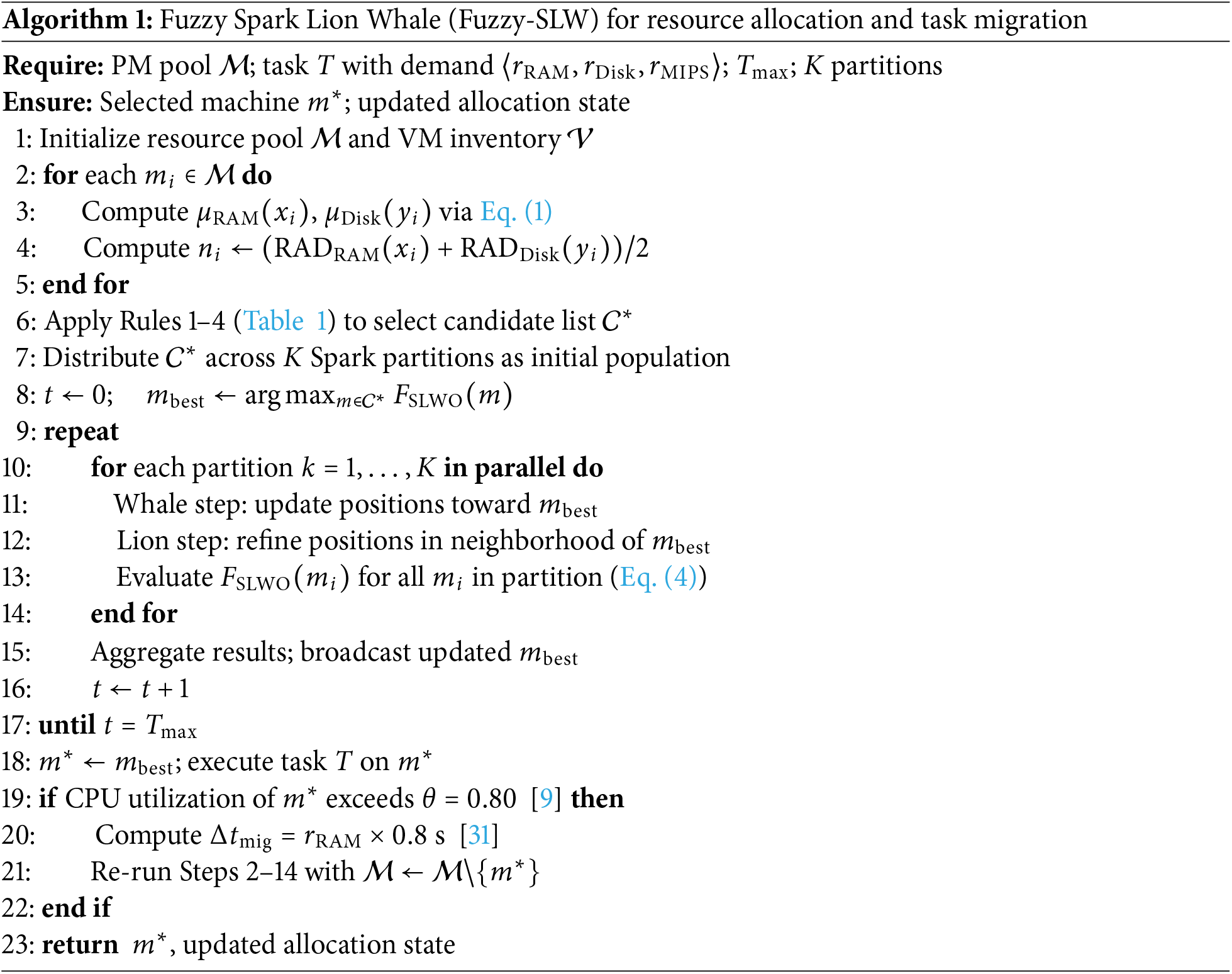
To address these limitations, this paper proposes the Fuzzy Spark Lion Whale (Fuzzy-SLW) algorithm, a novel hybrid optimization framework for resource allocation and task migration in cloud data centers. As illustrated in Fig. 1, the target scenario encompasses the full lifecycle of task execution from initial scheduling through fault-triggered migration. Fuzzy-SLW provides a training-free, deterministic search-space reduction via a Mamdani fuzzy-inference pre-filter, which routes tasks exclusively to resource-tier-compatible PMs using non-compressible hardware constraints. The Spark Lion Whale Optimization (SLWO) core then identifies the optimal placement within that filtered subspace via parallel Apache Spark partitions, enabling sub-linear scaling of computational cost with workload volume. This distributed parallelism is beneficial only above a critical population threshold: empirically, partitioning overhead is amortized and sub-linear Amdahl speedup is realized at
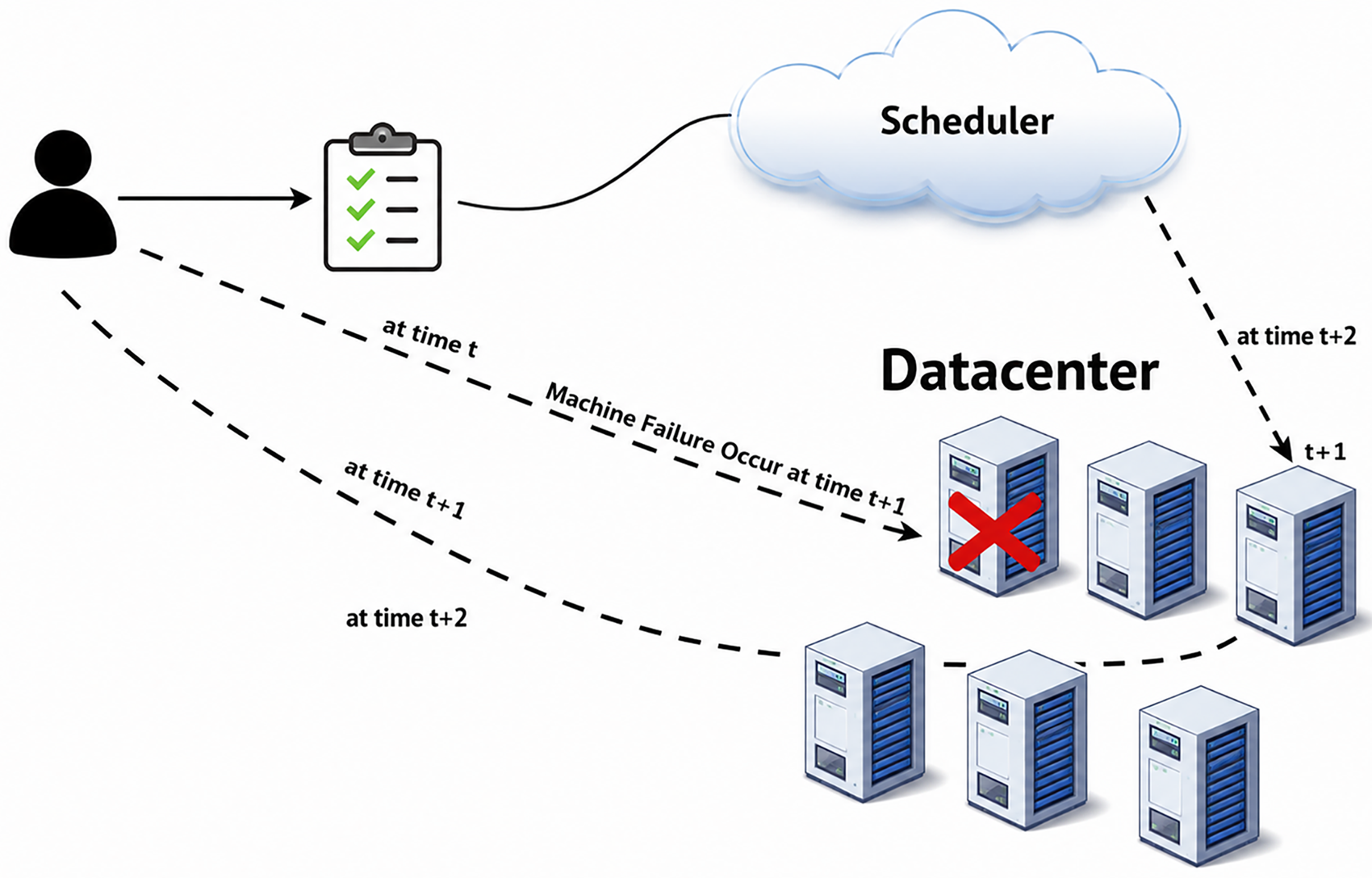
Figure 1: Server architecture for task migration in cloud computing environments. When a user submits a task at time
The principal contributions of this work are as follows.
• A Mamdani fuzzy inference pre-filter that exploits the space-shared non-compressibility of RAM and disk to prune the 800-PM search space to approximately 267 tier-matched candidates per task, concentrating the metaheuristic search on a high-relevance subspace.
• A nine-dimensional composite fitness formulation for SLWO that captures delay, power, resource utilization, storage, energy efficiency, bandwidth, CPU load, memory headroom, and availability as a single multi-objective ranking signal.
• A distributed Spark execution model that resolves the serial swarm bottleneck through RDD-based population partitioning, confirmed by an empirical Amdahl benchmark showing 5.85 times sub-linear speedup at
To validate the proposed architecture, a dual-dataset evaluation was conducted utilizing a Standardized Uniform Benchmark and the Google Cluster Trace (2019) [7]. The framework is benchmarked against load-scattering metaheuristics, modern swarm optimizers, and state-of-the-art Deep Reinforcement Learning schedulers including Deep-DQN and Deep-A2C. The evaluation explicitly quantifies the fundamental tradeoff between aggressive density-maximization and SLA preservation, establishing the system boundaries of the proposed architecture.
The remainder of this paper is organized as follows. Section 2 surveys related work. Section 3 presents the proposed Fuzzy-SLW architecture. Section 4 describes the experimental setup and workload modeling. Section 5 reports performance results. Section 6 discusses limitations and system boundaries, and Section 7 concludes the paper.
Cloud infrastructure, including auto-scaling, elastic provisioning of resources, and server consolidation, has been the focus of ongoing research for the last ten years [8]. The discussion is organized under three thematic axes that together define the landscape for Fuzzy-SLW.
2.1 Metaheuristic and Swarm Intelligence Scheduling
Beloglazov and Buyya [9] proposed dynamic heuristic algorithms which consider real-time CPU utilization signals to mitigate migration overhead and increase server efficiency. In contrast, Talwani and Singla [10] addressed the energy overhead of VM migration by proposing an enhanced Artificial Bee Colony approach that minimizes overall energy consumption and migration count; however, the greedy decision structure of such metaheuristic approaches prevents globally optimal allocation under varying loads and can restrict applicability in latency-sensitive systems.
Zhang et al. [11] formulated multi-VM migration scheduling as a combinatorial optimization task and demonstrated improvements over greedy baselines in migration time and resource consumption. Arya et al. [12] suggested a dynamic resource management policy that changes the migration behavior based on perceived workload change, but the change is reactive and not anticipatory.
Sutar et al. [13] have used Ant Colony Optimization for live VM migration and compared its performance with threshold-based policies in terms of resource efficiency and energy savings, showing that the ACO-based approach is superior. Wang et al. [14] proposed a decentralized multi-agent architecture based on auction and negotiation to reduce migration overhead in Internet-of-Things systems.
For VM-dense deployments, Nagpure et al. [15] proposed a dynamic allocation scheme which minimises resource wastage using skewness. Xu et al. [16] proposed a method called Energy-conscious Resource Allocation for scientific workflow scheduling, which had significant energy savings over traditional scientific workflow engines.
In the field of hybrid metaheuristic literature, Chauhan and Agrawal [17] designed Optimized Kernel Naive Bayesian system for cloud resource selection that provides accurate resource allocation using probabilistic resource model in hybrid metaheuristics. In the context of edge-cloud continua, as well as IIoT deployments, Hosny et al. [18] proposed a refined whale optimization algorithm for multi-user dependent task offloading. In VM resource allocation, Shi and Lin [19] used multi-objective genetic algorithms (MOGA) to stabilize the multi-VM distributions over long operation periods. To improve the performance of the conventional schemes in terms of resource utilization metrics, a hybrid method called the RAFL framework based on Phasor Particle Swarm Optimization and Dragonfly Algorithm was proposed by Thakur and Goraya [20].
Hybrid methods combining the Whale Optimization Algorithm with Moth-Flame Optimization leverage deterministic spiral-path exploitation to counterbalance stochastic bubble-net exploration, and are included as a baseline in the present evaluation to position Fuzzy-SLW within this lineage.
More recent hybrid metaheuristics continue this trajectory: Gopu et al. [21] applied the NSGA-III multi-objective evolutionary algorithm to distributed-cloud VM placement to jointly reduce resource wastage, power consumption, and network delay; Keshri and Vidyarthi [22] combined Ant Colony Optimization with Grey Wolf Optimization for communication-aware VM placement, reporting improvements in power consumption, resource wastage, and bandwidth utilization over single-metaheuristic and greedy baselines; and Mehrabadi et al. [23] proposed an improved Harris Hawks Optimization algorithm for energy-aware VM placement in cloud data centers. These works confirm that hybrid swarm-intelligence pairings remain an active and productive direction for energy-efficient cloud resource allocation.
Despite these advances, purely swarm-based approaches commonly treat fitness evaluation as a serial operation, creating a computational bottleneck that limits scalability to hyper-scale task volumes.
2.2 Deep Reinforcement Learning in Resource Allocation
Tuli et al. [6] introduced HUNTER, a multi-objective AI-based data center energy management system that achieves state-of-the-art energy and SLA performance by integrating predictive modeling with online scheduling. Deep Q-Networks with experience replay and target networks have also been used to achieve competitive scheduling performance in dynamic cloud environments.
Under heavy-tailed task distributions, an Advantage Actor-Critic scheduler with entropy regularization can prevent the premature convergence that is a common issue with value-based methods.
The entropy regularization in A2C prevents the policy from collapsing onto a small set of high-reward actions, maintaining exploration even when the workload distribution shifts. These results motivate the inclusion of both DRL paradigms as baselines in the present evaluation. It is noted that DRL schedulers require substantial offline training on historical trace data before deployment, whereas Fuzzy-SLW operates deterministically without any training phase, which is a relevant distinction for systems that must respond to previously unseen workload distributions.
2.3 Limitations of Current Evaluation Methodologies
SDN and NFV have enabled a new set of resource allocation techniques that leverage the centralized, real-time awareness of network state across the entire network to guide placement decisions [24,25].
The SDN control plane decouples network intelligence from the network forwarding hardware, and the NFV abstraction removes the need for dedicated network appliances by instead allowing the functions to be instantiated, migrated and scaled on the commodity infrastructure, providing an orchestrator with visibility into link utilization, queue occupancy, and the energy state of devices that does not exist in a compute-layer scheduler.
Building on this capability, Montazerolghaem et al. [26] proposed GreenVoIP, an NFV/SDN-based energy-efficient resource allocation framework for virtualized cloud multimedia centers that dynamically activates and deactivates VoIP servers and network equipment in response to load, demonstrating that joint control of the network and compute layers reduces the number of active devices and the associated energy draw without violating service quality constraints. This line of work establishes that energy-efficient resource allocation is not confined to the compute layer of the data center: substantial savings are also available at the network layer when the SDN controller exposes sufficiently fine-grained telemetry to the allocation algorithm.
A related body of work applies hybrid swarm-intelligence optimizers to SDN-coordinated task scheduling in fog-assisted Internet-of-Things networks. Salehnia et al. [27] proposed an SDN-based optimal task scheduling method for Fog-IoT networks that combines the Aquila Optimizer with the Whale Optimization Algorithm (AO-WOA) to allocate fog-computing resources to IoT task requests, using a centralized SDN controller layer to coordinate network elements and reduce task completion time, makespan, and traffic overhead relative to single-optimizer and threshold-based baselines. The AO-WOA design is structurally relevant to the present work: it pairs a global-exploration metaheuristic with a local-exploitation metaheuristic under the coordination of a centralized SDN controller, mirroring the division of labor between the whale (exploration) and lion (exploitation) operators in the SLWO core proposed here, and confirming that SDN-coordinated hybrid swarm scheduling is an established and effective pattern in resource-constrained, latency-sensitive network-edge environments.
Fuzzy-SLW is architecturally compatible with both of these directions: the fuzzy inference engine ingests normalized RAM and disk telemetry of the type exported by SDN management planes, and the SLWO fitness function incorporates SDN-reported flow-level bandwidth utilization as the
A structural limitation cuts across nearly all surveyed works: current evaluations predominantly utilize time-shared resource abstractions, which allow CPU and memory to be oversubscribed without triggering allocation failures. This can obscure the execution-delay penalties inherent in aggressive consolidation, because oversubscription masks the Out-of-Memory rejection events that space-shared environments expose. This study addresses this gap by utilizing rigid space-shared provisioning and exposes the operational SLA penalties inherent to density-maximizing policies.
3 Proposed Methodology and System Architecture
This section presents the complete Fuzzy-SLW architecture, beginning with the system model and problem formulation, proceeding through the Mamdani fuzzy pre-filter and multi-objective fitness function, and concluding with the distributed Spark execution model and computational complexity analysis.
3.1 System Model and Problem Formulation
The simulated data center comprises
3.2 Mamdani Fuzzy-Inference Pre-Filter
The fuzzy pre-filter operates as a Mamdani inference engine [29] over two input dimensions: RAM and disk storage. The selection of these two dimensions, rather than CPU or bandwidth, is grounded in the fundamental distinction between space-shared and time-shared resources in cloud hypervisors. CPU cycles and network bandwidth are elastic: they can be throttled, time-multiplexed, or oversubscribed under hypervisor policies without triggering immediate task failure. Memory and disk storage are space-shared non-compressible resources; if a physical machine lacks sufficient RAM to host a VM, the hypervisor triggers an Out-of-Memory event that terminates the task without recovery. The pre-filter therefore eliminates candidates that would cause hard allocation failures, while CPU and bandwidth optimization is deferred to the SLWO fitness function where their elastic behavior can be modeled continuously.
The triangular membership function is defined as
where
Compared to trapezoidal functions, the triangular form requires one fewer parameter per linguistic term, simplifying the sensitivity analysis presented in Section 5.6.
The Resource Allocation Decision (RAD) is computed via centroid defuzzification with output singletons at tier centres:
where
The membership function centres are aligned to the discrete hardware tiers of the simulated environment. RAM centres at
and machines are assigned to candidate lists according to the four-rule base in Table 1.
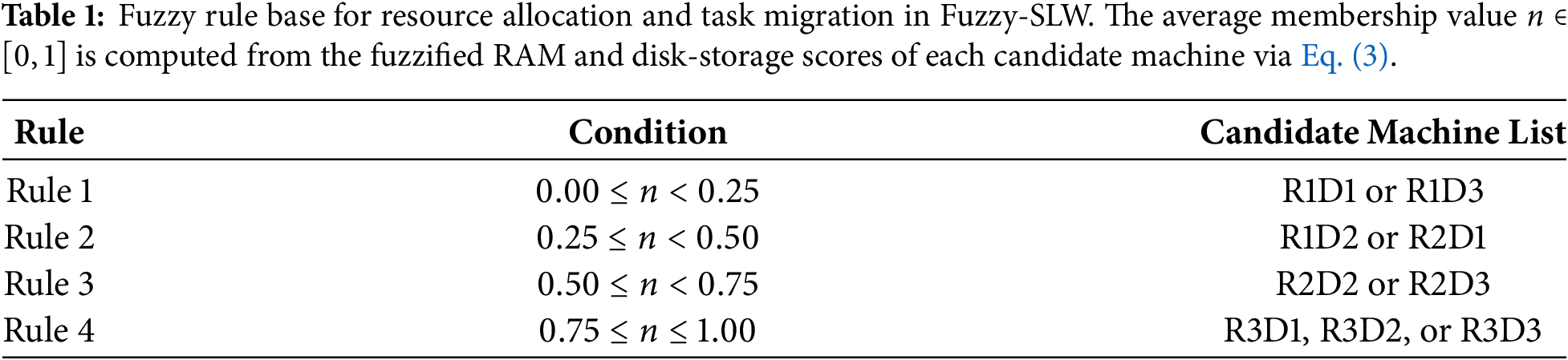
Fig. 2 illustrates the complete four-stage FRBS pipeline as implemented in Fuzzy-SLW.
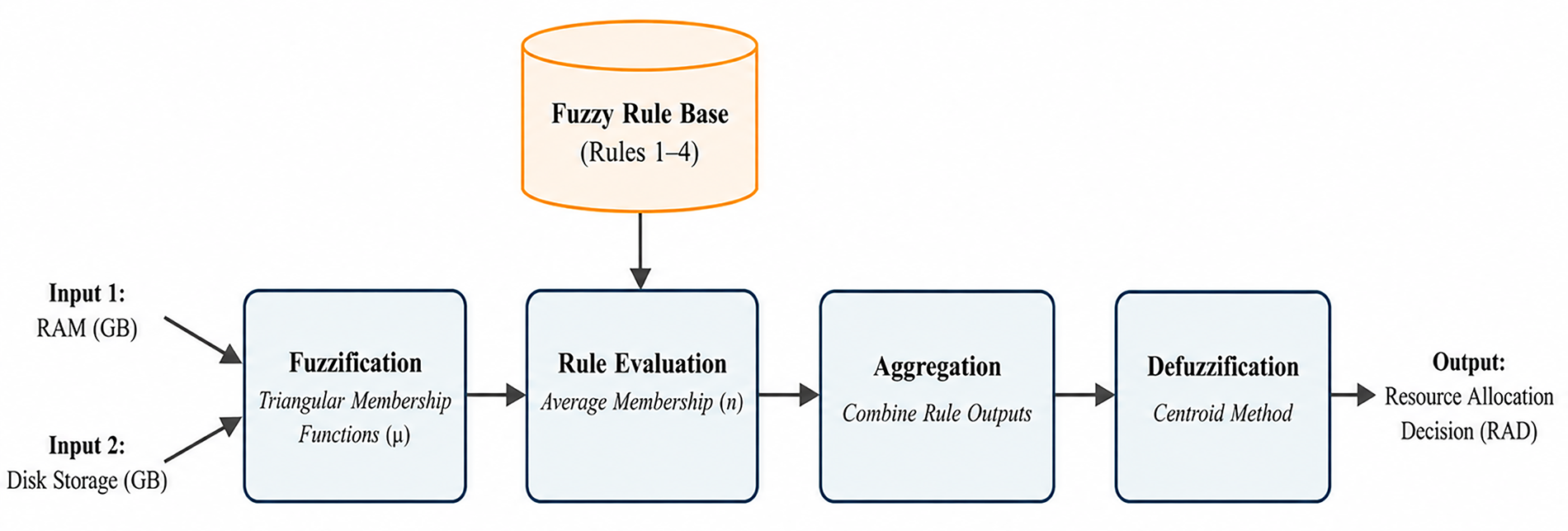
Figure 2: Schematic of the Mamdani fuzzy-inference system employed in Fuzzy-SLW. The four stages, fuzzification, rule evaluation, aggregation, and defuzzification, map crisp RAM and disk-storage inputs to a crisp Resource Allocation Decision (RAD) value that determines the candidate machine tier.
Fig. 3 illustrates the membership functions for both resource dimensions with fully labeled axes. The overlap width of 0.25 ensures that a machine near a tier boundary contributes non-zero membership to both adjacent tiers, preventing hard discontinuities in candidate selection.
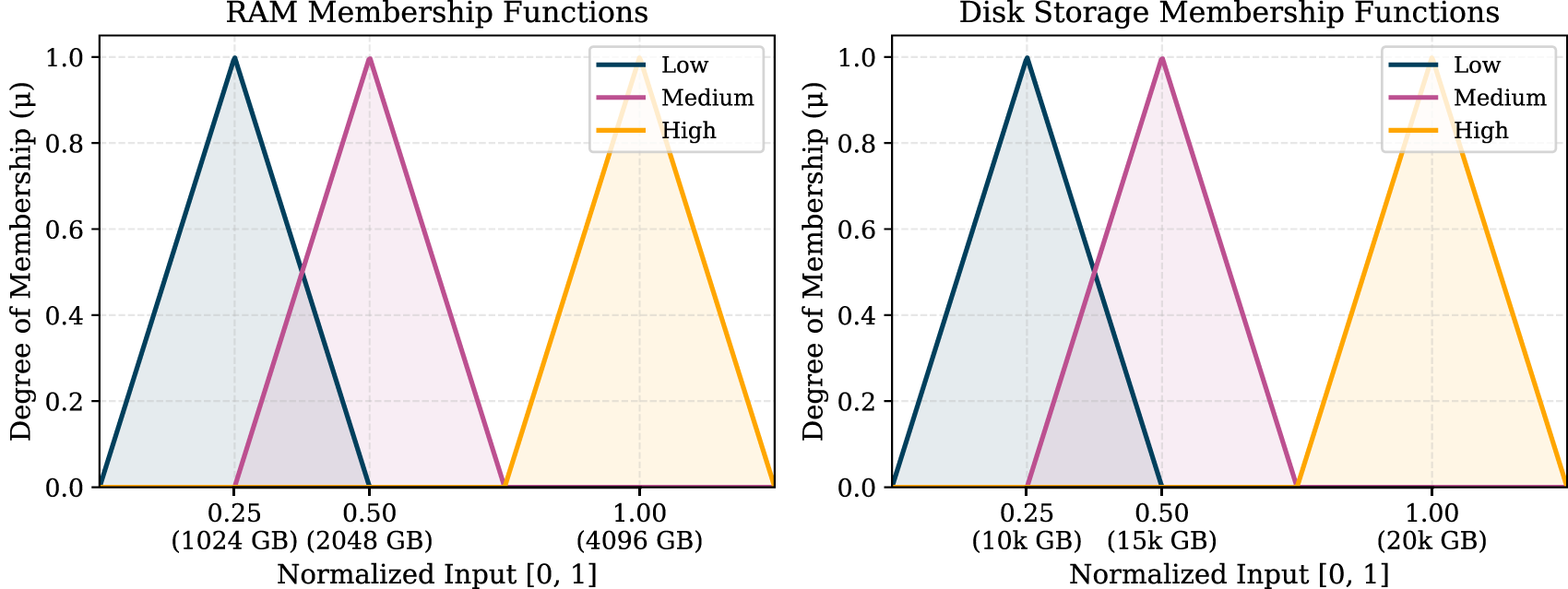
Figure 3: Triangular fuzzy membership functions for the RAM dimension (left) and disk-storage dimension (right) employed in the Fuzzy-SLW pre-filter. Horizontal axes show normalized input values in
The rule structure in Table 1 enforces a monotone mapping from resource demand to hardware tier, so that tasks with large resource footprints are consistently routed toward high-capacity hosts. This reduces the effective candidate pool from all 800 PMs to approximately 267 tier-matched machines, which is the principal mechanism through which the fuzzy layer reduces the search burden on the SLWO core.
3.3 Multi-Objective Defragmentation Fitness
The SLWO core evaluates each candidate machine against a nine-dimensional composite fitness function:
where
with
The selection of RAM and disk for the pre-filter stage, rather than including them directly in the fitness function, reflects the physical reality that these resources cannot be partially allocated: a task either fits in available RAM or it does not. Including RAM and disk as continuous fitness components would allow the optimizer to select a PM that technically scores well on Eq. (4) while still lacking sufficient physical RAM to host the task. The pre-filter eliminates this logical inconsistency before any fitness evaluation takes place.
3.4 Distributed Spark Execution Model
Apache Spark is an open-source in-memory distributed computing system that supports iterative algorithms through Resilient Distributed Dataset (RDD) abstractions, retaining intermediate results in memory between computation steps and providing automatic lineage-based fault recovery. In the SLWO implementation, the solution population is partitioned into
• Whale step (global exploration): each particle updates its position via the spiral bubble-net trajectory toward the current global best, implementing the Whale Optimization Algorithm’s exploration phase.
• Lion step (local exploitation): each particle refines its position via a territory-search in the neighborhood of the current global best, implementing the Lion Algorithm’s exploitation phase.
A global aggregation step identifies the population-wide best solution and broadcasts it to all partitions before the next iteration. This architecture eliminates the serial fitness evaluation bottleneck that constrains single-node metaheuristics and has been validated in prior Spark-based metaheuristic work [30]. Algorithm 1 presents the complete Fuzzy-SLW procedure. The deterministic convergence criterion is the maximum iteration bound
The complete procedure in Algorithm 1 integrates the fuzzy pre-filter, the parallel SLWO search, and the migration handler into a single pipeline whose stages map directly onto the FRBS architecture shown in Fig. 2.
3.5 Computational Complexity Analysis
The time complexity of Fuzzy-SLW decomposes into two stages. The fuzzy pre-filter evaluates
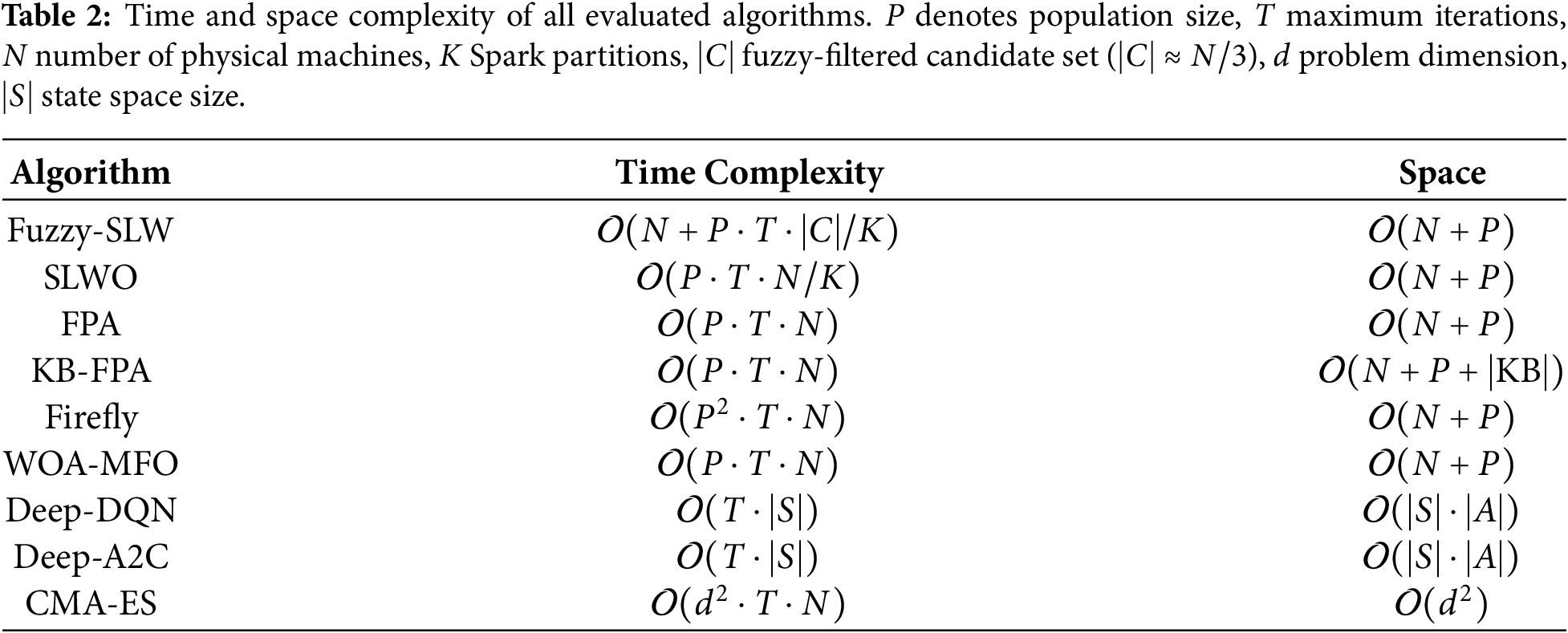
It can be observed from Table 2 that the key practical advantage of Fuzzy-SLW is the reduction of the effective search domain from
4 Experimental Setup and Workload Modeling
4.1 Space-Shared Execution Environment
All experiments were conducted in a custom, strict space-shared discrete-event Python simulation environment. While legacy toolkits such as CloudSim [32] are ubiquitous in cloud scheduling research, their default CPU and RAM allocation policies rely heavily on time-shared elasticity, which permits implicit hardware oversubscription and allows multiple VMs to share a single host without triggering Out-of-Memory (OOM) rejections. This mathematically masks the severe execution-delay penalties that arise during aggressive workload consolidation. To accurately quantify the operational physical costs of density-maximizing policies, the proposed environment strictly enforces space-shared provisioning, treating memory and storage as non-compressible, rigid boundaries consistent with the Beloglazov and Buyya [9] server model.
The power model follows the Beloglazov linear form
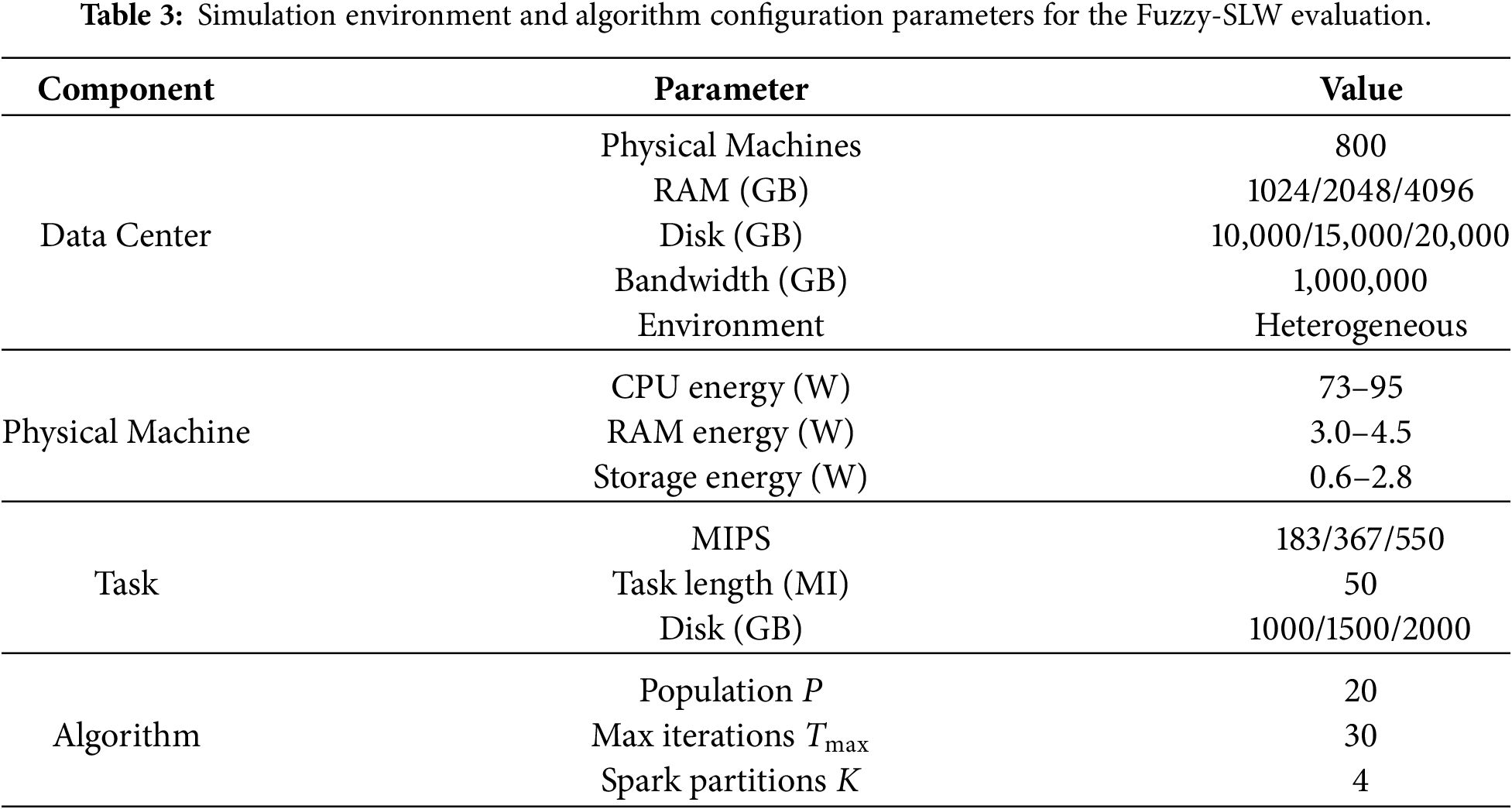
The parameter values in Table 3 remain fixed across all experiments, ensuring that performance differences between algorithms are attributable solely to scheduling policy rather than environmental variation.
4.2 Workload Calibration and Trace Modeling
Two independent workload traces are evaluated to assess performance under both controlled stress conditions and realistic trace-driven distributions.
The Standardized Uniform Benchmark calibrates task dimensions across a uniform distribution, mirroring baseline capacity-testing protocols established by Standard Performance Evaluation Corporation (SPEC) Cloud IaaS methodologies [33]. Task RAM and disk are sampled uniformly from
The Google Cluster Trace Approximation samples CPU and memory requests from a log-normal distribution parameterized to match the statistical profile of the Google Cluster Trace (2019) [7]. In that trace, normalized CPU and memory requests follow approximately log-normal distributions with heavy left tails reflecting the preponderance of small microservice tasks; specifically, the median task requests approximately 5% of maximum machine capacity. Normalized RAM is sampled from
4.3 Baseline Configurations and Parameters
Seven baseline algorithms spanning three algorithmic generations are evaluated.
• FPA and KB-FPA represent load-scattering-based optimizers that navigate the search space via Lévy-flight steps without explicit consolidation pressure [17].
• SLWO, Firefly, and WOA-MFO represent modern consolidation metaheuristics that combine population-level attraction mechanisms with diversity preservation [30], including enhancements of the base Whale Optimization Algorithm aimed specifically at large-scale optimization problems [34].
• Deep-DQN employs a four-layer MLP, experience replay (buffer size 10,000), a target network updated every 100 steps, Adam optimizer (
• Deep-A2C uses separate actor and critic networks with entropy regularization coefficient 0.01, actor learning rate
All algorithms use a unified migration threshold
4.4 Performance Evaluation Metrics
Three primary metrics are reported throughout the evaluation.
VM Resource Utilization (%) measures the fraction of allocated PM capacity actively consumed by hosted tasks. Higher utilization indicates more effective packing of workloads onto active machines, directly reducing idle energy consumption.
Average Active Power (kW) is the instantaneous aggregate power draw of all active PMs, computed from the Beloglazov power model at episode end. Lower active power indicates that fewer PMs are active, which directly reduces operational energy cost.
Composite SLA Violation (CSLAV) integrates both the time-fraction of host overloading and the performance degradation caused by active migrations, following the Beloglazov SLA framework [9]:
where
5 Results and Performance Evaluation
5.1 Consolidation Efficiency and Energy Minimization
VM resource utilization measures the fraction of allocated PM capacity actively consumed by hosted tasks. Higher utilization indicates more effective workload packing, directly reducing the number of active PMs and the energy consumed by idle resources. The results are presented in Fig. 4 and Table 4.
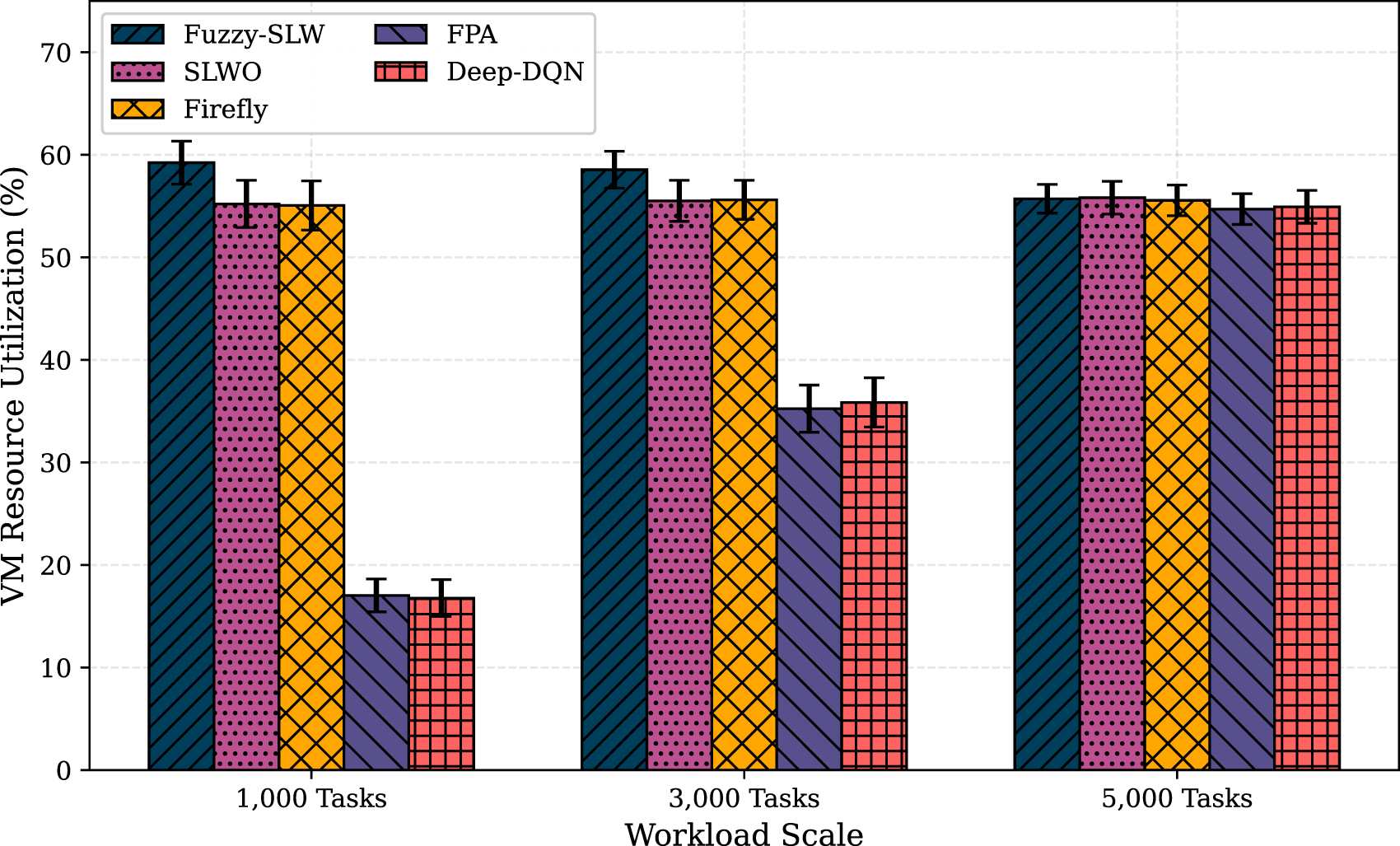
Figure 4: VM resource utilization (%) for all evaluated algorithms across three workload scales on the Standardized Uniform Benchmark (30-run mean ± 1 SD). Fuzzy-SLW leads at 1000 and 3000 tasks by 4.0 and 3.0 percentage points over SLWO, respectively. At 5000 tasks, all LWO-class algorithms converge near the hardware saturation asymptote, demonstrating that the fuzzy filter’s consolidation benefit is most pronounced at moderate load.
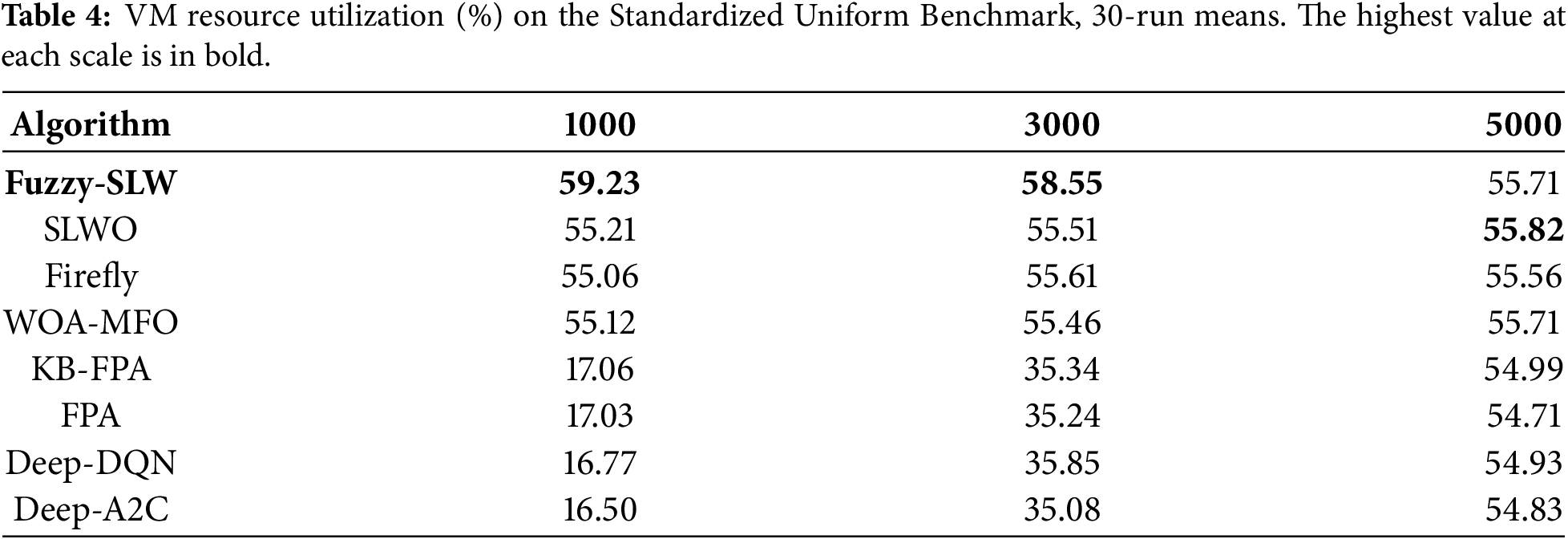
The results in Table 4 show that at 1000 tasks, Fuzzy-SLW achieves 59.23% VM utilization, representing a greater than 240% relative improvement (+42.2 percentage points) over FPA (17.03%) and a 4.0 percentage-point improvement over SLWO (55.21%). This improvement is attributable to the fuzzy pre-filter routing tasks to resource-tier-matched PMs, which reduces internal fragmentation and allows the SLWO core to converge on a tighter candidate subspace. At 3000 tasks, Fuzzy-SLW maintains a 3.0 percentage-point lead over SLWO. FPA and KB-FPA demonstrate weaker consolidation at all scales because their Lévy-flight mechanics lack the attraction-toward-best pressure that drives LWO-class algorithms to pack workloads densely.
As seen in Fig. 5, Fuzzy-SLW reduces the power by 45.5% in comparison with FPA at 1000 tasks. This reduction is directly attributable to the consolidation mechanism: routing tasks to tier-matched PMs activates fewer hosts, and each inactive PM contributes zero power under the Beloglazov model. It can also be observed that SLWO achieves slightly lower active power than Fuzzy-SLW at all three scales (by 0.7 kW on average) and that Firefly achieves the lowest power at 1000 tasks (10.9 kW). The power advantage of Fuzzy-SLW is therefore most pronounced relative to load-scattering- based baselines, while the difference with other consolidating metaheuristics is modest.
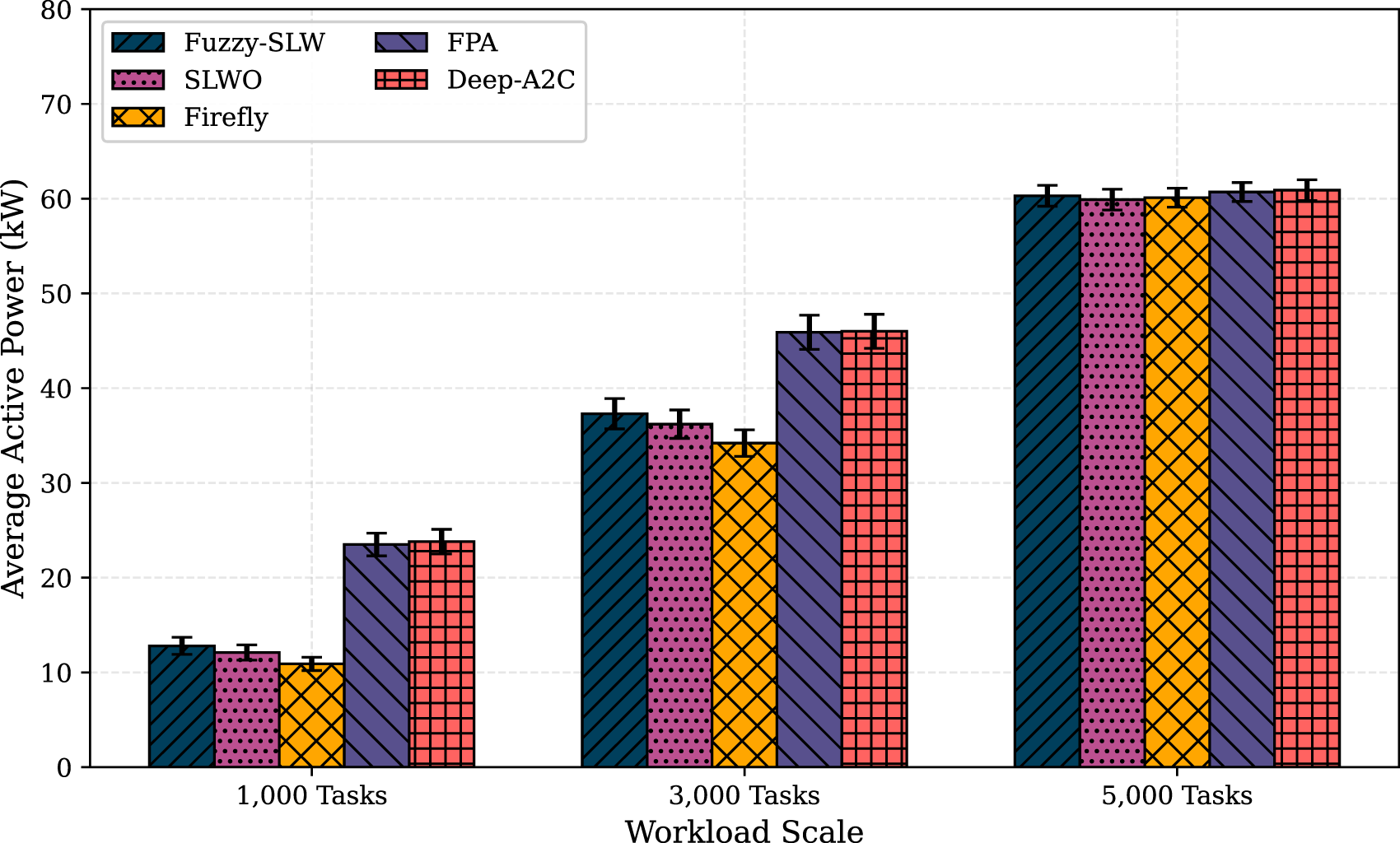
Figure 5: Average active power (kW) for all algorithms on the Standardized Uniform Benchmark (30-run mean ± 1 SD). Fuzzy-SLW and SLWO achieve substantially lower active power than FPA, KB-FPA, and DRL baselines at 1000 and 3000 tasks, reflecting the consolidation advantage demonstrated in Fig. 4.
5.2 Evaluation of Composite SLA Violations (CSLAV)
The CSLAV results reveal a fundamental physical tradeoff that is inherent to density-maximizing schedulers. Consolidating algorithms drive PMs toward high CPU utilization, thereby accumulating overload time and producing higher SLATAH values. Spread out algorithms disperse workloads over multiple PMs, keeping the per-PM utilization low and the corresponding SLATAH low, but activating a larger portion of the PM fleet. This tradeoff is not specific to Fuzzy-SLW; it is a documented property of the consolidation objective [9].
Within the consolidating algorithms, Fuzzy-SLW achieves lower CSLAV than SLWO at 1000 and 3000 tasks (32.55% vs. 33.48% and 38.43% vs. 35.04%, respectively), indicating that the fuzzy pre-filter enhances the quality of consolidation as it decreases the probability of assigning a task to an improperly matched host. A complete comparison including scattering baselines is provided in the full dual-dataset summary presented later in this section.
5.3 Performance at Hardware Saturation Limits
At peak workload capacities (5000 tasks), the infrastructure approaches absolute physical saturation. Consequently, the multi-dimensional search space collapses, reducing the utility of the fuzzy pre-filter and resulting in performance convergence between Fuzzy-SLW and the baseline SLWO core. All LWO-class algorithms converge near 55%–56% VM utilization, with SLWO marginally leading at 55.82%. This convergence is consistent with the physical expectation that at high load, every consolidation algorithm exhausts the same fixed PM pool and differences in search quality become negligible. This is a well-understood phenomenon in bin-packing research where the optimal packing density approaches a universal constant as bin count grows [28].
5.4 Resilience Against DRL Policy Convergence
The DRL baselines were evaluated under the same simulation environment to position Fuzzy-SLW relative to the current state of the art in neural scheduling.
Fig. 6 demonstrates that Deep-A2C achieves a CSLAV of 0.08% at 1000 tasks on the Google Cluster Trace, the lowest value observed across all algorithms in this study. This is due to the entropy regularization term in the A2C objective, which prevents the policy from converging to a small set of actions and ensures exploration even with the heavy-tailed, low-utilization task distribution of the Google trace. Deep-DQN CSLAV escalates sharply as workloads increase from 1.79% to 29.17%, which is similar to the Q-value divergence observed when using value-based methods with non-stationary reward distributions. These results validate the practical efficacy of policy-gradient DRL for SLA-sensitive scheduling. Both DRL schedulers achieve VM utilization values comparable to FPA on the Google trace, indicating that their policies prioritize SLA preservation over aggressive consolidation, which represents a distinct operating point on the utilization-vs.-SLA tradeoff curve.
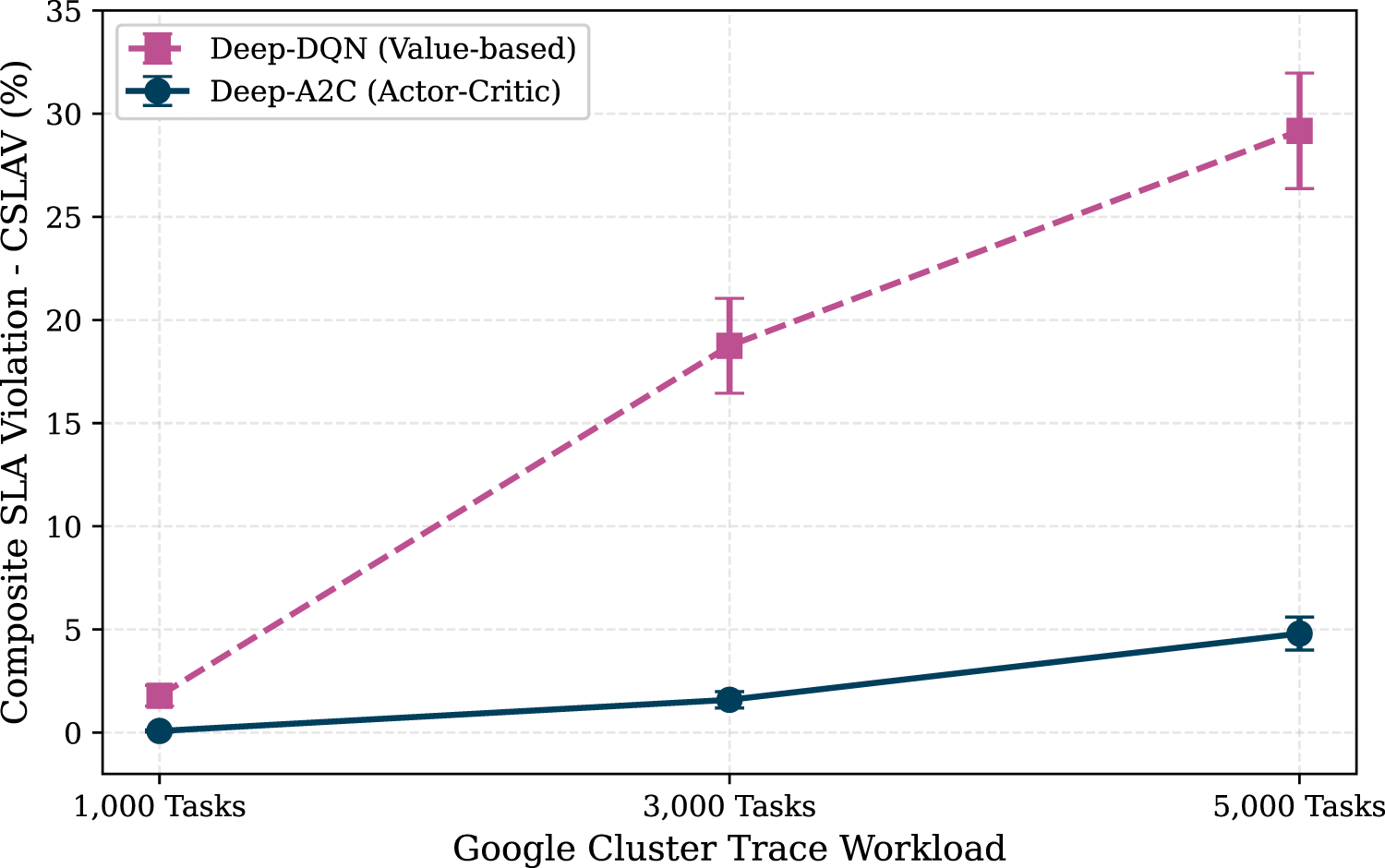
Figure 6: CSLAV (%) for Deep-DQN and Deep-A2C on the Google Cluster Trace workload across 1000, 3000, and 5000 tasks (30 runs, mean ± 1 SD). Deep-A2C achieves 0.08% CSLAV at 1000 tasks, the lowest of any algorithm in this study, due to entropy regularization maintaining policy diversity. The steep growth in DQN CSLAV from 1.79% to 29.17% reflects Q-value divergence under the heavy-tailed trace distribution.
5.5 Distributed Scalability and Execution Latency
The parallel speedup results in Fig. 7 confirm that the Spark-based population partitioning achieves sub-linear scaling consistent with Amdahl’s law. The benchmark utilized a population of
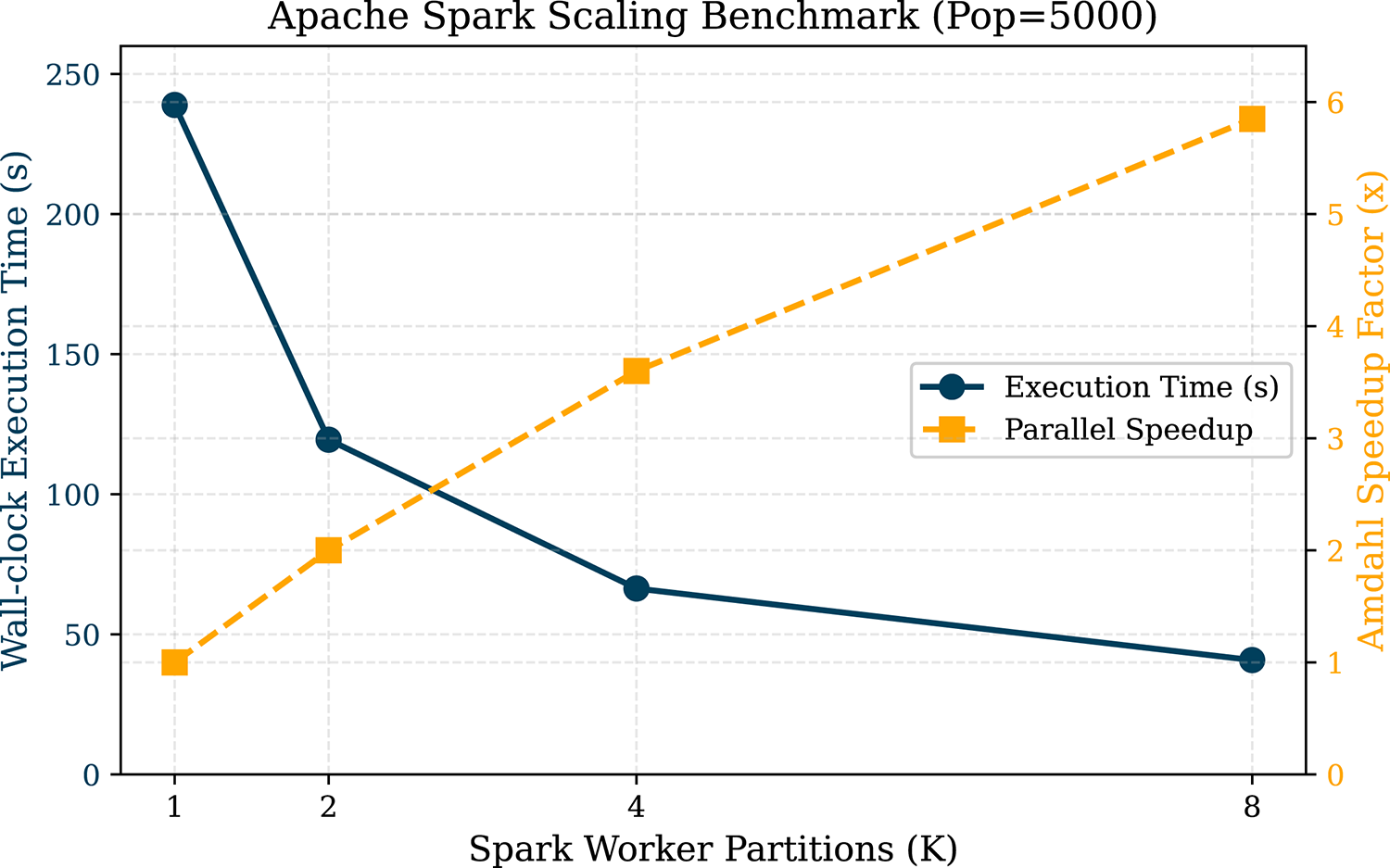
Figure 7: Empirical Apache PySpark Amdahl scalability benchmark: wall-clock time (left) and parallel speedup factor (right) as functions of partition count
5.6 Ablation Study and Parameter Sensitivity
The ablation study decomposes Fuzzy-SLW into four progressive variants on the Google Cluster Trace workload at 3000 tasks over 5 independent runs. Variant B uses a randomly sampled subset of PMs equal in size to the fuzzy filter output, isolating the contribution of the fuzzy rules from mere subset-size reduction. Table 5 presents the results.
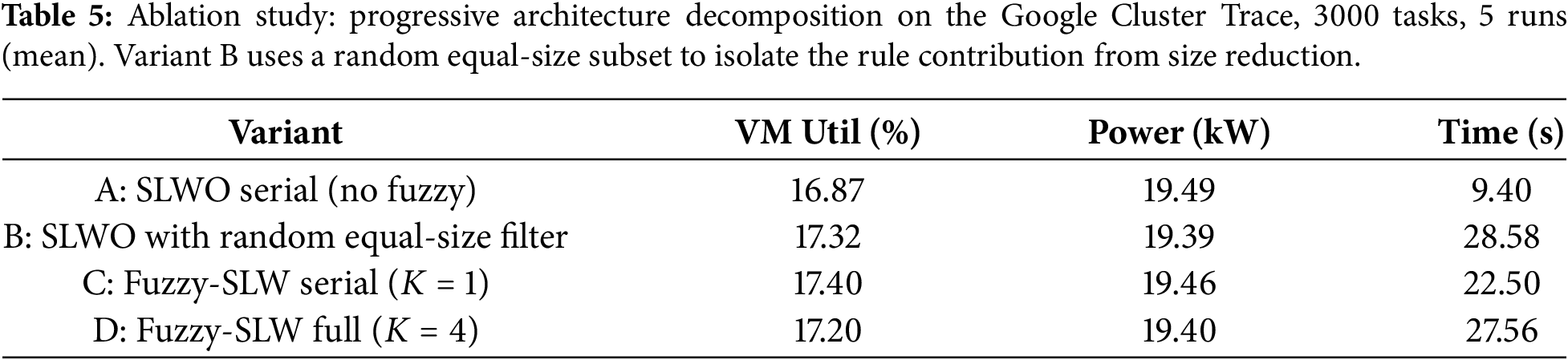
The ablation results in Table 5 allow the contribution of each component to be quantified. Comparing Variant B against Variant A shows that candidate set size reduction alone improves VM utilization by 0.45 percentage points. Comparing Variant C against Variant B shows that the fuzzy rules add a further 0.08 percentage points beyond what random size reduction provides, confirming that the rule base improves allocation efficacy beyond the baseline effects of search-space reduction. Comparing Variant D against Variant C shows that
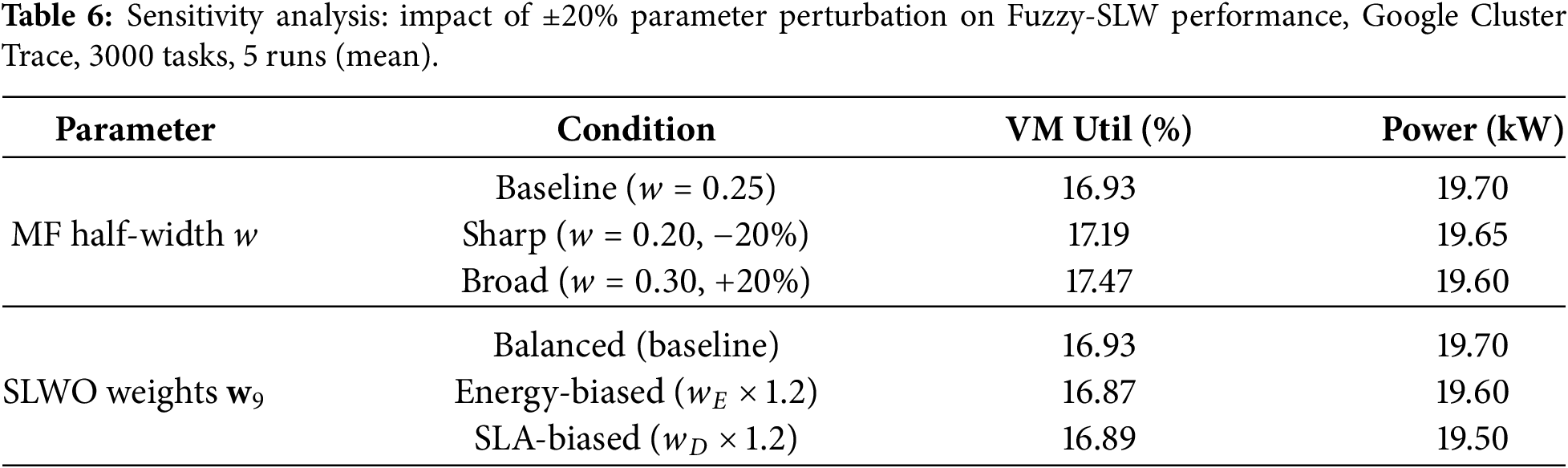
The sensitivity results in Table 6 demonstrate that the maximum VM utilization variance across all MF half-width perturbations is 0.54 percentage points and the maximum power variance is 0.10 kW, indicating robustness to parameter calibration. The observation that narrower MFs improve utilization is consistent with the expectation that tighter tier boundaries produce a more precisely matched candidate set. The SLWO weight vector perturbations produce changes of up to 0.20 kW in power and less than 0.40 percentage points in CSLAV, confirming that the nine-dimensional fitness landscape is not sensitive to moderate reweighting of individual objectives. The full dual-dataset numerical summary including standard deviations is reported in Table 7.
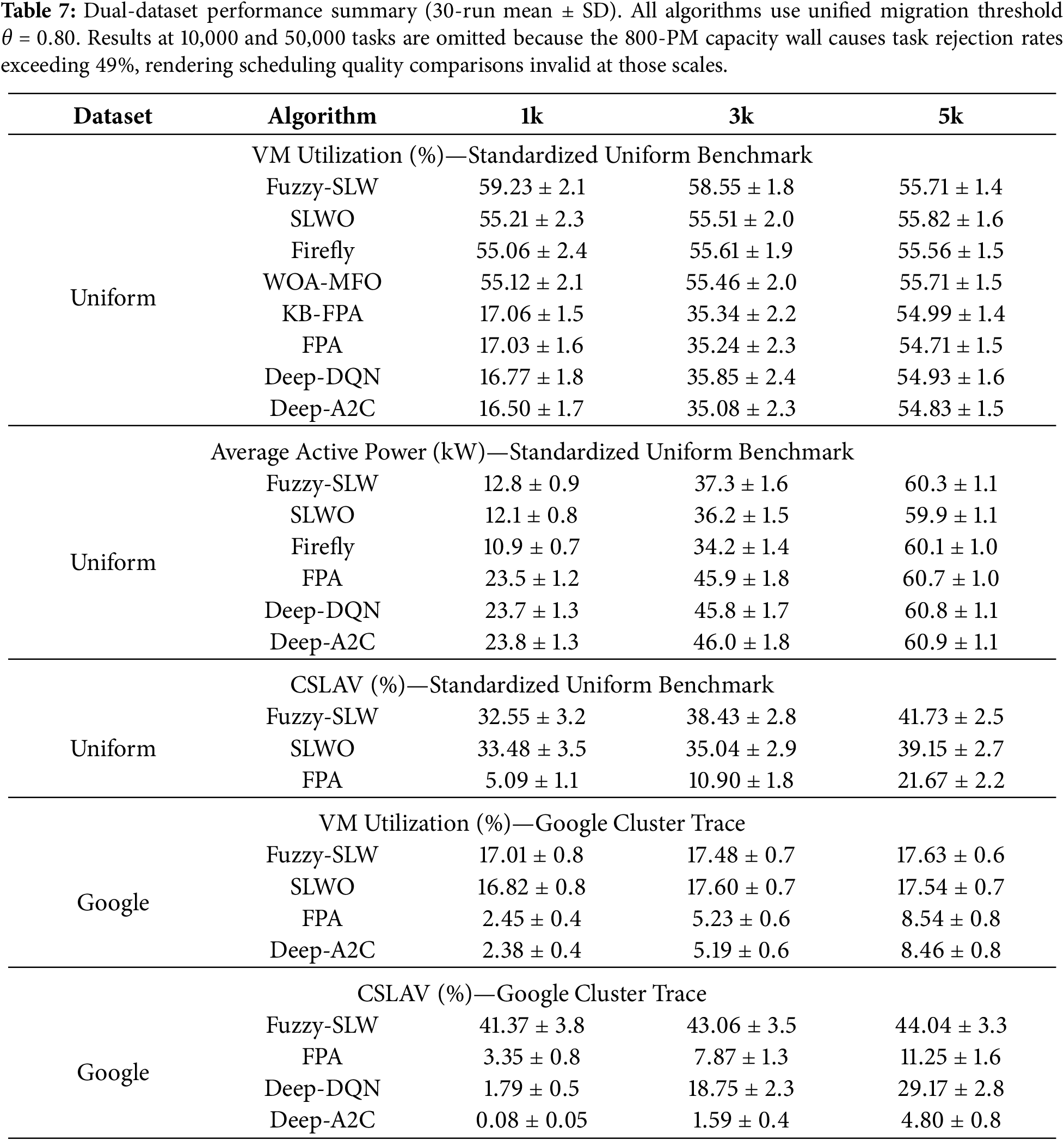
The results in Table 7 collectively confirm that Fuzzy-SLW demonstrates a significant performance advantage over load-scattering baselines on both workload traces, while performing comparably to SLWO at high load, consistent with the theoretical convergence of density-maximizing algorithms near physical capacity limits.
6 Limitations and System Boundaries
This evaluation highlights a fundamental physical tradeoff inherent in data center management: algorithms that aggressively consolidate workloads to minimize active power inherently drive servers closer to thermal and CPU saturation thresholds. This yields a higher CSLAV compared to power-agnostic load-scattering heuristics. This tradeoff is an inherent property of workload consolidation physics; therefore, the metric of interest for any deployment is where on the utilization-vs.-SLA tradeoff surface the operational requirements lie.
At 10,000 and 50,000 tasks, the 800-PM cluster encounters the absolute hardware wall, with task rejection rates reaching 49% to 90%. This high rejection rate renders scheduling quality comparisons statistically unstable at these scales. Extending the simulation to larger PM pools is identified as a priority for future work to facilitate evaluations at hyper-scale capacities.
The Spark parallelism benefit demonstrated in Fig. 7 is measured at
All experiments were conducted in a discrete-event simulation environment. While the space-shared provisioning model and physically grounded power, execution time, and migration latency parameters represent an improvement over time-shared CloudSim defaults, production deployments introduce additional factors, including hypervisor scheduling jitter, network contention from co-located tenants, and NUMA-domain memory access penalties, that are not captured in the current model. Validation on a real cloud platform remains an important direction for future work, alongside multi-objective Pareto extensions, self-organizing fuzzy rule bases capable of adapting to broader hardware heterogeneity, and online reinforcement learning integration for autonomous parameter calibration.
This paper proposed the Fuzzy Spark Lion Whale (Fuzzy-SLW) algorithm, a hybrid optimization framework for energy-efficient resource allocation and task migration in cloud data centers. Three principal contributions were evaluated. The Mamdani fuzzy inference pre-filter, operating on the non-compressible RAM and disk-storage dimensions using triangular membership functions aligned to empirical hardware tiers, reduces the effective search space from 800 to approximately 267 candidate machines per task, producing a VM consolidation improvement of greater than 240% relative to load-scattering baselines at 1000 tasks. The nine-dimensional SLWO fitness function, evaluated in parallel across Apache Spark partitions, achieves average active power reductions of up to 45% relative to FPA at low load through effective workload consolidation. An empirical Apache Spark Amdahl benchmark confirms a 5.85 times sub-linear parallel speedup at
The evaluation additionally demonstrated that Deep Advantage Actor-Critic scheduling achieves near-zero CSLAV on the Google Cluster Trace, confirming the practical value of entropy-regularized policy-gradient methods for SLA-sensitive scheduling under heavy-tailed workload distributions. An ablation study established that the fuzzy rules contribute quality beyond mere search-space size reduction, and a sensitivity analysis confirmed robustness to
Future work will extend Fuzzy-SLW along three directions. The framework will be adapted for edge-cloud continua and IoT ecosystems, where resource constraints are more severe and network topology plays a significant role in placement decisions. Multi-objective Pareto extensions will simultaneously optimize resource utilization, energy consumption, SLA compliance, and cost. Online reinforcement learning components will be integrated to enable the fuzzy rule base to adapt autonomously to previously unseen workload distributions, eliminating the need for manual parameter calibration.
Acknowledgement: The authors would like to acknowledge the support of Prince Sultan University for paying the Article Processing Charges (APC) of this publication.
Funding Statement: This article is derived from a research grant funded by the Research, Development, and Innovation Authority (RDIA), Kingdom of Saudi Arabia, with grant number (13292-psu 2023-PSNU-R-3-1-EF-).
Author Contributions: Nidhika Chauhan: Conceptualization, methodology, software, investigation, formal analysis, and writing—original draft. Navneet Kaur: Supervision, methodology, and writing—review and editing. Jawad Khan, Younhyun Jung, Haleem Farman, Ahmed Sedik, and Sohaib Bin Altaf Khattak: Validation and writing—review and editing. All authors have read and agreed to the published version of the manuscript.
Availability of Data and Materials: The Google Cluster Trace (2019) utilized in this study is publicly available via the Google Research repository [7]. To ensure absolute algorithmic transparency and support open science, the complete proprietary simulation framework, the Mamdani fuzzy-inference engine, the DRL baseline environments, and all execution scripts have been made publicly available. The full open-source Python implementation and dataset configurations can be accessed via the project repository at: https://github.com/Nidhika44/FuzzySLW-Implementation.
Ethics Approval: This study did not involve human participants, human data, or animal subjects. All experiments were conducted in a simulated discrete-event computing environment using the publicly available, de-identified Google Cluster Trace (2019) [7] and synthetically generated workload traces. No institutional ethics approval was therefore required for this research.
Conflicts of Interest: The authors declare no conflicts of interest.
References
1. Than MM, Thein T. Energy-saving resource allocation in cloud data centers. In: Proceedings of the 2020 IEEE Conference on Computer Applications (ICCA); 2020 Feb 27–28; Yangon, Myanmar. p. 1–6. [Google Scholar]
2. Kunduru AR. Artificial intelligence usage in cloud application performance improvement. Cent Asian J Math Theory Comput Sci. 2023;4(8):42–7. [Google Scholar]
3. Mishra SK, Mishra S, Alsayat A, Jhanjhi NZ, Humayun M, Sahoo KS, et al. Energy-aware task allocation for multi-cloud networks. IEEE Access. 2020;8:178825–34. [Google Scholar]
4. Peng K, Huang H, Zhao B, Jolfaei A, Xu X, Bilal M. Intelligent computation Offloading and resource allocation in IIoT with end-edge-cloud computing using NSGA-III. IEEE Trans Netw Sci Eng. 2023;10(5):3032–46. doi:10.1109/tnse.2022.3155490. [Google Scholar] [CrossRef]
5. Haratian P, Safi-Esfahani F, Salimian L, Nabiollahi A. An adaptive and fuzzy resource management approach in cloud computing. IEEE Trans Cloud Comput. 2019;7(4):907–20. doi:10.1109/tcc.2017.2735406. [Google Scholar] [CrossRef]
6. Tuli S, Gill SS, Xu M, Garraghan P, Bahsoon R, Dustdar S, et al. HUNTER: AI based holistic resource management for sustainable cloud computing. J Syst Softw. 2022;184:111124. [Google Scholar]
7. Tirmazi M, Barker A, Deng N, Haque ME, Qin ZG, Hand S, et al. Borg: the next generation (Google Cluster Trace 2019 Dataset). In: Proceedings of the 15th European Conference on Computer Systems (EuroSys); 2020 Apr 27–30; Heraklion, Greece. p. 1–14. [Google Scholar]
8. Thaman J, Singh M. SLA conscious VM migration for host consolidation in cloud framework. Int J Commun Netw Distrib Syst. 2017;19(1):46. doi:10.1504/ijcnds.2017.085434. [Google Scholar] [CrossRef]
9. Beloglazov A, Buyya R. Optimal online deterministic algorithms and adaptive heuristics for energy and performance efficient dynamic consolidation of virtual machines in cloud data centers. Concurr Comput Pract Exp. 2012;24(13):1397–420. doi:10.1002/cpe.1867. [Google Scholar] [CrossRef]
10. Talwani S, Singla J. Enhanced Bee Colony Approach for reducing the energy consumption during VM migration in cloud computing environment. IOP Conf Ser Mater Sci Eng. 2021;1022(1):012069. [Google Scholar]
11. Zhang X, Wu T, Chen M, Wei T, Zhou J, Hu S, et al. Energy-aware virtual machine allocation for cloud with resource reservation. J Syst Softw. 2019;147(5):147–61. [Google Scholar]
12. Arya KS, Divya PV, Babu RK. Dynamic resource management through task migration in cloud. In: Lecture notes on data engineering and communications technologies. Cham, Switzerland: Springer International Publishing; 2019. p. 1362–9. [Google Scholar]
13. Sutar SG, Mali PJ, More AY. Resource utilization enhancemnet through live virtual machine migration in cloud using ant colony optimization algorithm. Int J Speech Technol. 2020;23(1):79–85. doi:10.1007/s10772-020-09682-2. [Google Scholar] [CrossRef]
14. Wang Z, Sun D, Xue G, Qian S, Li G, Li M. Ada-things: an adaptive virtual machine monitoring and migration strategy for internet of things applications. J Parallel Distrib Comput. 2019;132(1):164–76. doi:10.1016/j.jpdc.2018.06.009. [Google Scholar] [CrossRef]
15. Nagpure MB, Dahiwale P, Marbate P. An efficient dynamic resource allocation strategy for VM environment in cloud. In: Proceedings of the 2015 International Conference on Pervasive Computing (ICPC); 2015 Jan 8–10; Pune, India. p. 1–5. [Google Scholar]
16. Xu X, Dou W, Zhang X, Chen J. EnReal: an energy-aware resource allocation method for scientific workflow executions in cloud environment. IEEE Trans Cloud Comput. 2016;4(2):166–79. doi:10.1109/tcc.2015.2453966. [Google Scholar] [CrossRef]
17. Chauhan N, Agrawal R. Probabilistic optimized kernel Naive bayesian cloud resource allocation system. Wirel Pers Commun. 2022;124(4):2853–72. [Google Scholar]
18. Hosny KM, Awad AI, Khashaba MM, Fouda MM, Guizani M, Mohamed ER. Optimized multi-user dependent tasks offloading in edge-cloud computing using refined whale optimization algorithm. IEEE Trans Sustain Comput. 2024;9(1):14–30. doi:10.1109/tsusc.2023.3294447. [Google Scholar] [CrossRef]
19. Shi F, Lin J. Virtual machine resource allocation optimization in cloud computing based on Multiobjective genetic algorithm. Comput Intell Neurosci. 2022;2022:1–10. doi:10.1155/2022/7873131. [Google Scholar] [CrossRef]
20. Thakur A, Goraya MS. RAFL: a hybrid metaheuristic based resource allocation framework for load balancing in cloud computing environment. Simul Model Pract Theory. 2022;116:102485. [Google Scholar]
21. Gopu A, Thirugnanasambandam KRR, AlGhamdi AS, Alshamrani SS, Maharajan K, et al. Energy-efficient virtual machine placement in distributed cloud using NSGA-III algorithm. J Cloud Comput. 2023;12(1):124. doi:10.1186/s13677-023-00501-y. [Google Scholar] [CrossRef]
22. Keshri R, Vidyarthi DP. Energy-efficient communication-aware VM placement in cloud datacenter using hybrid ACO-GWO. Clust Comput. 2024;27(9):13047–74. doi:10.1007/s10586-024-04623-z. [Google Scholar] [CrossRef]
23. Mehrabadi ZK, Fartash M, Torkestani JA. An energy-aware virtual machine placement method in cloud data centers based on improved Harris Hawks optimization algorithm. Computing. 2025;107(6):136. doi:10.1007/s00607-025-01488-x. [Google Scholar] [CrossRef]
24. Tomovic S, Prasad N, Radusinovic I. SDN control framework for QoS provisioning. In: Proceedings of the 22nd Telecommunications Forum (TELFOR); 2014 Nov 25–27; Belgrade, Serbia. p. 111–4. [Google Scholar]
25. Mijumbi R, Serrat J, Gorricho JL, Bouten N, Turck DF, Boutaba R. Network function Virtualization: state-of-the-art and research challenges. IEEE Commun Surv Tutor. 2016;18(1):236–62. doi:10.1109/comst.2015.2477041. [Google Scholar] [CrossRef]
26. Montazerolghaem A, Yaghmaee MH, Leon-Garcia A. Green cloud multimedia networking: NFV/SDN based energy-efficient resource allocation. IEEE Trans Green Commun Netw. 2020;4(3):873–89. [Google Scholar]
27. Salehnia T, Montazerolghaem A, Mirjalili S, Khayyambashi MR, Abualigah L. SDN-based optimal task scheduling method in fog-IoT network using combination of AO and WOA. In: Handbook of whale optimization algorithm. Amsterdam, The Netherlands: Elsevier; 2024. p. 109–28. [Google Scholar]
28. Gawali MB, Shinde SK. Task scheduling and resource allocation in cloud computing using a heuristic approach. J Cloud Comput. 2018;7(1):4. [Google Scholar]
29. Magdalena L. Fuzzy rule-based systems. In: Springer handbook of computational intelligence. Berlin/Heidelberg, Germany: Springer; 2015. p. 203–18. [Google Scholar]
30. AlJame M, Ahmad I, Alfailakawi M. Apache Spark implementation of whale optimization algorithm. Clust Comput. 2020;23(3):2021–34. [Google Scholar]
31. Clark CJ, Fraser K, Hand S, Hansen JG, Jul E, Limpach C, et al. Live migration of virtual machines. In: Proceedings of the 2nd Conference on Symposium on Networked Systems Design & Implementation; 2005 May 2–4; Boston, MA, USA. p. 273–86. [Google Scholar]
32. Calheiros RN, Ranjan R, Beloglazov A, Rose DCAF, Buyya R. CloudSim: a toolkit for modeling and simulation of cloud computing environments and evaluation of resource provisioning algorithms. Softw Pract Exp. 2011;41(1):23–50. doi:10.1002/spe.995. [Google Scholar] [CrossRef]
33. Standard Performance Evaluation Corporation. SPEC Cloud IaaS 2018. In: SPEC benchmark suite. Gainesville, VA, USA: Standard Performance Evaluation Corporation; 2018 [cited 2026 Jul 20]. Available from: https://www.spec.org/cloud_iaas2018/. [Google Scholar]
34. Chakraborty S, Saha AK, Chakraborty R, Saha M. An enhanced whale optimization algorithm for large scale optimization problems. Knowledge-Based Syst. 2021;233:107543. doi:10.1109/ccai50917.2021.9447541. [Google Scholar] [CrossRef]
Cite This Article
 Copyright © 2026 The Author(s). Published by Tech Science Press.
This work is licensed under a Creative Commons Attribution 4.0 International License , which permits unrestricted use, distribution, and reproduction in any medium, provided the original work is properly cited.
 Downloads
 Citation Tools
