
 Login
Login Register
 Submit a Paper
 Propose a Special lssue
 Open Access
ARTICLE
A Hybrid Genetic Algorithm with Information-Theoretic Local Search for Unsupervised Feature Selection
1 Division of Business Administration, Kyonggi University, Suwon, Republic of Korea
2 Division of AI Computer Science and Engineering, Kyonggi University, Suwon, Republic of Korea
* Corresponding Author: Hyunki Lim. Email:
Computers, Materials & Continua 2026, 89(2), 51 https://doi.org/10.32604/cmc.2026.085049
Received 04 May 2026; Accepted 31 July 2026; Issue published 15 September 2026
 View Full Text
 Download PDF
Abstract
Feature selection (FS) plays a crucial role in machine learning by reducing data dimensionality and improving learning efficiency. In many real-world scenarios, label information is unavailable, making unsupervised FS particularly important. While Genetic Algorithm (GA) offers a powerful global search mechanism for subset selection, it often suffers from premature convergence and struggles to refine solutions in complex search spaces. To address these limitations, we propose a hybrid GA that integrates an information-theoretic local search strategy for unsupervised FS. The proposed method integrates an information-theoretic local refinement procedure, consisting of DEL and ADD operations based on joint entropy, into a conventional GA framework. Unlike conventional evolutionary methods, our approach leverages information-theoretic measures not merely for evaluation, but as a guiding mechanism for fine-grained local exploration within the GA framework. By incorporating mutual information-based local refinement, the proposed method effectively overcomes the convergence bottlenecks of standard GAs, ensuring a more robust exploitation of feature dependencies. Experimental results on five datasets demonstrate that the proposed method consistently achieves higher clustering performance compared with conventional methods. These results imply that the proposed information-theoretic local refinement effectively mitigates the premature convergence problem of conventional GAs and improves search efficiency and solution quality compared to traditional heuristic and evolutionary approaches. It provides a promising framework for handling high-dimensional data in scenarios where label information is unavailable.Keywords
Analyzing all features contained in high-dimensional datasets is a time-consuming and computationally expensive process. Thus, FS plays a crucial role in machine learning by improving model performance, reducing computational complexity, and enhancing interpretability. It can be divided into supervised learning with class labels and unsupervised learning without labels, but obtaining class labels from real datasets is sometimes expensive or impossible. In particular, unsupervised feature selection (UFS) methods have attracted significant attention because they deal with learning tasks without class labels, which are frequently encountered in real-world applications. UFS methods aim to identify a subset of informative and non-redundant features that preserve the intrinsic structure of the data while eliminating irrelevant or noisy features. Traditional UFS approaches can be broadly categorized into filter, wrapper, and embedded methods [1,2]. Among these, wrapper-based UFS has demonstrated superior performance in many cases because it directly evaluates feature subsets by involving a learning algorithm in the selection process [3].
Despite their promising performance, wrapper-based UFS methods face significant challenges regarding computational complexity and search efficiency, particularly when applied to high-dimensional data. Since these methods require repeated executions of unsupervised learning algorithms, such as
Motivated by the complementary strengths of GA-based global search and information-theoretic local guidance, we propose a novel UFS framework that integrates an information-theoretic local refinement strategy into a conventional GA. Our method incorporates a local refinement process that leverages mutual information and related measures to prioritize informative and mutually independent features. By combining the global exploration capability of GA with the fine-grained optimization offered by local refinement, the proposed approach achieves a better balance between search efficiency and selection accuracy. This integration not only accelerates convergence but also improves the quality of the selected feature subsets, leading to more robust UFS.
The principal contributions and advantages of the proposed framework are summarized as follows:
• Hybrid Search Strategy: We introduce a dual-layered search mechanism that integrates the global exploration of GA with a deterministic, information-theoretic local refinement. This hybrid approach effectively mitigates the exploration-exploitation trade-off, ensuring both broad search coverage and precise local optimization.
• Enhanced Convergence via Local Refinement: By incorporating mutual information-based guidance into the evolutionary process, our method overcomes the common GA pitfall of premature convergence. The local refinement accelerates the search toward high-quality regions of the feature space, significantly reducing the number of generations required to find optimal subsets.
• Information-Theoretic Criteria: The computational intractability of estimating full-order joint entropy in high-dimensional spaces motivates a different approach. We derive a formal objective function that decomposes complex joint dependencies into computable mutual information terms, providing a robust proxy for the total information content of a subset. This analytical formulation ensures that the genetic search is guided by a mathematically consistent and efficient local optimization criterion.
The remainder of this paper is organized as follows. Section 2 discusses the difference between supervised and unsupervised learning in FS and reviews related research. Section 3 specifically describes the proposed GA framework and the information-theoretic local refinement. Section 4 presents the experimental settings, comparative results, and analysis. The final section 5 summarizes the study and discusses future research directions.
FS is an essential preprocessing step that identifies informative and non-redundant features from high-dimensional datasets. Depending on the availability of class label information, FS methods can be broadly divided into supervised and unsupervised approaches.
Improved Ensemble Classifier with Genetic Algorithm (IECGA) [8] is a five-stage ensemble-based framework that integrates GA-based FS with heterogeneous supervised classifiers. It consists of a training layer encompassing FS, base classification, and ensemble classification, and a testing layer for prediction. A GA search method combined with a Correlation-based FS evaluator is employed to identify an optimal feature subset. The selected features are fed into three base classifiers—Random Forest, Support Vector Machine, and Naïve Bayes—which are subsequently combined through a soft voting ensemble technique. Similarly, Importance-Guided Particle Swarm Optimization (IGPSO) [9] is a hybrid framework that combines a two-stage MLP-based focal neural network with importance-guided binary PSO for large-scale FS. The focal neural network learns a feature importance vector using positive and negative sample training, which is then used to guide both population initialization and the particle update strategy. While both approaches demonstrate strong performance, they remain supervised methods that fundamentally depend on class label information, limiting their applicability to environments where labeled data is available.
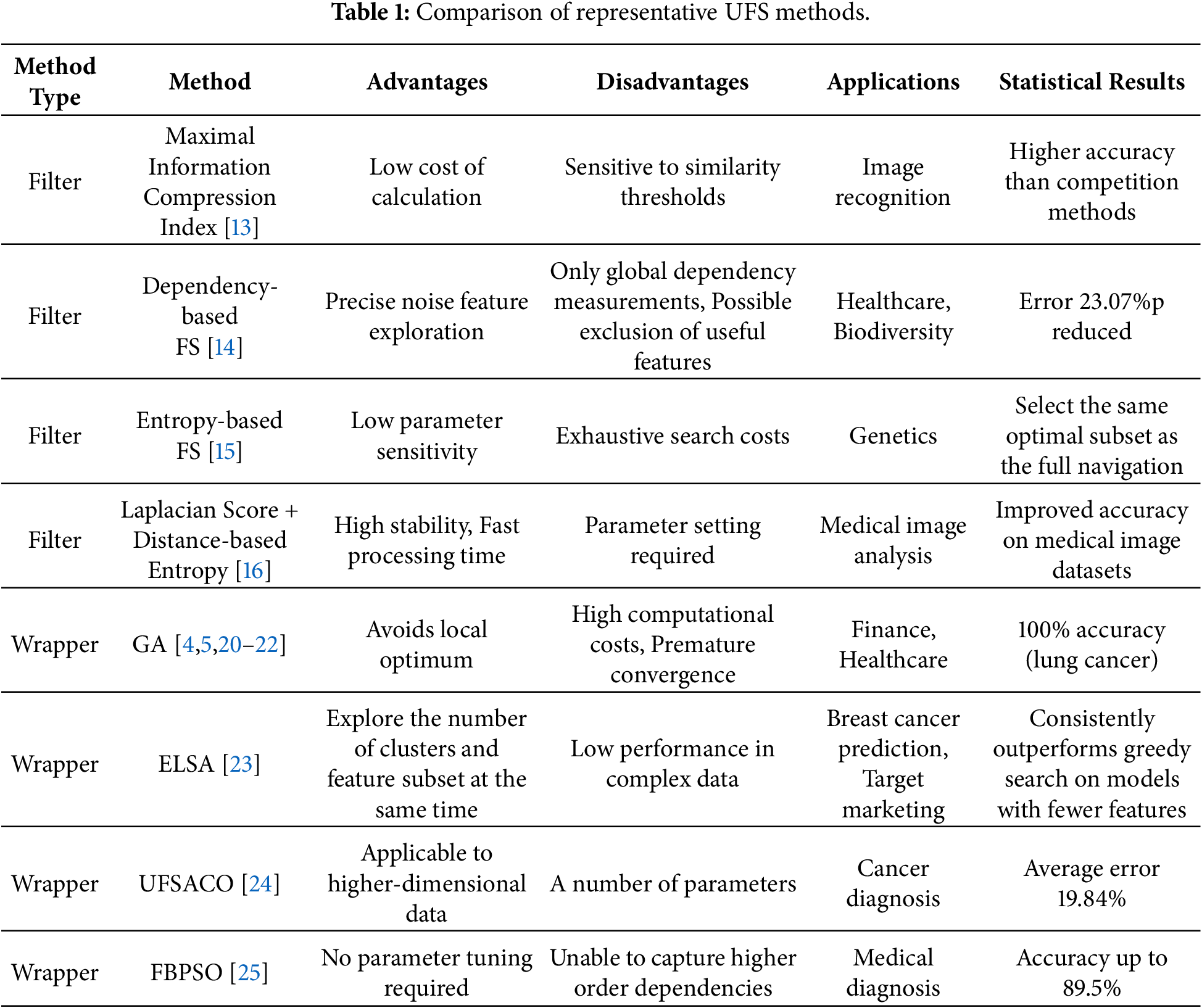
UFS can be broadly categorized into filter and wrapper methods [1,2,10].
Filter methods do not rely on a specific learning algorithm. Instead, they generate feature subsets by evaluating individual features or the relationships among features. To compute the importance of features, statistical or information-theoretic measures such as variance-covariance, linear correlation, entropy, and mutual information are used [11,12]. The Maximal Information Compression Index is a metric used to evaluate features based on their variance–covariance structure [13]. This approach aims to minimize information redundancy within the selected feature subset.
The dependency-based FS [14] uses statistical measures of dependence between features. If the correlation with other features is low, those features are evaluated as less dependent. Features with low dependence are considered unnecessary in the clustering process for label classification. For this reason, we select features with high dependence. The entropy-based filter method [15] proposes a distance-based similarity entropy. To measure the entropy of the feature, it is re-implemented as an exponential function instead of the usual logarithmic function. The Laplacian score combined with distance-based entropy measurements [16] presents a scheme to combine the Laplacian score with the distance entropy proposed by the entropy-based filter method [15]. The features are selected based on the distance entropy and the ranking generated by the Laplacian score. Thus, information-theoretic approaches can use mutual information volume, entropy, etc. to evaluate the relevance and information redundancy of unlabeled features and generate feature subsets.
These filter methods have the advantage of low computational complexity, enabling very fast processing even for large-scale datasets. However, they usually rely on individual or feature evaluations to find optimal solutions, but do not explicitly optimize subsets, so the resulting subset of features may still contain information redundancy.
Wrapper methods differ from filter methods in that they iteratively evaluate feature subsets using a fitness function to search for the optimal combination. Since label information is unavailable in unsupervised settings, it is essential to employ a fitness function that can evaluate underlying structural properties of the given dataset [1,17–19].
Wrapper-based approaches typically adopt evolutionary algorithms that mimic biological evolution to search for optimal feature subsets. A typical example is GA, which evolves candidate solutions through selection, crossover, and mutation operators inspired by biological reproduction [4,5,20–22]. GA encodes possible feature combinations as chromosomes and evaluates each combination using a fitness function. By introducing stochastic elements into the search process, GA increases the selection probability of high-fitness parent individuals through a roulette wheel selection mechanism and generates offspring through crossover operations. In addition, mutation, which flips certain values randomly, helps alleviate the local optimum problem.
Kim et al. introduce four heuristic fitness criteria in conjunction with the
In addition, UFS based on Ant Colony Optimization (UFSACO) does not use a fitness function but utilizes an iterative population-based search mechanism similar to the wrapper method’s optimization. UFSACO imitated the process by which ants use pheromones to find food by optimal routes. This method proposes a cosine similarity metric to quantify pairwise feature similarity between features [24]. Features are represented as nodes, and cosine similarity between features forms the edges of an undirected graph, which serves as the search space. During the search process, ants probabilistically prefer features with low similarity and high pheromone values. Ultimately, features with the highest pheromone values are sequentially selected for the final subset.
Particle Swarm Optimization (PSO) has strong global search capability and fast convergence rates, but is sensitive to parameter settings. To address these limitations, a filter-based barebone PSO (FBPSO) that does not require parameter adjustment has been proposed [25]. FBPSO is a hybrid approach that incorporates filter-based preprocessing steps within the wrapper-based PSO search framework. In this work, particles represent a subset of features, which move towards achieving stochastic optimal performance based on their own experience and the global best performance of the cluster. FBPSO first removes irrelevant or weakly related features based on feature correlations as a preprocessing step. After that, the algorithm repeatedly refines the feature subset using the DEL operator and the ADD operator based on the mutual information between the features. However, the filter component cannot capture higher-order dependence between the features, relying solely on pair-by-pair feature correlations. More broadly, existing hybrid methods tend to use informational measurements only as an evaluation criterion rather than an active guiding mechanism in the search process, and early convergence problems are likely to occur in high-dimensional feature spaces. Redundancy reduction strategies such as maximizing relevance while minimizing redundancy have been extensively studied in supervised settings [7], yet their systematic application in UFS remains limited.
Since wrapper methods repeatedly evaluate feature subsets, they have the advantage of producing optimized feature subsets with lower information redundancy compared to filter methods. However, they require substantial computational cost and time, and they also suffer from a convergence problem, where the search becomes trapped in a prematurely converged local optimum and fails to escape toward a globally superior solution [6]. Hybrid approaches integrate the strengths of both filter and wrapper methods by combining preprocessing steps with evolutionary search, aiming to reduce computational cost while maintaining high-quality feature subsets [25]. However, such sequential combinations lack a systematic workflow that interleaves global search with fine-grained local refinement, leaving the convergence problem fundamentally unresolved. To address the inherent convergence issues of metaheuristic wrapper approaches, we propose a hybrid framework that augments the global search capabilities of GA with a specialized local refinement module. This integrated approach is designed to refine the search trajectory through analytical guidance, thereby ensuring the selection of more robust and diverse feature subsets. For a clearer comparison, Table 1 categorizes the filter and wrapper methods based on their advantages, limitations, and practical applications, supplemented by statistical benchmarks reported in previous studies.
UFS aims to identify an informative subset of features that best represents the intrinsic structure of the data without relying on label information. Given a data matrix
GA provides an effective meta-heuristic framework to address such non-convex and discrete optimization problems [26]. In the context of UFS, each chromosome encodes a candidate feature subset, and the population evolves toward higher-quality subsets through evolutionary operators such as selection, crossover, and mutation. Each chromosome is represented as a binary vector, where a value of 1 indicates that the corresponding feature is selected. The initial chromosomes are generated by randomly setting a fixed number of bits, corresponding to the initial subset size, to 1. Parent selection is performed using a roulette-wheel mechanism, where the probability of selection is proportional to the fitness value. Crossover generates two offspring from two selected parents by exchanging segments of the parent chromosomes at a specific crossover point. The generated offspring then undergo mutation, in which the value of a randomly selected bit is changed from 0 to 1 or from 1 to 0. Unlike gradient-based methods that require differentiable objective functions, GA can explore discontinuous search spaces and avoid being trapped in local minima through stochastic recombination and mutation [23]. Moreover, the population-based nature of GA allows for parallel exploration of multiple candidate subsets, which enhances global search capability. Owing to these advantages, GA has been widely applied to FS problems as a flexible and general-purpose optimizer for discrete feature subset selection [3].
However, the standard crossover and mutation operations in a GA are not inherently suitable for FS, since the best individual features do not necessarily constitute the best feature subset [7]. In particular, the crossover operator tends to preserve individual features that appear favorable in isolation, without considering their joint redundancy or complementarity. To overcome these limitations and to enhance the discriminative capability of the selected subset while controlling its size, we introduce an information-theoretic local refinement mechanism applied to each chromosome in the genetic population. This refinement adaptively adds or removes features based on mutual information criteria, thereby guiding the evolutionary process toward more informative and compact feature subsets. The proposed framework consists of a GA-based global search module and an information-theoretic local refinement module. The GA conducts global exploration through selection, crossover, and mutation operators, while the local refinement module applies DEL and ADD operations based on joint entropy to the top-ranked elite chromosomes. This ensures both broad search coverage and precise local optimization simultaneously. A clustering-based fitness function combining
The amount of uncertainty of a random variable
where
where
Conditional entropy is useful for measuring how much additional information is needed to describe
To evaluate fitness, we construct a fitness function by combining the heuristic metrics
3.2.1 Motivation for Local Refinement
Let
In the context of a GA, the subset
3.2.2 DEL Operation for a Chromosome
In the case of removing a feature from the subset
However, since
Lee and Kim [27] define sum of the
where
where
Lemma 1: Let
Lemma 1 indicates that the upper bound of
Theorem 1: Upper bound of the
where
Theorem 1 implies that the approximation becomes tighter as the value of
where
Note that the total pairwise entropy over the subset
Since
This reformulation allows for highly efficient matrix-based vectorization, ensuring the removal of the feature with the least individual information and synergy.
3.2.3 ADD Operation for a Chromosome
In addition to the objective function designed for deletion, an analogous objective function can also be formulated for the addition operation. In the case of adding a feature from the subset
From the Theorem 1, the objective function (17) can be approximated as
where
where
Finally, the proposed local refinement process can be summarized by two complementary operations: feature removal (DEL) and addition (ADD), which are defined as
where the DEL operation removes the feature contributing the least entropy within the current subset, and the ADD operation selects the feature that maximizes the joint entropy with the already selected features. These two operators enable the adaptive refinement of chromosomes toward subsets that preserve higher information content while maintaining compactness. The number of selected features is kept constant during the refinement process.
Specifically, Algorithm 1 invokes Algorithm 2 in each generation by passing the top
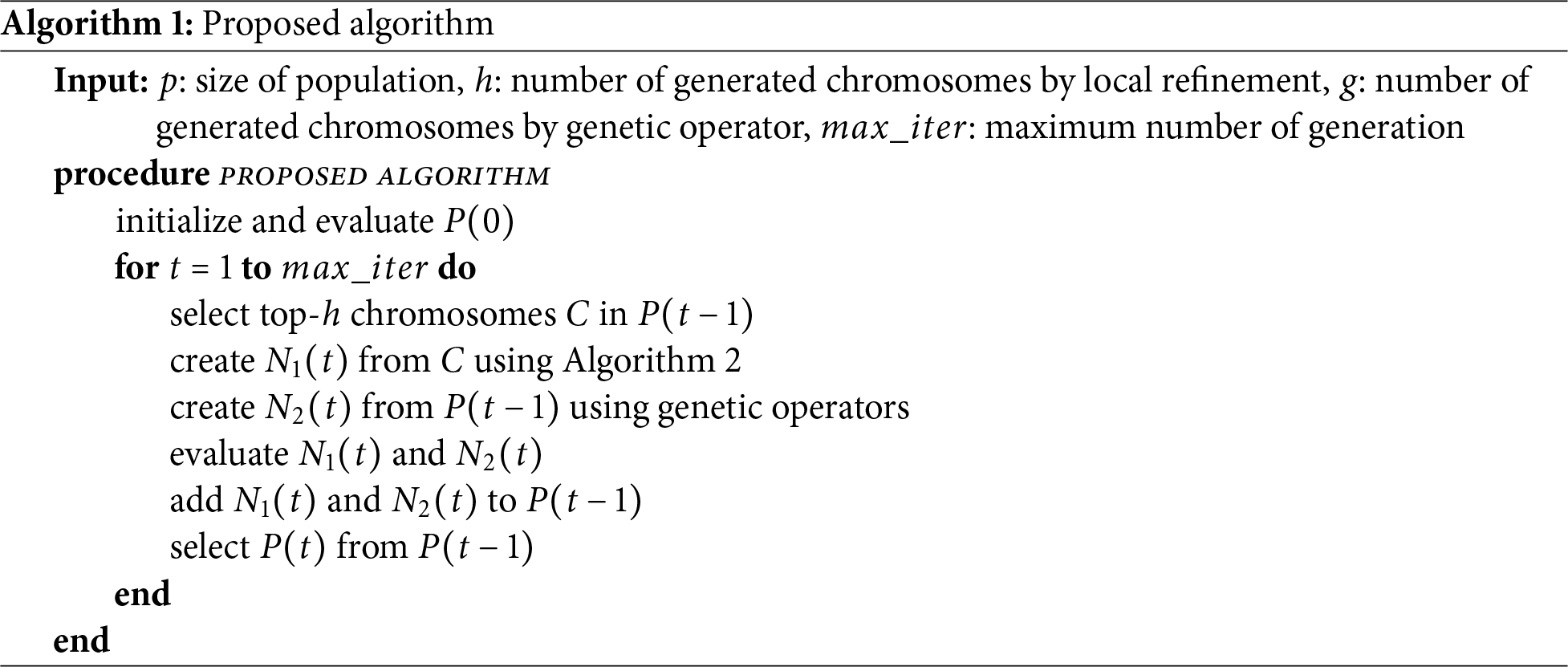
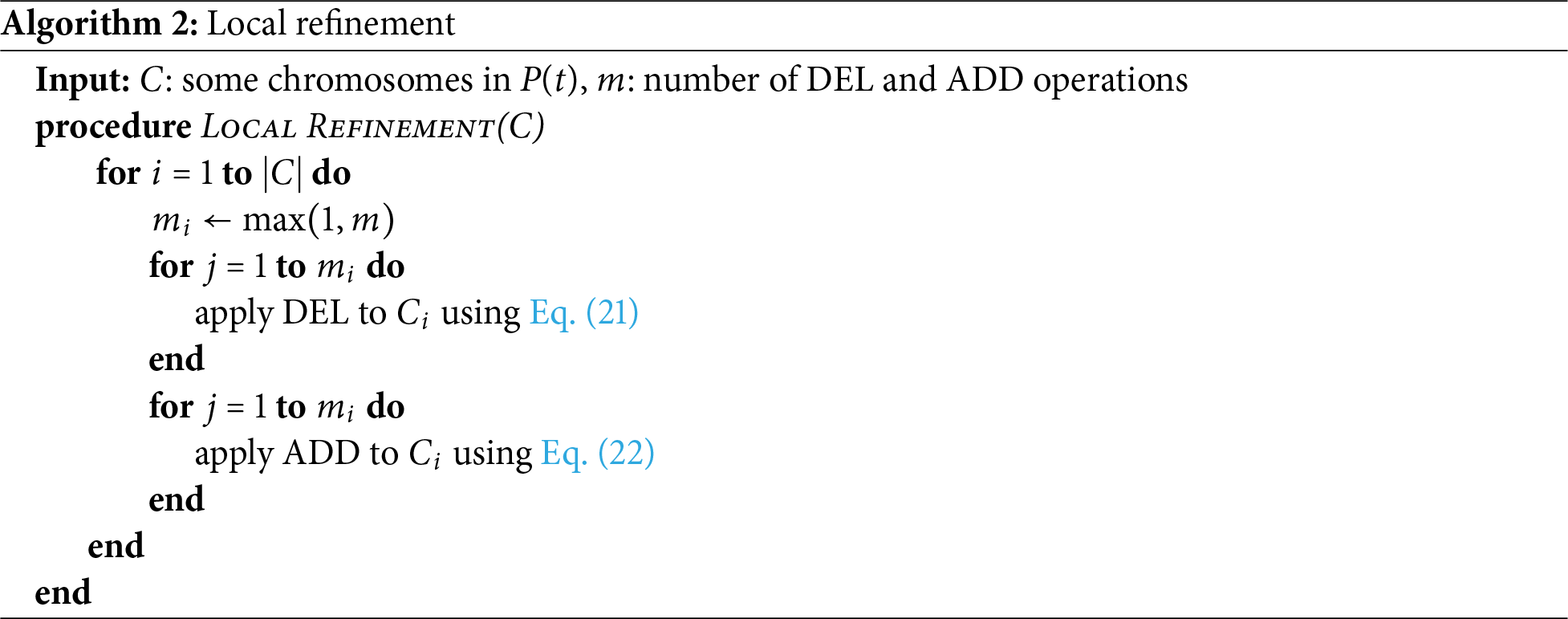
We adopt a memetic search framework in which a GA conducts global exploration while an information-theoretic local refinement operator performs on top-ranked individuals. In each iteration, the algorithm selects the top-
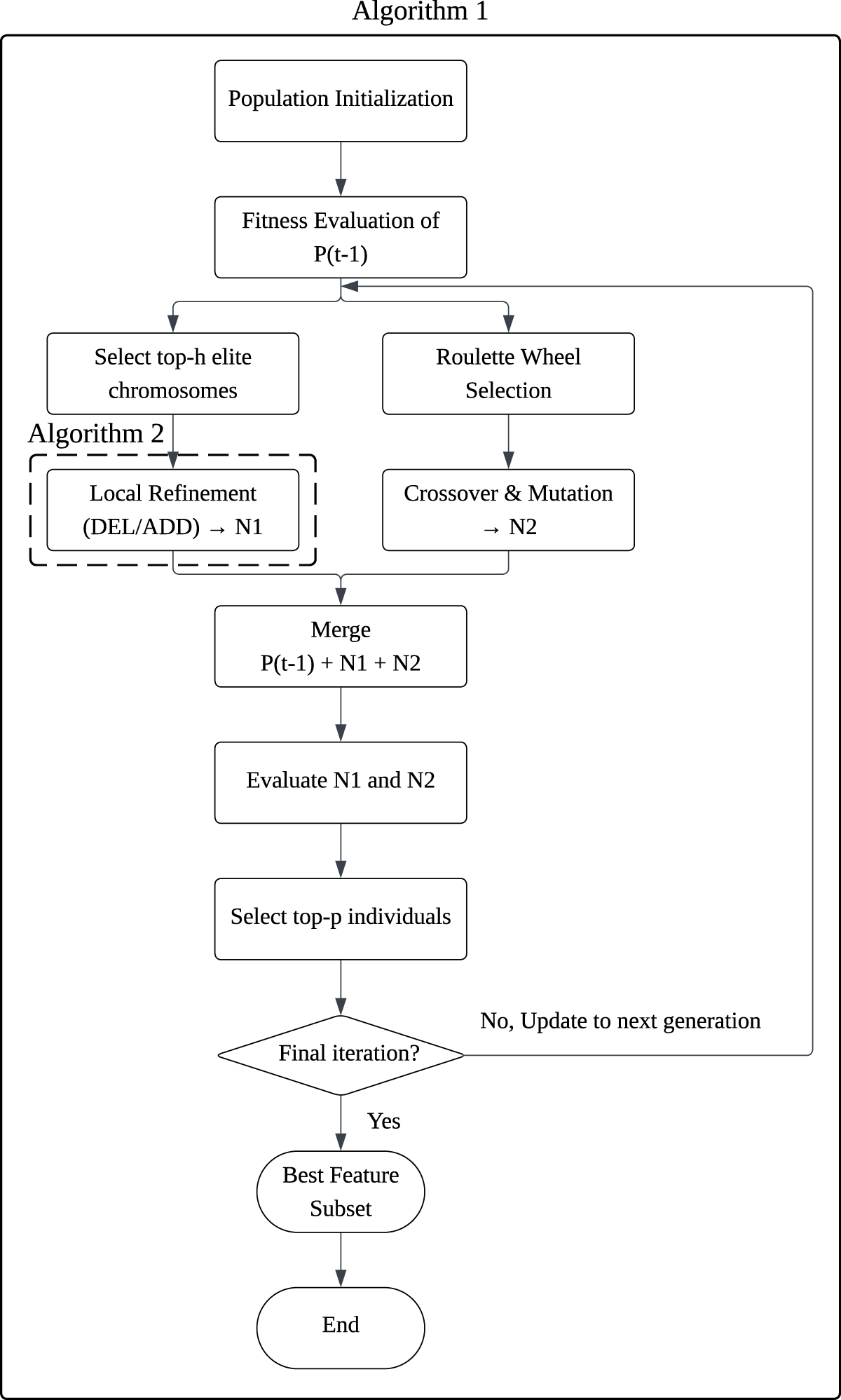
Figure 1: Overview of the proposed method.
3.4 Computational Complexity Analysis
Let
1) Initialization and Evaluation.
The initial evaluation of fitness values computes the clustering-based heuristic metrics. Assuming
2) Genetic Operations.
In each generation, crossover and mutation operations are performed on
3) Local Refinement.
The proposed refinement scheme operates on the top-
which has a complexity of
4) Overall Complexity.
Considering all components, the computational complexity of a single generation can be approximated as
If the local refinement uses sampling or pre-computed entropy tables, the dominant term is
5) Memory Complexity.
The memory requirement is mainly determined by the storage of pairwise entropy values, which is
Overall, the proposed algorithm maintains a reasonable computational complexity while enhancing the convergence stability and solution quality through information-theoretic local refinement.
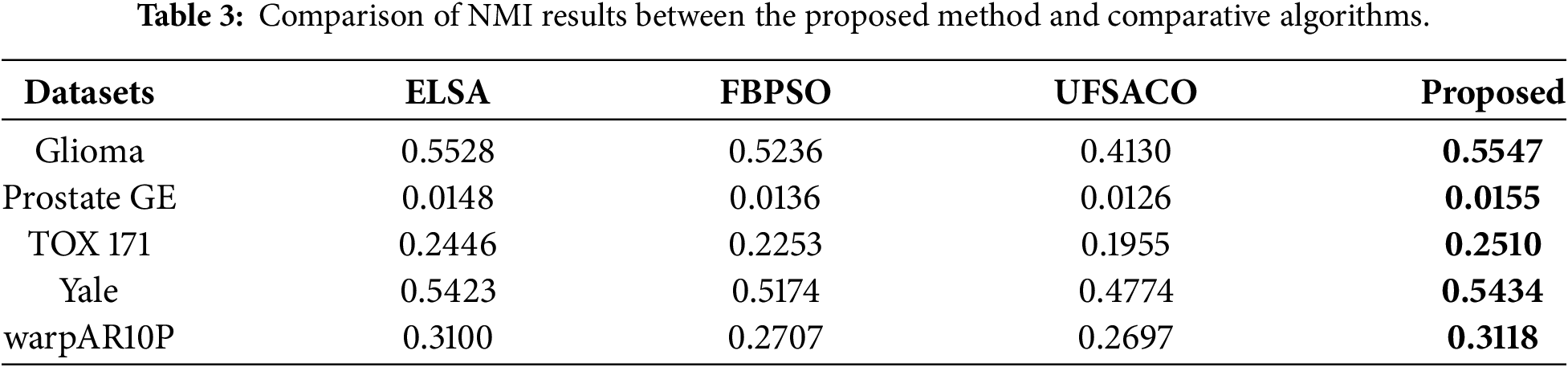
In this study, to validate the performance of the proposed method, three wrapper-based UFS techniques UFSACO [24], Evolutionary local selection algorithm based GA (ELSA) [23], and FBPSO [25] were selected as comparison models. There are five data used in the experiment: Glioma, Prostate GE, TOX 171, Yale, and warpAR10P. Normalized Mutual Information (NMI) and Clustering Accuracy Score (AC) are used as evaluation indicators.
ELSA follows a general GA algorithm and uses a clustering evaluation index as a fitness function. This function also has the same fitness function used in the method we propose. FBPSO generates a feature subset by evaluating the dissimilarity between selected features and the similarity between unselected features. UFSACO evaluates the similarity of features using cosine, through which a numerical value called pheromone is obtained and features with high values are sequentially selected.
All datasets are normalized to the range of [0, 1] using MinMaxScaler before the FS process. The parameters of the comparative methods were set as follows. For UFSACO, the maximum number of generations was set to 20, the number of ants in each generation was set to six, and the number of features explored by each ant was set equal to the initial subset size used in the proposed method. For ELSA and FBPSO, the number of generations was set to 20, and the population size for each generation was set to six. In particular, for a fair comparison with the proposed method, the number of offspring generated per generation in ELSA was fixed at six. This is because the proposed method generates two offspring and four additional individuals through local refinement in each generation. The number of ADD and DEL operations, denoted by
To evaluate the clustering performance of the selected feature subsets, we conduct
Both metrics take values between 0 and 1, and the evaluation is performed based on the clustering results obtained using
AC measures the matching ratio between cluster labels and true labels. Since the cluster labels obtained from the
These two evaluation metrics have been widely adopted in numerous prior studies on UFS [35–38]. Specifically, NMI measures the statistical dependency between clustering results and the actual class structure from an information-theoretic perspective. AC, on the other hand, directly measures the proportion of correctly classified samples through the Hungarian algorithm. However, each metric has its own limitations. NMI captures statistical dependency well but does not directly reflect misclassifications at the individual sample level. AC measures sample-level accuracy but does not account for differences in information content across clusters. Therefore, by employing both metrics together, the quality of unsupervised feature subsets can be evaluated more reliably from two complementary perspectives: statistical agreement and sample-level classification accuracy.
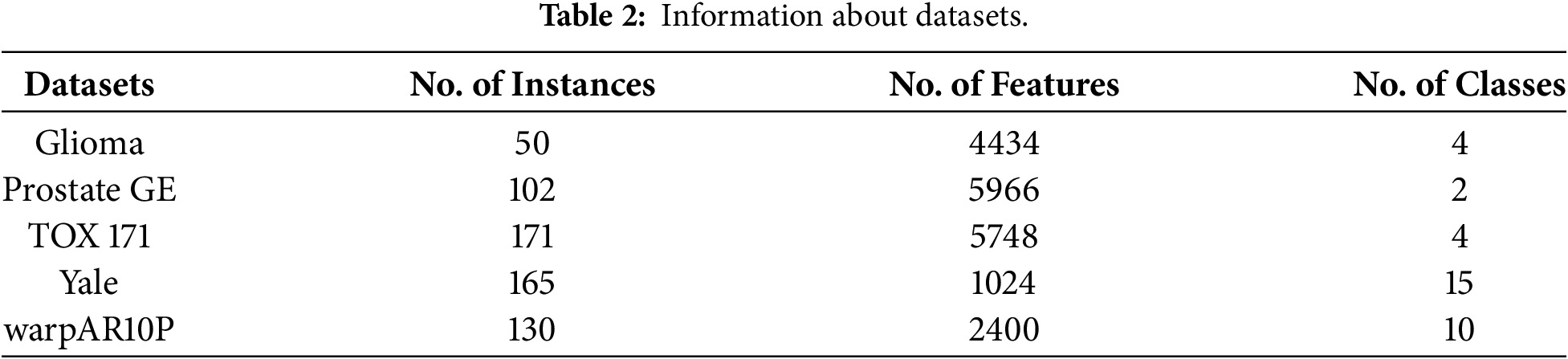
Table 2 summarizes the five data sets employed in this study, which comprise three biological and two facial image data sets. The biological group includes the Glioma [39] data set, which provides information on glioblastoma from 50 subjects, the Prostate GE [40] data set, containing 102 tissue samples, and TOX 171, which features gene expression profiles under various toxic conditions. To further validate the proposed method, two facial image datasets were incorporated: Yale and warpAR10P, consisting of images from 15 and 10 individuals, respectively. All datasets were sourced from the corresponding repository [41].
All experiments were conducted using Python 3.12.13 in the Google Colab environment, which provides cloud-based computing resources. The implementation utilized the scikit-learn library for
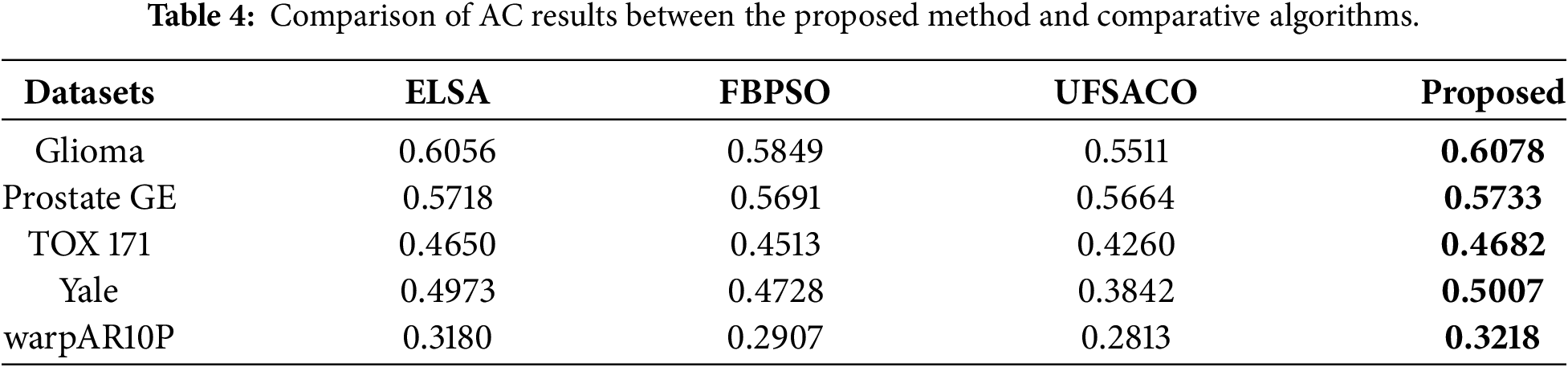
Tables 3 and 4 present the NMI and AC results of the proposed method and the comparative algorithms, respectively. The bold values represent the best performance for each dataset. In both evaluation metrics. In particular, for the NMI metric, the proposed method on the TOX 171 dataset significantly outperformed FBPSO and UFSACO. In terms of AC, the proposed method achieved a score of 0.5007 on the Yale dataset, showing a substantial performance improvement compared to UFSACO, which recorded the lowest performance, and also outperforming ELSA. These results objectively demonstrate that the proposed method effectively captures the interactions and information among multivariate features, thereby deriving a more optimized feature subset.
Figs. 2 and 3 illustrate the convergence processes of NMI and AC, respectively. The convergence comparison was limited to ELSA, which shares the same population size and fitness function as the proposed method, enabling a fair comparison based on the number of fitness evaluations. The horizontal axis represents the cumulative number of evaluations of newly generated individuals as the generations progress, while the vertical axis indicates the performance of the best individual found by the algorithm up to that evaluation point. By comparing the convergence processes of ELSA and the proposed method, the performance differences across generations can be clearly observed. As the number of evaluations increases, the proposed method consistently converges to higher NMI and AC values than the conventional ELSA across all five datasets. This pattern demonstrates that the local refinement process in the proposed method effectively alleviates the convergence problem of the traditional GA.
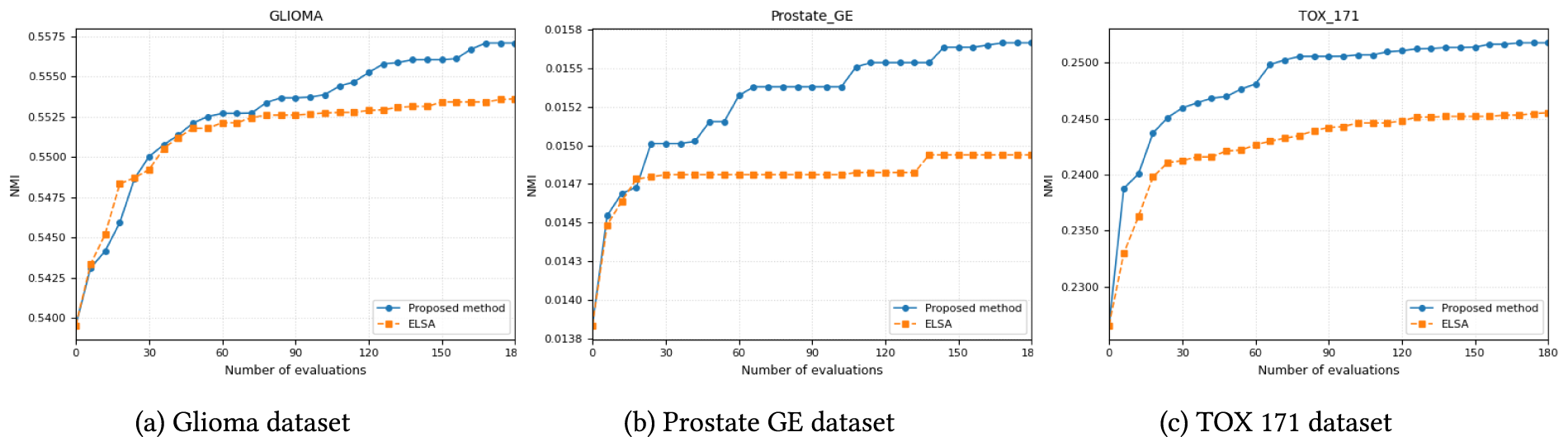
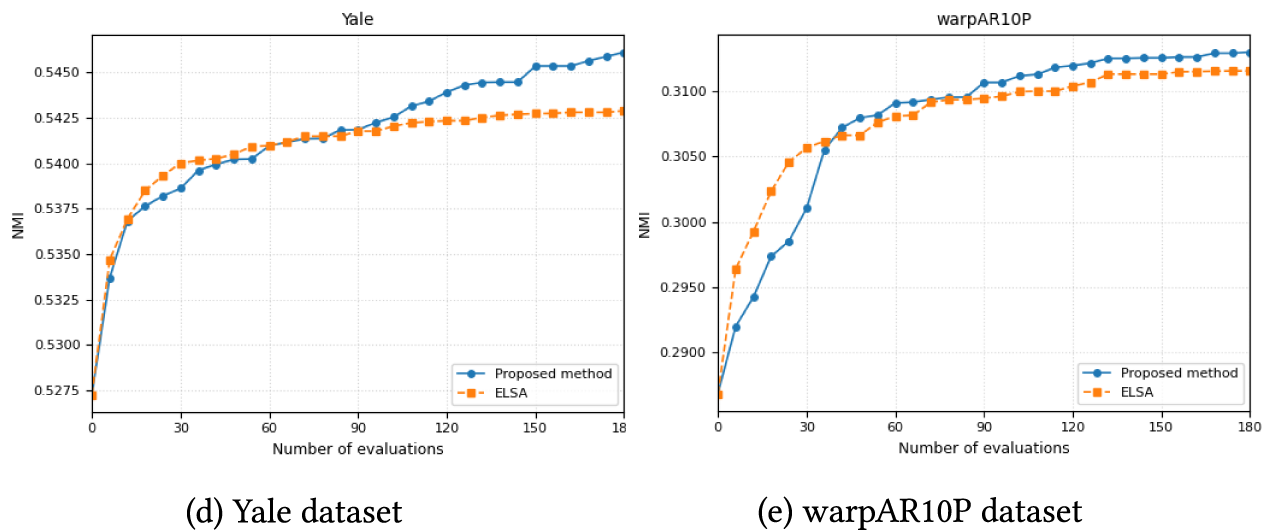
Figure 2: Comparison results of the convergence between the proposed method and ELSA in terms of NMI (higher value indicates better performance).
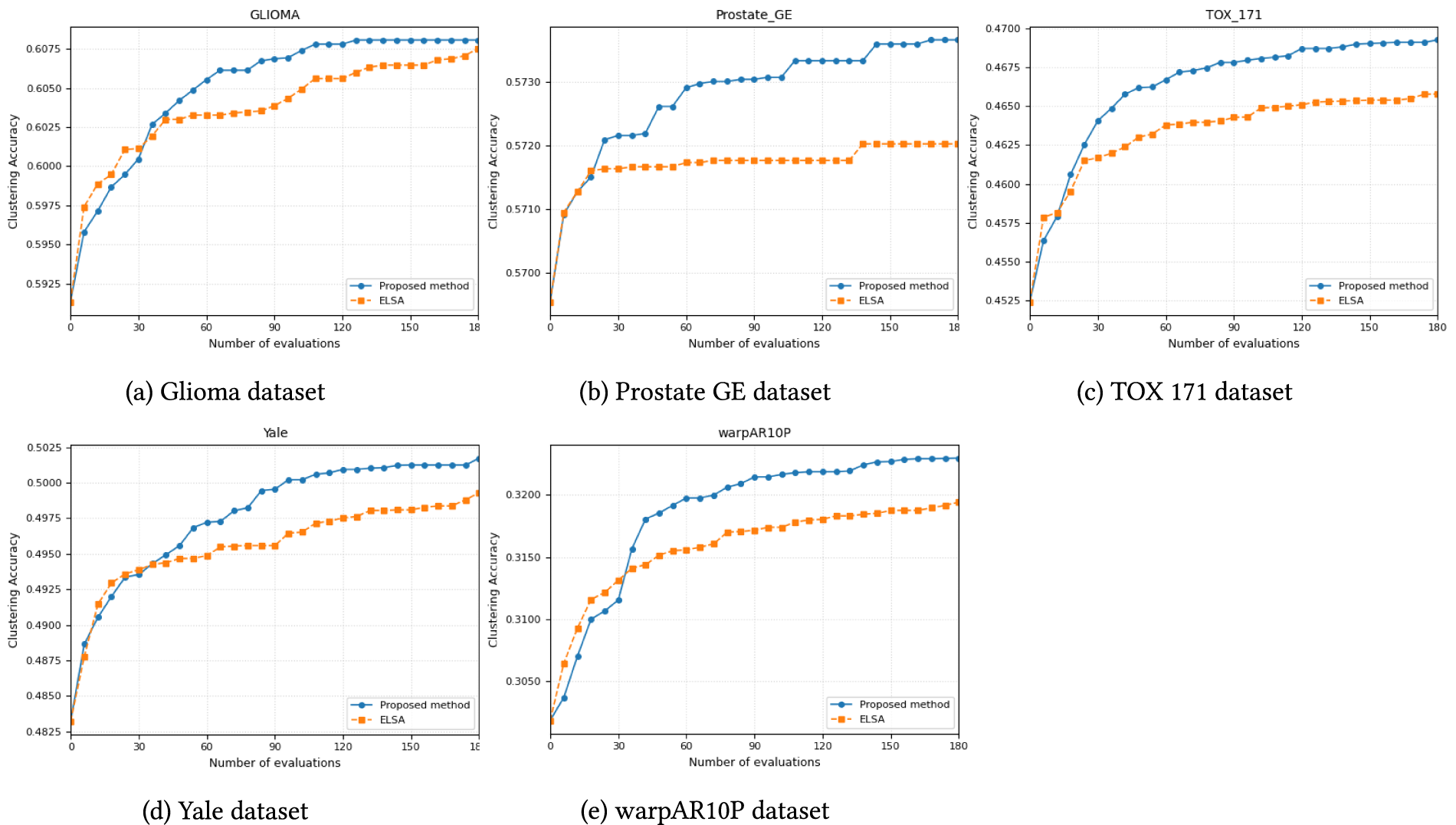
Figure 3: Comparison results of the convergence between the proposed method and ELSA in terms of AC (higher value indicates better performance).
4.3 Analysis of the Proposed Method
Tables 5 and 6 present the experimental results conducted to examine how sensitive the fitness function of the proposed method is to changes in the weights. Specifically,
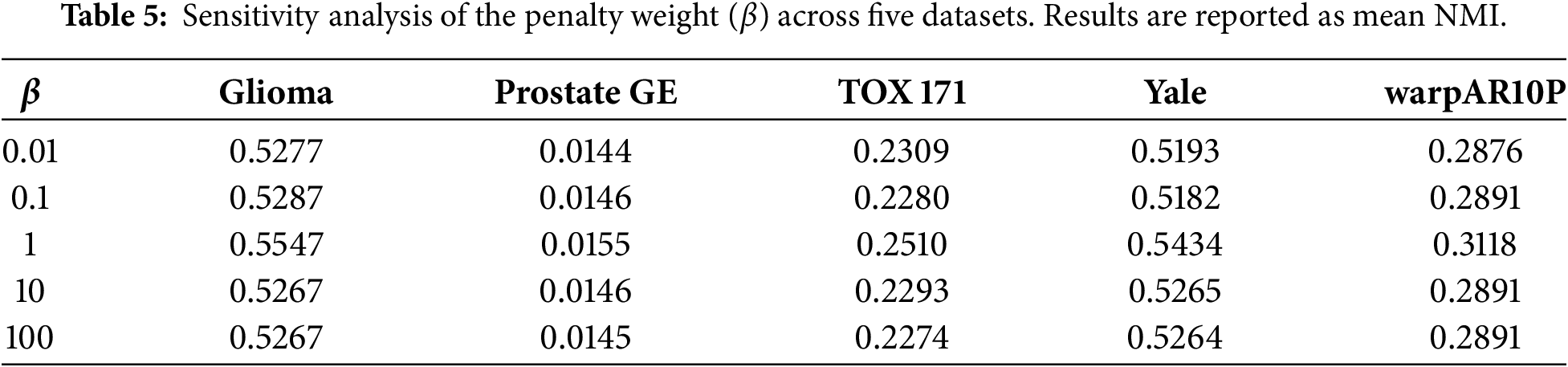
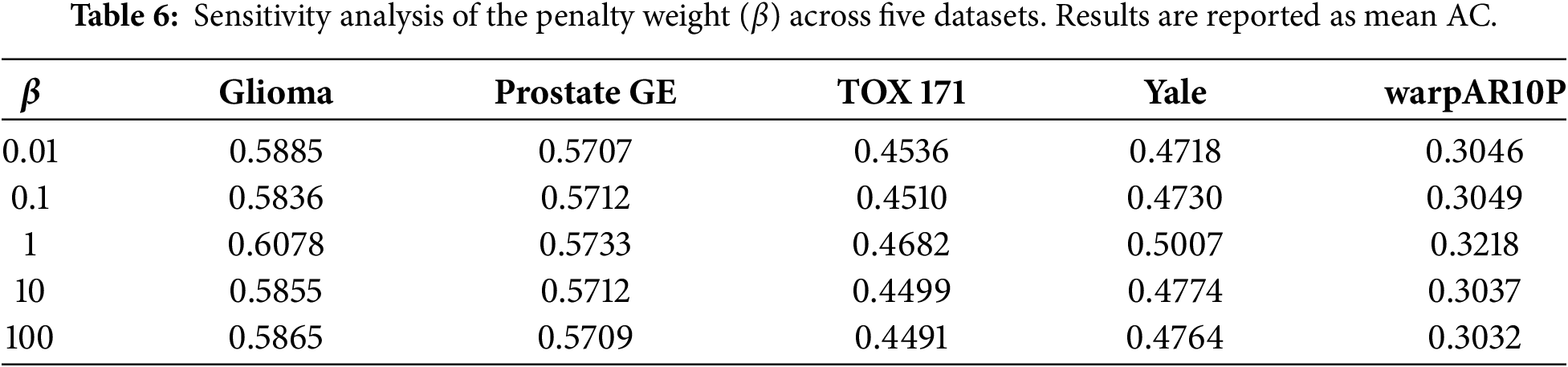
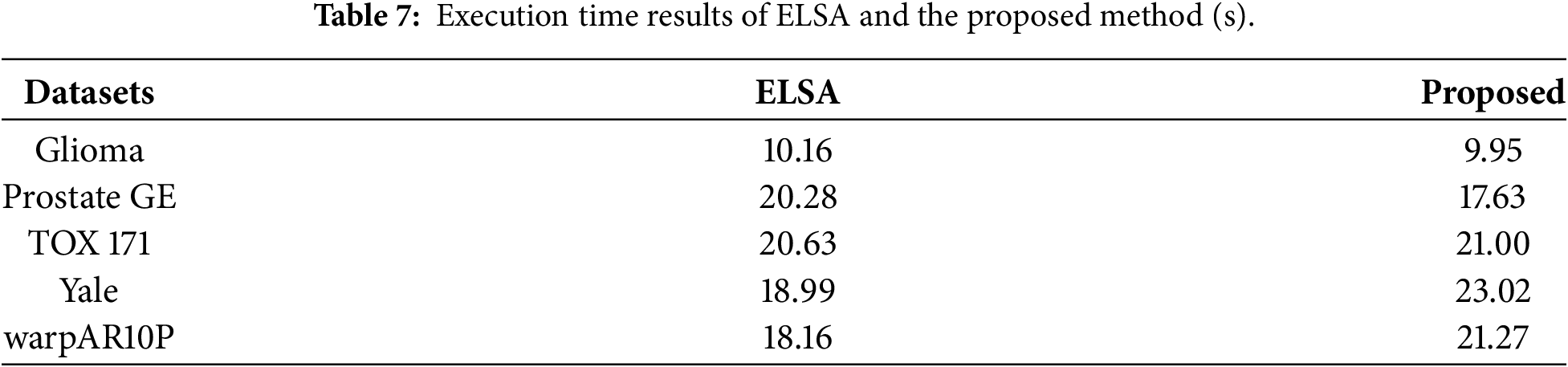
Table 7 presents the total execution time of the proposed method and the comparative algorithm, ELSA. Despite including the preprocessing overhead of constructing an initial joint entropy lookup table, the proposed method demonstrates computational efficiency. Although ELSA, which does not require the table construction process, generally records shorter execution times, it takes longer execution time on some datasets compared to the proposed method. This shows that the vectorized approach based on matrix operations reduces computational complexity in high-dimensional data, thereby enabling the local refinement process of the proposed method to be executed efficiently.
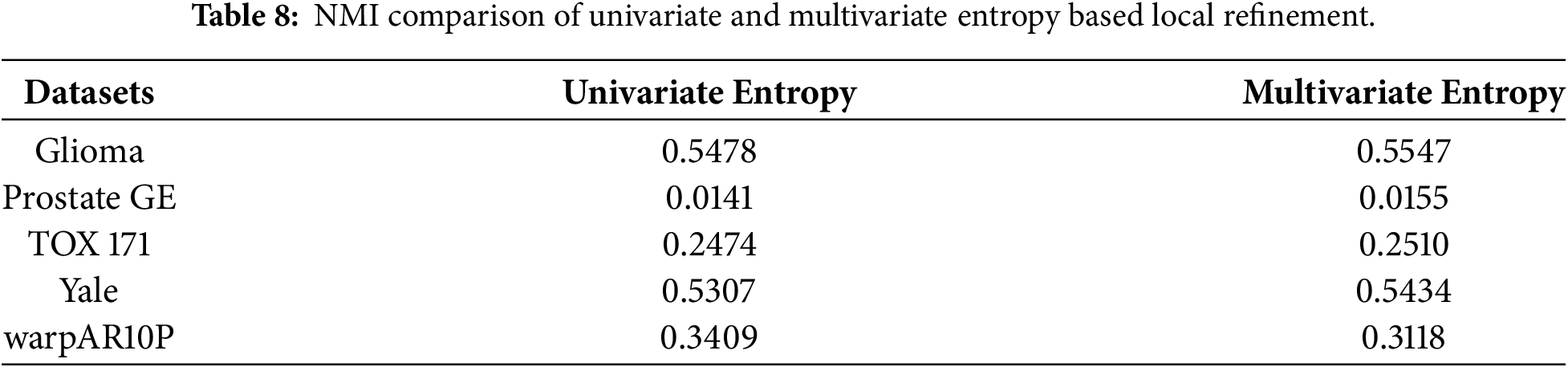
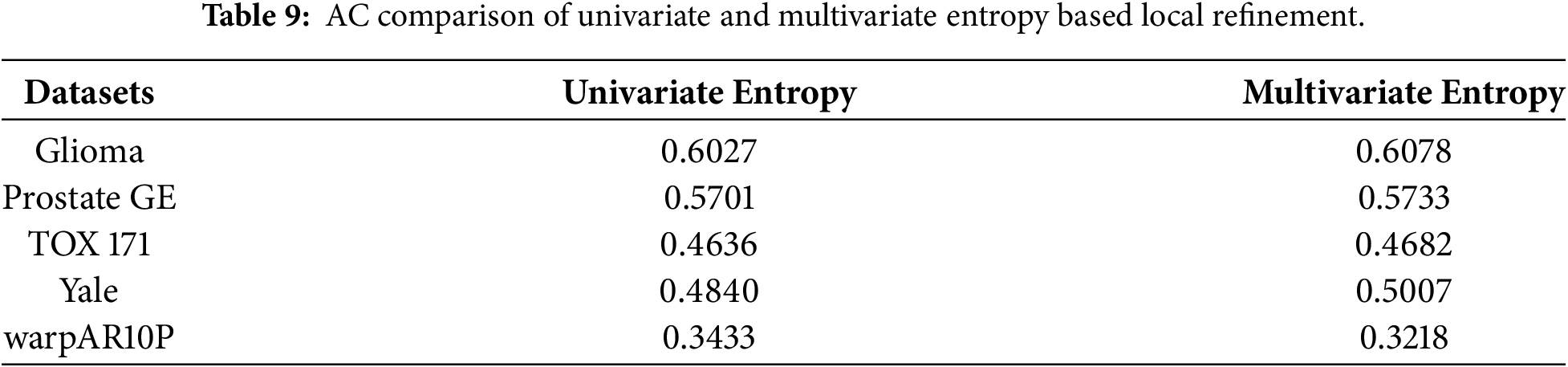
Tables 8 and 9 compare the performance of the univariate entropy-based search method and the proposed multivariate entropy-based search method in the local refinement process. In particular, for the Yale dataset, NMI increased from 0.5307 to 0.5434 and AC improved from 0.4840 to 0.5007 showing the most significant performance gain. However, since warpAR10P is a high-dimensional image dataset with strong correlations among pixels, multivariate entropy may reflect redundant information, which can result in lower performance compared to univariate entropy. This suggests that multivariate entropy may be less effective in datasets with strong feature redundancy. Nevertheless, these results demonstrate that the proposed method, which considers interactions between features using joint entropy, derives more clustering-optimized feature subsets than the univariate entropy-based approach.
This study proposes a joint entropy-based local search GA that considers interactions among multivariate features to address the convergence problem in UFS. To validate the effectiveness of the proposed method, experiments were conducted on five datasets, comparing its performance with ELSA, FBPSO, and UFSACO. The proposed method outperformed the comparative approaches in both NMI and AC across all datasets. This demonstrates that the joint entropy-based search effectively overcomes the limitations of conventional wrapper methods. Unlike conventional GA, which relies only on probabilistic operators, the proposed method incorporates information-theoretic measures, enabling precise local optimization even in unsupervised environments.
The proposed method achieves strong performance on the gene expression datasets Glioma and Prostate GE, suggesting that it can potentially be applied to disease detection and biomarker identification in clinical settings. Results obtained on the facial image datasets Yale and warpAR10P demonstrate its applicability to high-dimensional visual data processing. Moreover, it can be particularly suitable for high-dimensional data mining tasks that are expensive or impossible to obtain class labels such as customer segmentation, anomaly detection, and pattern recognition. The proposed framework can also be applied to cyber security applications such as network intrusion detection and malicious code classification. This is because high-dimensional, unlabeled data is common in these fields. Sensor data generated in IoT environments can also be utilized for unsupervised anomaly detection, as such data is typically collected without class labels. Future research will focus on integrating deep learning-based feature representation and cluster intelligence methods to further improve search efficiency and scalability.
However, the generation of a joint entropy table for the local refinement process generates preprocessing overhead, which requires more computational time as the dataset becomes larger, and its effectiveness can be limited in the presence of strong correlations between features, such as warpAR10P. Furthermore, since the performance evaluation in this study is based on the results of
Acknowledgement: None.
Funding Statement: This research was supported by Basic Science Research Program through the National Research Foundation of Korea (NRF) funded by the Ministry of Education (RS-2020-NR049579).
Author Contributions: Conceptualization, Hyunki Lim; methodology, Seyeon Son and Hyunki Lim; software, Seyeon Son; validation, Seyeon Son; formal analysis, Seyeon Son and Hyunki Lim; investigation, Seyeon Son and Hyunki Lim; resources, Hyunki Lim; data curation, Seyeon Son; writing—original draft preparation, Seyeon Son and Hyunki Lim; writing—review and editing, Seyeon Son and Hyunki Lim; visualization, Seyeon Son; supervision, Hyunki Lim; project administration, Hyunki Lim; funding acquisition, Hyunki Lim. All authors reviewed and approved the final version of the manuscript.
Availability of Data and Materials: Details of the dataset and materials used in this study are provided in the main text.
Ethics Approval: Not applicable.
Conflicts of Interest: The authors declare no conflict of interest.
References
1. Solorio-Fernández S, Carrasco-Ochoa JA, Martínez-Trinidad JF. A review of unsupervised feature selection methods. Artif Intell Rev. 2020;53(2):907–48. doi:10.1007/s10462-019-09682-y. [Google Scholar] [CrossRef]
2. Bashir S, Khattak IU, Khan A, Khan FH, Gani A, Shiraz M. A novel feature selection method for classification of medical data using filters, wrappers, and embedded approaches. Complexity. 2022;2022(1):8190814. doi:10.1155/2022/8190814. [Google Scholar] [CrossRef]
3. Sadeghian Z, Akbari E, Nematzadeh H, Motameni H. A review of feature selection methods based on meta-heuristic algorithms. J Exp Theor Artif Intell. 2025;37(1):1–51. doi:10.1080/0952813x.2023.2183267. [Google Scholar] [CrossRef]
4. Alhijawi B, Awajan A. Genetic algorithms: theory, genetic operators, solutions, and applications. Evol Intell. 2024;17(3):1245–56. doi:10.1007/s12065-023-00822-6. [Google Scholar] [CrossRef]
5. Taha ZY, Abdullah AA, Rashid TA. Optimizing feature selection with genetic algorithms: a review of methods and applications. arXiv:2409.14563. 2024. [Google Scholar]
6. El Aboudi N, Benhlima L. Review on wrapper feature selection approaches. In: Proceedings of 2016 International Conference on Engineering & MIS (ICEMIS); 2016 Sep 22–24; Agadir, Morocco. Piscataway, NJ, USA: IEEE; 2016. p. 1–5. [Google Scholar]
7. Peng H, Long F, Ding C. Feature selection based on mutual information criteria of max-dependency, max-relevance, and min-redundancy. IEEE Trans Pattern Anal Mach Intell. 2005;27(8):1226–38. doi:10.1109/tpami.2005.159. [Google Scholar] [CrossRef]
8. Ali M, Mazhar T, Al-Rasheed A, Shahzad T, Ghadi Y, Khan M. Enhancing software defect prediction: a framework with improved feature selection and ensemble machine learning. PeerJ Comput Sci. 2024;10(17):e1860. doi:10.7717/peerj-cs.1860. [Google Scholar] [CrossRef]
9. Xue Y, Zhang C. A novel importance-guided particle swarm optimization based on MLP for solving large-scale feature selection problems. Swarm Evol Comput. 2024;91(2):101760. doi:10.1016/j.swevo.2024.101760. [Google Scholar] [CrossRef]
10. Bouchlaghem Y, Akhiat Y, Amjad S. Feature selection: a review and comparative study. E3S Web Conf. 2022;351(1):01046. doi:10.1051/e3sconf/202235101046. [Google Scholar] [CrossRef]
11. Zuo X, Zhang W, Wang X, Dang L, Qiao B, Wang Y. Unsupervised feature selection via maximum relevance and minimum global redundancy. Pattern Recognit. 2025;164(3):111483. doi:10.1016/j.patcog.2025.111483. [Google Scholar] [CrossRef]
12. Ming H, Heyong W. Filter feature selection methods for text classification: a review. Multimed Tools Appl. 2024;83(1):2053–91. doi:10.1007/s11042-023-15675-5. [Google Scholar] [CrossRef]
13. Mitra P, Murthy C, Pal S. Unsupervised feature selection using feature similarity. IEEE Trans Pattern Anal Mach Intell. 2002;24(3):301–12. doi:10.1109/34.990133. [Google Scholar] [CrossRef]
14. Talavera L. Dependency-based feature selection for clustering symbolic data. Intell Data Anal. 2000;4(1):19–28. doi:10.3233/ida-2000-4103. [Google Scholar] [CrossRef]
15. Dash M, Choi K, Scheuermann P, Liu H. Feature selection for clustering—a filter solution. In: Proceedings of 2002 IEEE International Conference on Data Mining; 2002 Dec 9–12; Maebashi City, Japan. Piscataway, NJ, USA: IEEE; 2002. p. 115–22. [Google Scholar]
16. Liu R, Yang N, Ding X, Ma L. An unsupervised feature selection algorithm: laplacian score combined with distance-based entropy measure. In: Proceedings of 2009 Third International Symposium on Intelligent Information Technology Application; 2009 Nov 21–22; Nanchang, China. New York, NY, USA: IEEE; 2009. p. 65–8. [Google Scholar]
17. Liu Z, Yang J, Wang L, Chang Y. A novel relation aware wrapper method for feature selection. Pattern Recognit. 2023;140(1):109566. doi:10.1016/j.patcog.2023.109566. [Google Scholar] [CrossRef]
18. Njoku U, Abello A, Bilalli B, Bontempi G. Wrapper methods for multi-objective feature selection. In: Proceedings of 26th International Conference on Extending Database Technology (EDBT 2023); 2023 Mar 28–31; Ioannina, Greece. p. 697–709. [Google Scholar]
19. Li G, Yu Z, Yang K, Lin M, Chen CLP. Exploring feature selection with limited labels: a comprehensive survey of semi-supervised and unsupervised approaches. IEEE Trans Knowl Data Eng. 2024;36(11):6124–44. [Google Scholar]
20. Gen M, Lin L. Genetic algorithms and their applications. In: Pham H, editor. Springer handbook of engineering statistics. London, UK: Springer; 2023. p. 635–74. doi:10.1007/978-1-4471-7503-2_33. [Google Scholar] [CrossRef]
21. Naaman D, Ahmed B, Mahmood I. Optimization by nature: a review of genetic algorithm techniques. Indones J Comput Sci. 2025;14(1):268–84. [Google Scholar]
22. Altarabichi MG, Nowaczyk S, Pashami S, Mashhadi PS. Fast genetic algorithm for feature selection—a qualitative approximation approach. Expert Syst Appl. 2023;211(3):118528. doi:10.1016/j.eswa.2022.118528. [Google Scholar] [CrossRef]
23. Kim Y, Street WN, Menczer F. Feature selection in unsupervised learning via evolutionary search. In: Proceedings of the Sixth ACM SIGKDD International Conference on Knowledge Discovery and Data Mining; 2000 Aug 20–23; Boston, MA, USA. New York, NY, USA: ACM; 2000. p. 365–9. [Google Scholar]
24. Tabakhi S, Moradi P, Akhlaghian F. An unsupervised feature selection algorithm based on ant colony optimization. Eng Appl Artif Intell. 2014;32:112–23. doi:10.1016/j.engappai.2014.03.007. [Google Scholar] [CrossRef]
25. Zhang Y, Hai-Gang L, Wang Q, Chao P. A filter-based bare-bone particle swarm optimization algorithm for unsupervised feature selection. Appl Intell. 2019;49(8):2889–98. doi:10.1007/s10489-019-01420-9. [Google Scholar] [CrossRef]
26. Leardi R, Boggia R, Terrile M. Genetic algorithms as a strategy for feature selection. J Chemometr. 1992;6(5):267–81. [Google Scholar]
27. Lee J, Kim DW. Mutual information-based multi-label feature selection using interaction information. Expert Syst Appl. 2015;42(4):2013–25. doi:10.1016/j.eswa.2014.09.063. [Google Scholar] [CrossRef]
28. Han TS. Nonnegative entropy measures of multivariate symmetric correlations. Inf Control. 1978;36(2):133–56. doi:10.1016/s0019-9958(78)90275-9. [Google Scholar] [CrossRef]
29. Seo W, Kim DW, Lee J. Generalized information-theoretic criterion for multi-label feature selection. IEEE Access. 2019;7:122854–63. doi:10.1109/access.2019.2927400. [Google Scholar] [CrossRef]
30. Seo W, Lee J. Unsupervised feature selection towards pattern discrimination power. In: Kiyavash N, Mooij JM, editors. Proceedings of the Fortieth Conference on Uncertainty in Artificial Intelligence; 2024 Jul 15–19; Barcelona, Spain. Cambridge, MA, USA: PMLR; 2024. p. 3180–97. [Google Scholar]
31. Jerdee M, Kirkley A, Newman M. Normalized mutual information is a biased measure for classification and community detection. Nat Commun. 2025;16(1):11268. doi:10.1038/s41467-025-66150-8. [Google Scholar] [CrossRef]
32. Agrawal U, Rohatgi V, Katarya R. Normalized mutual information-based equilibrium optimizer with chaotic maps for wrapper-filter feature selection. Expert Syst Appl. 2022;207(1):118107. doi:10.1016/j.eswa.2022.118107. [Google Scholar] [CrossRef]
33. Suraya S, Sholeh M, Lestari U. Evaluation of data clustering accuracy using K-means algorithm. Int J Multidiscip Approach Res Sci. 2023;2(1):385–96. doi:10.59653/ijmars.v2i01.504. [Google Scholar] [CrossRef]
34. Xue D, Pang SY, Liu N, Liu SK, Zheng WM. Phase-angle-encoded snake optimization algorithm for K-means clustering. Electronics. 2024;13(21):4215. doi:10.3390/electronics13214215. [Google Scholar] [CrossRef]
35. Liu W, Ning Q, Liu G, Wang H, Zhu Y, Zhong M. Unsupervised feature selection algorithm based on L2,p-norm feature reconstruction. PLoS One. 2025;20(3):1–25. doi:10.1371/journal.pone.0318431. [Google Scholar] [CrossRef]
36. Perera K, Chan J, Karunasekera S. Group based unsupervised feature selection. In: Lauw HW, Wong RCW, Ntoulas A, Lim EP, Ng SK, Pan SJ, editors. Advances in knowledge discovery and data mining. Cham, Switzerland: Springer International Publishing; 2020. p. 805–17. [Google Scholar]
37. Li W, Chen H, Li T, Wan J, Sang B. Unsupervised feature selection via self-paced learning and low-redundant regularization. Knowl Based Syst. 2022;240(11):108150. doi:10.1016/j.knosys.2022.108150. [Google Scholar] [CrossRef]
38. Lin Z, Needell D. Kernel alignment for unsupervised feature selection via matrix factorization. arXiv:2403.14688. 2024. [Google Scholar]
39. Chin L, Meyerson M, Aldape K, Bigner D, Mikkelsen T, VandenBerg S, et al. Comprehensive genomic characterization defines human glioblastoma genes and core pathways. Nature. 2008;455(7216):1061–8. doi:10.1016/s0513-5117(09)79089-1. [Google Scholar] [CrossRef]
40. Singh D, Febbo PG, Ross K, Jackson DG, Manola J, Ladd C, et al. Gene expression correlates of clinical prostate cancer behavior. Cancer Cell. 2002;1(2):203–9. doi:10.1016/s1535-6108(02)00030-2. [Google Scholar] [CrossRef]
41. Li J, Cheng K, Wang S, Morstatter F, Trevino RP, Tang J, et al. Feature selection: a data perspective. ACM Comput Surv. 2017;50(6):94. doi:10.1145/3136625. [Google Scholar] [CrossRef]
Cite This Article
 Copyright © 2026 The Author(s). Published by Tech Science Press.
This work is licensed under a Creative Commons Attribution 4.0 International License , which permits unrestricted use, distribution, and reproduction in any medium, provided the original work is properly cited.
 Downloads
 Citation Tools
