
 Login
Login Register
 Submit a Paper
 Propose a Special lssue
 Open Access
ARTICLE
Congestion-Aware Load Balancing with Flowlet Switching Based on Data and Control Plane Cooperation
1 Military Intelligence Research Institute, Military Academy of Sciences, Beijing, China
2 National Digital Switching System Engineering and Technological Research Center, Information Engineering University, Zhengzhou, China
* Corresponding Author: Ziyong Li. Email:
Computers, Materials & Continua 2026, 89(2), 87 https://doi.org/10.32604/cmc.2026.085191
Received 06 May 2026; Accepted 17 August 2026; Issue published 15 September 2026
 View Full Text
 Download PDF
Abstract
Multipath load balancing can effectively improve network throughput and reliability by aggregating the available bandwidth of multiple paths. However, existing load balancing schemes including Equal-Cost Multi-Path forwarding (ECMP), Weighted-Cost Multi-Path forwarding (WCMP) or LetFlow may lead to significant performance degradation due to hash conflicts and only target fixed symmetric topologies (e.g., Fattree). Flowlet switching has been proven to be a fine-grained load balancing technique, but remains elusive for widespread deployment. The emergence of network programmability including the control plane and data plane provides a new insight for the management of multipath load balancing. To achieve more effective load balancing and guarantee Quality of Service (QoS) on any network topology, we present ConFlet, a congestion-aware load balancing with Flowlet switching based on the cooperation of the data and control plane, where the control plane monitors the global network status to perform the optimized routing decision, and the data plane implements the flow splitting and path switching. Specifically, the centralized controller evaluates the reliability of nodes and links to perform multi-path routing calculations, ensuring that flows always travel along the most reliable multiple paths. The data plane can dynamically set the flowlet timeout to split flows into flowlets according to the path quality difference, and then implement path switching and congestion avoidance based on real-time congestion feedback. Experimental results show that compared to WCMP/LetFlow, ConFlet can significantly improve average service reliability and network throughput, and reduce average packet delay. Meanwhile, ConFlet can react quickly to congestion and maintain high resilience to network asymmetry.Keywords
With the rapid development of network technologies including 6G, satellite Internet and edge computing, modern Internet infrastructures are required to accommodate a growing variety of differentiated applications. These emerging applications such as video broadcasting, telemedicine, and big-data analytics are profoundly affecting people’s lives, which also poses great challenges to the Quality of Service (QoS) of the Internet. Multipath routing can effectively aggregate available bandwidth to provide high-quality network services, and also improve the reliability of communication [1]. However, the current Internet lacks fine-grained forwarding control for multipath routing management, which is difficult to support more applications with higher requirements for low delay, high throughput, and high reliability [2].
Nowadays, the Internet is characterized by a topology with high connectivity and a large number of equivalent paths. Equal-Cost Multi-Path forwarding (ECMP) remains the dominant load balancing approach deployed across a majority of traditional IP routing devices. As a classic flow-level multipath routing scheme, ECMP adopts a dedicated hash calculation module to conduct random mapping to allocate every flow onto a single forwarding link among all available paths. However, due to hash conflicts and uneven allocation of large and small flows, ECMP may cause significant performance degradation [3]. WCMP [4] and Niagara [5] are weighted ECMP algorithms that set different weights for each path according to the available bandwidth, and implement routing according to the path weight. However, these schemes only work under specific symmetric network topologies (e.g., Fattree) in data centers, and perform poorly in other asymmetric topologies due to a lack of visibility into path congestion.
Due to the scale, heterogeneity, and high performance required by many emerging applications, the QoS and reliability of the Internet have become more challenging, which increases the need and complexity of managing multiple paths in the network. Software-Defined Networking decouples the control plane and data plane to enable unified and centralized global control over the entire network system, significantly simplifying automated network maintenance, orchestration and daily operational management tasks [6]. However, due to the non-negligible controller-switch delay and communication overhead (e.g., notification of events and installation of flow rules), the SDN controller is too slow to react quickly to sudden network events (e.g., network congestion and link failure). The programmable data plane not only empowers network operators to independently customize the underlying packet processing rules running on forwarding hardware, but also to offload some network functions (e.g., large flow monitoring, load balancing and in-band telemetry) to the data plane, which can effectively improve the QoS of the network [7]. Hence, the next generation network architecture may adopt SDN to implement the global optimization decision at the flow level, and combine P4 to sustain precise, fine-grained forwarding management at the packet level.
To overcome the limitations of existing load balancing schemes, we present ConFlet, a congestion-aware load balancing scheme with flowlet switching. ConFlet combines SDN and P4 to implement centralized and distributed collaborative management, retains the control plane to achieve centralized multipath routing control, and exploits the data plane to perform flowlet-level load balancing. The main contributions of our work can be concluded as follows:
• We identify the problem that existing load balancing schemes may lead to significant performance degradation due to hash conflicts and only target fixed symmetric topologies (e.g., Fattree). To overcome these limitations, we propose a general load balancing scheme named ConFlet, which implements centralized and distributed collaborative control to perform flowlet-level load balancing and congestion avoidance.
• We use a centralized controller to evaluate the reliability of nodes and links, and implement global multipath routing decisions to ensure reliable transmission of flows. On the other hand, we exploit a programmable data plane to perform flowlet-level load balancing based on adaptive timeouts and implement distributed congestion-awareness path switching, which realizes more fine-grained load balancing.
• We construct comprehensive simulations to verify the network performance of ConFlet. The experimental results show that compared with WCMP/LetFlow, ConFlet significantly improves network performance and performs quite well when encountering link congestion and network asymmetry.
The rest of this paper is organized as follows. The related works are presented in Section 2. Section 3 gives our research motivation about multipath load balancing. Section 4 details the design principles of ConFlet. Section 5 evaluates the performance of ConFlet. Finally, we give our conclusion in Section 6.
Multipath routing includes multipath calculation and multipath forwarding control. Multipath calculation uses efficient algorithms to calculate multiple node/link-disjoint paths based on the global network view for meeting the QoS requirements of a given flow. Multipath forwarding control splits individual flows and distributes packets onto a set of alternative transmission paths. For multipath calculation, some centralized mechanisms (e.g., Hedera [8], ARION [9], Flowcut [10] and EPIC [11]) exploited centralized controllers to monitor network link status, and then rescheduled large flows or congested flows in real time to alleviate network congestion. Farhan et al. [12] proposed a DRL-based approach for improving SDN traffic engineering named RDG-TE. RDG-TE adopts deep reinforcement learning (DRL) and GNN, considering multiple parameters such as link reliability, available link bandwidth, and node betweenness, to predict the optimal path of data flow in model training and reward calculation for achieving load balancing. Cheng and Jia [13] abstracted the co-optimization problem of multi-path routing and flow table matching constraints as a biconvex integer programming model and put forward a dedicated multi-path transmission strategy named NAMP. NAMP designed a new LP-based alternating convex search algorithm to minimize the transmission time of flow groups when meeting the flow table capacity constraints. Yan et al. [14] distinguished different types of services to calculate multiple paths that meet specific QoS constraints between source and destination nodes, and real-time monitored link utilization to select the optimal path for each flow, which can significantly boost overall network throughput while cutting down the end-to-end transmission latency of packets. However, the centralized control schemes cannot quickly capture the instantaneous state of the network, which was difficult to adapt to the fluctuations of traffic.
Multipath forwarding control can be divided into flow, packet and flowlet granularity. Flow granularity (e.g., ECMP and Hedera) uses the same path to forward all packets of each flow. However, due to hash conflicts, flow granularity will cause congestion or underutilization. Packet granularity transmits all packets along different paths. Although achieving high load balancing, packet granularity will cause serious packet out-of-order. Some other schemes (e.g., CONGA [15], HULA [16]) divided the flow into smaller units “flowlets,” according to the packet arrival interval from the same flow, and assigned these flowlets to different paths. Compared with flow and packet granularity, flowlet granularity achieves higher load balancing and avoids packet out-of-order. Vanini et al. [17] proposed a flowlet-based load balancing mechanism (LetFlow). LetFlow can control flowlet granularity by setting different flowlet timeouts and randomly selecting paths for flowlets to realize high load balancing. However, LetFlow cannot dynamically change the flowlet timeout with the traffic load of the network. Besides, these multipath routing schemes, including ECMP, CONGA, HULA, and LetFlow, are only designed for specific data center topologies. The comparison of typical multipath routing schemes is shown in Table 1.
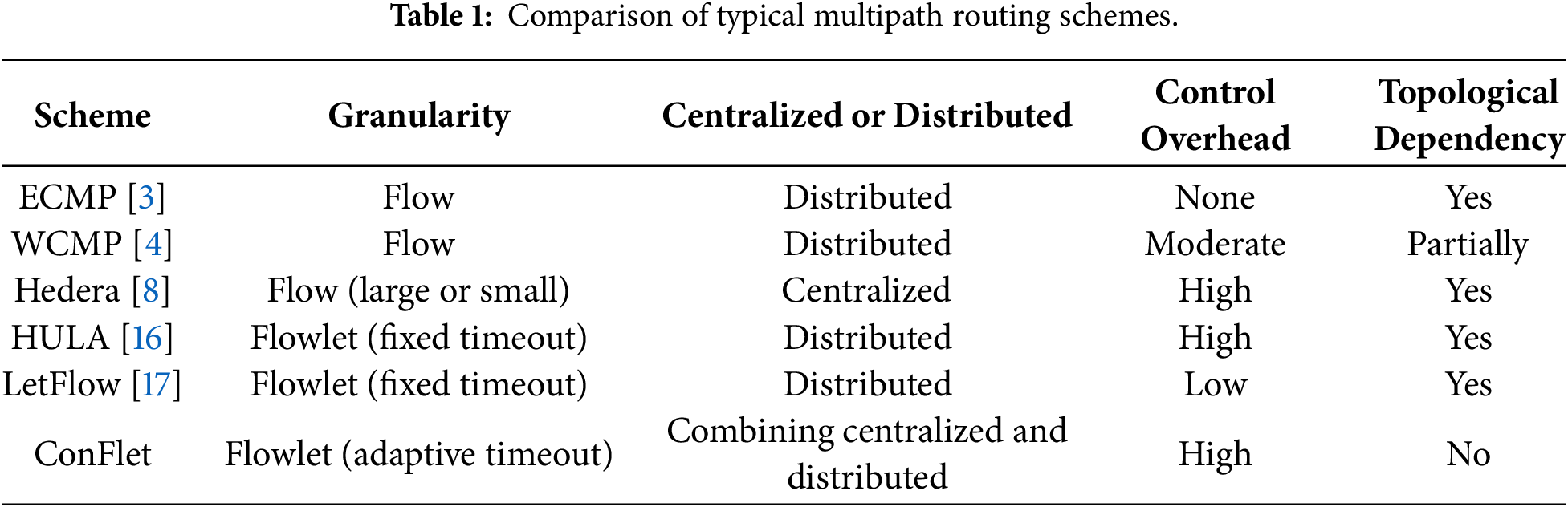
In summary, existing multipath routing schemes either use a centralized controller to make decisions, leading to slow response to instant congestion, or implement local routing strategies, only working in specific symmetric topologies. ConFlet is a general load balancing scheme that can work seamlessly on any network topology. It takes full advantage of centralized routing decisions and distributed forwarding control to implement flowlet-level load balancing and congestion-aware path switching under strict reliability requirements for enhancing the QoS and reliability of the network.
ECMP and WCMP are typical load balancing schemes in data center networks. ECMP randomly selects one path from multiple equivalent paths for forwarding. WCMP implements a set of flow splitting based on the ideal weights initially calculated by the SDN controller. Let’s provide an example to show that ECMP and WCMP may cause serious load imbalance and performance degradation. Consider a simple asymmetric topology in Fig. 1. There are three paths with available bandwidth ratios of 1:2:3 for forwarding each flow. ECMP lacks awareness of path congestion and distributes flows equally across multiple paths. Two or more elephant flows are transmitted on the bottleneck link, resulting in serious load imbalance. WCMP uses the controller to realize global congestion awareness, and assigns different weights for paths according to the available bandwidth of different paths, effectively avoiding load imbalance. However, WCMP still has hash conflicts. Once link congestion occurs due to hash conflicts or traffic bursts, WCMP can only request the controller to update the path weight to alleviate congestion, easily damaging latency-sensitive flows.
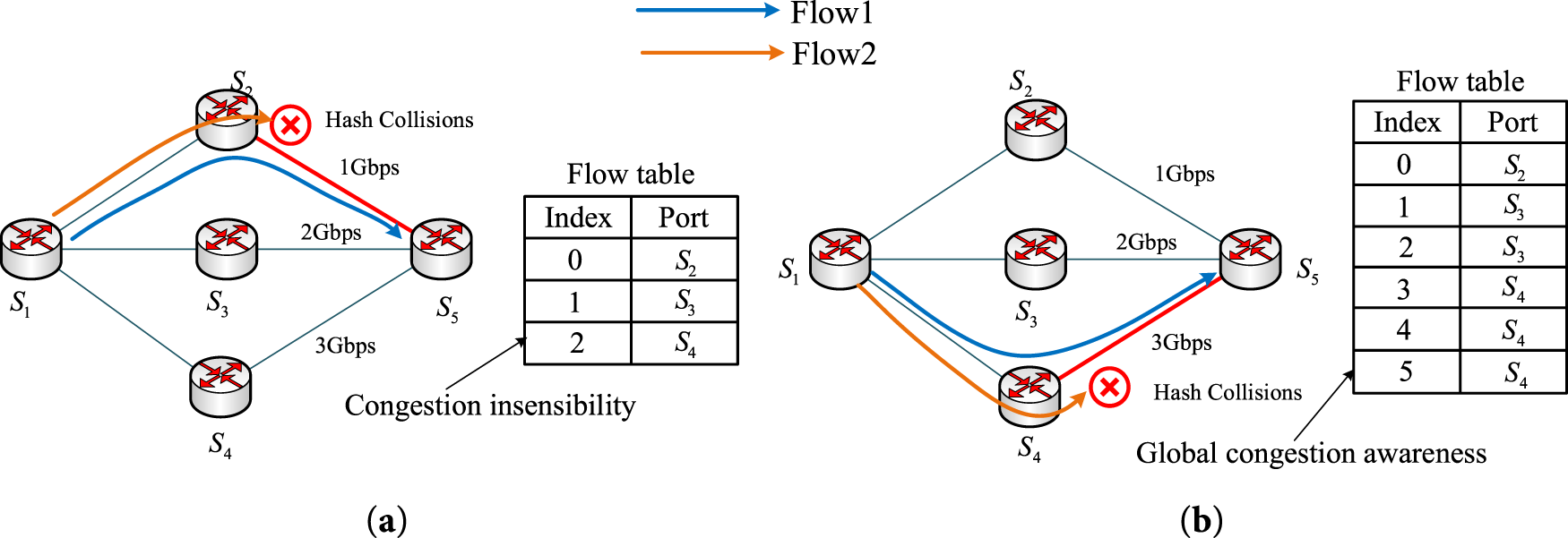
Figure 1: An example of ECMP and WCMP load balancing. (a) ECMP (congestion insensibility); (b) WCMP (global congestion awareness).
To overcome the limitations of ECMP and WCMP, ConFlet combines centralized global decision-making and distributed congestion awareness to implement flowlet-level load balancing. Specifically, as shown in Fig. 2a, ConFlet inherits the advantages of WCMP global congestion awareness to set different weights for paths. To avoid hash collisions between flows in the network, ConFlet can track the packet arrival interval of each flow and the load difference of each path in real time, and then dynamically split flows into multiple flowlets along different paths to achieve more fine-grained load balancing. Besides, suppose the worst thing is that link congestion still occurs due to traffic bursts or hash conflict, as shown in Fig. 2b, even if the controller re-plans the path, it will greatly increase the transmission delay of packets, which is unacceptable for flows that are sensitive to delay and jitter. ConFlet designs a distributed congestion-awareness mechanism on the data plane. The switch can locally detect congestion and quickly switch paths, which can react to congestion in microseconds.
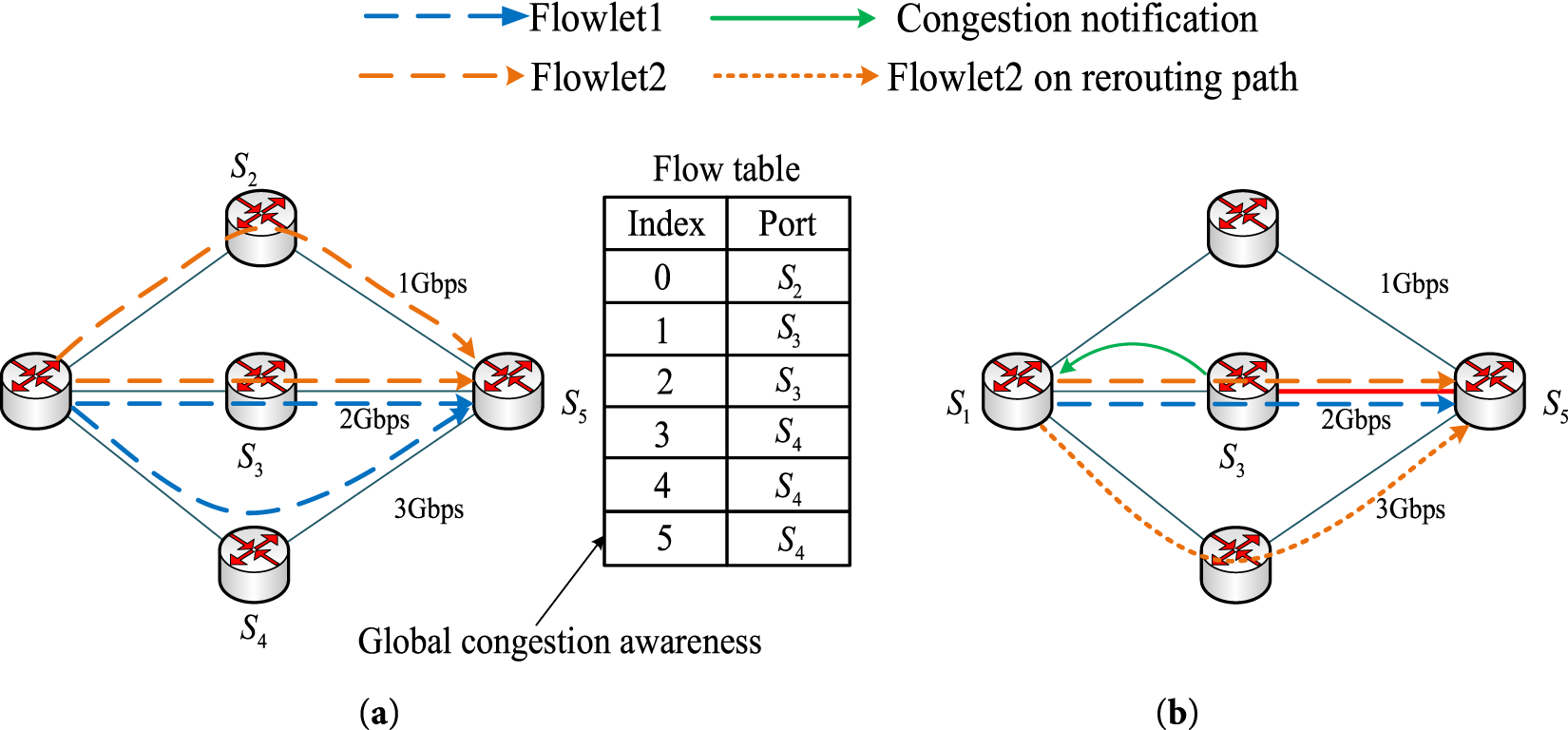
Figure 2: Core idea of ConFlet. (a) Flowlet-level load balancing; (b) Distributed congestion avoidance.
4.1 Global Routing Decision in the Control Plane
The whole network uses a centralized SDN controller to maintain a global network view and implement centralized multipath routing planning. The network topology can be described as an undirected graph
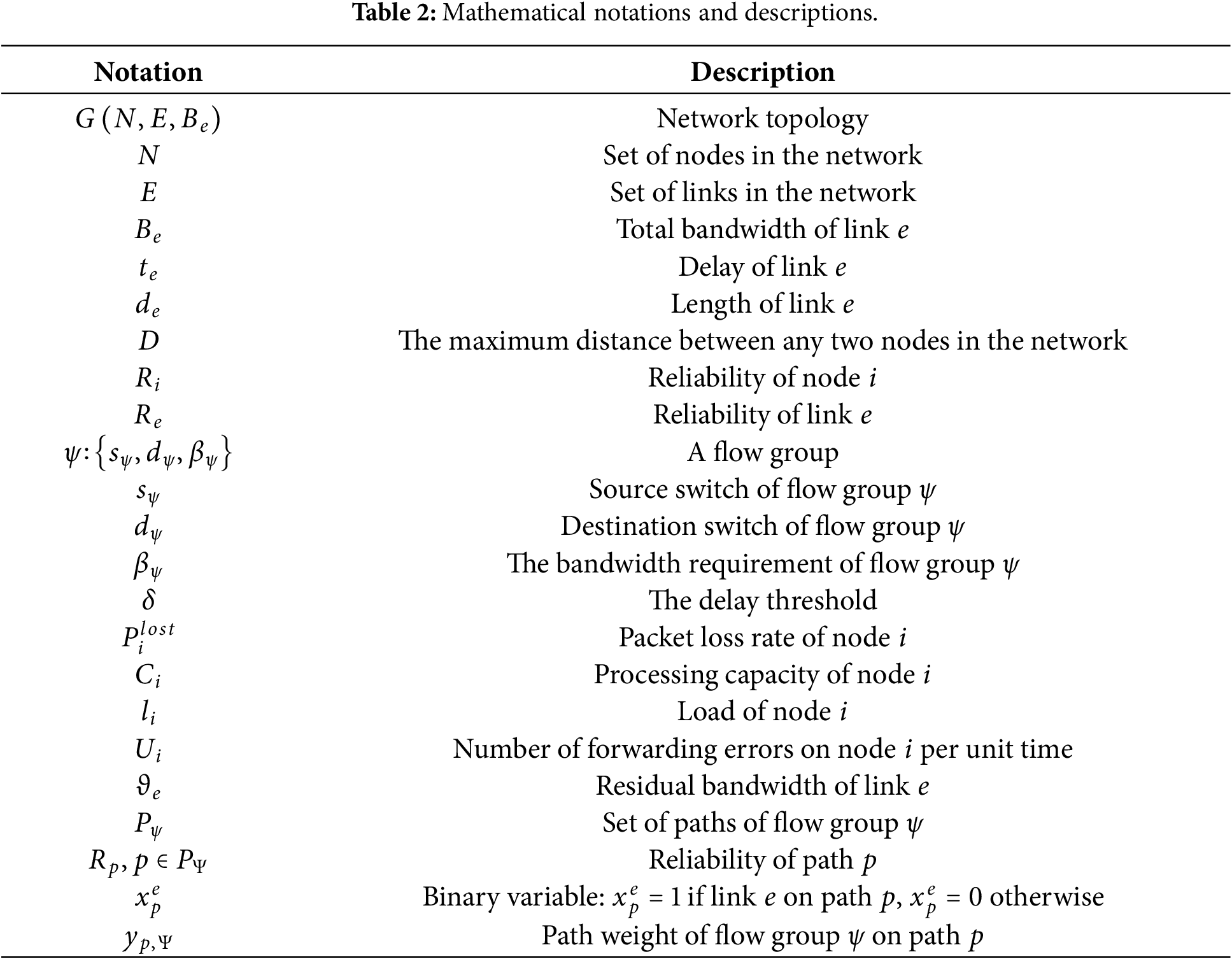
We define that the reliability of a node
The reliability of a link
Assuming that the forwarding path of a flow can be expressed as
Our objective function is a measure of the reliability of the paths chosen for routing the flows belonging to a flow group. For the whole network, the goal is to maximize the service reliability of the entire network while satisfying the QoS requirements of all flow groups. Given a flow group
where
(1) Delay constraint: for any path
(2) Bandwidth constraint: the bandwidth constraint guarantees that all forwarding links selected for path calculation retain adequate transmission capacity. Assume the total bandwidth demand of a specific flow group
(3) Reliability constraint: the reliability of all nodes and links constructing the path should not be lower than the given lower threshold
To quickly solve this multi-path routing problem, the SDN controller pre-calculates a set of paths
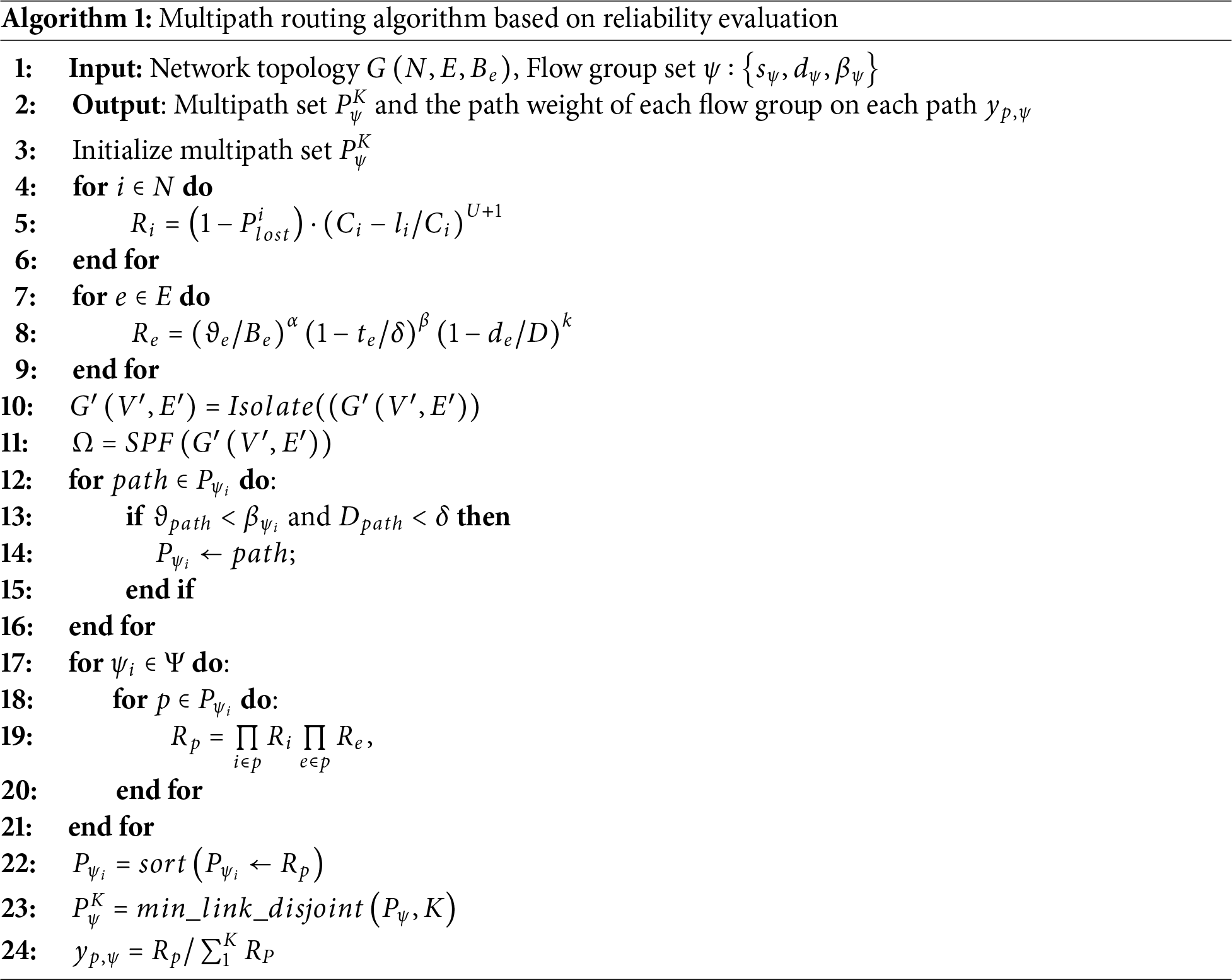
When implementing multipath routing, the controller uses an in-band telemetry technique to inject probes into the network regularly, collects network status information including topology changes, packet loss rate and load of nodes, available bandwidth and delay of links, and also audits the actual forwarding behavior of switches. Then the controller will evaluate the node reliability and link reliability to calculate the K most reliable paths to ensure that the flows are always transmitted along the K most reliable paths. The core idea of the multipath routing algorithm is to evaluate the reliability of nodes and links to remove malicious nodes and links from the network topology
4.1.3 Algorithm Overhead Analysis
The overhead of the multipath calculation algorithm comes from two parts: one is the complexity of the algorithm itself, and the other is additional control overhead incurred to implement the path calculation algorithm.
For the complexity of the algorithm itself, we adopt an improved Dijkstra algorithm. Assuming there are
For additional control overhead, it mainly includes the collection of full dimensional network state information, such as packet loss rate, node load, the number of forwarding errors, link bandwidth, link delay, link length, etc. To achieve better network optimization decisions, we need to evaluate the reliability of nodes and links to find the most reliable K path forwarding, the additional control overhead is necessary. To minimize the network control overhead as much as possible, we adopt an in-band telemetry mechanism to encapsulate the network state information inside the packet, avoiding a large amount of network probe.
4.2 Distributed Control in the Data Plane
4.2.1 Adaptive Flowlet-Level Forwarding Mechanism
In Section 4.1, we use a flow group to count network traffic demand and calculate the path weight of each flow group on multiple paths to maximize service reliability. In the actual forwarding of the data plane, the switch needs to deal with packet forwarding and flow splitting across multiple paths from one flow group.
Flowlet switching has been proven to be a fine-grained load balancing. A smaller timeout will easily lead to packet out-of order, while a larger timeout will affect the load balancing rate. Therefore, an appropriate flowlet timeout should be slightly greater than the maximum delay difference of multiple paths to ensure that the subsequent packets will not arrive at the destination earlier than the previous packets even if they are forwarded along the optimal path. However, the transmission delay of each path is not static, it varies greatly due to differences in link quality and traffic load. Hence, we propose an adaptive flowlet-level forwarding mechanism. It tracks the delay change of each path in real time, then performs dynamic flow splitting to achieve a better load balancing rate and minimize packet out-of-order. ConFlet is cost-efficient and topology-independent, which adopts an active probing technique to obtain path delay accurately in a distributed way.
Fig. 3 shows the adaptive flowlet-level forwarding mechanism. It dynamically updates the flowlet timeout by real-time monitoring the delay difference between paths, and changes the flow splitting granularity to perform path switching. The implementation process is as follows:
(1) According to the multipath set
(2) For each arriving flow, the ingress switch maintains a separate timeout threshold for each flow, records each packet arrival time of each flow, and evaluates the packet arrival interval. When the packet arrival interval exceeds the timeout threshold
(3) During the flow forwarding process, the ingress switch monitors the delay difference of multiple paths in real time, records the maximum delay
(4) Finally, the switch maps different flowlets to multiple paths for forwarding by hashing over header fields (e.g., source IP, destination IP, source port, destination port, protocol) and the flow splitting flag flowlet_id.
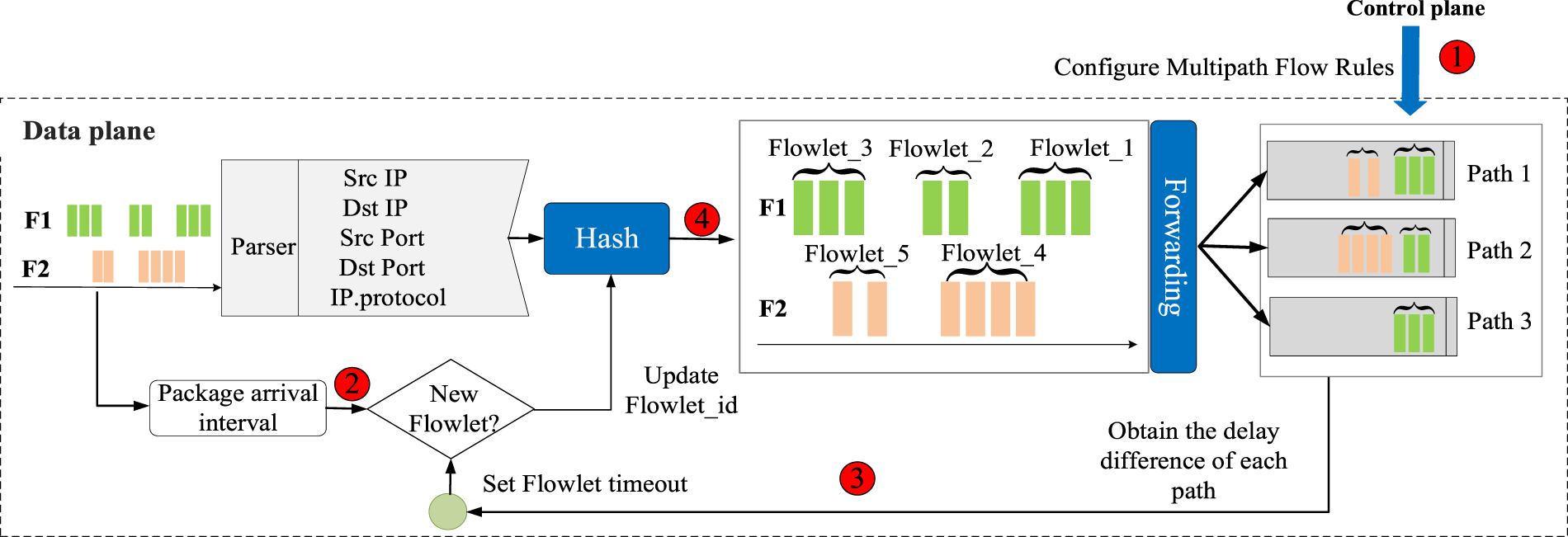
Figure 3: Adaptive flowlet-level forwarding mechanism.
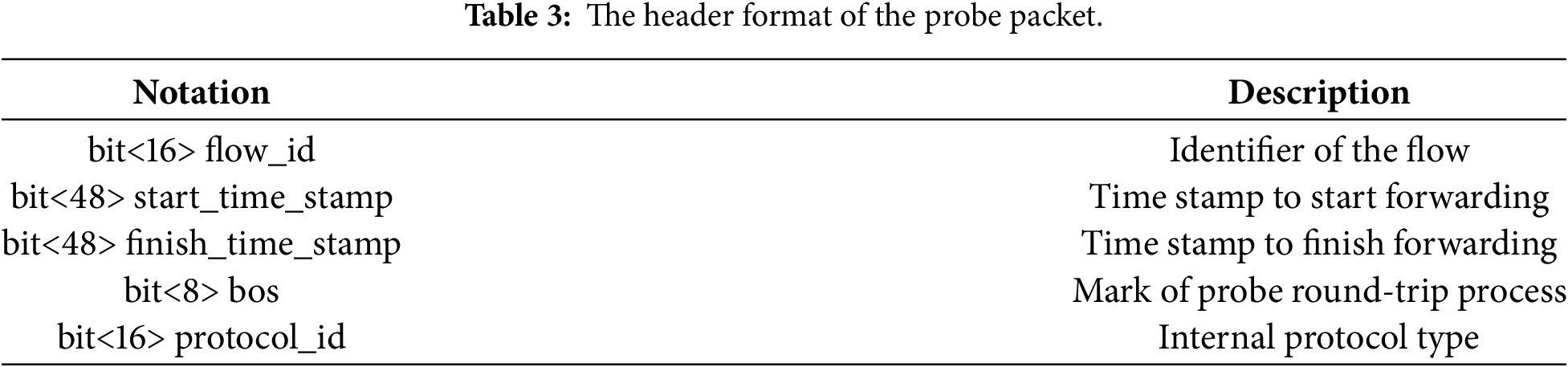
As shown in Fig. 4, to obtain the delay difference on multiple paths synchronously, for multiple paths of each flow, the ingress switch will periodically clone the packet digest of the corresponding flow as the probe packet and forward it from the output port of multiple paths in multicast mode. The probe header is shown in Table 3, including the field flow_ID to identify the flow, two timestamp fields start_time and finish_time to record the start time and the finish time of the probe for calculating the path delay. The flag field bos is used to distinguish the ingress switch, intermediate switch, or egress switch. The switch processing logic is shown in Algorithm 2. For each flow, the ingress switch will record the arrival interval of each packet online and compare it with the flow_timeout to determine whether to mark the flowlet and switch paths (steps 3~6). At the same time, it maintains two registers Max_delay_register and Min_delay_register to record the maximum and minimum delay of multiple paths. The ingress switch periodically clones the packet digest as the probe at the egress stage and sends the probe back to the ingress stage through the recirculate(.) function (step 24~28). Then the ingress switch first writes the current timestamp to start_time and forwards along different paths in multicast mode (step 7~10). The intermediate switch only performs normal forwarding operations. When the probe is forwarded to the egress switch (step 29~33), the egress switch sends the probe back to the ingress stage through recirculate(.), writes the current timestamp to finish_time, exchanges the source and destination IP addresses of the probe, and returns the probe along the original path (step 19~22). After receiving the returned probes, the ingress switch will compare the path delay from each probe
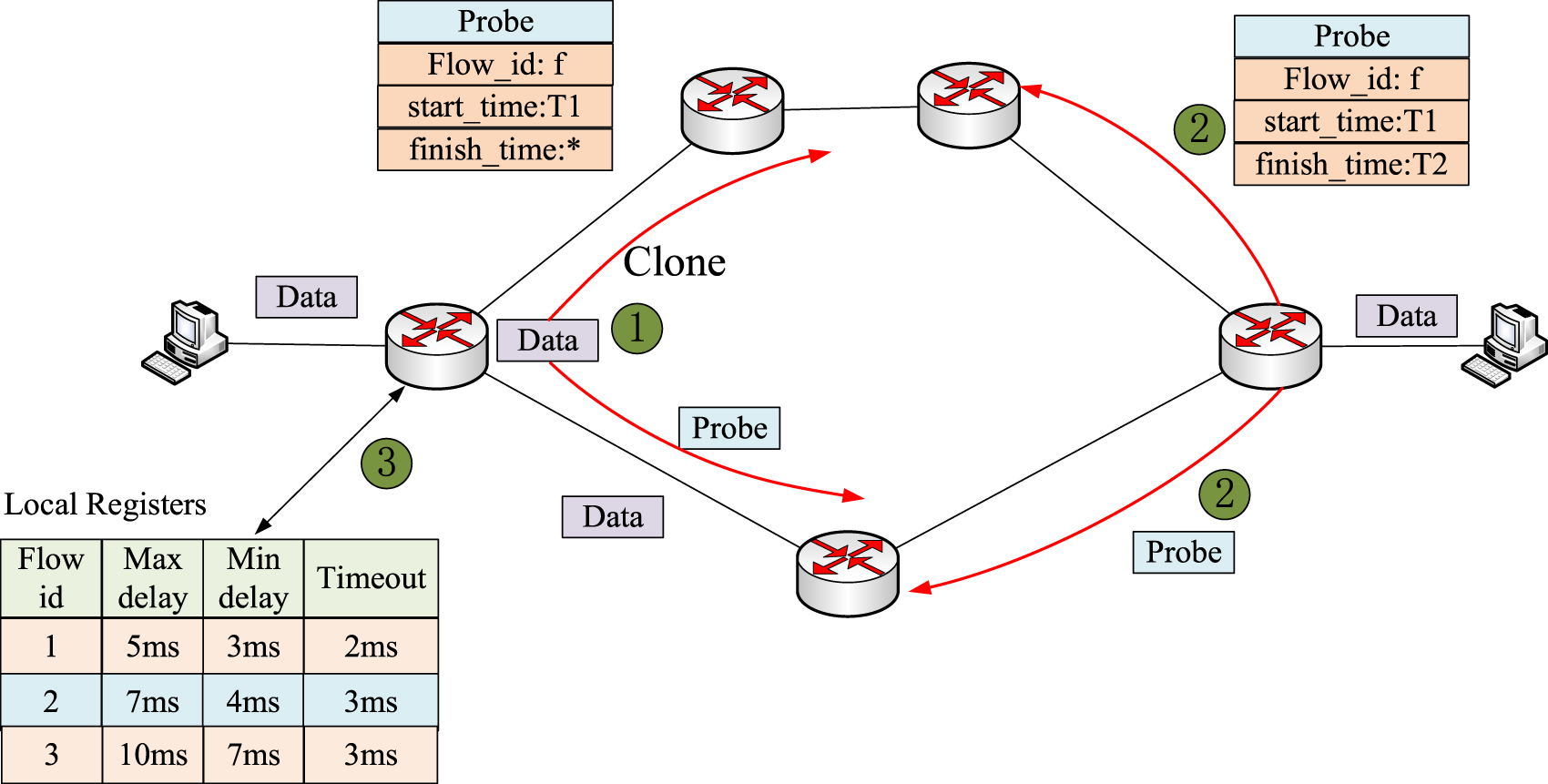
Figure 4: The process of obtaining delay difference on multiple paths.
According to reference [21], assuming two paths
According to Eq. (9), for

4.2.2 Distributed Congestion Avoidance Mechanism
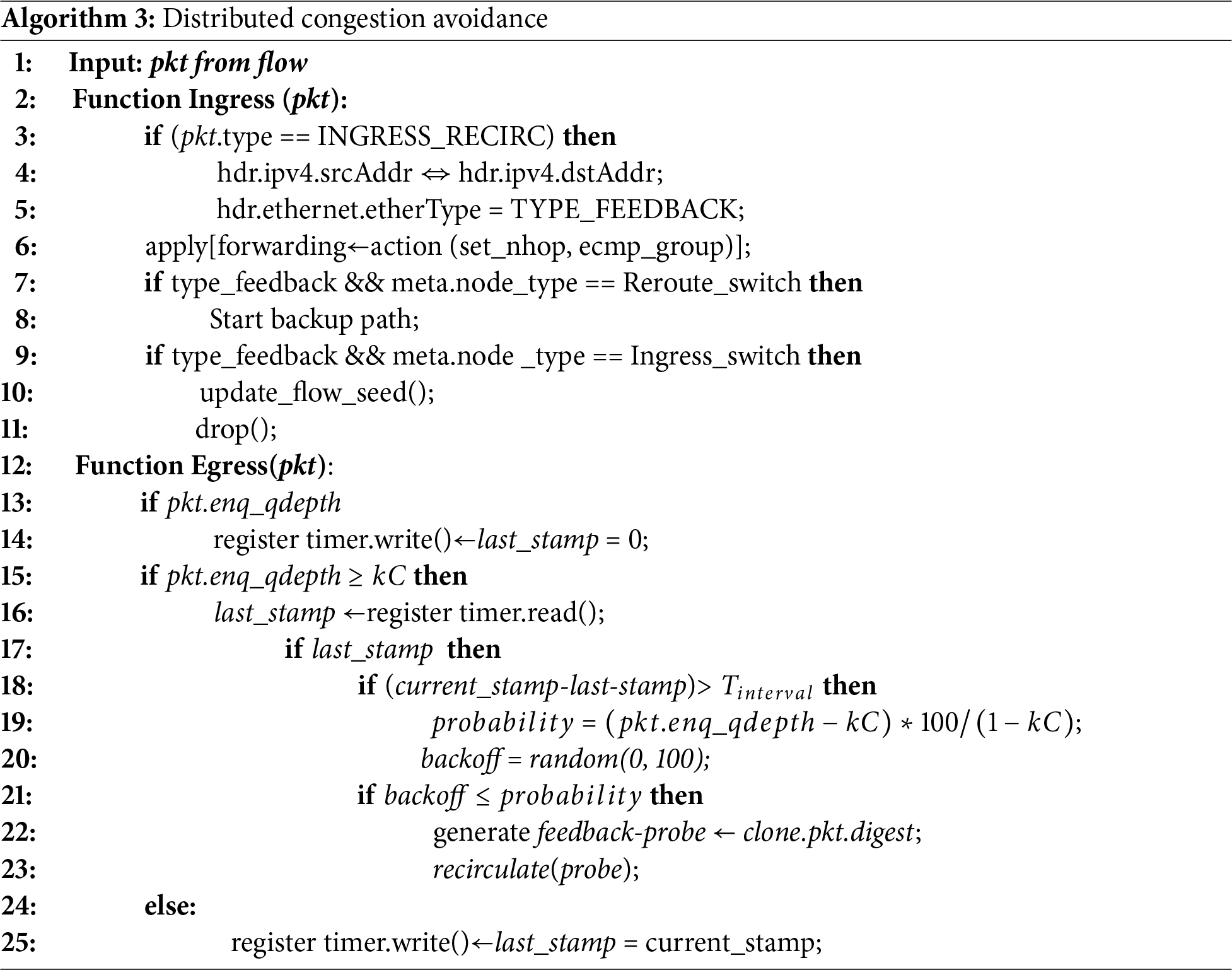
When the congestion control mechanism of traditional Internet such as TCP encounters link congestion, the switch usually notifies the terminal of congestion information in the form of packet loss, and the terminal eventually reduces the sending rate to alleviate congestion. This congestion feedback mechanism needs at least one round-trip time to work, which is not suitable for delay-sensitive flows. To prevent the network connection from being interrupted due to the packet transmission timeout or packet loss caused by the instantaneous link congestion, ConFlet uses a distributed congestion avoidance mechanism to perform local path switching when encountering link congestion.
To realize local rerouting of the switch, for each flow group
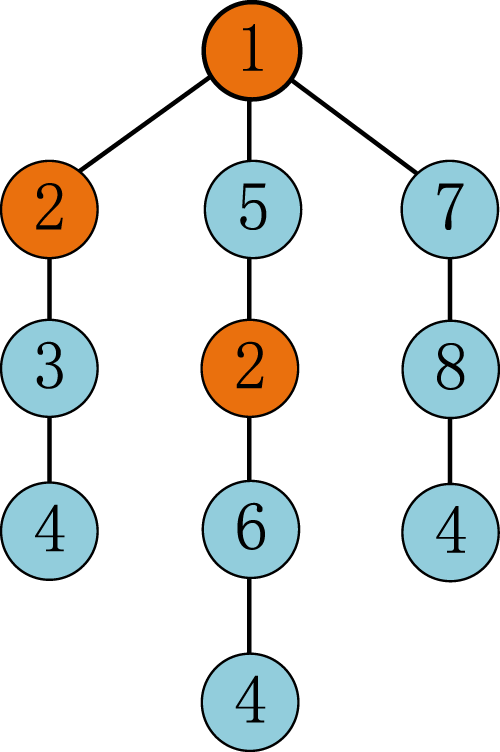
Figure 5: The multipath decision tree.
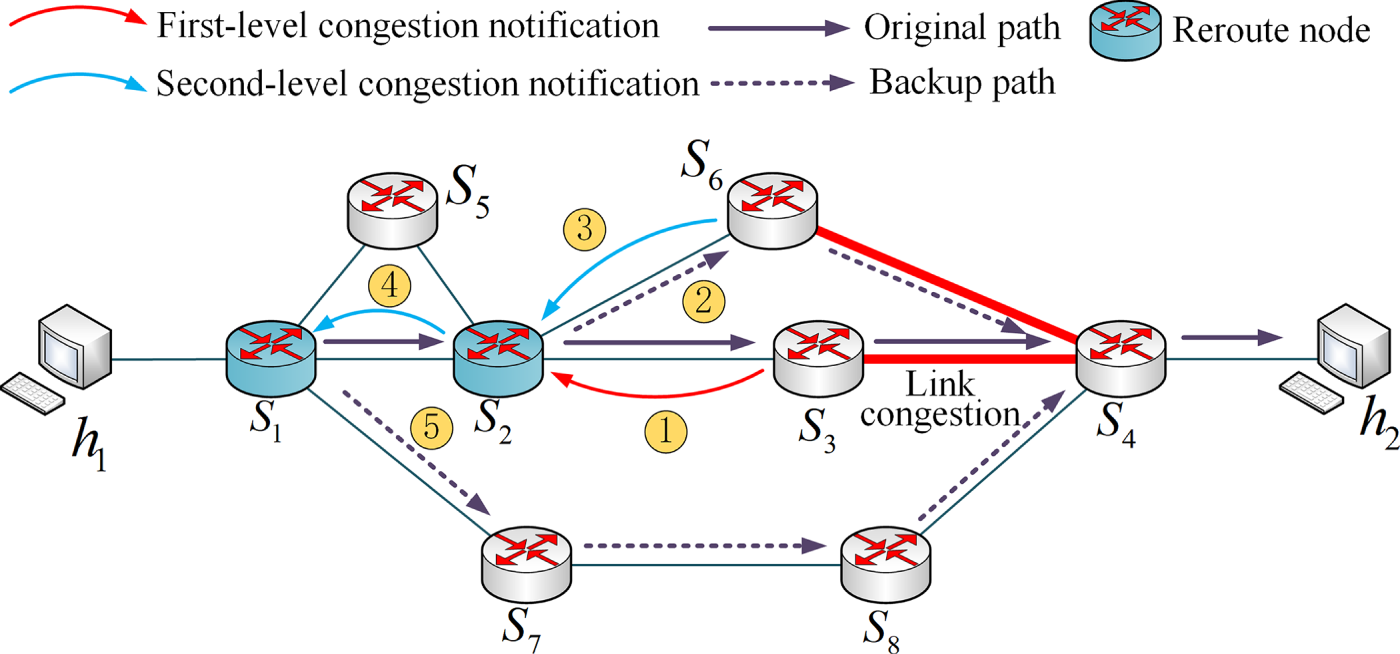
Figure 6: Distributed congestion avoidance process.
The following describes the conditions to generate congestion notification messages. Assuming that
We evaluate ConFlet compared with the state-of-the-art load balancing schemes in terms of average service reliability, average network throughput, and average packet delay. Furthermore, we conduct experiments to validate the stable performance of ConFlet over various network architectures, which consist of both symmetric and asymmetric topologies.
Experiment Platform: The test environment is built on Mininet [22] with BMv2 software switches [23]. The simulation uses the Fattree (symmetric) topology (80 nodes and 256 links) and Interllifiber (asymmetric) topology (73 nodes and 93 links) taken from the Internet Topology Zoo [24]. In terms of the Interllifiber topology, link distances are evaluated using the geographic positions of interconnected nodes. For Fat-tree, link lengths are randomly generated within a certain range (10, 100) and the value
Scheme Comparison: (1) ECMP [3]: the flow-granularity multipath routing scheme, which distributes different flows evenly to multiple paths through a hash function, but the load effect is limited in networks with unevenly large and small flows. (2) WCMP [4]: weighted multipath routing scheme, which sets different weights for each path according to the available bandwidth of each path. (3) LetFlow [17]: the flowlet-granularity load balancing scheme, which sets a fixed timeout threshold of 50
5.2 Network Performance Evaluation
5.2.1 Average Service Reliability
To quantify the average service reliability of ConFlet, given a flow
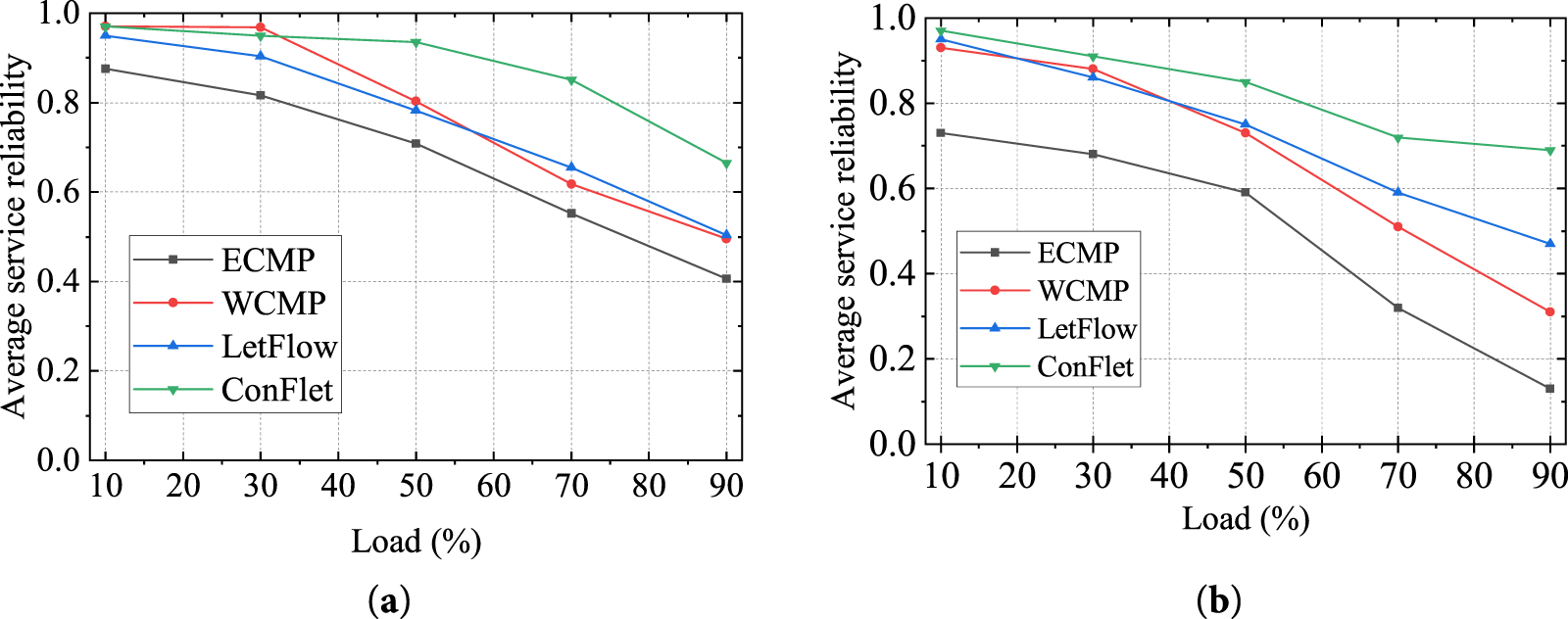
Figure 7: Average service reliability. (a) Fat tree topology; (b) Interllifiber topology.
5.2.2 The Average Throughput and Packet Delay
Fig. 8 shows the average throughput comparison under different loads in Fattree (symmetric) and Interllifiber (asymmetric) topology. To better display the performance comparison, we normalized the throughput to ConFlet. It can be seen that ConFlet has higher throughput than WCMP and LetFlow, while ECMP obtains the worst performance. WCMP sets different weights for the path according to the available bandwidth of the link and LetFlow can divide the large flows into small flows by monitoring the arrival intervals of packets, which has a certain effect of load balancing. However, WCMP still has the problem of hash conflict. LetFlow sets a fixed timeout threshold, which still leads to partial path congestion. As the load increases, the gap between ConFlet and LetFlow becomes more obvious. Compared with LetFlow, under high load (90%), ConFlet improves throughput by about 15% and 45% in symmetric and asymmetric topologies, respectively. ConFlet, on the one hand, realizes weighted forwarding according to the reliability of each path, implying the effect of load balancing. On the other hand, it implements flowlet-level load balancing based on adaptive flowlet timeout, which achieves the highest throughput.
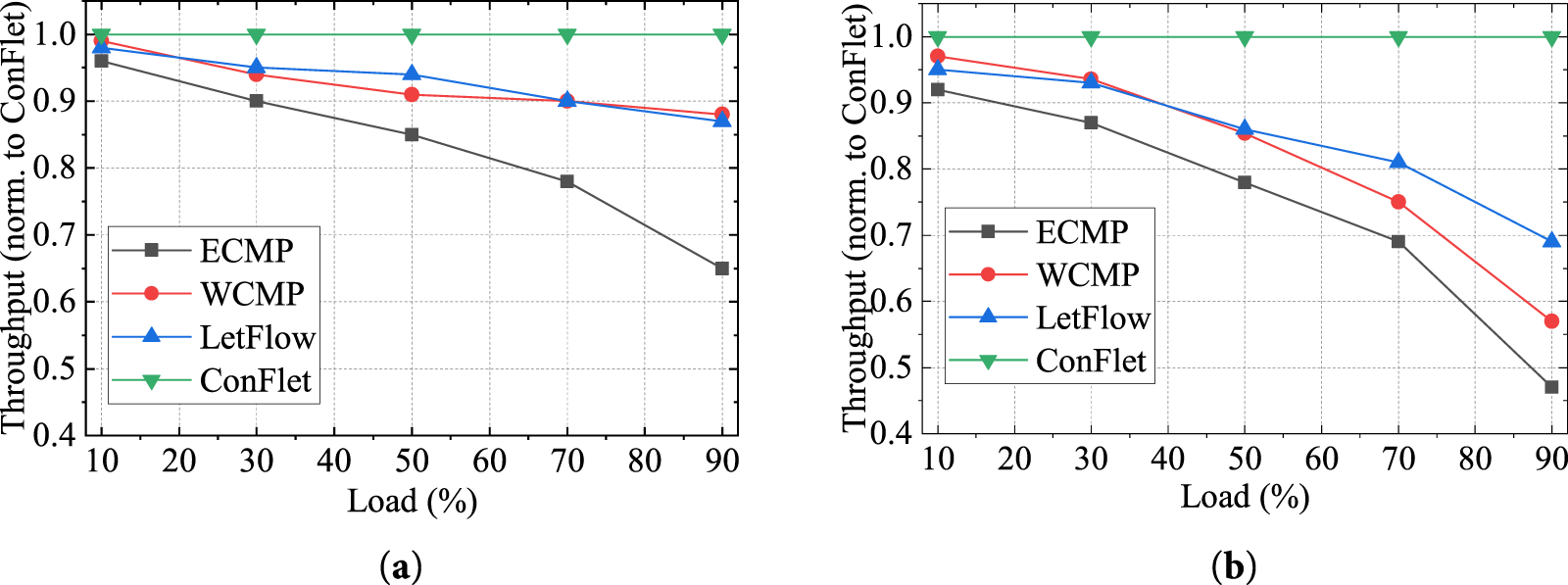
Figure 8: Average throughput comparison. (a) Fat tree topology; (b) Interllifiber topology.
Fig. 9 shows the average packet delay comparison under different loads. Average packet delay increases with the increase of traffic load. Since ConFlet, WCMP and LetFlow have finer granularity and fewer hash conflicts, their performance is also significantly better than ECMP. Compared with LetFlow, ConFlet reduces the average packet delay by about 25% and 53% in symmetric and asymmetric topologies, respectively, under high load (90%). In terms of throughput and delay, ConFlet has more advantages in asymmetric topology. This is because the asymmetric topology has fewer equivalent multipaths than the symmetric topology, which can better reflect the advantages of ConFlet’s load balancing and congestion avoidance mechanisms.
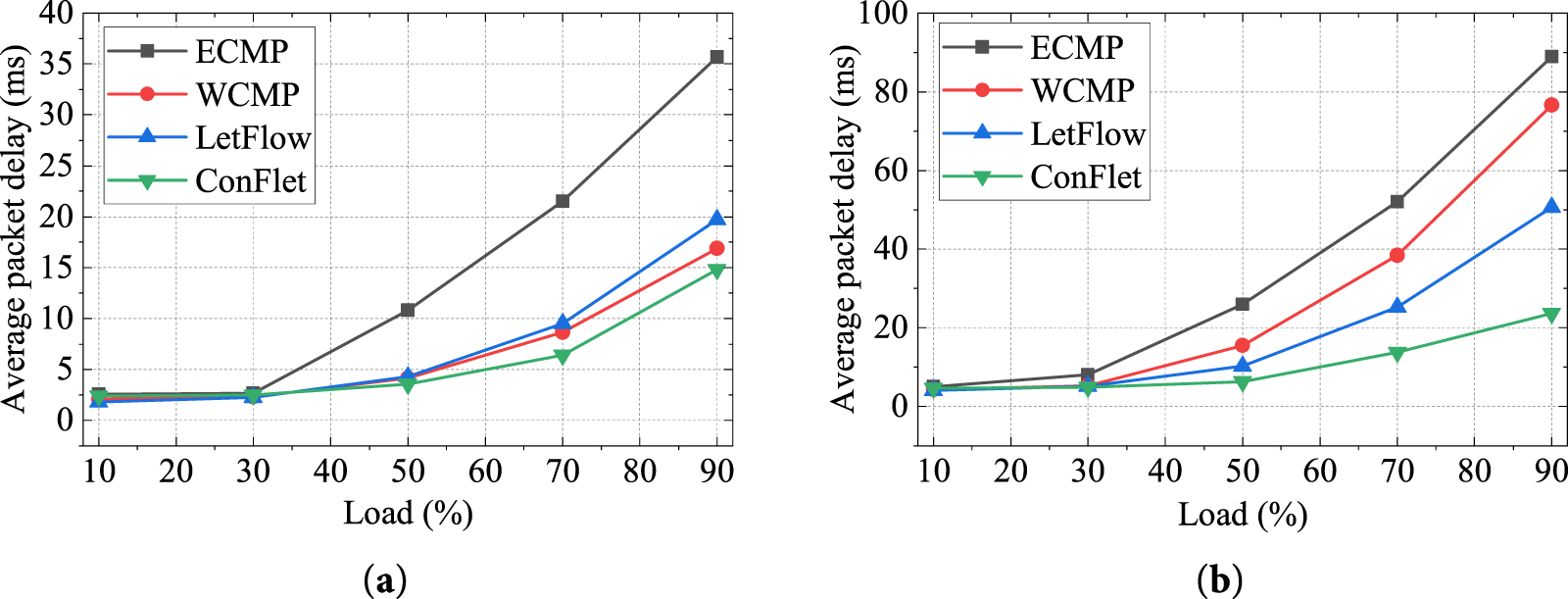
Figure 9: Average packet delay comparison. (a) Fat tree topology; (b) Interllifiber topology.
In this paper, we design ConFlet, a general load balancing scheme that can work seamlessly on any network topology. ConFlet takes full advantage of centralized and distributed control to achieve efficient and fine-grained load balancing. Specifically, in the control plane, ConFlet exploits the global network view to evaluate the reliability of nodes and links, and performs multipath routing decisions to guarantee that flows are always transmitted on a set of reliable paths. In the data plane, ConFlet can track the delay difference of each path and the packet arrival interval of each flow in real time, and set the adaptive timeout to split flows into flowlets along multiple paths. In addition, ConFlet adopts a distributed congestion avoidance mechanism to flexibly switch paths according to the congestion feedback, which can react to congestion in microseconds. Finally, we conduct simulation results to evaluate ConFlet against existing load balancing schemes. The experimental results show that, compared to LetFlow, ConFlet improves average service reliability by 47% and network throughput by 45%, reduce average packet delay by 53% under high load (90%) on asymmetry topology. For future research, we will deploy ConFlet in hardware devices and verify its performance in realistic large-scale networks.
Acknowledgement: Not applicable.
Funding Statement: The authors received no specific funding for this study.
Author Contributions: Ziyong Li: data curation; formal analysis; investigation; methodology; software; validation; writing—original draft. Yusheng Xia: formal analysis; validation; project administration. Junfei Li: data curation; formal analysis; investigation. Le Tian: conceptualization; supervision. Xinglong Pei: methodology; software; validation; visualization. All authors reviewed and approved the final version of the manuscript.
Availability of Data and Materials: The performance data generated or analyzed in support of this study are available from the corresponding author upon reasonable request.
Ethics Approval: Not applicable.
Conflicts of Interest: The authors declare no conflicts of interest.
References
1. Prabha R, G. A S, Bharathi GP, Sridevi S. Hybrid multipath routing cluster head prediction based on SDN-enabled IoT and heterogeneous context-aware graph convolution network. Peer Peer Netw Appl. 2024;17(4):2016–30. doi:10.1007/s12083-024-01685-z. [Google Scholar] [CrossRef]
2. Li H, Yang X, Wei G, Li K, Zeng W, Huang R, et al. An evolutionary network layer for future network MIN architecture. IEEE Trans Netw Sci Eng. 2026;13(2):360–75. doi:10.1109/tnse.2025.3583568. [Google Scholar] [CrossRef]
3. Rhamdani F, Suwastika NA, Nugroho MA. Equal-cost multipath routing in data center network based on software defined network. In: Proceedings of the 2018 6th International Conference on Information and Communication Technology (ICoICT); 2018 May 3–5; Bandung, Indonesia. p. 222–6. doi:10.1109/ICoICT.2018.8528730. [Google Scholar] [CrossRef]
4. Zhou J, Tewari M, Zhu M, Kabbani A, Poutievski L, Singh A, et al. WCMP: weighted cost multipathing for improved fairness in data centers. In: Proceedings of the Ninth European Conference on Computer Systems. Amsterdam, The Netherlands: ACM; 2014. p. 1–14. doi:10.1145/2592798.2592803. [Google Scholar] [CrossRef]
5. Kang N, Ghobadi M, Reumann J, Shraer A, Rexford J. Efficient traffic splitting on commodity switches. In: Proceedings of the 11th ACM Conference on Emerging Networking Experiments and Technologies. Heidelberg Germany: ACM; 2015. p. 1–13. doi:10.1145/2716281.2836091. [Google Scholar] [CrossRef]
6. Kaur A, Rama Krishna C, Patil NV. A comprehensive review on Software-defined Networking (SDN) and DDoS attacks: ecosystem, taxonomy, traffic engineering, challenges and research directions. Comput Sci Rev. 2025;55(9):100692. doi:10.1016/j.cosrev.2024.100692. [Google Scholar] [CrossRef]
7. Spina MG, De Rango F, Scalzo E, Guerriero F, Iera A. Distributing intelligence in 6G programmable data planes for effective in-network intrusion prevention. IEEE Netw. 2025;39(3):319–25. doi:10.1109/MNET.2025.3544828. [Google Scholar] [CrossRef]
8. Al-Fares M, Radhakrishnan S, Raghavan B, Huang N, Vahdat A. Hedera: dynamic flow scheduling for data center networks. Nsdi. 2010;10(8):89–92. [Google Scholar]
9. Korenfeld E, Kampeas J, Gurewitz O. ARION: aggregated routing for in-order optimized network load balancing in data centers. IEEE Trans Netw. 2026;34:4496–509. doi:10.1109/TON.2026.3678315. [Google Scholar] [CrossRef]
10. Bonato T, De Sensi D, Di Girolamo S, Bataineh A, Hewson D, Roweth D, et al. Flowcut switching: high-performance adaptive routing with in-order delivery guarantees. IEEE Trans Netw. 2026;34(2):1974–87. doi:10.1109/ton.2025.3636209. [Google Scholar] [CrossRef]
11. Dou S, Qi L, Wang J, Guo Z. EPIC: traffic engineering-centric path programmability recovery under controller failures in SD-WANs. IEEE/ACM Trans Netw. 2024;32(6):4871–84. doi:10.1109/TNET.2024.3438292. [Google Scholar] [CrossRef]
12. Farhan M, Shah N, Wang L, Muntean GM, Song HH. RDG-TE: link reliability-aware DRL-GNN-based traffic engineering in SDN. Expert Syst Appl. 2025;265(4):125963. doi:10.1016/j.eswa.2024.125963. [Google Scholar] [CrossRef]
13. Cheng Y, Jia X. NAMP: network-aware multipathing in software-defined data center networks. IEEE/ACM Trans Netw. 2020;28(2):846–59. doi:10.1109/TNET.2020.2971587. [Google Scholar] [CrossRef]
14. Yan J, Zhang H, Shuai Q, Liu B, HiQoS G X. An SDN-based multipath QoS solution. China Commun. 2015;12(5):123–33. doi:10.1109/CC.2015.7112035. [Google Scholar] [CrossRef]
15. Alizadeh M, Edsall T, Dharmapurikar S, Vaidyanathan R, Chu K, Fingerhut A, et al. CONGA: distributed congestion-aware load balancing for datacenters. In: Proceedings of the 2014 ACM conference on SIGCOMM; 2014 Aug 17–22; Chicago, IL, USA. p. 503–14. doi:10.1145/2619239.2626316. [Google Scholar] [CrossRef]
16. Katta N, Hira M, Kim C, Sivaraman A, Rexford J. HULA: scalable load balancing using programmable data planes. In: Proceedings of the Symposium on SDN Research; 2016 Mar 14–15; Santa Clara, CA, USA. p. 1–12. doi:10.1145/2890955.2890968. [Google Scholar] [CrossRef]
17. Vanini E, Pan R, Alizadeh M, Taheri P, Edsall T. Let it flow: resilient asymmetric load balancing with flowlet switching. In: Proceedings of the 14th USENIX Conference on Networked Systems Design and Implementation; 2017 Mar 27–29; Boston, MA, USA. [Google Scholar]
18. Wu P, Shang Y, Bai S, Cheng L, Tang H. A lightweight path consistency verification based on INT in SDN. Math Biosci Eng. 2023;20(11):19468–84. doi:10.3934/mbe.2023862. [Google Scholar] [CrossRef]
19. Zhao C, Li X, Qi S, Zhao Z, Qiao K, Li D, et al. A survey on reliability evaluation of optical networks. IEEE Commun Surv Tutor. 2026;28(3):3443–77. doi:10.1109/comst.2025.3621165. [Google Scholar] [CrossRef]
20. Murali Mohan P, Gurusamy M, Lim TJ. Dynamic attack-resilient routing in software defined networks. IEEE Trans Netw Serv Manag. 2018;15(3):1146–60. doi:10.1109/TNSM.2018.2846294. [Google Scholar] [CrossRef]
21. Liu WX, Cai J, Ling S, Zhang JY, Chen Q. QALL: distributed queue-behavior-aware load balancing using programmable data planes. IEEE Trans Netw Serv Manag. 2024;21(2):2303–22. doi:10.1109/TNSM.2023.3345862. [Google Scholar] [CrossRef]
22. Sheikh MNA, Hwang IS, Raza MS, Ab-Rahman MS. A qualitative and comparative performance assessment of logically centralized SDN controllers via mininet emulator. Computers. 2024;13(4):85. doi:10.3390/computers13040085. [Google Scholar] [CrossRef]
23. Elbediwy M, Pontikakis B, David JP, Savaria Y. Enabling rank-based P4 programmable schedulers: requirements, implementation, and evaluation on BMv2 switches. IEEE Trans Netw. 2025;33(1):299–310. doi:10.1109/TNET.2024.3481152. [Google Scholar] [CrossRef]
24. Knight S, Nguyen HX, Falkner N, Bowden R, Roughan M. The internet topology zoo. IEEE J Select Areas Commun. 2011;29(9):1765–75. doi:10.1109/jsac.2011.111002. [Google Scholar] [CrossRef]
25. Stubbe H, Gallenmüller S, Simon M, Hauser E, Scholz D, Carle G. Exploring data plane updates on P4 switches with P4Runtime. Comput Commun. 2024;225(C):44–53. doi:10.1016/j.comcom.2024.06.020. [Google Scholar] [CrossRef]
Cite This Article
 Copyright © 2026 The Author(s). Published by Tech Science Press.
This work is licensed under a Creative Commons Attribution 4.0 International License , which permits unrestricted use, distribution, and reproduction in any medium, provided the original work is properly cited.
 Downloads
 Citation Tools
