
 Login
Login Register
 Submit a Paper
 Propose a Special lssue
 Open Access
ARTICLE
DDGEM: Diffusion Denoising and Generative Enhancement for Multimodal Recommendation
School of Computer Science and Engineering, Chongqing University of Technology, Chongqing, China
* Corresponding Author: Weiwei Li. Email:
Computers, Materials & Continua 2026, 89(2), 82 https://doi.org/10.32604/cmc.2026.085768
Received 18 May 2026; Accepted 10 August 2026; Issue published 15 September 2026
 View Full Text
 Download PDF
Abstract
In multimodal recommendation, sparse implicit feedback can lead to noisy collaborative graphs, while long-tail and cold-start items often lack reliable collaborative signals. Textual and visual features provide useful item-side information, but they may also be incomplete or inconsistent across modalities. These issues make robust user and item representation learning difficult. To address them, we propose Diffusion Denoising and Generative Enhancement for Multimodal Recommendation (DDGEM). DDGEM first applies node-wise diffusion denoising in the latent collaborative space to reduce unreliable user–item signals. It then uses relational diffusion to reconstruct adaptive item–item relations instead of relying on fixed semantic similarity. For sparse and cold-start items, a conditional variational autoencoder (CVAE)-based conditional generative module produces complementary item representations from textual and visual features, followed by popularity-aware generation balance. Finally, behavior-aware multimodal fusion dynamically combines collaborative, textual, and visual representations for each user–item pair. Experiments on three public Amazon datasets show that DDGEM outperforms representative collaborative filtering, generative recommendation, and multimodal recommendation baselines. Further significance tests, ablation studies, efficiency comparison, graph-noise robustness analysis, strict cold-start evaluation, modality-conflict analysis, and hyperparameter analysis verify the effectiveness and practical behavior of DDGEM.Keywords
Recommender systems have become a core component of modern online services, including e-commerce, social media, and digital entertainment. Most recommendation models infer user preference from historical user–item interactions [1,2]. This paradigm is effective when feedback is dense and reliable, but it is fragile under sparse implicit interactions. A click, view, or purchase may reflect real preference, but it may also result from accidental exposure, temporary interest, or popularity bias. Once such unreliable signals are encoded into the collaborative graph, graph-based models may repeatedly propagate them and degrade user and item representations.
Multimodal recommendation introduces item-side content, such as textual descriptions and visual features, to alleviate sparsity and cold-start issues [3,4]. However, additional modalities are not always reliable. Textual and visual features may be noisy, incomplete, or even inconsistent with each other. Existing methods still leave three issues insufficiently addressed. First, matrix factorization methods [2,5], neural collaborative filtering models [6], and graph-based methods [7] are often trained on imperfect feedback, while recent contrastive learning and multimodal denoising methods [8–11] mainly reduce feature-level noise and rarely model the perturbation and recovery of collaborative embeddings. Second, explicit item–item graphs [12,13] are usually constructed by fixed similarity measures before training, making them less adaptive to uncertain semantic relations. Third, long-tail and cold-start items lack reliable collaborative anchors, and existing content–collaboration fusion methods [14] often overlook sparse-item uncertainty and the popularity-dependent balance between content and collaborative signals.
To improve representation reliability under these conditions, this paper proposes Diffusion Denoising and Generative Enhancement for Multimodal Recommendation, termed DDGEM. Instead of loosely combining several existing techniques, DDGEM follows a structured representation flow. It first applies node-wise diffusion denoising to refine collaborative user and item embeddings. The denoised item representations are then used for relational diffusion graph reconstruction, where candidate item–item relations are adaptively refined rather than fixed by one-shot similarity calculation. For sparse and cold-start items, a CVAE-based conditional generative module produces complementary item representations from textual and visual semantics. Finally, a behavior-aware fusion module dynamically combines collaborative, textual, and visual signals for each user–item pair, allowing unreliable modalities to be down-weighted when modality quality is imbalanced or conflicting.
The main contributions of this paper are summarized as follows:
• A unified multimodal recommendation framework, DDGEM, is proposed to improve representation robustness under sparse interactions, noisy collaborative structures, and modality imbalance.
• Node-wise and relation-level diffusion modules are designed to denoise collaborative embeddings and adaptively reconstruct item–item relations.
• A CVAE-based conditional generative enhancement module with popularity-aware fusion is developed to improve item representations for long-tail and cold-start scenarios.
• A behavior-aware multimodal fusion strategy is introduced to dynamically integrate collaborative, textual, and visual signals. Experiments on three public datasets, together with ablation, significance, efficiency, robustness, cold-start, and modality-conflict analyses, verify the effectiveness of DDGEM.
2.1 Collaborative Filtering–Based and Graph Neural Network(GNN)–Based Recommendation
Collaborative filtering is a fundamental paradigm in recommender systems. Matrix factorization and pairwise ranking methods infer user preference from historical interactions [15,16], while neural recommendation models enhance representation learning through nonlinear user–item interaction functions [6]. These methods are effective but depend heavily on the quality and density of observed feedback.
Graph neural networks further model high-order collaborative signals by propagating messages over the user–item bipartite graph [17]. NGCF explicitly encodes high-order connectivity [7], and LightGCN simplifies graph convolution by retaining only neighborhood aggregation [18]. Recent graph recommendation methods also incorporate contrastive learning or structural motifs to improve representation robustness [19,20]. A common limitation is that the observed interaction graph is usually treated as reliable. When implicit feedback contains accidental clicks, weak preferences, or popularity bias, graph propagation may also spread noise. This motivates denoising-oriented collaborative representation learning.
Multimodal recommendation uses item-side content, such as images and textual descriptions, to alleviate sparsity and cold-start problems. VBPR introduces visual features into Bayesian personalized ranking [9]; MMGCN models modality-specific user preference through graph convolution [10]; LATTICE constructs modality-aware item–item graphs, and BM3 simplifies multimodal contrastive learning by bootstrapping latent representations [11,14]. More recent studies investigate multimodal denoising, graph structure learning, and adaptive modality fusion [21–25]. However, multimodal content is not always reliable. Item images may contain background noise, style variation, or domain-specific visual bias, while textual descriptions may emphasize attributes weakly related to user preference. Therefore, static modality fusion may amplify unreliable content signals, while user–item-specific fusion is more suitable for multimodal preference modeling.
2.3 Generative and Diffusion Models for Recommendation
Generative models have been used to improve recommendation under sparse and cold-start scenarios. DropoutNet maps item content features to collaborative embeddings [26]. Variational autoencoders and conditional variational autoencoders model latent preference distributions and content-conditioned item representations [27–31]. GoRec further generates cold-start item representations from multimodal content and collaborative anchors [32]. These methods improve content-based representation learning, but they pay limited attention to noisy collaborative structures and adaptive item–item relations.
Diffusion models have recently been introduced into recommendation. DiffKG filters noisy knowledge graph signals through diffusion-based denoising [33]. DiffRec models user–item interaction generation with a denoising process [34]. Sequential diffusion methods refine user interaction sequences [35–37], and CDiff4Rec uses reviews to guide collaborative diffusion [38]. DiffMM further applies multimodal diffusion to recommendation representation learning [39]. These studies show the value of diffusion models, but most of them focus on sequence generation, knowledge graph denoising, or modality-level enhancement. Jointly modeling collaborative denoising, relation reconstruction, generative item enhancement, and behavior-aware fusion remains underexplored.
Diffusion-based generative augmentation has also been studied in computer vision. GenMix performs diffusion image editing for visual data augmentation [40], while DiffuseMix generates label-preserving augmented images with diffusion models [41]. Architecturally, these methods place diffusion models before the downstream task model and use them to synthesize or edit raw visual samples. DDGEM follows a different design. It does not synthesize images or texts, nor does it use diffusion as an external augmentation module. Instead, DDGEM embeds diffusion inside the recommendation architecture to denoise collaborative embeddings and refine item relations, while the CVAE module generates latent item representations for user–item ranking.
In addition, predictor-corrector aided discretized zeroing neural networks highlight the value of stable iterative modeling in dynamic optimization [42]. Although this line of work is methodologically different from recommendation, it provides a useful perspective on iterative refinement under noisy conditions.
3.1 Overall Framework of DDGEM
Let
As shown in Fig. 1, DDGEM follows a sequential representation refinement flow. The graph representation layer first performs
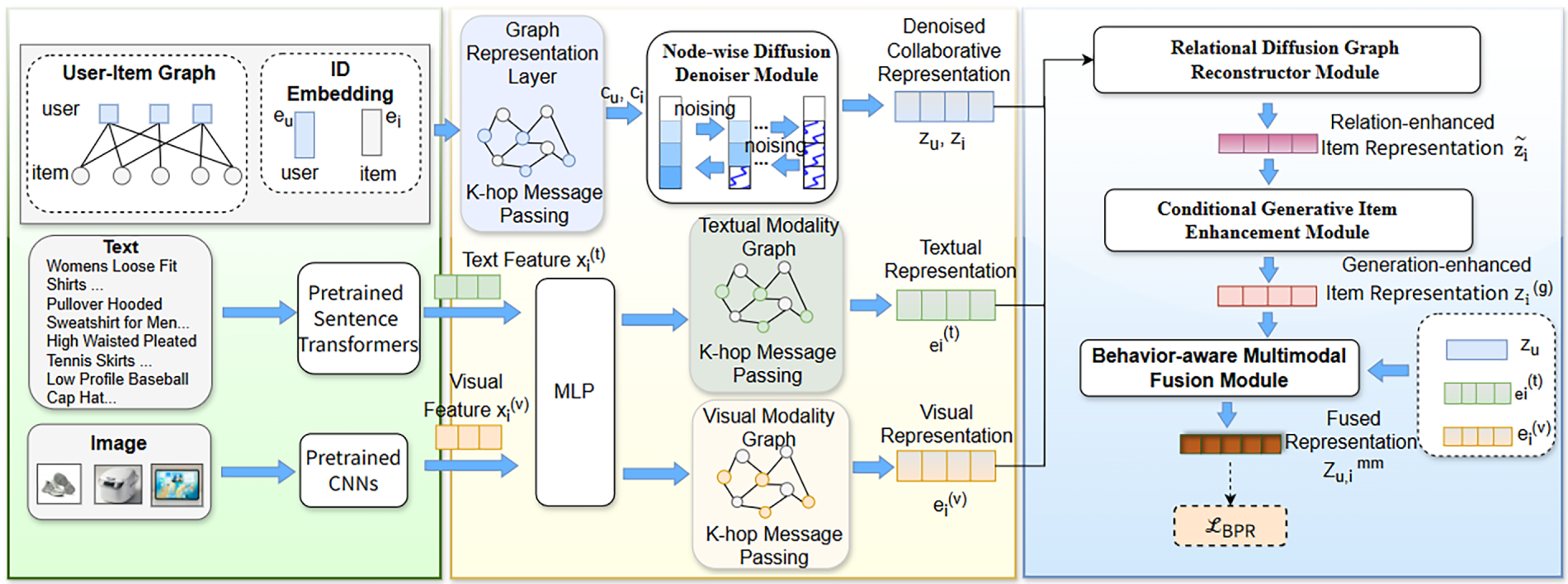
Figure 1: Overall framework of the Diffusion Denoising and Generative Enhancement for Multimodal Recommendation (DDGEM) model. ID, identifier; MLP, multilayer perceptron; CNN, convolutional neural network.
The core representation path of DDGEM is
3.2 Node-Wise Diffusion Denoiser Module
The graph representation layer outputs the preliminary collaborative embedding
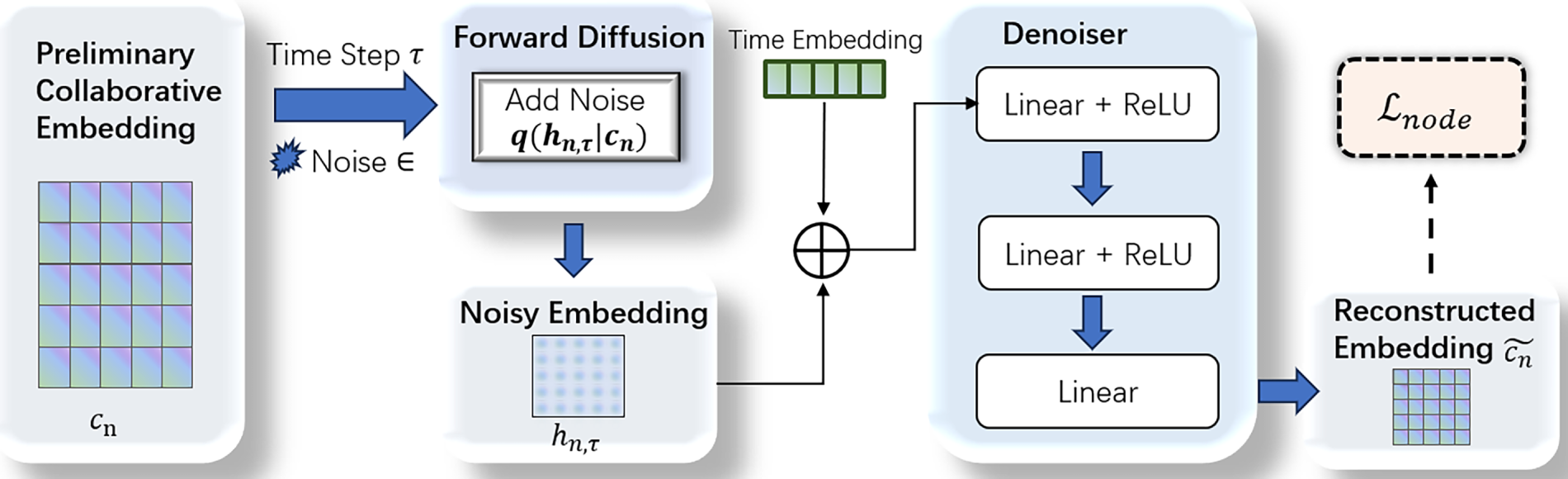
Figure 2: Schematic diagram of the node-wise diffusion denoiser. ReLU, rectified linear unit.
For diffusion step
where
where
After reverse denoising, the reconstructed embedding is denoted as
which keeps the original collaborative signal while introducing a denoising prior for the subsequent relation reconstruction and generative item enhancement.
3.3 Relational Diffusion Graph Reconstructor Module
The denoised item representation
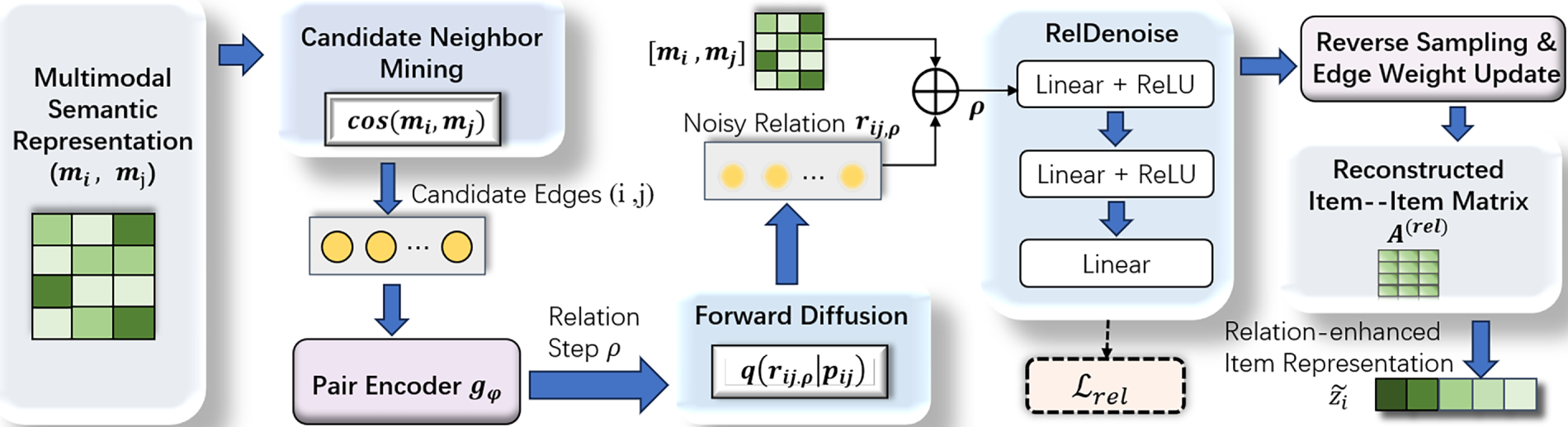
Figure 3: Structure of the relational diffusion graph reconstruction module. ReLU, rectified linear unit.
For each candidate edge
where
Relational diffusion is performed on
where
After reverse sampling, the denoised relation strength
where
In implementation,
3.4 Conditional Generative Item Enhancement Module
Sparse and cold-start items may have weak collaborative anchors even after relation-aware propagation. As shown in Fig. 4, DDGEM uses a conditional generative module to generate item representations from multimodal semantics. Given the multimodal semantic representation
where
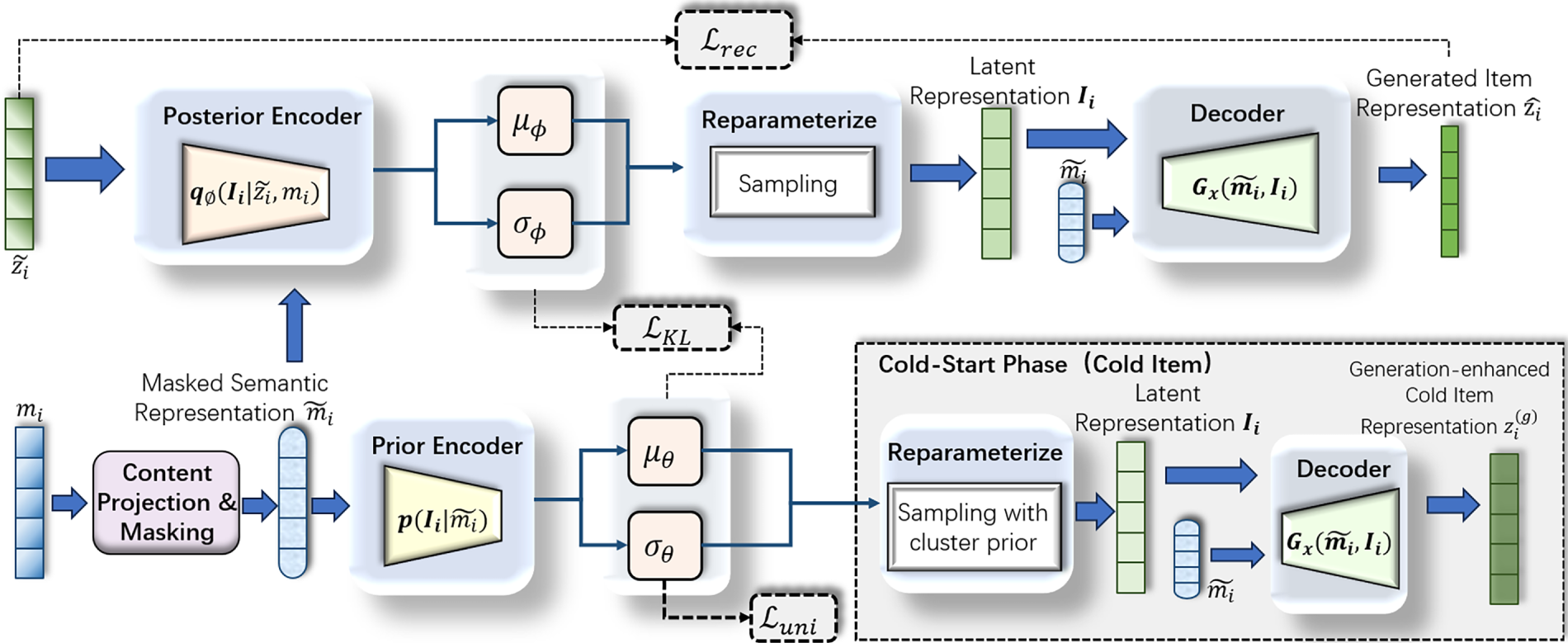
Figure 4: Conditional generative item enhancement and cold-start generation.
For warm items, the posterior encoder and prior encoder are defined as
The latent representation is sampled by reparameterization and decoded as
In implementation, the posterior encoder, prior encoder, and decoder are implemented as MLPs.
The training objective of this module is
where
and the prior uniformity loss over a mini-batch
In implementation, the semantic-cluster prior is obtained by applying K-means to the prior means
The generated representation
3.5 Behavior-Aware Multimodal Fusion Module
Collaborative, textual, and visual signals may contribute differently to different user–item pairs. As shown in Fig. 5, DDGEM uses a behavior-aware gating mechanism to assign pair-specific modality weights before final ranking.
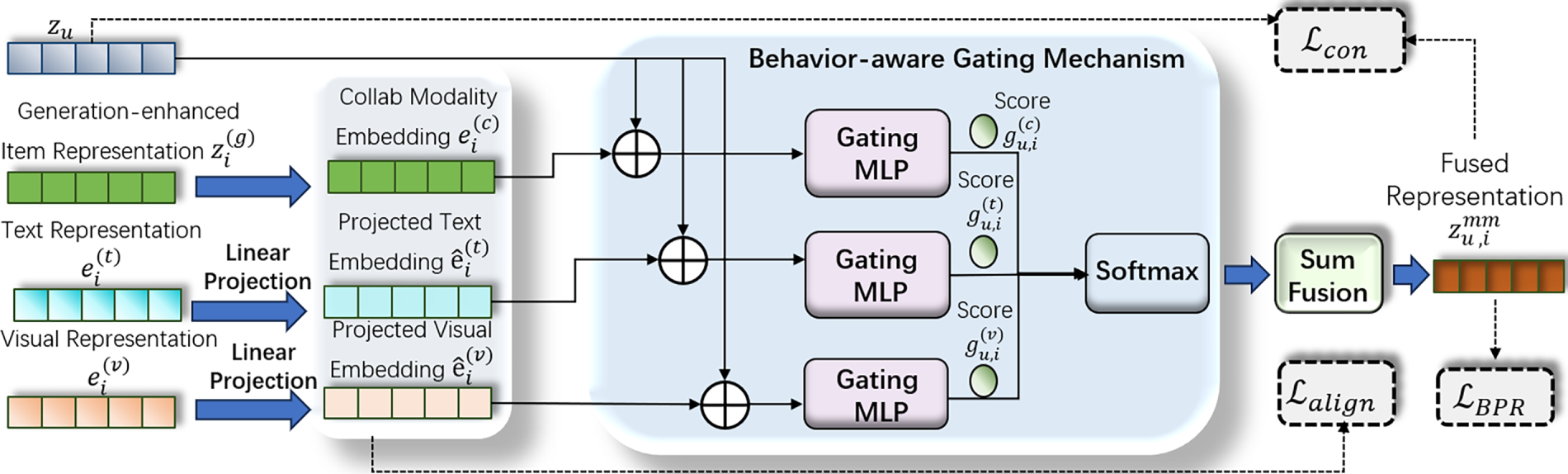
Figure 5: Structure of the behavior-aware multimodal fusion module. MLP, multilayer perceptron.
For item
For each user–item pair
The modality weights are obtained by softmax normalization:
The fused representation is computed by weighted summation:
The ranking score is
The ranking objective is optimized by BPR:
where
Here,
3.6 Joint Optimization and Complexity Analysis
Let
Here,
DDGEM applies diffusion in the latent recommendation space rather than in the raw image or text space. The forward processes perturb collaborative embeddings and relation codes with Gaussian noise, and the denoisers learn to recover stable latent signals. This gives a denoising interpretation to the node-wise and relational diffusion modules while keeping the generation process inside the recommendation architecture.
Let
where the terms correspond to graph propagation, diffusion denoising, relation-enhanced aggregation, and MLP-based generation/fusion. In implementation,
During inference, auxiliary training losses are not optimized, and item-side representations can be precomputed. For a candidate set
We evaluate DDGEM on three public Amazon datasets. The experiments address seven research questions (RQs): RQ1: Does DDGEM outperform representative baselines, and are the gains over MIG-GT statistically reliable across random seeds? RQ2: How much does each module and sub-design contribute? RQ3: What are the training cost, inference cost, memory usage, and parameter size? RQ4: How robust is DDGEM to noisy collaborative graphs? RQ5: How does DDGEM perform under strict item cold-start settings? RQ6: How does DDGEM behave when textual and visual modalities conflict? RQ7: How sensitive is DDGEM to key hyperparameters?
We use three public Amazon Review datasets [43]: Baby, Sports, and Clothing. Each dataset contains implicit user–item interactions and item-side textual and visual features. Following prior work [44], we use the released 384-dimensional text features and 4096-dimensional visual features, which are fixed during training. The dataset statistics are reported in Table 1.

We evaluate top-
4.1.3 Baseline Models for Comparison
We compare DDGEM with representative methods from three groups: collaborative filtering methods, including MF [2], LightGCN [18], and DirectAU [45]; generative recommendation methods, including GAR [46], GoRec [32], DGVAE [47], and DiffMM [39]; and multimodal recommendation methods, including VBPR [9], MMGCN [10], LATTICE [11], BM3 [14], DGHNet [22], FREEDOM [23], DA-MRS [24], AM2HRec [25], and MIG-GT [44].
DDGEM is implemented in PyTorch and trained on a single NVIDIA GeForce RTX 3090 graphics processing unit (GPU). The main recommendation parameters are optimized by AdamW, while the node-wise and relation-level denoising networks are optimized by Adam. The batch size is set to 8000, and one negative item is sampled for each positive interaction. The maximum number of training epochs is 600, with early stopping based on validation Recall@20. The embedding size is 64. The learning rate is
4.2 Overall Performance Comparison (RQ1)
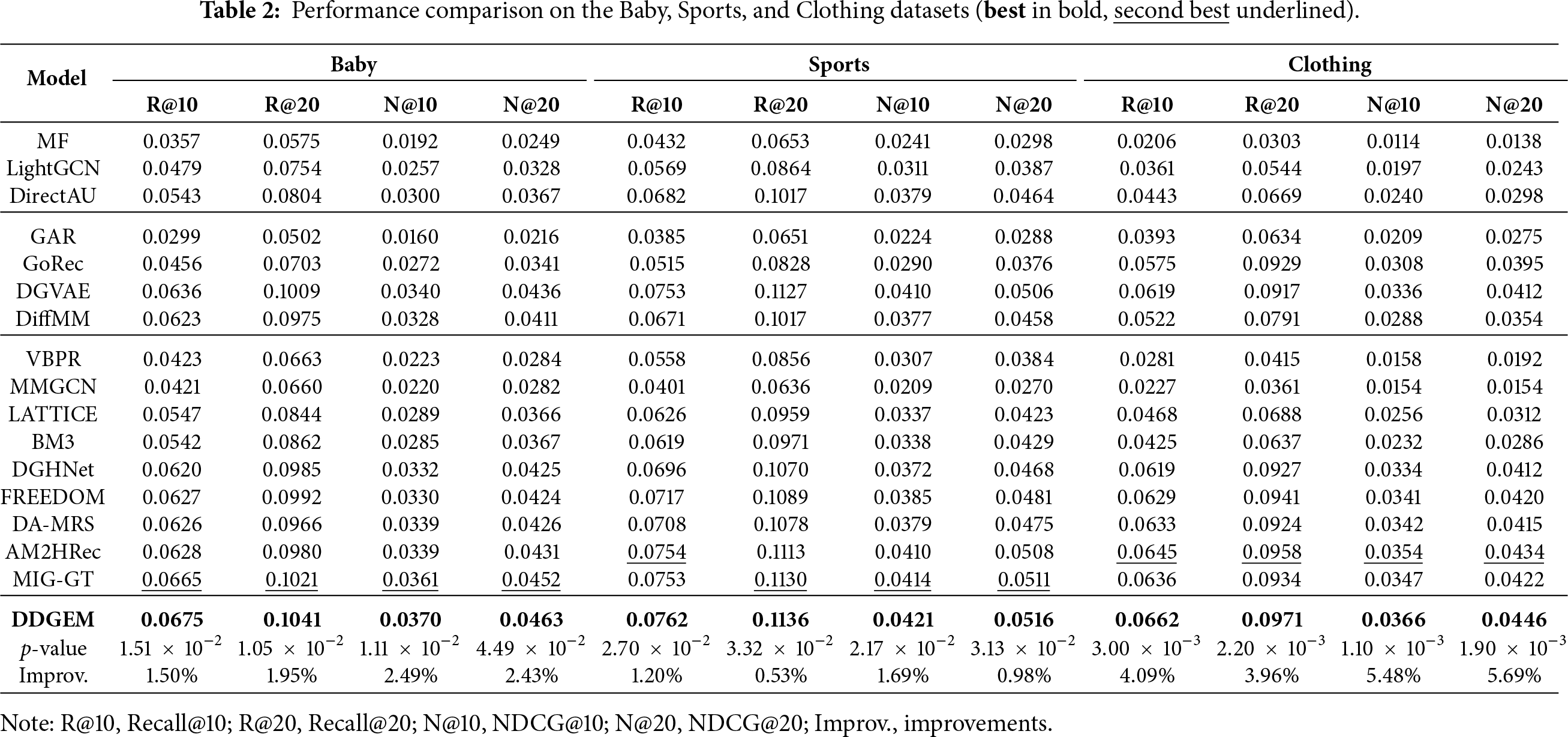
Table 2 reports the overall performance on the three datasets. The best results are shown in bold, and the second-best results are underlined. The rows “
DDGEM achieves the best results on all datasets and metrics. Compared with MIG-GT, it improves Recall@20 by 1.95%, 0.53%, and 3.96% on Baby, Sports, and Clothing, respectively. The corresponding NDCG@20 improvements are 2.43%, 0.98%, and 5.69%. The paired
The improvements on Sports are smaller than those on Baby and Clothing. One possible reason is that MIG-GT already captures strong multimodal signals on this dataset, leaving limited room for further improvement. Nevertheless, DDGEM still gives consistent gains, which supports the usefulness of latent collaborative denoising, relation reconstruction, generative item enhancement, and behavior-aware fusion performance.
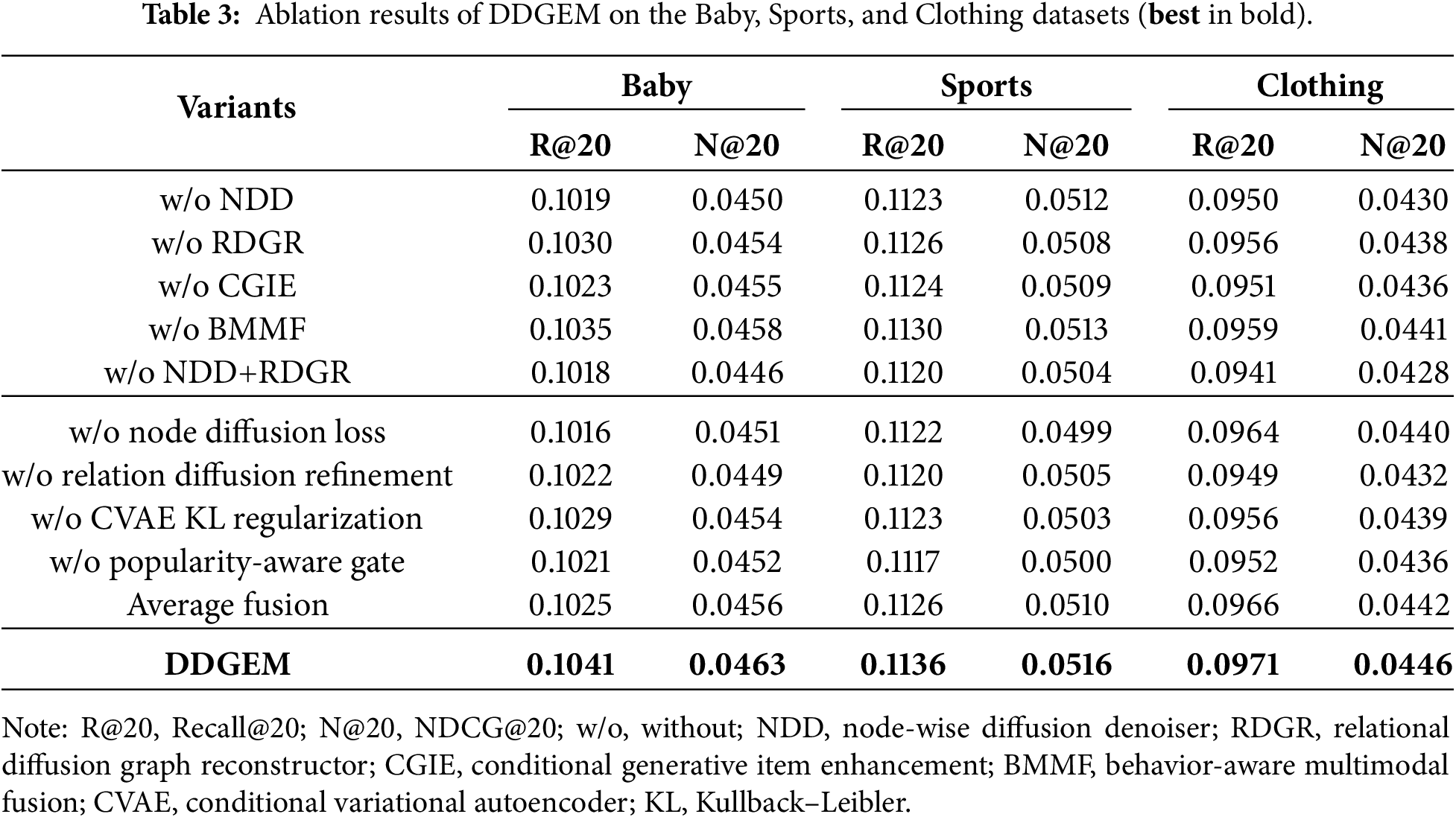
To examine the contribution of DDGEM’s main modules and internal sub-designs, we conduct module-level and sub-design-level ablation studies. The module-level variants remove NDD, RDGR, CGIE, BMMF, or both diffusion modules. The sub-design variants further remove the node diffusion loss, disable relation diffusion refinement, remove the CVAE KL regularization, remove the popularity-aware gate, or replace behavior-aware fusion with average fusion.
As shown in Table 3, all variants underperform DDGEM. Removing NDD and RDGR together causes the largest decline, indicating that collaborative denoising and relation reconstruction are complementary. The drops caused by w/o CGIE and w/o CVAE KL regularization show that content-conditioned generation benefits from latent regularization. In addition, w/o BMMF, w/o popularity-aware gate, and Average fusion reduce performance, confirming the need for adaptive generation balance and user–item-specific multimodal fusion.
To further compare diffusion-based denoising with CVAE-based generation, we conduct an incremental analysis. Here, base removes both designs from DDGEM; base-cvae and base-diff add only CVAE-based generation and diffusion-based denoising, respectively. As shown in Fig. 6, the single-component variants do not consistently outperform base, suggesting that either generation or denoising alone is insufficient and may require coordination with the other component. In contrast, the full DDGEM achieves the best results on all datasets, indicating that diffusion-based denoising and CVAE-based generation are complementary rather than redundant.
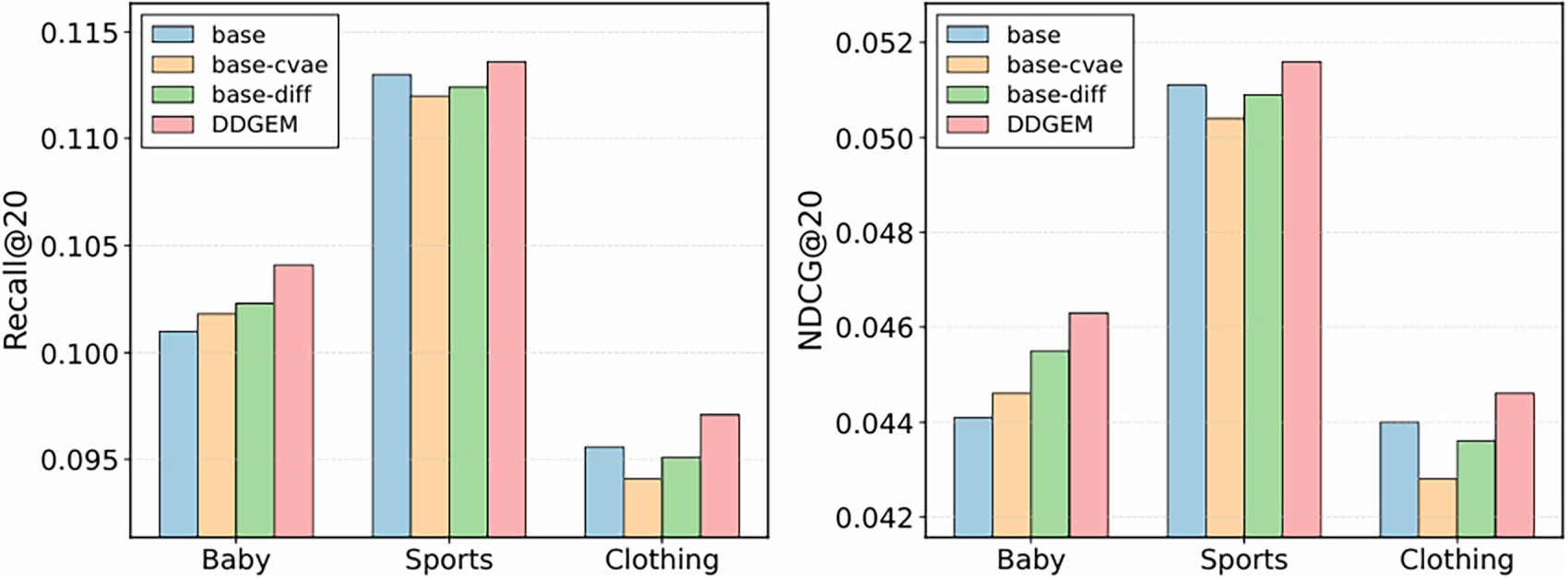
Figure 6: Incremental contribution analysis of diffusion-based denoising and CVAE-based generation. base-cvae, CVAE-based generation; base-diff, diffusion-based denoising.
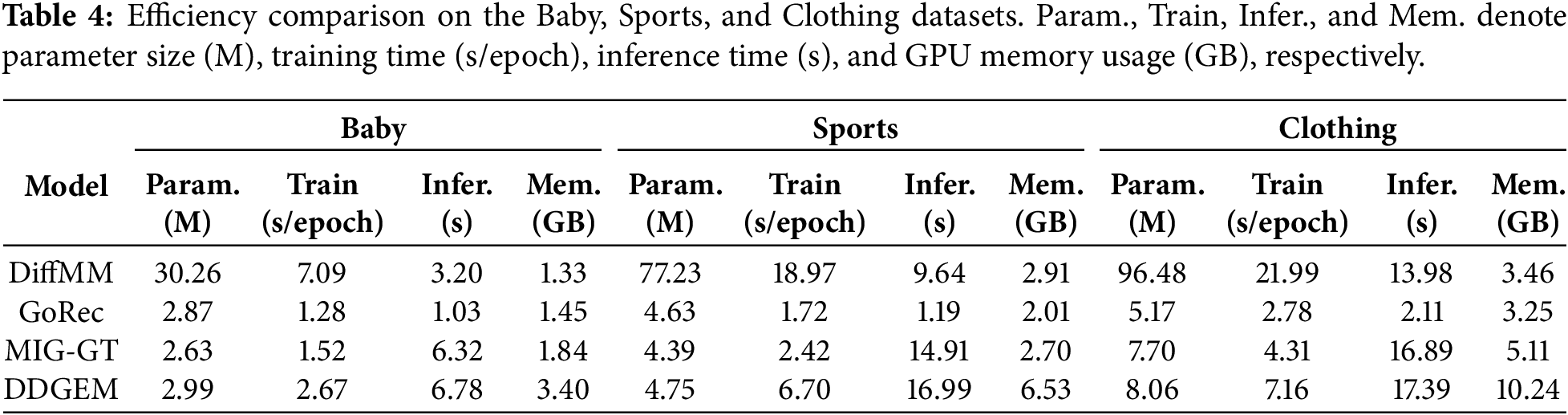
Table 4 reports the training time, inference time, GPU memory usage, and parameter size under the same hardware setting. DDGEM introduces extra memory and inference cost because it combines diffusion-based denoising with CVAE-based generation. However, its parameter size remains close to GoRec and MIG-GT and is much smaller than DiffMM. Its training time is also lower than DiffMM on all datasets. Overall, the main overhead of DDGEM comes from memory usage and inference, while its parameter scale and training cost remain within an acceptable range.
4.5 Graph Noise Robustness Analysis (RQ4)
To evaluate robustness to noisy collaborative graphs, we randomly remove user–item interactions from the training graph with noise ratios of 5%, 10%, 15%, and 20%. As shown in Fig. 7, both models degrade as the noise ratio increases. DDGEM consistently obtains higher Recall@20 and lower drop rates than MIG-GT on all datasets. This indicates that node-wise denoising and relation-level reconstruction help DDGEM reduce the effect of unreliable collaborative signals.
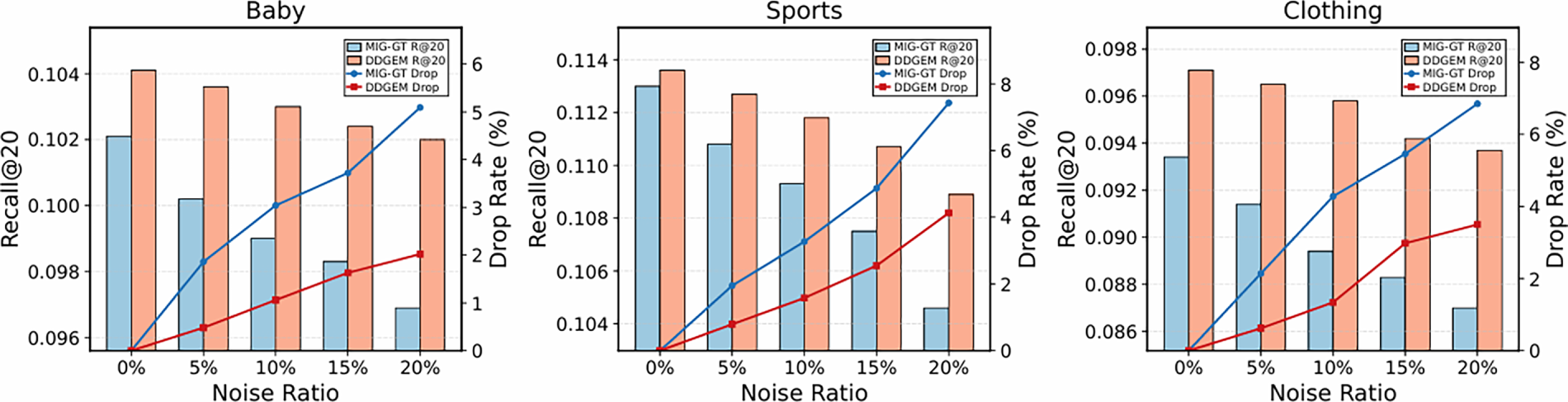
Figure 7: Model performance with respect to graph noise ratio. Bars denote Recall@20, and lines denote the percentage of performance degradation. R@20, Recall@20.
4.6 Strict Cold-Start Analysis (RQ5)
We further evaluate DDGEM under a strict item cold-start setting. In this setting, cold-start items are defined as test items with no user–item interactions in the training graph; only textual and visual features are available for these items. Fig. 8 reports Recall@20 and NDCG@20 on the three datasets. DDGEM consistently outperforms MIG-GT, with the largest margin on Sports, suggesting that it can provide more useful item representations when collaborative signals are unavailable. To further illustrate this effect, Fig. 9 visualizes warm-item and cold-item embeddings on Baby using t-distributed stochastic neighbor embedding (t-SNE). Compared with MIG-GT, DDGEM shows closer alignment between cold and warm items, indicating that the generated cold-start representations are better integrated into the latent space.
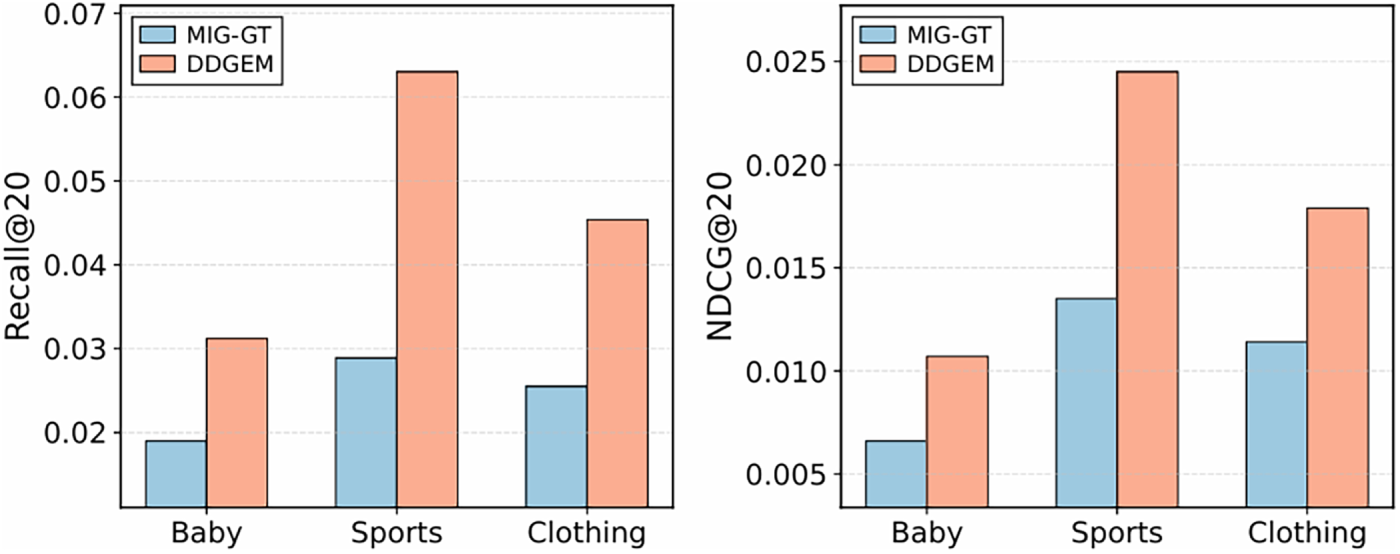
Figure 8: Performance under the strict item cold-start setting.
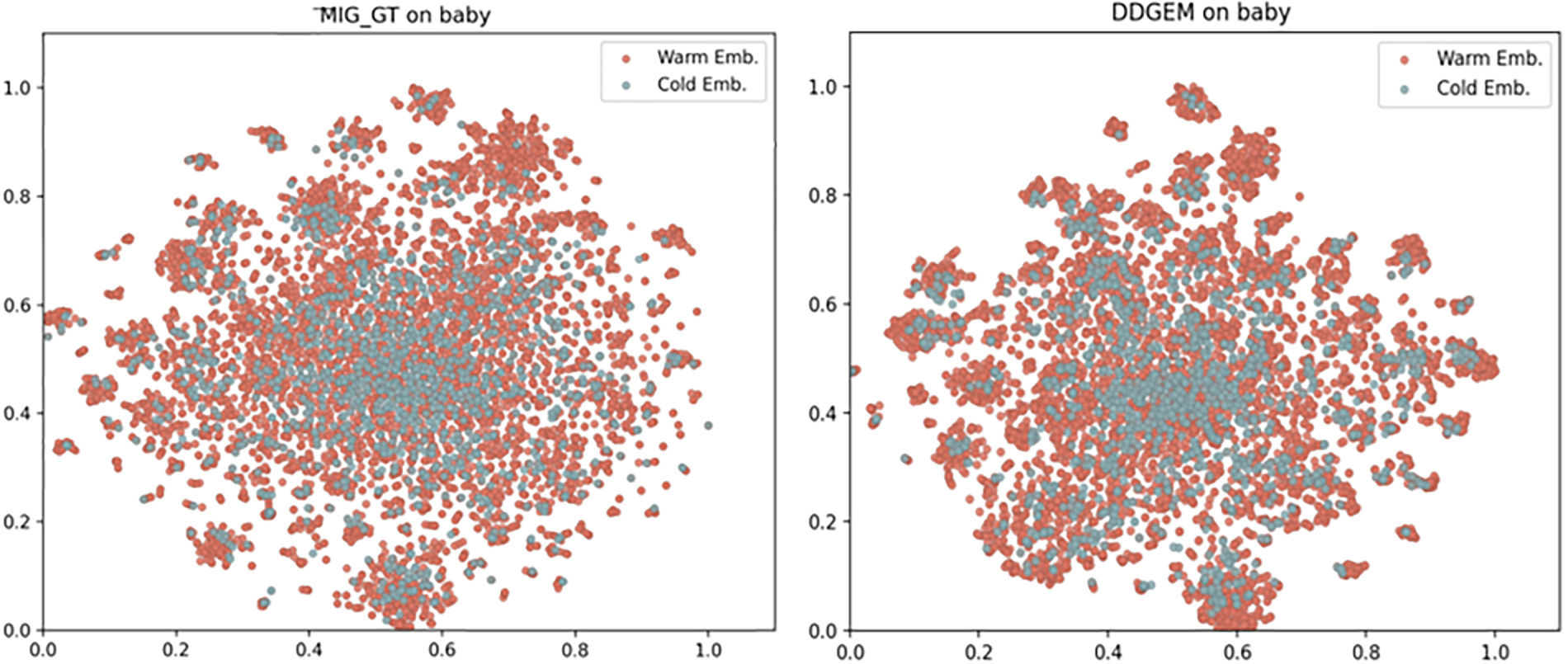
Figure 9: t-SNE visualization of warm-item and cold-item embeddings on Baby. Emb., embedding.
4.7 Modality Conflict Analysis (RQ6)
We further evaluate DDGEM under modality conflict settings. Here, Full denotes the original setting with matched textual and visual features; Text Conflict mismatches textual features across items while keeping visual features unchanged; and Image Conflict mismatches visual features across items while keeping textual features unchanged. As shown in Fig. 10, both models degrade under modality conflict, but DDGEM keeps higher Recall@20 and NDCG@20 than MIG-GT on all datasets. The drop is larger under text conflict, suggesting that textual inconsistency has a stronger effect on recommendation performance.
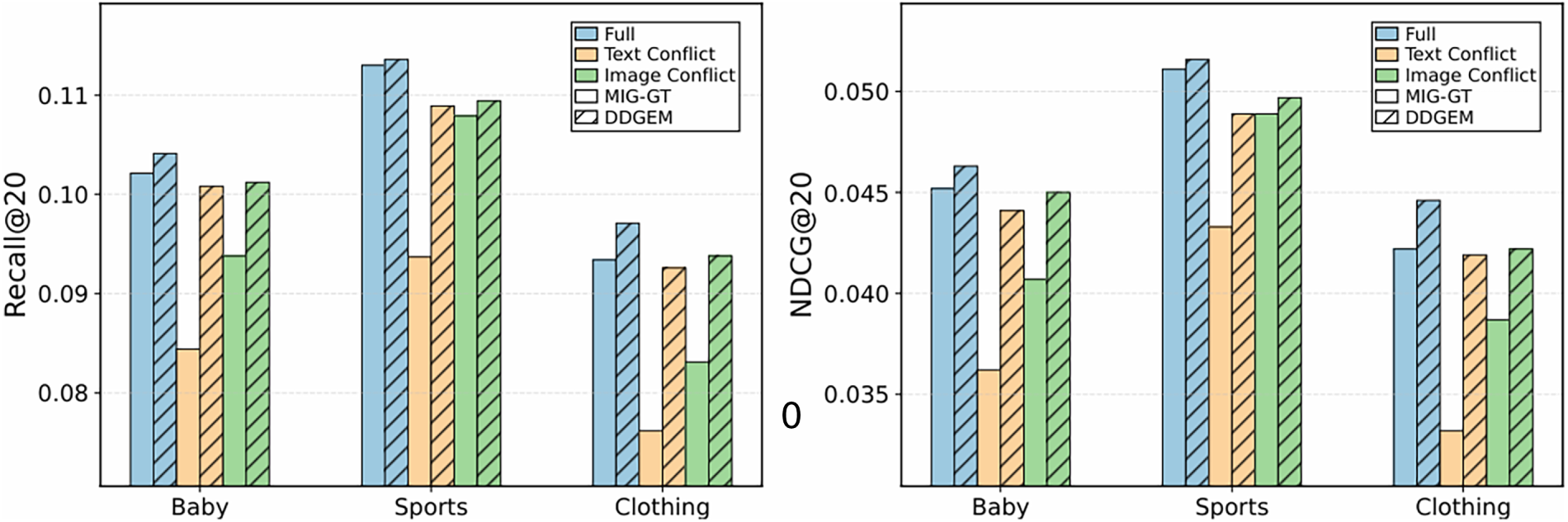
Figure 10: Performance under modality conflict settings.
4.8 Hyperparameter Sensitivity (RQ7)
We analyze the sensitivity of DDGEM to four key hyperparameters: diffusion_steps, cvae_weight,
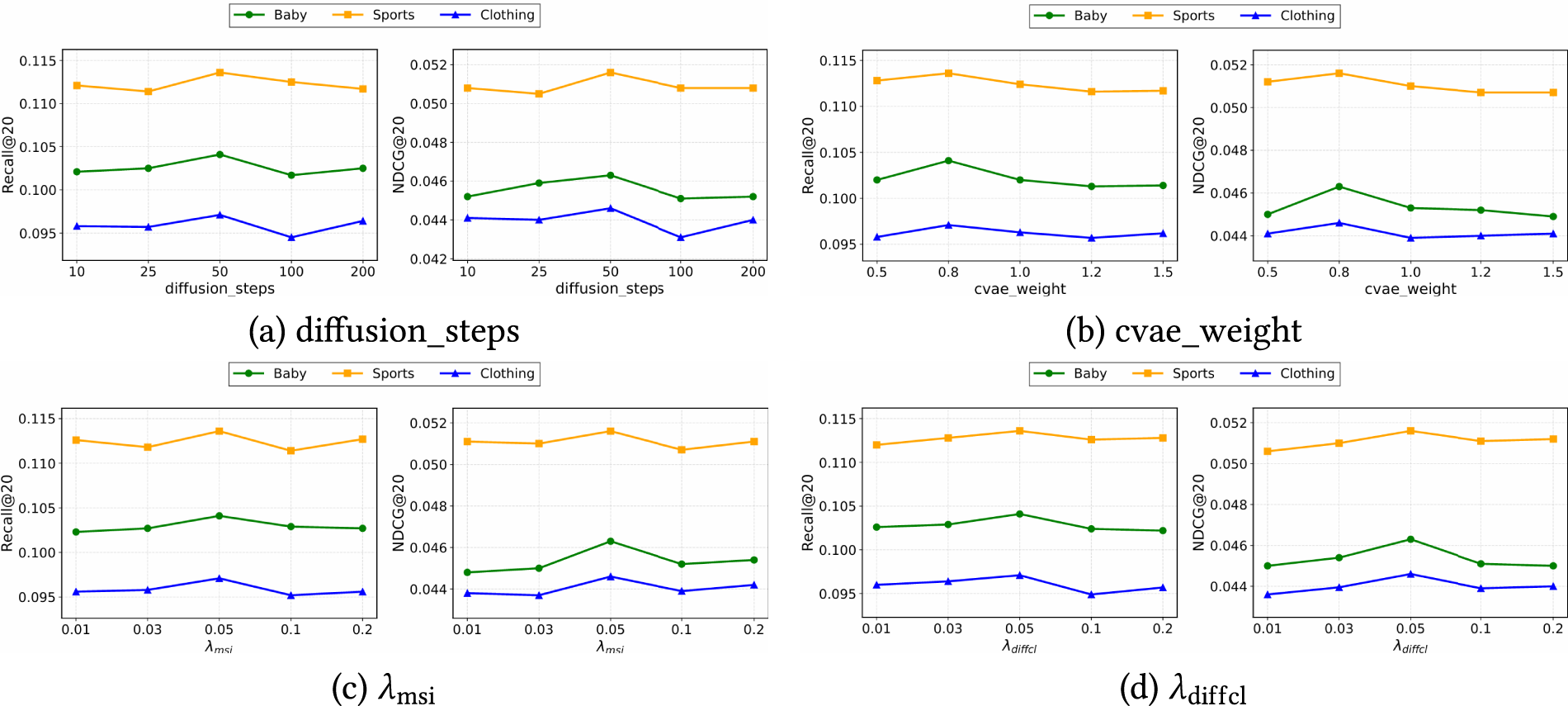
Figure 11: Hyperparameter sensitivity of DDGEM on the Baby, Sports, and Clothing datasets. (a) Performance with different numbers of diffusion steps; (b) performance with different CVAE weights; (c) performance with different values of
We proposed DDGEM, a diffusion denoising and generative enhancement framework for multimodal recommendation. DDGEM refines collaborative representations through node-wise diffusion, reconstructs adaptive item–item relations with relational diffusion, enhances sparse item representations through CVAE-based generation, and integrates multimodal signals with behavior-aware fusion. Experiments on three Amazon datasets show that DDGEM improves recommendation accuracy over representative baselines, with statistically reliable gains over MIG-GT. Further ablation, efficiency, graph-noise robustness, strict cold-start, modality-conflict, and hyperparameter analyses verify the contribution and practical behavior of the main designs.
Although DDGEM improves robustness and cold-start recommendation, it introduces additional memory and inference cost due to the diffusion and generative modules. Future work will focus on lighter denoising architectures, more efficient inference, evaluation on industrial-scale recommendation scenarios, and temporal preference modeling for dynamic recommendation.
Acknowledgement: The authors appreciate the support of the Youth Project of Humanities and Social Sciences of the Ministry of Education of China.
Funding Statement: This research was supported by the Youth Project of Humanities and Social Sciences of the Ministry of Education of China under Grant No. 25YJC860021.
Author Contributions: Conceptualization and methodology, Li Zhao and Weiwei Li; software, validation, data curation and visualization, Li Zhao, Chengshan Li and Wenjie Geng; writing—original draft preparation, Li Zhao; writing—review and editing, Li Zhao and Weiwei Li; supervision and project administration, Weiwei Li. All authors reviewed and approved the final version of the manuscript.
Availability of Data and Materials: The data that support the findings of this study are publicly available from the Amazon Review datasets cited in [43]. The data that support the findings of this study are available from the Corresponding Author upon reasonable request.
Ethics Approval: Not applicable.
Conflicts of Interest: The authors declare no conflicts of interest.
References
1. Goldberg D, Nichols D, Oki BM, Terry D. Using collaborative filtering to weave an information tapestry. Commun ACM. 1992;35(12):61–70. doi:10.1145/138859.138867. [Google Scholar] [CrossRef]
2. Koren Y, Bell R, Volinsky C. Matrix factorization techniques for recommender systems. Computer. 2009;42(8):30–7. doi:10.1109/MC.2009.263. [Google Scholar] [CrossRef]
3. Liu Q, Hu J, Xiao Y, Zhao X, Gao J, Wang W, et al. Multimodal recommender systems: a survey. ACM Comput Surv. 2024;57(2):1–17. doi:10.1145/3695461. [Google Scholar] [CrossRef]
4. Guo F, Wang Z, Wang X, Lu Q, Ji S. Dual-view multi-modal contrastive learning for graph-based recommender systems. Comput Electr Eng. 2024;116(1):109213. doi:10.1016/j.compeleceng.2024.109213. [Google Scholar] [CrossRef]
5. Mnih A, Salakhutdinov R. Probabilistic matrix factorization. Adv Neural Inf Process Syst. 2007;20:1257–64. [Google Scholar]
6. Cheng HT, Koc L, Harmsen J, Shaked T, Chandra T, Aradhye H, et al. Wide & deep learning for recommender systems. In: Proceedings of the 1st Workshop on Deep Learning for Recommender Systems; 2016 Sep 15; Boston, MA, USA. p. 7–10. doi:10.1145/2988450.2988454. [Google Scholar] [CrossRef]
7. Wang X, He X, Wang M, Feng F, Chua TS. Neural graph collaborative filtering. In: Proceedings of the 42nd International ACM SIGIR Conference on Research and Development in Information Retrieval; 2019 Jul 21–25; Paris, France. p. 165–74. doi:10.1145/3331184.3331267. [Google Scholar] [CrossRef]
8. Yu J, Xia X, Chen T, Cui L, Nguyen QVH, Yin H. XSimGCL: towards extremely simple graph contrastive learning for recommendation. IEEE Trans Knowl Data Eng. 2024;36(2):913–26. doi:10.1109/TKDE.2023.3288135. [Google Scholar] [CrossRef]
9. He R, McAuley J. VBPR: visual Bayesian personalized ranking from implicit feedback. Proc AAAI Conf Artif Intell. 2016;30(1):144–50. doi:10.1609/aaai.v30i1.9973. [Google Scholar] [CrossRef]
10. Wei Y, Wang X, Nie L, He X, Hong R, Chua TS. MMGCN: multi-modal graph convolution network for personalized recommendation of micro-video. In: Proceedings of the 27th ACM International Conference on Multimedia; 2019 Oct 21–25; Nice, France. p. 1437–45. doi:10.1145/3343031.3351034. [Google Scholar] [CrossRef]
11. Zhang J, Zhu Y, Liu Q, Wu S, Wang S, Wang L. Mining latent structures for multimedia recommendation. In: Proceedings of the 29th ACM International Conference on Multimedia; 2021 Oct 20–24; Chengdu, China. p. 3872–80. doi:10.1145/3474085.3475259. [Google Scholar] [CrossRef]
12. Tao Z, Wei Y, Wang X, He X, Huang X, Chua TS. MGAT: multimodal graph attention network for recommendation. Inf Process Manag. 2020;57(5):102277. doi:10.1016/j.ipm.2020.102277. [Google Scholar] [CrossRef]
13. Wei Y, Wang X, Li Q, Nie L, Li Y, Li X, et al. Contrastive learning for cold-start recommendation. In: Proceedings of the 29th ACM International Conference on Multimedia; 2021 Oct 20–24; Chengdu, China. p. 5382–90. doi:10.1145/3474085.3475665. [Google Scholar] [CrossRef]
14. Zhou X, Zhou H, Liu Y, Zeng Z, Miao C, Wang P, et al. Bootstrap latent representations for multi-modal recommendation. arXiv:2207.05969. 2023. doi:10.1145/3543507.3583251. [Google Scholar] [CrossRef]
15. Rendle S, Freudenthaler C, Gantner Z, Schmidt-Thieme L. BPR: Bayesian personalized ranking from implicit feedback. arXiv:1205.2618. 2012. [Google Scholar]
16. Aljunid MF, Manjaiah DH, Hooshmand MK, Ali WA, Shetty AM, Alzoubah SQ. A collaborative filtering recommender systems: survey. Neurocomputing. 2025;617(12):128718. doi:10.1016/j.neucom.2024.128718. [Google Scholar] [CrossRef]
17. Wu G, Zha Z, Tu L, Tao H, Song F. Research advances in graph neural network recommendation. CAAI Trans Intell Syst. 2020;15(1):14–24. (In Chinese). doi:10.11992/tis.201908034. [Google Scholar] [CrossRef]
18. He X, Deng K, Wang X, Li Y, Zhang Y, Wang M. LightGCN: simplifying and powering graph convolution network for recommendation. In: Proceedings of the 43rd International ACM SIGIR Conference on Research and Development in Information Retrieval; 2020 Jul 25–30; Xi’an, China. p. 639–48. doi:10.1145/3397271.3401063. [Google Scholar] [CrossRef]
19. Chen J, Zhou J, Ma L. GNNCL: a graph neural network recommendation model based on contrastive learning. Neural Process Lett. 2024;56(2):45. doi:10.1007/s11063-024-11545-9. [Google Scholar] [CrossRef]
20. Zhang Y, Yu J, Liu Z, Wang G, Nguyen M, Sheng QZ, et al. Improving graph collaborative filtering with network motifs. Neural Comput Appl. 2025;37(16):9413–32. doi:10.1007/s00521-025-11079-8. [Google Scholar] [CrossRef]
21. Liu J, Wang P, Sun G. Multi-modal recommendation algorithm based on graph structure learning. IAENG Int J Comput Sci. 2025;52(10):3862–9. [Google Scholar]
22. Dang Y, Pan Z, Zhang X, Chen W, Cai F, Chen H. Discrepancy learning guided hierarchical fusion network for multi-modal recommendation. Knowl Based Syst. 2025;317(1):113496. doi:10.1016/j.knosys.2025.113496. [Google Scholar] [CrossRef]
23. Zhou X, Shen Z. A tale of two graphs: freezing and denoising graph structures for multimodal recommendation. In: Proceedings of the 31st ACM International Conference on Multimedia; 2023 Jan 8–10; Nara, Japan. p. 935–43. doi:10.1145/3581783.3611943. [Google Scholar] [CrossRef]
24. Xv G, Li X, Xie R, Lin C, Liu C, Xia F, et al. Improving multi-modal recommender systems by denoising and aligning multi-modal content and user feedback. In: Proceedings of the 30th ACM SIGKDD Conference on Knowledge Discovery and Data Mining; 2024 Aug 25–29; Barcelona, Spain. p. 3645–56. doi:10.1145/3637528.3671703. [Google Scholar] [CrossRef]
25. Yu Y, Zhang C, Cong S, Yue X, Shen Y, Zhao J. AM2HRec: dual-representation adaptive noise reduction for multi-modal recommendation. Eng Lett. 2025;33(2):382–93. [Google Scholar]
26. Volkovs M, Yu G, Poutanen T. DropoutNet: addressing cold start in recommender systems. Adv Neural Inf Process Syst. 2017;30:4957–66. [Google Scholar]
27. Liang S, Pan Z, Liu W, Yin J, de Rijke M. A survey on variational autoencoders in recommender systems. ACM Comput Surv. 2024;56(10):1–40. doi:10.1145/3663364. [Google Scholar] [CrossRef]
28. Li X, She J. Collaborative variational autoencoder for recommender systems. In: Proceedings of the 23rd ACM SIGKDD International Conference on Knowledge Discovery and Data Mini; 2017 Aug 13–17; Halifax, NS, Canada. p. 305–14. doi:10.1145/3097983.3098077. [Google Scholar] [CrossRef]
29. Walker J, Zhang F, Zhong T, Zhou F, Baagyere EY. Variational cold-start resistant recommendation. Inf Sci. 2022;605:267–85. doi:10.1016/j.ins.2022.05.025. [Google Scholar] [CrossRef]
30. Ren J, Zhang R. When alignment makes a difference: a content-based variational model for cold-start CTR prediction. Adv Data Min Appl Lect Notes Comput Sci. 2023;14176(4):724–39. doi:10.1007/978-3-031-46661-8_48. [Google Scholar] [CrossRef]
31. Xu X, Yang C, Yu Q, Fang Z, Wang J, Fan C, et al. Alleviating cold-start problem in CTR prediction with a variational embedding learning framework. In: Proceedings of the ACM Web Conference 2022; 2022 Apr 25–29; Virtual. p. 27–35. doi:10.1145/3485447.3512048. [Google Scholar] [CrossRef]
32. Bai H, Hou M, Wu L, Yang Y, Zhang K, Hong R, et al. GoRec: a generative cold-start recommendation framework. In: Proceedings of the 31st ACM International Conference on Multimedia; 2023 Oct 29–Nov 3; Ottawa, ON, Canada. p. 1004–12. doi:10.1145/3581783.3612238. [Google Scholar] [CrossRef]
33. Jiang Y, Yang Y, Xia L, Huang C. DiffKG: knowledge graph diffusion model for recommendation. In: Proceedings of the 17th ACM International Conference on Web Search and Data Mining; 2024 Mar 4–8; Yucatán, Mexico. p. 313–21. doi:10.1145/3616855.3635850. [Google Scholar] [CrossRef]
34. Wang W, Xu Y, Feng F, Lin X, He X, Chua TS. Diffusion recommender model. In: Proceedings of the 46th International ACM SIGIR Conference on Research and Development in Information Retrieval; 2023 Jul 23–27; Taipei, Taiwan. p. 832–41. doi:10.1145/3539618.3591663. [Google Scholar] [CrossRef]
35. Du H, Yuan H, Huang Z, Zhao P, Zhou X. Sequential recommendation with diffusion models. arXiv:2304.04541. 2023. [Google Scholar]
36. Ma H, Xie R, Meng L, Chen X, Zhang X, Lin L, et al. Plug-in diffusion model for sequential recommendation. Proc AAAI Conf Artif Intell. 2024;38(8):8886–94. doi:10.1609/aaai.v38i8.28736. [Google Scholar] [CrossRef]
37. Ma H, Xie R, Meng L, Yang Y, Sun X, Kang Z. SeeDRec: sememe-based diffusion for sequential recommendation. In: Proceedings of the Thirty-Third International Joint Conference on Artificial Intelligence; 2024 Aug 3–9; Jeju, Republic of Korea. p. 2270–8. doi:10.24963/ijcai.2024/251. [Google Scholar] [CrossRef]
38. Lee G, Zhu Y, Yu H, Zhou Y, Li J. Collaborative diffusion model for recommender system. In: Companion Proceedings of the ACM on Web Conference 2025; 2025 Apr 28–May 2; Sydney, Australia. p. 1091–5. doi:10.1145/3701716.3715516. [Google Scholar] [CrossRef]
39. Jiang Y, Xia L, Wei W, Luo D, Lin K, Huang C. DiffMM: multi-modal diffusion model for recommendation. In: Proceedings of the 32nd ACM International Conference on Multimedia; 2024 Oct 28–Nov 1; Melbourne, Australia. p. 7591–9. doi:10.1145/3664647.3681498. [Google Scholar] [CrossRef]
40. Islam K, Zaheer MZ, Mahmood A, Nandakumar K, Akhtar N. GenMix: effective data augmentation with generative diffusion model image editing. Expert Syst Appl. 2026;322(2):132273. doi:10.1016/j.eswa.2026.132273. [Google Scholar] [CrossRef]
41. Islam K, Zaheer MZ, Mahmood A, Nandakumar K. DiffuseMix: label-preserving data augmentation with diffusion models. In: Proceedings of the 2024 IEEE/CVF Conference on Computer Vision and Pattern Recognition (CVPR); 2024 Jun 16–22; Seattle, WA, USA. p. 27611–20. doi:10.1109/CVPR52733.2024.02608. [Google Scholar] [CrossRef]
42. Kong Y, Chen X, Jiang Y, Sun D, Zhang J. Novel discretized zeroing neural network models for time-varying optimization aided with predictor-corrector methods. IEEE Trans Neural Netw Learn Syst. 2025;36(8):14037–48. doi:10.1109/TNNLS.2024.3512505. [Google Scholar] [CrossRef]
43. He R, McAuley J. Ups and downs: modeling the visual evolution of fashion trends with one-class collaborative filtering. In: Proceedings of the 25th International Conference on World Wide Web; 2016 Apr 11–15; Montreal, QC, Canada. p. 507–17. doi:10.1145/2872427.2883037. [Google Scholar] [CrossRef]
44. Hu J, Hooi B, He B, Wei Y. Modality-independent graph neural networks with global transformers for multimodal recommendation. Proc AAAI Conf Artif Intell. 2025;39(11):11790–8. doi:10.1609/aaai.v39i11.33283. [Google Scholar] [CrossRef]
45. Wang C, Yu Y, Ma W, Zhang M, Chen C, Liu Y, et al. Towards representation alignment and uniformity in collaborative filtering. In: Proceedings of the 28th ACM SIGKDD Conference on Knowledge Discovery and Data Mining; 2022 Aug 14–18; Washington, DC, USA. p. 1816–25. doi:10.1145/3534678.3539253. [Google Scholar] [CrossRef]
46. Chen H, Wang Z, Huang F, Huang X, Xu Y, Lin Y, et al. Generative adversarial framework for cold-start item recommendation. In: Proceedings of the 45th International ACM SIGIR Conference on Research and Development in Information Retrieval; 2022 Jul 11–15; Madrid, Spain. p. 2565–71. doi:10.1145/3477495.3531897. [Google Scholar] [CrossRef]
47. Zhou X, Miao C. Disentangled graph variational auto-encoder for multimodal recommendation with interpretability. IEEE Trans Multimed. 2024;26:7543–54. doi:10.1109/TMM.2024.3369875. [Google Scholar] [CrossRef]
Cite This Article
 Copyright © 2026 The Author(s). Published by Tech Science Press.
This work is licensed under a Creative Commons Attribution 4.0 International License , which permits unrestricted use, distribution, and reproduction in any medium, provided the original work is properly cited.
 Downloads
 Citation Tools
