
 Login
Login Register
 Submit a Paper
 Propose a Special lssue
 Open Access
ARTICLE
FedE: Protecting Training Data of Federated Learning Based on Multi-Precision Functional Encryption
1 Intelligent and Digital Operation Center, Guizhou Power Grid Co., Ltd., Guiyang, China
2 Guizhou Power Trading Center, Guiyang, China
3 State Key Laboratory of Public Big Data, College of Computer Science and Technology, Guizhou University, Guiyang, China
* Corresponding Author: Zhenyong Zhang. Email:
Computers, Materials & Continua 2026, 89(2), 30 https://doi.org/10.32604/cmc.2026.086022
Received 22 May 2026; Accepted 27 July 2026; Issue published 15 September 2026
 View Full Text
 Download PDF
Abstract
With the rapid development of artificial intelligence technologies in machine learning-as-a-service (MLaaS), deep learning-based intelligent models have demonstrated high value in applications such as trend prediction and risk assessment. However, MLaaS data are typically highly sensitive and contain private information. In cross-institutional collaborative modeling scenarios, different departments and local centers often hold partial, heterogeneous data resources on MLaaS platforms. Given data security, privacy, and compliance requirements, raw data are difficult to share directly, which makes it challenging to apply centralized model training methods. This paper proposes FedE, a multi-precision, multi-source, heterogeneous privacy-preserving federated learning training method based on functional encryption. By introducing a multi-precision joint-computation mechanism, this method enhances numerical adaptation during ciphertext computation. Besides, combined with differential privacy techniques, it prevents model parameter updates from easily compromising privacy in cross-institutional federated learning. Based on the federated learning training process, a secure training framework for sensitive MLaaS data is constructed. Finally, experiments demonstrate the security and efficiency of the proposed approach.Keywords
With the rapid development of information technology, big data and artificial intelligence technologies are continuously merging and integrating [1,2], and the application of deep learning in the machine learning-as-a-service (MLaaS) field is constantly expanding, showcasing broad prospects in areas such as assisted image analysis, infrastructure surveillance, disease diagnosis, and load forecasting [3]. Leveraging its strong ability to extract features and recognize patterns, deep learning can uncover hidden patterns from complex MLaaS data.
As deep learning applications in MLaaS continue to deepen, issues surrounding data privacy and security are becoming increasingly prominent [4]. MLaaS data is typically stored in a fragmented manner across different departments, regional centers, and management platforms. It contains vast amounts of sensitive information, including identification details, personal records, and imaging data, characterized by high levels of privacy and stringent compliance requirements. In the centralized training model, obtaining high-quality models often requires aggregating and processing multi-source MLaaS data in a unified manner. However, this approach can easily lead to risks such as data breaches, unauthorized access, and misuse. It also struggles to meet the real-world demands for privacy protection and data security [5]. Especially in cross-institutional collaborative modeling scenarios, although various stakeholders possess data resources that offer complementary value, they are often constrained by privacy protections and legal and regulatory restrictions, making it difficult to share raw data directly. Consequently, how to jointly train multi-source MLaaS data while ensuring that the data remains “available but invisible” has become a critical issue that urgently needs to be addressed.
To address these challenges, functional encryption [6] offers a viable technical pathway for privacy-preserving machine learning. This technology allows computing parties to obtain only the computed results of specified functions without directly accessing the original plaintext data. Compared with technologies such as homomorphic encryption, functional encryption is well-suited to handling linear transformations, parameter aggregation, and vector operations during neural network training, making it particularly suitable for secure training tasks in multi-client scenarios. Based on this, the paper focuses on privacy protection needs in federated learning model training, emphasizing the application of inner-product functional encryption for secure training with heterogeneous, multi-source data.
Directly applying inner-product functional encryption to federated learning training still faces several challenges. On the one hand, traditional inner-product functional encryption is primarily suited for integer-domain computations, whereas federated learning model training often involves floating-point numbers, negative values, and different precision parameter representations. This makes it difficult to directly adapt encryption mechanisms to the training tasks [7]. On the other hand, in multi-client collaborative environments, the data sources, feature structures, and numerical precisions of different clients often differ significantly, leading to inconsistencies in representation, precision loss, and excessive computational overhead during unified encrypted computations. Meanwhile, in federated learning scenarios, even when clients do not directly upload raw data, local model parameters, gradient updates, and aggregated results may still reveal sensitive information over multiple rounds of interaction, posing security threats such as membership inference and gradient inversion [8]. Therefore, balancing the adaptability of ciphertext computation, aggregation efficiency, and the strength of privacy protection remains a critical issue that urgently needs to be addressed in current research.
To address the above issues, this paper utilizes inner-product functional encryption to develop a secure federated learning method (i.e., FedE) for multi-precision, multi-source, heterogeneous privacy protection. During training, the proposed approach introduces a unified representation of encoding precision and a multi-precision inner-product encryption mechanism, thereby enhancing numerical adaptability across different data types and parameter representations in ciphertext form. Besides, by incorporating differential privacy principles, the model weights obtained through local client training are perturbed to provide protection. This creates a complete privacy-preserving training pipeline that covers local training, parameter protection, and ciphertext aggregation toward global model updates. This study not only ensures effective model training but also further meets the data security requirements and system implementation needs in multi-client collaborative scenarios. Specifically, the multi-precision joint computation mechanism enhances the numerical representation support provided by functional encryption, improving its applicability in heterogeneous multi-source environments. Furthermore, the coordinated design of differential privacy and functional encryption effectively reduces the risk of model parameter leakage during federated training. Experimental validation across multiple public datasets demonstrates that the proposed method achieves strong model training performance and computational efficiency while maintaining privacy protection.
With the widespread application of MLaaS in medical diagnosis, risk prediction, and decision support, efficiently training models while ensuring data privacy and security has become a critical research issue in privacy-preserving machine learning.
Homomorphic encryption (HE), an important cryptographic technique in privacy computing, enables computation parties to perform addition, multiplication, and other operations on ciphertexts without decrypting the original data. The decrypted result is identical to the result obtained by performing the same operations on the plaintext. This feature enables privacy-preserving computations while safeguarding data confidentiality, and has therefore been widely adopted in scenarios such as privacy-preserving machine learning, data aggregation, and secure collaborative computing [9,10]. Lee et al. [11] implemented ciphertext training and inference for the standard ResNet-20 model on the CIFAR-10 dataset based on the RNS-CKKS (Residue Number System variant of the Cheon-Kim-Kim-Song) fully homomorphic encryption scheme, and employed MINIMAX polynomial approximation for nonlinear activation functions, effectively mitigating precision loss in ciphertext computations. However, this scheme still faces limitations, including high computational overhead and significant system latency. Park et al. [12] proposed a lightweight homomorphic encryption training protocol for support vector machines; by redefining the objective function and introducing approximate methods, they significantly reduced both computational and communication overhead while ensuring data and model privacy. Nevertheless, this approach is primarily suited for classical machine learning models and lacks sufficient support for complex deep learning tasks. Carpov et al. [13] designed a decentralized privacy-preserving logistic regression scheme that leverages the CKKS encryption scheme for multi-party collaborative training, and improved system feasibility and scalability through graph-based computation optimization and batch processing techniques. In particular, in scenarios involving sensitive high-dimensional data, Castro et al. [14] introduced an efficient PPFL-HE method that effectively balances privacy, efficiency, and model utility.
Differential privacy (DP) is a privacy protection framework grounded in rigorous mathematical definitions. By introducing random noise into raw data, model parameters, or statistical results, DP ensures that even if an attacker obtains the system’s output, they cannot determine whether a specific individual participated in the training dataset. As a result, differential privacy has garnered widespread attention in multi-client collaborative training scenarios [15,16]. Lian et al. [17] proposed a scheme that achieves synergistic improvements in both communication efficiency and privacy protection by applying local differential privacy perturbations to selected parameters while reducing the overhead associated with client-side data uploads. Hu et al. [18] introduced the Fed-SMP scheme, which sparsifies local model updates and then adds Gaussian noise to mitigate the adverse impact of client-level differential privacy mechanisms on model accuracy. Wei et al. [19] further developed the DP-PFL framework for personalized federated learning, analyzing the relationship between privacy protection strength and model convergence performance by allocating privacy budgets across a two-tiered update process.
Functional encryption (FE) is an important extension of traditional public-key cryptographic systems. Its core idea is to enable authorized users to obtain only the computed results of a specific function on plaintext data, without decrypting the original data, thereby preventing them from learning any other information about it. Consequently, it has significant application value in privacy-preserving computation and constrained data-sharing scenarios [20,21]. In multi-client collaborative training environments, functional encryption enables computation of specific functions while avoiding direct exposure of raw samples, providing crucial cryptographic support for multi-party joint modeling. Qian et al. [22] proposed CryptoFE, a privacy-preserving federated learning scheme based on functional encryption. This scheme demonstrates good computational efficiency in high-precision model parameter aggregation scenarios while also offering formal guarantees for user gradient privacy; however, its adaptability to complex deep learning training tasks in multi-source, heterogeneous data environments still requires further improvement. Chang et al. [23] introduced a privacy-preserving federated learning framework based on dual-mode decentralized multi-client functional encryption (2DMCFE), which enhanced the security of functional encryption-based federated learning by identifying the risk of hybrid matching attacks in existing multi-input functional encryption (MIFE) schemes and by hiding intermediate models. However, this approach necessitates establishing new encryption instances for different user subsets, making system implementation relatively complex. Zhang et al. [24] proposed PIM-MCFE, a lattice-based functional encryption scheme, and extended it to privacy-preserving federated learning, offering advantages in protecting intermediate aggregated results and resisting quantum attacks. Yu et al. [25] introduced PrivLDFL, a lightweight, dynamic, privacy-preserving federated learning framework that enables dynamic participation and outage tolerance through decentralized multi-client functional encryption, vector compression funnels, and client partitioning strategies.
The method proposed in this paper is primarily based on inner-product functional encryption and federated learning. Below, we will introduce the relevant concepts and fundamental knowledge.
3.1 Single-Input Functional Encryption
The description of the Single-Input Functional Encryption (SIFE) scheme is given in Eq. (1), where
Specifically, SIFE comprises four polynomial algorithms:
•
•
•
•
3.2 Multi-Input Functional Encryption
Multi-Input Functional Encryption (MIFE) is an extension of SIFE that operates in a computational setting with multiple input vectors. Its description is given in Eq. (2), where, for
Specifically, Multi-Input Functional Encryption primarily comprises five polynomial algorithms:
•
•
•
•
•
3.3 Detailed Specification of the Differential Privacy Component
Privacy Mechanism and Noise Distribution. We will formally define the Gaussian mechanism as follows:
Definition 1. Let
In FedE, each client applies this mechanism to its local weight vector
Sensitivity. We will define the
Definition 2. For a function
Privacy Budget and
Theorem 1. Let
This follows directly from the standard Gaussian mechanism theorem. In our implementation, we set
Federated learning is a distributed machine learning paradigm designed to address the challenges of data privacy and security. In a federated learning system, participating nodes follow a predefined collaborative process: they use their local data to train local models and then submit the updated parameters to a central aggregator for integration. The process can be broken down into the following four steps:
(1) Model Initialization: The central aggregator first initializes the model parameters and then distributes these initialized model parameters to the clients participating in federated learning.
(2) Local Training: Each client uses its own local dataset to perform localized training on the global model parameters issued by the central aggregator.
(3) Model Parameter Aggregation: After several rounds of local training, each client uploads its respective model parameters to the central aggregator. Once the aggregator receives parameter updates from all participants, it performs weighted aggregation using a predefined algorithm and optimizes the global model parameters based on the aggregated results. Subsequently, the aggregator redistributes the updated global model parameters to all clients, initiating a new round of collaborative training.
(4) Iterative Optimization: After the global model parameters are distributed to the clients, steps (2) and (3) are repeated until the global model converges.
4 FedE: Privacy-Preserving Federated Learning With a Collaboration Framework
In the collaborative training process of cross-regional, multi-source federated learning, the local data held by each participating party constitutes their core assets and sensitive privacy information. To address privacy risks encountered during joint training, this paper designs and implements a privacy-protectionmework (i.e., FedE) tailored for cross-regional, multi-source federated learning.
4.1 Privacy-Preservation Collaborative Framework
This section describes the multi-precision, multi-source, heterogeneous federated learning collaboration training architecture. FedE involves three entities: clients, a central server, and a key generation authority (KGA).
Key Generation Authority (KGA): The KGA is a trusted third-party entity that can be regarded as an authoritative key distribution center or any other credible entity. The KGA’s primary task is to generate system-wide public parameters and distribute all keys. Specifically, the KGA generates the master public key
Clients: Clients train models based on their local private datasets and generate initial model parameters. To prevent private information from being leaked during subsequent transmission and aggregation processes, clients first add differential privacy noise to the model parameters obtained from local training. By introducing rigorously defined mathematical perturbations, they ensure that the contribution of individual data points cannot be accurately inferred, thereby providing theoretically provable privacy protection. Subsequently, the data protection encryption (DPE) method is employed to perform structured decomposition and encryption on the noisy parameters, ultimately uploading the resulting ciphertext-formatted parameters to the central server. The server performs aggregation operations on the ciphertexts, completing the update of the global model without decrypting each client’s parameters.
Central Server: During the initialization phase of collaborative learning, the central server presets global model parameters and is responsible for coordinating model updates and system scheduling throughout the entire federated learning process. Specifically, after receiving encrypted weight parameters uploaded by clients, the central server requests functional decryption keys from the KGA, enabling it to perform secure inner-product computations on ciphertexts and thus obtain aggregated results for the encrypted model weights. Once these aggregated results are verified through decryption, they are distributed as new global model parameters to all participating clients for the next round of local training.
The DPE is described as follows. FedE uses
• Data Processing: On client k, the Euclidean division method is employed to perform precision decomposition on each data point
• Data Encryption: During the data encryption phase, the client first submits an encryption key request to the KGA. After identity verification, it obtains the corresponding functional encryption key. Subsequently, the system employs a hierarchical encryption mechanism to encrypt the weights obtained through Euclidean precision decomposition. The t-weight sub-datasets
We assume that the central server is an honest yet curious entity, ensuring its behavior adheres to the protocol specifications and does not actively deviate or engage in malicious tampering. It may attempt to infer the private data of other participants by collecting and analyzing information exchanged during protocol execution (such as ciphertexts, intermediate computation results, or other metadata). To ensure the security and functional correctness of the cryptographic system, the KGA is introduced as the system’s core trust authority. The KGA is responsible for generating system parameters, producing public and private keys, and securely distributing them. Moreover, it serves as a completely trusted third party. This institution does not participate in the actual computation or transmission of data, but the key materials it generates provide the cryptographic foundation for the entire privacy-preserving computation. The KGA’s complete trustworthiness means it will not disclose any key information nor collude with either the server or clients. This hypothesis aligns with the trust models used in most inner-product cryptography and advanced cryptographic protocols. Based on the above, consider the following threat model:
• Honest Yet Curious Central Server: The central server strictly adheres to the Federated Learning protocol specifications and is capable of honestly and correctly performing aggregation operations on the encrypted model weights collected from each client, ensuring computational integrity and result accuracy throughout the aggregation process, and reliably distributing the resulting global aggregated results to the participating parties. However, while its behavior complies with protocol requirements and does not actively deviate from established procedures or introduce malicious actions, it does record and store all weight parameters uploaded by clients (or their encrypted forms), and may, based on historical interaction data, attempt to conduct inference and analysis in order to deduce private information contained within a specific client’s local training data.
• Malicious Attacker: A malicious attacker possesses the ability to eavesdrop on various communication channels and may also launch attacks against the server to steal sensitive data.
4.3 Inner-Product Functional Encryption Method Based on Multi-Precision Bit Decomposition
To address the high decryption overhead of inner-product functional encryption, this paper proposes a scheme that leverages multi-precision bit decomposition.
4.3.1 Double-Precision Bit Decomposition Inner Product Functional Encryption
Definition 3. (Vector Euclidean Division) Let
According to Definition 3, the vector
Definition 4. (Double-Tuple Ciphertext Based on Euclidean Division) Let
Lemma 1. (Double-Precision Inner Product Functional Encryption) Let
Proof: It is clear that
Thus, we obtain
4.3.2 Multi-Precision Bit Decomposition Inner Product Functional Encryption
Definition 5. (T-Tuple Ciphertext Based on Euclidean Division) Let
Lemma 2. (Multi-precision Inner Product Functional Encryption) – Let
Proof: It is clear that
Therefore, by similar reasoning, we can derive
4.4.1 Local Privacy Enhancement Training Based on Differential Privacy
First, the system is initialized as shown in Algorithm 1, where a cryptographic system is constructed via a key-generation mechanism. Algorithms
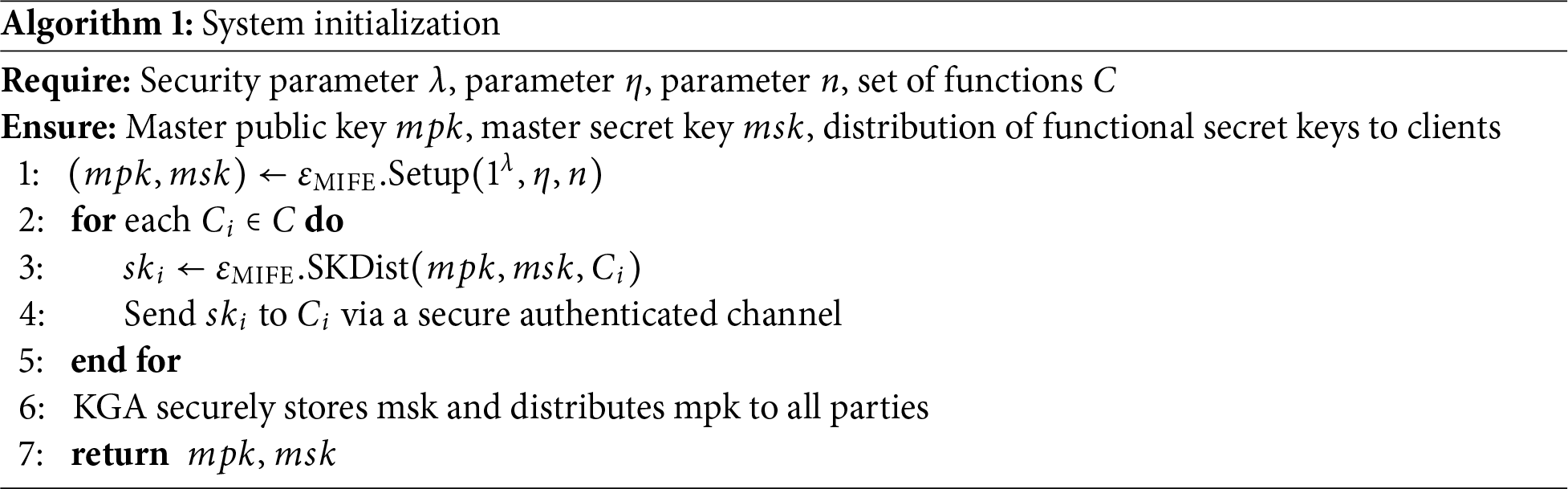
Before performing local model parameter encryption and uploading them to the central server for subsequent secure aggregation, client
After completing the perturbation, the client sets the appropriate type-identification parameters based on the data type and performs unified-precision encoding of the noisy model weights, thereby mapping parameters in different precision formats into a unified numerical space. Following the parameter decomposition method, multiple-precision parameters
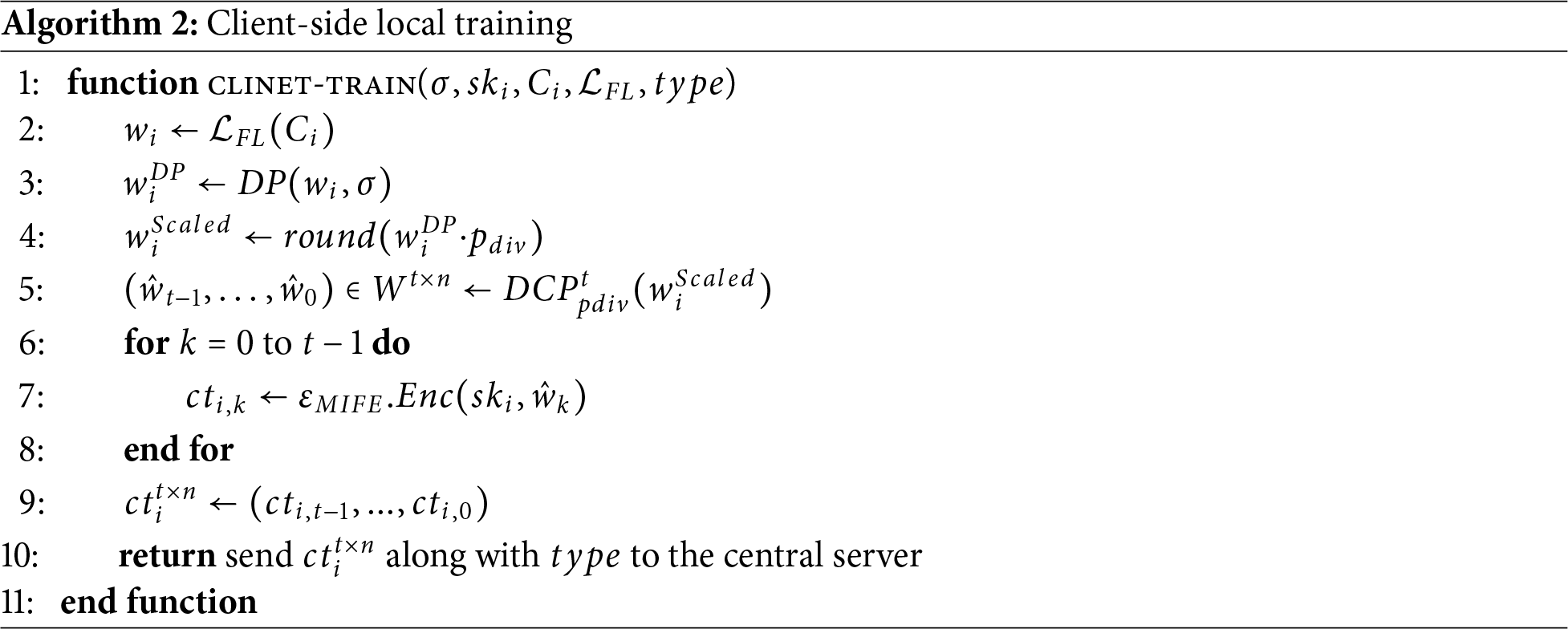
Inner-product encryption algorithms typically support only operations over finite integer domains; however, in practice, sample data and model parameters often contain both negative numbers and floating-point values. This makes it difficult to deploy this encryption scheme directly. To address the aforementioned issue, this chapter extends the application scenarios of inner-product encryption in vector computation by employing a generator inversion strategy, thereby enabling support for vector operations that include negative elements. To address the challenges posed by floating-point numbers, this chapter performs pre-processing by scaling the data and rounding it down, as follows:
In this process, the scaling factor
The DP and FE mechanisms serve complementary roles in our framework. FE provides cryptographic confidentiality: even with full access to ciphertexts and functional decryption keys, the server cannot recover individual client parameters beyond the prescribed inner product. However, FE does not prevent inference attacks that exploit statistical patterns in the aggregated results (e.g., membership inference or property inference). DP addresses this gap by adding calibrated noise to each client’s local update, which mathematically bounds the influence of any single training sample on the final aggregated output. The two protections compose additively: FE protects against direct parameter reconstruction, while DP protects against statistical inference. Even if the server were to bypass the FE (e.g., via KGA compromise), DP would still provide a statistical privacy guarantee (though weakened by the lack of FE). In our threat model, both defences are active simultaneously, providing layered security.
4.4.2 Secure Aggregation Based on Multi-Precision Inner-Product Functional Encryption
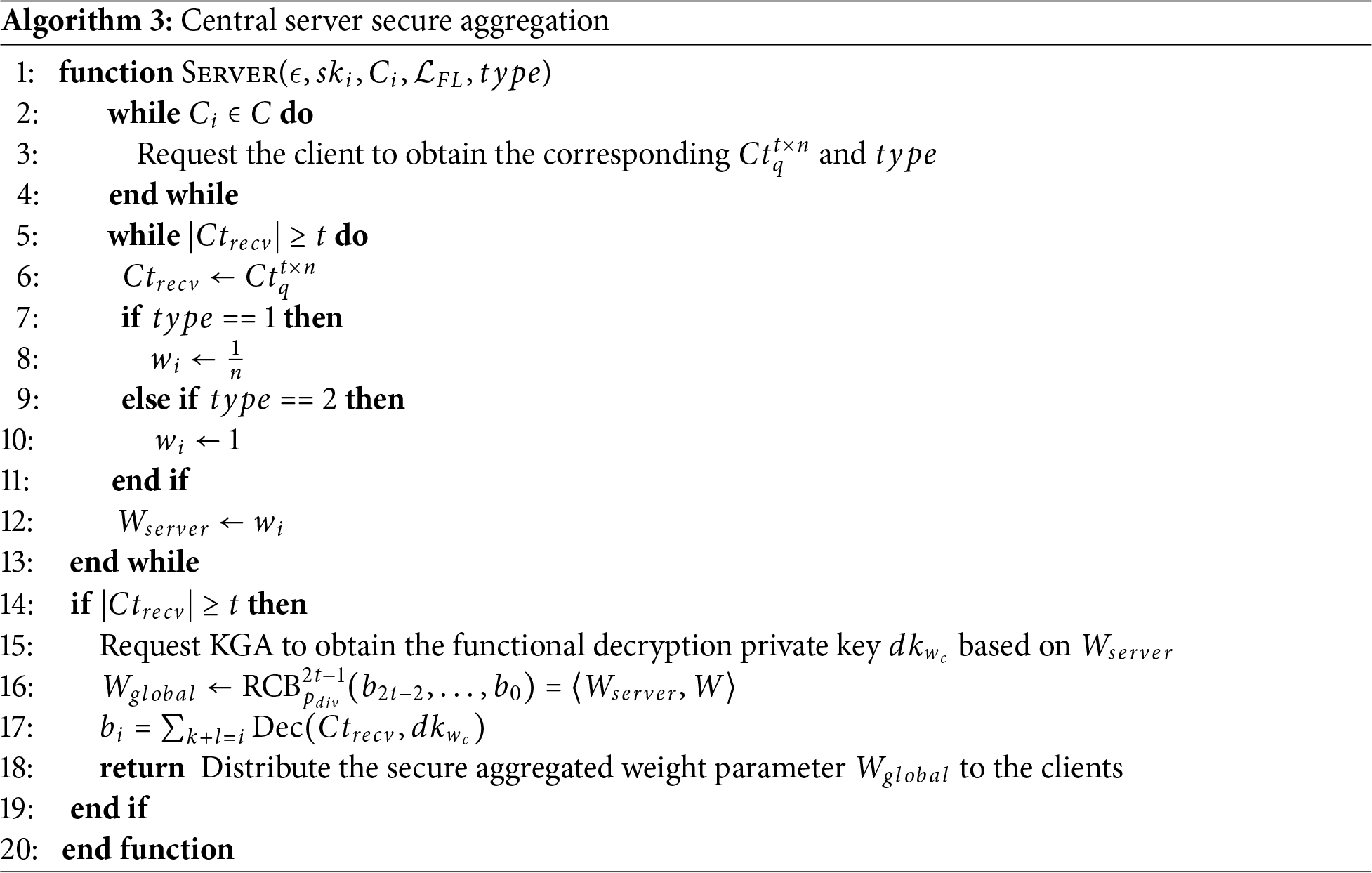
During the secure aggregation phase, the central server first sets the minimum aggregation parameters and other relevant information. As shown in Algorithm 3, the central server first requests the locally trained ciphertext weight vector parameters from each client. Next, it determines whether the collected weight vector parameters meet the minimum aggregation criteria; if so, all parameters uploaded by clients are organized and stored in
This process ensures effective protection of data privacy during secure aggregation. Finally, using the multi-precision inner-product-based encryption and recombination method, the global aggregation parameters
5 Formal Security Proof of the Protocol
5.1 Security Model and Adversarial Capabilities
We formalize the security model under the honest-but-curious setting. Let the adversary
• All ciphertexts (CTs) uploaded by clients;
• The functional decryption key
• All intermediate aggregated results
5.2 IND-CPA Security of the Multi-Precision Inner-Product Functional Encryption
We prove that our multi-precision FE scheme is selectively Indistinguishability under Chosen-Plaintext Attack (IND-CPA) secure under the standard Decisional Diffie-Hellman (DDH) assumption in the underlying cyclic group
Theorem 2. (Confidentiality of Ciphertexts). Let
Proof: We construct a sequence of hybrid games
•
•
•
•
A formal reduction shows that any PPT distinguisher between
Additionally, because our multi-precision decomposition (Section 4.3) linearly recombines ciphertext components without introducing non-linear operations, the security reduction seamlessly extends to the
5.3 Compositional Security of the FedE Protocol
Theorem 3. (Overall Protocol Security). Under the combined FE and DP protections, the FedE protocol ensures that the honest-butcurious server, having access to all ciphertexts and all functional decryption keys
Proof: From Theorem 1, the FE scheme ensures that ciphertexts reveal no information about
Thus, the overall protocol satisfies compositional privacy. The FE protects against direct parameter reconstruction, while the DP protects against statistical inference attacks, including membership and property inference.
Under the DDH assumption and assuming the KGA is fully trusted and does not collude with the server, the FedE protocol ensures that (1) individual client ciphertexts are IND-CPA secure, revealing nothing about the plaintext except the prescribed inner product with the aggregation vector; (2) the server’s view over multiple rounds reveals only the noisy aggregated inner products, which are differentially private; (3) the combined FE + DP protection prevents both direct parameter reconstruction and statistical inference attacks (membership and gradient inversion) within the bounds of the given privacy budget. These guarantees hold as long as the master secret key remains uncompromised and the randomisation of each round is fresh. If the KGA is compromised or colludes, all cryptographic privacy guarantees are void.
To evaluate the performance of the FedE framework, this section selected four publicly available datasets. The detailed information about these datasets is as follows:
• Diabetes Dataset1: The Diabetes Dataset contains 768 medical records related to diabetes, featuring eight variables including the number of pregnancies, blood glucose levels, blood pressure, age, and other indicators, with labels indicating whether the patient had diabetes. This dataset reflects real-world clinical prediction scenarios and can be used to test the framework’s ability to learn from imbalanced data and to predict trends using critical physiological indicators.
• Heart Disease Classification Dataset2: The Heart Disease Dataset consists of 303 patient medical records, each comprising 13 clinical features such as age, blood pressure, cholesterol levels, and others, with labels indicating whether the patient had heart disease. This dataset is relatively small in scale and has moderate feature dimensionality, making it suitable for validating the framework’s classification performance and privacy-protection effectiveness on structured sample data in MLaaS.
• Breast Cancer Diagnostic Dataset3: The Breast Cancer Dataset contains 569 breast cancer samples, each represented by 30 features extracted from digital images—such as radius, texture, perimeter, and other characteristics. The task is to determine whether each tumor is benign or malignant based on these features. With its high-dimensional features and clear clinical significance, this dataset is often used to assess the accuracy and reliability of machine learning models in medical diagnosis, particularly suitable for verifying the security and balance between privacy protection and utility in sensitive medical data.
• MNIST4: The MNIST dataset is a widely used standard benchmark dataset for image classification tasks, primarily employed for handwritten digit recognition. This dataset comprises 10 categories (digits 0–9) and contains 70,000 grayscale images, each 28
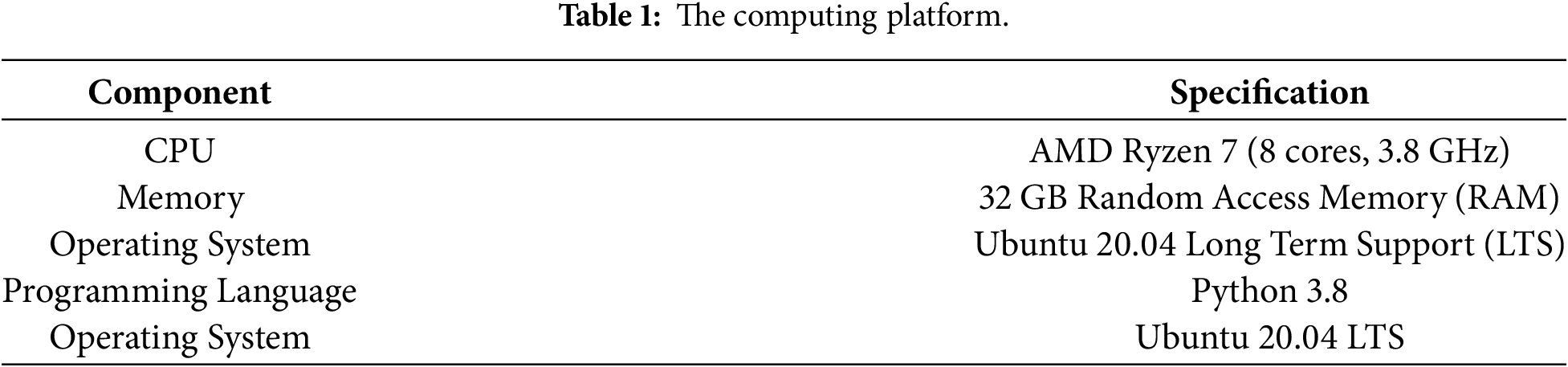
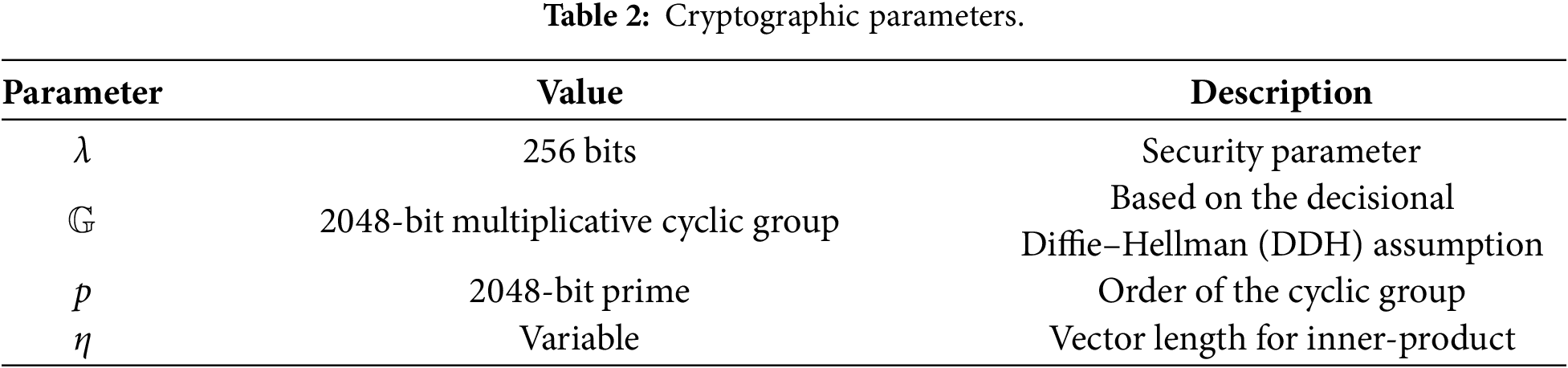
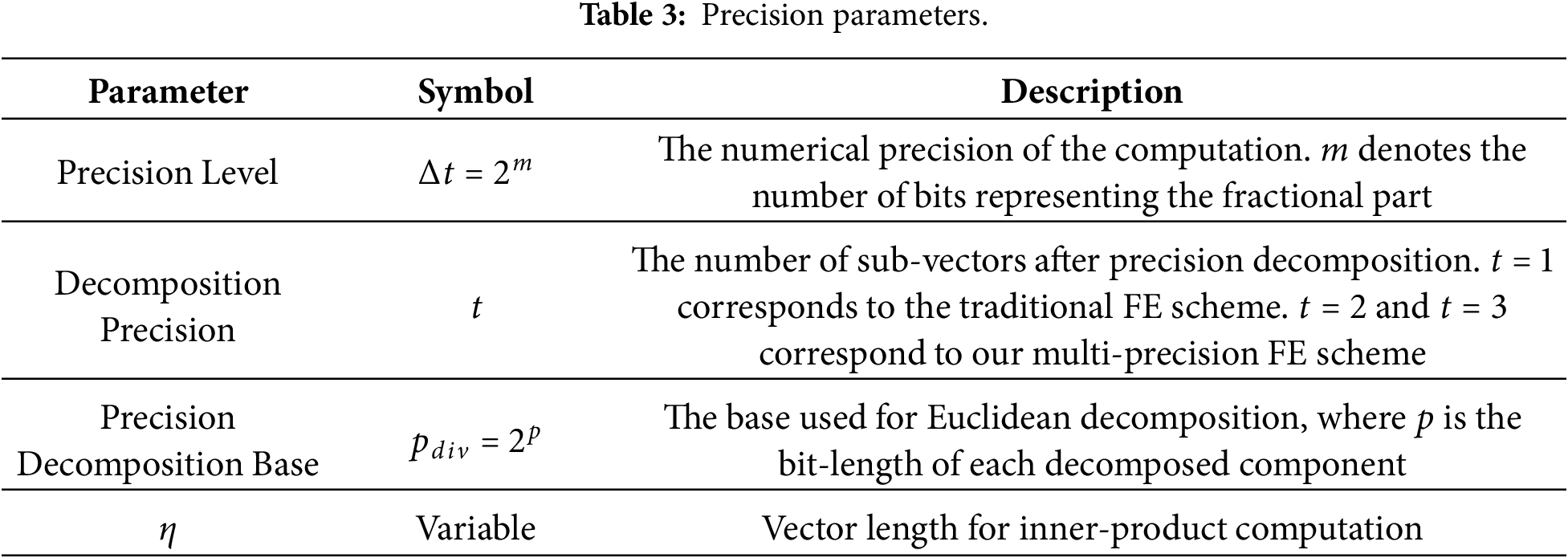
All experiments were conducted on a computing platform equipped with an AMD Ryzen 7 server with 8 cores at 3.8 GHz and 32 GB of memory. Throughout the model training process, the system used only the Central Processing Unit (CPU) for computation. The security parameters were set to 256 bits to meet the security requirements of current cryptographic standards. The runtime measurements were all performed using Python’s built-in “time” module. The baseline method (without encryption) and BatchCrypt [26] are used for comparison experiments. All experiments were conducted on a computing platform with the specifications given in Table 1. The security parameters for all experiments were set as given in Table 2. The key parameters are defined in Table 3.
6.2 Evaluation of the Computational Performance
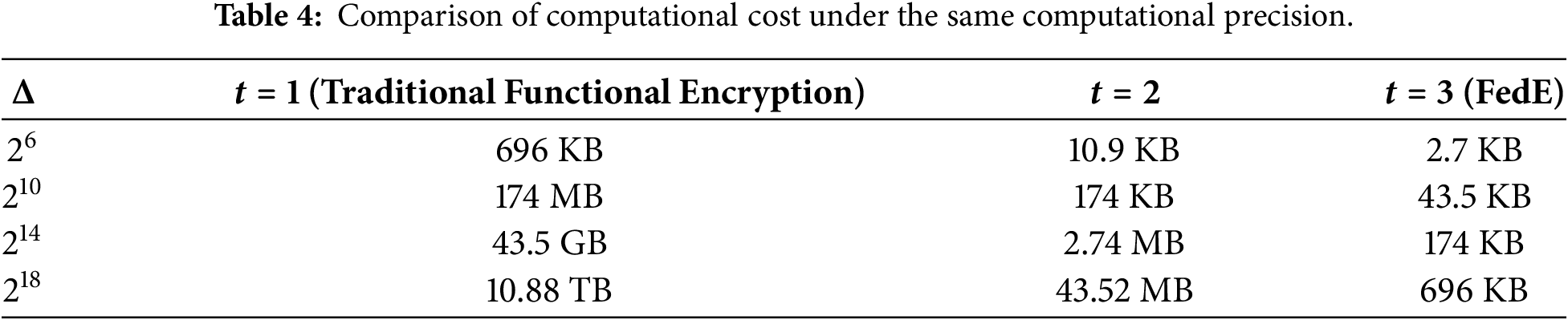
Table 4 compares the performance between the multi-precision inner-product functional encryption schemes across various computational precisions. Experimental results show that as computational precision increases (
6.3 The Impact of Global Communication Rounds on Model Accuracy
To analyze the impact of global communication rounds on model accuracy, this section conducted experiments with a fixed client count of 6 in federated learning and a differential privacy noise strength parameter of 0.02. The following figures (From Figs. 1–8) respectively illustrate how, under Independent and Identically Distributed (IID) and Non-IID data splits, the accuracy of various methods on the training set and test set changes as the number of global communication rounds increases for diabetes, heart disease classification, breast cancer, and the MNIST dataset. Overall, the three methods exhibit relatively consistent convergence patterns across most datasets: as the number of global communication rounds increases, both model training accuracy and test accuracy generally trend upward, eventually stabilizing after reaching a certain number of rounds. This indicates that the constructed federated learning training framework can continuously integrate local knowledge from each client through multiple rounds of parameter interaction, thereby gradually enhancing the overall classification capability of the global model.
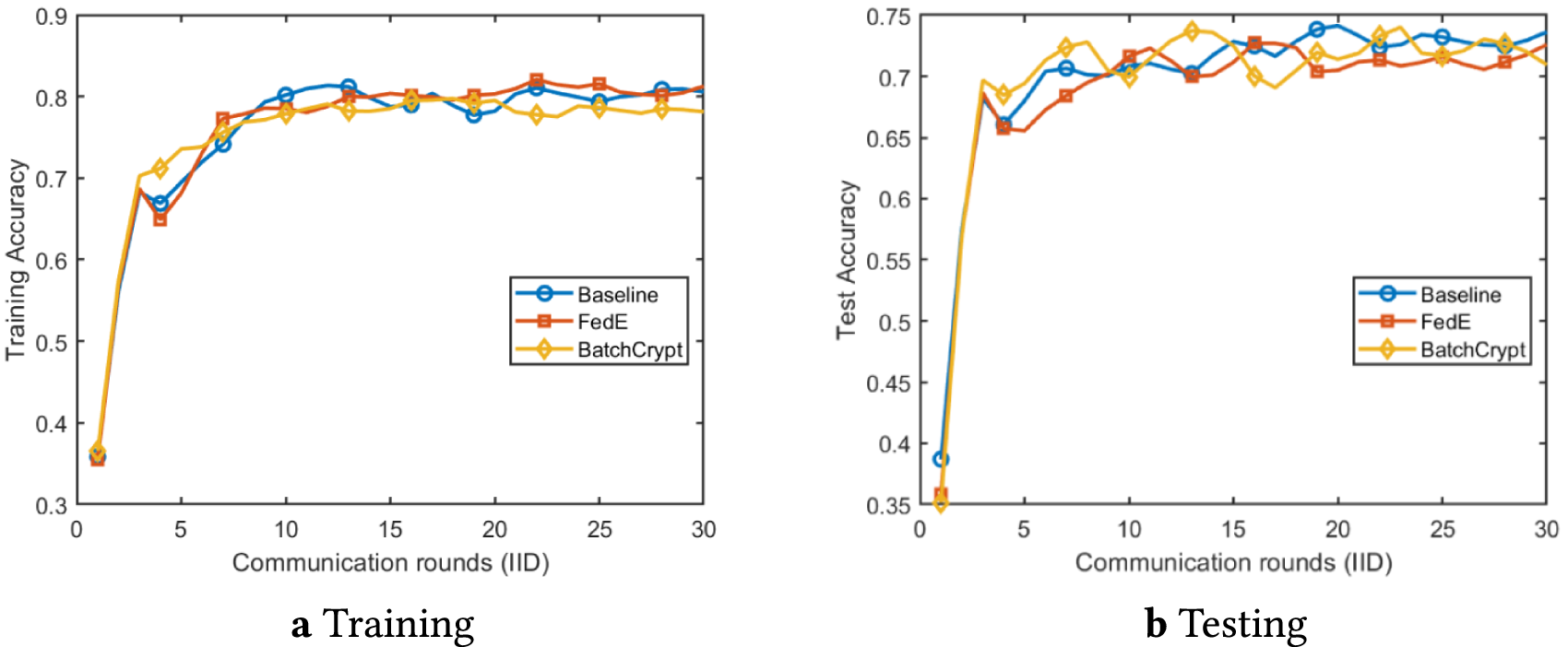
Figure 1: The impact of global communication rounds on model accuracy on the diabetes dataset (IID) during the (a) training and (b) testing phases, respectively.
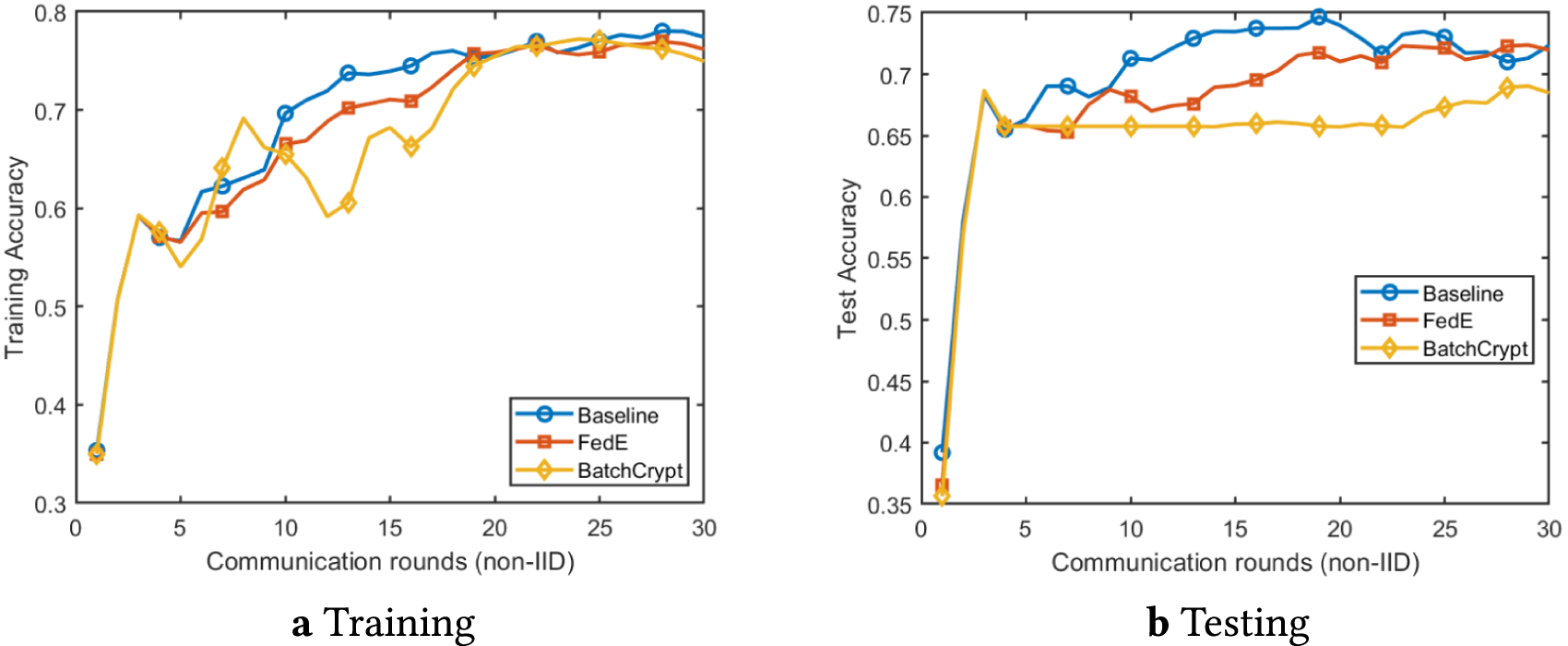
Figure 2: The impact of global communication rounds on model accuracy on the diabetes dataset (non-IID) during the (a) training and (b) testing phases, respectively.
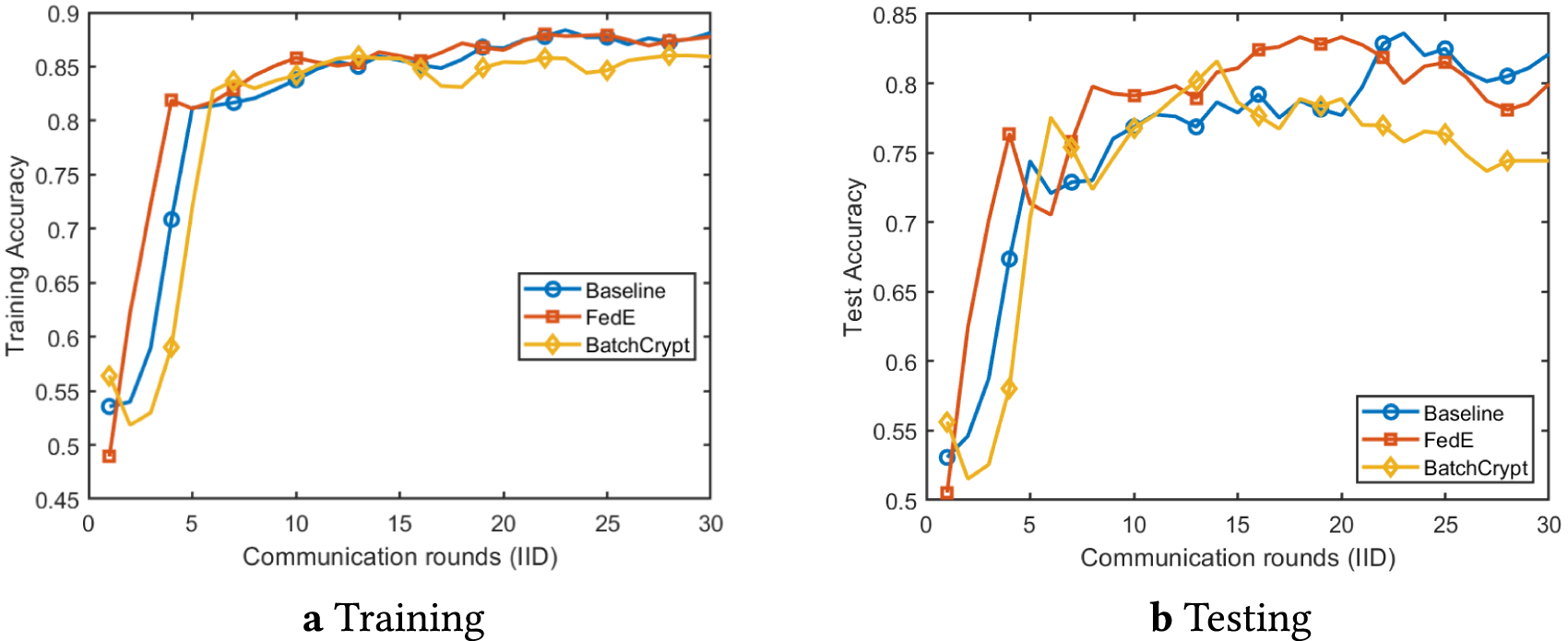
Figure 3: The impact of global communication rounds on model accuracy on the heart disease dataset (IID) during the (a) training and (b) testing phases, respectively.
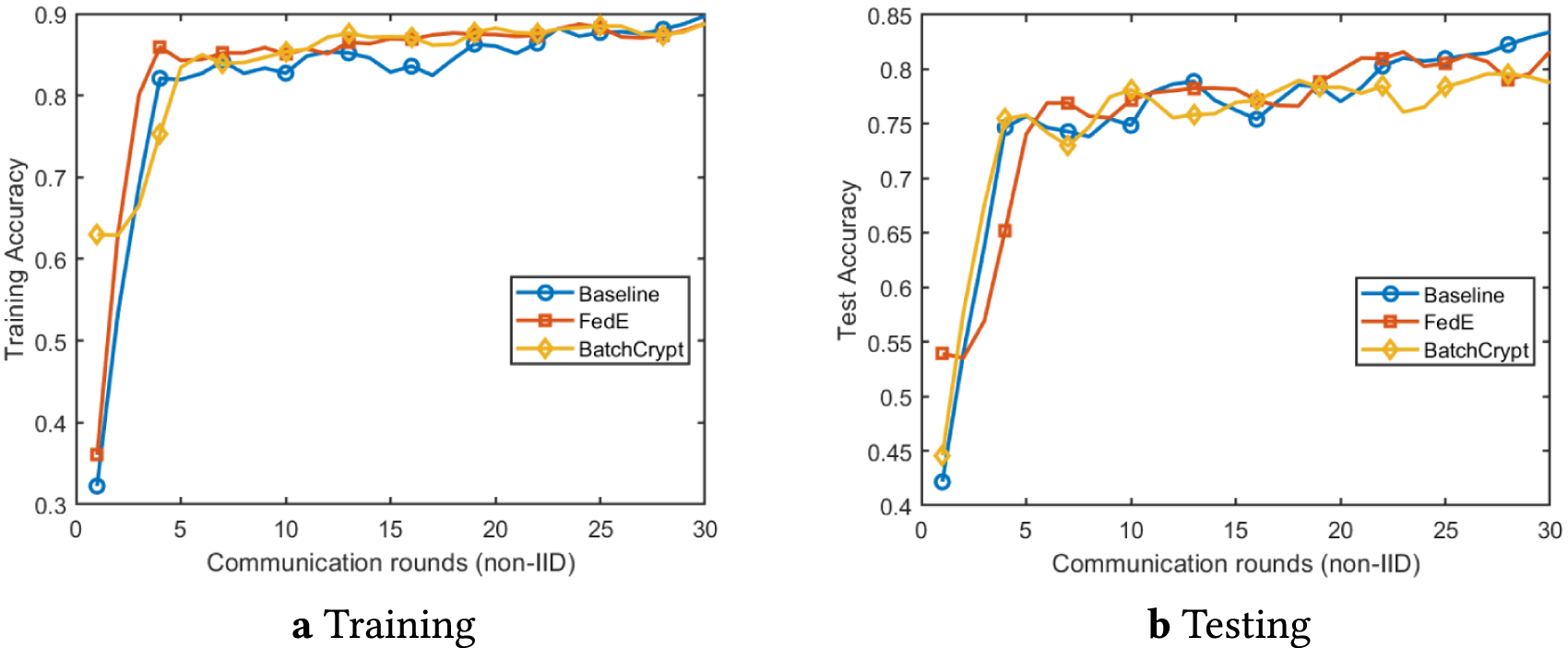
Figure 4: The impact of global communication rounds on model accuracy on the heart disease dataset (non-IID) during the (a) training and (b) testing phases, respectively.
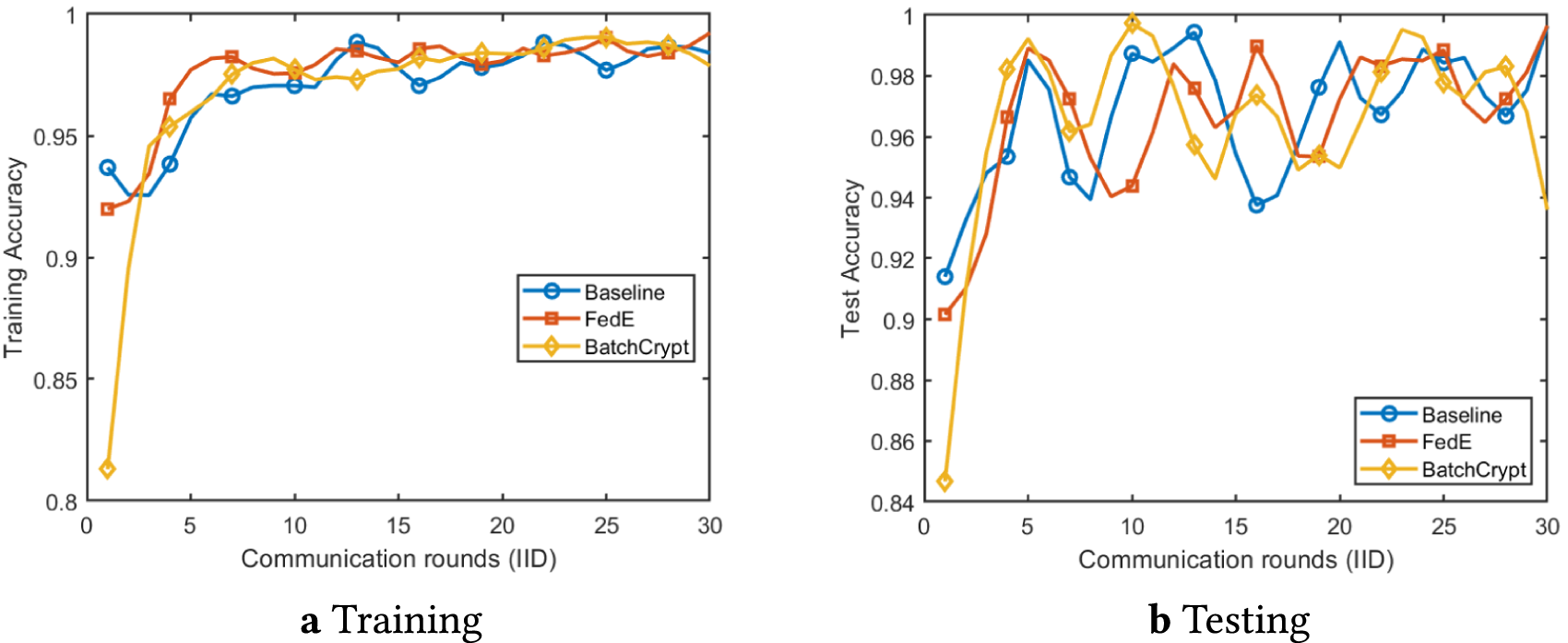
Figure 5: The impact of global communication rounds on model accuracy on the breast cancer diagnostic dataset (IID) during the (a) training and (b) testing phases, respectively.
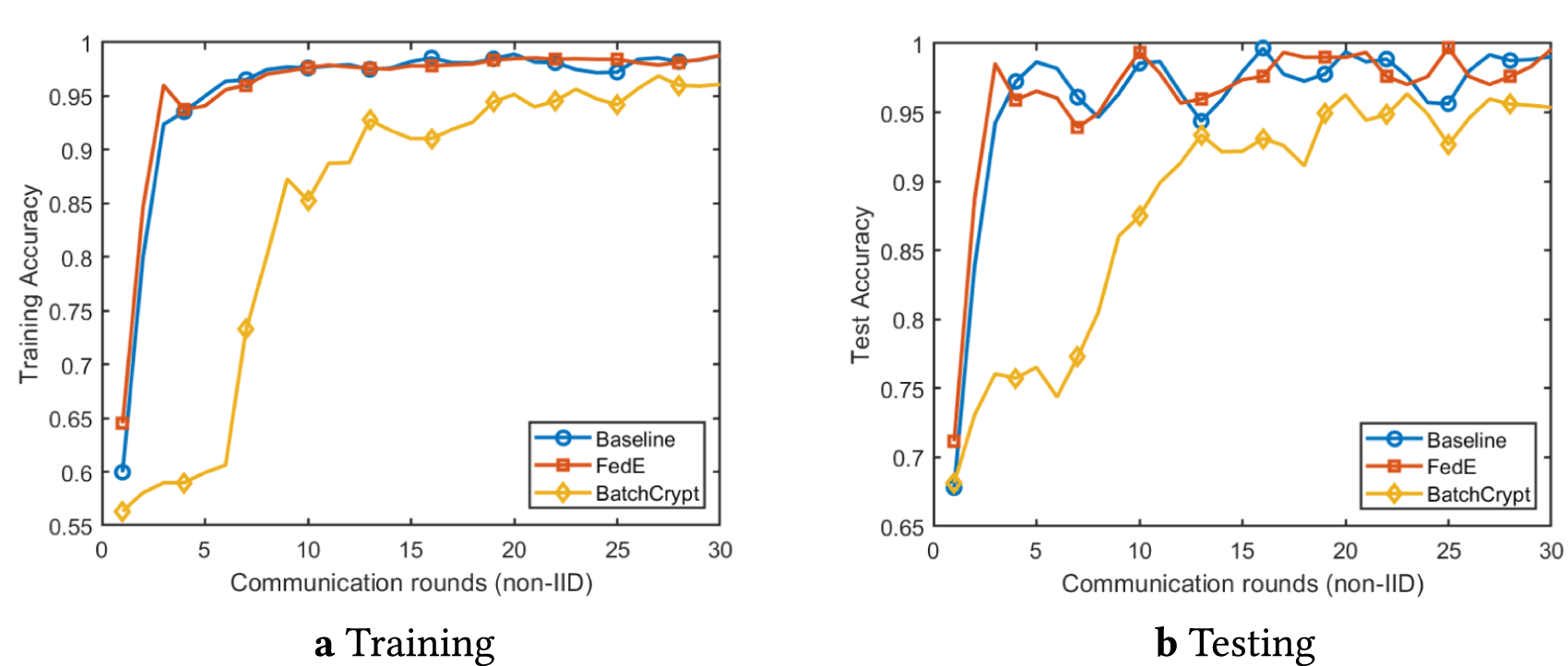
Figure 6: The impact of global communication rounds on model accuracy on the breast cancer diagnostic dataset (non-IID) during the (a) training and (b) testing phases, respectively.
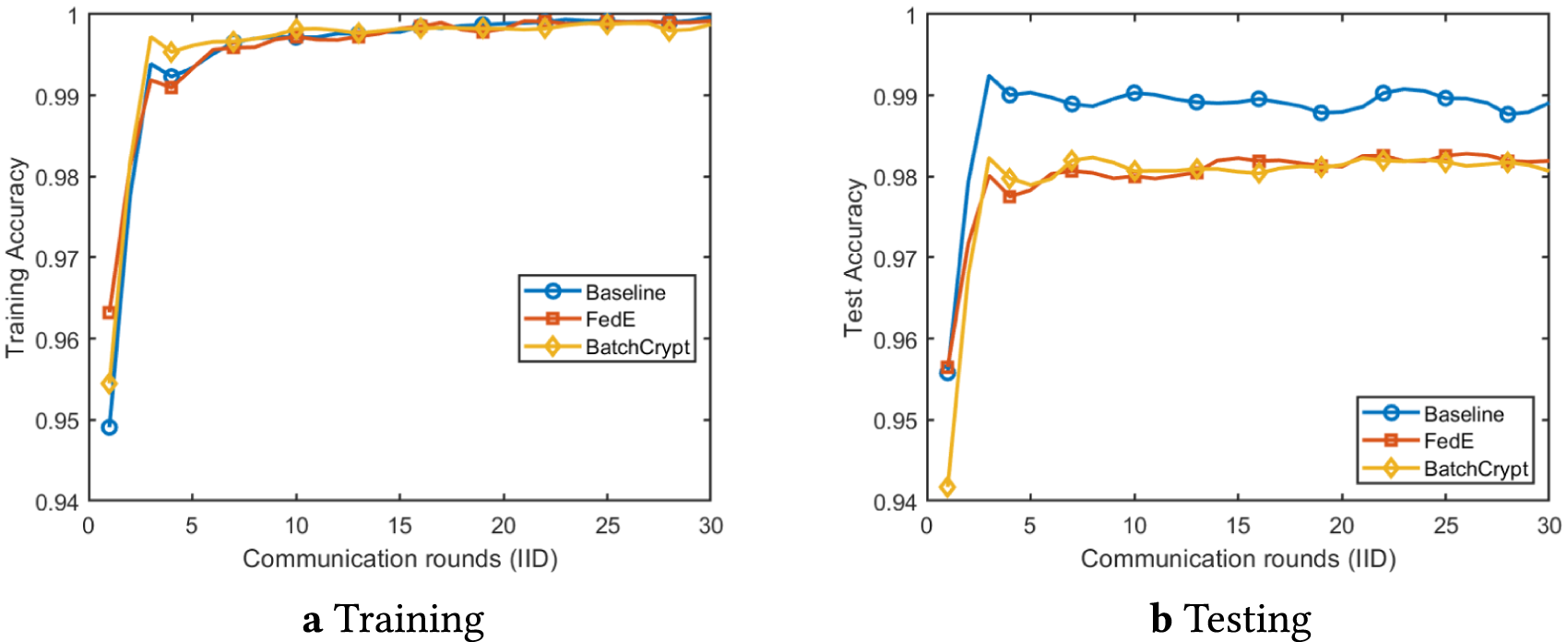
Figure 7: The impact of global communication rounds on model accuracy on the MNIST dataset (IID) during the (a) training and (b) testing phases, respectively.
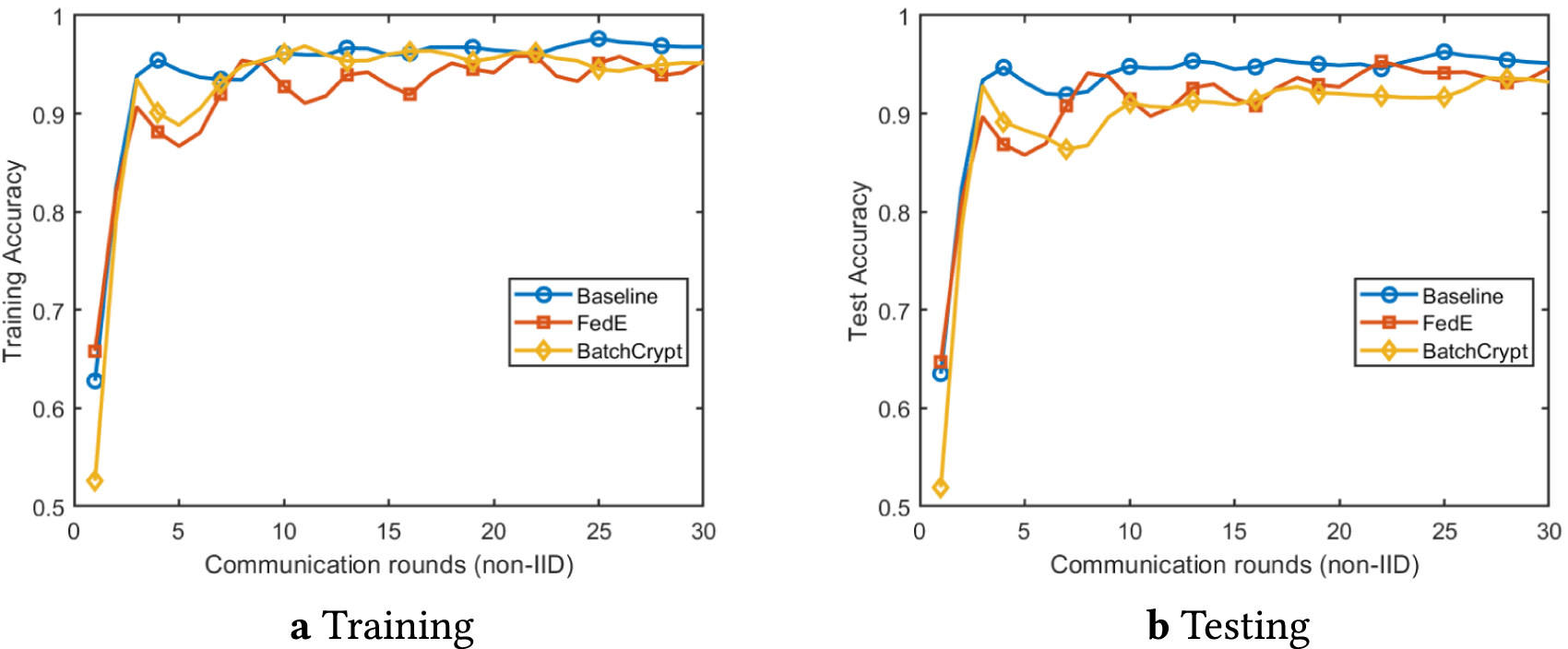
Figure 8: The impact of global communication rounds on model accuracy on the MNIST dataset (non-IID) during the (a) training and (b) testing phases, respectively.
In IID scenarios, the model convergence process is typically more stable, and the rate of improvement in training and test accuracy is also faster. The main reason is that the local data distributions across clients are relatively similar; after each round of aggregation, the global model can easily maintain a consistent direction of optimization. As a result, the training process exhibits less oscillation, and the model converges more quickly. Whether on structured disease datasets such as diabetes, heart disease classification, or breast cancer, or on the MNIST image dataset, it can be observed that as the number of communication rounds increases, the accuracy of all methods continues to improve, eventually reaching relatively high levels. This indicates that when data distributions are relatively balanced, federated learning is more effective at extracting global discriminative features and achieving stable classification.
In contrast, in Non-IID scenarios, the data distributions across clients vary significantly, making it difficult for the model to converge quickly to a unified global optimization direction in the early stages of training. As a result, the overall convergence speed is noticeably slower than in the IID scenario. As shown in Figs. 2, 4, 6, and 8, even though the training accuracy and test accuracy of all three methods continue to rise gradually with increasing communication rounds under Non-IID conditions, the rate of improvement is relatively slower, and the curves exhibit more pronounced fluctuations. Ultimately, the final accuracy is usually slightly lower than in the IID case. This phenomenon indicates that data heterogeneity weakens the effectiveness of federated aggregation, causing local updates from different clients to partially counteract one another, thereby affecting the convergence efficiency and the final performance of the global model.
Compared with the Baseline and BatchCrypt methods, FedE consistently maintains accuracy levels comparable to those of the baseline methods across datasets and data distributions. This indicates that introducing differential privacy and multi-precision inner-product-based encryption does not significantly compromise the convergence performance of federated learning models. In particular, during multiple rounds of communication, the accuracy curve of FedE generally follows the same trend as the plaintext or the benchmark approach, demonstrating that while protecting client-side local updates and ensuring the privacy of aggregation weights, it still effectively preserves the essential statistical features required for model training. This suggests that the proposed secure aggregation mechanism is highly feasible for balancing enhanced training security with minimal adverse impact on model classification performance.
Based on the above analysis, increasing the number of global communication rounds can effectively improve the overall accuracy of federated learning models. However, the extent of this improvement is influenced by factors such as data distribution consistency, task complexity, and the integration of security mechanisms. The proposed FedE framework exhibits relatively stable convergence in both IID and Non-IID scenarios, and it maintains accuracy levels close to those of the baseline methods across multiple disease prediction and image classification datasets, indicating that this approach enables effective multi-client collaborative training while safeguarding privacy and security.
6.4 The Impact of Multi-Precision on Model Accuracy
To further analyze the impact of multi-precision mechanisms on the classification performance of federated learning models, this study compared model training results under different precision settings within a federated learning environment consistent with the aforementioned experiments. The experiment primarily examined whether, after introducing multi-precision inner-product-based encryption, the model’s final classification accuracy would be significantly affected by changes in numerical representation methods, while still maintaining its ability to protect privacy.
As shown in Fig. 9, different precision settings affect model accuracy. Overall, as precision representation capabilities increase, model training outcomes tend to become more stable, and test set accuracy is more likely to remain high. This indicates that multi-precision mechanisms in federated learning scenarios can better adapt to varying ranges of data characteristics and parameter update magnitudes, thereby reducing information loss from numerical truncation, rounding, or low-precision representations. Particularly when multiple rounds of global communication and local updates from multiple clients are continuously layered together, higher or more flexible precision settings help preserve gradient changes and parameter details more accurately, thereby enhancing the model’s ability to fit the global data distribution.
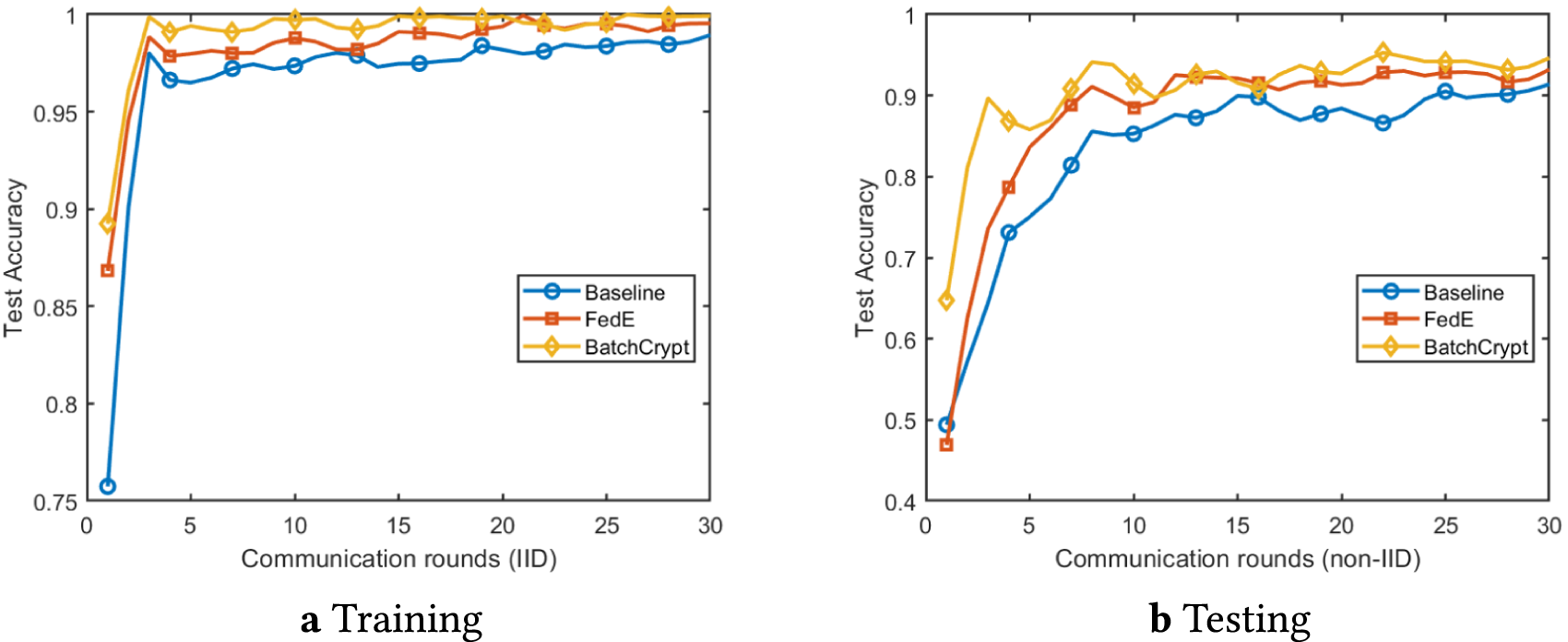
Figure 9: The impact of multi-precision on model accuracy for the MNIST dataset under IID and Non-IID settings during the (a) training and (b) testing phases, respectively.
6.5 The Impact of Noise Disturbance Intensity on Model Accuracy
As shown in Fig. 10, the experimental results reveal that as the strength of differential privacy noise increases, the model’s overall accuracy typically declines. This is because while stronger noise perturbations can effectively enhance privacy protection, they also weaken the ability of client-side local parameter updates to accurately capture the true data distribution. As a result, the local model information uploaded to the server contains more random components, which in turn affects the global aggregation process. In particular, in federated learning scenarios, local updates from multiple clients must be accumulated and integrated over multiple iterations. When each client introduces strong noise, random perturbations are gradually transmitted and accumulated across the global training process, leading to slower model convergence and a decline in test accuracy.
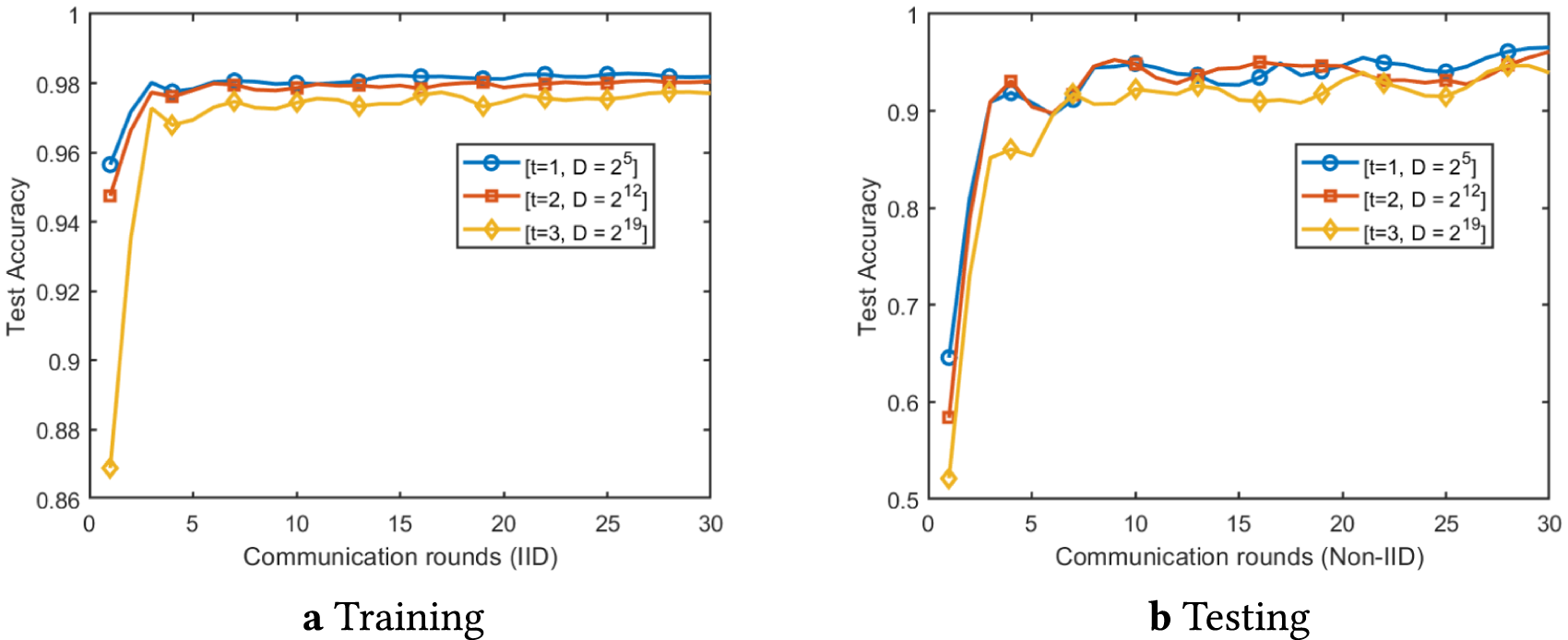
Figure 10: The impact of noise perturbation intensity on model accuracy for the MNIST dataset under IID and Non-IID settings during the (a) training and (b) testing phases, respectively.
6.6 The Impact of Training Iterations on Time Efficiency
Here, we compare the execution times of the FedE, centralized training, and BatchCrypt schemes on the MNIST dataset, both locally and on the cloud server. By comparing the results, we observed how the time overhead of the three algorithms varied across different communication rounds. As shown in Fig. 11, as the number of communication rounds increased from 1 to 10, the cumulative time consumption for all methods exhibited nearly linear growth; however, the rate of increase differed significantly. Among them, the baseline method had the lowest time overhead—since the entire process was completed in plaintext, the total time consumed after all 10 rounds of communication was approximately 260 s. In contrast, the FedE method proposed in this paper, by introducing multi-precision inner-product functional encryption and differential privacy mechanisms, saw its cumulative time consumption increase to about 900 s over the same 10 communication rounds, which is roughly 3.46 times that of the baseline scheme. This increase was primarily due to the additional computational burden imposed by encryption and decryption operations. Meanwhile, the comparison method, BatchCrypt, which employed a batch-based fully homomorphic encryption strategy, experienced the highest time overhead, with 10 rounds of communication. It reached approximately 2500 seconds, which was about 2.78 times that of FedE and 9.62 times that of the baseline scheme. Notably, during the initial phase (the first 3 rounds), each. The time overhead differences between the methods were relatively small; as the number of rounds increased, the cumulative computational burden from encryption operations became pronounced, and the time gap between the methods gradually widened. The experimental results confirmed that, while ensuring security, FedE offers a significant computational efficiency advantage over traditional fully homomorphic encryption schemes.
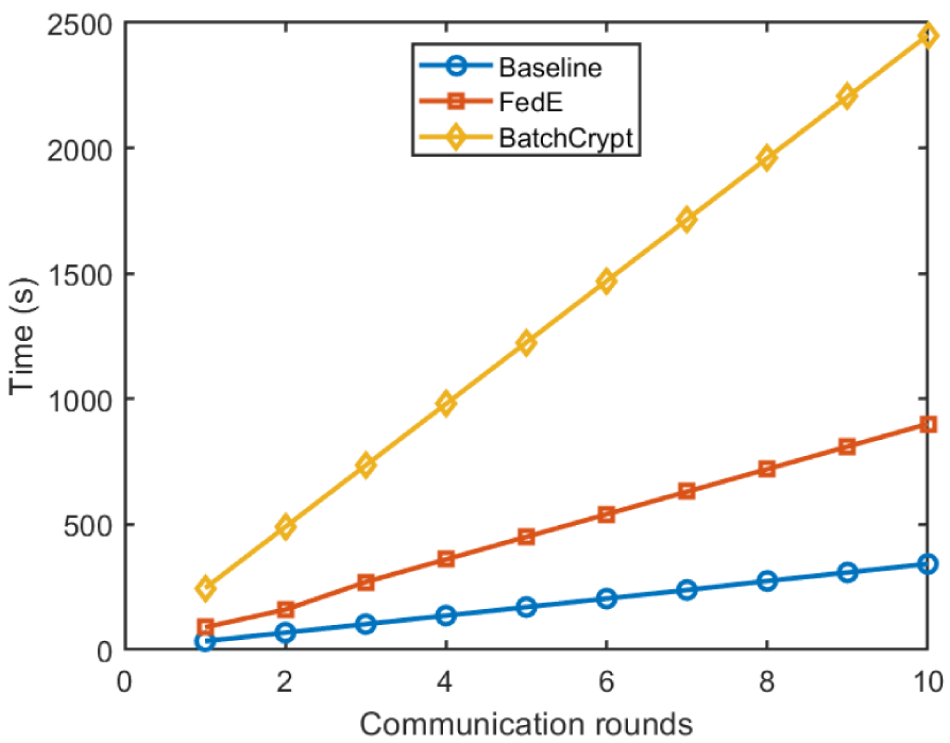
Figure 11: Time consumption of the MNIST dataset across different communication rounds.
Based on the above experimental results, it is evident that each of the three key technologies in this scheme plays a distinct role during model training. Differential privacy primarily enhances privacy protection during the client-side local update phase, with its impact mainly reflected in changes in noise intensity on model accuracy. The multi-precision mechanism is designed to mitigate numerical representation errors in scenarios involving heterogeneous data and ciphertext-based computations; its advantage lies in the differences between model accuracy and convergence stability across various precision settings. Functional encryption, on the other hand, enables secure aggregation by servers, with its value primarily stemming from the feasibility of ciphertext-based computations, reduced communication overhead, and the ability to protect privacy during aggregation. Experimental results demonstrate that these three techniques are not independent of one another—they work together within the FedE framework, ensuring both privacy security and, as much as possible, maintaining the performance of federated learning models.
6.7 Comparison with more State-of-the-Arts
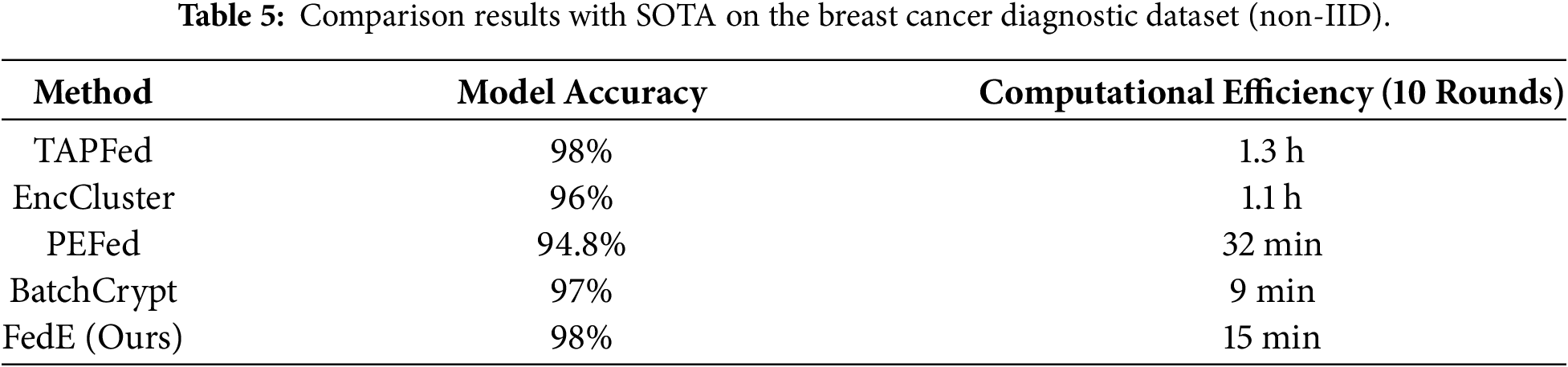
We compare FedE with TAPFed (2024) [27], EncCluster (2025) [28], PEFed (2025) [29], and BatchCrypt (2020) [26]. To ensure a fair and transparent comparison, we categorize the baselines into two groups. (i) Reproduced methods: BatchCrypt [29] and PEFed were re-implemented and evaluated under the exact same hardware environment (AMD Ryzen 7, 32 GB RAM, Ubuntu 20.04), dataset splits (Breast Cancer and MNIST, Non-IID with
From Table 5, FedE achieves 98% accuracy, which is the highest among all compared methods, tying with TAPFed. FedE’s multi-precision inner-product functional encryption combined with differential privacy does not compromise model utility even under challenging Non-IID data distributions. The accuracy improvement over PEFed (+3.2%), EncCluster (+2%), and BatchCrypt (+1%) confirms the effectiveness of the proposed multi-precision decomposition mechanism in preserving fine-grained parameter information during encrypted aggregation. FedE completes 10 rounds of training in 15 min, which is 5.2
As data resources become increasingly distributed across institutions, terminals, and platforms, collaborative computation among multiple clients has gradually emerged as an important approach for implementation in MLaaS scenarios. This paper conducts a comprehensive study of inner-product functional encryption technology and proposes a multi-precision inner-product functional encryption scheme. It incorporates differential privacy techniques to inject adaptive noise into raw data, and employs multi-input, multi-precision inner-product functions to securely aggregate model parameters during the federated learning process under the FedE strategy. By integrating client data from multiple organizations across multiple training rounds, a federated learning framework with strong privacy protection capabilities is constructed. Through targeted experiments on the diabetes, heart disease classification, breast cancer, and MNIST (classic handwritten digits) datasets, we compared and analyzed the advantages of using differential privacy and multi-precision functional encryption for privacy-preserving federated learning.
Acknowledgement: We express our gratitude to Guizhou Power Grid Co., Ltd., for their invaluable support and assistance in this investigation.
Funding Statement: This paper is supported in part by the Major Research Project of Guizhou Provincial Laboratory (QKHPT-SSYS [2024]014) and in part by the Natural Science Foundation of China no. 62362008.
Author Contributions: Conceptualization, Weijia Liu, Hao Li, Zhenyong Zhang, and Junwen Deng; methodology, Weijia Liu, Junwen Deng, Hao Li, and Zhenyong Zhang; software, Weijia Liu, Hao Li, Junwen Deng, and Zhenyong Zhang; validation, Weijia Liu, Junwen Deng, Hao Li, and Zhenyong Zhang; formal analysis, Weijia Liu, Junwen Deng, Hao Li, and Zhenyong Zhang; investigation, Weijia Liu, Junwen Deng, Hao Li, and Zhenyong Zhang; resources, Weijia Liu, Junwen Deng, Hao Li, and Zhenyong Zhang; data curation, Weijia Liu, Junwen Deng, Hao Li, and Zhenyong Zhang; writing—original draft preparation, Weijia Liu and Zhenyong Zhang; writing—review and editing, Weijia Liu and Zhenyong Zhang; visualization, Weijia Liu and Zhenyong Zhang; supervision, Zhenyong Zhang; project administration, Zhenyong Zhang; funding acquisition, Zhenyong Zhang. All authors reviewed and approved the final version of the manuscript.
Availability of Data and Materials: Data openly available in a public repository.
Ethics Approval: Not applicable.
Conflicts of Interest: Given his role as Editorial Board Member of this journal, Zhenyong Zhang had no involvement in the peer review of this article and had no access to information regarding its peer review. Full responsibility for the editorial process for this article was delegated to another journal editor. The authors declare no other conflicts of interest.
1https://www.kaggle.com/datasets/uciml/pima-indians-diabetes-database.
2https://www.kaggle.com/datasets/johnsmith88/heart-disease-dataset.
3https://www.kaggle.com/datasets/uciml/breast-cancer-wisconsin-data.
4https://www.kaggle.com/datasets/hojjatk/mnist-dataset.
References
1. Almanasra S. Applications of integrating artificial intelligence and big data: a comprehensive analysis. J Intell Syst. 2024;33(1):20240237. doi:10.1515/jisys-2024-0237. [Google Scholar] [CrossRef]
2. Zhang Z, Liu M, Sun M, Deng R, Cheng P, Niyato D, et al. Vulnerability of machine learning approaches applied in IoT-based smart grid: a review. IEEE Internet Things J. 2024;11(11):18951–75. doi:10.1109/jiot.2024.3349381. [Google Scholar] [CrossRef]
3. Zhang Z, Wang W, Wang M, Wang H, Bi J, Xu G. Physics-constrained adversarial attack generation and active defense for the hybrid deep reinforcement learning-based load frequency control. ACM Trans Auton Adapt Syst. 2026:3805703. doi:10.1145/3805703. [Google Scholar] [CrossRef]
4. Zhang Z, Shao K, Deng R, Wang X, Zhang Y, Wang M. PrivLSTM: a privacy-preserving LSTM inference framework by fusing encryption and network structure for multi-sourced Data. Inf Fusion. 2026;127(7):103711. doi:10.1016/j.inffus.2025.103711. [Google Scholar] [CrossRef]
5. Peng S, Yang Y, Mao M, Park DS. Centralized machine learning versus federated averaging: a comparison using MNIST dataset. KSII Trans Internet Inf Syst. 2022;16(2):742–56. doi:10.3837/tiis.2022.02.020. [Google Scholar] [CrossRef]
6. Abdalla M, Bourse F, De Caro A, Pointcheval D. Simple functional encryption schemes for inner products. In: IACR International Workshop on Public Key Cryptography. Berlin/Heidelberg, Germany: Springer; 2015. p. 733–51. [Google Scholar]
7. Panzade P, Takabi D, Cai Z. Privacy-preserving machine learning using functional encryption: opportunities and challenges. IEEE Internet Things J. 2024;11(5):7436–46. doi:10.1109/jiot.2023.3338220. [Google Scholar] [CrossRef]
8. Bai L, Hu H, Ye Q, Li H, Wang L, Xu J. Membership inference attacks and defenses in federated learning: a survey. ACM Comput Surv. 2025;57(4):1–35. doi:10.1145/3704633. [Google Scholar] [CrossRef]
9. Zhang Z, Cheng P, Wu J, Chen J. Secure state estimation using hybrid homomorphic encryption scheme. IEEE Trans Control Syst Technol. 2021;29(4):1704–20. doi:10.1109/tcst.2020.3019501. [Google Scholar] [CrossRef]
10. Wu L, Wang XA, Liu J, Su Y, Tu Z, Liu W, et al. Homomorphic encryption for machine learning applications with CKKS algorithms: a survey of developments and applications. Comput Mater Contin. 2025;85(1):89–119. doi:10.32604/cmc.2025.064346. [Google Scholar] [CrossRef]
11. Lee JW, Kang H, Lee Y, Choi W, Eom J, Deryabin M, et al. Privacy-preserving machine learning with fully homomorphic encryption for deep neural network. IEEE Access. 2022;10:30039–54. doi:10.1109/access.2022.3159694. [Google Scholar] [CrossRef]
12. Park S, Byun J, Lee J. Privacy-preserving fair learning of support vector machine with homomorphic encryption. In: Proceedings of the ACM Web Conference 2022; 2022 Apr 25–29; Virtual Event. p. 3572–83. [Google Scholar]
13. Carpov S, Gama N, Georgieva M, Troncoso-Pastoriza JR. Privacy-preserving semi-parallel logistic regression training with fully homomorphic encryption. BMC Med Genom. 2020;13(7):88. [Google Scholar]
14. Castro F, Impedovo D, Pirlo G. An efficient and privacy-preserving federated learning approach based on homomorphic encryption. IEEE Open J Comput Soc. 2025;6:336–47. doi:10.1109/ojcs.2025.3536562. [Google Scholar] [CrossRef]
15. Manderna A, Dohare U, Kumar S, Ram B. Intrusion detection in Internet of Things using differential privacy: a hybrid machine learning approach. Ad Hoc Netw. 2025;174(16):103818. doi:10.1016/j.adhoc.2025.103818. [Google Scholar] [CrossRef]
16. Demelius L, Kern R, Trügler A. Recent advances of differential privacy in centralized deep learning: a systematic survey. ACM Comput Surv. 2025;57(6):1–28. doi:10.1145/3712000. [Google Scholar] [CrossRef]
17. Lian Z, Wang W, Su C. COFEL: communication-efficient and optimized federated learning with local differential privacy. In: Proceedings of the ICC 2021-IEEE International Conference on Communications; 2021 June 14–23; Montreal, QC, Canada; p. 1–6. [Google Scholar]
18. Hu R, Guo Y, Gong Y. Federated learning with sparsified model perturbation: improving accuracy under client-level differential privacy. IEEE Trans Mob Comput. 2024;23(8):8242–55. doi:10.1109/tmc.2023.3343288. [Google Scholar] [CrossRef]
19. Wei K, Li J, Ma C, Ding M, Chen W, Wu J, et al. Personalized federated learning with differential privacy and convergence guarantee. IEEE Trans Inf Forensics Secur. 2023;18:4488–503. doi:10.1109/tifs.2023.3293417. [Google Scholar] [CrossRef]
20. Sorbera E, Zanetti F, Brandi G, Tomasi A, Doriguzzi-Corin R, Ranise S. Adaptive federated learning with functional encryption: a comparison of classical and quantum-safe options. arXiv:2504.00563. 2025. [Google Scholar]
21. Yu P, Huang W, Zhang R, Qian X, Li H, Chen H. GuardGrid: a queriable and privacy-preserving aggregation scheme for smart grid via function encryption. IEEE Internet Things J. 2025;12(11):17622–33. doi:10.1109/jiot.2025.3539724. [Google Scholar] [CrossRef]
22. Qian X, Li H, Hao M, Yuan S, Zhang X, Guo S. CryptoFE: practical and privacy-preserving federated learning via functional encryption. In: Proceedings of the GLOBECOM 2022–2022 IEEE Global Communications Conference; 2022 Dec 4–8; Rio de Janeiro, Brazil. p. 2999–3004. [Google Scholar]
23. Chang Y, Zhang K, Gong J, Qian H. Privacy-preserving federated learning via functional encryption, revisited. IEEE Trans Inf Forensics Secur. 2023;18:1855–69. doi:10.1109/tifs.2023.3255171. [Google Scholar] [CrossRef]
24. Zhang R, Li H, Qian X, Jiang W, Zhang X. An efficient and secure privacy-preserving federated learning via lattice-based functional encryption. In: Proceedings of the ICC 2024-IEEE International Conference on Communications; 2024 Jun 9–13; Denver, CO, USA. p. 2185–90. [Google Scholar]
25. Yu B, Zhao J, Zhang K, Gong J, Qian H. Lightweight and dynamic privacy-preserving federated learning via functional encryption. IEEE Trans Inf Forensics Secur. 2025;20:2496–508. doi:10.1109/tifs.2025.3540312. [Google Scholar] [CrossRef]
26. Zhang C, Li S, Xia J, Wang W, Yan F, Liu Y. BatchCrypt: efficient homomorphic encryption for cross-Silo federated learning. In: Proceedings of the 2020 USENIX Conference on Usenix Annual Technical Conference; 2020 Jul 15–17; Boston, MA, USA. p. 493–506. [Google Scholar]
27. Xu R, Li B, Li C, Joshi JBD, Ma S, Li J. TAPFed: threshold secure aggregation for privacy-preserving federated learning. IEEE Trans Dependable Secure Comput. 2024;21(5):4309–23. doi:10.1109/tdsc.2024.3350206. [Google Scholar] [CrossRef]
28. Tsouvalas V, Mohammadi S, Balador A, Ozcelebi T, Flammini F, Meratnia N. EncCluster: scalable functional encryption in federated learning through weight clustering and probabilistic filters. Pervasive Mob Comput. 2025;108(5):102021. doi:10.1016/j.pmcj.2025.102021. [Google Scholar] [CrossRef]
29. Guan M, Bao H, Wang J, Xing L, Dai HN. PEFed: enhancing privacy and efficiency in federated learning via removable perturbation and decentralized encryption. Inf Fusion. 2025;122(3):103187. doi:10.1016/j.inffus.2025.103187. [Google Scholar] [CrossRef]
Cite This Article
 Copyright © 2026 The Author(s). Published by Tech Science Press.
This work is licensed under a Creative Commons Attribution 4.0 International License , which permits unrestricted use, distribution, and reproduction in any medium, provided the original work is properly cited.
 Downloads
 Citation Tools
