
 Login
Login Register
 Submit a Paper
 Propose a Special lssue
 Open Access
ARTICLE
-FedVAE: Detached Posterior-Confidence Gating for Dimension-Wise KL Regularization in Personalized Federated Collaborative Filtering
1 The School of Computer Science and Engineering, Macau University of Science and Technology, Macau, China
2 The School of Finance and Economics, Shenzhen University of Information Technology, Shenzhen, China
* Corresponding Author: Li Feng. Email:
Computers, Materials & Continua 2026, 89(2), 85 https://doi.org/10.32604/cmc.2026.086183
Received 26 May 2026; Accepted 10 August 2026; Issue published 15 September 2026
 View Full Text
 Download PDF
Abstract
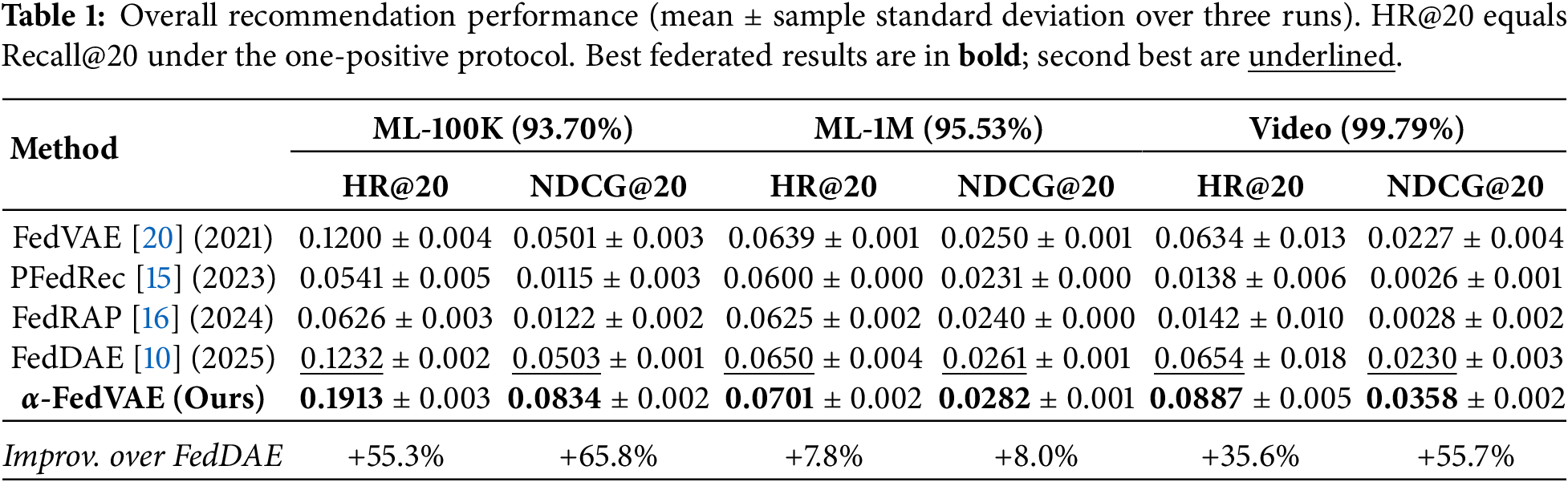
Federated Variational Autoencoders (VAEs) keep interaction data local, but existing federated VAE recommenders typically apply uniform KL regularization and do not adapt dimension-wise penalties to unreliable posteriors in sparse interaction scenarios. We propose -FedVAE, which uses a detached, clipped normalized signal-to-noise ratio as a local confidence gate for each KL dimension of a fused user posterior, without extra communication. Across MovieLens-100K, MovieLens-1M, and Amazon Video, -FedVAE improves mean HR@20 by 7.8%–55.3% and NDCG@20 by 8.0%–65.8% over FedDAE. These results indicate that -FedVAE improves personalized recommendation under sparse and decentralized settings while preserving the communication footprint.Keywords
Collaborative Filtering (CF) models user preferences from interaction data [1–3], but centralizing such data raises privacy concerns under regulations such as the General Data Protection Regulation [4]. Federated Learning (FL) instead aggregates model updates while retaining raw data on clients [5,6], enabling Personalized Federated Collaborative Filtering (PFCF) [7,8]. Variational Autoencoders (VAEs) [9] are effective generative recommenders: an encoder maps interactions to a stochastic latent representation and a decoder reconstructs item preferences. Training maximizes an Evidence Lower Bound (ELBO) containing reconstruction and Kullback–Leibler (KL) regularization terms.
Dual-encoder methods such as FedDAE [10] separate shared and private representations, but retain one KL weight
1.1 The Uniform Regularization Problem
For a sparse user, limited evidence leaves posterior dimensions with unequal reliability. Uniform KL regularization applies the same coefficient whether a posterior displacement is well determined or accompanied by high variance. Global
We use normalized SNR to calibrate the prior penalty: a well-determined displacement retains nearly the global KL strength, whereas a variance-dominated KL contribution is discounted. This rule distinguishes dimensions using encoder statistics without client-specific tuning; the gate study evaluates its empirical boundary rather than assuming unique optimality.
Normalized SNR, stop-gradient, and KL decomposition are established components rather than individual contributions. Our contribution is their integration as a locally recomputed gate on each fused-user-posterior KL term, without a learned gate parameter, client-specific tuning, or additional payload. The raw confidence approaches one for a well-determined dimension and zero when uncertainty dominates; fixed global clipping to
Our contributions are summarized as follows:
• We formulate and empirically examine dimension-blind KL regularization as a bottleneck for sparse federated VAE recommendation.
• We introduce the integrated federated VAE mechanism: the clipped normalized-SNR coefficient is locally recomputed and detached on each KL dimension of a fused user posterior. Its placement and update rule across dimensions, users, and local steps constitute the method contribution, not the SNR formula.
• We establish a limited ARD-like posterior-mean gradient analogy, a bound on aggregate gate strength, and a conditional descent decomposition with explicit budgets for non-stationary gates; these results are neither full ARD inference nor an unconditional convergence theorem for the neural network.
• Three-dataset 100-round experiments show mean gains of 7.8%–55.3% in HR@20 and 8.0%–65.8% in NDCG@20 over FedDAE, with controlled analyses delimiting where those gains persist.
2.1 Federated Collaborative Filtering
Federated CF spans matrix factorization [7,8], neural filtering (FedNCF [13]), personalization layers (FedPer [14]), dual or additive personalization (PFedRec [15]; FedRAP [16]), embedding-degradation mitigation (PLGC [17]), and common-representation learning (FedCR [18]). SCAFFOLD controls client drift [19]; FedVAE [20], EFVAE [21], FedDAE [10], and FedRKG [22] provide generative or knowledge-graph-based alternatives. These methods retain uniform within-user KL weighting; our focus is dimension-wise weighting of one fused client posterior, with FedDAE as the closest architectural baseline. LightGCN [23] is contextual because its architecture and centralized access differ.
2.2 KL Regularization in Variational Autoencoder
The
Free-bits thresholds
2.3 Automatic Relevance Determination
Automatic Relevance Determination (ARD) assigns independent prior precisions to dimensions [28,29]. With
Let
Federated VAE. A
The encoder
Dual-Encoder Architecture. Following FedDAE [10], the encoder decomposes into global
where
Fig. 1 shows the on-device confidence gate and shared-parameter aggregation. Each user is one client; raw interactions, local encoder parameters, and posterior-fusion parameters remain private, while only shared encoder and decoder updates are aggregated. The confidence gate itself has no learned parameter. The implementation provides data decentralization but not secure aggregation, homomorphic encryption, or differential privacy.
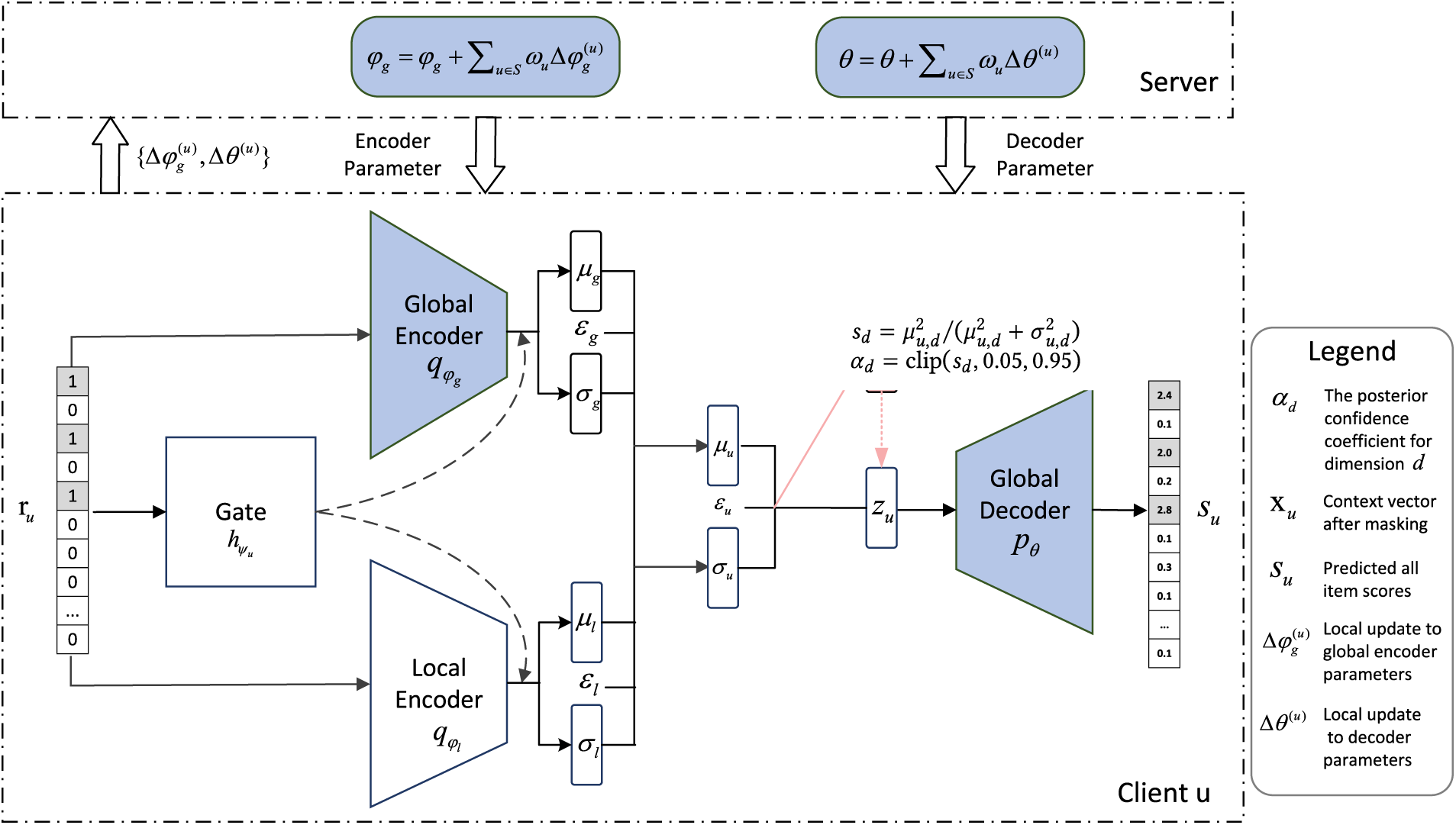
Figure 1: Architecture of
4.1 Diagnosing Uniform Regularization Waste
For a diagonal Gaussian posterior,
The issue is not that every uncertain dimension has a large gradient in isolation. Rather, a uniform objective has no mechanism to distinguish a small but reliable displacement from one accompanied by high posterior variance, and the same rule is repeated across all
4.2 Posterior Confidence as a Dimension Gate
From the fused posterior in Eq. (2), define the raw confidence
The squared mean measures displacement from the prior and the variance measures uncertainty:
The coefficient has four useful properties:
(i) Boundedness:
(ii) Continuity: clipping preserves a continuous confidence transition.
(iii) Non-learned adaptation: the fixed global bounds introduce no learned, client-specific, or dimension-specific gate parameter.
(iv) Interpretability:
The gated term is
Thus
Detachment is central to this interpretation. If gradients were propagated through the gate, the KL derivative would contain both
We warm up
Warm-up controls global KL strength across rounds, whereas confidence redistributes it across dimensions within each local step. At inference, the unchanged dual encoders and decoder rank items without computing
4.4 Federated Training Protocol
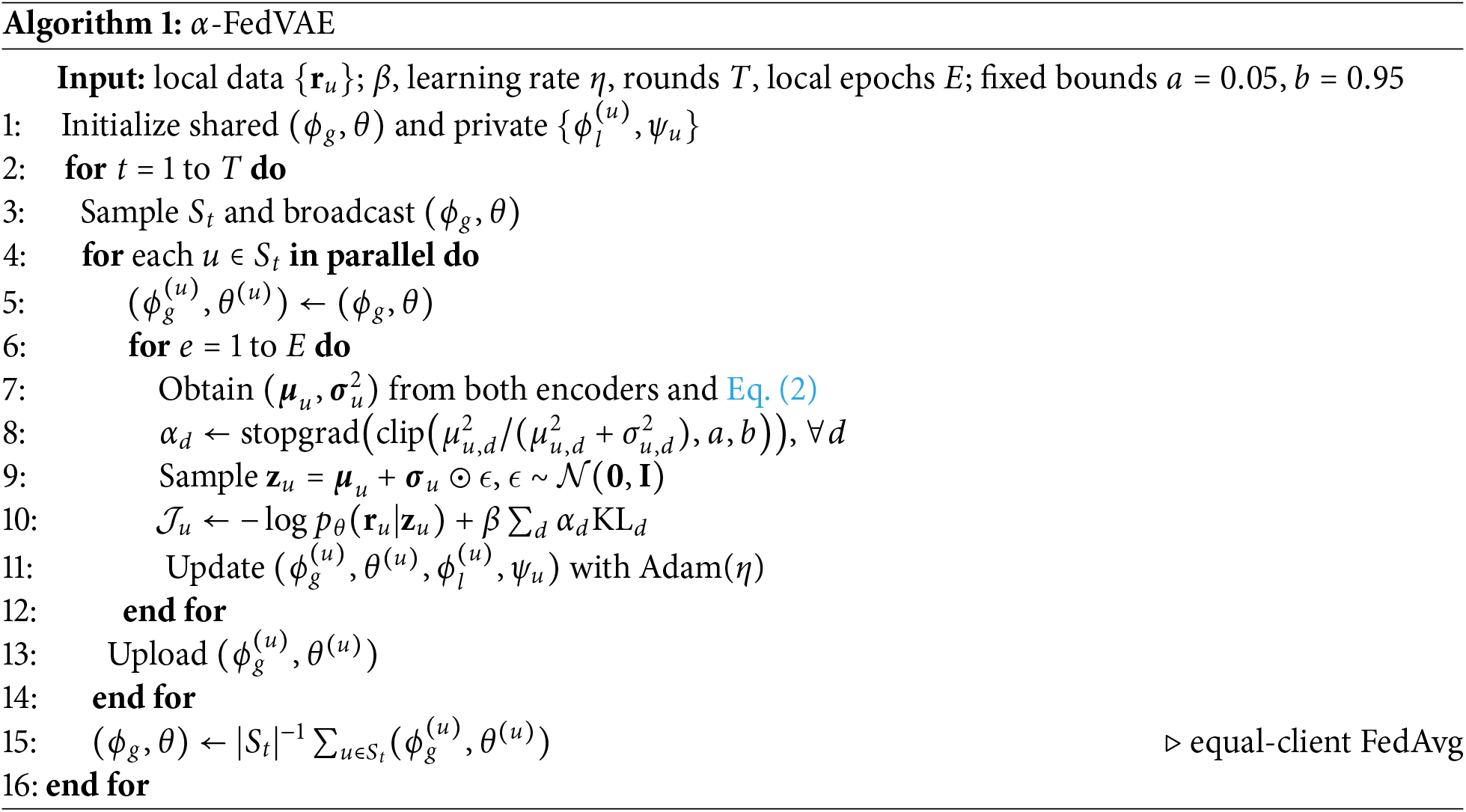
Algorithm 1 summarizes training. The server maintains
Relative to FedAvg [5], the only changes are the detached, clipped coefficient at line 8 and per-dimension KL weighting at line 10. Each participating client transfers
The server never observes
Operationally, a selected client combines the received shared model with its persistent private encoder and fusion parameters for
We characterize the gate through an ARD-like mean-gradient analogy, an aggregate gate-strength bound, and a conditional descent decomposition under gate variation.
Proposition 1 (ARD-Like Mean-Gradient Analogy): With
The proof of Proposition 1 is provided in Appendix A.
For the posterior mean, the gated gradient
Theorem 1 (Bounded Aggregate Gate Strength): Let
Hence
The proof of Theorem 1 is provided in Appendix B.
The variance floor makes the bound finite. Posterior mean norm is the signal quantity appearing in the bound: as the norm vanishes,
Proposition 2 (Conditional Descent under Gate Variation): Let
The proof of Proposition 2 is provided in Appendix C.
The first terms are standard optimization and client drift [30];
We evaluate recommendation accuracy, sparsity behavior, sensitivity, convergence, and overhead on three datasets.
MovieLens-100K (ML-100K: 100,000 interactions, 943 users, 1682 items, 93.70% sparsity) and MovieLens-1M (ML-1M: 1,000,209 interactions, 6040 users, 3706 items, 95.53% sparsity) are movie benchmarks [32]; Amazon Video (Video: 23,181 interactions, 1372 users, 7957 items, 99.79% sparsity) is a sparse e-commerce dataset [33]. The logged files are treated as implicit feedback. Their minimum history lengths are 20 for both MovieLens datasets and 10 for Video. The logged leave-one-out protocol reserves one interaction per user for validation and one for testing.
Federated baselines are FedVAE [20], PFedRec [15], FedRAP [16], and the dual-encoder FedDAE [10]. VAE-based methods share latent size, encoder/decoder capacity, optimizer, communication rounds, client sampling, and local epochs;
Each user is a naturally non-IID client. The server uses equal-client FedAvg,
The reviewer-requested controls in Tables 2–5 follow their logged 30-round configuration: seeds
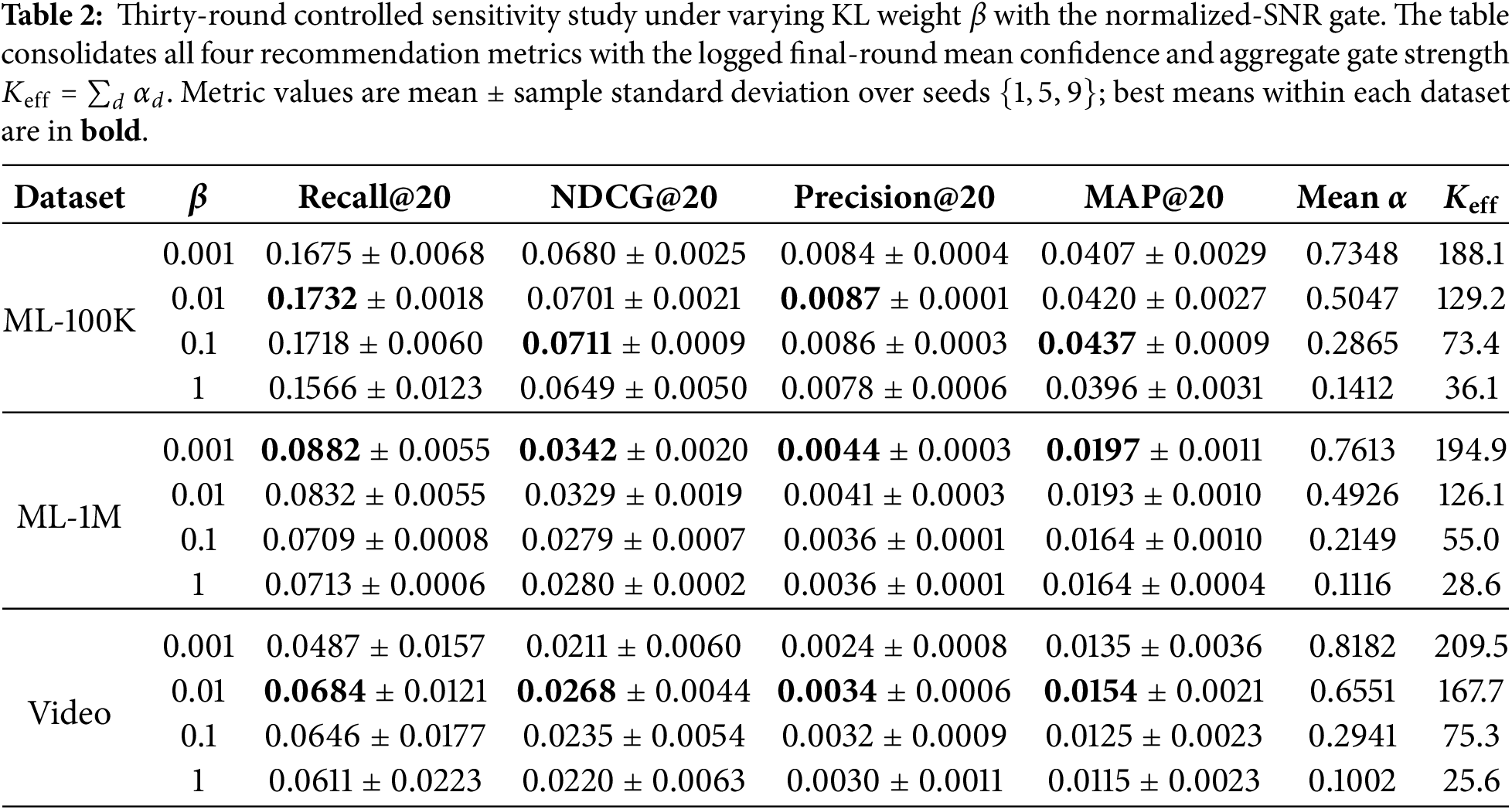
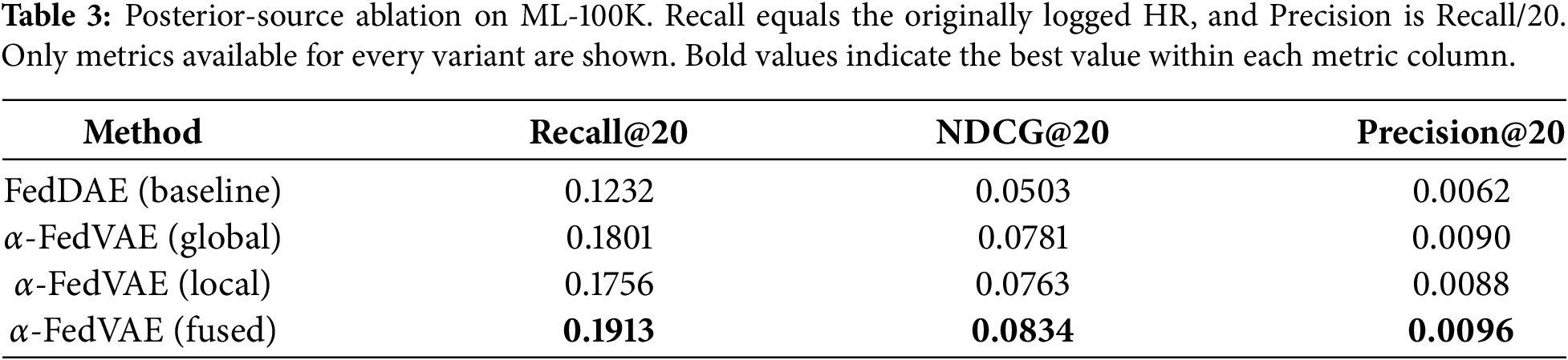
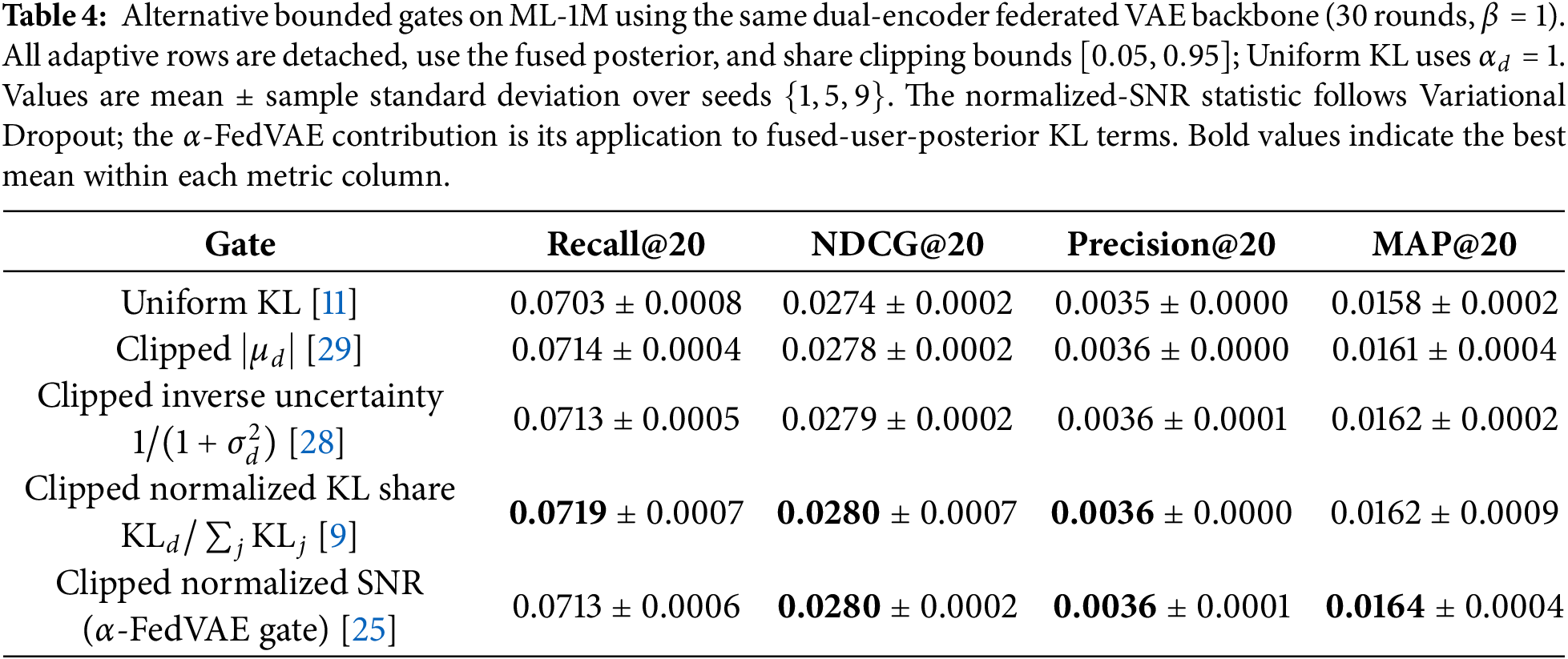
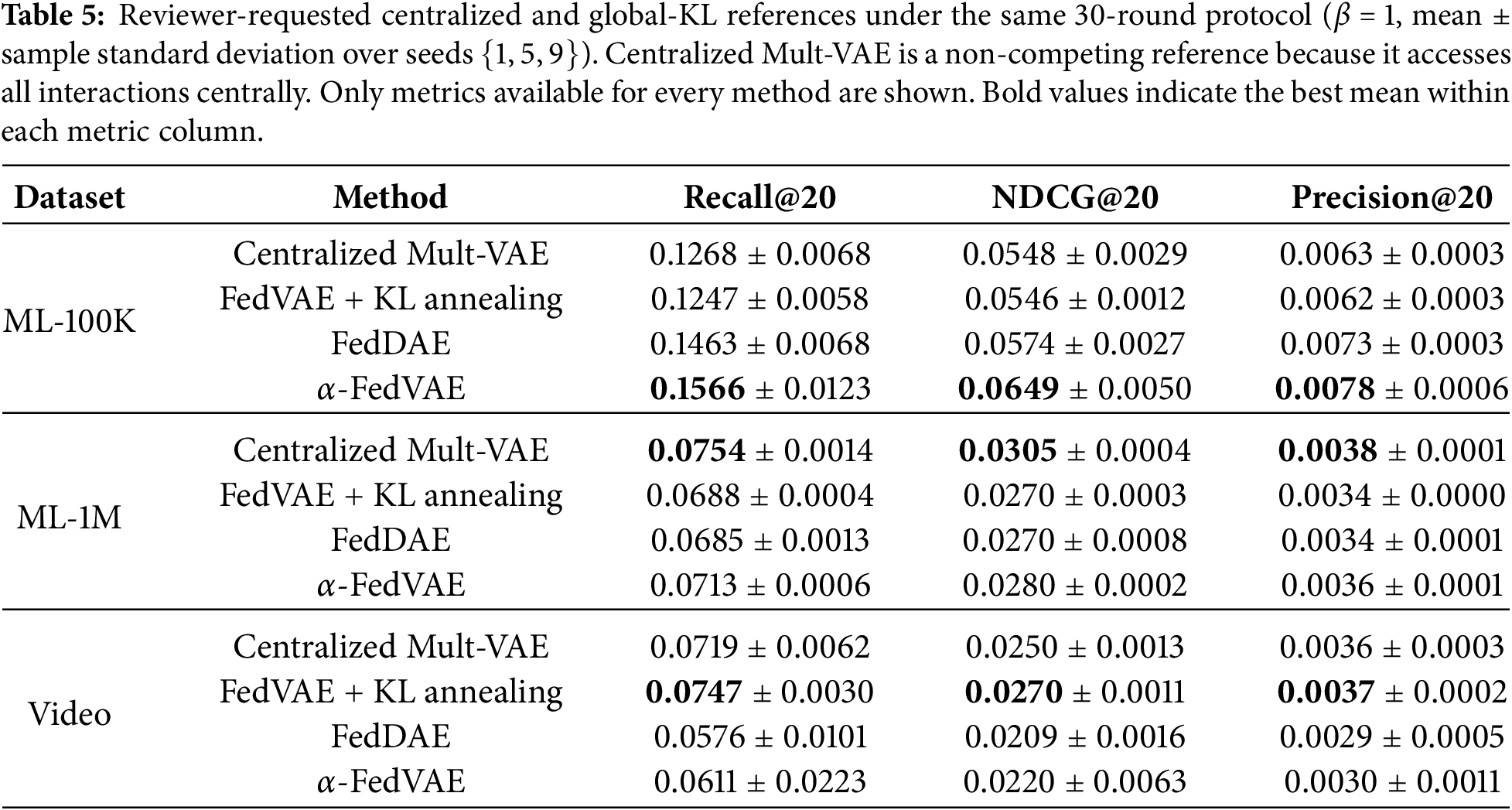
Tables report mean ± sample standard deviation. For the matched 30-round
At
More precisely, let
With one relevant test item, these are the leave-one-out forms of the standard metrics: Recall equals HR, Precision equals Recall
Under the 100-round, validation-selected
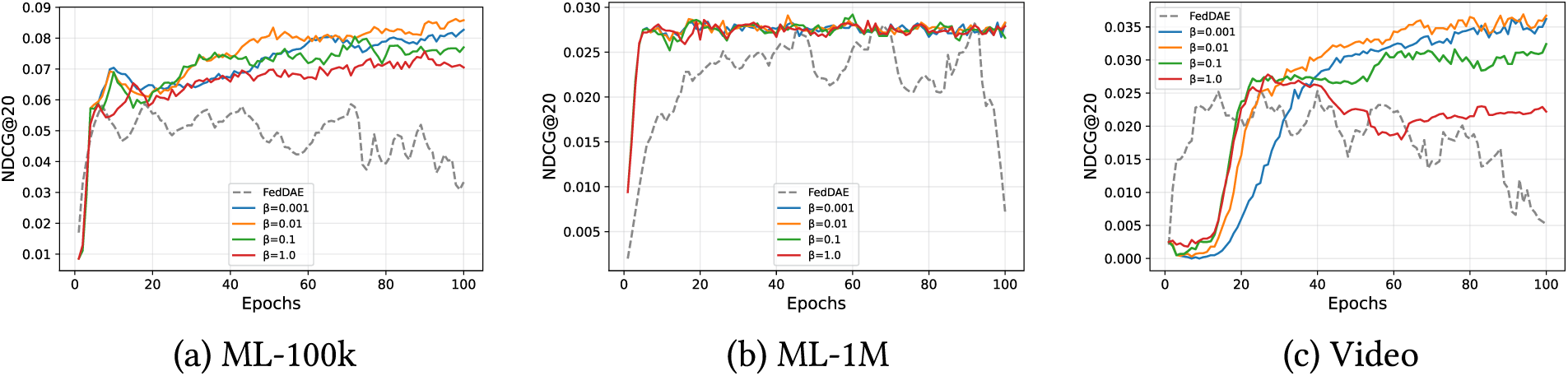
Figure 2: NDCG@20 convergence over 100 rounds.
ML-100K combines moderate sparsity with a relatively small client population, where the fused global/local posterior can provide differentiated confidence across dimensions. Video is substantially sparser and has lower absolute scores, yet confidence gating still improves both hit occurrence and ranking quality. This indicates that the method can remain useful under severe sparsity, although the later popularity analysis shows that the improvement should not be interpreted as success on tail items.
ML-1M yields smaller mean gains. Its larger user population and denser histories give FedDAE a stronger starting point, leaving less scope for changing the KL allocation alone. Together, the datasets suggest that the benefit depends on both sparsity and the quality of posterior estimates rather than increasing monotonically with catalog sparsity. The convergence curves support optimization stability but are not used to infer an unreported convergence threshold.
Table 2 shows that gating remains
6.4 Ablation and Confidence Analysis
Table 4 uses bounded counterparts of the suggested signal families to avoid singular raw precision and place every coefficient in the same allowed interval. This common interval does not equalize the empirical gate distributions: in particular, a normalized KL share can concentrate near the clipping floor when
Under the shared 30-round budget, splits, and seeds,
For the matched
Table 3 isolates posterior source: fused confidence performs best (HR@20 0.1913), ahead of global (0.1801) and local (0.1756), supporting fusion within this architecture.
6.5 Per-User Performance Analysis
Table 6 stratifies ML-100K by user activity and test-item popularity; these descriptive results are separate from the significance tests.
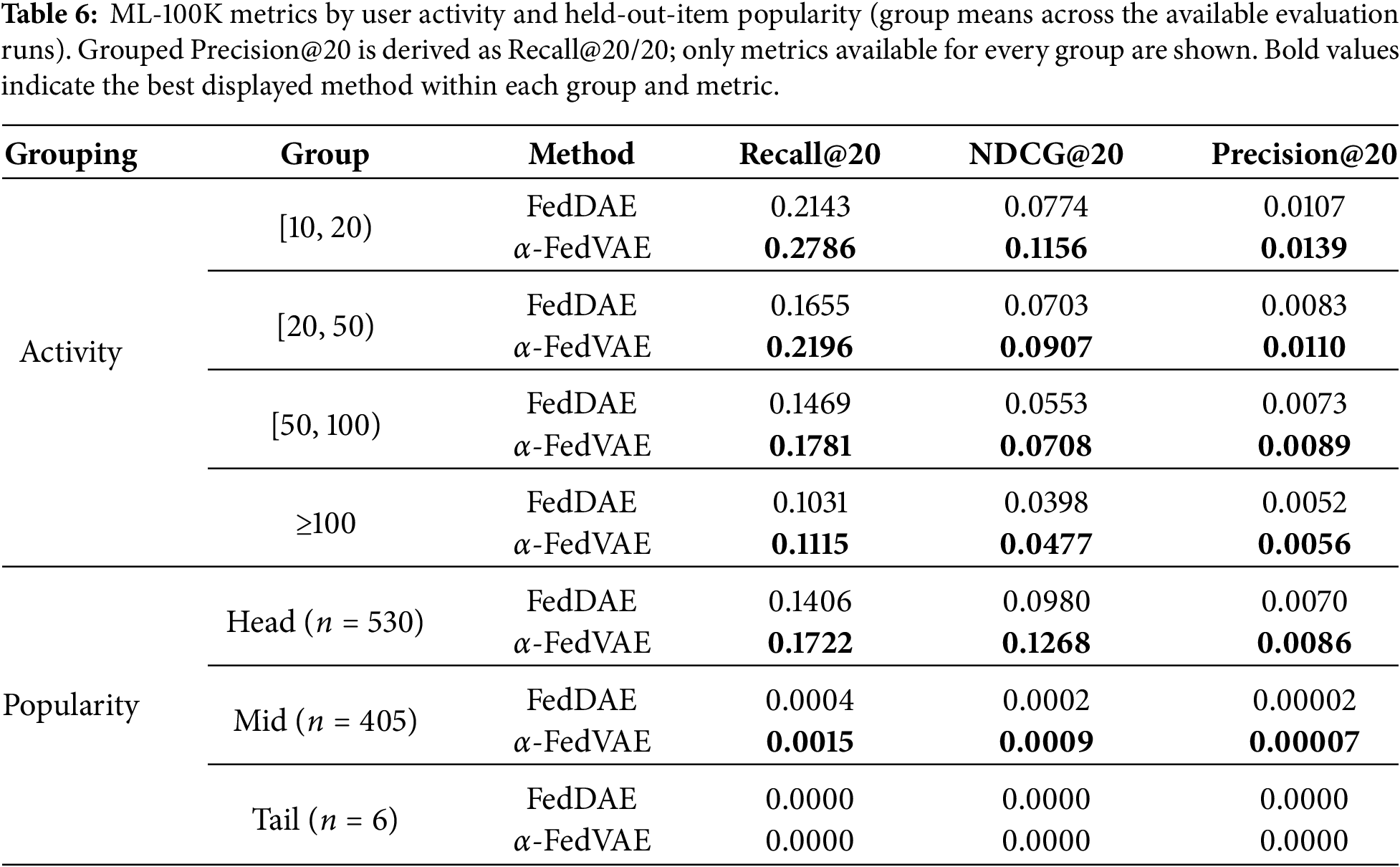
The relative NDCG gain decreases from 49.4% for the least-active group to 19.7% for users with at least 100 interactions, consistent with the sparse-user motivation. Head-item Recall/NDCG rises from 0.1406/0.0980 to 0.1722/0.1268, but both methods have zero hits among only six tail cases; most evidence therefore concerns head items, not tail recommendation.
Interaction count is only an observable proxy for data richness: two equally active users may still have posteriors with different uncertainty. Because gate strength was not logged by activity group, these accuracy results do not test or prove a monotone relationship between history length and
6.6 Computational Overhead Analysis
Extreme cold-start users may yield unreliable posterior means and variances, so side information or sequential context may be needed. Highly skewed popularity may concentrate confidence on head factors; the six-case ML-100K tail group provides no positive evidence, and most popularity evidence concerns head items.
The privacy scope is data decentralization, not secure aggregation, differential privacy, or homomorphic encryption; these mechanisms may alter optimization and require separate evaluation. The ML-1M gate study has different Recall and MAP leaders and no cross-dataset ranking. Explicit-feedback, sequential, cross-domain, rapidly changing, and substantially larger client populations remain untested.
The method also depends on the quality of posterior uncertainty. Misspecified variances can produce a bounded but poorly ranked confidence signal, and clipping prevents degeneracy without calibrating that signal. The fixed bounds
Calibration and recommendation diversity were not measured, so no conclusion is drawn for either criterion.
We introduced a detached, clipped posterior-confidence gate that changes dimension-wise KL allocation without learned gate parameters, extra payload, or inference cost. Theory provides a scoped ARD-like mean-gradient analogy, a clipping-consistent aggregate gate-strength bound, and conditional descent with variation budgets. Across three datasets, descriptive 100-round mean HR@20 and NDCG@20 gains over FedDAE are 7.8%–55.3% and 8.0%–65.8%, with the strongest activity-group gain among the least-active evaluated users. Controlled results limit the claim: the three-seed tests are exploratory, annealing can lead, and no gate is uniquely optimal. The mechanism is applicable to data-decentralized recommendation where records cannot be centralized, subject to the reported timing, privacy, and evidence boundaries.
Local, communication-neutral gating suits decentralized media, e-commerce, mobile, and healthcare personalization. Future work should test stronger privacy, larger federations, sequential recommendation, popularity debiasing, and cold-start side information.
Acknowledgement: Not applicable.
Funding Statement: Not applicable.
Author Contributions: Conceptualization, Jincheng Cai and Li Feng; methodology, Jincheng Cai; software, Jincheng Cai; validation, Jincheng Cai and Ni Zhao; formal analysis, Jincheng Cai; investigation, Jincheng Cai; resources, Li Feng and Ni Zhao; data curation, Jincheng Cai; writing—original draft preparation, Jincheng Cai; writing—review and editing, Li Feng and Ni Zhao; supervision, Li Feng; project administration, Li Feng. All authors reviewed and approved the final version of the manuscript.
Availability of Data and Materials: The datasets used in this study are publicly available: MovieLens datasets are available from GroupLens, and Amazon review data are available from the public Amazon review dataset collection. The processed data and implementation details are available from the corresponding author upon reasonable request.
Ethics Approval: Not applicable.
Conflicts of Interest: The authors declare no conflicts of interest.
Appendix A. Proof of the ARD-Like Mean-Gradient Analogy
Proof: For
The equality concerns shrinkage of the posterior mean. The variance component of the Gaussian KL, the evolution of
Appendix B. Proof of Bounded Aggregate Gate Strength
Proof: Let
For
The result is an upper bound on aggregate gate strength, not an equality or monotonic relationship involving interaction count. It formalizes only the limiting case of weak posterior-mean signal under a nonzero variance floor; the activity analysis reports recommendation accuracy by history length and does not test gate-strength monotonicity.
Appendix C. Derivation of Conditional Descent Bound
Proof: At round
The descent terms do not telescope directly because
References
1. Ko H, Lee S, Park Y, Choi A. A survey of recommendation systems: recommendation models, techniques, and application fields. Electronics. 2022;11(1):141. [Google Scholar]
2. Zhang S, Yao L, Sun A, Tay Y. Deep learning based recommender system: a survey and new perspectives. ACM Comput Surv. 2019;52(1):5. doi:10.1145/3285029. [Google Scholar] [CrossRef]
3. Koren Y, Bell R, Volinsky C. Matrix factorization techniques for recommender systems. Computer. 2009;42(8):30–7. doi:10.1109/mc.2009.263. [Google Scholar] [CrossRef]
4. Voigt P, Von dem Bussche A. The EU general data protection regulation (GDPR). A practical guide. 1st ed. Berlin/Heidelberg, Germany: Springer; 2017. [Google Scholar]
5. McMahan B, Moore E, Ramage D, Hampson S, Aguera y Arcas B. Communication-efficient learning of deep networks from decentralized data. In: Proceedings of the 20th International Conference on Artificial Intelligence and Statistics (AISTATS); 2017 Apr 20–22; Fort Lauderdale, FL, USA. p. 1273–82. [Google Scholar]
6. Kairouz P, McMahan HB, Avent B, Bellet A, Bennis M, Bhagoji AN, et al. Advances and open problems in federated learning. Found Trends Mach Learn. 2021;14(1–2):1–210. doi:10.1561/2200000083. [Google Scholar] [CrossRef]
7. Ammad-Ud-Din M, Ivannikova E, Khan SA, Oyomno W, Fu Q. Federated collaborative filtering for privacy-preserving personalized recommendation system. arXiv:1901.09888. 2019. [Google Scholar]
8. Chai D, Wang L, Chen K, Yang Q. Secure federated matrix factorization. IEEE Intell Syst. 2021;36(5):11–20. doi:10.1109/MIS.2020.3014880. [Google Scholar] [CrossRef]
9. Kingma DP, Welling M. Auto-encoding variational Bayes. arXiv:1312.6114. 2013. [Google Scholar]
10. Li Z, Long G, Zhou T, Jiang J, Zhang C. Personalized federated collaborative filtering: a variational autoencoder approach. Proc AAAI Conf Artif Intell. 2025;39(17):18602–10. doi:10.1609/aaai.v39i17.34047. [Google Scholar] [CrossRef]
11. Higgins I, Matthey B, Pal A, Burgess C, Glorot X, McWilliams M, et al. β-VAE: learning basic visual concepts with a constrained variational framework. In: Proceedings of the International Conference on Learning Representations (ICLR); 2017 Apr 24–26; Toulon, France. [Google Scholar]
12. Liang D, Krishnan RG, Hoffman MD, Jebara T. Variational autoencoders for collaborative filtering. In: Proceedings of the International World Wide Web Conference (WWW); 2018 Apr 23–27; Lyon, France. p. 689–98. [Google Scholar]
13. Jiang X, Liu B, Qin J, Zhang Y, FedNCF QJ. Federated neural collaborative filtering for privacy-preserving recommender system. In: Proceedings of the International Joint Conference on Neural Networks (IJCNN); 2022 Jul 18–23; Padua, Italy. p. 1–8. [Google Scholar]
14. Arivazhagan MG, Aggarwal V, Singh AK, Choudhary S. Federated learning with personalization layers. arXiv:1912.00818. 2019. [Google Scholar]
15. Zhang C, Long G, Zhou T, Yan P, Zhang Z, Zhang C, et al. Dual personalization on federated recommendation. In: Proceedings of the Thirty-Second International Joint Conference on Artificial Intelligence (IJCAI); 2023 Aug 19–25; Macau, China. p. 4558–66. doi:10.24963/ijcai.2023/507. [Google Scholar] [CrossRef]
16. Li Z, Long G, Zhou T. Federated recommendation with additive personalization. In: Proceedings of the International Conference on Learning Representations (ICLR); 2024 May 7–11; Vienna, Austria. [Google Scholar]
17. Shen J, Mi Y, Zhao G, Shen J, Qian X. A model-agnostic strategy to mitigate embedding degradation in personalized federated recommendation. arXiv:2508.19591. 2025. [Google Scholar]
18. Zhang H, Li C, Dai W, Zou J, FedCR XH. Personalized federated learning based on across-client common representation with conditional mutual information regularization. In: Proceedings of the International Conference on Machine Learning (ICML); 2023 Jul 23–29; Honolulu, HI, USA. p. 41314–30. [Google Scholar]
19. Karimireddy SP, Kale S, Mohri M, Reddi S, Stich S, Suresh AT. SCAFFOLD: stochastic controlled averaging for federated learning. In: Proceedings of the International Conference on Machine Learning (ICML); 2020 Jul 12–18; Virtual. p. 5132–43. [Google Scholar]
20. Polato M. Federated variational autoencoder for collaborative filtering. In: Proceedings of the International Joint Conference on Neural Networks (IJCNN); 2021 Jul 18–22; Shenzhen, China. p. 1–8. [Google Scholar]
21. Zhang L, Rong Q, Ding X, Li G, Yuan L. EFVAE: efficient federated variational autoencoder for collaborative filtering. In: Proceedings of the ACM International Conference on Information and Knowledge Management (CIKM); 2024 Oct 21–25; Boise, ID, USA. p. 3176–85. [Google Scholar]
22. Yao D, Liu T, Cao Q, Jin H. FedRKG: a privacy-preserving federated recommendation framework via knowledge graph enhancement. In: Proceedings of the 18th International Conference on Green, Pervasive, and Cloud Computing (GPC); 2023 Sep 22–24; Harbin, China. p. 81–96. doi:10.1007/978-981-99-9896-8_6. [Google Scholar] [CrossRef]
23. He X, Deng K, Wang X, Li Y, Zhang Y, LightGCN WM. Simplifying and powering graph convolution network for recommendation. In: Proceedings of the ACM SIGIR Conference on Research and Development in Information Retrieval (SIGIR); 2020 Jul 25–30; Xi’an, China. p. 639–48. [Google Scholar]
24. Bowman SR, Vilnis L, Vinyals O, Dai AM, Jozefowicz R, Bengio S. Generating sentences from a continuous space. In: Proceedings of the Conference on Computational Natural Language Learning (CoNLL); 2016 Aug 11–12; Berlin, Germany. p. 10–21. [Google Scholar]
25. Kingma DP, Salimans T, Welling M. Variational dropout and the local reparameterization trick. In: Proceedings of the Advances in Neural Information Processing Systems (NeurIPS); 2015 Dec 7–12; Montreal, QC, Canada. p. 2575–83. [Google Scholar]
26. Sonderby CK, Raiko T, Maaloe L, Sonderby SK, Winther O. Ladder variational autoencoders. In: Proceedings of the Advances in Neural Information Processing Systems (NeurIPS); 2016 Dec 5–10; Barcelona, Spain. p. 3738–46. [Google Scholar]
27. Shenbin I, Alekseev A, Tutubalina E, Malykh V, Nikolenko SI. RecVAE: a new variational autoencoder for top-N recommendations with implicit feedback. In: Proceedings of the ACM International Conference on Web Search and Data Mining (WSDM); 2020 Feb 3–7; Houston, TX, USA. p. 528–36. [Google Scholar]
28. MacKay DJC. Bayesian interpolation. Neural Comput. 1992;4(3):415–47. doi:10.1162/neco.1992.4.3.415. [Google Scholar] [CrossRef]
29. Tipping ME. Sparse Bayesian learning and the relevance vector machine. J Mach Learn Res. 2001;1:211–44. [Google Scholar]
30. Li T, Sanjabi M, Beirami A, Smith V. Federated optimization in heterogeneous networks. In: Proceedings of Machine Learning and Systems (MLSys); 2020 Mar 2–4; Austin, TX, USA. p. 429–50. [Google Scholar]
31. Ganguly B, Aggarwal V. Online federated learning via non-stationary detection and adaptation amidst concept drift. arXiv:2211.12578. 2022. doi:10.48550/arXiv.2211.12578. [Google Scholar] [CrossRef]
32. Harper FM, Konstan JA. The MovieLens datasets: history and context. ACM Trans Interact Intell Syst. 2015;5(4):19. doi:10.1145/2827872. [Google Scholar] [CrossRef]
33. Ni J, Li J, McAuley J. Justifying recommendations using distantly-labeled reviews and fine-grained aspects. In: Proceedings of the Conference on Empirical Methods in Natural Language Processing (EMNLP); 2019 Nov 3–7; Hong Kong, China. p. 188–97. [Google Scholar]
Cite This Article
 Copyright © 2026 The Author(s). Published by Tech Science Press.
This work is licensed under a Creative Commons Attribution 4.0 International License , which permits unrestricted use, distribution, and reproduction in any medium, provided the original work is properly cited.
 Downloads
 Citation Tools
