
 Login
Login Register
 Submit a Paper
 Propose a Special lssue
 Open Access
ARTICLE
An Improved Dream Optimization Algorithm-Driven Feature Selection Model for IoT Traffic Anomaly Detection
School of Computer Science and Artificial Intelligence, Hubei University of Technology, Wuhan, China
* Corresponding Author: Shuang Qu. Email:
(This article belongs to the Special Issue: Advances in IoT Security: Challenges, Solutions, and Future Applications, 2nd Edition)
Computers, Materials & Continua 2026, 89(2), 49 https://doi.org/10.32604/cmc.2026.087054
Received 09 June 2026; Accepted 28 July 2026; Issue published 15 September 2026
 View Full Text
 Download PDF
Abstract
With the rapid growth in the number of end devices in the Internet of Things (IoT), network traffic has become increasingly complex and redundant, while multiple attack types often coexist, posing major challenges to traffic anomaly detection. Traditional machine learning-based methods for IoT traffic anomaly detection often suffer from severe feature redundancy, high computational complexity, and low detection efficiency, making it difficult to simultaneously achieve high detection accuracy and computational efficiency. To address this issue, metaheuristic algorithms are often introduced in the feature selection stage to reduce feature redundancy and improve detection efficiency. However, the original Dream Optimization Algorithm (DOA) still has limitations when handling complex optimization problems such as feature selection for IoT traffic anomaly detection, including reduced population diversity in later iterations, insufficient global exploration capability, and a tendency to fall into local optima, which in turn affect the stability of feature selection and detection performance. Therefore, this paper proposes an Improved Dream Optimization Algorithm (IDOA) based on the original DOA, and further constructs an IDOA-based IoT traffic anomaly detection model for feature selection and classification tasks. Experimental results on benchmark functions and multiple publicly available datasets demonstrate the effectiveness and competitiveness of the proposed method. On four general-purpose classification benchmarks from the University of California, Irvine (UCI) Machine Learning Repository, IDOA demonstrates competitive feature-selection and classification performance. On the NF-ToN-IoT-v2 dataset, the binary classification accuracy reaches 98.01% with only 7.4 selected features on average, and the multiclass classification accuracy reaches 96.382% with 9.20 selected features on average. The experimental results indicate that the proposed method reduces feature redundancy and improves prediction efficiency in the evaluated offline setting while maintaining competitive detection accuracy.Keywords
With the rapid development of Internet of Things (IoT) technology, massive heterogeneous devices have been integrated into modern networks, supporting applications such as smart cities, industrial IoT, intelligent transportation, and smart healthcare. However, large-scale interconnection also expands the attack surface. Device heterogeneity, limited resources, diverse protocols, and weak built-in security mechanisms make IoT systems vulnerable to Distributed Denial-of-Service (DDoS) attacks, botnet control, and data theft [1–3]. Recent honeypot observations further show that IoT botnets continue to exploit brute-force attacks and protocol-specific vulnerabilities in cloud-connected environments [4]. Since such attacks are commonly reflected in anomalous traffic patterns, efficient traffic anomaly detection is critical for IoT security.
Traditional anomaly detection methods mainly rely on rules or statistical feature matching, making them highly dependent on prior knowledge and difficult to adapt to evolving attacks [5]. Machine learning and deep learning methods have therefore become widely used because of their strong representation capabilities [6–8]. Recent studies on Software-Defined Networking (SDN) and IoT security have also demonstrated the potential of deep learning and graph-based models for identifying abnormal traffic patterns [9–11].
Recent cybersecurity event-detection systems increasingly focus on complex environments such as SDN-enabled networks and IoT infrastructures. Deep learning-based DDoS detection and SDN intrusion detection models have been developed to capture abnormal traffic behaviors [7,8]. Hybrid deep learning models combine different neural architectures to improve traffic representation [9,10], while graph neural networks model structural relationships in IoT traffic [11]. However, these methods are generally classifier- or representation-oriented and often rely on relatively complete feature sets. Consequently, feature redundancy, high-dimensional inputs, and unnecessary computational cost remain important issues, making feature selection an essential step in efficient IoT anomaly detection.
Learning-based methods also face challenges caused by redundant, irrelevant, and noisy traffic features. NetFlow records and packet-level statistics often contain dozens or hundreds of variables [12]. Using all features may increase computational cost, aggravate overfitting, and weaken generalization. Therefore, feature selection is important for reducing model complexity and improving detection efficiency [13,14]. Hybrid feature selection methods have also shown effectiveness in removing irrelevant and redundant features [15].
Recent work on dynamic edge networks has also emphasized lightweight decision-making for maintaining timely and usable services under changing request and resource conditions [16]. Such studies improve operational efficiency at the service-management level, whereas the present work addresses efficiency at the data-processing level by removing redundant traffic features before anomaly classification. This complementary perspective supports efficient operation in resource-constrained IoT environments.
Wrapper-based feature selection using metaheuristic algorithms has attracted considerable attention because of its global search capability [17]. Particle Swarm Optimization (PSO), Grey Wolf Optimizer (GWO), Whale Optimization Algorithm (WOA), and Genetic Algorithm (GA) have been widely applied to feature selection and optimization [18–21]. In traffic anomaly detection, combining feature selection with intelligent classifiers can balance detection performance and computational cost [22]. Improved butterfly optimization, jump spider optimization, and dung beetle optimization have also been applied to intrusion-detection feature selection [23–25]. In addition, the Honey Badger Algorithm has been used to optimize a hybrid autoencoder and gated recurrent unit model for IoT cyber threat detection [26].
Despite these advances, metaheuristic algorithms may still suffer from exploration–exploitation imbalance, premature convergence, and population diversity loss in complex feature spaces [27,28]. Lang and Gao proposed the Dream Optimization Algorithm (DOA), inspired by human dreaming [29]. DOA is selected as the baseline optimizer because its memory, forgetting-and-replenishment, and dream-sharing mechanisms provide a suitable framework for targeted improvement. However, its deterministic memory update and limited perturbation strategy may restrict population diversity, global exploration, and convergence accuracy in traffic feature selection.
To address these limitations, this paper proposes an Improved Dream Optimization Algorithm (IDOA). By incorporating a Lévy-flight-based adaptive perturbation mechanism, an elite learning strategy, and an improved memory strategy, IDOA enhances the exploration capability and convergence stability of DOA. An IDOA-based IoT traffic anomaly detection model is further constructed to integrate feature selection with classification. The main contributions are as follows:
(1) An improved Dream Optimization Algorithm is proposed to reduce redundant traffic features in IoT anomaly detection.
(2) An IDOA-based anomaly detection model is constructed to integrate feature selection and classification.
(3) Experiments on benchmark functions and public datasets demonstrate the convergence, stability, and detection performance of the proposed method.
The remainder of this paper is organized as follows. Section 2 introduces DOA. Section 3 presents the improvement strategies. Section 4 describes the IDOA-based IoT traffic anomaly detection model. Section 5 reports the experiments and results. Section 6 concludes the paper and discusses future work.
2 Dream Optimization Algorithm
The Dream Optimization Algorithm (DOA) is a novel metaheuristic optimization algorithm inspired by human dreaming, in which mechanisms such as memory retention, partial forgetting, and logical self-organization are mathematically modeled to achieve effective global exploration and local exploitation.
DOA first generates an initial population randomly within the search space, which is formulated as follows:
where
Accordingly, the initialized population can be expressed as
where
2.2 Exploration and Exploitation Phases
The optimization process of DOA consists of an exploration phase (
(1) Memory strategy
In the exploration phase, the memory strategy is based on the group-best individual:
where
In the exploitation phase, the memory strategy is based on the global-best individual:
where
(2) Forgetting-and-replenishment strategy
Both phases use the following update rule:
where
The cosine term adaptively balances global exploration and local exploitation. In feature selection, a “forgotten dimension” refers to a decision variable selected for replacement, and the replenished value may change whether the corresponding feature is retained after binarization.
(3) Dream-sharing strategy
Both phases employ the same sharing mechanism:
where
The key parameter settings of DOA are given as follows:
• Maximum number of iterations in the exploration phase:
• Number of forgotten dimensions for each group in the exploration phase:
where
• Number of forgotten dimensions in the exploitation phase:
• Strategy selection probability:
DOA employs two boundary-handling strategies.
• Handling for low-dimensional problems (
• Handling for high-dimensional problems (
These strategies ensure that all variables remain within the search space.
2.5 Algorithm Complexity Analysis
The computational cost of DOA mainly arises from population initialization, position updating, and fitness evaluation. Population initialization requires
DOA provides a flexible framework for balancing exploration and exploitation through its memory, forgetting-and-replenishment, and dream-sharing mechanisms. However, its deterministic memory reset, cosine-based perturbation, and limited use of elite information may reduce population diversity and convergence performance in complex feature-selection tasks. Therefore, IDOA introduces adaptive Lévy-flight perturbation, elite learning, and probabilistic memory updating to improve global exploration and convergence stability.
3.1 Lévy-Flight-Based Adaptive Perturbation Strategy
Lévy flight is a heavy-tailed random walk with occasional long-range jumps, which helps enhance global exploration and avoid local optima. In IDOA, it replaces the random perturbation mechanism in both the exploration and exploitation phases of DOA. A smaller
The step length of Lévy flight is generated by the Mantegna algorithm:
where
The adaptive step-size scaling factor is defined as
and the adaptive Lévy distribution parameter is given by
These adaptive parameters are updated according to the iteration progress and do not require additional problem-specific tuning.
The elite learning strategy guides individuals toward the current best solution to improve convergence, while a random perturbation term is introduced to maintain population diversity. At iteration
The elite learning update is formulated as
where
In the original DOA, individuals are deterministically reset to the group-best solution in the exploration phase or the global-best solution in the exploitation phase before perturbation, which may cause premature aggregation. IDOA introduces a probabilistic memory mechanism, using a high reset probability in the early stage to accelerate convergence and a lower probability later to preserve population diversity.
The reset probability is linearly decreased as
During exploration, an individual is reset to the group-best solution
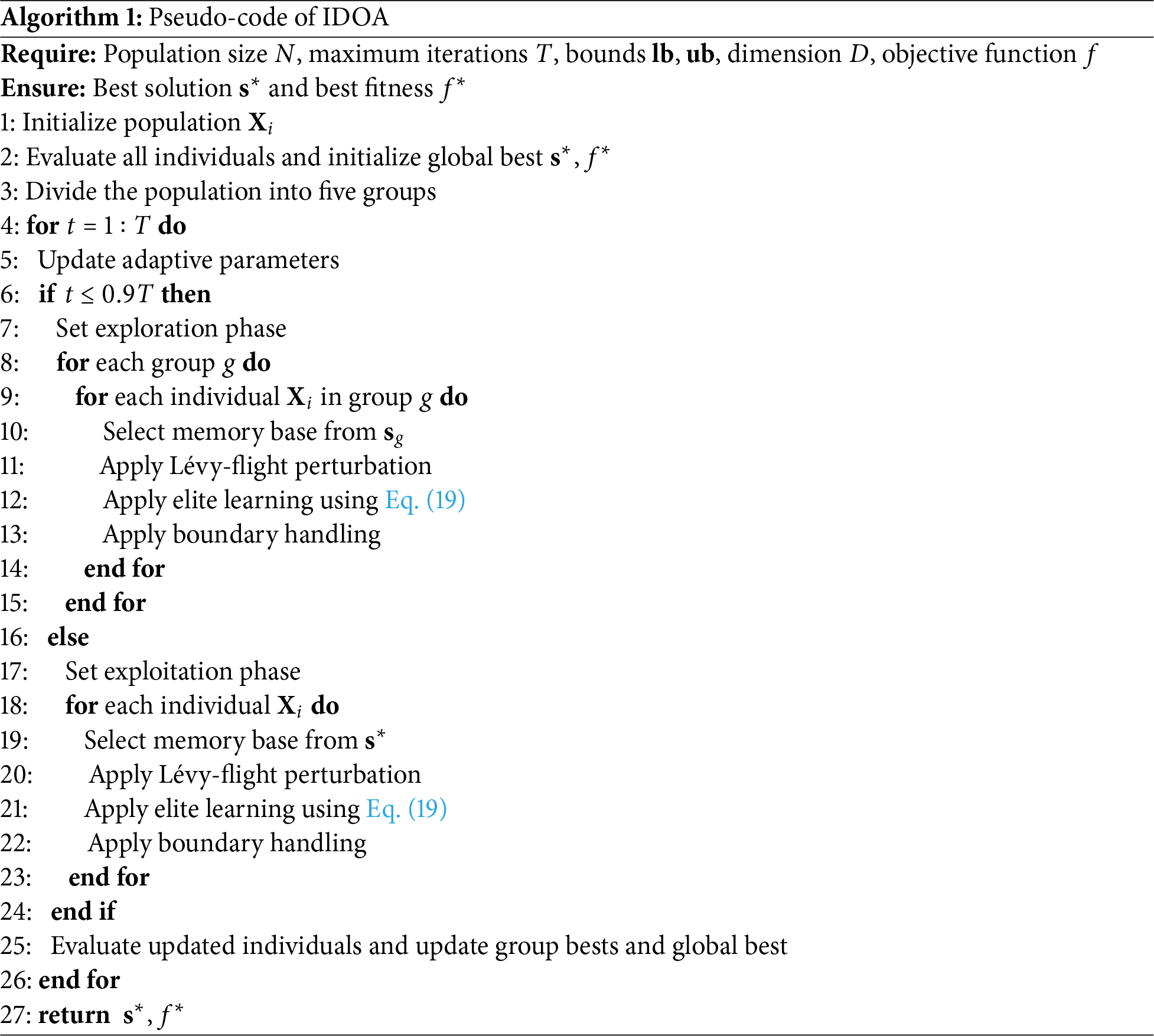
Algorithm 1 summarizes the main procedure of IDOA, including adaptive parameter updating, improved memory updating, Lévy-flight perturbation, elite learning, boundary handling, and best-solution updating.
3.5 Time Complexity Analysis of the Algorithm
Population initialization requires
The Mantegna-based Lévy-flight calculation and adaptive-parameter updating introduce only scalar operations, while Lévy perturbation, elite learning, and probabilistic memory updating require at most linear position updates over the population and feature dimensions. These strategies therefore do not change the dominant asymptotic order. Under the same wrapper-based evaluation setting, IDOA has the same dominant complexity order as DOA, PSO, GWO, and GA.
4 IDOA-Based Traffic Anomaly Detection Model
To improve the effectiveness and efficiency of IoT traffic anomaly detection, an IDOA-based traffic anomaly detection model is proposed. The proposed model employs IDOA for traffic feature selection to obtain a compact and discriminative feature subset, followed by KNN-based traffic anomaly detection. The model consists of four stages: data acquisition, data preprocessing, feature selection, and traffic classification. The overall architecture is shown in Fig. 1.
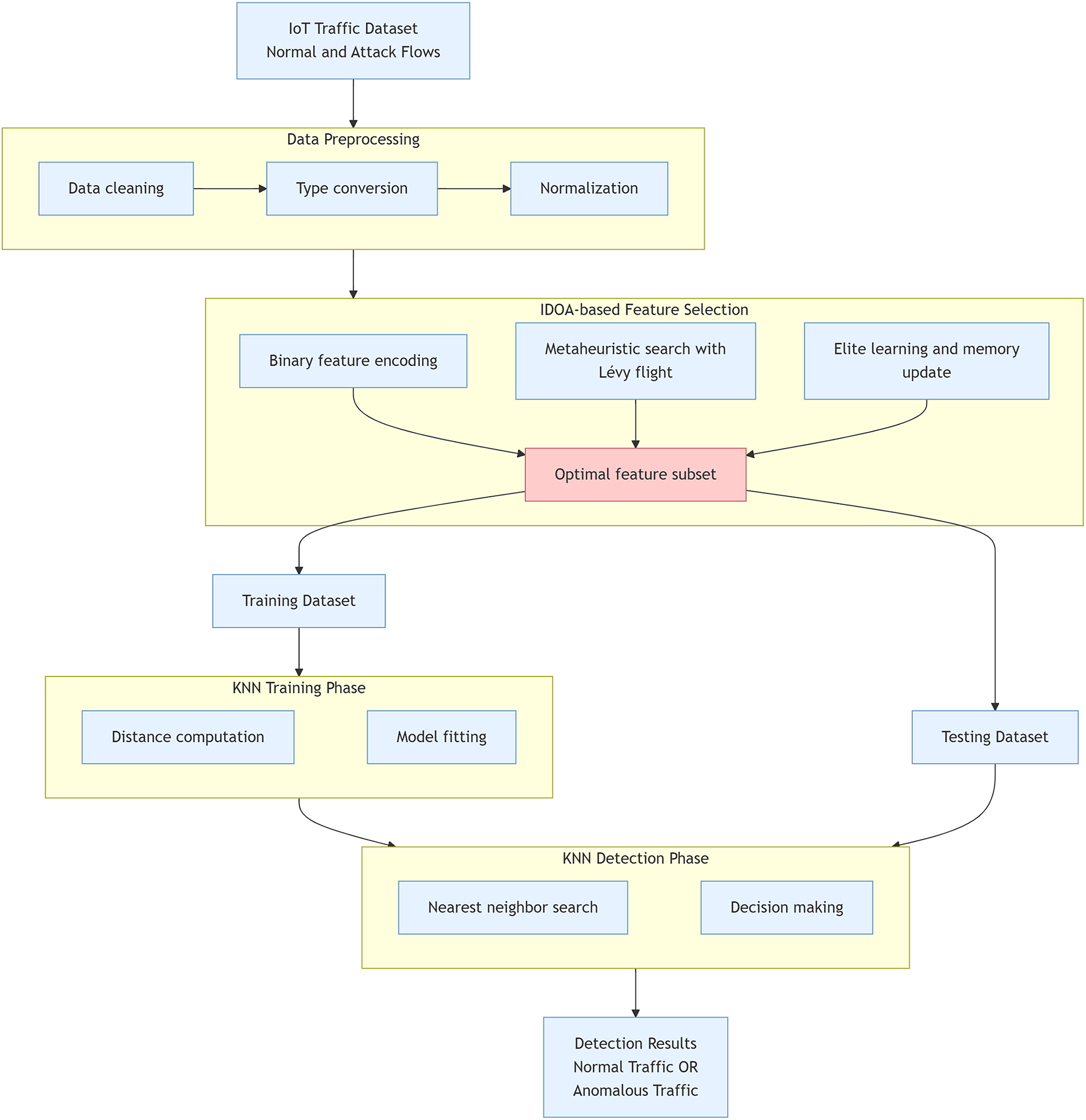
Figure 1: Overall workflow of the proposed IDOA-based IoT traffic anomaly detection model. IDOA and KNN denote the improved dream optimization algorithm and
(1) Data Acquisition Module
The data acquisition module is responsible for collecting raw IoT network traffic data. In this study, the NF-ToN-IoT-v2 dataset is used as the input, containing both normal and malicious traffic samples, thereby providing the data source for subsequent traffic anomaly detection.
(2) Data Preprocessing Module
The raw traffic data are first preprocessed to improve data quality and remove irrelevant information. The preprocessing procedure mainly includes the following steps:
• Data Cleaning: removing missing values, outliers, and redundant records;
• Type Conversion: converting categorical attributes into numerical representations;
• Normalization: scaling all features to a unified range before model training.
After preprocessing, the traffic data are transformed into normalized feature vectors for subsequent feature selection and classification.
(3) Feature Selection Module
After preprocessing, the improved Dream Optimization Algorithm (IDOA) is employed for IoT traffic feature selection, as shown in Fig. 2. Each individual is represented as a continuous position vector. Since feature selection is a binary optimization problem, each continuous position vector is converted into a binary feature mask before fitness evaluation according to the following thresholding rule:
where
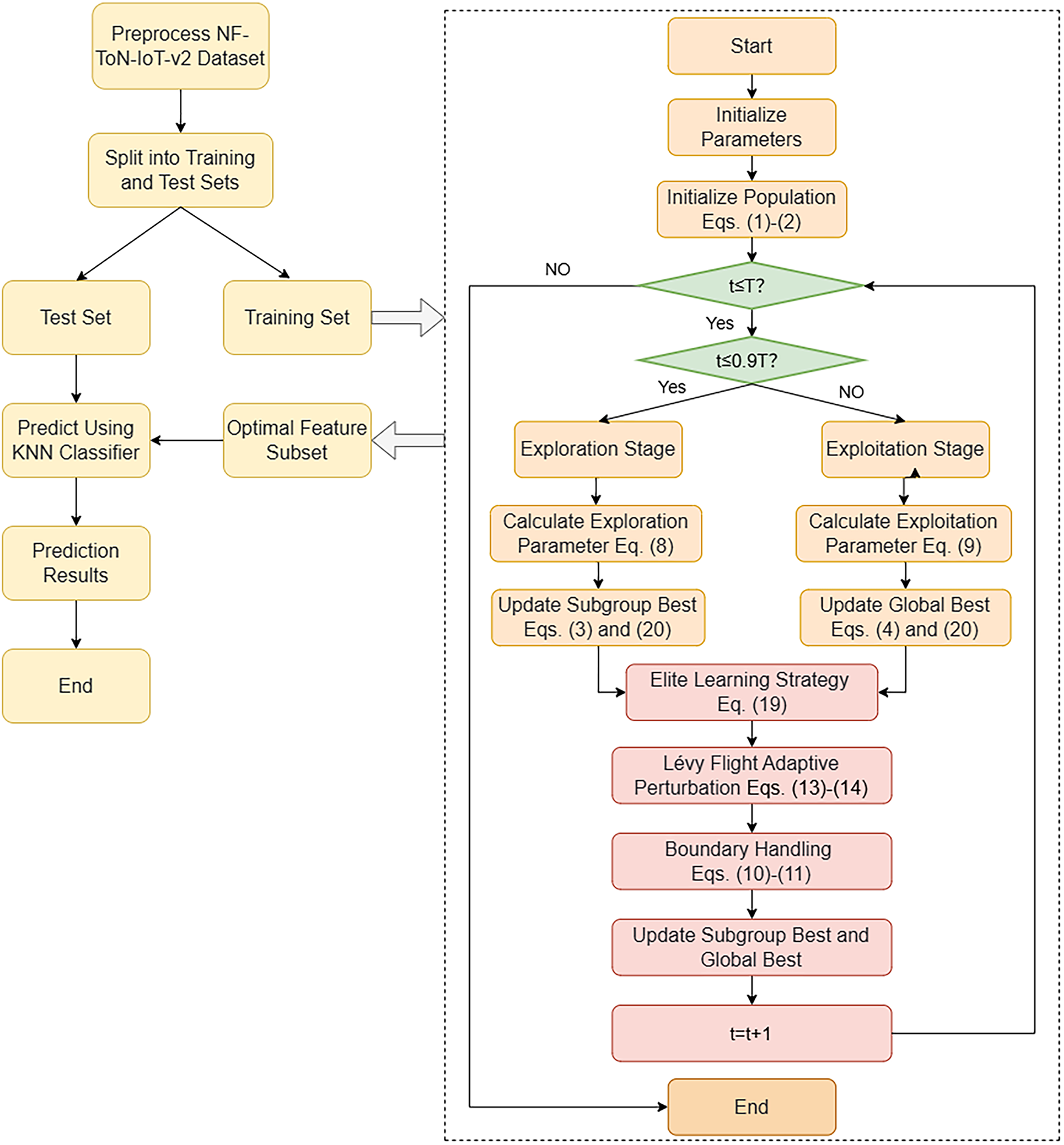
Figure 2: Feature selection flowchart of IDOA. IDOA and KNN denote the improved dream optimization algorithm and
The feature selection problem is formulated as a minimization problem by jointly considering the classification error and the number of selected features. The fitness function is defined as
where
Based on this fitness function, IDOA searches the feature space to obtain a compact and discriminative feature subset, thereby reducing feature redundancy and computational complexity while improving subsequent classification performance.
(4) Result Evaluation Module
The dataset is first partitioned using a stratified 5-fold cross-validation protocol. Within each fold, preprocessing steps requiring data-dependent parameter estimation, including normalization, are fitted exclusively on the training subset and then applied to the corresponding test subset. For each fold, feature selection is performed exclusively on the training subset using IDOA, while the corresponding test subset remains unseen during the feature selection process. The normalization parameters are estimated only from the training subset and then applied to the corresponding test subset. This protocol ensures that neither feature selection nor normalization uses any information from the test data, thereby preventing information leakage.
After obtaining the optimal feature subset, the KNN classifier is trained using the selected features from the training subset and evaluated on the corresponding test subset. This module consists of two stages:
• KNN Training Stage: model training based on the selected feature subset;
• KNN Detection Stage: classification of the test samples using the trained KNN classifier.
Finally, the network traffic is classified as normal or anomalous. The detection performance is evaluated using Accuracy, Recall, Precision, and F1-score.
5 Experimental Results and Analysis
This chapter evaluates the proposed IDOA algorithm in three aspects. First, benchmark functions are used to assess its convergence performance. Second, UCI datasets are adopted to verify its classification performance and generalization ability. Third, the NF-ToN-IoT-v2 dataset is used to validate its effectiveness in IoT traffic anomaly detection. KNN is adopted as the classifier in the classification experiments because of its simplicity and sensitivity to feature quality, making it suitable for evaluating the effectiveness of the proposed feature selection algorithm. All experiments were conducted on MATLAB R2024b using an Intel(R) Core(TM) i7-14650HX processor with a main frequency of 2.20 GHz.
The parameter settings of all optimization algorithms are summarized in Table 1. For a fair comparison, all algorithms used the same population size, iteration budget, and stopping criterion.
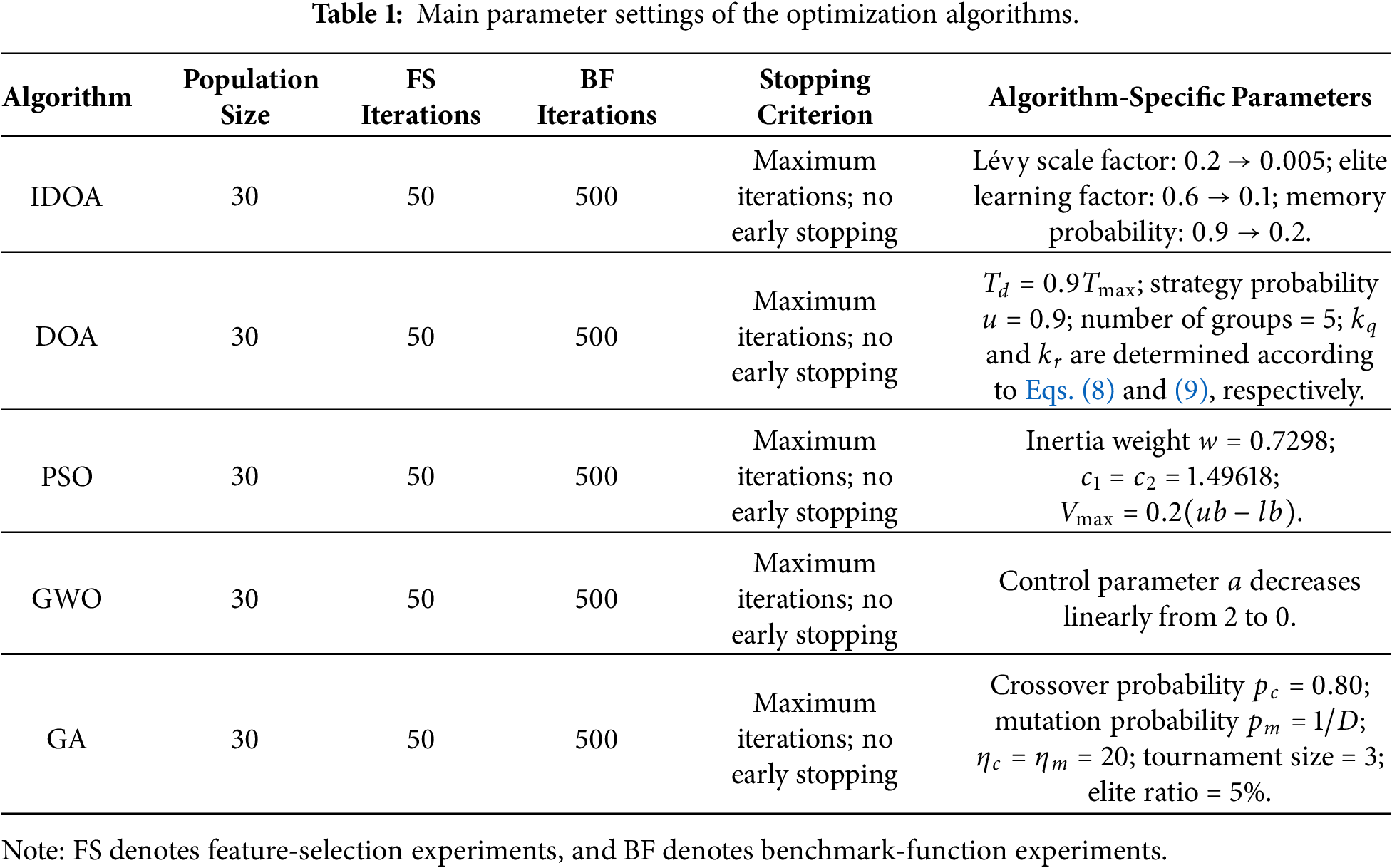
These parameters were kept fixed across all datasets and were not tuned separately for individual datasets. For reproducibility, the UCI experiments were repeated using random seeds 101–130, and the NF-ToN-IoT-v2 experiments were repeated using random seeds 101–106.
5.2 Benchmark Function Experiments
To evaluate the optimization performance and exploration capability of IDOA, six classical benchmark functions, including two unimodal (F1–F2) and four multimodal (F3–F6) functions, were employed. Table 2 summarizes their mathematical expressions, search ranges, and theoretical optimal values. The experimental results of IDOA and the comparison algorithms (DOA, PSO, GWO, and GA) are reported in Table 3, and the corresponding convergence curves are shown in Fig. 3.
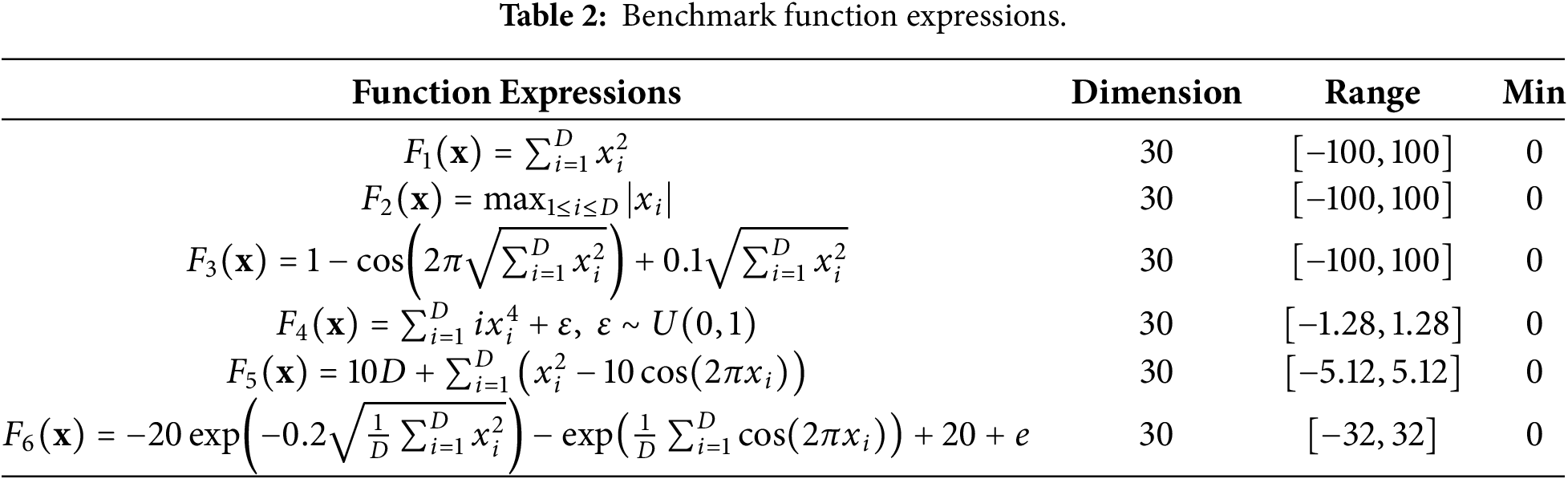
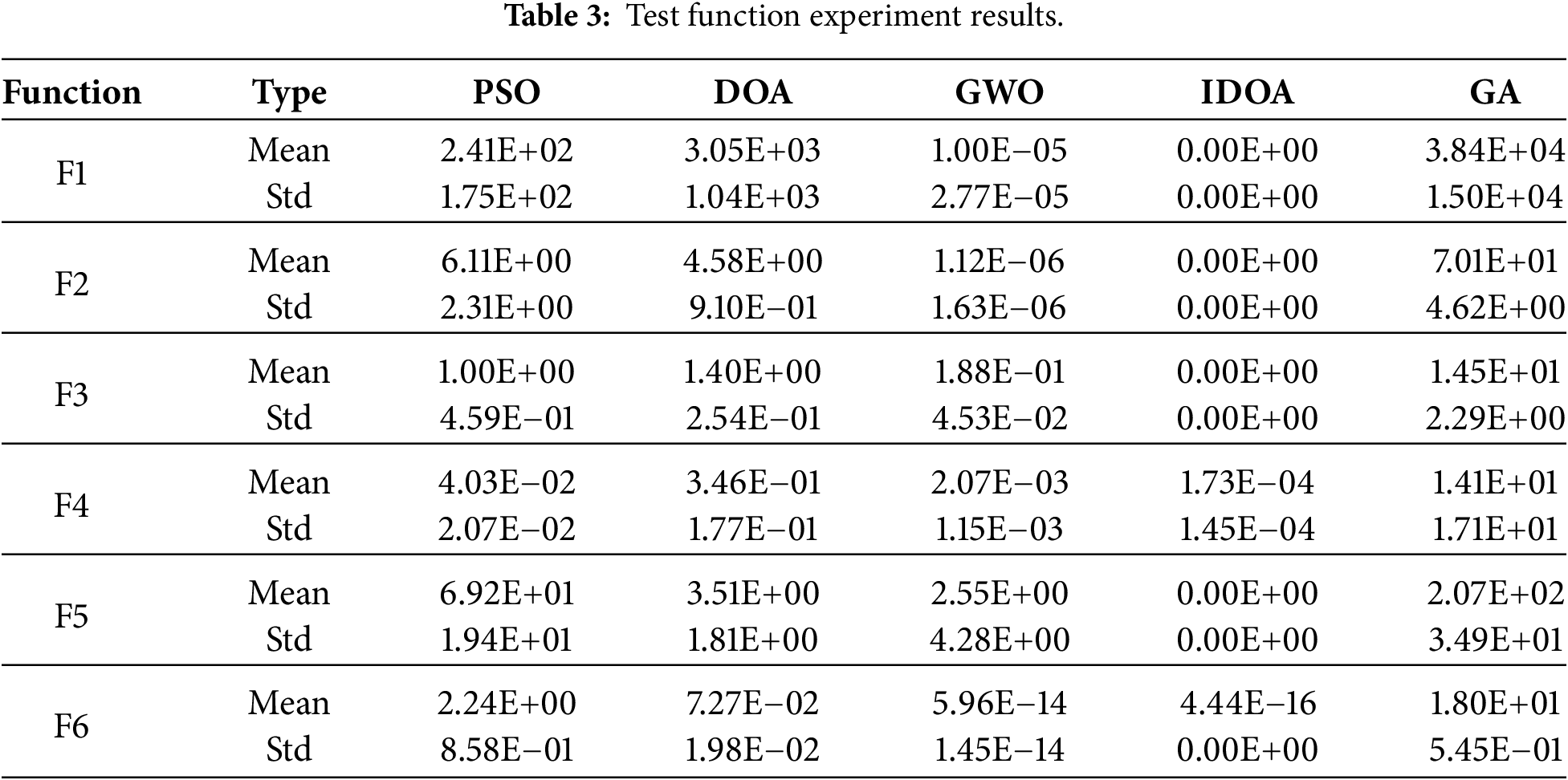
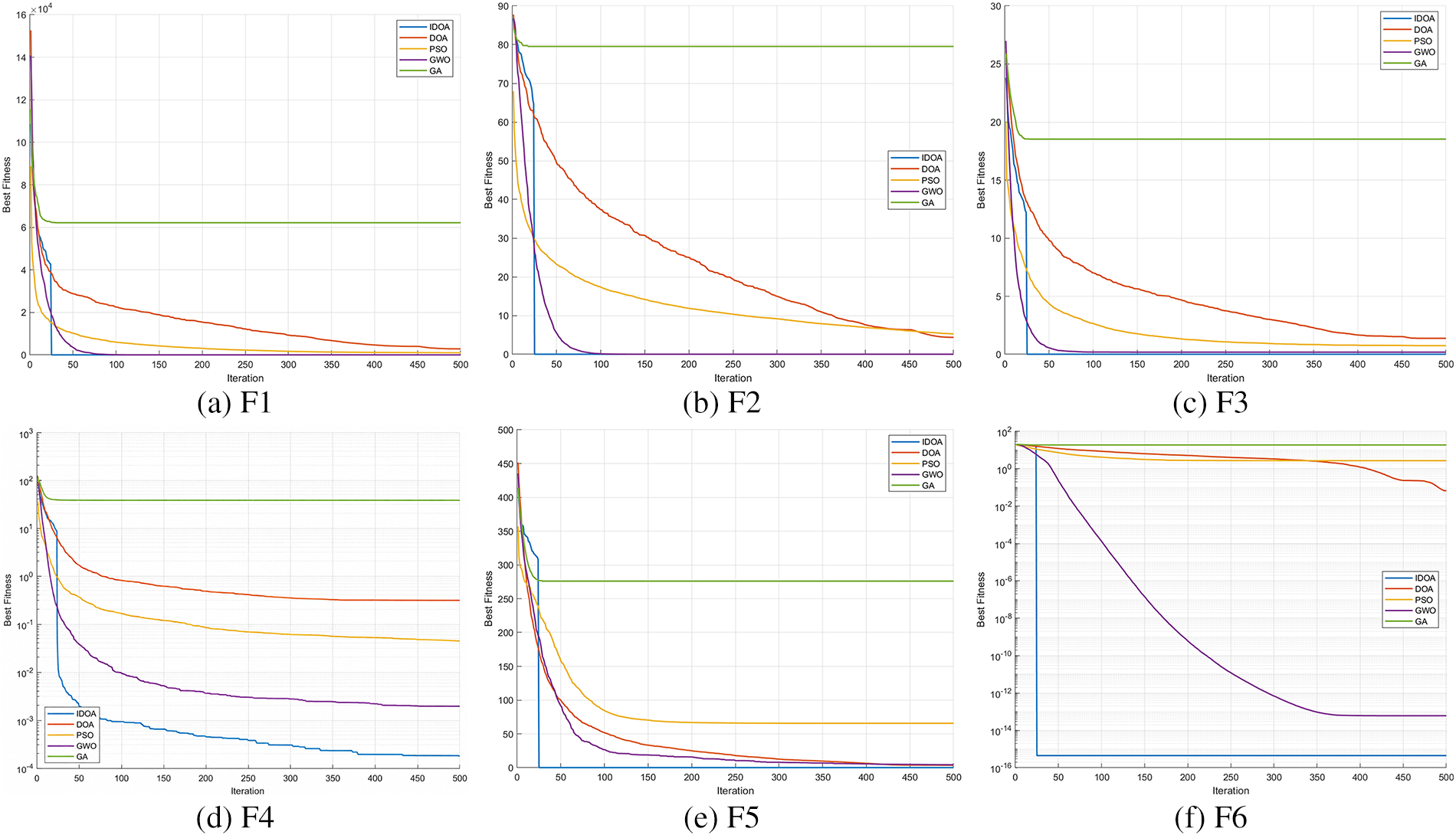
Figure 3: Convergence curves of fitness.
For all algorithms, the maximum number of iterations was set to
As shown in Table 3 and Fig. 3, IDOA achieves competitive optimization performance on the selected benchmark functions. It reaches the theoretical optimum on F1, F2, F3, and F5, while obtaining the best or near-best results on F4 and F6. The convergence curves indicate that IDOA generally converges faster and reaches lower fitness values than the comparison algorithms.
Ablation Study on Improvement Strategies
Ablation experiments on the six benchmark functions compared IDOA with four variants: DOA, DOA-Levy, DOA-Elite, and DOA-Memory. As shown in Fig. 4, IDOA achieves the best overall performance, while DOA-Levy performs best among the single-strategy variants. These results suggest that combining the three improvement strategies provides the greatest performance gain.
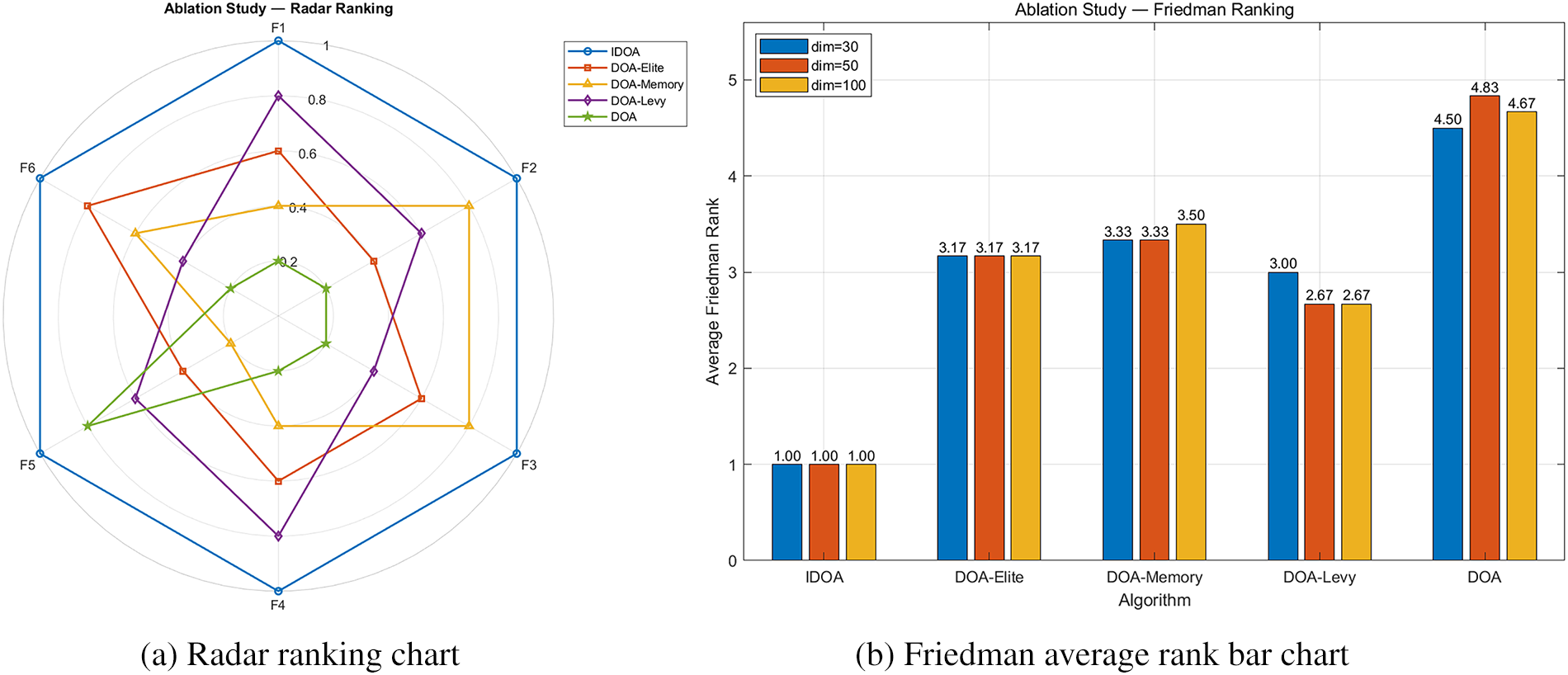
Figure 4: Ablation study results on six benchmark functions.
To evaluate the generic feature-selection capability of IDOA, four general-purpose UCI datasets, namely Ionosphere, WDBC, Heart Statlog, and Sonar, were selected as classification benchmarks. These datasets are not regarded as IoT traffic datasets; domain-specific validation is conducted separately on the NF-ToN-IoT-v2 dataset. To reduce the influence of randomness, 30 independent runs were conducted, and the average values of the evaluation metrics were reported. All four datasets were obtained from the UCI Machine Learning Repository. Table 4 summarizes their basic information and class labels, while Table 5 presents the comparative classification results.

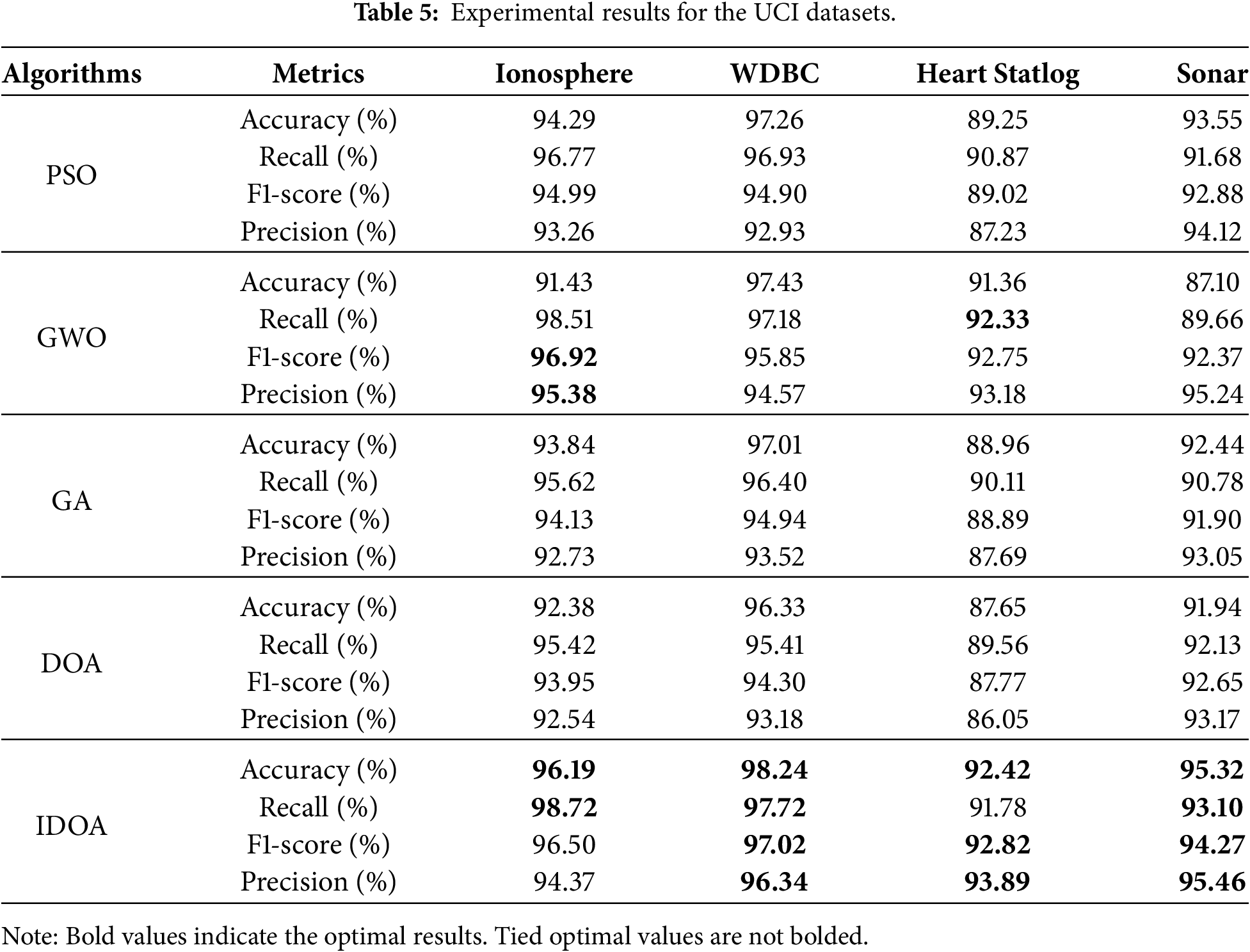
As shown in Table 5, IDOA achieves the highest classification accuracy on all four UCI datasets, demonstrating its stable performance across datasets with different sample sizes and feature dimensions. In addition, IDOA obtains the best Recall, Precision, or F1-score on most datasets. Although GWO achieves the highest Precision on the Ionosphere dataset and the highest Recall on the Heart Statlog dataset, IDOA maintains competitive performance across all evaluation metrics. These results suggest that the proposed feature selection strategy exhibits good generalization capability on different classification tasks.
5.4 Experiments on the NF-ToN-IoT-v2 Dataset
To further evaluate the effectiveness of the proposed method, experiments were conducted on the NF-ToN-IoT-v2 dataset, a publicly available network flow-based dataset designed for IoT traffic anomaly detection (https://espace.library.uq.edu.au/view/UQ:38a2d07). The dataset contains 43 extracted NetFlow features and multiple categories of normal and malicious traffic, and has been widely used for binary and multiclass traffic anomaly detection. After removing non-feature fields during preprocessing, 41 features were retained for subsequent experiments. For binary classification, all attack categories were merged into a single attack class, where normal and attack traffic were labeled as class 0 and class 1, respectively. For multiclass classification, the original attack labels were retained to distinguish different attack types.
Before cross-validation, 10,000 flow records were selected from the NF-ToN-IoT-v2 dataset using stratified random sampling without replacement while preserving the original class distribution. The sampled dataset was then partitioned using repeated stratified 5-fold cross-validation. Therefore, stratified sampling was completed before cross-validation. A duplicate-record check was also performed, confirming that no identical flow records appeared simultaneously in the training and test folds. For each fold, feature selection and normalization were performed exclusively on the training subset, while the corresponding test subset remained unseen until final evaluation.
5.4.1 Binary Classification Results
This subsection addresses binary classification, where normal and attack traffic are labeled as class 0 and class 1, respectively. The NF-ToN-IoT-v2 dataset contains 16,940,496 samples with 41 processed features, including 6,099,469 normal samples (36.01%) and 10,841,027 attack samples (63.99%).
Table 6 compares all algorithms in terms of classification performance, feature size, and computational cost. Fig. 5 presents the convergence curves of all compared algorithms, the confusion matrix of IDOA, and the ROC curves of all compared algorithms.
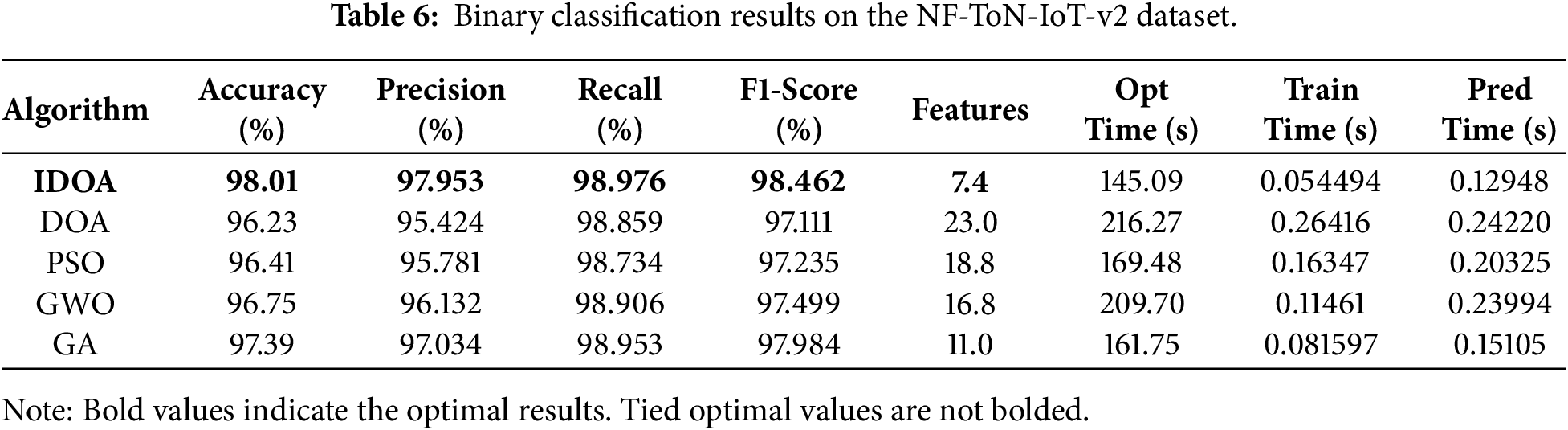
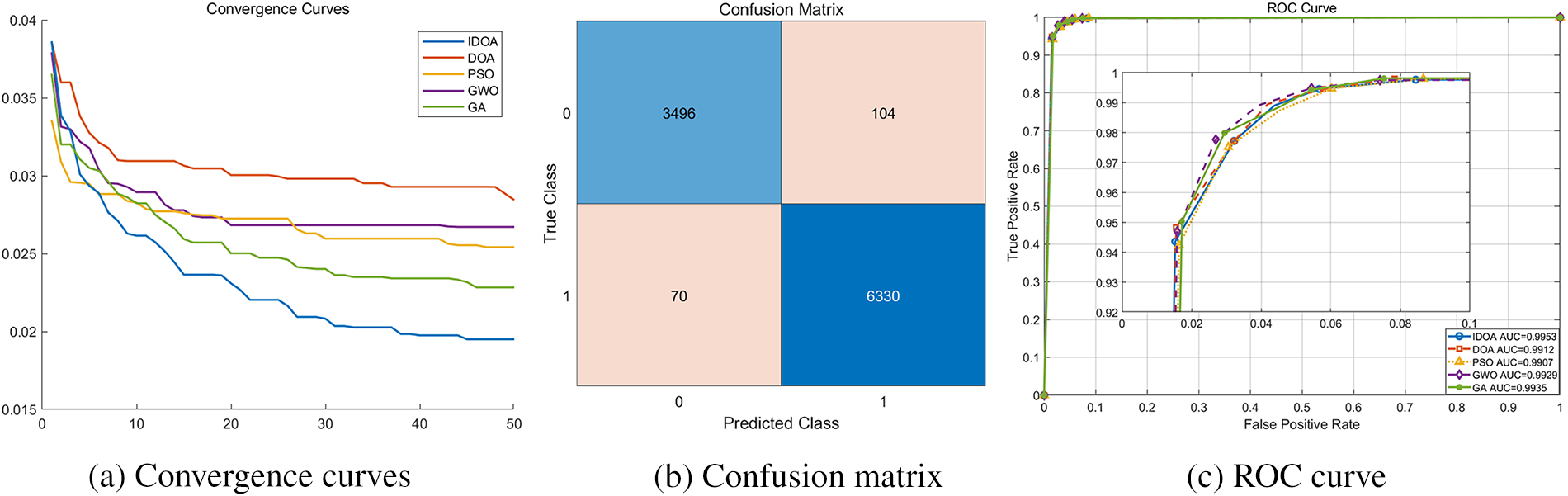
Figure 5: Binary classification results.
As shown in Table 6, IDOA achieves the best overall performance, obtaining the highest Accuracy, Precision, Recall, and F1-score while selecting the smallest feature subset, with 7.4 features on average. These results demonstrate a favorable balance between classification performance, feature compactness, and computational efficiency.
5.4.2 Multiclass Classification Results
Multiclass classification was conducted on the stratified sample of 10,000 NF-ToN-IoT-v2 flow records described in Table 7.

Table 8 reports the classification results of the five feature selection algorithms, with the best values highlighted in bold. The corresponding Wilcoxon signed-rank test results between IDOA and the other algorithms are presented in Table 9.
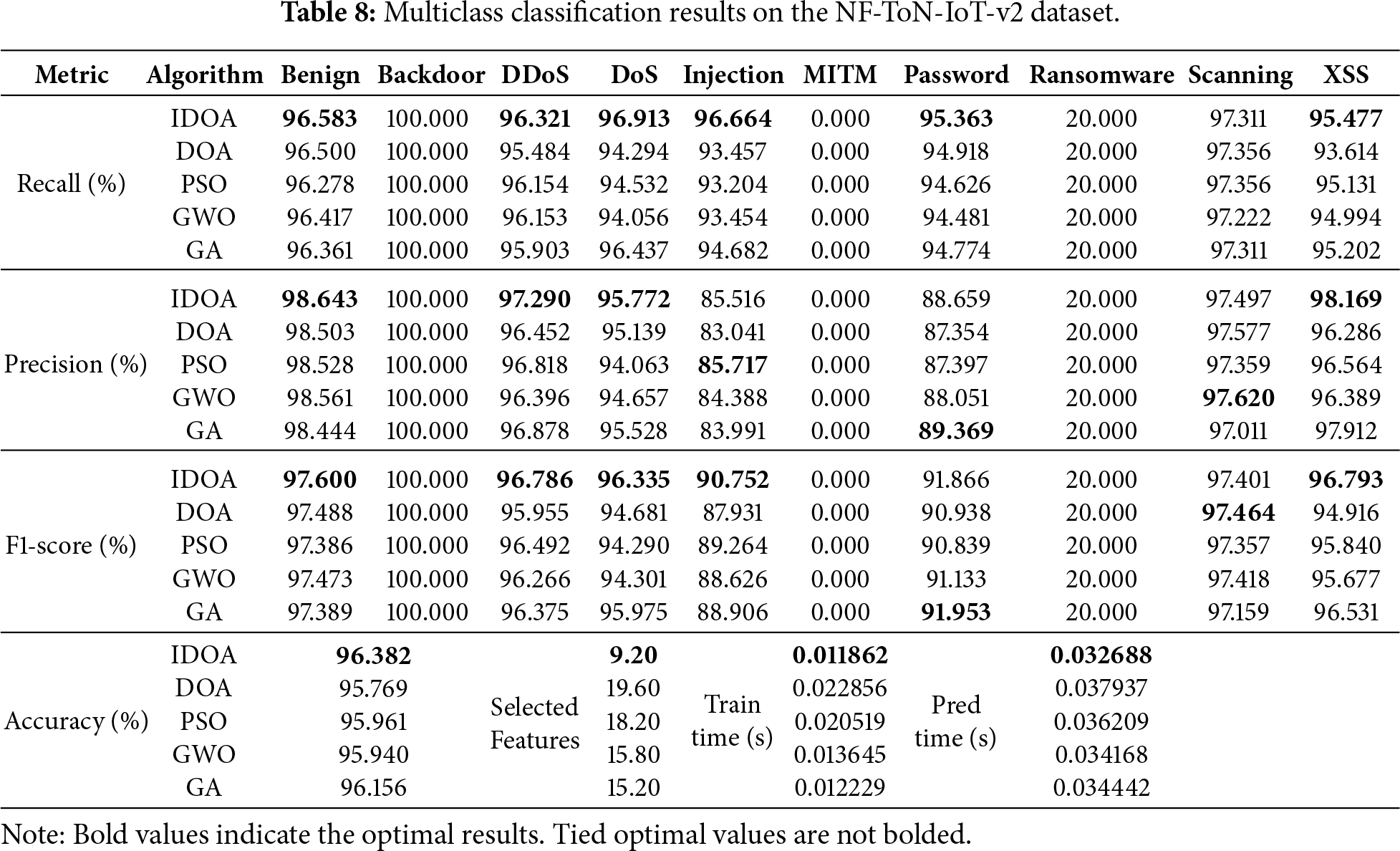

As shown in Table 8, IDOA achieves the highest overall classification accuracy while selecting the fewest features among the compared algorithms. Although some algorithms perform best on specific categories, IDOA maintains competitive performance across most traffic categories with a much smaller feature subset. Since several minority attack classes, such as MITM and ransomware, contain very few sampled instances, their per-class Recall and F1-score values may fluctuate and should be interpreted with caution. Therefore, the overall comparison is mainly based on weighted metrics and repeated cross-validation results.
Table 9 reports the Wilcoxon signed-rank test results between IDOA and the other four feature selection algorithms. Here,
5.5 Additional Baseline Comparison
To further evaluate the proposed method, three representative baseline methods, namely Full-KNN, MI-KNN, and RF-All, were introduced. Full-KNN uses all original features without feature selection. MI-KNN employs mutual information (MI) as a filter-based feature selection method, where the top 10 ranked features are selected for classification. RF-All uses the complete feature set with a Random Forest classifier as a non-KNN baseline.
All methods were evaluated using the same sampled dataset, preprocessing procedure, repeated stratified 5-fold cross-validation protocol, and evaluation metrics described in Section 5.4. Table 10 summarizes the classification results and accumulated running times. Since NF-ToN-IoT-v2 provides pre-extracted NetFlow features, the reported feature-preparation latency refers to the time required to construct the selected feature subset from the available feature matrix, rather than the time required to extract NetFlow attributes from raw packets. Classification latency is calculated as
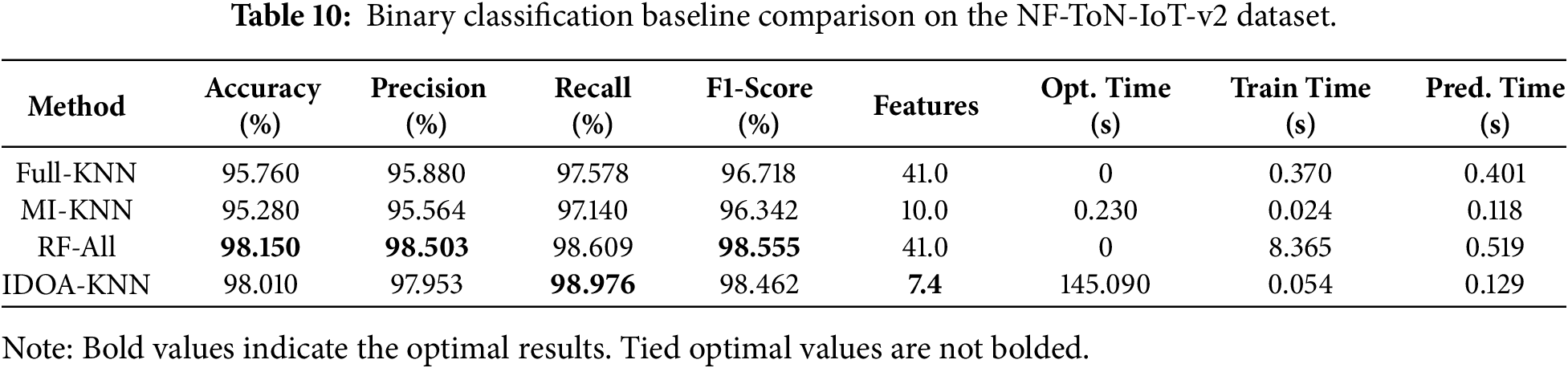
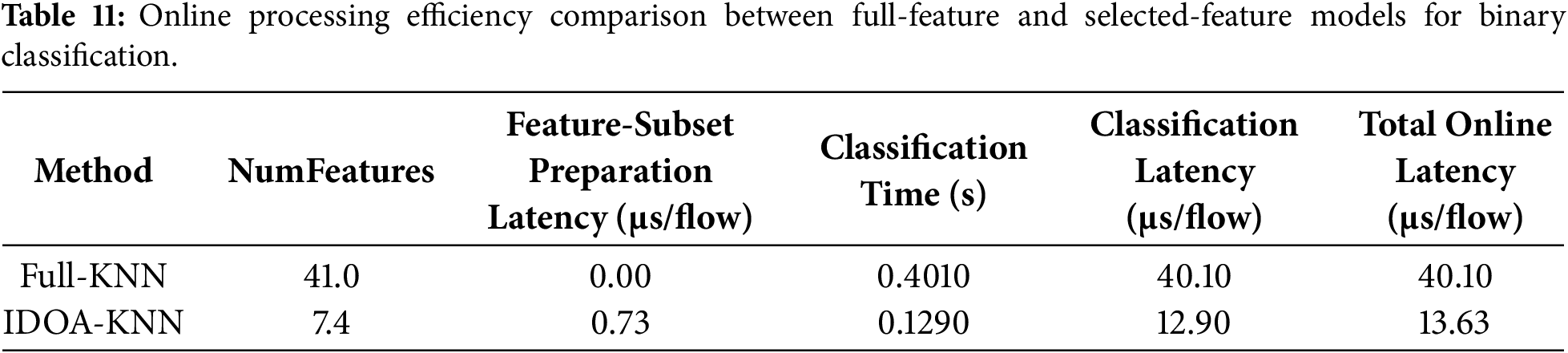
As shown in Table 10, IDOA-KNN achieves higher overall classification performance than Full-KNN while reducing the average number of features from 41 to 7.4. Although RF-All obtains slightly higher Accuracy, Precision, and F1-score, it uses all 41 features and requires longer training and prediction times. Table 11 shows that the classification latency of IDOA-KNN is reduced from 40.10 to 12.90
5.5.2 Multiclass Classification
All methods were evaluated under the same preprocessing procedure, sampling strategy, repeated stratified 5-fold cross-validation protocol, and evaluation metrics described in the previous subsection. Table 12 summarizes the multiclass classification results and accumulated running times. Classification latency is calculated using the same formula. Table 13 further reports Feature-Subset Preparation Latency, classification latency, and their sum as total online latency.
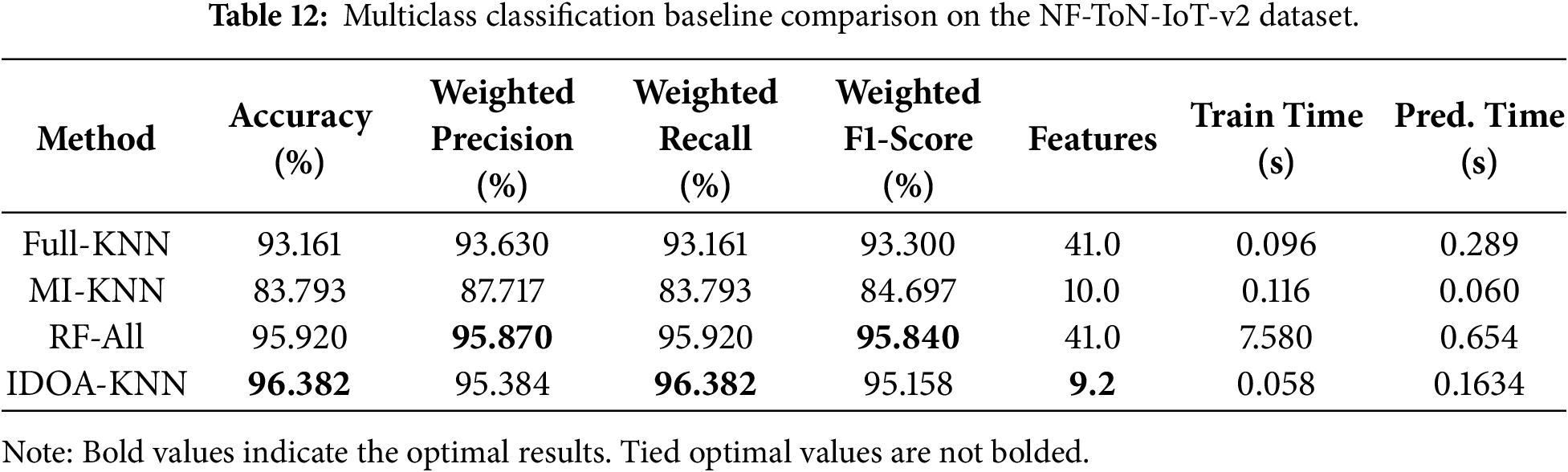
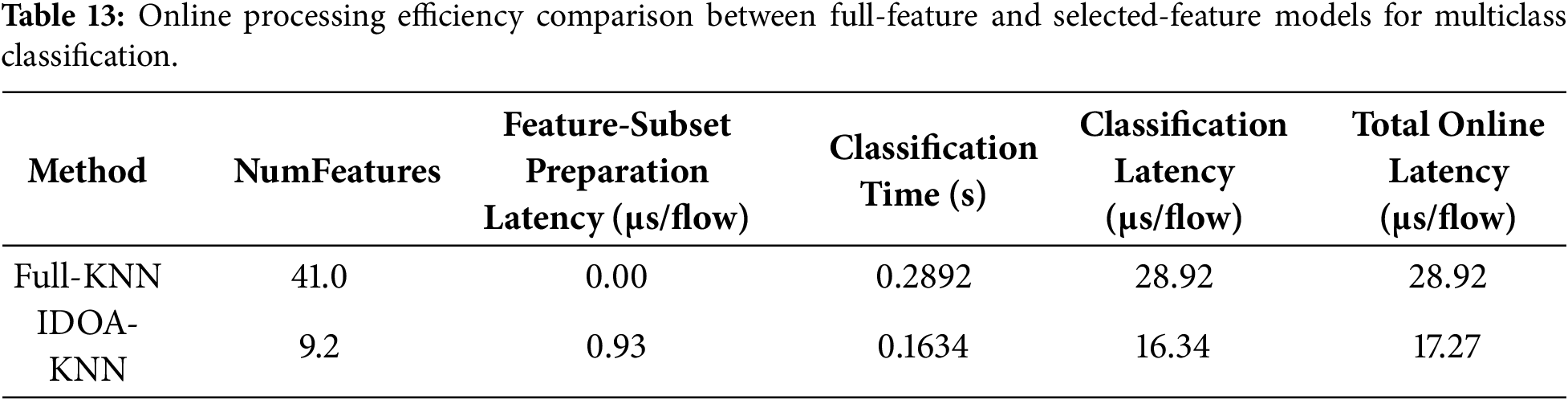
As shown in Table 12, IDOA-KNN achieves the highest Accuracy and Weighted Recall among the compared methods while using 9.2 features on average. Compared with Full-KNN, its Accuracy increases from 93.161% to 96.382%, while the classification latency decreases from 28.92 to 16.34
To address the problems of severe redundancy in high-dimensional features, high computational complexity, and limited detection efficiency in IoT traffic anomaly detection, this paper proposed an Improved Dream Optimization Algorithm (IDOA) and constructed an IoT traffic anomaly detection model based on IDOA. By incorporating a Lévy-flight-based adaptive perturbation mechanism, an elite learning strategy, and a probabilistic memory update mechanism, the proposed algorithm enhances global exploration capability, convergence accuracy, and stability without increasing the asymptotic order of time complexity.
The benchmark-function experiments verify the superior convergence performance of IDOA on both unimodal and multimodal optimization problems. In addition, the classification results on the UCI datasets and the real-world NF-ToN-IoT-v2 dataset demonstrate that the proposed IDOA-based feature selection method can effectively reduce feature redundancy while maintaining competitive detection performance. The reduced feature subset also leads to lower prediction time in the offline evaluation, indicating its potential for lightweight IoT traffic anomaly detection.
However, wrapper-based feature selection still requires repeated fitness evaluations during the offline optimization stage. Therefore, the proposed method is more suitable for offline feature subset optimization followed by lightweight online inference. Future work will further investigate deployment-level latency on edge devices, streaming IoT traffic scenarios, and more diverse classifiers to improve the robustness and practical applicability of the proposed method.
Acknowledgement: Not applicable.
Funding Statement: This study received no specific funding.
Author Contributions: Study conception and design: Hui Xu, Shuang Qu and Pan Hu; data collection: Shuang Qu; analysis and interpretation of results: Shuang Qu and Hui Xu; draft manuscript preparation: Hui Xu, Shuang Qu and Pan Hu. All authors reviewed and approved the final version of the manuscript.
Availability of Data and Materials: The UCI datasets used in this study are available from the UCI Machine Learning Repository. The NF-ToN-IoT-v2 dataset is publicly available at https://espace.library.uq.edu.au/view/UQ:38a2d07. The MATLAB implementation and experimental configurations will be made publicly available at https://github.com/magic-nine/IDOA-IoT-Anomaly-Detection upon acceptance.
Ethics Approval: Not applicable.
Conflicts of Interest: The authors declare no conflicts of interest.
References
1. Ahmed M, Mahmood AN, Hu J. A survey of network anomaly detection techniques. J Netw Comput Appl. 2016;60(1):19–31. doi:10.1016/j.jnca.2015.11.016. [Google Scholar] [CrossRef]
2. Tsogbaatar E, Bhuyan MH, Taenaka Y, Fall D, Gonchigsumlaa K, Elmroth E, et al. DeL-IoT: a deep ensemble learning approach to uncover anomalies in IoT. Internet Things. 2021;14(2):100391. doi:10.1016/j.iot.2021.100391. [Google Scholar] [CrossRef]
3. Johnpeter T, Karuppanan S. Fuzzy-rule based optimized hybrid deep learning model for network intrusion detection in SDN enabled IoT network. Comput Secur. 2025;152(10):104372. doi:10.1016/j.cose.2025.104372. [Google Scholar] [CrossRef]
4. Banoth R, Addula SR, Godishala AK, Sannapu R, Sajja GS, Kumar D, et al. Evolving IoT botnet threats and practical honeypot observation: a summary review and experimental study. J Cybersecur Priv. 2026;6(3):82. doi:10.3390/jcp6030082. [Google Scholar] [CrossRef]
5. Buczak AL, Guven E. A survey of data mining and machine learning methods for cyber security intrusion detection. IEEE Commun Surv Tutor. 2016;18(2):1153–76. doi:10.1109/COMST.2015.2494502. [Google Scholar] [CrossRef]
6. Kwon D, Kim H, Kim J, Suh S, Kim I, Kim K. A survey of deep learning-based network anomaly detection. Clust Comput. 2019;22(1):949–61. doi:10.1007/s10586-017-1117-8. [Google Scholar] [CrossRef]
7. Niyaz Q, Sun W, Javaid AY. A deep learning based DDoS detection system in software-defined networking (SDN). EAI Endorsed Trans Security Saf. 2017;4(12):153515. doi:10.4108/eai.28-12-2017.153515. [Google Scholar] [CrossRef]
8. Tang TA, Mhamdi L, McLernon D, Zaidi SAR, Ghogho M, El Moussa F. Deep learning approach for network intrusion detection in software defined networking. In: 2016 International Conference on Wireless Networks and Mobile Communications (WINCOM); 2016 Oct 26–29; Fez, Morocco. Piscataway, NJ, USA: IEEE; 2016. p. 258–63. doi:10.1109/WINCOM.2016.7777224. [Google Scholar] [CrossRef]
9. Wang K, Fu Y, Duan X, Liu T, Xu J. Abnormal traffic detection system in SDN based on deep learning hybrid models. Comput Commun. 2024;216(5):183–94. doi:10.1016/j.comcom.2023.12.041. [Google Scholar] [CrossRef]
10. Lu J, Wang J, Wei X, Wu K, Liu G. Deep anomaly detection based on variational deviation network. Future Internet. 2022;14(3):80. doi:10.3390/fi14030080. [Google Scholar] [CrossRef]
11. Gao M, Wu L, Li Q, Chen W. Anomaly traffic detection in IoT security using graph neural networks. J Inf Secur Appl. 2023;76(5):103532. doi:10.1016/j.jisa.2023.103532. [Google Scholar] [CrossRef]
12. Krupski J, Iwanowski M, Graniszewski W. Extraction of minimal set of traffic features using ensemble of classifiers and rank aggregation for network intrusion detection systems. Appl Sci. 2024;14(16):6995. doi:10.3390/app14166995. [Google Scholar] [CrossRef]
13. Guyon I, Elisseeff A. An introduction to variable and feature selection. J Mach Learn Res. 2003;3:1157–82. [Google Scholar]
14. Li J, Cheng K, Wang S, Morstatter F, Trevino RP, Tang J, et al. Feature selection: a data perspective. ACM Comput Surv. 2017;50(6):94. doi:10.1145/3136625. [Google Scholar] [CrossRef]
15. Shreem SS, Abdullah S, Nazri MZA. Hybrid feature selection algorithm using symmetrical uncertainty and a harmony search algorithm. Int J Syst Sci. 2016;47(6):1312–29. doi:10.1080/00207721.2014.924600. [Google Scholar] [CrossRef]
16. Li X, Zhang S, Luo H, Ma X, He J. Placing timely refreshing services at the network edge. IEEE Internet Things J. 2023;10(18):16450–64. doi:10.1109/JIOT.2023.3268308. [Google Scholar] [CrossRef]
17. Agrawal P, Abutarboush HF, Ganesh T, Mohamed AW. Metaheuristic algorithms on feature selection: a survey of one decade of research (2009–2019). IEEE Access. 2021;9:26766–91. doi:10.1109/ACCESS.2021.3056407. [Google Scholar] [CrossRef]
18. Kennedy J, Eberhart RC. Particle swarm optimization. In: Proceedings of ICNN’95—International Conference on Neural Networks; 1995 Nov 27–Dec 1; Perth, Australia. Piscataway, NJ, USA: IEEE; 1995. p. 1942–8. doi:10.1109/ICNN.1995.488968. [Google Scholar] [CrossRef]
19. Mirjalili S, Mirjalili SM, Lewis A. Grey wolf optimizer. Adv Eng Softw. 2014;69:46–61. doi:10.1016/j.advengsoft.2013.12.007. [Google Scholar] [CrossRef]
20. Mirjalili S, Lewis A. The whale optimization algorithm. Adv Eng Softw. 2016;95(12):51–67. doi:10.1016/j.advengsoft.2016.01.008. [Google Scholar] [CrossRef]
21. Stein G, Chen B, Wu AS, Hua KA. Decision tree classifier for network intrusion detection with GA-based feature selection. In: Proceedings of the 43rd Annual Southeast Regional Conference; 2005 Mar 18–20; Kennesaw, GA, USA. New York, NY, USA: ACM; 2005. p. 136–41. doi:10.1145/1167253.1167288. [Google Scholar] [CrossRef]
22. Nakashima M, Sim A, Kim Y, Kim J, Kim J. Automated feature selection for anomaly detection in network traffic data. ACM Trans Manag Inf Syst. 2021;12(3):18. doi:10.1145/3446636. [Google Scholar] [CrossRef]
23. Xu H, Lu Y, Guo Q. Application of improved butterfly optimization algorithm combined with black widow optimization in feature selection of network intrusion detection. Electronics. 2022;11(21):3531. doi:10.3390/electronics11213531. [Google Scholar] [CrossRef]
24. Xu H, Hu Y, Cao W, Han L. An improved jump spider optimization for network traffic identification feature selection. Comput Mater Contin. 2023;76(3):3239–55. doi:10.32604/cmc.2023.039227. [Google Scholar] [CrossRef]
25. Wu Q, Xu H, Liu M. Applying an improved dung beetle optimizer algorithm to network traffic identification. Comput Mater Contin. 2024;78(3):4091–107. doi:10.32604/cmc.2024.048461. [Google Scholar] [CrossRef]
26. Addula SR, Meesala MK, Ravipati P, Sajja GS. A hybrid autoencoder and gated recurrent unit model optimized by honey badger algorithm for enhanced cyber threat detection in IoT networks. Secur Priv. 2025;8(6):e70086. doi:10.1002/spy2.70086. [Google Scholar] [CrossRef]
27. Yang XS. Nature-inspired metaheuristic algorithms. 2nd ed. Frome, UK: Luniver Press; 2010. [Google Scholar]
28. Yusta SC. Different metaheuristic strategies to solve the feature selection problem. Pattern Recognit Lett. 2009;30(5):525–34. doi:10.1016/j.patrec.2008.11.012. [Google Scholar] [CrossRef]
29. Lang Y, Gao Y. Dream optimization algorithm (DOAa novel metaheuristic optimization algorithm inspired by human dreams and its applications to real-world engineering problems. Comput Methods Appl Mech Eng. 2025;436(2):117718. doi:10.1016/j.cma.2024.117718. [Google Scholar] [CrossRef]
Cite This Article
 Copyright © 2026 The Author(s). Published by Tech Science Press.
This work is licensed under a Creative Commons Attribution 4.0 International License , which permits unrestricted use, distribution, and reproduction in any medium, provided the original work is properly cited.
 Downloads
 Citation Tools
