
 Login
Login Register
 Submit a Paper
 Propose a Special lssue
 Open Access
ARTICLE
A Lightweight Quantum-Secure Authentication and Key Agreement Protocol for Vehicular Ad-Hoc Networks
1 African Center of Excellence in Internet of Things (ACEIoT), University of Rwanda, Kigali, Rwanda
2 Department of Computer Science and IT, The State University of Zanzibar, Zanzibar, Tanzania
* Corresponding Author: Lasseni Coulibaly. Email:
Computers, Materials & Continua 2026, 89(2), 41 https://doi.org/10.32604/cmc.2026.087148
Received 12 June 2026; Accepted 21 July 2026; Issue published 15 September 2026
 View Full Text
 Download PDF
Abstract
Intelligent transportation systems, a critical pillar for smart cities, enable real-time vehicular communications to prevent human errors and improve traffic safety and efficiency. However, the open and highly dynamic nature of vehicular networks exposes them to various security threats, including message tampering, impersonation, and privacy violations. Several authentication and key agreement (AKA) protocols have been proposed to mitigate these risks, but often fail to maintain future-proof security against emerging quantum threats or introduce significant latency that affects real-time applications by relying on computationally expensive public-key cryptography, blockchain or centralized architectures. This paper proposes a new AKA protocol that combines hash-based operations with the Blom’s key pre-distribution scheme and the standardized Module-Lattice-Based Key Encapsulation Mechanism (ML-KEM) to achieve lightweight and quantum-secure mutual vehicular authentications in a decentralized architecture. Formal security verifications together with informal security analysis demonstrate resistance against common network attacks, while performance evaluations confirm reduced computational costs up to 99.95% and communication overhead reductions from 8.46% to 87.08% compared with related methods. Moreover, NS-3 simulations under varying densities and mobility conditions demonstrate high packet delivery reliability, low end-to-end authentication latency, and excellent scalability, making the proposed protocol a practical solution for next-generation quantum-secure vehicular networks.Keywords
The rapid advancement of the Internet of Things has accelerated the integration of physical and digital systems, enabling intelligent transportation systems as a cornerstone of smart cities [1]. Within this ecosystem, vehicular ad hoc networks (VANETs) facilitate real-time communication among vehicles and roadside units (RSUs) to improve traffic safety, driving efficiency, and autonomous decision making. Vehicles equipped with onboard units (OBUs) continuously exchange safety-critical messages through vehicle-to-vehicle (V2V) and vehicle-to-infrastructure (V2I) communications to support cooperative awareness and proactive hazard avoidance. Despite these advantages, vehicular communications operate over an open and highly dynamic environment, making them vulnerable to numerous security and privacy threats as adversaries can launch message forgery, impersonation, replay, tracking, or denial-of-service (DoS) attacks that compromise communication reliability and road safety [2]. Consequently, authentication and key agreement (AKA) protocols are indispensable for ensuring that only legitimate entities participate in communication while preserving message authenticity, integrity, confidentiality, and user privacy.
Existing solutions predominantly rely on public-key cryptography (PKC), particularly elliptic curve cryptography (ECC), which provides strong classical security but incurs considerable computational overhead due to heavy operations, such as frequent signature generation, verification, and certificate management [3]. Blockchain-based authentication frameworks further improve trust decentralization and auditability [4,5] often using PKC primitives, but their consensus protocols and transaction validation introduce additional communication and computational latency that limits their applicability in real-time vehicular environments. Moreover, classical PKC schemes are fundamentally vulnerable to quantum attacks enabled by Shor’s algorithm [6], motivating the transition toward post-quantum authentication mechanisms. Recent lightweight authentication schemes reduce computational complexity by replacing expensive public-key operations with symmetric cryptographic primitives, offering reduced computational complexity with quantum resistance [7]. However, many of these approaches often depend on centralized architectures or static shared secrets, creating scalability bottlenecks and increasing the impact of long-term key compromise. In particular, reliance on a central authority during real-time authentication introduces single points of failure and increases susceptibility to black-hole and DoS attacks. In light of these limitations, achieving a balanced design that simultaneously ensures security, privacy, scalability, and efficiency, while remaining resilient to emerging quantum threats remains an open research problem.
To overcome the above research challenge, this paper proposes the first decentralized and lightweight post-quantum hash-based AKA protocol that combines Blom’s key pre-distribution scheme [8] with the Module-Lattice-Based Key Encapsulation Mechanism (ML-KEM) standardized by the National Institute of Standards and Technology (NIST) [9], for VANETs and Internet of Vehicles (IoV) environments. Unlike conventional approaches, the proposed protocol eliminates real-time dependence on a central authority during authentication, thereby reducing latency and removing critical bottlenecks. The Blom’s scheme enables efficient pairwise key establishment through lightweight polynomial evaluations during routine authentication, whereas ML-KEM provides quantum-resistant protection for credential distribution and infrastructure-assisted key establishment. In addition, temporary pseudonymous identities protect user privacy through anonymity and unlinkability. To safeguard cryptographic credentials against physical compromise, vehicles and RSUs are assumed to be equipped with tamper-proof devices (TPDs).
The key contributions of this work are summarized below:
1. A lightweight and decentralized post-quantum AKA protocol supporting secure mutual authentication across V2V, vehicle-to-RSU (V2R), and RSU-to-RSU (R2R) communications without requiring real-time involvement of the trusted authority (TA), which is also adaptable to various networking applications.
2. A hybrid key establishment framework that combines Blom’s symmetric scheme with ML-KEM to achieve efficient pairwise authentication while providing quantum-resistant credential distribution.
3. A forward secure and privacy-preserving authentication mechanism based on temporary pseudonym identities and session-specific keys to limit long-term credential exposure, while supporting a periodic security parameter refresh strategy and conditional traceability.
4. Formal security verifications, complemented by hardware computation benchmarking and NS-3 simulations demonstrating strong resistance against classical and quantum attacks while achieving low computation and communication costs with high scalability over existing schemes.
The remainder of this paper is organized as follows. Section 2 introduces the background and system models. Section 3 reviews the related literature. Section 4 presents the proposed protocol phases. Section 5 provides formal and informal security analyses. Section 6 evaluates cryptographic performance, while Section 7 presents the NS-3 simulation results before concluding the paper in Section 8.
We describe the preliminaries for system and threat models, security goals, and computation tools.
The proposed system architecture considers a typical VANET environment primarily with the TA, RSU, and vehicles that interact to enable vehicular safety communications.
TA: A centralized authority that manages the network with sufficient capacities to register all vehicles and RSUs in a given location (e.g., country or state) and provide security updates to them. TA is the secured trust anchor assumed to be trustworthy and it uses secure channels to interact with vehicles and RSUs. Furthermore, TA has the ability to trace any misbehaving entity and revoke its credentials when needed.
RSU: Fixed infrastructure devices positioned along the roadway, RSUs monitor traffic conditions and disseminate safety information to vehicles within their communication ranges. RSUs can also communicate among themselves to exchange long-range traffic data with each other, and act as intermediaries to facilitate communication between the TA and vehicles, particularly during security updates and misbehavior reports.
Vehicle: Mobile entities equipped with OBUs, vehicles communicate with one another and with RSUs. Vehicles process exchanged safety information to maintain a cooperative driving environment.
Vehicles and RSUs communicate through insecure wireless channels and they remain vulnerable to various attacks. Therefore, an adversary (
•
•
•
•
•
•
Assumption 1: TA is the trust anchor and its database is protected against attack capabilities of
To counter the aforementioned threats, the proposed protocol aims to achieve the following objectives:
• Mutual Authentication: Entities verify each other’s identity before establishing communication sessions.
• Message Integrity: A receiver verifies whether the content of a transmitted message has been modified or not, and rejects manipulated messages. Therefore,
• Privacy Preservation: Vehicles and RSUs communicate without exposing their real identities. Therefore,
• Session Key Agreement: Vehicles and RSUs establish unique session keys per communication instance to ensure confidentiality and forward secrecy. Thus,
• Resistance to Common Attacks: The protocol should resist common attacks such as replay attacks, storage compromise attacks, and brute force attacks under both classical and quantum computers.
2.4 Security Primer for Computation Tools
The proposed protocol employs Blom’s scheme, ML-KEM together with an authenticated encryption with associated data (AEAD) mechanism, and lightweight cryptographic operations based on the secure hash algorithm (SHA-256) complemented by the bitwise exclusive-OR (XOR). These primitives collectively provide efficient mutual authentication, secure credential distribution, and low-latency session key establishment.
Definition 1(ML-KEM): Let
Definition 2(AEAD): Given a symmetric key
Definition 3(Blom): Let
where
Let two legitimate nodes with identifiers
Definition 4(SHA-256): The hash function, denoted
One way: Given a hash value
Collision resistance: with distinct inputs
Avalanche effect: A small change in the input produces a statistically independent output. Hence, knowing
Definition 5(XOR): Let
In this section, we review related AKA protocols for vehicular networks, classifying them into three categories: PKC-based, blockchain-assisted, and lightweight symmetric-key-based approaches.
PKC-based approaches have been widely adopted due to their ability to provide public verifiability. In particular, ECC is predominantly used through digital signatures with or without certificate-based authentication. For instance, AKA protocols in [10–12] rely on ECC signatures and bilinear pairings, often supporting signature aggregation to enable batch authentication and group session key establishment. Although these techniques reduce authentication delay in dense vehicular environments, they introduce practical limitations where a single invalid signature may invalidate the entire aggregated verification process or, if verification succeeds, allow a malicious participant to obtain the group session key. Alternatively, Hoque et al. [13], Raghav et al. [14], and Yang et al. [15] have proposed individual AKA protocols that combine ECC with hash functions to reduce authentication latency while supporting V2V, V2R/V2I, and/or R2R communications. Jayashree and Santhosh Kumar [16] further combine ECC with bilinear pairing, providing enhanced security at the expense of significantly higher computational overhead. Despite the classical security guarantees, PKC-based schemes incur substantial computational overhead due to repeated heavy public-key operations and their mathematical problems remain fundamentally vulnerable to quantum attacks based on Shor’s algorithm, limiting their long-term applicability.
Blockchain-assisted authentication has emerged as an alternative for decentralized trust management. Dwivedi et al. [17] and Lin and Jhuang [18] integrate blockchain with ECC to realize batch and certificateless authentication, respectively. Noh et al. [19] propose a non-interactive blockchain-based authentication framework for one-time entity verification, whereas Zhao et al. [20] combine zero-knowledge proofs, smart contracts, and Merkle trees for cross-domain authentication. Zhao et al. [21] further employ homomorphic encryption and ECC for anonymous authentication with dynamic pseudonym updates. More recently, Yan et al. [22] adopt lattice-based cryptography to achieve quantum resistance within a blockchain architecture. Lu et al. [23] integrate blockchain with Merkle Patricia Trees to support privacy-preserving authentication and certificate revocation. Although blockchain improves trust decentralization and auditability, these schemes suffer from transaction latency, consensus overhead, scalability limitations, and dependence on reliable connectivity, making them less suitable for latency-sensitive vehicular communications.
Lightweight symmetric-key AKA protocols replace expensive public-key operations to reduce computational complexity. Wazid et al. [24] proposed a cluster-based framework that reduces repeated authentication but introduces communication overhead and potential single points of failure through cluster-head management. Aman et al. [25] and Kim et al. [26] improve authentication efficiency using RSU-assisted and two-factor authentication mechanisms, respectively, whereas decentralized protocols have also been proposed to improve scalability [27–30], with several incorporating biometric authentication to strengthen user verification. Although these approaches significantly reduce computational overhead and naturally resist Shor’s algorithm, many continue to depend on centralized infrastructures, static pre-shared symmetric keys, limiting scalability, forward secrecy, and resilience against long-term key compromise.
Overall, existing AKA protocols exhibit complementary strengths and limitations. PKC-based schemes provide strong classical security but incur high computational overhead and remain vulnerable to quantum attacks, while blockchain-assisted approaches offer decentralized trust at the cost of significant communication and processing latency. Lightweight hash-based protocols improve authentication efficiency but often depend on centralized infrastructures or static shared secrets, limiting scalability and long-term security. Table 1 summarizes the security and privacy comparison of representative schemes.
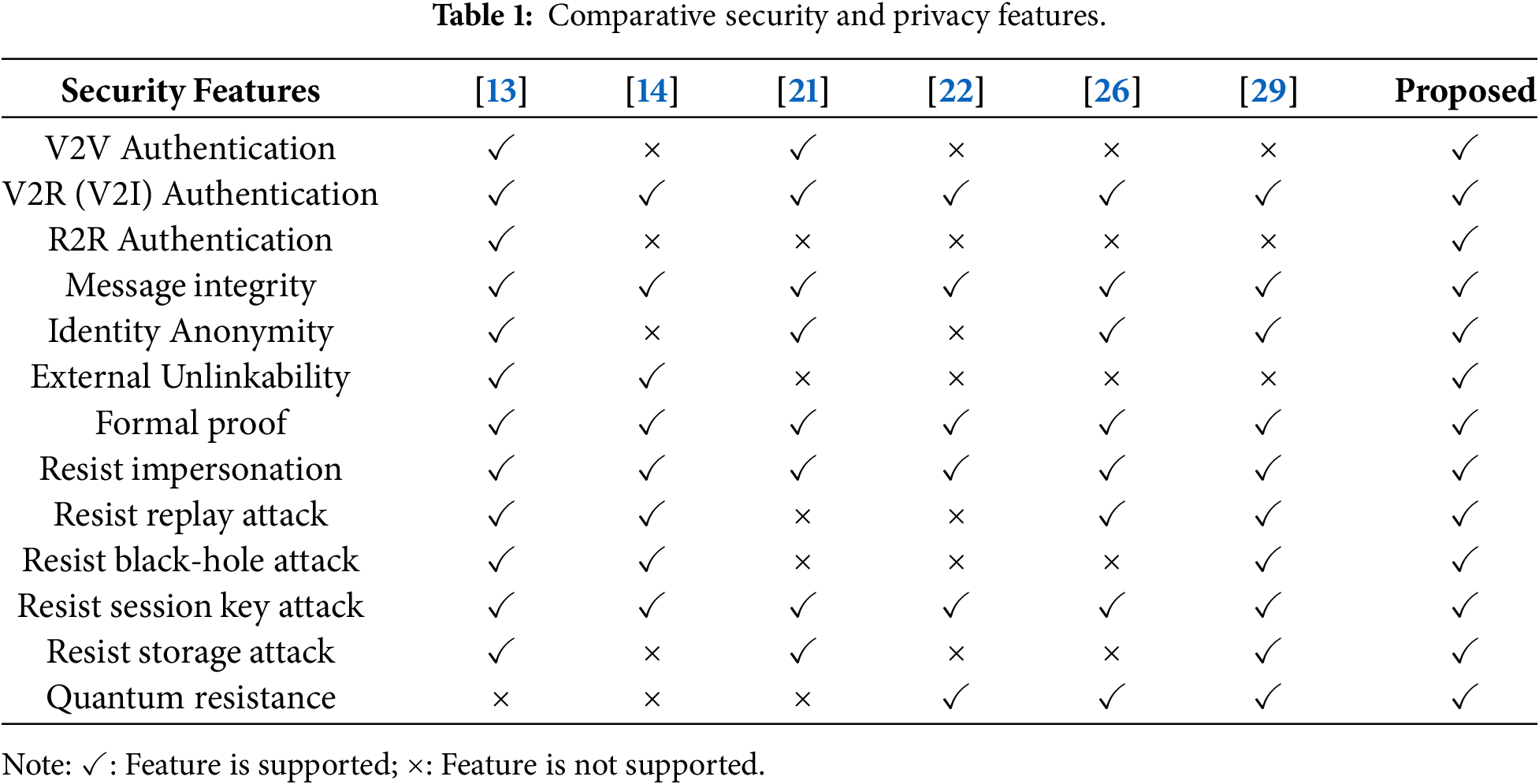
Although most existing methods support V2R/V2I authentication, secure session key establishment, message integrity, impersonation resistance, and formal security verification, many do not natively support V2V and R2R communications. While anonymity is generally preserved, the schemes in [14,22] expose real identities to communicating peers, and several methods fail to ensure unlinkability by transmitting a static identifier across multiple authentication sessions. Moreover, the protocols in [22,26] continuously rely on an intermediate authority to achieve V2R authentication, while [21] depends on RSU availability to achieve V2R authentication before enabling V2V authentications. These central entity-dependent architectures create a risk of single points of failure. Although replay protection is commonly achieved using timestamps, methods like [21,22] do not bind timestamps to message authentication, allowing replay with refreshed timestamps. In addition, the schemes in [14,22,26] provide no explicit protection against storage compromise. Finally, ECC-based methods like [13,14,21] remain vulnerable to quantum attacks. In sum, the proposed protocol offers a more robust and balanced security profile by combining hash functions, Blom’s scheme, and ML-KEM to provide decentralized, low-latency, and quantum-secure authentication with dynamic privacy preservation, periodic credential updates, and support for V2V, V2R, and R2R communications.
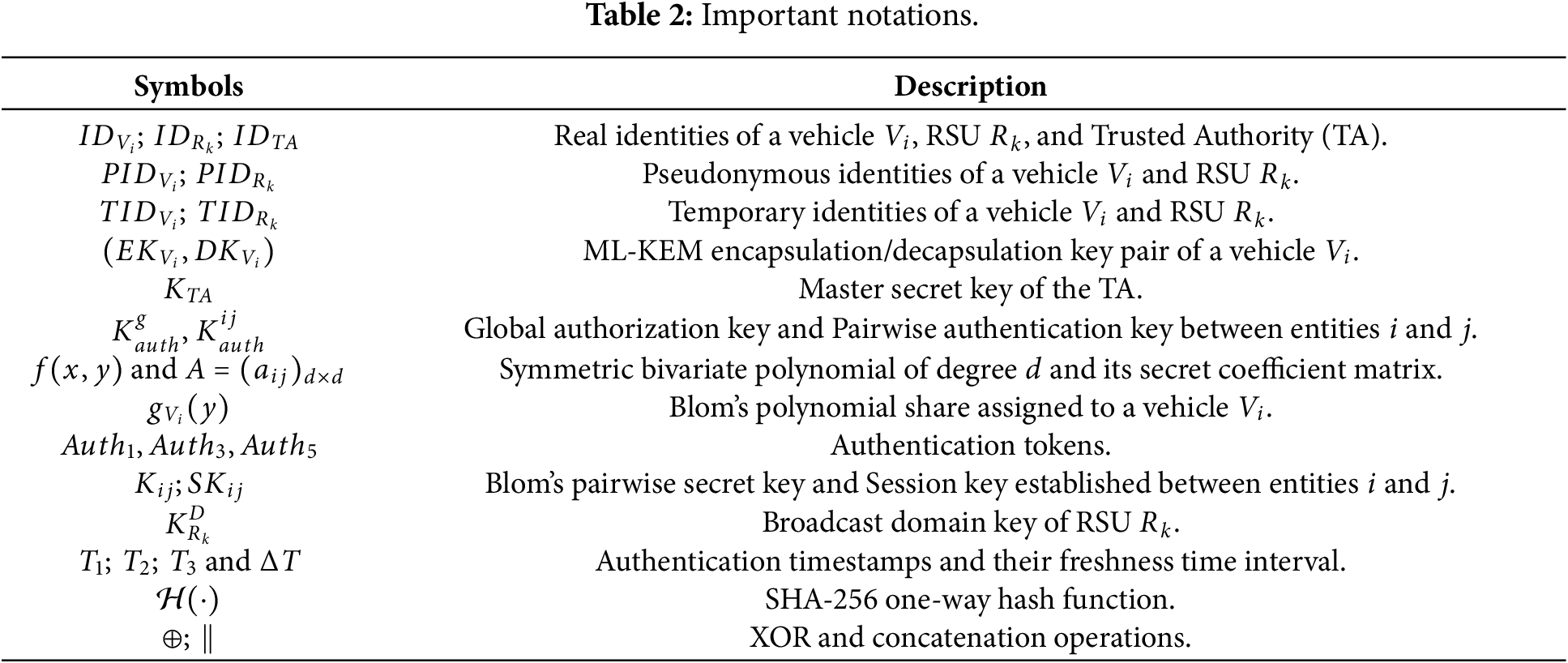
Fig. 1 illustrates the vehicular network architecture, in which the proposed AKA protocol enables post-quantum and low-latency mutual authentication and session key establishment for V2V, V2R, and R2R communications using ML-KEM for secure key encapsulation and Blom’s key pre-distribution scheme for efficient pairwise key derivation. The proposed AKA protocol consists of six phases. First, the TA initializes the system by generating the global cryptographic parameters. Second, it registers vehicles and RSUs by assigning pseudonymous identities, generating their Blom polynomial shares, and securely distributing these credentials using ML-KEM. Third, neighboring entities perform mutual authentication and establish a pairwise session key using their polynomial shares and fresh timestamps, which is then used to protect subsequent unicast safety messages, while temporary pseudonyms preserve user privacy. Fourth, each RSU securely distributes its domain key to vehicles within its coverage area through ML-KEM encapsulation, enabling secure RSU-domain broadcast communications. Fifth, the protocol periodically renews security credentials to mitigate long-term key compromise. Finally, it preserves network integrity by identifying and revoking malicious nodes. The notations used throughout the protocol are summarized in Table 2.
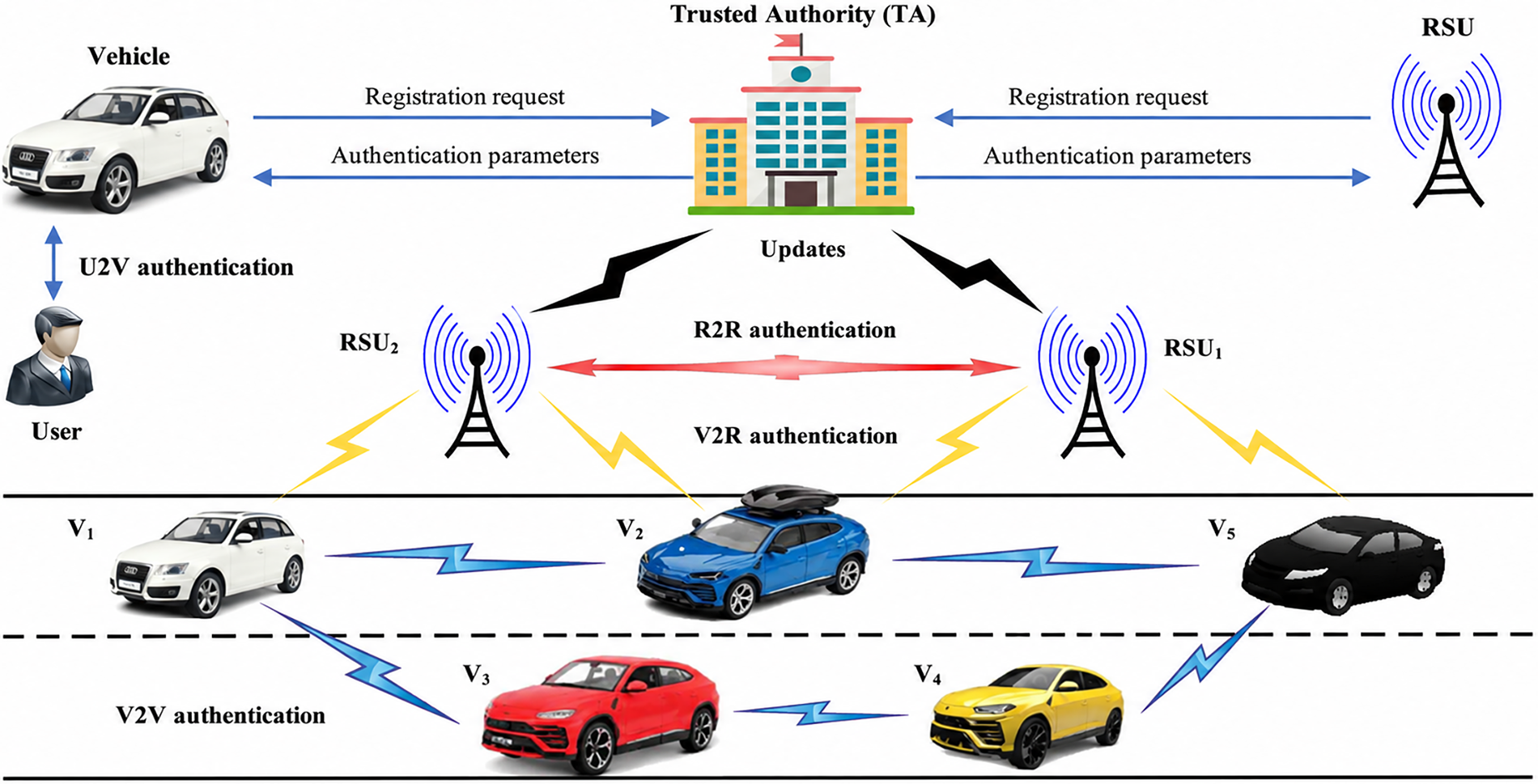
Figure 1: Network model for vehicular authentication.
4.1 System Initialization Phase
Before network deployment, the TA initializes the system parameters. It first selects a unique identity
The TA registers all vehicles and RSUs in offline or via secure channels following the same procedure but with their respective credentials as shown in Fig. 2. The registration steps are detailed as follows:
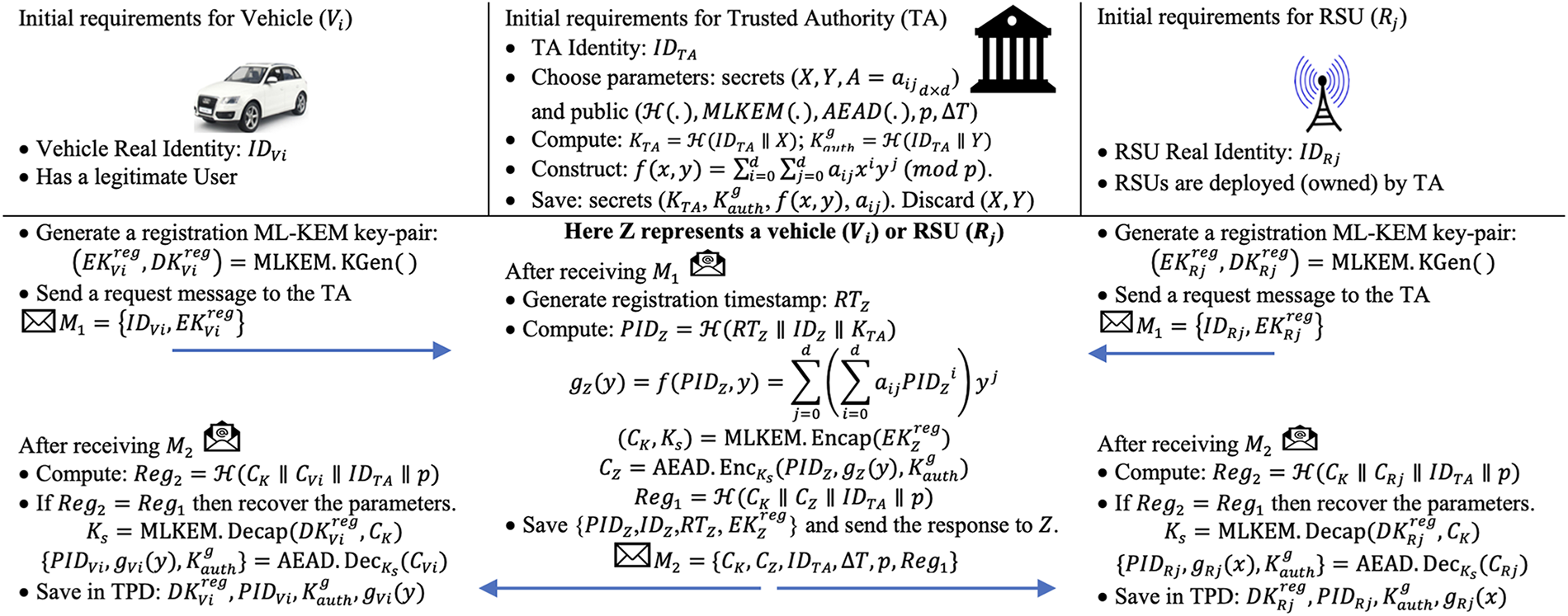
Figure 2: Vehicle and RSU registration.
Step 1: Each vehicle
Step 2: TA receives the registration request
Step 3: Upon receiving
4.3 Mutual Authentication and Session Key Establishment
After completing the registration phase, any two neighboring vehicles
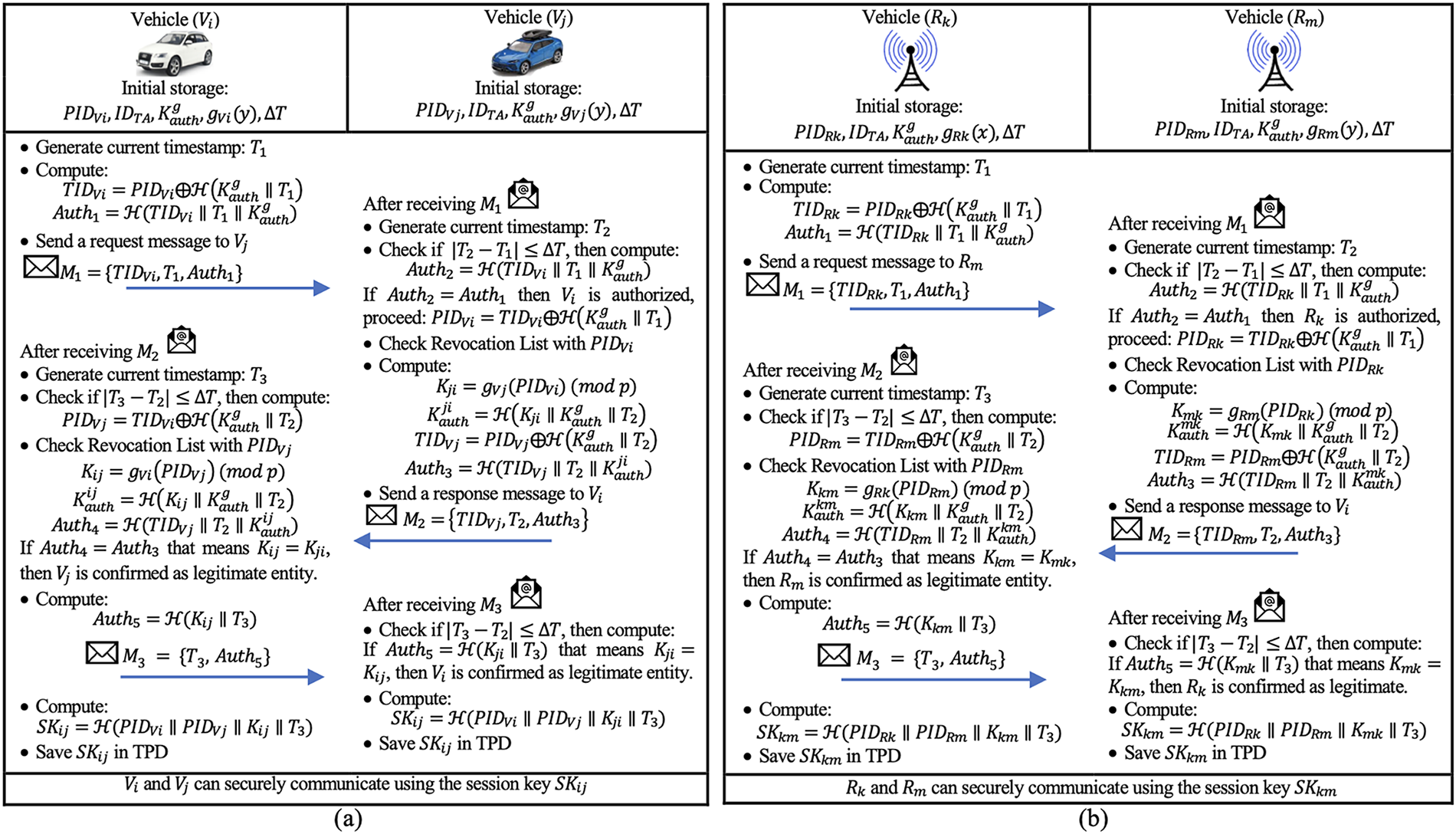
Figure 3: Mutual authentication and key agreement phase: (a) vehicle-to-vehicle and (b) RSU-to-RSU.
Step 1: When vehicle
Step 2: Upon receiving
Step 3: After receiving
Step 4: Finally, vehicle
Note that this mutual authentication and session key establishment procedure is applicable for all direct vehicular communication modes, including the V2V (Fig. 3a), R2R (Fig. 3b), and V2R (Fig. 4a) interactions. Each session key is valid only for one active session due to the inclusion of a fresh session timestamp, which prevents key reuse across different communication sessions and mitigates session key capture attacks.
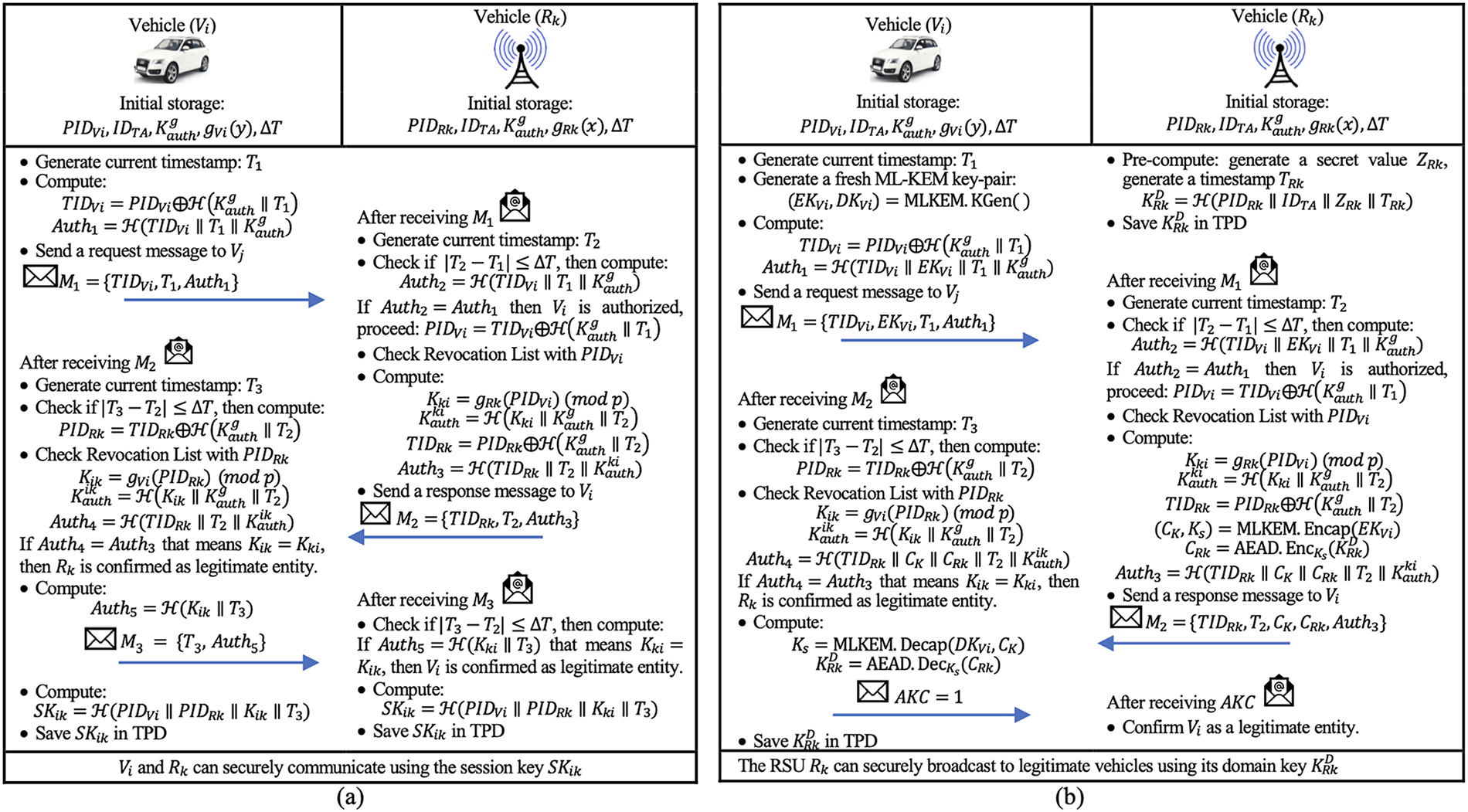
Figure 4: Vehicle-to-RSU authentication phase: (a) session key agreement and (b) domain key sharing.
4.4 V2R Mutual Authentication and Domain Key Distribution
When a vehicle enters the communication range of an RSU, they execute the mutual V2R authentication process where the RSU uses the ML-KEM encapsulation to securely distribute its domain broadcast key to the vehicle as illustrated in Fig. 4b. Consequently, authenticated vehicles can securely receive broadcast traffic messages within the RSU coverage area. In addition, vehicles and RSUs can achieve unicast communications when necessary by executing a mutual authentication and session key establishment as shown in Fig. 4a.
Step 0: Each RSU
Step 1: To initiate the authentication process, vehicle
Step 2: After receiving
Step 3: Upon receiving the response
To limit the long-term exposure of cryptographic material, the proposed scheme incorporates a periodic security update mechanism. This phase primarily refreshes the global authorization key
Re-initialization: The TA achieves an offline re-initialization before any update period following the steps in Section 4.1. It refreshes the global authorization key
Distribution: TA announces the security update period
The proposed protocol provides conditional traceability, allowing the TA to identify and revoke malicious or compromised entities while preserving the anonymity of legitimate users.
Misbehavior Reporting: When a vehicle or RSU detects invalid behavior or suspicious activity, it forwards the corresponding authentication messages as evidence to the TA for verification.
Identity Tracing and Revocation: Upon receiving a valid misbehavior report, the TA reconstructs the reported pseudonym as
Revocation Dissemination: To enable a dynamic revocation enforcement, the TA immediately publishes the RL after every update to be accessible by RSUs. Each RSU frequently broadcasts the latest RL to vehicles within its communication range, enabling them to verify whether the received pseudonym belongs to the current revocation list before initiating mutual authentication. Since vehicles and RSUs cannot forge valid pseudonyms, any entity associated with a revoked pseudonym is immediately rejected by legitimate peers even if its previous credentials remain valid within the current update interval
In this section, we analyze the security guarantees of the proposed AKA protocol through an informal analysis and a formal correctness analysis and a formal security verification.
5.1 Informal Security Analysis
5.1.1 Mutual Authentication and Message Integrity
The proposed protocol provides mutual authentication between communicating entities through a challenge-response mechanism based on hash verification and Blom’s pairwise secret computation. During authentication, each entity validates the received authentication token using the derived pairwise secret and the global authorization key. Since only legitimate nodes possess valid polynomial shares and authentication parameters, an adversary cannot generate a valid authentication response. Consequently, both communicating parties are assured of each other’s legitimacy before establishing a session key. Moreover, the computed hash-based authentication token assures that any modification of an intercepted message changes the hash input and causes the receiver’s verification to fail. Therefore, forged or modified messages are detected and discarded to preserve message integrity against man-in-the-middle attacks.
5.1.2 Privacy (Anonymity and Unlinkability)
In the proposed protocol, the real identity
5.1.3 Replay Attacks Resistance
Every authentication message includes a fresh timestamp that is verified upon reception using the condition
5.1.4 Impersonation (Even from Insider) Attack Resistance
An adversary attempting to impersonate a legitimate vehicle or RSU must generate valid authentication messages and establish a valid session key. External adversaries cannot accomplish this because they lack the required authorization key
5.1.5 Resistance to Node Capture and Storage Intrusion
The proposed protocol protects sensitive authentication parameters, including pseudonymous identities, polynomial shares, authorization keys, and session keys, by storing them in trusted TPDs. These tamper-resistant hardware modules significantly reduce the risk of unauthorized extraction of cryptographic material through physical attacks. Furthermore, the protocol inherits the threshold security property of Blom’s key pre-distribution scheme. Specifically, compromising up to
5.1.6 Resistance to Session Key Capture Attacks
In the proposed protocol, the session key is never transmitted over the communication channel. Instead, both communicating entities independently derive the identical fresh session key from their polynomial shares, pseudonym identities, and fresh timestamps after successful mutual authentication. Consequently, each session key is unique and independent of previously established session keys, ensuring that even if an adversary compromises a session key, it cannot derive past or future session keys without compromising the Blom’s polynomial share. Moreover, a fresh ML-KEM key pair is generated whenever it is used during credential or domain key distribution, preventing the reuse of cryptographic material across sessions and further limiting the impact of key compromise. Therefore, the protocol is secure against session key attacks.
5.1.7 Brute Force Attack Resistance
The proposed protocol employs SHA-256 and ML-KEM to protect its authentication parameters, requiring approximately
5.1.8 Resistance to Flooding Attacks
The protocol minimizes the computational impact of flooding attacks through early message validation. Received messages first undergo timestamp verification to immediately discard stale messages before any expensive cryptographic operation is performed, while authentication relies primarily on lightweight hash computations and Blom polynomial evaluations. Furthermore, the decentralized authentication process eliminates continuous dependence on the TA, reducing the risk of bottlenecks and distributed DoS attacks.
5.2 Formal Security Verification Using BAN Logic
To prove the structural correctness and cryptographic soundness of the proposed mutual authentication and key agreement mechanism, a formal deductive analysis is conducted using Burrows-Abadi-Needham (BAN) Logic [32]. This analysis verifies that the participating nodes can securely establish a common session key (
Notation 1: Let
•
•
•
•
•
•
•
•
•
•
The foundational inference rules of BAN logic applied in this proof include:
R1: The message meaning rule:
R2: The nonce-verification rule:
R3: The jurisdiction rule:
R4: The freshness rule:
R5: The belief rule:
Assumption 2: The verification proof is evaluated under the following initial beliefs and baseline assumptions regarding parameter distribution and clock synchronization:
A1 (the sender can verify timestamp freshness):
A2 (the receiver can verify timestamp freshness):
A3 (each entity received the global authorization key):
A4 (each entity received its secret polynomial slice):
By the Blom’s mathematical structure in Definition 3, evaluating local secret polynomial slices creates a unique, mutually verifiable pairwise secret
A5 (Pairwise Secret Ownership Authority):
Assumption 3: The actual over-the-air protocol packets (
Idealized
Idealized
Idealized
Theorem 1: To confirm that the session key configuration is fully secure and mutually authenticated, the deductive analysis must satisfy the following four fundamental security goals:
G1:
G2:
G3:
G4:
Proof of Theorem 1: The step-by-step application of BAN logic inference rules proceeds as follows:
Analysis of Message
S1:
By applying the Message Meaning Rule to S1 combined with the global initialization in A3, we derive:
S2:
Because vehicle
S3:
Based on the Belief Rule, we can decompose the belief components from S3 to directly achieves Goal 1:
S4:
Analysis of Message
S5:
Since
S6:
By referencing the timestamp freshness of
S7:
Breaking down the conjunction vector in S7 based on the Belief Rule achieves Goal 2:
S8:
Concurrently, parsing the remaining element from S7 yields:
S9:
Applying the Jurisdiction Rule to S9 using the initial network authority setting in A5 establishes:
S10:
Analysis of Message
S11:
Because
S12:
By applying the Message Meaning Rule to S11 and S12 yields: S13:
By integrating the freshness check
S14:
Session Key Establishment: The final session key is computed as
S15:
Similarly, because vehicle
S16:
Conclusion: The BAN logic verification confirms mutual authentication, message freshness, and session key establishment under the assumed trust conditions. The use of timestamps ensures protection against replay attacks, while the derivation of identity-bound temporary keys prevents adversarial impersonation and message forgery, validating the correctness of the protocol in satisfying its intended security properties. □
5.3 Formal Security Verification via AVISPA
To rigorously validate the security strength of the proposed AKA protocol against active malicious exploitation, a formal simulation is conducted using the industry-standard Automated Validation of Internet Protocols and Applications (AVISPA) tool [33]. Implementing a Dolev-Yao intruder model, AVISPA evaluates cryptographic transactions over an insecure channel where an adversary can intercept, modify, delete, or inject arbitrary messages. The architecture is formally modeled using the High-Level Protocol Specification Language (HLPSL), defining explicit state transitions, parameter spaces, and foundational network goals.
5.3.1 HLPSL Role Specifications
The proposed protocol is modeled in HLPSL using two primary roles: the initiator (
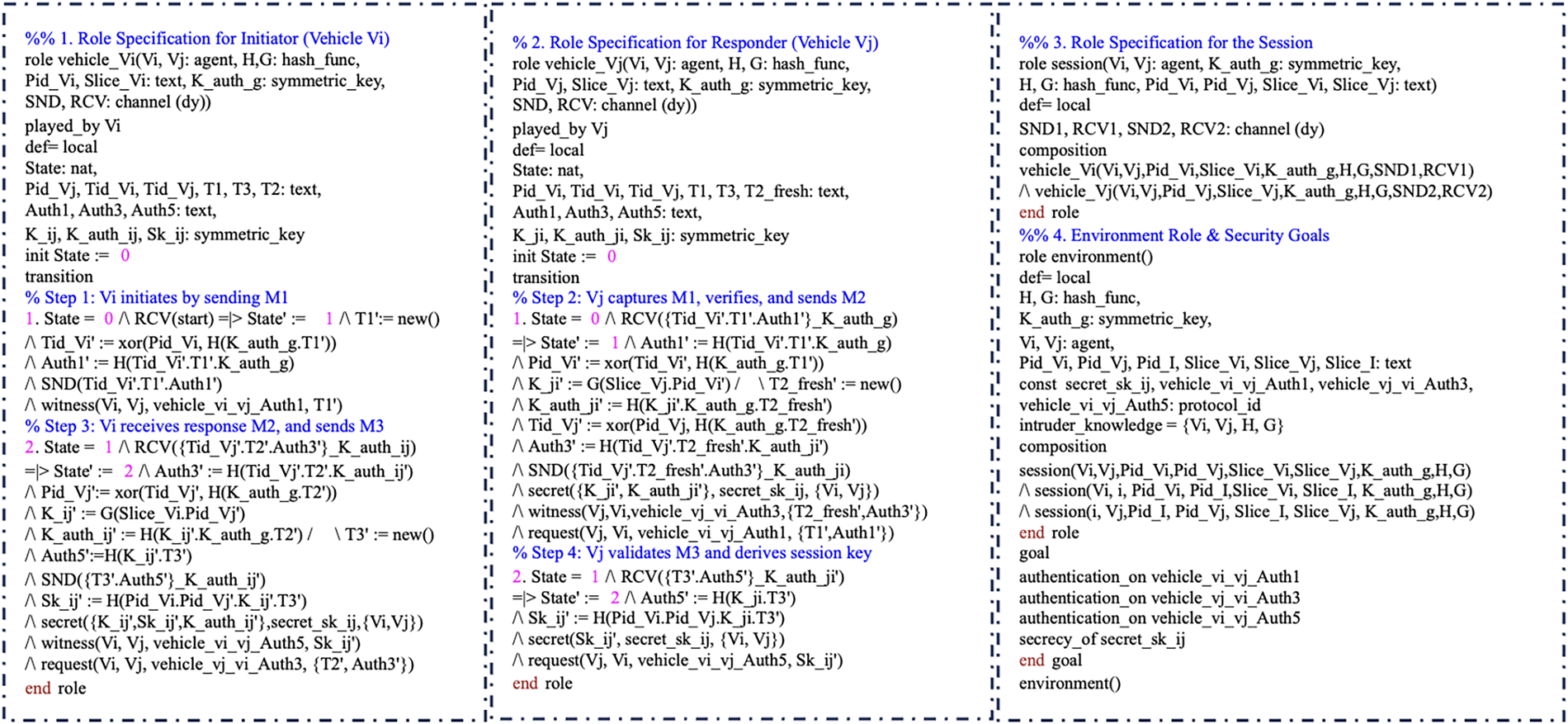
Figure 5: HLPSL role specifications.
5.3.2 AVISPA Simulation Results and Analysis
The HLPSL specification is formally verified using the AVISPA framework with its two principal verification backends: the On-the-Fly Model Checker (OFMC) and Constraint-Logic-Based Attack Searcher (CL-AtSe), which systematically explore the protocol state space to identify potential attacks, including replay, man-in-the-middle, and impersonation attacks. As shown in Fig. 6a,b, both analyses return a SAFE verdict, indicating that no attack trace violates the specified secrecy and authentication goals. Furthermore, an insider attack was evaluated by assuming that the adversary compromises the global authorization key
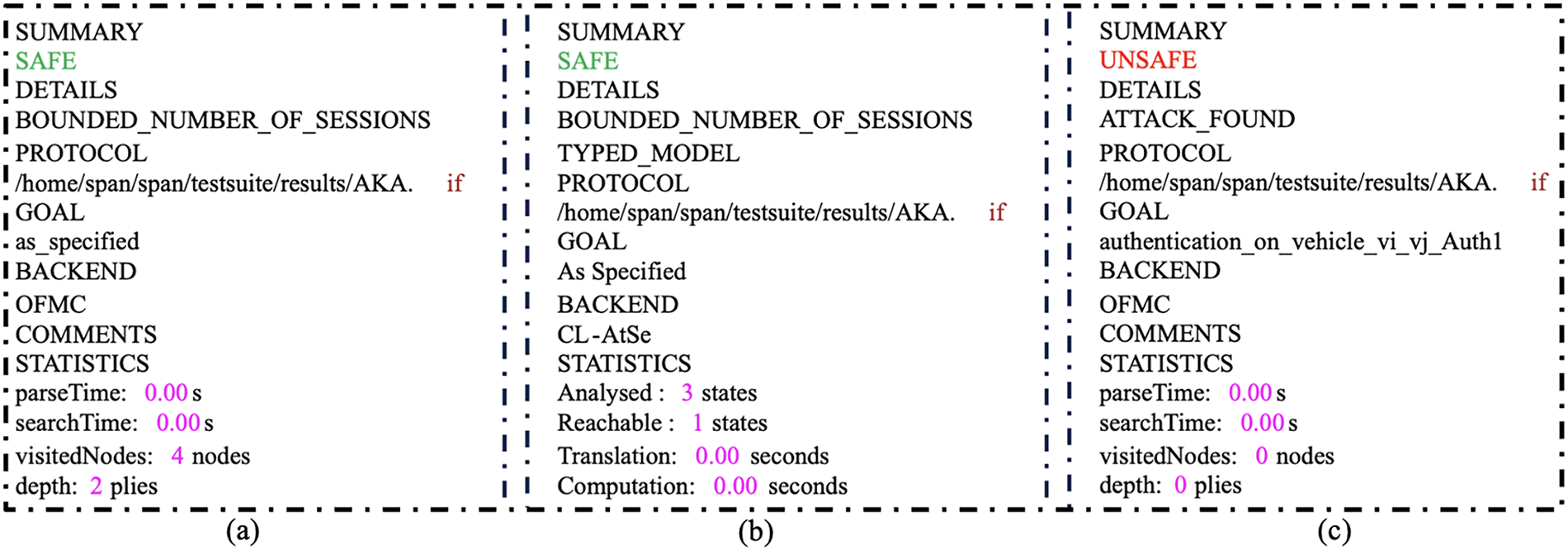
Figure 6: AVISPA results: (a) normal under OFMC, (b) normal under CL-AtSe, and (c) compromise under OFMC.
In this section, we discuss the computational and communication performances of the proposed protocol phases, while comparing it against existing representative AKA schemes (referenced as [13,14,21,22,26,29]).
To evaluate the computational overhead, cryptographic benchmarks were conducted on an Apple M2 processor (10 cores, 16 GB RAM) running Python 3.13, as summarized in Table 3. ECC, AES, SHA-256, and the pseudo-random function (PRF) were implemented using the cryptography (OpenSSL) library, while ML-KEM was evaluated using the pqcrypto library [34]. Additional benchmarks, including bitwise XOR, ECC modular arithmetic, Blom polynomial evaluation, Paillier homomorphic encryption, Arbiter Physical Unclonable Function (PUF) delay-path simulation, and Fuzzy Extractor operations, were implemented using native Python arithmetic. Execution times were measured with Python’s high-resolution
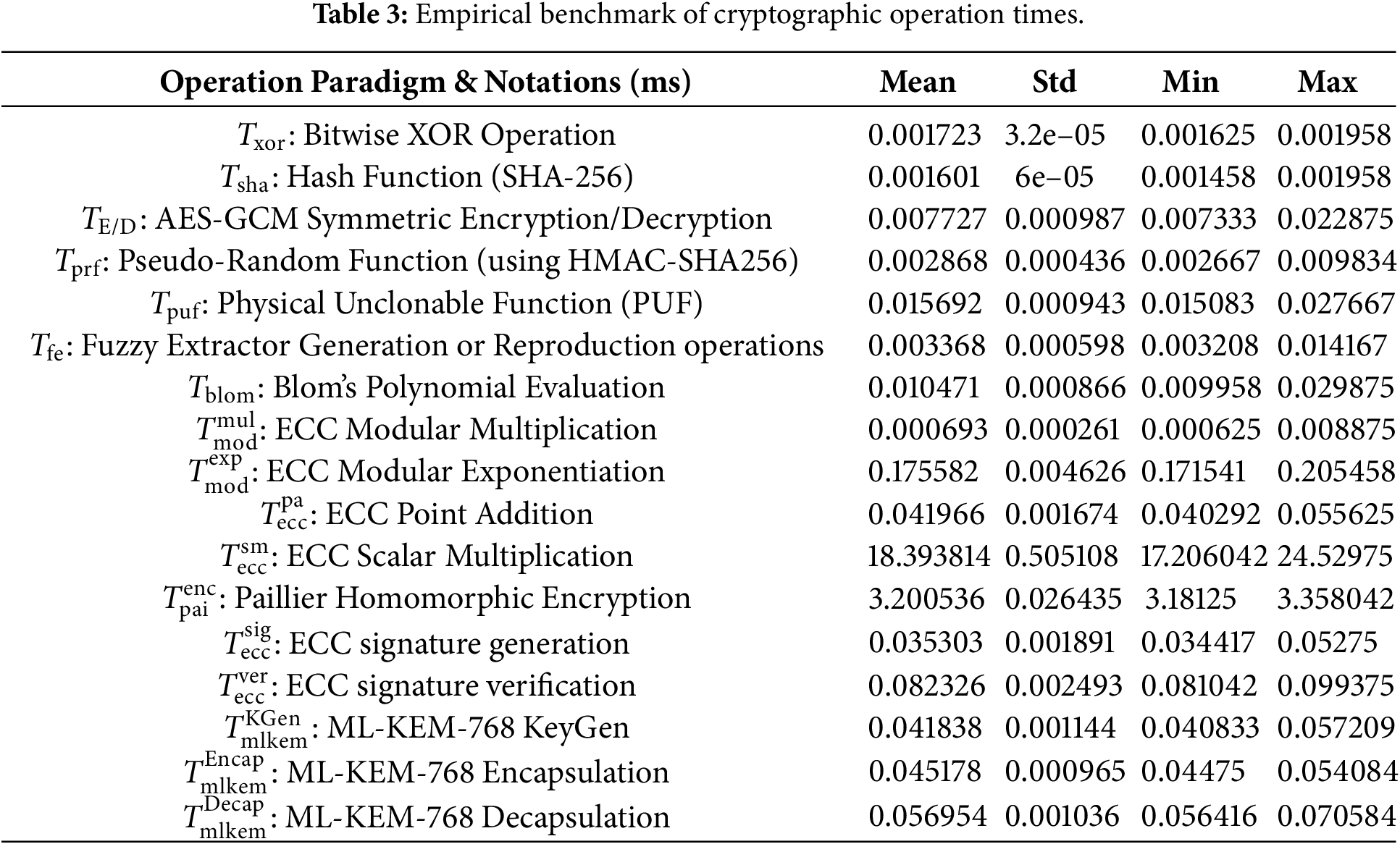
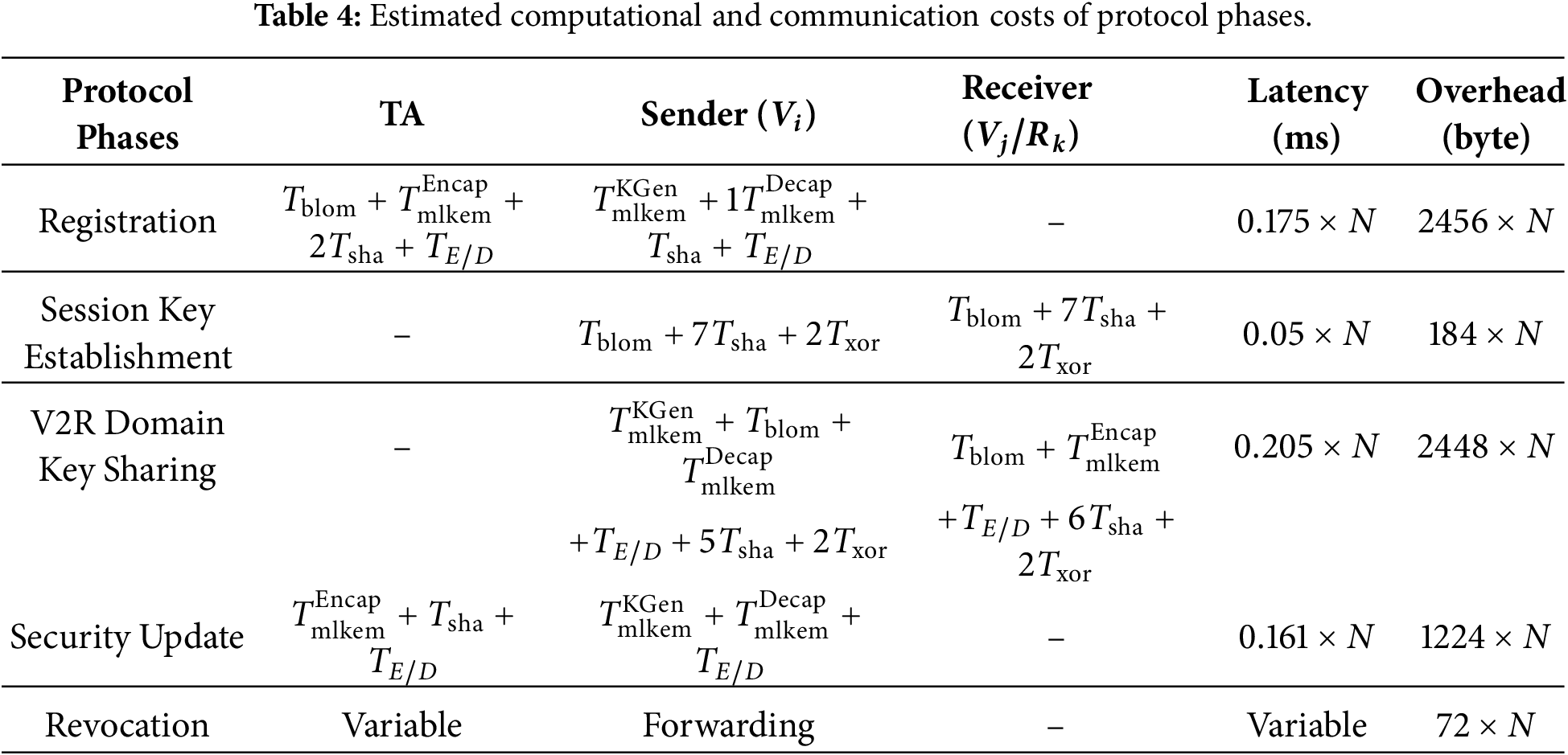
Table 4 gives the estimated computational complexity, communication overhead, and authentication latency of the proposed protocol for each operational phase. During registration, the TA computes the entity’s credentials and securely delivers them using ML-KEM and AEAD security mechanisms, resulting in a one-time latency of approximately
6.2 Comparative Computational Scalability
Based on the estimated computational costs in Table 5, the proposed protocol (denoted by
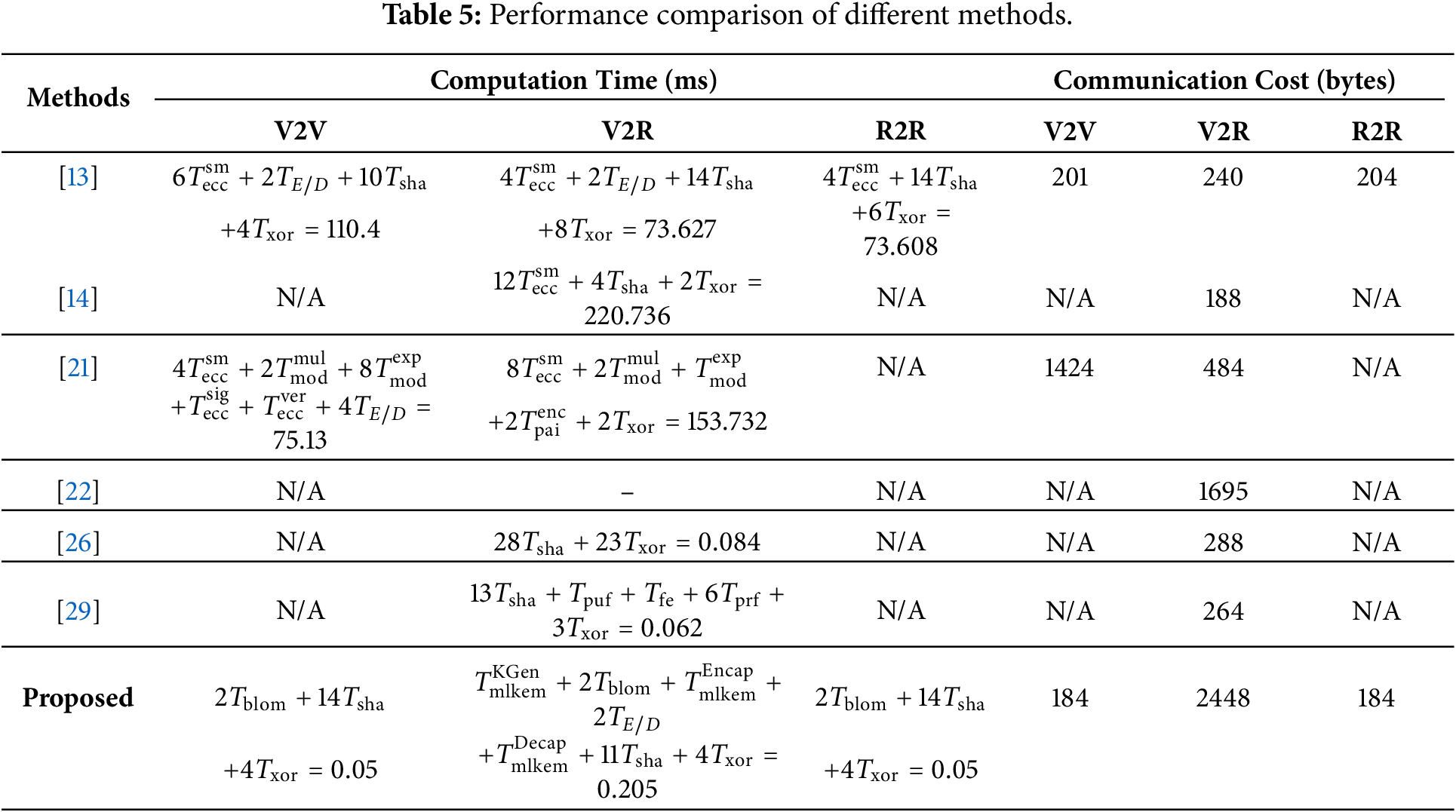
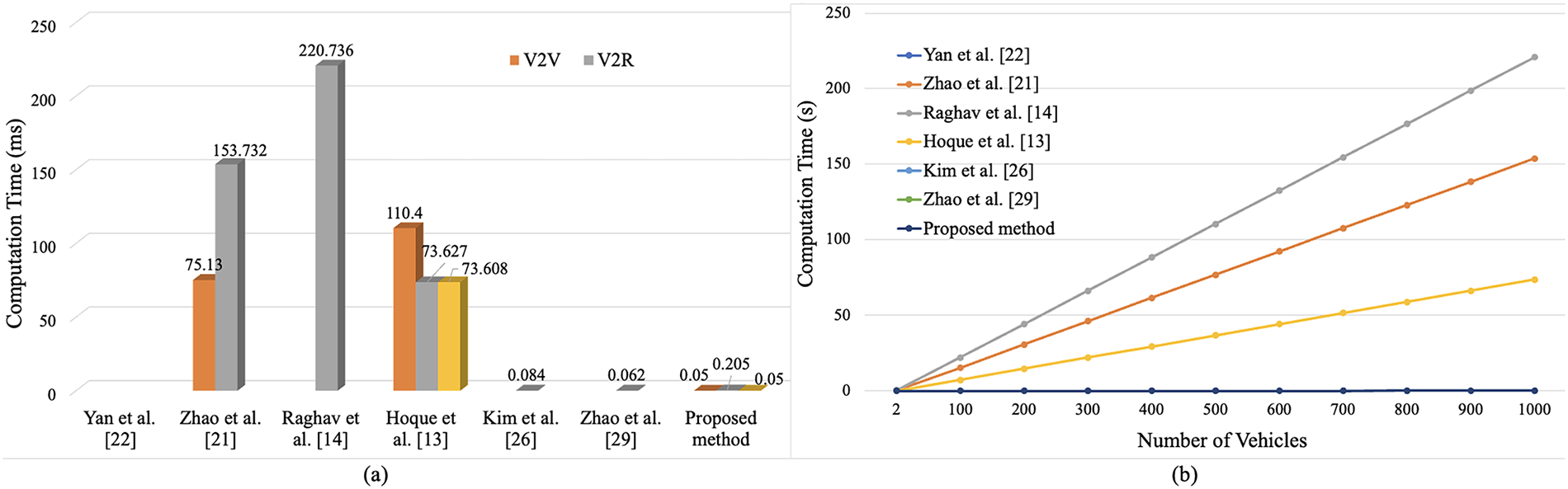
Figure 7: Computation cost: (a) comparative overhead and (b) comparative scalability.
6.3 Comparative Communication Scalability
The communication cost is evaluated based on the total size of the exchanged authentication messages. During mutual authentication and session key establishment (V2V, V2R, and, R2R), the protocol exchanges three messages containing temporary identities (32 bytes), timestamps (8 bytes), and authentication tokens (32 bytes), resulting in a total communication overhead of 184 bytes. In contrast, the V2R domain key sharing phase additionally carries the ML-KEM public key (1184 bytes), the ML-KEM encapsulated ciphertext (1088 bytes), and the AEAD encrypted domain key (32 bytes), increasing the communication overhead to 2448 bytes. Table 5 compares the communication costs of different protocols. The proposed protocol reduces the V2V communication overhead by 8.46% and 87.08% compared with [13] and [21], respectively as visible in Fig. 8a, while achieving a 9.80% reduction in R2R compared with [13]. However, the V2R communication overhead is higher than that of existing classical schemes because of the transmission of ML-KEM public keys and ciphertexts required to provide quantum-resistant key sharing. This additional overhead represents a deliberate trade-off for post-quantum security and occurs only during infrastructure-assisted authentication, whereas the more frequent mutual authentication and session key establishment phases remain lightweight. Furthermore, the decentralized authentication architecture eliminates the need for blockchain interactions or frequent TA involvement, reducing the number of exchanged messages and allowing most cryptographic operations to be performed locally. Consequently, despite the increased V2R message size, the proposed protocol maintains low authentication latency while providing scalable and quantum-secure authentication for dense vehicular networks as shown in Fig. 8b.
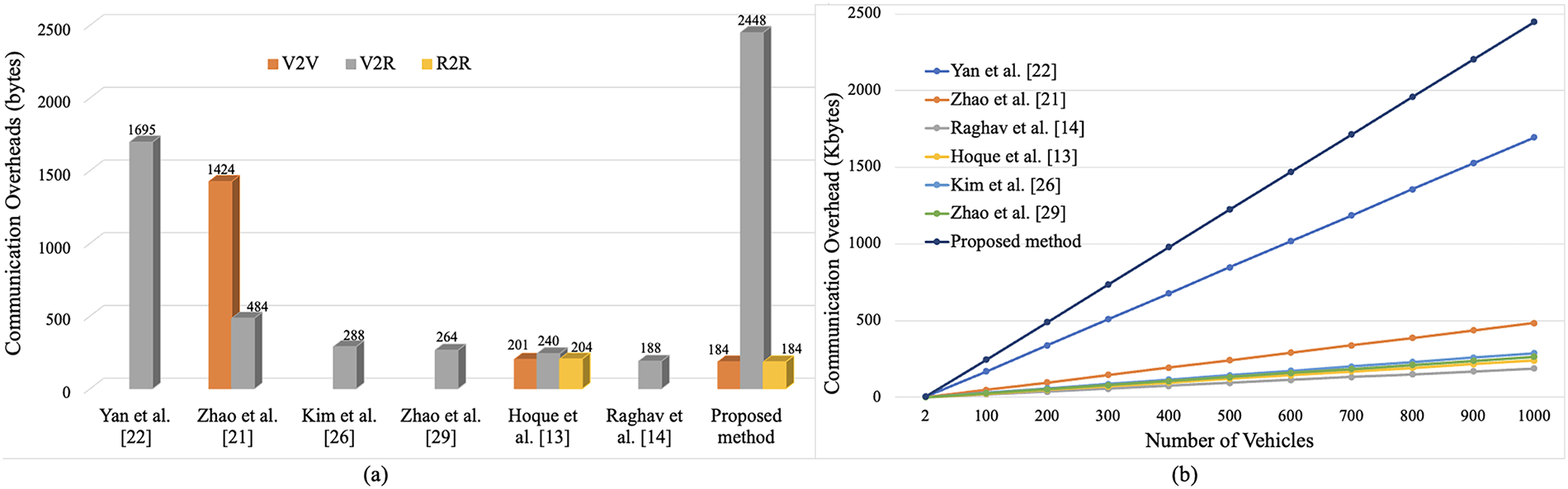
Figure 8: Communication cost: (a) comparative overhead and (b) comparative scalability.
The proposed protocol is evaluated using the NS-3 network simulator on macOS, with NetAnim employed for network visualization. The simulation models a dynamic V2X environment consisting of four static RSUs spaced 500 m apart and
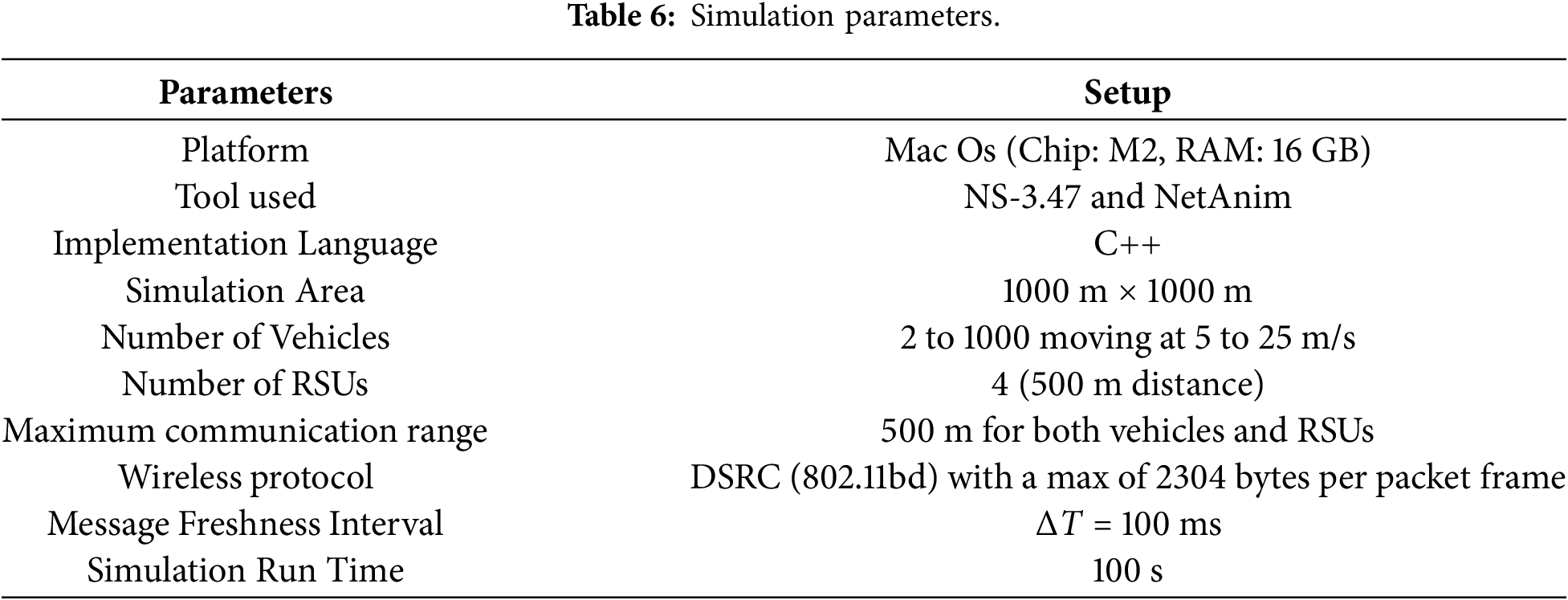
The proposed protocol is evaluated using two performance metrics: the packet delivery ratio (PDR) and the end-to-end authentication latency. The PDR, defined in Eq. (5), measures the percentage of successfully received packets
We first simulate the network by randomly distributing vehicles within a 1000 m
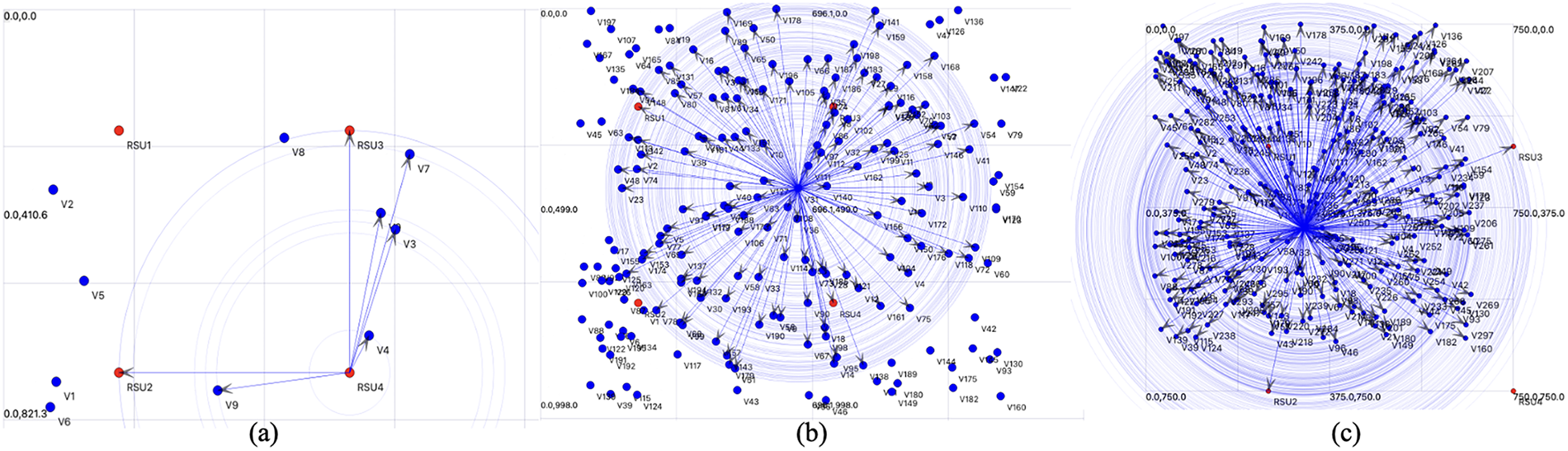
Figure 9: Visualization of the vehicular network simulation in the NetAnim environment: (a) low density with out-coverage senders, (b) high density with out-coverage senders, and (c) high density with full-coverage senders.
7.3.1 Impact of Vehicle Density Variation
This scenario tests the scalability constraints on a single vehicle and a single RSU when receiving authentication requests from multiple neighboring vehicles. Therefore, we maintain the vehicle speed to
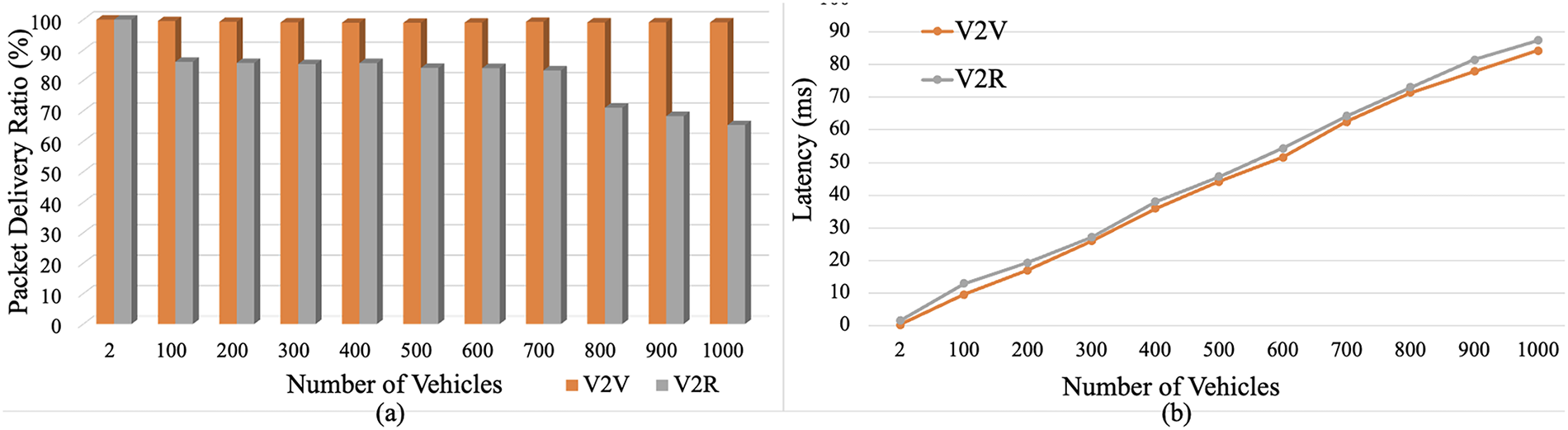
Figure 10: Density variations: (a) packet delivery ratio and (b) average end-to-end latency.
7.3.2 Impact of Vehicle Speed Variation
Unlike Scenario 1, this scenario fixes the network topology to two vehicles and one RSU while varying the vehicle speed from
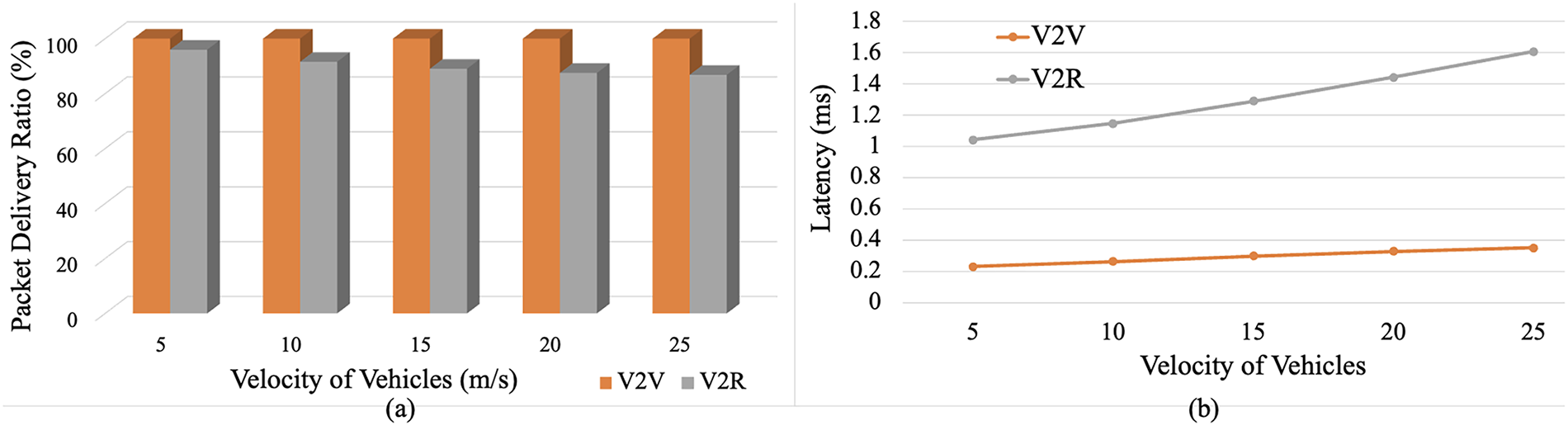
Figure 11: Speed variations: (a) packet delivery ratio and (b) average end-to-end latency.
Vehicular networks are a fundamental component of intelligent transportation systems, enabling secure and reliable communications for future smart cities. This paper presented a lightweight post-quantum authentication and key agreement protocol that combines Blom’s key pre-distribution scheme with ML-KEM to achieve efficient and quantum-resistant authentication across V2V, V2R, and R2R communications. By confining computationally intensive ML-KEM operations to registration and infrastructure-assisted key distribution while relying on lightweight Blom polynomial evaluations and SHA-256 hashing during routine authentication, the proposed protocol effectively balances security and efficiency. Security was validated through informal analysis, BAN logic, and AVISPA verification, demonstrating resistance against impersonation, replay, node capture, session key compromise, storage intrusion, and quantum attacks while preserving anonymity, unlinkability, and conditional traceability. Performance evaluation showed substantial reductions in computational cost up to 99.95% and communication overhead (8.46%–87.08%) compared with existing schemes. Although V2R communication incurs additional overhead due to ML-KEM ciphertext transmission, this trade-off enables post-quantum secure key establishment while maintaining low authentication latency. Furthermore, NS-3 simulations confirmed that the proposed protocol provides reliable packet delivery and low end-to-end authentication latency under varying vehicle densities and mobility conditions. Overall, the proposed protocol offers a scalable, secure, and practical post-quantum authentication framework for next-generation vehicular networks and other resource-constrained cyber-physical systems. Future work will investigate broadcast basic safety message authentication protocol using distributed RSU domain keys and implementation on real vehicular hardware platforms for more realistic deployments.
Acknowledgement: The authors acknowledge the support from the PASET-Regional Scholarship and Innovation Funds through the African Center of Excellence in Internet of Things (ACEIoT), the Google Africa PhD Fellowship, and the Carnegie Corporation of New York.
Funding Statement: The APC was funded by Carnegie Corporation of New York through the DOCTAS II Mobility Grant Award-Publication Support.
Author Contributions: The authors confirm contribution to the paper as follows: Conceptualization, methodology, and resources: Lasseni Coulibaly and Damien Hanyurwimfura; investigation, software, and formal analysis, Lasseni Coulibaly; writing—original draft preparation, Lasseni Coulibaly; writing—review and editing and validation: Damien Hanyurwimfura, Evariste Twahirwa, Abubakar Diwani and Lasseni Coulibaly; supervision: Damien Hanyurwimfura, Evariste Twahirwa and Abubakar Diwani; project administration: Damien Hanyurwimfura; funding acquisition: Lasseni Coulibaly and Damien Hanyurwimfura. All authors reviewed and approved the final version of the manuscript.
Availability of Data and Materials: The data that support the findings of this study are available upon request.
Ethics Approval: Not applicable.
Conflicts of Interest: The authors declare no conflicts of interest.
References
1. Muthuramalingam S, Bharathi A, Kumar SR, Gayathri N, Sathiyaraj R, Balamurugan B. IoT based intelligent transportation system (IoT-ITS) for global perspective: a case study. In: Balas VE, Solanki VK, Kumar R, Khari M, editors. Internet of Things and Big Data Analytics for Smart Generation. Cham, Switzerland: Springer; 2018. p. 279–300. doi:10.1007/978-3-030-04203-5_13. [Google Scholar] [CrossRef]
2. Coulibaly L, Hanyurwimfura D, Twahirwa E, Diwani A. A review of cybersecurity challenges and solutions for autonomous vehicles. Int J Adv Comput Sci Appl. 2025;16(2):850–66. doi:10.14569/ijacsa.2025.0160285. [Google Scholar] [CrossRef]
3. Muhammad M, Ali Safdar G. 5G-based V2V broadcast communications: a security perspective. Array. 2021;11(6):100084. doi:10.1016/j.array.2021.100084. [Google Scholar] [CrossRef]
4. Lai J, Zhang X, Liu S, Zhong S, Moshayedi AJ. Blockchain-based VANET edge computing-assisted cross-vehicle enterprise authentication scheme. Comput Commun. 2025;231(6):108040. doi:10.1016/j.comcom.2024.108040. [Google Scholar] [CrossRef]
5. Zhang H, Zhao F. Cross-domain identity authentication scheme based on blockchain and PKI system. High Confid Comput. 2023;3(1):100096. doi:10.1016/j.hcc.2022.100096. [Google Scholar] [CrossRef]
6. Moody D, Robinson A. Cryptographic standards in the post-quantum era. IEEE Secur Privacy. 2022;20(6):66–72. doi:10.1109/msec.2022.3202589. [Google Scholar] [CrossRef]
7. Moody D, Perlner R, Regenscheid A, Robinson A, Cooper D. Transition to post-quantum cryptography standards. Gaithersburg, MD, USA: National Institute of Standards and Technology (NIST); 2024. NIST IR 8547 (IPD). doi:10.6028/NIST.IR.8547.ipd. [Google Scholar] [CrossRef]
8. Antony SNFMA, Bahari MFA. Implementation of elliptic curves in the polynomial Blom key pre-distribution scheme for wireless sensor networks and distributed ledger technology. J Sens Actuator Netw. 2023;12(1):15. doi:10.3390/jsan12010015. [Google Scholar] [CrossRef]
9. NIST.FIPS.203.Module-Lattice-Based Key-Encapsulation Mechanism Standard. Washington, DC, USA: National Institute of Standards and Technology; 2024. doi:10.6028/NIST.FIPS.203. [Google Scholar] [CrossRef]
10. Liu Z, Yao N, Bai S, Mai T. A cooperative ECC-based authentication protocol for VANETs. Sci Rep. 2025;15(1):40837. doi:10.1038/s41598-025-24663-8. [Google Scholar] [CrossRef]
11. Mei Q, Xiong H, Chen J, Yang M, Kumari S, Khan MK. Efficient certificateless aggregate signature with conditional privacy preservation in IoV. IEEE Syst J. 2021;15(1):245–56. doi:10.1109/jsyst.2020.2966526. [Google Scholar] [CrossRef]
12. Jiang H, Hua L, Wahab L. SAES: a self-checking authentication scheme with higher efficiency and security for VANET. Peer Peer Netw Appl. 2021;14(2):528–40. doi:10.1007/s12083-020-00997-0. [Google Scholar] [CrossRef]
13. Hoque A, Amin R, Ali Khan D. L-VAKMC: lightweight authentication and dynamic key agreement for VANET multi-entity communications. IEEE Trans Depend Secur Comput. 2026;23(2):4310–22. doi:10.1109/tdsc.2025.3645431. [Google Scholar] [CrossRef]
14. Raghav, Maurya C, Verma S. Certificateless federated authentication and key agreement in IoV. Comput Netw. 2026;277(4):112017. doi:10.1016/j.comnet.2026.112017. [Google Scholar] [CrossRef]
15. Yang Q, Zhu X, Wang X, Fu J, Zheng J, Liu Y. A novel authentication and key agreement scheme for internet of vehicles. Fut Gener Comput Syst. 2023;145(8):415–28. doi:10.1016/j.future.2023.03.037. [Google Scholar] [CrossRef]
16. Jayashree S, Santhosh Kumar SVN. LAPEP—lightweight authentication protocol with enhanced privacy for effective secured communication in vehicular ad-hoc network. Wirel Netw. 2024;30(1):151–78. doi:10.1007/s11276-023-03459-6. [Google Scholar] [CrossRef]
17. Dwivedi SK, Amin R, Vollala S, Das AK. Design of blockchain and ECC-based robust and efficient batch authentication protocol for vehicular ad-hoc networks. IEEE Trans Intell Transp Syst. 2024;25(1):275–88. doi:10.1109/tits.2023.3310514. [Google Scholar] [CrossRef]
18. Lin HT, Jhuang WL. Blockchain-based lightweight certificateless authenticated key agreement protocol for V2V communications in IoV. IEEE Internet Things J. 2024;11(16):27744–59. doi:10.1109/jiot.2024.3400320. [Google Scholar] [CrossRef]
19. Noh J, Kwon Y, Son J, Cho S. Blockchain-based one-time authentication for secure V2X communication against insiders and authority compromise attacks. IEEE Internet Things J. 2023;10(7):6235–48. doi:10.1109/jiot.2022.3224465. [Google Scholar] [CrossRef]
20. Zhao F, Ding H, Li C, Su Z, Liang G, Yang C. A blockchain-based efficient cross-domain authentication scheme for Internet of vehicles. Comput Mater Contin. 2024;80(1):567–85. doi:10.32604/cmc.2024.052233. [Google Scholar] [CrossRef]
21. Zhao J, Guo Y, Liao L, Wang D. A blockchain-based efficient traceability authentication scheme in VANET. Digit Commun Netw. 2025;11(5):1410–20. doi:10.1016/j.dcan.2025.04.013. [Google Scholar] [CrossRef]
22. Yan M, Bao Z, Li J, Tian H. Quantum-resistant blockchain-assisted certificateless authentication and three-party key agreement scheme for VANET. Expert Syst Appl. 2026;299(5):130163. doi:10.1016/j.eswa.2025.130163. [Google Scholar] [CrossRef]
23. Lu Z, Wang Q, Qu G, Zhang H, Liu Z. A blockchain-based privacy-preserving authentication scheme for VANETs. IEEE Trans VLSI Syst. 2019;27(12):2792–801. doi:10.1109/tvlsi.2019.2929420. [Google Scholar] [CrossRef]
24. Wazid M, Das AK, Kumar N, Odelu V, Goutham Reddy A, Park K, et al. Design of lightweight authentication and key agreement protocol for vehicular ad hoc networks. IEEE Access. 2017;5:14966–80. doi:10.1109/access.2017.2723265. [Google Scholar] [CrossRef]
25. Aman MN, Javaid U, Sikdar B. A privacy-preserving and scalable authentication protocol for the Internet of vehicles. IEEE Internet Things J. 2021;8(2):1123–39. doi:10.1109/jiot.2020.3010893. [Google Scholar] [CrossRef]
26. Kim C, Kwon D, Son S, Yu S, Park Y. An anonymous and efficient authentication scheme with conditional privacy preservation in Internet of vehicles networks. Mathematics. 2024;12(23):3756. doi:10.3390/math12233756. [Google Scholar] [CrossRef]
27. Vasudev H, Das D. An efficient authentication and secure vehicle-to-vehicle communications in an IoV. In: Proceedings of the 2019 IEEE 89th Vehicular Technology Conference (VTC2019-Spring); 2019 Apr 28–May 1; Kuala Lumpur, Malaysia. p. 1–5. doi:10.1109/vtcspring.2019.8746612. [Google Scholar] [CrossRef]
28. Nandy T, Idris MYI, Noor RM, Das AK, Li X, Ghani NA, et al. An enhanced lightweight and secured authentication protocol for vehicular ad-hoc network. Comput Commun. 2021;177:57–76. doi:10.1016/j.comcom.2021.06.013. [Google Scholar] [CrossRef]
29. Zhao Y, Wu L, Wang J, Li W, Jin J, Zhang Z, et al. LDSAV: lightweight and dynamically scalable authentication key agreement for vehicle-cloud collaboration. IEEE Trans Veh Technol. 2026;1–15. doi:10.1109/tvt.2026.3669949. [Google Scholar] [CrossRef]
30. Li X, Liu T, Obaidat MS, Wu F, Vijayakumar P, Kumar N. A lightweight privacy-preserving authentication protocol for VANETs. IEEE Syst J. 2020;14(3):3547–57. doi:10.1109/jsyst.2020.2991168. [Google Scholar] [CrossRef]
31. Coulibaly L, Hanyurwimfura D, Twahirwa E, Diwani A. A lightweight biometric-based user authentication protocol for self-driving vehicles. In: Proceedings of the 2024 1st International Conference on Cyber Security and Computing (CyberComp); 2024 Nov 6–7; Melaka, Malaysia. p. 144–9. doi:10.1109/cybercomp60759.2024.10913668. [Google Scholar] [CrossRef]
32. Burrows M, Abadi M, Needham R. A logic of authentication. ACM Trans Comput Syst. 1990;8(1):18–36. doi:10.1145/77648.77649. [Google Scholar] [CrossRef]
33. Viganò L. Automated security protocol analysis with the AVISPA tool. Electron Notes Theor Comput Sci. 2006;155(1):61–86. doi:10.1016/j.entcs.2005.11.052. [Google Scholar] [CrossRef]
34. Backbone Authors. Pqcrypto: post-quantum cryptography for python. 2026 [cited 2026 May 1]. Available from: https://pypi.org/project/pqcrypto/. [Google Scholar]
35. IEEE Std 80211bd-2022. IEEE standard for information technology, specific requirements part 11: wireless LAN medium access control (MAC) and physical layer (PHY) specifications amendment 5: enhancements for next generation V2X. Piscataway, NJ, USA: IEEE; 2023. p. 1–144. doi:10.1109/IEEESTD.2023.10063942. [Google Scholar] [CrossRef]
Cite This Article
 Copyright © 2026 The Author(s). Published by Tech Science Press.
This work is licensed under a Creative Commons Attribution 4.0 International License , which permits unrestricted use, distribution, and reproduction in any medium, provided the original work is properly cited.
 Downloads
 Citation Tools
