
 Login
Login Register
 Submit a Paper
 Propose a Special lssue
 Open Access
ARTICLE
5G-Aware Incremental Routing and Scheduling for Dynamic Time-Triggered Flow Admission in Time-Sensitive Networks
1 Key Laboratory of Computing Power Network and Information Security, Ministry of Education, Shandong Computer Science Center (National Supercomputer Center in Jinan), Qilu University of Technology (Shandong Academy of Sciences), Jinan, China
2 Shandong Provincial Key Laboratory of Computing Power Internet and Service Computing, Shandong Fundamental Research Center for Computer Science, Jinan, China
3 School of Information and Communication Engineering, University of Electronic Science and Technology of China, Chengdu, China
4 College of Science, China University of Petroleum (East China), Qingdao, China
* Corresponding Author: Xiaolong Wang. Email:
Computers, Materials & Continua 2026, 89(2), 91 https://doi.org/10.32604/cmc.2026.088018
Received 26 June 2026; Accepted 21 August 2026; Issue published 15 September 2026
 View Full Text
 Download PDF
Abstract
Mobile edge services require deterministic communication across Time-Sensitive Networking (TSN) and 5G access, where the standardized integration architecture exposes the 5G System (5GS) to the TSN controller as a logical bridge. We study dynamic admission of time-triggered (TT) flows using reported 5GS bridge delay and TSN-to-5GS Quality of Service (QoS) mapping in route selection and Gate Control List (GCL) scheduling. Arrivals and departures can split available transmission time into noncontiguous windows. Online insertion preserves admitted schedules but may reduce subsequent schedulability, whereas full recomputation can restore schedulability but changes many routes and GCL entries, complicating coordinated activation. Coupling routing and GCL scheduling under timing, bridge-delay, QoS-mapping, and a bound on changes to admitted schedules yields an NP-hard problem. To address it, we propose a two-timescale scheduling mechanism. The fast timescale uses current 5GS bridge information to place arrivals without modifying admitted flows. Fragmented windows, repeated insertion failures, or changes in reported 5GS state invoke the slower timescale, which sequentially reschedules a bounded subset of admitted flows and commits only feasible improvements. At 0.95 offered load across A380, CEV, and Ring6, admission improves by 14.8–18.5 percentage points over online-only scheduling and remains within 1.7–2.2 points of full recomputation, while per-event runtime falls by over one order of magnitude with limited GCL changes.Keywords
Industrial and mobile applications increasingly run latency-sensitive control and data processing close to users, machines, and production systems. Mobile Edge Computing (MEC) supports this shift by moving computation, storage, and service control from remote cloud data centers toward nearby edge servers. MEC surveys and European Telecommunications Standards Institute (ETSI) specifications describe this shift as a way to support low-latency services through nearby computing and edge resource management [1,2]. For many applications, however, nearby computation creates value only when the communication path can deliver predictable service.
Proximity to computation is therefore not enough. A control task may run on an edge server, but its deadline still depends on the network path between the device, the 5G access segment, the Time-Sensitive Networking (TSN) domain, and the edge node. Harmatos and Maliosz studied 5G, TSN, and edge-computing integration for smart manufacturing [3], while Rost and Kolding analyzed performance issues in integrated 5G and TSN networks [4]. These studies reflect the same practical requirement: industrial MEC services need bounded latency, time synchronization, and traffic isolation on the communication path.
TSN supplies the scheduling machinery for this deterministic communication. The Institute of Electrical and Electronics Engineers (IEEE) 802.1AS standard supports time synchronization, IEEE 802.1Qbv defines scheduled traffic through the Time-Aware Shaper (TAS) and Gate Control List (GCL) configurations, and IEEE 802.1Qcc supports centralized configuration [5–7]. In 5G-TSN, the 5G System (5GS) can be exposed to the TSN control plane as a 5GS logical bridge through Device-side TSN Translator (DS-TT), Network-side TSN Translator (NW-TT), and TSN Application Function (TSN AF) entities [8,9]. The controller then schedules over bridge and port management information, bridge delay, Quality of Service (QoS) mapping configuration, and forwarding availability, rather than over 5G physical-layer details.
Dynamic time-triggered (TT) admission introduces two coupled problems. Runtime flow churn can leave enough total idle slots but no contiguous window for a new frame. Moreover, a route crossing the 5GS logical bridge must satisfy the reported bridge-delay, QoS-mapping, and forwarding-availability state. The problem is therefore 5G-aware at the TSN controller, without extending its decision space to radio scheduling or allocation.
Existing joint routing and scheduling methods are effective when the TT-flow set is known in advance or when the controller can afford batch recomputation. Prior studies considered traffic scheduling for integrated 5G-TSN systems and learning-assisted end-to-end optimization [10,11]. Online scheduling reduced current-flow decision latency [12], but a foreground-only inserter may gradually consume scarce contiguous windows. Full recomputation can recover schedulability, but it may change many routes and GCL entries. Deploying such a broad update requires coordinated activation across the affected bridges and end systems. If activation is non-atomic or mistimed, packets may encounter inconsistent old and new routes or gate states, causing transient queuing, loss, reordering, or deadline violations. Dynamic admission must therefore balance fast decisions and future schedulability against the scope and coordination cost of schedule transitions.
To balance these requirements, we develop a two-timescale, 5G-aware mechanism. Foreground bounded search filters routes using current 5GS information and places GCL windows without moving admitted flows. The background lane is invoked when a composite trigger identifies depleted placement options from fragmentation, reduced window flexibility, recent insertion failures, or adverse 5GS state. It assigns its bounded budget first to bottleneck-relevant flows and repairs them sequentially. Feasible coordinate updates are retained in a candidate state, and the aggregate incremental GCL delta is committed only after final feasibility and utility validation.
The main contributions are as follows.
• We formulate controller-side dynamic TT-flow admission as a 5G-aware incremental routing and scheduling problem that combines TAS/GCL constraints with runtime 5GS bridge-information inputs, and establish that its underlying joint feasibility problem is NP-hard.
• We design the 5G-Aware Foreground Online Insertion for TT-Flow Admission algorithm, which performs 5G-aware route filtering, flexibility-aware route ranking, and bounded feasible-window propagation without relocating admitted TT flows.
• We develop the Fragmentation-Aware Background Selective Rescheduling for GCL Repair algorithm, which assigns a bounded disturbance budget to bottleneck-relevant flows and sequentially re-evaluates their routes and windows, improving long-term admission while controlling background computation and GCL modifications.
The remainder of this paper is organized as follows. Section 2 reviews MEC resource management and 5G-TSN deterministic scheduling. Section 3 presents the system model and problem formulation. Section 4 describes the proposed two-timescale mechanism. Section 5 reports the performance evaluation. Section 6 concludes the paper.
Prior work around this problem falls into two groups: MEC resource management and 5G-TSN deterministic scheduling. The distinction is useful because edge computing explains where services run, while TSN and 5G-TSN scheduling determine whether their traffic can meet deterministic timing requirements after runtime changes.
2.1 Mobile Edge Computing and Edge Resource Management
Broader MEC resource-management work mainly decided where computation should run and how scarce edge resources should be assigned. Zhang and Debroy surveyed MEC resource management across computation offloading, service placement, communication control, and mobility-aware allocation [1]. ETSI MEC 003 defined the architectural role of MEC platforms and services, providing the system-level reference model used by many later studies [2]. These works established the edge-computing context of this paper, but did not specify how deterministic transmission windows should be maintained after runtime traffic changes.
Industrial MEC services also required a deterministic network substrate. Harmatos and Maliosz connected 5G, TSN, and edge computing in a smart-manufacturing architecture [3]. Rost and Kolding evaluated performance aspects of integrated 5G and TSN networks [4]. Following this communication-oriented MEC line, our work studies how an edge-side TSN controller admits TT flows and updates GCL resources under runtime traffic changes; it does not design an offloading policy.
2.2 5G-TSN Integration and Dynamic Deterministic Scheduling
TSN standards provided the deterministic Ethernet basis: IEEE 802.1AS defined time synchronization, IEEE 802.1Qbv scheduled traffic control, and IEEE 802.1Qcc centralized network configuration [5–7]. Third Generation Partnership Project (3GPP) TS 23.501 further specified how the 5GS can appear to the TSN side as a logical or virtual bridge through translator and application-function entities [8]. Sasiain et al. surveyed this 5G-TSN convergence and identified industrial communication as a major use case [9].
Static and batch TSN schedulers usually assumed that the flow set was known before optimization. Wang et al. formulated joint routing and scheduling with cyclic queuing and forwarding for TSN [13]. Yang and Yu studied traffic scheduling for 5G-TSN integrated systems [10]. Yang et al. proposed a performance-balanced scheduling algorithm for diverse TSN scenarios [14]. These methods could produce high-quality schedules, but applying them after every arrival, departure, or 5GS information change can be too disruptive for online admission.
Several studies moved closer to hybrid or dynamic 5G-TSN operation. Wang et al. combined reinforcement learning and particle swarm optimization for end-to-end TSN-5G traffic scheduling [11]. Cheng et al. studied joint time-frequency resource scheduling over a cyclic-queuing-and-forwarding-based TSN-5G system [15]. Cai et al. addressed dynamic QoS mapping and adaptive semi-persistent scheduling in 5G-TSN networks [16], while Satka et al. proposed QoS-MAN for TSN-5G flow mapping [17]. Larranaga et al. examined configured-grant scheduling for 5G-TSN support in Industry 4.0 [18], and Wang et al. analyzed time synchronization for integrated 5G and TSN networking [19].
Online and incremental TSN schedulers reduced response time for runtime traffic events. InNetScheduler showed that time- and event-triggered critical traffic could be scheduled with in-network online decisions [12]. However, foreground insertion alone could not restore contiguous scheduling opportunities once successive events had fragmented idle windows or concentrated route bottlenecks. Our method retains online response while using the reported 5GS bridge-information snapshot as a feasibility input and selectively repairing bottleneck-relevant routes and windows instead of rebuilding the full schedule.
3 System Model and Problem Formulation
The system model separates controller-visible 5GS information from the TSN scheduling configuration, and then defines the dynamic TT-flow model, GCL idle-window metrics, and foreground and background optimization problems.
3.1 5GS Information Available to the TSN Controller
As shown in Fig. 1, the standardized integration architecture exposes the 5GS as a logical TSN-capable bridge between device-side and network-side TSN domains [8]. DS-TT, NW-TT, user equipment, gNodeB, and the User Plane Function jointly provide bridge-like forwarding behavior. The TSN AF supplies the controller-visible information used here: bridge and port management information, maximum bridge delay per port pair and traffic class, QoS mapping, and forwarding availability.
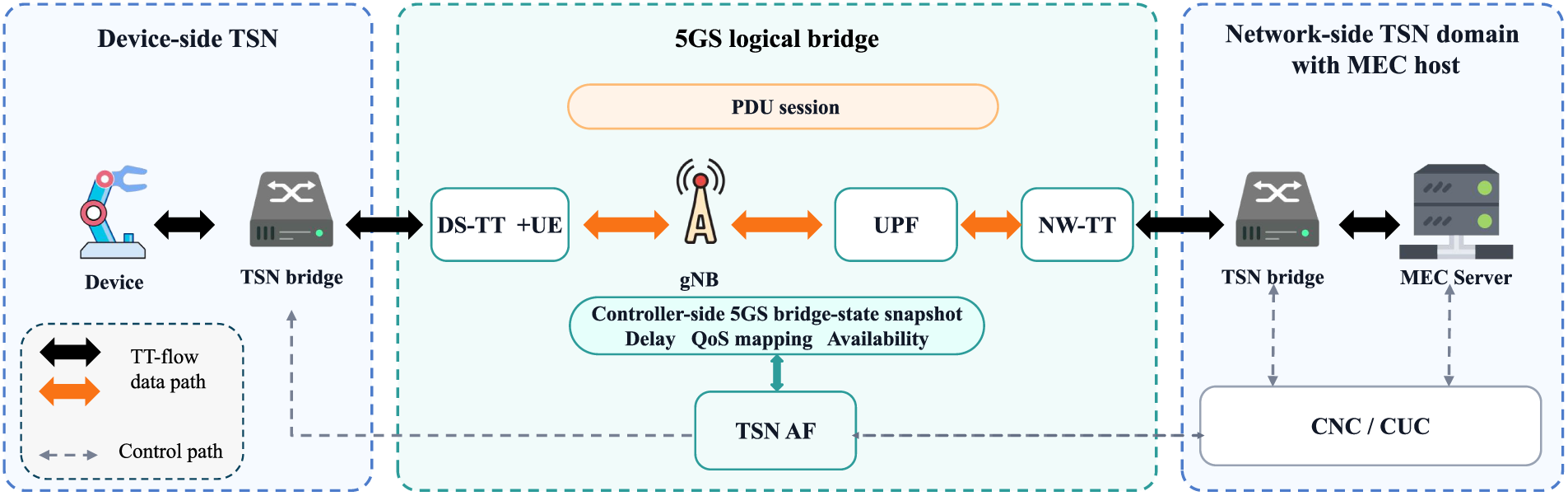
Figure 1: MEC-oriented 5G-TSN architecture and controller-side 5G-aware scheduling view. CNC: Centralized Network Configuration; CUC: Centralized User Configuration.
For each decision epoch, the scheduler reads the snapshot
A logical hop
The network is a directed graph
A TT flow is
For each admitted flow, the controller stores
The scheduling configuration is
TAS controls each egress port by opening and closing queue gates according to a GCL. As illustrated in Fig. 2, TT flows obtain reserved transmission windows, while other intervals are available to lower-priority traffic or remain idle. In a static setting, the controller can compute a complete GCL for a known flow set. In a dynamic setting, the controller must insert and remove reservations while preserving existing deterministic transmissions.
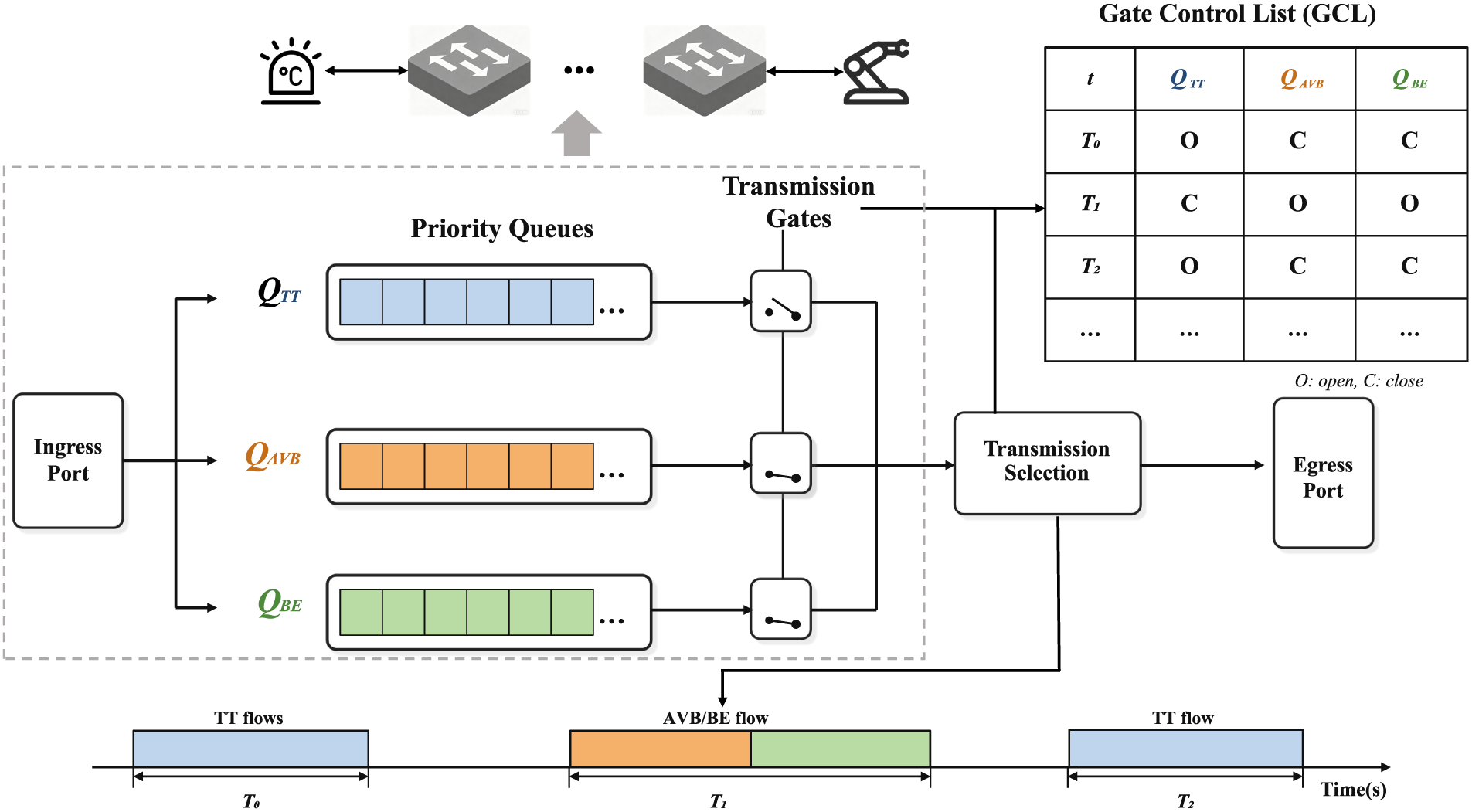
Figure 2: TAS/GCL gate states and reserved transmission windows.
The idle-window structure of each egress port is therefore a scheduling resource. A port may have sufficient unused time in aggregate but no contiguous interval long enough for the next TT frame. This distinction matters because each hop of a TT flow needs a feasible window, and adjacent windows must satisfy propagation, processing, and possible 5GS bridge-delay constraints. Fragmentation on one bottleneck port can invalidate an otherwise feasible multi-hop route.
For an egress port
The GCL Fragmentation Index (FI) is defined as
The value
For a transmission window of length
where
Following the standard TAS/GCL non-overlap and precedence model [6,7,13], the payload serialization length is
Causality between adjacent hops is written as
where
Candidate routes must also satisfy
Given
The main objective is to maximize long-term admission success rate:
where
Proposition 1 (computational hardness). The joint route/window feasibility subproblem underlying dynamic admission is NP-hard even with one egress port, fixed one-hop routes, one instance per hyperperiod, and static 5GS state. Proof sketch. Reduce classical NP-complete non-preemptive single-machine feasibility with release times and deadlines [20]. Map the machine to the port and each job to a one-hop flow whose release offset, window length, and deadline encode the corresponding job data. GCL non-overlap, release, and deadline constraints exactly enforce machine capacity and timing. This polynomial mapping proves NP-hardness of the restricted, hence general, problem.
The objective is subject to non-overlap, causality, deadline, 5GS-state feasibility, and disturbance constraints. For a triggered background repair, let
where
For later use, the controller maintains a candidate-route pool
The configuration aggregates are
4 Two-Timescale Incremental Routing and Scheduling
The proposed mechanism has a fast foreground path for newly arrived flows and a bounded background path for repairing the scheduling state.
Fig. 3 shows the proposed two-timescale mechanism. The foreground lane receives a new TT-flow arrival, reads the current scheduling configuration and 5GS information snapshot, and returns insertion entries or a rejection record. The background lane uses fragmentation, flexibility, insertion-failure, and 5GS-risk diagnostics to identify bottleneck resources and repairs only a selected subset of admitted flows. Both lanes update controller-side state through incremental GCL entries.
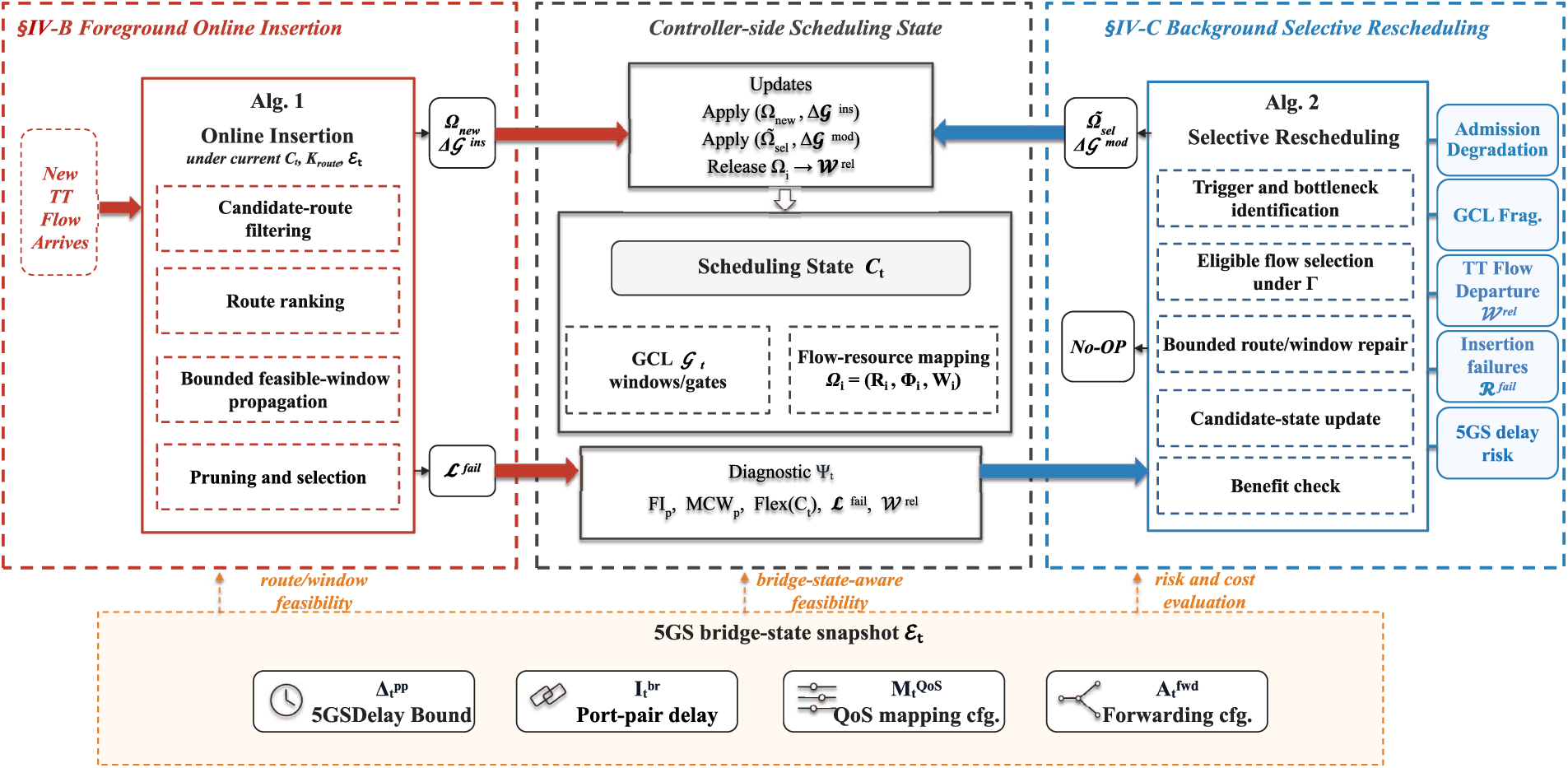
Figure 3: Two-timescale online admission and selective repair framework.
The mechanism separates latency-critical admission from capacity restoration. Algorithm 1 does not relocate admitted flows. Algorithm 2 broadens search only within
4.2 Algorithm 1: 5G-Aware Foreground Online Insertion for TT-Flow Admission
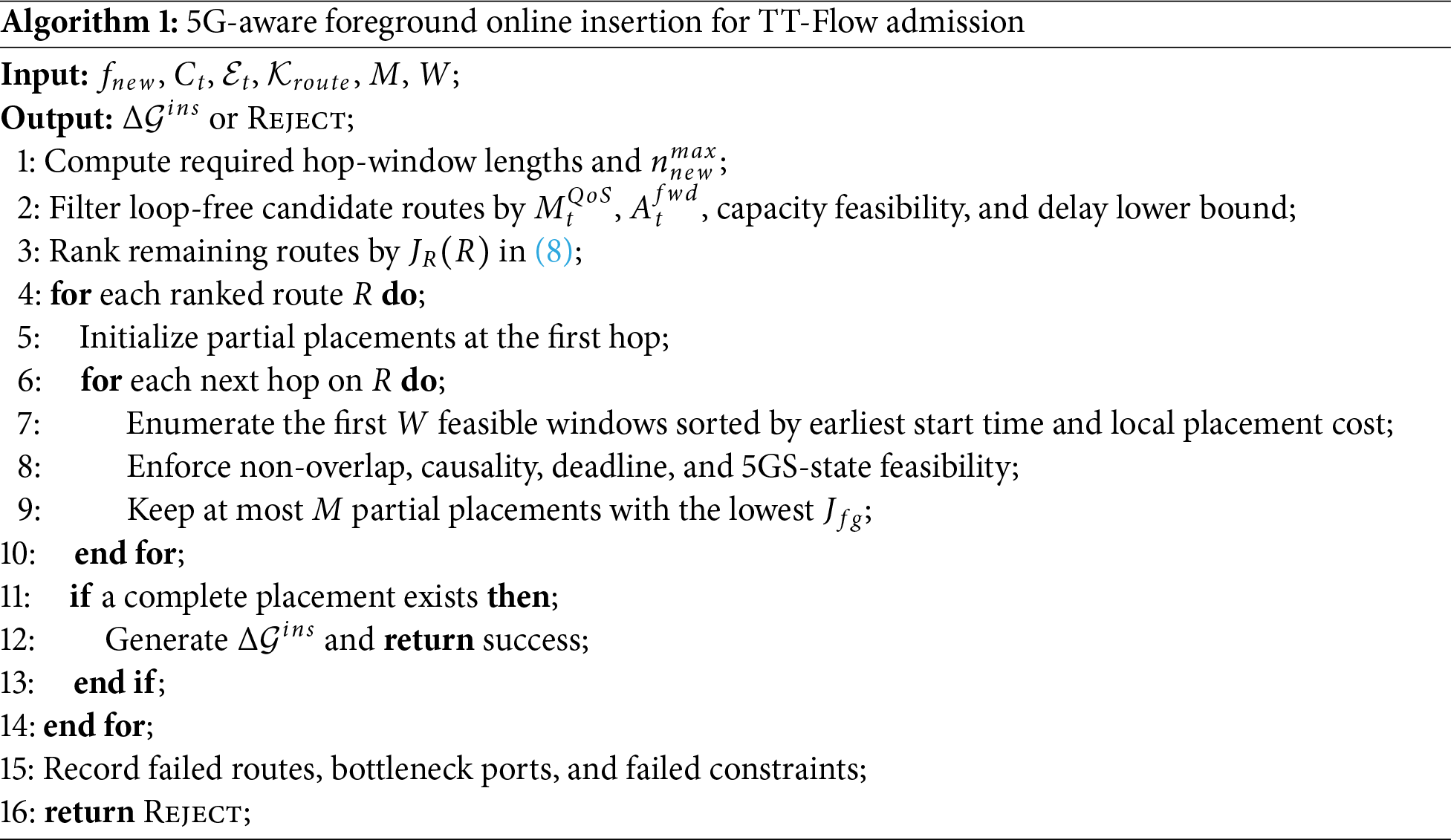
Algorithm 1 performs fast 5G-aware foreground insertion for a newly arrived TT flow. It first builds or reads a candidate-route pool, then filters routes that violate loop-freedom, forwarding availability, QoS mapping, capacity feasibility, or a coarse delay lower bound. For route ranking,
where
For a partial placement
where
The scheduling step uses bounded feasible-window propagation. At each hop, the algorithm enumerates feasible windows from the GCL idle-window set and propagates only the best partial placements. If a complete placement is found, the controller generates
4.3 Algorithm 2: Fragmentation-Aware Background Selective Rescheduling for GCL Repair
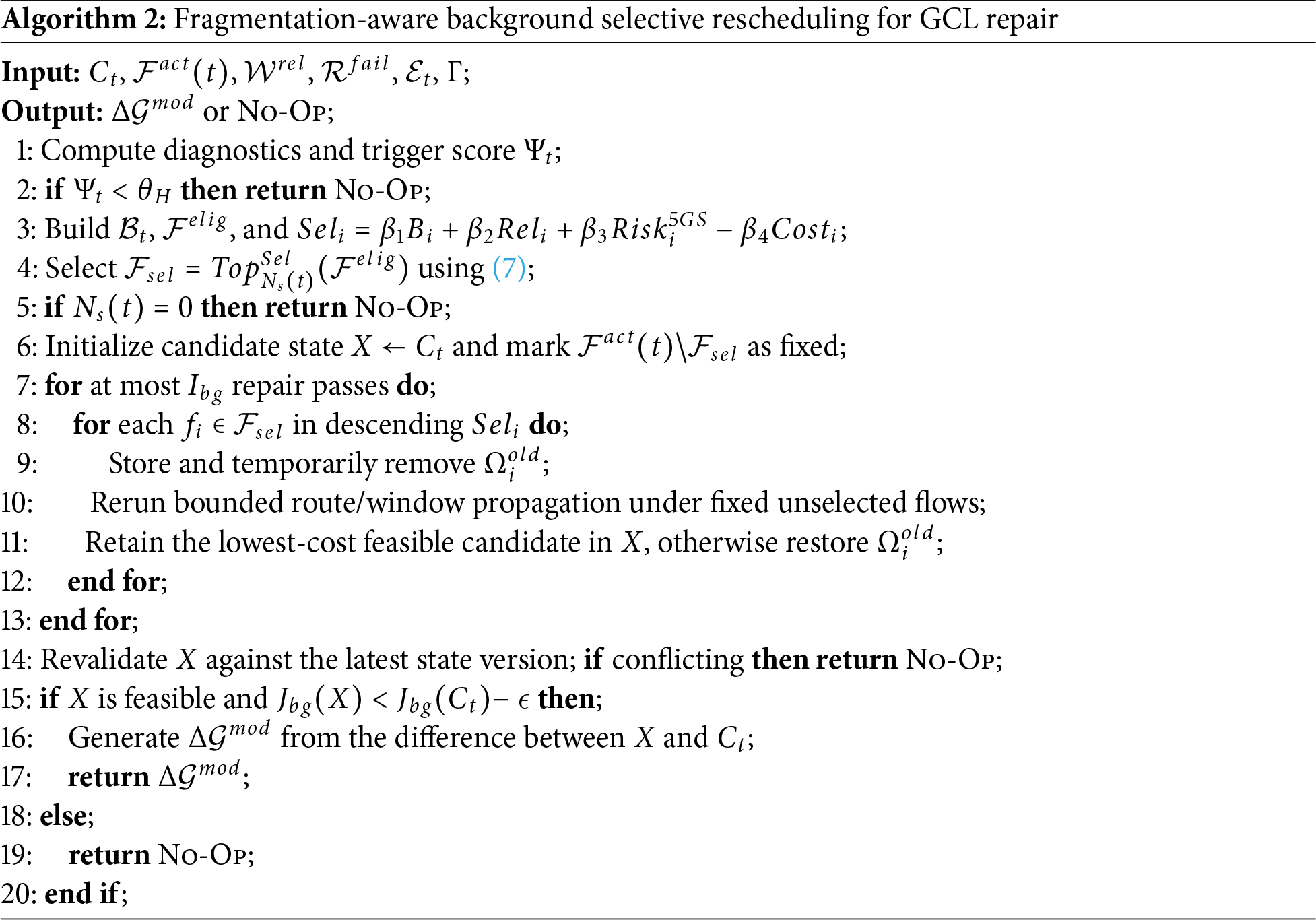
Algorithm 2 triggers when
With
The background objective combines feasibility, flexibility, fragmentation, load balance, 5GS delay risk, and adjustment cost:
where
Proposition 2 (feasibility preservation and bounded disturbance). If
The evaluation covers admission, decision cost, configuration disturbance, exact-instance quality, arrival-order dependence, multi-slot fragmentation, and dynamic controller-visible 5GS input.
A380, CEV, and Ring6 contain
Source and destination nodes are sampled uniformly from distinct end systems. We set
The main setting uses
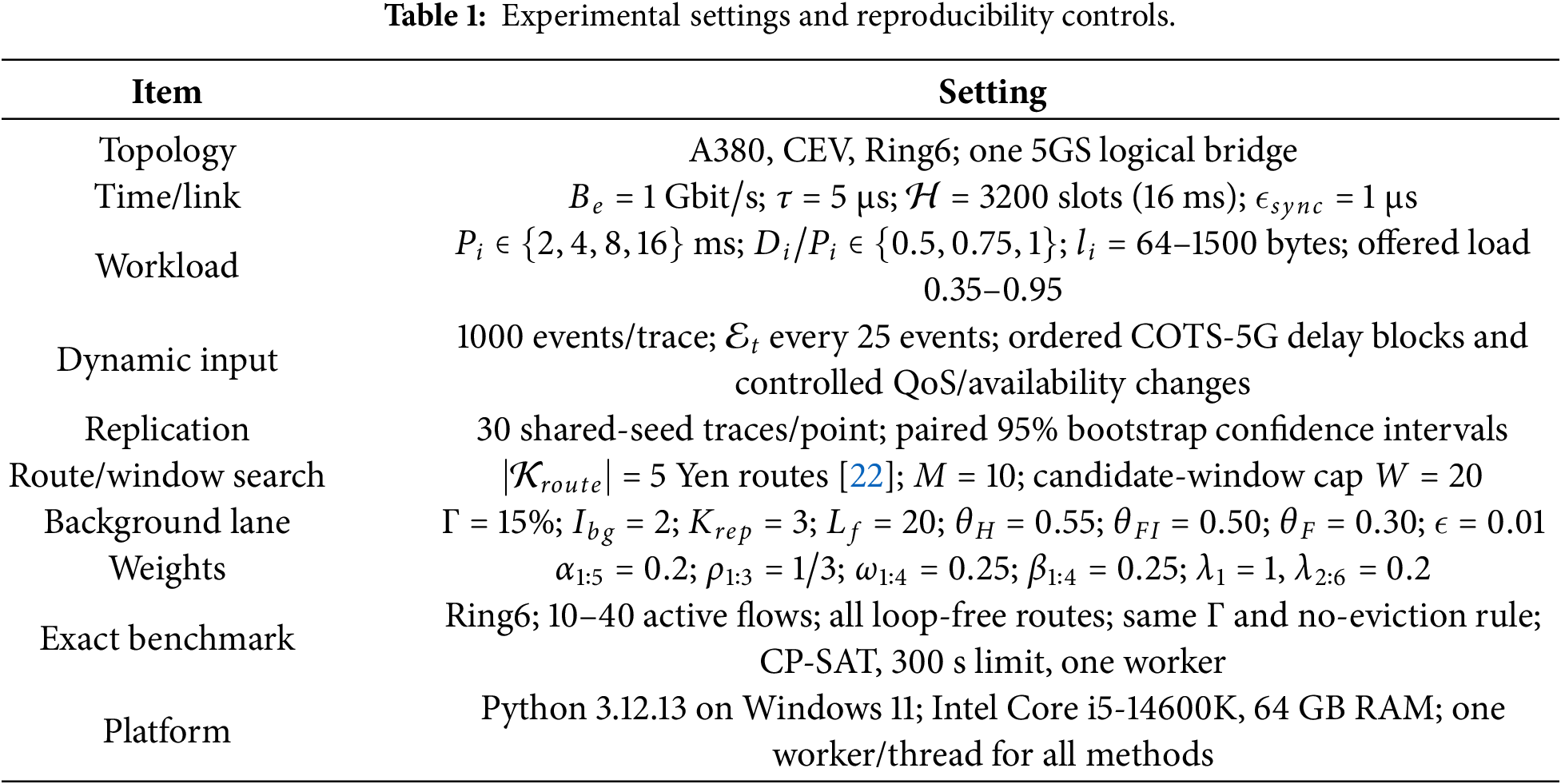
SWOTS-ASAP-WS (SWOTS) is the incremental TSN baseline [23]; all implementations share route pools, replication, and checks. 5GA-SWOTS adds hard
For Ring6, OR-Tools CP-SAT [24] receives all loop-free routes, mandatory flows, and the same
5.3 Admission and Operational Cost
In Fig. 4a–c, methods remain close at light load, whereas repair recovers windows fragmented by departures and earlier insertions at high load. At load 0.95, Proposed exceeds Online-only by 14.8, 18.5, and 16.0 points on A380, CEV, and Ring6. The corresponding gains over 5GA-SWOTS are 19.0, 21.0, and 18.5 points, while the gaps to Batch-Recompute are only 2.0, 2.2, and 1.7 points. Thus, bounded repair recovers most of the broader-rescheduling admission without rebuilding every schedule.
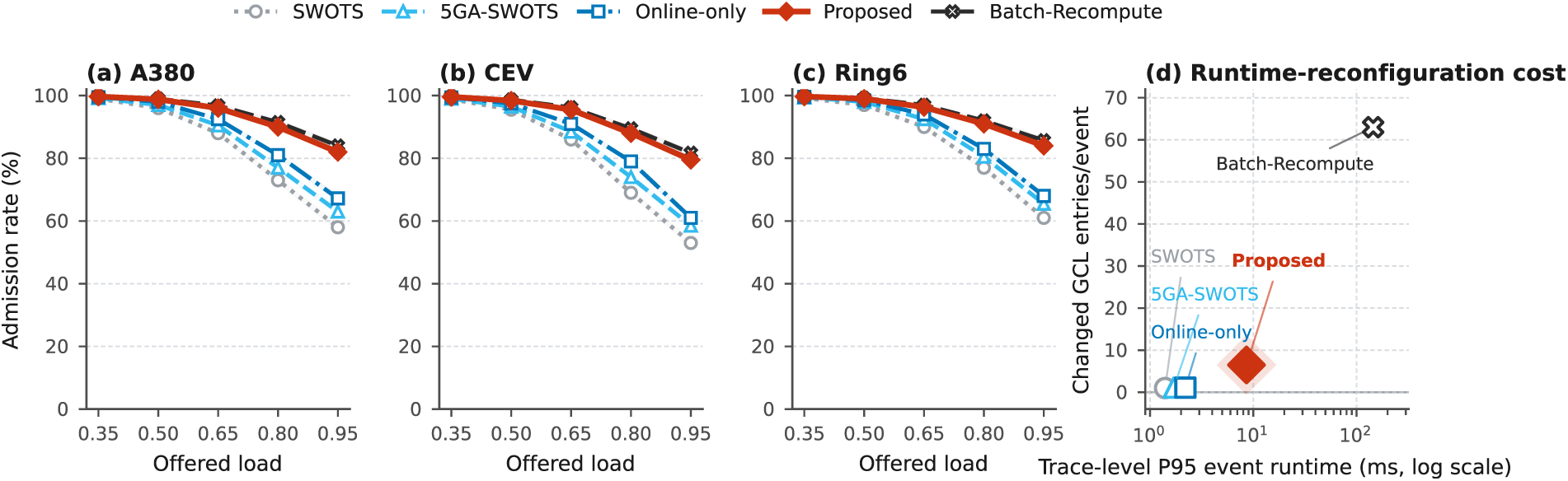
Figure 4: Overall admission and operational cost. (a) A380 admission vs. load; (b) CEV admission vs. load; (c) Ring6 admission vs. load; and (d) A380 P95 event runtime vs. changed GCL entries at load 0.95. Bands show paired 95% confidence intervals.
On A380, Fig. 4d gives Proposed a P95 runtime of
5.4 Quality and Mechanism Validation
On Ring6, Fig. 5a gives Proposed an empirical optimality gap of 0.1%–1.8% against the exact benchmark at 10–40 active flows, vs. 9.0% for Online-only at 40; CP-SAT proves optimal for 100%, 100%, 96%, and 88% of cases, with timeouts excluded. Fig. 5b links this quality to restored feasible start positions after repair.
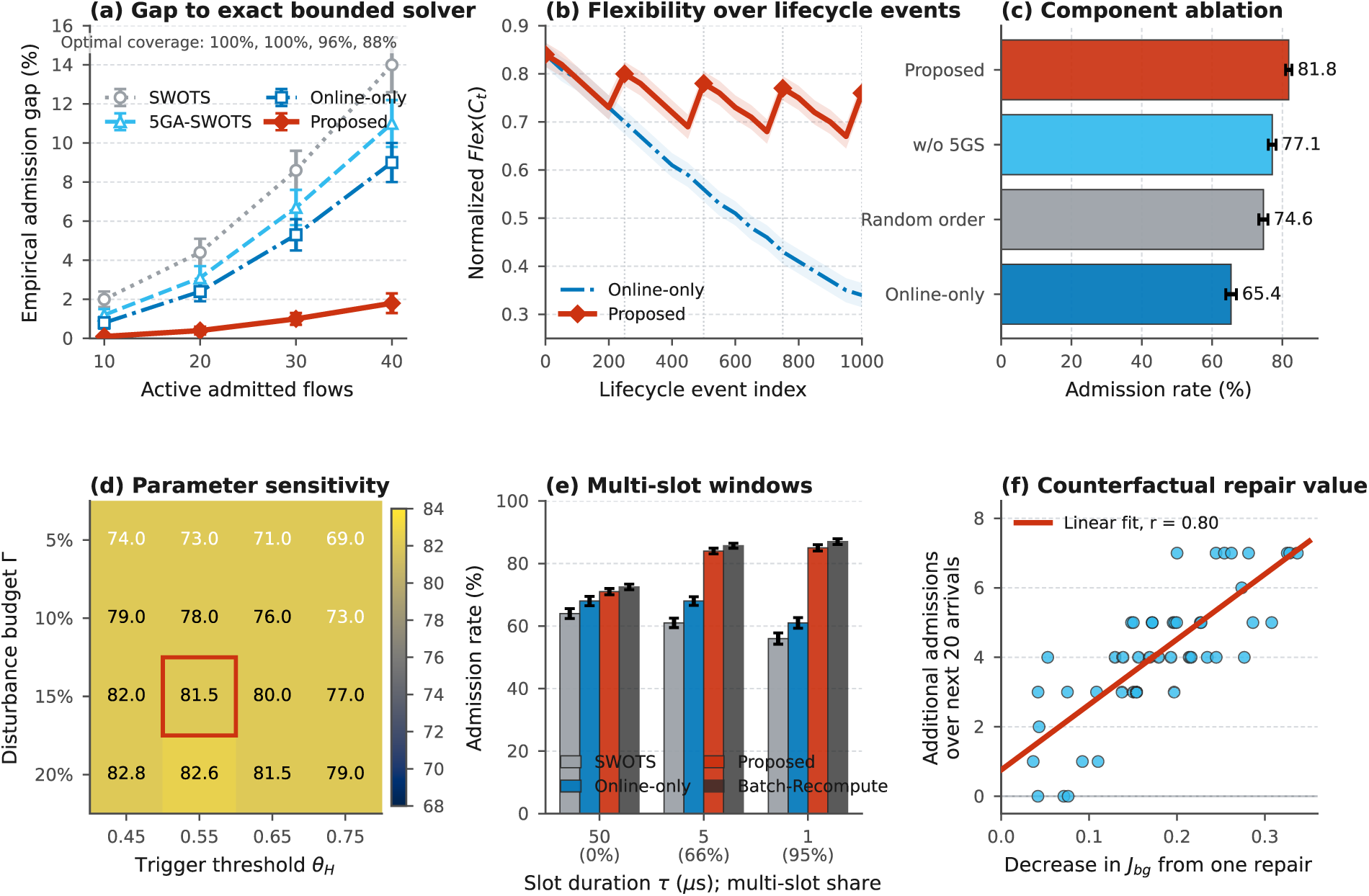
Figure 5: Solution quality and mechanism validation. (a) Gap to the exact Ring6 solver; (b) normalized feasible-start flexibility
In Fig. 5c, the variant without 5GS guidance retains all hard delay, mapping, and availability constraints but removes
Fig. 5d varies
Fig. 5e changes only
Trace-driven
This work formulated controller-side dynamic TT-flow admission using reported 5GS bridge information and established NP-hardness of the underlying joint feasibility problem. Fast foreground insertion protects admitted schedules, while priority-ordered background repair concentrates a bounded disturbance budget on bottleneck-relevant flows. At 0.95 offered load, the mechanism improves admission by 14.8–18.5 points over online-only scheduling and remains within 1.7–2.2 points of full recomputation. On A380, its P95 runtime is
Acknowledgement: None.
Funding Statement: This work was supported in part by the Shandong Provincial Natural Science Foundation under Grant Nos. ZR2023LZH011 and ZR2026QC0792, and the Taishan Scholar Program of Shandong Province in China under Grant No. TSON202312230.
Author Contributions: Zhihao Liu: conception, methods, software, experiments, analysis, drafting; Xiaolong Wang: design, supervision, revision; Yi Zhang: data; Wei Zhang: methods; Jian Wang and Huiling Shi: validation. All authors reviewed and approved the final version of the manuscript.
Availability of Data and Materials: The simulation data and source code supporting the findings of this study are available from the corresponding author upon reasonable request. The public COTS-5G delay dataset is available at https://doi.org/10.5281/zenodo.10390211.
Ethics Approval: Not applicable.
Conflicts of Interest: The authors declare no conflicts of interest.
References
1. Zhang X, Debroy S. Resource management in mobile edge computing: a comprehensive survey. ACM Comput Surv. 2023;55(13s):291. [Google Scholar]
2. ETSI GS MEC 003. Multi-access edge computing (MEC); framework and reference architecture. Sophia Antipolis, France: ETSI; 2022. [cited 2026 Aug 20]. Available from: https://www.etsi.org/deliver/etsi_gs/MEC/001_099/003/03.01.01_60/gs_MEC003v030101p.pdf. [Google Scholar]
3. Harmatos J, Maliosz M. Architecture integration of 5G networks and time-sensitive networking with edge computing for smart manufacturing. Electronics. 2021;10(24):3085. doi:10.3390/electronics10243085. [Google Scholar] [CrossRef]
4. Rost PM, Kolding T. Performance of integrated 3GPP 5G and IEEE TSN networks. IEEE Commun Stand Mag. 2022;6(2):51–6. doi:10.1109/mcomstd.0001.2000013. [Google Scholar] [CrossRef]
5. 802.1AS-2020. IEEE Standard for local and metropolitan area networks–timing and synchronization for time-sensitive applications. New York, NY, USA: IEEE; 2020. doi:10.1109/IEEESTD.2020.9121845. [Google Scholar] [CrossRef]
6. 802.1Qbv-2015. IEEE standard for local and metropolitan area networks–bridges and bridged networks–amendment 25: enhancements for scheduled traffic. New York, NY, USA: IEEE; 2016. doi:10.1109/IEEESTD.2016.8613095. [Google Scholar] [CrossRef]
7. 802.1Qcc-2018. IEEE standard for local and metropolitan area networks–bridges and bridged networks–amendment 31: stream reservation protocol enhancements and performance improvements. New York, NY, USA: IEEE; 2018. doi:10.1109/IEEESTD.2018.8514112. [Google Scholar] [CrossRef]
8. ETSI TS 123501. 5G; System architecture for the 5G system (5GS) (3GPP TS 23.501 version 18.5.0 Release 18). Sophia Antipolis, France: ETSI; 2024 [cited 2026 Aug 20]. Available from: https://www.etsi.org/deliver/etsi_TS/123500_123599/123501/18.05.00_60/ts_123501v180500p.pdf. [Google Scholar]
9. Sasiain J, Franco D, Atutxa A, Astorga J, Jacob E. Toward the integration and convergence between 5G and TSN technologies and architectures for industrial communications: a survey. IEEE Commun Surv Tutor. 2025;27(1):259–314. doi:10.1109/comst.2024.3422613. [Google Scholar] [CrossRef]
10. Yang J, Yu G. Traffic scheduling for 5G-TSN integrated systems. In: Proceedings of the 2022 International Symposium on Wireless Communication Systems (ISWCS); 2022 Oct 19–22; Hangzhou, China. p. 1–6. [Google Scholar]
11. Wang X, Yao H, Mai T, Guo S, Liu Y. Reinforcement learning-based particle swarm optimization for end-to-end traffic scheduling in TSN-5G networks. IEEE/ACM Trans Netw. 2023;31(6):3254–68. doi:10.1109/tnet.2023.3276363. [Google Scholar] [CrossRef]
12. Zhuge X, Cai X, He X, Wang Z, Dang F, Xu W, et al. InNetScheduler: in-network scheduling for time- and event-triggered critical traffic in TSN. In: Proceedings of IEEE INFOCOM 2024–IEEE Conference on Computer Communications; 2024 May 20–23; Vancouver, BC, Canada. p. 421–30. [Google Scholar]
13. Wang X, Yao H, Mai T, Xiong Z, Wang F, Liu Y. Joint routing and scheduling with cyclic queuing and forwarding for time-sensitive networks. IEEE Trans Veh Technol. 2023;72(3):3793–804. doi:10.1109/tvt.2022.3216958. [Google Scholar] [CrossRef]
14. Yang Q, Jiang X, Liu R, Li T, Yang H, Quan W, et al. A performance-balanced scheduling algorithm for diverse real-world TSN scenarios. IEEE Trans Parallel Distrib Syst. 2025;36(12):2469–81. doi:10.1109/tpds.2025.3580402. [Google Scholar] [CrossRef]
15. Cheng Z, Yang D, Guo R, Zhang W. Joint time-frequency resource scheduling over CQF-based TSN-5G system. In: Proceedings of the 15th International Conference on Communication Software and Networks (ICCSN); 2023 Jul 21–23; Shenyang, China. p. 60–5. [Google Scholar]
16. Cai Y, Zhang X, Hu S, Wei X. Dynamic QoS mapping and adaptive semi-persistent scheduling in 5G-TSN integrated networks. China Commun. 2023;20(4):340–55. doi:10.23919/jcc.fa.2022-0548.202304. [Google Scholar] [CrossRef]
17. Satka Z, Ashjaei M, Fotouhi H, Daneshtalab M, Sjodin M, Mubeen S. QoS-MAN: a novel QoS mapping algorithm for TSN-5G flows. In: Proceedings of the IEEE 28th International Conference on Embedded and Real-Time Computing Systems and Applications (RTCSA); 2022 Aug 23–25; Taipei, Taiwan. p. 220–7. [Google Scholar]
18. Larranaga A, Lucas-Estan MC, Martinez I, Gozalvez J. 5G configured grant scheduling for 5G-TSN integration for the support of industry 4.0. In: Proceedings of the 18th Wireless On-Demand Network Systems and Services Conference (WONS); 2023 Jan 30–Feb 1; Madonna di Campiglio, Italy. p. 72–9. [Google Scholar]
19. Wang Z, Li Z, Long C, Zheng Y, Ai B, Song X. Time synchronization for 5G and TSN integrated networking. IEEE J Sel Areas Commun. 2025;43(9):2969–80. doi:10.1109/jsac.2025.3574595. [Google Scholar] [CrossRef]
20. Lenstra JK, Rinnooy Kan AHG, Brucker P. Complexity of machine scheduling problems. Ann Discrete Math. 1977;1:343–62. doi:10.1016/s0167-5060(08)70743-x. [Google Scholar] [CrossRef]
21. Mostafavi SS, Sharma GP. DETERMINISTIC6G COTS 5G latency measurements (Version v1). Zenodo. 2023. doi:10.5281/zenodo.10390211. [Google Scholar] [CrossRef]
22. Yen JY. Finding the K shortest loopless paths in a network. Manag Sci. 1971;17(11):712–6. doi:10.1287/mnsc.17.11.712. [Google Scholar] [CrossRef]
23. Alnajim A, Salehi S, Shen CC. Incremental path-selection and scheduling for time-sensitive networks. In: Proceedings of the 2019 IEEE Global Communications Conference (GLOBECOM); 2019 Dec 9–13; Waikoloa, HI, USA. p. 1–6. [Google Scholar]
24. Perron L, Didier F, Gay S. The CP-SAT-LP solver. In: Proceedings of the 29th International Conference on Principles and Practice of Constraint Programming. Vol. 280 of Leibniz International Proceedings in Informatics; 2023 Aug 27–31; Toronto, ON, Canada. p. 3:1–2. [Google Scholar]
Cite This Article
 Copyright © 2026 The Author(s). Published by Tech Science Press.
This work is licensed under a Creative Commons Attribution 4.0 International License , which permits unrestricted use, distribution, and reproduction in any medium, provided the original work is properly cited.
 Downloads
 Citation Tools
