
 Login
Login Register
 Submit a Paper
 Propose a Special lssue
 Open Access
CORRECTION
Correction: Artificial Intelligence Design of Sustainable Aluminum Alloys: A Review
1 Shanghai Key Lab of Advanced High-Temperature Materials and Precision Forming, School of Materials Science and Engineering, Shanghai Jiao Tong University, Shanghai, China
2 Inner Mongolia Research Institute, Shanghai Jiao Tong University, Hohhot, China
* Corresponding Author: Chao Yang. Email:
Computers, Materials & Continua 2026, 89(2), 95 https://doi.org/10.32604/cmc.2026.090428
Issue published 15 September 2026
This article is a correction of:
Artificial Intelligence Design of Sustainable Aluminum Alloys: A Review
Read original article
 View Full Text
 Download PDF
Abstract
This article has no abstract.In the article entitled “Artificial Intelligence Design of Sustainable Aluminum Alloys: A Review” (Computers, Materials & Continua, 2026, Vol. 86, No. 2, pp. 1–33, doi:10.32604/cmc.2025.070735), the following corrections have been made:
1. The citation for Fig. 5 was incorrect in the published version. The correct source has now been added as Reference [60]. Accordingly, References [60–77] have been renumbered to maintain the correct citation sequence throughout the article.

Figure 5: Application of natural language processing in extraction of aluminum alloy properties from literature. Reprinted with permission from Reference [60]. Copyright 2024, Springer Nature.
New Reference [60]: Montanelli L, Venugopal V, Olivetti EA, Latypov MI. High-throughput extraction of phase–property relationships from literature using natural language processing and large language models. Integr Mater Manuf Innov. 2024;13;396–405. https://doi.org/10.1007/s40192-024-00344-8.
2. The copyright years for Figs. 10 and 11 were incorrectly given as 2022. They have now been corrected to 2021.

Figure 10: (a,c) and (d,e) Experimental vs. predicted hardness of various models of the testing data set and the related R2 and MSE recorded for the employed algorithms without optimization and with optimization, respectively, (b) Hardness distribution profile for the input dataset. Reprinted with permission from Reference [35]. Copyright 2021, Elsevier.
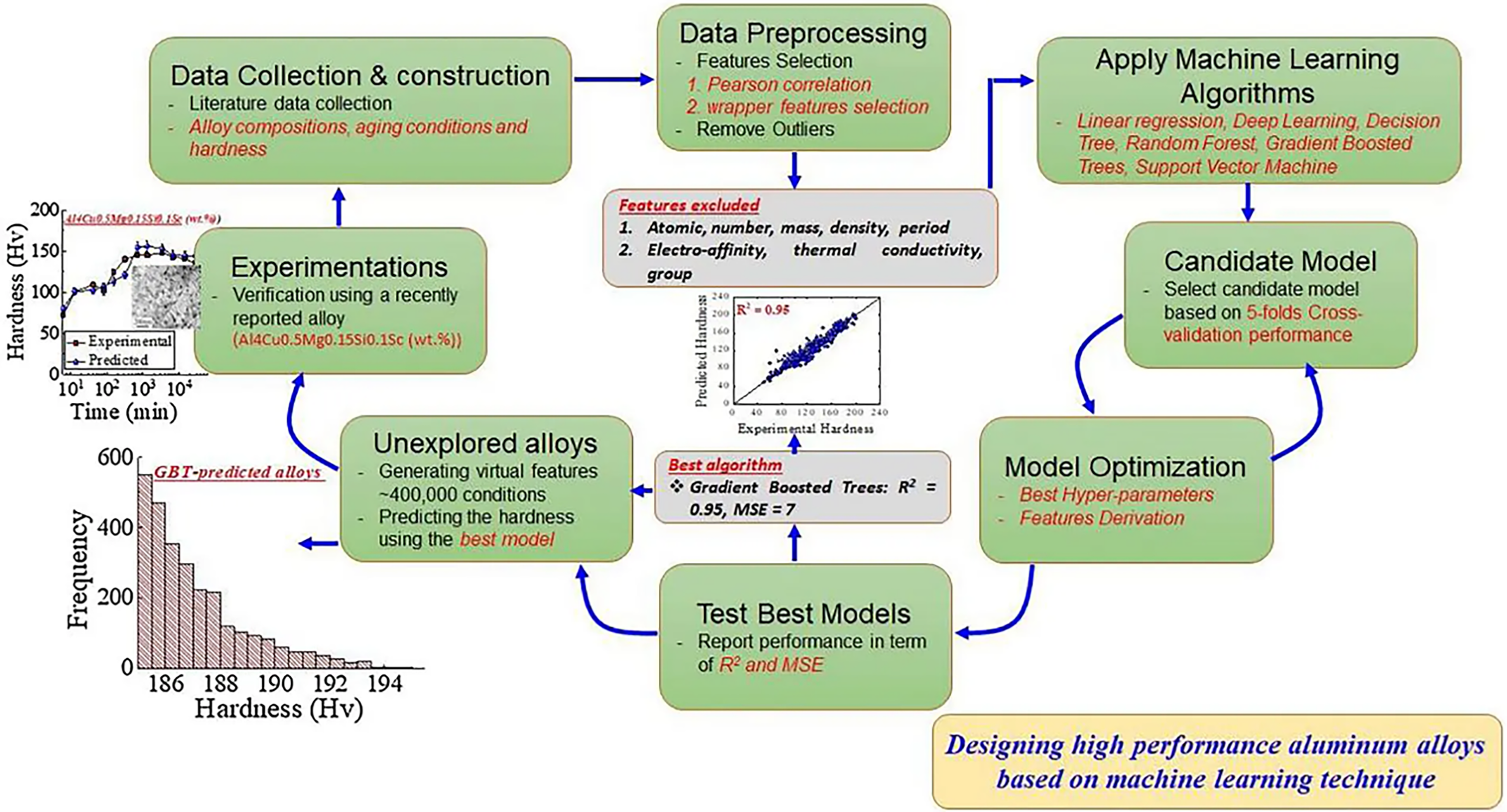
Figure 11: The loop used for designing high performance Al-Cu-Mg alloys based on the machine learning technique. Reprinted with permission from Reference [35]. Copyright 2021, Elsevier.
The authors confirm that these corrections do not affect the results, discussion, or scientific conclusions of the article. The authors apologize for any inconvenience caused.
This correction was approved by the Computers, Materials & Continua Editorial Office. The original publication has been updated accordingly.
Cite This Article
 Copyright © 2026 The Author(s). Published by Tech Science Press.
This work is licensed under a Creative Commons Attribution 4.0 International License , which permits unrestricted use, distribution, and reproduction in any medium, provided the original work is properly cited.
 Downloads
 Citation Tools
