
 Login
Login Register
 Submit a Paper
 Propose a Special lssue
 Open Access
ARTICLE

Multiscale Single-Phase Flow Mechanisms of Shale Oil Revealed by High-Pressure Nuclear Magnetic Resonance Experiments
1 State Key Laboratory of Shale Oil and Gas Enrichment Mechanisms and Effective Development, Beijing, China
2 Petroleum Exploration and Production Research Institute, SINOPEC, Beijing, China
* Corresponding Author: Maolei Cui. Email:
(This article belongs to the Special Issue: Multiphase Fluid Flow Behaviors in Oil, Gas, Water, and Solid Systems during CCUS Processes in Hydrocarbon Reservoirs)
Fluid Dynamics & Materials Processing 2026, 22(2), 9 https://doi.org/10.32604/fdmp.2026.075360
Received 30 October 2025; Accepted 13 February 2026; Issue published 04 March 2026
 View Full Text
 Download PDF
Abstract
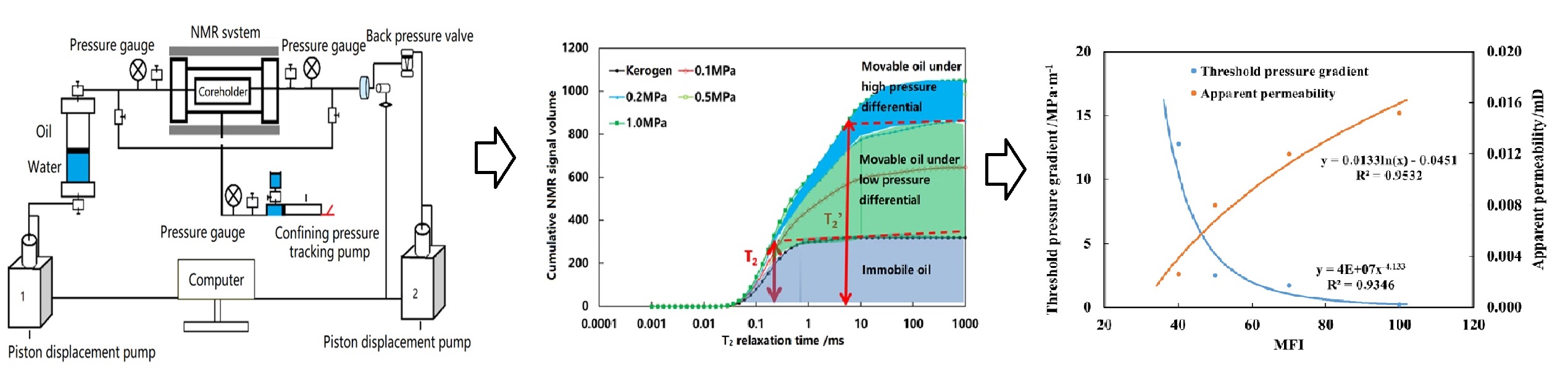
To clarify fluid flow mechanisms and establish effective development conditions in continental shale oil reservoirs, a high-temperature, high-pressure steady-state flow system integrated with nuclear magnetic resonance (NMR) technology has been developed. The apparatus combines sample evacuation, rapid pressurization and saturation, and controlled displacement, enabling systematic investigation of single-phase shale oil flow under representative reservoir conditions. Related experiments allow proper quantification of the activation thresholds and relative contributions of different pore types to flow. A movable fluid index (MFI), defined using dual T2 cutoff values, is introduced accordingly and linked to key flow parameters. The results reveal distinct multi-scale characteristics of single-phase shale oil transport, namely micro-scale graded displacement and macro-scale segmented nonlinear behavior. As the injection–production pressure difference increases, flow pathways are activated progressively, beginning with fractures, followed by large and then smaller macropores, leading to a pronounced enhancement in apparent permeability. Although mesopores and micropores contribute little to direct flow, their indirect influence becomes increasingly important, and apparent permeability gradually approaches a stable limit at higher pressure difference. It is also shown that the MFI exhibits a strong negative correlation with the starting pressure gradient and a positive correlation with apparent permeability, providing a rapid and reliable indicator of shale oil flow capacity. Samples containing through-going fractures display consistently higher MFI values and superior flowability compared with those dominated by laminated fractures, highlighting the pivotal role of well-connected fracture networks generated by large-scale hydraulic fracturing in improving shale oil production.Graphic Abstract
Keywords
Cite This Article
 Copyright © 2026 The Author(s). Published by Tech Science Press.
This work is licensed under a Creative Commons Attribution 4.0 International License , which permits unrestricted use, distribution, and reproduction in any medium, provided the original work is properly cited.
 Downloads
 Citation Tools
