
 Login
Login Register
 Submit a Paper
 Propose a Special lssue
 Open Access
ARTICLE

Interpersonal adjustment and depression in college students: The mediating effect of core self-evaluation and moderating effect of gender
School of Educational Sciences, Xinjiang Teacher’s College, Urumqi, 830043, China
* Corresponding Author: Siqi Ma. Email:
Journal of Psychology in Africa 2025, 35(1), 135-141. https://doi.org/10.32604/jpa.2025.065759
Received 28 October 2024; Accepted 01 December 2024; Issue published 30 April 2025
 View Full Text
 Download PDF
Abstract
This study aimed to explore how core self-evaluations and gender influence interpersonal adjustment and depression risk. Participants were 1748 college students (female = 59.73%, male = 40.27%, mean age = 18.71 years, SD = 0.78 years). The students completed the Interpersonal Adjustment Scale for College Students, Center for Epidemiological Studies Depression Scale, and Core Self-evaluation Scale. The results of Linear regression and mediated moderated effects modeling revealed that college students with higher interpersonal adjustment and core self-evaluation scores were at lower risk for depression. Core self-evaluation mediated the relationship between interpersonal adjustment and depression in college students for lower risk for depression. Gender moderated the relationship between interpersonal adjustment and core self-evaluation in college students for higher risk for depression in female students. From these findings, we conclude that interpersonal adjustment and core self-evaluation are significant for screening depression risk college students. Moreover, female students may benefit from targeted interventions aimed at their interpersonal adjustment for reducing their risk of depression.Keywords
Interpersonal adjustment qualities are key indicators of risk for mood disorder in human populations (Alhussain et al., 2023; Chi et al., 2024). By their interpersonal qualities, people build and sustain positive relationships with and receive support from others (Summerfeldt et al., 2006). Poor interpersonal adjustment is associated with mental and social health dysfunction (Caliskan et al., 2023), including higher risk for depressive symptoms (Liu et al., 2022). Emerging adults, such as college students at navigating their interpersonal worlds with various degrees of success, of which the less successful are at higher risk for depression (Della Volta et al., 2024; Lüdtke & Westermann, 2023). However, much may depend on their core self-evaluations of who they believe to be and can be (Chu et al., 2022; Geng et al., 2021). Core self-evaluation, which includes an individual’s evaluation of his or her own values, abilities, and talents (Judge et al., 1998). Moreover, gender may explain the interpersonal qualities and risk for depression with core self-evaluations in ways yet to be examined.
In recent years, as the number of graduates from Chinese colleges and universities has climbed dramatically, the pressure on Chinese college students to find employment has increased, and thus college students are at an especially high risk for depression in China (Zhou et al., 2024). The aim of our study was to clarify the roles played by core self-evaluation and gender in the relationship between interpersonal adjustment and risk for depression among Chinese college students.
Interpersonal adjustment and depression
College students are emerging adults with fast changing intimate relationship (Wasserman et al., 2023), and associated interpersonal distress related to risk for depression (Jiang & Zhang, 2023). Previous studies have reported that college students’ interpersonal adjustment is a significant predictor of depression (Yang et al., 2024). Interpersonal adjustment is an essential component of college students’ adjustment (Commodari et al., 2022), with low levels of interpersonal adjustment a risk for mental health disorders (Niu, 2023; La Rue et al., 2024). How college students self-perceive as by their core-self evaluations would determine whether risk for depression becomes actual depression experience.
The mediation of core self-evaluation
Beck’s (1996) cognitive model of depression suggests that individuals have two personality vulnerabilities, each of which consists of a set of maladaptive self-schemas, including sociability (interpersonal adjustment) and autonomy (core self-evaluation), and that these two personality vulnerabilities predispose them to depression. Studies have reported is a high correlation between college students’ interpersonal adjustment and core self-evaluation (Yang et al., 2021a). In other words, the stronger the interpersonal adjustment, the higher the favorable self-evaluation of their own values, abilities, and talents, by college students (Wang et al., 2023). In college student population, higher college students’ level of core self-evaluations were associated with good mental health (Liu et al., 2023). However, fragile core self-evaluations were a risk factor for depression (Deng et al., 2019). However, there is a gap in the research evidence as to the correlates of interpersonal adjustment in college students’ depression risk through the pathway of core self-evaluation.
Gender is a key variable in interpersonal adjustment, core self-evaluation, and depression. First, in a study on gender and interpersonal adjustment, female college students had higher levels of interpersonal adjustment than male college students (He & Xu, 2022; Liu et al., 2020). However, Walton et al. (2021) reported that female college students face greater difficulties with interpersonal adjustment, while Kaur and Sharma (2022) reported that male college students have greater interpersonal adjustment. A study reported that there is no significant difference between interpersonal adjustment and gender dimensions among college students (Chen et al., 2022). Some while other studies have reported that males score higher than females on core self-evaluation (Zhao et al., 2022). However, other studies have shown that there is no significant difference in gender performance on core self-evaluation (Chen et al., 2023; Gong et al., 2023).
In general, most research on gender and depression suggests that women at greater risk for depression than men (Slavich & Sacher, 2019; Conley et al., 2020; Gao et al., 2020), which would be true of college students. Although not necessarily so. Thus, the role that gender plays in the relationship between interpersonal adjustment, core self-evaluation, and depression among college students is not clear, which is the central aim of this study.
This study explored the mediating role of core self-evaluation, and the moderating role of gender in the relationship between interpersonal adjustment and depression, among college students. Based on the literature review, we proposed the following research model (Figure 1) and tested the following hypotheses:

Figure 1. A simple mediation model showing the effects of interpersonal adjustment on depression via core self-evaluation. Note. **p < 0.001.
Hypothesis 1: College students with high interpersonal adjustment have a lower risk of experiencing depression.
Hypothesis 2: Core self-evaluation mediates the relationship between interpersonal adjustment and depression in college for lower risk for depression.
Hypothesis 3: Gender moderates the mediating path of college students’ interpersonal adjustment to depression through core self-evaluation for higher risk for depression among female students.
A total of 1748 college students from four colleges in Autonomous Region of Xinjiang participated in the study. The mean age was 18.71 years old (SD = 0.78 years), among which 1044 (59.73%) were female students. A total of 842 (48.17%) were first-year students.
The China College Student Adjustment Scale (CCSAS)
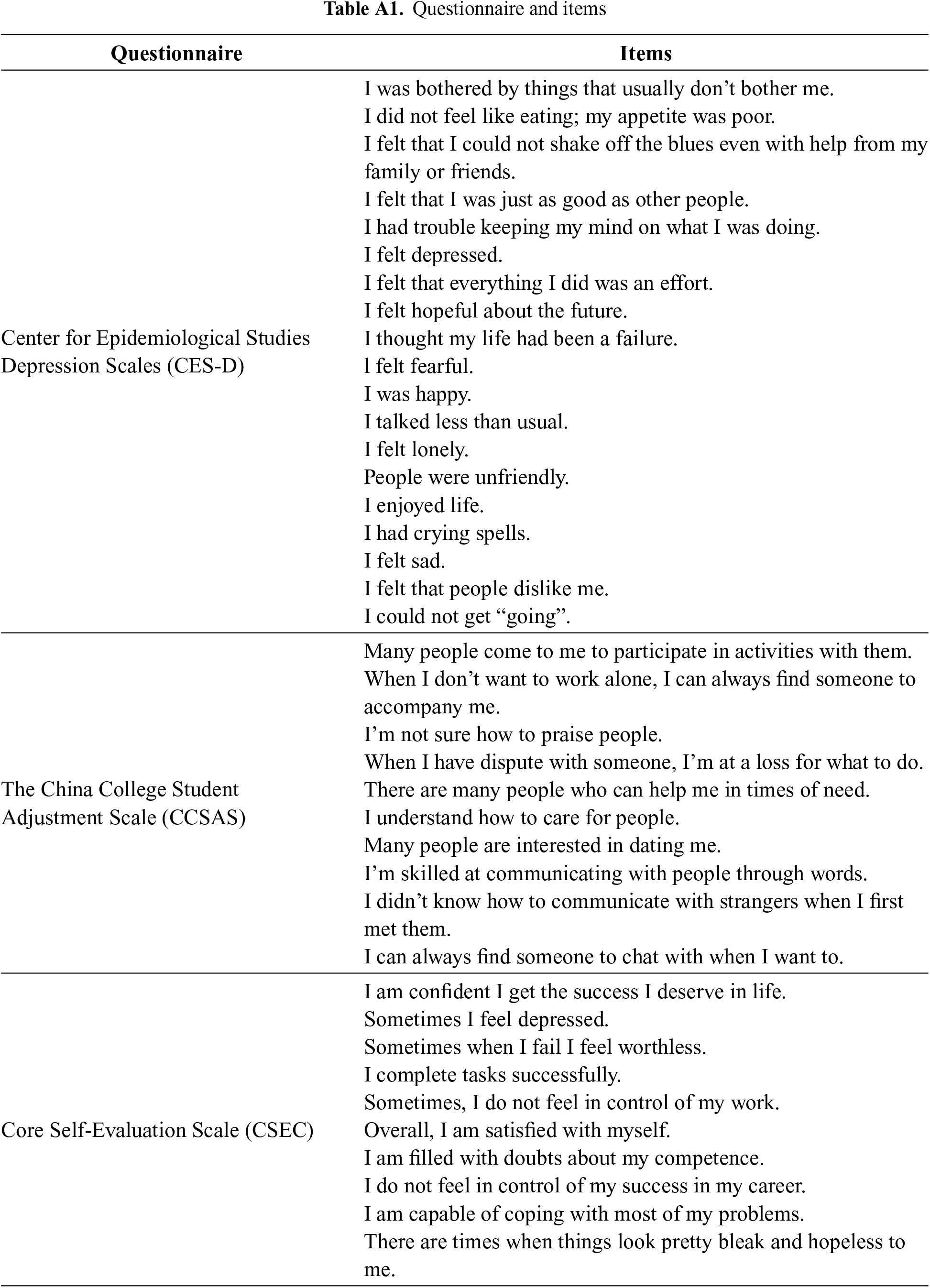
The China College Student Adjustment Scale (CCSAS) is a 10-item measure of interpersonal adjustment for college students (Fang et al., 2005). A sample item is: “Many people come to me to participate in activities with them.” The items are rated on a 5-point Likert scale ranging from 1 = strongly disagree to 5 = strongly agree. In the present study, Cronbach’s α = 0.74.
Center for Epidemiological Studies Depression Scales (CES-D)
The Center for Epidemiological Studies Depression Scales (CES-D) is a 20-item measure of interpersonal adjustment for depressive symptomatology (Radloff, 1977). A sample item is: “I was bothered by things that usually don’t bother me.” The items are rated on a 4-point Likert scale ranging from 1 = none or rarely (less than 1 day) to 4 = most or all time (5–7 days), In the present study, Cronbach’s α = 0.88.
Core Self-Evaluation Scale (CSEC)
The Core Self-evaluation Scale (CSEC) is a 10-item measure of core self-evaluation (Du et al., 2012; Judge et al., 1998). A sample item is: “I am confident I get the success I deserve in life.” The items are rated on a 5-point Likert scale ranging from 1 = strongly disagree to 5 = strongly agree. In the present study, Cronbach’s α = 0. 83.
College grade and type of residence were selected as control variables. For grade, 0 = Grade 1, 1 = Grade 2, 2 = Grade 3, and 3 = Grade 4; and for residence 0 = rural residence, and 1 = urban residence, see Table A1.
The research proposal was approved by the Ethics Committee of Xinjiang Teacher’s College. All participants voluntarily participated and signed an informed consent form before taking part in the study. The data were collected in October 2023 by trained fourth-year student research assistants who were fluent in Mandarin Chinese. The participants completed electronic questionnaires in Chinese college students.
We used SPSS 26.0 for the analysis. We used Harman’s one-way test for common method bias. The results showed that seven factors had eigenvalues greater than 1 and that the first factor explained 26.02% of the variance, which is less than the critical criterion of 40%, so there is no common method bias in this study. A Bootstrap analysis on the mediating effects of core self-evaluation on interpersonal adjustment and depression was conducted with the PROCESS program (Hayes & Andrew, 2013). Select Model 7 in the PROCESS program, set the number of samples to 5000, and set the confidence interval to 95%.
Descriptive statistics and correlation analysis
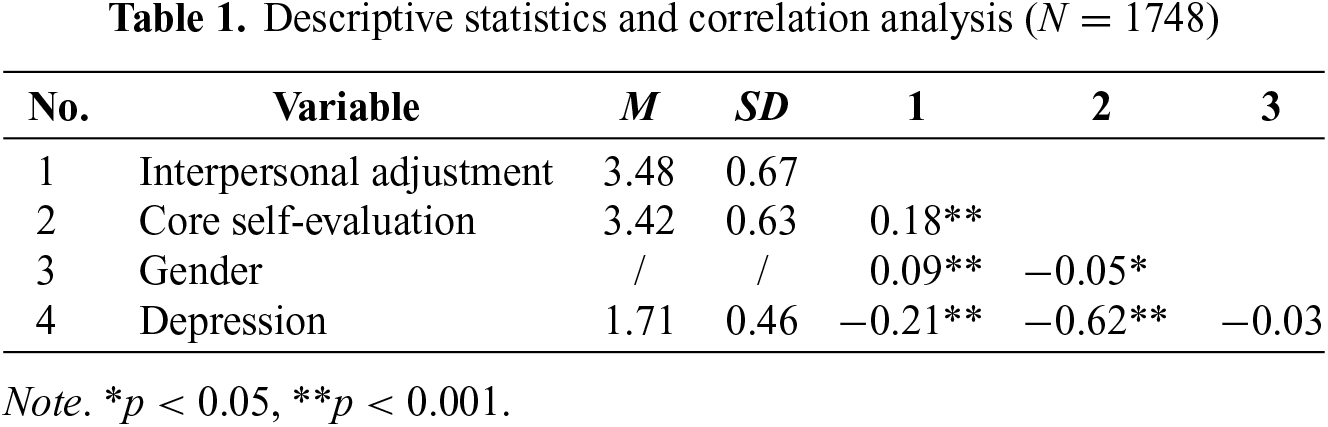
As in Table 1, there was a significant negative correlation between gender and core self-evaluation (r = −0.05, p < 0.05). There was also a significant positive correlation between interpersonal adjustment and core self-evaluation (r = 0.18, p < 0.001), and a significant negative correlation between interpersonal adjustment and depression (r = −0.21, p < 0.001). There was a significant negative correlation between core self-evaluation and depression (r = −0.62, p < 0.001).
Interpersonal adjustment and depression
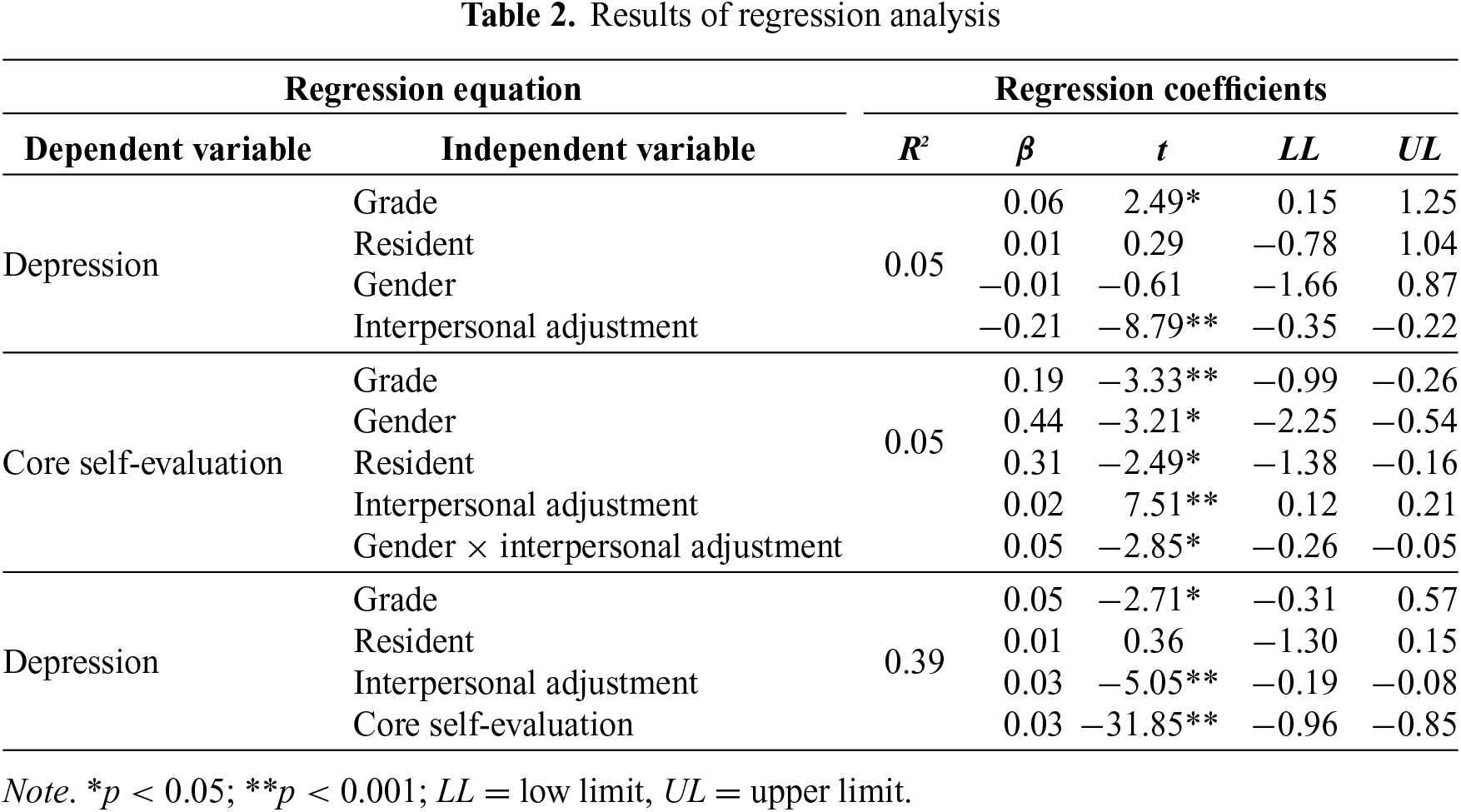
Table 2 presents the regression analysis results. We found a significant negative predictive effect of interpersonal adjustment on depression among college students (b = −0.29, p < 0.001), controlling for demographic variables such as grade, and resident, and Hypothesis 1 was supported. Interpersonal adjustment was a positive predictor of college students’ core self-evaluation (b = 0.17, p < 0.001); core self-evaluation was a significant negative predictor of depression (b = −0.62, p < 0.001).
Mediation effect of core self-evaluation
As shown in Table 2. The results revealed that core self-evaluation positively influenced depression (intermediary model, b = −0.63, p < 0.1). The results of the mediated effect analysis revealed that the indirect effect value of college students’ interpersonal adjustment through core self-evaluation and depression was −0.10 [95% CI: −0.19, −0.01], and Hypothesis 2 was supported.
Moderated mediation effect of gender
The moderated effect tests revealed that gender was a significant positive predictor of depression (b = 0.01, p < 0.001), and an interaction term between interpersonal adjustment and gender negatively affected core self-evaluation in college students (moderated-mediated model, b = 0.14, p < 0.001, 95% CI [0.03, 0.25]); thus, Hypothesis 3 was supported.
Simple slope analyses (Figure 2) indicated that interpersonal adjustment was a weaker predictor of core self-evaluation in the male college student population. The interpersonal adjustment of college students was a stronger predictor of core self-evaluation in the female college students.

Figure 2. Analysis of the moderating effect of gender. Note. Interpersonal adjustment (IA).
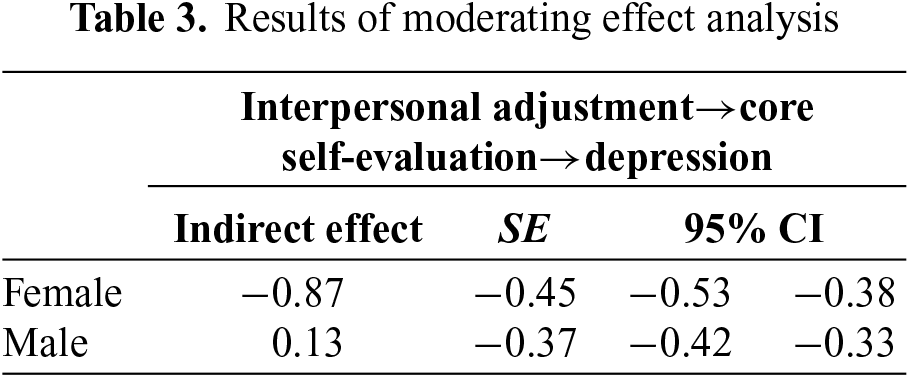
As shown in Table 3, in the female college students, interpersonal adjustment negatively affected depression through core self-evaluation (b = −0.45, 95% CI [−0.53, −0.38]) and interpersonal adjustment positively influenced depression through core self-evaluation in the of male college students (b = −0.37, 95% CI [−0.42, −0.33]); thus, Hypothesis 3 was supported.
In this study, the quality of interpersonal adjustment was associated with risk for depression in college students, which is consistent with previous research (Jones et al., 2024). That is to say that students with high interpersonal adjustment are more likely to build and sustain positive relationships, and receive support from others (Summerfeldt et al., 2006; Wang et al., 2024), which reduces their risk for depression. The results are consistent with Beck’s (1996) cognitive model of depression.
First, we found that higher interpersonal adjustment was associated with lower risk for depression in college students, a finding that is consistent with previous research (Caliskan et al., 2023; Yang et al., 2024). College students with lower levels of interpersonal adjustment are prone to experiencing adverse events such as interpersonal conflicts (Li et al., 2022), which in turn induces more negative emotions. Thus, poor interpersonal adjustment is associated with depression and is an essential predictor of it (Alhussain et al., 2023). Such findings may be explained by the significant role that interpersonal adjustment plays in the lives of college students in that they need to spend more time and energy dealing with interpersonal adjustment issues.
Second, we found that core self-evaluation plays a mediating role between interpersonal adjustment and depression in college students. Some previous studies have reported similarly (e.g., Geng et al., 2021; Yang et al., 2021b). Together these results suggest that self-evaluation serves as a person’s essential evaluation of self-worth and competence (Bipp et al., 2019) and impacts well-being (Prati, 2024). This is to say that, negative core self-evaluations can lead college students to deny their abilities and values, which leads to further self-criticism and can easily lead to depression. If college students’ interpersonal adjustment is poor, they are more inclined to evaluate themselves negatively, doubt their competence, and negate their value (Chen et al., 2022). Subsequently, they may experience more negative emotions and their interpersonal adjustment influences depression through their core self-evaluations. Core self-evaluation serves as a crucial protective factor in students’ failed relationship scenarios. For instance, as a student’s core self-evaluation continually improves and they develop stronger more interpersonal adjustment with their surroundings. Also, their risk for depression decreases.
Lastly, the results of the study support our hypothesis that gender plays a moderating role in the relationship between interpersonal adjustment and core self-evaluation in college students, which in turn affects depression. Previous studies have also reported that female report more interpersonal conflicts than male do (Walton et al., 2021), which would place them at greater risk for interpersonal distress (Dwivedi et al., 2021). The high demand on female students regarding their interpersonal adjustment and depression may be related to the Chinese culture in which females are more social tham males (Jiang & Zhang, 2023) and more susceptible to relationship distress (Wang et al., 2022). Hence, males are less prone to depression compared to females riksing depression among the females.
Implications for research and practice
Based on our findings, our study has some practical implications for reducing the levels of depression in students. For instance, school administrators could reduce the risk of depression among college students by supporting their sense of belonging. This would involve mental health workers paying more attention to college students’ interpersonal adjustment and cultivating the empowerment of their core self-evaluations. Specifically, mental health education courses, special club activities, and the daily wellness guidance of classroom teachers and counselors would enhance interpersonal adjustment, lowering college students’ risk for depression.
Limitations and future directions
This study has several limitations. First, we only considered the effects of interpersonal adjustment and risk for depression by gender and core self-evaluations. Other variables would be at play and calling for investigation. Second, interpersonal adjustment is a network analysis variable and requires further operationalization for more comprehensive insights. Second, with the current study’s cross-sectional design, we could not examine temporal associations among the variables. Third, being based on convenience sampling, our study sample comprised only college students from one region in China and the finding may not be generalizable to other regions. Future research could conduct a network analysis and involve further operationalization for comprehensive insight.
This study found that higher interpersonal adjustment was associated with lower risk depression in college students. Moreover, core self-evaluation mediated the relationship between interpersonal adjustment and depression in college students, for lower risk for depression with positive rather than negative core self-evaluations. Female gender was a higher risk for depression among the college students, particularly with poorer interpersonal relationships and low core self-evaluations. Therefore, interventions aimed at improving interpersonal adjustment and increasing positivity in core self-evaluation may be effective in preventing or reducing risk for depression in college students.
Acknowledgement: The authors are thankful to the students and teachers who participated in this study.
Funding Statement: This work was supported by the Education Working Committee of the Xinjiang Uygur Autonomous Region Party Committee (grant number 2023GZYB10).
Author Contributions: Siqi Ma proposed the framework, collected data, completed the manuscript and proofread the text. Pei Zhang analyzed the data and proofread the text. All authors reviewed the results and approved the final version of the manuscript.
Availability of Data and Materials: Data available on request from the corresponding author.
Ethics Approval: For this study, ethics approval was obtained from the ethics committee of Xinjiang Teacher’s College. The procedures used in this study adhere to the tenets of the Declaration of Helsinki.
Conflicts of Interest: The authors declare no conflicts of interest to report regarding the present study.
References
Alhussain F. A., Onayq A. I. B., Ismail D. H., Alduayj M. A., Alawbathani T. A., et al. (2023). Adjustment disorder among first year medical students at King Saud university, Riyadh, Saudi Arabia, in 2020. Journal of Family & Community Medicine, 30(1), 59–64. https://doi.org/10.4103/jfcm.jfcm_227_22 [Google Scholar] [PubMed] [CrossRef]
Beck, A. T. (1996). Beyond belief: A theory of modes, personality, and psychopathology. In: Frontiers of cognitive therapy (pp. 1–25). New York, NY, USA: The Guilford Press. [Google Scholar]
Bipp, T., Kleingeld, A., & Ebert, T. (2019). Core self-evaluations as a personal resource at work for motivation and health. Personality and Individual Differences, 151(3), 109556. https://doi.org/10.1016/j.paid.2019.109556 [Google Scholar] [CrossRef]
Caliskan, F. C., Akmehmet-Sekerler, S., Kiziltepe, Z., Sunbul, Z. A., & Borkan, B. (2023). The mediating role of depression and anxiety on the relationship between mindfulness and college adjustment. British Journal of Guidance & Counselling, 52(4), 1–15. https://doi.org/10.1080/03069885.2023.2220896 [Google Scholar] [CrossRef]
Chen, H., Liu, F., & Wen, Y. (2023). The influence of college students’ core self-evaluation on job search outcomes: Chain mediating effect of career exploration and career adaptability. Current Psychology, 42(18), 15696–15707. https://doi.org/10.1007/s12144-022-02923-4 [Google Scholar] [PubMed] [CrossRef]
Chen, W., Yang, T., & Luo, J. (2022). Core self-evaluation and subjective wellbeing: A moderated mediation model. Frontiers in Public Health, 10, 5. https://doi.org/10.3389/fpubh.2022.1036071 [Google Scholar] [PubMed] [CrossRef]
Chi, X. L., Huang, L. Y., Zhang, J. J., Wang, E. N., & Ren, Y. Z. (2024). Latent profiles of multi-dimensionality of self-compassion predict youth psychological adjustment outcomes during the COVID-19: A longitudinal mixture regression analysis. Current Psychology, 43(14), 13190–13201. https://doi.org/10.1007/s12144-022-03378-3 [Google Scholar] [PubMed] [CrossRef]
Chu, X., Yang, S., Sun, Z., Jiang, M., & Xie, R. (2022). The association between cyberbullying victimization and suicidal ideation among Chinese college students: The parallel mediating roles of core self-evaluation and depression. Frontiers in Psychiatry, 13, 277. https://doi.org/10.3389/fpsyt.2022.929679 [Google Scholar] [PubMed] [CrossRef]
Commodari, E., La Rosa, V. L., Sagone, E., & Indiana, M. L. (2022). Interpersonal adaptation, self-efficacy, and metacognitive skills in Italian adolescents with specific learning disorders: A cross-sectional study. European Journal of Investigation in Health, Psychology and Education, 12(8), 1034–1049. https://doi.org/10.3390/ejihpe12080074 [Google Scholar] [PubMed] [CrossRef]
Conley, C. S., Shapiro, J. B., Huguenel, B. M., & Kirsch, A. C. (2020). Navigating the college years: Developmental trajectories and gender differences in psychological functioning, cognitive-affective strategies, and social well-being. Emerging Adulthood, 8(2), 103–117. https://doi.org/10.1177/2167696818791603 [Google Scholar] [CrossRef]
Della Volta, M. F. C., Vallone, F., & Zurlo, M. C. (2024). COVID-19-related stressors and psychophysical health conditions among Italian university students: A post pandemic insight. Healthcare, 12(7), 752. https://doi.org/10.3390/healthcare12070752 [Google Scholar] [PubMed] [CrossRef]
Deng Y., Wang S., Leng L., Chen H., Yang T., et al. (2019). Pleasing or withdrawing: Differences between dependent and self-critical depression in psychosocial functioning following rejection. Personality and Individual Differences, 140(8), 4–9. https://doi.org/10.1016/j.paid.2018.02.037 [Google Scholar] [CrossRef]
Du, J., Zhang, X., & Zhao, Y. (2012). Reliability, validation and construct confirmatory of core self-evaluations scale. Psychological Research, 5(3), 54–60. [Google Scholar]
Dwivedi, P., Misangyi, V. F., & Joshi, A. (2021). “Burnt by the Spotlight”: How leadership endorsements impact the longevity of female leaders. Journal of Applied Psychology, 106(12), 1885–1906. https://doi.org/10.1037/apl0000871 [Google Scholar] [PubMed] [CrossRef]
Fang, X., Wo, J., & Lin, X. (2005). Development of Chinese college student adjustment scale. Studies of Psychology and Behavior, 3(2), 95–101. [Google Scholar]
Gao, W., Ping, S., & Liu, X. (2020). Gender differences in depression, anxiety, and stress among college students: A longitudinal study from China. Journal of Affective Disorders, 263(2), 292–300. https://doi.org/10.1016/j.jad.2019.11.121 [Google Scholar] [PubMed] [CrossRef]
Geng, J., Lei, L., Han, L., & Gao, F. (2021). Shyness and depressive symptoms: A multiple mediation model involving core self-evaluations and sense of security. Journal of Affective Disorders, 286(2), 19–26. https://doi.org/10.1016/j.jad.2021.01.035 [Google Scholar] [PubMed] [CrossRef]
Gong, Y., Yang, H., Bai, X., Wang, Y., & An, J. (2023). The relationship between physical exercise and smartphone addiction among Chinese college students: The mediating effect of core self-evaluation. Behavioral Sciences, 13(8), 647. https://doi.org/10.3390/bs13080647 [Google Scholar] [PubMed] [CrossRef]
Hayes, B. H. J., & Andrew, F. (2013). Introduction to mediation, moderation, and conditional process analysis: A regression-based approach. New York, NY, USA: The Guilford press. Journal of Educational Measurement, 51(3), 335–337. https://doi.org/10.1111/jedm.12050 [Google Scholar] [CrossRef]
He, S., & Xu, S. (2022). Study of the influence of introduction course on freshmen’s college life adaptation and emotional regulation. International Journal of Neuropsychopharmacology, 25(1), A56–A57. https://doi.org/10.1093/ijnp/pyac032.078 [Google Scholar] [CrossRef]
Jiang, P., & Zhang, Z. H. (2023). Self-esteem mediation of perceived social support and depression in university first-year students: A longitudinal study. Journal of Psychology in Africa, 33(5), 433–439. https://doi.org/10.1080/14330237.2023.2257076 [Google Scholar] [CrossRef]
Jones J. D., Schwartz K. T. G., Davis M., Gallop R., Hankin B. L., et al. (2024). Cognitive and interpersonal moderators of two evidence-based depression prevention programs. Journal of Consulting and Clinical Psychology, 92(7), 432–444. https://doi.org/10.1037/ccp0000886 [Google Scholar] [PubMed] [CrossRef]
Judge, T. A., Locke, E. A., Durham, C. C., & Kluger, A. N. (1998). Dispositional effects on job and life satisfaction: The role of core evaluations. Journal of Applied Psychology, 83(1), 17–34. https://doi.org/10.1037/0021-9010.83.1.17 [Google Scholar] [PubMed] [CrossRef]
Kaur, R., & Sharma, S. (2022). Gender differences in social adjustment and interpersonal support among undergraduate students. International Journal of Bio-Resource and Stress Management, 13(1), 53–61. https://doi.org/10.23910/1.2022.2331 [Google Scholar] [CrossRef]
La Rue, C. J., Steffens, N. K., Werth, B. A., Bentley, S. V., & Haslam, C. (2024). A latent profile analysis of the nature of social group memberships and their contribution to retirement outcomes. British Journal of Social Psychology, 63(2), 591–613. https://doi.org/10.1111/bjso.12694 [Google Scholar] [PubMed] [CrossRef]
Li, B., Wang, Y., Dou, K., & Shang, Y. (2022). On the development of meaning in life among college freshmen: Social relationship antecedents and adjustment consequences. Journal of Happiness Studies, 23(4), 1–27. https://doi.org/10.1007/s10902-021-00470-6 [Google Scholar] [CrossRef]
Liu, S., Song, M., & Teng, H. (2023). Postgraduates’ time management disposition and mental health: Mediating role of life satisfaction and moderating role of core self-evaluations. BMC Psychology, 11(1), 316. https://doi.org/10.1186/s40359-023-01349-2 [Google Scholar] [PubMed] [CrossRef]
Liu, W. T., Sun, N., Guo, J. Y., & Zheng, Z. H. (2022). Campus green spaces, academic achievement and mental health of college students. International Journal of Environmental Research and Public Health, 19(14), 8618. https://doi.org/10.3390/ijerph19148618 [Google Scholar] [PubMed] [CrossRef]
Liu, H., Zhang, M., Yang, Q., & Yu, B. (2020). Gender differences in the influence of social isolation and loneliness on depressive symptoms in college students: A longitudinal study. Social Psychiatry and Psychiatric Epidemiology, 55(2), 251–257. https://doi.org/10.1007/s00127-019-01726-6 [Google Scholar] [PubMed] [CrossRef]
Lüdtke, T., & Westermann, S. (2023). Negative expectations regarding interpersonal interactions in daily life are associated with subclinical depressive symptoms in a student sample: A prospective experience sampling study. Motivation and Emotion, 47(1), 125–136. https://doi.org/10.1007/s11031-022-09985-8 [Google Scholar] [CrossRef]
Niu, S. J. (2023). Mobile phone addiction, self-control, physical exercise, and depression: A moderated mediation model. Journal of Psychology in Africa, 33(3), 235–240. https://doi.org/10.1080/14330237.2023.2195709 [Google Scholar] [CrossRef]
Prati, G. (2024). Is job satisfaction related to subjective well-being? Causal inference from longitudinal data. Applied Research in Quality of Life, 12, 1–28. https://doi.org/10.1007/s11482-024-10400-2 [Google Scholar] [CrossRef]
Radloff L. S. (1977). The CES-D scale a self-report depression scale for research in the general population. Applied Psychological Measurement, 1(3), 385–401. https://doi.org/10.1177/014662167700100306 [Google Scholar] [CrossRef]
Slavich, G. M., & Sacher, J. (2019). Stress, sex hormones, inflammation, and major depressive disorder: Extending social signal transduction theory of depression to account for sex differences in mood disorders. Psychopharmacology, 236(10), 3063–3079. https://doi.org/10.1007/s00213-019-05326-9 [Google Scholar] [PubMed] [CrossRef]
Summerfeldt, L. J., Kloosterman, P. H., Antony, M. M., & Parker, J. D. A. (2006). Social anxiety, emotional intelligence, and interpersonal adjustment. Journal of Psychopathology and Behavioral Assessment, 28(1), 57–68. https://doi.org/10.1007/s10862-006-4542-1 [Google Scholar] [CrossRef]
Walton C. C., Rice S., Gao C. X., Butterworth M., Clements M., et al. (2021). Gender differences in mental health symptoms and risk factors in Australian elite athletes. BMJ Open Sport & Exercise Medicine, 7(1), e000984. https://doi.org/10.1136/bmjsem-2020-000984 [Google Scholar] [PubMed] [CrossRef]
Wang Q., Duan R., Han F., Huang B., Wang W., et al. (2023). The impact of core self-evaluation on school adaptation of high school students after their return to school during the COVID-19 pandemic: The parallel mediation of positive and negative coping styles. PeerJ, 11(538), e15871. https://doi.org/10.7717/peerj.15871 [Google Scholar] [PubMed] [CrossRef]
Wang Q., Zainal Abidin N. E., Aman M. S., Wang N., Ma L., et al. (2024). Cultural moderation in sports impact: Exploring sports-induced effects on educational progress, cognitive focus, and social development in Chinese higher education. BMC Psychology, 12(1), 89. https://doi.org/10.1186/S40359-024-01584-1 [Google Scholar] [PubMed] [CrossRef]
Wang, L., Zhou, X., Wu, W., & Chen, A. (2022). Moderating effect of gender and engineering identity on the association between interpersonal relationships and mental health of female engineering students. International Journal of Environmental Research and Public Health, 19(16), 10425. https://doi.org/10.3390/IJERPH191610425 [Google Scholar] [PubMed] [CrossRef]
Wasserman D., Arango C., Fiorillo A., Levin S., Peters A., et al. (2023). Improving mental health through fostering healthy lifestyles in young people: One of the targets in the WPA Action Plan 2023–2026. World Psychiatry, 22(3), 488–489. https://doi.org/10.1002/wps.21146 [Google Scholar] [PubMed] [CrossRef]
Yang W., Morita N., Zuo Z., Kawaida K., Ogai Y., et al. (2021a). Maladaptive perfectionism and internet addiction among Chinese college students: A moderated mediation model of depression and gender. International Journal of Environmental Research and Public Health, 18(5), 2748. https://doi.org/10.3390/ijerph18052748 [Google Scholar] [PubMed] [CrossRef]
Yang, Y., Li, T., & He, L. (2021b). The relationship among Chinese adolescents’ parental involvement, core self-evaluation and school adaptation. International Journal of Mental Health Promotion, 23(4), 521–531. https://doi.org/10.32604/ijmhp.2021.019290 [Google Scholar] [CrossRef]
Yang, Y., Tian, M., Liu, Y., Qiu, S., Hu, Y. et al. (2024). Effects of impulsivity and interpersonal problems on adolescent depression: A cross-lagged study. Behavioral Sciences, 14(1), 52. https://doi.org/10.3390/bs14010052 [Google Scholar] [PubMed] [CrossRef]
Zhao, W., Ding, W., Li, Q., Wang, X., & Zhao, M. (2022). Compared with him or her, I am not good enough: How to alleviate depression due to upward social comparison? The Journal of Psychology, 156(7), 21–23. https://doi.org/10.1080/00223980.2022.2101421 [Google Scholar] [PubMed] [CrossRef]
Zhou, Y., Huang, Z., Liu, Y., & Liu, D. (2024). The effect of replacing sedentary behavior with different intensities of physical activity on depression and anxiety in Chinese university students: An isotemporal substitution model. BMC Public Health, 24(1), 1388. https://doi.org/10.1186/s12889-024-18914-y [Google Scholar] [PubMed] [CrossRef]
Appendix A
Cite This Article
 Copyright © 2025 The Author(s). Published by Tech Science Press.
This work is licensed under a Creative Commons Attribution 4.0 International License , which permits unrestricted use, distribution, and reproduction in any medium, provided the original work is properly cited.
 Downloads
 Citation Tools
