
 Login
Login Register
 Submit a Paper
 Propose a Special lssue
 Open Access
ARTICLE

Teacher support and adolescents’ personal growth initiative: The mediating role of basic psychological needs satisfaction
1 College of Educational Sciences, Hanshan Normal University, Chaozhou, 521041, China
2 College of Education and Psychology, Minnan Normal University, Zhangzhou, 363000, China
* Corresponding Author: Wanru Lin. Email:
Journal of Psychology in Africa 2025, 35(1), 37-42. https://doi.org/10.32604/jpa.2025.065760
Received 23 July 2024; Accepted 02 December 2024; Issue published 30 April 2025
 View Full Text
 Download PDF
Abstract
This study investigated the mediating role of basic psychological needs satisfaction in relationship between teacher support and adolescents’ personal growth initiative. A total of 493 adolescents (females = 44.8%, mean age = 12.46, SD = 0.57) completed the Teacher Support Scale, the Adolescents’ Personal Growth Initiative Scale, and the Basic Psychological Needs Scale. The results, analyzed through a Mediation model analysis results indicated higher teacher support to be significantly associated with higher adolescents’ personal growth initiative. Teacher support was also associated with higher basic psychological needs satisfaction. Basic psychological needs satisfaction mediated the relationship between teacher support and adolescents’ personal growth initiative for higher personal growth initiative. Thus, enhancing students’ perceptions of teacher support would support the student’s sense of proactive and resilient growth with basic psychological needs satisfaction.Keywords
Adolescence is a critical period for individual growth and development, with personal growth initiative playing a crucial role (Guo, 2018). Personal growth initiative (PGI) refers to an individual’s proactive behavior and mindset aimed at self-improvement and perfection during self-development, encompassing both cognitive and behavioral dimensions. The cognitive dimension involves self-efficacy, beliefs, attitudes, and values, while the behavioral dimension reflects the transformation of these perceptions into concrete actions (Robitschek, 1998). Adolescents would thrive their physical and mental development, with supportive adults, such as parents/guardian and teachers, of which further evidence is needed on correlated of teacher support as an asset for adolescent personal growth initiative, assuming basic psychological needs satisfaction. Teacher support refers to students’ perceptions of teachers’ supportive behaviors and attitudes. This includes respect for students’ opinions and feelings, concern for students’ academic and personal lives, and trust and fairness in their interactions (Tian et al., 2016). Basic psychological needs essential for an individual’s development: autonomy (the ability to make decisions about one’s behavior according to personal wishes), relatedness (the feeling of acceptance and understanding in interpersonal relationships), and competence (the belief in one’s ability to take on specific roles and accomplish tasks) (Ryan & Deci, 2000). This study aims to examine the role of teacher support in enhancing adolescent’s growth initiative with basic psychological satisfaction.
Teacher support and adolescents’ personal growth initiative
Teacher support encompasses three main dimensions: learning support, emotional support, and competence support. Learning support involves the guidance and feedback provided by teachers during academic activities, such as constructive feedback on assignments. Emotional support includes the care and motivation students receive from teachers, like encouragement aimed at stimulating positive emotions and promoting overall development. Competence support refers to teachers’ efforts to recognize and foster students’ strengths and interests, thereby enhancing their competencies (Ou, 2005).
Previous research has indicated that adolescents with higher levels of personal growth initiative demonstrate enhanced self-concept (Chen, 2021) and identity (Luyckx & Robitschek, 2014) at the cognitive level. At the behavioral level, they are more actively engaged in exploring and planning for their future (Xu et al., 2019) and are less likely to exhibit problematic behaviors (Xiong et al., 2022). Ecosystem theory posits that the social environment significantly shapes psychological development (Bronfenbrenner & Ceci, 1994). In this context, perceived social support has been identified as a key predictor of adolescents’ personal growth initiative (Laksono & Saraswati, 2024).
Moreover, previous research has also shown that teacher support positively influences adolescents’ psychological and behavioral development (Qiao et al., 2013). When teacher-provided social support is substantial, students perceive higher levels of self-acceptance, which encourages them to be more proactive in exploring their environment and addressing growth challenges (Wang et al., 2014). What remains for further study is the role of basic psychological needs satisfaction in how teacher support would promote adolescents’ personal growth initiative.
Basic psychological needs satisfaction mediation
According to Self-Determination Theory (SDT), when basic psychological needs are met, individuals are more likely to move in a positive, healthy, and adaptive direction (Ryan & Deci, 2000). Basic psychological needs satisfaction is closely emotional adjustment (Peng et al., 2021), positive coping styles (Xia & Ye, 2014), internal motivation and academic performance (Zhang et al., 2018) in adolescents. Moreover, perceived support from teachers enhances basic psychological needs satisfaction (Lee & Kim, 2022). Conceivably, teacher support likely enhances adolescents’ basic psychological needs satisfaction, which in turn fosters the development of their personal growth initiative.
This study explored the relationship between teacher support and adolescents’ personal growth initiative, focusing on the mediating role of basic psychological needs satisfaction (as shown in Figure 1). We constructed and tested a mediated structural model with basic psychological needs satisfaction as the mediating variable and tested the following hypotheses:
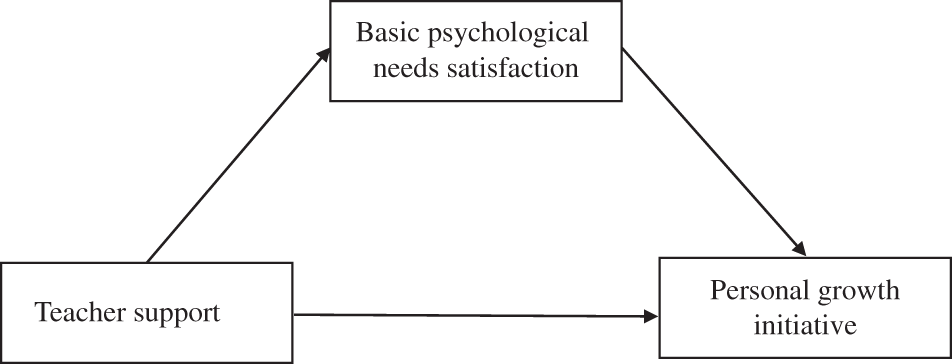
Figure 1. Hypothetical model
H1: Higher teacher support is associated higher level of personal growth initiative among adolescents.
H2: Basic psychological needs satisfaction mediates the relationship between teacher support and adolescents’ personal growth initiative for higher personal growth initiative.
Through convenient sampling, 493 were participants. The sample included 272 male students (55.2%) and 221 female students (44.8%). The age range of the participants was between 11 and 15 years old, with a mean age of 12.46 years (SD = 0.57 years).
The Teacher Support Scale (TSS, Ou, 2005) was employed to assess students’ perceptions of teachers’ supportive attitudes and behaviors in their academic lives. This scale consists of 19 Items across three dimensions: learning support (9 Items), emotional support (6 Items), and competence support (4 Items). An example item is: “Teachers often encourage me in my studies and life.” Participants responded using a 6-point Likert scale ranging from 1 (“not fully consistent”) to 6 (“fully consistent”). Higher scores indicate greater perceived teacher support. In the current study, the scale demonstrated strong reliability, with an internal consistency coefficient (Cronbach’s alpha) of 0.89. Additionally, confirmatory factor analysis revealed excellent construct validity, with the following fit indices: χ2/df = 1.91, CFI = 0.96, TLI = 0.95, RMSEA = 0.04, SRMR = 0.04.
Adolescents’ personal growth initiative scale
The Personal Growth Initiative Scale for Adolescents (PGISA, Xu, 2018) was employed to assess the level of personal growth initiative of an individual. This scale contains 16 questions covering the four dimensions of readiness to change (4 Items), planning (5 Items), resource utilization (3 Items), and proactive behavior (4 Items). An example item is: “I know what aspects of myself need to change.” Participants used a 6-point Likert scale to rate their level of agreement with each question on a scale from 0 (“not at all agree”) to 5 (“completely agree”). The level of the scale score reflects the participants’ level of personal growth initiative. In the current study, the scale demonstrated strong reliability, with an internal consistency coefficient (Cronbach’s alpha) of 0.91. Additionally, confirmatory factor analysis revealed excellent construct validity, with the following fit indices: χ2/df = 3.37, CFI = 0.93, TLI = 0.91, RMSEA = 0.07, SRMR = 0.04.
Basic psychological needs scale
The Basic Psychological Needs Scale (BPNS, Yu et al., 2012) consists of 21 questions covering the dimensions of Competence Needs (6 Items), Relatedness Needs (8 Items), and Autonomy Needs (7 Items). An example item is: “I often feel a lack of competence or difficulty in performing.” Participants used a 7-point Likert scale to rate the degree of agreement with each of the questions, with ratings ranging from 1 (“not at all”) to 7 (“completely”). Higher scores on the scale indicate that participants’ basic psychological needs are more fully met. In the current study, the scale demonstrated strong reliability, with an internal consistency coefficient (Cronbach’s alpha) of 0.86. Additionally, confirmatory factor analysis revealed excellent construct validity, with the following fit indices: χ2/df = 2.23, CFI = 0.93, TLI = 0.90, RMSEA = 0.05, SRMR = 0.05.
The Ethics committee of the Hanshan Normal University approved the study. School principals and teachers granted study permission. The parents or guardians of the adolescents consented to the study. The adolescents assented to the study with assurances voluntary participation. The students completed the surveys during normal school hours.
Data were analyzed using SPSS 27.0. First, descriptive statistics were performed to summarize the data; then, Pearson’s product-difference correlation analysis was used to assess the relationship between the variables. Finally, the mediating effect was tested using multiple stepwise regression analysis and bias-corrected nonparametric percentile Bootstrap technique.
Since this study mainly used surveys for data collection, common method bias may be introduced. To control for this bias, the Harman one-factor test (Podsakoff et al., 2003) was used. Factor analysis showed that 12 factors with eigenvalues greater than 1. The amount of variance explained by the first factor was only 26.15%, which did not reach the critical value of 40%, indicating that there was no serious common method bias in this study.
In this study, the mediation effect analysis method proposed by Wen and Ye (2014) was used. First, the coefficients c, a, and b in the equation were tested for significance, and then the significance of coefficient c’ was further tested; then, Bootstrap technique was applied to verify the existence of mediating effects.
Descriptive statistics and correlation analysis of variables
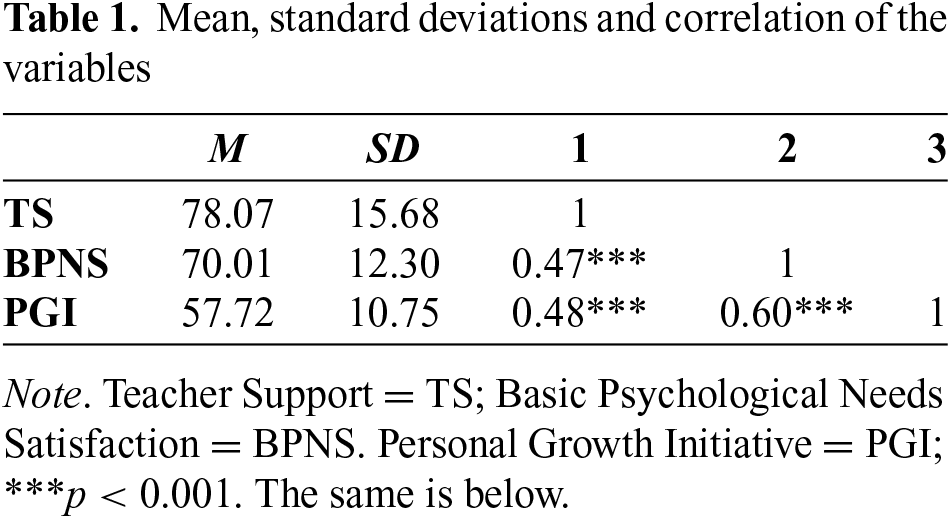
Table 1 presents the means, standard deviations and Pearson correlations among study variables. The correlation analysis shows that teacher support was significantly positively correlated with personal growth initiative (r = 0.48, p < 0.001). In other words, the more supportive attitudes and behaviors students perceived from their teachers in their academic life, the higher the level of personal growth initiative. Teacher support was significantly positively correlated with basic psychological needs satisfaction (r = 0.47, p < 0.001), and basic psychological needs satisfaction was significantly positively correlated with personal growth initiative (r = 0.60, p < 0.001).
Test of the mediating effect of basic psychological needs satisfaction
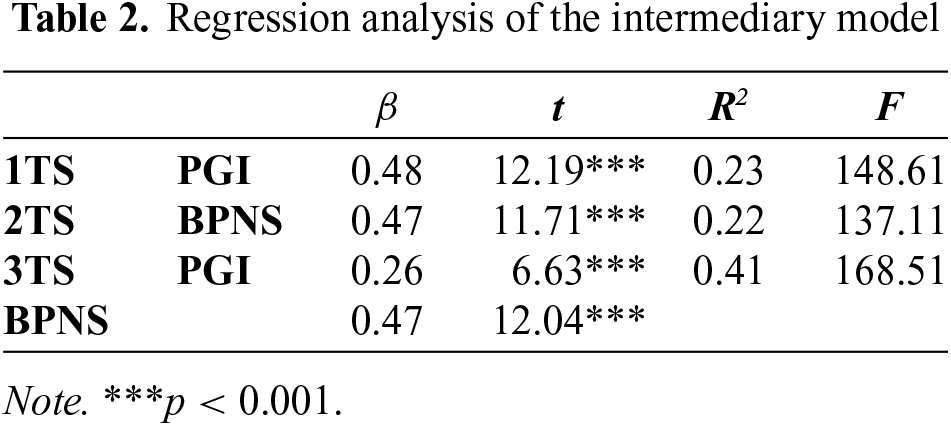
The results (as shown in Figure 2 and Table 2) showed that teacher support significantly and positively predicted personal growth initiative (β = 0.48, p < 0.001). Hypothesis 1 is supported. Teacher support also had a significant positive predictive effect on basic psychological needs satisfaction (β = 0.47, p < 0.001). Also, when considering the joint prediction of teacher support and basic psychological needs satisfaction on personal growth initiative, both showed significant predictive power (β = 0.26, p < 0.001; β = 0.47, p < 0.001).
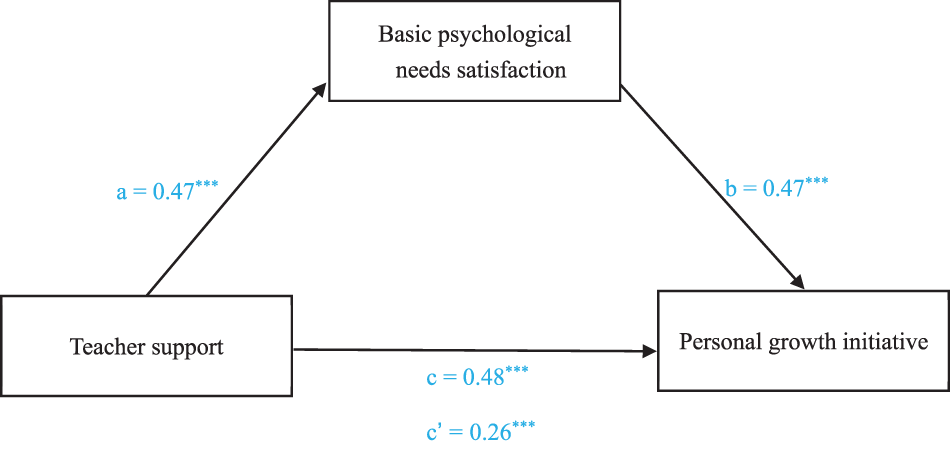
Figure 2. Path analysis diagram of the impact of teacher support on personal growth initiative. ***p < 0.001
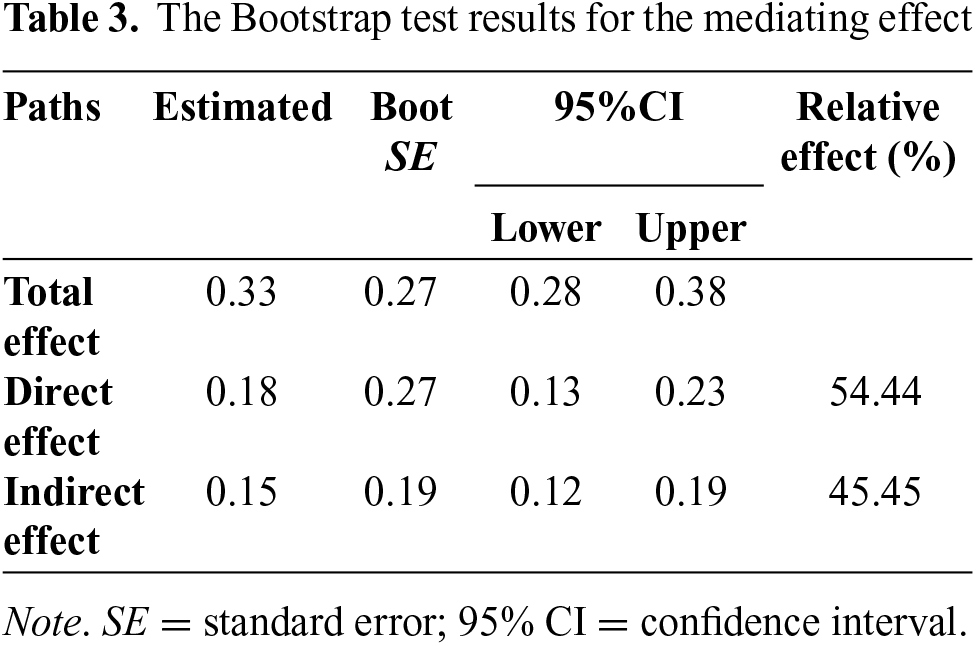
Bootstrap method was used to extract 5000 samples for mediation effect analysis, and the 95% confidence interval was [0.12, 0.19], excluding 0. Therefore, the mediation effect of basic psychological needs satisfaction between teacher support and personal growth initiative was significant. The proportion of the mediating effect in the total effect is 45.45%, and basic psychological needs satisfaction plays a partial mediating role (as shown in Table 3). Hypothesis 2 is supported.
The results indicated that teacher support positively predicts adolescents’ personal growth initiative, consistent with the findings of previous studies (Lee et al., 2018; Guo, 2018). This finding may be explained by the fact that learning support from teachers enhances students’ interest in classroom activities (Rolland, 2012) and increases their engagement in learning (Gao et al., 2023; Quin et al., 2018). Moreover, emotional support from teachers fosters a greater sense of belonging (Sakiz et al., 2012) and improves social well-being (Robitschek & Keyes, 2009). Teachers’ competence support would boost student’s self-efficacy in the school environment (Yu & Singh, 2018). In turn, the students will actively strive for higher self-actualization (Guo, 2018).
The results indicated that basic psychological needs satisfaction indeed plays a mediating role in this relationship, consistent with findings from similar studies (Luo et al., 2014). Adolescents’ perceptions of concern, respect, and encouragement from teachers have a sense of autonomy, competence, and relatedness (Jang et al., 2009). First, teacher learning support fulfills adolescents’ need for autonomy. By granting students greater autonomy in the classroom, teachers help students experience a sense of control and responsibility over their learning processes, thereby enhancing their intrinsic motivation for autonomy (Niemiec & Ryan, 2009). Second, teacher emotional support satisfies adolescents’ need for relatedness. When students perceive understanding, care, and encouragement from their teachers, they develop a stronger sense of belonging and emotional security within the school environment (St-Amand et al., 2023). Lastly, teacher competence support addresses adolescents’ need for competence. By providing necessary learning resources, guidance, and recognition of students’ achievements, teachers help students approach challenges with a positive attitude, fostering their sense of competence (Lopez-Agudo & Marcenaro-Gutierrez, 2017). The satisfaction of these basic psychological needs would promote the students’ autonomous development motivation and behavior (Wu et al., 2018), for positive changes in their studies or lives.
The findings of this study also provide valuable theoretical references for future educational practices. Teachers can enhance their support by ensuring their words and actions meet students’ needs for autonomy, competence, and relatedness, thereby promoting positive development in students’ bodies and minds. In educational contexts, teachers’ supportive behaviors can effectively fulfill students’ psychological needs and promote their holistic development. Specifically, teachers can meet students’ need for relatedness by fostering positive teacher-student interactions, thereby enhancing their sense of belonging and psychological security. For instance, in classroom settings, teachers can encourage students to ask questions and express their opinions, enabling them to feel valued and supported, which in turn motivates their personal growth. Moreover, teachers can address students’ need for autonomy by designing more open-ended activities and allowing them to choose tasks that align with their interests. This approach not only strengthens their sense of responsibility but also fosters intrinsic motivation for learning. Finally, teachers’ competence support can be achieved by providing appropriately challenging tasks and timely feedback, helping students recognize their own abilities, thereby boosting their sense of competence and self-confidence.
Implications, limitations, and future directions and conclusion
This study’s findings provide valuable theoretical insights for educational practice. It suggests that school education can significantly enhance students’ development through increased teacher support. Therefore, schools counseling programs should focus on improving teacher-student interactions to promote students’ personal growth initiative, ultimately contributing to their overall well-being and academic success.
However, the present study also has some shortcomings. First, it was cross-sectional design, and could not make causal claims as with experimental and longitudinal designs. Moreover, other factors not considered would be relevant to teacher support and adolescents’ personal growth initiative relationships. Finally, the study sample was drawn from a specific region in China, which may limit the generalizability of the findings to broader contexts. While the results provide valuable insights, they should be interpreted cautiously when applied to populations outside this region. Future research should consider expanding the sample to include participants from diverse geographic, cultural, and socioeconomic backgrounds, which would enhance the external validity and robustness of the study’s conclusions.
In conclusion, teacher support is closely related to adolescents’ personal growth initiative by the satisfaction of adolescents’ basic psychological needs. These findings underscore the importance of fostering supportive teacher-student relationships to promote adolescents’ overall development and self-improvement.
Acknowledgement: We are grateful to our friends and teachers for their invaluable support in the data collection and analysis of this study. We also extend our sincere appreciation to the project fund for its financial support.
Funding Statement: This research was funded by the China National Education Science Planning Youth Program (grant number ECA230515), the 2024 Guangdong Education Science Planning Project (Higher Education) (grant number 2024GXJK395), and the Hanshan Normal University Guangdong East Regional Education Collaborative Innovation Research Center. The APC was jointly funded by all three sources.
Author Contributions: The authors confirm contribution to the paper as follows: study conception and design: Xi Chen, Wanru Lin; data collection: Xi Chen; analysis and interpretation of results: Xi Chen, Qing Wang, Xiaoxiao Hong; draft manuscript preparation: Xi Chen, Qing Wang, Xiaoxiao Hong; critical revision of the manuscript: Wanru Lin, Xi Chen. All authors reviewed the results and approved the final version of the manuscript.
Availability of Data and Materials: The data that support the findings of this study are available from the corresponding author, Wanru Lin, upon reasonable request.
Ethics Approval: Institutional Review Board Statement: All procedures performed in studies involving human participants were in accordance with the ethical standards of the institutional and/or national research committee. This study was approved by the Academic Ethics Committee of Hanshan Normal University, China (Approval Number: 2024042903).
Conflicts of Interest: The authors declare no conflicts of interest to report regarding the present study.
References
Bronfenbrenner, U., & Ceci, S. J. (1994). Nature-nature reconceptualized in developmental perspective: A bioecological model. Psychological Review, 101(4), 568–586. https://doi.org/10.1037/0033-295X.101.4.568. [Google Scholar] [PubMed] [CrossRef]
Chen, S. (2021). The relationship between self-concept and personal growth initiative in middle school students: The mediating role of hope [Unpublished master’s thesis]. China: Guangxi Normal University. [Google Scholar]
Gao, Q. Y., Bao, C. Y., Du, H. P., & Yan, R. X. (2023). The mediating role of basic psychological needs satisfaction in the relationship between teacher-student relationships and academic engagement in China. Asia Pacific Journal of Education, 43(2), 514–525. https://doi.org/10.1080/02188791.2021.1933380 [Google Scholar] [CrossRef]
Guo, J. C. (2018). Adolescent students’ personal growth initiative: Developmental characteristics, influencing factors and mechanism [Unpublished doctoral dissertation]. China: Fujian Normal University. [Google Scholar]
Jang, H., Reeve, J., Ryan, R. M., & Kim, A. (2009). Can self-determination theory explain what underlies the productive, satisfying learning experiences of collectivistically oriented Korean. Journal of Educational Psychology, 101(3), 644–661. https://doi.org/10.1037/a0014241 [Google Scholar] [CrossRef]
Laksono, N. A. P., & Saraswati, P. (2024). Perceived social support as a predictor of personal growth initiative in adolescents. KnE Social Sciences, 9(5), 340–360. https://doi.org/10.18502/kss.v9i5.15187 [Google Scholar] [CrossRef]
Lee, S., & Kim, H. (2022). Autonomy support and school adjustment: The mediating role of basic psychological needs satisfaction and frustration. Educational Psychology Review, 34(4), 567–589. https://doi.org/10.1007/s10648-021-09685-y [Google Scholar] [CrossRef]
Lee, D. S., Ybarra, O., Gonzalez, R., & Ellsworth, P. (2018). I-through-we: How supportive social relationships facilitate personal growth. Personality and Social Psychology Bulletin, 44(1), 37–48. https://doi.org/10.1177/0146167217730371. [Google Scholar] [PubMed] [CrossRef]
Lopez-Agudo, L. A., & Marcenaro-Gutierrez, O. D. (2017). The role of teacher support and self-regulated learning in students’ academic achievement. Educational Psychology Review, 29(4), 521–538. https://doi.org/10.1007/s10648-017-9397-9 [Google Scholar] [CrossRef]
Luo, Y., Zhao, M., & Wang, Z. H. (2014). The effects of middle school students’ perceived teacher autonomy support on academic burnout: The mediating roles of basic psychological needs, and autonomous motivation. Psychological Development and Education, 30(3), 312–321. https://doi.org/10.16187/j.cnki.issn1001-4918.2014.03.010 [Google Scholar] [CrossRef]
Luyckx, K., & Robitschek, C. (2014). Personal growth initiative and identity formation in adolescence through young adulthood: Mediating processes on the pathway to well-being. Journal of Adolescence, 37(7), 973–981. https://doi.org/10.1016/j.adolescence.2014.07.009. [Google Scholar] [PubMed] [CrossRef]
Niemiec, C. P., & Ryan, R. M. (2009). Autonomy, competence, and relatedness in the classroom: Applying self-determination theory to educational practice. Theory and Research in Education, 7(2), 133–144. https://doi.org/10.1177/1477878509104318 [Google Scholar] [CrossRef]
Ou, Y. D. (2005). Research on the relation among teachers’ expectation, self-conception of students’ academic achievement, students’ perception of teacher’s behavioral supporting and the study achievement [Unpublished master’s thesis]. Guangxi Normal University. [Google Scholar]
Peng, S., Niu, G. F., Wang, X., Zhang, H. P., & Hu, X. E. (2021). The effects of parental autonomy support on adolescents’ positive emotional adjustment: A model of mediation and moderation of basic psychological needs satisfaction. Psychological Development and Education, 37(2), 240–248. https://doi.org/10.16187/j.cnki.issn1001-4918.2021.02.11 [Google Scholar] [CrossRef]
Podsakoff, P. M., MacKenzie, S. B., Lee, J. Y., & Podsakoff, N. P. (2003). Common method biases in behavioral research: A critical review of the literature and recommended remedies. Journal of Applied Psychology, 88(5), 879–903. https://doi.org/10.1037/0021-9010.88.5.879. [Google Scholar] [PubMed] [CrossRef]
Qiao, N., Zhang, J. H., Liu, G. R., & Lin, C. D. (2013). The effects of family socioeconomic status and parental involvement on middle school students’ academic achievement: The moderating role of teacher support. Psychological Development and Education, 29(05), 507–514. https://doi.org/10.16187/j.cnki.issn1001-4918.2013.05.006 [Google Scholar] [CrossRef]
Quin, D., Heerde, J., & Toumbourou, J. (2018). Teacher support within an ecological model of adolescent development: Predictors of school engagement. Journal of School Psychology, 69(1), 1–15. https://doi.org/10.1016/j.jsp.2018.04.003. [Google Scholar] [PubMed] [CrossRef]
Robitschek, C. (1998). Personal growth initiative: The construct and its measure. Measurement and Evaluation in Counseling and Development, 30(4), 183–198. https://doi.org/10.1080/07481756.1998.12068941 [Google Scholar] [CrossRef]
Robitschek, C., & Keyes, C. L. M. (2009). Keyes’s model of mental health with personal growth initiative as a parsimonious predictor. Journal of Counseling Psychology, 56(2), 321–329. https://doi.org/10.1037/a0013954 [Google Scholar] [CrossRef]
Rolland, R. G. (2012). Synthesizing the evidence on classroom goal structures in middle and secondary schools. Review of Educational Research, 82(4), 396–435. https://doi.org/10.3102/0034654312464909 [Google Scholar] [CrossRef]
Ryan, R. M., & Deci, E. L. (2000). Self-determination theory and the facilitation of intrinsic motivation, social development, and well-being. The American Psychologist, 55(1), 68–78. https://doi.org/10.1037/0003-066X.55.1.68. [Google Scholar] [PubMed] [CrossRef]
Sakiz, G., Pape, S. J., & Hoy, A. W. (2012). Does perceived teacher affective support matter for middle school students in mathematics classrooms? Journal of School Psychology, 50(2), 235–255. https://doi.org/10.1016/j.jsp.2011.10.005. [Google Scholar] [PubMed] [CrossRef]
St-Amand, J., Carignan, I., & Passarelli, M. (2023). Social support from teachers and peers in relation to engagement in students from different social backgrounds. Frontiers in Psychology, 13, 958286. https://doi.org/10.3389/fpsyg.2022.958286 [Google Scholar] [CrossRef]
Tian, L., Tian, Q. Q., & Huebner, E. S. (2016). School-related social support and adolescents’ school-related subjective well-being: The mediating role of basic psychological needs satisfaction at school. Social Indicators Research, 128(1), 105–129. https://doi.org/10.1007/s11205-015-1021-7 [Google Scholar] [CrossRef]
Wang, X. M., Cai, L., Qian, J., & Peng, J. X. (2014). Social support moderates stress effects on depression. International Journal of Mental Health Systems, 8(1), 41. https://doi.org/10.1186/1752-4458-8-41. [Google Scholar] [PubMed] [CrossRef]
Wen, Z. L., & Ye, B. J. (2014). Mediation effects analysis: Methodology and model development. Advances in Psychological Science, 22(5), 731–745. https://doi.org/10.3724/SP.J.1042.2014.00731 [Google Scholar] [CrossRef]
Wu, C. Z., Rong, S., Zhu, F. T., Chen, Y., & Guo, Y. Y. (2018). Basic psychological needs and their satisfaction. Advances in Psychological Science, 26(6), 1063–1073. https://doi.org/10.3724/SP.J.1042.2018.01063 [Google Scholar] [CrossRef]
Xia, C., & Ye, B. J. (2014). The impact of stressful life events on adolescent tobacco and alcohol use: The chain-mediated role of basic psychological needs and coping styles. Psychological Science, 37(6), 1385–1391. https://doi.org/10.16719/j.cnki.1671-6981.2014.06.017 [Google Scholar] [CrossRef]
Xiong, G., Xiang, G. X., Li, H., Wang, S. H., Jin, X., et al. (2022). Cumulative family risk and internet gaming disorder among adolescents: A serial mediating model of personal growth initiative and gratitude. Frontiers in Public Health, 10, 819324. https://doi.org/10.3389/fpubh.2022.819324. [Google Scholar] [PubMed] [CrossRef]
Xu, D. J. (2018). The influences of parental autonomy support on adolescents’ future planning: Evidences of cross-sectional and longitudinal studies [Unpublished master’s thesis]. Guangzhou, China: Guangzhou University. [Google Scholar]
Xu, D. J., Yu, C. F., Dou, K., Liang, Z. Q., Li, Z. H., et al. (2019). Parental autonomy support and adolescent future planning: The mediating role of basic psychological needs and personal growth initiative. Psychological Development and Education, 35(1), 23–31. https://doi.org/10.16187/j.cnki.issn1001-4918.2019.01.03 [Google Scholar] [CrossRef]
Yu, R., & Singh, K. (2018). Teacher support, instructional practices, student motivation, and mathematics achievement in high school. The Journal of Educational Research, 111(1), 81–94. https://doi.org/10.1080/00220671.2016.1204260 [Google Scholar] [CrossRef]
Yu, C. F., Zhang, W., Zeng, Y. Y., Ye, T., Hu, J. P., et al. (2012). The relationship between adolescent gratitude, basic psychological needs, and pathological Internet use. Psychological Development and Education, 28(1), 83–90. https://doi.org/10.16187/j.cnki.issn1001-4918.2012.01.005 [Google Scholar] [CrossRef]
Zhang, D. H., Fu, D. M., Liu, H. Y., & Liu., L. M. (2018). The impact of students’ perceived teacher autonomy support on academic performance: The mediating roles of autonomy psychological needs and intrinsic motivation. Research on Teacher Education, 30(1), 79–86. https://doi.org/10.13445/j.cnki.t.e.r.2018.01.012 [Google Scholar] [CrossRef]
Cite This Article
 Copyright © 2025 The Author(s). Published by Tech Science Press.
This work is licensed under a Creative Commons Attribution 4.0 International License , which permits unrestricted use, distribution, and reproduction in any medium, provided the original work is properly cited.
 Downloads
 Citation Tools
