
 Login
Login Register
 Submit a Paper
 Propose a Special lssue
 Open Access
ARTICLE

Academic self-efficacy and self-directed learning ability among nursing students: The moderating role of learning engagement
1 School of Nursing, Sichuan Vocational College of Health and Rehabilitation, Zigong, 643000, China
2 Nursing Department, Zigong First People’s Hospital, Zigong, 643000, China
* Corresponding Author: Jinmei Zou. Email:
Journal of Psychology in Africa 2025, 35(4), 481-487. https://doi.org/10.32604/jpa.2025.070066
Received 23 April 2025; Accepted 30 June 2025; Issue published 17 August 2025
 View Full Text
 Download PDF
Abstract
This study explored the role of learning engagement in the relationship between academic self-efficacy and self-directed learning ability among nursing students. Participants were 328 Chinese nursing students (male = 11.3%, female = 88.7%; mean age = 20.86 years; SD = 1.75 years). The participants completed surveys on academic self-efficacy (Academic Self-efficacy Scale), learning engagement (Learning Engagement Scale), and self-directed learning ability (Self-directed Learning Instrument). Hayes regression-based PROCESS macro analysis revealed that learning engagement mediated the relationship between academic self-efficacy and self-directed learning ability. The hierarchical regression analysis showed higher academic self-efficacy to be associated with self-directed learning ability. Additionally learning engagement was associated with higher self-directed learning ability. Based on these findings, there is a need for interventions to improve students’ self-directed learning ability through increasing their academic self-efficacy and enhancing learning engagement.Keywords
Nursing is a very demanding profession requiring lifelong learning ability to adapt efficiently to the development of and changes in the discipline (Kaulback, 2020; Yang et al., 2024). Given the constant updating of health informatics, nursing students must self-direct their learning for their professional development (Boyer et al., 2014; Cadorin et al., 2017). Self-directed learning (SDL) requires self-motivation for proactive learning attributes (problem-solving ability, self-efficacy, learning attitude, and learning interest) (Wong et al., 2021), assuming academic self-efficacy. Yet, relatively little attention to the role of learning engagement in the relationship between academic self-efficacy and self-directed learning ability among nursing students. This study aimed to fill this gap in the China context.
Academic self-efficacy and self-directed learning. Academic self-efficacy is defined as an individual’s belief and confidence in their capability of learning or performing actions at designated levels in academic settings (Schunk & DiBenedetto, 2022). It has been widely recognized that academic self-efficacy is an important predictor of academic achievement in nursing education (Atak & Meriç, 2023; Ibrahim & Aldawsari, 2023; Mohamed & Morsi, 2019; Motahari et al., 2020). Additionally, Berdida et al. (2023) found that nursing students’ academic self-efficacy is positively associated with psychological well-being.
Self-directed learning ability is “the process in which individuals take the initiative, with or without the help of others, in diagnosing their learning needs, formulating goals, identifying human and material resources for learning, choosing and implementing appropriate learning strategies, and evaluating learning outcomes” (van Lankveld et al., 2019). SDL is one of the most effective approaches to life-long learning, whose core is that individuals should take responsibility for the learning process (Saxon, 2013; Huang & Kim, 2023). Nursing students’ self-directed learning abilities have a close relationship with their academic achievement, professional values, professional identity, caring behaviors, critical thinking ability, problem-solving ability, and clinical practice competence (Gil, 2021; Hu et al., 2024; Huang et al., 2023; Lee et al., 2020; Vasli & Asadiparvar-Masouleh, 2023; Zhou et al., 2023; Zhou et al., 2022; Jin & Ji, 2021). For instance, Huang et al. (2023) reported that problem-solving ability, learning engagement, and critical thinking ability were positively associated with self-directed learning ability. A meta-analysis of studies evaluating SDL in nursing students concluded that SDL in nursing students is at a moderate level and is associated with problem-solving ability and clinical practice competence (Nazarianpirdosti et al., 2021). According to the theory of social cognition, students’ SDL ability is affected by many factors including individual characteristics (i.e., age and sex) and the environment (i.e., study years and teaching-learning methods). Although some previous studies have explored the importance of SDL ability in nursing education, as well as the relationship between academic self-efficacy and learning engagement among nursing students (An et al., 2019; de Bruin & Hughes, 2012), the evidence remains inadequate because different research populations from different countries have been used. Furthermore, one study of Korean nursing students taking a home-based course revealed the positive impact of learning engagement on academic achievement but this had little influence on SDL ability (Kim, 2021). Other studies have reported that nursing students’ SDL ability was negative, being associated with academic burnout and stress (Hu et al., 2024; Berdida, 2023; Yang et al., 2024).
Learning engagement mediation. Learning engagement, an affective-cognitive state in the learning process, is defined as the degree of individual effort in learning, understanding, and mastering knowledge and skills. It is a multidimensional concept that comprises affective engagement (i.e., enthusiasm and interest), cognitive engagement (i.e., the use of learning strategies and self-regulation), and behavioral engagement (i.e., effort, persistence, and attention) (Huang et al., 2023; Schaufeli et al., 2002; Ying et al., 2023; Zhang et al., 2024). Learning engagement is considered to be an important part of effective teaching and can affect students’ academic achievement and personal development (Chukwuedo et al., 2021; Lei et al., 2018). When students have a high level of learning engagement, they will actively put in more time and energy to learn in depth, and also hold positive emotional experiences when learning (Liu et al., 2020; Park & Woo, 2020). Huang et al. (2023) found that learning engagement had a further effect on nursing students’ critical thinking ability and was positively associated with their problem-solving ability and self-directed learning ability. In addition, it has been shown by several other researchers that students’ learning engagement is related to their professional identity, career adaptability, and career commitment (Chen & Zhang, 2023; Liu et al., 2023).
Relevant theory. Academic self-efficacy and learning engagement are significant factors in the promotion of students’ academic achievement in nursing education (Bandura, 2012). Based on the theory of social cognition learning (Bandura, 1997), self-efficacy is the judgment of people’s capability to successfully accomplish tasks, which includes goals, behaviors, and environmental conditions. In the field of education, academic self-efficacy is the concreteness of self-efficacy. Individuals’ activities and behaviors are decided by the interplay of two factors: external social systems and internal self-influence (Bandura, 2012; Matoti, 2011; Akanni and Oduaran, 2018). Among the internal factors, academic self-efficacy, as an intrinsic motivation and an important component, played a significant role in students’ self-directed learning, and academic success (Honicke & Broadbent, 2016; Bhati et al., 2022; Saeid & Eslaminejad, 2017; Bulfone et al., 2022). Additionally, learning engagement is also an important factor that influences students’ academic performance in nursing education.
A higher academic self-efficacy can positively affect students’ learning engagement, stimulate the motivation, arouse the enthusiasm and increase the class participation in their study (Zou et al., 2024). In light of this, learning engagement may serve as a mediator between academic self-efficacy and self-directed learning.
The rapid development of the medicine arises higher demand for the general qualities of nursing students (Mergen et al., 2024). In China, all nursing students must complete at least 32 weeks (1280 h) of clinical practice continuously in their final year, otherwise they cannot take the nurse qualification examination (Yu et al., 2021). Self-regulated learning ability is very important for nursing students and it can help them to grasp relevant professional knowledge and skills in a more timely and effective method and successfully completed clinical practice and become qualified nurses, if lacking this ability, personal development will be restricted (Chen et al., 2019; Dogu et al., 2022). Therefore, self-learning is the need of nursing education, not only the students learn the elementary knowledge, master basic theories and acquire the basic skill in the college, but also more importantly obtain the self-learning ability (Subaş & Karaçay, 2023). Once nursing students have acquired self-learning ability during the school education, they will continue to keep this learning style so after graduation to develop their professional knowledge and skills.
This study aimed to replicate and extend the findings on academic self-efficacy and SDL in nursing students by exploring the role of learning engagement in that relationship. Our research hypotheses were:
H1: Academic self-efficacy significantly predict higher levels of self-directed learning ability among nursing students.
H2: Learning engagement significantly predict higher levels of self-directed learning ability among nursing students.
H3: Learning engagement mediates the association between academic self-efficacy and self-directed learning ability among nursing students for higher self-directed learning ability .
The study included 328 nursing students. The respondents were between the ages of 18 and 22 years, with a mean age of 20.86 years (SD = 1.75 years). Female (n = 291) participants comprised 88.7% of the sample, while male (n = 37) participants represented 11.3% of the sample. Inclusion criteria for the study: (1) Being first-, second-, and third-year nursing students who took course in college; (2) consent to participate in the study.
The students reported their demographic information: age, sex, academic year, census area, being a student leader (yes/no), being interested in nursing (yes/no), and being in clinical practice (yes/no). In addition, all nursing students completed the Academic Self-Efficacy Scale (ASES, Pintrich & De Groot, 1990), Learning Engagement Scale (LES, Schaufeli et al., 2002), and Self-directed Learning Instrument (SDLI, Cheng et al., 2010).
Academic Self-Efficacy Scale: The ASES is a 22-item, two-factor scale, which aims to measure academic self-efficacy among nursing students. The two factors are learning ability self-efficacy (11 items) and learning behavior self-efficacy (11 items). Sample items include: “I think I’m a good student in comparison with others in my class”, “I am often unable to accurately summarize the primary meaning of learning content I read”, and “when I prepare for an examination, I am capable of achieving mastery through a comprehensive study of the subject”. The instrument items are rated on a 5-point scale (1 = totally inconsistent; 5 = totally consistent). The total score ranges from 22 to 110, with a higher total score indicating a higher level of academic self-efficacy. In this study, the Cronbach’s alpha for ASES scores was 0.980.
Learning Engagement Scale: The LES was used to measure learning engagement. This scale consists of 17 items and includes three dimensions: vigor (6 items), dedication (5 items), and absorption (6 items). Sample items include: “Even if my study is not smooth, I am not discouraged and can persevere”, “I feel energetic while studying”, and “When I study, I forget everything around me”. Each item is scored on a 7-point scale (1–7), from “1 = never” to “7 = always”; thus, a higher total score is indicative of a greater level of learning engagement. In the current study, scores from the LES scale attained a Cronbach’s alpha value of 0.982.
Self-Directed Learning Instrument: The SDLI comprises 20 items, and consists of four domains, which reflect learning motivation (six items), planning and implementing (six items), self-monitoring (four items), and interpersonal communication (four items). Representative items are “I know what I need to learn”, “Regardless of the results or effectiveness of my learning, I still like learning”, and “Whether in the clinical practicum, classroom or on my own, I am able to follow my own plan of learning”. The instrument items are scored using a 5-point Likert scale ranging from 1 (strongly disagree) to 5 (strongly agree). Scores range from 20 to 100, with a higher overall score indicative of higher SDL ability. In this study, the Cronbach’s α values for SDLI subscales were 0.932, 0.955, 0.941, 0.887, and 0.978 for the four sub-scales and the total instrument, respectively.
The study was approved by the Ethics Committee of Zigong First People’s Hospital (approval number: 2025001). Before the survey, each nursing student signed an electronic consent form and was guaranteed confidentiality and anonymity. The data-collection instruments were prepared in the Questionnaire Star platform. The students completed the surveys at their convenience.
We utilized the Hayes regression-based Process macro for SPSS 23.0 for hypothesis testing, with learning engagement as a mediator between the predictor (academic self-efficacy) and the criterion (SDL ability). For the mediation test analysis (i.e., the direct and indirect effects of academic self-efficacy on SDL ability through learning engagement), we performed bootstrapping based on model 4 (Hayes, 2013). A p value ≤ 0.05 was considered to be statistically significant.
Descriptive statistics and correlation analysis of variables
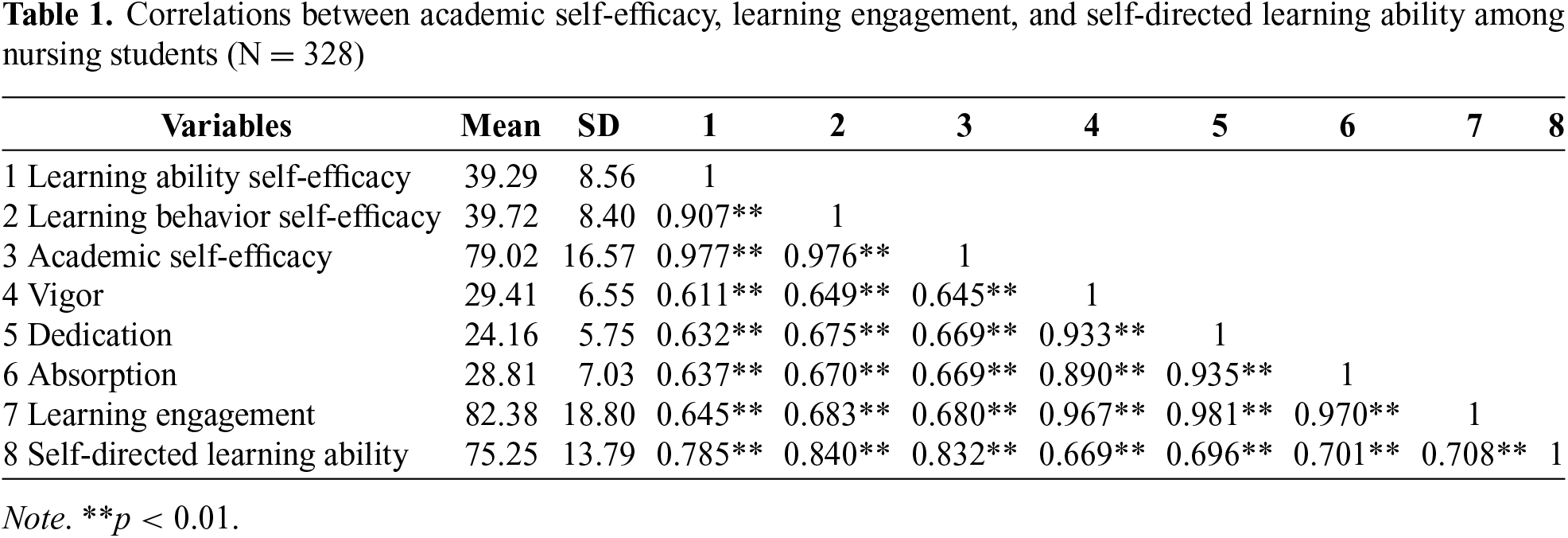
As shown in Table 1, learning engagement was positively correlated with academic self-efficacy (r = 0.680, p < 0 001) and with SDL ability (r = 0.780, p < 0.001). Academic self-efficacy was significantly related to SDL ability (r = 0.832, p < 0.001).
Test of the mediating effect of learning engagement
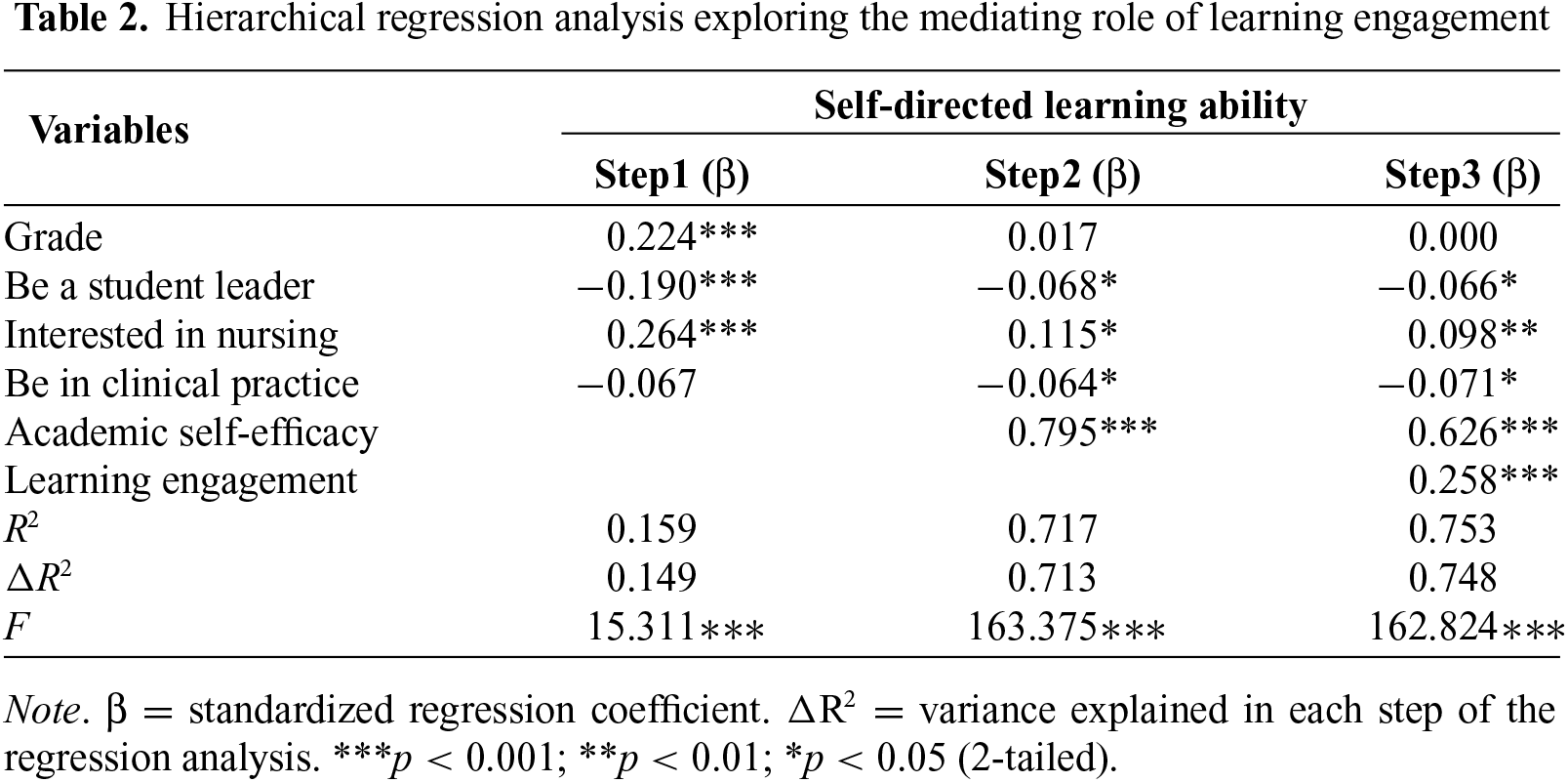
The results (as shown in Table 2) showed that academic self-efficacy significantly and positively predicted SDL ability (β = 0.795, p < 0.001), hence Hypothesis 1 is supported. Learning engagement also had a significant positive effect on SDL ability (β = 0.258, p < 0.001), hence Hypothesis 2 is supported. Learning engagement partially mediated the relationship between academic self-efficacy and SDL ability, with learning engagement reducing the main effect of academic self-efficacy on SDL ability when added to the model (from β = 0.795 to β = 0.626; p < 0.001).
The specific indirect effect of learning engagement was further tested. The estimated β values are presented in Table 3, which showed that the indirect effect of academic self-efficacy on SDL ability through learning engagement was 0.150 and the 95% bias corrected bootstrap confidence interval ranged from 0.084 to 0.225.
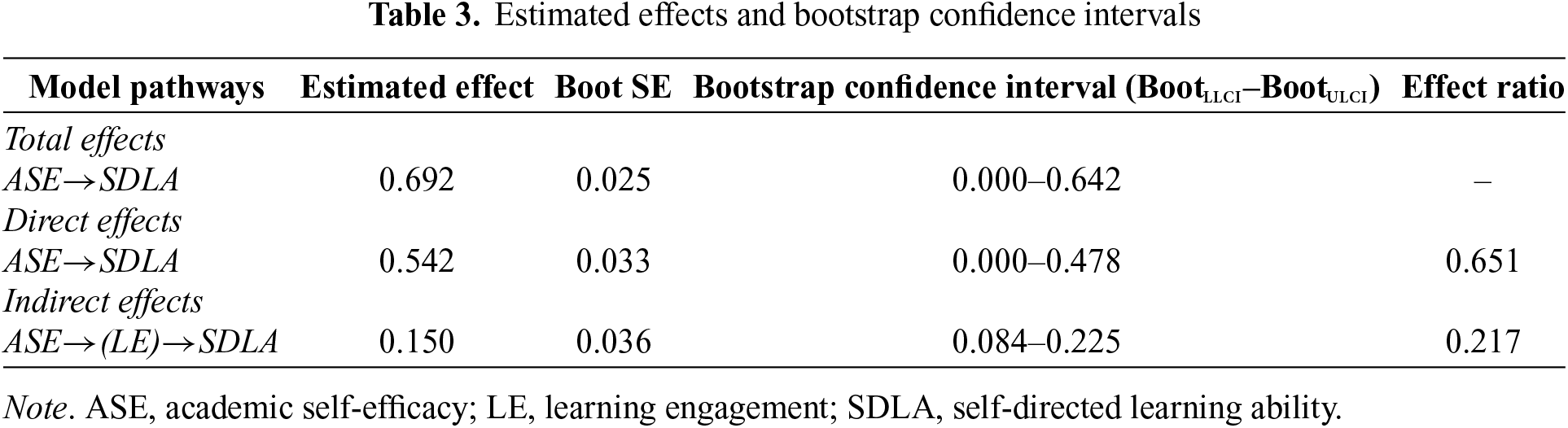
The percent of the indirect effect to the total effect was 21.7%. This finding was in support of Hypothesis 3 (Learning engagement mediates the relationship between academic self-efficacy and SDL ability for higher SDL).
This study found academic self-efficacy predicted self-directed learning ability, suggesting that students with a high sense of academic self-efficacy were more likely to have a stronger self-directed learning ability. Previous studies (Hwang & Oh, 2021; Park & Kim, 2023; Zhang et al., 2023; Karataş et al., 2023) reported academic self-efficacy to be a strong predictor of self-directed learning ability. Huang et al. (2024) also confirmed that academic self-efficacy is strongly associated with self-directed learning ability. Academic self-efficacy will have an influence on students’ learning processes. These findings are consistent with social cognition learning theory regarding how self-generated ability improves self-directed learning ability (Bandura, 2001).
Furthermore, learning engagement predicted self-directed learning ability. This finding was in line with those of Rashid and Asghar (2016), Huang et al. (2023), and Sun et al. (2023), who reported that there was a positive correlation between learning engagement and self-directed learning ability. This result suggested that the higher the level of a student’s learning engagement, the higher the level of self-directed learning ability. Mohamed and Alsayed (2021) noted that nursing students with higher degrees of emotional and behavioral engagement showed better self-directed learning ability and academic performance. Moreover, academic self-efficacy was also positively related to learning engagement in the present study, in line with previous studies (Yang et al., 2023; Luo et al., 2023; Wang and Zhang, 2024; Meng and Zhang, 2023). As suggested by both social cognitive theory and self-efficacy theory, students with high levels of academic self-efficacy tend to put more time and energy into their study and have higher levels of confidence and optimism when encountering difficulties and challenges in the learning process, leading to an overall enhancement of their engagement in study (Wu et al., 2020; Luo et al., 2023).
Last but not least, learning engagement mediated the academic self-efficacy and self-directed learning ability, to be stronger. The higher the level of academic self-efficacy, the higher the level of learning engagement, which, in turn, had a positive influence on self-directed learning ability.
These findings confirmed our hypothesis that learning engagement mediated the relationship between academic self-efficacy and self-directed learning ability. Learning is an active self-construction process, and each learner is an active learner (Meng & Zhang, 2023). Academic self-efficacy and learning engagement are the important factors affecting self-directed learning ability, the learning process, and learning outcomes of students. These results emphasize the importance for nursing educators of considering increasing nursing students’ academic self-efficacy and enhancing their learning engagement when they focus on efficient interventions to improve self-directed learning ability. Educators should adopt teaching methods that emphasize the development of students’ academic self-efficacy and the enhancement of their learning engagement to improve self-directed learning ability, such as flipped learning, heterogeneous group learning, and problem-based learning (Ali & El Sebai, 2010; Wang et al., 2021; Khodaei et al., 2022). Therefore, increasing academic self-efficacy and enhancing learning engagement effectively improved nursing students’ self-directed learning abilities.
Limitations and future recommendations
The current study had several limitations. First, the study depended on a convenience sample from one district of China, and the results may be different from other places or country settings. Therefore, the present findings may not generalize to the whole country or other areas. Future research should adopt random sampling and a larger and more diverse sample to improve the generalizability of the results. Second, the cross-sectional study design does not allow for causal relationships claims regarding the study variables. A longitudinal study would address this limitation. Third, self-report measures were used, which are prone to social desirability bias. Future studies should collect objective data on academic self-efficacy, learning engagement, and self-directed learning ability to give greater confidence in the findings.
Academic self-efficacy had a positive and significant effect on students’ self-directed learning ability through the intermediary role of learning engagement. Learning engagement was a mechanism or pathway through which academic self-efficacy influenced self-directed learning ability. Therefore, it is necessary for nursing educators to develop effective measures to increase nursing students’ academic self-efficacy and enhance their learning engagement in order to improve their self-directed learning ability.
Acknowledgement: The authors would like to thank all nursing students who participated in the study.
Funding Statement: This project were supported by the Medical and Health Communication Research Center of Zigong Academy of Medical Sciences (No. YXJKCB-2024-06) and the Demonstration Project for Consolidating the Scientific and Educational Support for Medical Talents (Scientific Research Team for improving the Service Quality of “the Elderly and the Young”).
Author Contributions: Huan Ma drafted the manuscript and performed the statistical analysis and interpretation. Jinmei Zou contributed to the study concept and design. Ying Zhong and Huan Ma were in charge of data acquisition. All authors reviewed the results and approved the final version of the manuscript.
Availability of Data and Materials: Data are available upon reasonable request.
Ethics Approval: The study was approved by the Ethics Committee of Zigong First People’s Hospital (approval number: 2025001).
Conflicts of Interest: The authors declare no conflicts of interest to report regarding the present study.
References
Akanni, A. A., & Oduaran, C. A. (2018). Perceived social support and life satisfaction among freshmen: Mediating roles of academic self-efficacy and academic adjustment. Journal of Psychology in Africa, 28(2), 89–93. https://doi.org/10.1080/14330237.2018.1454582 [Google Scholar] [CrossRef]
Ali, W. G. M., & El Sebai, N. A. M. (2010). Effect of problem-based learning on nursing students’ approaches to learning and their self-directed learning abilities. International Journal of Academic Research, 2(4), 188–195. [Google Scholar]
An, M., Nho, J., Jang, H. J., Choi, J., Han, D. et al. (2019). Effects of academic engagement and negative psychological tendency on self-directed learning ability among undergraduate students. Journal of The Korean Society of School Health, 32(2), 67–76. [Google Scholar]
Atak, N. T., & Meriç, M. (2023). The determination of the psychological resilience, academic achievement and academic self-efficacy of nursing students. Journal of Medical Sciences, 7(6), 767–773. [Google Scholar]
Bandura, A. (1997). Self-efficacy: The exercise of control (pp. 21–23). New York, NY, USA: Freeman and Company. [Google Scholar]
Bandura, A. (2001). Social cognitive theory: An agentic perspective. Annual Review of Psychology, 52, 1–26. https://doi.org/10.1146/annurev.psych.52.1.1. [Google Scholar] [PubMed] [CrossRef]
Bandura, A. (2012). Social cognitive theory. In: Van Lange, P. M., Kruglanski, A. W., Higgins, E. (Eds.Handbook of theories of social psychology (pp. 349–373Thousand Oaks, CA, USA: Sage Publications Ltd. [Google Scholar]
Berdida, D. J. E. (2023). Resilience and academic motivation’s mediation effects in nursing students’ academic stress and self-directed learning: A multi-center cross-sectional study. Nurse Education in Practice, 69(15), 103639. https://doi.org/10.1016/j.nepr.2023.103639. [Google Scholar] [PubMed] [CrossRef]
Berdida, D. J. E., Lopez, V., & Grande, R. A. N. (2023). Nursing students’ perceived stress, social support, self-efficacy, resilience, mindfulness and psychological well-being: A structural equation model. International Journal of Mental Health Nursing, 32(5), 1390–1404. https://doi.org/10.1111/inm.13179. [Google Scholar] [PubMed] [CrossRef]
Bhati, K., Baral, R., & Meher, V. (2022). Academic self-efficacy and academic performance among undergraduate students in relation to gender and streams of education. Indonesian Journal of Contemporary Education, 4(2), 80–88. https://doi.org/10.33122/ijoce.v4i2.35 [Google Scholar] [CrossRef]
Boyer, S. L., Edmondson, D. R., Artis, A. B., & Fleming, D. (2014). Self-directed learning: A tool for lifelong learning. Journal of Marketing Education, 36(1), 20–32. [Google Scholar]
Bulfone, G., Iovino, P., Mazzotta, R., Sebastian, M., Macale, L. et al. (2022). Self-efficacy, burnout and academic success in nursing students: A counterfactual mediation analysis. Journal of Advanced Nursing, 78(10), 3217–3224. [Google Scholar] [PubMed]
Cadorin, L., Bressan, V., & Palese, A. (2017). Instruments evaluating the self-directed learning abilities among nursing students and nurses: A systematic review of psychometric properties. BMC Medical Education, 17(1), 1–13. https://doi.org/10.1186/s12909-017-1072-3. [Google Scholar] [PubMed] [CrossRef]
Chen, J. H., Björkman, A., Zou, J. H., & Engström, M. (2019). Self-regulated learning ability, metacognitive ability, and general self-efficacy in a sample of nursing students: A cross-sectional and correlational study. Nurse Education in Practice, 37(Suppl. 1), 15–21. https://doi.org/10.1016/j.nepr.2019.04.014. [Google Scholar] [PubMed] [CrossRef]
Chen, J., & Zhang, X. (2023). The impact of career calling on higher vocational nursing students’ learning engagement: The mediating roles of career adaptability and career commitment. Frontiers in Psychology, 14, 1111842. https://doi.org/10.3389/fpsyg.2023.1111842. [Google Scholar] [PubMed] [CrossRef]
Cheng, S. F., Kuo, C. L., Lin, K. C., & Lee-Hsieh, J. (2010). Development and preliminary testing of a self-rating instrument to measure self-directed learning ability of nursing students. International Journal of Nursing Studies, 47(9), 1152–1158. https://doi.org/10.1016/j.ijnurstu.2010.02.002. [Google Scholar] [PubMed] [CrossRef]
Chukwuedo, S. O., Mbagwu, F. O., & Ogbuanya, T. C. (2021). Motivating academic engagement and lifelong learning among vocational and adult education students via self-direction in learning. Learning and Motivation, 74(1), 101729. https://doi.org/10.1016/j.lmot.2021.101729 [Google Scholar] [CrossRef]
de Bruin, K.,, & Hughes, G. (2012). Career decision self-efficacy and self-directed learning among women university students: A cross-cultural study. Journal of Psychology in Africa, 22(1), 61–68. https://doi.org/10.1080/14330237.2012.10874522 [Google Scholar] [CrossRef]
Dogu, O., Karadas, A., & Eskin Bacaksiz, F. (2022). The relationships between self-regulated learning in clinical nursing practice and self-efficacy: A cross-sectional study among nursing students. Perspectives in Psychiatric Care, 58(4), 2107–2115. https://doi.org/10.1111/ppc.13037. [Google Scholar] [PubMed] [CrossRef]
Gil, C. R. (2021). Relationship between self-directed learning ability, learning flow, academic self-efficacy, and academic achievement of nursing students. Journal of Digital Convergence, 19(12), 617–626. [Google Scholar]
Hayes, A. F. (2013). Introduction to mediation, moderation, and conditional process analysis: A regression-based perspective. New York, NY, USA: The Guilford Press. [Google Scholar]
Honicke, T., & Broadbent, J. (2016). The influence of academic self-efficacy on academic performance: A systematic review. Educational Research Review, 17, 63–84. [Google Scholar]
Hu, P., Kong, L. N., Chen, S. Z., & Luo, L. (2024). The mediating effect of self-directed learning ability between professional identity and burnout among nursing students. Heliyon, 10(6), e27707. https://doi.org/10.1016/j.heliyon.2024.e27707. [Google Scholar] [PubMed] [CrossRef]
Huang, L., Li, X., Meng, Y., Lei, M., Niu, Y. et al. (2023). The mediating effects of self-directed learning ability and critical thinking ability on the relationship between learning engagement and problem-solving ability among nursing students in Southern China: A cross-sectional study. BMC Nursing, 22(1), 212. https://doi.org/10.1186/s12912-023-01280-2. [Google Scholar] [PubMed] [CrossRef]
Huang, L., Zhang, X., Wang, F., Zhang, S., Chang, X. et al. (2024). The relationship between reflective ability and professional identity: The mediating effect of self-directed learning and self-efficacy for junior clinical nurses. BMC Nursing, 23(1), 858. https://doi.org/10.1186/s12912-024-02534-3. [Google Scholar] [PubMed] [CrossRef]
Huang, E. H., & Kim, K. H. (2023). Relationship between optimism, emotional intelligence, and academic resilience of nursing students: The mediating effect of self-directed learning competency. Frontiers in Public Health, 11, 1182689. https://doi.org/10.3389/fpubh.2023.1182689. [Google Scholar] [PubMed] [CrossRef]
Hwang, Y., & Oh, J. (2021). The relationship between self-directed learning and problem-solving ability: The mediating role of academic self-efficacy and self-regulated learning among nursing students. International Journal of Environmental Research and Public Health, 18(4), 1738. https://doi.org/10.3390/ijerph18041738. [Google Scholar] [PubMed] [CrossRef]
Ibrahim, R. K., & Aldawsari, A. N. (2023). Relationship between digital capabilities and academic performance: The mediating effect of self-efficacy. BMC Nursing, 22(1), 434. [Google Scholar] [PubMed]
Jin, M., & Ji, C. (2021). The correlation of metacognitive ability, self-directed learning ability and critical thinking in nursing students: A cross-sectional study. Nursing Open, 8(2), 936–945. https://doi.org/10.1002/nop2.702. [Google Scholar] [PubMed] [CrossRef]
Karataş K., Arpaci I., & Süer S. (2023). Predicting academic self-efficacy based on self-directed learning and future time perspective. Psychological Reports, 128(4), 2885–2905. https://doi.org/10.1177/00332941231191721. [Google Scholar] [PubMed] [CrossRef]
Kaulback, M. K. (2020). Correlating self-directed learning abilities to lifelong learning orientation in baccalaureate nursing students. Nurse Educator, 45(6), 347–351. https://doi.org/10.1097/NNE.0000000000000803. [Google Scholar] [PubMed] [CrossRef]
Khodaei, S., Hasanvand, S., Gholami, M., Mokhayeri, Y., & Amini, M. (2022). The effect of the online flipped classroom on self-directed learning readiness and metacognitive awareness in nursing students during the COVID-19 pandemic. BMC Nursing, 21(1), 22. https://doi.org/10.1186/s12912-022-00804-6. [Google Scholar] [PubMed] [CrossRef]
Kim, K. A. (2021). Relationship between self-directed learning ability, self-efficacy, learning engagement and academic achievement of nursing students in home-based course. Journal of the Korea Convergence Society, 12(2), 337–345. https://doi.org/10.5977/jkasne.2024.30.3.232 [Google Scholar] [CrossRef]
Lee, S., Kim, D. H., & Chae, S. M. (2020). Self-directed learning and professional values of nursing students. Nurse Education in Practice, 42, 102647. [Google Scholar] [PubMed]
Lei, H., Cui, Y., & Zhou, W. (2018). Relationships between student engagement and academic achievement: a meta-analysis. Social Behavior and Personality: An International Journal, 46(3), 517–528. [Google Scholar]
Liu, X., Ji, X., Zhang, Y., & Gao, W. (2023). Professional identity and career adaptability among Chinese engineering students: The mediating role of learning engagement. Behavioral Sciences, 13(6), 480. https://doi.org/10.3390/bs13060480. [Google Scholar] [PubMed] [CrossRef]
Liu, H., Yao, M., & Li, J. (2020). Chinese adolescents’ achievement goal profiles and their relation to academic burnout, learning engagement, and test anxiety. Learning and Individual Differences, 83(2), 101945. https://doi.org/10.1016/j.lindif.2020.101945 [Google Scholar] [CrossRef]
Luo, Q., Chen, L., Yu, D., & Zhang, K. (2023). The mediating role of learning engagement between self-efficacy and academic achievement among chinese college students. Psychology Research and Behavior Management, 16, 1533–1543. https://doi.org/10.2147/PRBM.S401145. [Google Scholar] [PubMed] [CrossRef]
Matoti, S. N. (2011). Measuring the academic self-efficacy of students at a South African higher education institution. Journal of Psychology in Africa, 21(1), 151–154. https://doi.org/10.1080/14330237.2011.10820442 [Google Scholar] [CrossRef]
Meng, Q., & Zhang, Q. (2023). The influence of academic self-efficacy on university students’ academic performance: The mediating effect of academic engagement. Sustainability, 15(7), 5767. https://doi.org/10.3390/su15075767 [Google Scholar] [CrossRef]
Mergen, M., Graf, N., & Meyerheim, M. (2024). Reviewing the current state of virtual reality integration in medical education-a scoping review. BMC Medical Education, 24(1), 788. [Google Scholar] [PubMed]
Mohamed, M. B. H., & Alsayed, S. (2021). Investigating relationship of perceived learning engagement, motivation, and academic performance among nursing students: A multisite study. Advances in Medical Education and Practice, 12, 351–369. https://doi.org/10.2147/AMEP.S272745. [Google Scholar] [PubMed] [CrossRef]
Mohamed, N. A. A. A., & Morsi, M. E. S. (2019). Learning styles, learning approaches, academic achievement factors, and self efficacy among nursing students. International Journal of Novel Research in Healthcare and Nursing, 6(1), 818–830. [Google Scholar]
Motahari, M., Rahimibashar, M., & GHasemnegad, S. M. (2020). The relationship between clinical self-efficacy and academic achievement motivation in nursing students. Research in Medical Education, 12(2), 10–20. [Google Scholar]
Nazarianpirdosti, M., Janatolmakan, M., Andayeshgar, B., & Khatony, A. (2021). Evaluation of self-directed learning in nursing students: A systematic review and meta-analysis. Education Research International, 2021(1), 2112108. [Google Scholar]
Park, H. J., & Kim, S. (2023). Relationship between super-leadership and self-directed learning ability in online nursing education: The mediating effects of self-leadership and self-efficacy perceptions. Heliyon, 9(6), e17416. https://doi.org/10.1016/j.heliyon.2023.e17416. [Google Scholar] [PubMed] [CrossRef]
Park, J. Y., & Woo, C. H. (2020). The mediating effect of self-regulated learning ability on the relationship between experience of good class and problem solving ability of nursing students. The Journal of Korean Academic Society of Nursing Education, 26(2), 185–197. https://doi.org/10.5977/jkasne.2020.26.2.185 [Google Scholar] [CrossRef]
Pintrich, P. R., & De Groot, E. V. (1990). Motivational and self-regulated learning components of classroom academic performance. Journal of Educational Psychology, 82(1), 33. [Google Scholar]
Rashid, T., & Asghar, H. M. (2016). Technology use, self-directed learning, student engagement and academic performance: Examining the interrelations. Computers in Human Behavior, 63(4), 604–612. https://doi.org/10.1016/j.chb.2016.05.084 [Google Scholar] [CrossRef]
Saeid, N., & Eslaminejad, T. (2017). Relationship between student’s self-directed-learning readiness and academic self-efficacy and achievement motivation in students. International Education Studies, 10(1), 225–232. https://doi.org/10.5539/ies.v10n1p225 [Google Scholar] [CrossRef]
Saxon, D. P. (2013). Student responsibility and self-directed learning: An interview with Christine McPhail. Journal of Developmental Education, 36(3), 14–17. [Google Scholar]
Schaufeli, W. B., Salanova, M., Gonz, M., Grom, V., & Bakker, A. B. (2002). The measurement of engagement and burnout: A two sample confirmatory factor analytic approach. Journal of Happiness Studies, 3, 71–92. [Google Scholar]
Schunk, D. H., & DiBenedetto, M. K. (2022). Academic self-efficacy. In: Handbook of positive psychology in schools (pp. 268–282Abingdon, UK: Routledge. [Google Scholar]
Subaş, F., & Karaçay, P. (2023). Factors associated with nursing students’ self-regulated learning in clinical practicum: A descriptive cross-sectional study. Nursing & Health Sciences, 25(1), 98–107. https://doi.org/10.1111/nhs.12997. [Google Scholar] [PubMed] [CrossRef]
Sun, W., Hong, J. C., Dong, Y., Huang, Y., & Fu, Q. (2023). Self-directed learning predicts online learning engagement in higher education mediated by perceived value of knowing learning goals. The Asia-Pacific Education Researcher, 32(3), 307–316. https://doi.org/10.1007/s40299-022-00653-6 [Google Scholar] [CrossRef]
Van Lankveld, W., Maas, M., van Wijchen, J.,, Visser, V., & Staal, J. B. (2019). Self-regulated learning in physical therapy education: A non-randomized experimental study comparing self-directed and instruction-based learning. BMC Medical Education, 19(1), 1–9. https://doi.org/10.1186/s12909-019-1484-3. [Google Scholar] [PubMed] [CrossRef]
Vasli, P., & Asadiparvar-Masouleh, H. (2023). Self-directed learning and clinical competence: The mediating role of the clinical learning environment. Journal of Taibah University Medical Sciences, 19(2), 221–232. https://doi.org/10.1016/j.jtumed.2023.11.004. [Google Scholar] [PubMed] [CrossRef]
Wang, Y., Ma, J., Gu, Y., Wang, J., Chen, C. et al. (2021). How does group cooperation help improve self-directed learning ability in nursing students? A trial of one semester intervention. Nurse Education Today, 98(2), 104750. https://doi.org/10.1016/j.nedt.2021.104750. [Google Scholar] [PubMed] [CrossRef]
Wang, Y., & Zhang, W. (2024). The relationship between college students’ learning engagement and academic self-efficacy: A moderated mediation model. Frontiers in Psychology, 15, 1425172. https://doi.org/10.3389/fpsyg.2024.1425172. [Google Scholar] [PubMed] [CrossRef]
Wong, F. M. F., Tang, A. C. Y., & Cheng, W. L. S. (2021). Factors associated with self-directed learning among undergraduate nursing students: A systematic review. Nurse Education Today, 104, 104998. [Google Scholar] [PubMed]
Wu, H., Li, S., Zheng, J., & Guo, J. (2020). Medical students’ motivation and academic performance: The mediating roles of self-efficacy and learning engagement. Medical Education Online, 25(1), 1742964. https://doi.org/10.1080/10872981.2020.1742964. [Google Scholar] [PubMed] [CrossRef]
Yang, Y., Li, G., Song, F., & Yuan, Y. (2023). Teacher support and student engagement in mathematics: The chain mediating role of academic self-efficacy and achievement goal orientation. Journal of Psychology in Africa, 33(5), 488–495. https://doi.org/10.1080/14330237.2023.2256078 [Google Scholar] [CrossRef]
Yang, D., Zheng, W., Li, N., Wang, X., Chen, W. et al. (2024). The mediating role of psychological capital on the relationship between perceived stress and self-directed learning ability in nursing students. BMC Nursing, 23(1), 404. https://doi.org/10.1186/s12912-024-02094-6. [Google Scholar] [PubMed] [CrossRef]
Ying, W., Mingxuan, L., Qian, Z., Shuxian, Z., Yufang, G. et al. (2023). The mediating role of professional commitment between the clinical learning environment and learning engagement of nursing students in clinical practice: A cross-sectional study. Nurse Education Today, 121, 105677. https://doi.org/10.1016/j.nedt.2022.105677. [Google Scholar] [PubMed] [CrossRef]
Yu, M., Tong, H., Li, S., Wu, X. V., Hong, J. et al. (2021). Clinical competence and its association with self-efficacy and clinical learning environments among Chinese undergraduate nursing students. Nurse Education in Practice, 53(2), 103055. https://doi.org/10.1016/j.nepr.2021.103055. [Google Scholar] [PubMed] [CrossRef]
Zhang, X., Chen, Y., Li, B., Jiang, L., Lang, X. et al. (2024). The association between school educational atmosphere, learning engagement, and professional commitment of nursing students, and learning engagement as the mediator. Nurse Education Today, 139(5), 106223. https://doi.org/10.1016/j.nedt.2024.106223. [Google Scholar] [PubMed] [CrossRef]
Zhang, H., Xiong, H., Chung, L. Y. F., Wang, Y., Wang, P. et al. (2023). What affects self-regulated learning ability in undergraduate nursing students: A structural equation modelling approach. Nursing Open, 10(8), 5728–5740. https://doi.org/10.1002/nop2.1824. [Google Scholar] [PubMed] [CrossRef]
Zhou, H., Wang, Y., & Cheng, L. (2022). The mediating effect of self-directed learning in the relationship between caring and resilience among Chinese nursing students: A multi-center cross-sectional study. Nurse Education Today, 119(3), 105598. https://doi.org/10.1016/j.nedt.2022.105598. [Google Scholar] [PubMed] [CrossRef]
Zhou, T., Yin, Y., Zhang, H., Zhang, J., Xu, X. et al. (2023). Subgroups of self-directed learning ability and their differences in professional identity among nursing undergraduates during the COVID-19 pandemic: A latent profile analysis. BMC Nursing, 22(1), 122. https://doi.org/10.1186/s12912-023-01295-9. [Google Scholar] [PubMed] [CrossRef]
Zou, L., Xie, Z., Tan, M., Ou, Q., & Liao, M. (2024). The effect of professional identity on nursing academic achievement: The chain mediating effect of general self-efficacy and learning engagement. BMC Medical Education, 24(1), 1014. [Google Scholar] [PubMed]
Cite This Article
 Copyright © 2025 The Author(s). Published by Tech Science Press.
This work is licensed under a Creative Commons Attribution 4.0 International License , which permits unrestricted use, distribution, and reproduction in any medium, provided the original work is properly cited.
 Downloads
 Citation Tools
