
 Login
Login Register
 Submit a Paper
 Propose a Special lssue
 Open Access
ARTICLE

How parenting styles shape marital attitudes: The mediating role of para-social relationships
1 Psychological Counseling and Guidance Center, Jiangxi University of Chinese Medicine, Nanchang, 330004, China
2 Industry-Academia-Research Service Center, Jiangxi University of Chinese Medicine, Nanchang, 330004, China
3 Asset Management Office, Jiangxi University of Chinese Medicine, Nanchang, 330004, China
* Corresponding Author: Shijian Sun. Email:
Journal of Psychology in Africa 2025, 35(5), 713-721. https://doi.org/10.32604/jpa.2025.066529
Received 10 April 2025; Accepted 25 September 2025; Issue published 24 October 2025
 View Full Text
 Download PDF
Abstract
This cross-sectional study examined how parenting styles influence college students’ romantic attitudes through para-social relationships. A total of 571 college students (females = 71.2%) completed the Short-form Parenting Style Scale, the Para-social Relationship Scale, and the Questionnaire on College Students’ View of Marriage and Love. Mediation was examined with bootstrap-corrected structural equation modelling (5000 resamples). Results indicated that maternal rejection (indirect effect β = −0.019, 95% CI = −0.055–−0.001, p < 0.05) and overprotection (indirect effect β = −0.02, 95% CI = −0.055–−0.001, p < 0.05) indirectly undermined college students’ marriage views by intensifying para-social relationships, whereas paternal warmth directly fostered a positive marriage view (β = 0.21, 95% CI = 0.062–0.369, p < 0.01). Therefore, to foster healthy romantic and marital attitudes among youth, families should provide emotional support, while society should promote balanced and realistic social interactions.Keywords
Parenting is critical to young people’s attitudes towards marriage and relationships. College students seek to engage in supportive relationships with others based on their sense of happiness as societies continue to change their views on marriage and relationships. The family of origin, as the primary environment for individual growth, exerts a profound influence on the psychological development of college students. However, para-social relationships also shape individual psychological characteristics, thereby affecting their attitudes and behaviors towards relationships and marriage (Shen et al., 2022). Para-social relationships are one-way virtual relationships that individuals develop with media roles (such as politicians, news announcers, celebrities, and fictional characters) based on emotional and cognitive participation (Horton & Wohl, 1956). It fulfills individuals’ need for belonging and profoundly influences their mental health and behavioral patterns (Gardner et al., 2005a,b). We examined these relationships in the collectivist China context.
Parenting styles and marital relationship concepts
Darling and Steinberg (1993) defines parenting style as the emotional ambiance conveyed through parental actions within the parent-child relationship, representing a mode of interaction and communication with children. The parenting styles in the family of origin, including emotional warmth, strict punishment, and denial, directly influence the romantic views of college students. Specifically, parental emotional warmth is significantly positively correlated with college students’ positive attitudes towards love, while parental rejection and excessive protection are significantly positively correlated with negative attitudes towards love (such as fear of intimate relationships) (Liu & Lopez, 2024). Furthermore, certain factors of parental parenting styles can predict the romantic views of college students, emphasizing the significant role of family interaction patterns in shaping positive romantic views (Siddaiah & Ashraf, 2024). Furthermore, research indicates that a healthy family interaction pattern helps form positive romantic views, while negative family interaction patterns may lead college students to develop negative tendencies towards romance, such as fear and avoidance (Amato and Rivera, 1999). Authoritative parenting helps young people’s sense of emotional security and trust in relationships, thereby fostering positive romantic views. Conversely, authoritarian, egalitarian, and disordered family types, lacking authoritative guidance, may lead children to develop negative romantic views (Siddaiah & Ashraf, 2024; White et al., 2024; Shen et al., 2022). The family of origin, being the initial and paramount environment for individual growth, is not only the fundamental setting for acquiring communication skills and forming intimate relationships but also a key influencer in shaping their values and perspectives on relationships and marriage.
Para-social relationships mediation
In the context of the information age, para-social interactions, as a form of psychological interaction, are increasingly influencing the romantic views of college students. Research also suggests that audiences perceive media figures as a form of companionship, meeting their needs for media consumption (Sokolova & Kefi, 2020). Studies by Iannone et al. (2018) indicate that establishing and maintaining para-social relationships on social platforms like Twitter is an effective way for individuals to fulfill their social interaction needs that are challenging to meet in real life. Individual immersion in media roles can positively predict the strength of the para-social relationship between the individual and the roles (Greenwood, 2008). Studies by Tsay and Bodine (2012) confirm that the time spent engaging with media figures significantly and positively predicts the strength of para-social relationships.
Conceptual basis. The theory of adaptation suggests that para-social relationships are similar to real-life interpersonal relationships, making it easy for individuals to adjust their behavior to develop behaviors that align with the roles they assume in these relationships (Bell, 1991). Adaptation allows for alternative social participation, such as online activities (Green & Brock, 1998), which could be deficit or compensatory (Derrick et al., 2008; Iannone et al., 2018).
The deficiency paradigm suggests that para-social interactions compensate for individuals’ lack of interpersonal connections due to environmental or psychological constraints, while the global-use paradigm argues that para-social interactions complement interpersonal relationships, possessing stronger empathic abilities that can facilitate the formation of para-social relationships, impacting romantic relationships.
Romantic attitudes refer to individuals’ fundamental attitudes and views towards premarital romance, marital life, and sexual orientation throughout the romantic process (Su, 2006). Under the dual influence of the family of origin and para-social interactions, college students exhibit complex and varied characteristics in their romantic attitudes.
Therefore, para-social relationships may mediate between parenting styles in one’s family of origin and university students’ attitudes towards romantic relationships.
Goals of the study. This study aims to explore the mechanisms through which the family of origin impacts the psychological well-being of university students, particularly in the formation and development of their attitudes towards romantic relationships. By dissecting factors within the family of origin and the mechanisms of para-social interactions, a deeper understanding can be gained of how these factors influence the psychological development of university students, subsequently affecting their attitudes and behaviors in romantic relationships. This research not only enriches theoretical frameworks on attitudes towards romantic relationships but also provides a scientific basis and practical guidance for family and relationship education.
The study examined the relationship between parenting styles in the family of origin and college students’ romantic attitudes, with mediation by para-social relationships. We tested a moderated model (see Figure 1) and the following hypotheses:

Figure 1: The proposed moderated model
H1. Parenting styles (rejection, overprotection, emotional warmth) directly predict college students’ romantic attitudes.
H2. Parenting styles (rejection, overprotection, emotional warmth) directly predict para-social relationships.
H3. Para-social relationships mediate the relationship between parenting styles and romantic attitudes, with:
(a) Parental rejection and overprotection strengthen para-social relationships to indirectly affect romantic attitudes;
(b) Parental emotional warmth weakens para-social relationships to indirectly affect romantic attitudes.
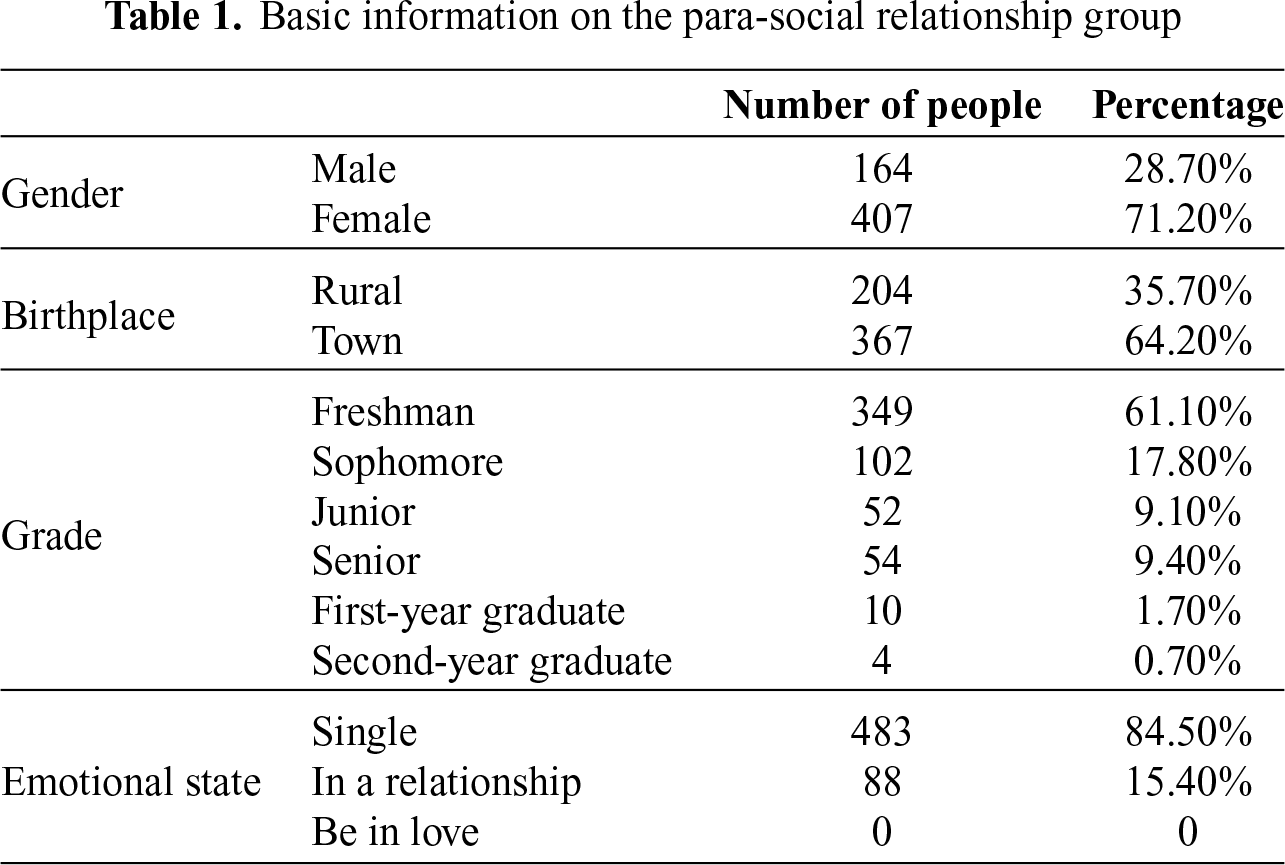
All participants are from universities in Nanchang, China (n = 571, females = 71.2%). The demographic information of research participants is shown in Table 1.
Para-social relationship scale
A modified Chinese para-social relationship measurement scale, adapted from Ma et al., (2020), with good reliability and validity. Previous social relationship scales typically measure para-social relationships across three dimensions (cognition, attitude, and behavior) (Hartmann, 2008), whereas this scale is better suited for the Chinese context, focusing on measuring a single dimension (Ge, 2017), specifically the overall strength of para-social relationships. The measure consists of 18 items. Each statement on the scale was rated on a 7-point scale from 1 (strongly disagree) to 7 (strongly agree), with higher scores indicating greater agreement. In the present study, the Cronbach’s α coefficient for this scale was 0.938.
Short-form parenting style scale
The 42-item Short-EMBU (EMBU-C) was used to assess parental rearing styles (Jiang et al., 2010). The father and mother subscales each have 21 questions, respectively measuring rejection (such as “When I do something wrong, my father/mother will severely scold me”), emotional warmth (such as “My father/mother often hugs or praises me”), and overprotection (such as “My father/mother does not allow me to go out alone”). Jiang et al. (2010) reported that Cronbach’s α in each dimension was 0.74–0.84. Confirmatory factor analysis supports the three-factor model, with CFI = 0.99 and RMSEA = 0.05. In the present study, the Cronbach’s α coefficients for the father section were 0.845 for rejection, 0.884 for emotional warmth, and 0.736 for overprotection. In the mother section, the coefficients were 0.848 for rejection, 0.883 for emotional warmth, and 0.743 for overprotection.
Questionnaire on college students’ view of marriage and love
The 34-item scale by Su (2006) is a measure of college students’ attitudes towards marriage and relationships across seven factors: sexual choice beliefs, marital roles perceptions, marital autonomy views, marital tendencies, love motivations, marital loyalty beliefs, and marital values. The items are rated on a 5-point Likert scale, with higher scores indicating more conservative views on marriage and relationships. Su reported that Cronbach’s α for each dimension was 0.58–0.86, and the total scale α was 0.74, demonstrating good reliability and validity. In the present study, the internal consistency coefficients for the questionnaire factors ranged from 0.632 to 0.838. However, the Cronbach’s α coefficient for the marital values dimension was 0.390, below the acceptable reliability standard. Consequently, this study excluded the marital values dimension to ensure the overall accuracy and reliability of the questionnaire.
The present study was conducted in accordance with national and international ethical standards for research involving human participants. As a questionnaire-based investigation in the field of psychology, it did not involve any clinical trials, biological sampling, or collection of sensitive personal data. All participants were university students who engaged voluntarily under conditions of informed consent. The study employed fully anonymous surveys, ensuring that no identifiable information was collected or could be linked to individual responses. Given the non-invasive nature of the research and the use of anonymous data collection methods, the study qualified for an exemption from ethical review approval in accordance with prevailing ethical guidelines. All procedures emphasized the protection of participants’ rights and confidentiality throughout the research process. Data collection was conducted using an online survey platform, Questionnaire Star. Students were informed of the general purpose of the study and that it was anonymous and voluntary. Students completed the survey in approximately 10–15 min with no incentive provided.
Statistical analyses were performed using SPSS 27.0. Regression was used to examine the relationships between para-social relationships, parenting styles, and attitudes towards marriage and relationships. Additionally, this study utilized AMOS for structural equation modeling to investigate the mediating role of para-social relationships in the relationship between parental parenting styles and college students’ attitudes towards marriage and relationships.
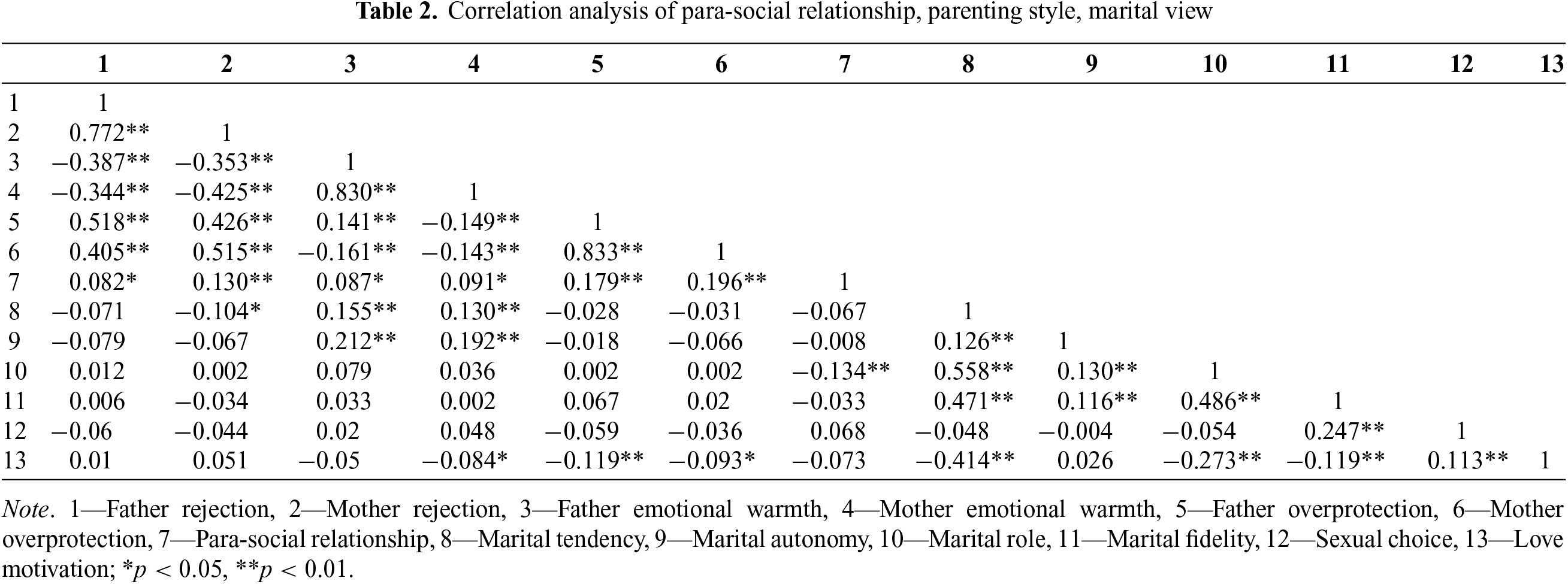
Table 2 indicates significant correlations between parenting styles, college students’ attitudes towards marriage, and para-social relationships. Regarding relationships with parenting styles and college students’ attitudes towards marriage, it was found that marital tendency and autonomy were positively correlated with parental emotional warmth (r = 0.155 to 0.212, p < 0.01) but negatively correlated with maternal rejection (r = −0.104, p < 0.05). Love motivation showed a significant negative correlation with maternal emotional warmth (r = −0.084, p < 0.05) and parental overprotection (r = −0.119 to −0.093, p < 0.05), with weaker correlations with parental rejection and paternal emotional warmth (r = −0.05 to 0.051, p > 0.05). Furthermore, there was a significant negative correlation between para-social relationships and the marital role perception dimension in attitudes towards marriage and relationships (r = −0.134, p < 0.01).
Parenting styles and marital attitudes of students
To further explore the relationship between parental rearing styles and para-social relationships, as well as romantic views among college students, this study conducted a path analysis based on structural equation modeling, utilizing 5000 bootstrapping iterations.
Across the three mediation models (Figures 2–4), fit indices consistently demonstrated adequate-to-excellent model fit (χ2/df = 2.33–3.34; CFI = 0.961–0.975; GFI = 0.974–0.982; TLI = 0.936–0.958; RMSEA = 0.048–0.064). According to the results of the path analysis, it is indicated that the dimensions of maternal rejection and overprotection within parental rearing styles significantly positively predict para-social relationships (β = 0.16, β = 0.15, p < 0.05). Additionally, para-social relationships significantly negatively predict romantic views (β = −0.13, p < 0.01). However, the paths from parental warmth to para-social relationships are not significant, and paternal warmth significantly positively predicts romantic views (β = 0.21, p < 0.05). The paths from other dimensions of parenting styles (rejection and overprotection) to views on marriage and romance were not significant (p > 0.05). Hence, Hypotheses 1 and 2 were partially confirmed.

Figure 2: The relationship model between the rejection dimension of parenting style, para-social relationship and marriage view. Note. *p < 0.05, ***p < 0.001.

Figure 3: The relationship model between the overprotective dimension of parenting style, para-social relationship and marriage view. Note. *p < 0.05, **p < 0.01,***p < 0.001.

Figure 4: The relationship model between the emotional warmth dimension of parenting style, para-social relationship and marriage view. Note. *p < 0.05, **p < 0.01,***p < 0.001.
Para-social relationships medication
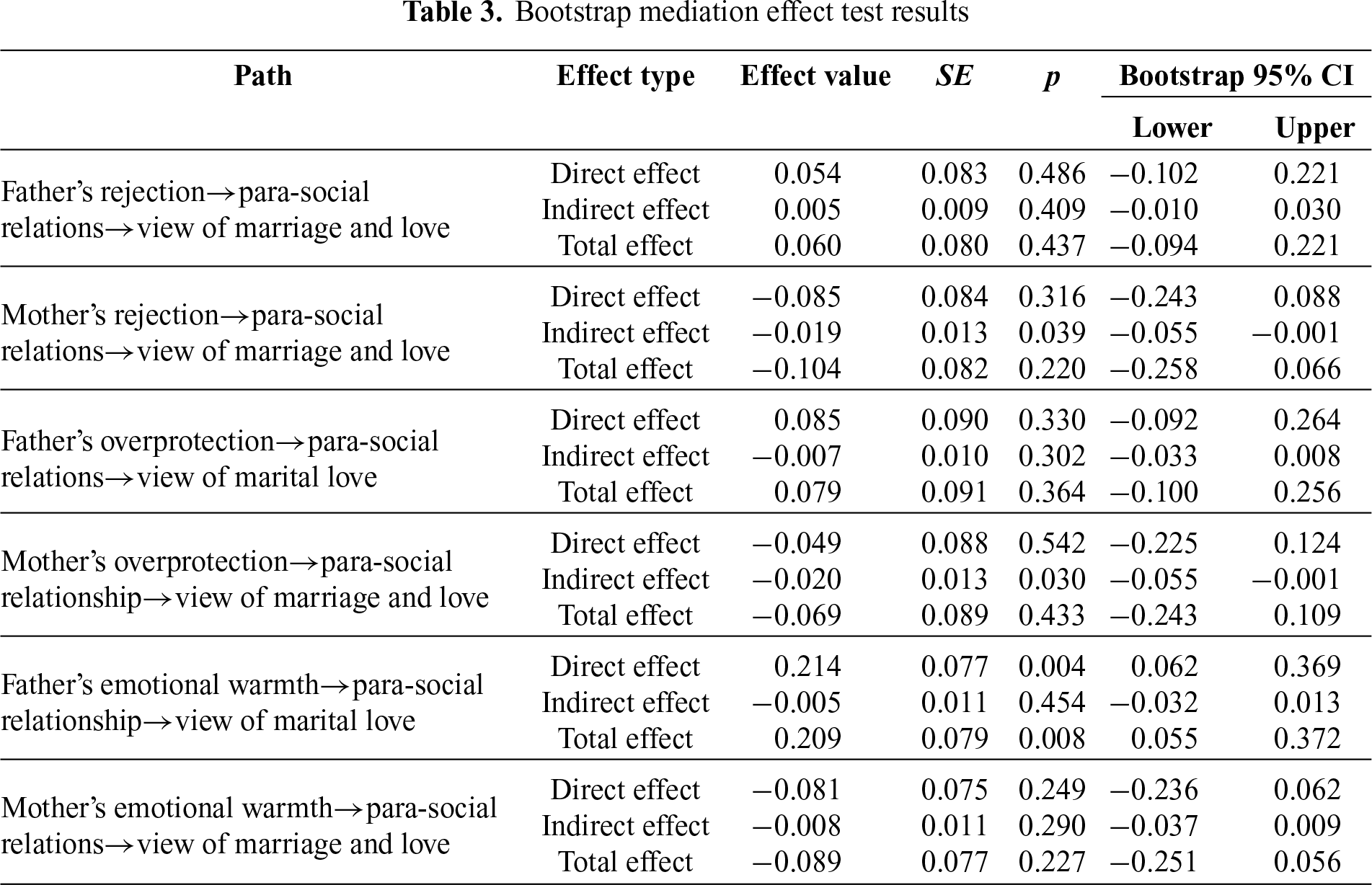
Para-social relationships completely mediated the impact of maternal rearing styles (rejection and overprotection) on college students’ views on marriage and romance. As shown in Table 3, the upper and lower limits of the bootstrap 95% confidence interval for the direct effect include 0, while the indirect effect is significant. Hence, Hypothesis 3(a) (Parental rejection and overprotection strengthen para-social relationships to indirectly affect romantic attitudes) was partially supported. Additionally, the father’s emotional warmth has a significant positive predictive effect on attitudes toward marriage and romance (β = 0.21, p < 0.05). Both its direct and total effects on attitudes toward romance are significant (p < 0.01), while the indirect effect is not significant. Therefore, Hypothesis 3(b) (Parental emotional warmth weakens para-social relationships to indirectly affect romantic attitudes) was not supported.
This study found that maternal rejection and overprotection can predict an individual’s para-social relationships. Previous research has demonstrated a strong association between parenting styles and para-social relationships. Individuals who did not receive sufficient emotional fulfillment in their original families may be more inclined to seek emotional support and comfort in para-social interactions to fulfill unmet “deficit needs” (Lotun et al., 2024). Past studies have shown that college students lacking psychological belongingness engage in online live streaming to alleviate loneliness, participating through bullet comments, private messages, and virtual gifting (Zou & Mu, 2024). Hilvert-Bruce et al. (2018) suggest that online live streaming can serve as a low-threat substitute for real-life social interactions, mitigating communication barriers that individuals may face in their daily lives. Similarly, unlike previous studies, this research reveals a significant association between maternal rejection, overprotection, para-social relationships, and romantic views. Previous research has demonstrated that positive family interaction patterns contribute to the formation of a healthy view of romantic relationships (Amato and Rivera, 1999). Authoritative family interaction patterns have been shown to foster positive attitudes towards marriage among offspring, while authoritarian, egalitarian, and disordered family patterns have been associated with negative impacts. Adverse family interaction patterns can subconsciously instill explicit or implicit negative tendencies towards establishing a family, such as fear and avoidance of romantic relationships (Shen et al., 2022).
This study revealed that negative parenting styles do not directly predict attitudes towards romantic relationships, but rather indirectly predict them through para-social relationships. This suggests that the romantic views of college students are not only directly associated with positive parenting styles, such as emotional warmth, but may also change due to other behaviors resulting from negative parenting styles (Siddaiah & Ashraf, 2024), such as engaging in para-social interactions.
Furthermore, this study found that para-social relationships can predict lower levels of romantic beliefs. Prior research has shown that negative values conveyed by certain media figures may influence individuals through para-social relationships (Hu et al., 2023; Paravati et al., 2024). Para-social relationships, as substitutes for interpersonal connections, can alleviate feelings of loneliness and provide individuals with more social support. Relevant studies indicate that interacting with media figures may lead individuals to internalize idealized romantic beliefs or trigger avoidance of real romantic relationships (Tukachinsky & Dorros, 2018; Hoffner & Bond, 2022). This suggests that para-social interactions are not necessarily entirely negative, as they may encourage groups to form “para-social relationships” and develop more open attitudes towards romantic relationships or hold more positive views on marriage and love. However, whether these conservative or liberal views on relationships will inhibit the romantic behaviors or motivations of college students still requires further research and exploration. Para-social relationships may foreshadow the romantic views of college students, but do not necessarily imply that the stronger the “para-social relationships,” the more inclined they are towards romantic involvement or marriage.
This study introduces the concept of para-social interaction behavior to explore the evolution of parenting styles in diverse social contexts. Para-social relationships, as substitutes for interpersonal relationships (Tukachinsky & Dorros, 2018), can to some extent provide individuals with increased social support, fulfilling unmet “deficit needs” from their original family environment (Hsu, 2020; Lotun et al., 2024; Robinson et al., 2025). Hence, we argue that parental influence is equally significant for children. The father’s emotional warmth serves as a direct factor influencing college students’ attitudes towards relationships, challenging the traditional notion of fathers being relatively absent or having a singular role, thus highlighting the indispensable nature of fathers in their children’s upbringing. In traditional parenting models, mothers often play a crucial role. Excessive parental intervention or neglect of children’s emotional needs can disrupt their healthy development in social and emotional aspects, leading children to seek emotional compensation through other means, thereby influencing the formation of their attitudes towards relationships and the risk of self-harm. Hence, parents should strike a balance in their roles, collectively providing emotional support and guidance to foster the formation and development of healthy relationship perspectives in their children.
This study provides clear guidance for family education. Parents should focus on adjusting their parenting styles, with fathers particularly encouraged to increase emotional support for their children by fostering warm and caring relationships to establish positive intimacy patterns. Mothers, on the other hand, should avoid overprotection and emotional neglect, and instead adopt supportive and understanding approaches to reduce their children’s reliance on virtual emotional relationships.
Additionally, the study reveals the role of virtual social relationships in the emotional development of college students. When using online platforms, college students may compensate for emotional deficiencies in real life by forming emotional connections with virtual characters. Therefore, schools and society should enhance support for the mental health of college students, assisting them in cultivating healthy real-life interpersonal relationships and reducing excessive dependence on virtual emotions. Through collaborative efforts from families, schools, and society, a more effective promotion of college students’ development of positive attitudes towards romantic relationships and healthy emotional pathways can be achieved.
Limitations and future recommendations
This study also has some limitations. Firstly, relying solely on questionnaire surveys to explore the relationship between para-social relationships, parenting styles, and attitudes towards romantic relationships may not fully delve into other potential influencing factors. It is necessary to incorporate qualitative research methods such as interviews alongside questionnaire surveys, or to utilize a mixed-methods research design, integrating self-reports from participants on their para-social interactions or attitudes towards relationships. Refusal and excessive protection in negative parenting styles may lead to deeper involvement of children in para-social behaviors. Further research is needed to explore the complex reasons behind this, including potential mediators and moderators.
Additionally, the para-social relationships examined in this study were based solely on a sample of college students using online live streaming platforms, potentially overlooking other para-social relationships that could be investigated among college students. Moreover, the sample of para-social relationship groups surveyed in this study consisted of students from two universities in the region, lacking in representativeness and generalizability, which may limit the ability of this study to fully explain the associations between para-social interactions, attitudes towards relationships, and parenting styles. The findings of this study may only reflect the characteristics of para-social relationships among college students from the two sampled institutions.
Future research can further explore the mechanisms and influencing factors of para-social relationships through in-depth interviews. Surveys and interviews can be conducted longitudinally to investigate the long-term associations between the degree of involvement in para-social interactions and its influencing factors. Study participants may include young adults on campus and those in the workforce, allowing for comparisons based on age, upbringing, education, and social involvement to better understand the origins and mechanisms of para-social interactions. Additionally, future research could delve into the influencing factors of young adults’ attitudes towards romantic relationships, exploring potential mediating or moderating variables between upbringing and relationship attitudes.
In this study, the variable of para-social relationships was introduced for the first time to explore the influence mechanism of parenting style on college students’ views of marriage. The results of this study showed that a father’s emotional warmth in their parenting style directly predicted college students’ views of marriage, and also indirectly influenced their views through the mediating role of para-social relationships in the dimensions of mother’s rejection and overprotection. This finding reveals the complex pathways of parenting styles on college students’ marital relationships. In the context of diversification, para-social relationships, as a new type of alternative social support, can alleviate individuals’ loneliness and fulfill their emotional needs that they have not been able to obtain in their families of origin. Its existence does not necessarily lead to a negative outlook on marital relationships; it may also prompt individuals to hold a more positive attitude toward marriage.
Given the results of the current study, the influence of family parenting styles on college students’ views of marital relationships is multidimensional, involving both direct and indirect pathways. Thus, (a) parents should balance their roles and work together to provide emotional support and guidance to promote the formation and development of their children’s healthy views on marital relationships. (b) Society should pay attention to college students’ para-social interaction behaviors and guide them to establish healthy social patterns to support their psychological health development.
Acknowledgement: The authors would like to extend their sincere gratitude to all college students who participated in the study.
Funding Statement: This study was funded by the Jiangxi Province Colleges and Universities Humanities and Social Sciences Research Key Research Base Project (Grant No. JD23056).
Author Contributions: The authors confirm contribution to the paper as follows: study conception and design: Lan Luo, Yun Shen, Shijian Sun; data collection: Lan Luo and Zuntao Gu; analysis and interpretation of results: Lan Luo, Yun Shen, Linbing Wang; draft manuscript preparation: Lan Luo and Yun Shen. All authors reviewed the results and approved the final version of the manuscript.
Availability of Data and Materials: The data that support the findings of this study are available from the corresponding author, [Shijian Sun], upon reasonable request.
Ethical Approval: The present study was conducted in accordance with national and international ethical standards for research involving human participants. As a questionnaire-based investigation in the field of psychology, it did not involve any clinical trials, biological sampling, or collection of sensitive personal data. All participants were university students who engaged voluntarily under conditions of informed consent. The study employed fully anonymous surveys, ensuring that no identifiable information was collected or could be linked to individual responses. Given the non-invasive nature of the research and the use of anonymous data collection methods, the study qualified for an exemption from ethical review approval in accordance with prevailing ethical guidelines. All procedures emphasized the protection of participants’ rights and confidentiality throughout the research process.
Conflict of Interest: The authors declare no conflicts of interest to report regarding the present study.
References
Amato, P. R., Rivera, F. (1999). Paternal involvement and children’s behavior problems. Journal of Marriage & Family, 61(2), b375–b384. https://doi.org/10.2307/353755 [Google Scholar] [CrossRef]
Bell, A. (1991). Contexts of accommodation: Audience accommodation in the mass media (pp. 69–102). Cambridge, UK: Cambridge University Press, https://doi.org/10.1017/CBO9780511663673.002. [Google Scholar] [CrossRef]
Darling, N., & Steinberg, L. (1993). Parenting style as context: An integrative model. Psychological Bulletin, 113(3), 487–496. https://doi.org/10.1037/0033-2909.113.3.487 [Google Scholar] [CrossRef]
Derrick, J. L., Gabriel, S., & Tippin, B. (2008). Parasocial relationships and self-discrepancies: Faux relationships have benefits for low self-esteem individuals. Personal Relationships, 15(2), 261–280. https://doi.org/10.1111/j.1475-6811.2008.00197.x [Google Scholar] [CrossRef]
Gardner, W. L., Pickett, C. L., Jefferis, V., & Knowles, M. (2005a). On the outside looking in: Loneliness and social monitoring. Personality and Social Psychology Bulletin, 31(11), 1549–1560. https://doi.org/10.1177/0146167205277208. [Google Scholar] [PubMed] [CrossRef]
Gardner, W. L., Pickett, C. L., & Knowles, M. (2005b). Social snacking and shielding: Using social symbols, selves, and surrogates in the service of belonging needs.In: Williams, K. D., Forgas, J. P. & von Hippel W. (Eds.The social outcast: Ostracism, social exclusion, rejection, and bullying (pp. 227–241). Psychology Press. [Google Scholar]
Ge, J. P. (2017). Development of the Gottman scale for pre-social relationships. Statistics & Decision, 8, 19–22. (In Chinese). https://doi.org/10.13546/j.cnki.tjyjc.2017.08.004 [Google Scholar] [CrossRef]
Green, M. C., & Brock, T. C. (1998). Trust, mood, and outcomes of friendship determine preferences for real versus ersatz social capital. Political Psychology, 19(3), 527–544. https://doi.org/10.1111/0162-895X.00116 [Google Scholar] [CrossRef]
Greenwood, D. N. (2008). Television as escape from self: Psychological predictors of media involvement. Personality and Individual Differences, 44(2), 414–424. https://doi.org/10.1016/j.paid.2007.09.001 [Google Scholar] [CrossRef]
Hartmann, T. (2008). The PSI-process scales: A new measure to assess the intensity and breadth of parasocial processes. Communications, 33(4), 385–401. https://doi.org/10.1515/COMM.2008.025 [Google Scholar] [CrossRef]
Hilvert-Bruce, Z., Neill, J. T., Sjöblom, M., & Hamari, J. (2018). Social motivations of live-streaming viewer engagement on Twitch. Computers in Human Behavior, 84(3), 58–67. https://doi.org/10.1016/j.chb.2018.02.013 [Google Scholar] [CrossRef]
Hoffner, C. A., & Bond, B. J. (2022). Parasocial relationships, social media, & well-being. Current Opinion in Psychology, 45(1), 101306. https://doi.org/10.1016/j.copsyc.2022.101306. [Google Scholar] [PubMed] [CrossRef]
Horton, D., & Wohl, R. R. (1956). Mass communication and para-social interaction. Psychiatry, 19, 215–229. https://doi.org/10.1080/00332747.1956.11023049. [Google Scholar] [PubMed] [CrossRef]
Hsu, C. L. (2020). How vloggers embrace their viewers: Focusing on the roles of para-social interactions and flow experience. Telematics and Informatics, 49, 101364. https://doi.org/10.1016/j.tele.2020.101364 [Google Scholar] [CrossRef]
Hu, Q., Pan, Z., Lu, Y., & Wang, B. (2023). Heterophily or homophily of social media influencers: The role of dual parasocial relationships in impulsive buying. International Journal of Electronic Commerce, 27(4), 558–589. https://doi.org/10.1080/10864415.2023.2255112 [Google Scholar] [CrossRef]
Iannone, N. E., McCarty, M. K., Branch, S. E., & Kelly, J. R. (2018). Connecting in the Twitterverse: Using Twitter to satisfy unmet belonging needs. The Journal of Social Psychology, 158(4), 491–495. https://doi.org/10.1080/00224545.2017.1385445. [Google Scholar] [PubMed] [CrossRef]
Jiang, J., Lu, Z. R., Jiang, B. J., & Xu, Y. (2010). The preliminary revision of the Chinese version of the brief parenting style questionnaire. Psychological Development and Education, 1, 94–99. (In Chinese). https://doi.org/10.16187/j.cnki.issn1001-4918.2010.01.017 [Google Scholar] [CrossRef]
Liu, Q., Lopez, E. (2024). Research on parenting style, alexithymia and fear of intimacy among college students. Applied & Educational Psychology, 5(1), 92–100. https://doi.org/10.23977/appep.2024.050113 [Google Scholar] [CrossRef]
Lotun, S., Lamarche, V. M., Matran-Fernandez, A., & Sandstrom, G. M. (2024). People perceive parasocial relationships to be effective at fulfilling emotional needs. Scientific Reports, 14(1), 8185. https://doi.org/10.1038/s41598-024-58069-9. [Google Scholar] [PubMed] [CrossRef]
Ma, Z. H., Ge, J. P., & Zhou, X. (2020). The continuous use behavior and subjective well-being of online live broadcasting users—A theoretical perspective based on the expectation confirmation model and parasocial relationships. Journal of Journalism and Communication Review, 2, 29–46. (In Chinese). https://doi.org/10.14086/j.cnki.xwycbpl.2020.02.003 [Google Scholar] [CrossRef]
Paravati, E., Gabriel, S., Valenti, J., Valent, K., & Buffone, A. (2024). Social comparison, parasocial relationships, and attachment style: How and when do celebrities improve self-liking? The Journal of Social Psychology, 164(5), 683–694. https://doi.org/10.1080/00224545.2022.2149385. [Google Scholar] [PubMed] [CrossRef]
Robinson, T. J., Brown, X., & Hackathorn, J. (2025). The name’s bond. parasocial bond: Imagined interactions and state-level empathy. The Journal of Social Psychology, 165(4), 483–490. https://doi.org/10.1080/00224545.2024.2360466. [Google Scholar] [PubMed] [CrossRef]
Shen, J., Chen, S. Y., & Shan, K. Y. (2022). The impact of family interaction patterns on college students’ views on marriage and love. Chinese Youth Social Sciences, 4, 77–86. (In Chinese). https://doi.org/10.16034/j.cnki.10-1318/c.2022.04.016 [Google Scholar] [CrossRef]
Siddaiah, A., & Ashraf, M. B. (2024). Attitude towards marriage and perceived parenting style among college-going students. Social Psychology and Society, 15(3), 60–71. https://doi.org/10.17759/sps.2024150304 [Google Scholar] [CrossRef]
Sokolova, K., & Kefi, H. (2020). Instagram and YouTube bloggers promote it, why should I buy? How credibility and parasocial interaction influence purchase intentions. Journal of Retailing and Consumer Services, 53(1), 101742. https://doi.org/10.1016/j.jretconser.2019.01.011 [Google Scholar] [CrossRef]
Su, H. (2006). The structure, characteristics, and influencing factors of college students’ views on marriage and love [Master’s thesis]. El Paso, TX, USA: Southwest University. (In Chinese). https://doi.org/10.7666/d.y902292 [Google Scholar] [CrossRef]
Tsay, M., & Bodine, B. M. (2012). Exploring parasocial interaction in college students as a multidimensional construct: Do personality, interpersonal need, and television motive predict their relationships with media characters? Psychology of Popular Media Culture, 1(3), 185–200. https://doi.org/10.1037/a0028120 [Google Scholar] [CrossRef]
Tukachinsky, R., & Dorros, S. M. (2018). Parasocial romantic relationships, romantic beliefs, and relationship outcomes in USA adolescents: Rehearsing love or setting oneself up to fail? Journal of Children and Media, 12(3), 329–345. https://doi.org/10.1080/17482798.2018.1463917 [Google Scholar] [CrossRef]
White, A. C., Diggs, O. N., & Neppl, T. K. (2024). Father and mother harsh parenting and adult romantic relationships over time: Individual behavior during adolescence. Journal of Family Psychology, 38(5), 775–785. https://doi.org/10.1037/fam0001245. [Google Scholar] [PubMed] [CrossRef]
Zou, M., & Mu, D. (2024). Bullet-screen engagement in videos and deindividualized online behavior: The chain mediating role of belonging and loneliness. Current, 43(21), 19162–19170. https://doi.org/10.1007/s12144-024-05746-7 [Google Scholar] [CrossRef]
Cite This Article
 Copyright © 2025 The Author(s). Published by Tech Science Press.
This work is licensed under a Creative Commons Attribution 4.0 International License , which permits unrestricted use, distribution, and reproduction in any medium, provided the original work is properly cited.
 Downloads
 Citation Tools
