
 Login
Login Register
 Submit a Paper
 Propose a Special lssue
 Open Access
ARTICLE
Who I am shapes how I learn: A mixed methods study exploring the role of work identity and psychological needs in learning engagement
1 Research Studio of Digital Intelligence and Humanities, College of Foreign Languages, Zhejiang Normal University, Jinhua, 321004, China
2 Humanities and Social Sciences Department, Zhejiang Conservatory of Music, Hangzhou, 310058, China
* Corresponding Authors: Wenjing Wang. Email: ; Jianfen Ying. Email:
# These authors are the co-first author
Journal of Psychology in Africa 2025, 35(6), 833-842. https://doi.org/10.32604/jpa.2025.071557
Received 07 August 2025; Accepted 17 November 2025; Issue published 30 December 2025
 View Full Text
 Download PDF
Abstract
This study explores the role of teachers’ professional identity (TPI) on employee learning engagement (LE), with mediation by basic needs satisfaction (BNS). Participants were 255 Chinese pre-service teachers (191 females = 74.9%, 16 freshmen = 6.2%, 135 sophomores = 52.9%, 35 juniors = 12.5%, 72 seniors = 28.2%). They completed surveys on the “QuestionStar” online survey platform and 12 of the teachers completed interviews for sharing their personal insights. The results of Structural Equation Modeling (SEM) indicated that teachers’ professional identity significantly predicted both learning engagement and basic needs satisfaction, with basic needs satisfaction partially mediating the relationship between teachers’ professional identity and learning engagement. A strong professional identity fosters engagement directly and indirectly by satisfying psychological needs—autonomy, competence, and relatedness. Qualitative data revealed that alignment between professional identity and learning experiences enhances motivation, persistence, and reflection, while identity confusion or unmet psychological needs lead to disengagement. These findings highlight the critical role of fostering professional identity development within teacher training curricula to enhance motivational outcomes, learning engagement, and reflective teaching practices in nurturing educational settings.Keywords
Learning engagement has been widely acknowledged as a key factor in work orientation and identity (Keijzer et al., 2022). Professional identity here is about how employees view work roles (Butakor et al., 2021; Zhang & Wang, 2022). Employees with a strong sense of professional identity are more likely to take pride in their work, exhibit intrinsic motivation, and engage more deeply in learning, ultimately contributing to improved professional performance (Fathi et al., 2024; Li et al., 2025). A strong professional identity not only enhances work engagement and performance but also fosters the perception that one’s basic psychological needs are fulfilled. This relationship aligns with identity-based motivation theory, which suggests that individuals with a well-defined professional self-concept are more likely to interpret their experiences in ways that reinforce their identity, including seeing their environment as need-supportive (Oyserman et al., 2021). Self-determination theory further supports this dynamic process, as professional identity clarity facilitates internalized motivation, making individuals more proactive in seeking experiences that satisfy their psychological needs (Ryan & Deci, 2017). While the relationships between professional identity, psychological need satisfaction, and learning engagement have been established in various educational contexts (Fathi et al., 2024; Li et al., 2025), these interrelated processes remain understudied among pre-service teachers in developing countries, particularly in China, where rapid educational reforms and sociocultural factors create unique professional identity challenges (Yang, 2021). This study addresses this gap by examining these mechanisms in Chinese pre-service English teachers, whose dual roles as language learners and future educators create a critical yet unexplored intersection of identity development and professional preparation.
Professional identity and learning engagement
Learning engagement refers to students’ psychological state of active involvement during learning tasks, encompassing affective activation, behavioral effort, and cognitive absorption (Wong & Liem, 2021; Keijzer et al., 2022). Among pre-service teachers, their professional identity is in development (Weiß et al., 2023).
Pre-service teachers who exhibit a clearer, more positive professional identity tend to engage more actively and meaningfully in their learning processes. Overall, existing research underscores a robust and positive correlation between teachers’ professional identity and learning engagement, applicable to both in-service and pre-service cohorts (Peng & Zhang, 2024; Li et al., 2025).
Learning engagement is typically conceptualized as consisting of three core dimensions: behavioral engagement, cognitive engagement and emotional engagement, which correspond to distinct aspects of the learning experience—action, thought, and feeling, respectively. Participation in educational activities is a key aspect of behavioral engagement, which includes both classroom and extracurricular involvement. Emotional engagement, on the other hand, pertains to the emotional reactions of students toward their educators, classmates, and the institution itself. Cognitive engagement then, encompasses the dedication students show in grasping intricate academic material and their endeavors to sharpen their critical thinking and problem-solving abilities (Fredricks et al., 2004; Reeve, 2012). Then, Reeve suggested the fourth dimension: agentic engagement, which is defined as students’ constructive contributions to the flow of instruction (Reeve & Tseng, 2011). Teachers’ learning engagement parallels this framework but adapts it to professional contexts (Chan et al., 2023). This multidimensional framework demonstrates that both student and teacher engagement are fundamentally influenced by the fulfillment of basic psychological needs and environmental factors. These elements collectively shape learning experiences and professional growth trajectories (Ryan & Deci, 2017).
Thus, for pre-service English teachers, a strong professional identity can lead to deeper engagement in learning activities, as these are perceived as directly relevant to their anticipated professional roles. This perceived relevance fosters fulfillment of their psychological needs, thereby facilitating sustained learning engagement (Fathi et al., 2024; Li et al., 2025).
Basic needs satisfaction mediation
Basic needs satisfaction is a core construct derived from self-determination theory, which posits that human motivation and well-being depend on the fulfillment of three fundamental psychological needs. According to self-determination theory, autonomy refers to the experience of volition and self-endorsement in one’s actions, competence involves feeling effective in mastering challenges, and relatedness entails establishing meaningful interpersonal connections (Ryan & Deci, 2017). In teacher education, basic needs satisfaction serves as a critical mechanism linking contextual support to professional engagement and development. Empirical studies demonstrate that when pre-service teachers perceive autonomy-supportive mentoring, competence-building feedback, and collaborative relationships, they exhibit higher intrinsic motivation, deeper reflection, and sustained commitment to teaching (Xu et al., 2024; Chan et al., 2023). Notably, basic needs satisfaction not only directly enhances engagement but also mediates the effects of teacher support and professional identity on learning outcomes, as shown in studies of Chinese higher vocational students and English as a foreign language (EFL) pre-service teachers (Xu et al., 2024; Peng & Zhang, 2024). These findings align with self-determination theory’s proposition that need-supportive environments foster internalization of professional practices (Weiß et al., 2023).
Basic needs satisfaction and learning engagement
Motivation has been extensively studied in educational psychology, leading to the development of several influential theories, such as social cognitive theory, expectancy-value theory, and self-determination theory (Eccles, 2005; Ryan & Deci, 2017). Motivation serves as the driving force behind behavior, influencing both its intensity and persistence (Reeve, 2012). It encompasses both intrinsic and extrinsic forms, with self-determination theory placing a central emphasis on the former. Intrinsic motivation refers to engagement in activities driven by personal interest and satisfaction, rather than external incentives such as rewards or punishments (Chiu, 2023). According to self-determination theory, intrinsic motivation is characterized by self-directed behavior fueled by internal values and curiosity (Schweder et al., 2025).
For instance, a study of pre-service teacher profiles revealed that teachers with strong intrinsic motivation demonstrated greater cognitive engagement and persistence in instructional tasks compared to their less motivated peers (Zhou et al., 2025). This aligns with the proposition of self-determination theory that when learners’ basic needs are satisfied, they exhibit deeper cognitive engagement and persistence (Chiu, 2022). The mediating role of need satisfaction is further evidenced in vocational education. Xu et al. (2024) found that Chinese higher vocational students who perceived teacher support for autonomy developed stronger learning drives, subsequently demonstrating higher behavioral engagement in practice-oriented tasks. These findings demonstrate how need-supportive environments transform external knowledge into valued competencies through intrinsic motivation (Ryan & Deci, 2017).
For pre-service teachers, fulfilling fundamental psychological needs affects both their current learning involvement and their ongoing professional growth, motivational persistence, and psychological health. Given the importance of basic needs satisfaction in fostering sustained engagement, it is essential to examine how these needs influence learning engagement specifically among pre-service English teachers, who face unique pedagogical and identity-related challenges during their training (Chan et al., 2023).
Identity-based motivation (IBM) theory offers a valuable framework for understanding how professional identity can influence basic needs satisfaction and learning engagement. According to identity-based motivation theory, individuals are motivated to act in ways that are congruent with their current and envisioned social identities (Oyserman et al., 2021). A strong identification with the teaching profession increases the likelihood that pre-service teachers will set and pursue goals aligned with their future teaching roles. Importantly, identity does not merely correlate with need satisfaction but actively shapes how individuals interpret and seek out need-supportive experiences (Weiß et al., 2023). A coherent identity structure can guide need-fulfilling behaviors, thereby enhancing perceptions of autonomy, competence, and relatedness—the three core psychological needs emphasized in self-determination theory (Weiß et al., 2023; Knittle et al., 2023).
The Chinese teaching profession context
China’s teacher education system places unique demands on pre-service English teachers, who must navigate the dual challenges of mastering pedagogical skills while developing a professional identity aligned with both global language teaching standards and local educational expectations. However, studies show that while Chinese pre-service EFL teachers demonstrate strong content knowledge, they often lack confidence in classroom management and adaptive teaching strategies (Sang, 2023). This gap highlights the critical role of professional identity formation during teacher preparation, as those with clearer professional self-concepts show greater resilience and engagement in skill development (Peng & Zhang, 2024). Studies on teacher motivation suggest that satisfying basic needs satisfaction plays a crucial role in sustaining engagement during teacher preparation (Chan et al., 2023). However, research specifically examining how professional identity interacts with these psychological needs in Chinese EFL contexts remains limited (Yang, 2021). This study addresses this gap by examining how professional identity and basic needs satisfaction jointly shape learning engagement, offering insights for designing more holistic EFL teacher preparation in China’s evolving educational landscape.
Guided by self-determination theory, this study examines how teachers’ professional identity influences learning engagement among pre-service English teachers, with basic needs satisfaction as a potential mediator. Based on the conceptual model (Figure 1), we propose the following hypotheses:

Figure 1: Simple mediation model. Note. TPI, teachers’ professional identity; BNS, basic needs satisfaction; LE, learning engagement.
H1: Pre-service teachers’ professional identity is associated with higher learning engagement.
H2: Pre-service English teachers’ professional identity is associated with higher basic needs satisfaction.
H3: Pre-service English teachers’ basic needs satisfaction is associated with higher learning engagement.
H4: The relationship between pre-service English teachers’ professional identity and learning engagement is mediated by basic needs satisfaction.
To comprehend the interplay among teachers’ professional identity (TPI), basic needs satisfaction (BNS), and learning engagement (LE) among pre-service English educators, the current research introduces a model for investigation (see Figure 1). There are four routes to examine the relationship among the three variables. Route 1 (TPI→BNS) indicates that pre-service English teachers’ professional identity can positively impact their basic needs satisfaction. Route 2 (BNS→LE) illustrates the positive link between pre-service English teachers’ basic needs satisfaction and their learning engagement. Route 3 (TPI→LE) indicates that pre-service English teachers’ professional identity has an important impact on their learning engagement. Route 4 (TPI→BNS→LE) implies that basic needs satisfaction mediates the relationship between pre-service English teachers’ professional identity and learning engagement.
This study used a sequential explanatory mixed-methods design. First, we collected quantitative data through a revised questionnaire; then we conducted semi-structured interviews based on the quantitative results, followed by thematic analysis. Interviews provided specific examples of pre-service English teachers’ learning situations, aiming to offer a clearer picture of the professional identity’s relationship with basic needs satisfaction and learning engagement.
A total of 255 pre-service English teachers participated. Participants included 191 females (74.9%) and 64 males (25.1%). In terms of grades, there were 16 freshmen (6.2%), 135 sophomores (52.9%), 35 juniors (12.5%), and 72 seniors (28.2%).
The scales were adapted from established scales with high reliability and validity. The measures were rated on a 5-point Likert scale (1 = strongly disagree, 5 = strongly agree). Semi-structured interviews were included to complement and clarify the quantitative results.
Pre-service english teachers’ professional identity
For pre-service English teachers’ professional identity, this study adapted Hanna et al.’s (2020) scale for the pre-service English context so that the questionnaire has the characteristics of the English discipline. The 21-item scale was divided into four sections reflecting teachers’ professional identity dimensions: motivation, self-image, self-efficacy, and task perception. In this sample, Cronbach’s alpha was 0.91.
The 11 items of basic needs satisfaction were adapted from Chen et al.’s (2015) scale, which include three parts: autonomy, competence, and relatedness. The scale has undergone rigorous testing to establish its reliability and validity (α = 0.93).
Based on a new sub-dimension of engagement proposed by Reeve, this study adopted the scale compiled by Reeve according to the new definition (Reeve, 2013). The 16-item scale (α = 0.95) includes four sub-dimensions: behavioral engagement (α = 0.86), cognitive engagement (α = 0.86), emotional engagement (α = 0.89), and agentic engagement (α = 0.90).
In the qualitative research stage, twelve participants from different academic levels were selected purposively: 4 sophomores, 3 juniors, and 5 seniors. Participants were asked a series of seven key questions that centered on pre-service English teachers’ professional identity, basic needs satisfaction, and learning engagement. An extra interview was conducted six months later with 2 interviewees who had become full-time teachers.
The committee of Zhejiang Normal University approved the study. Participants consented to the study. Before participation, all participants assured of their voluntary participation, including the option to withdraw at any time without consequence. Once participants provided informed consent, the research team distributed the questionnaire via the “QuestionStar” online survey platform.
Quantitative data analysis involved descriptive analysis, Pearson’s correlation, and path analysis using SPSS 27.0 and PROCESS V3.3. To assess the fit of each measure, confirmatory factor analysis (CFA) was performed. Composite reliability (CR) and average variance extracted (AVE) values were calculated to further assess construct validity. Data preprocessing and descriptive statistics were first conducted using SPSS 27.0.
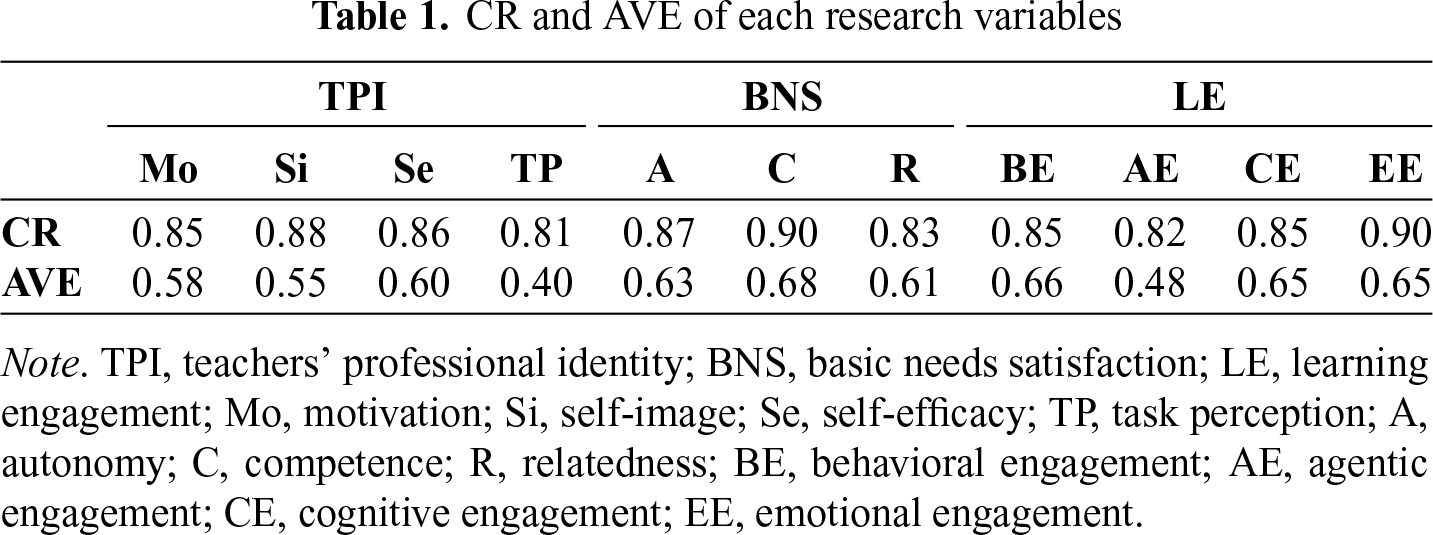
A series of analyses were undertaken to explore the study’s findings. Confirmatory Factor Analysis (CFA) with maximum likelihood estimation was applied to each scale (see Table 1). The initial CFA results for digital teacher support (DTS) (X2/df = 2.01, p < 0.05; RMSEA = 0.06, CFI = 0.94, IFI = 0.94, TLI = 0.93), basic needs satisfaction (X2/df = 2.15, p < 0.05; RMSEA = 0.07, CFI = 0.97, IFI = 0.98, TLI = 0.97), and SE (X2/df = 1.91, p < 0.05; RMSEA = 0.06, CFI = 0.97, IFI = 0.97, TLI = 0.96) were all acceptable. The CFA demonstrated robust composite reliability for all latent variables, with CR values ranging from 0.81 to 0.90 (CR > 0.8). Although most AVEs exceeded the recommended 0.5 threshold, two constructs showed marginally lower values (0.48 and 0.40). Considering the satisfactory composite reliability (CR > 0.7) and adequate factor loadings (>0.5), these slightly reduced AVE values remain acceptable according to established criteria (Fornell & Larcker, 1981).
Next, a structural equation model was developed employing the maximum likelihood estimation method to assess the significance of the path coefficients. Additionally, the mediating effects were tested using the bootstrap method (n = 5000) with 95% confidence intervals. As shown in Table 2 and Figure 2, the fitness of the model with this survey data has been tested by using fit indices: chi-square divided by degrees of freedom (χ2/df < 3), the root mean square error of approximation (RMSEA < 0.1) (MacCallum et al., 1996), incremental fit index (IFI > 0.95), Tucker-Lewis index (TLI > 0.95), and comparative fit index (CFI > 0.95). The analysis revealed no significant moderating effects for either gender (β = −0.13, p > 0.05, 95% CI [−0.32, 0.58]) or grade level (β = −0.03, p > 0.05, 95% CI [−0.08, 0.13]) as covariates. This suggests that the observed TPI—LE relationships are not attributable to gender composition differences.


Figure 2: The SEM Model (standardized). Note. TPI, teachers’ professional identity; BNS, basic needs satisfaction; SLE, students’ learning engagement.
The qualitative data were analyzed using NVivo 14.0. Based on the six-phase framework, the analysis of the collected data in this paper consists of six steps: (1) becoming intimately acquainted with the dataset, (2) devising preliminary codes, (3) identifying overarching themes, (4) reevaluating these themes for coherence, (5) categorizing and titling the themes, and (6) compiling the findings into a comprehensive report (Braun & Clarke, 2006).
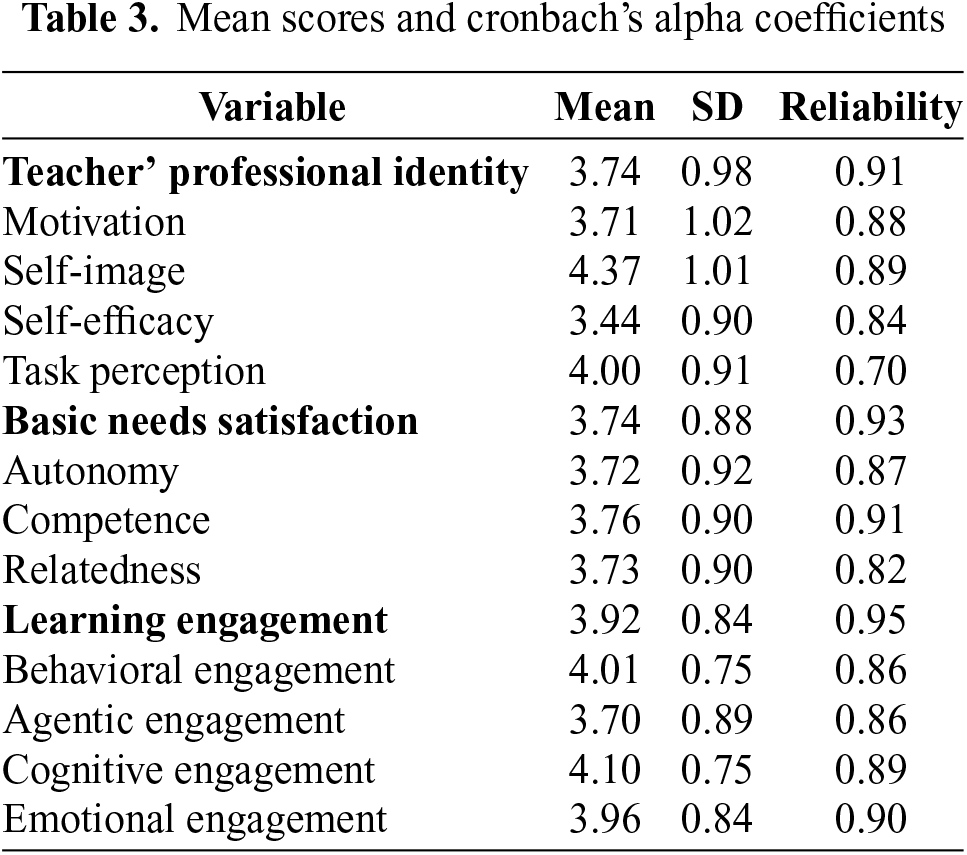
Table 3 presents the descriptive statistics and mean scores for all variables measured. The data indicate that the teachers’ professional identity among pre-service English teachers is notably high, with a composite mean score of 3.73 and a standard deviation of 0.98. The sub-dimension encompassed all show high levels, including motivation (M = 3.71, SD = 1.02), self-image (M = 4.37, SD = 1.01), self-efficacy (M = 3.44, SD = 0.90), and task perception (M = 4.00, SD = 0.91). Furthermore, pre-service English teachers reported a high level of satisfaction with their basic psychological needs, with a mean score of 3.74 (SD = 0.88). This dimension comprised autonomy (M = 3.72, SD = 0.92), competence (M = 3.76, SD = 0.90), and relatedness (M = 3.73, SD = 0.90). Regarding learning engagement, the mean score was 3.92 (SD = 0.84). Learning engagement encompassed students’ behavioral engagement (M = 4.01, SD = 0.75), agentic engagement (M = 3.70, SD = 0.89), cognitive engagement (M = 4.10, SD = 0.75), and emotional engagement (M = 3.96, SD = 0.84), which show a high level of mean.
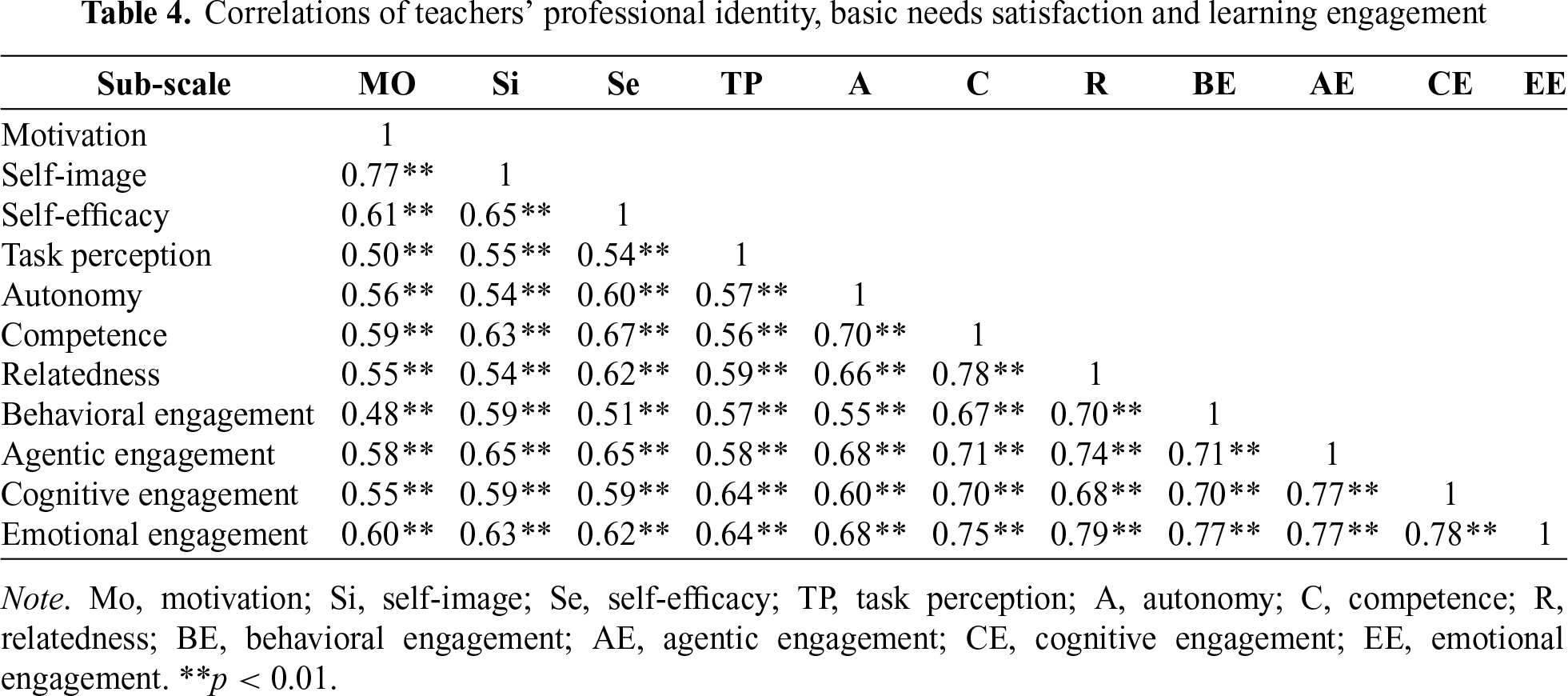
This study used a Pearson multiple correlation analysis to scrutinize the interrelations among teachers’ professional identity, basic needs satisfaction, and learning engagement. Teachers’ professional identity and basic needs satisfaction exhibited a positive correlation (r = 0.77, p < 0.01). Furthermore, a robust positive association was identified between teachers’ professional identity and learning engagement (r = 0.79, p < 0.01). On top of that, a positive correlation surfaced between basic needs satisfaction and learning engagement (r = 0.85, p < 0.01). Subsidiary analyses revealed that the sub-scales, encompassing motivation, self-image, self-efficacy, task perception, autonomy, competence, relatedness, behavioral engagement, agentic engagement, cognitive engagement, and emotional engagement, were all positively and significantly correlated, with coefficients ranging from 0.48 to 0.79 (See Table 4).
Professional identity and learning engagement
The Structural Equation Modeling (SEM) analysis was conducted using AMOS 26.0 software to examine the hypothesized path relationships. The results, shown in Figure 2, indicate that the standardized path coefficients for hypotheses H1, H2, and H3 were 0.28, 0.91, and 0.68, respectively. All p-values were below 0.05, providing support for hypotheses H1, H2, and H3.
Basic psychological process mediation
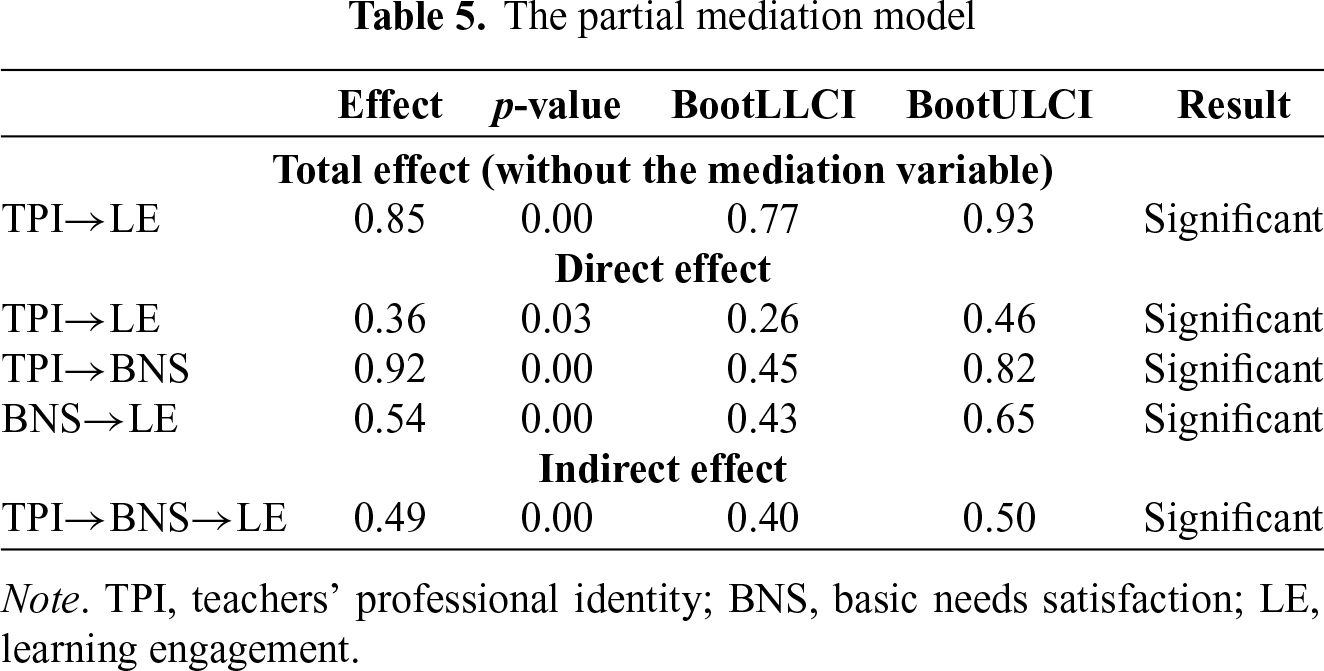
Table 5 and Figure 2 present the evidence on basic needs satisfaction as a mediating variable, and the statistical significance of the path from teachers’ professional identity to learning engagement was evident (p < 0.01), indicating that teachers’ professional identity has a positive impact on learning engagement. In addition, TPI→LE had statistical significance (p < 0.01), SE value = 0.04 (SE > 0), and CR value = 2.11 (CR > 2). The bias-corrected confidence intervals 95% CI (0.77, 0.93) do not contain zero [β = 0.85, t = 20.42]. Upon inclusion of the mediating variable basic needs satisfaction a positive impact of teachers’ professional identity on basic needs satisfaction emerged, with the TPI→BNS path also demonstrating statistical significance, SE value was 0.05 (SE > 0), CR value was 10.93 (CR > 2), and zero was not included in the 95% CI (0.82, 1.01) [β = 0.92, p < 0.01]. Similarly, in the BNS→LE path, β = 0.54, t = 12.35 (p < 0.01), SE value = 0.04 (SE > 0), CR value = 4.96 (CR > 2), where zero is not included in CI (0.43, 0.65). That means it’s also statistically significant. The table shows that the indirect effect of TPI→BNS→LE is β = 0.49, [p < 0.01, 95% CI (0.40, 0.50)], the direct effect is β = 0.36, [p < 0.05, 95% CI (0.26, 0.46)], affirming the significant mediating role of basic needs satisfaction in the relationship between teachers’ professional identity and learning engagement. Consequently, basic needs satisfaction is proved to be a partial mediator in this context. Thus, hypothesis H4 was supported.
To complement the findings from the quantitative analysis, this investigation also used semi-structured interviews for qualitative research. After coding the qualitative responses, we found that the relationship between teachers’ professional identity, basic needs satisfaction, and learning engagement was consistent with the outcomes of the quantitative analysis. This study thematically analyzed three key themes that are pertinent to the hypotheses: 1) the passion for teaching and students’ sincerity fortify the convictions; 2) responsibility and interest drive diligence; 3) autonomy and collaboration stimulate aspiration.
Students’ authentic enthusiasm for teaching reinforces the convictions
Most interviewees expressed a desire to become English teachers, influenced by both personal passion and external factors. Interviewees in lower-grade years were primarily motivated by a passion for education or inspiring teachers they had encountered. In contrast, those with teaching internship experience were more affected by the sincerity of their students, with the teacher-student bond reinforcing their commitment. Notably, in follow-up interviews with interviewees who had become full-time teachers six months later, they shared more about their experiences with students and indicated that these interactions were the driving force behind their commitment to excel in their teaching roles. In contrast, in the interviews conducted six months earlier, they focused on expressing their passion for English and the influence of their former teachers. This highlights that teachers’ professional identity is dynamic, shaped by experiences and ongoing professional development. Interviewees acknowledged the need to improve their professional knowledge and skills, noting that they did not yet fully consider themselves part of the teaching community. As interviewees stated:
During my internship, my students also gave me high recognition and affirmation. For instance, they would write letters or express that they believe I have the potential to become a great teacher in the future, which has significantly boosted my self-confidence. (Participant 11, Interview, December 7, 2024)
At present, I feel that it is a long way to go to be qualified for the role of teacher, but I still have some confidence in myself. (Participant 3, Interview, March 13, 2024)
However, the satisfaction gained from teachers’ professional identity is not always sustained. Interviewees noted that the competencies developed through university courses often fail to translate into effective teaching due to challenges in adapting to classroom realities. This disconnect reduces the sense of competency fulfillment and disrupts the continuity of learning engagement.
The entire practice and the theories we learned back then faced certain challenges in implementation... During the practical process, my biggest concern was that students wouldn’t grasp the issues I was teaching. (Participant 11, Interview, December 7, 2024)
The requirements for the college entrance exam certainly weren’t as rigorous as those for specialized English programs like ours. And when external demands weren’t as stringent, I sometimes found myself relaxing my own standards. (Participant 11, Interview, December 7, 2024)
Students’ sense of responsibility and internal interest drive diligence
In interviews, most participants highlighted their active classroom engagement. They attentively listened to lessons, participated in group discussions, and prioritized continued learning beyond class. Many mentioned reviewing class material to deepen their understanding and broaden their knowledge, improving their professional skills. Some pre-service teachers prepared thoroughly for topics of personal interest, such as class presentations or role-playing activities; some even volunteered to ask teachers to arrange activities that interested them. Respondents emphasized that their teachers’ professional identity positively influences their learning, noting that a strong belief in their future teaching role fosters responsibility, motivates effort in studies, and promotes active participation. This engagement, they argued, lays a solid foundation for effectively imparting knowledge to students in the future:
Certainly, when it comes to presentations, we naturally choose topics that interest us, which also drives us autonomously... My classmates also take the initiative to perform in role plays because they are genuinely interested and request to take the stage for these activities. (Participant 11, Interview, December 7, 2024)
The fact that I want to become a teacher will definitely affect my personal allocation of energy and time, therefore I will gain more knowledge in this area. (Participant 8, Interview, March 13, 2024)
Students’ autonomy and collaboration stimulate aspiration
Interviewees highlighted autonomy and relatedness as key facilitators of engagement. They reported that instructor-provided explanations and practical skill demonstrations strengthened professional competence. Teachers also gave students autonomy to choose topics of interest, both in-class and for extended learning, such as presentations and book reports. This supportive learning environment helped meet their needs and encouraged active learning. Additionally, due to the numerous group activities in this course, students frequently mentioned the value of group activities, as they fostered collaboration, camaraderie, and collective learning.
I feel that both during my freshman and sophomore years, the comprehensive English courses were quite warm and friendly. We had group assignments where everyone was quite united and able to work together on tasks. The teachers were also very patient in answering questions we had, and if we had any suggestions to offer, they would actively consider adopting them. (Participant 12, Interview, December 7, 2024)
While most pre-service teachers believe the integrated English curriculum offers autonomy, some interviewees indicated that this autonomy is largely limited, constrained by teacher evaluation priorities or curriculum requirements. This imbalance may weaken the mediating role of basic needs satisfaction. Under such circumstances, pre-service teachers’ engagement is more significantly affected by the absence of teachers’ professional identity.
In the presentation of the classroom or the choice of the topic, we cannot be completely left to our own will, but we need to choose according to what the teacher has laid down. (Participant 1, Interview, March 13, 2024)
I encountered two teachers, both of whom are truly remarkable individuals. Firstly, I believe that by paying close attention to their lectures, I can uncover the underlying logic of their teaching methods—some of which may be worth adopting myself. Secondly, there are inevitably certain concepts in the classroom that are difficult to grasp fully. It is essential to absorb and digest these concepts, transforming them into my own knowledge base. This will ultimately enable me to teach students more effectively in the future. (Participant 1, Interview, December 7, 2024)
With respect to learning engagement, participants demonstrated overall high engagement, particularly in the cognitive dimension, followed by lower levels in agentic engagement. The elevated cognitive engagement may reflect pre-service teachers’ proactive efforts to bridge theoretical knowledge and classroom practice (Fredricks et al., 2004). In contrast, the relatively lower agentic engagement indicates limitations in current teacher education programs, which may not fully support the development of autonomy and proactive learning behaviors (Chan et al., 2023).
Teachers’ professional identity positively predicts learning engagement, a finding consistent with previous studies demonstrating that a strong professional identity enhances learning involvement and reinforces the value of specialized pedagogical knowledge (Fathi et al., 2024; Li et al., 2025). However, this result contrasts with the findings of Butakor et al. (2021), who reported no direct relationship between teachers’ professional identity and in-service teachers’ work engagement. One possible explanation lies in the distinct developmental contexts: pre-service teachers are actively shaping their professional selves and tend to exhibit higher levels of motivation and investment in learning. In contrast, in-service teachers may experience reduced engagement due to the repetitive nature of daily teaching tasks. Qualitative interview data further support this interpretation, revealing that pre-service teachers’ engagement is closely tied to identity-relevant experiences, particularly when pedagogical tasks align with their evolving self-concepts (Hanna et al., 2020). Among the sub-dimensions, high competence indicated participants’ growing confidence in their academic performance and professional preparation. This aligns with previous findings that competence enhances intrinsic motivation and learning engagement (Chiu, 2022). In contrast, autonomy registered the lowest mean score. Prior research reported higher autonomy satisfaction in other learning contexts (Chiu, 2022), suggesting that the traditional teacher-centered instructional environment may inhibit students’ sense of agency. In such settings, shaped by hierarchical teacher authority and passive learning norms, students are more accustomed to receiving rather than actively constructing knowledge. Qualitative interviews further illuminated these dynamics. Several participants noted limitations in selecting courses or influencing instructional content, although many still appreciated opportunities to choose topics of personal interest. These findings underscore the importance of contextualizing self-determination theory based interventions, particularly in relation to cultural norms and disciplinary practices that mediate how autonomy is experienced and expressed.
Importantly, the mediation model indicated that pre-service teachers actively leverage their identity clarity to construct need-supportive learning conditions. Rather than passively receiving motivation from external structures, these learners demonstrated a proactive approach, articulating learning goals, communicating needs to instructors, and selecting materials aligned with their future teaching roles. This atmosphere of self-directed engagement may foster greater classroom participation and investment in learning. While prior research has largely conceptualized basic needs satisfaction as shaped by environmental support (Deci & Ryan, 2017), the present findings suggest that professional identity can be a driver of need satisfaction. This reconceptualization highlights the bidirectional relationship between identity and motivation and invites further exploration of how identity-based interventions can be used to support engagement and development in teacher education.
Pre-service teachers with high levels of need satisfaction reported greater willingness to participate in class discussions when situated in supportive and cohesive classroom environments. Such findings underscore the moderating role of basic needs satisfaction in shaping both engagement and learning-related behaviors among pre-service English teachers (Chan et al., 2023). Beyond validating the applicability of self-determination theory within teacher education, these results also illuminate the unique motivational dynamics of professional learning in the pre-service context (Wong & Liu, 2024).
Teachers’ professional identity significantly predicts basic needs satisfaction, which in turn enhances learning engagement. This finding aligns with Identity-based motivation theory, which posits that identity influences the perceived value and relevance of tasks (Oyserman et al., 2021). Second, competence affirmation emerges through successful teaching-related experiences. For instance, Participant 11 reported that receiving positive feedback from students during an internship significantly boosted their self-confidence. Third, the development of a future-self bridge was evident when participants described how present learning efforts were framed as investments in their future teaching selves. As one participant noted, they were motivated to pursue additional domain-specific knowledge to align with their professional goals (Participant 8).
Implications for research and practice
Adopting a sequential explanatory mixed-methods design, this study demonstrates how teachers’ professional identity functions as a psychological framework through which pre-service English teachers interpret and pursue opportunities for basic needs satisfaction. Grounded in self-determination theory and Identity-based motivation theory, the findings reveal that basic needs satisfaction partially mediates the relationship between teachers’ professional identity and learning engagement. This dual-theoretical perspective offers a more nuanced understanding of why pre-service teachers with a strong sense of professional identity report higher levels of need satisfaction, even under less supportive contextual conditions.
Theoretically, this study extends self-determination theory’s traditional emphasis on environmental affordances by foregrounding the role of identity-driven agency. Rather than viewing need satisfaction solely as a product of external structures, the findings highlight how a well-developed professional identity enables learners to actively construct need-supportive experiences. From a practical perspective, the results suggest that fostering autonomy-supportive environments through graduated responsibility would enhance both basic needs satisfaction and agentic engagement. Moreover, the integration of identity-reflective practices throughout the teacher preparation process can consolidate professional identity and promote sustained engagement.
Limitations and future directions
While this study advances current understanding, it has several limitations that suggest important directions for future research. First, the sample teachers are from eastern and southwestern China, and findings may not generalize to the international community. Second, the cross-sectional and static framework may obscure reciprocal or dynamic interactions across time. To address these limitations, future research should adopt longitudinal designs and employ more advanced techniques, such as cross-lagged panel models or dynamic SEM, to capture the evolving and bidirectional nature of these relationships.
These findings suggest that teachers’ professional identity both directly enhances engagement and indirectly maintains it by satisfying autonomy, competence, and relatedness needs, which suggests a need for teacher education programs to fulfill basic needs satisfaction and engagement by gradually cultivating identity. Pre-service English teachers should reflect on their identity and teaching roles to strengthen their professional identity, while teacher educators should prioritize real-world teaching experiences to promote self-reflection and engagement. The study findings are in line with self-determination theory framework, which emphasizes that intrinsic motivation, driven by internal goals and personal relevance, is critical to sustained and meaningful learning (Ryan & Deci, 2017). Participants reported high levels of satisfaction across all three psychological needs: competence, autonomy, and relatedness. This suggests that for pre-service English teachers, a robust professional identity can directly fulfill basic needs through processes of goal internalization.
Acknowledgement: Not applicable.
Funding Statement: 1. Major Humanities and Social Sciences Research Projects in Zhejiang higher education institutions (2024QN142); 2. The 2025 Key Project of Education Science Planning of Zhejiang Province (2025SB139); 3. The 2024 Special Project of Education Common Prosperity in Zhejiang Normal University (24JYGF19); 4. National Undergraduate Training Program on Innovation and Entrepreneurship (202510345062); 5. Anhui Social Science Planning General Project (AHSKY2022D22).
Author Contributions: The authors confirm contribution to the paper as follows: study conception and design: Ling Li, Jianfen Ying; data collection: Ninghui Xu; analysis and interpretation of results: Ninghui Xu, Wenjing Wang; draft manuscript preparation: Ling Li, Ninghui Xu; manuscript revision: Ling Li, Ninghui Xu, Wenjing Wang, Jianfen Ying; funding support: Wenjing Wang. All authors reviewed the results and approved the final version of the manuscript.
Availability of Data and Materials: Data available on request from the authors.
Ethics Approval: The committee of Zhejiang Normal University approved the study (ZSRT2025325). Participants consented to the study.
Conflicts of Interest: The authors declare no conflicts of interest to report regarding the present study.
References
Braun, V., & Clarke, V. (2006). Using thematic analysis in psychology. Qualitative Research in Psychology, 3(2), 77–101. https://doi.org/10.1191/1478088706qp063oa. [Google Scholar] [CrossRef]
Butakor, P. K., Guo, Q., & Adebanji, A. O. (2021). Using structural equation modeling to examine the relationship between Ghanaian teachers’ emotional intelligence, job satisfaction, professional identity, and work engagement. Psychology in the Schools, 58(3), 534–552. https://doi.org/10.1002/pits.22462 [Google Scholar] [CrossRef]
Chan, S., Maneewan, S., & Koul, R. (2023). Teacher educators’ teaching styles: Relation with learning motivation and academic engagement in pre-service teachers. Teaching in Higher Education, 28(8), 2044–2065. https://doi.org/10.1080/13562517.2021.1947226 [Google Scholar] [CrossRef]
Chen B., Vansteenkiste M., Beyers W., Boone L., Deci E. Let al. (2015). Basic psychological need satisfaction, need frustration, and need strength across four cultures. Motivation and Emotion, 39(2), 216–236. https://doi.org/10.1007/s11031-014-9450-1 [Google Scholar] [CrossRef]
Chiu, T. K. F. (2022). Applying the self-determination theory (SDT) to explain student engagement in online learning during the COVID-19 pandemic. Journal of Research on Technology in Education, 54(S1), S14–S30. https://doi.org/10.1080/15391523.2021.1891998 [Google Scholar] [CrossRef]
Chiu, T. K. F. (2023). Student engagement in K-12 online learning amid COVID-19: A qualitative approach from a self-determination theory perspective. Interactive Learning Environments, 31(6), 3326–3339. https://doi.org/10.1080/10494820.2021.1926289 [Google Scholar] [CrossRef]
Deci, E. L., & Ryan, R. M. (2017). Intrinsic motivation and self-determination in human behavior. New York, NY, USA: Springer. [Google Scholar]
Eccles, J. S. (2005). Subjective task value and the eccles et al. model of achievement-related choices. In: A. J. Elliot, C. S. Dweck (Eds.Handbook of competence and motivation (pp. 105–121New York, NY, USA: Guilford Publications. [Google Scholar]
Fathi, J., Zhang, L., & Arefian, M. (2024). Testing a model of EFL teachers’ work engagement: The roles of teachers’ professional identity, L2 grit, and foreign language teaching enjoyment. International Review of Applied Linguistics in Language Teaching, 62(4), 2087–2119. https://doi.org/10.1515/iral-2023-0024 [Google Scholar] [CrossRef]
Fornell, C., & Larcker, D. F. (1981). Structural equation models with unobservable variables and measurement error: Algebra and statistics. Journal of Marketing Research, 18, 382–388. https://doi.org/10.2307/3150980 [Google Scholar] [CrossRef]
Fredricks, J. A., Blumenfeld, P. C., & Paris, A. H. (2004). School engagement: Potential of the concept, state of the evidence. Review of Educational Research, 74(1), 59–109. https://doi.org/10.3102/00346543074001059. [Google Scholar] [CrossRef]
Hanna, F., Oostdam, R., Severiens, S. E., & Zijlstra, B. J. H. (2020). Assessing the professional identity of primary student teachers: Design and validation of the Teacher Identity Measurement Scale. Studies in Educational Evaluation, 64(3), 100822. https://doi.org/10.1016/j.stueduc.2019.100822 [Google Scholar] [CrossRef]
Keijzer, R., Van Schooten, E., Van Der Rijst, R., & Admiraal, W. (2022). Individual characteristics of students in vocational education moderating the relationship between school engagement and vocational identity. European Journal of Psychology of Education, 37(4), 1255–1283. https://doi.org/10.1007/s10212-021-00580-y [Google Scholar] [CrossRef]
Knittle, K., Fidrich, C., & Hankonen, N. (2023). Self-enactable techniques to influence basic psychological needs and regulatory styles within self-determination theory: An expert opinion study. Acta Psychologica, 240(1), 104017. https://doi.org/10.1016/j.actpsy.2023.104017. [Google Scholar] [PubMed] [CrossRef]
Li, X., Xu, L., Sun, C., & Sun, B. (2025). The relationship between professional identity and job burnout among Chinese teachers: Mediating roles of career satisfaction and work engagement. Psychology in the Schools, 62(6), 1830–1840. https://doi.org/10.1002/pits.23432 [Google Scholar] [CrossRef]
MacCallum, R. C., Browne, M. W., & Sugawara, H. M. (1996). Power analysis and determination of sample size for covariance structure modeling. Psychological Methods, 1(2), 130–149. https://doi.org/10.1037/1082-989X.1.2.130 [Google Scholar] [CrossRef]
Oyserman D., O'Donnell S. C., Sorensen N., & Wingert K. M. (2021). Process matters: Teachers benefit their classrooms and students when they deliver an identity-based motivation intervention with fidelity. Contemporary Educational Psychology, 66(3), 101993. https://doi.org/10.1016/j.cedpsych.2021.101993 [Google Scholar] [CrossRef]
Peng, Y., & Zhang, C. (2024). The influence of achievement motivation on the educational practice ability of pre-service teachers: The multiple mediating role of professional identity and learning engagement. Frontiers in Psychology, 15, 1463557. https://doi.org/10.3389/fpsyg.2024.1463557. [Google Scholar] [PubMed] [CrossRef]
Reeve, J. (2012). A self-determination theory perspective on student engagement. In: S. Christenson, A. Reschly, C. Wylie (Eds.Handbook of research on student engagement (pp. 149–172Boston, MA, USA: Springer. https://doi.org/10.1007/978-1-4614-2018-7_7 [Google Scholar] [CrossRef]
Reeve, J. (2013). How students create motivationally supportive learning environments for themselves: The concept of agentic engagement. Journal of Educational Psychology, 105(3), 579–595. https://doi.org/10.1037/a0032690 [Google Scholar] [CrossRef]
Reeve, J., & Tseng, C. M. (2011). Agency as a fourth aspect of students’ engagement during learning activities. Contemporary Educational Psychology, 36(4), 257–267. https://doi.org/10.1016/j.cedpsych.2011.05.002 [Google Scholar] [CrossRef]
Ryan, R. M., & Deci, E. L. (2017). Self-determination theory: Basic psychological needs in motivation, development, and wellness. New York, NY, USA: The Guilford Press. https://doi.org/10.1521/978.14625/28806. [Google Scholar] [CrossRef]
Sang, Y. (2023). Seeing teacher identity through teachers’ beliefs: Narratives of pre-service EFL teachers in China. Language Teaching Research. https://doi.org/10.1177/13621688231165349 [Google Scholar] [CrossRef]
Schweder, S., Hagenauer, G., Grahl, L., & Raufelder, D. (2025). Transitions in motivation across self-directed and teacher-directed learning: A self-determination theory perspective. Teaching and Teacher Education, 159, 105001. https://doi.org/10.1016/j.tate.2025.105001 [Google Scholar] [CrossRef]
Weiß, J. K., Bottling, M., & Kärner, T. (2023). Professional identification in the beginning of a teacher’s career: A longitudinal study on identity formation and the basic psychological need for autonomy in VET teacher training. Frontiers in Psychology, 14, 1196473. https://doi.org/10.3389/fpsyg.2023.1196473. [Google Scholar] [PubMed] [CrossRef]
Wong, Z. Y., & Liem, G. A. D. (2021). Student engagement: Current state of the construct, conceptual refinement, and future research directions. Educational Psychology Review, 33(2), 1–43. https://doi.org/10.1007/s10648-021-09628-3 [Google Scholar] [CrossRef]
Wong, C. Y. E., & Liu, W. C. (2024). Development of teacher professional identity: Perspectives from self-determination theory. European Journal of Teacher Education, 20, 1–19. https://doi.org/10.1080/02619768.2024.2371981 [Google Scholar] [CrossRef]
Xu, X., Wu, Z., & Wei, D. (2024). Perceived teacher support and student engagement: The chain mediating effect of basic psychological needs satisfaction and learning drive. Journal of Psychology in Africa, 34(1), 73–79. https://doi.org/10.1080/14330237.2024.2311984 [Google Scholar] [CrossRef]
Yang, J. (2021). Understanding and enhancing Chinese TEFL teachers’ motivation for continuing professional development through the lens of self-determination theory. Frontiers in Psychology, 12, 768320. https://doi.org/10.3389/fpsyg.2021.768320. [Google Scholar] [PubMed] [CrossRef]
Zhang, Y., & Wang, P. (2022). Twenty years’ development of teacher identity research: A bibliometric analysis. Frontiers in Psychology, 12, 783913. https://doi.org/10.3389/fpsyg.2021.783913. [Google Scholar] [PubMed] [CrossRef]
Zhou, S., Slemp, G. R., & Vella-Brodrick, D. A. (2025). Profiling pre-service teachers’ motivational and behavioral characteristics: Relationships with psychological wellbeing and occupational commitment. Teaching and Teacher Education, 164, 105041. https://doi.org/10.1016/j.tate.2025.105041 [Google Scholar] [CrossRef]
Cite This Article
 Copyright © 2025 The Author(s). Published by Tech Science Press.
This work is licensed under a Creative Commons Attribution 4.0 International License , which permits unrestricted use, distribution, and reproduction in any medium, provided the original work is properly cited.
 Downloads
 Citation Tools
