
 Login
Login Register
 Submit a Paper
 Propose a Special lssue
 Open Access
ARTICLE

National identity and subjective well-being among college students: A sequential mediation analysis of collective and personal self-esteem
1 School of Journalism, Fudan University, Shanghai, 200433, China
2 Department of Political Theory, PLA Rocket Force University of Engineering, Xi’an, 710025, China
3 Department of Military Medical Psychology, Fourth Military Medical University & Xijing Innovation Research Institute, Xi’an, 710032, China
4 Mental Health Education Center, Chengdu University, Chengdu, 610106, China
* Corresponding Authors: Yan Zhang. Email: ; Jiaxi Peng. Email:
Journal of Psychology in Africa 2026, 36(1), 1-8. https://doi.org/10.32604/jpa.2025.067375
Received 01 May 2025; Accepted 04 December 2025; Issue published 26 February 2026
 View Full Text
 Download PDF
Abstract
The current study examined the roles of collective self-esteem and personal self-esteem in the relationship between national identity and subjective well-being. Participants were 583 Chinese college students (females = 49%; mean age = 19.25 ± 1.85 years). They completed measures of national identity, collective self-esteem, personal self-esteem, and subjective well-being. Path analysis findings result indicated national identity to influence the students’ subjective well-being through three pathways: (1) national identity → collective self-esteem → subjective well-being, meaning higher subjective wellbeing with collective self-esteem. (2) national identity → personal self-esteem → subjective well-being, to suggest higher personal self-esteem was associated with subjective wellbeing; (3) national identity → collective self-esteem → personal self-esteem → subjective well-being. Compared to simple mediation models constructed with only personal self-esteem or collective self-esteem as a single mediating variable, the chain mediation model better explains the mediating mechanism of national identity on subjective well-being (the variance explained by the mediating variables increased by 65.38% and 59.26%, respectively). The collective self-esteem and personal self-esteem mediation is consistent with social identity theory, whereby national identity enhances collective self-evaluation, which in turn bolsters personal self-worth and subjective well-being. These findings of the current study offer new insights into how national identity affects subjective well-being in collectivistic culture.Keywords
Nations thrive by the self-regard of citizens, a key form of group identity of connection to their country (Huddy & Khatib, 2007; Spinner-Halev & Theiss-Morse, 2003), and with feelings of concern and pride (Zeugner-Roth et al., 2015). These perceptions would be mutually shared, suggesting a collective self-esteem effect, which may be higher with level of personal self-esteem. The collective self-pride of citizens would explain their subjective wellbeing. Subjective well-being encompasses individuals’ overall assessment of their quality of life according to their self-defined standards, comprising three dimensions: life satisfaction, positive affect, and negative affect (Diener & Ryan, 2009; Genç & Arslan, 2021; Jebb et al., 2020). However, macro-level cultural factors like national identity remain underexplored, especially in collectivistic cultural contexts. The current study aims to investigate the mechanism of national identity and subjective wellbeing in the Chinese context.
National identity and subjective well-being
National identity relates to satisfaction with one’s country as well as personal life satisfaction (Morrison et al., 2011). Recent studies also explored the relationship between national identity and subjective well-being (Grey & Thomas, 2019; Grozdanovska, 2016; Park et al., 2023; Pezzia et al., 2016). For instance, Pezzia et al. discovered a significant relationship between national identity and various dimensions of well-being, including subjective, psychological, and social well-being in Peru (Pezzia et al., 2016). Similarly, Park’s research on Korean New Zealanders showed that both ethnic and national identities significantly influence subjective well-being (Park et al., 2023). Thus, previous studies suggest a link between national identity and well-being, likely mediated by self-esteem.
Self-esteem refers to an individual’s overall valuation of their own worth (Orth & Robins, 2014; Trzesniewski et al., 2003). It influences both cognitive and behavioral regulation for psychological health (Peng et al., 2021).
Personal self-esteem reflects an individual’s overall positive evaluation and acceptance of themselves. In contrast, collective self-esteem pertains to one’s appraisal of the group’s value that they belong to, marked by feelings of collective worth, respect, and pride (Crocker & Major, 1989; Salice, 2020). While there is a significant correlation between personal and collective self-esteem, with correlation coefficients ranging from 0.25 to 0.36 (Luhtanen & Crocker, 1992), it is important to recognize that they intersect in shaping the self-concept and jointly contribute to an overall sense of worth and a positive self-concept. Nevertheless, clear distinctions between the two types of self-esteem exist (Sharma & Agarwala, 2014).
Although current research indicates that national identity enhances collective self-esteem and is significantly linked with personal self-esteem (Gong, 2007; Lucas et al., 2014; Spinner-Halev & Theiss-Morse, 2003), perhaps with a more favorable self-view and a positive outlook on life, leading to enhanced life satisfaction and increased positive emotions, which contribute to greater subjective well-being (Peng et al., 2020; Poudel et al., 2020). Given these insights, we propose
Theoretical foundations. Social identity theory posits that individuals have a profound need for group identity, and the identities of group members become internalized as part of individual self-awareness (Ellemers et al., 2002; Kalin & Sambanis, 2018). Self-categorization theory (Hornsey, 2008) also explains that national identity first strengthens collective self-esteem (via in-group positivity), which then boosts personal self-esteem (via social comparison)—supporting the sequential path. Group identity offers individuals a sense of belonging and can even imbue life with meaning, potentially enhancing subjective well-being (Greenaway et al., 2015). According to social identity theory and self-system theory, national identity, as an important group identity, can influence an individual’s evaluation of their affiliated group (country), thereby enhancing collective self-esteem (Gu et al., 2022). The enhancement of collective self-esteem will prompt individuals to obtain more positive feedback in group comparisons, which helps to form a positive self-concept and thus enhances personal self-esteem. Personal self-esteem, as an overall evaluation of an individual’s own value, is an important predictor of subjective well-being.
The Chinese national pride context
Chinese national pride is widely reported to be high, and large cross-national surveys consistently place China among countries with strong pride in nation (Tang & Darr, 2012; Van Bavel et al., 2022). For instance, recent work also shows that Chinese pride often draws on material achievements such as economic growth and scientific progress (Ni et al., 2024). At the same time, cohort analyses suggest meaningful age differences: younger Chinese tend to show a more varied pattern of national identity than older cohorts, with some evidence of lower identity among the tertiary-educated young (Li & Liu, 2018; Li & Liu, 2020; Yang & Zhao, 2025). Because university students are forming civic attitudes and will soon enter key social roles, they are an especially important population.
Despite these findings, national identity, a core component of group identity in collectivistic cultures like China, has rarely been examined for its mechanism on college students’ subjective well-being. Prior studies (e.g., Pezzia et al., 2016; Park et al., 2023) only confirmed a positive correlation between national identity and well-being but failed to clarify whether self-esteem (collective or personal) acts as a bridge, especially in Chinese university contexts. Understanding this mechanism in China may also provide insights for other emerging economies in the Global South. Thus, the current study aims to fill the gaps and propose based on our conceptual model (see Figure 1).
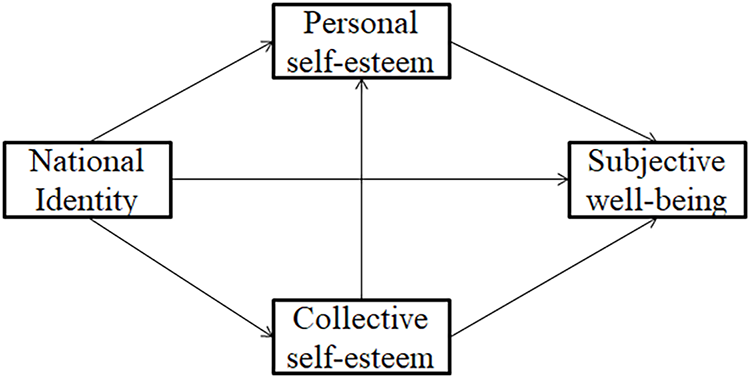
Figure 1: The hypothesized model
We proposed to test three hypotheses regarding college students’ subjective wellbeing:
Hypothesis 1: National identity significantly predicts higher subjective well-being
Hypothesis 2a: Collective mediate the relationship between national identity and subjective well-being for higher subjective wellbeing
Hypothesis 2b: Personal self-esteem mediates the relationship between national identity and subjective well-being for higher subjective wellbeing
Hypothesis 3: Collective self-esteem and Personal self-esteem have a sequential mediation effect on the national identity and subjective well-being relationship for higher subjective wellbeing than by either of personal self-esteem or collective self-esteem alone.
Participants included 298 males and 285 females, with an average age of 19.25 ± 1.85 years. The students’ fields of study spanned a range of disciplines, including Chinese Language and Literature, Education, Civil Engineering, Computer Science, Automation, among others.
The 5 item National Identity Scale (NIS) developed by Li and Liu (2018) includes items such as: “When others criticize China, I feel like they are criticizing me,” “I often feel I’ve lost face because of some problems existing in my country,” which is reverse scored, “I often feel proud of the achievements of our country,” “If I could live again, I would still want to be Chinese,” and “No matter what happens in China, even if I have the opportunity to leave, I would stay in China.” Responses are on a five-point Likert scale ranging from “strongly disagree” (1) to “strongly agree” (5). Higher scores represent a stronger national identity. In this study, the NIS scores yielded a Cronbach’s alpha coefficient of 0.79.
The collective self-esteem scale
The Collective Self-Esteem Scale (CSES, Luhtanen & Crocker, 1992) consists of 16 items. Sample items include, “I feel like a valuable member of the social groups I belong to,” and “My social group is generally perceived positively by others.” The items are on a 7-point Likert scale from 1 (strongly disagree) to 7 (strongly agree). The total CSES score is derived by summing the ratings, including adjustments for reverse-scored items. This scale has been validated and shown to be reliable in its Chinese context (Yu et al., 2016). In this study, the CSES scores achieved Cronbach’s alpha coefficient of 0.82.
The Rosenberg Self-Esteem Scale (Rosenberg, 1965) is a 10 items measure. Sample items are “Overall, I am satisfied with myself” and “Generally, I feel I am a failure.” Participants rate each item using a 4-point Likert scale ranging from 1 (strongly disagree) to 4 (strongly agree). The scale has been effectively translated into Chinese, maintaining strong reliability and validity (Cheung & Lau, 1985). In this study, the RSES scores Cronbach’s alpha coefficient was 0.86.
The subjective well-being scale
The Subjective Well-Being Scale (Diener et al., 2000), comprises three sub-scales measuring life satisfaction, positive affect, and negative affect. Sample items for Satisfaction with Life are “In many ways, my life is close to my ideal” and “I am satisfied with my life,” rated on a 7-point scale from 1 (strongly disagree) to 7 (strongly agree). Scores are calculated by summing the responses, including adjustments for reverse-scored items. The Positive and Negative Affect Scales consist of six and eight items, respectively, each item denoting a specific emotion like “angry,” “ashamed,” or “proud.” Participants rate the frequency of these emotions on a 7-point scale, where 1 indicates “not at all” and 7 means “all the time.” The Chinese version of these measures has been validated and shown to be reliable (Huang et al., 2003; Zhang et al., 2014). In the current study, SWB scores yielded Cronbach’s alpha coefficients of 0.86 for life satisfaction, 0.79 for positive affect, and 0.77 for negative affect.
The research ethics committee of Chengdu University approved the study (Approval No. CDU233117). Participants consented to the study, and they received a compensation of 10 RMB (approximately 1.5 USD) for their involvement in the research.
Initially, we explored the correlations among national identity, collective self-esteem, personal self-esteem, and subjective well-being. We utilized regression analysis with subjective well-being as the dependent variable and national identity as the independent variable. This analysis assessed whether the regression coefficient for national identity on subjective well-being was significantly altered by the inclusion of collective self-esteem and personal self-esteem in the model. This method helped determine whether collective self-esteem and personal self-esteem could mediate the impact of national identity on subjective well-being. Subsequently, structural equation modeling (SEM) was employed, identifying national identity as the independent variable, collective self-esteem and personal self-esteem as mediators, and subjective well-being as the dependent variable. Indirect effects were estimated using bias-corrected bootstrap (5000 resamples). We report completely standardized indirect effects from SEM, which differ from products of regression coefficients due to simultaneous path estimation. Following the two-step method (Anderson & Gerbing, 1988), we began with a confirmatory factor analysis to ascertain the measurement model’s fit to the data before advancing to the structural model analysis.
To evaluate the potential for common method bias, we implemented the Harman single-factor test. Following Podsakoff et al. (2003), exploratory factor analysis of all items identified 11 factors with eigenvalues >1, and the first factor explained 26.09% of total variance (below the 40% threshold), indicating no significant common method bias.
In order to conduct a preliminary exploration of the linear relationship between variables and provide a foundation for structural equation model analysis, a series of regression analyses were performed. The regression analyses conducted involved several models to explore the predictive relationships among the variables detailed. In Model 1, with collective self-esteem as the dependent variable and national identity as the independent variable, the results supported that national identity significantly predicts collective self-esteem (β = 0.53, p < 0.01). Similarly, Model 2 demonstrated that national identity is a significant predictor of personal self-esteem (β = 0.44, p < 0.01). In Model 3, subjective well-being, which combines life satisfaction, positive affect, and reverse-scored negative affect, was set as the dependent variable with national identity again serving as the independent variable. The findings underscored a significant predictive relationship (β = 0.39, p < 0.01). However, Model 4, which incorporated both collective self-esteem and personal self-esteem into the analysis.
Structural Equation Modeling (SEM) To further elucidate the relationships among the variables more clearly, the structural equation modeling was utilized. Initially, confirmatory factor analysis was conducted, establishing a measurement model consisting of four latent variables and 34 observed indicators. This measurement model demonstrated excellent fit: χ²/df = 1.17, RMSEA = 0.02, SRMR = 0.01, and CFI = 0.99. Subsequently, we tested the structural model with competing specifications. Compared to three alternative models: (1) no mediation (χ²/df = 8.92, RMSEA = 0.12, CFI = 0.91); (2) single mediation via collective self-esteem (χ²/df = 7.56, RMSEA = 0.11, CFI = 0.93); (3) single mediation via personal self-esteem (χ²/df = 7.14, RMSEA = 0.10, CFI = 0.94), the hypothesized dual mediation model demonstrated superior fit (χ²/df = 4.85, RMSEA = 0.07, CFI = 0.98).
Subsequently, a structural model analysis was performed in line with the hypotheses. The model posited national identity as the independent variable, collective and personal self-esteem as mediators, and subjective well-being as the dependent variable. Using the maximum likelihood method to estimate and evaluate the model, the results indicated an adequate fit to the sampled data: χ2/df = 5.78, RMSEA = 0.08, SRMR = 0.02, and CFI = 0.98.
Additionally, we conducted a Pearson correlation analysis to explore relationships among national identity, collective self-esteem, personal self-esteem, life satisfaction, positive affect, and negative affect, as shown in Table 1. The analysis revealed significant correlations between each pair of variables examined. Specifically, national identity was positively correlated with collective self-esteem (r = 0.53, p < 0.01), personal self-esteem (r = 0.44, p < 0.01), and subjective well-being (r = 0.39, p < 0.01); collective and personal self-esteem were positively correlated with subjective well-being (r = 0.31, p < 0.01; r = 0.42, p < 0.01) (see Table 1). No high collinearity (all r < 0.6) was observed.
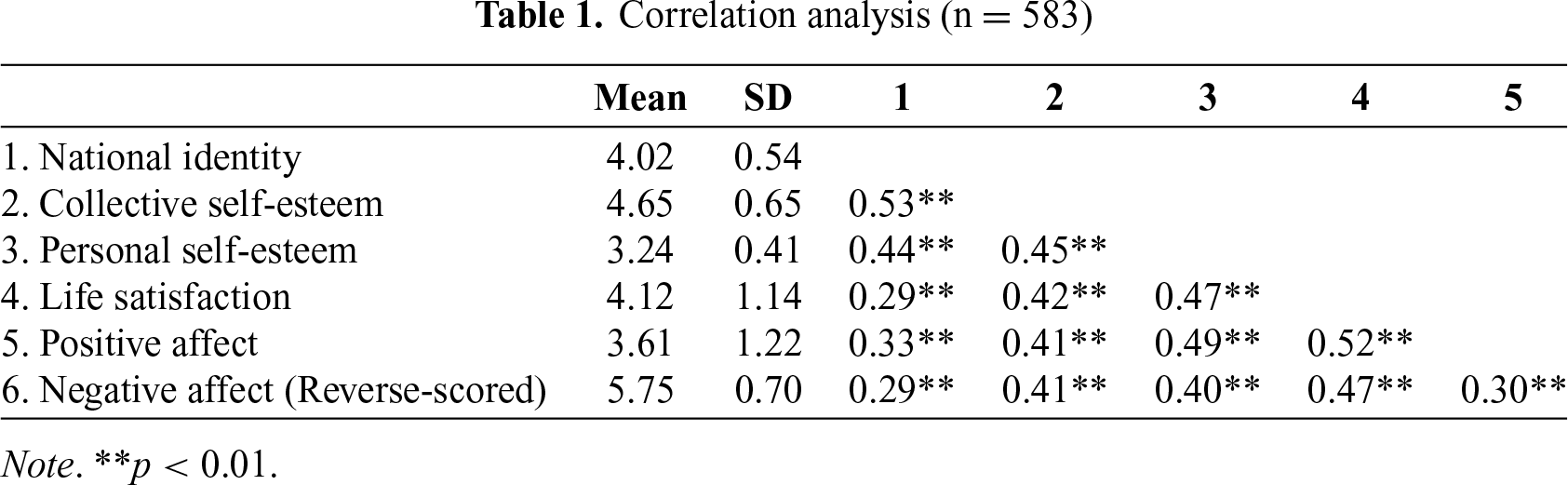
National identity effects on subjective wellbeing
To examine Hypothesis 1, we tested whether national identity directly predicts subjective well-being using regression analysis (Model 3, Table 2). The results indicated that national identity was a significant positive predictor of subjective well-being (β = 0.39, p < 0.01, R² = 0.15), providing initial support for the hypothesis. However, when both collective self-esteem and personal self-esteem were entered into the model simultaneously (Model 4, Table 2), the direct effect of national identity became non-significant (β = 0.04, p = 0.32). This finding suggests that the influence of national identity on subjective well-being may be fully mediated by these two forms of self-esteem. Consistent with this interpretation, structural equation modeling further confirmed that the direct path from national identity to subjective well-being was not significant (β = 0.04, p = 0.39) when the mediators were included. Overall, these results indicate that Hypothesis 1 is supported: national identity significantly predicts subjective well-being, with this relationship fully mediated by collective and personal self-esteem (tested in subsequent models).
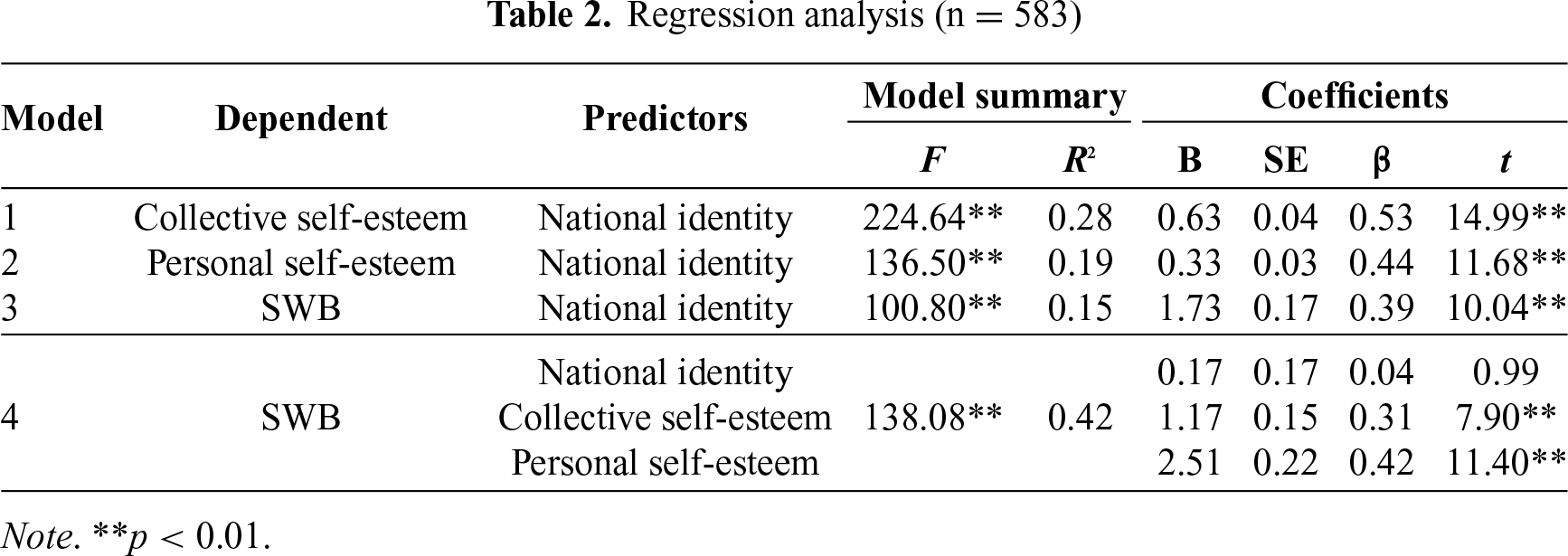
Collective self-esteem mediation
Hypotheses 2a and 2b were first tested separately using simple mediation models. To test Hypothesis 2a, we examined the indirect effect of national identity on subjective well-being through collective self-esteem. Bootstrapping analysis (5000 samples) revealed a significant mediation effect (β = 0.26, 95% CI = [0.18, 0.35]), indicating that collective self-esteem significantly mediates the relationship between national identity and subjective well-being. Since the confidence interval did not include zero, Hypothesis 2a was supported. This finding suggests that national identity enhances subjective well-being by strengthening individuals’ positive evaluation of their national collective membership.
Personal self esteem mediation
To test Hypothesis 2b, we examined the indirect effect through personal self-esteem. Bootstrapping analysis revealed a significant mediation effect (β = 0.27, 95% CI = [0.20, 0.34]), confirming that personal self-esteem mediates the relationship between national identity and subjective well-being. The confidence interval excluding zero provides strong support for Hypothesis 2b. This result indicates that national identity contributes to subjective well-being by enhancing individuals’ overall self-worth and positive self-evaluation.
Collective self-esteem and personal self-esteem chain mediation
Next, we simultaneously incorporated collective self-esteem and personal self-esteem into the structural equation model as mediating variables between national identity and subjective well-being, and we added a path from collective self-esteem to personal self-esteem. The results showed that the effects of national identity on subjective well-being are fully mediated by both types of self-esteem. Bootstrapping analysis (5000 samples) confirmed significant mediation effects through: collective self-esteem (β = 0.15, 95% CI = [0.07, 0.22]), personal self-esteem (β = 0.19, 95% CI = [0.13, 0.27]), and sequential mediation (β = 0.09, 95% CI = [0.04, 0.14]); none of the CIs included 0 in the sequential mediation model. After adjusting for non-significant paths, the refined final model maintained a good fit with the data: χ2/df = 4.85, RMSEA = 0.07, SRMR = 0.02, and CFI = 0.98, as depicted in Figure 2. Those results further verify the complete mediating role of collective self-esteem and personal self-esteem between national identity and subjective well-being, as well as the hypothesized chain mediating effect path of national identity → collective self-esteem → personal self-esteem → subjective well-being. The results strongly support Hypothesis 3.
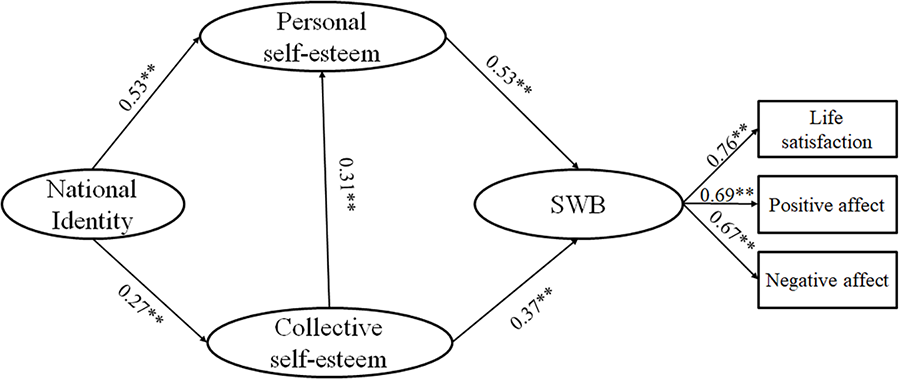
Figure 2: The complete mediating model. Note. **p < 0.01.
Sensitivity analysis was conducted by excluding participants aged >22 (n = 68). The mediation effects remained significant (collective self-esteem: 95% CI = [0.07, 0.23]; personal self-esteem: 95% CI = [0.14, 0.27]; sequential mediation: 95% CI = [0.03, 0.16]), confirming result stability.
Interpretation of key findings
The results confirmed three significant mediation paths: (1) national identity → collective self-esteem → SWB; The significant mediation effect of collective self-esteem (β = 0.26, 95% CI = [0.18, 0.35]) is consistent with previous empirical findings. Chen et al. (2021) found that collective self-esteem mediated the relationship between group identity and mental health outcomes during the COVID-19 pandemic in China, demonstrating how collective evaluation serves as a psychological resource. Similarly, in organizational contexts, Steffens et al. (2017) showed that group identification enhances well-being through the strengthening of collective self-esteem. The present finding extends this mechanism to the national identity domain, confirming that Chinese college students’ positive evaluation of their national collective translates into enhanced life satisfaction and positive affect. This pathway is particularly salient in collectivistic cultures where the “we” identity provides meaning and psychological security (Greenaway et al., 2015). (2) national identity → personal self-esteem → SWB; The mediation through personal self-esteem (β = 0.27, 95% CI = [0.20, 0.34]) aligns with established research on the self-esteem–well-being link. Benish-Weisman et al. (2015) demonstrated in their longitudinal study that national identity precedes the development of self-esteem among adolescents in Germany and Israel, supporting the directional pathway observed in this study. Furthermore, extensive meta-analytic evidence confirms that personal self-esteem is a robust predictor of subjective well-being across cultures (Zell & Johansson, 2025; Orth & Robins, 2014). The current finding suggests that for Chinese college students, national identity serves as a source of personal worth. When individuals feel proud of their nation, they internalize this pride as part of their self-concept, which subsequently enhances their overall life satisfaction and emotional well-being. This mechanism is consistent with Spinner-Halev and Theiss-Morse’s (2003) assertion that national identity constitutes a fundamental source of self-esteem. (3) national identity → collective self-esteem → personal self-esteem → SWB. The sequential mediation pathway (β = 0.09, 95% CI = [0.04, 0.14]) represents a novel contribution and is theoretically grounded in self-categorization theory (Hornsey, 2008), which posits that individuals derive personal worth through positive intergroup comparisons. Jetten et al. (2015) found that collective self-esteem fully mediated the relationship between group identity and personal self-esteem, while Yu et al. (2016) observed similar patterns among Chinese undergraduates. The sequential pattern observed here may be particularly characteristic of collectivistic contexts, where personal self-worth is inherently tied to collective evaluations (Yu et al., 2016). This finding suggests that in Chinese cultural settings, the psychological benefits of national identity accumulate through a dual-layered self-esteem mechanism.
The finding of this study that college students’ national identity prompts them to actively integrate into the large group of the country, enhancing their sense of belonging and identity to the collective and thus enhancing collective self-esteem, which have important theoretical and practical significance. Firstly, this study provides new empirical evidence for the research on the relationship between national identity and subjective well-being and fill the gap in fine-grained mediating mechanisms. Especially in revealing the mediating mechanism of collective self-esteem and personal self-esteem. Prior research on national identity and SWB primarily focused on direct correlations (e.g., Pezzia et al., 2016, on Peruvian samples; Park et al., 2023, on Korean New Zealanders) or single mediating variables (e.g., Chen et al., 2021, which only examined collective self-esteem). This study is the first to validate a dual mediation model (parallel + sequential) in Chinese college students, clarifying the “dual bridge” role of collective and personal self-esteem. It enriches the theoretical chain linking “macro-cultural factors (national identity) → micro-psychological factors (self-esteem) → SWB,” providing a more comprehensive understanding of how national identity shapes well-being.
Secondly, this study further expands the application of social identity theory and self-system theory in this field and expanded the cross-cultural applicability of social identity theory. Social identity theory originated in Western individualistic cultures, where group identity is assumed to directly boost personal self-esteem and SWB (Steffens et al., 2017). However, its applicability in collectivistic cultures remained underexplored. This study’s sequential path (collective self-esteem → personal self-esteem) demonstrates that in collectivistic contexts, the impact of group identity on personal self-esteem requires a “collective recognition transition.” This finding revises the single, direct logic of Western studies and provides new evidence for the cross-cultural adaptation of social identity theory.
Thirdly, through in-depth analysis of the chain mediating path, this study integrating social identity theory and self-system theory, which helps deepen the understanding of how macro social and cultural factors (national identity) affect subjective well-being through micro individual psychological factors (collective and personal self-esteem). In another words, this study integrates two previously isolated theories: social identity theory explains how national identity is converted into collective self-esteem, while self-system theory clarifies how personal self-esteem translates into SWB. This integration overcomes the explanatory limitations of single theories and offers a new “macro-micro linkage” paradigm for future research.
In practice, the research results have important implications for educators and mental health practitioners. Schools and educational institutions can enhance college students’ national identity by carrying out diversified cultural education activities such as national culture festivals and patriotic lectures (Steffens et al., 2021). At the same time, it is should to pay attention to cultivating students’ positive collective sense of honor. The university can launch campus group projects (e.g., community volunteer teams) to build collective honor, create a good campus cultural atmosphere, and promote the improvement of collective self-esteem. In terms of personal self-esteem cultivation, educators can provide one-on-one counseling to help students recognize their strengths and guide students to correctly understand themselves, encourage students to give play to their own advantages, and enhance their sense of self-worth. These measures are helpful to improve college students’ subjective well-being, promote their mental health development (Bücker et al., 2018), and provide practical guidance for cultivating positive, highly socially responsible and happy college students.
Limitations and future directions
This study yields significant insights; nevertheless, it also presents certain limitations that merit consideration. Primarily, the use of convenience sampling challenges the representativeness of the sample. College students in different regions may have significant differences in national identity, self-esteem and subjective well-being due to factors such as regional cultural differences, different levels of economic development and uneven distribution of educational resources. The convenience sampling the current study adopted may lead to a certain selective bias in the sample and cannot fully represent the overall Chinese college students. Future studies will use stratified cluster sampling to include students from eastern/western China and diverse institution types (e.g., vocational colleges, science-focused universities) to enhance generalizability across Chinese college students. Moreover, the cross-sectional nature of this study limits its ability to explore the dynamic evolution of national identity, self-esteem, and subjective well-being among college students over time. Consequently, it does not establish causal relationships among these variables. Although the current study has found that national identity affects collective self-esteem and then affects personal self-esteem and subjective well-being, it is also possible that college students with higher subjective well-being are more likely to form positive national identity and self-esteem. Future research needs to adopt a longitudinal research design to track and investigate the changes in national identity, self-esteem, and subjective well-being of the same group of college students at different time points (Villanueva et al., 2022), so as to clarify the causal relationship between variables and more accurately reveal their dynamic change process. Last but not least, the measurement tools used in this study, such as CSES, RSES and the Subjective Well-Being Scale, although widely validated, may have some cultural and contextual limitations. Future research could explore the development or adaptation of more culturally appropriate measures to enhance the accuracy and validity of the assessment.
This study examined the mechanisms through which national identity relates to subjective well-being among Chinese college students, with a focus on the mediating roles of collective and personal self-esteem. The findings provide evidence for dual mediating pathways: national identity enhances well-being both through collective self-regard and personal self-worth, and these two forms of self-esteem also operate sequentially. The sequential mediation pattern, where collective self-esteem precedes personal self-esteem, offers additional insights into how group-level identification may translate into individual psychological outcomes in collectivistic cultural contexts. By examining both parallel and sequential mediation processes, this research contributes to the literature on national identity and well-being, and extends the application of social identity theory and self-system theory to the Chinese college student population. The findings may inform practices aimed at supporting students’ psychological well-being through identity and self-esteem related interventions.
Acknowledgement: Not applicable.
Funding Statement: The authors received no specific funding for this study.
Author Contributions: The authors confirm contribution to the paper as follows: Conceptualization, Luming Zhao, Yan Zhang and Jiaxi Peng; methodology, Luming Zhao and Jiaxi Zhang; formal analysis, Jiaxi Zhang; data curation, Jiaxi Zhang and Yan Zhang; writing—original draft preparation, Luming Zhao; writing—review and editing, Yan Zhang and Jiaxi Peng; supervision, Yan Zhang and Jiaxi Peng. All authors reviewed the results and approved the final version of the manuscript.
Availability of Data and Materials: The data that support the findings of this study are available from the Corresponding Author, Jiaxi Peng, upon reasonable request.
Ethics Approval: The research ethics committee of Chengdu University approved the study (Approval No. CDU233117).
Informed Consent: All participants consented to the study.
Conflicts of Interest: The authors declare no conflicts of interest to report regarding the present study.
References
Anderson, J. C., & Gerbing, D. W. (1988). Structural equation modeling in practice: A review and recommended two-step approach. Psychological Bulletin, 103(3), 411–423. https://doi.org/10.1037/0033-2909.103.3.411 [Google Scholar] [CrossRef]
Benish-Weisman, M., Daniel, E., Schiefer, D., Möllering, A., & Knafo-Noam, A. (2015). Multiple social identifications and adolescents’ self-esteem. Journal of Adolescence, 44, 21–31. https://doi.org/10.1016/j.adolescence.2015.06.008. [Google Scholar] [PubMed] [CrossRef]
Bücker, S., Nuraydin, S., Simonsmeier, B. A., Schneider, M., & Luhmann, M. (2018). Subjective well-being and academic achievement: A meta-analysis. Journal of Research in Personality, 74, 83–94. https://doi.org/10.1016/j.jrp.2018.02.007 [Google Scholar] [CrossRef]
Chen, H., Zhao, X., Zeng, M., Li, J., Ren, X. et al. (2021). Collective self-esteem and perceived stress among the non-infected general public in China during the 2019 coronavirus pandemic: A multiple mediation model. Personality and Individual Differences, 168, 110308. https://doi.org/10.1016/j.paid.2020.110308. [Google Scholar] [PubMed] [CrossRef]
Cheung, P. C., & Lau, S. (1985). Self-esteem: Its relationship to the family and school social environments among Chinese adolescents. Youth & Society, 16(4), 438–456. https://doi.org/10.1177/0044118X85016004003 [Google Scholar] [CrossRef]
Crocker, J., & Major, B. (1989). Social stigma and self-esteem: The self-protective properties of stigma. Psychological Review, 96(4), 608–630. https://doi.org/10.1037/0033-295X.96.4.608 [Google Scholar] [CrossRef]
Diener, E., Gohm, C. L., Suh, E., & Oishi, S. (2000). Similarity of the relations between marital status and subjective well-being across cultures. Journal of Cross-Cultural Psychology, 31(4), 419–436. https://doi.org/10.1177/00220221000310040 [Google Scholar] [CrossRef]
Diener, E., & Ryan, K. (2009). Subjective well-being: A general overview. South African Journal of Psychology, 39(4), 391–406. https://doi.org/10.1177/008124630903900402 [Google Scholar] [CrossRef]
Ellemers, N., Spears, R., & Doosje, B. (2002). Self and social identity. Annual Review of Psychology, 53(1), 161–186. https://doi.org/10.1146/annurev.psych.53.100901.135228. [Google Scholar] [PubMed] [CrossRef]
Genç, E., & Arslan, G. (2021). Optimism and dispositional hope to promote college students’ subjective well-being in the context of the COVID-19 pandemic. Journal of Positive School Psychology, 5(2), 87–96. https://doi.org/10.47602/jpsp.v5i2.255 [Google Scholar] [CrossRef]
Gong, L. (2007). Ethnic identity and identification with the majority group: Relations with national identity and self-esteem. International Journal of Intercultural Relations, 31(4), 503–523. https://doi.org/10.1016/j.ijintrel.2007.03.002 [Google Scholar] [CrossRef]
Greenaway, K. H., Haslam, S. A., Cruwys, T., Branscombe, N. R., Ysseldyk, R. et al. (2015). From we to me: Group identification enhances perceived personal control with consequences for health and well-being. Journal of Personality and Social Psychology, 109(1), 53–74. https://doi.org/10.1037/pspi0000019. [Google Scholar] [PubMed] [CrossRef]
Grey, I., & Thomas, J. (2019). National identity, implicit in-group evaluation, and psychological well-being among Emirati women. Journal of Cross-Cultural Psychology, 50(2), 220–232. https://doi.org/10.1177/0022022118812131 [Google Scholar] [CrossRef]
Grozdanovska, E. (2016). The relationship between national identity, subjective well-being and meaning in life. Suvremena Psihologija, 19(1), 91–99. https://doi.org/10.21465/2016-SP-191-08 [Google Scholar] [CrossRef]
Gu, T., Cheng, Z., Zhang, Z., Li, C., Ni, Y. et al. (2022). Formation mechanism of contributors’ self-identity based on social identity in online knowledge communities. Frontiers in Psychology, 13, 1046525. https://doi.org/10.3389/fpsyg.2022.1046525. [Google Scholar] [PubMed] [CrossRef]
Hornsey, M. J. (2008). Social identity theory and self-categorization theory: A historical review. Social and Personality Psychology Compass, 2(1), 204–222. https://doi.org/10.1111/j.1751-9004.2007.00066.x [Google Scholar] [CrossRef]
Huang, L., Yang, T., & Li, Z. (2003). Applicability of the positive and negative affect scale in Chinese. Chinese Mental Health Journal, 17(1), 54–56. [Google Scholar]
Huddy, L., & Khatib, N. (2007). American patriotism, national identity, and political involvement. American Journal of Political Science, 51(1), 63–77. [Google Scholar]
Jebb, A. T., Morrison, M., Tay, L., & Diener, E. (2020). Subjective well-being around the world: Trends and predictors across the life span. Psychological Science, 31(3), 293–305. https://doi.org/10.1177/0956797619898826. [Google Scholar] [PubMed] [CrossRef]
Jetten, J., Branscombe, N. R., Haslam, S. A., Haslam, C., Cruwys, T. et al. (2015). Having a lot of a good thing: Multiple important group memberships as a source of self-esteem. PLoS One, 10(5), e0124609. https://doi.org/10.1371/journal.pone.0124609. [Google Scholar] [PubMed] [CrossRef]
Kalin, M., & Sambanis, N. (2018). How to think about social identity. Annual Review of Political Science, 21(1), 239–257. https://doi.org/10.1146/annurev-polisci-042016-024408 [Google Scholar] [CrossRef]
Li, C., & Liu, S. (2018). Factors influencing national identity and intergenerational differences: Based on data from the 2013 China social survey. Social Sciences in China, 4, 132–150. [Google Scholar]
Li, C., & Liu, S. (2020). Factors influencing National Identity and intergenerational differences: Based on data from the 2013 China social survey. Social Sciences in China, 41(2), 65–79. [Google Scholar]
Lucas, T., Barkho, E., Rudolph, C., Zhdanova, L., Fakhouri, M., et al. (2014). Political affiliation, collective self-esteem and perceived employability of immigrants: Inducing national identity polarizes host-nation employers. International Journal of Intercultural Relations, 39(3), 136–151. https://doi.org/10.1016/j.ijintrel.2013.11.001 [Google Scholar] [CrossRef]
Luhtanen, R., & Crocker, J. (1992). A collective self-esteem scale: Self-evaluation of one’s social identity. Personality and Social Psychology Bulletin, 18(3), 302–318. [Google Scholar]
Morrison, M., Tay, L., & Diener, E. (2011). Subjective well-being and national satisfaction: Findings from a worldwide survey. Psychological Science, 22(2), 166–171. https://doi.org/10.1177/0956797610396224. [Google Scholar] [PubMed] [CrossRef]
Ni, J., Wang, M., & Quek, K. (2024). The sources of national pride: Evidence from China and the United States. Nations and Nationalism, 30(4), 547–564. https://doi.org/10.1111/nana.13007 [Google Scholar] [CrossRef]
Orth, U., & Robins, R. W. (2014). The development of self-esteem. Current Directions in Psychological Science, 23(5), 381–387. https://doi.org/10.1177/0963721414547414 [Google Scholar] [CrossRef]
Park, J. J., Park, L. S.-C., & Song, C. (2023). A person-centred approach to ethnic and national identity and its relation to subjective well-being among Korean New Zealanders. Kōtuitui: New Zealand Journal of Social Sciences Online, 18(4), 420–442. https://doi.org/10.1080/1177083x.2023.2199816 [Google Scholar] [CrossRef]
Peng, J., Zhang, J., Xia, Z., Wang, X., Dan, Z. et al. (2021). How does relative deprivation relate to aggression in young male migrant workers? The mediator of self-esteem. Current Psychology. https://doi.org/10.1007/s12144-021-02094-8 [Google Scholar] [CrossRef]
Peng, J., Zhang, J., Zhao, L., Fang, P., & Shao, Y. (2020). Coach-athlete attachment and the subjective well-being of athletes: A multiple-mediation model analysis. International Journal of Environmental Research and Public Health, 17(13), 4675. https://doi.org/10.3390/ijerph17134675. [Google Scholar] [PubMed] [CrossRef]
Pezzia, A. E., Schmitz, M., & de Rojas, J. M. R., (2016). Ideological bases of national identity and their influence on subjective, psychological and social well-being in Perú. Límite: Revista de Filosofía y Psicología, 11(35), 18–32. [Google Scholar]
Podsakoff, P. M., MacKenzie, S. B., Lee, J. Y., & Podsakoff, N. P., (2003). Common method biases in behavioral research: A critical review of the literature and recommended remedies. Journal of Applied Psychology, 88(5), 879–903. https://doi.org/10.1037/0021-9010.88.5.879. [Google Scholar] [PubMed] [CrossRef]
Poudel, A., Gurung, B., & Khanal, G. P. (2020). Perceived social support and psychological wellbeing among Nepalese adolescents: The mediating role of self-esteem. BMC psychology, 8, 43. https://doi.org/10.1186/s40359-020-00409-1. [Google Scholar] [PubMed] [CrossRef]
Rosenberg, M. (1965). Rosenberg self-esteem scale (RSES) [database record]. APA Psyc Tests. https://doi.org/10.1037/t01038-000 [Google Scholar] [CrossRef]
Salice, A. (2020). Self-esteem, social esteem, and pride. Emotion Review, 12(3), 193–205. https://doi.org/10.1177/1754073920930788 [Google Scholar] [CrossRef]
Sharma, S., & Agarwala, S. (2014). Self-esteem and collective self-esteem as predictors of depression. Journal of Behavioural Sciences, 24(1), 21–28. [Google Scholar]
Spinner-Halev, J., & Theiss-Morse, E. (2003). National identity and self-esteem. Perspectives on Politics, 1(3), 515–532. https://doi.org/10.1017/S1537592703000379 [Google Scholar] [CrossRef]
Steffens, N. K., Haslam, S. A., Schuh, S. C., Jetten, J., & van Dick, R. (2017). A meta-analytic review of social identification and health in organizational contexts. Personality and Social Psychology Review, 21(4), 303–335. https://doi.org/10.1177/1088868316656701. [Google Scholar] [PubMed] [CrossRef]
Steffens, N. K., LaRue, C. J., Haslam, C., Walter, Z. C., Cruwys, T. et al. (2021). Social identification-building interventions to improve health: A systematic review and meta-analysis. Health Psychology Review, 15(1), 85–112. https://doi.org/10.1080/17437199.2019.1669481. [Google Scholar] [PubMed] [CrossRef]
Tang, W., & Darr, B. (2012). Chinese nationalism and its political and social origins. Journal of Contemporary China, 21(77), 811–826. https://doi.org/10.1080/10670564.2012.684965 [Google Scholar] [CrossRef]
Trzesniewski, K. H., Donnellan, M. B., & Robins, R. W. (2003). Stability of self-esteem across the life span. Journal of Personality and Social Psychology, 84(1), 205–220. [Google Scholar] [PubMed]
Van Bavel, J. J., Cichocka, A., Capraro, V., Sjåstad, H., Nezlek, J. B., et al. (2022). National identity predicts public health support during a global pandemic. Nature Communications, 13(1), 517. https://doi.org/10.1038/s41467-021-27668-9. [Google Scholar] [PubMed] [CrossRef]
Villanueva, L., Prado-Gascó, V., & Montoya-Castilla, I. (2022). Longitudinal analysis of subjective well-being in preadolescents: The role of emotional intelligence, self-esteem and perceived stress. Journal of Health Psychology, 27(2), 278–291. https://doi.org/10.1177/1359105320951605. [Google Scholar] [PubMed] [CrossRef]
Yang, H., & Zhao, L. (2025). A tragic hero in a borrowed jersey: The grassroots rhetoric and contested identity of Guihua (Naturalized) Athletes in Chinese Football. Communication & Sport, 12(3), 69. https://doi.org/10.1177/21674795251400632 [Google Scholar] [CrossRef]
Yu, X., Zhou, Z., Fan, G., Yu, Y., & Peng, J. (2016). Collective and individual self-esteem mediate the effect of self-construals on subjective well-being of undergraduate students in China. Applied Research in Quality of Life, 11(1), 209–219. https://doi.org/10.1007/s11482-014-9362-y [Google Scholar] [CrossRef]
Zell, E., & Johansson, J. S. (2025). The association of self-esteem with health and well-being: A quantitative synthesis of 40 meta-analyses. Social Psychological and Personality Science, 16(4), 412–421. https://doi.org/10.1177/19485506241229308 [Google Scholar] [CrossRef]
Zeugner-Roth, K. P., Žabkar, V., & Diamantopoulos, A. (2015). Consumer ethnocentrism, national identity, and consumer cosmopolitanism as drivers of consumer behavior: A social identity theory perspective. Journal of International Marketing, 23(2), 25–54. https://doi.org/10.1509/jim.14.0038. [Google Scholar] [PubMed] [CrossRef]
Zhang, J., Miao, D., Sun, Y., Xiao, R., Ren, L. et al. (2014). The impacts of attributional styles and dispositional optimism on subject well-being: A structural equation modelling analysis. Social Indicators Research, 119(2), 757–769. https://doi.org/10.1007/s11205-013-0520-7 [Google Scholar] [CrossRef]
Cite This Article
 Copyright © 2026 The Author(s). Published by Tech Science Press.
This work is licensed under a Creative Commons Attribution 4.0 International License , which permits unrestricted use, distribution, and reproduction in any medium, provided the original work is properly cited.
 Downloads
 Citation Tools
