
 Login
Login Register
 Submit a Paper
 Propose a Special lssue
 Open Access
ARTICLE

Loneliness and mobile phone addiction: The roles of social anxiety and self-presentation
1 School of Educational Science, Gannan Normal University, Ganzhou, 341000, China
2 School of Ethnology and Sociology, Yunnan University, Kunming, 650021, China
3 School of Law and Political Science, Yunnan University of Finance and Economics, Kunming, 650221, China
* Corresponding Author: Kai-Peng Gan. Email:
Journal of Psychology in Africa 2026, 36(1), 45-52. https://doi.org/10.32604/jpa.2026.067701
Received 09 May 2025; Accepted 09 December 2025; Issue published 26 February 2026
 View Full Text
 Download PDF
Abstract
This study examined the relationship between loneliness and mobile phone addiction (MPA), and the mediating roles of social anxiety and self presentation in that relationship. The sample comprised 559 students (male = 250, female = 309, mean age = 20.78 years, SD = 1.13 years). Based on bias-corrected bootstrap method, our indicate loneliness to be associated with MPA of college students. Additionally, social anxiety and self-presentation, respectively, partially mediated the association between loneliness and college students’ MPA. Specifically, as loneliness increased, both social anxiety and self-presentation rose, thereby increasing MPA. Social anxiety and self-presentation also sequentially mediated the relationship between loneliness and MPA among college students, such that greater loneliness heightened social anxiety, which subsequently enhanced self-presentation, ultimately resulting in increased MPA. These findings are consistent with Compensatory Internet Use Theory (CIUT). This study findings suggest for college students counselling and development services should alleviate loneliness and social anxiety through group activities, Cognitive-behavioral Therapy (CBT), and social skills training to foster belonging and reduce students’ reliance on mobile phones.Keywords
Younger age lonely individuals frequently turn to virtual social interactions to offset social anxiety, risking excessive use and addiction. Social anxiety is a critical predictor of mobile phone addiction (MPA) (Zhou et al., 2021; Xiao & Huang, 2022; Wei et al., 2024). Individuals with high social anxiety tend to prefer online communication, which correlates with increased mobile phone dependence and addiction. Furthermore, self-presentation on social networks significantly affects MPA (Bareket-Bojmel et al., 2016). Positive self-presentation obtains favorable social feedback, motivating adolescents to spend more time on social media, potentially leading to problematic use and addiction (Britt, 2015; Zhu & Xiong, 2022). Research also suggests that loneliness intensifies social anxiety levels (Spithoven et al., 2017; Maes et al., 2019; Wu et al., 2024), prompting individuals to actively engage in self-presentation in social media to navigate real-life social challenges (Blachnio et al., 2016; Veissière & Stendel, 2018). Previous studies also underscore the role of loneliness, social anxiety, and self-presentation on the development of mobile phone addiction, highlighting their complex interrelationships. However, few studies have integrated both social anxiety and self-presentation into a single analytical framework to clarify how loneliness ultimately leads to MPA. Specifically, we explored loneliness effects on MPA and how social anxiety and self-presentation may act as mediators in the association between loneliness and MPA.
Loneliness is characterized by lacking in social company in the presence of others (Pittman & Reich, 2016), suggesting difficulties in communication (Alinejad et al., 2022; Ge et al., 2023). People with loneliness experience feelings of emptiness, passivity, inferiority, and low self-efficacy, often leading to emotional disorders including sensitivity, irritability, anxiety, fear, and depression (Zhang et al., 2022). This state is also associated with behaviors such as self-blame, escapism, autism, aggression, excessive mobile phone use, and MPA (Karaoglan Yilmaz et al., 2023; Ge et al., 2023; Wu et al., 2024). In the digital era, loneliness is increasingly linked to MPA (Alinejad et al., 2022; Wu et al., 2024).
Lonely individuals are more likely to excessively use mobile phones and develop addiction to them. According to CIUT, individuals experiencing stressful life events or psychological difficulties are at higher risk of becoming addicted to the Internet or mobile phones. For instance, studies indicate that college students facing academic pressure, separation from parents, or employment stress are particularly vulnerable to loneliness (Musetti et al., 2020). High levels of loneliness often drive individuals to seek solace in portable and versatile mobile phones, compensating for a lack of close social interactions and support (Kim et al., 2017; Li et al., 2021).
Social anxiety is “one of the most prevalent mental health disorders, which is characterized by excessive fear of social networking”. Some scholars further describe social anxiety as encompassing social pain and avoidance, manifesting in cognitive biases, behavioral withdrawal, and negative emotional responses linked to social evaluation (Sang et al., 2018). It is a prevalent mental health condition characterized by excessive anxiety, fear, tension, or distress during interpersonal interactions, often leading individuals to avoid face-to-face communication for fear of negative judgment. Instead, individuals with high social anxiety may prefer online communication, which alleviates real-world tensions, reduces anxiety, and provides a sense of control and comfort (Xiao & Huang, 2022).
Additionally, social anxiety serves as a significant mediator between loneliness and MPA, alongside factors such as lower life satisfaction, negative emotions, and aggressive behaviors (Zhang et al., 2022; Karaoglan Yilmaz et al., 2023). Previous research underscores social anxiety’s role as a key antecedent of MPA in adolescents (Sun et al., 2023), highlighting how loneliness heightens social anxiety, thereby facilitating MPA among college students.
Self-presentation is about impression management (Nichols, 2020). This involves individuals presenting different aspects of themselves through platforms like QQ, WeChat, Facebook, and Twitter, employing selective, idealized, or authentic strategies to project their ideal self-image and maintain social connections (You & Liu, 2022). With mobile phone usage, self-presentation refers to individuals’ general motivation to manage and express their social image on mobile social networking platforms. Research indicates that active self-presentation on social networks correlates with Internet addiction (Bareket-Bojmel et al., 2016) for social feedback with online interactions (Hall et al., 2014). Consequently, individuals who engage in positive self-presentation often focus on presenting favorable aspects of themselves, which can create a sense of expanded positivity. This positive self-experience reinforces mobile phone use, potentially leading to problematic use of mobile social networks and even MPA. Consequently, individuals with high loneliness often use mobile social networks as a means to mitigate their loneliness, with the frequency of use increasing as they accumulate positive experiences. Thus, we expect that loneliness may positively affect self-presentation among college students.
Social anxiety and self-presentation chain mediation
There could be a directional path from social anxiety to self-presentation as self-expression prompting socially anxious individuals to selectively present their idealized selves and share identity experiences online (Manago et al., 2008). For instance, socially anxious individuals seek safer environment for self-presentation by selectively present their idealized selves and sharing identity experiences online to maintain a positive self-image, enhance self-evaluation, and foster positive interpersonal interactions (Michikyan, 2020). Social anxiety may mediate the relationship between loneliness and MPA (Blachnio et al., 2016) with self-presentation driving increased social media use among lonely individuals. To alleviate this anxiety, they tend to engage in self-presentation on social media, seeking positive social interactions. Thus, we expect that social anxiety and self-presentation might sequentially mediate the link between loneliness and MPA.
Theoretical basis. The Compensatory Internet Use Theory (CIUT) suggests that individuals facing psychosocial challenges in real life are more inclined to turn to the Internet or mobile phones to alleviate negative emotions and fulfill unmet social needs (Kardefelt-Winther, 2014). In this theoretical view, loneliness functions as a motivational trigger that propels individuals toward online engagement as an alternative to unsatisfying offline interactions. The resulting overreliance on mobile phone becomes a maladaptive coping strategy. That is, initially aimed at emotional relief but gradually reinforcing compulsive use patterns that may culminate in MPA. Previous studies have consistently shown that loneliness predicts MPA, implying that loneliness significantly contributes to the development of MPA (Mahapatra, 2019; Ma et al., 2020).
China’s Internet user base has expanded to over 1.092 billion the past decade, with mobile phone users making up 99.8% of this figure (China Internet Network Infomation Center (CNNIC), 2023). Notably, approximately 60% of these users are young people. This highlights the crucial role mobile phones play in Chinese society, particularly among young users. However, while mobile phones bring convenience, they also lead to challenges such as excessive use and addiction (Brodersen et al., 2022). The (World Health Organization, 2021) reported that many young people cannot go a day without their smartphones and even sleep with it. MPA has emerged as a global psychological and behavioral issue, with growing evidence indicating that excessive mobile use is associated with loneliness, social anxiety, and impaired well-being across diverse cultural contexts (Zhang et al., 2022; Ran et al., 2022). However, most empirical findings have been derived from Western, individualistic societies, where mobile technology is primarily used for personal autonomy and self-expression. In contrast, in collectivist cultures such as China, mobile social networking often serves interpersonal maintenance and group belonging needs. Examining the mechanisms linking loneliness and MPA in such a context offers valuable cross-cultural insights and tests the universality of established theoretical frameworks.
Goals of the study. This study examined the relationship between loneliness and mobile phone addiction (MPA), and the mediating roles of social anxiety and self presentation in that relationship.
Accordingly, we propose to test a loneliness and MPA model, that would accounts for social anxiety and self-presentation (Figure 1).
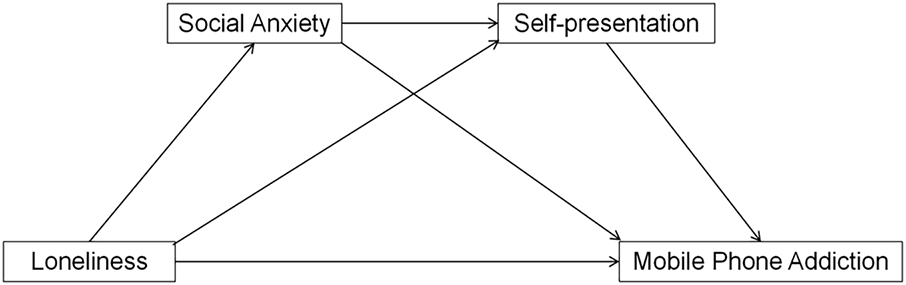
Figure 1: Research model
We tested the following hypotheses among college students:
Hypothesis 1: Loneliness predicts higher MPA.
Hypothesis 2: Social anxiety serves as a mediator in the relationship between loneliness and MPA. That is, when loneliness increases, social anxiety will increase, thereby increasing MPA.
Hypothesis 3: Self-presentation mediates the association between loneliness and MPA. That is, when loneliness increases, self-presentation will increase, thereby increasing MPA.
Hypothesis 4: Social anxiety and self-presentation sequentially mediate the connection between loneliness and MPA. That is, when loneliness increases, individuals experience higher levels of social anxiety, which in turn enhances their tendency toward self-presentation, thereby increasing MPA.
This study involved 559 college students in total. The sample consisted of 250 males (44.7%) and 309 females (55.3%). Regarding daily mobile phone usage, 78.9% of respondents used their phones for less than 1 h per day, 15.4% for 2 to 5 h, 5.2% for 6 to 10 h, and 0.5% for more than 11 h daily. In terms of usage frequency, 39.5% reported very infrequent use, 37.6% infrequent use, 16.5% average use, 5.2% frequent use, and 1.3% very frequent use.
Loneliness was measured with an 8-item scale developed by Hays and Dimatteo (1987). The scale utilizes a 4-point Likert scale with options from 1 (never) to 4 (always). A sample item is “I feel isolated from others”. In this study, the Cronbach’s α for loneliness scores was 0.823.
Mobile phone addiction (MPA) was evaluated using a 10-item scale validated by Kwon et al. (2013). Participants responded on a 5-point Likert scale ranging from 1 (strongly disagree) to 5 (strongly agree). A sample statement is “I feel impatient and fretful when I am not holding my smartphone”. For this study, the Cronbach’s α for scores was 0.832.
Social anxiety was measured with a 7-item scale developed by Liebowitz (1987). The scale uses a 5-point Likert scale from 1 (strongly disagree) to 5 (strongly agree). A sample item is “I was afraid that others did not approve of me”. In this study, the Cronbach’s α for scores was 0.769.
Self-presentation was evaluated with a 3-item scale created by Omar and Subramanian (2013). Participants rated their responses on a 5-point Likert scale, ranging from 1 (strongly disagree) to 5 (strongly agree). A sample item is “I use WeChat because I want to show my personality”. The Cronbach’s α for score for this study was 0.747.
Data analysis was conducted using SPSS 27, AMOS 21, and SPSS Process macro 4.1. Initially, descriptive statistics, including reliability analysis, mean, and standard deviation, were calculated for all variables.
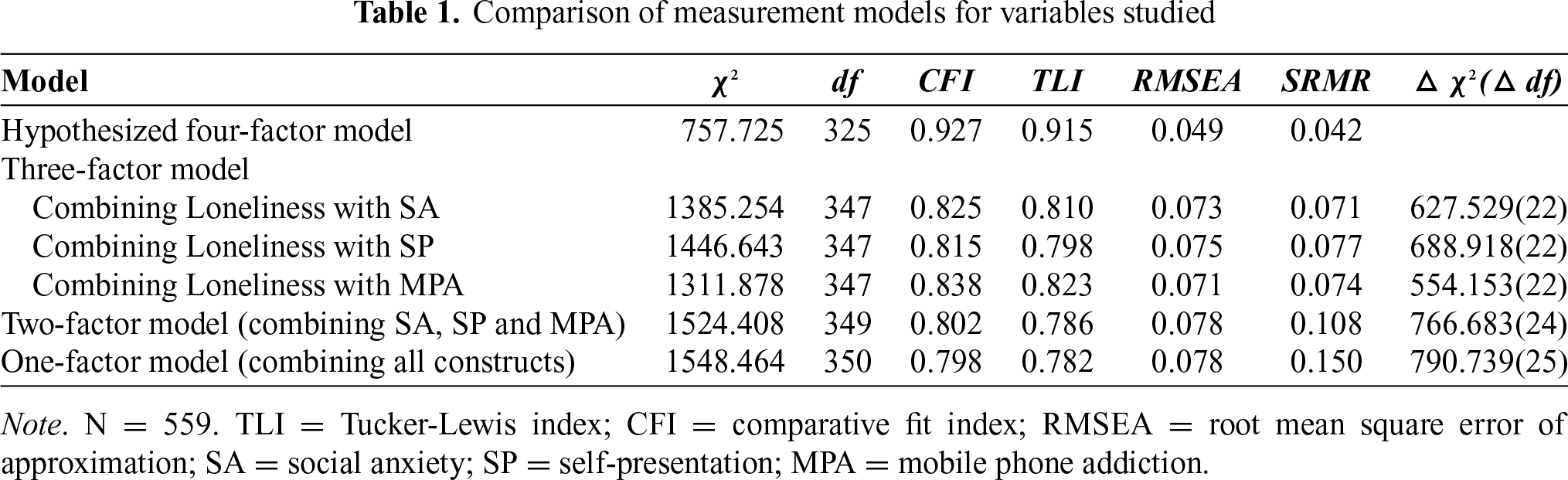
To test the construct validity of our hypothesized four-factor model, a Confirmatory Factor Analysis (CFA) was conducted. Table 1 provides a comparison of different measurement models for the variables studied. The hypothesized four-factor model demonstrated an excellent fit to the data (χ2(df) = 757.725(325), CFI = 0.927, TLI = 0.915, RMSEA = 0.049, and SRMR = 0.042). This model was compared against several alternative models, including three-factor, two-factor, and one-factor models. All alternative models showed significantly worse fit indices compared to the hypothesized four-factor model. For instance, the two-factor model had inferior fit indices (χ2(df) = 1524.408(349), CFI = 0.802, TLI = 0.786, RMSEA = 0.078, and SRMR = 0.108), underscoring the superior validity of the four-factor model. To verify the chain mediation effect of social anxiety and self-presentation between loneliness and MPA, this study utilized the SPSS PROCESS macro for dual mediation testing. Specifically, MODEL 6 was employed for this analysis.
Descriptive statistics and correlation
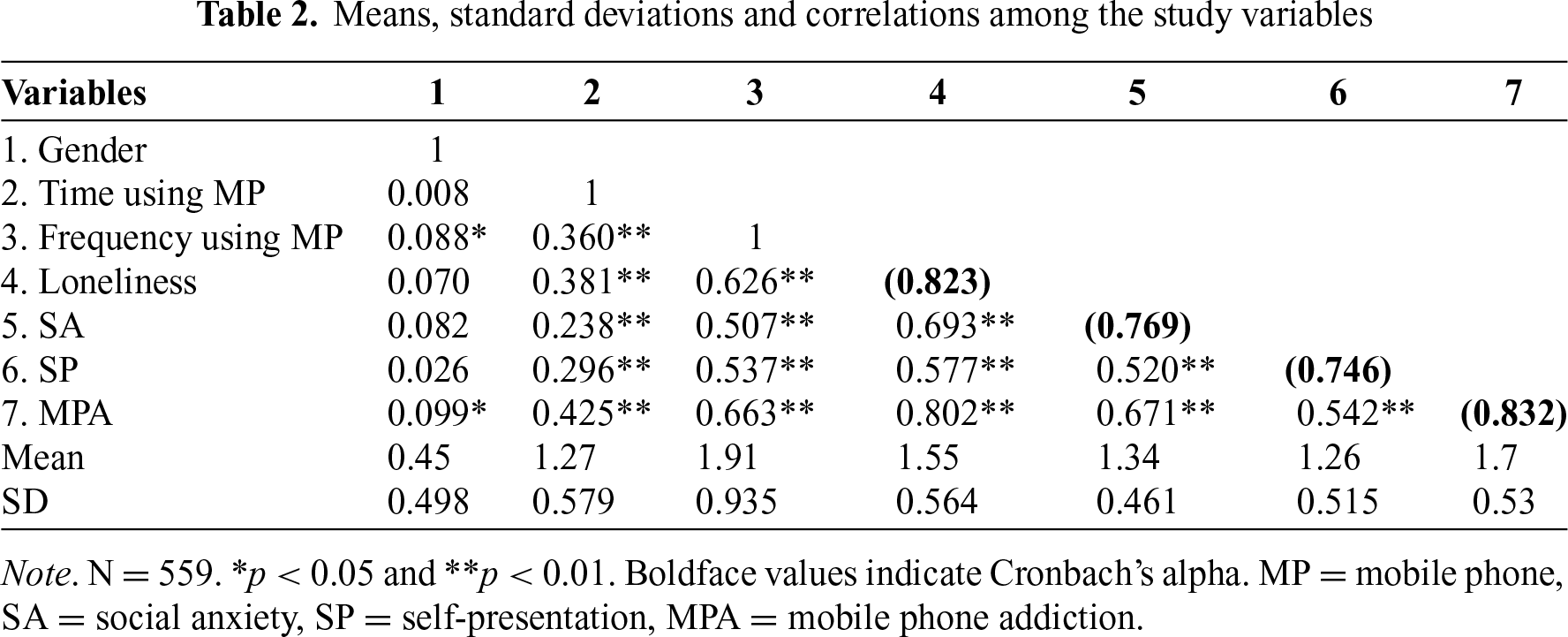
Table 2 presents the means, standard deviations, and correlations among the variables of this study. The findings reveal significant correlations between loneliness and social anxiety (r = 0.693, p < 0.01), self-presentation (r = 0.577, p < 0.01), and MPA (r = 0.802, p < 0.01). Furthermore, social anxiety shows a significant association with both self-presentation (r = 0.520, p < 0.01) and MPA (r = 0.671, p < 0.01). The link between self-presentation and MPA is also significant (r = 0.542, p < 0.01). Cronbach’s alpha values, ranging from 0.746 to 0.832, demonstrate strong internal consistency across all constructs.
The results, as presented in Table 3 and Figure 2 indicate that loneliness significantly influences university students’ MPA (B = 0.754, p < 0.001). The total effect of loneliness on MPA is significant, with the 95% confidence interval not including zero (estimate = 0.131, 95% CI: [0.080, 0.185]). The direct effect of loneliness on MPA is also significant (estimate = 0.437, 95% CI: [0.367, 0.507]). Loneliness was also associated with social anxiety (B = 0.567, p < 0.001), and self-presentation (B = 0.380, p < 0.001), thus supporting Hypothesis 1.
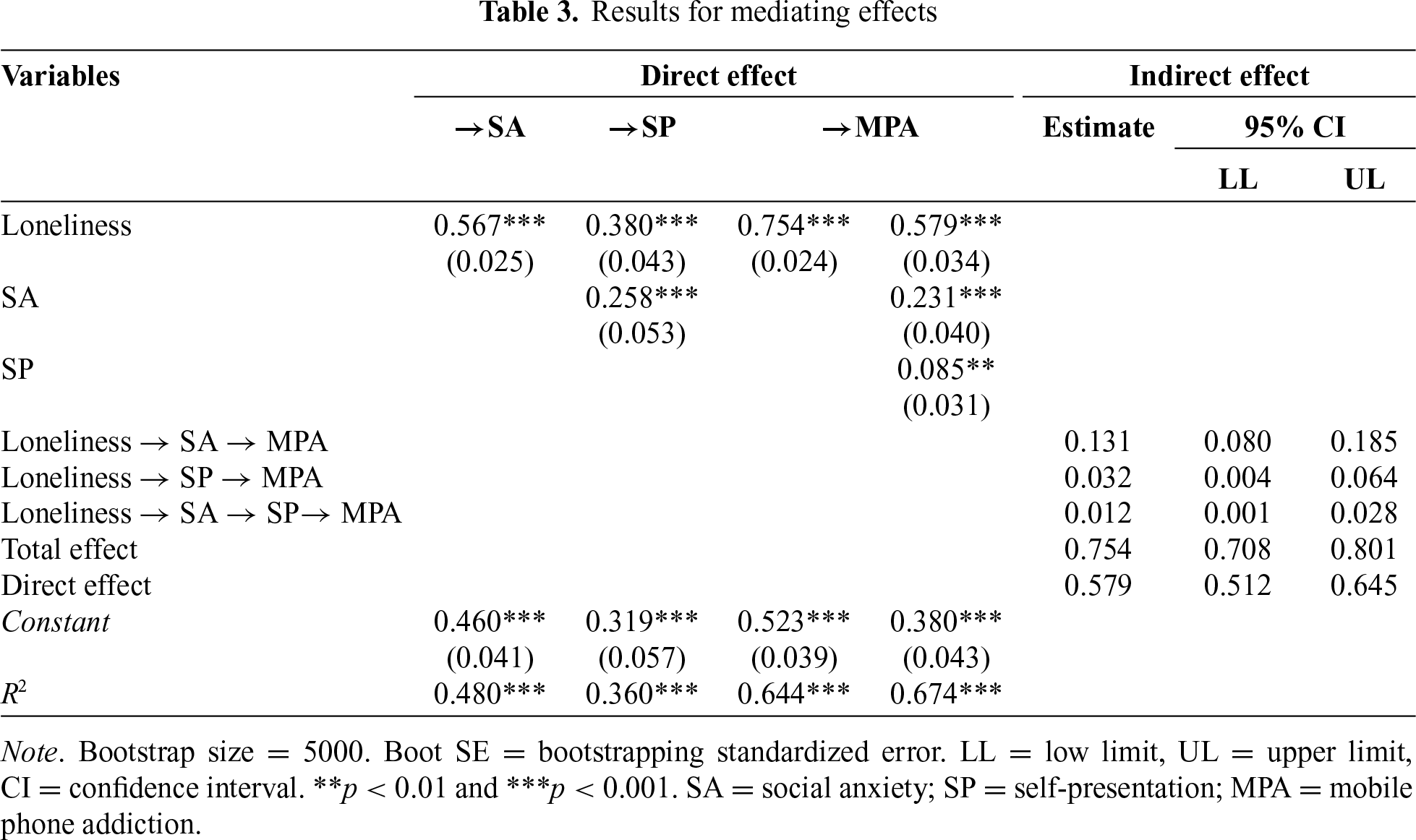
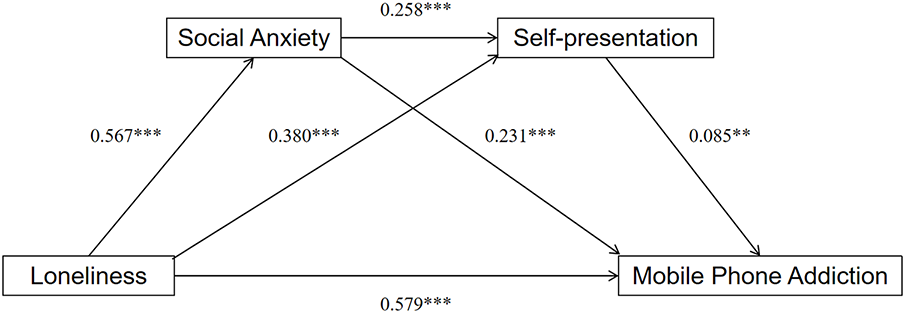
Figure 2: The effect sizes of each path. Note. **p < 0.01 and ***p < 0.001.
Social anxiety and self-presentation mediation. Social anxiety was found to have a significant positive effect on MPA (B = 0.231, p < 0.001). When social anxiety is considered, the effect of loneliness on MPA decreases significantly (B = 0.579, p < 0.001). The indirect effect of loneliness on MPA through social anxiety is also significant, with a 95% confidence interval that does not include zero (estimate = 0.131, 95% CI: [0.080, 0.185]), validating Hypothesis 2. Similarly, self-presentation has a significant positive effect on MPA (B = 0.085, p < 0.001). When self-presentation is accounted for, the impact of loneliness on MPA is significantly reduced (B = 0.579, p < 0.001). The indirect effect of loneliness on MPA through self-presentation is significant, with the 95% confidence interval excluding zero (estimate = 0.032, 95% CI: [0.004, 0.064]), support Hypothesis 3.
Furthermore, the chain mediation effect of loneliness on MPA through social anxiety and self-presentation is 0.012, with the 95% confidence interval not including zero (95% CI: [0.001, 0.028]). Thus, social anxiety and self-presentation function as chain mediators in the relationship between loneliness and MPA among university students. Therefore, Hypothesis 4 was supported.
To examine the impact of loneliness on MPA, the present study analyzed its relationships with social anxiety and self-presentation among college students. Firstly, our results confirm a positive effect of loneliness on MPA among college students. Those experiencing pronounced loneliness tend to exhibit higher MPA, potentially as a means to alleviate negative emotions and fulfill a sense of belonging through virtual social platforms, a phenomenon documented in prior research (Ma et al., 2020). This supports the Compensatory Internet Use Theory proposed by Kardefelt-Winther (2014). Specifically, loneliness may increase individuals’ emotional distress and perceived social isolation, motivating them to turn to mobile phones as a coping strategy for social compensation. Mobile interactions provide a low-risk, easily accessible environment where lonely individuals can seek connection and affirmation, which in turn reinforces their dependence on mobile devices. While previous studies primarily examined this relationship in non-collegiate samples from other countries, our study confirms the direct effect of loneliness on MPA within a Chinese context, thus testing the universality of CIUT (Kardefelt-Winther, 2014) and providing new perspectives for MPA prevention.
Secondly, our results reveal that social anxiety mediates the association between loneliness and MPA. We found that loneliness contributes to heightened social anxiety, which in turn significantly predicts MPA. This suggests that college students with high levels of loneliness may escalate their online activity to deal with social anxiety, aligning with existing literature (Spithoven et al., 2017; Maes et al., 2019). This can be explained by the fact that lonely individuals often experience fear of negative evaluation and discomfort in face-to-face interactions, leading them to seek safer, less threatening social environments online. Mobile phones provide an easily accessible medium where they can communicate without direct social pressure, temporarily alleviating anxiety. However, this avoidance-based coping strategy reinforces their dependence on mobile devices, gradually increasing the risk of addiction.
Thirdly, self-presentation also mediates the association between loneliness and MPA. Our study shows that social anxiety affects MPA indirectly through self-presentation, particularly positive self-presentation, consistent with prior findings (Britt, 2015; Bareket-Bojmel et al., 2016; Michikyan, 2020). Lonely individuals tend to construct idealized versions of themselves online in order to gain recognition and approval. Social media platforms provide a controlled environment where they can manage impressions and reduce the fear of rejection present in real-life interactions. While such behavior temporarily enhances self-esteem and social satisfaction, it also reinforces the need for continuous online engagement, which over time increases the risk of mobile phone addiction.
Lastly, social anxiety and self-presentation serially mediate the relationship between loneliness and MPA. This finding extends previous studies that examined these factors separately (Ran et al., 2022; Sun et al., 2023), revealing how social anxiety and self-presentation mechanisms operate in sequence. Specifically, loneliness heightens social anxiety, which increases individuals’ tendency to engage in online self-presentation as a way to seek validation and social acceptance. Such behavior may temporarily relieve anxiety but simultaneously reinforces dependence on mobile phones for emotional regulation and social interaction. This sequential pathway suggests that loneliness contributes to MPA through a continuous cycle of emotional discomfort and compensatory online behavior, supporting the Compensatory Internet Use Theory (Kardefelt-Winther, 2014).
Implications for Research and Practice
Previous studies have explored various variables related to MPA, such as loneliness (Zhang et al., 2022), social anxiety (Ran et al., 2022), and self-presentation (Bareket-Bojmel et al., 2016). While some models have integrated related variables like aggression, anthropomorphic personality, negative emotions, boredom tendency, self-control, or social attachment as mediators (Li et al., 2021; Zhang et al., 2022; Zwilling, 2022), few have combined social anxiety and self-presentation into a single framework. Our findings demonstrate that loneliness affects mobile phone addiction among college students by way of the mediating roles of social anxiety and self-presentation, elucidating a clear mechanism that is valuable for preventing and guiding interventions against MPA.
Our study significantly offers a new insight into the theory of Compensatory Internet Use. Firstly, our study introduces a novel model of MPA, offering a fresh perspective on its prevention. By integrating emotional (social anxiety) and behavioral (self-presentation) mechanisms into a single sequential framework, which reveals how loneliness may progressively lead to MPA. This approach goes beyond previous research that examined these variables independently, thus offering a more comprehensive theoretical explanation for the psychological process underlying MPA.
Secondly, this study extends existing literature by illuminating how social anxiety and self-presentation mediate the relationship between loneliness and MPA (Ran et al., 2022; Sun et al., 2023; Wei et al., 2024). Although the effect size of the chained indirect effect is small (β = 0.012), it still holds important theoretical significance. Lonely college students are more susceptible to heightened social anxiety, prompting them to engage in self-presentation on social media to receive positive feedback and manage their online image, which inadvertently increases mobile phone use. Furthermore, social anxiety and self-presentation jointly contribute to MPA through a sequential psychological pathway rather than functioning independently. Social anxiety and self-presentation thus serve as critical links between loneliness and MPA, elucidating a complex pathway where loneliness triggers social anxiety, leading to increased online self-presentation and ultimately higher levels of MPA. Therefore, our study clarifies the underlying mechanisms linking loneliness and MPA, enriching the existing literature.
Lastly, our study contributes valuable insights into the linkage between loneliness and MPA in China, confirming loneliness as a significant predictor of MPA.
Our study also provides practical interventions and strategies for its prevention, focusing on the roles of loneliness, social anxiety, and self-presentation. Firstly, reducing loneliness is crucial in mitigating MPA, as loneliness directly increases the risk of MPA. Initiatives promoting social engagement and community building are effective in combating loneliness. Organizing group activities, social events, and peer support groups fosters a sense of belonging and reduces feelings of loneliness (Xie et al., 2025).
Secondly, our study reaffirms the significant mediating effects of social anxiety and self-presentation. Addressing social anxiety through interventions like Cognitive-behavioral Therapy (CBT) helps college students manage their anxiety and reduce reliance on mobile phones for social interaction. Educational institutions can support college students by offering counseling services, workshops, and social skills training to alleviate social anxiety (Wang et al., 2025). Additionally, educators should integrate activities that promote real-world interactions and reduce pressure from idealized online personas into their curriculum.
Thirdly, our findings advocate for creating low MPA-risk environments through policy interventions by university administrators and social media platform developers. Policy makers can introduce regulations that prioritize psychological well-being in platform design, such as implementing features like screen time reminders and promoting mental health tips and real-life social interactions. Social support should be provided to college students at high risk of MPA, focusing on enhancing stress resilience, improving social interactions, and providing mental health resources.
Limitations and Future Research
Of course, the present study has several limitations. First, its cross-sectional design limits the capacity to establish causal relationships. While the study confirmed associations among loneliness, social anxiety, self-presentation, and MPA, it should be cautious to explain our results due to unclear underlying mechanisms. Future studies should utilize longitudinal designs to monitor changes over time, which would enable causal inferences and improve the understanding of evolving relationships. Additionally, the dependence on self-reported measures may introduce biases, such as social desirability and recall errors. Participants might inaccurately report their levels of loneliness, social anxiety, self-presentation behaviors, and mobile phone use. Moreover, the timing of this study’s questionnaire survey may have coincided with the final exam period of some universities, which may have influenced students’ participation and responses due to academic workload or exam-related stress. Future studies should pay attention to the timing of the survey and incorporate objective measures, including actual phone use tracking, to ensure data accuracy. Thirdly, the study collected data exclusively from two universities in Yunnan Province, raising concerns about sample representativeness beyond this specific population. Our results may not generalize to other age groups or cultural backgrounds. Moreover, cultural factors influencing attitudes towards mobile phone use, social anxiety, and self-presentation could have impacted our results. To enhance generalizability, future research should include diverse samples and conduct cross-cultural investigations to explore how cultural norms shape interactions among loneliness, social anxiety, self-presentation, and MPA.
This study demonstrates that loneliness significantly contributes to MPA among college students. Furthermore, by integrating emotional and behavioral mechanisms within the Compensatory Internet Use framework, it elucidates a sequential pathway—loneliness triggers social anxiety, prompting increased online self-presentation and ultimately leading to MPA. The findings advance theoretical understanding of MPA’s psychological processes and offer practical guidance for interventions targeting loneliness and social anxiety. By elucidating these direct and indirect pathways, our research contributes to a more comprehensive understanding of MPA, incorporating social anxiety and self-presentation into research models. Specifically, it highlights how college students with elevated social anxiety might resort to online self-presentation, thereby heightening their dependence on mobile phones and fostering MPA. Promoting real-world social engagement and healthy digital behaviors can effectively mitigate MPA risk among college students.
Acknowledgement: Not applicable.
Funding Statement: The work was supported by The Xingdian Talent Support Program Project (41112080006/015) and Yunnan University Graduate Research Innovation Fund Project (KC-252512463).
Author Contributions: Zhang-Lian Xie: Conceptualization, Writing—original draft, Formal analysis. Zheng-Xin Hu: Methodology, Formal analysis, Writing—original draft. Jun Li & Long-Wei Qin: Conceptualization, Writing—original draft. Kai-Peng Gan: Conceptualization, Writing—original draft, Project administration, Writing—review & editing. All authors reviewed the results and approved the final version of the manuscript.
Availability of Data and Materials: The datasets generated and/or analyzed during the current study are available from the corresponding author upon reasonable request.
Ethics Approval: This study was approved by School of Law and Political Science, Yunnan University of Finance and Economics.
Informed Consent: Informed consent was obtained from all individual participants included in the study.
Conflicts of Interest: The authors declare no conflicts of interest to report regarding the present study.
References
Alinejad, V., Parizad, N., Yarmohammadi, M., & Radfar, M. (2022). Loneliness and academic performance mediates the relationship between fear of missing out and smartphone addiction among Iranian university students. BMC Psychiatry, 22(1), 550. https://doi.org/10.1186/s12888-022-04186-6. [Google Scholar] [PubMed] [CrossRef]
Bareket-Bojmel, L., Moran, S., & Shahar, G. (2016). Strategic self-presentation on Facebook: Personal motives and audience response to online behavior. Computers in Human Behavior, 55(3), 788–795. https://doi.org/10.1016/j.chb.2015.10.033 [Google Scholar] [CrossRef]
Britt, R. K. (2015). Effects of self-presentation and social media use in attainment of beauty ideals. Studies in Media and Communication, 3(1), 79–88. https://doi.org/10.11114/smc.v3i1.705 [Google Scholar] [CrossRef]
Brodersen, K., Hammami, N., & Katapally, T. R. (2022). Smartphone use and mental health among youth: It is time to develop smartphone-specific screen time guidelines. Youth, 2(1), 23–38. https://doi.org/10.3390/youth2010003 [Google Scholar] [CrossRef]
Błachnio, A., Przepiorka, A., Boruch, W., & Bałakier, E. (2016). Self-presentation styles, privacy, and loneliness as predictors of Facebook use in young people. Personality and Individual Differences, 94(1), 26–31. https://doi.org/10.1016/j.paid.2015.12.051 [Google Scholar] [CrossRef]
China Internet Network Infomation Center (CNNIC). (2023). The 53th statistical report on China’s internet development. Retrieved from: https://www.100ec.cn/detail–6630164.html. [Google Scholar]
Ge, M. W., Hu, F. H., Jia, Y. J., Tang, W., Zhang, W. Q. et al. (2023). The relationship between loneliness and Internet or smartphone addiction among adolescents: A systematic review and meta-analysis. Psychological Reports, 128(3), 1429–1451. https://doi.org/10.1177/00332941231180119. [Google Scholar] [PubMed] [CrossRef]
Hall, J. A., Pennington, N., & Lueders, A. (2014). Impression management and formation on Facebook: A lens model approach. New Media & Society, 16(6), 958–982. https://doi.org/10.1177/1461444813495166 [Google Scholar] [CrossRef]
Hays, R. D., & DiMatteo, M. R. (1987). A short-form measure of loneliness. Journal of Personality Assessment, 51(1), 69–81. https://doi.org/10.1207/s15327752jpa5101_6. [Google Scholar] [PubMed] [CrossRef]
Karaoglan Yilmaz, F. G., Avci, U., & Yilmaz, R. (2023). The role of loneliness and aggression on smartphone addiction among university students. Current Psychology, 42(21), 17909–17917. https://doi.org/10.1007/s12144-022-03018-w. [Google Scholar] [PubMed] [CrossRef]
Kardefelt-Winther, D. (2014). A conceptual and methodological critique of Internet addiction research: Towards a model of compensatory Internet use. Computers in Human Behavior, 31(1), 351–354. https://doi.org/10.1016/j.chb.2013.10.059 [Google Scholar] [CrossRef]
Kim, E., Cho, I., & Kim, E. J. (2017). Structural equation model of smartphone addiction based on adult attachment theory: Mediating effects of loneliness and depression. Asian Nursing Research, 11(2), 92–97. https://doi.org/10.1016/j.anr.2017.05.002. [Google Scholar] [PubMed] [CrossRef]
Kwon, M., Kim, D. J., Cho, H., & Yang, S. (2013). The smartphone addiction scale: Development and validation of a short version for adolescents. PLoS One, 8(12), e83558. https://doi.org/10.1371/journal.pone.0083558. [Google Scholar] [PubMed] [CrossRef]
Li, X., Feng, X., Xiao, W., & Zhou, H. (2021). Loneliness and mobile phone addiction among Chinese college students: The mediating roles of boredom proneness and self-control. Psychology Research and Behavior Management, 14, 687–694. https://doi.org/10.2147/PRBM.S315879. [Google Scholar] [PubMed] [CrossRef]
Liebowitz, M. R. (1987). Social phobia. Modern Problems in Pharmacopsychiatry, 22, 141–173. https://doi.org/10.1037/10522-154 [Google Scholar] [CrossRef]
Ma, S., Huang, Y., & Ma, Y. (2020). Childhood maltreatment and mobile phone addiction among Chinese adolescents: Loneliness as a mediator and self-control as a moderator. Frontiers in Psychology, 11, 813. https://doi.org/10.3389/fpsyg.2020.00813. [Google Scholar] [PubMed] [CrossRef]
Maes, M., Nelemans, S. A., Danneel, S., Fernández-Castilla, B., Van den Noortgate, W., et al. (2019). Loneliness and social anxiety across childhood and adolescence: multilevel meta-analyses of cross-sectional and longitudinal associations. Developmental Psychology, 55(7), 1548. https://doi.org/10.1037/dev0000719. [Google Scholar] [PubMed] [CrossRef]
Mahapatra, S. (2019). Smartphone addiction and associated consequences: role of loneliness and self-regulation. Behaviour & Information Technology, 38(8), 833–844. https://doi.org/10.1080/0144929X.2018.1560499 [Google Scholar] [CrossRef]
Manago, A. M., Graham, M. B., Greenfield, P. M., & Salimkhan, G. (2008). Self-presentation and gender on MySpace. Journal of Applied Developmental Psychology, 29(6), 446–458. https://doi.org/10.1016/j.appdev.2008.07.001 [Google Scholar] [CrossRef]
Michikyan, M. (2020). Linking online self-presentation to identity coherence, identity confusion, and social anxiety in emerging adulthood. British Journal of Developmental Psychology, 38(4), 543–565. https://doi.org/10.1111/bjdp.12337. [Google Scholar] [PubMed] [CrossRef]
Musetti, A., Corsano, P., Boursier, V., & Schimmenti, A. (2020). Problematic Internet use in lonely adolescents: The mediating role of detachment from parents. Clinical Neuropsychiatry, 17(1), 3. https://doi.org/10.36131/clinicalnpsych20200101. [Google Scholar] [PubMed] [CrossRef]
Nichols, A. L. (2020). Self-presentation theory/impression management. In: The Wiley encyclopedia of personality and individual differences: Models and theories, pp. 397–400. Hoboken, NJ, USA: John Wiley & Sons, Inc. https://doi.org/10.1002/9781118970843.ch66. [Google Scholar] [CrossRef]
Omar, B., & Subramanian, K. (2013). Addicted to Facebook: Examining the roles of personality characteristics, gratifications sought and Facebook exposure among youths. International Journal on Media & Communications, 1(1), 54–65. https://doi.org/10.5176/2335-6618_1.1.6 [Google Scholar] [CrossRef]
Pittman, M., & Reich, B. (2016). Social media and loneliness: Why an Instagram picture may be worth more than a thousand Twitter words. Computers in Human Behavior, 62(1), 155–167. https://doi.org/10.1016/j.chb.2016.03.084 [Google Scholar] [CrossRef]
Ran, G., Li, J., Zhang, Q., & Niu, X. (2022). The association between social anxiety and mobile phone addiction: A three-level meta-analysis. Computers in Human Behavior, 130(2), 107198. https://doi.org/10.1016/j.chb.2022.107198 [Google Scholar] [CrossRef]
Sang, B., Ding, X., Coplan, R. J., Liu, J., Pan, T., & Feng, X. (2018). Assessment and implications of social avoidance in Chinese early adolescents. The Journal of Early Adolescence, 38(4), 554–573. https://doi.org/10.1177/0272431616678988 [Google Scholar] [CrossRef]
Spithoven, A. W., Bijttebier, P., & Goossens, L. (2017). It is all in their mind: A review on information processing bias in lonely individuals. Clinical Psychology Review, 58, 97–114. https://doi.org/10.1016/j.cpr.2017.10.003. [Google Scholar] [PubMed] [CrossRef]
Sun, R., Li, W., Lu, S., & Gao, Q. (2023). Psychological needs satisfaction and smartphone addiction among Chinese adolescents: The mediating roles of social anxiety and loneliness. Digital Health, 9, 20552076231203915. https://doi.org/10.1177/20552076231203915. [Google Scholar] [PubMed] [CrossRef]
Veissière, S. P., & Stendel, M. (2018). Corrigendum: Hypernatural monitoring: A social rehearsal account of smartphone addiction. Frontiers in Psychology, 9, 1118. https://doi.org/10.3389/fpsyg.2018.01118. [Google Scholar] [PubMed] [CrossRef]
Wang, H., Ji, M., Tu, H., Qi, Y., Wu, S. et al. (2025). College students’ loneliness and mobile phone addiction: Mediating role of mobile phone anthropomorphism and moderating role of interpersonal relationship quality. Frontiers in Psychiatry, 16, 1581421. https://doi.org/10.3389/fpsyt.2025.1581421. [Google Scholar] [PubMed] [CrossRef]
Wei, J., Dang, J., Mi, Y., & Zhou, M. (2024). Mobile phone addiction and social anxiety among Chinese adolescents: Mediating role of interpersonal problems. Anales De Psicología/Annals of Psychology, 40(1), 103–109. https://doi.org/10.6018/analesps.381801 [Google Scholar] [CrossRef]
World Health Organization (2011). Mobile phone use: a growing problem of driver distraction. Retrieved from: https://apps.who.int/iris/handle/10665/44696. [Google Scholar]
Wu, D., Liu, M., Li, D., & Yin, H. (2024). The longitudinal relationship between loneliness and both social anxiety and mobile phone addiction among rural left-behind children: A cross-lagged panel analysis. Journal of Adolescence, 96(5), 969–982. https://doi.org/10.1002/jad.12309. [Google Scholar] [PubMed] [CrossRef]
Xiao, Z., & Huang, J. (2022). The relation between college students’ social anxiety and mobile phone addiction: The mediating role of regulatory emotional self-efficacy and subjective well-being. Frontiers in Psychology, 13, 861527. https://doi.org/10.3389/fpsyg.2022.861527. [Google Scholar] [PubMed] [CrossRef]
Xie, Z. L., Gan, K. P., Li, J., Qin, L. W., & Wu, Y. T. (2025). The impact of loneliness on depression among college students: The mediating role of problematic Internet use and the moderating role of perceived social support. BMC Public Health, 25(1), 2534. https://doi.org/10.1186/s12889-025-23759-0. [Google Scholar] [PubMed] [CrossRef]
You, C., & Liu, Y. (2022). The effect of mindfulness on online self-presentation, pressure, and addiction on social media. Frontiers in Psychology, 13, 1034495. https://doi.org/10.3389/fpsyg.2022.1034495. [Google Scholar] [PubMed] [CrossRef]
Zhang, B., Liang, H., Luo, Y., Peng, Y., Qiu, Z. et al. (2022). Loneliness and mobile phone addiction in Chinese college students: A moderated mediation model. Journal of Psychology in Africa, 32(6), 605–610. https://doi.org/10.1080/14330237.2022.2121474 [Google Scholar] [CrossRef]
Zhou, H. L., Jiang, H. B., Zhang, B., & Liang, H. Y. (2021). Social anxiety, maladaptive cognition, mobile phone addiction, and perceived social support: A moderated mediation model. Journal of Psychology in Africa, 31(3), 248–253. https://doi.org/10.1080/14330237.2021.1927354 [Google Scholar] [CrossRef]
Zhu, X., & Xiong, Z. (2022). Exploring association between social media addiction, fear of missing out, and self-presentation online among university students: A cross-sectional study. Frontiers in Psychiatry, 13, 896762. https://doi.org/10.3389/fpsyt.2022.896762. [Google Scholar] [PubMed] [CrossRef]
Zwilling, M. (2022). The impact of nomophobia, stress, and loneliness on smartphone addiction among young adults during and after the COVID-19 pandemic: An Israeli case analysis. Sustainability, 14(6), 3229. https://doi.org/10.3390/su14063229 [Google Scholar] [CrossRef]
Cite This Article
 Copyright © 2026 The Author(s). Published by Tech Science Press.
This work is licensed under a Creative Commons Attribution 4.0 International License , which permits unrestricted use, distribution, and reproduction in any medium, provided the original work is properly cited.
 Downloads
 Citation Tools
