
 Login
Login Register
 Submit a Paper
 Propose a Special lssue
 Open Access
ARTICLE

Parental involvement and social skills of school-aged children with intellectual disabilities: The role of parenting stress and social support
School of Teacher Education, Heze University, Heze, China
* Corresponding Author: Yuan Yuan. Email:
Journal of Psychology in Africa 2026, 36(1), 79-87. https://doi.org/10.32604/jpa.2026.069939
Received 03 July 2025; Accepted 05 January 2026; Issue published 26 February 2026
 View Full Text
 Download PDF
Abstract
This study investigated the effects of parental involvement, parenting stress, and social support on the social skills of school-aged children (6–18 years old) with intellectual disabilities (ID). Data were collected from 280 Chinese parents (mothers = 70.0%, fathers = 30.0%) of children with ID through purposive sampling and analyzed using partial least squares structural equation modeling (PLS-SEM). The results indicated that parental involvement not only directly enhanced children’s social skills but also indirectly improved them by alleviating parenting stress, which acted as a partial mediator. Contrary to the stress-buffering hypothesis, social support did not moderate the negative impact of parenting stress on social skills. Theoretically, this study contributes by validating ecological systems theory through a shift in focus from individual deficits to family systems, while also challenging the conventional view of stress-buffering theory. Accordingly, parent-support programs should integrate practical involvement training with systematic stress reduction and provide tailored assistance such as behavior-management training and respite care.Keywords
Among the factors that promote children’s social skills development, parental involvement (PI) is widely regarded as playing a key role. Specifically, PI refers to the time, energy, and resources that parents invest in their children’s education and development (Shi et al., 2024). It manifests as emotional support and shared activities within the family, as well as collaborative participation at school and community levels (Oranga et al., 2022). Empirical evidence indicates that higher-quality PI is associated with greater social self-efficacy and better behavioral adjustment in children (Yue et al., 2024). Moreover, PI may foster social skills by providing structured practice opportunities and supportive interactional contexts (Gera et al., 2024). However, for families of children with intellectual disabilities (ID), the benefits of PI may be constrained by high levels of parenting stress (PS), a factor that demands closer examination.
Social skills, a core component of individuals’ social adaptability, refer to the ability to interact with others and to establish and maintain relationships in social contexts (Gresham, 2016). Strong social skills foster the acquisition of appropriate social behaviors and promote social cognition as well as high-quality peer relationships (Nóblega et al., 2024). The development of these skills is particularly crucial for children with ID, as they are fundamental to achieving greater independence and improving quality of life. However, children with ID face greater challenges in developing social skills due to substantial deficits in cognitive functioning and adaptive behavior. Compared to typically developing peers, children with ID are more likely to be socially withdrawn and to experience social difficulties. These challenges can delay their transition to adulthood and adversely affect their independence and quality of life (Sigafoos et al., 2017). Identifying family factors that support social skills development in children with ID is therefore important for both theory and practice.
This study is guided by an integration of ecological systems theory and stress-buffering theory. Ecological systems theory emphasizes that child development is influenced by multi-level systems (Bronfenbrenner, 1979), with the family as a core microsystem where internal processes like PI and parental psychological states jointly shape developmental trajectories. Stress-buffering theory posits that social support (SSU) protects against the negative impact of high stress on parenting and family functioning (Cohen & Wills, 1985; Aldosiry, 2025). Integrating these perspectives provides a comprehensive framework: ecological systems theory outlines the contextual layers within which development occurs, while stress-buffering theory specifies a key protective mechanism within this context. This integrated framework positions three key elements: PI as a core family process, PS as an indicator of family strain, and SSU as a protective resource that buffers the microsystem from external stress.
Parental involvement and social skills
Cross-cultural studies have consistently shown that PI significantly enhances the social skills of typically developing children (Dekker & Kamerling, 2017; LaRosa et al., 2023). This beneficial effect is also evident in children with various special needs, such as physical disabilities (Bennett & Hay, 2007) and hearing impairments (Calderon, 2000). Recent evidence confirms this relationship also extends to children with intellectual disabilities (Zhang et al., 2024). Cognitive limitations and difficulties with generalization in children with ID necessitate a different focus from parents, often shifting from academics to daily living and social adaptation skills (Lee & Joo, 2020). As the social learning of children with ID heavily relies on structured parent-child interactions (Singer, 2006), high-quality PI provides essential opportunities for social skill development through modeling, practice, and reinforcement within supportive family environments.
Parenting stress as a mediator
The parenting demands are particularly acute for families of children with ID, who generally experience higher levels of PS. Studies show that approximately one-third of parents of children with ID reach clinically significant levels of stress, and 6.7% report severe psychological distress (Devi & Lestari, 2024). Chronic stress stems from multiple sources, including lifelong caregiving responsibilities, uncertainty about the child’s future, daily communication demands, and behavior management challenges (Hooper et al., 2022). This elevated stress level creates a concerning cycle that can undermine family functioning and child development. Crucially, PI itself may be a powerful tool to break this cycle.
Research suggests that high-quality PI significantly reduces PS (Wang et al., 2020), with longitudinal studies demonstrating that PI predicts subsequent declines in stress levels (Goodrum et al., 2022). This stress reduction is particularly important because persistent high PS undermines positive parenting practices and disrupts parent-child interactions. This, in turn, impedes the development of critical social competencies, including emotion regulation, cooperation, and empathy (Lee & Joo, 2020; Kim & Lee, 2021). Early or persistent exposure to high PS constitutes a significant risk factor for impaired social skills development (Crum & Moreland, 2017; Wang et al., 2022; Xu et al., 2024). These consistent findings suggest that PS may serve as a key mechanism through which PI influences children’s social skills.
Social support (SSU) refers to the emotional, informational, and instrumental assistance derived from social networks (Zimet et al., 1988). Support networks not only directly reduce PS and improve caregiver well-being (Duvdevany & Abboud, 2003) but also help parents maintain positive parenting behaviors under stressful conditions. As a distal protective factor, SSU establishes external supportive networks that synergize with proximal family resources to prevent parental emotional burnout (Ren & Pope Edwards, 2015; Yan et al., 2022; Xu et al., 2024). This creates a protective barrier that shields parent-child interactions from stress disruption (Cohen & Wills, 1985), thereby preserving the quality of these critical interactions even in challenging circumstances.
Empirical evidence supports this stress-buffering function. Park and Lee (2022) demonstrated that SSU significantly weakens the relationship between economic stress and negative parenting behaviors. Similarly, Hooper et al. (2022) found that adequate social support can counteract the detrimental effects of stress, with high support producing synergistic benefits for children’s social-emotional development even under stressful conditions. These findings indicate that SSU may be particularly crucial for families of children with ID (Islam, 2020), where caregivers typically experience elevated and sustained stress levels, and where maintaining quality parent-child interactions is essential for children’s social development.
Based on the theoretical basis and empirical evidence reviewed, this study proposes a moderated mediation model to examine the mechanisms through which PI, PS, and SSU jointly influence social skills development in children with ID (see Figure 1 for the research model). Specifically, the study aims to test the following hypotheses:
H1: Parental involvement positively predicts social skills in children with ID.
H2: Parental involvement negatively predicts parenting stress.
H3: Parenting stress negatively predicts social skills in children with ID.
H4: Parenting stress mediates the relationship between parental involvement and social skills.
H5: Social support moderates the relationship between parenting stress and the social skills of children with ID, such that the negative association is weaker at higher levels of social support.
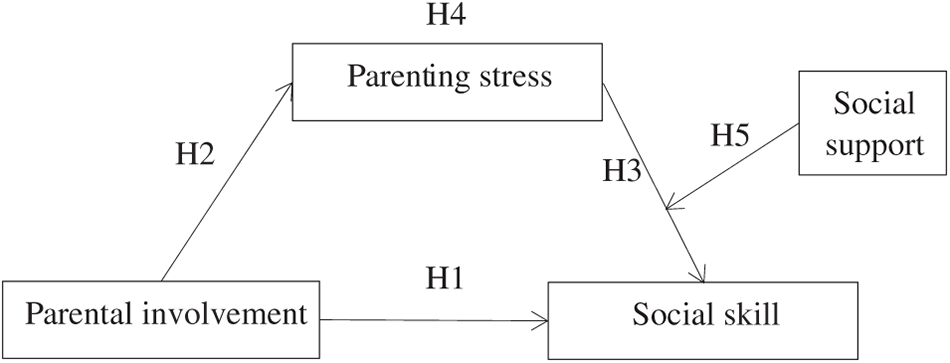
Figure 1: The research model
This study was conducted in special education schools in Shandong Province, China. Researchers obtained institutional permission from school administrators. Purposive sampling was used to recruit parents of children with ID from special education settings, owing to the impracticality of random sampling for this hard-to-reach population given issues of access and ethics. All participating schools served school-aged children with nationally recognized disability certificates who had been formally diagnosed with ID by qualified professionals.
Parents were included if they: (1) had lived with the child for at least three months and understood the child’s daily behavior; (2) could understand and complete the questionnaire; and (3) understood the study’s purpose and participated voluntarily. Parents with cognitive or psychiatric disorders affecting questionnaire responses were excluded.
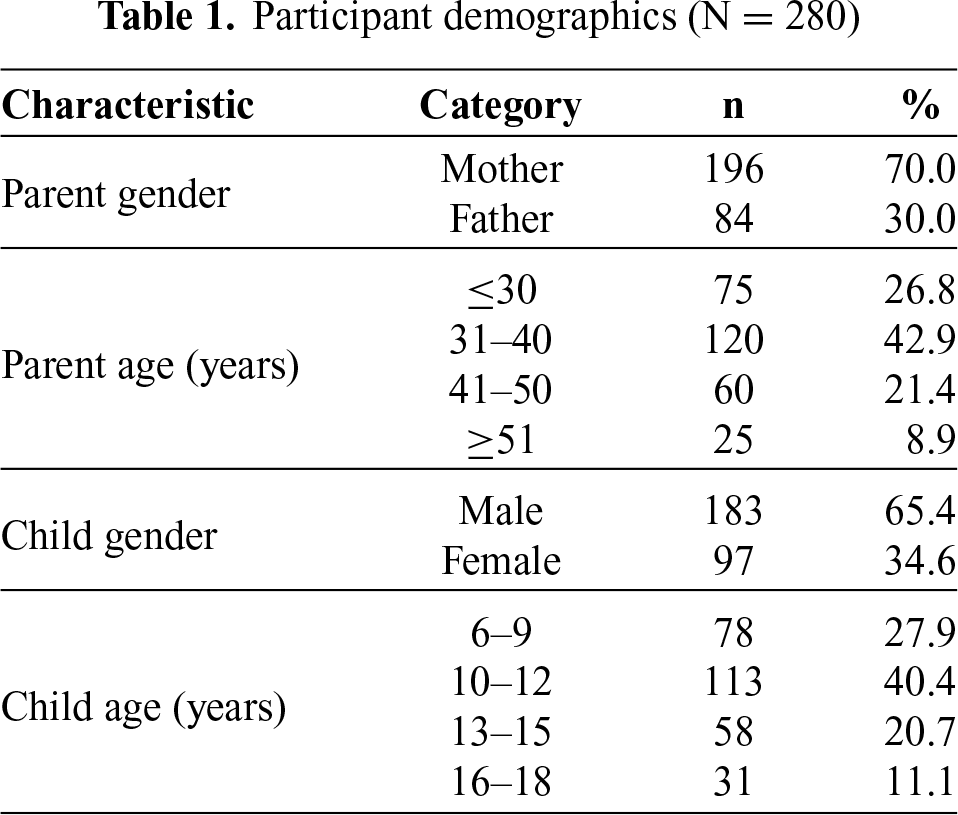
A total of 305 parents were recruited and received questionnaires. Twenty-five returned invalid or incomplete responses, while 280 provided valid questionnaires, yielding a 91.8% response rate. Table 1 presents participant demographics.
Social responsiveness scale-short form-18 (SRS-SF-18)
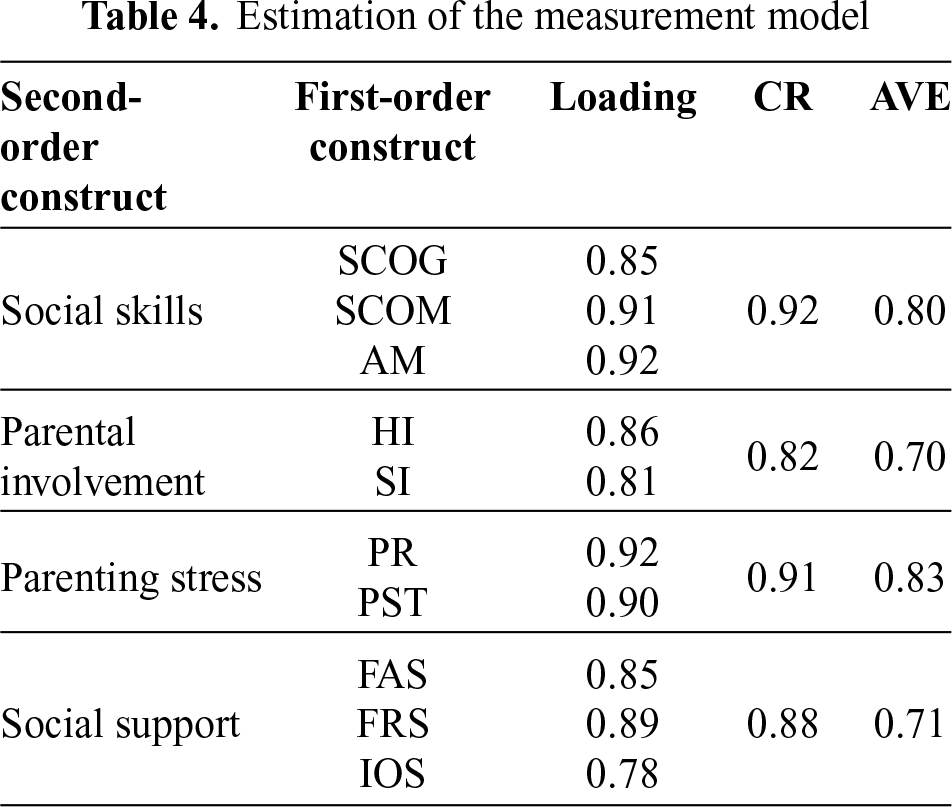
Social skills were assessed using the 18-item Social Responsiveness Scale-Short Form (Román et al., 2013), derived from the original 65-item SRS-SF (Constantino et al., 2003). Chen et al. (2019) adapted the SRS-SF-18 for Chinese populations. The scale covers three dimensions: social cognition (5 items), social communication (7 items), and autistic mannerisms (6 items). Each item is rated on a 4-point Likert scale ranging from 0 (never) to 3 (always), with higher scores indicating poorer social skills. Example item: “Is slow or awkward in turn-taking interactions with peers.” The total social skills score was calculated by summing the three subdimension scores. In this study, the SRS-SF-18 demonstrated excellent composite reliability (CR = 0.92) and average variance extracted (AVE = 0.80). These values exceeded the recommended thresholds (CR > 0.7, AVE > 0.5), indicating good convergent validity.
Parental involvement questionnaire (PIQ)
This study used the Parental Involvement Questionnaire revised by Benson (2015). It contains 15 items across two dimensions: home-based involvement (7 items) and school-based involvement (8 items). Items were rated on a 5-point scale ranging from 1 (never) to 5 (always), with higher scores indicating greater involvement. Example item: “I take the time to train and improve my child’s language and communication skills.” The total PI score was calculated by summing the two subdimension scores. The PIQ demonstrated good reliability and validity in this study (CR = 0.82, AVE = 0.70).
Parenting stress was assessed using the Parental Stress Scale developed by Berry and Jones (1995), and adapted for Chinese populations by Leung and Tsang (2010). The PSS comprises two dimensions: parental reward (8 items) and parental stressor (10 items). Items are rated on a 5-point Likert scale ranging from 1 (strongly disagree) to 5 (strongly agree), with higher scores indicating higher parenting stress. Example item: “The major source of stress in my life is my child.” The total parental stress score was calculated by summing the two subdimension scores. In this study, the scale showed acceptable reliability and structural validity (CR = 0.91, AVE = 0.83).
Multidimensional scale of perceived social support (MSPSS)
The Multidimensional Scale of Perceived Social Support, originally developed by Zimet et al. (1988), has demonstrated robust psychometric properties in China (Yang et al., 2024). The MSPSS contains 12 items in three dimensions: family support (4 items), friend support (4 items), and important others support (4 items). The scale uses a 7-point Likert scale, with 1 representing “strongly disagree” and 7 representing “strongly agree”. Higher scores indicate higher perceived SSU. Example item: “I can talk about my problems with my family.” The total SSU score was calculated by summing the three subdimension scores. In this study, the MSPSS demonstrated good reliability (CR = 0.88, AVE = 0.71).
This study received ethical approval from the Ethics Review Committee of Heze University (Approval No.: 2025031202) and was conducted in accordance with the Declaration of Helsinki. School administrators provided institutional consent prior to data collection. Parents received comprehensive information about the study’s purpose, procedures, and potential risks and benefits. They were informed of their right to withdraw at any time without penalty. Written informed consent was then obtained from all participants.
Data collection took place from April to May 2025 in quiet, private classroom settings within participating special education schools. Research assistants received standardized training on ethical protocols and questionnaire administration. They then conducted individual face-to-face surveys with participants. Each data collection session lasted approximately 20 min. Research assistants were available to provide clarification while maintaining procedural consistency. Participants received a small gift (e.g., stationery) after completing the questionnaires.
All questionnaires were assigned anonymous identification codes to protect participant confidentiality. Collected data were stored securely in password-protected electronic files. Access was restricted to authorized research team members only, ensuring compliance with institutional data protection policies.
Descriptive statistics and correlation analyses were conducted using SPSS (version 30.0). Structural equation modeling was performed using SmartPLS (version 4.0) to address multicollinearity, assess reliability and validity, and test hypotheses. SmartPLS was chosen due to its effectiveness in handling complex constructs with reflective indicators (Hair et al., 2011). All constructs in this study were measured using reflective indicators. The measurement model was evaluated against the criteria of composite reliability (CR > 0.7), convergent validity (AVE > 0.5), and discriminant validity (Fornell-Larcker criteria).
The higher-order construct processing used the two-stage approach proposed by Sarstedt et al. (2019). Specifically, in the first stage, lower-order constructs were assessed, and their scores retained. These scores were then incorporated into the model as indicators of higher-order constructs in the second stage. Following Hair et al. (2024), the measurement model was examined before proceeding to the analysis of the structural model.
All hypothesis tests were conducted at a significance level of α = 0.05. Standard errors and significance levels for parameter estimates were calculated using Bootstrap sampling with 10,000 repetitions. Mediating effects were assessed using 95% confidence intervals via Bootstrap. Effects were considered significant if the interval excluded zero. The strength of mediating effects was evaluated by reporting Variance Accounted For (VAF).
The data in this study were collected through parent self-assessment, which raises the possibility of common method bias. We evaluated this using variance inflation factor (VIF) tests with a conservative threshold of VIF < 3.3, as suggested by Kock (2015). As presented in Table 2, all VIF values ranged from 1.20 to 2.86, well below the threshold. This clearly demonstrates that common method bias is not a concern in this study.
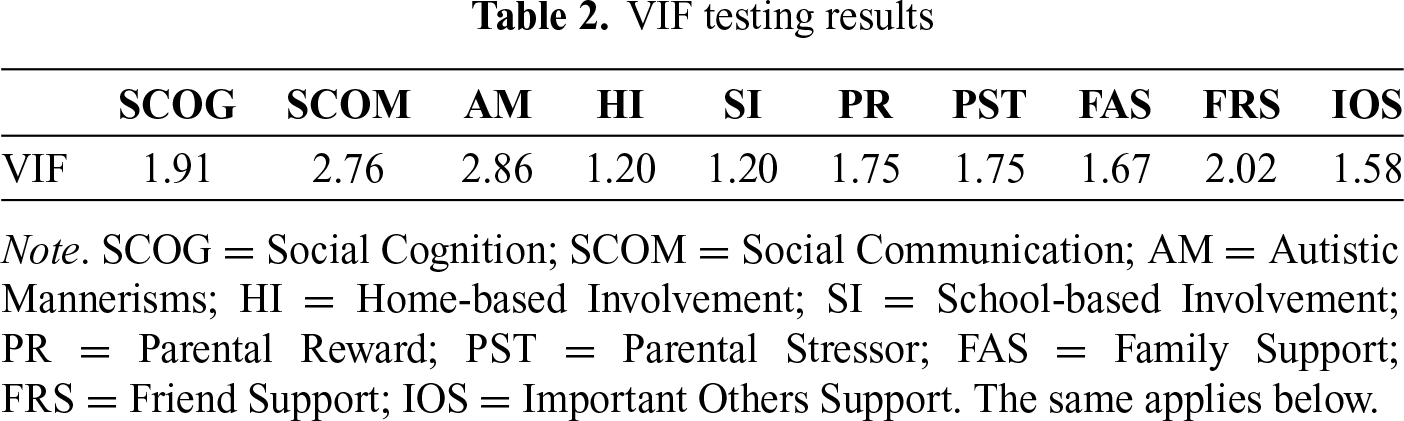
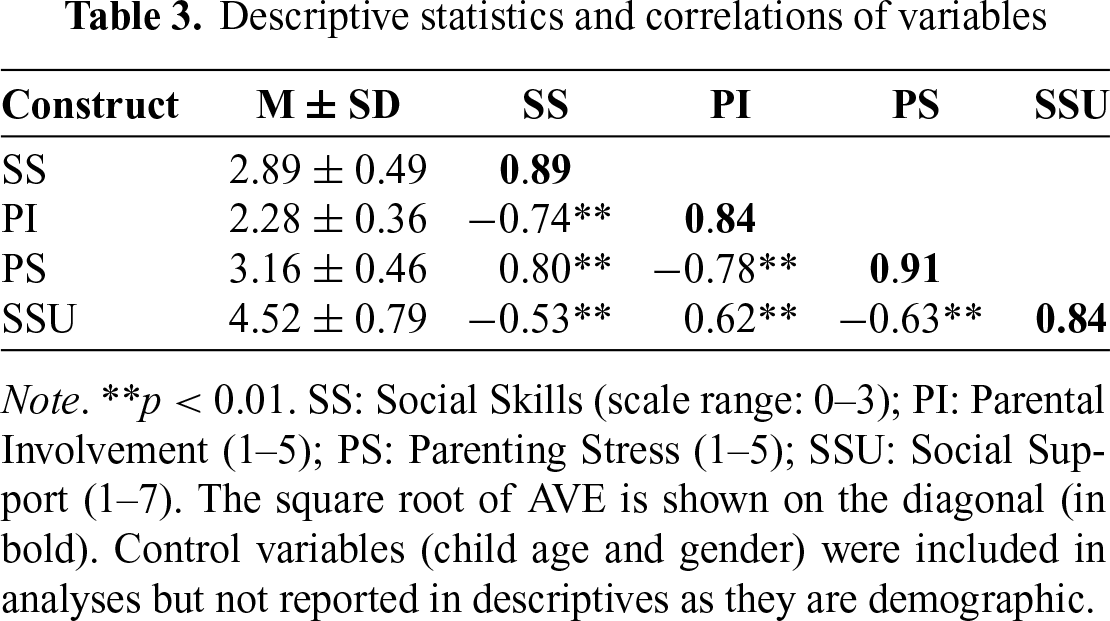
Table 3 presents the means, standard deviations, and correlations among the variables. Note that the SS scale is reverse-coded (higher scores indicate poorer social skills). Thus, negative correlations with SS represent positive relationships with actual social skills, and vice versa. The analysis revealed that social skills scores were significantly correlated with PI (r = −0.74, p < 0.01) and with PS (r = 0.80, p < 0.01). PS was negatively related to PI (r = −0.78, p < 0.01) and to SSU (r = −0.63, p < 0.01). Additionally, social skills were positively correlated with SSU (r = −0.53, p < 0.01). This preliminary analysis sets the stage for more advanced model assessments.
We assessed the measurement models for reliability, convergent validity, and discriminant validity. Hair et al. (2019) suggest acceptable thresholds. Specifically, indicator loadings and CR should be 0.7 or higher. AVE should be 0.5 or higher.
Table 4 shows that all indicator loadings and CR values exceeded 0.7. All AVE values met or surpassed 0.5. These results support good reliability and convergent validity.
For discriminant validity, the square roots of AVEs (0.84 to 0.91) are shown in bold on Table 3’s diagonal. These values are higher than the maximum correlation each construct has with the others. This satisfies the Fornell and Larcker (1981) criterion. Together, these results show a satisfactory measurement model.
First-order constructs (e.g., social cognition, family support) loaded significantly onto their respective second-order constructs. This validates the hierarchical structure. Given the satisfactory validation of the hierarchical structure, the subsequent structural model assessment focuses on relationships among higher-order constructs to test our main hypotheses.
After validating the measurement model, we assessed the structural model to test the hypothesized paths. We evaluated explanatory power using R2 (variance explained) and
R2 showed that PI, PS, SSU, and control variables explained 68% of the variance in children’s social skills (Figure 2). This indicates moderate to strong explanatory capacity (Hair et al., 2024).
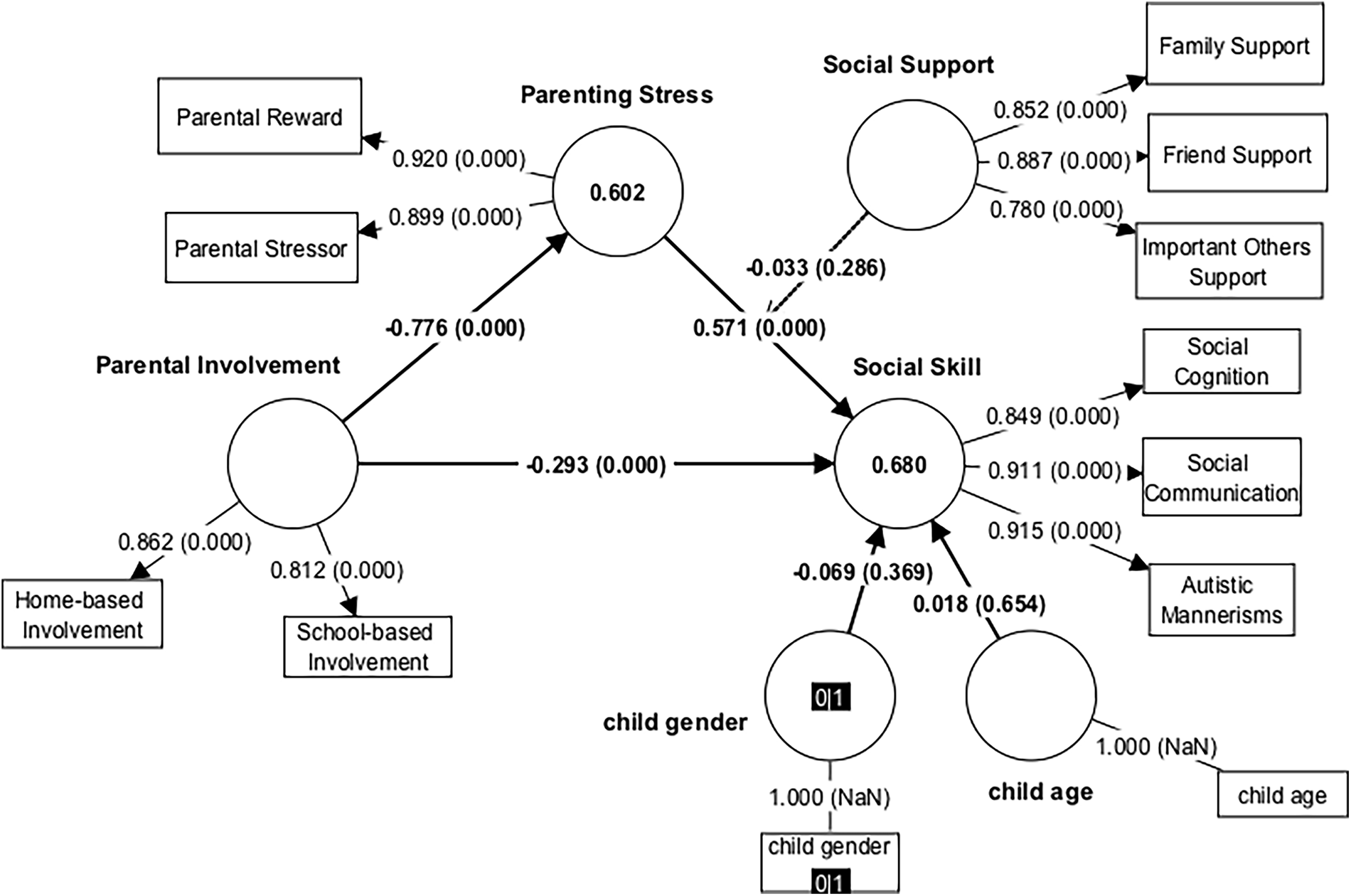
Figure 2: Path analysis of the model
For
Q2 values for all endogenous variables exceeded zero. This confirms predictive relevance (Hair et al., 2011).
With the model’s explanatory and predictive power confirmed, we now examine the specific path coefficients and mediation/moderation effects to test the hypotheses (see Figure 2 and Table 5). Figure 2 illustrates relationships between second-order constructs and their first-order indicators. Path analysis tests the strength and direction of the hypotheses at the higher-order level. Control variables were included to isolate effects. Neither child age (β = 0.02, p = 0.65) nor gender (β = −0.07, p = 0.37) had a significant impact on social skills.
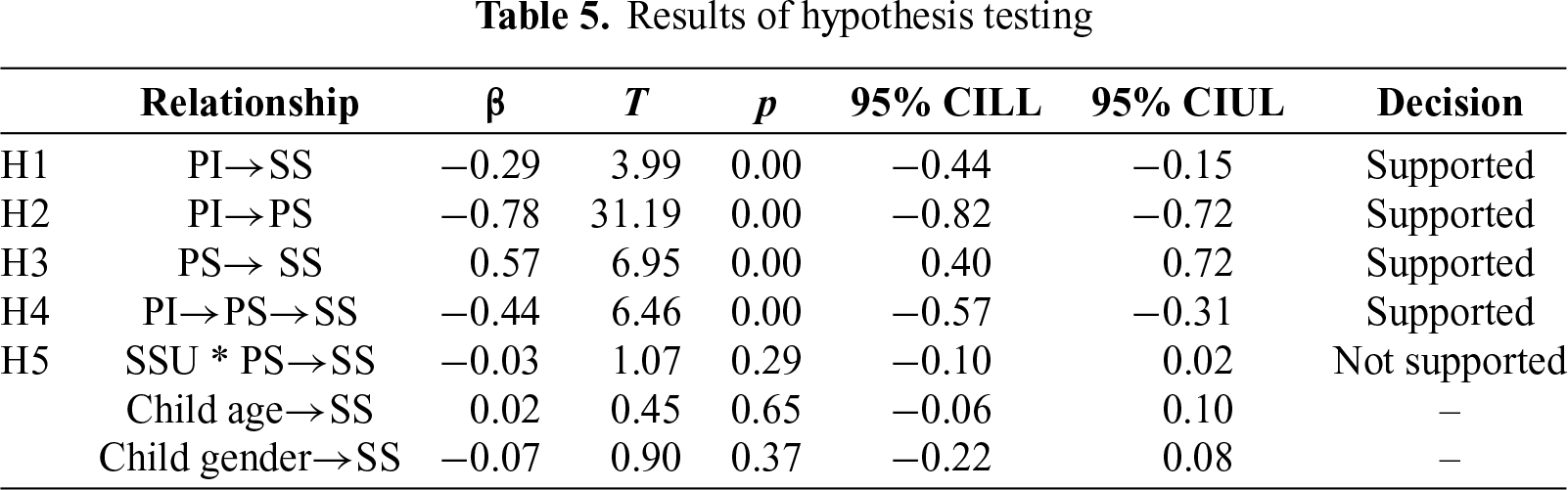
After controlling for these, PI showed a significant positive impact on social skills (β = −0.29, p < 0.01; negative β indicates positive relationship due to reverse scoring), thus supporting H1. PI had a significant negative impact on PS (β = −0.78, p < 0.01). This supports H2. PS demonstrated a significant impact on social skills (β = 0.57, p < 0.01), supporting H3. The positive β reflects that higher PS predicts poorer actual skills because the SS scale is reverse-coded. The mediating effect of PS on the relationship between PI and social skills was significant (β = −0.44, p < 0.01), with a Variance Accounted For (VAF) of 60.27%. VAF indicates the proportion of the total effect explained by the mediation. Following Hair et al.’s (2019) guideline, 20% < VAF < 80% suggests partial mediation. This means the indirect effect explains a substantial but not complete portion of the relationship. Our results support H4. However, the interaction between PS and SSU was not significant (β = −0.03, p = 0.29). This means SSU did not moderate the relationship between PS and social skills. Thus, H5 is not supported.
In summary, the model demonstrates robust explanatory and predictive power. The findings highlight the mediating role of PS while revealing no moderation by SSU.
This study demonstrates that PI is associated with better social skills in children with ID, an effect largely mediated by reduced PS. In contrast, SSU did not emerge as a significant buffer. Taken together, these findings suggest that parental psychological states are a pivotal conduit linking family processes to child social outcomes, whereas generic SSU may not function as a reliable stress buffer in ID contexts.
As hypothesized, PI significantly reduced social skills deficits in children with ID (β = −0.29, p < 0.001), extending prior evidence from typically developing samples to ID populations. However, this effect size was smaller than that observed in typically developing children (e.g., β = 0.37; Yue et al., 2024), where outcomes are typically measured on a positive scale. This attenuation likely reflects population-specific developmental dynamics. Children with ID often exhibit slower skill acquisition and limited generalization, making routine PI insufficient without specialized strategies (Zhang et al., 2024). Moreover, high caregiving demands may channel parental time toward basic care at the expense of cognitively and socially enriching interactions, a pattern exacerbated by limited access to specialized guidance and weak home-school coordination (Oranga et al., 2022).
Furthermore, our analysis revealed that PS mediated the association between PI and social skills (indirect effect β = −0.44, p < 0.001, 95% bootstrapped CI [−0.57, −0.31]). Specifically, higher PI predicted lower levels of PS, which in turn was associated with fewer social skills deficits in children. This finding underscores the value of addressing parental well-being in family interventions. While Williams et al. (2020) linked structured parental activities with reduced stress and improved child outcomes, they did not test mediation. Our findings address this gap by empirically demonstrating that PS formally mediates the PI–social skills association. Consistent with ecological systems theory and stress-buffer perspectives, high-quality PI (e.g., structured play, effective home-school communication) enhances parents’ sense of control and efficacy (Tazouti & Jarlégan, 2019), alleviating helplessness and isolation. Reduced stress, in turn, enables more patient and consistent responses to children’s social needs, fostering higher-quality emotional support and modeling opportunities (Neece & Baker, 2008).
Contrary to the traditional stress-buffering hypothesis, SSU did not moderate the link between PS and social skills: the SSU × PS interaction was non-significant (β = −0.03, p = 0.29). This diverges from traditional buffering accounts (e.g., Yıldız & Uzundağ, 2024) but accords with recent null findings (Li et al., 2022; Negi & Sattler, 2024). Several factors may explain this null finding. First, the type of support available may be mismatched to families’ needs, as generic emotional support may lack the ID-specific expertise required to reduce stress effectively. Second, measurement aggregation may mask source-specific effects if professional and informal supports operate differently. Third, in family-centered cultures, stigma-related concerns and preferences for maintaining family privacy may constrain effective utilization of external support (Mak & Kwok, 2010).
Theoretically, this study makes three primary contributions. First, it empirically validates the applicability of ecological systems theory in families of children with ID, shifting the analytical focus from child-centric deficits to family-system dynamics. Second, by identifying PS as the mediator linking PI to children’s social skills, it specifies the core psychological pathway through which family processes shape social development and refines the family stress process model for special needs contexts. Third, the non-significant moderating role of SSU challenges the stress-buffering theory and redirects attention from the quantity of support to its qualitative dimensions—fit to family needs, quality, accessibility, and utilization capacity. Collectively, these insights underscore parental well-being and the family emotional climate as central levers for improving children’s social outcomes.
Building on these findings, we propose a precision-oriented, multi-tiered intervention framework. At the micro level, interventions should adopt a dual-track approach that targets both skill enhancement and stress reduction. One track delivers concrete PI training—scaffolding peer interactions, providing situational cues, and delivering contingent feedback. The other systematically reduces PS through targeted stress-management workshops, structured parent-to-parent networks, and professional psychological support. At the meso level, SSU’s non-significant moderating effect necessitates a shift in service delivery—from generic resource provision to precisely matched, sustainable support. This requires providing tangible supports such as respite care, specialized behavior-management training, culturally responsive guidance, and expert service navigation, effectively shifting from “more support” to “the right support”. At the macro level, these results call for policy reforms that integrate parental mental health services into standard rehabilitation and education frameworks for children with ID. Policymakers should establish a closed-loop service model covering assessment, referral, intervention, and follow-up to ensure parental well-being is a structural priority rather than an afterthought.
Limitations of the study and future directions
This study has several limitations that warrant further exploration in future research.
First, the sample lacked sufficient socioeconomic diversity, potentially constraining the external validity of our findings. Participants were primarily recruited from Heze City in Shandong Province—a geographically concentrated sample that inadequately captures the diversity across China’s various regions, educational levels, or family structures. Additionally, the potential impact of urban-rural disparities on family dynamics and support systems remains unexplored. Future research should employ stratified sampling techniques to systematically include participants from broader socioeconomic backgrounds, with particular attention to how urban-rural differences influence SSU effectiveness and family functioning mechanisms.
Second, our reliance on parent self-report data introduces potential common method bias, where correlations between variables may be artificially inflated due to single-source measurement. To mitigate this limitation, subsequent studies should implement multi-source, multi-method data collection strategies. These should incorporate both teacher assessments and direct behavioral observations. Crucially, to circumvent the subjectivity inherent in parent reports, validated tools such as the Brief Observation of Social Communication Change (BOSCC; Grzadzinski et al., 2016)—designed to capture subtle changes in social communication behaviors—could be employed to provide a more objective assessment of children’s interactions across home and educational environments.
Third, beyond methodological concerns, the standardized SSU measurement instruments employed may not fully capture culturally specific support utilization patterns in the Chinese context (Fang et al., 2024). Conventional measures often overlook the distinctive role of “guanxi” (relationships) in resource acquisition and the gap between expectations and reality within China’s collectivist family framework. Future research should implement sequential mixed methods designs: beginning with in-depth interviews and focus groups to identify culturally-specific support patterns, followed by developing and validating measurement instruments that authentically reflect Chinese families’ support utilization experiences and challenges.
This study reveals a dual pathway through which parental involvement enhances the social skills of children with ID: a direct developmental gain and, more critically, an indirect route by alleviating parenting stress. By positioning parental well-being as a central mechanism rather than a peripheral concern, our findings reframe child-focused interventions as necessarily parent-psychology-first endeavors. The null buffering effect of generic SSU further signals that “more” support is less important than precisely matched support. Consequently, future programs should prioritize reducing parenting stress and incorporate evidence-informed supports delivered with attention to cultural fit to enable more meaningful and sustained gains in children’s social competence. This shift from child-centric to family-systemic approaches represents not merely a tactical adjustment but a fundamental reconceptualization of how we support families affected by ID.
Acknowledgement: We sincerely thank all participants for their contribution to this study.
Funding Statement: The authors received no specific funding for this study.
Author Contributions: The authors confirm contribution to the paper as follows: study conception and design: Yuting Han, Nana Jiang, and Yuan Yuan; data collection: Yuting Han, Nana Jiang, and Yuan Yuan; analysis and interpretation of results: Yuting Han and Nana Jiang; draft manuscript preparation: Yuting Han. All authors reviewed and approved the final version of the manuscript.
Availability of Data and Materials: The data for this study are available upon request from the first author.
Ethics Approval: This study received ethical approval from the Ethics Review Committee of Heze University (Approval No.: 2025031202) and was conducted in accordance with the Declaration of Helsinki. School administrators provided institutional consent prior to data collection. Parents received comprehensive information about the study’s purpose, procedures, and potential risks and benefits. They were informed of their right to withdraw at any time without penalty. Written informed consent was then obtained from all participants.
Conflicts of Interest: The authors declare no conflicts of interest.
References
Aldosiry, N. (2025). Support and services targeting young adults with intellectual and developmental disabilities and their families in Saudi Arabia. Acta Psychologica, 254, 104813. https://doi.org/10.1016/j.actpsy.2025.104813. [Google Scholar] [PubMed] [CrossRef]
Bennett, K. S., & Hay, D. A. (2007). The role of family in the development of social skills in children with physical disabilities. International Journal of Disability, Development and Education, 54(4), 381–397. https://doi.org/10.1080/10349120701654555 [Google Scholar] [CrossRef]
Benson, P. R. (2015). Longitudinal effects of educational involvement on parent and family functioning among mothers of children with ASD. Research in Autism Spectrum Disorders, 11, 42–55. https://doi.org/10.1016/j.rasd.2014.11.011 [Google Scholar] [CrossRef]
Berry, J. O., & Jones, W. H. (1995). The parental stress scale: Initial psychometric evidence. Journal of Social and Personal Relationships, 12(3), 463–472. https://doi.org/10.1177/0265407595123009 [Google Scholar] [CrossRef]
Bronfenbrenner, U. (1979). The Ecology of Human Development: Experiments by Nature and Design. Cambridge, MA, USA: Harvard University Press. [Google Scholar]
Calderon, R. (2000). Parental involvement in deaf children’s education programs as a predictor of child’s language, early reading, and social-emotional development. The Journal of Deaf Studies and Deaf Education, 5(2), 140–155. https://doi.org/10.1093/deafed/5.2.140. [Google Scholar] [PubMed] [CrossRef]
Chen, L., Shu, Y., Liu, X., Ji, Y., Dai, Y. et al. (2019). Assessing accuracy of social responsiveness scale short form for screening autism spectrum disorder in Chinese children. Journal of Bio-Education, 7(2), 80–85. (In Chinese). https://doi.org/10.1007/s12264-017-0114-5. [Google Scholar] [PubMed] [CrossRef]
Cohen, J. (1988). Statistical Power Analysis for the Behavioral Sciences. 2nd ed. Hillsdale, NJ, USA: Lawrence Erlbaum Associates. [Google Scholar]
Cohen, S., & Wills, T. A. (1985). Stress, social support, and the buffering hypothesis. Psychological Bulletin, 98(2), 310–357. https://doi.org/10.1037/0033-2909.98.2.310 [Google Scholar] [CrossRef]
Constantino, J. N., Davis, S. A., Todd, R. D., Schindler, M. K., Gross, M. M. et al. (2003). Validation of a brief quantitative measure of autistic traits: Comparison of the social responsiveness scale with the autism diagnostic interview-revised. Journal of Autism and Developmental Disorders, 33(4), 427–433. https://doi.org/10.1023/A:1025014929212. [Google Scholar] [PubMed] [CrossRef]
Crum, K. I., & Moreland, A. D. (2017). Parental stress and children’s social and behavioral outcomes: The role of abuse potential over time. Journal of Child and Family Studies, 26(11), 3067–3078. https://doi.org/10.1007/s10826-017-0822-5 [Google Scholar] [CrossRef]
Dekker, K., & Kamerling, M. (2017). Social skills scores: The impact of primary school population characteristics and parental involvement. Journal For Multicultural Education, 11(4), 275–286. https://doi.org/10.1108/JME-09-2016-0048 [Google Scholar] [CrossRef]
Devi, M. A., & Lestari, D. (2024). Differences in parenting stress levels in parents of children with intellectual disabilities based on demographic factors. Journal of Humanities and Social Studies, 8(2), 472–476. https://doi.org/10.21075/kacsn.2009.11.2.113 [Google Scholar] [CrossRef]
Duvdevany, I., & Abboud, S. (2003). Stress, social support and well-being of Arab mothers of children with intellectual disability who are served by welfare services in northern Israel. Journal of Intellectual Disability Research, 47(4), 264–272. https://doi.org/10.1046/j.1365-2788.2003.00488.x. [Google Scholar] [PubMed] [CrossRef]
Fang, Q., Chang, H. H., Fisher, K. R., Dong, R., & Wang, X. (2024). Disability policy meets cultural values: Chinese families of children and young people with developmental disabilities in Taipei and Sydney. Ethics and Social Welfare, 18(1), 37–53. https://doi.org/10.1080/17496535.2023.2295850 [Google Scholar] [CrossRef]
Fornell, C., & Larcker, D. F. (1981). Evaluating structural equation models with unobservable variables and measurement error. Journal of Marketing Research, 18(1), 39–50. https://doi.org/10.2307/3151312 [Google Scholar] [CrossRef]
Gera, T., Kumar, S., & Bhushan, K. B. (2024). Influence of parental involvement on social skills among children with intellectual disability. International Journal of Education and Management Studies, 14(4), 506–511. https://doi.org/10.17265/2161-623x/2024.05.005 [Google Scholar] [CrossRef]
Goodrum, N. M., Carroll, J., Dubrow, I., Armistead, L. P., Masyn, K. et al. (2022). Parenting stress predicts longitudinal change in parental involvement among mothers living with HIV. Journal of Family Psychology, 36(5), 725–735. https://doi.org/10.1037/fam0000909. [Google Scholar] [PubMed] [CrossRef]
Gresham, F. M. (2016). Social skills assessment and intervention for children and youth. Cambridge Journal of Education, 46(3), 319–332. https://doi.org/10.1080/0305764X.2016.1195788 [Google Scholar] [CrossRef]
Grzadzinski, R., Carr, T., Colombi, C., McGuire, K., Dufek, S. et al. (2016). Measuring changes in social communication behaviors: Preliminary development of the brief observation of social communication change (BOSCC). Journal of Autism and Developmental Disorders, 46(7), 2464–2479. https://doi.org/10.1007/s10803-016-2782-9. [Google Scholar] [PubMed] [CrossRef]
Hair, J. F., Ringle, C. M., & Sarstedt, M. (2011). PLS-SEM: Indeed a silver bullet. Journal of Marketing Theory and Practice, 19(2), 139–151. https://doi.org/10.2753/MTP1069-6679190202 [Google Scholar] [CrossRef]
Hair, J. F., Risher, J. J., Sarstedt, M., & Ringle, C. M. (2019). When to use and how to report the results of PLS-SEM. European Business Review, 31(1), 2–24. https://doi.org/10.1108/EBR-11-2018-0203 [Google Scholar] [CrossRef]
Hair, J. F., Sarstedt, M., Ringle, C. M., Sharma, P. N., & Liengaard, B. D. (2024). Going beyond the untold facts in PLS-SEM and moving forward. European Journal of Marketing, 58(13), 81–106. https://doi.org/10.1108/EJM-08-2023-0645 [Google Scholar] [CrossRef]
Hooper, A., Hustedt, J. T., Slicker, G., Hallam, R. A., & Gaviria-Loaiza, J. (2022). Linking early head start children’s social-emotional functioning with profiles of family functioning and stress. Journal of Family Psychology, 37(1), 153–160. https://doi.org/10.1037/fam0001014. [Google Scholar] [PubMed] [CrossRef]
Islam, M. A. (2020). An investigation into social support networks of parents of children with intellectual disability in Bangladesh. Mediterranean Journal of Clinical Psychology, 8(2), 1–22. https://doi.org/10.6092/2282-1619/mjcp-2506. [Google Scholar] [CrossRef]
Kim, J., & Lee, J. (2021). Paternal influence on the developmental pathways of maternal parenting stress, home learning stimulation, and children’s social skills in the U.S. and Korea: A moderated mediation model. Journal of Comparative Family Studies, 52(3), 344–372. https://doi.org/10.3138/jcfs.52.3.03 [Google Scholar] [CrossRef]
Kock, N. (2015). Common method bias in PLS-SEM: A full collinearity assessment approach. International Journal of E-Collaboration, 11(4), 1–10. https://doi.org/10.4018/ijec.2015100101 [Google Scholar] [CrossRef]
LaRosa, K., Ogg, J. A., Dedrick, R., Suldo, S., Rogers, M. et al. (2023). Parent involvement in education as predictors of social-emotional strengths in kindergartners. School Psychology Review, 54(1), 84–97. https://doi.org/10.1080/2372966x.2023.2194845 [Google Scholar] [CrossRef]
Lee, W. K., & Joo, Y. S. (2020). Adolescent extracurricular activity participation: Associations with parenting stress, mother-adolescent closeness, and social skills. Children and Youth Services Review, 116, 1–45. https://doi.org/10.1016/j.childyouth.2020.105110 [Google Scholar] [CrossRef]
Leung, C., & Tsang, S. K. M. (2010). The Chinese parental stress scale: Psychometric evidence using Rasch modeling on clinical and nonclinical samples. Journal of Personality Assessment, 92(1), 26–34. https://doi.org/10.1080/00223890903379209. [Google Scholar] [PubMed] [CrossRef]
Li, F., Xu, M., Wu, D., Tang, Y., Zhang, L. et al. (2022). From child social impairment to parenting stress in mothers of children with ASD: The role of parental self-efficacy and social support. Frontiers in Psychiatry, 13, 1005748. https://doi.org/10.3389/fpsyt.2022.1005748. [Google Scholar] [PubMed] [CrossRef]
Mak, W. W., & Kwok, Y. T. (2010). Internalization of stigma for parents of children with autism spectrum disorder in Hong Kong. Social Science & Medicine, 70(12), 2045–2051. https://doi.org/10.1016/j.socscimed.2010.02.023. [Google Scholar] [PubMed] [CrossRef]
Neece, C., & Baker, B. (2008). Predicting maternal parenting stress in middle childhood: The roles of child intellectual status, behaviour problems and social skills. Journal of Intellectual Disability Research, 52(12), 1114–1128. https://doi.org/10.1111/j.1365-2788.2008.01071.x. [Google Scholar] [PubMed] [CrossRef]
Negi, S., & Sattler, K. M. (2024). Protective effect of social support: A longitudinal application of family stress model. Children and Youth Services Review, 164, 1–10. https://doi.org/10.1016/j.childyouth.2024.107864 [Google Scholar] [CrossRef]
Nóblega, M., Monteiro, L., Santos, C., Diniz, E., Guimet, M. et al. (2024). Father’s engagement in direct care is associated with children’s social competence for preschool boys but not girls in Peru. Psychology of Men and Masculinity, 26, 49–60. https://doi.org/10.1037/men0000466 [Google Scholar] [CrossRef]
Oranga, J., Obuba, E., Sore, I., & Boinett, F. (2022). Parental involvement in the education of learners with intellectual disabilities in Kenya. Open Access Library Journal, 9(4), 1–18. https://doi.org/10.4236/oalib.1108542 [Google Scholar] [CrossRef]
Park, G. A., & Lee, O. N. (2022). The moderating effect of social support on parental stress and depression in mothers of children with disabilities. Occupational Therapy International, 2022(1), 5162954. https://doi.org/10.1155/2022/5162954. [Google Scholar] [PubMed] [CrossRef]
Ren, L., & Pope Edwards, C. (2015). Pathways of influence: Chinese parents’ expectations, parenting styles, and child social competence. Early Child Development and Care, 185(4), 614–630. https://doi.org/10.1080/03004430.2014.944908 [Google Scholar] [CrossRef]
Román, G. C., Ghassabian, A., Bongers-Schokking, J. J., Jaddoe, V. W. V., Hofman, A. et al. (2013). Association of gestational maternal hypothyroxinemia and increased autism risk. Annals of Neurology, 74(5), 733–742. https://doi.org/10.1002/ana.23976. [Google Scholar] [PubMed] [CrossRef]
Sarstedt, M., Hair, J. F., Cheah, J. H., Becker, J. M., & Ringle, C. M. (2019). How to specify, estimate, and validate higher-order constructs in PLS-SEM. Australasian Marketing Journal, 27(3), 197–211. https://doi.org/10.1016/j.ausmj.2019.05.003 [Google Scholar] [CrossRef]
Shi, J., Gao, X., & Fan, M. (2024). Research into the relationship between parental involvement and children’s social behavior in different family socioeconomic statuses. Educational Science Research, 1, 29–36. (In Chinese). [Google Scholar]
Sigafoos, J., Lancioni, G. E., Singh, N. N., & O’Reilly, M. F. (2017). Intellectual disability and social skills. In Handbook of social behavior and skills in children (pp. 249–271). Cham: Springer International Publishing. https://doi.org/10.1007/978-3-319-64592-6_14. [Google Scholar] [CrossRef]
Singer, G. H. (2006). Meta-analysis of comparative studies of depression in mothers of children with and without developmental disabilities. American Journal on Mental Retardation, 111(3), 155–169. https://doi.org/10.1352/0895-8017(2006)111[155:mocsod]2.0.co;2 [Google Scholar] [CrossRef]
Tazouti, Y., & Jarlégan, A. (2019). The mediating effects of parental self-efficacy and parental involvement on the link between family socioeconomic status and children’s academic achievement. Journal of Family Studies, 25(3), 250–266. https://doi.org/10.1080/13229400.2016.1241185 [Google Scholar] [CrossRef]
Wang, H., Hu, X., & Han, Z. R. (2020). Parental stress, involvement, and family quality of life in mothers and fathers of children with autism spectrum disorder in mainland China: A dyadic analysis. Research in Developmental Disabilities, 107, 1–13. https://doi.org/10.1016/j.ridd.2020.103791. [Google Scholar] [PubMed] [CrossRef]
Wang, Y., Zhang, M., Xie, Q., & Li, Y. (2022). The relationship between mother’s parenting stress and pre-school children’s social adjustment and its gender difference: A cross-lagged analysis. Journal of Psychological Science, 45(3), 620–627. (In Chinese). https://doi.org/10.16719/j.cnki.1671-6981.20220315 [Google Scholar] [CrossRef]
Williams, K. E., So, K. T., & Siu, T. S. C. (2020). A randomized controlled trial of the effects of parental involvement in supported playgroup on parenting stress and toddler social-communicative behavior. Children and Youth Services Review, 118, 105364. https://doi.org/10.1016/j.childyouth.2020.105364 [Google Scholar] [CrossRef]
Xu, X., Zhu, L., Zhou, S., Li, Z., Chen, Y. et al. (2024). Relations between maternal parenting stress and children’s social competence in Chinese parent-grandparent co-parenting families. Journal of Child and Family Studies, 33(8), 2500–2512. https://doi.org/10.1007/s10826-024-02890-3 [Google Scholar] [CrossRef]
Yan, T., Hou, Y., & Deng, M. (2022). Direct, indirect, and buffering effect of social support on parental involvement among Chinese parents of children with autism spectrum disorders. Journal of Autism and Developmental Disorders, 52(7), 2911–2923. https://doi.org/10.1007/s10803-021-05170-x. [Google Scholar] [PubMed] [CrossRef]
Yang, X., Xue, M., & Pauen, S. (2024). Psychometric properties of the Chinese version of multidimensional scale of perceived social support. Psychology Research and Behavior Management, 17, 2233–2241. https://doi.org/10.2147/prbm.s463245. [Google Scholar] [PubMed] [CrossRef]
Yıldız, E., & Uzundağ, B. A. (2024). The role of perceived social support in mitigating the impact of parenting stress on children’s effortful control. International Journal of Behavioral Development, 48(5), 462–466. https://doi.org/10.1177/01650254241239975 [Google Scholar] [CrossRef]
Yue, Y., Huang, J., Yuan, H., Zhao, Y., Lei, J. et al. (2024). The mediating role of self-competence in the relationship between parental involvement and support and Children’s social skills: Evidence from China. Children and Youth Services Review, 161, 107641. https://doi.org/10.1016/j.childyouth.2024.107641 [Google Scholar] [CrossRef]
Zhang, Q., Wang, X., Gu, Z., & Wang, T. (2024). Pathway analysis of the effects of parental involvement and teacher-student relationship on the social skills of children with intellectual disabilities. Chinese Journal of Special Education, 5, 25–33. (In Chinese). https://doi.org/10.21203/rs.3.rs-5474664/v1 [Google Scholar] [CrossRef]
Zimet, G. D., Dahlem, N. W., Zimet, S. G., & Farley, G. K. (1988). The multidimensional scale of perceived social support. Journal of Personality Assessment, 52(1), 30–41. https://doi.org/10.1207/s15327752jpa5201_2. [Google Scholar] [PubMed] [CrossRef]
Cite This Article
 Copyright © 2026 The Author(s). Published by Tech Science Press.
This work is licensed under a Creative Commons Attribution 4.0 International License , which permits unrestricted use, distribution, and reproduction in any medium, provided the original work is properly cited.
 Downloads
 Citation Tools
