
 Login
Login Register
 Submit a Paper
 Propose a Special lssue
 Open Access
ARTICLE

Topological analysis of the depression-anxiety-stress network in vocational college freshmen: A longitudinal trace-based analysis
1 School of Educational Science, Anhui Normal University, Wuhu, China
2 Pre-School Education Department, Tongcheng Teachers College, Tongcheng, China
* Corresponding Author: Siliang Yang. Email:
Journal of Psychology in Africa 2026, 36(1), 21-32. https://doi.org/10.32604/jpa.2026.070171
Received 09 July 2025; Accepted 06 January 2026; Issue published 26 February 2026
 View Full Text
 Download PDF
Abstract
This study explores the core characteristics, dynamic progression of the depression-anxiety-stress network among Chinese higher vocational college freshmen and its association with life satisfaction, and identifies key nodes and critical intervention points. Participants were 295 higher vocational college freshmen (male = 137; M = 18.52, SD = 0.69) completing two follow-up surveys (5-month interval). Measures included depression-anxiety-stress symptoms and life satisfaction, analyzed via cross-sectional and binary cross-lagged panel network analysis. The results showed that “Easily agitated” was the central node (strength = 1.519, EI = 1.967); “Irritable” and “Mouth Dryness” were top predictors (Out-EI = 1.101, 1.100), with depressive symptoms as the convergence hub. “Easily agitated” had the strongest direct negative impact on life satisfaction (cross-cluster out-predictability = −0.653). This study elucidates depression-anxiety-stress network mechanisms in higher vocational freshmen, providing a theoretical framework and targeted intervention guidance (e.g., focusing on somatic and emotional nodes).Keywords
Supplementary Material
Supplementary Material FileIn some contexts, vocational education students are often perceived by society as “academic failures” with a lack of academic aptitude (Wang, 2021). They also may be perceived as overly focused on earning a living rather than career development or meaning-seeking (Hou et al., 2020; Woronov, 2015). These negative evaluations would predispose some to psychological disorders, especially depression, anxiety, and stress (Ibrahim et al., 2013; Bayram & Bilgel, 2008; Steptoe et al., 2007). At the same time, young students are entering higher education for the first time, and the life environment has changed, as a group of young people, they are at a critical point in the transition from adolescence to adulthood, and their physical and mental development will experience challenges (Meeus, 2016). During this developmental stage, they are reconstructing their psychological states to balance the new environment and their development (Li et al., 2008).
College admission is a positive experience for young adults of which they may have positive emotional feelings. However, the college life adaptation problems can also make many college freshmen feel stressed (Bayram & Bilgel, 2008), anxious (Doane et al., 2015), and depressed (Bewick et al., 2010). However, existing studies have mostly focused on the association between total symptom scores and external variables (Gao & Meng, 2022), at the neglect of network topological features of the interactions among symptoms. This study aimed to address this gap in the evidence in the China context.
Depression, anxiety, and stress symptoms in vocational education
Depression factor is associated poor state of mind, low self-esteem, and low levels of positive affect, while anxiety is associated with somatic and subjective experiences of anxiety arousal (Gomez et al., 2014). They may be differences by cultural context. For instance, compared with Western students, experience of symptoms of depression, anxiety, and stress. Chinese students would commonly experience the coexistence and clustering of multiple health risk factors (Atorkey et al., 2021). This may be explained by the facat that substance use and depressive symptoms often form specific clusters (Bannink et al., 2015). Also, Western cultures prioritize the expression and recognition of psychological symptoms (Ryder et al., 2011), while Chinese culture often tend to internalize emotional experiences (Qiao & Ji, 2002), risking somatization symptoms (Zhou et al., 2016; Gong et al., 2010), potentially reporting lower self-reported symptom scores (Luo et al., 2025). A meta-analysis incorporating 13 studies on non-Chinese college students and 15 studies on Chinese college students showed that the prevalence rates of depression, anxiety, and stress among non-Chinese college students were 53%, 40%, and 28%, respectively. In contrast, the prevalence rates of these symptoms among Chinese college students were 22%, 19%, and 17%, respectively (Wang et al., 2021), reflecting significant regional and cultural differences.
Notably, the prevalence rates of depression, anxiety, and stress among Chinese higher vocational college students have reached 28.7%, 41.7%, and 20.2%, respectively (Zeng et al., 2019). These rates are not only higher than the average level of Chinese college students, but the prevalence of anxiety symptoms also exceeds that of non-Chinese college student samples, indicating the uniqueness and severity of emotional problems in this population. The vocational training phase itself has been identified as a period with a high incidence of stress, personal, and educational problems (Larkins et al., 2003). Multivariate analyses consistently reveal that factors such as female gender, poor self-rated health status, disadvantaged family economic conditions, out-of-province student status, and off-campus residence are significantly associated with a higher risk of depression, anxiety, and stress symptoms (Wu & Liu, 2024). Additionally, students from single-parent families or orphaned backgrounds, and non-only children exhibit greater psychological vulnerability, particularly in terms of depression and stress (Wu & Liu, 2024; Zeng et al., 2019). Behavioral factors—including lack of physical exercise, excessive screen time, insufficient leisure activities, and poor sleep quality—have also been confirmed as important risk factors that exacerbate these mental health problems (Zeng et al., 2019). Within the Chinese social context, high-intensity academic pressure and a highly competitive employment environment further constitute key situational triggers for the onset of these symptoms. The above findings emphasize the urgency and necessity of developing culturally sensitive and contextually adapted mental health screening and intervention strategies for this population.
Network topological analysis is a methodological framework with graph theory as its core foundation (Devineni & Gorantla, 2024). Previous studies have demonstrated the value of this approach in unveiling the intricate hidden structures of data in the field of social sciences (Dong et al., 2025; Healy et al., 2020). Network analysis can characterize the interactions within psychological and behavioral systems as a network structure composed of “nodes” and “edges”, and enables the identification of the centrality characteristics of nodes in the network and the relational connections between nodes (Borsboom et al., 2021; Epskamp et al., 2018). This method can provide information about key nodes and high-influence nodes in the network, thereby laying the foundation for exploratory research at the practical level from an exploratory, non-theory-driven perspective (Li & Kwok, 2023). One of its prominent features is its capacity to visualize intricate, dynamic connections, intuitively presenting the nodes in the network and their mutual relationships (Borsboom et al., 2021; Bringmann & Eronen, 2018).
In network analysis models, causality occurs at the item level rather than at the latent variable level (Borsboom, 2017; Abplanalp & Green, 2022). Combining the network analysis model with a cross-lagged panel model (CLPM), the cross-lagged panel network model (CLPN) reveals the longitudinal processes that occur within and between mental constructs over time (Wysocki et al., 2025). Mental Network Theory breaks away from the linear causal assumption and views causal connections between symptoms as the central mechanism of psychological problems (Borsboom, 2017). In a mental network, certain items can be conceptualized as bridging symptoms, connecting or “bridging” symptom clusters within the same disorder, or bridging clusters corresponding to different disorders (Abplanalp & Green, 2022). In longitudinal designs, temporal variability in network structure can track critical symptom activation pathways (Jordan et al., 2020). Only one study has examined temporal variability in the network structure of Depression-Anxiety using the DASS-21 (Wang et al., 2024). This study compared temporal networks of depression and anxiety in adolescents, college students, and older adults, and found that irrational fear and somatic anxiety were the core symptoms; notably, the network structure of college students did not show a clear order between depression and anxiety symptoms, except in adolescents and older adults (Wang et al., 2024).
Most existing studies use traditional inter-variable analysis to examine depression, anxiety, and stress manifestations in populations (including higher vocational students) and their correlations with other variables, overlooking their internal topological structure. Since depression, anxiety, and stress in higher vocational students constitute a unique multidimensional network, exploring this structure facilitates a deeper understanding of their negative emotions. Life satisfaction is a key indicator of subjective well-being (Diener et al., 1985). Low life satisfaction contributes to mental health problems (Fergusson et al., 2015) and harmful behaviors hindering personal and societal development (Hanniball et al., 2021). While negative emotions correlate negatively with life satisfaction (Ooi et al., 2022), prior research ignores the influence of specific symptom nodes within the negative emotion network.
Overall, two gaps exist in research on the mental health of vocational students: (1) Few studies investigate the intra-symptom topological structure of depression, anxiety, and stress, with most focusing on total scores of symptoms and their correlations with external variables (Gao & Meng, 2022); (2) Longitudinal research on the dynamic evolution of the depression-anxiety-stress network, especially directional predictive links between symptoms, is lacking.
Chinese vocational education has long served as a “second chance” for “at-risk youth,” admitting academically underachieving or behaviorally challenged students, especially those from low socioeconomic status families (Ling, 2015). A meta-analysis of 1043 studies (2,905,979 students) reported that the prevalence of depression and anxiety among college students was 20.8% and 13.7%, respectively (Yu & Huang, 2023). The vocational students face heightened mental health risks amid negative self-perception and environmental evaluation (Sun, 2010), with a study using the Chinese version of the DASS-21 finding their depression, anxiety, and stress symptoms showed a bimodal distribution in the first and third years (Wu & Liu, 2024).
Chinese college students have significantly lower depression and stress scores but comparable anxiety levels (Gong et al., 2010), reflecting cultural differences in negative emotion experience and expression (Lu, 2008). Chinese individuals rarely express emotional experiences (Clara et al., 2001); most instead translate subjective adverse experiences into physical discomfort (Gong et al., 2010).
This study explored the topology, internal/external attributes, and dynamic evolution of the depression-anxiety-stress network among higher vocational freshmen, as well as its relationship with life satisfaction, to clarify the consequences and key channels of the network.
This study addresses three research questions.
RQ1: What are the core symptoms and internal structure of the depression-anxiety-stress network of freshmen?
RQ2: How temporally stable is the depression-anxiety-stress network of freshmen?
RQ3: How is the network intrinsically related to life satisfaction?
To answer these, the study first used cross-sectional network analysis to identify key dimensions and core associations of the depression-anxiety-stress network. Second, it examined the inter-temporal stability and trends via network comparison and cross-lagged panel network analysis. Finally, a cross-lagged binary network was constructed to clarify core nodes and key linkage paths between negative emotions (depression, anxiety, stress) and life satisfaction. This enhances understanding of the negative emotional changes of higher vocational freshmen and provides scientific guidance for regulating their life satisfaction.
In the initial (T1) survey, 839 participants (45.17% male, 83.31% urban, 10.97% only children) had a mean age of 18.49 ± 0.67 years (range: 18–21 years). Five months later (T2), 295 of these participants were tracked: 46.44% male, 83.39% urban, 11.53% only children, with a mean age of 18.52 ± 0.69 years (range: 18–21 years).
A total of 544 participants were unavailable for follow-up, mainly for three reasons: 311 were preparing for the Junior College to Undergraduate Program Entrance Exam, and 168 were on off-campus internships—both groups could not participate due to busy schedules and strict attendance; the remaining 65 opted out (38 for part-time work conflicts, 27 for low interest in repeated surveys).
The ethics committee of the Anhui Normal University approved the study. Consent was obtained from the students themselves, class leaders, and school authorities before data collection, allowing all participants to withdraw at any time during the research process.
Depression, anxiety, stress scale-21
The Depression-Anxiety-Stress-Scale-21 (DASS-21) was used in this study (Wang et al., 2016; Gong et al., 2010), comprising 3 subscales (Depression [D], Anxiety [A], Stress [S]) with 7 items each. It uses a 4-point Likert scale (0–3), where higher scores reflect greater depression, anxiety, or stress severity. At T1, Cronbach’s α for the scale and three subscales was 0.95, 0.87, 0.86, 0.87, respectively, with good model fit (χ2/df = 3.695, RMSEA = 0.057, CFI = 0.924, TLI = 0.913, SRMR = 0.041). At T2, Cronbach’s α was 0.96, 0.88, 0.87, 0.89, respectively, and the model fit remained good (χ2/df = 2.065, RMSEA = 0.060, CFI = 0.933, TLI = 0.923, SRMR = 0.044).
The Satisfaction With Life Scale (SWLS; Wang & Liu, 2018) includes 5 items, using a 7-point Likert scale (1–7), where higher scores reflect greater life satisfaction. At T1, its Cronbach’s α was 0.88 with mediocre model fit (χ2/df = 6.577, RMSEA = 0.082, CFI = 0.989, TLI = 0.964, SRMR = 0.011); at T2, its Cronbach’s α was 0.90 with mediocre model fit (χ2/df = 3.719, RMSEA = 0.096, CFI = 0.982, TLI = 0.954, SRMR = 0.021). A model has “acceptable fit” if most core indices meet standards and only RMSEA is marginally elevated (i.e., <0.10) (Hu & Bentler, 1999). RMSEA may be overestimated in models with low degrees of freedom (Kenny et al., 2015), therefore, SRMR and CFI should be prioritized for short scales like the SWLS (Shi et al., 2022), which confirms its sound structural validity.
Descriptive statistics were conducted in SPSS 25.0, and cross-sectional and cross-lagged panel network analyses were performed in R 4.3.3. First, independent-samples t-tests and chi-square tests were used to compare demographic characteristics and key variables between retained (n = 295) and lost (n = 544) samples. No statistically significant differences existed between groups in gender (χ² = 0.295, p = 0.587), age (t = −1.121, p = 0.263), urban/rural household registration (χ² = 0.002, p = 0.985), only-child status (χ² = 0.146, p = 0.702), Stress score (t = 1.082, p = 0.280), Anxiety score (t = 1.185, p = 0.236), Depression score (t = 1.033, p = 0.302), and SWLS score (t = −1.225, p = 0.221). This indicates attrition bias had no substantial impact on study outcomes, ensuring the generalizability of longitudinal findings.
Second, regularized regression was conducted via the glmnet package, with λ selected via 10-fold cross-validation, and the optimal λ (λ.min) defined as the value that minimizes cross-validation mean squared error (MSE). This balances model predictive accuracy and sparsity, preventing overfitting. Networks were plotted using the qgraph package, sequentially constructing DASS cross-sectional, DASS cross-lagged panel, and DASS-SWLS cross-lagged panel networks to explore core nodes and predictive paths in the depression-anxiety-stress network.
Analysis of the cross-sectional network
Strength and expected influence were used as network centrality indices. Node strength reflects the direct connectivity of a node, defined as the sum of absolute edge weight values with other nodes; higher strength means greater influence (Epskamp et al., 2018). Expected influence builds on strength by incorporating positive and negative relationships within the network, offering a more holistic network influence evaluation (Bekkhus et al., 2023; Robinaugh et al., 2016).
Cross-lagged panel network analysis (CLPN)
Cross-lagged panel network analysis (Wysocki et al., 2025) uses longitudinal panel data to infer variable prediction directions in networks. It controls for item autoregressive effects, accounts for within-time (undirected) and between-time (directed) correlations, and estimates prior-time single-item effects on next-time other items.
For network comparison, qgraph’s average Layout fixed identical nodes across networks at the same position. Nodes represent symptoms, arrows indicate cross-lagged direction (blue = positive, red = negative), and line thickness reflects association strength. Autoregressive paths (the strongest) visually suppress key cross-lagged paths (Funkhouser et al., 2021); therefore, they were set to 0 in the main text plots to highlight target effects.
Directed edges from this analysis yield two centrality indices: out-expected influence (out-EI, sum of outgoing edges, reflecting a node’s predictive power) and in-expected influence (in-EI, sum of incoming edges, reflecting being predicted by others). High out-EI symptoms are clinically valuable as they predict numerous other symptoms, with activation potentially triggering subsequent network symptoms (McNally, 2016).
Network nodes and symptom content
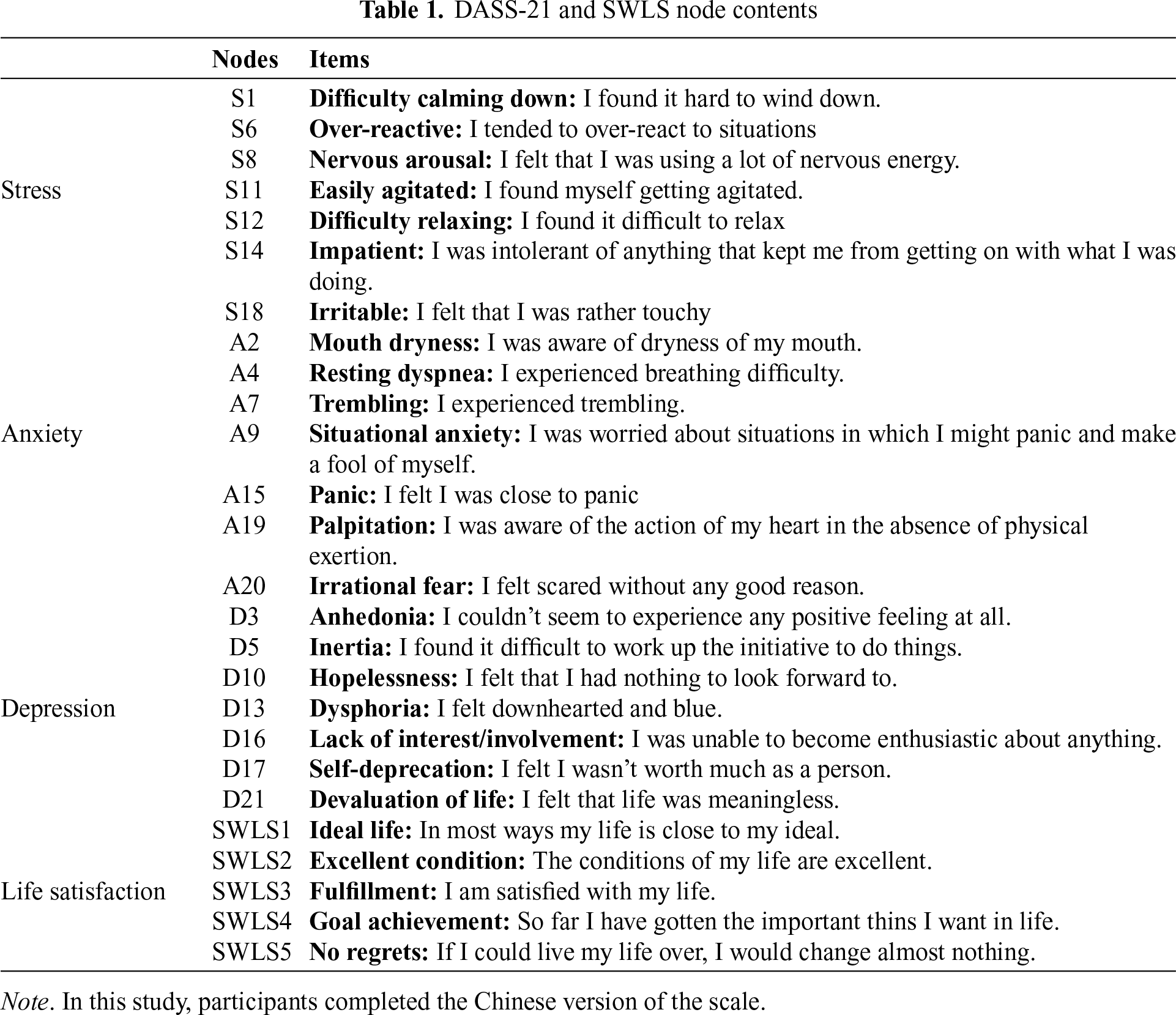
Each item of the DASS-21 and SWLS was treated as an individual node in the network, and the correspondence of the nodes to specific item content is shown in Table 1.
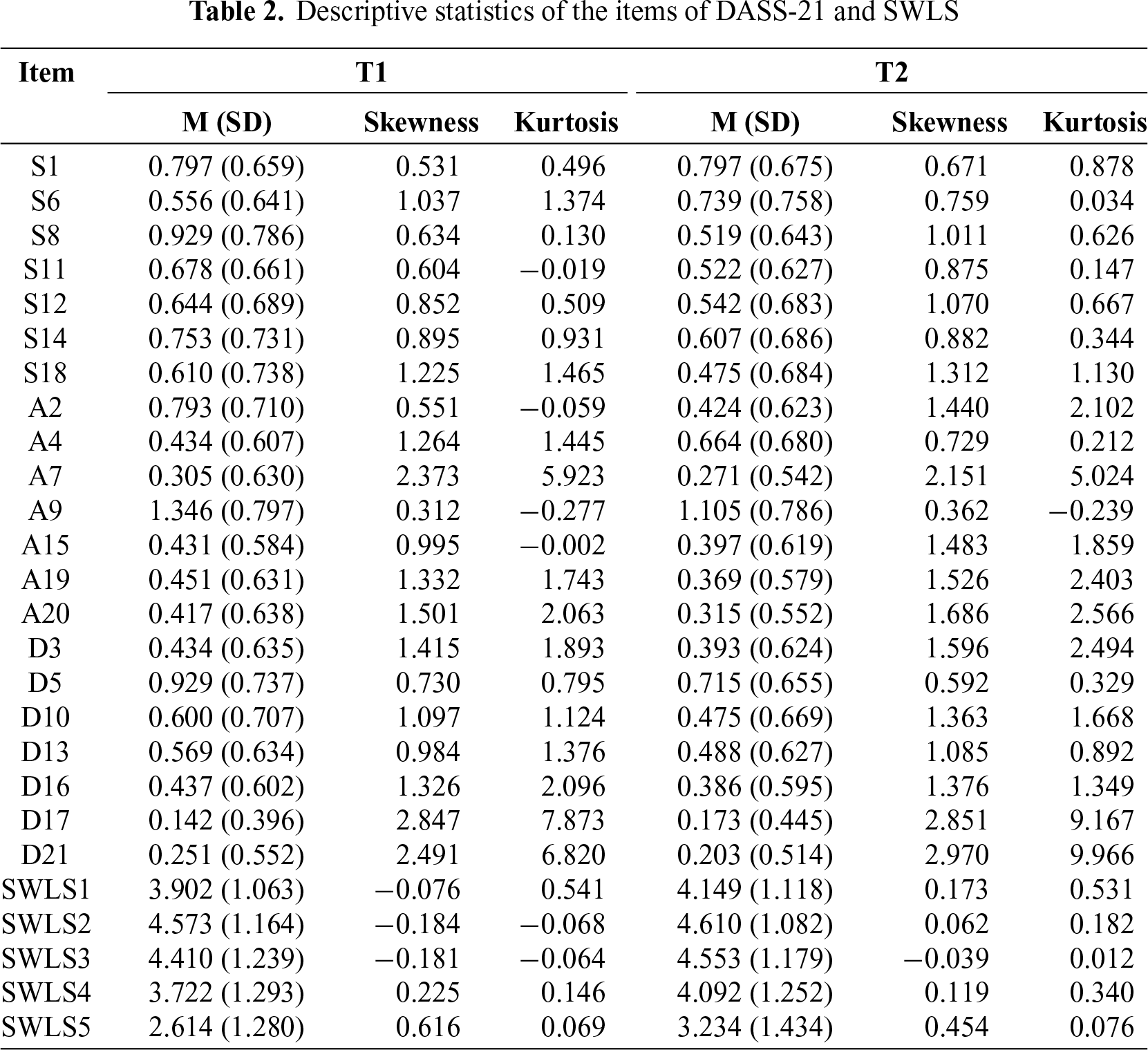
The mean, standard deviation, skewness, and kurtosis of the items are shown in Table 2. According to Kline (2016), a variable follows a skewed distribution if the absolute value of its skewness is greater than 3 and its kurtosis is greater than 10; conversely, it follows or approximately follows a normal distribution. Therefore, the study data are normally distributed, meeting the requirements for network analysis.
Cross-sectional network of depression-anxiety-stress among higher vocational college freshmen
Figure 1 presents the cross-sectional network of the DASS-21 items, where nodes represent items, and edges represent regularized partial correlations. The network comprises 21 nodes connected by 210 edges (density = 1), with edge weights ranging from −0.118 to 0.386 (mean = 0.047, Table S1). In the Stress, Depression, and Anxiety dimensions, the highest-strength nodes are Easily agitated (S11, Str = 1.519), Anhedonia (D3, Str = 1.598), and Irrational fear (A20, Str = 1.216), respectively; the top expected influence nodes are Easily agitated (S11, EI = 1.967), Anhedonia (D3, EI = 1.063), and Panic (A15, EI = 0.912). The CS coefficients for Expected Influence (0.750) and Strength (0.361) indicate acceptable metric stability (Fig. S1). The strongest edge is “Self-deprecation (D17)-Devaluation of life (D21)” (r = 0.386), with satisfactory edge weight stability (Fig. S2).
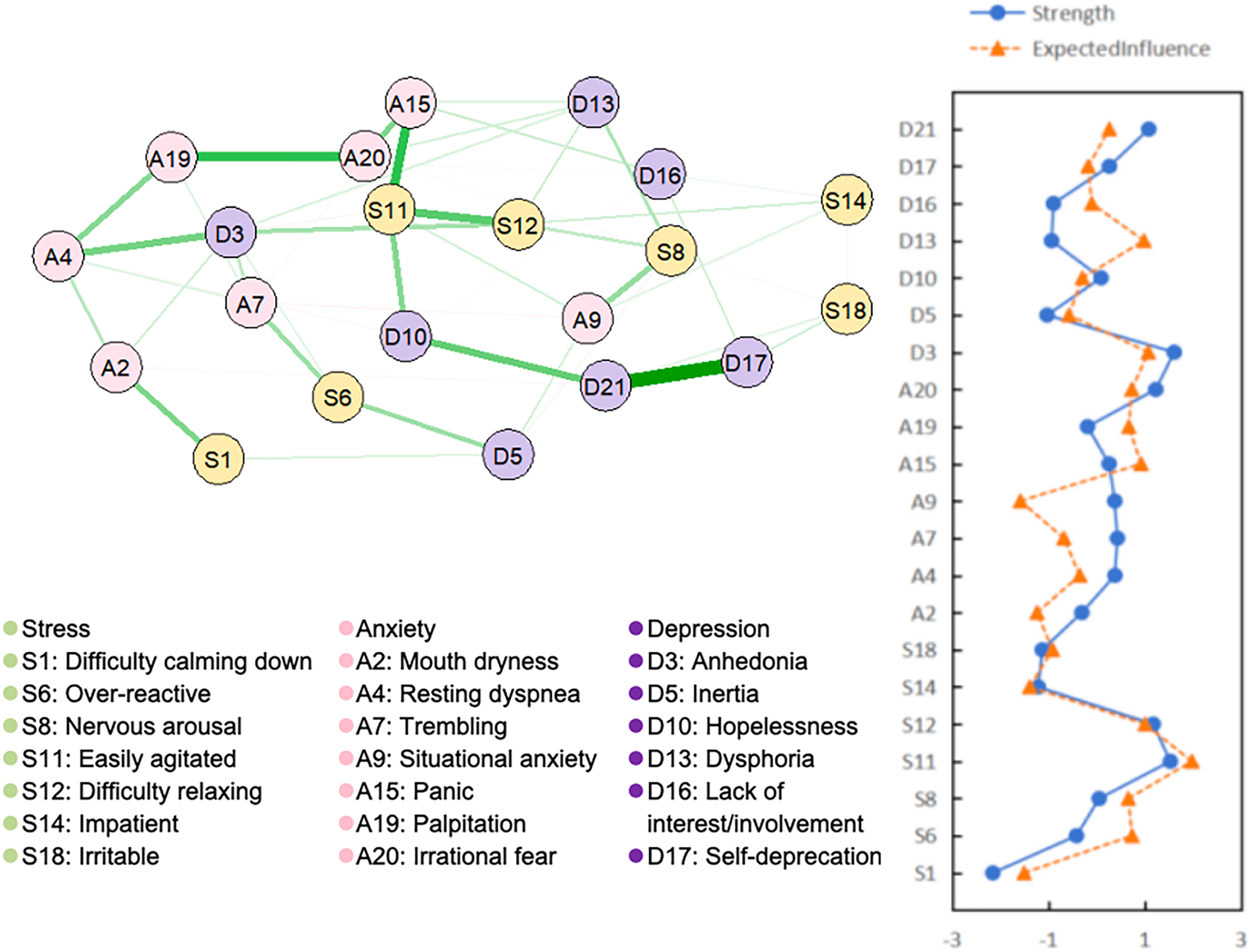
Figure 1: Regularized partial correlation network for DASS-21 items. Note. showing edges with weights ≥ 0.1
Network comparison results (Figure 2, Tables S2 and S3) indicated that the overall structure (M = 0.317, p = 0.013) and global expected influence (S = 0.405, p = 0.021) of the T1 and T2 networks differed significantly, suggesting notable changes in the overall topology and predictive influence of the depression-anxiety-stress network between the two time points. Local analysis revealed that the proportions of significant differences in node strength, node expected influence, and borderline coefficients were 3/21, 4/21, and 28/210, respectively (Tables S4 and S5). These variations reflected significant changes in the role of some key nodes and edges, which further affected the overall strength of the network and reconfigure its overall structure.
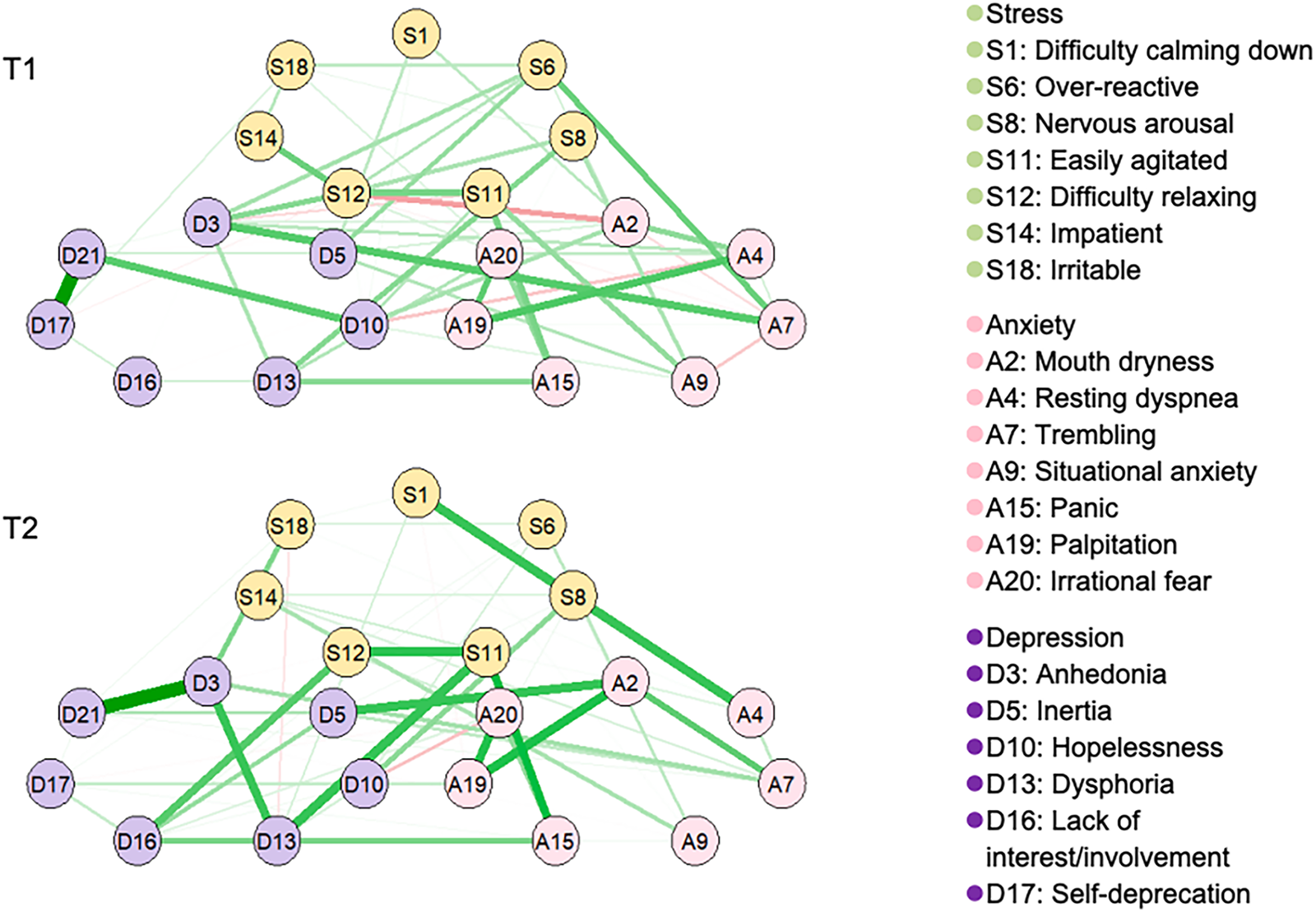
Figure 2: Cross-sectional network at T1 and T2. Note. For visual comparison, the choice is to present the network in groups. Showing edges with weights ≥ 0.1
The CLPN of the DASS-21 for higher vocational college freshmen is shown in Figure 3, with a well-fitted model (RMSEA = 0.037, CFI = 0.978, TLI = 0.939, SRMR = 0.032). Comprising 21 nodes and 179 directed edges (Table S6), it forms a cross-temporal depression-anxiety-stress CLPN, with a network density of 0.426, edge weights ranging from −0.107 to 0.275, and an average weight of 0.051. The nodes with the strongest out-expected influence (highest predictability) were Irritable (S18, out-EI = 1.101) and Mouth dryness (A2, out-EI = 1.100), while those with the strongest in-expected influence (highest being predictability) were Dysphoria (D13, in-EI = 0.585) and Over-reactive (S6, in-EI = 0.583). The strongest edge was the direct predictive effect of Mouth dryness (A2) on Resting dyspnea (A4; r = 0.275). Notable edges between the three factors included Lack of interest/involvement (D16) on Irritable (S18; r = 0.202) and Irritable (S18) on Dysphoria (D13; r = 0.148), Palpitation (A19) on Impatient (S14; r = 0.181) and Difficulty relaxing (S12) on Palpitation (A19; r = 0.097), Self-deprecation (D17) on Resting dyspnea (A4; r = 0.130) and Mouth dryness (A2) on Inertia (D5; r = 0.085). Combined with the network diagrams, the overall influential relationship among the three factors shows a prominent trend of anxiety predicting stress and stress predicting depression.
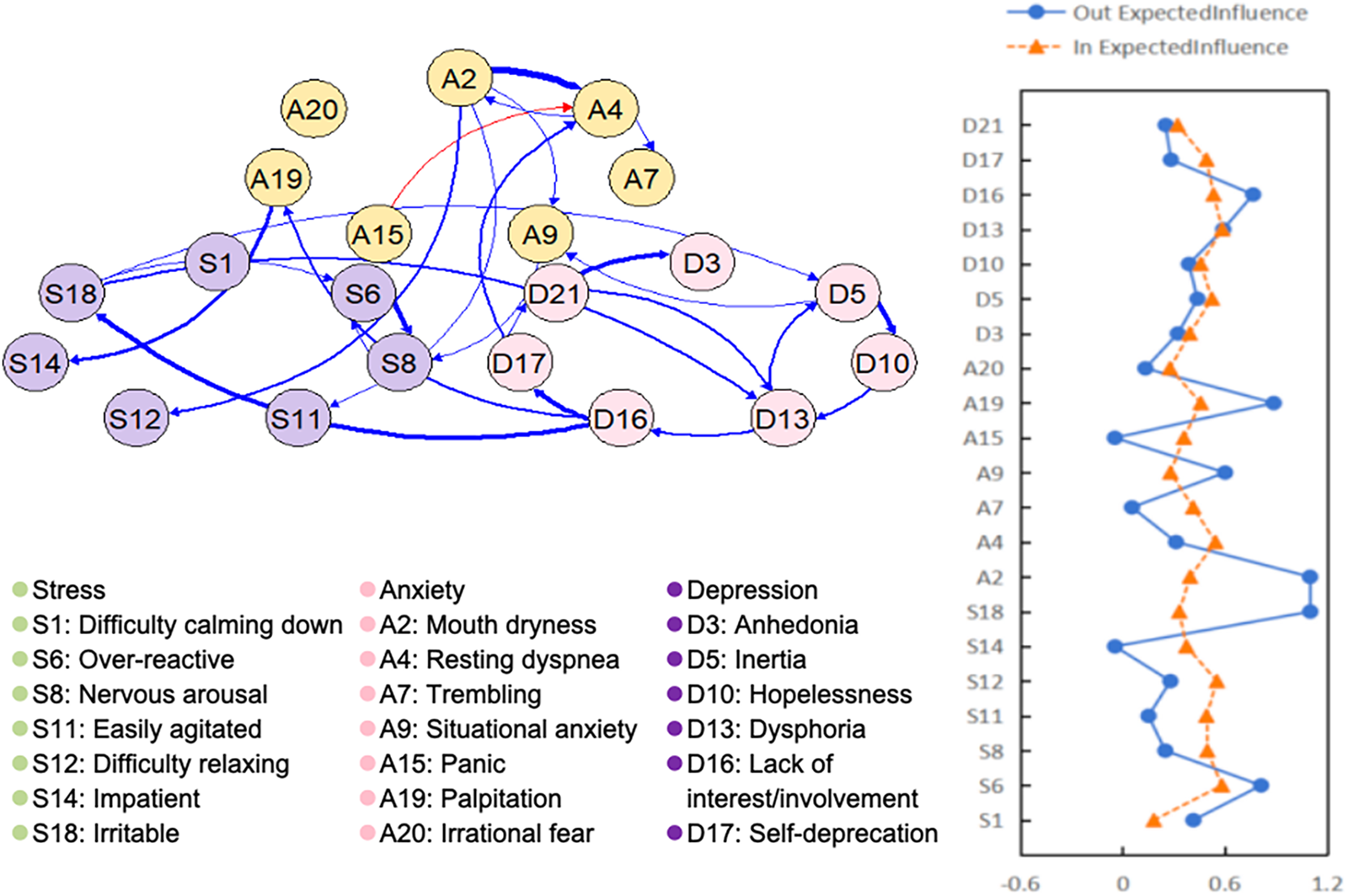
Figure 3: Depression-anxiety-stress CLPN. Note. Autoregressive paths omitted. Showing edges with weights ≥ 0.1
Cross-lagged panel network analysis of the depression anxiety stress scale-21 and the satisfaction with life scale
The CLPN of DASS-21 and SWLS is shown in Figure 4, with a well-fitted model (RMSEA = 0.040, CFI = 0.966, TLI = 0.919, SRMR = 0.036). Comprising 26 nodes and 223 directed edges, the cross-temporal CLPN has a density of 0.343, edge weights ranging from −0.278 to 0.260, and an average weight of 0.037. Focusing on DASS-21’s predictive role for SWLS among higher vocational college freshmen, the network structure largely supported this trend: there were 23 directed edges from DASS-21 to SWLS nodes (range: −0.278~0.134, mean = −0.073; Table S7) vs. only 14 in the reverse direction (range: −0.079~0.102, mean = 0.001). Cross-cluster in-predictability (extent nodes are predicted by out-cluster nodes), cross-cluster out-predictability (extent nodes predict out-cluster nodes), and bridge edges (connections between clusters) were calculated. CLPN analysis showed Easily agitated (S11, cross-cluster out-predictability = −0.653) was the most cross-cluster out-predictive node in the depression-anxiety-stress cluster, while SWLS nodes had relatively similar cross-cluster in-predictability, with No regrets (SWLS5, cross-cluster in-predictability = −0.489) slightly higher (Figure 4). Bridging edges were mainly directed from the depression-anxiety-stress cluster to SWLS, with the strongest being the direct predictive effect of Easily agitated (S11) on No regrets (SWLS5; r = −0.278).
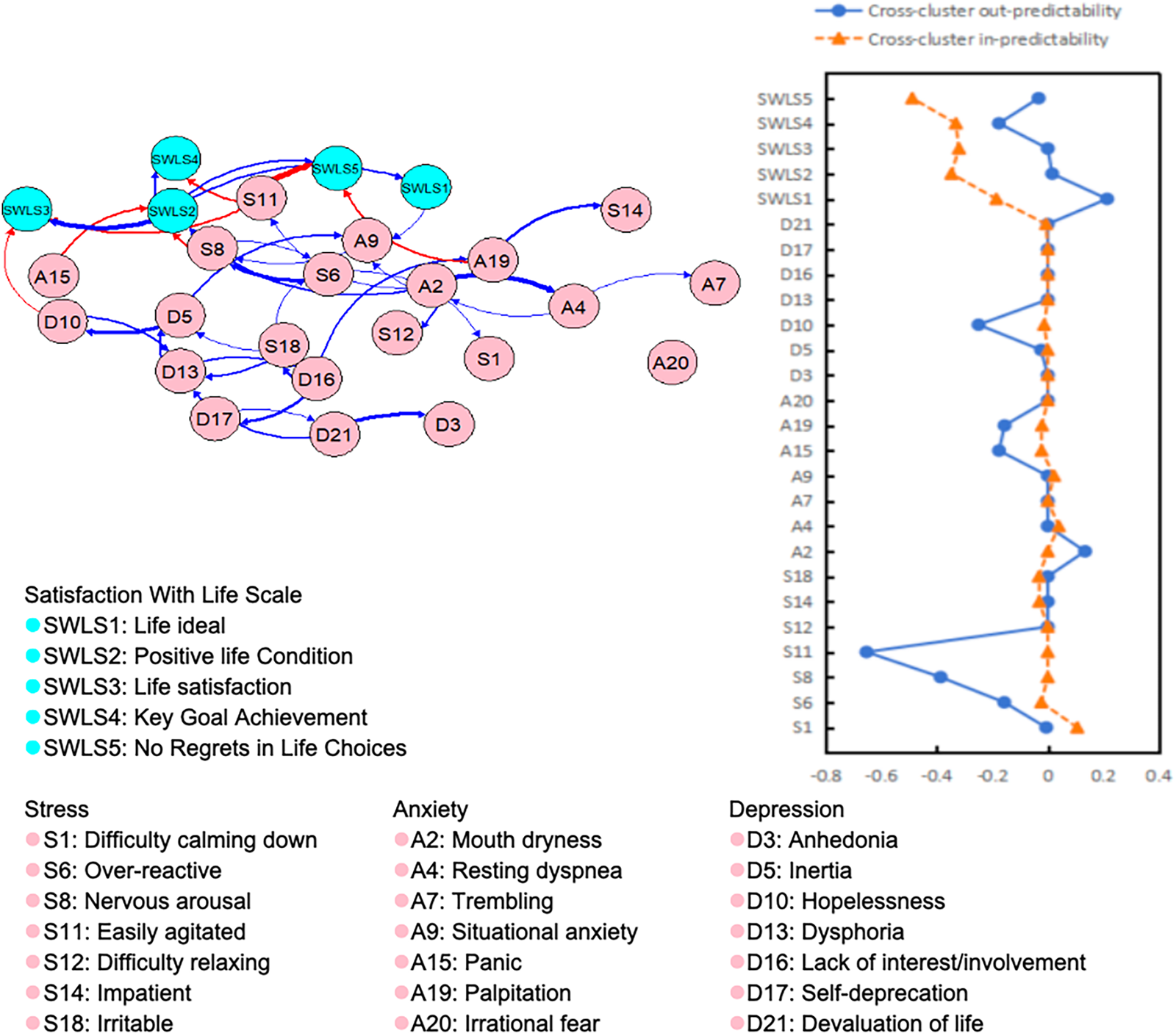
Figure 4: DASS-21 and SWLS CLPN. Note. Autoregressive paths omitted. Showing edges with weights ≥ 0.1
Internal structure and core symptoms
The cross-sectional network of DASS-21 items (Figure 1) uses the Spring layout, showing that nodes of Stress, Depression, and Anxiety are intertwined without aggregating into factor-centered community structures. This implies a synergistic or complementary relationship between nodes across factors. Depression, anxiety, and stress share commonalities and strong symptom and potential influence links (Ali et al., 2022), indicating the network’s holism. Cross-sectional analysis revealed that ‘Easily agitated’, ‘Anhedonia’, and ‘Irrational fear’ had the highest intensity in Stress, Depression, and Anxiety, respectively; ‘Easily agitated’, ‘Anhedonia’, and ‘Panic’ had the highest expected influence. Notably, ‘Easily agitated’ ranked highest in both across the network. Over time, the intensity and expected influence of ‘Easily agitated’ increased significantly (Table S4). Its edges to ‘Difficulty relaxing’, ‘Dysphoria’, and ‘Panic’ strengthened (Figure 2), enhancing its links within Stress and with Depression and Anxiety, affirming its core status. However, its edge with ‘Situational anxiety’ weakened (Figure 2). Situational anxiety, a transient response to situational threats, likely diminished as participants adapted to the new environment, reducing perceived threats (Good et al., 2024).
Depression-anxiety-stress CLPN analysis showed that ‘Easily agitated’ was mainly predicted by ‘Mouth dryness’, which was the starting point of the strongest edge, reflecting the strong connection between somatic anxiety and Stress. The culture-psychology-brain mutual construction perspective highlights dynamic interactions between cultural norms, psychological processes, and cognitive mechanisms (Ryder & Chentsova-Dutton, 2012; Ryder et al., 2011), with cultural scripts (organised implicit or explicit cultural knowledge that is critical to individual adaptation and survival, and encoded in cognitive systems) at its core (Zhou, 2012). For Chinese individuals, cultural scripts prioritise interpersonal harmony and emotional restraint (Russell & Yik, 1996), discouraging direct negative emotional expression, while mental or psychological symptoms carry significant social stigma (Fung et al., 2007; Phillips et al., 2000). In response, Chinese populations often exhibit somatisation (Parker et al., 2005; Ryder et al., 2008), as somatic symptoms are socially acceptable for expressing distress without violating norms or incurring stigma. Chinese vocational college freshmen already face negative self-perceptions (e.g., “academic failure”) and environmental evaluation (Sun, 2010). Amid campus adaptation, characterised by the establishment of new social relationships and the imposition of academic demands, individuals are more likely to exhibit somatic experiences like ‘Mouth dryness’ in line with cultural scripts, further strengthening such script selection (Zhou et al., 2024). Over time, this coping strategy becomes habitual and internalised (Butler et al., 2009). This process reinforces the centrality of somatic nodes in the emotional network. As a physiological response, ‘Mouth dryness’ may predict apprehensive stress in these freshmen. Campus-related stress (learning, socializing, environment change) triggers nervousness and anxiety, leading to sympathetic nervous system excitation, reduced salivary secretion, and dry mouth. This physical sensation signals psychological unease, fostering worries about adapting to the new environment and handling tasks.
CLPN analysis of DASS-21 and SWLS found that ‘Easily agitated’ had the strongest predictive effect on SWLS cluster nodes among the depression-anxiety-stress cluster. ‘Easily agitated’ and ‘Hopelessness’ were the only two nodes in the depression-anxiety-stress cluster predicting all SWLS nodes, with ‘Easily agitated’ having significantly higher predictive power than ‘Hopelessness’. The strongest bridge edge was the direct prediction of ‘Easily agitated’ for ‘No regrets’. These results reflect the centrality of ‘Easily agitated’ in the depression-anxiety-stress network of higher vocational college freshmen, and its role as a key node of the intrinsic link between the depression-anxiety-stress network and SWLS.
Cross-temporal stability of the depression-anxiety-stress network
Network comparative analysis showed that higher vocational college freshmen’s post-enrollment emotional states of depression, anxiety, and stress are not static, but change dynamically over time under multiple influences. This internal dynamism reflects the plasticity of their emotional states, providing a basis for further exploring inter-temporal directed network relationships among the symptoms.
CLPN model showed that ‘Mouth dryness’ and ‘Irritable’ had the strongest out-expected influence, acting as key drivers in the dynamics (Figure 3). ‘Mouth dryness’ mainly affected ‘Resting dyspnea’, ‘Situational anxiety’, ‘Easily agitated’, and ‘Difficulty relaxing’, indicating that ‘Mouth dryness’ is a key driver of Anxiety and an important source of Stress. ‘Irritable’ significantly impacted ‘Over-reactive’, ‘Dysphoria’, and ‘Inertia’, driving Stress and directly influencing the development of depressive symptoms. In-expected influence of symptom nodes showed no significant differences (in-EI: 0.18–0.58), meaning T2 nodes were similarly influenced by T1 nodes. This indicates that the symptoms of the depression-anxiety-stress network of higher vocational college freshmen change more synchronously over time, echoing the previous finding of network wholeness.
A comparison of intra-factor node influences (Figure 3, Table S6) showed the seven depression factor nodes had the closest mutual influences, forming distinct internal relationships. Key paths included the long chain “‘Inertia’-‘Hopelessness’-‘Dysphoria’-‘Lack of interest/involvement’-‘Self-deprecation’-‘Devaluation of life’-‘Anhedonia’” and small cycles “‘Inertia’-‘Hopelessness’-‘Dysphoria’” and “‘Dysphoria’-‘Lack of interest/involvement’-‘Self-deprecation’-‘Devaluation of life’”, with ‘Inertia’ and ‘Dysphoria’ as starting points and key nodes. No similar paths were found in anxiety and stress factors. Cross-factor comparisons (Figure 3, Table S6) revealed that the expected influence of anxiety on stress exceeded stress on anxiety, and the expected influence of stress on depression exceeded depression on stress. Thus, Anxiety is the starting point of the temporal network, Stress is the mediator, and Depression is the “landing point”. Previous studies reported age-related differences in symptom sequencing: depressive symptoms precede anxiety in adolescents (Costello et al., 2003), no clear order in college students (Wang et al., 2024), and anxiety precedes depression in older adults (Lenze & Wetherell, 2011). The present study found no direct anxiety-depression sequence; instead, anxiety-related symptoms predict depressive symptoms via stress mediation, offering a new interpretation of their relationship and potential cultural specificity.
This result reminds us that the depressive emotions of higher vocational college freshmen have the possibility of improvement. Timely detection and mitigation of initial anxiety, especially ‘Mouth dryness’, and the release of mid-term stress (core symptom: ‘Irritable’) can effectively prevent depressive symptoms (notably ‘Dysphoria’ and ‘Inertia’). As the starting points and key nodes of the intrinsic relationship paths among depression symptoms, ‘Dysphoria’ and ‘Inertia’ ultimately lay the groundwork for the prevention and improvement of depression symptoms.
Relationship between negative emotions (depression, anxiety, and stress) network and life satisfaction
DASS-21 and SWLS CLPN analysis revealed ‘Easily agitated’ had the strongest direct effect on the life satisfaction network, strongly negatively predicting ‘No Regrets’, ‘Goal achievement’, and ‘Fulfillment’. According to the Mental Filter effect, people tend to focus on negative life event information, ignoring or minimizing positive or neutral content, which hinders the psychological resource gain from positive experiences (Wang et al., 2022). For higher vocational college freshmen, internal agitation may blur rational life perception, leading to the cognitive bias of “selectively ignoring positive life elements”. The Conservation of Resources Theory notes that coping with psychological agitation consumes limited psychological resources (Hobfoll et al., 2018; Silva et al., 2024), leaving insufficient resources to perceive life satisfaction and disrupting “psychological equilibrium”. Facing major changes to their living and learning environment, freshmen are easily agitated due to their uncertainty about the environment and their relationship with it. This hinders them from focusing on the positive aspects of their lives, thereby impairing their perception of life satisfaction. Therefore, ‘Easily agitated’ can serve as a signal to predict life satisfaction among higher vocational freshmen.
Research value and practical implications
The present study delivers innovative contributions and valuable findings. It integrates cross-sectional network analysis, network comparison, and cross-lagged panel networks to systematically examine the static structure and dynamic evolution of depression-anxiety-stress networks among Chinese higher vocational college freshmen. This approach offers a more comprehensive perspective than single cross-sectional or longitudinal designs. Theoretically, it uncovers the cultural specificity of negative emotion networks among the freshmen, which are centred on somatic symptoms (e.g., ‘Mouth dryness’). Practically, it identifies key intervention nodes (A2, S18, S11) and pathways, providing targeted, more actionable guidance for vocational mental health education than generalised recommendations.
Based on key nodes and pathways, we preliminarily propose the following targeted intervention strategies. (1) Early intervention for somatic anxiety: Develop a “somatic symptom screening + psychological counseling” program. For example, incorporate physical symptoms like dry mouth into mental health screenings for new students; provide Cognitive Behavioral Therapy to students with high somatization scores to help them recognize the psychological roots of physical symptoms and reduce symptom activation. (2) Stress regulation for ‘Irritable’: Employ mindfulness training and emotion regulation techniques to help students manage irritability and prevent stress from escalating into depressive symptoms (e.g., ‘Dysphoria’, ‘Inertia’). (3) Enhancing life satisfaction for ‘Easily agitated’: Design “positive experience cultivation” activities. For students with higher irritability levels, guide them to record positive life events (e.g., academic progress, social support received) in daily journals. This increases psychological resources, counteracts the “mental filter effect” (Wang et al., 2022), and elevates perceived life satisfaction.
Limitations, and future directions
This study has limitations. It only selected life satisfaction as the external linkage of the depression-anxiety-stress network, and did not include all outcomes of students’ emotional development. Future research should use more diverse indicators (e.g., mental health indicators) to comprehensively assess the impact of the freshmen’s emotional development.
The depression-anxiety-stress network is holistic and dynamic, with ‘Easily agitated’ as its core symptom. ‘Mouth dryness’ and ‘Irritable’ have the greatest influence on the network evolution, and the depression factor serves as the “landing point” of network evolution. ‘Easily agitated’ has the strongest direct impact on life satisfaction, serving as an early warning signal for the decline in life satisfaction of higher vocational college freshmen.
Acknowledgement: We thank our friends, colleagues, and teachers for their support in data collection and analysis.
Funding Statement: This research was supported by the Anhui Philosophical and Social Science Fund for University Research: The Application of Painting Psychological Analysis in College Students’ Mental Health Education Courses (Grant #: 2023AH052874), which has provided essential financial support for data collection.
Author Contributions: The authors confirm contribution to the paper as follows: Conceptualization, Siliang Yang; methodology, Siliang Yang; software, Siliang Yang; validation, Siliang Yang and Mengying Xu; formal analysis, Siliang Yang; investigation, Mengying Xu; data curation, Mengying Xu; writing—original draft preparation, Siliang Yang; writing—review and editing, Siliang Yang; visualization, Siliang Yang; funding acquisition, Mengying Xu. All authors reviewed and approved the final version of the manuscript.
Availability of Data and Materials: The data that support the findings of this study are available from the Corresponding Author, Siliang Yang, upon reasonable request.
Ethics Approval: This study involving human participants adhered to the Declaration of Helsinki was approved by Anhui Normal University’s Academic Ethics Committee (AHNU-ET2022002).
Informed Consent: Consent was obtained from the students themselves, class leaders, and school authorities before data collection, allowing all participants to withdraw at any time during the research process.
Conflicts of Interest: The authors declare no conflicts of interest to report regarding the present study.
Supplementary Materials: The supplementary material is available online at https://www.techscience.com/doi/10.32604/jpa.2026.070171/s1.
References
Abplanalp, S. J., & Green, M. F. (2022). Symptom structure in schizophrenia: Implications of latent variable modeling vs network analysis. Schizophrenia Bulletin, 48(3), 538–543. https://doi.org/10.1093/schbul/sbac020. [Google Scholar] [PubMed] [CrossRef]
Ali, A. M., Hori, H., Kim, Y., & Kunugi, H. (2022). The Depression Anxiety Stress Scale 8-items expresses robust psychometric properties as an ideal shorter version of the Depression Anxiety Stress Scale 21 among healthy respondents from three continents. Frontiers in Psychology, 13, 799769. https://doi.org/10.3389/fpsyg.2022.799769. [Google Scholar] [PubMed] [CrossRef]
Atorkey, P., Byaruhanga, J., Paul, C., Wiggers, J., Bonevski, B. et al. (2021). Multiple health risk factors in vocational education students: A systematic review. International Journal of Environmental Research and Public Health, 18(2), 637. https://doi.org/10.3390/ijerph18020637. [Google Scholar] [PubMed] [CrossRef]
Bannink, R., Broeren, S., Heydelberg, J., van’t Klooster, E., & Raat, H. (2015). Depressive symptoms and clustering of risk behaviours among adolescents and young adults attending vocational education: A cross-sectional study. BMC Public Health, 15(1), 396. https://doi.org/10.1186/s12889-015-1692-7. [Google Scholar] [PubMed] [CrossRef]
Bayram, N., & Bilgel, N. (2008). The prevalence and socio-demographic correlations of depression, anxiety and stress among a group of university students. Social Psychiatry and Psychiatric Epidemiology, 43(8), 667–672. https://doi.org/10.1007/s00127-008-0345-x. [Google Scholar] [PubMed] [CrossRef]
Bekkhus, M., McVarnock, A., Coplan, R. J., Ulset, V., & Kraft, B. (2023). Developmental changes in the structure of shyness and internalizing symptoms from early to middle childhood: A network analysis. Child Development, 94(4), 1078–1086. https://doi.org/10.1111/cdev.13906. [Google Scholar] [PubMed] [CrossRef]
Bewick, B., Koutsopoulou, G., Miles, J., Slaa, E., & Barkham, M. (2010). Changes in undergraduate students’ psychological well-being as they progress through university. Studies in Higher Education, 35(6), 633–645. https://doi.org/10.1080/03075070903216643 [Google Scholar] [CrossRef]
Borsboom, D. (2017). A network theory of mental disorders. World Psychiatry, 16(1), 5–13. https://doi.org/10.1002/wps.20375. [Google Scholar] [PubMed] [CrossRef]
Borsboom, D., Deserno, M. K., Rhemtulla, M., Epskamp, S., Fried, E. I. et al. (2021). Network analysis of multivariate data in psychological science. Nature Reviews Methods Primers, 1(1), 58. https://doi.org/10.1038/s43586-021-00055-w [Google Scholar] [CrossRef]
Bringmann, L. F., & Eronen, M. I. (2018). Don’t blame the model: Reconsidering the network approach to psychopathology. Psychological Review, 125(4), 606–615. https://doi.org/10.1037/rev0000108. [Google Scholar] [PubMed] [CrossRef]
Butler, E. A., Lee, T. L., & Gross, J. J. (2009). Does expressing your emotions raise or lower your blood pressure? The answer depends on cultural context. Journal of Cross-cultural Psychology, 40(3), 510–517. https://doi.org/10.1177/0022022109332845. [Google Scholar] [PubMed] [CrossRef]
Clara, I. P., Cox, B. J., & Enns, M. W. (2001). Confirmatory factor analysis of the Depression–Anxiety–Stress Scales in depressed and anxious patients. Journal of Psychopathology and Behavioral Assessment, 23(1), 61–67. https://doi.org/10.1023/A:1011095624717 [Google Scholar] [CrossRef]
Costello, E. J., Mustillo, S., Erkanli, A., Keeler, G., & Angold, A. (2003). Prevalence and development of psychiatric disorders in childhood and adolescence. Archives of General Psychiatry, 60(8), 837–844. https://doi.org/10.1001/archpsyc.60.8.837. [Google Scholar] [PubMed] [CrossRef]
Devineni, S., & Gorantla, B. (2024). Graph theory and algorithms for social network analysis. REST Journal on Data Analytics and Artificial Intelligence, 3(1), 52–60. https://doi.org/10.46632/jdaai/3/1/7 [Google Scholar] [CrossRef]
Diener, E., Emmons, R. A., Larsen, R. J., & Griffin, S. (1985). The satisfaction with life scale. Journal of Personality Assessment, 49(1), 71–75. https://doi.org/10.1207/s15327752jpa4901_13. [Google Scholar] [PubMed] [CrossRef]
Doane, L. D., Gress-Smith, J. L., & Breitenstein, R. S. (2015). Multi-method assessments of sleep over the transition to college and the associations with depression and anxiety symptoms. Journal of Youth and Adolescence, 44(2), 389–404. https://doi.org/10.1007/s10964-014-0150-7. [Google Scholar] [PubMed] [CrossRef]
Dong, W. H., Zhang, J., Meng, S. J., Jia, M., & Wang, W. J. (2025). The topological structure of adolescents’ internet adaptation: A longitudinal tracking study. Acta Psychologica Sinica, 57(3), 415–427. (In Chinese). https://doi.org/10.3724/SP.J.1041.2025.0415 [Google Scholar] [CrossRef]
Epskamp, S., Borsboom, D., & Fried, E. I. (2018). Estimating psychological networks and their accuracy: A tutorial paper. Behavior Research Methods, 50(1), 195–212. https://doi.org/10.3758/s13428-017-0862-1. [Google Scholar] [PubMed] [CrossRef]
Fergusson, D. M., McLeod, G. F., Horwood, L. J., Swain, N. R., Chapple, S. et al. (2015). Life satisfaction and mental health problems (18 to 35 years). Psychological Medicine, 45(11), 2427–2436. https://doi.org/10.1017/S0033291715000422. [Google Scholar] [PubMed] [CrossRef]
Fung, K. M., Tsang, H. W., Corrigan, P. W., Lam, C. S., & Cheung, W. M. (2007). Measuring self-stigma of mental illness in China and its implications for recovery. The International Journal of Social Psychiatry, 53(5), 408–418. https://doi.org/10.1177/0020764007078342. [Google Scholar] [PubMed] [CrossRef]
Funkhouser, C. J., Chacko, A. A., Correa, K. A., Kaiser, A. J. E., & Shankman, S. A. (2021). Unique longitudinal relationships between symptoms of psychopathology in youth: A cross-lagged panel network analysis in the ABCD study. Journal of Child Psychology and Psychiatry, 62(2), 184–194. https://doi.org/10.1111/jcpp.13256. [Google Scholar] [PubMed] [CrossRef]
Gao, Y., & Meng, L. (2022). A study on the relationship between depressive symptoms and social support among freshmen in a vocational college in Shenyang. Chinese Journal of Health Statistics, 39(1), 68–70+76. (In Chinese). https://doi.org/10.3969/j.issn.1002-3674.2022.01.014 [Google Scholar] [CrossRef]
Gomez, R., Summers, M., Summers, A., Wolf, A., & Summers, J. J. (2014). Depression anxiety stress scales-21: Factor structure and test-retest invariance, and temporal stability and uniqueness of latent factors in older adults. Journal of Psychopathology and Behavioral Assessment, 36(2), 308–317. https://doi.org/10.1007/s10862-013-9391-0 [Google Scholar] [CrossRef]
Gong, X., Xie, X., Xu, R., & Luo, Y. (2010). Psychometric properties of the Chinese versions of DASS-21 in Chinese college students. Chinese Journal of Clinical Psychology, 18(4), 443–446. (In Chinese). https://doi.org/10.16128/j.cnki.1005-3611.2010.04.020 [Google Scholar] [CrossRef]
Good, D. J., Lyddy, C. J., Thompson, P. S., & Becker, W. J. (2024). The costs of mindfulness during a crisis: The moderating effects of mindfulness on the relationship between situational anxiety, loneliness, and job performance. The Journal of Applied Behavioral Science, 61(3), 435–467. https://doi.org/10.1177/00218863241261071 [Google Scholar] [CrossRef]
Hanniball, K. B., Viljoen, J. L., Shaffer, C. S., Bhatt, G., Tweed, R. et al. (2021). The role of life satisfaction in predicting youth violence and offending: A prospective examination. Journal of Interpersonal Violence, 36(11–12), 5501–5529. https://doi.org/10.1177/0886260518805103. [Google Scholar] [PubMed] [CrossRef]
Healy, M., Hammer, S., & McIlveen, P. (2020). Mapping graduate employability and career development in higher education research: A citation network analysis. Studies in Higher Education, 47(4), 799–811. https://doi.org/10.1080/03075079.2020.1804851 [Google Scholar] [CrossRef]
Hobfoll, S. E., Halbesleben, J., Neveu, J.-P., & Westman, M. (2018). Conservation of resources in the organizational context: The reality of resources and their consequences. Annual Review of Organizational Psychology and Organizational Behavior, 5(1), 103–128. https://doi.org/10.1146/annurev-orgpsych-032117-104640 [Google Scholar] [CrossRef]
Hou, L., Wang, C., Bai, X., & Tang, X. (2020). Life is like this, not as good as poetry: The lived experience of a Chinese rural vocational school student in a mandatory quasiemployment internship. Children and Youth Services Review, 109, 104678. https://doi.org/10.1016/j.childyouth.2019.104678 [Google Scholar] [CrossRef]
Hu, L., & Bentler, P. M. (1999). Cutoff criteria for fit indexes in covariance structure analysis: Conventional criteria versus new alternatives. Structural Equation Modeling, 6(1), 1–55. https://doi.org/10.1080/10705519909540118 [Google Scholar] [CrossRef]
Ibrahim, A. K., Kelly, S. J., Adams, C. E., & Glazebrook, C. (2013). A systematic review of studies of depression prevalence in university students. Journal of Psychiatric Research, 47(3), 391–400. https://doi.org/10.1016/j.jpsychires.2012.11.015. [Google Scholar] [PubMed] [CrossRef]
Jordan, D. G., Winer, E. S., & Salem, T. (2020). The current status of temporal network analysis for clinical science: Considerations as the paradigm shifts? Journal of Clinical Psychology, 76(9), 1591–1612. https://doi.org/10.1002/jclp.22957. [Google Scholar] [PubMed] [CrossRef]
Kenny, D. A., Kaniskan, B., & McCoach, D. B. (2015). The performance of RMSEA in models with small degrees of freedom. Sociological Methods & Research, 44(3), 486–507. https://doi.org/10.1177/0049124114543236 [Google Scholar] [CrossRef]
Kline, R. B. (2016). Principles and practice of structural equation modeling (4th ed). New York, NY, USA: The Guilford Press. [Google Scholar]
Larkins, S. L., Spillman, M., Vanlint, J. W., & Hays, R. B. (2003). Stress, personal and educational problems in vocational training. A prospective cohort study. Australian Family Physician, 32(6), 473–480. [Google Scholar] [PubMed]
Lenze, E. J., & Wetherell, J. L. (2011). A lifespan view of anxiety disorders. Dialogues in Clinical Neuroscience, 13(4), 381–399. https://doi.org/10.31887/DCNS.2011.13.4/elenze. [Google Scholar] [PubMed] [CrossRef]
Li, D., Chen, L., & Ning, W. (2008). A study on the different adaptability of college students from different regions and the counter measures. Journal of Southwest Jiaotong University (Social Sciences), 9(3), 77–82. (In Chinese). [Google Scholar]
Li, Y., & Kwok, S. Y. C. L. (2023). A longitudinal network analysis of the interactions of risk and protective factors for suicidal potential in early adolescents. Journal of Youth and Adolescence, 52(2), 306–318. https://doi.org/10.1007/s10964-022-01698-y. [Google Scholar] [PubMed] [CrossRef]
Ling, M. (2015). Bad students go to vocational schools!: Education, social reproduction and migrant youth in urban China. The China Journal, 73(5), 108–131. https://doi.org/10.1086/679271 [Google Scholar] [CrossRef]
Lu, C. (2008). Relationship between thinking style and mental health in university students. Chinese Journal of Clinical Psychology, 16(3), 278–279. (In Chinese). https://doi.org/10.16128/j.cnki.1005-3611.2008.03.002 [Google Scholar] [CrossRef]
Luo, Z., Wang, S. Z., Xia, W. J., Guo, D. X., Ren, C. et al. (2025). Psychometric properties of the Chinese version of the depression anxiety stress scales for youth (DASS-Y-C) and its application in higher vocational college students. Current Psychology, 44, 13386–13400. https://doi.org/10.1007/s12144-025-08057-7 [Google Scholar] [CrossRef]
McNally, R. J. (2016). Can network analysis transform psychopathology? Behaviour Research and Therapy, 86, 95–104. https://doi.org/10.1016/j.brat.2016.06.006. [Google Scholar] [PubMed] [CrossRef]
Meeus, W. (2016). Adolescent psychosocial development: A review of longitudinal models and research. Developmental Psychology, 52(12), 1969–1993. https://doi.org/10.1037/dev0000243. [Google Scholar] [PubMed] [CrossRef]
Ooi, P. B., Khor, K. S., Tan, C. C., & Ong, D. L. T. (2022). Depression, anxiety, stress, and satisfaction with life: Moderating role of interpersonal needs among university students. Frontiers in Public Health, 10, 958884. https://doi.org/10.3389/fpubh.2022.958884. [Google Scholar] [PubMed] [CrossRef]
Parker, G., Chan, B., Tully, L., & Eisenbruch, M. (2005). Depression in the Chinese: The impact of acculturation. Psychological Medicine, 35(10), 1475–1483. https://doi.org/10.1017/S0033291705005623. [Google Scholar] [PubMed] [CrossRef]
Phillips, M. R., Li, Y., Stroup, T. S., & Xin, L. (2000). Causes of schizophrenia reported by patients’ family members in China. The British Journal of Psychiatry, 177(1), 20–25. https://doi.org/10.1192/bjp.177.1.20. [Google Scholar] [PubMed] [CrossRef]
Qiao, J., & Ji, H. (2002). The role of culture and gender in positive and negative affect. Advances in Psychological Science, 10(1), 108–113. (In Chinese). https://doi.org/10.3969/j.issn.1671-3710.2002.01.017 [Google Scholar] [CrossRef]
Robinaugh, D. J., Millner, A. J., & McNally, R. J. (2016). Identifying highly influential nodes in the complicated grief network. Journal of Abnormal Psychology, 125(6), 747–757. https://doi.org/10.1037/abn0000181. [Google Scholar] [PubMed] [CrossRef]
Russell, J. A., & Yik, M. S. M. (1996). Emotion among the Chinese. In: M. H. Bond (Ed.), The handbook of Chinese psychology (pp. 166–188), Oxford, UK: Oxford University Press. [Google Scholar]
Ryder, A. G., Ban, L. M., & Chentsova-Dutton, Y. E. (2011). Towards a cultural-clinical psychology. Social and Personality Psychology Compass, 5(12), 960–975. https://doi.org/10.1111/j.1751-9004.2011.00404.x [Google Scholar] [CrossRef]
Ryder, A. G., & Chentsova-Dutton, Y. E. (2012). Depression in cultural context: “Chinese somatization,” revisited. Psychiatric Clinics of North America, 35(1), 15–36. https://doi.org/10.1016/j.psc.2011.11.006. [Google Scholar] [PubMed] [CrossRef]
Ryder, A. G., Yang, J., Zhu, X., Yao, S., Yi, J. et al. (2008). The cultural shaping of depression: Somatic symptoms in China, psychological symptoms in North America? Journal of Abnormal Psychology, 117(2), 300–313. https://doi.org/10.1037/0021-843X.117.2.300. [Google Scholar] [PubMed] [CrossRef]
Shi, D., DiStefano, C., Maydeu-Olivares, A., & Lee, T. (2022). Evaluating SEM model fit with small degrees of freedom. Multivariate Behavioral Research, 57(2–3), 179–207. https://doi.org/10.1080/00273171.2020.1868965. [Google Scholar] [PubMed] [CrossRef]
Silva, S. V., Dean, C. J., & Balkin, R. S. (2024). A canonical correlation analysis of self-compassion, life balance, and burnout in counselors. Journal of Counseling & Development, 102(4), 431–444. https://doi.org/10.1002/jcad.12527 [Google Scholar] [CrossRef]
Steptoe, A., Ardle, J., Tsuda, A., & Tanaka, Y. (2007). Depressive symptoms, socio-economic background, sense of control, and cultural factors in university students from 23 countries. International Journal of Behavioral Medicine, 14(2), 97–107. https://doi.org/10.1007/BF03004175. [Google Scholar] [PubMed] [CrossRef]
Sun, W. (2010). A study on the investigation and intervention strategies of inferiority psychology among students in higher vocational colleges: Taking a vocational college as an example. Chinese Vocational and Technical Education, (24), 62–65. (In Chinese). https://doi.org/10.25236/ijnde.2023.050620 [Google Scholar] [CrossRef]
Wang, G. (2021). Stepping into the labour market from the VET sector in china: Student perceptions and experiences. Studies in Continuing Education, 44(3), 392–408. https://doi.org/10.1080/0158037X.2021.1872522 [Google Scholar] [CrossRef]
Wang, S., Chong, Z. Y., Zhang, C., & Xu, W. (2024). Longitudinal associations between anxiety and depressive symptoms in adolescence, early adulthood, and old age: Cross-lagged panel network analyses. Depression and Anxiety, 2024(1), 6205475. https://doi.org/10.1155/da/6205475. [Google Scholar] [PubMed] [CrossRef]
Wang, D., & Liu, Z. (2018). Testing measurement invariance of satisfaction with life scale (SWLS) based on the multi-group confirmatory factor analysis. Psychological Exploration, 38(1), 80–85. (In Chinese). https://doi.org/10.4135/9781071938959.n5 [Google Scholar] [CrossRef]
Wang, K., Shi, H. S., Geng, F. L., Zou, L. Q., Tan, S. P. et al. (2016). Cross-cultural validation of the depression anxiety stress scale-21 in China. Psychological Assessment, 28(5), e88–e100. https://doi.org/10.1037/pas0000207. [Google Scholar] [PubMed] [CrossRef]
Wang, C., Wen, W., Zhang, H., Ni, J., Jiang, J. et al. (2021). Anxiety, depression, and stress prevalence among college students during the COVID-19 pandemic: A systematic review and meta-analysis. Journal of American College Health, 70(2), 1–10. https://doi.org/10.1080/07448481.2021.1960849. [Google Scholar] [PubMed] [CrossRef]
Wang, B., Zhao, Y., Lu, X., & Qin, B. (2022). Cognitive distortion based explainable depression detection and analysis technologies for the adolescent internet users on social media. Frontiers in Public Health, 10, 1045777. https://doi.org/10.3389/fpubh.2022.1045777. [Google Scholar] [PubMed] [CrossRef]
Woronov, T. (2015). Class work: Vocational schools and China’s urban youth. Stanford, CA, USA: Stanford University Press. [Google Scholar]
Wu, L., & Liu, Y. (2024). Depression, anxiety, and stress among vocational college students during the initial stage of post-epidemic era: A cross-sectional study. Medicine, 103(36), e39519. https://doi.org/10.1097/MD.0000000000039519. [Google Scholar] [PubMed] [CrossRef]
Wysocki, A., McCarthy, I., van Bork, R., Cramer, A. O. J., & Rhemtulla, M. (2025). Cross-lagged panel networks. Advances in Psychology, 2, e739621. https://doi.org/10.56296/aip00037 [Google Scholar] [CrossRef]
Yu, G., & Huang, X. (2023). A comparison of the rates of prevalence of students’ mental health problems: Evidence based on meta-analysis. Educational Research, 44(6), 105–121. (In Chinese). [Google Scholar]
Zeng, Y., Wang, G., Xie, C., Hu, X., & Reinhardt, J. D. (2019). Prevalence and correlates of depression, anxiety and symptoms of stress in vocational college nursing students from Sichuan, China: A cross-sectional study. Psychology, Health & Medicine, 24(8), 798–811. https://doi.org/10.1080/13548506.2019.1574358. [Google Scholar] [PubMed] [CrossRef]
Zhou, X. L. (2012). Unpacking somatization: A cross-cultural study among chinese and south koreans [Doctoral dissertation]. Changsha, China: Hunan Normal University. (In Chinese). [Google Scholar]
Zhou, X., Peng, Y., Zhu, X., Yao, S., Dere, J. et al. (2016). From culture to symptom: Testing a structural model of Chinese somatization. Transcultural Psychiatry, 53(1), 3–23. https://doi.org/10.1177/1363461515589708. [Google Scholar] [PubMed] [CrossRef]
Zhou, X., Ren, F., Lui, S. S. Y., & Chan, R. C. K. (2024). Interoception, somatic symptoms, and somatization tendency in Chinese individuals with subsyndromal depression: A follow-up study. PsyCh Journal, 13(4), 616–624. https://doi.org/10.1002/pchj.739. [Google Scholar] [PubMed] [CrossRef]
Cite This Article
 Copyright © 2026 The Author(s). Published by Tech Science Press.
This work is licensed under a Creative Commons Attribution 4.0 International License , which permits unrestricted use, distribution, and reproduction in any medium, provided the original work is properly cited.
 Downloads
 Citation Tools
