
 Login
Login Register
 Submit a Paper
 Propose a Special lssue
 Open Access
ARTICLE
Long-Term Survival Following the Fontan Procedure: A Focus on Hepatic Function in a Twenty-Year Single-Center Cohort from Southern China
1 Department of Cardiac Surgery, Guangdong Cardiovascular Institute, Guangdong Provincial People’s Hospital (Guangdong Academy of Medical Sciences), Southern Medical University, Guangzhou, China
2 Guangdong Provincial Key Laboratory of South China Structural Heart Disease, Guangzhou, China
* Corresponding Author: Jimei Chen. Email:
# The authors contributed equally to this work
Structural and Congenital Heart Disease 2026, 21(4), 2 https://doi.org/10.32604/schd.2026.083722
Received 13 April 2026; Accepted 05 August 2026; Issue published 30 September 2026
 View Full Text
 Download PDF
Abstract
Background: This study aimed to evaluate the long-term prognosis and influencing factors in patients who underwent Fontan palliation. We specifically investigated the impact of demographic characteristics, preoperative clinical conditions, surgical techniques, and postoperative variables-particularly liver dysfunction markers such as the Model for End-Stage Liver Disease excluding the international normalized ratio (MELD-XI) score-on survival outcomes. Methods: We conducted a retrospective cohort study involving 322 patients who underwent the Fontan procedure. Comprehensive data on demographics, perioperative parameters, and long-term outcomes were collected. Kaplan-Meier survival analysis was performed to estimate 1-, 5-, 10-, and 15-year survival rates, with subgroup comparisons using log-rank tests. Univariate and multivariate Cox proportional hazards models were used to identify independent predictors of mortality, including sex, anatomical anomalies, hemodynamic indices, vasoactive-inotropic score (VIS), and hepatic fibrosis and injury biomarkers. Results: The 15-year overall survival rate was 83.9%. Male sex, heterotaxy syndrome, and anomalous pulmonary venous return were each significantly associated with worse long-term survival rates (p < 0.05). Furthermore, a high preoperative MELD-XI score (>9.44), measured before Fontan completion as a baseline physiological indicator, was significantly associated with worse long-term survival, and Fontan patients demonstrated markedly elevated plasma levels of hepatic biomarkers, including hyaluronic acid (HA), procollagen type III N-terminal peptide (PIIINP), tissue inhibitor of metalloproteinases-1 (TIMP-1), and microRNA-122 (miR-122), compared to healthy controls. Finally, multivariate analysis revealed that asplenia (hazard ratio [HR] = 5.953), elevated mean pulmonary artery pressure (PAP; HR = 1.127), increased pulmonary vascular resistance (PVR; HR = 1.077), higher 48-h VIS (HR = 1.081), and elevated MELD-XI score (HR = 3.145) were independent predictors of mortality (p < 0.05). Conclusions: Long-term survival after Fontan palliation is generally favorable; however, it is significantly compromised by certain congenital anatomical syndromes and markers of physiological stress. Asplenia, indices of pulmonary hypertension, postoperative hemodynamic support, and liver dysfunction (as measured by the MELD-XI score) serve as robust independent predictors of mortality. These findings underscore the importance of early risk stratification and vigilant monitoring of hepatic function to guide clinical management and potentially improve long-term outcomes.Keywords
Supplementary Material
Supplementary Material FileCongenital heart disease (CHD) is a cardiovascular malformation caused by abnormal development of the fetal heart and blood vessels. It is estimated that there are currently 2 million patients affected in China [1], among which complex CHD accounts for 20% to 30% [2]. Functional single ventricle (FSV) is a complex form of CHD characterized by a dominant ventricle accompanied by an atretic or severely hypoplastic contralateral ventricle [3]. This anatomy fails to support the normal separation of systemic and pulmonary circulations, leading to severe clinical manifestations including hypoxemia, congestive heart failure, and growth retardation. Given the extreme complexity of the anatomical malformations, these patients are typically not amenable to biventricular repair [3,4]. Fontan procedures, which were originally designed to provide physiologic palliation for patients with an FSV [5], have become the treatment of choice for a wide spectrum of complex CHD [6]. Of which, total cavopulmonary connection (TCPC) has become the predominant modification within the spectrum of Fontan procedures [7]. This physiological palliation attenuates the excessive volume and pressure overload on the single ventricle, thereby enhancing the patient’s functional capacity and overall well-being [8].
With progressive improvements in surgical techniques, cardiopulmonary bypass (CPB), anesthetic management, and perioperative care, the mortality rate following the Fontan procedure has decreased significantly. As a result, most patients undergoing this palliation now achieve long-term survival into adulthood [9,10]. However, the Fontan procedure is, by nature, a palliative procedure. The Fontan circulation is characterized by a unique physiological paradigm predicated upon chronic systemic venous congestion, altered pulmonary hemodynamics and reduced cardiac output. This pathophysiological substrate predisposes patients to a myriad of clinical complications, severely compromising their quality of life and potentially leading to premature mortality [11,12]. Our previously published meta-analysis demonstrated a significant association between the severity of Fontan-associated liver disease (FALD) and mortality [13]. However, as the included studies were exclusively conducted in foreign populations, relevant domestic data remains scarce. Over the past two decades, a total of 322 patients were subjected to TCPC at our center. We sought to elucidate the prognostic significance of perioperative liver dysfunction and other risk factors regarding postoperative mortality.
A total of 322 patients who underwent TCPC surgery in the Department of Cardiac Surgery at Guangdong Provincial People’s Hospital were enrolled in this study. Prior to surgery, all patients routinely underwent electrocardiography, chest X-ray, echocardiography, cardiac computed tomography, and cardiac catheterization. The vasoactive-inotropic score (VIS) was calculated using the following formula [14]: (VIS = dopamine [μg/(kg·min)] + dobutamine [μg/(kg·min)] + 10 × milrinone [μg/(kg·min)] + 100 × epinephrine [μg/(kg·min)] + 100 × norepinephrine [μg/(kg·min)] + 10,000 × vasopressin [U/(kg·min)]). Early mortality was defined as death occurring within 30 days postoperatively, while late mortality referred to death occurring beyond 30 days after surgery. Patients were advised to return for follow-up examinations one and three months after discharge, with subsequent follow-ups scheduled every six months or annually depending on their individual conditions. The final follow-up date was June 1, 2023. This study was approved by the Ethics Committee of Guangdong Provincial People’s Hospital (Approval No. KY-Q-2021-109-04) on 26 April 2022. All procedures were conducted in accordance with the Declaration of Helsinki (as revised in 2013). Written informed consent was obtained from all participants. For participants under 12 years of age, informed consent was obtained from their parents or guardians.
Thirty healthy volunteers aged 18 years or older were recruited from the university to serve as the control group. Comprehensive medical histories were obtained, and physical, laboratory, and imaging examinations were performed. Subjects with cardiovascular disease, hepatic or renal dysfunction, diabetes, infectious diseases, severe trauma, or those who had undergone major surgery within the previous six months were excluded.
The surgical strategies employed in this cohort were categorized into four principal types. ① Extracardiac conduit (ECC): the inferior vena cava (IVC) was anastomosed to a Gore-Tex graft, and an end-to-side anastomosis between the other end of the artificial graft and the inferior aspect of the right pulmonary artery (or the pulmonary artery bifurcation) was performed. In our institution, ECC is the preferred configuration, utilizing grafts with diameters ranging from 18 to 22 mm. ② Atrial lateral tunnel (LT): a tubular Gore-Tex graft was longitudinally incised and fashioned into a baffle. The inferior aspect of the baffle was anastomosed to the IVC orifice, while the superior aspect connected to the MPA. Crucially, the posterior surface of the synthetic baffle was sutured to the free wall of the RA, thereby creating a composite channel composed of approximately two-thirds prosthetic material and one-third native atrial wall. This anatomical arrangement theoretically permits somatic growth of the conduit as the patient matures. ③ Intra-extracardiac conduit (IECC): this hybrid technique was utilized in patients with specific anatomical constraints, such as apicocaval juxtaposition. A beveled Gore-Tex tube was anastomosed to the IVC. The graft was then tunneled through a right atriotomy and anastomosed to the PA. The atrial incision was subsequently closed around the graft to create a seal. ④ Direct total cavopulmonary connection (dTCPC): in select cases, a direct anastomosis was performed. Following adequate mobilization of the MPA, it was directly anastomosed to the IVC in a “pull-down” fashion without interposition of a synthetic conduit. All procedures were performed via median sternotomy under CPB. Myocardial arrest was selectively instituted based on the necessity for concomitant repair of intracardiac lesions. In high-risk patients, specifically those with elevated pulmonary vascular resistance (PVR) or significant atrioventricular valve (AVV) regurgitation, conventional surgical fenestration (3.5–4.0 mm) was performed.
2.3 Assessment of Hepatic Fibrosis and Injury Biomarkers
Fasting blood samples were collected from all participants at study enrollment, and serum was separated by centrifugation (3000 rpm, 10 min, 4°C) within 30 min of collection. Samples were stored at −80°C until batch analysis. Serum concentrations of hyaluronic acid (HA), procollagen type III N-terminal peptide (PIIINP), tissue inhibitor of metalloproteinases-1 (TIMP-1) and microRNA-122 (miR-122) were quantified using commercially available enzyme-linked immunosorbent assay (ELISA) kits according to the manufacturers’ instructions (Jiangsu Jingmei Biotechnology Co., Ltd.). The biomarkers were sampled and evaluated at a median of 8 years (IQR 4.6–11.2) following the Fontan procedure. The Enhanced Liver Fibrosis (ELF) score was calculated using the validated algorithm incorporating HA, PIIINP, and TIMP-1 levels, as previously described [15]. The Model for End-Stage Liver Disease excluding INR (MELD-XI) score was utilized in this study as a combined index of hepatic and renal function [16]. Patients were stratified into low and high MELD-XI groups using a cut-off value of 9.44, as described in previous studies [17,18].
SPSS version 20.0 (SPSS, Chicago, IL) and R software version 4.5.1 (R Foundation for Statistical Computing) were used for statistical analysis. Normally distributed variables are presented as mean ± standard deviation, non-normally distributed variables are presented as median [interquartile range (IQR)], and categorical variables are presented as frequencies. Continuous variables were compared using the Student’s t-test (for normally distributed data) or the Mann-Whitney U test (for non-normally distributed data). Categorical variables were analyzed using the Chi-square test or Fisher’s exact test, as appropriate. Survival curves were generated using the ggsurvplot function (survminer package, R software) and compared using the log-rank test. Independent prognostic factors were identified using Cox proportional hazards regression. Candidate variables were first evaluated via univariate Cox regression, and those reaching statistical significance (p < 0.05) were subsequently included in the multivariate model to adjust for potential confounders. Unadjusted p-values are reported without multiple comparison corrections (e.g., FDR). Because univariate analysis served as an exploratory screening step for multivariate modeling, corrections were intentionally omitted to avoid inflating the risk of Type II errors. The assumption of proportional hazards was verified using the Schoenfeld residual test. The results indicated no violation of the proportional hazards assumption for the included covariates (Fig. S2). Additionally, a forest plot was constructed using the forestplot package in R to visually summarize the hazard ratios (HRs) and corresponding 95% confidence intervals (CIs) from the Cox analysis results. All statistical tests were two-sided, and a p-value < 0.05 was considered statistically significant.
3.1 Demographics and Preoperative Clinical Characteristics
Table 1 presents the baseline demographics and preoperative clinical characteristics of the 322 patients. The median age at surgery was 5.8 years (IQR 4.1–10.6), 68.6% were male, and the median weight was 17.0 kg (IQR 14.0–25.0). Anatomical and surgical features included heterotaxy syndrome (HS; 17.1%), atrioventricular discordance (15.8%), and anomalous pulmonary venous return (APVR; 9.6%). A prior Glenn procedure was performed in 77.0% of patients. The predominant Fontan connection type was an ECC (83.2%), with fenestration performed in 38.2% of cases. At the time of Fontan, atrioventricular valve regurgitation was mild or less in 83.0% of patients, and 15.2% had undergone concomitant valve intervention. Preoperatively, 93.2% were in sinus rhythm, with a median SpO2 of 82% (IQR 77–86), mean pulmonary artery pressure (PAP) of 13 mmHg (IQR 11–16), and pulmonary vascular resistance (PVR) of 2.27 Wood units (IQR 1.55–3.17).
Table 1: Demographics and Preoperative Clinical Characteristics.
| n = 322 | |
|---|---|
| Age at the time of surgery—y | 5.8 [4.1–10.6] |
| Male sex (%) | 221 (68.6) |
| Weight—kg | 17.0 [14.0–25.0] |
| Operative era | |
| 2004–2012 | 147 (45.7) |
| 2013 onward | 175 (54.3) |
| Heterotaxy syndrome (%) | 55 (17.1) |
| Atrioventricular discordance (%) | 51 (15.8) |
| Anomalous pulmonary venous return (%) | 31 (9.6) |
| TAPVC correction (%) | 10 (3.1) |
| Asplenia (%) | 15 (4.7) |
| Glenn (%) | 248 (77.0) |
| Type of Fontan connection (%) | |
| Extracardiac conduit | 268 (83.2) |
| Direct total cavopulmonary connection | 29 (9.0) |
| Other | 25 (7.8) |
| Fenestration (%) | 123 (38.2) |
| Atrioventricular valve regurgitation at Fontan (%) | |
| None | 119 (37.0) |
| Mild | 148 (46.0) |
| Moderate | 47 (14.6) |
| Severe | 8 (2.4) |
| Atrioventricular valve intervention (%) | |
| No | 273 (84.8) |
| Repair | 33 (10.2) |
| Replacement | 16 (5.0) |
| Preoperative sinus rhythm (%) | 300 (93.2) |
| Preoperative SpO2—% | 82 [77–86] |
| Preoperative PAP—mmHg | 13 [11–16] |
| Preoperative PVR—Wood | 2.27 [1.55–3.17] |
3.2 Perioperative Data and Outcome
Table 2 summarizes perioperative data and outcomes for the 322 patients. Median aortic clamp time was 76 min (IQR 53–95), cardiopulmonary bypass time was 126 min (IQR 96–164), and operative time was 325 min (IQR 260–405). Postoperatively, median central venous pressure (CVP) was 16.0 mmHg (IQR 14.0–19.0), and SpO2 was 94% (IQR 90–96). VIS values were 7.63 (IQR 5.00–12.06) at 24 h, 5.60 (IQR 4.00–10.00) at 48 h, and 5.00 (IQR 3.00–8.63) at 72 h. Median postoperative mechanical ventilation time (MVT) was 8.6 h (IQR 5.0–19.7), ICU length of stay was 2.8 days (IQR 1.7–5.6), hospital stay was 21 days (IQR 14–31), and chest drainage duration was 12 days (IQR 7–21). Chylothorax occurred in 45.3% of patients (defined as the microscopic observation of chylomicrons), and it did not adversely affect long-term outcomes in our study population (Table S1). Median follow-up time was 8.0 years (IQR 4.6–11.2), with a median age at follow-up of 14.8 years (IQR 10.6–20.6). Loss to follow-up was 14.9%, early mortality was 3.7%, and late mortality was 7.1%. To assess the potential bias caused by the high loss to follow-up, we further compared the baseline characteristics between patients who completed follow-up and those lost to follow-up (Table S2). The results showed that although the lost-to-follow-up group had a greater age at surgery and weight, and a higher proportion of surgeries performed during 2004–2012, no significant differences were observed between the two groups in terms of sex, anatomical variables, intraoperative factors, or preoperative assessment parameters (all p > 0.05).
Table 2: Perioperative Data and Outcome.
| n = 322 | |
|---|---|
| Aortic clamp time—min | 76 [53–95] |
| Cardiopulmonary bypass time—min | 126 [96–164] |
| Operative time—min | 325 [260–405] |
| Postoperative CVP—mmHg | 16.0 [14.0–19.0] |
| Postoperative SpO2—% | 94 [90–96] |
| 24-h VIS | 7.63 [5.00–12.06] |
| 48-h VIS | 5.60 [4.00–10.00] |
| 72-h VIS | 5.00 [3.00–8.63] |
| Postoperative MVT—h | 8.6 [5.0–19.7] |
| ICU length of stay—d | 2.8 [1.7–5.6] |
| Postoperative hospital stay—d | 21 [14–31] |
| Chest drainage duration—d | 12 [7–21] |
| Chylothorax (%) | 146 (45.3) |
| Follow-up time—year | 8.0 [4.6–11.2] |
| Age at follow-up—year | 14.8 [10.6–20.6] |
| Lost to follow-up (%) | 48 (14.9) |
| Early death (%) | 12 (3.7) |
| Late death (%) | 23 (7.1) |
3.3 Kaplan-Meier Survival Analysis
We evaluated the long-term survival outcomes in this cohort of patients who underwent Fontan completion using the Kaplan-Meier method, with comparisons made across various clinical subgroups. Overall Cohort Survival (Fig. 1A): The cohort demonstrated favorable long-term prognosis, with an overall 1-, 5-, 10-, and 15-year survival rates were 94.1%, 91.9%, 87.9%, and 83.9%, respectively. Sex (Fig. 1B): Male patients demonstrated significantly worse long-term survival compared to female patients (84.8% vs. 94.6%, p = 0.021). HS (Fig. 1C): Fifty-five patients with HS exhibited markedly poor long-term survival, with a 10-year survival rate of only 74.3%, significantly lower than non-HS patients (90.8%, p < 0.0001). APVR (Fig. 1D): Thirty-one patients with APVR had a 10-year survival rate of 72.6%, which was significantly lower than those without this anomaly (89.6%, p = 0.0022). However, no significant difference in survival was observed between patients undergoing surgery before and after 2013 (Fig. S1A). Furthermore, survival outcomes did not vary significantly among patients with atrioventricular discordance (Fig. S1B), those with AVV intervention at Fontan (Fig. S1C), and those undergoing One-stage TCPC (Fig. S1D). In addition, long-term survival did not differ significantly by Fontan procedure type (Fig. S1E) or the use of intraoperative fenestration (Fig. S1F).
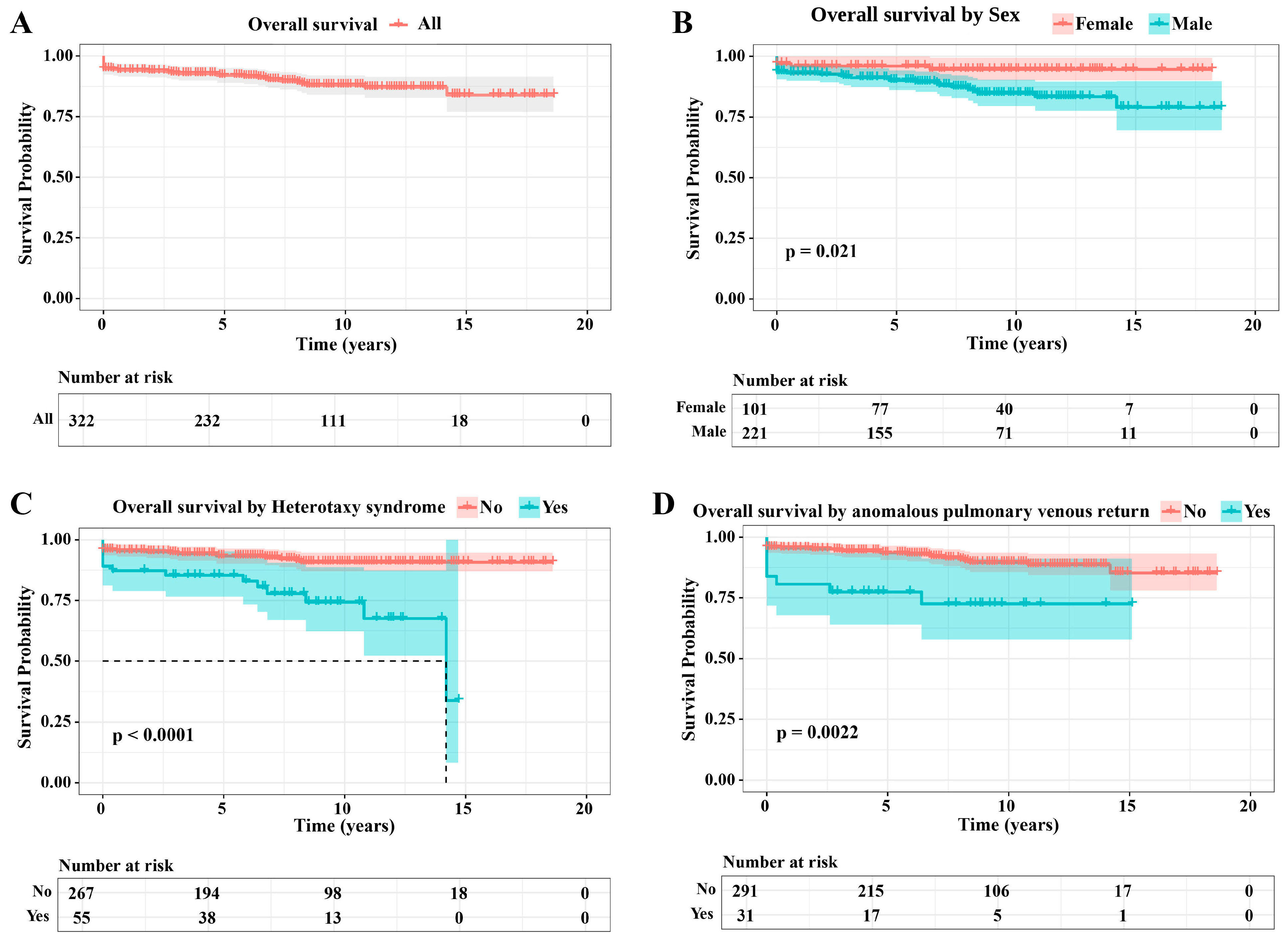
Figure 1: Kaplan-Meier Survival Analysis Following Fontan Completion. (A) Overall survival for the entire cohort, showing favorable long-term prognosis with 1-, 5-, 10-, and 15-year survival rates of 94.1%, 91.9%, 87.9%, and 83.9%, respectively. (B) Female patients had significantly better long-term survival than males (94.6% vs. 84.8% at 10 years, p = 0.021). (C) Patients with heterotaxy syndrome (HS) exhibited markedly worse outcomes, with a 10-year survival rate of 74.3% versus 90.8% in non-HS patients (p < 0.0001). (D) The presence of anomalous pulmonary venous return (APVR) was associated with reduced 10-year survival (72.6% vs. 89.6% in non-APVR patients, p = 0.0022). The x-axis represents follow-up time in years, while the y-axis denotes survival probability. Shaded areas indicate 95% CIs.
3.4 The Association between Abnormal Liver-Related Laboratory Indices and Mortality
Kaplan-Meier survival analysis comparing overall survival between patients stratified by MELD-XI score calculated from preoperative laboratory results, which were measured before Fontan completion as a baseline physiological indicator. As shown in Fig. 2A, patients with a high MELD-XI score (>9.44) exhibited significantly worse long-term survival compared to those with a low MELD-XI score (81.2% vs. 91.3%, p = 0.0094). Through age, sex, and body mass index (BMI) matching, we included another 30 Fontan patients to compare their plasma levels of hepatic biomarkers with those of healthy volunteers. The groups were comparable in sex distribution (Control: 56.7% male; Fontan: 60.0% male; p = 1.000), median age (Control: 23.5 years [IQR: 22.2–25.0]; Fontan: 21.0 years [IQR: 20.0–26.0]; p = 0.215), and BMI (Control: 21.6 ± 2.9; Fontan: 21.0 ± 3.7; p = 0.485). The results demonstrated that Fontan patients exhibited significantly elevated levels of HA (Fig. 2B), PIIINP (Fig. 2C), TIMP-1 (Fig. 2D), ELF score (Fig. 2E) and miR-122 expression (Fig. 2F).
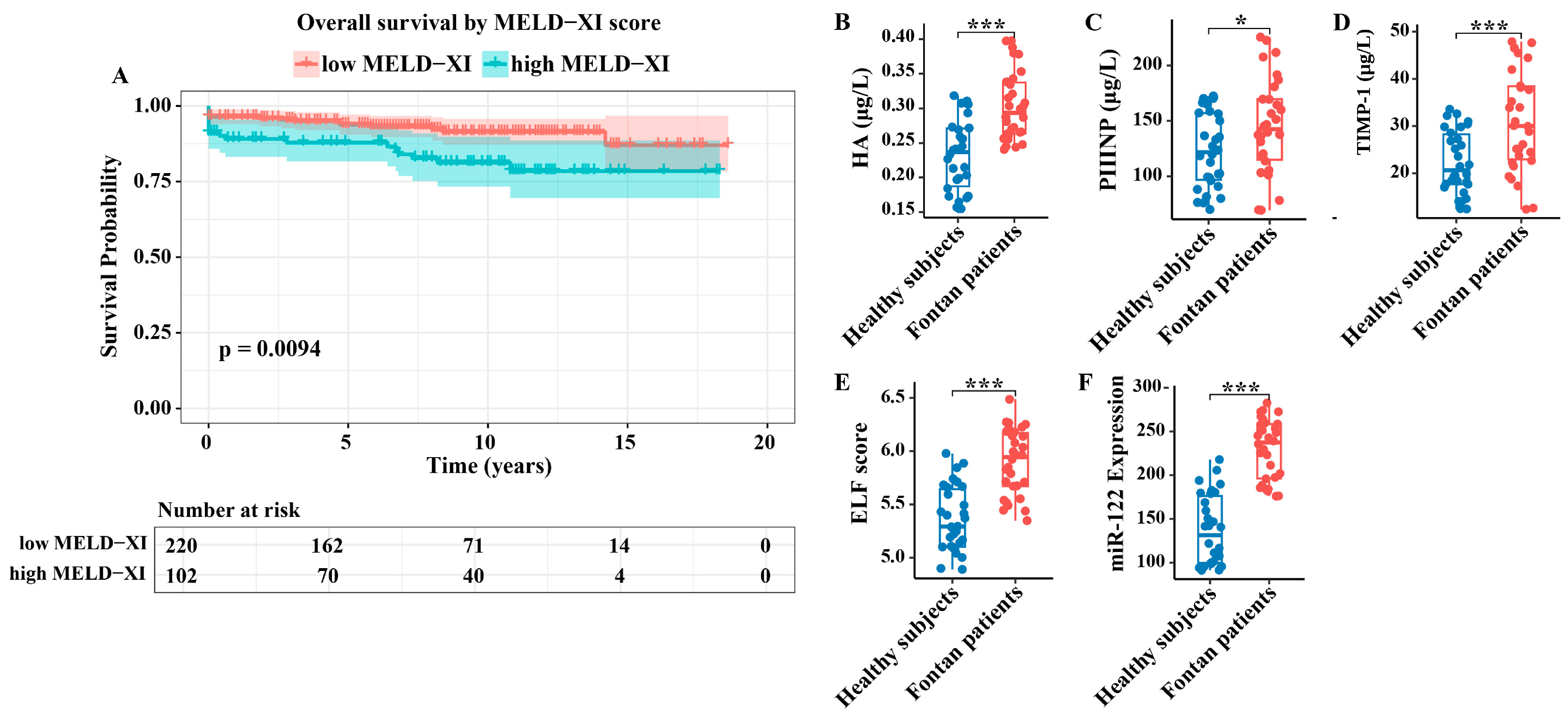
Figure 2: Association between MELD-XI score, hepatic fibrosis and injury biomarkers, and survival outcomes in patients with Fontan circulation. (A) Patients with high MELD-XI score (>9.44) exhibited significantly worse long-term survival compared to those with low MELD-XI score (81.2% vs. 91.3% at 10 years, p = 0.0094). (B–F) Fontan patients demonstrated significantly elevated levels of HA (B), PIIINP (C), TIMP-1 (D), ELF score (E), and miR-122 expression (F), compared to healthy controls. *p < 0.05, ***p < 0.001. Abbreviations: MELD-XI, Model for End-Stage Liver Disease excluding INR; HA, hyaluronic acid; PIIINP, procollagen type III N-terminal peptide; TIMP-1, tissue inhibitor of metalloproteinases-1; ELF, enhanced liver fibrosis; miR-122, microRNA-122.
3.5 Patient Survival Prognosis and Influencing Factors
Univariate Cox regression analysis was performed on candidate variables potentially affecting prognosis. The results indicated that (1) baseline anatomical variables: male sex (HR = 2.873, p = 0.029), asplenia (HR = 6.155, p = 0.000), HS (HR = 3.488, p = 0.000), APVR (HR = 3.181, p = 0.004); (2) preoperative assessment parameters: PAP (HR = 1.093, p = 0.002), PVR (HR = 1.093, p = 0.000); (3) intraoperative and surgery-dependent factors: 48-h VIS (HR = 1.058, p = 0.000), 72-h VIS (HR = 1.060, p = 0.002) and MELD-XI score (HR = 2.324, p = 0.013). To further explore independent predictors, we performed multivariate Cox regression analysis. The results showed that asplenia (HR = 5.953, p = 0.002), PAP (HR = 1.127, p = 0.004), PVR (HR = 1.077, p = 0.008), 48-h VIS (HR = 1.081, p = 0.000) and MELD-XI score (HR = 3.145, p = 0.028) were independent risk factors affecting patient prognosis. The forest plot of the Cox regression results is shown in Fig. 3. To assess the robustness of our findings, we conducted a sensitivity analysis employing a multivariable model adjusted for clinically relevant covariates based on biological plausibility and previous studies. The results corroborated our primary analysis (Fig. S3), indicating that our conclusions are insensitive to the variable selection strategy. To address the competing risks between perioperative complications and long-term failure, we performed another sensitivity analysis excluding the 12 early deaths (Fig. S4). In this model restricted to late mortality, asplenia (HR = 5.958, p = 0.032), PAP (HR = 1.137, p = 0.011), PVR (HR = 1.112, p = 0.000), and MELD-XI score (HR = 4.594, p = 0.030) remained significant predictors, while 48-h VIS lost its significance. This sensitivity analysis suggests that 48-h VIS is primarily a perioperative risk factor, and asplenia, PAP, PVR, and MELD-XI score are robust markers for chronic Fontan deterioration, independent of surgical recovery.
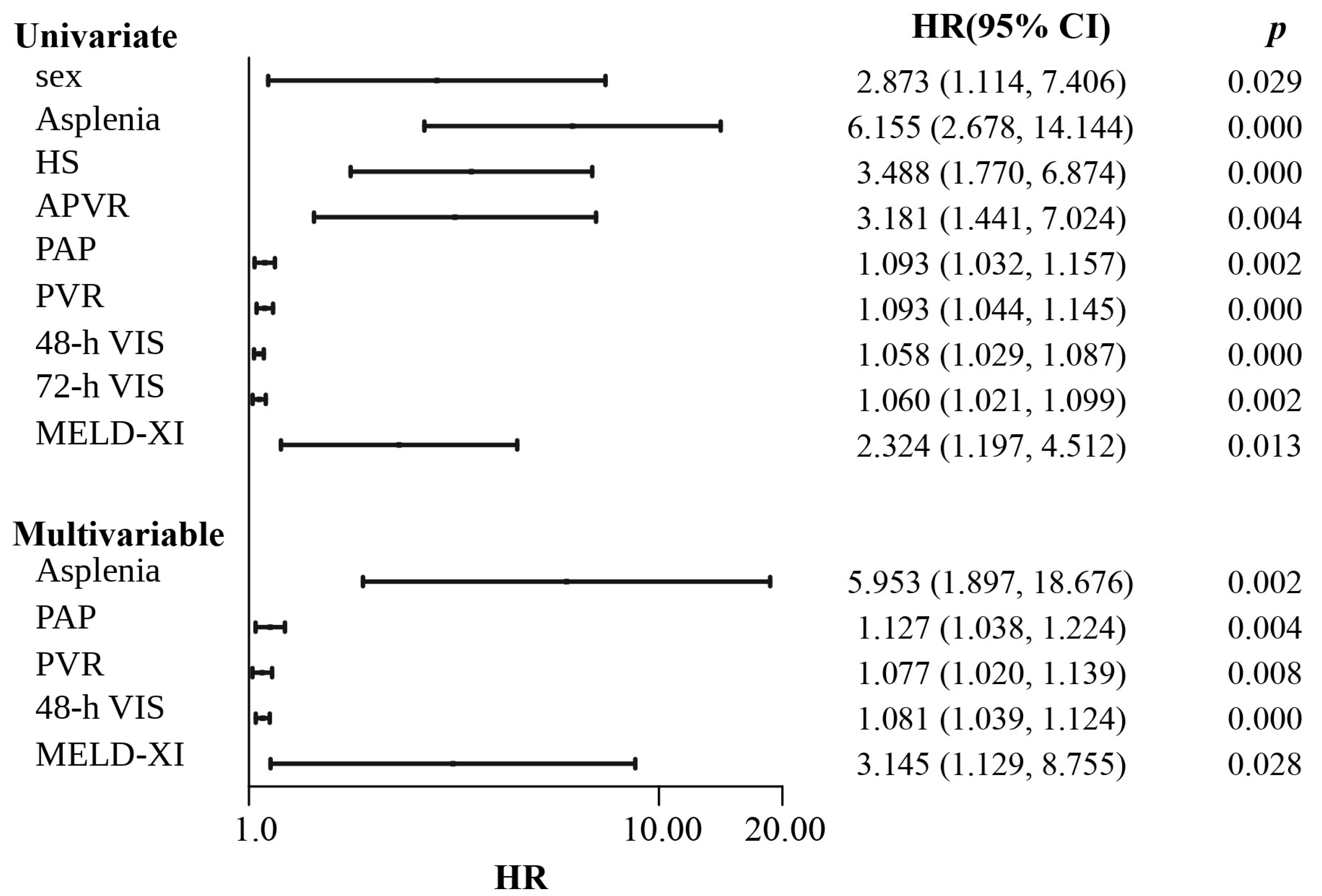
Figure 3: Forest plot of univariate and multivariate Cox regression analyses. Hazard ratios (HRs) and 95% confidence intervals (CIs) are shown for candidate variables associated with overall survival. Univariate analysis identified the following variables as significant predictors of poor prognosis: male sex (HR = 2.873, p = 0.029), asplenia (HR = 6.155, p = 0.000), HS (HR = 3.488, p = 0.000), APVR (HR = 3.181, p = 0.004), PAP (HR = 1.093, p = 0.002), PVR (HR = 1.093, p = 0.000), 48-h VIS (HR = 1.058, p = 0.000), 72-h VIS (HR = 1.060, p = 0.002), and MELD-XI score (HR = 2.324, p = 0.013). Multivariate analysis confirmed that asplenia (HR = 5.953, p = 0.002), PAP (HR = 1.127, p = 0.004), PVR (HR = 1.077, p = 0.008), 48-h VIS (HR = 1.081, p = 0.000), and MELD-XI score (HR = 3.145, p = 0.028) were independent risk factors for mortality. Variables were selected for multivariate modeling based on univariate significance (p < 0.05). Abbreviations: HS, heterotaxy syndrome; APVR, anomalous pulmonary venous return; PAP, mean pulmonary artery pressure; PVR, pulmonary vascular resistance; 48-h VIS, 48-h vasoactive-inotropic score; 72-h VIS, 72-h vasoactive-inotropic score; MELD-XI, Model for End-Stage Liver Disease excluding INR.
This single-center retrospective study presents a comprehensive analysis of long-term outcomes and prognostic determinants in a large cohort of 322 patients who underwent Fontan palliation, with a median follow-up duration of 8.0 years. The overall survival rates in this cohort are favorable, with 1-, 5-, 10-, and 15-year survival probabilities of 94.1%, 91.9%, 87.9%, and 83.9%, respectively, consistent with contemporary reports from high-volume centers [19]. Although advancements in surgical techniques, perioperative management, and postoperative care over these years, long-term outcomes showed no significant variation between patients operated on in the recent period (after 2013) versus the earlier period. Based on the 40-year follow-up results of a previous cohort undergoing the Fontan procedure, the overall survival rate was highest for patients operated on after the year 2000, showing a significant improvement compared to those operated on prior to this date [10]. Given that the earliest surgical date included in our study was 2004, this may explain why we did not observe a significant impact of the surgical era on prognosis. However, our analysis identifies several key clinical, anatomical, and physiological factors that significantly influence long-term prognosis, highlighting the heterogeneity of outcomes within this population.
Preoperative risk stratification in our cohort was multifaceted, encompassing distinct anatomical variations, hemodynamic disturbances, and systemic physiological markers. Regarding anatomical substrates, one of the most striking findings is the substantial impact of underlying congenital anatomical conditions on survival. Patients with HS, and APVR exhibited markedly worse long-term outcomes. HS is a rare congenital disorder characterized by the abnormal lateralization and arrangement of thoracoabdominal organs and systemic vasculature [20]. HS is significantly associated with elevated risks of post-Fontan cardiovascular, renal, and respiratory morbidities, as well as in-hospital mortality [21]. Although early survival following the Fontan procedure has improved in patients with HS, long-term morbidity and mortality remain substantial, with arrhythmias and thromboembolic events being prevalent complications [22]. APVR significantly impacts the prognosis of patients undergoing the Fontan procedure. This influence may be primarily manifested in three aspects. First, the concomitant repair of APVR during the Fontan procedure substantially increases surgical complexity, CPB time, and aortic clamp time. Second, these patients are more prone to postoperative pulmonary hypertension or hypertensive crises. Finally, in these patients, even subtle, undetected pulmonary venous obstruction (PVO) can gradually elevate PVR, thereby accelerating the failure of the Fontan circulation. It was found that overall survival was significantly lower in single-ventricle patients with total anomalous pulmonary venous connection (TAPVC) versus those without. Notably, PVO remained a critical determinant of poor prognosis [23]. In another study, approximately one-third of the 190 patients with single-ventricle physiology and TAPVC had PVO. Importantly, the presence of PVO was independently associated with worse long-term outcomes and a markedly elevated mortality risk [24]. In terms of physiological and demographic factors, our findings indicate a significant impact of sex on prognosis, with male patients exhibiting inferior long-term survival rates. It was identified that male sex as a significant predictor of prolonged length of stay following TCPC completion in the November to March period [25]. And Kim et al. found that aortic dilation at the root and ascending segment is prevalent after the Fontan procedure, and male sex is one of the independent risk factors for severe dilation [26]. Additionally, emerging evidence suggests that female sex was significantly associated with superior exercise performance among patients with Fontan physiology, with females being overrepresented in the highest tertiles of both peak oxygen consumption and ventilatory anaerobic threshold [27]. This sex-based difference might be attributed to a combination of biological factors, however, the exact mechanisms remain unclear and warrant further investigation.
The Fontan procedure is, by nature, a palliative procedure. The unique physiological characteristics of Fontan circulation, including chronically elevated systemic venous pressure, significant alterations in pulmonary arterial hemodynamics, and reduced cardiac output, predispose patients to a spectrum of clinical complications. These complications severely impact patients’ quality of life and may even lead to premature death [11,12]. The systemic impact of the Fontan procedure extends beyond the cardiovascular system, involving other organs and resulting in exercise intolerance, susceptibility to respiratory infections, microalbuminuria, anxiety, depression, protein-losing enteropathy, and FALD [6,28,29]. Concerning hepatic and multisystem involvement, in this study, we found that patients with elevated MELD-XI scores had significantly worse survival, and the MELD-XI score was confirmed as an independent risk factor in multivariate analysis. This finding is particularly significant given the growing recognition of FALD as a major long-term complication. In our previous study, we demonstrated that the severity of liver disease following the Fontan procedure is significantly associated with mortality [13]. Overall, elevated MELD-XI scores, serving as a surrogate for abnormal liver-related laboratory indices, are significantly associated with long-term mortality after Fontan palliation. However, without direct histological or radiological confirmation, these findings should not be interpreted as definitive evidence that established FALD drives mortality. Furthermore, elevated MELD-XI values frequently correlate with increased central venous pressure and diminished cardiac output, functioning as a marker of advanced multisystem Fontan failure rather than a specific mediator of hepatic injury. Importantly, as the MELD-XI scores in this study were derived from preoperative laboratory data, they reflect the patient’s baseline multisystem vulnerability before Fontan completion rather than the hemodynamics of an established Fontan circulation.
The observed elevation in liver injury markers, including HA, PIIINP, TIMP-1, ELF score, and miR-122, suggests the presence of active hepatic fibrogenesis and hepatocellular injury in this population. Accumulating evidence indicates that circulating HA serves as an earlier biomarker for hepatic injury compared to traditional aminotransferase indices [30]. Furthermore, PIIINP has been proposed as a marker for fibrogenesis in various fibroproliferative conditions, including liver and pulmonary fibrosis [31]. Similarly, plasma levels of TIMP-1 have been suggested as potential non-invasive markers for the early detection of liver fibrosis [32]. Additionally, miR-122, which is predominantly generated in the liver, is constantly released into the circulation, with significant plasma elevations observed following hepatic injury [33]. These studies suggest that non-invasive liver stiffness and fibrosis markers, combined with MELD-XI, may serve as valuable tools for risk stratification and longitudinal assessment of liver health. However, these findings are hypothesis-generating and require further validation.
Regarding specific prognostic predictors, building on the Kaplan-Meier analysis, we conducted Cox regression to further elucidate the underlying factors and control for potential biases. In multivariate analysis, asplenia emerged as the strongest independent predictor of mortality, underscoring its association with increased morbidity and mortality. Heterotaxy patients are classified into asplenia and polysplenia syndromes [34], significant mortality remains a challenge following the Fontan procedure in heterotaxy patients, particularly in the asplenia subgroup [35]. The underlying causes may include the frequent co-occurrence of PVO and AVV regurgitation, which increase surgical complexity and predispose patients to postoperative low cardiac output syndrome and heart failure. It was showed that mortality is particularly high when TAPVC, pulmonary atresia, and moderate or greater AVV regurgitation coexist [36]. Additionally, persistent thrombocytosis in these patients significantly promotes thromboembolic events [37].
Finally, in terms of hemodynamic status, our study further demonstrates that preoperative hemodynamic parameters, particularly PAP and PVR, are independent predictors of mortality in multivariate analysis. As is well established, a mean PAP below 15 mmHg is one of the ‘Ten Commandments’ of the Fontan procedure [38]. A recent meta-analysis demonstrates that pulmonary vasodilator therapy leads to improvements in both exercise capacity and pulmonary hemodynamics among individuals with Fontan circulation [39]. Interestingly, preoperative SpO2 and CVP were not identified as significant predictors in the univariate analysis. This may be attributed to the relatively homogeneous baseline characteristics of our cohort, specifically the narrow interquartile ranges for SpO2 (77–86%) and CVP (14.0–19.0 mmHg), which could reduce the statistical sensitivity. Additionally, these standard clinical indicators may serve as less precise prognostic markers compared to more comprehensive hemodynamic parameters, such as PAP and PVR, which were significant in our analysis. The VIS serves as an objective metric for quantifying the degree of hemodynamic support provided by pharmacological agents. Elevated VIS values have been consistently identified as an independent predictor of adverse clinical outcomes. In this study, while 24-h VIS showed a trend in univariate analysis, both 48-h VIS and 72-h VIS values were independent predictors of poor survival, with 48-h VIS exhibiting the strongest effect. Research indicates that the intensity of cardiovascular support, as quantified by the maximum VIS within the first 48 h following congenital heart surgery with CPB, is a significant predictor of morbidity and mortality in young infants [14].
Several limitations of this study must be acknowledged. First, as a retrospective single-center analysis, selection bias and unmeasured confounders (e.g., ventricular function, protein-losing enteropathy, exercise capacity) may influence outcomes. Second, the definition of “recent operative era” (post—2013) may not fully capture temporal trends in surgical technique or perioperative care. Furthermore, the biomarker analysis was restricted to a small subgroup and thus excluded from the primary survival model. Although these markers demonstrate biological plausibility for liver injury in Fontan patients, their independent prognostic value warrants validation in larger future cohorts. Additionally, although baseline characteristics were comparable between groups, the survival status of lost-to-follow-up patients remains unknown, meaning some degree of informative censoring cannot be entirely excluded. Finally, our study lacks direct histological or radiological confirmation of FALD, so MELD-XI serves only as a surrogate for laboratory-based liver dysfunction rather than definitive FALD staging. Despite these limitations, the large overall sample size, extended follow-up, and inclusion of both anatomical, hemodynamic, and novel liver-specific biomarkers strengthen the validity and clinical relevance of our findings.
In conclusion, this study reaffirms that while overall survival after Fontan palliation is favorable, specific anatomical substrates-particularly HS, asplenia and APVR-are associated with significantly worse outcomes. Preoperative hemodynamic parameters (PAP, PVR), the intensity of postoperative cardiovascular support (48-h VIS), and markers of hepatic and renal dysfunction (MELD-XI score) are independent predictors of long-term survival. These findings advocate for a multimodal pre-Fontan assessment incorporating cardiac, systemic, and hepato-renal evaluations. Future prospective studies should focus on developing integrated risk prediction models that include these parameters to guide timing of surgery, optimize perioperative management, and implement early interventions for liver surveillance and protection, ultimately aiming to improve both survival and quality of life in this vulnerable population.
Acknowledgement:
Funding Statement: This research was supported by the National Natural Science Foundation of China (No. 82200435) and Medical Scientific Research Foundation of Guangdong Province of China (No. A2026173).
Author Contributions: The authors confirm contribution to the paper as follows: Conceptualization, Xiang Liu and Jimei Chen; methodology, Xiang Liu and Linjiang Han; validation, Jiazichao Tu and Ruyue Zhang; formal analysis, Xiang Liu and Linjiang Han; investigation, Xiang Liu, Linjiang Han, Zirui Huang, Jiazichao Tu and Ruyue Zhang; writing—original draft preparation, Xiang Liu; writing—review and editing, Jimei Chen; visualization, Xiang Liu and Linjiang Han; supervision, Jimei Chen; project administration, Jimei Chen; funding acquisition, Xiang Liu. All authors reviewed and approved the final version of the manuscript.
Availability of Data and Materials: The data that support the findings of this study are available from the Corresponding Author, Jimei Chen, upon reasonable request.
Ethics Approval: This study was approved by the Ethics Committee of Guangdong Provincial People’s Hospital (Approval No. KY-Q-2021-109-04) on 26 April 2022. All procedures were conducted in accordance with the Declaration of Helsinki (as revised in 2013). Written informed consent was obtained from all participants. For participants under 12 years of age, informed consent was obtained from their parents or guardians.
Conflicts of Interest: The authors declare no conflicts of interest.
Supplementary Materials: The supplementary material is available online at https://www.techscience.com/doi/10.32604/schd.2026.083722/s1.
References
1. In China TWCOTROCHAD , Hu SS . Report on cardiovascular health and diseases in China 2021: An updated summary. J Geriatr Cardiol. 2023; 20( 6): 399– 430. doi:10.26599/1671-5411.2023.06.001. [Google Scholar] [CrossRef]
2. Zhang Y , Wang J , Zhao J , Huang G , Liu K , Pan W , et al. Current status and challenges in prenatal and neonatal screening, diagnosis, and management of congenital heart disease in China. Lancet Child Adolesc Health. 2023; 7( 7): 479– 89. doi:10.1016/S2352-4642(23)00051-2. [Google Scholar] [CrossRef]
3. Khairy P , Poirier N , Mercier LA . Univentricular heart. Circulation. 2007; 115( 6): 800– 12. doi:10.1161/circulationaha.105.592378. [Google Scholar] [CrossRef]
4. Talwar S , Marathe S , Desai M , Kisku N , Bhende VV . The single ventricle presenting late: Surgical options. Indian J Thorac Cardiovasc Surg. 2025; 41( 6): 745– 55. doi:10.1007/s12055-025-01948-1. [Google Scholar] [CrossRef]
5. Fontan F , Baudet E . Surgical repair of tricuspid atresia. Thorax. 1971; 26( 3): 240– 8. doi:10.1136/thx.26.3.240. [Google Scholar] [CrossRef]
6. Rychik J , Atz AM , Celermajer DS , Deal BJ , Gatzoulis MA , Gewillig MH , et al. Evaluation and management of the child and adult with Fontan circulation: A scientific statement from the American Heart Association. Circulation. 2019; 140( 6): e234– 84. doi:10.1161/CIR.0000000000000696. [Google Scholar] [CrossRef]
7. de Leval MR , Kilner P , Gewillig M , Bull C , McGoon DC . Total cavopulmonary connection: A logical alternative to atriopulmonary connection for complex Fontan operations. Experimental studies and early clinical experience. J Thorac Cardiovasc Surg. 1988; 96( 5): 682– 95. doi:10.1016/S0022-5223(19)35174-8. [Google Scholar] [CrossRef]
8. Mazza GA , Gribaudo E , Agnoletti G . The pathophysiology and complications of Fontan circulation. Acta Biomed. 2021; 92( 5): e2021260. doi:10.23750/abm.v92i5.10893. [Google Scholar] [CrossRef]
9. d’Udekem Y , Iyengar AJ , Galati JC , Forsdick V , Weintraub RG , Wheaton GR , et al. Redefining expectations of long-term survival after the Fontan procedure: Twenty-five years of follow-up from the entire population of Australia and New Zealand. Circulation. 2014; 130( 11_suppl_1): S32– 8. doi:10.1161/circulationaha.113.007764. [Google Scholar] [CrossRef]
10. Pundi KN , Johnson JN , Dearani JA , Pundi KN , Li Z , Hinck CA , et al. 40-year follow-up after the Fontan operation: Long-term outcomes of 1,052 patients. J Am Coll Cardiol. 2015; 66( 15): 1700– 10. doi:10.1016/j.jacc.2015.07.065. [Google Scholar] [CrossRef]
11. Brosig S , Wagner R , Twal R , Meier S , Vollroth M , Markel F , et al. “Quality of life” analysis in the long-term follow-up after “Fontan” palliation for CHDs—A single-centre experience. Cardiol Young. 2024; 34( 6): 1312– 24. doi:10.1017/S1047951123004547. [Google Scholar] [CrossRef]
12. Fontan F , Kirklin JW , Fernandez G , Costa F , Naftel DC , Tritto F , et al. Outcome after a “perfect” Fontan operation. Circulation. 1990; 81( 5): 1520– 36. doi:10.1161/01.cir.81.5.1520. [Google Scholar] [CrossRef]
13. Liu X , Han L , Zhou Z , Tu J , Ma J , Chen J . Effect of liver abnormalities on mortality in Fontan patients: A systematic review and meta-analysis. BMC Cardiovasc Disord. 2024; 24( 1): 385. doi:10.1186/s12872-024-04042-3. [Google Scholar] [CrossRef]
14. Gaies MG , Gurney JG , Yen AH , Napoli ML , Gajarski RJ , Ohye RG , et al. Vasoactive–inotropic score as a predictor of morbidity and mortality in infants after cardiopulmonary bypass. Pediatr Crit Care Med. 2010; 11( 2): 234– 8. doi:10.1097/PCC.0b013e3181b806fc. [Google Scholar] [CrossRef]
15. Lichtinghagen R , Pietsch D , Bantel H , Manns MP , Brand K , Bahr MJ . The Enhanced Liver Fibrosis (ELF) score: Normal values, influence factors and proposed cut-off values. J Hepatol. 2013; 59( 2): 236– 42. doi:10.1016/j.jhep.2013.03.016. [Google Scholar] [CrossRef]
16. Amdani S , Simpson KE , Thrush P , Shih R , Simmonds J , Knecht K , et al. Hepatorenal dysfunction assessment with the Model for End-Stage Liver Disease Excluding INR score predicts worse survival after heart transplant in pediatric Fontan patients. J Thorac Cardiovasc Surg. 2022; 163( 4): 1462– 73.e12. doi:10.1016/j.jtcvs.2021.02.014. [Google Scholar] [CrossRef]
17. Malik G , Pidboyochynski T , Buchholz H , Freed DH , Al-Aklabi M , Bozso SJ , et al. End stage liver disease models and outcomes in pediatric patients supported with short-term continuous flow ventricular assist devices. J Heart Lung Transplant. 2019; 38( 4): S479. doi:10.1016/j.healun.2019.01.1219. [Google Scholar] [CrossRef]
18. Saito Y , Nakai T , Ikeya Y , Kogawa R , Otsuka N , Wakamatsu Y , et al. Prognostic value of the MELD-XI score in patients undergoing cardiac resynchronization therapy. ESC Heart Fail. 2022; 9( 2): 1080– 9. doi:10.1002/ehf2.13776. [Google Scholar] [CrossRef]
19. Schwartz I , McCracken CE , Petit CJ , Sachdeva R . Late outcomes after the Fontan procedure in patients with single ventricle: A meta-analysis. Heart. 2018; 104( 18): 1508– 14. doi:10.1136/heartjnl-2017-312807. [Google Scholar] [CrossRef]
20. Riguetto CM , Pelichek S , Moura Neto A . Heterotaxy syndrome with agenesis of dorsal pancreas and diabetes mellitus: Case report and review of the literature. Arch Endocrinol Metab. 2019; 63( 4): 445– 8. doi:10.20945/2359-3997000000142. [Google Scholar] [CrossRef]
21. Duong SQ , Zaniletti I , Lopez L , Sutherland SM , Shin AY , Collins RT II . Post-operative morbidity and mortality after Fontan procedure in patients with heterotaxy and other situs anomalies. Pediatr Cardiol. 2022; 43( 5): 952– 9. doi:10.1007/s00246-021-02804-w. [Google Scholar] [CrossRef]
22. Bartz PJ , Driscoll DJ , Dearani JA , Puga FJ , Danielson GK , O’Leary PW , et al. Early and late results of the modified Fontan operation for heterotaxy syndrome 30 years of experience in 142 patients. J Am Coll Cardiol. 2006; 48( 11): 2301– 5. doi:10.1016/j.jacc.2006.07.053. [Google Scholar] [CrossRef]
23. Heinisch PP , Kido T , Burri M , Kornyeva A , Mertin J , Vodiskar J , et al. Impact of total anomalous pulmonary venous connection in staged single ventricle palliation. Ann Thorac Surg. 2023; 115( 5): 1213– 21. doi:10.1016/j.athoracsur.2022.07.021. [Google Scholar] [CrossRef]
24. Geoffrion TR , Aronowitz DI , Mangeot C , Ittenbach RF , Lodge AJ , Fuller SM , et al. Contemporary outcomes for functional single ventricle with total anomalous pulmonary venous connection. J Thorac Cardiovasc Surg. 2024; 167( 6): 2177– 85.e1. doi:10.1016/j.jtcvs.2023.09.046. [Google Scholar] [CrossRef]
25. Salam S , Dominguez T , Tsang V , Giardini A . Longer hospital stay after Fontan completion in the November to March period. Eur J Cardiothorac Surg. 2015; 47( 2): 262– 8. doi:10.1093/ejcts/ezu134. [Google Scholar] [CrossRef]
26. Kim YY , Rathod RH , Gauvreau K , Keenan EM , Del Nido P , Geva T . Factors associated with severe aortic dilation in patients with Fontan palliation. Heart. 2016; 103( 4): 280– 6. doi:10.1136/heartjnl-2016-309615. [Google Scholar] [CrossRef]
27. Goldberg DJ , Zak V , McCrindle BW , Ni H , Gongwer R , Rhodes J , et al. Exercise capacity and predictors of performance after Fontan: Results from the pediatric heart network Fontan 3 study. Pediatr Cardiol. 2021; 42( 1): 158– 68. doi:10.1007/s00246-020-02465-1. [Google Scholar] [CrossRef]
28. Ohuchi H , Hayama Y , Nakajima K , Kurosaki K , Shiraishi I , Nakai M . Incidence, predictors, and mortality in patients with liver cancer after Fontan operation. J Am Heart Assoc. 2021; 10( 4): e016617. doi:10.1161/JAHA.120.016617. [Google Scholar] [CrossRef]
29. Egbe AC , Connolly HM , McLeod CJ , Ammash NM , Niaz T , Yogeswaran V , et al. Thrombotic and embolic complications associated with atrial arrhythmia after Fontan operation. J Am Coll Cardiol. 2016; 68( 12): 1312– 9. doi:10.1016/j.jacc.2016.06.056. [Google Scholar] [CrossRef]
30. George J , Stern R . Serum hyaluronan and hyaluronidase: Very early markers of toxic liver injury. Clin Chim Acta. 2004; 348( 1–2): 189– 97. doi:10.1016/j.cccn.2004.05.018. [Google Scholar] [CrossRef]
31. Ulrich D , Noah EM , Burchardt ER , Atkins D , Pallua N . Serum concentration of amino-terminal propeptide of type III procollagen (PIIINP) as a prognostic marker for skin fibrosis after scar correction in burned patients. Burns. 2002; 28( 8): 766– 71. doi:10.1016/S0305-4179(02)00193-6. [Google Scholar] [CrossRef]
32. Flisiak R , Maxwell P , Prokopowicz D , Timms PM , Panasiuk A . Plasma tissue inhibitor of metalloproteinases-1 and transforming growth factor beta 1—Possible non-invasive biomarkers of hepatic fibrosis in patients with chronic B and C hepatitis. Hepatogastroenterology. 2002; 49( 47): 1369– 72. [Google Scholar]
33. Liu X , Shao Y , Han L , Zhang R , Chen J . Emerging evidence linking the liver to the cardiovascular system: Liver-derived secretory factors. J Clin Transl Hepatol. 2023; 11( 5): 1246– 55. doi:10.14218/JCTH.2022.00122. [Google Scholar] [CrossRef]
34. Kim SJ . Heterotaxy syndrome. Korean Circ J. 2011; 41( 5): 227– 32. doi:10.4070/kcj.2011.41.5.227. [Google Scholar] [CrossRef]
35. Stephens EH , Graham G , Dearani JA , Niaz T , Cetta F . Fontan palliation in patients with heterotaxy syndrome: A five decade experience. World J Pediatr Congenit Heart Surg. 2022; 13( 4): 436– 42. doi:10.1177/21501351221099944. [Google Scholar] [CrossRef]
36. Kobayashi Y , Sano S , Tokuda Y , Kimura A , Staffa SJ , Zurakowski D , et al. Long-term outcomes and risk factors for mortality after single ventricle palliation for asplenia syndrome. J Am Heart Assoc. 2026; 15( 3): e044756. doi:10.1161/JAHA.125.044756. [Google Scholar] [CrossRef]
37. Yamamura K , Joo K , Ohga S , Nagata H , Ikeda K , Muneuchi J , et al. Thrombocytosis in asplenia syndrome with congenital heart disease: A previously unrecognized risk factor for thromboembolism. Int J Cardiol. 2013; 167( 5): 2259– 63. doi:10.1016/j.ijcard.2012.06.009. [Google Scholar] [CrossRef]
38. Stern HJ . Fontan “ten commandments” revisited and revised. Pediatr Cardiol. 2010; 31( 8): 1131– 4. doi:10.1007/s00246-010-9811-9. [Google Scholar] [CrossRef]
39. Cho MJ , Kim SJ , Choi M , Lee JS , Oh KJ , Choi HJ , et al. Pulmonary vasodilator therapy in patients with Fontan circulation: A meta-analysis. Korean Circ J. 2025; 55( 8): 721– 32. doi:10.4070/kcj.2024.0378. [Google Scholar] [CrossRef]
Cite This Article
 Copyright © 2026 The Author(s). Published by Tech Science Press.
This work is licensed under a Creative Commons Attribution 4.0 International License , which permits unrestricted use, distribution, and reproduction in any medium, provided the original work is properly cited.
 Downloads
 Citation Tools
