
 Login
Login Register
 Submit a Paper
 Propose a Special lssue
 Open Access
ARTICLE

Revisiting Nonlinear Modelling Approaches for Existing RC Structures: Lumped vs. Distributed Plasticity
Department of Civil Engineering, Faculty of Architecture and Engineering, EPOKA University, Tirana, 1032, Albania
* Corresponding Author: Hüseyin Bilgin. Email:
Structural Durability & Health Monitoring 2026, 20(1), . https://doi.org/10.32604/sdhm.2025.071007
Received 29 July 2025; Accepted 03 September 2025; Issue published 08 January 2026
 View Full Text
 Download PDF
Abstract
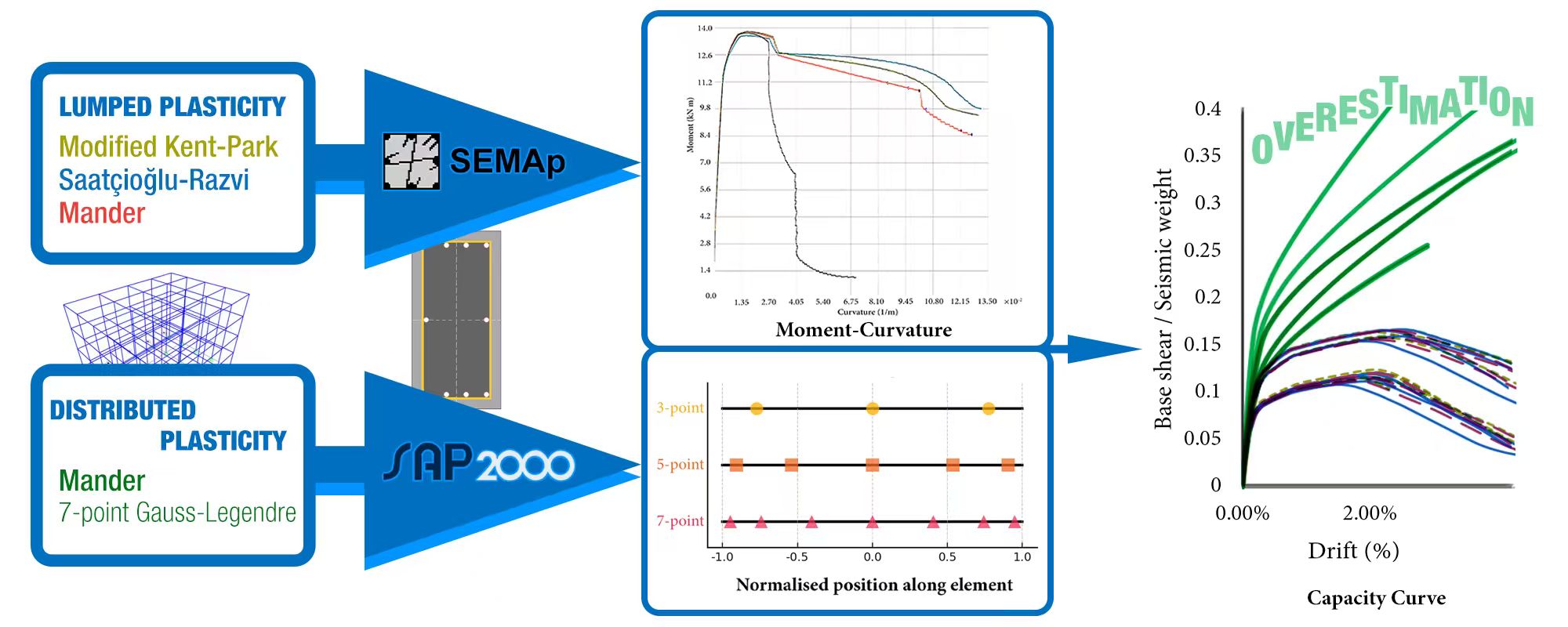
Nonlinear static procedures are widely adopted in structural engineering practice for seismic performance assessment due to their simplicity and computational efficiency. However, their reliability depends heavily on how the nonlinear behaviour of structural components is represented. The recent earthquakes in Albania (2019) and Türkiye (2023) have underscored the need for accurate assessment techniques, particularly for older reinforced concrete buildings with poor detailing. This study quantifies the discrepancies between default and user-defined component modelling in pushover analysis of pre-modern reinforced concrete structures, analysing two representative low- and mid-rise reinforced concrete frame buildings. The lumped plasticity approach incorporates moment-rotation relationships derived from actual member properties and reinforcement configurations, while the distributed plasticity approach uses software-generated default properties based on modern codes. Results show that the distributed plasticity models systematically overestimate both the strength and the deformation capacity by up to 35% compared to lumped plasticity models, especially in buildings with poor detailing and low concrete strength. These findings demonstrate that default software procedures, widely used in practice but not validated for pre-modern structures, produce dangerously unconservative seismic performance estimates. The study provides quantitative evidence of the critical need for tailored modelling strategies that reflect the actual conditions of the existing building stock.Graphic Abstract
Keywords
Reinforced concrete frames; seismic assessment; pushover analysis; lumped plasticity; distributed plasticity
Cite This Article
APA Style
Bilgin, H., Plaku, B. (2026). Revisiting Nonlinear Modelling Approaches for Existing RC Structures: Lumped vs. Distributed Plasticity. Structural Durability & Health Monitoring, 20(1). https://doi.org/10.32604/sdhm.2025.071007
Vancouver Style
Bilgin H, Plaku B. Revisiting Nonlinear Modelling Approaches for Existing RC Structures: Lumped vs. Distributed Plasticity. Structural Durability Health Monit. 2026;20(1). https://doi.org/10.32604/sdhm.2025.071007
IEEE Style
H. Bilgin and B. Plaku, “Revisiting Nonlinear Modelling Approaches for Existing RC Structures: Lumped vs. Distributed Plasticity,” Structural Durability Health Monit., vol. 20, no. 1, 2026. https://doi.org/10.32604/sdhm.2025.071007
 Copyright © 2026 The Author(s). Published by Tech Science Press.
This work is licensed under a Creative Commons Attribution 4.0 International License , which permits unrestricted use, distribution, and reproduction in any medium, provided the original work is properly cited.
 Downloads
 Citation Tools
