
 Login
Login Register
 Submit a Paper
 Propose a Special lssue
 Open Access
REVIEW
Digital Twins and Cyber-Physical Systems: A New Frontier in Computer Modeling
1 Department of Computer Science and Engineering, SRM University AP, Amaravati, 522240, India
2 School of Computer Science and Engineering, VIT-AP University, Amaravathi, 522240, India
3 Robotics and Internet-of-Things Laboratory, Prince Sultan University, Riyadh, 12435, Saudi Arabia
4 Department of Math and Computer Science, Brandon University, Brandon, MB R7A6A9, Canada
5 Research Centre for Interneural Computing, China Medical University, Taichung, 40402, Taiwan
* Corresponding Author: S Gopikrishnan. Email:
(This article belongs to the Special Issue: Data-Driven and Physics-Informed Machine Learning for Digital Twin, Surrogate Modeling, and Model Discovery, with An Emphasis on Industrial Applications)
Computer Modeling in Engineering & Sciences 2025, 143(1), 51-113. https://doi.org/10.32604/cmes.2025.057788
Received 27 August 2024; Accepted 20 December 2024; Issue published 11 April 2025
 View Full Text
 Download PDF
Abstract
Cyber-Physical Systems (CPS) represent an integration of computational and physical elements, revolutionizing industries by enabling real-time monitoring, control, and optimization. A complementary technology, Digital Twin (DT), acts as a virtual replica of physical assets or processes, facilitating better decision making through simulations and predictive analytics. CPS and DT underpin the evolution of Industry 4.0 by bridging the physical and digital domains. This survey explores their synergy, highlighting how DT enriches CPS with dynamic modeling, real-time data integration, and advanced simulation capabilities. The layered architecture of DTs within CPS is examined, showcasing the enabling technologies and tools vital for seamless integration. The study addresses key challenges in CPS modeling, such as concurrency and communication, and underscores the importance of DT in overcoming these obstacles. Applications in various sectors are analyzed, including smart manufacturing, healthcare, and urban planning, emphasizing the transformative potential of CPS-DT integration. In addition, the review identifies gaps in existing methodologies and proposes future research directions to develop comprehensive, scalable, and secure CPS-DT systems. By synthesizing insights from the current literature and presenting a taxonomy of CPS and DT, this survey serves as a foundational reference for academics and practitioners. The findings stress the need for unified frameworks that align CPS and DT with emerging technologies, fostering innovation and efficiency in the digital transformation era.Keywords
Cyber-Physical Systems (CPS) integrate computational, networking and physical components to seamlessly interact with the real world through sensor data collection and control loops [1]. Communication modules will hand over the measured data to the controller, which is software. Controllers make decisions and perform actions based on data collected via feedback loops [2,3]. CPS is a complex and multidimensional system that fills the gap between the virtual and physical worlds. Computation, communication and control in CPS, referred to as the “3C,” enable legitimate sensing, feedback of information, and control in addition to various services. Feedback loops, along with significant connectivity, provide a close intertwining of physical and computer processes [4]. The authors in [5] proposed a CPS framework consisting of the design of the connection, conversion, cyber, recognition, and configuration layers (5C CPS) to meet the objective of durable, smart, and self-adaptable robots.
A Digital Twin (DT) is a virtual replica of a physical object or process, allowing real-time monitoring, simulation, and optimization by mirroring the state and behavior of the physical counterpart. DT creates computerized representations of real physical processes to mimic and provide feedback on their real-world nature [6]. A DT is a dynamic mapping strategy that breaks down the limits in the product life cycle and gives an object a digital imprint [7]. As a result, DTs help firms predict and detect physical problems earlier and more precisely, as well as improve manufacturing processes and deliver superior goods [8]. DTs are dynamic models of physical systems built to address the specific needs of various stakeholders such as engineers, operators, and decision-makers. Multiple models of the same entity may exist to cater to different interests. A system must meet several requirements to be classified as a CPS. Increasing the efficiency and flexibility of different application processes requires greater autonomy and faster decision-making. CPS must be in sync with the outside environment to transmit information and trigger actions [9].
CPS and DT are key enablers of Industry 4.0. In the context of CPS, a DT serves as the digital reflection of the physical components within the system, receiving data continuously from sensors and actuators embedded in the physical environment. The Digital Twin mirrors the behavior, state, and performance of the physical system, allowing real-time monitoring, simulation, and predictive analysis. This integration allows for optimized control and decision-making within the CPS, providing a testing ground for various scenarios without interrupting the actual physical processes. By facilitating advanced modeling and analysis, DT enhances the functionality of CPS, making it a crucial tool for industries adopting smart, autonomous, and interconnected systems as part of Industry 4.0. In CPS, bidirectional communication channels are present between the physical and cyber realms. The addition of the Internet of Things (IoT) in the physical world will connect different types of sensors, actuators, and control devices to the equipment for actual data propagation, processing, responses, and service [10]. As CPS’s core technology, DT gives a straightforward and practical methodology to put CPS’s functions into action. The virtual copy of a real process (or system) reflects its geometry, actual state, and behavior. It also allows you to model and control performance in real-time in the best possible way.
This research reviewed different communication protocols suitable for the physical and cyber parts of CPS, where we discussed the suitability of each protocol for different levels of CPS applications. The basic characteristics needed for CPS were mentioned by studying some modeling techniques available for CPS and also identified the challenges in modeling CPS. Eventually, according to existing research, DT is the preferred combination for modeling CPS, so the other technologies needed to develop CPS with DT were discussed. The features of DT and its main components were explored to emphasize the importance of DT in CPS. The layered architecture of DT was provided, and the enabling technologies to identify the tools required to develop DT for CPS were also presented. Various innovative applications in the combination of CPS and DT, such as in smart manufacturing, smart grids, smart healthcare, smart transportation, smart aerospace, and smart city, were examined, and the challenges of modeling were identified in all these application areas. The final aim of this research was to identify the modeling challenges of CPS, how DT is useful for developing CPS applications, and the required tools for DT were described with future research direction such as the need for a unique CPS modeling architecture.
Studying DTs and CPS together is essential because they are interconnected and complementary concepts. Understanding the relationship between DTs and CPS provides a more holistic view of how they can collectively enhance various aspects of technology, engineering, and decision-making. Here are some reasons why studying them together is beneficial.
Synergistic Benefits: DTs offer advanced modeling, simulation, and data-driven capabilities, while CPS incorporate physical components and the real-world context. By studying them together, we can leverage the strengths of each concept to achieve synergistic benefits, leading to more effective and efficient solutions in various industries.
Seamless Integration: DTs and CPS often work together in practical applications. For example, a DT of a manufacturing process can be integrated into the CPS of a smart factory to monitor and control the physical production line in real-time. Understanding how these components interact is crucial to a successful implementation.
Problem Solving:Many real-world challenges require a multidisciplinary approach that combines insights from both DTs and CPS. By studying them together, researchers and engineers can develop innovative solutions that bridge the gap between virtual and physical realms.
Performance Optimization: Integrating DTs with CPS allows continuous monitoring and optimization of physical systems. The insights gained from DTs can be used to fine-tune CPS operations, leading to improved efficiency, reduced downtime, and better resource utilization.
Risk Management: Understanding the interplay between DTs and CPS can help identify potential risks and vulnerabilities. For example, security threats targeting the DT might have severe implications on the physical system. By studying both aspects, organizations can implement comprehensive risk management strategies.
Education and Training: Students and professionals in relevant fields benefit from studying DT and CPS together, as it equips them with a wider set of skills and prepares them to tackle complex real-world problems.
Future Innovations: Emerging technologies often involve the integration of DTs and CPS. By studying them together, researchers and innovators can explore new possibilities and push the boundaries of technological advancements.
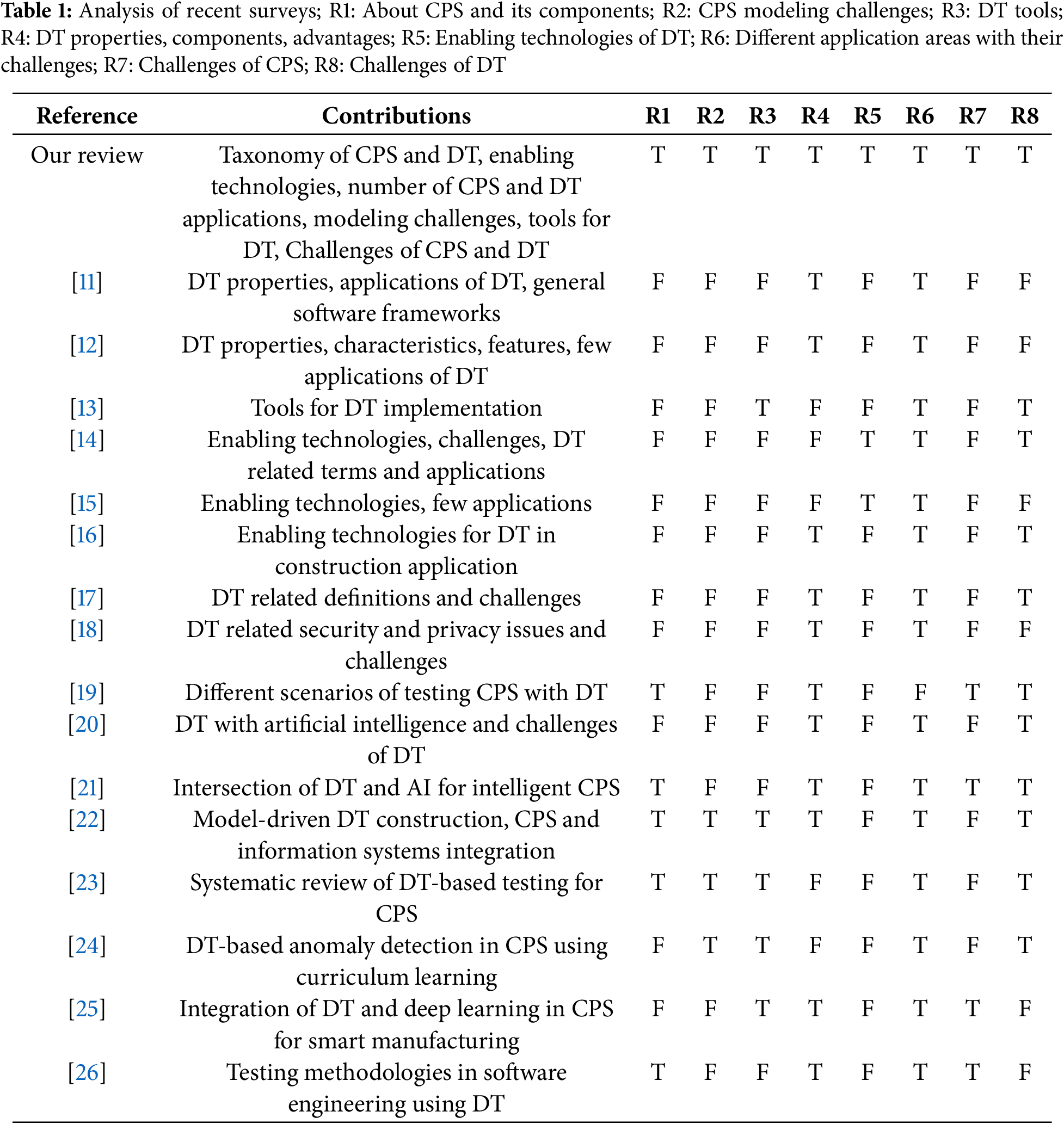
DTs and CPS together allow us to unlock their full potential, understand their interdependencies, and create more sophisticated and practical solutions for a wide range of industries and applications. Foster a comprehensive approach to problem-solving, innovation, and decision-making in the digital transformation era. In the context of recent research, CPS and DT have become highly prominent subjects, resulting in a proliferation of surveys. Table 1 presents a comprehensive analysis of previous surveys related to CPS and DT, comparing their contributions with the present survey, as illustrated in the table. Notably, this survey stands out in several aspects: it primarily focuses on implementing CPS with DT, presents the required prerequisites, offers a comprehensive taxonomy of CPS and DT, includes papers from early works to the most recent ones, examines diverse application areas of CPS and DT, and addresses the challenges associated with both CPS and DT. These distinctive characteristics distinguish this survey from others and contribute to its uniqueness and relevance in the field.
This study examined various concepts related to CPS and DT using which we can build a DT for different CPS applications. Section 2 presents the methodology adopted for conducting the review, including the search strategy, quality assessment rules, and research questions. Section 3 provides the background by defining CPS and DT, classifying their types, and reviewing recent literature to position the current survey. Section 4 elaborates on the architecture, characteristics, and modeling challenges of CPS, focusing on communication protocols, system heterogeneity, and concurrency issues. Section 5 introduces Digital Twins in depth, discussing their relationship with CPS, layered architecture, enabling technologies, components, and a roadmap for CPS-DT integration. Section 6 highlights the role of supporting technologies such as IoT, big data, machine learning, cloud computing, and blockchain in enhancing CPS and DT functionalities. Section 7 explores a wide range of application domains, including smart manufacturing, healthcare, urban infrastructure, transportation, and energy systems, emphasizing the practical utility of CPS-DT fusion. Section 8 outlines the key challenges and open issues in modeling and deploying CPS and DT, while also suggesting future research directions toward building secure, scalable, and interoperable digital frameworks. Finally, the conclusion summarizes the insights derived from the survey and reinforces the significance of CPS and DT in enabling next-generation intelligent systems.
The main objective of this review article is to explore the existing and proposed approaches to CPS and DT, including their components, characteristics, applications, and challenges. Initially, a thorough understanding of the concepts of CPS is established, which includes its components, features, and the prevalent modelling challenges. Subsequently, the relevant concepts related to DTs, such as components, properties, advantages, and various tools, are extensively investigated. The roles of different technologies in both CPS and DT are also emphasized.
This paper focuses primarily on heterogeneous CPS, encompassing both anthropogenic systems, such as industrial automation and smart grids, and natural systems, such as environmental monitoring and smart water networks. Therefore, the research methodology delves into the combined applications of CPS and DT through the analysis of multiple case studies. Each application area is thoroughly examined and the associated challenges are documented. Finally, the review presents challenges in both the CPS and DT domains, paving the way for future research directions. To achieve the study goal, a comprehensive approach is followed, which includes four distinct stages: formulation of a search strategy, selection of relevant research studies, quality assessment of the chosen studies, and in-depth analysis of case studies. Through this systematic review, the article seeks to provide a holistic view of the advancements and potential of CPS and DT, identifying areas where further research is warranted. By synthesising existing knowledge and exploring case studies, the objective of the review is to contribute to the advancement of CPS and DT technologies and their applications in diverse domains.
One of the essential aspects of a review paper is accurately defining the research topic and subsequently identifying the most relevant papers related to this topic. In the process of seeking the necessary research papers, the primary library resources employed are Science Direct, IEEE Xplore, ACM Digital Library, and Google Scholar. A thorough and extensive search was conducted, covering articles ranging from the earliest to the most recent, to identify any relevant literature regarding CPS, DT, and their combined applications. The terms encompassing terms such as “Cyber physical systems”, “CPS”, “DTs”, “DT”, “applications of CPS and DT”, “IoT in CPS and DT”, “ML in CPS and DT”, “Big data in CPS and DT”, “blockchain technology in DT implementation for CPS”, as well as domain-specific phrases like “smart manufacturing”, “smart transportation”, “smart farming”, “smart aerospace”, “smart healthcare”, “smart grid”, and “smart city”. Initially we considered 848 paper excluding conference papers and non scopus indexed papers from this list of papers, the selection process involved reviewing case studies and research articles from the earliest to the most recent publications relevant to CPS and DT. A rigorous quality assessment process was applied using seven quality assessment rules to ensure that only the most relevant and high-quality 157 papers were included in the final analysis.
The objective of this review paper is to focus on the implementation of CPS with DT. To ensure the selection of appropriate research papers for this study, certain inclusion and exclusion criteria have been applied. This review covers case studies spanning from the first to the most recent publications, with a particular emphasis on recent research papers. However, case studies that are not relevant to the topic or do not utilise machine learning models or deep learning models in the context of cloud security and case studies that are not written in the English language have not been considered.
In this review article, every research paper is subjected to inclusion and analysis, ensuring its quality and ability to address the key questions of the review. The selection process adheres to seven quality assessment rules specified within the review. Each paper is evaluated against these criteria and if it meets the prescribed threshold, it is included in the review; otherwise, it is excluded. The quality assessment rules applied in this review are presented as follows:
• QA1: Is the research question addressed by the research topic?
• QA2: Is it apparent in the paper what the study’s objectives are?
• QA3: Is the implementation issue in the research paper well defined?
• QA4: Does the collected data satisfy the following characteristics (up-to-date, comprehensive, sufficient, etc.)?
• QA5: Is the proposed ML/DL model used to solve the addressed security issue?
• QA6: In which year is the paper published?
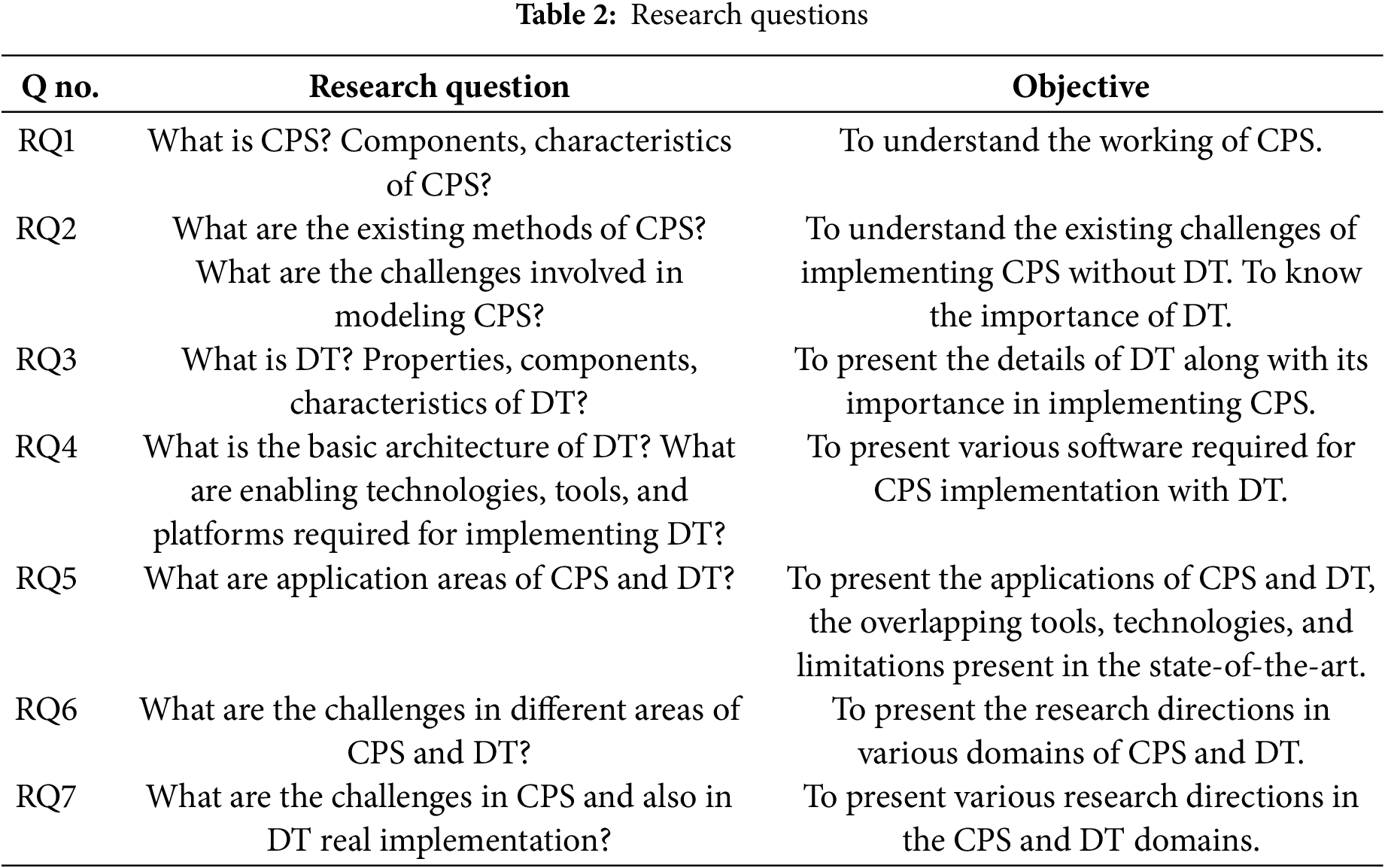
The primary focus of the paper is on the integration of CPS and DT, exploring how DT can enhance the design, operation, and modelling of CPS in various application domains. The paper provides a comprehensive survey on CPS, the role of DT in the implementation of CPS, and the challenges associated with their integration, particularly in smart applications such as smart manufacturing, healthcare, transportation, and urban infrastructure. The study also investigates enabling technologies, tools, and methodologies for modelling CPS through DT and offers insights into future research directions. Based on this, the research questions that are tried to answer in this paper are presented in Table 2.
CPS and DTs are central to Industry 4.0, enabling the integration of physical and cyber domains for real-time interaction, monitoring, and optimisation [5,7]. CPS combines physical components with computational algorithms and networking [1,2], while digital twins enhance these systems by creating virtual replicas that reflect the real-time states of physical entities [6,7]. This section defines key concepts, distinguishes between types of digital twins, clarifies the focus of this review, and positions it within the context of existing literature.
3.1 Definitions of Key Concepts
A Cyber-Physical System (CPS) is defined as a multidisciplinary system that integrates computational algorithms, network communication, and physical processes. CPS operates through real-time feedback loops, facilitating autonomous sensing, decision making, and control in various domains, including smart manufacturing, energy grids, healthcare and transportation [3,4]. The core characteristics of CPS are summarised by the “3C” framework: Computation, communication, and control, ensuring that physical components interact seamlessly with software-based systems to execute intelligent tasks [1,34].
A Digital Twin (DT) is defined as a virtual model of a physical asset, process, or system, dynamically updated with real-time data from its physical counterpart [7,14]. Not only does it mirror the current state of the physical entity, but it also enables simulations and predictive analytics [12,20]. Digital twins offer insights for improved decision making, maintenance, and optimisation. They are typically categorised into two types:
• Runtime Digital Twins operate concurrently with physical systems, allowing real-time monitoring, optimisation, and predictive maintenance [11,35]. By continuously receiving sensor data, these DTs provide immediate feedback, allowing adjustments and proactive interventions. Common applications include smart factories, autonomous vehicle control, and real-time energy management [8,16].
• Production-Stage Digital Twins, on the other hand, focus on the design, development, and testing phases [12,24]. They provide virtual simulations before physical deployment, facilitating design refinements, error detection, and resource optimisation. These DTs are especially valuable in manufacturing, aerospace, and infrastructure projects, where early virtual testing reduces cost and development time [36,37].
3.2 Overview of Recent Reviews on DT in CPS
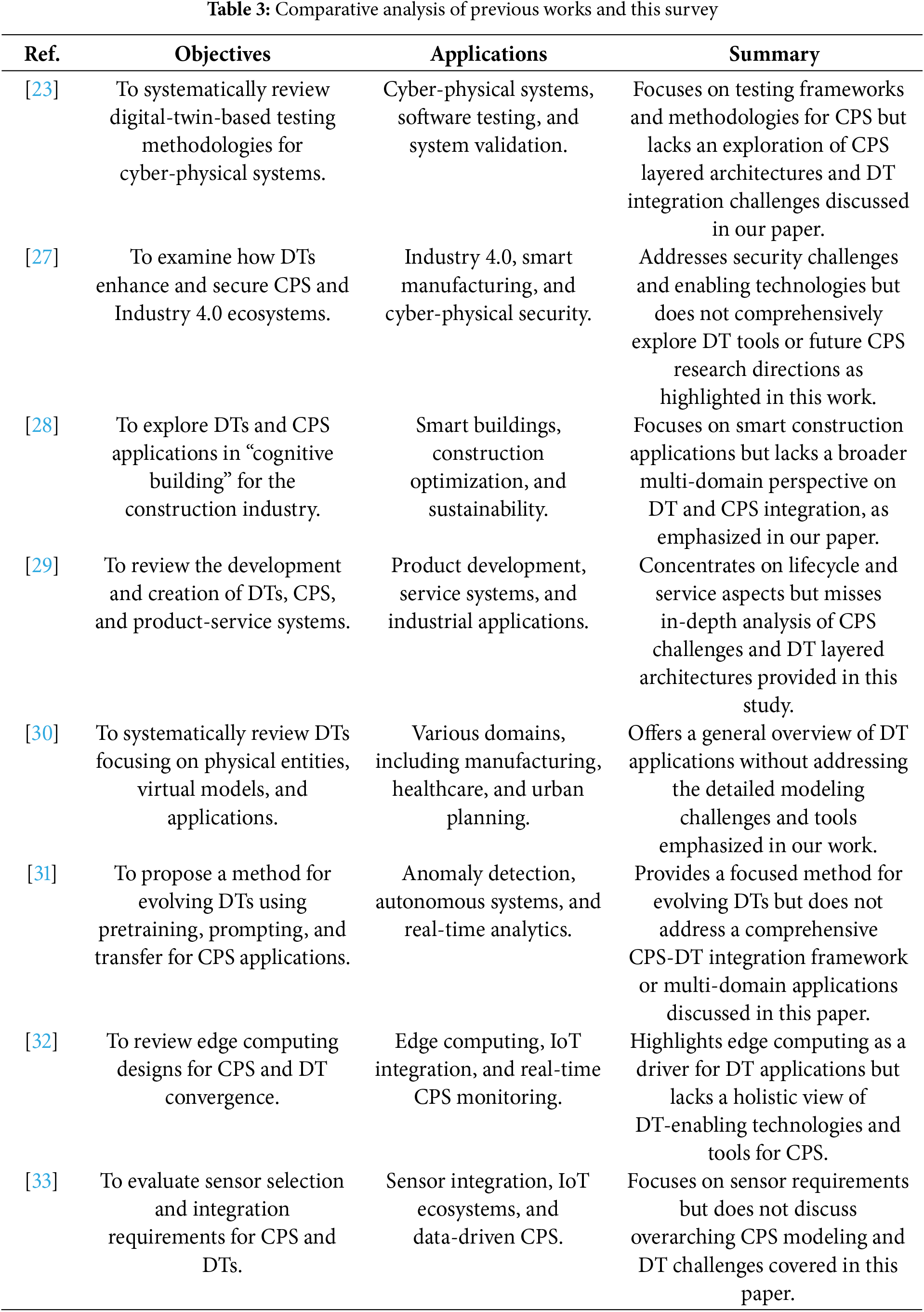
The use of DTs within CPS has been widely explored in recent literature, with numerous reviews examining their applications, enabling technologies, challenges, and potential impact in diverse domains [24,26]. The summary of the existing reviews with CPS DT implementations has been presented in Table 3. To provide context for the current study, this section offers a brief overview of key reviews highlighting the evolution of digital twin integration within CPS.
Recent reviews have focused on specific aspects of DTs, such as their roles in smart manufacturing, healthcare, energy systems, and transportation networks. For example, reviews on smart manufacturing emphasise the capabilities of runtime digital twins for real-time process monitoring, predictive maintenance, and supply chain optimisation [13,38]. These studies explore the use of IoT, AI, and big data analytics to enable seamless integration and operation of DTs within CPS environments, emphasising challenges such as interoperability, communication latency, and security risks [16,39].
In healthcare systems, reviews detail how digital twins aid patient monitoring, predictive diagnostics, and personalised medicine [40,41]. These studies emphasise the role of digital twins in real-time patient data analysis, simulation of treatment outcomes, and optimisation of healthcare workflows. Enabling technologies such as AI, cloud computing, and advanced sensors are frequently discussed, along with challenges related to data privacy, accuracy, and scalability [42,43].
Reviews on energy systems discuss how digital twins contribute to managing smart grids, optimising energy flows, and ensuring grid reliability through real-time data analytics [44,45]. These studies highlight the potential of digital twins in the production and execution stages for grid stability, energy forecasting, and resource management, while identifying barriers such as data integration, system heterogeneity, and cybersecurity vulnerabilities [23,46].
In addition, there are reviews that take a broader perspective, analysing the enabling technologies of digital twins in CPS [9,11]. These reviews provide insights into how technologies such as blockchain, machine learning, edge computing, and IoT networks are used to develop robust digital twin frameworks [25,47]. They identify the challenges of ensuring interoperability between different components of the CPS, maintaining secure communication channels, and addressing scalability requirements [48,49].
Despite the extensive coverage of digital twins in CPS, existing reviews often focus on DT in the execution or production stage, rarely offering an integrated perspective in both stages [20,39]. The present review addresses this gap by providing a comprehensive analysis that consolidates the findings of these diverse reviews, integrating the roles, applications, challenges, and enabling technologies of digital twins in the execution and production stage in CPS [19,24]. In doing so, this study not only synthesises recent insights, but also identifies areas where further research is needed, setting a foundation for future work in this field.
3.3 Contextualizing This Review within Existing Literature
This review explicitly addresses both types of digital twins runtime and production stage in the context of CPS. The aim is to provide a comprehensive analysis that integrates the roles, applications, challenges, and enabling technologies of each type within CPS environments [13,24]. While runtime digital twins focus on real-time operation, control, and predictive maintenance, production-stage digital twins emphasise design optimisation, virtual testing, and predeployment improvements [12,23]. By covering both categories, this review captures the entire lifecycle of digital twins within CPS, from initial design stages to ongoing real-time operation, offering a holistic view that encompasses diverse applications, techniques, and results [2,36]. The detailed comparison of this review with the existing review is presented in Table 3.
Recent literature has explored digital twins in CPS from various angles, including specific applications, technological frameworks, or challenges [9,14]. For example, some reviews emphasise runtime DTs, focussing on their impact on predictive maintenance, real-time control, and supply chain optimisation, particularly in smart manufacturing and transportation [13]. Other reviews concentrate on production-stage DTs, detailing their role in design simulations, process optimisation, and virtual testing in fields such as aerospace and infrastructure development [24,36]. Furthermore, several studies address enabling technologies such as IoT, AI, and blockchain that facilitate the deployment of DT in CPS, highlighting challenges related to data integration, interoperability, and cybersecurity [47,49].
However, most existing reviews focus on digital twins in the execution or production stage, rarely addressing the complete lifecycle of DT integration within CPS [19,24]. This review distinguishes itself by bridging the gap, offering a consolidated perspective that examines the implementation and implications of digital twins in the runtime and production stage across various CPS applications [12,36]. Not only does it synthesise current research, but it also identifies gaps, emerging trends, and directions for future work. By integrating findings across different phases and types of digital twins, this review aims to provide a comprehensive understanding of DTs’ contributions to CPS, addressing current limitations and setting a foundation for further exploration.
4 Cyber Physical System Architecture
The CPS system in Fig. 1 is a general architecture. Four actions take place in a typical CPS system. Sensor gadgets gather specific data from the monitored and controlled physical environment. Subsequently, these data are sent through specialised sinks and gateways, which may perform data cleaning, prediction, and aggregation as intermediate functions [50]. Data duplication can be removed by using these functions. Certain techniques may be applied to other forms of data (e.g., mean value, maximum value, minimum value, etc.). This minimises the quantity of data transported from the local environment to the rest of the system, saving bandwidth, transmission energy, and computation.
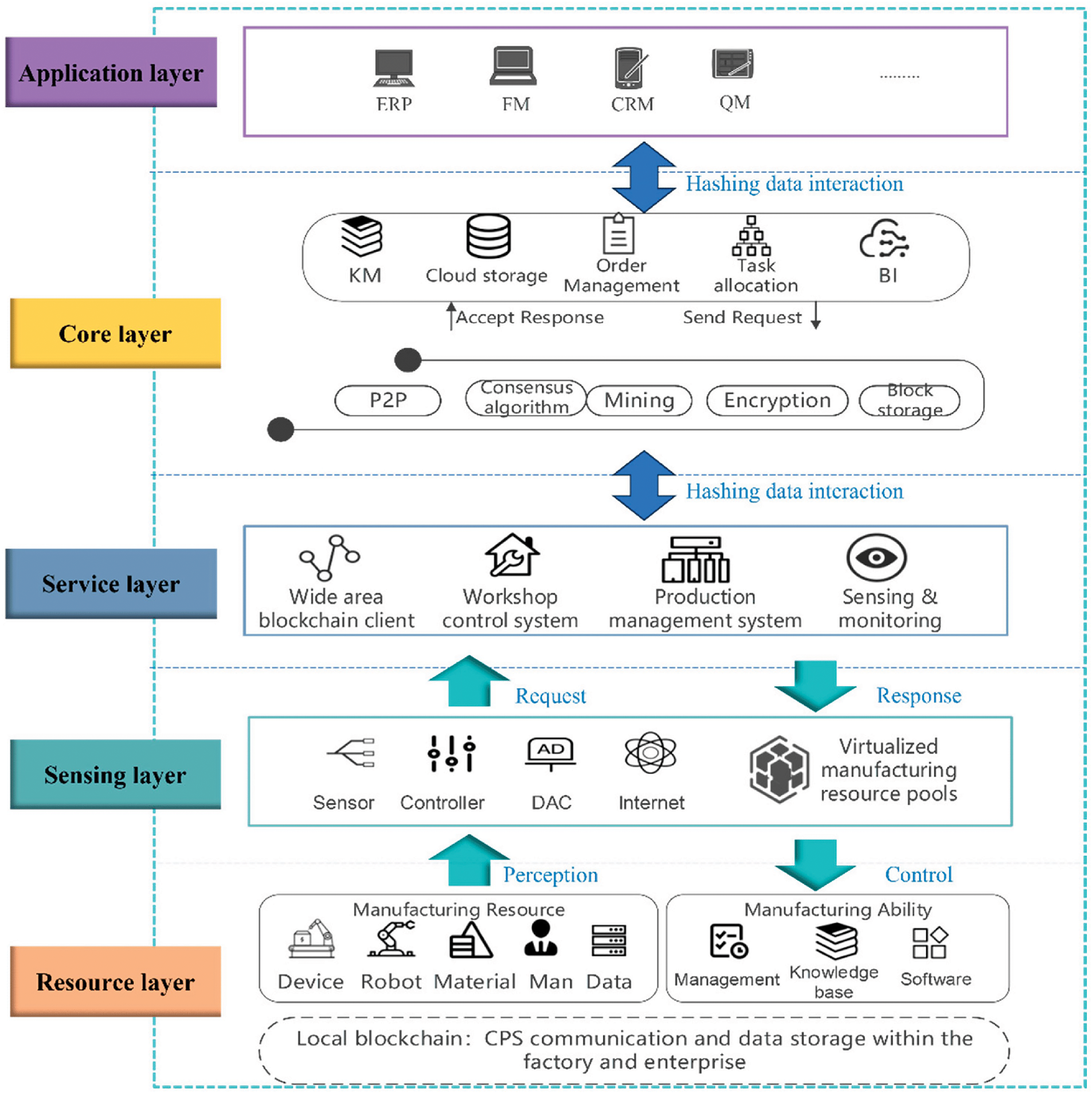
Figure 1: Cyber physical systems architecture
The data is then sent across the network to designated servers for storage, additional processing, and analysis. The Internet is usually the network used for data transfer [51]. Other types of proprietary networks controlled by businesses, which can provide better security and privacy, can also be used. Such considerations are relevant, if not critical, for particular firms that handle sensitive and secret data. Cloud computing enables the use of storage and other services, providing increased resources and flexibility.
Users and control workers can easily access the processed results and analyse them on a variety of platforms, including PCs, tablets, and mobile devices. Furthermore, the combination of user input and sensor data analysed using specific control algorithms resulted in system control commands [52]. These control commands are then executed by actuators in the physical environment, which carry out various regulatory and control functions. The localised sensors can then monitor for changes in the physical system and send the data to the database, where a server will repeat the control and feedback cycles. Fig. 2 shows a simplified representation of the different stages of a CPS. As stated previously, detection and detection, storage and analysis, deciding and acting are different phases to affect specific physical parameters and transmit the resulting data to perform the specified closed-loop process [34].
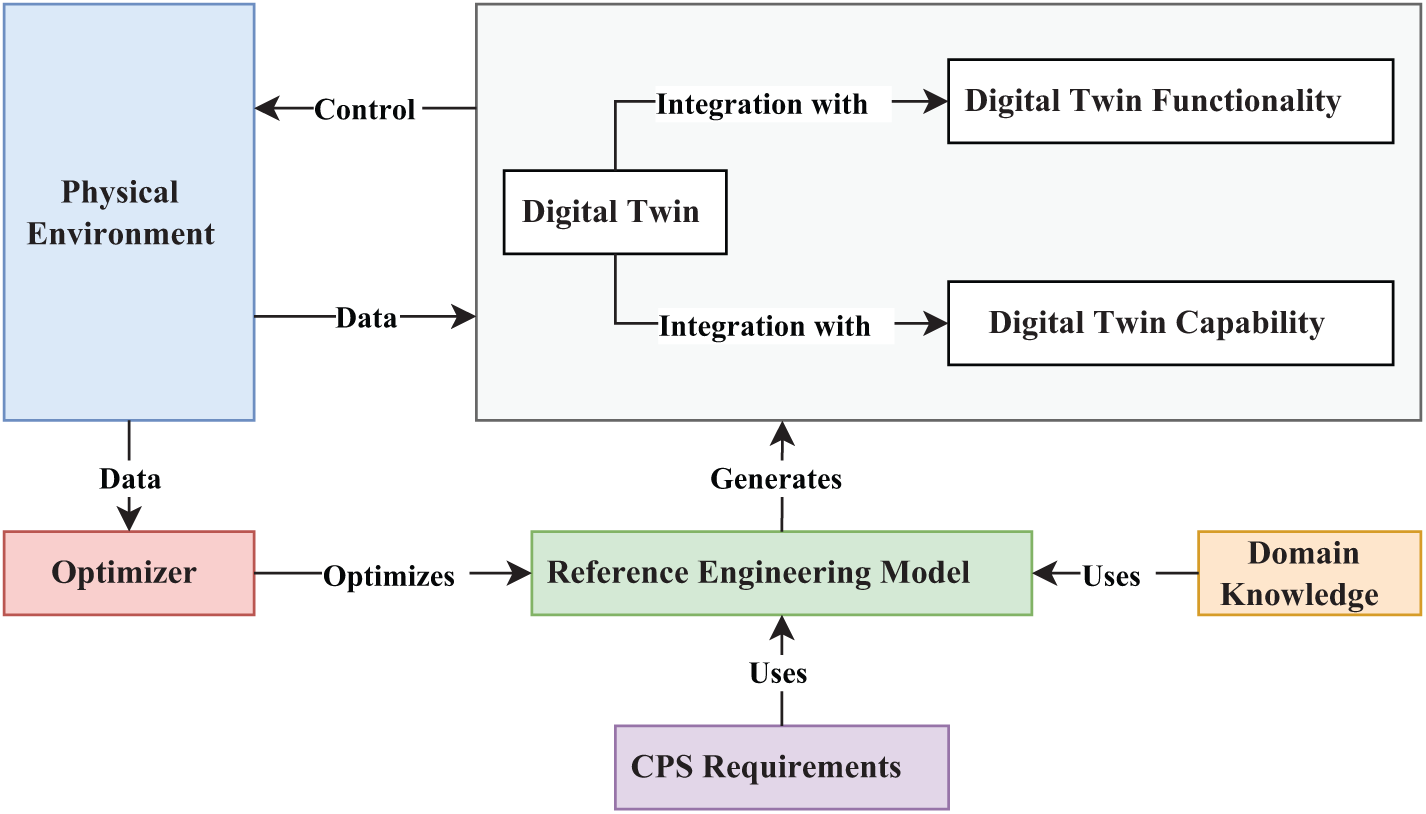
Figure 2: Phases of CPS
4.1 Communication and Computation in CPS
CPS’s computational and physical parts are gently connected. The physical entities are then monitored and controlled by the computing entities. Heterogeneous communication networks connect entities that frequently involve many computational platforms. This is a basic characteristic and a requirement for cyber-physical entities [42]. Due to their low power consumption, wireless sensors and actuators can be placed in a large number and in a range of random physical locations to measure a specific physical phenomenon. This enables more precise monitoring and control of physical processes, something that wired systems make difficult or impossible. As a result, wireless technology is extremely beneficial for CPS, and wireless sensor networks, in particular, can be regarded as an essential component for communication and control [53].
Due to the extensive use of digital systems, a variety of protocols have been developed for wired communication. The transmission control protocol/Internet protocol stacks and the user datagram protocol stacks are used in house and organizational applications, whereas the Fieldbus protocols are used in industrial applications. CAN, OPC UA, Modbus, CANopen, PROFINET, Foundation Fieldbus, INTERBUS, HART, and others [54,55] are some of the communication protocols used in industrial environments between field equipment, controllers, and software. Compared to wired alternatives, cost savings from cable replacement, changeable network topology, extensibility, and fewer operational efforts are just a few of the evident advantages [56].
Wireless communication, on the other hand, comes with a slew of obstacles that people should overcome. In most situations, wireless sensors and wireless actuators in different application domains are restricted in terms of energy efficiency, information exchange, and energy supplies, so issues such as transmission consistency, data shipping, and efficiency must be considered from the design step. The important factor affecting the choice of communication protocols in any application is the power consumption of the nodes, which must be maintained as low as possible [57]. The CPS-supported network protocols along their primary features, including the parameters of the physical and data connection layer, the data speeds, and the transmission range, are listed in Table 4.
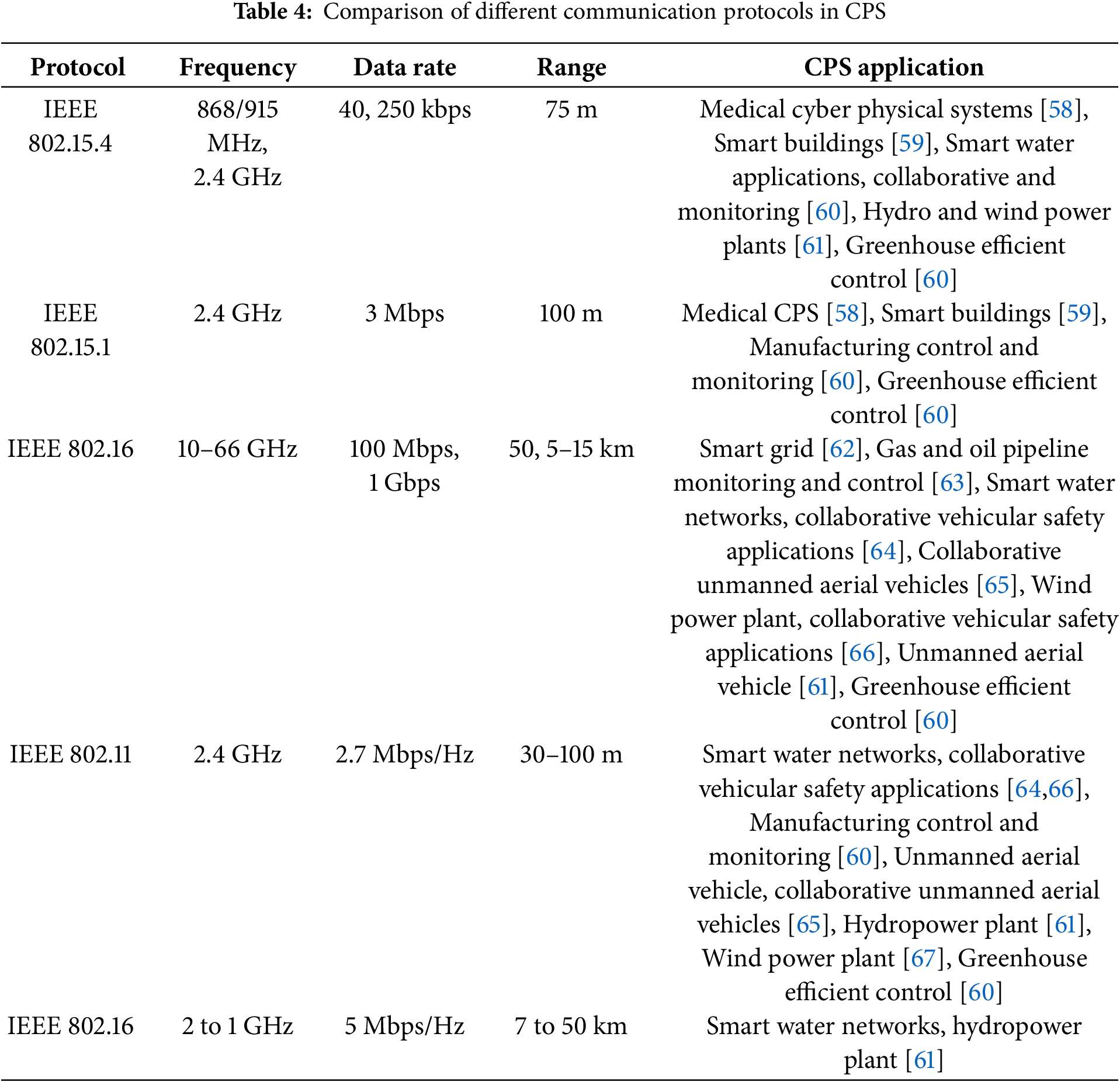
The network features and necessities of CPS are determined by various factors, such as the need for bandwidth, tolerance for delays, level of power consumption, demand for reliability, security concerns, diversity of network links (wired, wireless, or both), and mobility traits unique to each application. CPS can be categorised into four main types according to their size and geographic coverage.
Device CPSs embedded within a particular device or body operate within a limited or personal geographic space using protocols from the body area network (BAN) and personal area network (PAN) categories, such as IEEE 802.15.4 (Zigbee) and 802.15.1 (Bluetooth). These protocols are generally associated with lower bandwidth, low energy consumption, and short-range communication. Localised CPSs are located within a relatively small geographic region that covers an area of several hundred metres, such as a house, a building, a warehouse, or a manufacturing facility. These CPS applications require longer-range communication protocols from the local area network (LAN) category, such as IEEE 802.11 (WiFi). These protocols are also suitable for mobile CPS applications. However, efficient and robust routing protocols must be designed for mobile CPS systems due to the highly variable and dynamic environment.
Extensive CPS situated across a large to very large geographic region, spanning from a small city to the entire world. Mobile CPS comprises mobile nodes that establish a flexible structure. Wireless communication links enable nodes to communicate with each other using a multi-hop mechanism. As nodes move in and out of each other’s range, these links are formed and broken continuously. Communication protocols of the wide area network (WAN) category, such as IEEE 802.16 (WiMAX), cellular, and satellite, are required for extensive CPS. These protocols offer provisions to support both synchronous and asynchronous data connections. Real-time CPS applications have specific requirements for security and bandwidth. However, implementing security features often requires additional processing, which can result in increased delays and energy. Therefore, these factors should be carefully considered before implementing security features. Additionally, bandwidth requirements within the same type of application can vary from low to medium to high, depending on the type of data being generated.
The delay tolerance varies between different CPS applications. Although some applications require a low end-to-end delay, others can tolerate higher delays. For example, applications that focus on data collection and monitoring can tolerate higher delays, since the data is processed later. Examples of such applications include medical CPS that records patient data for later analysis and Unmanned Aireal Vehicles (UAVs) that take images for later processing. Power consumption is another crucial requirement for CPS applications. CPS also places great importance on reliability, ensuring that the systems operate consistently and predictably. Another critical characteristic of CPS is mobility, as nodes may be moving or the system itself may be deployed in a mobile environment.
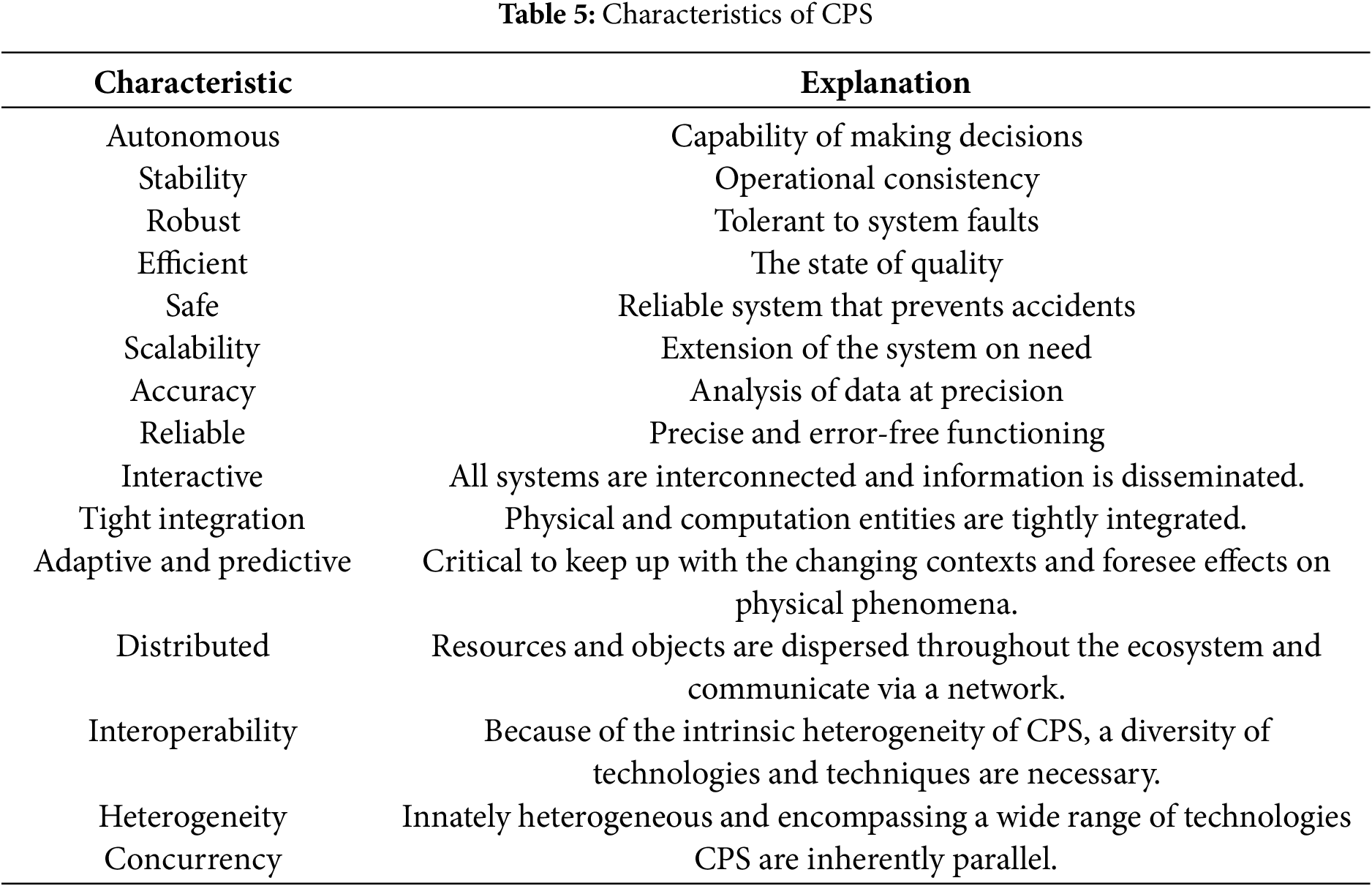
CPS has some characteristics that make it usable in different smart applications. To increase the efficiency and flexibility of manufacturing processes and also in other domains, considerable autonomy and quick choice procedures are required. CPS and the outside environment must always be in sync in order to transmit facts and trigger actions [42]. Table 5 presents the characteristics of the CPS.
Complexity/heterogeneity encapsulation: The components used to construct a CPS can have different properties, such as different processing speeds, power requirements, communication protocols and sensing capabilities. These differences in inherent properties can impact the overall performance and behaviour of the CPS. Therefore, designing a CPS requires careful consideration of the properties of each component and how they interact with each other in the system.
Interoperability: For a system to be interoperable, its components must be able to interact with each other effectively. This is particularly important for CPSs, where the ability to communicate in an understandable way is crucial to ensure an adaptive response. Standardisation is essential to achieve interoperability, as it establishes a common language or protocol that enables components from different CPSs to communicate seamlessly. Interoperability and understanding of shared knowledge are crucial in various CPS systems
Communication and connectivity: To acquire information from the physical domain and obtain feedback from the cyber environment in real time, CPSs include the communication or, analogously, the connectivity feature. With IoT, any object can be linked to the internet, enabling bidirectional connections between or between production systems; this facilitates the availability of fresh data across operations and encourages the use of horizontal applications with decentralised decision making. CPSs use the IoT’s infrastructure to exchange and analyse data, then use that information to direct the deployment of physical resources and the subsequent management of physical operations.
Networking capability/scalability: Many authors have provided descriptions of network capacity: With the goal of adding intelligence across different fields, CPSs should be made up of clusters of processing and physical components in wired or wireless networks via various sensors and actuators. Internet is commonly used to link these disciplines, allowing dynamic network participation.
Modularity: If a CPS has modularity, it can be easily modified and reconfigured to meet the ever-evolving demands of the market. As a result, the freedom afforded by modularity gives the system increased adaptability. To this end, modularity is a key feature of CPSs.
Similarity of autonomy and self-capabilities: Autonomy refers to the ability of CPSs to acquire knowledge and modify their behaviour without external intervention. Complex adaptive systems are autonomous, dynamic, and incredibly complicated. In order for the components to recover from localised changes, to disturbances and recover from localised changes. The autonomy of CPSs enhances their inherent potential.
Decentralization: The term “distribution,” which can also mean “decentralisation,” is commonly used to describe the method through which CPSs make and implement decisions. Parts of a distributed system exist on different computers connected by a network and work together to achieve a common objective by exchanging data and coordinating their efforts.
Integration: For CPSs, integration is a crucial and difficult challenge. Integrated CPSs are the natural result of the merging of computational and physical processes. As a design issue (including physical systems, software, and platform engineering), CPS integration will speed up the creation of new process networks across production assets.
Virtualization: Simply put, virtualization is the process of establishing a digital representation of the real physical environment and maintaining a connection to it over time. This includes the capacity to correlate sensor data to digital representations of factories and simulations. CPSs allow remote monitoring and analysis of physical processes, simulation of behaviour, and, in some cases, communication from the virtual environment to the field.
Real-time capability: When it comes to equipment, quality, and raw materials, CPSs with real-time capabilities can acquire, analyse, and quickly deliver real-time data. In order to meet the operational and safety demands of the system, CPSs rely on this feature, which allows them to notice any changes in the physical mechanisms and respond immediately. It follows that real-time capability may also involve taking concrete measures to forestall breakdowns.
Computational capability: The cyber components of CPSs should be able to carry out a significant chunk of the computation and control work previously undertaken by humans, with the added benefit of today’s enhanced capacity for data sharing and interoperability.
Intelligence/smartness: CPSs are expected to have intelligence, sometimes known as smartness, because of their ability to be recognised, perceive the world around them, engage in social interaction and make independent judgments. In order to impart intelligence to a physical component, CPSs equip it with the means of computation and communication. This sort of knowledge is shared among physical, communication and computational components of CPS.
Cooperation and collaboration: Despite the fact that collaboration is typically viewed as a more powerful notion due to the sharing of resources and the pursuit of common goals, the terms (cooperation and collaboration) are frequently interchanged. Cooperation refers to a distributed system’s ability to dynamically determine which of its independent subsystems will carry out a task in order to maximise performance such as reaction time.
Dynamic reconfigurability, adaptability: The ability to quickly adapt to changing market conditions and disruptions is what the term “dynamic reconfigurability” means. Specifically, CPSs can change over time by dynamically reconfiguring their structures, features, behaviours, and boundaries. To the same extent, flexibility refers to the capacity of CPSs for rapid reorganisation/reconfiguration in response to unexpected circumstances and novel objectives.
4.3 Challenges in Modeling CPS
A crucial design need for CPS is the capacity of computer elements, physical components, and communication technology to work together to deliver the desired functionality. The primary difficulties in designing and testing CPS are concurrency and asynchronous communication [68]. Furthermore, in CPS, software with time limitations is widespread, such as activities that must be executed on a regular basis, deadline requirements, or latency restrictions. Traditional control systems use discrete-time or continuous signaling, in which the controller continuously or periodically observes and acts on the physical subsystem (e.g., industrial plant). Unlike these systems, signaling in a typical CPS architecture is mediated by software and networks.
In CPS, time-triggered or event-triggered methods are often used to transfer information between physical and cyber components [69]. Physical subsystems function on a time continuum, whereas cyber subsystems are made up of discrete, sequential actions. An industrial CPS control system, for example, collects system status measurements from sensors and samples them periodically on a time-triggered basis, whereas the interaction between a man and a system often operates on a demand-interference basis when certain events occur [70]. For CPS, integrating engineering abstractions for continuous dynamics (such as differential calculus) with computer science abstractions is a major challenge (such as algorithms) [71].
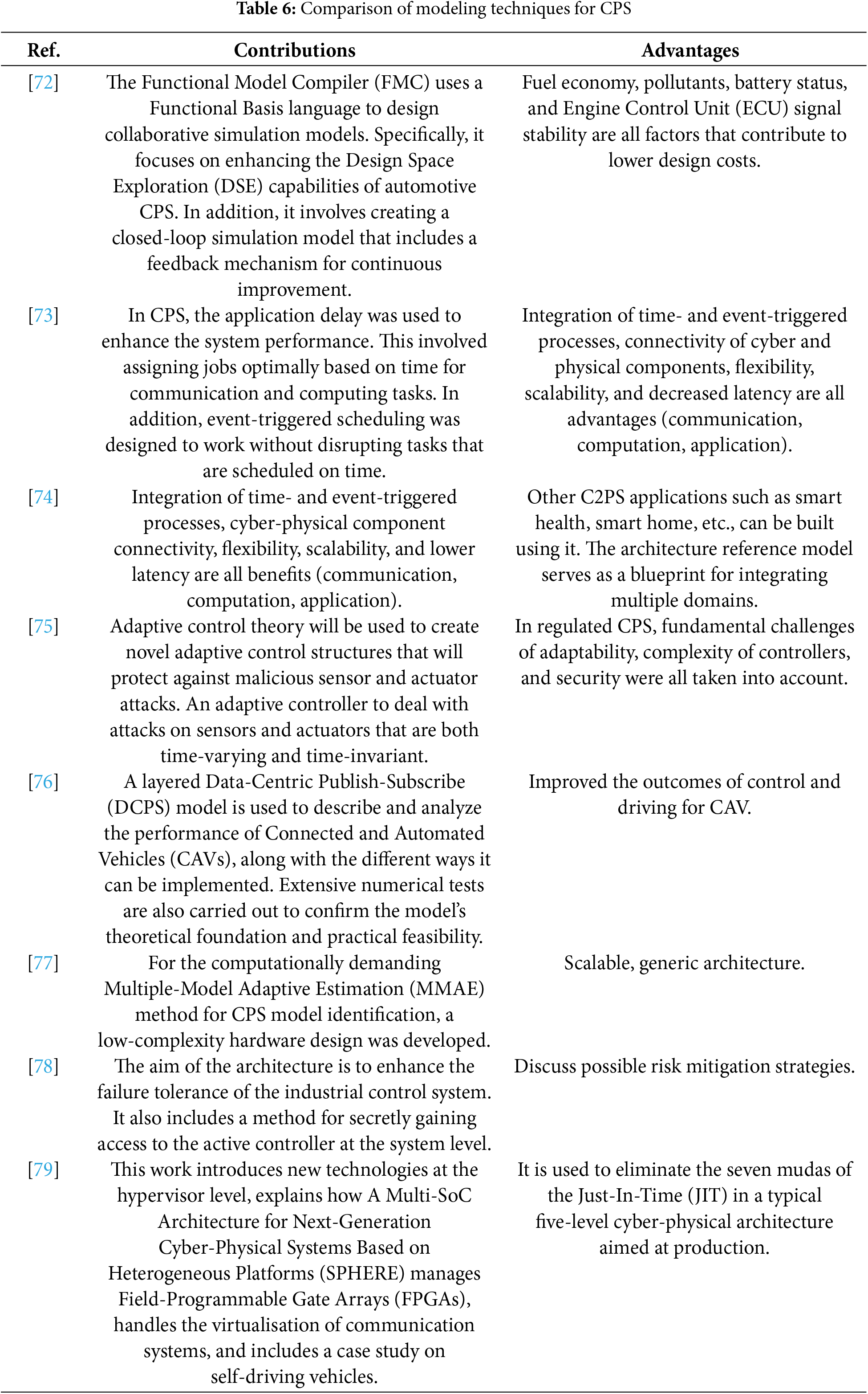
The inability to fully model interactions between various components and between the physical and cyber aspects is a major impediment to the efficient implementation of CPSs. It is difficult to explain the connections between these cyber and physical worlds precisely. Due to the required qualities, designing a CPS presents distinct challenges. As a result, a substantial gap has been discovered: there are no generalised approaches to CPS design. However, a few traits of the CPS modelling technique have been outlined, and various CPS structural concepts are being developed. The known approaches for modelling CPS are listed in Table 6.
In CPS, physical dynamics and computer operations are inherently diverse. Machine motion control and chemical and biological processes, for example, could all be part of the physical domain. In the cyber world, networking technologies, programming languages, software models, and concurrency methodologies are all possible.
As a result, the goal is to build engineering processes and tools to aid in large-scale design techniques so that the underlying systems must be studied and better understood [80]. Self-configuring, self-adjusting, and self-optimizing production environments will lead to increased agility. The authors [81] proposed a cyber-physical system of systems. This variation helps to manage CPS and makes the design process easier. The most common practical production issues are the unpredictability of the quality of the machine, the unpredictability of the prices of the machine, and the unpredictability of the machining efficiency [82]. Although process equipment is chosen with care in terms of process design, some unknown aspects are present in the real process, including damage to equipment, overlap with various processes, etc. As a result of these challenges, the processing route is usually unable to run smoothly. In addition, procedures are slowed [83] in CPS applications.
The authors argue in [84] that today’s computer processing and networking abstract concepts are insufficient for CPS modeling because of the inability to adequately render the passage of time and parallelism of a physical process, and they suggest research directions for improved computational and networked abstractions for CPS. The work in [85] illustrates the limitations of CPS modeling, as well as an evaluation of recent developments using an insightful description of a fuel management platform in an aircraft. CPS can be found in almost every industry area and operates according to the Industry 4.0 paradigm. Computation, networking, and physical processes incorporate numerous types of system with the goal of managing a physical process. To accomplish CPS, cloud and machine intelligence will increasingly combine with physical systems and processes with the help of wireless communication.
DTs, which mainly consist of real-time data collection, data mapping, and data-based anticipation technologies, will help products achieve physical and virtual space convergence [86]. From the literature on CPS modeling techniques, challenges in CPS modeling, and combined applications of CPS and DT, it can be observed that DT is useful in implementing critical safety systems, i.e., CPS. So, the concepts required for implementing CPS through DT are provided in the following sections.
5 Introduction to Digital Twins
The cyber components of the CPS driven by data promote new and inventive design methods to build, operate, and manage our smart systems in the future and the DT is an example of this. “A realistic digital depiction of assets, processes, or systems in a built or natural environment” [87] is what a DT is. DT can reflect any sort of physical, social and/or economic conditions and processes [88]. DT implementation can be done in a variety of ways. While some [89] classify DTs as prototypes, instances, aggregates, and environments, others classify them as status, operational, and simulation twins. IoT, CAD (Computer-Aided Design) models, networked sensors, artificial intelligence, data analytics, and algorithms in machine learning, as well as cognition, can be included in DTs.
Regardless of the types of CPS, the technologies involved in implementation or the systems they attempt to imitate in a digitized form, DTs facilitate a way of gathering and combining data for the enhancement, development, operation and management of physical things. Networked twins, for example, can analyze and optimize outbound energy as well as material usage through smart IoT. Alternatively, DTs can track infrastructure usage, efficiency, safety, and other metrics, as well as promote more environmentally friendly practices [87]. CPS includes software, communication protocols, and physical and embedded systems, which are recognized as a fundamental driver of digital transformation [90]. Sensors collect data from the physical environment and send it to compute units of DT. These data are analyzed by DT computing units, which subsequently notify physical systems of their findings and, in some situations, transmit controls to make the necessary adjustments to the physical environment of the system properties [91].
The Product Life cycle Management (PLM) class was an initiative of the DT. The PLM is a management of a product’s entire lifecycle, from inception to disposal. DT has rapidly expanded its application beyond PLM to additional yields such as aerospace, oil and gas, medical, and so on, because of its distinctive advantages in terms of expansibility, reproducibility, and openness. Although there is a considerable review on DTs for smart manufacturing, there is not much to say about smart cities, and they are mostly about technological decisions, with only a handful for infrastructure. CPS is built on the foundation of the DT.
5.1 Relationship between CPS and DT
While CPS integrates the physical and cyber components for real-time monitoring and control of physical systems, DT serves as the virtual counterpart of CPS by providing a digital replica of physical assets or processes. The role of CPS is to collect real-time data from physical environments, which are then fed into the DT to model, simulate, and optimize performance. DTs, in turn, enhance CPS by enabling advanced analysis, simulation, and decision-making capabilities. In essence, DT augments the CPS by providing a comprehensive platform for real-time feedback, control, and performance optimization. The relationship between CPS and DT is depicted in Fig. 3, emphasizing the flow of real-time data from CPS into the DT for simulation and optimization, with feedback enhancing control and decision-making. The left section of the diagram represents CPS, capturing real-time data from physical systems through sensors and actuators. This data flows into the DT, depicted on the right, where it is used for simulation, optimization, and predictive insights. The bi-directional arrows highlight the feedback loop where CPS influences DT and vice versa, showcasing their complementary roles.
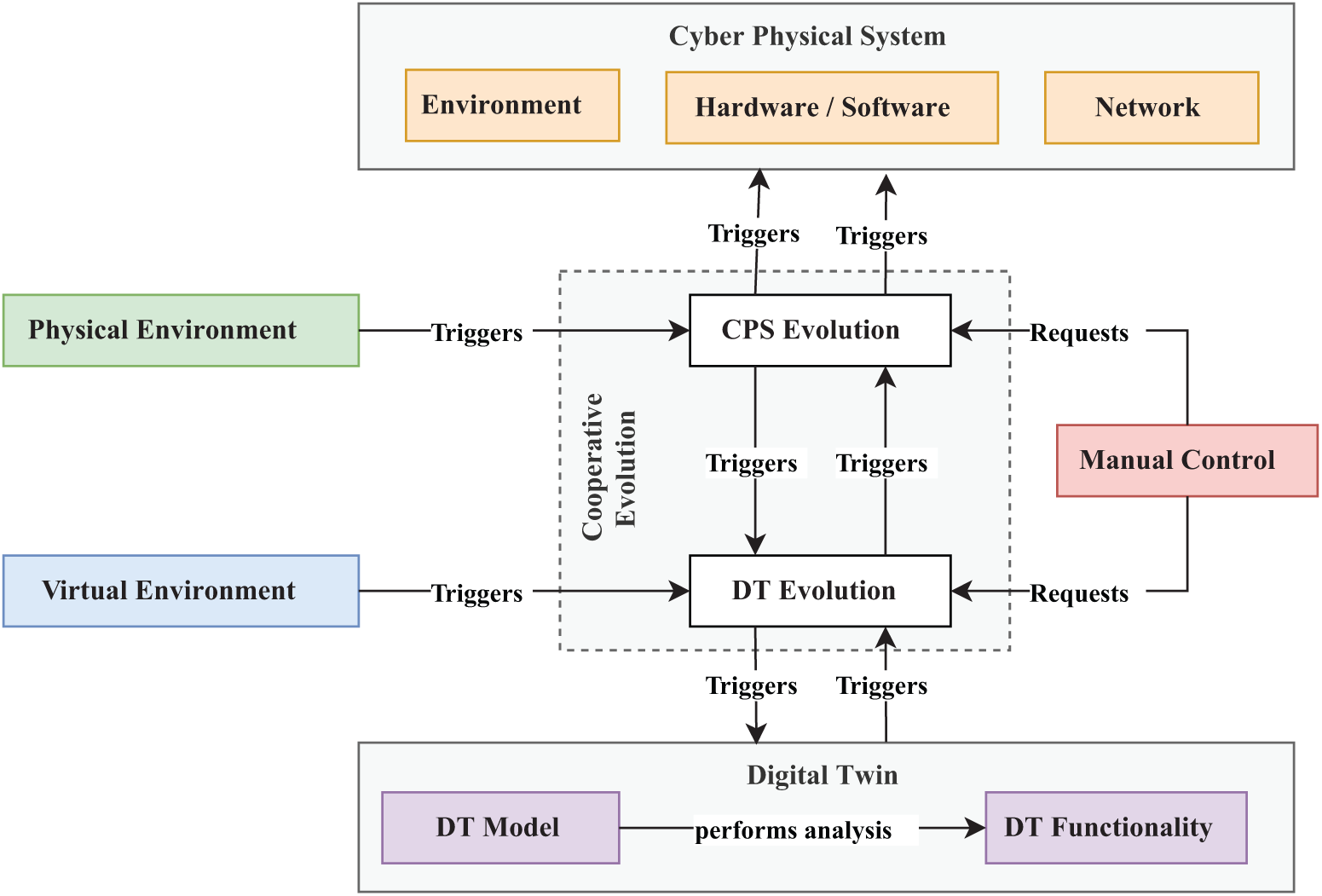
Figure 3: The visual illustration of the interplay between CPS and DT
In different applications, CPS and DT play complementary yet distinct roles: CPS Responsibilities: The primary responsibility of CPS is real-time monitoring and control of the physical system in real time. CPS ensures that physical assets operate within the desired parameters by collecting sensor data, making decisions based on control algorithms, and sending commands to actuators. DT Responsibilities: DTs are responsible for simulating, analyzing, and predicting the behavior of the physical system in real-time. They improve the CPS by providing insights that allow predictive maintenance, optimisation, and risk assessment without disrupting the actual system.
Use cases: In a smart manufacturing setup, the CPS ensures that the machinery operates correctly by monitoring performance metrics and controlling the production line. Meanwhile, DT provides predictive analytics and simulations that help optimise the production process, identify potential failures, and reduce downtime. In smart cities, CPS manages the real-time operation of infrastructure (e.g., traffic lights, energy grids), while DT simulates city-wide operations to improve resource allocation and optimise urban planning.
5.2 Layered Architecture of CPS and DTs
The modern CPS are often complex, multi-level distributed systems, structured as federated and coalition systems, which require distributed modeling approaches rather than viewing the DT as a monolithic software module. There are a number of DT architectures based on different applications. The authors in [92] proposed a unified architecture for a DT to increase processing efficiency, reduce manual intervention, and reduce investment. This allowed a combination of models and simulations at various levels. Another research in [93] identified design-derived security needs for DT-based data sharing and control and also showed that coordinating design met the expected synchronization requirement given the high-level design and other security components of the architecture. The authors [94] presented the modular architecture for the implementation of DT based on open source tools to control the process and easy tools for 3D representation. The authors [95] presented a new blockchain variant, twin chain, which proposes quantum-resilient and instant transaction confirmation. A twin chain deployment architecture for the construction of a robotic surgical machine was also presented.
In this review, we emphasize the interplay between CPS and DTs in the integration of physical and digital layers. CPS, as a bridge between the cyber and physical worlds, utilizes sensors, actuators, and real-time feedback to directly control physical systems. Given the distributed nature of CPS, the Digital Twin must comprise a system of interconnected models that represent both physical and software entities. These models allow for the layered, dynamic interaction of components, providing a more accurate and flexible simulation environment. Digital Twins, in contrast, provide a virtual representation of these physical components, offering advanced modeling, simulation, and predictive capabilities based on real-time data. Fig. 4 depicts the architecture and enabling technologies across each layer that are essential to integrate physical devices with their virtual counterparts in the cyber-physical domain. While data transfer, processing, collection, computation, and communication occur within the virtual environment, the architecture also utilizes various physical devices, sensors, and data capture systems in the real world. Layers 1 and 2 of the architecture represent the physical aspect, where Layer 1 consists of actuators, sensors, and other hardware, and Layer 2 defines the data sources for a given physical object.
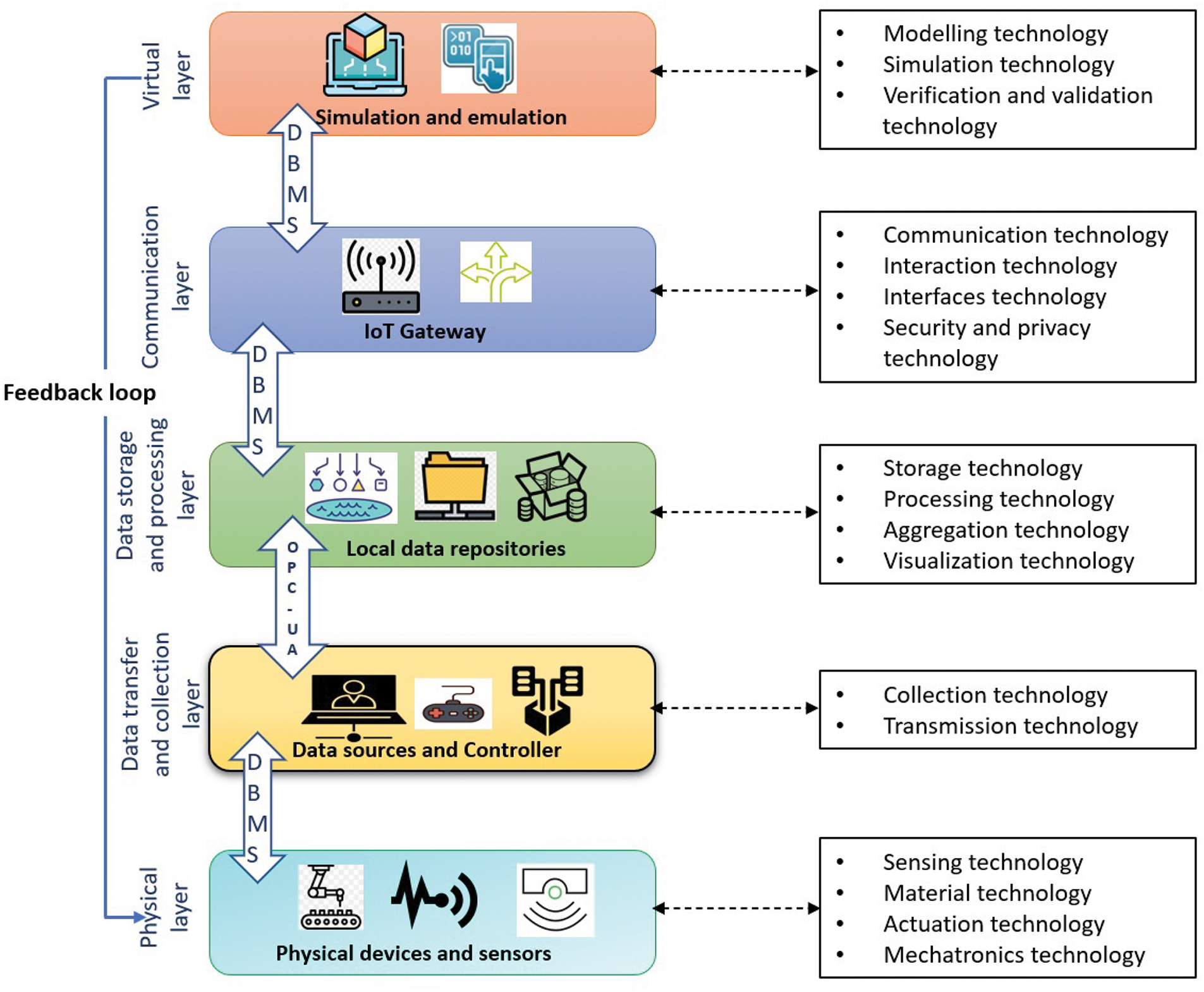
Figure 4: Layered architecture of DT with enabling technologies
While CPS is concerned with immediate interaction with the physical world, DTs rely on these inputs to maintain an accurate, real-time virtual replica of the physical system. The physical layer within the DT architecture serves an essential role in connecting DTs to real-world data, enabling synchronization between the digital twin and its physical counterpart. This layer ensures that the DT’s simulations, predictions, and optimizations reflect the current state of the physical system. Thus, CPS and DTs, though distinct, work synergistically, with CPS handling real-time physical control and DTs enhancing system performance through virtual modeling and predictive analytics. DT requires a deep understanding of the physical domain, which encompasses disciplines such as dynamics, thermodynamics, material science, structural mechanics, electromagnetism, hydro mechatronics, acoustics, and control theory. Using advanced sensing, measurement, and knowledge-based technologies, physical entities and processes are mapped to virtual environments, enhancing the realism and accuracy of the models. Throughout its operation, DT generates large amounts of data, contributing to the continuous improvement of the digital representation.
Data analysis and aggregation technologies are required to extract usable information from raw data. Data gathering, transmission, storage, processing, aggregation, and display are all part of the process. Advanced data analytics and fusion technologies are required to extract meaningful information from raw data sets. The controller values are transferred from Layer 2 to a local data vault in Layer 3, which is the interaction between the higher architectural levels and the physical entity. The most important component for efficient data sharing between the layers is Open Platform Communication-Unified Architecture (OPC-UA). The OPC-UA is a communication protocol that ensures seamless machine-to-machine interaction in industrial automation. Layer 4 uses Internet of Things (IoT) tools to transform raw data into meaningful insights. By applying various transformations to the data collected in Layer 3, this layer makes it more useful for subsequent architectural layers.
Connecting Layers 3 and 5, Layer 4 transforms Layer 2 data into suitable information for Layer 5. Again, OPC-UA is crucial to the flow of information in this scenario. The cognitive layer, that is, Layer 5, located at the top of the design, stores the physical replicas’ past data and allows for continuous monitoring of the machine’s health. This layer allows users to interact with a digital version of the physical twin, improving their ability to make decisions, enhance existing procedures, and anticipate future results. Several types of modeling techniques are required for the virtual model. Physical assets and processes must be monitored in real time using visualization technology. An accurate virtual model directly influences the performance of the DT. Therefore, verification, affirmation, and certification technologies and optimization techniques must be used to validate and optimize the models. To further speed up quality defect detection, simulations and retrospective technologies might be used. Model evolution technology is required to keep up with the ever-changing real world.
The architecture of Digital Twins allows for the inclusion of multiple models that cater to different stakeholders, each focusing on specific aspects such as operational efficiency, life cycle management, or safety. These models are built with varying perspectives to ensure that all stakeholder requirements are met effectively. As explained, DT consist of multiple layers, each performing a specific role in linking the physical and cyber domains. These layers include physical devices, data collection, and processing technologies. Each key component of the DT belongs to a specific layer:
• Physical Layer (Layer 1): This layer consists of physical devices such as sensors and actuators that collect real-world data from the physical system.
• Data Source Layer (Layer 2): The collected data from the physical layer flows through this layer, which aggregates the information and prepares it for further processing.
• Communication and Data Processing Layer (Layer 3): Here, data from the physical systems is transferred and managed using technologies like OPC-UA. This layer acts as the interface between the physical and digital environments.
• IoT and Analytics Layer (Layer 4): In this layer, data from sensors is processed into meaningful insights using advanced analytics and IoT tools. This allows for real-time decision-making based on the physical system’s state.
• Cognitive Layer (Layer 5): At the top of the architecture, this layer stores historical data and provides predictive analysis and simulation capabilities, allowing for performance optimization and future predictions.
By mapping these components to specific layers, it becomes clear how DT’s physical and virtual components interact, ultimately enabling real-time synchronization, performance optimization, and control of physical systems. In addition to physical components, software entities also serve as observed and controlled objects within the DT, allowing for a more comprehensive management of CPS across different operational levels. Depending on the stakeholder’s role, a single entity within the Digital Twin might be modeled in multiple ways, addressing distinct requirements like real-time performance monitoring for operators or long-term predictive maintenance for engineers.
5.4 Road-Map for Building CPS with Digital Twins
Building a Cyber-Physical System (CPS) with integrated Digital Twins (DTs) requires a structured roadmap encompassing key steps that ensure seamless interaction between the physical and digital domains. The process begins with the deployment of sensors and actuators in the physical environment, forming the foundation for real-time data collection. This data, essential for creating a DT, enables accurate simulation of the physical environment. The collected data is then transmitted to the computational layer of the CPS, where it is processed and relayed to the DT. This ensures that the DT maintains a real-time representation of the physical system. A detailed digital model of the physical system is developed, capturing its geometry, state, and behavioral characteristics, thus creating a high-fidelity digital replica. To enable seamless integration, real-time synchronization and feedback loops are established between the CPS and DT. This ensures that changes in the physical system are reflected in the DT, allowing for timely and accurate responses. Finally, the DT supports dynamic decision-making by simulating various scenarios, predicting future behaviors, and optimizing the performance of the physical system.
The visual representation in Fig. 5 illustrates the layered architecture of this integration. It highlights the application layer hosting services and the digital twin environment, interconnected with the physical environment via communication pathways. These pathways enable the bidirectional flow of data, connecting the physical, virtual, and service domains. The cloud data repository ensures centralized data management, supporting the synchronization and analysis required for effective CPS and DT integration. This depiction emphasizes the importance of a well-coordinated infrastructure, integrating physical systems, digital twins, and service communications to achieve robust system optimization and real-time adaptability.
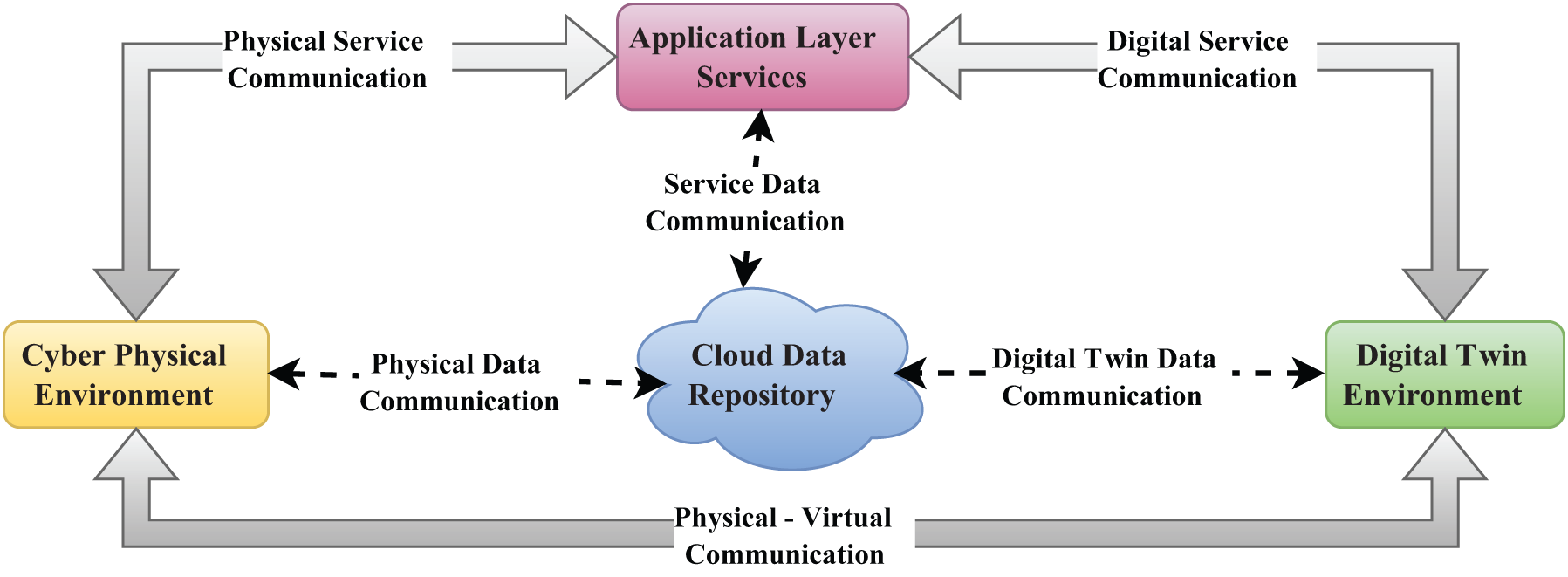
Figure 5: Overview for building CPS with digital twins
5.5 Essential Components of Digital Twin
DT has a number of components. Some of them are used for the administration, and the remaining ones are useful for its creation. From the literature [96–98], the components of DT creation are outlined as.
Identifier Each physical product requires a worldwide identification in order to be linked to its digital representations. In this context, RFID (radio frequency identification) and the EPC (electronic product code), etc., are used to create an identity for each physical process, no matter where it is or how long it has existed.
Information management: Throughout the product life cycle, the beginning, middle, and end stages produce and evolve product data and information. The number of saved data may increase to huge proportions during these three phases, providing a data management challenge for storing required data. Reference [99] proposed a data collection technique, whereas in [100] concentrated on DT to realise and organise data. The End-of-Life (EoL) of DTs in information management refers to the phase or process when a DT is retired, decommissioned, or taken out of active use. Like physical products, DTs also have a life cycle, and there comes a point when they are no longer needed or relevant for ongoing operations or analysis.
During the life cycle of a DT, it serves various purposes, such as monitoring, analyzing, and optimizing the performance of a physical asset or system. However, as the physical asset or system it represents undergoes changes or reaches the end of its useful life, the DT may also become outdated or unnecessary. The End-of-Life (EoL) of DTs involves proper management and handling of the digital representation to ensure data security, privacy, and responsible disposal. Some key aspects related to the End-of-Life of DTs in information management may include:
• Data Retention and Archiving: Depending on the organization’s policies and regulations, data from DTs might need to be retained or archived for a certain period even after the DT itself is retired. This could be for historical reference, compliance reasons, or future analysis.
• Data Deletion and Privacy: As with any data management process, the EoL of DTs requires careful consideration of data privacy and protection. Personal or sensitive information collected and used by the DT should be properly deleted or anonymized, ensuring that privacy is maintained.
• Knowledge Capture: Before retiring a DT, it is essential to capture any valuable insights, lessons learned, or knowledge gained during its life cycle. This information can be used to improve future DT implementations or to inform decision-making for similar assets or systems.
• Communication and Reporting: Stakeholders and relevant parties should be informed of the DT’s retirement to avoid confusion or unintended usage of outdated information. Proper reporting and communication channels are necessary to ensure everyone is aware of the DT’s EoL.
• Integration with Legacy Systems: In some cases, the DT’s data and information might need to be integrated or migrated into legacy systems or other data repositories for long-term storage or analysis.
• Continuous Improvement: Organizations should use insights from the DT’s performance and its EoL process to continuously improve their DT implementations and information management practices.
It is important to note that the EoL of DTs can vary depending on the specific use case, industry, and organization. Proper planning and policies must be in place to ensure a smooth and responsible EoL process for DTs to maximize their value while minimizing potential risks.
Digital twin models: During the product life cycle, several product models are created, which include system, functional, 3-D geometric, multi-physic, production, and consumption prototypes. These are incompatible, causing a major problem; as a result, a means of integrating all of these prototypes is necessary. Accurate product information feedback is required between the physical product and its digital version [101]. Establishing a DT, according to [102], requires the collaboration of an information model with greater data processing and business interactions. AutomationML, according to [103], should be used to create DT.
Data analysis: It is obtained from massive volumes of data collected throughout the life cycle of a product, with real-time limits in some cases [104]. When applying approaches to estimate changing product behavior in the future, maintenance, and usage data are critical. Reference [35] published a study to analyze huge data and DT.
Human-computer interface: It is obvious that retrieving and displaying essential data to the appropriate user is a challenge. Throughout its existence, the DT offers information to a wide range of users and stakeholders. As a result, the DT’s human-machine interface (HMI) should be well-designed. Using augmented reality technology, Schroeder et al. [105] begin his work in this manner. Rasheed et al. [98] saw interface modeling as a crucial enabler for new DT technologies in a variety of industries.
Architecture: The architecture of Digital Twins (DTs) for Cyber-Physical Systems (CPS) emphasizes the seamless integration of physical and virtual components through a well-defined data flow and communication framework. DTs store their information across various databases, necessitating mechanisms for remote data access at any location and time. Sensors deployed in the physical system collect data, which is transmitted via communication protocols to centralized databases, forming the backbone for CPS-DT integration. Villalonga et al. [106] introduced an architecture model for CPS, which delineates the roles of basic and advanced computation modes while leveraging cloud platforms for DT operations. This model is critical for differentiating layers of data processing and computational complexity. Similarly, Borodulin et al. [107] highlight a hierarchical organization of data across private and shared databases, ensuring efficient and secure information management.
Fig. 6 visualizes the CPS-DT architecture, emphasizing the layered structure where the operational environment integrates with the virtual twin environment through robust communication pathways. The data acquisition layer includes physical equipment capturing condition and state information, which feeds into the twin’s information model. This model incorporates detailed representations such as the virtual product model, principle model, and field model, enabling precise operational optimization. The cloud data repository acts as a central hub for data storage and computational resources, facilitating real-time synchronization between CPS and DT. This synchronization supports advanced services like predictive analytics and dynamic decision-making, ensuring continuous improvement in system performance and reliability.
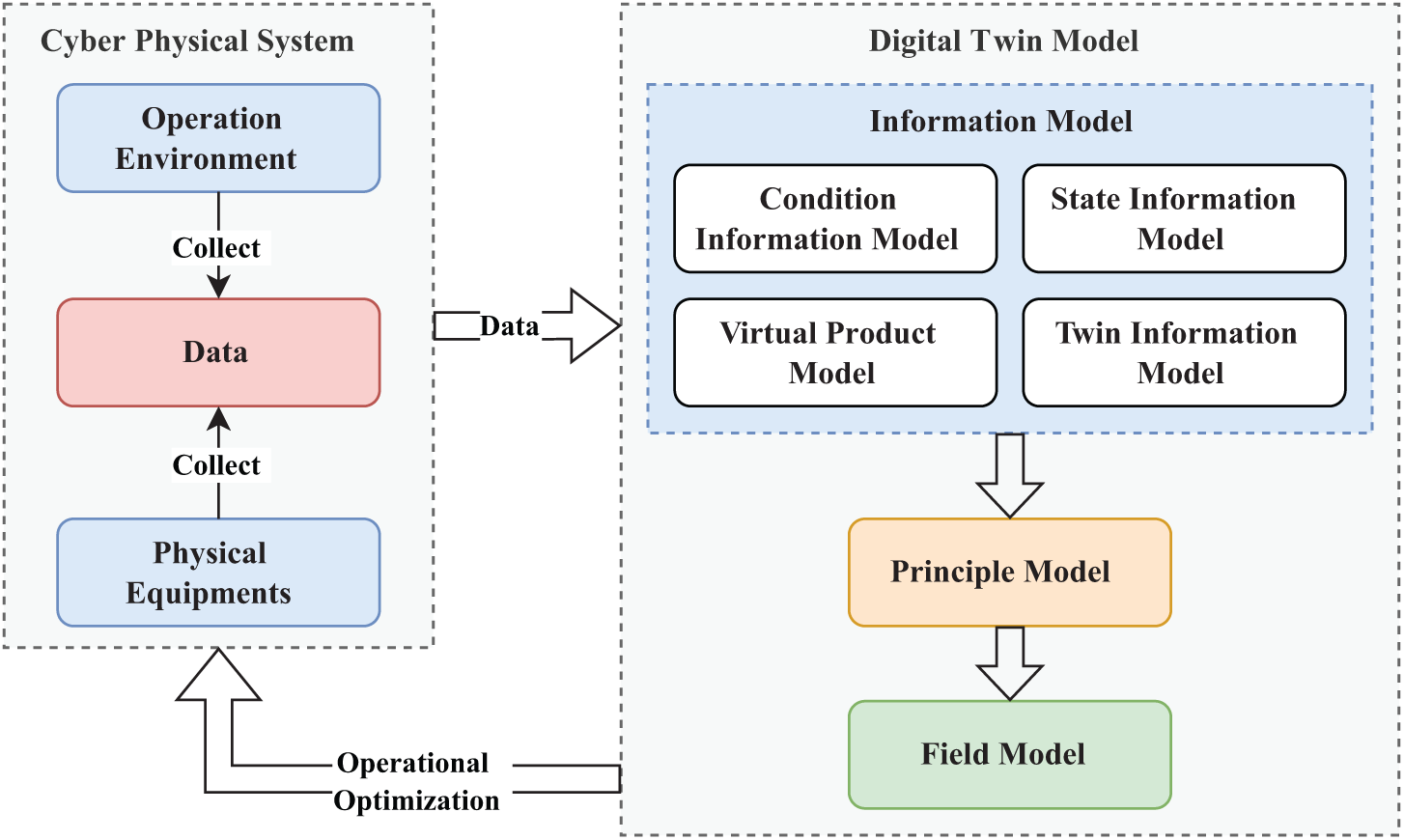
Figure 6: Essential components of CPS with digital twins
Simulation: Most researchers, such as [108], address the necessity of employing the DT for simulation. Several authors have employed the DT simulation to control the quality. In [109], the DT imitated the shop-floor layout in order to improve production. A model of a hollow glass production line was built by [110]. The replication phase of a DT refers to the process of creating and establishing a virtual representation of a physical object, system, process, or entity in the digital world. During this phase, a DT is “replicated” based on the real-world counterpart, incorporating various data sources, sensors, and models to simulate and mirror the behavior, characteristics, and properties of the physical asset or system.
The replication phase is a crucial step in developing a DT, as it lays the foundation for the virtual representation that will be used for monitoring, analysis, simulation, and decision making. The process typically involves the following steps:
• Data Acquisition: Relevant data is collected from the physical object or system through sensors, IoT devices, or other data sources. This data can include parameters such as temperature, pressure, vibration, location, and more.
• Data Integration: The acquired data is integrated into the DT model to create a holistic and comprehensive representation of the physical asset.
• Model Creation: Mathematical models, simulations, and algorithms are developed to replicate the behavior and performance of the physical asset accurately. These models are based on the collected data and can simulate various real-world scenarios.
• Real-Time Update: The DT is continuously updated with real-time data from the physical counterpart, ensuring that the virtual representation stays synchronized with the actual asset’s current state.
• Validation and Calibration: The DT is validated and calibrated to ensure its accuracy and reliability. This involves comparing the virtual model’s behavior with the real-world data to verify its correctness.
• Connectivity: The DT is connected to the relevant systems and databases to enable seamless data exchange and integration with other processes and technologies.
Once the replication phase is complete, the DT becomes an active representation of the physical asset, capable of offering valuable insights, predictive capabilities, and decision support for various applications, such as predictive maintenance, performance optimization, and real-time monitoring.
In the literature, DT implementations and examples have shown a variety of technological functionalities, i.e., DT features (DTFs) which includes the functionalities of DT that facilitate simulation, monitoring, and optimization. Despite the fact that many implementations have DTFs, publications that expressly mention DTFs are hard to come across. Some of the DT feature lists are mentioned here from [38,111–114] to highlight the state of the literature.
1. Product identity, product lifespan, product information, product configuration, and product models are the significant themes for the DT of a product in the aerospace sector, according to [111].
2. According to [112], the DT concept faces challenges in the areas of “intelligent perception and connection, virtual modeling, running simulation and verification, DT data construction and management, DT-driven operation technology, smart production, and precision service.”
3. According to [113], the most significant aspects of constructing a DT are identification, product models, human-computer interface data management, and communication.
4. DTs have seven qualities, according to [38]: “unique identity, sensors and actuators, AI, communication, representation, trust, and privacy and security.”
5. Data link, analysis, identification, security, coupling, user interface, simulation model, artificial intelligence, and computation are some of the distinctive elements that can exist in a single product’s DT, according to literature [114].
5.6 Characteristics of Digital Twin
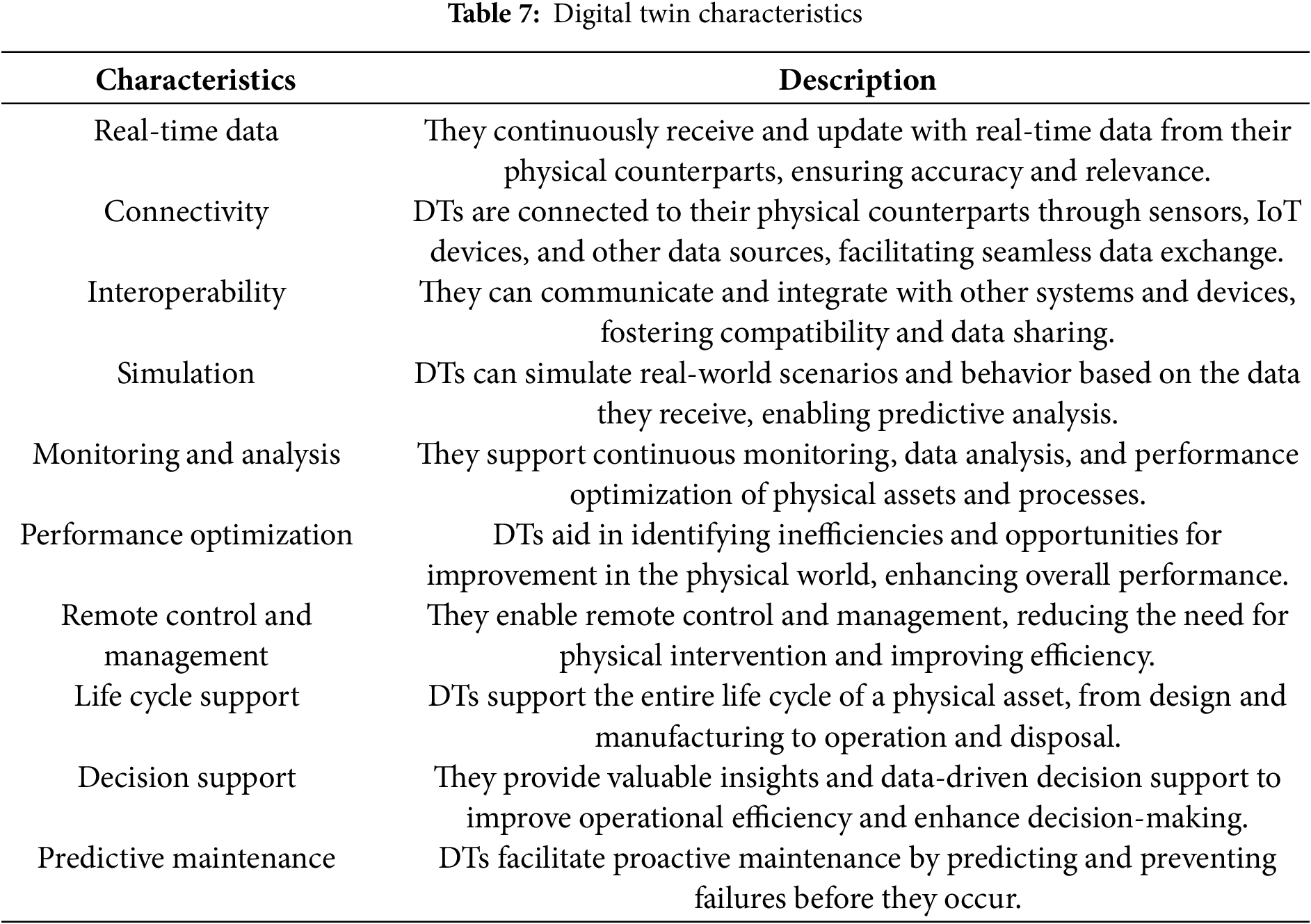
DTs exhibit several defining characteristics that make them valuable in the monitoring and management of physical assets and systems. One of the core characteristics is the integration of real-time data. Using IoT sensors and other data acquisition technologies, DTs continuously gather and update data from their physical counterparts. This ensures that the virtual model remains synchronized with the current state of the physical object, allowing for real-time monitoring and control. By continuously reflecting the actual conditions, DTs enable decision makers to make timely interventions when needed. Another important characteristic is the ability to simulate and predict system behaviors. Using data gathered from the physical object, DTs can simulate various operational scenarios and predict future behaviors, providing a significant advantage in anticipating potential failures or problems. This predictive capability improves system optimization and enables more efficient maintenance schedules. Simulation also allows industries to test different operational strategies without impacting the physical object, ensuring a cost-effective and risk-free way to improve performance.
DTs are also characterized by their scalability and interoperability. Whether a single component or a complex system is modeled, DTs can adapt to varying levels of complexity across industries. They promote collaboration by integrating with various systems and platforms, allowing for seamless data sharing and analysis. This interoperability enables cross-functional teams to collaborate more effectively, making DTs an essential tool for optimizing operations and improving communication within organizations. The compilation of DT characteristics is illustrated in Table 7.
5.7 Properties of Digital Twins
DTs possess several foundational properties that enable them to replicate, monitor, and optimize physical systems effectively. Hence, properties are essential for creating effective and efficient DT systems in various applications and industries according to [11,12]. One of the primary properties of DTs is representation and contextualization. A DT serves as an accurate digital representation of its physical counterpart (PO) within a specific environment or operational context. The DT captures the essential characteristics and behaviors of the PO, allowing for feature simplification while maintaining functional accuracy. Contextualization ensures that the DT is adaptable to various industries, such as manufacturing, healthcare, and urban infrastructure, enabling it to represent a wide range of scenarios effectively.
Another key property is reflection and synchronization. A DT must continuously reflect the real-time status of the physical object it represents. This is achieved through constant synchronization with IoT sensors and other data sources. As changes occur in the physical object, they are mirrored immediately in the DT, allowing real-time monitoring and analysis. This capability makes the DT indispensable for decision-making processes that rely on up-to-date system information. The predictive capabilities of DTs are also crucial. Using both real-time and historical data, DTs can forecast future behaviors of physical systems, allowing for proactive risk management and performance optimization. This predictive functionality is vital for anticipating potential failures and optimizing maintenance schedules, particularly in high-stakes industries such as aerospace, manufacturing, and healthcare.
Another essential property of DTs is their persistence and availability. A DT remains available even when the physical object it represents is offline or has been decommissioned. This allows stakeholders to access historical performance data for analysis and decision-making. DTs also retain historical data over time, providing a comprehensive view of the system’s life cycle that can be used to inform long-term strategies and future system enhancements. Finally, DTs offer augmented functionality that extends the capabilities of physical objects. DTs provide additional services, such as advanced analytics, predictive maintenance, and data visualization, that help optimize system performance and improve decision-making. This augmented functionality transforms DTs into intelligent systems capable of not only monitoring but also optimizing and predicting future outcomes. These properties of Digital Twins representation and contextualization, reflection and synchronization, predictive capabilities, persistence and availability, and augmented functionality are critical for their effective deployment and operation. These properties enable DTs to go beyond simple replication and serve as powerful tools to optimize physical systems across a wide array of industries and applications.
6 Building Blocks of Digital Twins
The building blocks of DTs consist of several essential components that interact to create a comprehensive digital representation of physical systems. These include:
• Physical Assets: These are the real-world devices, machines, or systems that are replicated digitally within a CPS. The physical assets interact with the digital twin environment through sensors and other data sources.
• Digital Twin Environment: This is the digital counterpart of the physical assets, where their digital representations are created and managed. It serves as a platform for simulations, monitoring, and performance analysis.
• Data Sources: Data is collected from the physical assets through sensors, IoT devices, and other mechanisms. These data sources provide either real-time or historical data that are fed into the digital twin environment for continuous updates.
• Digital Twin Modeling: The process of creating a digital representation of the physical assets and their behavior is known as digital twin modeling. This involves simulating the behavior and predicting the performance of the physical assets based on the data collected from the sensors.
• Digital Twin Services: These services include data analytics, predictive maintenance, and optimization functionalities. Digital twin services enable enhanced performance, real-time monitoring, control, and decision-making processes.
• Physical and Logical Objects: The digital twin contains both the Physical Object (PO), which refers to the real-world entity, and the Logical Object (LO), which is the digital representation of the physical object. The LO reflects the properties and behavior of the PO in the digital world.
• Foundational Properties: These are the core attributes that define a digital twin. Foundational properties include the ability to monitor, control, optimize, and simulate the physical object, ensuring the digital twin accurately represents the physical counterpart.
• Architectural Model: The architectural model outlines how the components of a digital twin interact, including data acquisition, processing, storage, and visualization. This model provides a structure for implementing digital twins across different industries and applications.
These components collectively empower Digital Twins to accurately mimic, oversee, and enhance the functioning of physical systems, delivering crucial insights for maintenance, decision-making, and operational efficiency.
6.1 Digital Twin Data Management Tools
There can be no DT without the use of data. The different data management tools of DT can be divided into different types such as data collection/gathering tools, transmission tools, storage, processing tools, aggregation tools, and visualization tools. The placement of sensors allows data gathering technologies to obtain complete, stable, and effective data. The software is compatible with a wide range of models for real-time signal acquisition and processing. In addition, software can perform signal analysis processing. Examples of software that plays a role in data gathering are Scribe, Logstash, etc.
It is imperative to transmit information in real-time while ensuring that no information is lost or corrupted, and also maintaining the integrity of the transmitted information. Traditional File Transfer Protocol (FTP) solutions are no longer suitable to meet the data transmission requirements of the big data era in terms of performance or reliability. Aspera is a good example of a tool that can handle enormous files, great distances, and terrible network conditions. Faster than FTP and HTTP, Aspera leverages the WAN architecture to transfer data. With no changes to the original network design, it can be used on a variety of platforms, including PCs and mobile devices. Similarly to Aspera some other tools such as Multidesk, Share etc., are also available.
Data are stored in a manner that ensures data classification and preservation while also responding in real time to data requests made using an efficient read-write mechanism to ensure future operations. In recent years, data storage technology has grown at a rapid pace. HBase, a Hadoop-based database, provides a good illustration. HBase is a column-oriented, scalable, real-time read-write distributed database with great reliability and performance. Additionally, it has the capacity to support a wide range of different types of data, including semi-structured as well as unstructured data. When information is processed, it is free of errors and inconsistencies, allowing more effective utilization. Whenever open-source software support for several programming languages is sparked, such as Java, Scala, and Python, the user’s entry point is substantially reduced. In addition to Structure Query Language (SQL) and Hive SQL, Spark can be used for DT data processing.
Data aggregation or fusion integrates, filters, correlates, and synthesizes the processed data to help with judgment, planning, verification, and diagnosis. Spyder, for example, is a popular Python-based data fusion tool. Using Drools, Jess, CLIPS, and Prolog are powerful rule engines and programming tools used to create rule-based systems and decision-making logic in Digital Twin environments. Pyke is a Python-based knowledge engine, while Drools-Scorecards and PyCaret enable rule-based decision processes and predictive modeling within Digital Twin systems. Data visualization aids in real-time monitoring and the rapid acquisition of target information by providing clear, concise, and intuitive data information. As an example, the free and open source software Echarts works flawlessly across a wide range of platforms and browsers. Intuitive, vibrant, and customizable data representations are provided by Echarts for both large volumes of static and constantly changing data. It is possible to handle a wide range of data forms without the need for additional processing. Fig. 7 depicts a variety of DT data management tools.
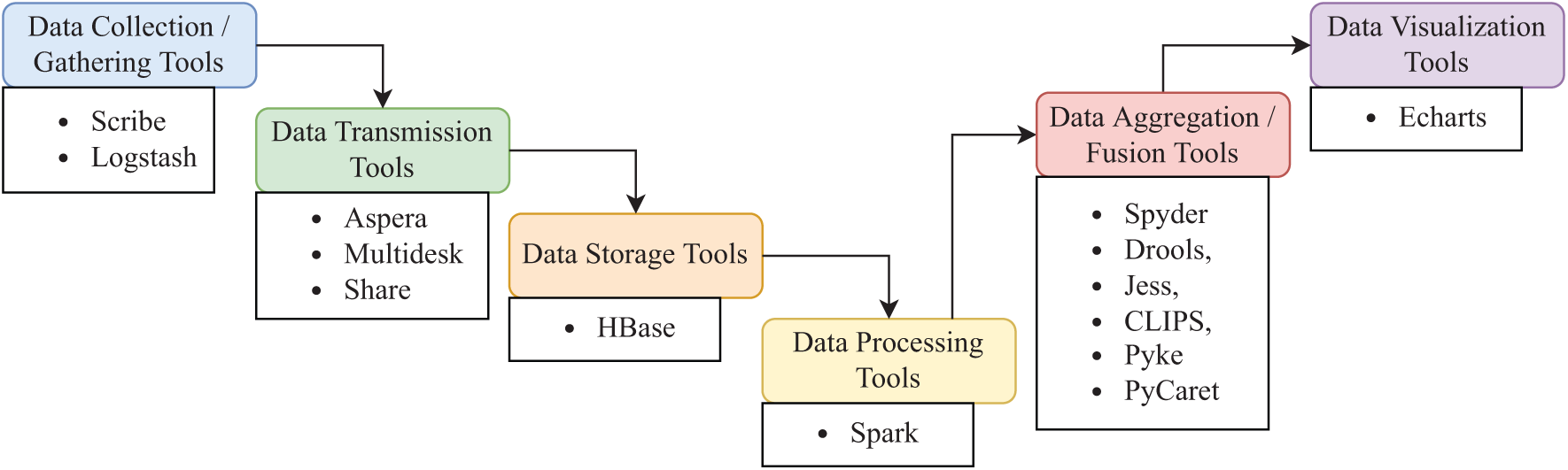
Figure 7: Data management tools for digital twin
6.2 Digital Twin Modelling Tools
The four most important aspects of a DT of any device are device data, AI or data analytics, device knowledge, and data modelling. DTs obtain data from sensors mounted on physical things to identify real-time performance, operational conditions, and changes over time, ensuring accurate modelling during the lifetime of a product or its manufacturing. Once the data from the device are collected, the DT is updated throughout the product life cycle to reflect any changes to the physical counterpart. This creates a closed loop of feedback in a virtual environment that allows companies to continue to improve their products, production, and performance at the lowest cost [115]. Even when AI detects patterns, it is critical to have a thorough understanding of whether the pattern is relevant. Connected digital things can help businesses better analyze and predict problems or provide early warnings; reduce downtime, build new business models or simulations, and even prepare better for the future at a lower cost by employing simulation software. So, in order to achieve the performance, simulation tools are required in association with the Internet of Things device management software. All types of tools required for DT modeling at different levels are presented in Fig. 8.
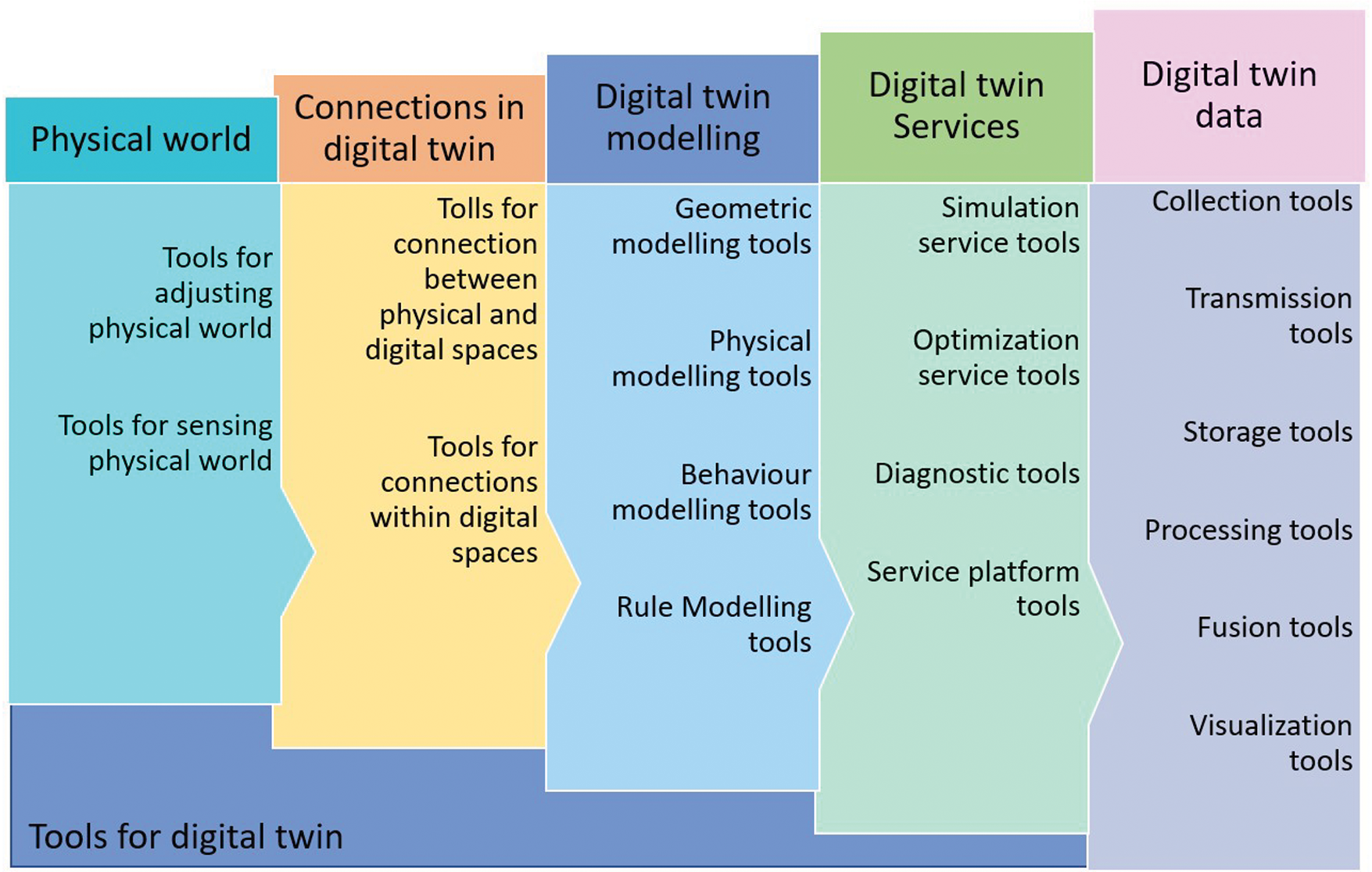
Figure 8: Tools for digital twin
Engineers may achieve unprecedented levels of accuracy using predictive analytics with Ansys Hybrid Analytics capabilities, which combine machine learning (ML)-based analytics with a physics-based approach. By merging physical and virtual sensors, Ansys Twin Builder provides predictive analytics with unparalleled accuracy. Twin builder features allow for faster deployment of the DT, simpler workflows, and an online web application to interact with the DT model [13]. 3D CAD models are the most suitable information hubs for the incremental creation of DTs. The information and metadata that originate at each stage of the design and engineering process gradually create interlinked layers in the DT [116]. 3D Max has packages with built-in scripting languages, meaning that users have long been able to control 3D models through scripts. Programmable Logic Controller (PLC) allows the administration of control duties throughout the life cycle of a controller (application development, operation, maintenance, and commissioning).
All controllers linked to the CoDEeSys Automation Servers have access to the “PLC Management” product option. To accurately allocate orders and communications, a DT is produced in the cloud (status, alarms, etc.). The CoDEeSys Automation Server, a PLC platform, serves as the core interface [76]. An application can be loaded onto any number of controllers from here (CoDEeSys Automation Server). Higher efficiency but less prone to mistakes are the included benefits. If the present condition of the device is known, it can respond to a controller malfunction even if production is not stopped, or the issue might otherwise go undiscovered. For example, if the PLC of a mobile machine unit breaks, whose function is only utilised on occasion, as the machine park operator, you will be notified promptly on the CoDEeSys Automation Server. This is especially useful if the machine at issue is used in the field.
Azure DTs is an IoT platform that enables the creation of digital representations of physical objects, locations, business processes, and people. Gain insights that will help you create superior products, reduce costs, and improve consumer experiences. Siemens Digital Enterprise Suite provides perfectly coordinated and unified software and automation capabilities for a comprehensive approach. A single data platform is used to digitise the entire value-added process in the industry. Intelligent industrial connectivity facilitates data transport between production units and data collection in real-time.
Siemens’ Defence-in-Depth approach guarantees that businesses are prepared to meet rising industrial security demands and that industrial operations are successfully secured from both internal and external threats. Standard-compliant security systems provide reliable and personalized protection for the digital factory, from password authentication to continuous security monitoring. MindSphere also provides a platform for industrial firms to establish new digital business models, rounding out Siemens’ offering of data-driven digital services for the industrial environment. It includes cutting-edge security features for data collection in the field, as well as data transport and storage in the cloud. Table 8 shows the summary of the modelling tools for DTs: geometric modeling, behavioural modeling, physical modeling, and rule modeling.
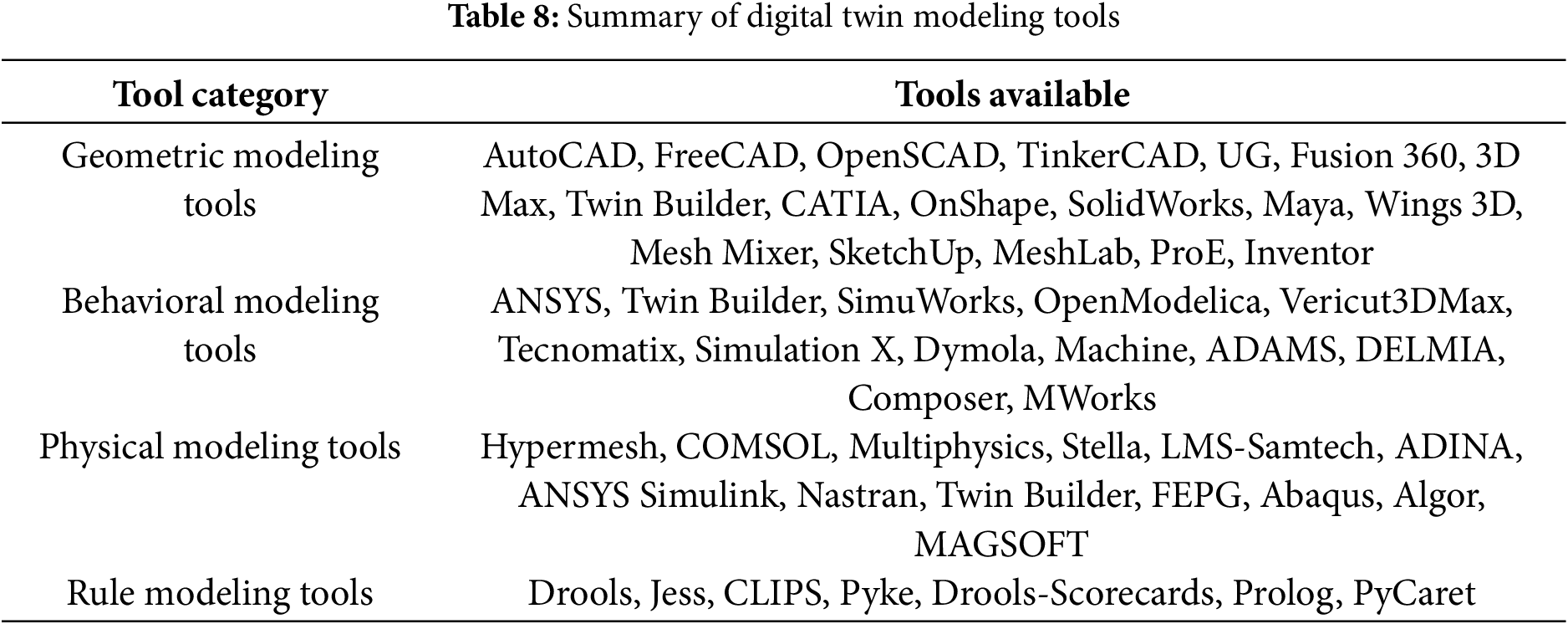
Geometric modelling approaches show the structure, size, orientation, and assembly relationships of systems. 3D Max, for instance, is an example of such a tool. Animation, 3D modelling, and rendering are all possible with this software. It is commonly used in multimedia development, games, and architectural design to depict a complete environment. By simulating the rules, logic, and principles underlying physical behaviour, rule modelling increases service performance. DT can use learning rules to spot strange processes, predict future trends, and find strange patterns. To increase the simulation service performance, behavior modeling methods are used to construct a model that reacts to external drivers and perturbation sources. Twin Builder, SimuWorks, ADAMS, etc., are the example software for behavioural modelling.
Physical modeling techniques are used to create a physical model that may be used to investigate the states of the physical entities. The physical model is created by converting the physical attributes of the physical entities into geometric models. ANSYS’s finite element analysis software (FEA) is an example of this kind of tool. Sensor data is used to provide real-time model parameters for the overall wear factor and geometric models, as well as a malfunction in the digital model. Simulink has also been applied to physics-based modelling. Simulink includes a variety of electrical and mechanical component models.
6.3 Features of Digital Twin Platforms
DT software solutions leverage IoT sensor data and additional data to track asset performance and carry out simulations. Scalable DT platforms possess several essential characteristics, as listed in Table 9.
• Manage the DT life cycle: DTs, according to Skerrett, are “digital threads” or “digital masters,” which are the needs, pieces, and control systems that make up a physical asset [117]. The engineering designs, the bill of materials, the software versions and other artifacts used to make a windmill are all part of the digital master. A DT platform for windmills must make use of the digital master and provide tools to test, deploy, and manage the DT based on it. These solutions must be scalable to hundreds or thousands of DTs [118].
• Source of truth: Platforms must be able to update and give the most up-to-date status information for each DT. Routine maintenance, for example, could result in one asset having a different part or firmware version than another. When the actual state of each item and asset changes, the platform must be able to update it as soon as possible [119].
• Visualization and analysis: The platform must allow the company to build live data visualizations, dashboards, and in-depth studies using the DT’s data. The digital master should be linked to the live data.
• Management of processes and events: Users must be able to construct events and processes that can be executed using data from the platform.
• Perspectives of users and customers: Stakeholders must be able to collaborate on the platform. It should show which entity owns or operates each one, as well as who has access to the data.
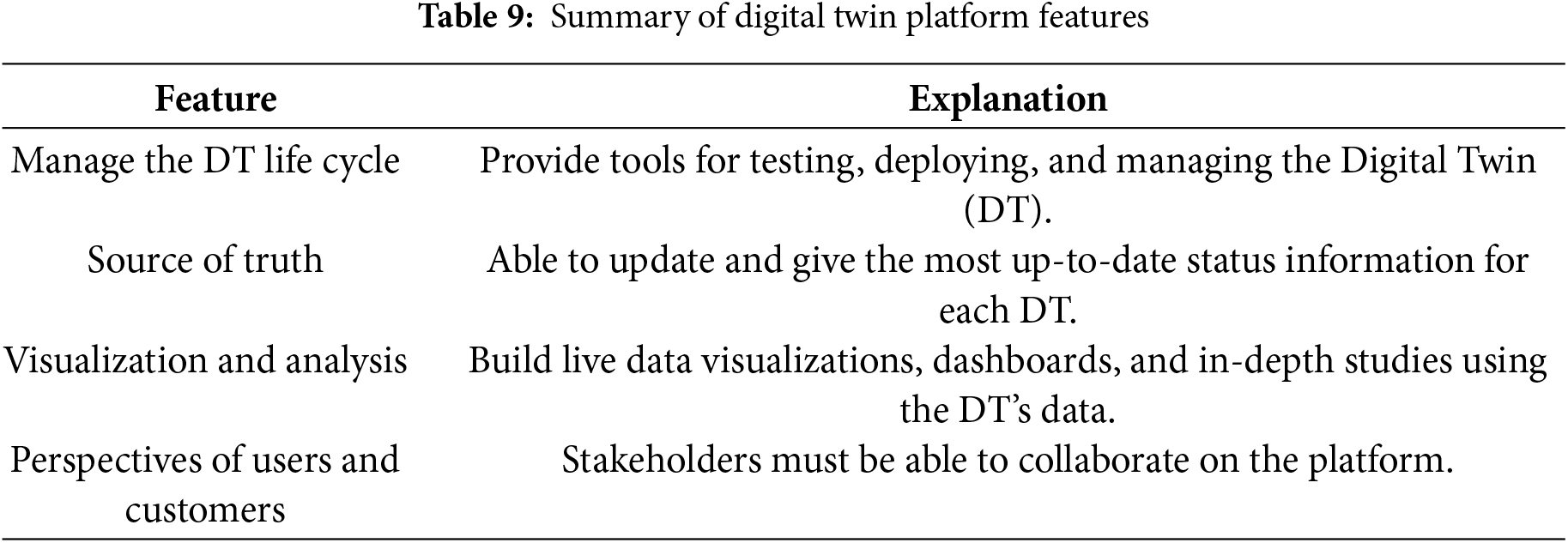
7 Advantages of Using Digital Twin
The DT value has been discovered and presented here:
1. Remote monitoring and control in real time: It is practically difficult to get an in-depth physical picture of a complex system. A DT can be viewed from anywhere due to its nature. The status of the system can be monitored and managed remotely via feedback loops.
2. Increased efficiency: Digital Twining is projected to provide people with more autonomy while keeping them informed as needed. People can assign complex and filthy jobs to robots (because of safety reasons) and monitor them through DTs.
3. Predictive maintenance and scheduling: Thanks to comprehensive DT, several sensors that monitor physical assets will create important data in real time. By sophisticated data analysis, system flaws can be identified much earlier and make maintenance scheduling easier.
4. Risk assessment: A digital sister of the system, what-if studies will be possible, resulting in improved risk assessment. It is easy to disturb the system to cause unexpected occurrences and assess response and mitigation strategies of the system. Only a DT can do this type of research without causing harm to the real asset.
5. Improved intra- and inter-team synergy and collaborations: By improving synergies and partnerships, teams can better use their time, resulting in increased productivity, greater autonomy, and access to all information.
6. Real-time access to a more efficient and educated decision-making system will enable better informed and faster decision-making.
7. Improved documentation and communication: Real data combined with reporting data will help users stay informed, resulting in greater transparency.
8. Increased productivity: According to Gartner, DTs have the potential to help industrial companies improve their efficiency 10% due to the reduction in preventive maintenance downtime and the higher optimization performance.
9. Reduced production times: Companies using DT technology will see a 30% decrease in cycle times for key processes such as production lines. In part, this is because DTs are more efficient.
10. Pre-production testing: Companies can use DTs to assess the viability of innovative products before they go into production.
7.1 Digital Twin as a Building Block for CPS
A Digital Twin (DT) can evolve into a Cyber-Physical System (CPS) by incorporating control mechanisms and feedback loops. Initially, a DT serves as a digital replica that is used for monitoring and simulation. As it evolves, the DT can be integrated with actuators and control systems, enabling it not only to reflect the current state of the physical system but also to control it in real-time. Over time, as more autonomous decision-making capabilities are added, the DT transforms into a fully functional CPS, capable of both modeling and controlling the physical system without human intervention. By bridging the physical and cyber realms, DTs help CPS achieve enhanced functionality, adaptability, and autonomy.
Fig. 9 illustrates the process of Digital Twin modeling in the context of CPS development. The figure highlights the role of the DT as both a static and dynamic representation of physical systems, emphasizing its ability to adapt and evolve. Key elements include the synchronization of DTs with their physical counterparts, enabling seamless integration between the physical and virtual realms. The DT transitions from a standalone model to a system capable of operational optimization and lifecycle management, leveraging the principles of system engineering. It progresses through stages such as lifecycle process adaptation, meta-modeling for semantics, and engineering workflows to eventually build comprehensive CPS architectures. This depiction underscores the pivotal role of DTs in enabling CPS to achieve sophisticated functionalities, from simulation and monitoring to autonomous control and optimization.
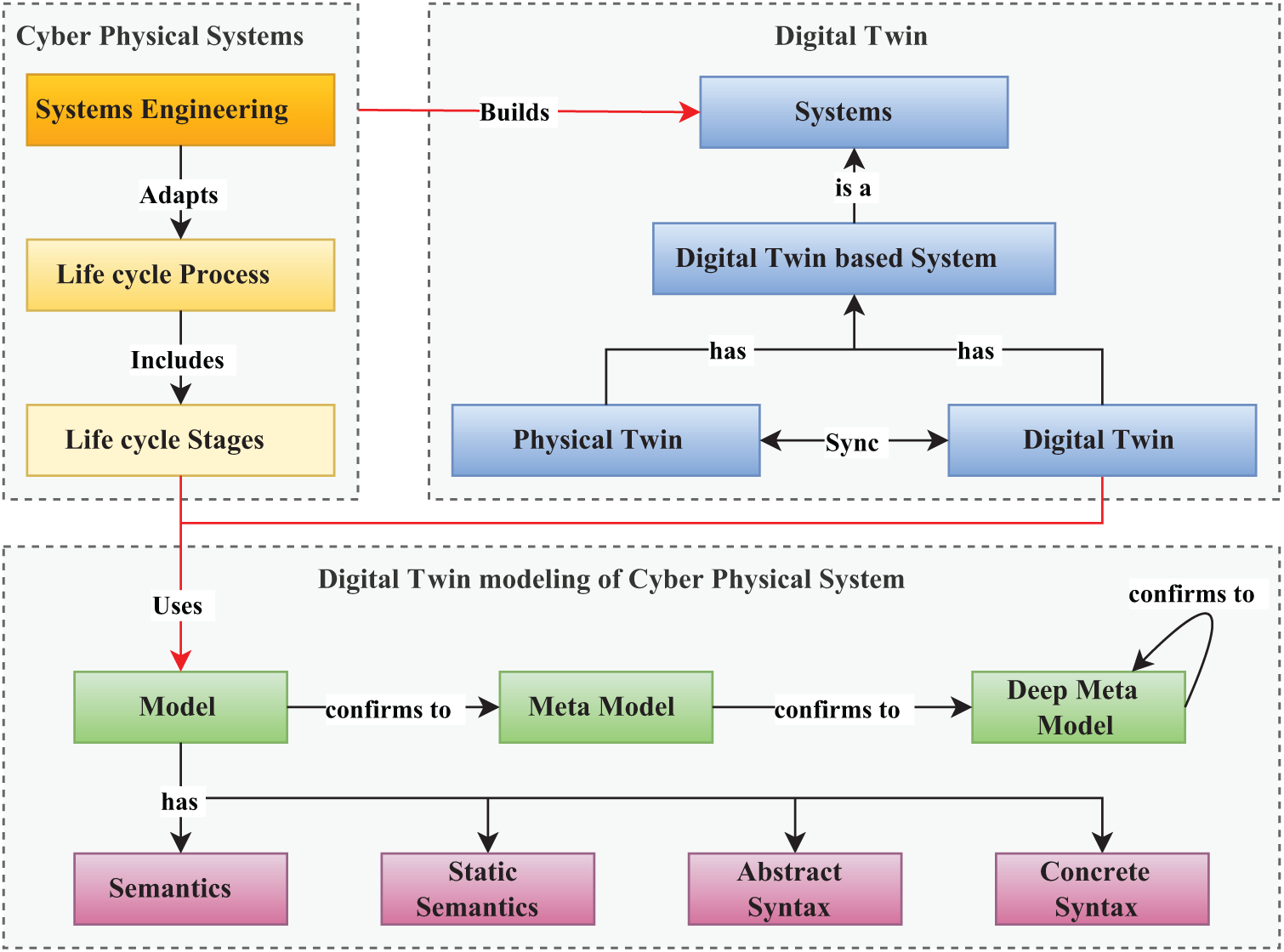
Figure 9: Process of digital twin modeling in the context of CPS development
Real-Time Data Integration and Synchronization: At the heart of both CPS and DT is the real-time integration of data. Sensors and actuators embedded in physical systems collect data continuously, which is processed and analyzed in the cyber environment. The DT acts as the digital mirror of this physical system, constantly receiving updated data to maintain synchronization with the real-world counterpart. This data synchronization is critical to ensure that the CPS accurately reflects real-time conditions, enabling real-time monitoring, control, and decision-making.
Enhanced Simulation and Predictive Capabilities: One of the most powerful aspects of Digital Twins in CPS is their ability to simulate complex physical processes in a controlled digital environment. These simulations provide insights into how the physical system will react under different conditions. DTs can forecast system behaviors using predictive analytics, enabling CPS to act proactively rather than reactively.
Closed-Loop Feedback for Real-Time Control: A critical feature of CPS is its ability not only to monitor but also to control physical processes based on feedback loops. Digital Twins enable this by integrating the feedback mechanisms in the digital environment. The data from the physical world is processed and analyzed in the DT, which then sends control commands back to the physical system via actuators. This closed-loop control system allows CPS to adjust its behavior dynamically based on real-time data from the DT, ensuring optimal performance.
Optimization of Resource Management: By continuously analyzing real-time data, DTs provide CPS with insights on optimizing resource allocation such as energy, bandwidth, or materials. This optimization occurs through the DT’s ability to simulate various operational scenarios and identify inefficiencies, making CPS more efficient in resource usage.
Virtual Testing and Validation: Before deploying a CPS into critical environments, virtual testing and validation are essential to ensure that the system will perform as expected. Digital Twins enable thorough testing of CPS functionalities without the need to interact with the actual physical system, reducing risks and costs. By simulating different scenarios in the DT, engineers can assess how the CPS would perform under various conditions and make necessary adjustments before the system is deployed.
Digital Twin as a Learning and Adaptation Platform: CPS systems often operate in dynamic environments, where conditions change continuously. DTs allow CPS to learn from past performance and adapt to new situations. By analyzing historical data and continuously updating its models, a DT helps the CPS evolve to meet changing conditions without human intervention. This capability is essential for CPS to achieve autonomy.
Interoperability and Collaboration across Systems: CPS are often part of larger, interconnected systems where various subsystems must communicate and collaborate effectively. DTs provide a platform to ensure interoperability between these subsystems by integrating data from multiple sources and facilitating communication. This allows for seamless coordination between different CPS subsystems, which is crucial for large-scale implementations.
Security and Risk Management: DTs contribute to the security and reliability of CPS by simulating potential threats and vulnerabilities. They can be used to model cyber-attacks, equipment failures, or environmental disruptions, allowing CPS to develop contingency plans or automatically trigger fail-safes. This proactive approach to risk management makes CPS more robust and resilient.
Life Cycle Management and Continuous Improvement: DTs allow CPS to manage the entire life cycle of physical assets, from design and deployment to maintenance and decommissioning. By continuously analyzing performance data and simulating future use cases, DTs enable CPS to optimize asset management and reduce life cycle costs. This continuous improvement loop ensures that CPS remains efficient and adaptable over time.
7.2 Digital Twin as a Security Tool for CPS
DTs enhance the security of CPS through various mechanisms and applications, as outlined in both [44,120] are provided here:
1. Identifying Security Flaws: During the design phase, DTs enable engineers to simulate the behavior of the physical system and identify potential security flaws and vulnerabilities. By addressing these issues before system deployment, the risk of security breaches and cyber attacks is reduced [121].
2. Security Testing and Intrusion Detection: DTs serve as a platform for security testing and intrusion detection during plant operation. By simulating the behavior of the physical system, DTs can detect potential security threats and vulnerabilities, enabling timely actions to improve CPS security [122].
3. Continuous Monitoring and Prediction: DTs accompany their physical counterparts throughout the entire life cycle of CPSs. They continuously monitor and predict the states of CPSs, enabling early detection of security issues and proactive security measures.
4. Testing and Training Platform: DTs offer a valuable testing and training platform for new security defenses and responses to cyber incidents. By simulating cyber attacks and evaluating defense strategies, DTs enhance the effectiveness of CPS security measures.
5. Versatility across CPS Types: The concept of DTs is applicable to various CPS types, including smart grids, smart factories, transportation systems, and medical CPSs. This adaptability extends the benefits of enhanced security to diverse domains.
Despite the significant advantages of DTs in improving CPS security, challenges remain, primarily related to the costs and complexities of creating, maintaining, and running DTs. Further research and development efforts are required to address these challenges and fully leverage the potential of DTs to improve CPS security. In summary, DTs play a vital role in enhancing the security of CPS through their ability to identify flaws, perform security testing, monitor, and predict system states, and provide a platform for testing and training security defenses. As research progresses and costs decrease, DTs are poised to become powerful assets in the continuous improvement of CPS security.
8 Role of Technological Advancements in CPS
This section explores the impact of cutting-edge technologies such as ML, AI, the IoT, Cloud Computing, Big Data, and Blockchain in the implementation of CPS and DT technology. Although simple systems can benefit from DTs without the need for advanced AI or ML, complex systems with multiple variables often require data science techniques to interpret the data streams. Contrary to popular belief, many of the advantages of modeling can still be achieved using traditional machine learning approaches without full reliance on AI.
Cloud computing, known for its efficiency and cost effectiveness, is crucial for storing and accessing the vast amounts of data generated by DT applications. This method provides an optimal platform for managing large-scale data, which requires sophisticated tools and algorithms, particularly in industrial settings. For example, Zhang et al. [110] introduced a framework for smart manufacturing in a DT environment, while Wang et al. [112] highlighted cloud computing’s pivotal role in data processing and analysis.
In DT applications, the IoT serves as a core technology by collecting data from physical objects using sensors. This data helps to create a digital replica of the physical object, allowing real-time analysis, optimization, and updates. The IoT enables a continuous connection between the physical and virtual worlds, supporting industrial applications such as real-time monitoring of equipment and asset tracking [106,107]. By integrating physical components with virtual representations through sensors and actuators, IoT devices help maintain and optimize systems, as discussed by Soderberg et al. [123]. Given the extensive data IoT generates, Big Data analytics becomes essential for constructing effective DTs [109].
AI further enhances DT systems by enabling intelligent decision-making using data collected from IoT sensors and virtual twins. By feeding IoT data into AI models, DTs can perform various industrial tasks and improve operational efficiency. The application of sensor technology and IoT has already enabled innovations like real-time control of physical components, both indoors and outdoors. To manage the complexity of industrial operations and detect potential issues early, big data analytics and AI tools become necessary. As the volume of data increases, advanced methodologies are required to enhance efficiency in DT systems. In terms of smart manufacturing, frameworks like the one proposed by Zhang et al. [124] exemplify how DTs can optimize resource allocation and ensure safety through AI algorithms. These AI-driven DT systems can monitor processes in real time, predict maintenance needs, and optimize production schedules [125].
The convergence of IoT, AI, ML, CPS, and big data enables the realization of DT systems. These innovations allow simulations, predictions, and analyses to be performed within a controlled environment. Modern IT tools such as cloud computing, big data, and AI have made the integration of real and virtual systems feasible, driving the digitization of industries [126]. Industry 4.0’s flagship technology is the DT, which relies heavily on ML and DL models for system predictions and analytics.
Blockchain technology also plays a key role in enhancing DTs by addressing security and trust issues. Blockchain ensures data integrity and immutability throughout the life cycle of a DT, offering decentralized data management and protecting sensitive information through cryptographic methods [127]. It supports automated interactions through smart contracts and improves interoperability by enabling seamless data exchange across DT platforms. The use of blockchain’s consensus mechanisms ensures data reliability, while its audit trails increase accountability [47]. Blockchain-enabled DTs can thus enhance decision-making, thanks to real-time data, and provide better resilience and fault tolerance against failures or attacks. As blockchain evolves, it continues to unlock new possibilities for DT applications across industries, solidifying its importance in ensuring reliable, secure, and efficient DT operations.
9 Applications of CPS and Digital Twin
The DT refers to a concept related to cyber-physical integration. A DT generates substantial digital models of physical objects to imitate and can provide feedback on their patterns of behavior in the real world. A DT is a bidirectional temporal mapping method that removes barriers throughout the life cycle of a product and generates a full digital replica of the product. Consequently, DTs help companies examine and identify physical ailments with greater speed and accuracy, streamline processes, and produce high-quality goods. CPS and DTs lay the foundation for intelligent machines by creating a closed system between the physical and virtual world by state sensing, precise information, intelligent decision-making, and precise implementation. However, by employing digital modeling, DT provides a more natural and effective approach to technical development.
Integrating data continuously enhances the DTs’ capacity to provide related solutions. Simulated methods may be employed to extend the composition and capabilities of CPS as an alternative. Consequently, DT innovation serves as an essential platform for constructing CPS and facilitating its development. Merging CPS with DT results in more efficient, superior, and accurate management. The primary control objective, especially in case of faults, is to maintain the system within acceptable norms. Both CPS and DT focus on achieving and maintaining control over an environment. For instance, the CPS’s cyber-physical interface plays a pivotal role. Throughout a product or system’s lifecycle, the virtual models and physical processes utilized by DTs evolve in alignment. CPS and DTs control integrates two key components: the physical properties or processes influencing the cyber/digital representations and the management of physical properties or processes affecting the cyber/digital domain. The physical domain is in a state of flux; thus, an object’s characteristics can shift at any moment. Sensors capture real-time data from the physical world and relay it to the cyber/digital domain, ensuring synchronization between the cyber/digital and physical elements.
Simulating the actual process and its progress is critical for a DT. Hence, real-time data are essential [128]. Cyber/digital control uses data to compute control outputs and transfer them to actuators for physical design in later stages of control. Predicting future conditions and malfunctions, for example, can be accomplished through the use of mathematical methods and related computing technologies, enabling the improvement of new service and control methods in advance. Through interactive cyber-physical control, various disruptions, including dangers of an unanticipated and hostile character, can be eliminated. For each stakeholder group, Digital Twin models are designed with tailored functionalities. For example, an engineer might focus on the structural integrity of a system, while a business analyst may prioritize cost optimization. This modular approach enables the Digital Twin to serve multiple purposes simultaneously, utilizing different models of the same physical entity. Some of the CPS and DT applications are shown in Fig. 10.
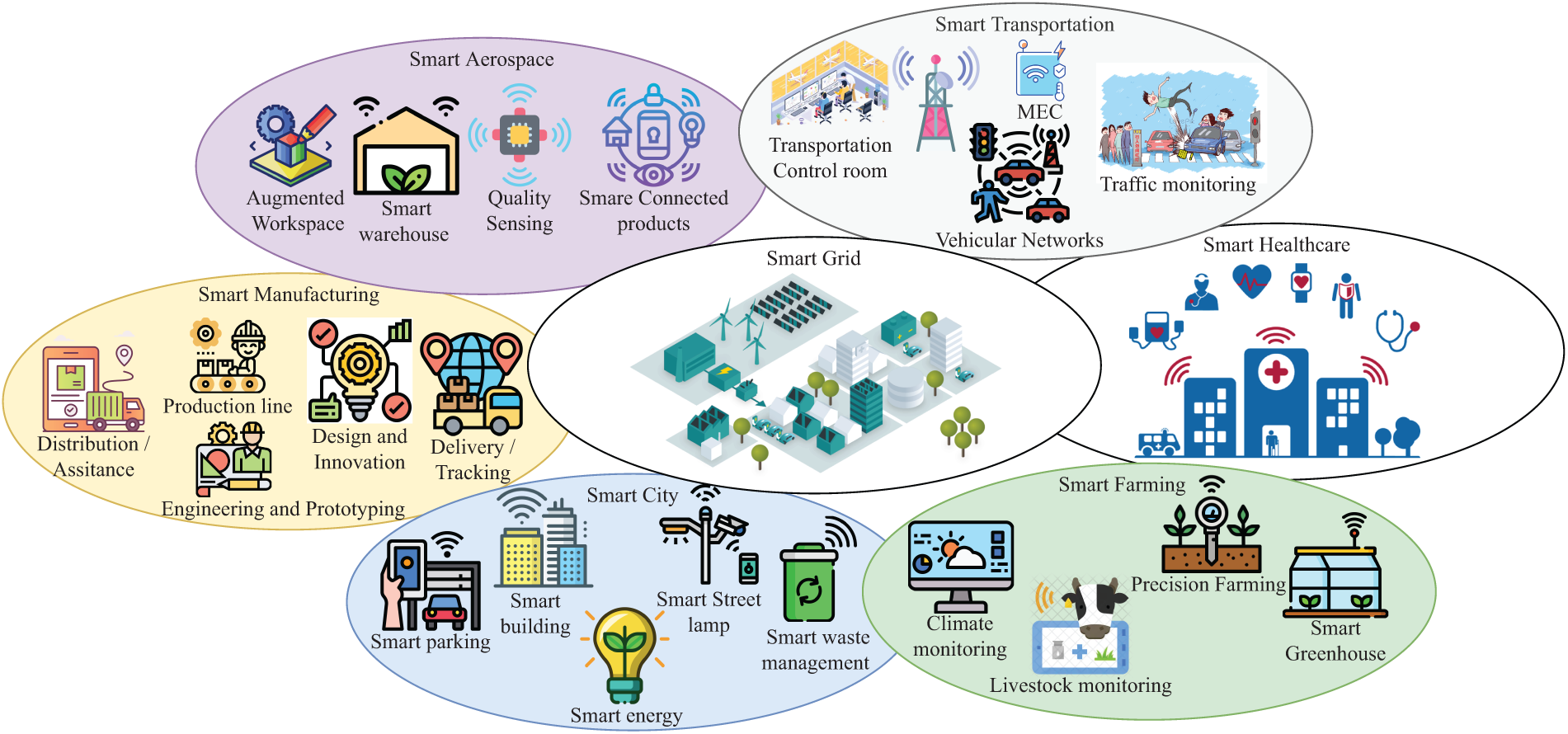
Figure 10: Bird-eye view on applications of CPS and DT
Taking advantage of DT, numerous applications have emerged in the real world, including smart manufacturing, smart healthcare, grids, smart transportation, smart farming, smart aerospace, smart cities, and more. The subsequent section details various CPS and DT applications, case studies, tools, and technologies in the current state of the art.
As the term implies, “smart manufacturing” refers to a new state of industrial production where real-time data delivery and analysis from all phases of the development life cycle, as well as model-based process simulation, create insights that have an optimistic effect on all areas of manufacturing. The industrial sectors and manufacturing processes, which constitute a significant socioeconomic force, are significantly influenced by the use of CPS technology. Manufacturing is a broad term that incorporates CPS with a variety of technical areas, ranging from 3D scanners/printers to cloud-based manufacturing [129]. With the increasing focus on IT convergence and openness, security as a cross-cutting aspect becomes more critical.
Manufacturing is already a pioneer in automation, with solutions spreading to other sectors such as factory automation and self-driving automobiles. Currently, mass customization is driving the growth of more adaptable and efficient manufacturing methods [130]. Modular designs that can be reused and recycled are among the solutions offered by CPS technology. Future manufacturing systems will be highly dependent on complex CPS. It is difficult to successfully industrialize these systems due to their management, security and safety issues, and seamless interoperability. The provision of additional skills, including Internet, security and software, is considered a significant enabler because the absence of the necessary new competencies may inhibit sustainable industrial evolution. Smart manufacturing relies on cyber physical integration, both a prerequisite and a crucial component. A growing body of research has focused on integrating CPS and DTs as an optimal method. The well-known CPS and DT technologies have been specialized in an ever-increasing field of “smart manufacturing”. Table 10 describes the few applications of DT in smart manufacturing.
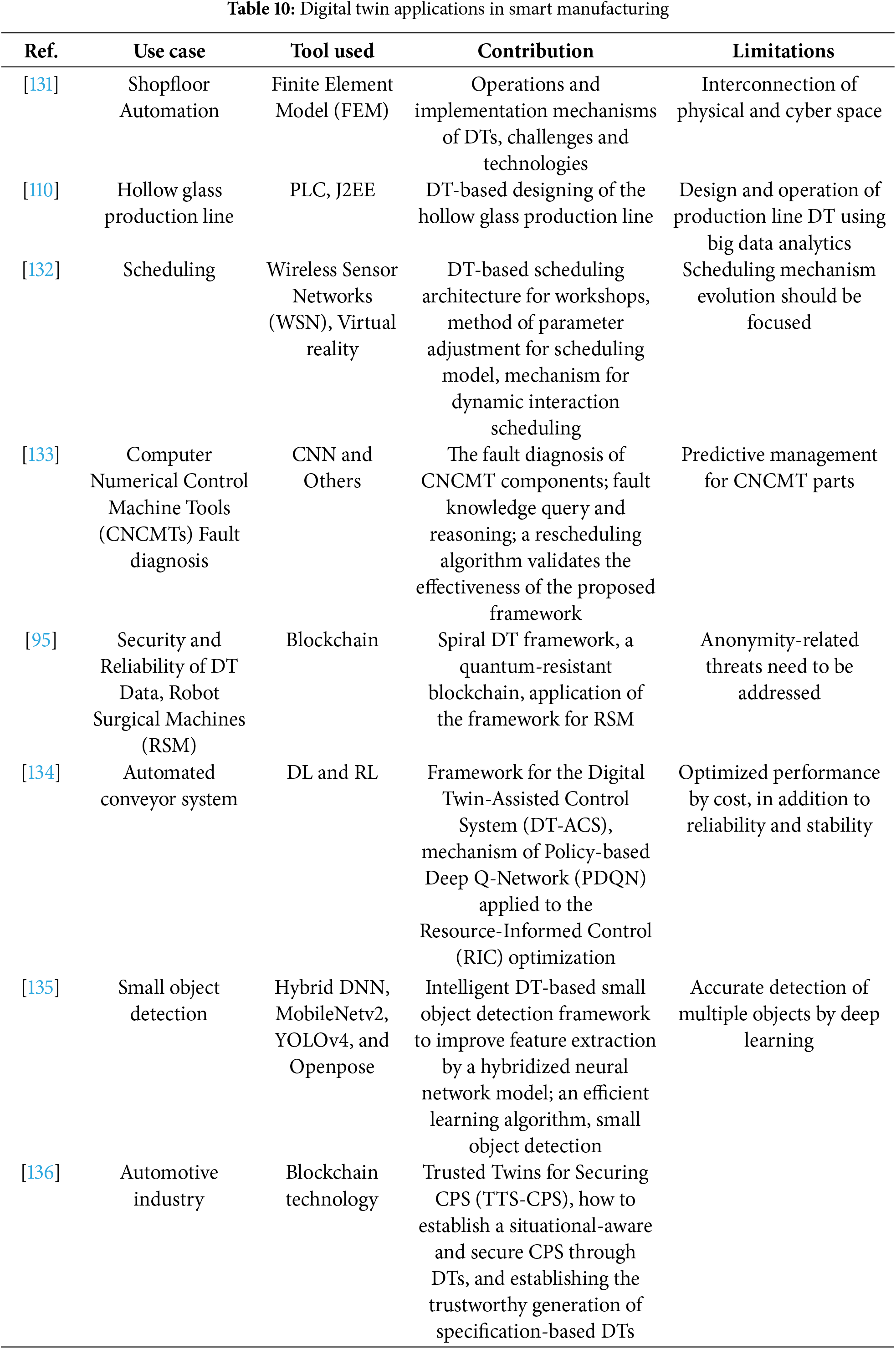
Challenges in smart manufacturing include data integration and interoperability, ensuring seamless integration of diverse data sources; cybersecurity and data privacy, safeguarding sensitive manufacturing data from cyber threats; real-time monitoring and control, optimizing processes through real-time data analysis; machine learning and predictive analytics, extracting insights from manufacturing data; system complexity and scalability, managing the increasing volume and variety of data; energy efficiency and sustainability, optimising resource utilization; human-machine interaction and collaboration, improving worker safety and productivity; and legacy system integration, seamlessly integrating new technologies with existing systems.
Clinical decision support systems in healthcare can take many forms, from medical devices that aim to increase the efficiency of medication and surgeries to remote services that rely on data obtained from patients. The paradigm shift from human-operated passive devices to IT-enabled devices is substantial in terms of degree of automation [137]. Physiological systems and functions are actively controlled by new healthcare technology and equipment. As a result, these new CPSs can achieve levels of functionality, adaptability, and effectiveness that were previously unimaginable in passive systems. This will allow clinicians to fine-tune their processes and procedures to create greater life cycle integration for patients and products if CPS is widely adopted. It is also critical to have a better grasp of the side effects and real-time data to tailor therapies and get better results. Since CPSs can be administered using minimally or non-invasive methods, they are less expensive to implement and provide patients with greater freedom, self-sufficiency, and general well-being [49].
As a result of constant monitoring of a chronic disease, care can be significantly transferred from inpatient care to outpatient care and home care. Designing a CPS for healthcare is difficult due to the complexity and interconnectedness, as well as the sensitivity involved in dealing with medical illnesses that have a direct impact on people’s lives. The impact of technology on healthcare care is extraordinary, as previously inconceivable things are becoming reality for the first time. The surge in IoT connectivity is due to the lower cost and ease of implementation of IoT devices [138]. The rise in connectedness in the healthcare sector only increases the possibilities for adoption of DT. A DT of a person could be used in the future to analyze the body in real time. Similarly to other healthcare applications, the usage of a DT enables healthcare professionals to recreate environments tailored to their individual needs, whether in real time or looking to the future.
Despite the fact that many healthcare applications do not directly involve the patient, they have a significant impact on the patient’s care and treatment. Medical DTs are still nascent, but the possibilities are limitless, from small wards and hospitals to enormous healthcare facilities. Real-time simulation and action are much more critical in healthcare because they can bridge the gap between life and death. In addition, DT might be used to help with diagnostics and repairs of medical equipment, as well as maintenance checks. Medical professionals can use DT and AI to make lifesaving decisions based on current and historical data. Here, the responsibilities of CPS and DT are explained, and the combination of CPS and DT in patient monitoring will yield successful results.
Reference [139] is primarily concerned with the research of DT characteristics, communication techniques and tools used for the construction of DT; reference models; challenges; standards; unresolved concerns; and recent work in intelligent manufacturing and intelligent healthcare. There is ISO/IEEE 11073 standardized DT framework for well being. Table 11 describes the few applications of DT in smart healthcare.
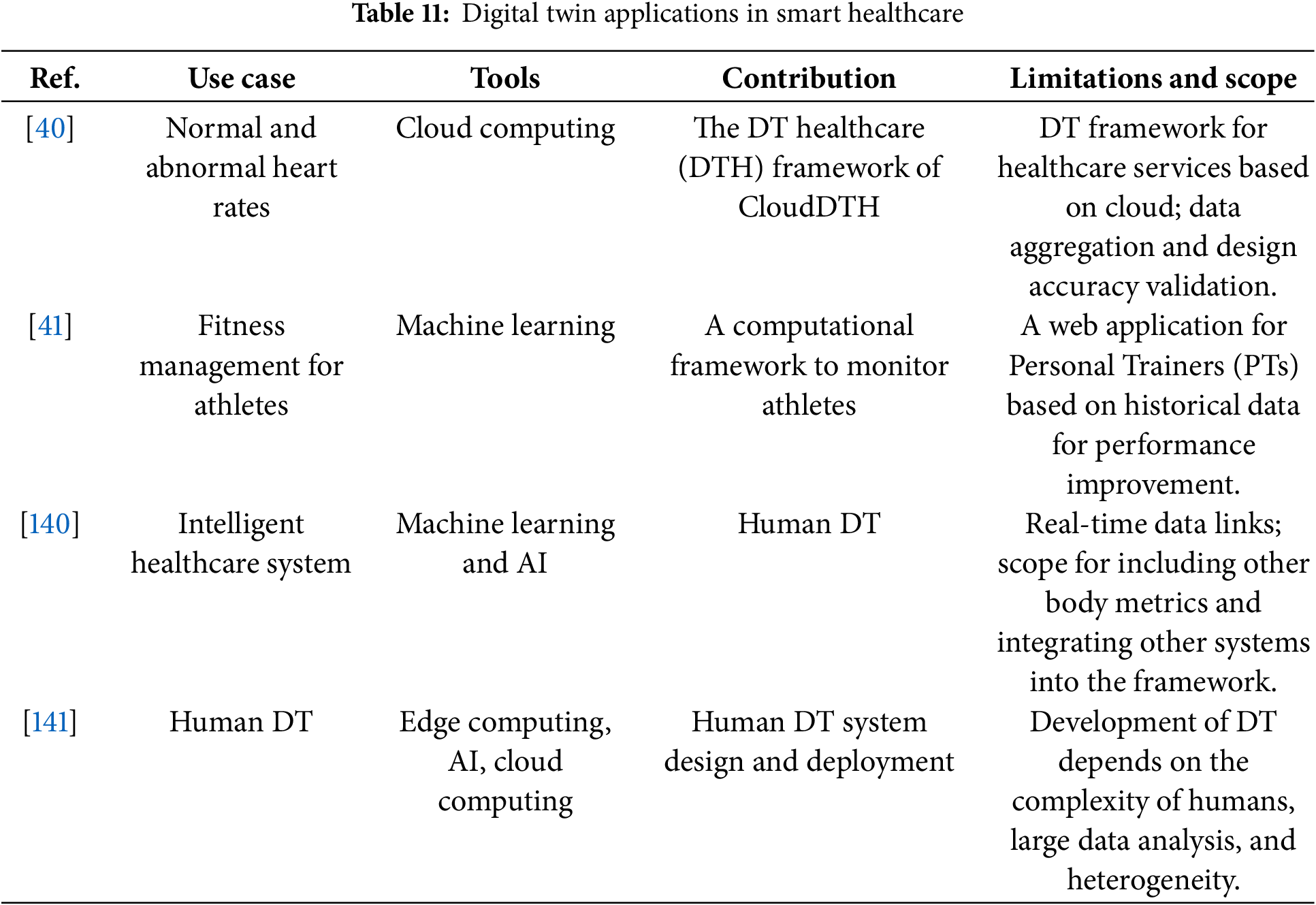
The modeling of smart healthcare CPS presents unique challenges due to complex healthcare environments and the integration of advanced technologies. Specific modeling challenges include patient-centric modeling to personalize healthcare interventions, multi-domain integration of various healthcare systems, real-time monitoring and prediction of patients’ health status, ensuring security and privacy of healthcare data, developing decision support systems, optimizing resource allocation, addressing interoperability and standardization issues, and considering ethical and legal considerations. These challenges require comprehensive models that capture patient data, enable seamless data flow, support clinical decision making, optimize resource allocation, ensure data security and privacy, promote interoperability, and adhere to ethical and legal guidelines in healthcare.
Our industrialized societies are built on a foundation of energy infrastructure. Electric grids are often built with a few high-volume production facilities and a large number of low-to-medium-volume consumer installations, with demand fluctuating by a factor of four between the day’s lows and highs. The old asymmetric and centralized electric grid management plan is increasingly unsuitable in light of the growing use of renewable energy resources, which is often produced by a greater range of institutions with fluctuating volumes that are out of step with the required consumption [142]. In this case, the CPS smart grid provides a solution by enabling the decentralized and cooperative synchronization of technological and organizational operations, from the management of a photovoltaic system to the invoicing and selling of electricity.
As a result of such dispersed solutions, micro-grids (local grids) can function without the need for a link to the main grid. In addition, using smart meters to keep an eye on the consumption and production of renewable energy sources can achieve a more precise short-term equilibrium between production and requirement. Lower power buffers (e.g., batteries) can help the grid move from supply-to-demand-side management through the use of smart systems and managed infrastructure. Using a CPS, these processes can be scaled to the number of participants needed [46].
The potential for even greater advantages lies in a life interconnection that makes it possible for this control to be continuously updated throughout the smart grid. Additional data or dispersed sensing capabilities can be introduced in a modular approach, identifying and replacing ineffective local control [45]. New data or widespread sensing capabilities can be introduced in a modular approach to identify and replace ineffective local control. Another way to tailor smart grids is to share data between the companies that build them and the people who use them. However, if the required technological (including compatible, safe and strong infrastructure) and legislative requirements cannot be developed, this will not be possible [143]. Energy production, trade and monitoring have cross-cutting effects that must be well understood so that dispersed investments in smart grid infrastructure are not stifled by uncertainty and risk.
There are significant uncertainties in both cyber and physical parts of the smart grid, which can be characterized as a complex system. An outage in one area of the grid can cause uncertainty; in other words, random mishaps, such as power load imbalances, outages, and even disturbances of the surrounding environment, can have a significant impact on the smart grid system [144]. As big data and IoT progress, it may be possible to foresee some of the hazards associated with smart grid incidents by utilizing big data analytic methods (such as data mining, learning, deep learning, statistics, etc.). A virtual smart grid (DT) environment can be created using big data to mimic real-world incidents and develop mitigation methods. Table 12 describes the few applications of DT in smart grid.
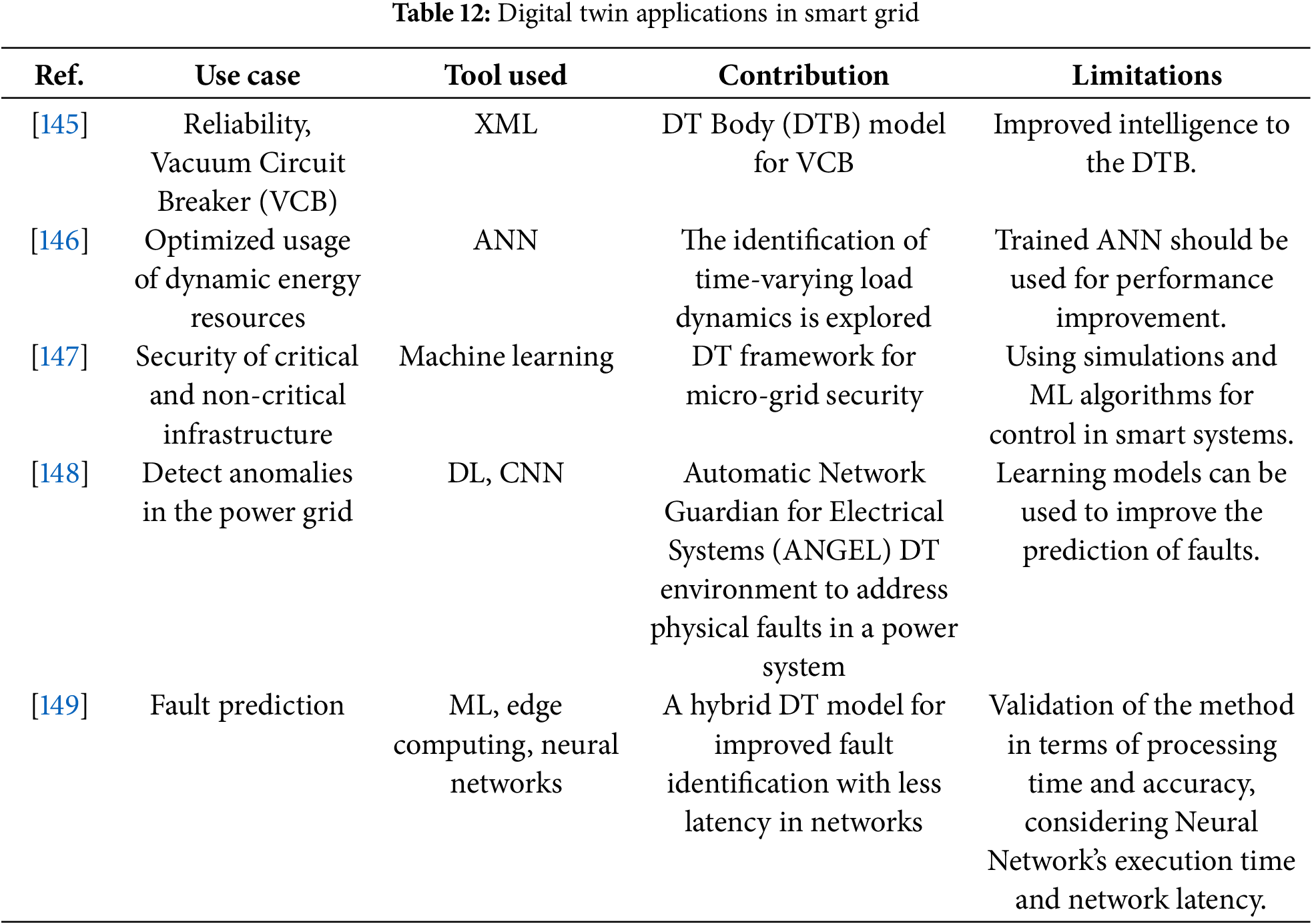
The CPS include real-time data integration, ensuring efficient processing of large volumes of real-time data; grid stability and control, modeling dynamic behavior and stability while integrating renewable energy sources; cybersecurity and resilience, protecting against cyber threats and ensuring grid integrity; demand response and energy management, capturing consumer behaviour and optimizing energy consumption; distributed energy resources, integrating and controlling renewable generation and energy storage; grid planning and expansion, modeling infrastructure growth and optimization; interoperability and standards, ensuring seamless integration among different components and systems; and economic and market modeling, considering pricing mechanisms and optimising energy trading. These challenges require comprehensive models to handle real-time data, ensure grid stability, enhance cybersecurity, optimize energy management, integrate distributed resources, plan grid expansion, promote interoperability, and optimize market dynamics.
From smart components such as a smart tyre to intelligent transportation systems, CPS encompasses the transportation sector. Cross-domain integration is directly related to transportation systems. The logistics, automotive and rail industries, as well as others, need to work together to provide transportation services. Both vehicles and infrastructure components (for example, roads and communications) influence coordination, with differences in speed, capacity, cost, and governance that influence coordination [150]. Moving from providing vehicles to providing a service is becoming more commonplace because logistics is an essential component in both the industrial and social worlds. Rather than relying on individual vehicles, emerging mobility solutions will largely depend on highly automated modes of transportation to meet individual transportation needs [139]. As the global need for mobility increases, other social objectives must also be considered, such as improving safety, efficiency, security, comfort, and economics, in order to implement the vision of connected and autonomous vehicles.
To address the needs of an ageing population, transportation services must be able to provide quality, reliability, security, accessibility, and safety to those with reduced mobility. Despite the fact that many CPS domains face comparable obstacles, the CPS of transport has its own distinct set of issues. Traditional models cannot complete model training with large data in a short period of time because the smart transportation system requires real-time data transfer and analysis skills to deploy time-sensitive services such as driverless vehicles [151]. The collection and compilation of all sensor data in a short period of time is also difficult for traditional smart transportation systems [116]. To achieve real-time processing and transmission, the DT model can leverage high-performance cloud/edge servers in the digital system for data gathering and model training. Table 13 describes the few applications of DT in smart transportation.
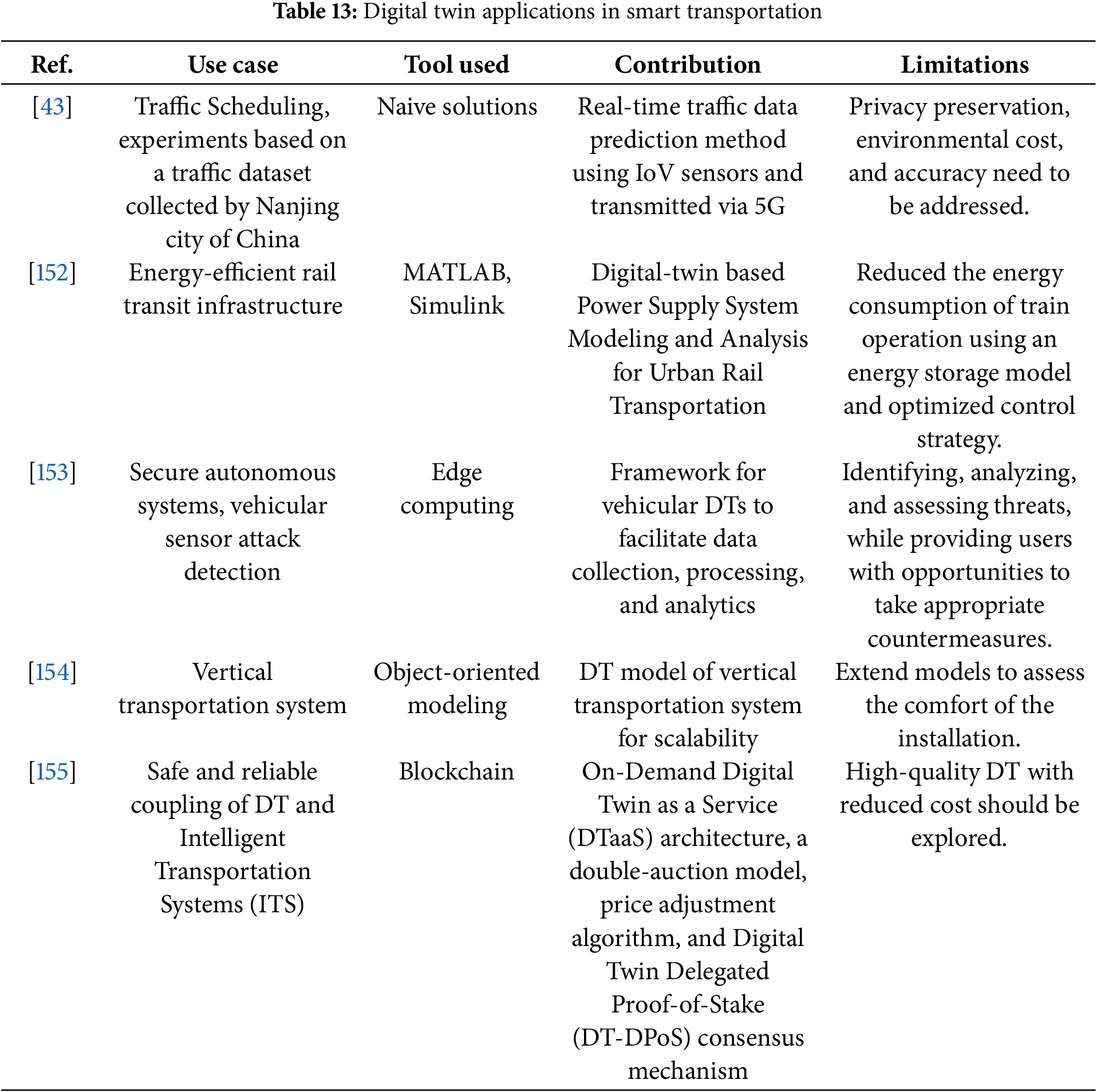
The modeling challenges in smart transportation systems include capturing the complex behavior of traffic flow, optimizing route planning based on multiple factors, integrating different transportation modes, accurately modeling travel demand, incorporating intelligent infrastructure elements, optimizing energy efficiency, understanding user behavior and preferences, and ensuring safety and security measures. These challenges require comprehensive models that accurately represent traffic dynamics, optimize routes, integrate multimodal transportation, forecast demand, integrate intelligent infrastructure, promote energy efficiency, understand user behavior, and address safety and security concerns in CPS smart transportation.
DTs have the potential to revolutionize agriculture in terms of efficiency and sustainability. A DT is a virtual representation of the real object that mimics its behavior patterns and states over time in a virtual world. Decoupling physical flows from their planning and control can be achieved by using DTs as just a centralized management tool. Using digital data instead of direct observation and physical activities [156], farmers can now manage their businesses from afar. When deviations occur, they can immediately take action and mimic the effects of interventions using real-world data. There is a global food crisis and an increasing population that provides the most significant barriers to sustainable development.
Artificial intelligence, the IoT, and the Internet can help solve some of the world’s biggest problems. Instead of relying on observation on site and manual labor, farmers using smart farming systems can keep an eye on and control activities from a distance using (near) real-time digital information [157]. When there is an issue or something goes wrong, farmers are automatically alerted. They can monitor the situation on the yard or in the barn from the comfort of their office or smartphone by viewing high-quality image information of the plant, animal, or machine involved [158]. The digital picture is further enhanced by object-specific analysis and recommendations provided by machine learning techniques. Farmers can simulate and analyze the impact of corrective and preventive activities on digital information. For final confirmation of the problem (targeted), the farmer can use a digital view to see if it has been fixed [159]. It is also reasonable to assume that this smart agricultural maintenance cycle will become increasingly self-sufficient and will require less and less farmer involvement. These are the CPSs’ agricultural scenario applications, known as agricultural CPSs (ACPSs).
In order to maintain ideal environmental qualities, applications use advanced computers, the Internet, and agricultural facilities. Accuracy and thoroughness are expected of them when it comes to collecting data on weather patterns, soil conditions, and crop yields. Watering, humidity, and plant health are just a few of the variables that can be controlled with the information gathered [160]. The crops, fields, cows, and machinery on a farm are virtualized and may be remotely operated, to say the least. The emergence of a DT is a good analogy for this. Farming with DTs can be viewed as a new phase. Precision farming, IoT, and simulation are included in the new system. As a result, there are numerous uses for DTs in agriculture, even if they are not portrayed as such.
In most cases, DTs remain in their simplest form, such as the digital form in a cloud platform. Predictive and prescriptive skills, for example, are still in the early stages of development for more advanced applications. Reference [161] is the first to look into using DTs for agricultural management, as far as we know. According to this study, DTs are viewed through the lens of the Internet of Things, a network of interconnected physical and virtual things. This research indicates that DTs are already being used in smart farming; however, existing applications focus mainly on basic features and capabilities. Based on these qualities, according to the authors, online DTs can be used for optimization, simulation, and decision support.
DTs have been used in the creation of field robots, such as those used in vineyard phenotype and crop treatment. With the help of real-time data, they create a DT of a robot that can be used to control its real-world counterpart. As a result, development time frames are shortened, sensor behavior is better evaluated, and the number of field tests needed to evaluate phenotypes or evaluate the impacts of crop treatments is reduced. In [162], the period 2019–2021, the work focuses on new approaches to smart formation (SF), in which the work reveals data collection and transmission, as well as backup, analysis, and appropriate solutions. Connecting sensors to perform fundamental activities is one of the key functions of the Internet of Things (IoT). Sensors were integrated to monitor water levels [163], irrigation efficiency, climate, and other variables in the smart irrigation system. Based on controls and sensors, together with some functional equations, smart irrigation was achieved. Table 14 describes the few applications of DT in smart agriculture.
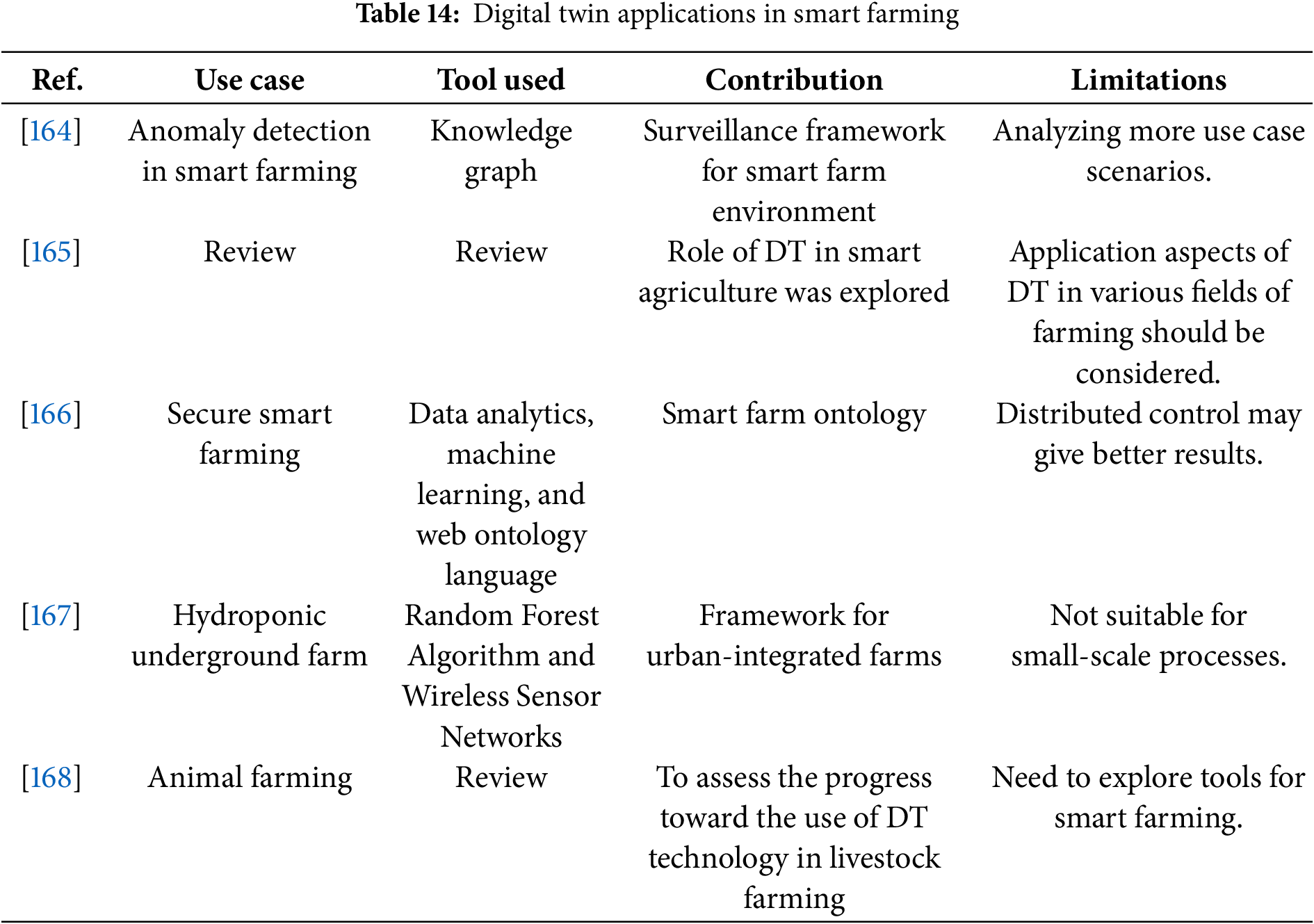
Modeling challenges in smart farming processes involve accurately representing material behavior, simulating the dynamic farming process, incorporating multiphysics phenomena, modeling tooling and equipment, addressing uncertainties and variability, modeling real-time control systems, leveraging data-driven approaches, and addressing scalability and optimization in large-scale farming processes. These challenges require comprehensive models that capture material behavior, simulate the farming process, consider multiphysics effects, model equipment interactions, handle uncertainties, enable real-time control, use data-driven approaches, and optimize large-scale farming operations while ensuring computational efficiency and accuracy.
In the aerospace industry, which includes its manufacturing base, DTs have become an integral part of the design, growth, and deployment of critical functions. The problem is that there are many misunderstandings about DTs and a lack of knowledge about how to use them optimally [170]. A DT is not an intelligent model, but rather a digital shadow or a digital model if the critical elements of data capture and data visualization are ignored. This leads to the creation of digital shadows rather than the DT. The progressive digitization that has occurred over many years within the aerospace industry has given the aviation industry the reputation of being technology intensive. Due to this, aircraft systems have improved in terms of safety and efficiency [171]. In addition, the incorporation of digital avionics systems, vehicle care coordination, and sensors within the aircraft has increased the complexities of configurations, ease of maintenance, and data enormity.
As a result, the reliability and safety of the aircraft platform must be maintained throughout its life cycle through effective, rapid, and factual data analysis [172]. In order to create a DT model, a digital virtual body must be created from a physical one. It takes time for the DT to resemble the physical entity so closely that it appears to be in perfect sync with it [39]. Information systems in the CPS include this part, which includes simulation and control of a virtual entity based on the DT’s simulation and prediction results, as well as autonomous decision making, using controllers to control physical entities, optimizing operating states, and implementing iterative optimization parts of the CPS [173].
As a result of this investigation, it can be concluded that the DT of an aircraft can be linked to CPS and the Internet of Things. DT, simulation, and the Internet of Things (IoT) are all components of a physical system. The Internet of Things refers to both the physical plane and the DT [174]. It is important that the DT has a high-precision simulation model that corresponds to the physical counterpart. The DT can really be adjusted based on the physical entity’s output data, allowing it to reflect the physical entity’s operational state in real-time while also approximating it. The predicted simulation results of the DT are used in the simulation part [175]. A CPS system can be created using a DT, modeling, and the Internet of Things (IoT). The Internet of Things (IoT) represents the physical and interaction aspects of CPS, while the virtual model and modeling represent the information aspects of CPS. Table 15 describes the few applications of DT in smart aerospace.
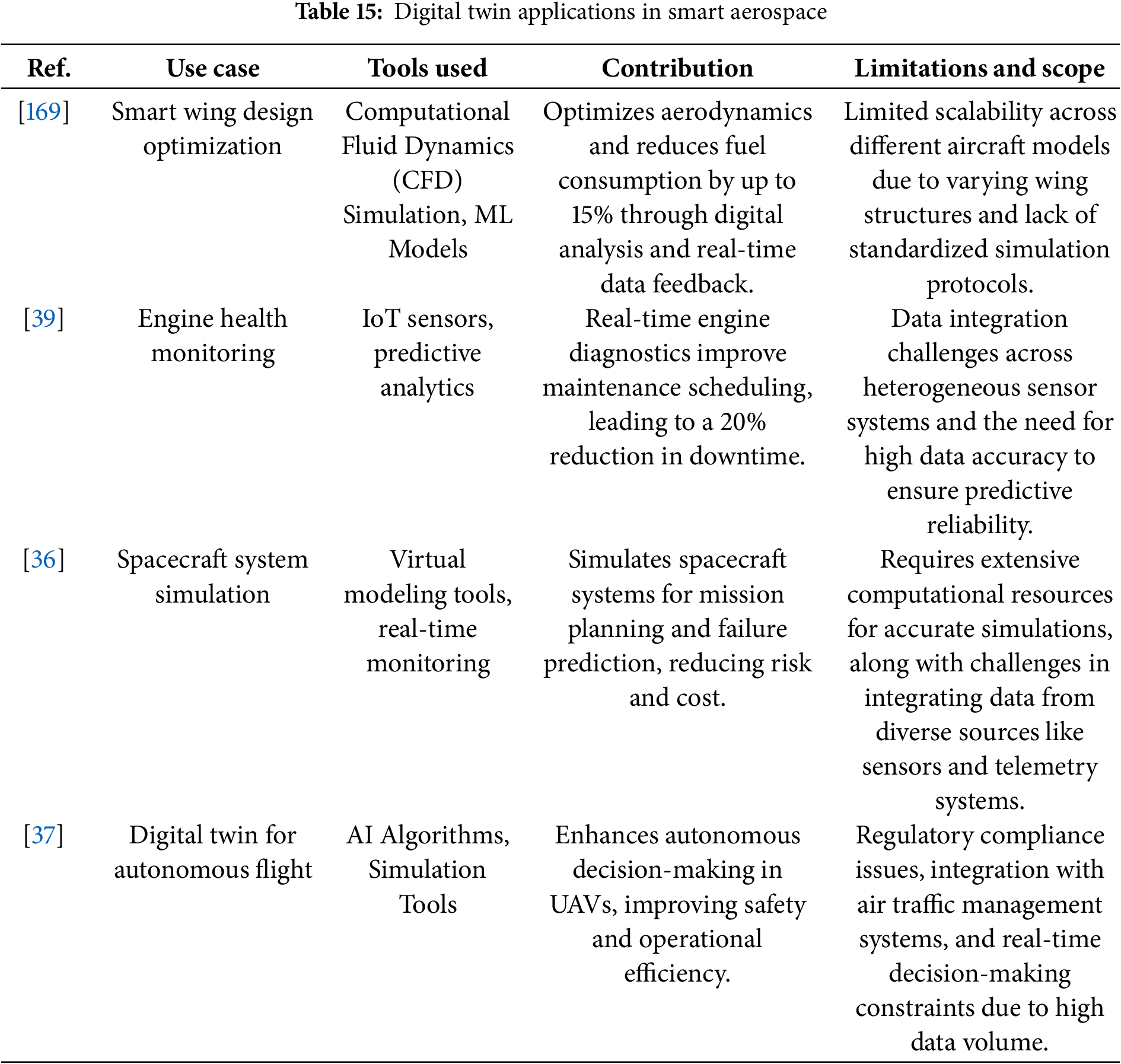
Modeling challenges in smart aerospace CPS include accurately simulating flight dynamics, integrating subsystem models, detecting and diagnosing faults, addressing cybersecurity and safety concerns, optimizing system performance, modeling environmental impact, enhancing human-machine interaction, and ensuring certification and regulatory compliance. These challenges require the development of accurate and comprehensive models that capture the dynamic behavior of aerospace vehicles, integrate subsystem interactions, detect and mitigate faults, address cybersecurity and safety risks, optimize operational parameters, quantify environmental impact, consider human factors, and adhere to industry standards and regulations.
Many different areas of CPS research and technology are being integrated to create “smart cities.” The cross-domain elements of CPS are also addressed by these researchers, who touch on a variety of fields, including architecture, law, economics, and sociology. Due to the current state of affairs, there are several possibilities for CPS in smart cities. The result is a congested downtown area with narrow and narrow streets. Traffic can be overwhelming at times [176]. Other factors, such as the vast number of automobiles on American city highways, make the problem even more dire. The situation will become unmanageable if advanced technology is not used with the latest technical emphasis. It is feasible to monitor and control security, safety and efficiency in smart cities due to the widespread sensor network and the ubiquitous communication system of CPS deployment.
Future highly automated city services will provide an extraordinary ability to avoid resource waste, losses associated with water pollution, fires or the release of hazardous materials, and disruptions caused by failing infrastructure, all thanks to this unprecedented ability to avoid human error [177]. The biggest problems arise from decision makers who are generally uninformed about new technologies. A CPS-driven infrastructure or service can lead them to fall prey to ill-advised design plans.
Technology mutations have turned out to be costly and time-consuming failures. More life cycle integration, where data are collected and specific smart city technology has been linked to advantages, is required for decision-makers, regardless of their technical expertise, to act. It is possible that in smart cities, like in many other industries, DT could be used to detect and correct problems before they exist, saving time and money in the long run [178]. Data can be moved quickly and easily from DT to physical objects if the findings meet expectations. Table 16 describes the few applications of DT in the smart city.
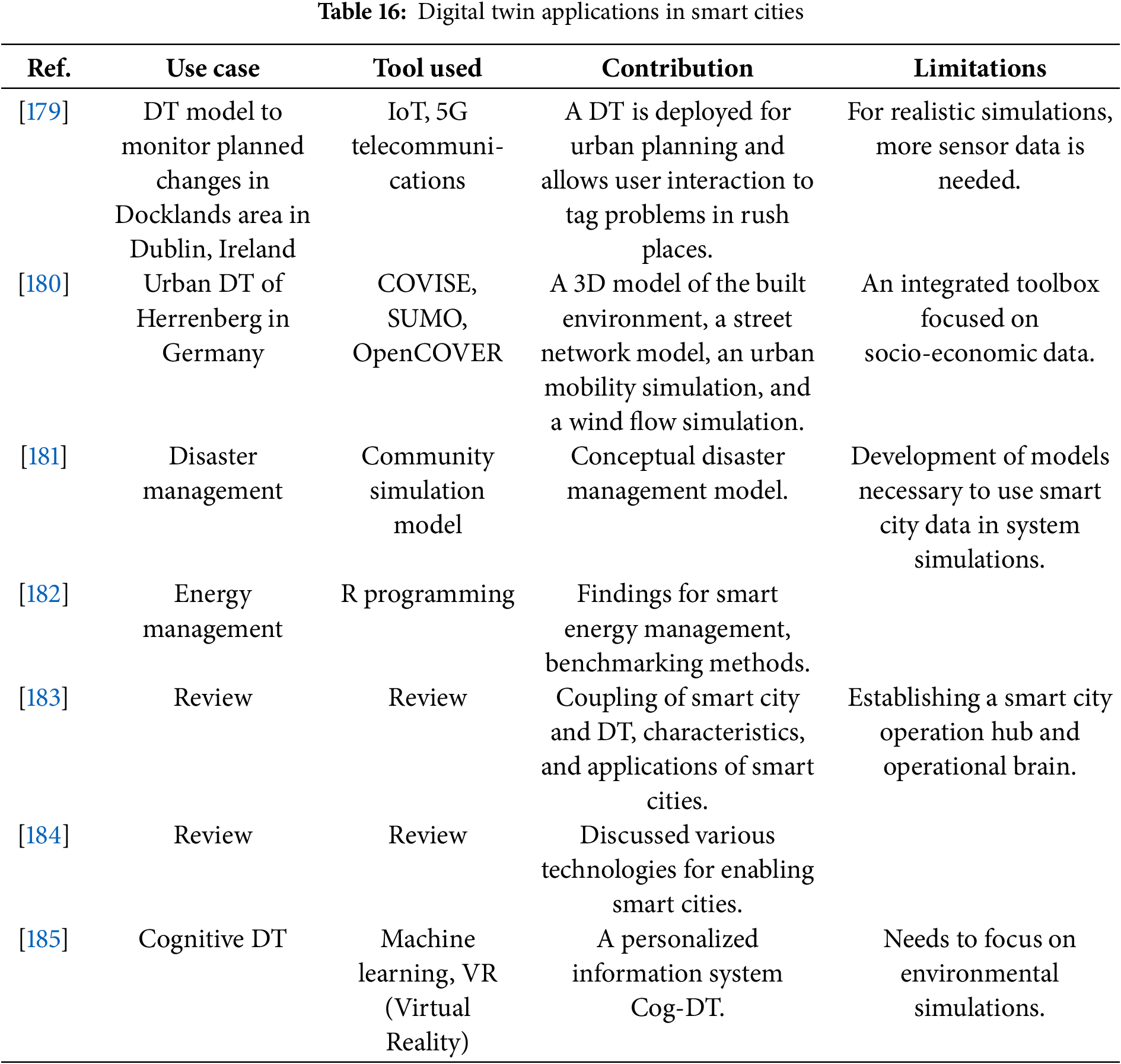
The modeling challenges in smart city systems encompass optimizing energy management, monitoring environmental factors, managing smart infrastructure, understanding citizen behavior, ensuring security and privacy, facilitating emergency response, and promoting social equity. These challenges require the development of models that accurately capture the dynamics of energy systems, integrate diverse data sources, simulate smart infrastructure behavior, predict citizen behavior, implement robust security measures, plan for emergencies, and address social disparities.
10 Challenges and Open Research Issues in CPS
CPSs are integral to modern industrial and technological applications, yet they face numerous challenges in their development and implementation. This section provides a detailed overview of the challenges and open research issues that impede the advancement of CPS, particularly when integrated with DTs.
Dynamic Resource Allocation: CPS deal with limited resources such as bandwidth, processing power, energy, and memory, which must be dynamically managed in real-time. The heterogeneity of CPS hardware, which involves components with varying computational power and energy needs, requires flexible and adaptive resource allocation strategies. Additionally, many CPS applications, like autonomous vehicles and industrial automation, demand timely responses. Balancing the system load while adhering to strict real-time deadlines presents a complex challenge in managing resources effectively.
Energy Efficiency: Energy consumption in CPS, especially in systems with wireless sensor networks or mobile nodes, is a critical concern as these devices often rely on finite power sources such as batteries. Managing energy-hungry computations and offloading them efficiently becomes crucial to prolong system operation. Moreover, CPS systems must carefully balance performance with energy consumption, often requiring algorithms that dynamically adjust performance to meet the needs of the system while minimizing energy usage.
Scalability: As CPS systems scale from small setups to large networks involving thousands of interconnected devices, managing resources becomes increasingly difficult. A major challenge lies in the coordination overhead required to manage numerous components that share limited resources like bandwidth. Furthermore, implementing distributed control algorithms across a large system to ensure consistent performance while avoiding bottlenecks is a significant challenge, especially when trying to maintain the system’s scalability.
Communication Latency and Bandwidth: Effective resource coordination in CPS depends heavily on real-time communication between physical and computational components. Many CPS applications, such as autonomous vehicles or smart grids, require low-latency communication to ensure timely feedback and safety, but network delays or jitter can hinder system performance. Additionally, CPS often operate in environments with constrained bandwidth, which makes it difficult to ensure timely data exchange and efficient resource management without data loss.
Fault Tolerance and Robustness: CPS systems must be robust and maintain operational integrity even in the presence of component or network failures. This includes dynamically reallocating tasks to available components when a sensor or actuator fails, without compromising system performance. Achieving resilient coordination, especially in distributed systems where communication failures or delays can occur, is vital to ensure that the system continues to function despite such challenges.
Heterogeneous Resource Requirements: Different CPS applications, such as healthcare, transportation, or manufacturing, have unique and varying resource demands. Managing these heterogeneous resources is challenging, as some components may require high computational power (e.g., for image processing), while others prioritize low latency or energy efficiency. Resource management must occur at multiple levels within the CPS stack, requiring coordination across hardware, network, and application layers, further complicating the management process.
Security and Privacy: Resource management in CPS must also address security concerns, as attackers can exploit vulnerabilities to disrupt system operations. For example, resource hijacking could occur, where malicious entities over-utilize resources like bandwidth or processing power, leading to degraded system performance. Additionally, in sensitive applications like healthcare CPS, managing resources securely while ensuring privacy preservation is a challenge, as the system must maintain both security and performance.
Context Awareness and Adaptability: CPS often operate in dynamic and unpredictable environments, necessitating real-time adaptability and context awareness in resource management. The system must quickly respond to changing conditions, such as sensor faults or newly added devices, while maintaining optimal performance. Furthermore, CPS systems deployed in environments that are subject to external changes, like drones or autonomous vehicles, must manage resources dynamically to adapt to environmental factors such as weather or obstacles.
Coordination Among Multiple Systems: Large-scale CPS deployments often involve multiple independent CPS systems that must coordinate resource management across different domains. Interoperability between these systems is a key challenge, as they may use different communication protocols and standards. Additionally, conflicting objectives between CPS subsystems, such as competing demands for limited bandwidth, require sophisticated negotiation mechanisms to ensure optimal resource allocation across the entire system.
Decentralized Decision Making: Traditional centralized control approaches are often unsuitable for CPS due to concerns around scalability and latency, pushing the need for decentralized decision-making. However, this brings its own challenges, such as the need for distributed optimization to ensure resources are allocated efficiently across decentralized nodes. Furthermore, achieving consensus on resource allocation strategies in a decentralized network, especially in scenarios with intermittent communication, poses a significant challenge for CPS.
Intelligent Computing and Caching: For CPS, these are two key areas that deserve further study to improve content distribution and processing of data. Caching in CPSs can be improved by taking into account two distinct factors: cache decision and content delivery. As a result of the high frequency with which adjacent users request cached content, content distribution in CPSs is facilitated. CPSs, on the other hand, contain enormous amounts of dynamic data and a wide range of content. Furthermore, some of them are available in different formats, bitrates, and resolutions. It’s also worth noting that each user prefers a better variations, and the extent of their preference changes over time. This makes caching optimization more difficult. The above issues can be solved by intelligent caching. CPSs must be able to analyze and process massive amounts of data obtained by sensors or devices in real time. However, it is essential to separate valuable information from noise in order to improve analysis and processing efficiency. The above problem can be solved with the help of intelligent computing.
10.2 Challenges of Digital Twin
Balanced against the many advantages of DT technology, there are several challenges to overcome.These challenges are discussed in this subsection.
• Accurate Capturing of Physical Properties: A DT technology should capture the physical qualities, simulate the behaviours, and scale of both simple items (such as a vehicle, aeroplane, building, or human person) and complex objects relationships.
• Project Collaboration: It is important that DTs be able to work together on projects. For instance, an united DT could be an efficient platform for cooperation between DTs. Depending on the situation, a DT may work in tandem with or establish connections to other DTs.
• Conflict Detection and Resolving: It needs to be able to monitor its surroundings in real time and adjust accordingly. For reliable and consistent interactions, it must be able to spot and address variations in execution.
• Mutual Understanding and Integration of Different Domains in the Product Engineering Process in DT: Integrating the ideas of product designers, production planners, and application engineers is essential for the effective use and provision of information in DTs. Each field must have an agreed-upon comprehension of the others’ needs and objectives. Boundary conditions and optimization concepts change from stage to stage in product engineering, and it’s impossible to predict how they’ll interact with or affect one another.
• Interfaces for Standardized Information Exchange: Once agreement is obtained on the needs of the other domain and common interfaces for data interchange are defined, the two areas can begin to interact effectively. The overall product design phase can now benefit from consistent information sharing. It is possible to directly implement the needs for later usage in production or application with the formation of a DT, for example. This guarantees that the DT prototypes will work smoothly during the development and integration phases of the product.
• Efficient Design of Information Flow: As more and more domains become interconnected, the potential for an overwhelming deluge of data becomes even more real. Therefore, information flows must be designed efficiently and the volume of data must be adjusted for the different domains. This guarantees that the required data are easily available and editable, but cannot be misused. Significant simulation results may require interdisciplinary teams to interpret and make safe decisions.
• Fidelity Issues in DT: In the context of DT challenges, the “fidelity issue” refers to the accuracy, precision, and reliability of the DT representation in comparison to its real-world counterpart. It is a critical challenge that arises when creating and using DTs in various applications.
When developing a DT, engineers and data scientists aim to create a virtual model that closely resembles the physical object or system it represents. The higher the fidelity, the more accurate and reliable the DT becomes in simulating and predicting real-world behaviours and responses. However, achieving high fidelity is not always straightforward and can be hindered by several factors:
1. Data Quality and Availability: Obtaining high-quality data from the physical asset or system can be challenging. Inaccurate or incomplete data can lead to discrepancies between the DT and its real-world counterpart.
2. Sensor Limitations: The fidelity of a DT is highly dependent on the data collected by sensors on the physical asset. If the sensors are not sufficiently sensitive or if some critical data is not captured, the DT may lack precision.
3. Model Complexity: Some real-world systems are highly complex and difficult to model accurately. As a result, the DT can oversimplify or omit certain aspects, affecting its fidelity.
4. Calibration and Validation: Calibrating and validating the DT against the physical asset is essential to ensure accuracy. However, this process can be time-consuming and may require a significant amount of data.
5. Computational Resources: Achieving high fidelity often requires substantial computational power. Simulating complex systems in real time can be resource intensive and may not be feasible in certain environments.
6. Dynamic Changes: Real-world systems can undergo continuous changes and updates, which may not always be reflected in the DT in a timely manner.
Overcoming fidelity issues is crucial for the successful implementation and utilisation of DTs. Addressing these challenges involves improving data collection methods, improving sensor technologies, improving modelling techniques, and ensuring ongoing calibration and validation processes to maintain alignment with the physical asset. As technology advances and more data become available, the fidelity of DTs is expected to improve, unlocking their potential for various applications in industries such as manufacturing, healthcare, transportation, and more. After analysing different applications of CPS with DT, the related challenges are also presented in Table 17.
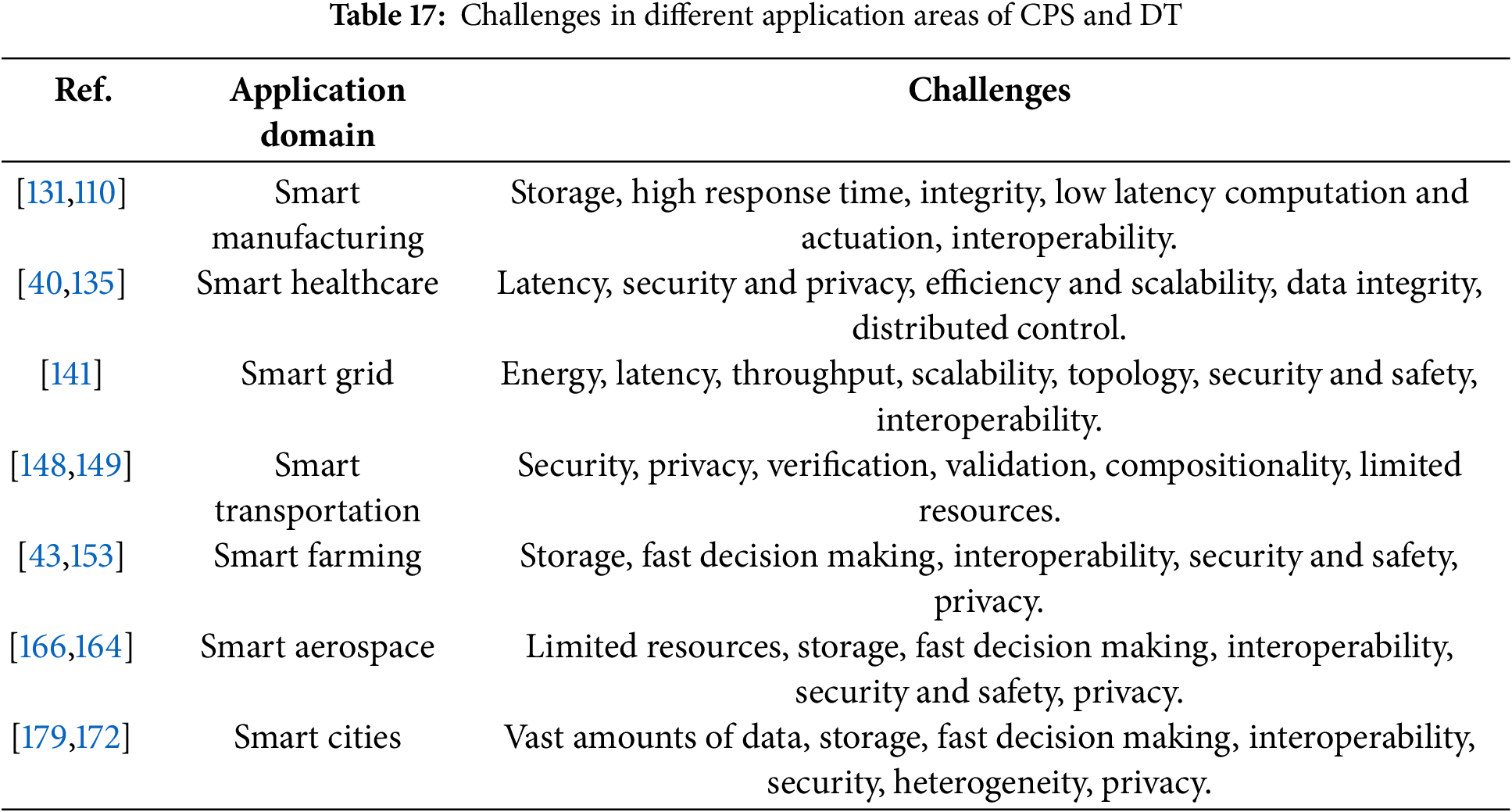
This study delves into the evolving landscape of CPS and DT, providing an extensive analysis of their architectures, methodologies, and integration challenges. By highlighting the interplay between the cyber and physical worlds, this work underscores the transformative potential of CPS and DT to enhance real-time sensing, decision-making, and control in various industries. The findings of this study reinforce that the integration of CPS-DT is not merely a technological improvement but a paradigm shift that redefines how systems are designed, monitored, and optimized in dynamic environments.
CPSs, with their inherent ability to synchronize computation, communication, and control (3C), require meticulous coordination for diverse applications such as healthcare, smart cities, and autonomous transportation. The addition of DTs amplifies this potential by enabling detailed virtual representations of physical systems, thereby facilitating predictive analytics, fault detection, and optimization. This survey has dissected the existing literature to identify key strengths and gaps in current CPS-DT implementations. This survey reveals that while DTs offer immense promise in scalability and adaptability, challenges related to fidelity, interoperability, resource management, and security remain significant barriers to widespread adoption.
The study also recognizes the pressing need for standardized frameworks that can bridge the gap between theoretical advances and practical implementations. Such frameworks must cater to the heterogeneity of CPS applications, ensuring that varying domain-specific requirements are met effectively. In addition, this research underscores the importance of addressing latency, energy efficiency, and security concerns to achieve seamless integration and reliable performance in real-world applications.
Limitations of This Work This study, while comprehensive, has certain limitations that should be addressed in future research. First, the scope is limited to reviewing existing methodologies and frameworks for CPS and DT integration, without offering in-depth experimental validation or domain-specific implementation insights. Secondly, the findings are primarily based on theoretical models and literature reviews, which may not fully capture the complexities and nuances of real-world applications or recent technological advancements. Moreover, this work does not propose a standardized framework or reference implementation for CPS-DT integration, leaving the practical deployment and testing to future investigations. Another limitation lies in the lack of detailed consideration for interdisciplinary integration challenges, particularly in harmonizing diverse domains such as healthcare, manufacturing, and transportation within a unified CPS-DT framework. Finally, mechanisms to ensure real-time adaptability and resilience in dynamically changing environments remain unexplored, which is critical for the deployment of CPS-DT systems in complex and unpredictable scenarios. Addressing these limitations will pave the way for more practical, adaptive, and robust CPS-DT solutions.
Future Research Directions: Several research directions have been identified to address the challenges of CPS and DT integration. These include developing new architectures that enhance system interoperability, energy efficiency, and security, while also enabling more accurate real-time control and decision-making. Other research areas include improving the scalability of CPS-DT systems to handle more complex applications, such as smart cities, and exploring the use of artificial intelligence and machine learning to optimize system performance. The integration of CPS with Digital Twins provides a powerful framework for the development of smart systems in various industries. However, several challenges, including resource management, energy optimization, system heterogeneity, and real-time data integration, must be addressed to fully realize the potential of CPS-DT systems. Future research should focus on developing innovative solutions to these challenges, particularly in the areas of security, privacy, and adaptive control. It should also focus on refining methods for integrating multiple models within a Digital Twin to better serve the diverse and sometimes conflicting needs of stakeholders throughout the life cycle of a CPS.
Acknowledgement: We would like to express our gratitude to VIT-AP University, Prince Sultan University, and the University of Nottingham for their invaluable support in facilitating the evaluation of this research. We also extend our sincere thanks to Marco Rivera and Patrick Wheeler from the University of Nottingham for their insightful contributions and critical revisions to this article.
Funding Statement: The authors received no specific funding for this study.
Author Contributions: Vidyalakshmi G: Conceptualization, Methodology, Software, Validation, Formal analysis, Investigation, Writing—original draft, Visualization. S Gopikrishnan: Conceptualization, Software, Formal analysis, Investigation, Writing—original draft, Writing—review & editing, Visualization, Supervision, Project administration. Wadii Boulila: Formal analysis, Resources, Project administration, Supervision, Writing—review & editing. Gautam Srivastava: Conceptualization, Investigation, Resources, Writing—review & editing, Visualization. Anis Koubaa: Conceptualization, Validation, Writing—review & editing, Visualization. All authors reviewed the results and approved the final version of the manuscript.
Availability of Data and Materials: All data generated or analyzed during this study are included in this published article.
Ethics Approval: Not applicable.
Conflicts of Interest: The authors declare no conflicts of interest to report regarding the present study.
References
1. Lee EA. Cyber physical systems: design challenges. In: 2008 11th IEEE International Symposium on Object and Component-Oriented Real-Time Distributed Computing (ISORC); 2008; Orlando, FL, USA:IEEE. p. 363–9. [Google Scholar]
2. Lee EA, Seshia SA. Introduction to embedded systems: a cyber-physical systems approach. 2nd ed. Cambridge, MA, USA: Mit Press; 2016 [cited 2024 Oct 20]. Available from: https://leeseshia.org. [Google Scholar]
3. Sanislav T, Mois G. A dependability analysis model in the context of cyber-physical systems. In: 2017 18th International Carpathian Control Conference (ICCC); 2017; Sinaia, Romania: IEEE. p. 146–50. [Google Scholar]
4. Lee EA. The past, present and future of cyber-physical systems: a focus on models. Sensors. 2015;15(3):4837–69. doi:10.3390/s150304837. [Google Scholar] [PubMed] [CrossRef]
5. Lee J, Bagheri B, Kao HA. A cyber-physical systems architecture for Industry 4.0-based manufacturing systems. Manuf Lett. 2015;3:18–23. doi:10.1016/j.mfglet.2014.12.001. [Google Scholar] [CrossRef]
6. Grieves M. Digital twin: manufacturing excellence through virtual factory replication. White Paper. Florida Institute of Technology; 2017 [cited 2024 Oct 20]. Available from: https://www.researchgate.net/publication/307509727_Digital_Twin_Manufacturing_Excellence_through_Virtual_Factory_Replication. [Google Scholar]
7. Tao F, Cheng J, Qi Q, Zhang M, Zhang H, Sui F. Digital twin-driven product design, manufacturing and service with big data. The Int J Adv Manuf Technol. 2018;94(9):3563–76. doi:10.1007/s00170-017-0233-1. [Google Scholar] [CrossRef]
8. Parott A, Warshaw L. Industry 4.0 and the digital twin: manufacturing meets its match. 2017. Retrieved January 23,2019 [cited 2024 Oct 20]. Available from: https://www2.deloitte.com/us/en/insights/focus/industry-4-0/digital-twin-technology-smart-factory.html. [Google Scholar]
9. Rojas RA, Rauch E, Vidoni R, Matt DT. Enabling connectivity of cyber-physical production systems: a conceptual framework. Procedia Manuf. 2017;11:822–9. doi:10.1016/j.promfg.2017.07.184. [Google Scholar] [CrossRef]
10. Liu XF, Shahriar MR, Al Sunny SN, Leu MC, Hu L. Cyber-physical manufacturing cloud: architecture, virtualization, communication, and testbed. J Manuf Syst. 2017;43:352–64. doi:10.1016/j.jmsy.2017.04.004. [Google Scholar] [CrossRef]
11. Minerva R, Crespi N. Digital twins: properties, software frameworks, and application scenarios. IT Professional. 2021;23(1):51–5. doi:10.1109/MITP.2020.2982896. [Google Scholar] [CrossRef]
12. Minerva R, Lee GM, Crespi N. Digital twin in the IoT context: a survey on technical features, scenarios, and architectural models. Proc IEEE. 2020;108(10):1785–824. doi:10.1109/JPROC.2020.2998530. [Google Scholar] [CrossRef]
13. Qi Q, Tao F, Hu T, Anwer N, Liu A, Wei Y, et al. Enabling technologies and tools for digital twin. J Manuf Syst. 2021;58(1):3–21. doi:10.1016/j.jmsy.2019.10.001. [Google Scholar] [CrossRef]
14. Fuller A, Fan Z, Day C, Barlow C. Digital twin: enabling technologies, challenges and open research. IEEE Access. 2020;8:108952–71. doi:10.1109/ACCESS.2020.2998358. [Google Scholar] [CrossRef]
15. Parnianifard A, Jearavongtakul S, Sasithong P, Sinpan N, Poomrittigul S, Bajpai A, et al. Digital-twins towards cyber-physical systems: a brief survey. Eng J. 2022;26(9):47–61. doi:10.4186/ej.2022.26.9.47. [Google Scholar] [CrossRef]
16. Akanmu AA, Anumba CJ, Ogunseiju OO. Towards next generation cyber-physical systems and digital twins for construction. J Inf Technol Constr. 2021;26:505–25. doi:10.36680/j.itcon. [Google Scholar] [CrossRef]
17. Olsson T, Axelsson J. Systems-of-systems and digital twins: a survey and analysis of the current knowledge. In: 2023 18th Annual System of Systems Engineering Conference (SoSe); 2023; Lille, France: IEEE. p. 1–6. [Google Scholar]
18. Wang Y, Su Z, Guo S, Dai M, Luan TH, Liu Y. A survey on digital twins: architecture, enabling technologies, security and privacy, and future prospects. IEEE Internet Things J. 2023;10(17):14965–87. doi:10.1109/JIOT.2023.3263909. [Google Scholar] [CrossRef]
19. Somers RJ, Douthwaite JA, Wagg DJ, Walkinshaw N, Hierons RM. Digital-twin-based testing for cyber-physical systems: a systematic literature review. Inf Softw Tech. 2022;156:107145. doi:10.1016/j.infsof.2022.107145. [Google Scholar] [CrossRef]
20. Radanliev P, De Roure D, Nicolescu R, Huth M, Santos O. Digital twins: artificial intelligence and the IoT cyber-physical systems in Industry 4.0. Int J Intell Robot Appl. 2022;6(1):171–85. doi:10.1007/s41315-021-00180-5. [Google Scholar] [CrossRef]
21. Groshev M, Guimaraes C, Martin-Perez J, de la Oliva A. Toward intelligent cyber-physical systems: digital twin meets artificial intelligence. IEEE Commun Mag. 2021;59(8):14–20. doi:10.1109/MCOM.001.2001237. [Google Scholar] [CrossRef]
22. Kirchhof JC, Michael J, Rumpe B, Varga S, Wortmann A. Model-driven digital twin construction: synthesizing the integration of cyber-physical systems with their information systems. In: Proceedings of the 23rd ACM/IEEE International Conference on Model Driven Engineering Languages and Systems (MODELS); 2020;Montreal, QC, Canada:ACM. p. 90–101. [Google Scholar]
23. Karabulut E, Pileggi SF, Groth P, Degeler V. Ontologies in digital twins: A systematic literature review. Future Gener Comp Sy. 2024 Apr 1;153:442–56. doi:10.1016/j.future.2023.12.013. [Google Scholar] [CrossRef]
24. Xu Q, Ali S, Yue T. Digital twin-based anomaly detection with curriculum learning in cyber-physical systems. ACM Trans Software Eng Methodol. 2023;32(5):1–32. doi:10.1145/3582571. [Google Scholar] [CrossRef]
25. Lee J, Azamfar M, Singh J. Integration of digital twin and deep learning in cyber-physical systems: towards smart manufacturing. IEEE Trans Industr Inform. 2020;16(9):6035–42. [Google Scholar]
26. Vid RJ, Walkinshaw N, Hierons RM. Testing methodologies in software engineering using digital twins. Inf Softw Tech. 2023;156:107145. [Google Scholar]
27. Lampropoulos G, Siakas K. Enhancing and securing cyber-physical systems and Industry 4.0 through digital twins: a critical review. J Softw: Evol Process. 2023;35(7):e2494. doi:10.1002/smr.2494. [Google Scholar] [CrossRef]
28. Ghansah FA, Lu W. Cyber-physical systems and digital twins for “cognitive building” in the construction industry. Constr Innov. 2023;41(1):3. doi:10.1108/CI-07-2022-0164. [Google Scholar] [CrossRef]
29. Fett M, Wilking F, Goetz S, Kirchner E, Wartzack S. A literature review on the development and creation of digital twins, cyber-physical systems, and product-service systems. Sensors. 2023;23(24):9786. doi:10.3390/s23249786. [Google Scholar] [PubMed] [CrossRef]
30. Liu X, Jiang D, Tao B, Xiang F, Jiang G, Sun Y, et al. A systematic review of digital twin about physical entities, virtual models, twin data, and applications. Adv Eng Inform. 2023;55:101876. doi:10.1016/j.aei.2023.101876. [Google Scholar] [CrossRef]
31. Xu Q, Yue T, Ali S, Arratibel M. Pretrain, prompt, and transfer: evolving digital twins for time-to-event analysis in cyber-physical systems. IEEE Trans Softw Eng. 2024;50(6):1464–77. doi:10.1109/TSE.2024.3388572. [Google Scholar] [CrossRef]
32. Hlophe MC, Maharaj BT. From cyber-physical convergence to digital twins: a review on edge computing use case designs. Appl Sci. 2023;13(24):13262. doi:10.3390/app132413262. [Google Scholar] [CrossRef]
33. Fett M, Wilking F, Goetz S, Kirchner E, Wartzack S. Sensor selection and integration for cyber-physical systems in context of digital twins—a systematic review of requirements. In: Proceedings of the 2023 18th Annual System of Systems Engineering Conference (SoSe); 2023; Lille, France: IEEE. p. 1–7. [Google Scholar]
34. Jawhar I, Al-Jaroodi J, Noura H, Mohamed N. Networking and communication in cyber physical systems. In: 2017 IEEE 37th International Conference on Distributed Computing Systems Workshops (ICDCSW); 2017; Atlanta, GA, USA: IEEE. p. 75–82. [Google Scholar]
35. Qi Q, Tao F. Digital twin and big data towards smart manufacturing and Industry 4.0: 360 degree comparison. IEEE Access. 2018;6:3585–93. doi:10.1109/ACCESS.2018.2793265. [Google Scholar] [CrossRef]
36. Liu W, Wu M, Wan G, Xu M. Digital twin of space environment: development, challenges, applications, and future outlook. Remote Sens. 2024;16(16):3023. doi:10.3390/rs16163023. [Google Scholar] [CrossRef]
37. Aggarwal P, Narwal B, Mohapatra AK, Bhati P. Digital twin in the aviation industry and the role of machine learning: a review. In: Proceedings of the 2023 International Conference on ICT for Sustainable Development (ICT4SD); 2023; Goa, India: Springer. p. 445–55. [Google Scholar]
38. El Saddik A. Digital twins: the convergence of multimedia technologies. IEEE Multimedia. 2018;25(2):87–92. doi:10.1109/MMUL.2018.023121167. [Google Scholar] [CrossRef]
39. Li L, Aslam S, Wileman A, Perinpanayagam S. Digital twin in aerospace industry: a gentle introduction. IEEE Access. 2021;10:9543–62. doi:10.1109/ACCESS.2021.3050549. [Google Scholar] [CrossRef]
40. Liu Y, Zhang L, Yang Y, Zhou L, Ren L, Wang F, et al. A novel cloud-based framework for the elderly healthcare services using digital twin. IEEE Access. 2019;7:49088–101. doi:10.1109/ACCESS.2019.2909828. [Google Scholar] [CrossRef]
41. Barricelli BR, Casiraghi E, Gliozzo J, Petrini A, Valtolina S. Human digital twin for fitness management. IEEE Access. 2020;8:26637–64. doi:10.1109/ACCESS.2020.2971576. [Google Scholar] [CrossRef]
42. Abikoye OC, Bajeh AO, Awotunde JB, Ameen AO, Mojeed HA, Abdulraheem M, et al. Application of internet of thing and cyber physical system in Industry 4.0 smart manufacturing. In: Emergence of cyber physical system and IoT in smart automation and robotics. Cham, Switzerland: Springer; 2021. p. 203–17. [Google Scholar]
43. Hu C, Fan W, Zeng E, Hang Z, Wang F, Qi L, et al. Digital twin-assisted real-time traffic data prediction method for 5G-enabled internet of vehicles. IEEE Trans Indust Inf. 2021;18(4):2811–9. doi:10.1109/TII.2021.3083596. [Google Scholar] [CrossRef]
44. Eckhart M, Ekelhart A. Digital twins for cyber-physical systems security: state of the art and outlook. In: Security and quality in cyber-physical systems engineering. Cham, Switzerland: Springer; 2019. p. 383–412. [Google Scholar]
45. Babun L, Aksu H, Uluagac AS. A system-level behavioral detection framework for compromised CPS devices: smart-grid case. ACM Trans Cyber-Phys Syst. 2019;4(2):1–28. doi:10.1145/3355300. [Google Scholar] [CrossRef]
46. Qian C, Liu X, Ripley C, Qian M, Liang F, Yu W. Digital twin—cyber replica of physical things: architecture, applications and future research directions. Future Internet. 2022;14(2):64. doi:10.3390/fi14020064. [Google Scholar] [CrossRef]
47. Yaqoob I, Salah K, Uddin M, Jayaraman R, Omar M, Imran M. Blockchain for digital twins: recent advances and future research challenges. IEEE Network. 2020;34(5):290–8. doi:10.1109/MNET.001.1900661. [Google Scholar] [CrossRef]
48. Suhail S, Iqbal M, Hussain R, Jurdak R. ENIGMA: an explainable digital twin security solution for cyber-physical systems. Comput Ind. 2023;151(3):103961. doi:10.1016/j.compind.2023.103961. [Google Scholar] [CrossRef]
49. Poongodi M, Sharma A, Hamdi M, Maode M, Chilamkurti N. Smart healthcare in smart cities: wireless patient monitoring system using IoT. J Supercomput. 2021;77(11):12230–55. doi:10.1007/s11227-021-03765-w. [Google Scholar] [CrossRef]
50. Sales DC, Becker LB, Koliver C. The systems architecture ontology (SAOan ontology-based design method for cyber-physical systems. Appl Comput Inform. 2022;18(3/4):383–412. doi:10.1108/ACI-09-2021-0249. [Google Scholar] [CrossRef]
51. Sony M. Design of cyber physical system architecture for Industry 4.0 through lean six sigma: conceptual foundations and research issues. Prod Manuf Res. 2020;8(1):158–81. doi:10.1080/21693277.2020.1774814. [Google Scholar] [CrossRef]
52. Cruz Salazar LA, Ryashentseva D, Lüder A, Vogel-Heuser B. Cyber-physical production systems architecture based on multi agent’s design pattern comparison of selected approaches mapping four agent patterns. Int J Adv Manuf Technol. 2019;105(9):4005–34. doi:10.1007/s00170-019-03800-4. [Google Scholar] [CrossRef]
53. Boulila N. Cyber-physical systems and Industry 4.0: properties, structure, communication, and behavior. Munich: Siemens Corporate Technology; 2019. doi:10.13140/RG.2.2.27890.76485. [Google Scholar] [CrossRef]
54. Capatina D, Stoian I, Sanislav T, Ghiran O, Stancel E, Filip I. Integration techniques of the embedded distributed systems using programming environments and industrial standard communication protocols. In: 2006 IEEE International Conference on Automation, Quality and Testing, Robotics; 2006; Cluj-Napoca, Romania: IEEE. Vol. 1, p. 430–5. [Google Scholar]
55. Galloway B, Hancke GP. Introduction to industrial control networks. IEEE Commun Surv Tutor. 2012;15(2):860–80. doi:10.1109/SURV.2012.071812.00124. [Google Scholar] [CrossRef]
56. Zand P, Chatterjea S, Das K, Havinga P. Wireless industrial monitoring and control networks: the journey so far and the road ahead. J Sens Actuat Netw. 2012;1(2):123–52. doi:10.3390/jsan1020123. [Google Scholar] [CrossRef]
57. Moiş G, Folea S, Sanislav T, Miclea L. Communication in cyber-physical systems. In: 2015 19th International Conference on System Theory, Control and Computing (ICSTCC); 2015; Cheile Grădiştei, Romania: IEEE. p. 303–7. [Google Scholar]
58. Lee I, Sokolsky O, Chen S, Hatcliff J, Jee E, Kim B, et al. Challenges and research directions in medical cyber-physical systems. Proc IEEE. 2011;100(1):75–90. doi:10.1109/JPROC.2011.2165270. [Google Scholar] [CrossRef]
59. Gurgen L, Gunalp O, Benazzouz Y, Gallissot M. Self-aware cyber-physical systems and applications in smart buildings and cities. In: 2013 Design, Automation & Test in Europe Conference & Exhibition (DATE); 2013; Grenoble, France: IEEE. p. 1149–54. [Google Scholar]
60. Pivoto DG, de Almeida LF, da Rosa Righi R, Rodrigues JJ, Lugli AB, Alberti AM. Cyber-physical systems architectures for industrial internet of things applications in Industry 4.0: a literature review. J Manufact Syst. 2021;58(4):176–92. doi:10.1016/j.jmsy.2020.11.017. [Google Scholar] [CrossRef]
61. Miclea L, Sanislav T. About dependability in cyber-physical systems. In: 2011 9th East-West Design & Test Symposium (EWDTS); 2011; Zebrud, Ukraine: IEEE. p. 17–21. [Google Scholar]
62. Karnouskos S. Cyber-physical systems in the smartgrid. In: 2011 9th IEEE International Conference on Industrial Informatics (INDIN); 2011; Lisbon, Portugal: IEEE. p. 20–3. [Google Scholar]
63. Jawhar I, Mohamed N, Agrawal DP. Linear wireless sensor networks: classification and applications. J Netw Comput Applicat. 2011;34(5):1671–82. doi:10.1016/j.jnca.2011.05.006. [Google Scholar] [CrossRef]
64. Fallah YP, Huang C, Sengupta R, Krishnan H. Design of cooperative vehicle safety systems based on tight coupling of communication, computing and physical vehicle dynamics. In: Proceedings of the 1st ACM/IEEE International Conference on Cyber-Physical Systems (ICCPS); 2010; Stockholm, Sweden: ACM/IEEE. p.159–67. [Google Scholar]
65. Mohamed N, Al-Jaroodi J, Jawhar I, Lazarova-Molnar S. A service-oriented middleware for building collaborative UAVs. J Intell Robot Syst. 2014;74(1):309–21. doi:10.1007/s10846-013-9942-3. [Google Scholar] [CrossRef]
66. Falasi HA, Mohamed N. Similarity-based trust management system for detecting fake safety messages in VANETs. In: International Conference on Internet of Vehicles (IoV); 2015; Chengdu, China: Springer. p. 273–84. [Google Scholar]
67. Sridhar S, Hahn A, Govindarasu M. Cyber-physical system security for the electric power grid. Proc IEEE. 2011;100(1):210–24. doi:10.1109/JPROC.2011.2165269. [Google Scholar] [CrossRef]
68. Lin J, Yu W, Zhang N, Yang X, Ge L. Data integrity attacks against dynamic route guidance in transportation-based cyber-physical systems: modeling, analysis, and defense. IEEE Transact Vehic Technol. 2018;67(9):8738–53. doi:10.1109/TVT.2018.2845744. [Google Scholar] [CrossRef]
69. Persson M, Håkansson A. A communication protocol for different communication technologies in cyber-physical systems. Proc Comput Sci. 2015;60(3):1697–706. doi:10.1016/j.procs.2015.08.279. [Google Scholar] [CrossRef]
70. Berger C, Rumpe B. Autonomous driving-5 years after the urban challenge: the anticipatory vehicle as a cyber-physical system. arXiv:14090413. 2014. [Google Scholar]
71. Bakirtzis G, Carter BT, Elks CR, Fleming CH. A model-based approach to security analysis for cyber-physical systems. In: 2018 Annual IEEE International Systems conference (SysCon); 2018; Vancouver, BC, Canada: IEEE. p. 1–8. [Google Scholar]
72. Seshia SA, Hu S, Li W, Zhu Q. Design automation of cyber-physical systems: challenges, advances, and opportunities. IEEE Transact Comput-Aid Des Integrat Circ Syst. 2016;36(9):1421–34. doi:10.1109/TCAD.2016.2633961. [Google Scholar] [CrossRef]
73. Yao J, Xu X, Liu X. MixCPS: mixed time/event-triggered architecture of cyber–physical systems. Proc IEEE. 2016;104(5):923–37. doi:10.1109/JPROC.2016.2519381. [Google Scholar] [CrossRef]
74. Alam KM, El Saddik A. C2PS: a digital twin architecture reference model for the cloud-based cyber-physical systems. IEEE Access. 2017;5:2050–62. doi:10.1109/ACCESS.2017.2657006. [Google Scholar] [CrossRef]
75. Jin X, Haddad WM, Yucelen T. An adaptive control architecture for mitigating sensor and actuator attacks in cyber-physical systems. IEEE Transact Automat Cont. 2017;62(11):6058–64. doi:10.1109/TAC.2017.2652127. [Google Scholar] [CrossRef]
76. Lou S, Feng Y, Tian G, Lv Z, Li Z, Tan J. A cyber-physical system for product conceptual design based on an intelligent psycho-physiological approach. IEEE Access. 2017;5:5378–87. doi:10.1109/ACCESS.2017.2686986. [Google Scholar] [CrossRef]
77. Vala CK, French M, Acharyya A, Al-Hashimi BM. Low-complexity architecture for cyber-physical systems model identification. IEEE Transact Circ Syst II: Express Briefs. 2018;66(8):1416–20. doi:10.1109/TCSII.2018.2881481. [Google Scholar] [CrossRef]
78. Ma R, Cheng P, Zhang Z, Liu W, Wang Q, Wei Q. Stealthy attack against redundant controller architecture of industrial cyber-physical system. IEEE Int Things J. 2019;6(6):9783–93. doi:10.1109/JIOT.2019.2931349. [Google Scholar] [CrossRef]
79. Biondi A, Casini D, Cicero G, Borgioli N, Buttazzo G, Patti G, et al. SPHERE: a multi-SoC architecture for next-generation cyber-physical systems based on heterogeneous platforms. IEEE Access. 2021;9:75446–59. doi:10.1109/ACCESS.2021.3080842. [Google Scholar] [CrossRef]
80. Walter Colombo A, Karnouskos S, Hanisch C. Engineering human-focused industrial cyber-physical systems in industry 4.0 context. Philos Transact Royal Soc A. 2021;379(2207):20200366. doi:10.1098/rsta.2020.0366. [Google Scholar] [PubMed] [CrossRef]
81. Guzman SC, Cabal MDC, Regidor FM, Virgos LA. Cyber-physical system architecture for minimizing the possibility of producing bad products in a manufacturing system. In: Industry 4.0-impact on intelligent logistics and manufacturing. London, UK: IntechOpen; 2019. [Google Scholar]
82. Lozano CV, Vijayan KK. Literature review on cyber physical systems design. Proc Manufact. 2020;45(1):295–300. doi:10.1016/j.promfg.2020.04.020. [Google Scholar] [CrossRef]
83. Liu J, Zhou H, Liu X, Tian G, Wu M, Cao L, et al. Dynamic evaluation method of machining process planning based on digital twin. IEEE Access. 2019;7:19312–23. doi:10.1109/ACCESS.2019.2893309. [Google Scholar] [CrossRef]
84. Lee EA. Cyber-physical systems-are computing foundations adequate. In: Position Paper for NSF Workshop on Cyber-Physical Systems: Research Motivation, Techniques and Roadmap; 2006; Pennsylvania State University, PA, USA: Citeseer. Vol. 2, p. 1–9. [Google Scholar]
85. Derler P, Lee EA, Vincentelli AS. Modeling cyber-physical systems. Proc IEEE. 2011;100(1):13–28. doi:10.1109/JPROC.2011.2160929. [Google Scholar] [CrossRef]
86. Ferrer BR, Mohammed WM, Lastra JLM, Villalonga A, Beruvides G, Castaño F, et al. Towards the adoption of cyber-physical systems of systems paradigm in smart manufacturing environments. In: 2018 IEEE 16th International Conference on Industrial Informatics (INDIN); 2018; Piscataway, NJ, USA: IEEE. p. 792–9. [Google Scholar]
87. Thiruloga SV, Kukkala VK, Pasricha S. TENET: temporal CNN with attention for anomaly detection in automotive cyber-physical systems. In: 2022 27th Asia and South Pacific Design Automation Conference (ASP-DAC); 2022; Piscataway, NJ, USA: IEEE. p. 326–31. [Google Scholar]
88. Rudrappa S. Architecture to bridge physical world to virtual digital world. Medium. 2017;2:2020 [cited 2024 Oct 20]. Available from: https://shivakumar-goniwada.medium.com/architecture-to-bridge-physical-world-to-virtual-digital-world-d55ecbe93b85. [Google Scholar]
89. Broo DG, Schooling J. A framework for using data as an engineering tool for sustainable cyber-physical systems. IEEE Access. 2021;9:22876–82. doi:10.1109/ACCESS.2021.3055652. [Google Scholar] [CrossRef]
90. Klötzer C, Weißenborn J, Pflaum A. The evolution of cyber-physical systems as a driving force behind digital transformation. In: 2017 IEEE 19th Conference on Business Informatics (CBI); 2017; Piscataway, NJ, USA: IEEE. Vol. 2, p. 5–14. [Google Scholar]
91. Hawkins M. Cyber-physical production networks, internet of things-enabled sustainability, and smart factory performance in Industry 4.0-based manufacturing systems. Econom, Manag Finan Mark. 2021;16(2):73–83. doi:10.22381/emfm16220214. [Google Scholar] [CrossRef]
92. Matt C, Hess T, Benlian A. Digital transformation strategies. Busin Inform Syst Eng. 2015;57(5):339–43. doi:10.1007/s12599-015-0401-5. [Google Scholar] [CrossRef]
93. Selvaraj P, Burugari VK, Gopikrishnan S, Alourani A, Srivastava G, Baza M. An enhanced and Secure Trust-aware improved GSO for encrypted data sharing in the internet of things. Appl Sci. 2023;13(2):831. doi:10.3390/app13020831. [Google Scholar] [CrossRef]
94. Jin J, Gubbi J, Marusic S, Palaniswami M. An information framework for creating a smart city through internet of things. IEEE Internet Things J. 2014;1(2):112–21. doi:10.1109/JIOT.2013.2296516. [Google Scholar] [CrossRef]
95. Khan A, Shahid F, Maple C, Ahmad A, Jeon G. Toward smart manufacturing using spiral digital twin framework and twinchain. IEEE Transact Indust Inform. 2020;18(2):1359–66. doi:10.1109/TII.2020.3047840. [Google Scholar] [CrossRef]
96. Schroeder GN, Steinmetz C, Rodrigues RN, Henriques RVB, Rettberg A, Pereira CE. A methodology for digital twin modeling and deployment for Industry 4.0. Proc IEEE. 2020;109(4):556–67. doi:10.1109/JPROC.2020.3032444. [Google Scholar] [CrossRef]
97. Ríos J, Hernández JC, Oliva M, Mas F. Product avatar as digital counterpart of a physical individual product: literature review and implications in an aircraft. Transdiscip Lifecycle Anal Syst. 2015;657–66. doi:10.3233/978-1-61499-544-9-657. [Google Scholar] [CrossRef]
98. Rasheed A, San O, Kvamsdal T. Digital twin: values, challenges and enablers from a modeling perspective. IEEE Access. 2020;8:21980–2012. doi:10.1109/ACCESS.2020.2970143. [Google Scholar] [CrossRef]
99. Uhlemann THJ, Lehmann C, Steinhilper R. The digital twin: realizing the cyber-physical production system for industry 4.0. Procedia Cirp. 2017;61:335–40. doi:10.1016/j.procir.2016.11.152. [Google Scholar] [CrossRef]
100. Alexopoulos K, Nikolakis N, Chryssolouris G. Digital twin-driven supervised machine learning for the development of artificial intelligence applications in manufacturing. Int J Comput Integ Manufact. 2020;33(5):429–39. doi:10.1080/0951192X.2020.1747642. [Google Scholar] [CrossRef]
101. Semeraro C, Lezoche M, Panetto H, Dassisti M. Digital twin paradigm: a systematic literature review. Comput Ind. 2021;130:103469. doi:10.1016/j.compind.2021.103469. [Google Scholar] [CrossRef]
102. Lu Y, Liu C, Kevin I, Wang K, Huang H, Xu X. Digital Twin-driven smart manufacturing: connotation, reference model, applications and research issues. Robot Comput Integr Manuf. 2020;61:101837. doi:10.1016/j.rcim.2019.101837. [Google Scholar] [CrossRef]
103. Um J, Weyer S, Quint F. Plug-and-simulate within modular assembly line enabled by digital twins and the use of automation ML. IFAC-PapersOnLine. 2017;50(1):15904–9. doi:10.1016/j.ifacol.2017.08.2360. [Google Scholar] [CrossRef]
104. Min Q, Lu Y, Liu Z, Su C, Wang B. Machine learning based digital twin framework for production optimization in petrochemical industry. Int J Inform Manag. 2019;49(2):502–19. doi:10.1016/j.ijinfomgt.2019.05.020. [Google Scholar] [CrossRef]
105. Schroeder G, Steinmetz C, Pereira CE, Muller I, Garcia N, Espindola D, et al. Visualising the digital twin using web services and augmented reality. In: 2016 IEEE 14th International Conference on Industrial Informatics (INDIN); 2016; Piscataway, NJ, USA: IEEE. p. 522–7. [Google Scholar]
106. Villalonga A, Negri E, Biscardo G, Castano F, Haber RE, Fumagalli L, et al. A decision-making framework for dynamic scheduling of cyber-physical production systems based on digital twins. Ann Revi Cont. 2021;51(11):357–73. doi:10.1016/j.arcontrol.2021.04.008. [Google Scholar] [CrossRef]
107. Borodulin K, Radchenko G, Shestakov A, Sokolinsky L, Tchernykh A, Prodan R. Towards digital twins cloud platform: microservices and computational workflows to rule a smart factory. In: Proceedings of the 10th International Conference on Utility and Cloud Computing; 2017; New York, NY, USA: ACM. p. 209–10. [Google Scholar]
108. Ding K, Chan FT, Zhang X, Zhou G, Zhang F. Defining a digital twin-based cyber-physical production system for autonomous manufacturing in smart shop floors. Int J Product Res. 2019;57(20):6315–34. doi:10.1080/00207543.2019.1566661. [Google Scholar] [CrossRef]
109. Bottani E, Cammardella A, Murino T, Vespoli S. From the cyber-physical system to the digital twin: the process development for behaviour modelling of a Cyber Guided Vehicle in M2M logic. In: Proceedings of the XXII Summer School "Francesco Turco" –Industrial Systems Engineering; 2017;Palermo, Italy: Italian Association of Industrial Operations Professors (AIDI). p. 1–7. [Google Scholar]
110. Zhang H, Liu Q, Chen X, Zhang D, Leng J. A digital twin-based approach for designing and multi-objective optimization of hollow glass production line. IEEE Access. 2017;5:26901–11. doi:10.1109/ACCESS.2017.2766453. [Google Scholar] [CrossRef]
111. Opoku DGJ, Perera S, Osei-Kyei R, Rashidi M. Digital twin application in the construction industry: a literature review. J Build Eng. 2021;40(3):102726. doi:10.1016/j.jobe.2021.102726. [Google Scholar] [CrossRef]
112. Wang Y, Wang S, Yang B, Zhu L, Liu F. Big data driven Hierarchical Digital Twin Predictive Remanufacturing paradigm: architecture, control mechanism, application scenario and benefits. J Clean Prod. 2020;248(12):119299. doi:10.1016/j.jclepro.2019.119299. [Google Scholar] [CrossRef]
113. Vidal-Balea A, Blanco-Novoa O, Fraga-Lamas P, Vilar-Montesinos M, Fernández-Caramés TM. Collaborative augmented digital twin: a novel open-source augmented reality solution for training and maintenance processes in the shipyard of the future. Eng Proc. 2021;7(1):10. doi:10.3390/engproc2021007010. [Google Scholar] [CrossRef]
114. Autiosalo J, Vepsäläinen J, Viitala R, Tammi K. A feature-based framework for structuring industrial digital twins. IEEE Access. 2019;8:1193–208. doi:10.1109/ACCESS.2019.2950507. [Google Scholar] [CrossRef]
115. Luo W, Hu T, Zhu W, Tao F. Digital twin modeling method for CNC machine tool. In: 2018 IEEE 15th International Conference on Networking, Sensing and Control (ICNSC); 2018; Zhuhai, China: IEEE. p. 1–4. [Google Scholar]
116. Zhang M, Tao F, Nee A. Digital twin enhanced dynamic job-shop scheduling. J Manufact Syst. 2021;58(4):146–56. doi:10.1016/j.jmsy.2020.04.008. [Google Scholar] [CrossRef]
117. Armendia M, Ghassempouri M, Ozturk E, Peysson F. Twin-control: a digital twin approach to improve machine tools lifecycle. 1st ed. Cham, Switzerland: Springer Nature; 2019. [Google Scholar]
118. Zhang H, Qi Q, Tao F. A multi-scale modeling method for digital twin shop-floor. J Manufact Syst. 2022;62(1):417–28. doi:10.1016/j.jmsy.2021.12.011. [Google Scholar] [CrossRef]
119. Falah MF, Sukaridhoto S, Al Rasyid MUH, Wicaksono H. Design of virtual engineering and digital twin platform as implementation of cyber-physical systems. Proc Manufact. 2020;52(5):331–6. doi:10.1016/j.promfg.2020.11.055. [Google Scholar] [CrossRef]
120. Eckhart M, Ekelhart A, Allison D, Almgren M, Ceesay-Seitz K, Janicke H, et al. Security-enhancing digital twins: characteristics, indicators, and future perspectives. IEEE Secu Priv. 2023;21(6):64–75. doi:10.1109/MSEC.2023.3271225. [Google Scholar] [CrossRef]
121. Shafique A, Ahmed J, Boulila W, Ghandorh H, Ahmad J, Rehman MU. Detecting the security level of various cryptosystems using machine learning models. IEEE Access. 2020;9:9383–93. doi:10.1109/ACCESS.2020.3046528. [Google Scholar] [CrossRef]
122. Latif S, Boulila W, Koubaa A, Zou Z, Ahmad J. DTL-IDS: an optimized intrusion detection framework using deep transfer learning and genetic algorithm. J Netw Comput Appl. 2024;221(1):103784. doi:10.1016/j.jnca.2023.103784. [Google Scholar] [CrossRef]
123. Söderberg R, Wärmefjord K, Carlson JS, Lindkvist L. Toward a Digital Twin for real-time geometry assurance in individualized production. CIRP Annals. 2017;66(1):137–40. doi:10.1016/j.cirp.2017.04.038. [Google Scholar] [CrossRef]
124. Zhang Y, Ren S, Liu Y, Si S. A big data analytics architecture for cleaner manufacturing and maintenance processes of complex products. J Cleaner Product. 2017;142(9):626–41. doi:10.1016/j.jclepro.2016.07.123. [Google Scholar] [CrossRef]
125. Rathore MM, Shah SA, Shukla D, Bentafat E, Bakiras S. The role of AI, machine learning, and big data in digital twinning: a systematic literature review, challenges, and opportunities. IEEE Access. 2021;9:32030–52. doi:10.1109/ACCESS.2021.3060863. [Google Scholar] [CrossRef]
126. Leskovskỳ R, Kučera E, Haffner O, Rosinová D. Proposal of digital twin platform based on 3D rendering and IIoT principles using virtual/augmented reality. In: 2020 Cybernetics & Informatics (K&I); 2020; Velke Karlovice, Czech Republic: IEEE. p. 1–8. [Google Scholar]
127. Suhail S, Hussain R, Jurdak R, Oracevic A, Salah K, Hong CS, et al. Blockchain-based digital twins: research trends, issues, and future challenges. ACM Comput Surv. 2022;54(11s):1–34. doi:10.1145/3517189. [Google Scholar] [CrossRef]
128. Qayyum S, Naeem A. Crime resistant model for smart cities based on CPS. Int J Comput Commun Netw. 2019; 21:1–28. [cited 2024 Oct 20]. Available from: https://ssrn.com/abstract=3655247. [Google Scholar]
129. Tao F, Sui F, Liu A, Qi Q, Zhang M, Song B, et al. Digital twin-driven product design framework. Int J Product Res. 2019;57(12):3935–53. doi:10.1080/00207543.2018.1443229. [Google Scholar] [CrossRef]
130. Leng J, Wang D, Shen W, Li X, Liu Q, Chen X. Digital twins-based smart manufacturing system design in Industry 4.0: a review. J Manufact Syst. 2021;60(9):119–37. doi:10.1016/j.jmsy.2021.05.011. [Google Scholar] [CrossRef]
131. Tao F, Zhang M. Digital twin shop-floor: a new shop-floor paradigm towards smart manufacturing. IEEE Access. 2017;5:20418–27. doi:10.1109/ACCESS.2017.2756069. [Google Scholar] [CrossRef]
132. Fang Y, Peng C, Lou P, Zhou Z, Hu J, Yan J. Digital-twin-based job shop scheduling toward smart manufacturing. IEEE Transact Indus Inform. 2019;15(12):6425–35. doi:10.1109/TII.2019.2938572. [Google Scholar] [CrossRef]
133. Liu J, Yu D, Hu Y, Yu H, He W, Zhang L. CNC machine tool fault diagnosis integrated rescheduling approach supported by digital twin-driven interaction and cooperation framework. IEEE Access. 2021;9:118801–14. doi:10.1109/ACCESS.2021.3106797. [Google Scholar] [CrossRef]
134. Wang T, Cheng J, Yang Y, Esposito C, Snoussi H, Tao F. Adaptive optimization method in digital twin conveyor systems via range-inspection control. IEEE Transact Autom Sci Eng. 2020;19(2):1296–304. doi:10.1109/TASE.2020.3043393. [Google Scholar] [CrossRef]
135. Zhou X, Xu X, Liang W, Zeng Z, Shimizu S, Yang LT, et al. Intelligent small object detection for digital twin in smart manufacturing with industrial cyber-physical systems. IEEE Transact Indus Informat. 2021;18(2):1377–86. doi:10.1109/TII.2021.3061419. [Google Scholar] [CrossRef]
136. Suhail S, Malik SUR, Jurdak R, Hussain R, Matulevičius R, Svetinovic D. Towards situational aware cyber-physical systems: a security-enhancing use case of blockchain-based digital twins. Comput Ind. 2022;141(1):103699. doi:10.1016/j.compind.2022.103699. [Google Scholar] [CrossRef]
137. Li W, Chai Y, Khan F, Jan SRU, Verma S, Menon VG, et al. A comprehensive survey on machine learning-based big data analytics for IoT-enabled smart healthcare system. Mobile Netw Appl. 2021;26(1):234–52. doi:10.1007/s11036-020-01700-6. [Google Scholar] [CrossRef]
138. Batista E, Moncusi MA, López-Aguilar P, Martínez-Ballesté A, Solanas A. Sensors for context-aware smart healthcare: a security perspective. Sensors. 2021;21(20):6886. doi:10.3390/s21206886. [Google Scholar] [PubMed] [CrossRef]
139. Rani S, Kataria A, Chauhan M, Rattan P, Kumar R, Sivaraman AK. Security and privacy challenges in the deployment of cyber-physical systems in smart city applications: state-of-art work. Mater Today: Proc. 2022;62(2):4671–6. doi:10.1016/j.matpr.2022.03.123. [Google Scholar] [CrossRef]
140. Elayan H, Aloqaily M, Guizani M. Digital twin for intelligent context-aware IoT healthcare systems. IEEE Int Things J. 2021;8(23):16749–57. doi:10.1109/JIOT.2021.3051158. [Google Scholar] [CrossRef]
141. Shengli W. Is human digital twin possible?. Comput Meth Prog Biomed Update. 2021;1:100014. doi:10.1016/j.cmpbup.2021.100014. [Google Scholar] [CrossRef]
142. Ding K, Shi H, Hui J, Liu Y, Zhu B, Zhang F, et al. Smart steel bridge construction enabled by BIM and Internet of Things in industry 4.0: a framework. In: 2018 IEEE 15th International Conference on Networking, Sensing and Control (ICNSC); 2018; Piscataway, NJ, USA: IEEE. p. 1–5. [Google Scholar]
143. Jha AV, Appasani B, Ghazali AN, Pattanayak P, Gurjar DS, Kabalci E, et al. Smart grid cyber-physical systems: communication technologies, standards and challenges. Wireless Netw. 2021;27(4):2595–613. doi:10.1007/s11276-021-02579-1. [Google Scholar] [CrossRef]
144. Ravikumar G, Nicklaus A, Govindarasu M. Cyber-physical smart light control system integration with smart grid using zigbee. In: 2020 IEEE Power & Energy Society Innovative Smart Grid Technologies Conference (ISGT); 2020;Washington, DC, USA: IEEE. p. 1–5. [Google Scholar]
145. Jiang Z, Lv H, Li Y, Guo Y. A novel application architecture of digital twin in smart grid. J Ambient Intell Humaniz Comput. 2022;13:3819–35. [Google Scholar]
146. Baboli PT, Babazadeh D, Bowatte DRK. Measurement-based modeling of smart grid dynamics: a digital twin approach. In: 2020 10th Smart Grid Conference (SGC); 2020; Piscataway, NJ, USA: IEEE. p. 1–6. [Google Scholar]
147. Danilczyk W, Sun Y, He H. Angel: an intelligent digital twin framework for microgrid security. In: 2019 North American Power Symposium (NAPS); 2019; Wichita, KS, USA: IEEE. p. 1–6. [Google Scholar]
148. Danilczyk W, Sun YL, He H. Smart grid anomaly detection using a deep learning digital twin. In: 2020 52nd North American Power Symposium (NAPS); 2021; Tempe, AZ, USA: IEEE. p. 1–6. [Google Scholar]
149. Tzanis N, Andriopoulos N, Magklaras A, Mylonas E, Birbas M, Birbas A. A hybrid cyber physical digital twin approach for smart grid fault prediction. In: 2020 IEEE Conference on Industrial Cyberphysical Systems (ICPS); 2020; Tampere, Finland: IEEE. Vol. 1, p. 393–7. [Google Scholar]
150. Butt OM, Zulqarnain M, Butt TM. Recent advancement in smart grid technology: future prospects in the electrical power network. Ain Shams Eng J. 2021;12(1):687–95. doi:10.1016/j.asej.2020.05.004. [Google Scholar] [CrossRef]
151. Linares Garcia DA, Roofigari-Esfahan N. CPS in other industries. In: Cyber-physical systems in the built environment. Cham, Switzerland: Springer; 2020. p. 31–43. [Google Scholar]
152. Guo J, Wu X, Liang H, Hu J, Liu B. Digital-twin based power supply system modeling and analysis for urban rail transportation. In: 2020 IEEE International Conference on Energy Internet (ICEI); 2020; Beijing, China: IEEE. p. 74–9. [Google Scholar]
153. Almeaibed S, Al-Rubaye S, Tsourdos A, Avdelidis NP. Digital twin analysis to promote safety and security in autonomous vehicles. IEEE Commun Stand Magaz. 2021;5(1):40–6. doi:10.1109/MCOMSTD.011.2100004. [Google Scholar] [CrossRef]
154. González M, Salgado O, Croes J, Pluymers B, Desmet W. A digital twin for operational evaluation of vertical transportation systems. IEEE Access. 2020;8:114389–400. doi:10.1109/ACCESS.2020.3001686. [Google Scholar] [CrossRef]
155. Liao S, Wu J, Bashir AK, Yang W, Li J, Tariq U. Digital twin consensus for blockchain-enabled intelligent transportation systems in smart cities. IEEE Trans Intell Transp Syst. 2022;23(11):22619–29. doi:10.1109/TITS.2021.3134002. [Google Scholar] [CrossRef]
156. Sreedevi T, Kumar MS. Digital twin in smart farming: a categorical literature review and exploring possibilities in hydroponics. In: 2020 Advanced Computing and Communication Technologies for High Performance Applications (ACCTHPA); 2020; p. 120–4. [Google Scholar]
157. Karpagam G, Hameed MS, Eshwar K. Smart agricultural-an application of cyber physical systems. In: Smart cyber physical systems. Boca Raton, FL, USA: Chapman and Hall/CRC; 2020. p. 79–98. [Google Scholar]
158. Verdouw C, Tekinerdogan B, Beulens A, Wolfert S. Digital twins in smart farming. Agric Syst. 2021;189(15):103046. doi:10.1016/j.agsy.2020.103046. [Google Scholar] [CrossRef]
159. Angin P, Anisi MH, Göksel F, Gürsoy C, Büyükgülcü A. AgriLoRa: a digital twin framework for smart agriculture. J Wirel Mob Networks Ubiquitous Comput Dependable Appl. 2020;11(4):77–96. doi:10.22667/JOWUA.2020.12.31.077. [Google Scholar] [CrossRef]
160. Selmani A, Oubehar H, Outanoute M, Ed-Dahhak A, Guerbaoui M, Lachhab A, et al. Agricultural cyber-physical system enabled for remote management of solar-powered precision irrigation. Biosyst Eng. 2019;177(7):18–30. doi:10.1016/j.biosystemseng.2018.06.007. [Google Scholar] [CrossRef]
161. Verdouw C, Kruize JW. Digital twins in farm management: illustrations from the FIWARE accelerators SmartAgriFood and Fractals. In: Proceedings of the 7th Asian-Australasian Conference on Precision Agriculture Digital; 2017; Hamilton, New Zealand. p. 16–8. [Google Scholar]
162. Mohamed ES, Belal A, Abd-Elmabod SK, El-Shirbeny MA, Gad A, Zahran MB. Smart farming for improving agricultural management. Egyptian J Remote Sens Space Sci. 2021;24(3):971–81. doi:10.1016/j.ejrs.2021.08.007. [Google Scholar] [CrossRef]
163. Et-taibi B, Abid MR, Boumhidi I, Benhaddou D. Smart agriculture as a cyber physical system: a real-world deployment. In: 2020 Fourth International Conference on Intelligent Computing in Data Sciences (ICDS); 2020; Fez, Morocco: IEEE. p. 1–7. [Google Scholar]
164. Chukkapalli SSL, Pillai N, Mittal S, Joshi A. Cyber-physical system security surveillance using knowledge graph based digital twins-a smart farming usecase. In: 2021 IEEE International Conference on Intelligence and Security Informatics (ISI); 2021; Houston, TX, USA: IEEE. p. 1–6. [Google Scholar]
165. Nasirahmadi A, Hensel O. Toward the next generation of digitalization in agriculture based on digital twin paradigm. Sensors. 2022;22(2):498. doi:10.3390/s22020498. [Google Scholar] [PubMed] [CrossRef]
166. Chukkapalli SSL, Piplai A, Mittal S, Gupta M, Joshi A. A smart-farming ontology for attribute based access control. In: 2020 IEEE 6th International Conference on Big Data Security on Cloud (BigDataSecurityIEEE International Conference on High Performance and Smart Computing, (HPSC) and IEEE International Conference on Intelligent Data and Security (IDS); 2020; Baltimore, MD, USA: IEEE. p. 29–34. [Google Scholar]
167. Jans-Singh M, Leeming K, Choudhary R, Girolami M. Digital twin of an urban-integrated hydroponic farm. Data-Centric Eng. 2020;1:e20. doi:10.1017/dce.2020.21. [Google Scholar] [CrossRef]
168. Neethirajan S, Kemp B. Digital twins in livestock farming. Animals. 2021;11(4):1008. doi:10.3390/ani11041008. [Google Scholar] [PubMed] [CrossRef]
169. Xiong M, Wang H. Digital twin applications in aviation industry: a review. Int J Adv Manufact Technol. 2022;121(9):5677–92. doi:10.1007/s00170-022-09717-9. [Google Scholar] [CrossRef]
170. Melesse TY, Di Pasquale V, Riemma S. Digital twin models in industrial operations: a systematic literature review. Procedia Manufact. 2020;42:267–72. doi:10.1016/j.promfg.2020.02.084. [Google Scholar] [CrossRef]
171. Aydemir H, Zengin U, Durak U. The digital twin paradigm for aircraft review and outlook. In: AIAA Scitech 2020 Forum; 2020;Orlando, FL, USA: American Institute of Aeronautics and Astronautics (AIAA). [Google Scholar]
172. Yin H, Wang L. Application and development prospect of digital twin technology in aerospace. IFAC-PapersOnLine. 2020;53(5):732–7. doi:10.1016/j.ifacol.2021.04.165. [Google Scholar] [CrossRef]
173. Guo J, Lv Z. Application of digital twins in multiple fields. Multimed Tools Appl. 2022;81(19):26941–67. doi:10.1007/s11042-022-12536-5. [Google Scholar] [PubMed] [CrossRef]
174. Ahmadi-Assalemi G, Al-Khateeb H, Maple C, Epiphaniou G, Alhaboby ZA, Alkaabi S, et al. Digital twins for precision healthcare. In: Cyber defence in the age of AI, smart societies and augmented humanity. Cham, Switzerland: Springer; 2020. p. 133–58. [Google Scholar]
175. Lyu X, Ding Y, Yang SH. Safety and security risk assessment in cyber-physical systems. IET Cyber-Phys Syst: The Applicat. 2019;4(3):221–32. doi:10.1049/iet-cps.2018.5068. [Google Scholar] [CrossRef]
176. Shahat E, Hyun CT, Yeom C. City digital twin potentials: a review and research agenda. Sustainability. 2021;13(6):3386. doi:10.3390/su13063386. [Google Scholar] [CrossRef]
177. Peneti S, Sunil Kumar M, Kallam S, Patan R, Bhaskar V, Ramachandran M. BDN-GWMNN: internet of things (IoT) enabled secure smart city applications. Wirel Pers Commun. 2021;119(3):2469–85. doi:10.1007/s11277-021-08339-w. [Google Scholar] [CrossRef]
178. Bujari A, Calvio A, Foschini L, Sabbioni A, Corradi A. IPPODAMO: a digital twin support for smart cities facility management. In: Proceedings of the Conference on Information Technology for Social Good; 2021;New York, NY, USA: ACM. p. 49–54. [Google Scholar]
179. White G, Zink A, Codecá L, Clarke S. A digital twin smart city for citizen feedback. Cities. 2021;110(1):103064. doi:10.1016/j.cities.2020.103064. [Google Scholar] [CrossRef]
180. Dembski F, Wössner U, Letzgus M, Ruddat M, Yamu C. Urban digital twins for smart cities and citizens: the case study of Herrenberg. Germany Sustain. 2020;12(6):2307. doi:10.3390/su12062307. [Google Scholar] [CrossRef]
181. Ford DN, Wolf CM. Smart cities with digital twin systems for disaster management. J Manag Eng. 2020;36(4):04020027. doi:10.1061/(ASCE)ME.1943-5479.0000779. [Google Scholar] [CrossRef]
182. Francisco A, Mohammadi N, Taylor JE. Smart city digital twin-enabled energy management: toward real-time urban building energy benchmarking. J Manag Eng. 2020;36(2):04019045. doi:10.1061/(ASCE)ME.1943-5479.0000741. [Google Scholar] [CrossRef]
183. Deren L, Wenbo Y, Zhenfeng S. Smart city based on digital twins. Computat Urban Sci. 2021;1(1):1–11. doi:10.1007/s43762-021-00005-y. [Google Scholar] [CrossRef]
184. Shirowzhan S, Tan W, Sepasgozar SM. Digital twin and CyberGIS for improving connectivity and measuring the impact of infrastructure construction planning in smart cities. ISPRS Int J Geo-Inf. 2020;9(4):240. doi:10.3390/ijgi9040240. [Google Scholar] [CrossRef]
185. Du J, Zhu Q, Shi Y, Wang Q, Lin Y, Zhao D. Cognition digital twins for personalized information systems of smart cities: proof of concept. J Manag Eng. 2020;36(2):04019052. doi:10.1061/(ASCE)ME.1943-5479.0000740. [Google Scholar] [CrossRef]
Cite This Article
 Copyright © 2025 The Author(s). Published by Tech Science Press.
This work is licensed under a Creative Commons Attribution 4.0 International License , which permits unrestricted use, distribution, and reproduction in any medium, provided the original work is properly cited.
 Downloads
 Citation Tools
