
 Login
Login Register
 Submit a Paper
 Propose a Special lssue
 Open Access
ARTICLE

Optimizing CNN Architectures for Face Liveness Detection: Performance, Efficiency, and Generalization across Datasets
1 Computer Science and Information Technology Department, Symbiosis Institute of Technology, Symbiosis International (Deemed) University, Pune, 412115, India
2 Department of Computer Engineering, Pimpri Chinchwad College of Engineering, SPPU, Pune, 411044, India
3 Department of Artificial Intelligence and Machine Learning, Symbiosis Institute of Technology, Symbiosis Centre of Applied Artificial Intelligence (SCAAI), Symbiosis International (Deemed) University, Pune, 412115, India
4 Centre for Advanced Modelling and Geospatial Information Systems (CAMGIS), School of Civil and Environmental Engineering, Faculty of Engineering & Information Technology, University of Technology Sydney, Sydney, NSW 2007, Australia
5 PCET’s, Pimpri Chinchwad University, Pune, 412106, India
6 Department of Geology and Geophysics, College of Science, King Saud University, Riyadh, 11543, Saudi Arabia
* Corresponding Authors: Shilpa Gite. Email: ; Biswajeet Pradhan. Email:
(This article belongs to the Special Issue: Artificial Intelligence Emerging Trends and Sustainable Applications in Image Processing and Computer Vision)
Computer Modeling in Engineering & Sciences 2025, 143(3), 3677-3707. https://doi.org/10.32604/cmes.2025.058855
Received 23 September 2024; Accepted 28 April 2025; Issue published 30 June 2025
 View Full Text
 Download PDF
Abstract
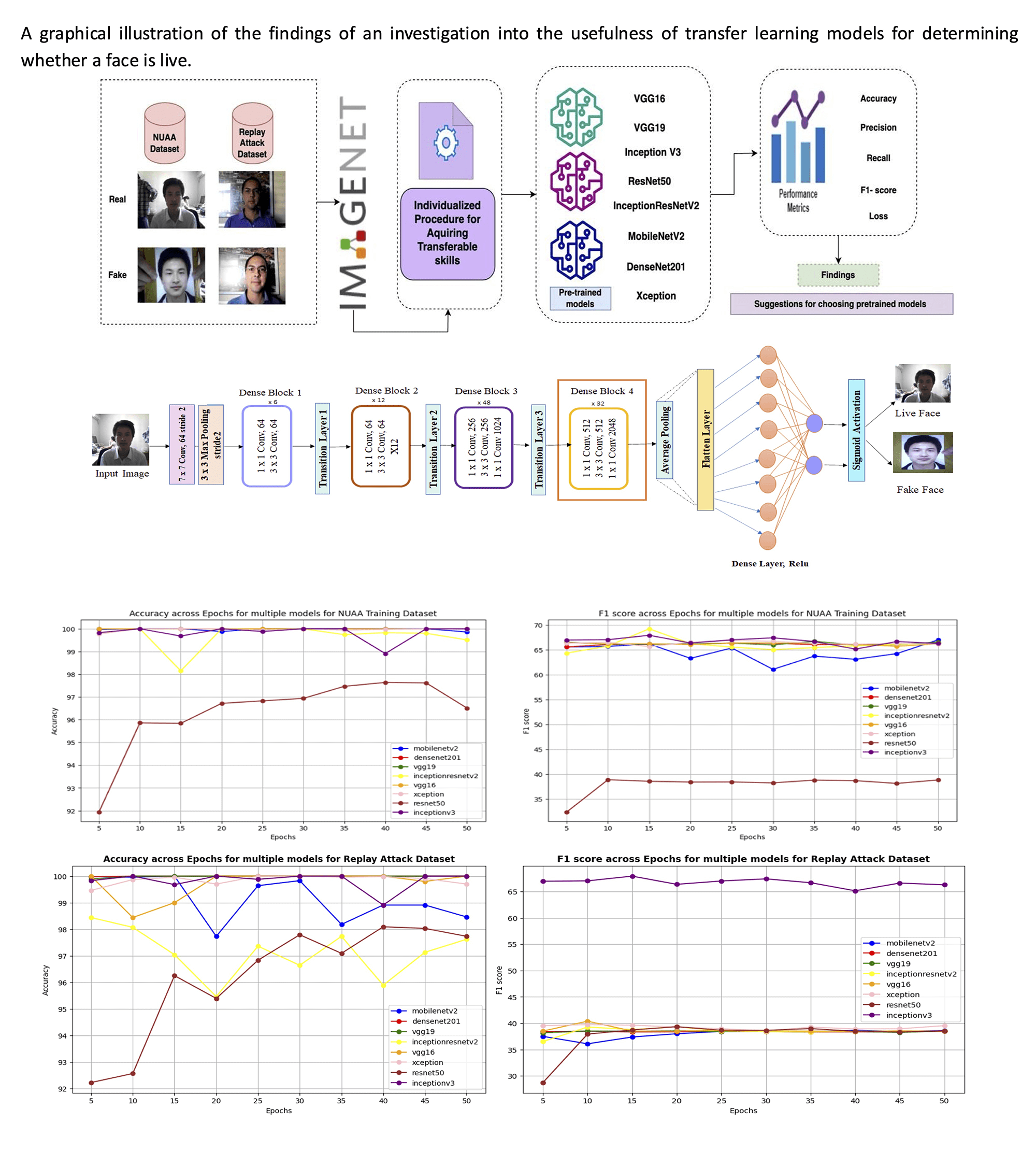
Face liveness detection is essential for securing biometric authentication systems against spoofing attacks, including printed photos, replay videos, and 3D masks. This study systematically evaluates pre-trained CNN models— DenseNet201, VGG16, InceptionV3, ResNet50, VGG19, MobileNetV2, Xception, and InceptionResNetV2—leveraging transfer learning and fine-tuning to enhance liveness detection performance. The models were trained and tested on NUAA and Replay-Attack datasets, with cross-dataset generalization validated on SiW-MV2 to assess real-world adaptability. Performance was evaluated using accuracy, precision, recall, FAR, FRR, HTER, and specialized spoof detection metrics (APCER, NPCER, ACER). Fine-tuning significantly improved detection accuracy, with DenseNet201 achieving the highest performance (98.5% on NUAA, 97.71% on Replay-Attack), while MobileNetV2 proved the most efficient model for real-time applications (latency: 15 ms, memory usage: 45 MB, energy consumption: 30 mJ). A statistical significance analysis (paired t-tests, confidence intervals) validated these improvements. Cross-dataset experiments identified DenseNet201 and MobileNetV2 as the most generalizable architectures, with DenseNet201 achieving 86.4% accuracy on Replay-Attack when trained on NUAA, demonstrating robust feature extraction and adaptability. In contrast, ResNet50 showed lower generalization capabilities, struggling with dataset variability and complex spoofing attacks. These findings suggest that MobileNetV2 is well-suited for low-power applications, while DenseNet201 is ideal for high-security environments requiring superior accuracy. This research provides a framework for improving real-time face liveness detection, enhancing biometric security, and guiding future advancements in AI-driven anti-spoofing techniques.Graphic Abstract
Keywords
Cite This Article
 Copyright © 2025 The Author(s). Published by Tech Science Press.
This work is licensed under a Creative Commons Attribution 4.0 International License , which permits unrestricted use, distribution, and reproduction in any medium, provided the original work is properly cited.
 Downloads
 Citation Tools
