
 Login
Login Register
 Submit a Paper
 Propose a Special lssue
 Open Access
ARTICLE

Malware of Dynamic Behavior and Attack Patterns Using ATT&CK Framework
1 Department of Computer Science and Information Engineering, National Taipei University of Technology, Taipei, 106344, Taiwan
2 Department of Artificial Intelligence and Computer Engineering, National Chin-Yi University of Technology, Taichung, 411030, Taiwan
* Corresponding Authors: Ping-Feng Wang. Email: ; Ti-Feng Hsieh. Email:
Computer Modeling in Engineering & Sciences 2025, 143(3), 3133-3166. https://doi.org/10.32604/cmes.2025.064104
Received 05 February 2025; Accepted 19 May 2025; Issue published 30 June 2025
 View Full Text
 Download PDF
Abstract
In recent years, cyber threats have escalated across diverse sectors, with cybercrime syndicates increasingly exploiting system vulnerabilities. Traditional passive defense mechanisms have proven insufficient, particularly as Linux platforms—historically overlooked in favor of Windows—have emerged as frequent targets. According to Trend Micro, there has been a substantial increase in Linux-targeted malware, with ransomware attacks on Linux surpassing those on macOS. This alarming trend underscores the need for detection strategies specifically designed for Linux environments. To address this challenge, this study proposes a comprehensive malware detection framework tailored for Linux systems, integrating dynamic behavioral analysis with the semantic reasoning capabilities of large language models (LLMs). Malware samples are executed within sandbox environments to extract behavioral features such as system calls and command-line executions. These features are then systematically mapped to the MITRE ATT&CK framework, incorporating its defined data sources, data components, and Tactics, Techniques, and Procedures (TTPs). Two mapping constructs—Conceptual Definition Mapping and TTP Technical Keyword Mapping—are developed from official MITRE documentation. These resources are utilized to fine-tune an LLM, enabling it to semantically interpret complex behavioral patterns and infer associated attack techniques, including those employed by previously unknown malware variants. The resulting detection pipeline effectively bridges raw behavioral data with structured threat intelligence. Experimental evaluations confirm the efficacy of the proposed system, with the fine-tuned Gemma 2B model demonstrating significantly enhanced accuracy in associating behavioral features with ATT&CK-defined techniques. This study contributes a fully integrated Linux-specific detection framework, a novel approach for transforming unstructured behavioral data into actionable intelligence, improved interpretability of malicious behavior, and a scalable training process for future applications of LLMs in cybersecurity.Keywords
With the rapid advancement of information technology, cyberattacks have become increasingly prevalent across various domains, making information security a critical global concern. According to FortiGuard Labs’ 1H 2023 Global Threat Landscape Report [1], the volume of malware activities detected in Taiwan during the first half of 2023 nearly doubled (96.85%) compared to the same period in 2022. This dramatic increase highlights the growing scale and sophistication of cybercriminal operations, as threat actors continue to expand both the scope and diversity of their malware campaigns.
Furthermore, Trend Micro’s 2022 Annual Cybersecurity Report [2] revealed a shift in ransomware targeting strategies, indicating that attacks are no longer limited to traditional platforms like Windows and macOS. Instead, Linux systems are increasingly becoming a target. The number of ransomware attacks against Linux systems was reported to be nearly double that of attacks on macOS in 2022. Trend Micro’s 2023 Mid-Year Cybersecurity Report [3] further confirms this trend, noting that incidents involving Linux-based systems increased by over 62% from the first half of 2022 to the first half of 2023. These statistics suggest that threat actors have begun to exploit vulnerabilities in Linux environments, which are often under-researched and insufficiently protected compared to other operating systems.
Despite the growing threat landscape, most malware detection research in recent years has focused primarily on the Windows platform, with limited attention given to Linux-based malware. In light of this imbalance, our study proposes a dedicated technical framework for detecting malware on the Linux platform, with a focus on dynamic behavior analysis and semantic threat interpretation.
In this study, we collect malware samples from public repositories and perform dynamic analysis using Cuckoo Sandbox [4] to observe and record their behavior in a simulated execution environment. The resulting behavioral data, such as system calls and execution traces, are essential indicators of malicious intent. However, due to the complexity and variability of these behavioral sequences, manual interpretation is difficult. To address this, we analyze the frequency and patterns of behavioral features to extract common attack traits across malware families. These behaviors are then semantically mapped to the MITRE ATT&CK framework [5,6], which standardizes adversary tactics, techniques, and procedures (TTPs).
TTPs refer to the tactical goals adversaries aim to achieve (Tactics), the methods used (Techniques), and the detailed execution patterns (Procedures). By aligning behavioral features with MITRE ATT&CK techniques, we provide a structured and intuitive interpretation of malware activity. To support this mapping, we construct a TTP Keyword Mapping Table that correlates observed system behaviors with their respective ATT&CK techniques based on documented definitions.
To further enhance behavioral interpretation, we employ a large language model (LLM) capable of understanding the semantics of human language and contextual associations between technical elements. The model is fine-tuned using prompt-engineered datasets derived from behavioral logs and MITRE ATT&CK mappings. This allows the LLM to accurately infer the likely data sources, data components, and technique combinations used by malware during execution.
This study presents a novel malware detection framework targeting the Linux platform, integrating dynamic behavioral analysis with semantic modeling based on the MITRE ATT&CK framework. The key contributions are outlined as follows:
First, we propose a behavior-based detection framework for Linux malware by collecting dynamic execution traces and mapping them to standardized techniques in the MITRE ATT&CK framework. Through the construction of TTP Keyword and Conceptual Definition Mapping Tables, the system bridges low-level behavioral data with high-level semantic representations, enabling structured and interpretable threat analysis.
Second, we introduce a prompt engineering strategy that transforms observed malware behavior into structured instruction-response pairs. These are used to fine-tune a large language model (Gemma 2B) to classify and interpret malware behaviors in terms of ATT&CK techniques.
Third, our approach enhances the explainability of malware detection. By mapping complex behaviors to standardized attack techniques, the system provides interpretable output that security analysts can use for threat investigation and response.
Finally, the proposed framework addresses a significant research gap by focusing specifically on Linux-based threats, which remain underrepresented in malware detection literature despite their growing prevalence in cloud and enterprise environments.
2 Background and Previous Work
Malware detection is the process of identifying or detecting programs that may be suspicious or potentially threatening by analyzing the data, code, or behavior in a computer system to identify and isolate malicious programs. Malware detection is mainly divided into signature detection and behavior detection.
The MITRE ATT&CK Framework, a research project initiated by the MITRE organization in May 2015, makes public a total of nine tactic types and 96 techniques contained within each type, with the tactic types corresponding to the various stages of the malware attack lifecycle, and the techniques describing the means required to achieve the goals of a particular tactic type. The framework provides a way to characterize the different attack techniques used by malicious attackers and their tactical phases in a matrix categorization. The ATT&CK matrix uses the concepts of Tactic, Technique, and Procedure as the core of analyzing malicious attack behaviors, and the descriptions of these three concepts are shown in Table 1.

Large Language Model (LLM) is a deep learning model based on Natural Language Processing (NLP) technology, which is mainly used for understanding, generating and manipulating human language, but also for recognizing and generating relevant textual content.
Large languages are often modeled with large amounts of textual information, often derived from articles and websites on the Internet. Repeated training allows the model to learn the complex structure and context of human language. Large language models can be used in a wide variety of applications, such as intelligent assistants, chatbots, sentiment analysis, speech recognition, and machine translation, which dramatically improve productivity and user experience.
Gemma [7] is an open-source large language model developed by Google DeepMind. It is specifically optimized for responsible AI deployment and research usage, supporting both instruction-following and general-purpose language understanding. Gemma models are designed with a focus on efficiency and performance, making them suitable for a wide range of academic and industrial applications. Based on the Transformer decoder-only architecture, Gemma is trained on curated datasets with reinforcement learning and safety-aligned techniques, enabling it to perform well on natural language generation, reasoning, and comprehension tasks.
Prompt engineering refers to the practice of designing and refining input prompts to elicit optimal responses from large language models. For models like Gemma, prompt engineering can significantly impact the quality of outputs by guiding the model toward context-relevant and precise answers. This process involves creating prompts that are specific, concise, and tailored to the task at hand, followed by iterative testing and refinement to enhance response accuracy and relevance. Effective prompt engineering is especially valuable in zero-shot or few-shot learning scenarios.
Fine-tuning is the process of adapting a pre-trained language model like Gemma to a specific domain or task by further training it on a task-specific dataset. This allows the model to learn domain-specific vocabulary, semantics, and task requirements, thereby improving its performance on specialized applications. Fine-tuning leverages the generalized language understanding already embedded in Gemma, which reduces the need for full retraining, lowers computational costs, and improves efficiency.
LoRA (Low-Rank Adaptation) is a parameter-efficient fine-tuning technique proposed by Hu et al. [8] and is widely applied to large language models such as Gemma. Traditional fine-tuning involves updating all model parameters, which can be computationally prohibitive due to the billions of parameters in modern large models. To address this challenge, LoRA introduces trainable low-rank matrices into specific projection layers, such as the query, key, and value projections in the attention mechanism.
This approach dramatically reduces the number of parameters that need to be trained, while still maintaining the original model’s performance. LoRA is particularly beneficial for deploying Gemma models in resource-constrained environments, as it lowers GPU memory usage, accelerates training, and enables efficient domain adaptation without full model retraining.
In the field of malware analysis, Catak et al. [9] used the Cuckoo Sandbox to dynamically analyze malware targeting the Windows platform. Their approach involved recording Windows API calls during sandbox execution and providing a benchmark dataset for Windows malware. Chierzi et al. [10] proposed a methodology to track the evolution of malware capabilities using the MITRE ATT&CK framework. Their method combined static and dynamic analysis techniques, mapping the results to ATT&CK-defined techniques and comparing the methods used by the same type of malware over a two-year interval. Ahn et al. [11] introduced a behavioral visualization approach for malware detection on the Windows platform. Their process applied static analysis to classify software as benign, malicious, or suspicious, followed by dynamic analysis on suspicious samples to extract system calls. These behavioral features were then mapped to the MITRE ATT&CK framework to provide a more intuitive representation of tactics and techniques, thereby aiding in the determination of whether the software was malicious. To enhance detection accuracy, their model utilized ensemble learning techniques, including Random Forest, AdaBoost, and Gradient Boosting, through iterative training and testing.
Sartoli et al. [12] introduced the concept of recurrence plots to visualize the binary structure of malware files, graphically representing their intrinsic characteristics. Malware samples belonging to the same family exhibit similar recurrence plots, enabling the classification of malware families using convolutional neural networks (CNNs). Shiva Darshan and Jaidhar [13] proposed a CNN-based malware detection model for the Windows platform, utilizing system calls and their operational categories as dynamic features. These features are refined through feature selection techniques to generate black-and-white images, which are then input into a CNN to extract higher-order features for classification. Xu et al. [14] developed a malware behavior detection model for Windows that combines the strengths of CNN and long short-term memory (LSTM) networks. Their hybrid deep learning model analyzes file names and system call information to distinguish between benign software and seven different malware types. Similarly, Zhang [15] employed a CNN-LSTM model to detect dynamic malware behavior by capturing both spatial correlations and temporal sequences within system call patterns, thereby producing a high-level representation of behavioral features. Anandhi et al. [16] proposed a detection method that combines bidirectional LSTM (BiLSTM) with CNN for identifying malware on Windows systems. Their model classifies software as benign or as one of five specific malware families, demonstrating superior accuracy compared to models using BiLSTM or CNN alone. He et al. [17] integrated self-attention mechanisms with LSTM for enhanced malware detection, leveraging attention to model interdependence among system calls and LSTM to capture sequence order. Or-Meir et al. [18] applied Transformer models to classify malware families on the Windows platform and studied the impact of system call sequence length on detection performance. Their findings show that Transformer-based models not only outperform LSTM-based models in accuracy but also reduce training and detection time by up to 75%. Walker et al. [19] developed a malware family classification system for Windows using dynamic analysis to extract system call combinations. Their model, based on Single Hidden Layer Feedforward Neural Networks (SLFN), including ELM and OS-ELM variants, accurately detects and classifies malware families.
In addition to the aforementioned approaches, An et al. [20] proposed a dual Siamese network-based malware detection framework that leverages few-shot learning techniques to enhance detection of novel and variant malware. Their model integrates two independent Siamese networks—one trained on bytecode grayscale images and the other on opcode 2-g frequency images. By measuring similarity between image pairs using L1 distance, the system achieves high accuracy with limited data, showcasing the effectiveness of similarity-based models in identifying malware variants. This approach, while powerful, is primarily visual and static in nature and lacks semantic interpretability of behavioral patterns and attack techniques, which is the focus of our study.
In the domain of applying large language models (LLMs) to information security, several studies have demonstrated their potential for enhancing threat detection capabilities. Sekharan et al. [21] utilized an LLM for clickbait title detection, employing OpenAI’s Ada model for fine-tuning. Their approach enabled the model to effectively identify malicious intent behind deceptive titles, achieving a detection accuracy of up to 99.5%. Li et al. [22] proposed a network security vulnerability detection framework based on a fine-tuned GPT-3.5 model provided by OpenAI [23]. The framework demonstrated the ability to deeply analyze common cybersecurity vulnerabilities and generate corresponding mitigation strategies. Similarly, Li et al. [24] introduced a method for detecting malicious web pages using an LLM. By analyzing webpage URLs and textual content, their method leveraged zero-shot and few-shot prompting strategies to adapt the LLM for detection tasks. The results showed that this approach outperformed traditional deep learning methods designed for the same purpose, highlighting the adaptability and effectiveness of LLMs in web threat detection.
From the reviewed literature, it is evident that the majority of recent research efforts have focused on the Windows platform, with relatively limited attention given to malware targeting Linux environments. However, across all platforms, system calls and their sequential patterns serve as critical indicators for analyzing malware attack behaviors. By further examining these behavioral characteristics, it is possible to abstract and generalize the underlying malicious actions. This study aims to analyze the behavioral features of malware during execution in a real environment and interpret them through the lens of the MITRE ATT&CK framework. To this end, we propose an analysis process tailored for detecting Linux malware attack techniques, employing dynamic analysis as the primary method. Software samples are executed in a Cuckoo Sandbox to monitor actual runtime behavior. The system calls invoked by malware during execution are extracted and used as key behavioral features. These features are then analyzed using a large language model (LLM) that has been fine-tuned through prompt engineering. The objective is to semantically interpret the observed behaviors and map them to the corresponding Tactics, Techniques, and Procedures (TTPs) defined in the MITRE ATT&CK framework. This approach enables a more precise and automated understanding of Linux malware behavior within a structured threat intelligence framework.
This study proposes a malware technology detection process, which combines the MITRE ATT&CK framework as the basis of the study, as illustrated in Fig. 1. This study uses a malware database to download the required malware as the malware samples for this study. Then, the sample format is verified by the behavior analysis module to ensure that the sample can be executed properly in the sandbox environment, and the sample is uploaded to the Cuckoo sandbox for dynamic analysis. After obtaining the behavioral track report of the sample, the behavioral track of the sample is extracted as the behavioral characteristics of the malicious attack are extracted through the technical detection module, and then the frequency of the behavioral characteristics and the analysis of the attack pattern are further conducted. Then, we obtained the relevant information recorded in the MITRE ATT&CK framework, including information on data sources, data components, and concepts such as TTP, and organized and summarized them into a concept mapping table and a TTP technical keyword mapping table as defined in this study. The Concept Mapping Table and TTP Technical Keyword Mapping Table are used for model training on large language models, and the behavioral characteristics of attack patterns are used as model inputs for the technical detection of the MITRE ATT&CK framework.
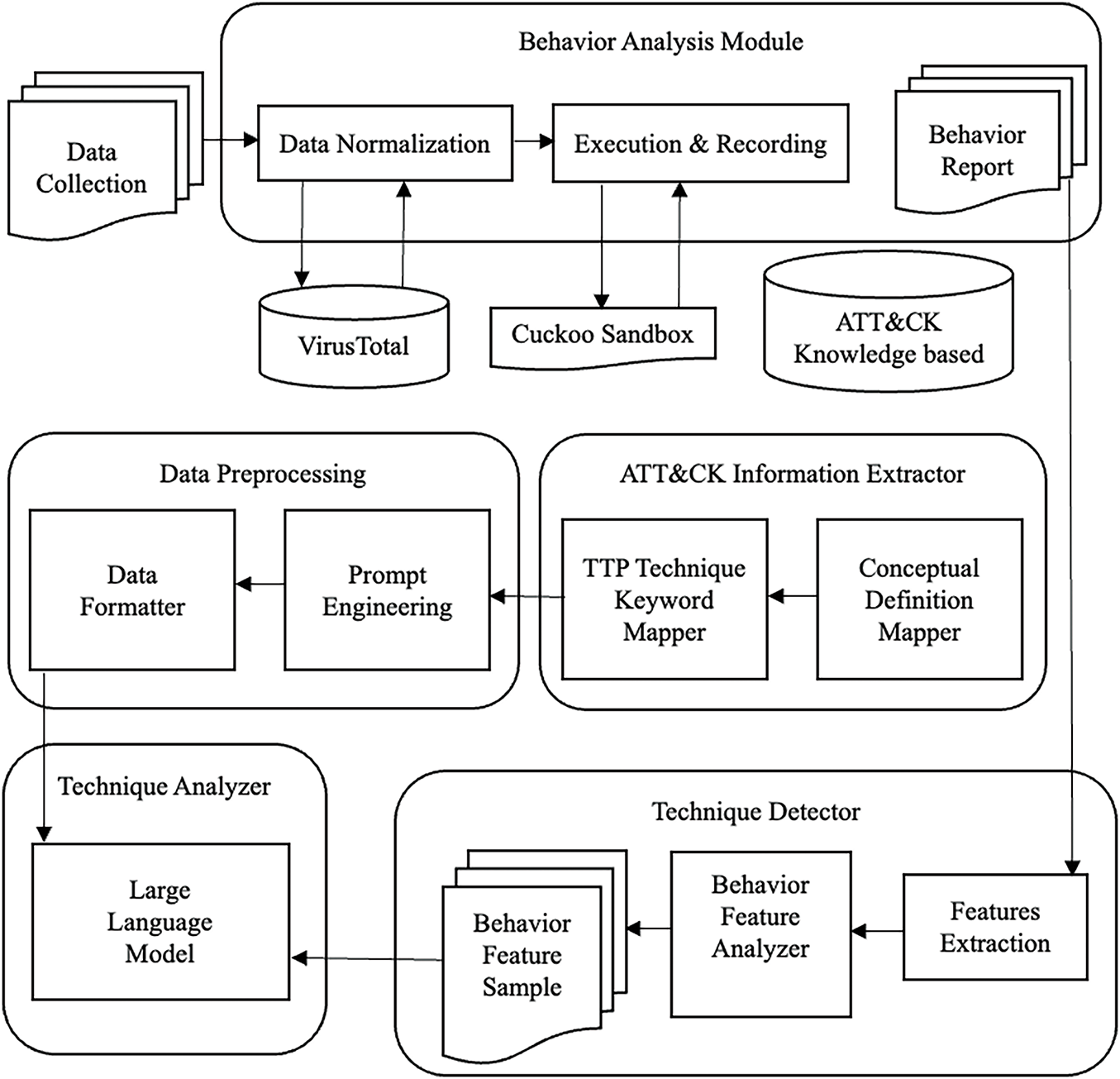
Figure 1: System architecture
This study focuses on analyzing various types and families of malware that can be executed on the Linux platform. Accordingly, malware samples are selected based on specific criteria to ensure a diverse and representative dataset. Samples are collected from several well-known malware repositories, including VirusShare [25], MalShare [26], MalwareBazaar [27], and vx-underground [28]. Among these, vx-underground is a comprehensive and widely used malware archive that aggregates samples from multiple sources and supports advanced search capabilities for retrieving specific types of malware. These repositories provide a broad spectrum of malicious samples, enabling this study to perform a robust evaluation of Linux-targeted malware behaviors.
3.3 Behavioral Analysis Module
The behavioral analysis module of this study can be divided into two steps: the first step is the data normalization, and the second step is the behavioral trajectory report of the sample implementation record and compilation.
In the data regularization phase, particular attention is given to the compatibility of malware formats with the Linux platform, as the file format significantly impacts the success of subsequent dynamic analysis. Therefore, it is essential to verify the format of each collected malware sample before execution in a sandbox environment. To achieve this, static analysis is performed using the VirusTotal malware analysis system, as illustrated in Fig. 2.

Figure 2: Data normalization in this study
VirusTotal is a widely used, freely accessible malware analysis service that enables analysts to evaluate suspicious files or URLs via both a web interface and an API. It provides comprehensive static analysis results, including detailed information on file structure, format, and potential threat indicators. Analysts can input a file’s hash value (e.g., MD5, SHA-256), IP address, domain, or URL to initiate a static analysis.
The static analysis results include detailed metadata about the malware sample, such as the executable file format (e.g., ELF for Linux), the applicable instruction set architecture (e.g., x86-64), the linking type (e.g., statically linked), and the file size (e.g., 156.27 KB), among other technical attributes.
In this study, VirusTotal is used to verify the structural properties of each malware sample, including the file type, instruction set architecture, linking method (static or dynamic), and required dynamic libraries. This verification step is crucial to ensure that all samples are compatible with the sandbox environment used for dynamic behavioral analysis and can be executed reliably without format-related errors.
3.3.2 Sample Execution Record and Export Behavioral Track Report
After confirming that the malware samples are executable within the sandbox environment, dynamic analysis is conducted to observe and record their runtime behavior. In this study, the Cuckoo Sandbox is employed as the primary tool for dynamic analysis.
Upon uploading a malware sample to the Cuckoo Sandbox, the system executes the sample in an isolated virtual environment and monitors its behavior throughout the execution process. This includes recording system calls, command-line instructions, and any application or API calls invoked by the malware. All observed actions are systematically documented and exported as a comprehensive behavioral malware trajectory report, which serves as the foundation for further behavioral feature extraction and analysis.
The technique detection process in this study consists of three main steps: (1) behavioral feature extraction, (2) behavioral feature analysis, and (3) the construction of a behavioral feature sample corresponding to each malware instance.
Cuckoo Sandbox is employed to capture all system calls invoked by the malware sample during execution. These system calls constitute the core behavioral features and are compiled into the behavioral trajectory report. As illustrated in Fig. 3, the report includes a top-level “behavior” field, which contains a “processes” subfield that records the activities of each process spawned during malware execution.

Figure 3: Illustration of the behavior field of the behavior track report
Each process may invoke multiple system calls, each accompanied by specific parameters and return values. As shown in Fig. 4, within the “processes” subfield, the “calls” list contains individual entries, where:

Figure 4: Illustration of the system calls used by the program
• “api” specifies the name of the system call,
• “arguments” provides the parameter list passed to the call,
• “return_value” records the result returned after execution.
These fields collectively represent the malware’s dynamic behavior during runtime. In this study, all “api” calls captured within the “processes” structure are extracted as primary behavioral features for downstream analysis, including frequency modeling and semantic mapping to ATT&CK techniques.
3.4.2 Behavior Feature Analyzer
Following feature extraction, a set of behavioral features is compiled for each malware sample. Since malware may invoke the same system, call multiple times, or follow repeated behavioral patterns during execution, the resulting dataset may contain many redundant or repeated features and sequences. These repetitions often reflect characteristic attack behaviors, known as attack patterns.
This study emphasizes both the frequency analysis and pattern recognition of these behavioral features. Repetitive features and sequences are normalized and generalized to reduce their noise effect and highlight the core malicious behavior. The focus is placed on identifying dominant behavioral patterns that represent the malware’s functional intent.
After analysis, each behavioral trajectory report is transformed into a structured and summarized set of behavioral features. These processed samples are then prepared for use as input to the detection model, ensuring consistency and relevance in the modeling phase.
3.5 ATT&CK Information Extractor
The ATT&CK information extraction process in this study is divided into two main steps: (1) Conceptual Definition Mapping, and (2) TTP Technical Keyword Mapping.
This study adopts a two-step approach for ATT&CK information extraction. In the first step, data sources defined within the MITRE ATT&CK framework are collected, along with their corresponding data components and detailed descriptions. These data sources represent types of system or application-level information that can be captured, while data components define specific attributes relevant to identifying and detecting attack techniques. In the second step, technical keywords annotated on each technique’s official page are extracted. These keywords are further categorized and generalized to enable more accurate attribution of observed behavioral features to specific Tactics, Techniques, and Procedures (TTPs). By systematically mapping behavioral characteristics to corresponding ATT&CK techniques, based on both keyword associations and relevant data sources and components, this study establishes a robust foundation for detecting and interpreting malicious behaviors within a structured threat intelligence framework.
3.5.1 Conceptual Definition Mapper
This study extracts descriptions of both data sources and data components as defined by the MITRE ATT&CK framework [29]. The framework currently defines 37 distinct data sources and 106 data components. Each data source represents a category of information typically collected in a system’s logs, while each data component specifies attributes used to identify and detect ATT&CK techniques or sub-techniques.
Fig. 5 illustrates an example of a data source: Command, which represents an instruction given to a system to perform a specific operation. This study extracts the name and description of such data sources for mapping purposes.

Figure 5: Illustration of MITRE ATT&CK data source description
Fig. 6 presents an example of a data component: Command Execution, which falls under the Command data source. This component refers to a line of executable code derived from a program and executed within the system. The names and descriptions of data components such as this are also extracted for use in this study.

Figure 6: Illustration of MITRE ATT&CK data component descriptions
Furthermore, this study collects detailed information on all techniques and sub-techniques defined in the MITRE ATT&CK framework, including their identifiers, names, and descriptions. These TTPs represent the specific methods or actions used by adversaries to accomplish tactical objectives. At the time of this study, the framework includes 201 techniques and 424 sub-techniques.
Fig. 7 illustrates a TTP example: Abuse Elevation Control Mechanism: Setuid and Setgid (T1548.001). The figure shows the TTP name, its unique identifier, and a description detailing the implementation or potential impact of the technique. To support the model training and semantic mapping process, this study creates the following structured mapping tables:

Figure 7: Illustration of MITRE ATT&CK TTP technical description
• Mapping Table of Data Sources: Table 2 is a mapping of the data sources defined in this study, with different columns for different data sources and their descriptions. The description of each column of the table is shown in the table.
• Mapping Table of Data Component: Table 3 is a mapping of the data components defined in this study, each of which belongs to a specific data source. Each data element belongs to a specific data source. This table is divided into columns based on different data elements and their descriptions. Descriptions of the individual columns of the table are shown in the table.
• Mapping Table of TTP Technology: Table 4 is a mapping of the TTP technologies defined in this study, with each TTP technology serving a different purpose. Each TTP technology has its own function. The table is divided into different columns according to the different technologies and their descriptions. The description of each column of the table is shown in the table.


3.5.2 TTP Technique Keyword Mapper
To enhance the precision of malware behavior interpretation, this study establishes a systematic method for extracting, categorizing, and mapping technical keywords from the MITRE ATT&CK framework. The goal is to semantically align low-level behavioral features, such as system calls, commands, and file interactions, captured through dynamic analysis, with high-level adversary tactics and techniques.
The MITRE ATT&CK framework currently defines 202 techniques and 435 sub-techniques. Each entry contains detailed textual descriptions outlining how adversaries can achieve specific tactical goals. Within these descriptions, MITRE highlights critical operational elements—such as commands, behaviors, or low-level system interactions—using visual indicators (e.g., gray background text). These keywords are central to understanding the execution logic of each technique and are used in this study as semantic anchors for behavior classification.
As shown in Fig. 8, the technique T1548.001: Abuse Elevation Control Mechanism: Setuid and Setgid includes operational details such as the use of chmod 4777 or chmod u + s to escalate privileges. These command patterns are extracted as technical keywords, which serve as direct behavioral indicators of specific attack strategies. By generalizing such indicators across all techniques, this study builds a structured mapping between system-level observations and ATT&CK-defined TTPs (Tactics, Techniques, and Procedures).

Figure 8: Illustration of the MITRE ATT&CK technical description
In addition to keyword extraction, the study also incorporates data sources, data components, and detection method information from ATT&CK. These elements define how a given technique can be practically detected. For example, as illustrated in Fig. 9, detection of T1548.001 may rely on two distinct methods:

Figure 9: Illustration of MITRE ATT&CK data element detection technology description
• Command-line monitoring of tools such as chmod, categorized under the Command Execution component of the Command data source.
• File metadata inspection, categorized under the File Metadata component of the File data source.
By collecting and cross-referencing such detection methods, the study constructs a holistic framework for mapping behaviors not only to techniques but also to their observable characteristics in real systems.
To improve semantic granularity, technical keywords are classified across multiple dimensions:
• Platform (e.g., Linux, Windows),
• Type (e.g., system call, file path, registry key),
• Keyword Role (e.g., command, parameter, file name),
• Execution Context (e.g., process-level, user-level).
Compound keywords—such as those composed of a command and its associated parameters or path—are further parsed and mapped into their components to allow precise classification and contextual interpretation.
Beyond static keyword classification, the study also performs behavioral analysis of each system call and command. This involves evaluating their function, operational context, and impact on the host system. Only those actions that reliably indicate adversarial behavior are retained and incorporated into the TTP Technical Keyword Correspondence Table, a core knowledge structure developed in this research.
To organize and utilize this information systematically, two mapping tables are constructed:
• Mapping Table of TTP Technique Keyword: Table 5 is a TTP Technology Keyword Mapping Table as defined by this research, which is categorized by different columns according to the keywords of the technology. The description of each field in the table is shown in the table. Each TTP technology keyword contains information about the data source, data component, TTP technology number, technology name, and technology keyword, which also contains information about the technology keyword, such as the platform, type, command, parameter, file path, and file for the technology keyword.
• Mapping Table of Data Component Detection: Table 6 is a mapping of the data element detection techniques defined in this study. Each data element is capable of detecting a number of different techniques and is described specifically according to the detection method. The individual columns of the table are described as shown in the table.


In summary, this keyword-based mapping framework bridges the gap between low-level malware behavior and high-level threat intelligence models. By integrating technique descriptions, command patterns, and data-driven detection logic, the proposed system enables fine-grained, explainable attribution of malware activities to ATT&CK-defined techniques. These mappings play a foundational role in the semantic classification pipeline and in the training of large language models to interpret dynamic malware behavior with precision and clarity.
The malware samples and structured datasets used in this study include a large volume of heterogeneous data types and complex textual descriptions. Therefore, appropriate preprocessing is essential to ensure compatibility with the fine-tuning requirements of large language models (LLMs). To facilitate the use of LLMs in answering user queries or understanding contextual inputs via system prompts, the information collected from the MITRE ATT&CK framework is subjected to a process of prompt engineering.
Additionally, because this study employs Gemma as the base model for fine-tuning, it is critical to ensure that the training data conforms to the specific formatting and structural requirements of Gemma fine-tuning. This includes adapting data for instruction tuning and supervised fine-tuning formats, both of which impose unique constraints on input/output structures. Consequently, all data intended for model training must be transformed into a standardized format that aligns with the LLM’s fine-tuning scheme.
In this study, prompt engineering is applied to the Conceptual Definition Mapping Table and the TTP Technical Keyword Mapping Table derived from the MITRE ATT&CK framework. The goal is to enable the large language model (LLM) to learn and understand the key concepts defined within the framework and their interrelationships. These include data sources, data components, TTP techniques, and technical keywords. As illustrated in Fig. 10, data sources encompass multiple data components, which in turn can detect one or more TTP techniques. Each technique may be associated with several technical keywords that contribute to achieving specific tactical objectives.

Figure 10: MITRE ATT&CK conceptual relationship diagram
To train the LLM effectively, the relationships between these elements are systematically organized and summarized into structured prompts. These prompts are carefully designed to be concise, reducing computational complexity during inference, improving response time, and lowering overall model usage cost. The following examples demonstrate several use cases of prompt engineering implemented in this study.
• Data Sources Recognition: The system prompt is configured to provide an object description, and the model is expected to identify the corresponding data source. As shown in Fig. 11, given a description of the “File” data source, the model correctly identifies it as “Data source: File.”

Figure 11: Prompt engineering of data sources
• Data Component Recognition: As illustrated in Fig. 12, the prompt includes the name and description of a data source along with a data component description. LLM is tasked with recognizing the correct data component, e.g., identifying “File Creation” as a component of the “File” data source.

Figure 12: Prompt engineering of data components
• TTP Technique Recognition: For technique identification, the system prompt provides a textual description of the technique. As shown in Fig. 13, the model receives the description and responds with the correct technique ID and name, such as “Technique: T1548.001, Setuid and Setgid.”

Figure 13: Prompt engineering of TTP technology
• Technique Detection via Data Components: In this case, the prompt provides a data component and its detection description. The model is instructed to return the TTP techniques that can be detected using this information. As shown in Fig. 14, the model successfully identifies multiple techniques that correspond to the given data.
• Data Component Detection via System Calls: This prompt format aims to link system calls to their corresponding data components. As shown in Fig. 15, the system called “openat” with the description “open and possibly create a file” is correctly mapped to components such as “Process Creation,” “Command Execution,” and “OS API Execution.”

Figure 14: Prompt engineering of data component detect technique

Figure 15: Prompt engineering of TTP technology keywords and corresponding data components
• TTP Technique Identification via System Calls: Finally, Fig. 16 shows how the model is used to infer the corresponding TTP technique based on a system call and its description. Given the system called “openat,” the model identifies techniques that may utilize this call.

Figure 16: Prompt engineering of TTP technologies corresponding to TTP technology keywords
These structured prompt engineering methods enable the LLM to semantically understand and infer the relationships between low-level system behaviors and high-level adversarial techniques. This facilitates accurate mapping of dynamic behavioral features to MITRE ATT&CK techniques during the detection phase.
3.6.2 Data Formatter for Gemma
For fine-tuning the Gemma large language model in this study, the Alpaca dataset format is adopted. The Alpaca dataset, originally generated using OpenAI’s text-davinci-003 model, consists of multi-turn instruction-response pairs designed to fine-tune language models toward instruction-following behavior. The dataset is structured in a JSON format and includes four primary fields: instruction, input, output, and text.
As shown in Fig. 17, the instruction field specifies the task the model should perform, while the input field provides optional context or user queries. The output field contains the model’s expected response, and the text field aggregates the full interaction for training purposes. This format helps ensure that the fine-tuned model can understand tasks clearly and generate relevant and structured outputs. The Alpaca-style formatting is thus adopted to convert data from the MITRE ATT&CK framework into training samples suitable for Gemma fine-tuning.

Figure 17: Schematic of Alpaca format
Given the complex structure and diversity of data types in the malware samples and ATT&CK-based datasets used in this study, proper data preprocessing is essential. The collected data includes rich textual descriptions of behaviors, techniques, and indicators, all of which must be standardized and transformed to match the input requirements of large language models. By applying prompt engineering and aligning the data with the Alpaca format, the study ensures compatibility with the Gemma model’s fine-tuning pipeline. These preprocessing steps enable LLM to understand cybersecurity-specific contexts and respond accurately to queries about malware behavior and ATT&CK techniques.
Large language models (LLMs) are pre-trained on extensive textual corpora, enabling them to capture intricate patterns in natural language, including semantic relationships and contextual nuances. When fine-tuned on domain-specific data, these models can generalize effectively and provide accurate, context-aware responses to queries within that domain.
In this study, after preprocessing and formatting the data using prompt engineering and Alpaca-compatible structures, the fine-tuning process is applied to adapt the model for the detection and interpretation of malware behavior based on the MITRE ATT&CK framework.
In this study, the Gemma 2B large language model, developed by Google, was selected as the foundation for model fine-tuning and served as the predictive engine for detecting malware behaviors and analyzing attack techniques. Fine-tuning enables large language models to adapt to specialized domains by leveraging relevant datasets, thereby improving their task-specific performance with constrained computational resources.
Gemma 2 [30], released in 2024 by Google DeepMind, is an open-weight large language model designed for responsible AI development and efficient deployment. It is trained in a high-quality, curated corpus with alignment for safe and useful output. The Gemma family emphasizes both model performance and deployment efficiency, making it particularly suitable for academic research or lightweight inference environments.
To accommodate hardware limitations—specifically the availability of a single NVIDIA RTX 2080Ti GPU—this study adopted the Gemma 2B variant. Despite its compact size, Gemma 2B demonstrates competitive performance on a wide range of NLP benchmarks. It supports a context window of 8192 tokens, which is sufficient for most long-context reasoning and sequence classification tasks. Furthermore, Gemma’s compatibility with lightweight fine-tuning techniques such as LoRA (Low-Rank Adaptation) allows it to be effectively customized on consumer-grade hardware without excessive memory overhead.
Gemma 2 comes in several variants:
• Gemma 2B: Optimized for single-GPU environments and prototyping under resource constraints.
• Gemma 9B: Provides stronger performance for larger-scale inference tasks.
• Gemma 27B: Targets competitive performance in open-weight LLM evaluations while maintaining cost-efficiency.
Although larger models like Gemma 2B may achieve higher benchmark scores, their deployment requires substantial hardware resources. In contrast, Gemma 2B offers a practical trade-off between computational feasibility and predictive performance, making it a compelling choice for this research scenario.
Therefore, Gemma 2B was ultimately selected as the final predictive model in this study. It aligns with the project’s resource limitations while maintaining reliable capability for malware behavior analysis and attack technique identification.
Benchmark evaluations indicate that Gemma 2B achieves the following scores, as summarized in Table 7, which compares different Gemma model variants across major NLP tasks including MMLU, HumanEval, GSM-8K, and MATH:

4 Implementation and Result Analysis
This chapter introduces the system architecture of the design. Section 4.1 gives an overview of the system architecture and introduces the modules in each subsection. Section 4.1.1 describes the data collection module, Section 4.1.2 introduces the data analysis module, Section 4.1.3 describes the behavioral analysis module, Section 4.1.4 introduces the concept extraction module of the ATT&CK framework, Section 4.1.5 introduces the data preprocessing module, Section 4.1.6 presents the model training, and Section 4.2 introduces the experiments.
Fig. 18 illustrates the system architecture of this research. Initially, the required malware samples are collected and analyzed to generate behavioral trace reports. These reports are then used to extract behavioral features. This study also gathers information related to data sources, data components, and techniques defined in the MITRE ATT&CK framework, which are utilized as training data for fine-tuning a large language model (LLM). Following data preprocessing and model training, the fine-tuned LLM is employed to detect data sources, data components, and technology combinations within the context of the MITRE ATT&CK framework.

Figure 18: System architecture
Fig. 19 presents the data collection module. The malware samples for the research are collected based on various platforms, types, and families. The corresponding samples are downloaded from malware databases using the method described in Section 3.2.1, Data Collection Methods.

Figure 19: Data collection module
The Data Collection Module includes the following features:
• Condition-Specific Malware Search: Requires input of search condition and specified malware file type. Based on the criteria, it searches the relevant malware database. If matches are found, the function returns the SHA256 hash values.
• Specific Malware Download: Requires SHA256 hash values and download path. The specified malware is then downloaded from the relevant database to the designated path.
Fig. 20 depicts the data analysis module. The analysis process is conducted in three stages: malware sample format confirmation, sample execution and logging, and behavior trajectory report download.

Figure 20: Data analysis module
In the first phase, the collected malware samples are verified using VirusTotal to confirm their compatibility with the Cuckoo Sandbox environment. This ensures proper execution. The process is detailed in Section 3.3.1 Data Normalization.
In the second stage, the malware is uploaded to the Cuckoo sandbox for dynamic analysis to record all the malicious attack behaviors during the execution.
The third stage is to download the behavioral trajectory report of the sample after the sample has been executed for subsequent behavioral analysis.
The Data Analysis Module consists of two parts: Sample Format Confirmation, Sample Execution and Recording. The following is a brief introduction of the functions of each part.
• Sample Format Confirmation includes the following features:
a. Input the malware to be analyzed.
b. Input the hash value of the malware to be analyzed. By using the API service provided by VirusTotal to obtain the analysis report of the malware, we can further obtain information about the file type and instruction set architecture in the analysis report. This function will return the malware’s file type and instruction set architecture information.
• Sample Execution and Logging includes the following features:
a. Execute the malware and retrieve information about its file type and instruction set architecture.
b. The malware sample is submitted for analysis by specifying its file path through the API interface provided by Cuckoo Sandbox. This triggers an automated dynamic analysis process to monitor and record the sample’s behavior during execution.
c. By inputting the specified analysis ID and defining the log download path, the Cuckoo Sandbox API is utilized to retrieve and store the execution log corresponding to the given analysis. This execution log, saved at the designated path, serves as the behavioral trace report of the analyzed malware sample.
4.1.3 Behavioral Analysis Module
Fig. 21 shows the behavior analysis module of the system. The analysis process is divided into two stages: behavior feature extraction and behavior feature analysis.

Figure 21: Behavioral analysis module
The first stage involves extracting behavioral features from the behavioral trajectory report by identifying fields that reflect the software’s behavior during execution. These extracted fields are compiled into a behavioral feature set. The extraction method is described in Section 3.4.1 Feature Extraction.
The second stage focuses on analyzing the frequency and attack patterns within the behavioral feature set. By evaluating samples from a specific malware family, common attack behaviors can be identified. The analysis method is outlined in Section 3.4.2, Behavior Feature Analyzer.
The Behavior Analysis Module comprises two components: Behavioral Feature Extraction and Behavioral Feature Analysis. Each component is described as follows:
• Behavioral Feature Extraction: This function requires the file location of the incoming behavioral track report. It reads the calls field from the processes subfield of the behavior section, further extracts the api and argument subfields of the calls field. This information is compiled and returned as a collection of behavioral trace reports.
• Behavioral Features Analysis: This function takes as input a collection of behavioral tracks and the corresponding sample storage path. Based on the behavioral characteristics, it analyzes repeated behavioral patterns, calculates their frequencies, and consolidates the findings into a summarized representation. The resulting data is stored in CSV format at the specified path.
To formalize the behavioral analysis, we define the extracted runtime features as a system call set
Given a malware sample
•
•
We define the behavioral trace set of the sample mim_imi as:
Each system call
From this, we construct the raw behavior vector
where
4.1.4 ATT&CK Concept Extraction
Fig. 22 illustrates the ATT&CK framework information extraction module. The extraction process consists of two phases: the extraction of the conceptual definitions and the extraction of the TTP technical keywords from the MITRE ATT&CK framework.

Figure 22: ATT&CK information extraction module.
In the first stage, the module extracts concepts related to data sources and data components as defined in the MITRE ATT&CK framework. The extraction method is described in Section 3.5.1, Conceptual Definition Mapping Method.
In the second stage, the module extracts technical keywords associated with the Tactics, Techniques, and Procedures (TTPs) defined in the MITRE ATT&CK framework. The extraction method is explained in Section 3.5.2, TTP Technical Keyword Mapping Method.
ATT&CK Framework Information Extraction Module comprises two subcomponents: ATT&CK Conceptual Information Extraction and ATT&CK Technical Keyword Extraction. Each is described below:
• ATT&CK Conceptual Information Extraction:
a.Data Source Concept Extraction: Requires the MITRE ATT&CK STIX file and file storage path. STIX (Structured Threat Information Expression) is a standard for sharing Cyber Threat Intelligence (CTI), and the MITRE team formatted the MITRE ATT&CK Framework’s STIX for users to analyze. This function extracts the names and descriptions of the data sources from the STIX file and saves these results in a CSV format.
b.Data Component Concept Extraction: Requires the STIX file and a storage path. It extracts data component names, descriptions, and associated data sources, saving them as a CSV file.
c.TTP Technical Concept Extraction: Also requires the STIX file and a storage path, this function retrieves the names, identifiers, and descriptions of TTP techniques, saving the information in CSV format.
• ATT&CK Technical Keyword Extraction:
a.ATT&CK Technology Keyword Extraction: This function parses TTP descriptions from the STIX file to extract highlighted textual information and maps it to corresponding technique identifiers, storing the data in CSV format.
b.ATT&CK Data Component Detection and Extraction: Extracts detectable data elements and their corresponding detection methods from the STIX file. The information is mapped to relevant techniques and saved in CSV format.
c.Technology Keyword Classification: Based on the extracted TTP technical keyword mapping table, this function classifies keywords by data source, data component, platform, and type, and stores the categorized data in CSV format.
In this stage, each observed system call or behavioral keyword is semantically mapped to the corresponding MITRE ATT&CK techniques via the TTP Technical Keyword Mapping Table. Formally, a mapping function
• TTP Technical Keyword Mapping Table: Maps extracted low-level indicators (e.g., execve, LD_PRELOAD, bash) to potential ATT&CK techniques. Each entry:
–
–
We define a mapping function:
• Conceptual Definition Mapping Table: Maps high-level concepts and definitions from ATT&CK (e.g., Command and Scripting Interpreter, Shared Object Injection) to structured labels. These are used to train the LLM in understanding semantic meaning and context. Each entry includes:
–Technique ID
Concept name
–Associated tactic
–Descriptive text
This table is used to construct prompt-response pairs for supervised fine-tuning of the LLM.
• Unified Technique Mapping for Sample
This yields the initial candidate ATT&CK techniques corresponding to the system-level behavior of the sample.
The Conceptual Definition Mapping Table complements this process by providing a structured semantic reference for each ATT&CK technique, which is later utilized in constructing high-quality prompt-response training pairs for the language model.
4.1.5 Data Preprocessing Module
Fig. 23 presents the data preprocessing module of the system, which comprises two primary stages: Prompt Engineering and Data Format Conversion.

Figure 23: Data preprocessing module.
The first stage involves constructing prompts based on the conceptual elements defined in the MITRE ATT&CK framework, as outlined in Section 3.6.1, Prompt Engineering. In the second stage, the conceptual information and TTP technical keyword mappings are transformed into the Alpaca format, suitable for fine-tuning the Gemma model, as detailed in Section 3.6.2 Data Formatter for Gemma.
The Data Preprocessing Module is structured into two functional components—Prompt Engineering and Data Format Conversion. The specific functions of each component are elaborated in the following sections.
• Prompt Engineering contains the following functions:
a.Concept Prompt Statement Composition: This function requires the input of all concept sets extracted from the ATT&CK framework. System prompts, user input, and model response statements are designed and optimized for each concept defined within the framework. This process generates an optimized set of concept prompt statements.
b.TTP Keyword Prompt Statement Composition: This function takes the ATT&CK Framework’s TTP Technical Keyword Mapping Table as input. Based on this input, the system designs and optimizes the corresponding prompts, user input, and model response related to TTP technical keywords. The output is a refined set of conceptual prompt statements.
c.ATT&CK Data Component Detection Prompt Statement Composition: This function requires the Data Component Detection Technology Mapping Table from the ATT&CK framework. It constructs the TTP techniques and their corresponding detection methods. The output is an optimized collection of conceptual prompt statements for detection purposes.
• Data format conversion includes the following functions:
a.Gemma Data Format Conversion: This function takes the optimized set of concept prompt statements and a specified dataset storage path as input. It converts the designed and optimized prompt-response pairs into the format required by the Alpaca dataset for training the Gemma model. The converted data is then stored in JSON format at the designed dataset storage location.
The model training module of this study will fine-tune the model for the corresponding large language model to detect the concepts of the MITER ATT&CK framework. Based on the behavior-to-technique mapping, we construct instruction-response pairs
To improve training efficiency and memory usage, we adopt the LoRA (Low-Rank Adaptation) method to inject trainable low-rank matrices into the attention layers of the model. Once fine-tuned, the model can generalize behavior traces into ATT&CK techniques even when unseen combinations or obfuscated commands appear.
To generalize behavior beyond static mappings and enable semantic inference, we employ a large language model (Gemma 2B) fine-tuned via prompt engineering using both mapping tables.
• Training Data Generation:
For each malware sample
Target label:
The training dataset:
• Fine-Tuning via LoRA (Low-Rank Adaptation):
The LLM learns the mapping
Fine-tuning uses LoRA modules
where W is the frozen base weight and α is a scaling factor.
• Inference:
At inference time, for an unknown malware sample
During inference, the system constructs a prompt
This chapter describes the model used in the experiment, including the model creation process, model fine-tuning process, and model-related settings, such as model initial settings and model hyperparameter settings.
This study chose to use the Gemma 2B large language model for model fine-tuning to detect concept detection in the MITER ATT&CK framework.
In this study, the experimental environment is centered around fine-tuning the Gemma 2B large language model using parameter-efficient fine-tuning (PEFT) via LoRA (Low-Rank Adaptation) on a local workstation equipped with an NVIDIA RTX 2080 Ti GPU, as illustrated in Fig. 24. Compared to cloud-based platforms such as Google Colab, a dedicated GPU environment offers full control over hardware allocation, removes runtime restrictions, and supports longer and more stable training sessions for deep learning experiments.

Figure 24: Gemma 2B experimental environment architecture diagram (source: this study)
To improve training efficiency and reduce GPU memory consumption, this experiment adopts the open-source PEFT framework with LoRA. LoRA enables the training of a minimal subset of model parameters by injecting trainable low-rank matrices into selected components of the transformer’s architecture. This method is particularly suitable for constrained environments, such as single-GPU workstations, and maintains high model performance while minimizing memory overhead.
The fine-tuning pipeline begins by loading the “google/gemma-2b” tokenizer and base model from Hugging Face. The model is converted to torch.float16 precision and transferred to the GPU to optimize memory usage. A structured dataset in Alpaca-style format is used for instruction tuning, comprising three fields: instruction, input, and output, which describe malware behavior prompts and their corresponding MITRE ATT&CK technique labels.
Fine-tuning settings are defined using a LoraConfig object, with parameters carefully aligned to the architectural components of the Gemma 2B model, as illustrated in Fig. 25. This configuration supports parameter-efficient fine-tuning under constrained GPU resources by injecting low-rank matrices into specific transformer layers.

Figure 25: Gemma 2B fine-tuning model settings (source: this study)
The following configuration parameters were applied:
• r = 8: rank of the low-rank adaptation matrices
• lora_alpha = 32: scaling factor applied to the LoRA output
• lora_dropout = 0.05: dropout applied within LoRA layers
• task_type = TaskType.CAUSAL_LM: specifies a causal language modeling objective
• target_modules = [“q_proj”, “k_proj”, “v_proj”, “o_proj”, “gate_proj”, “up_proj”, “down_proj”]: modules targeted for LoRA injection
Python configuration of LoRA parameters applied to Gemma 2B.
These target modules encompass both the core components of the attention mechanism (q_proj, k_proj, v_proj, o_proj) and the feed-forward network (gate_proj, up_proj, down_proj). This configuration follows best practices in LoRA-based fine-tuning and provides high adaptability while only updating a fraction of the total model parameters. It is especially effective for transformer architectures like Gemma 2B, which follows a Gemma-style design.
These settings are passed to get_peft_model (base_model, lora_config), which wraps the base model with LoRA adapters, enabling efficient fine-tuning without modifying the pre-trained weights—a critical advantage for running large models on limited hardware such as the RTX 2080Ti.
Training arguments are then specified using the TrainingArguments class, as illustrated in Fig. 26, which outlines the full configuration used during instruction tuning. These settings are optimized for memory-efficient training while maintaining stable convergence under constrained GPU capacity.

Figure 26: Training parameters (source: this study)
The configuration parameters include:
• output_dir = “gemma_lora_output”
• per_device_train_batch_size = 1
• gradient_accumulation_steps = 4
• num_train_epochs = 4
• learning_rate = 2 × 10⁻⁴
• fp16 = True (for mixed precision training)
• logging_steps = 100
Python script used to define training arguments in the Hugging Face Trainer.
The Hugging Face Trainer is then used to launch the training process. Loss values are monitored at regular intervals to assess convergence. For example, by step 800, the training loss typically converges to approximately 0.3621, indicating effective learning of behavior-to-technique mappings from the instruction-tuning dataset.
After the training phase, the model transitions into inference mode. For each test example, the behavioral input prompt is formatted and tokenized before being passed into the generate() function of the language model. This function outputs a sequence of tokens, which are then decoded using the decode() method to produce human-readable text.
The decoded predictions are further processed to extract the predicted MITRE ATT&CK technique IDs. Similarly, the ground truth labels are parsed from the expected output. To handle multi-label classification, both the predicted and true techniques are converted into binary vectors using a predefined set of technique labels.
If no technique is detected in either the prediction or the ground truth, a zero vector is used to represent the absence of TTPs. The comparison between these vectors allows for precise evaluation of the model’s ability to infer multiple ATT&CK techniques from a single Linux command or behavioral input.
This study uses F1-Score as an indicator to evaluate model performance. The calculation method of F1-Score is shown in Formula (3).
F1-Score can be calculated by weighting precision and recall, where precision is the ratio of the predicted category to the actual category, and the calculation method is shown in Formula (1). Recall is the ratio of the correct prediction of the actual category, and the calculation method is shown in Formula (2). TP (True Positive) is a true positive, which means that the prediction is true and the actual is also true. FP (False Positive) is a false positive, which means that the prediction is true, but the actual result is not true. FN (False Negative) is a false negative, which means that the judgment is false, but the actual is true.
The experimental results of fine-tuning the MITRE ATT&CK framework concept for the fine-tuned Gemma 2B model are shown in Table 8. The F1-Score of using the fine-tuned Gemma 2B to detect the data sources, data components, and technology combinations defined by the MITRE ATT&CK framework is 86%.

There is no charge for using the Gemma model provided by the Meta AI team. In contrast, the Gemma model requires its own experimental environment. The Gemma model is quite large in scale and parameters, and requires high-performance computing equipment to ensure the normal operation of the model. At the same time, a large amount of storage space is required to save the model weights and training data. Therefore, the requirements for system equipment to establish the Gemma model are quite high.
Therefore, although this study uses the Gemma 2B model, it is also necessary to consider factors such as model usage fees and research experimental environment to obtain the best research results for the research topic.
This study presents a Linux-specific malware detection framework that combines dynamic behavioral analysis with the semantic reasoning capabilities of large language models (LLMs), fine-tuned using the MITRE ATT&CK framework. By executing malware samples in sandboxed environments, behavioral features such as system calls and command-line interactions are extracted and mapped to ATT&CK-defined data sources, components, and Tactics, Techniques, and Procedures (TTPs). This mapping is supported by two key constructs—Conceptual Definition Mapping and TTP Technical Keyword Mapping—derived from official MITRE documentation. These enable the LLM to semantically interpret behavioral patterns and associate them with corresponding attack techniques.
The experimental results confirm that the fine-tuned Gemma 2B model significantly enhances the precision and recall of technique-level detection, especially for malware variants with ambiguous or previously unclassified behaviors. By uncovering consistent attack patterns across malware families, the framework not only identifies malicious intentions and targets but also improves interpretability and situational awareness in Linux environments. This semantic understanding bridges raw behavioral data and structured threat intelligence, contributing to a more explainable and scalable detection pipeline.
Looking ahead, we plan to extend this detection process to other platforms (e.g., Windows, Android) by adapting behavior extraction pipelines and enriching the TTP mapping with platform-specific intelligence sources. These efforts aim to build a scalable, explainable, and cross-platform malware detection system driven by behavioral semantics and threat intelligence integration.
Acknowledgement: The authors are grateful to all the editors and anonymous reviewers for their comments and suggestions.
Funding Statement: This work was supported by the National Science and Technology Council under grant number 113-2221-E-027-126-MY3.
Author Contributions: The authors confirm contribution to the paper as follows: study conception and methodology, Ping-Feng Wang; funding acquisition and supervision, Jong-Yih Kuo; writing—original draft preparation, Ti-Feng Hsieh; writing—review and editing, Cheng-Hsuan Kuo. All authors reviewed the results and approved the final version of the manuscript.
Availability of Data and Materials: The data that support the findings of this study are available from the corresponding author, Ping-Feng Wang, upon reasonable request.
Ethics Approval: Not applicable.
Conflicts of Interest: The authors declare no conflicts of interest to report regarding the present study.
References
1. Fortinet. 1H 2023 global threat landscape report [Internet]. [cited 2023 Dec 5]. Available from: https://www.fortinet.com/content/dam/fortinet/assets/threat-reports/threat-report-1h-2023.pdf. [Google Scholar]
2. Trend Micro. 2022 annual cybersecurity report [Internet]. [cited 2023 Dec 5]. Available from: https://www.trendmicro.com/vinfo/tw/security/research-and-analysis/threat-reports/roundup/rethinking-tactics-annual-cybersecurity-roundup-2022. [Google Scholar]
3. Trend Micro. 2023 mid-year cybersecurity report [Internet]. [cited 2023 Dec 5]. Available from: https://www.trendmicro.com/content/dam/trendmicro/global/zh_tw/security-intelligence/threat-report/report/2023%20mid-year%20roundup%20full%20report_Final.pdf. [Google Scholar]
4. Cuckoo sandbox [Internet]. [cited 2023 Dec 5]. Available from: https://cuckoosandbox.org/. [Google Scholar]
5. MITRE. MITRE ATT&CK framework [Internet]. [cited 2023 Dec 5]. Available from: https://attack.mitre.org/. [Google Scholar]
6. MITRE. MITRE ATT&CK software [Internet]. [cited 2023 Dec 5]. Available from: https://attack.mitre.org/software/. [Google Scholar]
7. Google DeepMind. Gemma [Internet]. [cited 2024 Jun 2]. Available from: https://ai.google.dev/gemma?hl=zh-tw. [Google Scholar]
8. Hu E, Shen Y, Wallis P, Allen-Zhu Z, Li Y, Wang S, et al. LoRA: low-rank adaptation of large language models. arXiv:2106.09685. 2021. [Google Scholar]
9. Catak FO, Yazi AF. A benchmark API call dataset for windows PE malware classification. arXiv:1905.01999. 2021. [Google Scholar]
10. Chierzi V, Mercês F. Evolution of IoT linux malware: a MITRE ATT&CK TTP based approach, Virtual. In: APWG Symposium on Electronic Crime Research; 2021 Dec 1–3; Virtual. Piscataway, NJ, USA: IEEE; 2021. p. 1–11. [Google Scholar]
11. Ahn G, Kim K, Park W, Shin D. Malicious file detection method using machine learning and interworking with MITRE ATT&CK framework. Appl Sci. 2022;12(21):10761. [Google Scholar]
12. Sartoli S, Wei Y, Hampton S. Malware classification using recurrence plots and deep neural network. In: 9th IEEE International Conference on Machine Learning and Applications; 2020 Dec 14–17; Miami, FL, USA. p. 901–6. [Google Scholar]
13. Shiva Darshan SL, Jaidhar CD. Windows malware detector using convolutional neural network based on visualization images. IEEE Trans Emerg Top Comput. 2021;9(2):1057–69. doi:10.1109/tetc.2019.2910086. [Google Scholar] [CrossRef]
14. Xu A, Chen L, Kuang X, Lv H, Yang H, Jiang Y, et al. A hybrid deep learning model for malicious behavior detection. In: IEEE 6th International Conference on Big Data Security on Cloud, IEEE International Conference on High Performance and Smart Computing, and IEEE International Conference on Intelligent Data and Security; 2020 May 25–27; Baltimore, MD, USA. Piscataway, NJ, USA: IEEE; 2020. p. 55–9. [Google Scholar]
15. Zhang J. DeepMal: a CNN-LSTM model for malware detection based on dynamic semantic behaviours. In: International Conference on Computer Information and Big Data Applications; 2020 Apr 17–19; Guiyang, China. Piscataway, NJ, USA: IEEE; 2020. p. 313–6. [Google Scholar]
16. Anandhi V, Vinod P, Menon VG, AK ER, Shilesh A, Viswam A, et al. Malware detection using dynamic analysis. In: International Conference on Advances in Intelligent Computing and Applications; 2023 Feb 1–3; Kochi, India. Piscataway, NJ, USA: IEEE; 2023. p. 1–6. [Google Scholar]
17. He Y, Geng S, Zhao Y, Feng Y. Research on intelligent detection method of malicious behavior based on self-attention. In: 2nd International Conference on Machine Learning and Computer Application; 2021 Dec 17–19; Shenyang, China. Piscataway, NJ, USA: IEEE; 2021. p. 1–5. [Google Scholar]
18. Or-Meir O, Cohen A, Elovici Y, Rokach L, Nissim N. Pay attention: improving classification of PE malware using attention mechanisms based on system call analysis, Virtual. In: International Joint Conference on Neural Networks; 2021 Jul 18–22; Piscataway, NJ, USA: IEEE; 2021. p. 1–8. [Google Scholar]
19. Walker A, Shukla RM, Das T, Sengupta S. Ohana means family: malware family classification using extreme learning machines. In: 19th Annual Consumer Communications & Networking Conference; 2022 Jan 8–11; Las Vegas, NV, USA. Piscataway, NJ, USA: IEEE; 2022. p. 534–42. [Google Scholar]
20. An BY, Yang JH, Kim S, Kim T. Malware detection using dual siamese network model. Comput Model Eng Sci. 2024;141(1):563–84. doi:10.32604/cmes.2024.052403. [Google Scholar] [CrossRef]
21. Sekharan CN, Vuppala PS. Fine-tuned large language models for improved clickbait title detection. In: Congress in Computer Science, Computer Engineering, & Applied Computing; 2023 Jul 24–27; Las Vegas, NV, USA. Piscataway, NJ, USA: IEEE; 2023. p. 215–20. [Google Scholar]
22. Li L, Gong B. Prompting large language models for malicious webpage detection. In: 4th International Conference on Pattern Recognition and Machine Learning; 2023 Aug 4–6; Urumqi, China. Piscataway, NJ, USA: IEEE; 2023. p. 393–400. [Google Scholar]
23. OpenAI [Internet]. [cited 2024 Jun 2]. Available from: https://openai.com/. [Google Scholar]
24. Li H, Shan L. LLM-based vulnerability detection. In: International Conference on Human-Centered Cognitive Systems; 2023 Dec 16–17; Cardiff, UK. Piscataway, NJ, USA: IEEE; 2023. p. 1–4. [Google Scholar]
25. VirusShare [Internet]. [cited 2023 Dec 5]. Available from: https://virusshare.com/. [Google Scholar]
26. MalShare [Internet]. [cited 2023 Dec 5]. Available from: https://malshare.com/. [Google Scholar]
27. abuse.ch. MalwareBazaar [Internet]. [cited 2023 Dec 5]. Available from: https://bazaar.abuse.ch/. [Google Scholar]
28. vx-underground [Internet]. [cited 2023 Dec 5]. Available from: https://vx-underground.org/. [Google Scholar]
29. MITRE. ATT&CK data sources [Internet]. [cited 2023 Dec 5]. Available from: https://github.com/mitre-attack/attack-datasources. [Google Scholar]
30. HuggingFace. Gemma 2 [Internet]. [cited 2024 Jun 2]. Available from: https://huggingface.co/google/gemma-2b. [Google Scholar]
Cite This Article
 Copyright © 2025 The Author(s). Published by Tech Science Press.
This work is licensed under a Creative Commons Attribution 4.0 International License , which permits unrestricted use, distribution, and reproduction in any medium, provided the original work is properly cited.
 Downloads
 Citation Tools
